

Crypto World
Polygon Labs Cuts Staff Again as It Closes Coinme Deal



Polygon Labs CEO Marc Boiron announced a new round of layoffs on Thursday, saying the company decided to "say goodbye to many of our colleagues" as it completes a transformation "from operating as a blockchain foundation into operating as a blockchain-enabled payments company." Polygon Labs… Read the full story at The Defiant

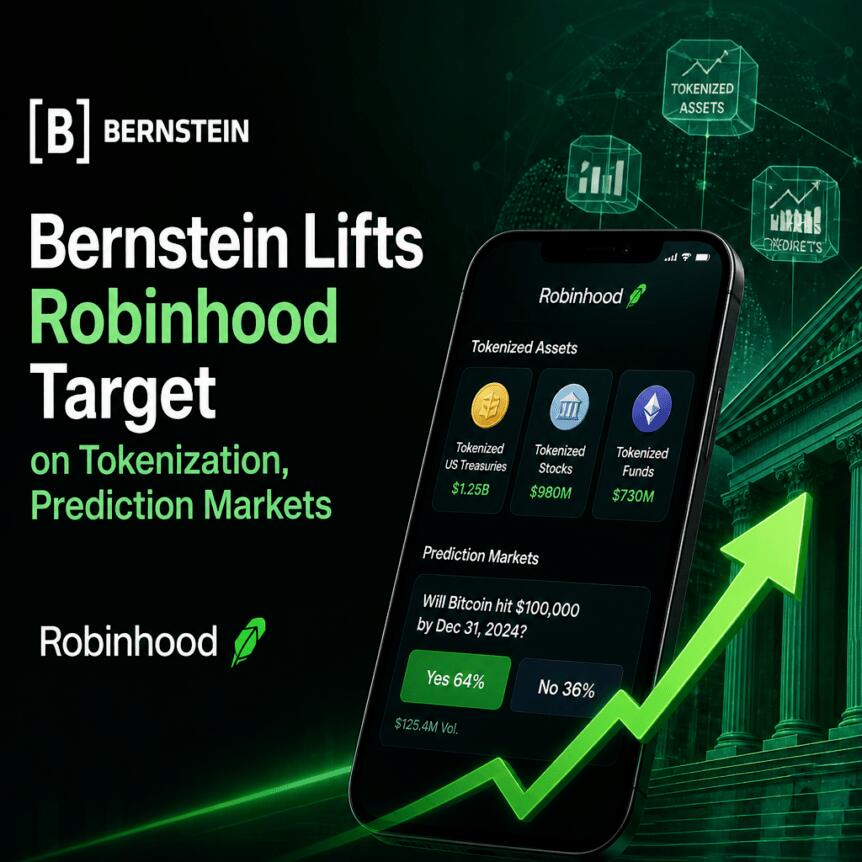
Bernstein analysts have lifted their price target for Robinhood Markets to $160 from $130, arguing that the company’s next growth phase will be driven more by tokenized equities and prediction markets than by conventional crypto trading. In a research note released on Monday, Bernstein kept an “Outperform” rating on the stock, which was last seen trading around $101 at the time of publication.
The investment firm’s central thesis is that Robinhood’s expansion into financial applications on-chain is still early, and that prediction markets could become its fastest-growing segment. Bernstein forecasts segment revenue of $1.7 billion by 2028, implying a 64% compound annual growth rate.
Key takeaways
- Bernstein raised Robinhood’s price target to $160 from $130 and maintained an Outperform rating.
- Analysts expect prediction markets to become Robinhood’s fastest-growing business, reaching $1.7 billion in segment revenue by 2028.
- Tokenized equities are framed as a major long-term opportunity tied to Robinhood’s push into blockchain infrastructure.
- Bernstein points to Robinhood Chain—an Arbitrum-based layer-2—as the firm’s proprietary route to building on-chain financial products.
- Industry momentum is highlighted by new integrations aimed at bringing shareholder governance tooling to tokenized securities.
Why Bernstein is betting on prediction markets
Bernstein’s upgrade is rooted in a shift from “crypto trading first” to “financial markets on-chain.” While the report doesn’t suggest traditional crypto activity will disappear, it places prediction markets at the center of Robinhood’s near-to-medium term growth story.
According to the analysts, prediction markets are positioned to scale faster than many other adjacent lines of business because they map closely to trading behavior and user engagement patterns already familiar to Robinhood customers. Bernstein’s segment revenue projection—$1.7 billion by 2028—also signals that it views this category as more than a pilot product.
Investors will likely focus on whether Robinhood can convert early adoption into durable volume and retention, particularly as the competitive landscape evolves. The report frames prediction markets as a “battleground” area alongside other market products that can benefit from on-chain infrastructure, but the key question remains whether growth matches Bernstein’s expectations as the category matures.
Tokenized equities and Robinhood Chain’s role
Beyond prediction markets, Bernstein highlighted tokenized equities as a long-term opportunity. The analysts connected this to Robinhood’s investment in blockchain infrastructure, specifically calling out Robinhood Chain—an Arbitrum-based layer-2 network—as the company’s proprietary foundation for tokenized real-world assets.
The report’s emphasis is not only on tokenization itself, but on the ability to build on-chain financial products without relying on third-party blockchains. That distinction matters commercially: if Robinhood can control key infrastructure layers, it may reduce integration friction and speed up product iteration, though the market will still require regulatory and operational clarity as tokenized securities expand.
Bernstein also argued that tokenization is becoming a foundational layer for capital markets. It projected that on-chain real-world assets could rise to between $2 trillion and $4 trillion by 2030, compared with roughly $35 billion today. The analysts further expect tokenized equities to capture an increasing share of that growth as adoption extends beyond areas such as Treasury instruments and private credit.
For traders and builders, the practical implication is that tokenized equities are increasingly tied to mainstream market infrastructure—not just crypto-native rails. If that plays out, Robinhood’s strategy would benefit from the broader shift toward digitized settlement, programmable compliance, and infrastructure that can support capital markets workflows end-to-end.
Wall Street accelerates governance for tokenized securities
The Bernstein note landed amid continued progress in tokenization infrastructure—particularly around the capabilities needed for investors to exercise rights in tokenized formats. On Monday, brokerage infrastructure provider Alpaca and Broadridge Financial Solutions announced they integrated Broadridge’s shareholder governance tools into Alpaca’s Instant Tokenization Network.
Per the announcement, the integration adds functions such as proxy voting, investor communications, and regulatory disclosures for tokenized securities. The stated goal is to offer governance rights comparable to those available to holders of traditional shares.
That matters because governance is one of the most concrete “real world” hurdles for tokenized markets. It’s not enough to tokenize ownership; participants also need operational pathways for voting, disclosures, and other mechanisms that align with existing securities frameworks.
The integration follows a partnership disclosed last week between tokenization platform Securitize and investment bank Cantor Fitzgerald, aimed at developing infrastructure for blockchain-based initial public offerings and follow-on equity offerings while operating within existing US securities regulations. Together, these developments suggest an increasing focus on making tokenized instruments usable at scale, not just technically feasible.
Momentum in the tokenized stocks category is also reflected in market sizing. According to RWA.xyz, the asset class has grown to nearly $2 billion in market value this year, underscoring that tokenized equities are still early but no longer confined to isolated experiments.
What to watch as Robinhood’s thesis meets execution
Bernstein’s upgrade frames Robinhood’s roadmap around two overlapping themes: prediction markets as the fastest path to meaningful segment revenue growth, and tokenized equities as a longer-duration structural bet supported by infrastructure investments such as Robinhood Chain. The next phase for investors will be whether execution and regulatory readiness can keep pace with the market narrative.
Key signals to monitor include product rollout and performance in prediction markets, plus measurable progress toward wider tokenized equity adoption—particularly where governance tooling and compliant issuance infrastructure are required. With Wall Street simultaneously building the connective tissue for tokenized securities, the competitive advantage may shift toward companies that can operationalize these capabilities quickly and reliably.
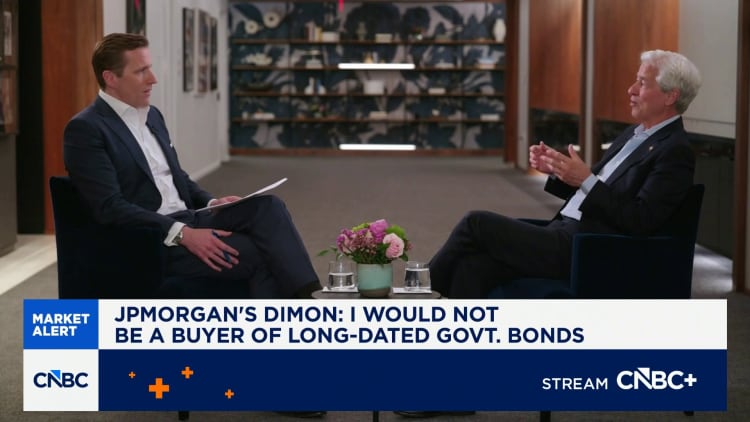

JPMorgan Chase CEO Jamie Dimon said investors are underestimating the risks facing the global economy and that he wouldn’t buy either equities or long-dated U.S. Treasurys at their current prices.
In an hourlong interview with Wilfred Frost released late Monday, Dimon said markets aren’t fully accounting for a growing list of geopolitical and fiscal threats.
“I do think those risks are probably bigger than other people think,” Dimon said, pointing to wars in Ukraine and the Middle East, tensions between the U.S. and China, and rising military spending in a time of mounting government deficits.
Asked whether markets are underpricing the chance of a major shock, Dimon said it’s difficult to know exactly what risks are already reflected in asset prices.
“It’s possible something’s baked in, but what’s not baked in is what actually happens,” he said.
Dimon, who leads the world’s largest bank by market cap, often warns the public about the economic risks he sees.
Jamie Dimon, chief executive officer of JPMorgan Chase & Co., speaks during the 2025 Institute of International Finance annual membership meeting in Washington, Oct. 16, 2025.
Samuel Corum | Bloomberg | Getty Images
His latest comments contrast with investors’ recent willingness to look past wars, tariffs and other shocks. The S&P 500 has returned nearly 10% this year as consumers continue to spend, inflation has moderated and investors have embraced the artificial intelligence trade.
Last week, JPMorgan Chase and its peers posted blockbuster quarterly results powered by surging trading and investment banking revenue, reinforcing the view that the U.S. economy has weathered recent geopolitical turmoil better than many expected.
Dimon acknowledged in the interview with “The Master Investor Podcast” that the global economy has become more resilient because of a lower energy dependence than in previous decades, but warned that doesn’t eliminate the possibility of a sudden inflection point.
“You may need more straws in the camel’s back to cause that tipping point,” he said. “Even this current war starting up again, maybe that’s not enough to do it.”
Persistent U.S. budget deficits will eventually force a reckoning, potentially driving interest rates higher, Dimon said.
“My view is it will become a problem,” he said, predicting higher interest rates as so-called bond vigilantes demand greater compensation to finance the government’s debt.
Stocks, AI cycle
When asked, Dimon said he wouldn’t purchase long-dated Treasurys: “Personally, no,” he said.
Even if inflation falls back to the Federal Reserve’s 2% target, “the 10-year bond should probably be at 4% to 4.5%,” he said, adding that he sees little upside for Treasury prices.
He was similarly cautious on stocks. While he would consider an individual stock if it was “a great investment,” Dimon said he wouldn’t be a buyer of the broader market at current valuations.
Dimon also struck a measured tone on artificial intelligence, comparing today’s spending boom to the early days of the internet.
“The amount of money being spent is huge. Will it in total pay off? Probably, just like the internet did,” Dimon said.
He also pointed out that during that internet boom, big early players such as Yahoo and Netscape faded while eventual winners such as Google and Facebook emerged later.
“Will it pay off the way you expect and the timetable you expect? Definitely not,” Dimon said.


- Cardano (ADA) gained 7.8% in 24 hours as buying momentum returned.
- Van Rossem upgraded Cardano with faster smart contracts.
- Whale accumulation has put the $0.20 level back in focus.
Cardano has bounced back after a sharp sell-off, with ADA climbing nearly 8% over the past 24 hours to trade around $0.1747.
The recovery comes amid a combination of strong whale accumulation, a major network upgrade, and renewed buying interest, even as lingering security concerns persist in the broader ecosystem.
Notably, the recovery has also brought a key level back into focus.
After gaining 11% over the past seven days and reaching an intraday high of $0.1774, focus is now on whether ADA can build enough momentum to challenge the $0.20 mark in the coming sessions.
Whale accumulation and price recovery strengthen bullish sentiment
Cardano’s recent rebound comes after a period of heavy selling that pushed ADA to a 24-hour low of $0.1615 before buyers stepped in.
The token has since recovered to around $0.1747, reflecting a 7.8% daily gain and signalling that demand has returned after the decline.

One of the biggest developments supporting the recovery is increased whale activity.
Large holders have reportedly accumulated substantial amounts of ADA during the recent weakness, a trend that is often viewed as a sign of confidence from long-term investors.
The accumulation has fueled speculation that Cardano could attempt a move toward $0.20, a level that has emerged as an important psychological resistance.
Trading activity has also remained strong. Cardano recorded approximately $435 million in 24-hour trading volume, highlighting continued participation as the token recovered from recent lows.
Van Rossem hard fork marks a major milestone for Cardano
Beyond price action, Cardano has received a fundamental boost through the successful activation of the Van Rossem hard fork, which upgraded the blockchain to Protocol Version 11.
The upgrade introduces several technical improvements designed to enhance the network’s efficiency.
These include lower-cost and faster execution of Plutus smart contracts, updated cost models, additional built-in functions for developers, and stronger node security.
Perhaps more importantly, the upgrade represents a governance milestone for the blockchain.
It is the first Cardano hard fork approved entirely through the network’s on-chain governance system, with participation from Delegated Representatives (DReps), Stake Pool Operators (SPOs) and the Constitutional Committee.
The successful implementation reinforces Cardano’s transition toward community-led governance while providing developers with improved tools for decentralised finance, NFT applications and other blockchain-based services.
Hoskinson shifts focus to long-term network development
As ADA experienced heightened volatility, Charles Hoskinson, the founder of Cardano and chief executive of Input Output Global (IOG), urged investors to focus on the network’s long-term development rather than short-term price swings.
Hoskinson said Cardano should be measured by the strength of its technology and the continued decentralisation of its ecosystem.
He also explained that IOG intends to place greater emphasis on research and innovation while more organisations take responsibility for maintaining Cardano’s core infrastructure.
According to Hoskinson, development of Cardano’s Haskell-based node software is already being shared among multiple companies, reflecting the project’s broader push toward decentralised development.
These comments came as the network continued expanding its governance model following the Van Rossem upgrade, adding another layer to Cardano’s long-term roadmap.
Bridge exploit adds caution despite improving outlook
While Cardano has benefited from positive developments, the ecosystem also faced negative headlines after an exploit involving Wanchain’s Cardano bridge.
The incident resulted in the theft of approximately 515 million NIGHT tokens, valued at around $9 million. However, the exploit affected the bridge infrastructure rather than Cardano’s Layer 1 blockchain itself.
That distinction is important because cross-chain bridges operate independently from the underlying blockchain.
The incident therefore did not indicate a flaw in Cardano’s consensus mechanism or protocol, although it highlighted the security risks that continue to surround interoperability platforms across the cryptocurrency industry.
Wanchain @wanchain_org Cardano bridge was reportedly being attacked, with ~515M $NIGHT drained from the bridge Treasury.
Our initial investigation suggests that the root cause seems to be a non-injective signed-message encoding in the TreasuryCheck validator. The signed message… https://t.co/bnWEnw3Dxc pic.twitter.com/PQFAN6lRn9
— BlockSec Phalcon (@Phalcon_xyz) July 21, 2026
For investors, the exploit served as a reminder that infrastructure built around a blockchain can still introduce risks even when the core network remains unaffected.
Cardano price prediction
Cardano enters the coming sessions with improving momentum after recovering from its recent lows.
ADA’s move from $0.1615 to around $0.1747, combined with an 11% weekly gain, suggests buying interest has strengthened following the latest market correction.
At the same time, whale accumulation, the successful rollout of the Van Rossem hard fork and continued development under Input Output Global have provided supportive fundamental developments for the network.

The next major level remains $0.1917, with the next higher level at $1.20. A sustained move above that price would represent the next significant technical milestone after ADA’s recent recovery.
Until then, traders are likely to watch whether buying volume remains strong enough to maintain the current rebound while the market continues to digest both the positive network upgrades and the recent bridge-related security incident.
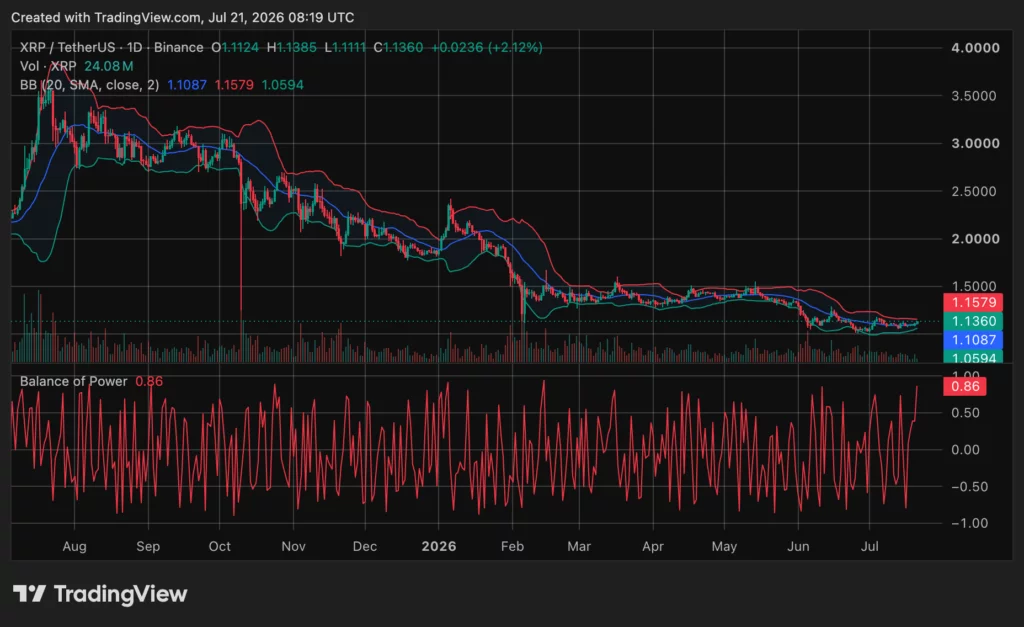
Ripple’s native token pushed back toward $1.13 on Tuesday as buyers defended the $1.08-$1.10 area and tried to turn a short-term recovery into a breakout.
Summary
- XRP reclaimed $1.13 as short-term momentum improved, though its broader descending channel remains firmly intact.
- Spot XRP ETFs added $2.49 million, extending institutional demand despite persistent weakness in the token.
- Analysts see $1.35 upside after breakout confirmation, while longer-term resistance keeps downside risks clearly active.
At press time, crypto.news market data showed XRP near $1.13, up about 4.1% over 24 hours.
The rebound has improved short-term momentum, but the larger structure remains weaker. The token still trades inside a descending channel that has limited rallies, leaving the market with two different signals: a possible near-term breakout and a broader trend that has not yet turned bullish.
XRP tests $1.13 as traders watch $1.35
Crypto analyst Ali Martinez said XRP’s monthly chart had produced a TD Sequential buy signal, while the hourly chart showed price compressing inside a symmetrical triangle. He said a sustained move above $1.13 could open a roughly 20% rally toward $1.35. The setup gained attention as the token climbed from the lower end of its recent range.
However, $1.13 is only the first test. A recent crypto.news analysis placed resistance near $1.17, followed by about $1.27 and $1.37 if buyers continue to gain control. The supplied daily chart also shows XRP above the middle Bollinger Band near $1.11 but below the upper band around $1.16. A close above $1.16 would strengthen the recovery, while a drop below $1.11 would weaken momentum.
The Balance of Power indicator near 0.86 points to strong buying pressure on the latest candle. Still, one strong reading does not confirm a trend reversal. XRP has produced several relief rallies during its wider decline, so buyers still need to hold reclaimed levels and build volume above resistance.
ETF inflows support the rebound
U.S.-listed spot XRP ETFs recorded $2.49 million in net inflows on July 20, according to SoSoValue data. Bitwise’s fund was the only product to record net buying for the session, lifting its cumulative inflows to about $501 million. Total XRP ETF assets stood near $1.017 billion, while cumulative net inflows remained around $1.489 billion.
That demand continues a pattern seen through much of 2026. XRP ETFs have absorbed close to one billion tokens while exchange reserves have fallen to multi-year lows. Yet the tighter available supply has not produced a sustained rally. XRP has remained far below its July 2025 peak despite steady ETF demand.
U.S. spot XRP ETFs attracted $6.78 million last week while the listed products held about 971 million XRP. That steady demand provides support, but price still needs a clear technical break before traders can treat the current move as more than another rebound inside a larger decline.
Analysts split over the larger trend
The latest bounce has produced sharply different long-term forecasts. EGRAG CRYPTO said XRP may be forming a third macro bottom around the $0.90-$1.00 area, supported by long-term exponential moving averages. His roadmap places $1.23 as an initial reclaim level and $1.56 as a stronger confirmation before much higher long-term targets.
Those projections remain speculative. EGRAG said the third bottom has not yet been fully confirmed, while his targets of $9, $15 and $31 rely on Fibonacci extensions and a future macro breakout.
Chart analyst ChartNerd has taken a more cautious view, arguing that XRP remains in a long-term downtrend after a bearish 20-week and 50-week EMA crossover formed earlier in 2026.
ChartNerd said rallies toward roughly $1.29 or even $1.60 could still face heavy resistance unless XRP breaks above its larger descending structure. The broader technical picture also remains cautious, with recent analysis placing XRP beneath descending resistance despite improving short-term price action.
A move toward $1.35 would confirm the short-term triangle breakout described by Martinez, but XRP would still need to reclaim higher weekly resistance before the larger trend changes. The divide between improving momentum and continued long-term weakness remains central to the current setup.
XRP bulls need to clear $1.16
The clearest short-term levels sit close to the current price. The $1.11 area, which aligns with the middle Bollinger Band, acts as the first support. The $1.16 area marks the upper band and a nearby resistance zone. A sustained move through that level would strengthen the case for a push toward $1.20, $1.27 and eventually $1.35.
On the downside, losing $1.11 would weaken the latest recovery and put the $1.08-$1.10 area back in focus. A deeper breakdown could return attention to the $1.05-$1.00 zone, where buyers have recently defended the market.
Meanwhile, institutional demand remains a supporting factor rather than a confirmed breakout driver.
Disclosure: This article does not represent investment advice. The content and materials featured on this page are for educational purposes only.

Bitcoin is trading at just a nod above $66,000 after a 3% rally since yesterday morning, with price prediction pointing at a $70K target. That may not look dramatic at first glance, yet the weekly trend tells a stronger story. Bitcoin has added 6% over the past seven days, while improving on-chain positioning and whale accumulation continue supporting the bullish case. Unsurprisingly, $70,000 is becoming the next target.
Meanwhile, the total crypto market cap has climbed to around $2.25 trillion, recovering ground lost earlier this month. A decisive move above June’s local high could open the door to another leg higher. Cardano led the major gainers after the Van Rossem hard fork went live on the mainnet. This was a meaningful network upgrade that reduced the cost of executing Plutus smart contracts.
Elsewhere, FTX’s fifth creditor payout remains scheduled for July 31, releasing roughly $900 million to eligible users. That will bring total distributions to about $10 billion. Some recipients could lock in profits, while others may redeploy capital into crypto. Either way, the payout is one event traders will keep on their radar.
Even so, the macro backdrop still deserves attention. Stablecoin outflows from Binance and Bybit reached roughly $2.3 billion over the past month, leaving less sidelined capital available for fresh buying. That partly explains why Bitcoin has struggled to clear resistance despite improving sentiment. Still, the longer-term bullish structure remains intact. Sometimes the market prefers a short breather before making its next move.
Discover: The Best Crypto to Diversify Your Portfolio
Bitcoin Price Prediction: $70K This Week?
Bitcoin is pressing against the $66K to $68K zone, a former support area that flipped into resistance after the recent breakdown. The 61.8% Fibonacci retracement of the May to June decline sits near the upper end of that range. Price action has remained steady rather than explosive, which often hints at accumulation rather than a panic-fueled squeeze.
Meanwhile, options positioning still favors the bulls. Call buying around the $70K to $75K strikes has increased, suggesting traders are paying for upside exposure instead of downside protection. Large whale wallets have continued accumulating for weeks, while mid-sized holders have trimmed positions. Sometimes the big fish really do eat first.

If Bitcoin pushes above $68K and turns that level into support, momentum could carry it toward $70K. That level has become the next obvious magnet for traders. However, bulls still need a convincing close above resistance before popping the champagne.
The base case remains a period of consolidation between $64K and $68K as liquidity rebuilds. Markets rarely move in straight lines, no matter how much traders wish they would. If that range holds, the eventual breakout could simply arrive a little later than expected.
On the flip side, a firm rejection from the $66K to $68K resistance zone could drag Bitcoin back toward the $61K to $62K support area. A break below $60K would weaken the current market structure and force traders to reassess the trend. Spot ETF flows and macroeconomic data remain the key swing factors.
Trade BTC on Bybit and Get a Chance to Win Our $1,000 USDT Airdrop
Bitcoin Hyper Targets Early Mover Upside as Bitcoin Tests Key Levels
Bitcoin at $66K is a meaningful recovery, but at its market cap, the math on percentage gains is unavoidably different from what early BTC holders experienced. Traders who want Bitcoin-correlated exposure with asymmetric upside potential are increasingly looking at infrastructure projects built on top of Bitcoin itself, where the upside multiples are structurally larger.
Bitcoin Hyper ($HYPER) is one project drawing serious attention in that category. It positions itself as the first Bitcoin Layer 2 with Solana Virtual Machine (SVM) integration. The argument being that it can deliver faster transaction performance than Solana while inheriting Bitcoin’s security model.
Hyper boasts a sub-second finality and low-cost smart contract execution on a Bitcoin-secured network, addressing three of Bitcoin’s persistent limitations simultaneously: slow throughput, high fees, and limited programmability.
The presale has raised $32,97 million at a current token price of $0.0136834, with staking available for early participants. It’s a no-brainer of an investment at the current Bitcoin price prediction.
For traders wanting to research the thesis: explore Bitcoin Hyper’s presale details here.
Discover: The Best Token Presales
The post Bitcoin Price Prediction: Now, $70K is the Target appeared first on Cryptonews.


An Argentine federal judge ordered the identification and freezing of 25 cryptocurrency wallets tied to the LIBRA memecoin case, targeting accounts routed through exchanges including Binance, Bybit, OKX and Bitfinex, according to a court document reviewed by Clarín. Judge Marcelo Martínez de Giorgi… Read the full story at The Defiant


Ant International has completed a roughly $1.2 billion Series A funding round, securing backing from Ant Group, Alibaba, existing shareholders, and global investment firms to expand its international fintech business and AI capabilities.
Summary
- Ant International has completed a roughly $1.2 billion Series A funding round backed by Ant Group, Alibaba, existing shareholders, and global investors.
- The company said the capital will expand its international business, increase AI investment, and strengthen cross border payment and global account services.
- The financing comes as Ant International continues building its blockchain payments network and advances stablecoin licensing plans across multiple markets.
Chinese media outlet Yicai reported on Tuesday that the financing will support Ant International’s global expansion, increase investment in artificial intelligence, and extend services including cross-border payments and global accounts. The company said the capital will also help merchants grow through its international financial technology offerings.
The financing follows months of investor interest in Ant International as the Singapore-based unit continued expanding outside mainland China. In June, Bloomberg reported that the company had been exploring a fundraising round of about $1 billion at a valuation of at least $10 billion after recording eight consecutive quarters of profitability, citing people familiar with the matter.
Funding backs AI and international payments strategy
The newly completed Series A round included participation from Ant Group, several existing shareholders including Alibaba, and multiple international investment institutions, according to Yicai. The company did not identify the outside investors participating in the financing.
According to the report, the fresh capital will be directed toward growing Ant International’s presence across overseas markets while increasing spending on AI technologies. The company also plans to expand inclusive fintech products focused on cross-border payments and global account services for businesses operating internationally.
Ant International has become the centerpiece of Ant Group’s overseas business after the parent company reorganized several units into independently governed businesses. On March 19, 2024, Ant Group Chairman Eric Jing announced that Ant International, OceanBase, and Ant Digital had each established separate boards of directors to operate independently in the market.
The current leadership team includes Jing as chairman, Yang Peng as chief executive officer, and Douglas Feagin as president, according to the local report.
Operating from Singapore, Ant International now serves markets across Asia, Europe, the Middle East, and Latin America. The company says its network connects more than 150 million merchants with over 2 billion consumer accounts through innovation, settlement, and operational centers in Shanghai, Hong Kong, Singapore, and Malaysia.
Its business is organized into four operating units: Alipay+, merchant payments platform Antom, cross-border financial services provider WorldFirst, and Bettr, which develops AI-powered treasury management and fintech products for businesses.
Global expansion builds on blockchain and stablecoin plans
The latest financing comes as Ant International continues expanding its blockchain-powered payments infrastructure and regulated digital asset initiatives.
Bloomberg reported in June that Ant International generated an estimated $3.7 billion in revenue during 2025, an increase of about 25% from the previous year. Although the business accounted for roughly one-tenth of Ant Group’s total revenue, Bloomberg said its international operations had been growing faster than several of the company’s domestic businesses.
A large part of that international strategy centers on cross-border payments. Ant International previously said its Alipay+ network operates in more than 100 markets, allowing consumers to pay with their existing digital wallets while merchants receive settlements through local payment systems.
Supporting that network is Whale, the company’s blockchain platform. According to previous company figures cited by Bloomberg, Ant International processed more than $1 trillion in global transactions during 2024, with about one-third of those payments settled through blockchain infrastructure.
The company has also been extending the platform into enterprise treasury management. Previous collaborations with Standard Chartered included blockchain-based liquidity transfers denominated in Singapore dollars after earlier Hong Kong dollar settlement trials under the Hong Kong Monetary Authority’s Ensemble Sandbox initiative for tokenization.
At the same time, Ant International has been incorporating regulated digital assets into its payment infrastructure. Earlier this year, the company integrated Circle’s USDC stablecoin into parts of its cross-border settlement network, allowing selected transactions to settle over blockchain rails instead of relying entirely on traditional correspondent banking systems.
Regulated stablecoins are expected to become another part of Ant International’s international strategy. Bloomberg reported in June 2025 that the company planned to apply for stablecoin issuer licenses in Hong Kong, Singapore, and Luxembourg. A company spokesperson confirmed at the time that it would seek a fiat-referenced stablecoin issuer license in Hong Kong after the city’s Stablecoins Ordinance took effect, with applications in Singapore and Luxembourg expected to follow.
Speaking previously at the Singapore FinTech Festival, Ant Group Chairman Eric Jing said artificial intelligence and tokenized settlement technologies could make financial services more accessible, underscoring the technologies the company continues to prioritize as it expands its international business.


A Stripe takeover of PayPal would fold two of the payments industry's crypto operations into one company, pairing Stripe's Bridge stablecoin infrastructure with PayPal's PYUSD token and crypto-trading business. Stripe and private-equity firm Advent International made an unsolicited joint offer to… Read the full story at The Defiant
United Stables has adopted Chainlink as the official oracle and cross-chain infrastructure for its U stablecoin after the asset surpassed $1 billion in circulating supply and more than $2.5 billion in daily trading volume.
Summary
- United Stables has adopted Chainlink as the official oracle and cross chain infrastructure for its U stablecoin after the asset surpassed $1 billion in supply.
- Chainlink Data Feeds and Proof of Reserve are now live, while CCIP will support future cross chain transfers of U.
- The integration builds on Chainlink’s expanding institutional presence as more stablecoin and DeFi projects adopt its interoperability and data services.
According to an announcement from United Stables, the company has integrated Chainlink’s data and interoperability products to strengthen pricing, reserve verification, and future cross-chain transfers for U, its dollar-pegged stablecoin launched on BNB Chain and Ethereum in December 2025.
The rollout includes Chainlink Data Feeds and Proof of Reserve, both of which are now live. United Stables said it also plans to integrate Chainlink’s Cross-Chain Interoperability Protocol (CCIP) to support secure transfers of U between blockchain networks as the stablecoin expands across the multi-chain ecosystem.
The company said the decision followed a review of security standards across the industry after recent incidents exposed weaknesses in legacy oracle and bridge infrastructure. According to United Stables, fragmented liquidity, unverified pricing, and vulnerabilities in cross-chain transfers were among the issues it sought to address by adopting Chainlink’s infrastructure.
Data feeds, reserve verification go live
Under the integration, Chainlink Data Feeds now provide decentralized pricing data that United Stables said supports more than 20 lending protocols. At the same time, Chainlink Proof of Reserve allows users and protocols to verify the collateral backing U through on-chain cryptographic checks.
United Stables launched U in December 2025 as a fully backed stablecoin designed for trading, payments, decentralized finance, institutional settlement, and AI-driven applications. At launch, the company said U was backed one-to-one by cash and audited stablecoins including USDC, USDT, and USD1, with reserves held in segregated accounts and verified through on-chain Proof of Reserve alongside quarterly independent audits.
Athena, chief executive officer of United Stables, said the Chainlink integration allows users, institutional partners, and decentralized finance protocols to access verified pricing data, independently confirm U’s collateral around the clock, and eventually transfer the stablecoin securely across multiple blockchain networks.
She added that the company views cryptographic verification as a core requirement for building trust as U expands beyond its initial deployments.
Johann Eid, chief business officer at Chainlink Labs, said the infrastructure would allow United Stables to extend U across decentralized finance while relying on Chainlink’s decentralized oracle and interoperability network. According to Eid, the platform is designed to support institutional-scale stablecoin activity across multiple blockchains.
CCIP planned for future multi-chain transfers
Beyond the services already deployed, United Stables said it intends to adopt Chainlink CCIP to power cross-chain transfers of U. According to the company, the protocol is expected to reduce friction when liquidity moves between supported blockchain networks while providing an additional security layer for interoperability.
For United Stables, the announcement builds on the roadmap introduced when U launched late last year. Alongside decentralized finance integrations with platforms including PancakeSwap, ListaDAO, Aster, and Four.meme, the company said it plans to add confidential balances and AI-focused payment capabilities through technologies such as EIP-3009 and delegated transaction execution.
According to United Stables, combining its liquidity infrastructure with Chainlink’s oracle, reserve verification, and interoperability products is intended to provide transparent collateral verification, secure pricing data, and future cross-chain functionality as U continues expanding across BNB Chain, Ethereum, TRON, and other supported blockchain networks.
CCIP has become one of Chainlink’s main products for blockchain interoperability over the past year. Earlier this month, Aave expanded its use of the protocol by making CCIP the default cross-chain infrastructure across the Aave App and Stable Vaults. According to Aave, the same infrastructure now handles token transfers, vault rebalancing, governance execution, deposits, withdrawals, and yield optimization instead of relying on separate systems for different cross-chain functions.
Aave also said CCIP already powers transfers of its GHO stablecoin across supported networks through Chainlink’s Cross-Chain Token standard. Cross-chain governance proposals are also executed through the Aave Delivery Infrastructure, which uses CCIP to relay approved governance actions from Ethereum to other blockchain networks where Aave operates.
Security has remained a key part of CCIP’s design. According to Aave, every bridge lane is secured by at least 16 independent node operators distributed across different organizations and regions, while built-in rate limits restrict the amount of value that can move during abnormal conditions.
Chainlink continues institutional expansion
The latest integration adds to Chainlink’s growing presence across both decentralized finance and institutional financial infrastructure.
In June, Chainlink joined Project Pangea, a bank-backed initiative focused on testing stablecoin-based foreign exchange settlement between Europe and South Korea. According to Chainlink, the project includes FairSquareLab, UniKA, and Qivalis, representing more than 50 banks with over $10 trillion in assets under management. The initiative uses Chainlink infrastructure alongside ISO 20022 messaging and existing SWIFT systems to test atomic payment-versus-payment settlement using compliant euro and South Korean won stablecoins.
Chainlink has also expanded into traditional market infrastructure. In January, BitMEX said it would use Chainlink Data Streams to provide pricing for its planned Equity Perpetuals, allowing the exchange to support perpetual contracts linked to stocks and exchange-traded funds using continuous market data from multiple sources.


The Depository Trust & Clearing Corporation, the market infrastructure that clears and settles most U.S. securities trades, began running live production trades of tokenized stocks and Treasurys on Wednesday, moving its tokenization effort out of testing and into a live environment. More than two… Read the full story at The Defiant

Apple TV’s ‘Silo’ Season 3 Justified Its Most Controversial Twist in Only 3 Episodes

Jim Parsons Was ‘Miserable’ At The Big Bang Theory’s Peak Success

Visionary Mason Jappa Shares Entrepreneurial Insights from a Decade of Company Building


-
 NewsBeat5 days ago
London Mayor Sadiq Khan handed a peerage by Keir Starmer alongside 15 other Labour figures… just days before the PM leaves No10
-

 Fashion4 days ago
Weekend Open Thread – Corporette.com
-

 Politics3 days ago
The House | The City of London can help the new chancellor deliver growth in every postcode
-

 Politics6 days ago
Young campaigners urge incoming PM to act on outdoor junk food ads
-

 Crypto World5 days ago
CFTC blocks Kalshi from unwinding Michigan trades after court order
-
 Crypto World4 days ago
Two July Windows Left: The CLARITY Act’s Senate Fight and What Failure Means
-

 Crypto World3 days ago
Ripple Payments Joins MiCA With 14 Firms, Does It Mean Anything For XRP?
-

 Business5 days ago
Nvidia Stock Slips After Big Tuesday Rally as Huang Confirms Vera Rubin Chip Is Now in Production Today
-

 Politics2 days ago
Democrats look to World Cup watch parties to register thousands of voters
-
 Entertainment6 days ago
Disney’s Most Ambitious Failed Star Wars Attraction Is Coming to SDCC
-

 Crypto World4 days ago
Ripple wins EU-wide access as ESMA adds it to MiCA register
-

 Crypto World5 days ago
Injective Submits SEC Transfer-Agent Registration to Onchain Ownership Records
-

 Business5 days ago
Palantir Shares Rise After Expanded Nvidia Partnership and Fresh Analyst Upgrades Ahead of Earnings Day
-

 Tech11 hours ago
Sail Virtually Aboard The “Itanic” With IA-64 Emulator
-
 Tech8 hours ago
Turtle Beach Command Series KB7 review: a nifty screen-equipped gaming keyboard
-

 Tech7 days ago
Dark Secrets Emerge When Jailbreaking LLMs
-

 News Videos7 days ago
XRP BOMBSHELL… XRP OMBOARDED FOR TRANSACTIONS!!!
-

 NewsBeat4 days ago
Registration is now open for March for Men with Kev 2026
-

 Crypto World3 hours ago
Grayscale Files For Worldcoin ETF, WLD Registers Sharp Rise
-

 NewsBeat1 day ago
Unregistered fitter used Gas Safe logo on business flyers
You must be logged in to post a comment Login