

Crypto World
Ant International secures $1.2 billion Series A backed by Alibaba and Ant Group



Ant International has completed a roughly $1.2 billion Series A funding round, securing backing from Ant Group, Alibaba, existing shareholders, and global investment firms to expand its international fintech business and AI capabilities.
Summary
- Ant International has completed a roughly $1.2 billion Series A funding round backed by Ant Group, Alibaba, existing shareholders, and global investors.
- The company said the capital will expand its international business, increase AI investment, and strengthen cross border payment and global account services.
- The financing comes as Ant International continues building its blockchain payments network and advances stablecoin licensing plans across multiple markets.
Chinese media outlet Yicai reported on Tuesday that the financing will support Ant International’s global expansion, increase investment in artificial intelligence, and extend services including cross-border payments and global accounts. The company said the capital will also help merchants grow through its international financial technology offerings.
The financing follows months of investor interest in Ant International as the Singapore-based unit continued expanding outside mainland China. In June, Bloomberg reported that the company had been exploring a fundraising round of about $1 billion at a valuation of at least $10 billion after recording eight consecutive quarters of profitability, citing people familiar with the matter.
Funding backs AI and international payments strategy
The newly completed Series A round included participation from Ant Group, several existing shareholders including Alibaba, and multiple international investment institutions, according to Yicai. The company did not identify the outside investors participating in the financing.
According to the report, the fresh capital will be directed toward growing Ant International’s presence across overseas markets while increasing spending on AI technologies. The company also plans to expand inclusive fintech products focused on cross-border payments and global account services for businesses operating internationally.
Ant International has become the centerpiece of Ant Group’s overseas business after the parent company reorganized several units into independently governed businesses. On March 19, 2024, Ant Group Chairman Eric Jing announced that Ant International, OceanBase, and Ant Digital had each established separate boards of directors to operate independently in the market.
The current leadership team includes Jing as chairman, Yang Peng as chief executive officer, and Douglas Feagin as president, according to the local report.
Operating from Singapore, Ant International now serves markets across Asia, Europe, the Middle East, and Latin America. The company says its network connects more than 150 million merchants with over 2 billion consumer accounts through innovation, settlement, and operational centers in Shanghai, Hong Kong, Singapore, and Malaysia.
Its business is organized into four operating units: Alipay+, merchant payments platform Antom, cross-border financial services provider WorldFirst, and Bettr, which develops AI-powered treasury management and fintech products for businesses.
Global expansion builds on blockchain and stablecoin plans
The latest financing comes as Ant International continues expanding its blockchain-powered payments infrastructure and regulated digital asset initiatives.
Bloomberg reported in June that Ant International generated an estimated $3.7 billion in revenue during 2025, an increase of about 25% from the previous year. Although the business accounted for roughly one-tenth of Ant Group’s total revenue, Bloomberg said its international operations had been growing faster than several of the company’s domestic businesses.
A large part of that international strategy centers on cross-border payments. Ant International previously said its Alipay+ network operates in more than 100 markets, allowing consumers to pay with their existing digital wallets while merchants receive settlements through local payment systems.
Supporting that network is Whale, the company’s blockchain platform. According to previous company figures cited by Bloomberg, Ant International processed more than $1 trillion in global transactions during 2024, with about one-third of those payments settled through blockchain infrastructure.
The company has also been extending the platform into enterprise treasury management. Previous collaborations with Standard Chartered included blockchain-based liquidity transfers denominated in Singapore dollars after earlier Hong Kong dollar settlement trials under the Hong Kong Monetary Authority’s Ensemble Sandbox initiative for tokenization.
At the same time, Ant International has been incorporating regulated digital assets into its payment infrastructure. Earlier this year, the company integrated Circle’s USDC stablecoin into parts of its cross-border settlement network, allowing selected transactions to settle over blockchain rails instead of relying entirely on traditional correspondent banking systems.
Regulated stablecoins are expected to become another part of Ant International’s international strategy. Bloomberg reported in June 2025 that the company planned to apply for stablecoin issuer licenses in Hong Kong, Singapore, and Luxembourg. A company spokesperson confirmed at the time that it would seek a fiat-referenced stablecoin issuer license in Hong Kong after the city’s Stablecoins Ordinance took effect, with applications in Singapore and Luxembourg expected to follow.
Speaking previously at the Singapore FinTech Festival, Ant Group Chairman Eric Jing said artificial intelligence and tokenized settlement technologies could make financial services more accessible, underscoring the technologies the company continues to prioritize as it expands its international business.

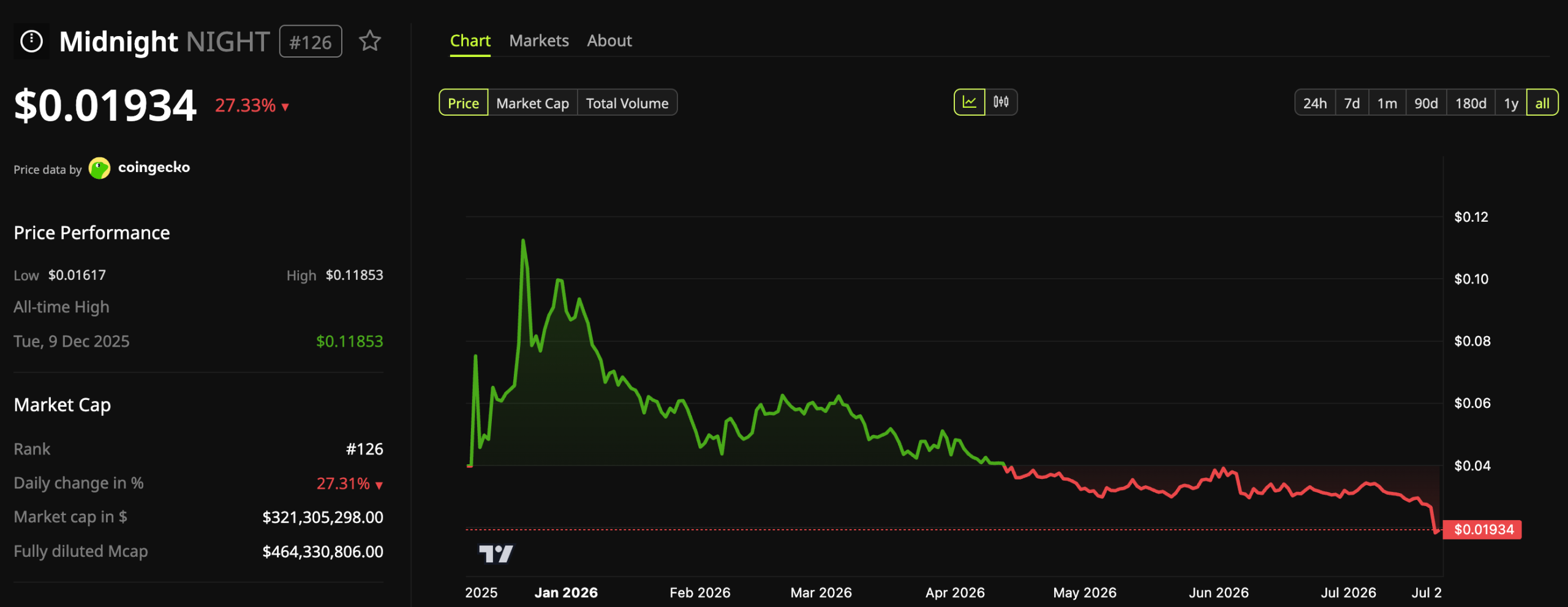
Midnight (NIGHT) token slid to a record low of $0.01524 after an attacker drained roughly 515 million tokens from Wanchain’s Cardano (ADA) bridge.
The stolen tokens reportedly represented about 97% of the bridge’s NIGHT reserves. Wanchain has since suspended the bridge while it investigates the breach.
Inside the Wanchain Bridge Drain
According to analyst Paul, the attacker emptied Wanchain’s Cardano-side lock address between 14:46 and 14:55 UTC. That address holds the custody backing Wanchain-wrapped NIGHT on BNB Chain.
Only NIGHT left the contract. Other bridged assets stayed untouched, according to the on-chain analyst. Reserves fell from about 527 million NIGHT to near 12 million. The move stripped roughly 97% of the bridge’s holdings.
“This is a bridge-layer incident, token supply is unchanged. The wrapped NIGHT on BNB is now largely unbacked though,” the post read.
Follow us on X to get the latest news as it happens
Token Dumped as Midnight Distances Itself
The attacker routed funds through newly created wallets and sold them on Cardano-based exchanges. About 290 million NIGHT hit decentralized exchanges (DEXs), pushing prices down.
The impact was clearly visible. At press time, NIGHT traded around $0.019, down about 27% on the day.

Meanwhile, the Midnight Foundation said the incident did not impact its network. It stressed that core infrastructure continued to run normally.
“Midnight’s protocol, validator network, consensus, and core infrastructure remain secure and continue to operate normally,” the team said.
The attack landed shortly after Allbridge Core lost $1.65 million, continuing the string of attacks on crypto infrastructure this year.
Subscribe to our YouTube channel to watch leaders and journalists provide expert insights
The post Wanchain Bridge Breach Sends Midnight Token to All-Time Low appeared first on BeInCrypto.

Arthur Hayes is buying Ethereum again, trading above $1,900, as its price prediction centers around the psychological $2,000 level, which will finally give way. That latest move has reignited a familiar question: Is smart money quietly soaking up supply while everyone else hesitates?
On-chain trackers flagged another purchase of 1,332.5 ETH, worth $2.53 million at the time of execution. It followed an earlier July accumulation of about 1,939 ETH through two OTC-style transactions. Together, those recent buys exceed $5 million, showing Hayes is not exactly nibbling around the edges.
The turnaround stands out because Hayes sold 6,000 ETH in June, locking in an estimated $606,000 loss. Instead of staying sidelined, he reversed course as Ethereum pulled back and started accumulating again. Sometimes the market hands you lemons. Hayes apparently buys Ether instead.
Meanwhile, institutional demand continues to shape the narrative. Fresh inflows into BlackRock’s iShares Staked Ethereum ETF and Robinhood Chain’s use of ETH as its gas token have strengthened the investment case. Fundstrat’s Tom Lee summed up the shift neatly, saying Wall Street is now building on Ethereum rather than simply trading it.
Whether that institutional bid can keep supporting Ethereum near current levels remains the key question by the end of the month. If large buyers keep stepping in, the path toward $2,000 becomes far less intimidating. If not, traders may need a little more patience before the next curtain call.
Discover: The Best Crypto to Diversify Your Portfolio
Ethereum Price Prediction: Reclaim $2,000 Before August?
ETH is trading in a contested range around $1,920 after recovering from last week’s pullback. Its market cap sits near $232 billion, while the daily move remains modest. That calm follows a sharp correction, so the market is still deciding whether it found a floor or is simply catching its breath.
Technically, $1,500 is the major bounce zone and a structural support level, and $2,000 remains the level bulls need to reclaim convincingly. Until that happens, sellers still have a say. The 100-day EMA also remains an important hurdle, refusing to roll out the welcome mat.

The bullish scenario for Ethereum price prediction stays straightforward. If ETH holds above $1,900 and buying volume improves, a retest of $2,000 becomes increasingly likely. A decisive close above that level could then clear the path toward the mid $2,000s. Markets rarely move in straight lines, though. They prefer making everyone doubt first.
The base case still points to range-bound trading between roughly $1,900 and $2,000 as macro developments and Bitcoin continue driving sentiment. On the downside, losing $1,800 with strong selling pressure would shift focus back toward the $1,500 support zone and weaken the near-term structure.
Meanwhile, staking continues to tighten Ethereum’s available supply. More than one-third of the circulating ETH supply remains locked in staking, reducing liquid tokens on exchanges. That does not always move the market overnight, but it can quietly strengthen the setup for investors looking several weeks ahead.
Trade Ethereum on Bybit and Get a Chance to Win Our $1,000 USDT Airdrop
LiquidChain Targets Early-Mover Upside as Ethereum Tests Key Levels
ETH at $1,800–$1,950 is a psychologically awkward position. It’s not cheap enough to be an obvious value buy for new entrants, not strong enough to confirm a trend reversal. That compression pushes risk-tolerant capital toward earlier-stage infrastructure plays where the asymmetry is structurally different.
LiquidChain is a Layer 3 infrastructure project building what it calls a unified cross-chain execution environment, fusing Bitcoin, Ethereum, and Solana liquidity into a single settlement layer.
The next generation of infrastructure won't stand alone. — LiquidChain (@getliquidchain) July 21, 2026
It'll connect everything around it.  ⟁https://t.co/vqvBcdSQYC pic.twitter.com/mWc9fGndPd
The architecture is built around four pillars: a Unified Liquidity Layer, Single-Step Execution, Verifiable Settlement, and a Deploy-Once framework. Liquid lets developers push to all three ecosystems simultaneously rather than maintaining separate deployments.
The presale is currently priced at $0.01482 per $LIQUID token, with $915K raised to date. With the cross-chain thesis playing out as ETH’s institutional layer matures, the entry point is materially different from buying ETH at the current market cap.
Research LiquidChain here before the presale advances to its next pricing tier.
Discover: The Best Token Presales
The post Ethereum Price Prediction: Arthur Hayes Makes $25M Move as ETH Tests $2K appeared first on Cryptonews.

On Tuesday, July 21, 2026, institutional capital showed sustained momentum as Bitcoin (BTC) climbed back above $66,000. This recovery, fueled by five consecutive days of net inflows into US spot ETFs, has stabilized the market after a period of volatility near the $60,000 support level. As capital flows back into the primary digital asset, market attention is shifting toward infrastructure projects capable of bridging Bitcoin’s liquidity with other major ecosystems. Among these, the LiquidChain (LIQUID) presale has secured over $914,000, approaching its $1 million target ahead of the month’s end.
On Monday, US spot Bitcoin ETFs registered a net inflow of approximately $227 million, reversing the net outflows recorded during May and June. BlackRock’s IBIT led the session with $116 million in net inflows, bringing total net assets across all US spot Bitcoin products to nearly $79 billion. This sustained buying pressure pushed Bitcoin past $66,000, with 24-hour trading volume exceeding $31 billion.
According to analyst Ted Pillows, clearing the $65,000 resistance opens the door for a near-term target of $68,000, with potential for further upward momentum.
While spot exposure remains the primary vehicle for institutional entry, Bitcoin’s price stabilization is driving interest in decentralized applications and infrastructure that expand the utility of idle BTC.
LiquidChain Targets Cross-Chain Fragmentation with Layer 3 Network
To address capital fragmentation across major networks, LiquidChain (LIQUID) is building a Layer 3 execution environment. The network aims to connect Bitcoin’s liquidity with Ethereum’s decentralized finance (DeFi) ecosystem and Solana’s execution speed. By leveraging a Solana-class virtual machine, trust-minimized state verification, and cross-chain proofs, the protocol enables atomic settlements without relying on traditional wrapped assets.
The Order builds. — LiquidChain (@getliquidchain) July 15, 2026
Brick by brick. Layer by layer. ⟁https://t.co/vqvBcdSQYC pic.twitter.com/tcfMNP4lNq
The native LIQUID token serves as the network’s utility asset, powering transaction fees, staking, and governance. The total supply of LIQUID is capped at 11.8 billion tokens, structured as follows:
- Development: 35%
- Marketing and Growth: 32.5%
- Business Partnerships: 15%
- Staking and Rewards: 10%
- Exchange Listings: 7.5%
The ongoing presale has raised more than $914,000, with the current token price set at $0.01482. The next incremental price increase is scheduled to take effect in two days.
Presale Access and Staking Integration
Participants can access the presale via the official LiquidChain website by connecting a compatible Web3 wallet. Alternatively, the presale is integrated into the Best Wallet mobile application under its “Upcoming Tokens” section, available for download on the Apple App Store and Google Play.
The presale supports multiple payment methods, including BTC, ETH, SOL, BNB, USDT, USDC, and direct credit/debit card purchases. Upon acquiring LIQUID, participants can opt to stake their tokens immediately to access a dynamic staking yield of 1,231% APY, which will adjust as the staking pool grows.
For real-time development updates and presale milestones, interested parties can follow LiquidChain on X and join the Telegram community.
The post Institutional ETF Inflows Push Bitcoin Past $66K as LiquidChain Presale Nears $1M appeared first on Cryptonews.
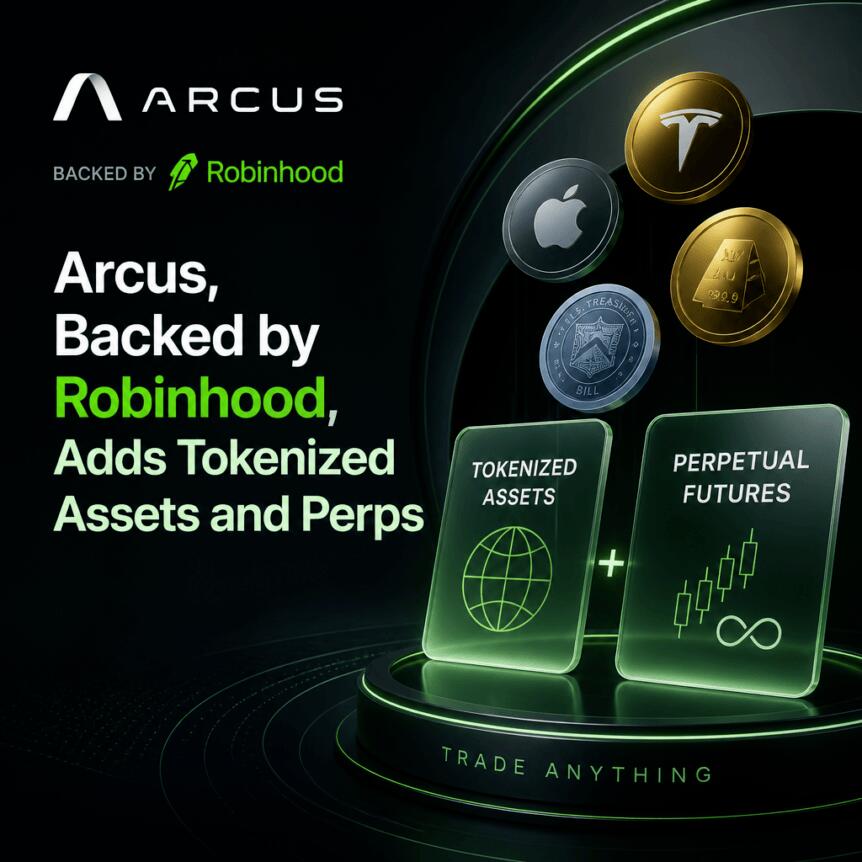
Arcus, a decentralized exchange backed by Robinhood Crypto, has expanded its onchain trading offering on Robinhood Chain by launching tokenized stocks alongside perpetual futures. The development signals how quickly DEX infrastructure is evolving to cover traditional market exposure, not just crypto-native assets.
According to an announcement shared with Cointelegraph, Arcus began trading tokenized equities and perpetual contracts on Tuesday. The platform also previously launched spot markets when Robinhood Chain went live on July 1, including stock token access across a self-custodial trading model.
Key takeaways
- Arcus launched tokenized stocks and perpetual futures on Robinhood Chain on Tuesday, building on earlier spot markets.
- The exchange supports more than 95 stock tokens and offers perpetual markets linked to equities, ETFs, commodities, indexes, and crypto assets.
- Arcus uses a self-custodial approach where users keep control of their wallets, with wallet integration via Privy and connectors such as MetaMask and Ledger.
- Paxos-issued USDG is positioned as Arcus’s primary collateral and settlement asset.
- Arcus restricts stock tokens in multiple regions, including the US, Canada, and the UK, underscoring ongoing regulatory fragmentation for tokenized securities.
Arcus adds tokenized equities and perpetual futures
Arcus is positioning itself as a bridge between onchain trading and traditional capital markets. The new offering includes tokenized versions of well-known US company stocks—such as Nvidia, Tesla, Apple, Microsoft, Meta, Google, and Amazon—alongside perpetual markets tied to equities and other offchain reference categories.
In addition to stock-linked perpetuals, Arcus’s product slate reportedly extends to perpetual markets associated with exchange-traded funds, commodities, indexes, and crypto assets. The company frames the expansion as part of a broader push to “onboard” real-world assets into decentralized trading workflows.
Arcus previously rolled out spot markets shortly after Robinhood Chain launched. Cointelegraph previously reported that Robinhood Chain saw more than 70 million in ETH bridged during its first week, and Arcus’s early spot rollout used that foundation to bring tokenized exposure to the chain.
A self-custody model built around Privy and existing wallets
A defining feature of Arcus is its self-custodial structure. Rather than depositing assets into a centralized exchange custody system, Arcus describes a trading setup where users keep control of their crypto wallets. That matters for traders because self-custody shifts responsibility for key management and reduces reliance on an intermediary to hold funds.
To support onboarding and wallet management, Arcus uses Privy, a wallet infrastructure provider. The platform enables sign-ups via email or social logins, then routes trading activity through wallet-based authorization.
For users who already hold crypto, Arcus supports connecting existing self-custodial wallets, including MetaMask, Ledger, and WalletConnect. The company also indicates support for additional Ethereum-compatible wallets.
Arcus’s trading system is also designed around stablecoin settlement. Paxos-issued USDG is described as the primary collateral and settlement asset for the platform, tying equity-linked trading to a familiar stablecoin infrastructure rather than requiring users to rely solely on native crypto volatility.
Restrictions highlight uneven regulation for tokenized stocks
While tokenized stocks are a core part of Arcus’s expansion, the company is explicit about where those instruments can’t be offered. Arcus states that its stock tokens are unavailable in the US, Canada, the UK, and other restricted jurisdictions.
Cointelegraph contacted Arcus for clarification on the restrictions, but did not receive a response by publication time. Even without additional detail, the regional exclusions reinforce a central theme in tokenized real-world assets: regulatory standards for securities representations vary widely, and product access often becomes the first battleground.
In markets including the US and UK, regulators have been scrutinizing how blockchain-based representations of traditional assets fit within existing financial rules. Key questions typically include who effectively holds or controls the asset, how ownership is defined, and what market structure is created when trading happens through token contracts.
Arcus’s approach suggests it is attempting to scale onchain trading while limiting exposure to jurisdictions where compliance requirements may be more complex or where the classification of tokenized securities remains unsettled.
Competition accelerates for onchain RWA infrastructure
Arcus’s move lands in the middle of a broader sector race: crypto firms and financial platforms are competing to build infrastructure for tokenized real-world assets (RWAs). The push isn’t limited to token issuances—DEX-style trading venues, perpetual markets, and settlement mechanisms are becoming just as important as the onchain representation of the underlying assets.
As Robinhood Chain-based products expand, the DEX landscape is also seeing other efforts to bring traditional financial instruments onchain. Cointelegraph previously reported that platforms including Coinbase-backed Base have been exploring ways to deliver tokenized equities and related products onchain, showing that the “tokenized markets” strategy is no longer confined to a single ecosystem.
There is also a thematic tension in this transition. Tokenized markets depend on regulatory permissions to determine where products can be offered, yet onchain infrastructure is often built to be globally accessible. Arcus’s launch, with explicit geographic exclusions, illustrates how companies may prioritize compliance routing while still using public blockchain networks as the underlying execution layer.
The launch adds to the growing list of platforms trying to translate traditional market participation into decentralized trading patterns—particularly for users seeking exposure to equity-linked references without using legacy brokerage interfaces.
For investors and traders, the immediate watch-items are straightforward: how Arcus evolves its regional availability, whether it expands beyond stock tokens into additional derivatives liquidity over time, and how settlement and custody design choices—centered on self-custody and USDG—hold up as regulatory scrutiny intensifies across major markets.

A single Robinhood transaction just moved 200 million DOGE, and the market wants to know who’s behind it. Dogecoin trades above $0.073, holding modest daily gains. However, the real story sits beneath the surface. Open interest has climbed above $1.08 billion, while derivatives activity continues to heat up. That combination usually means volatility is at the door.
Meanwhile, traders are watching a thick liquidation cluster around $0.074. If bulls push through, short sellers could fuel a sharp squeeze. If momentum fades instead, late buyers may find themselves trapped. Either way, the next move looks unlikely to be a quiet one.
Naturally, Elon Musk’s name has returned to the conversation. There is no evidence linking him to the transaction, and no wallet data confirms his involvement. Still, every large Dogecoin buy raises the same question. Given Musk’s history of moving DOGE with little more than a post, the rumor mill rarely needs much encouragement.
For now, the market has more questions than answers. Bitcoin’s next move could easily determine Dogecoin’s direction, while any surprise social media post could add fuel to the fire. Until the mystery buyer steps into the spotlight, traders will keep guessing. And if history has taught Dogecoin anything, sometimes the biggest rallies start with a single unexplained transfer.
Discover: The Best Token Presales
Can Dogecoin Price Reclaim $0.075 and Force a Short Squeeze This Week?
DOGE is hovering near $0.074, sitting around the 50% Fibonacci retracement level. The memecoin recently reclaimed this area but still needs to confirm it as support. That makes the level worth watching.
The latest liquidation heatmap outlines the battlefield clearly. Support sits between $0.0710 and $0.0726, while resistance stretches from $0.0754 to $0.0796. The Supertrend indicator also caps the near-term upside around $0.0796. However, spot demand and on-balance volume remain soft. That mismatch often leaves leveraged longs and shorts walking on thin ice.

The bullish path starts with DOGE holding above $0.074. If buyers keep control, short liquidations could fuel a quick move toward $0.0755 and $0.076. Nothing goes up forever, but meme coins rarely send a calendar invite before they sprint.
The base case remains a familiar grind. DOGE could continue ranging between $0.071 and $0.074 until a fresh catalyst arrives. On the other hand, losing $0.071 would weaken the setup. That could send the price back toward $0.070 as leveraged positions unwind.
Longer term, analyst Trader Tardigrade still points to cycle targets of $0.653, $0.70, and even above $1.25. Those projections depend on another full crypto bull cycle instead of the current market structure. For now, they work better as long-range markers than actionable trading levels.
Trade Memecoins like DOGE on Bybit and Get a Chance to Win Our $1,000 USDT Airdrop
Maxi Doge Eyes Early-Stage Upside as DOGE Tests Critical Resistance
DOGE at $0.074 with a $1 billion OI overhang is a trade, not a position. The asymmetry that existed at lower prices has compressed. Even a successful squeeze to $0.076 represents roughly 4% upside from here, meaningful on leverage, limited in spot. Traders looking for a larger risk-reward multiple are scanning earlier on the curve.
Maxi Doge ($MAXI) is an ERC-20 meme token built around a trading community thesis: the 240-lb canine juggernaut persona embodies 1000x leverage culture, and the project channels that into structured community mechanics.
The presale has raised closer to $5 million at a current price of just $0.000283, with a dynamic staking APY live for holders. Differentiating features include holder-only trading competitions with leaderboard rewards, a Maxi Fund treasury allocated to liquidity and partnerships, and meme-first marketing that leans into gym-bro culture without apology.
Research Maxi Doge before the next stage reprices.
Discover: The Best Crypto to Diversify Your Portfolio
The post Is Elon Musk Behind the 200 Million DOGE Buy as Open Interest Tops $1 Billion? appeared first on Cryptonews.
Crypto World
Bitcoin, ether rally on Clarity progress report, Asian chip stock rebound: Crypto Markets Today
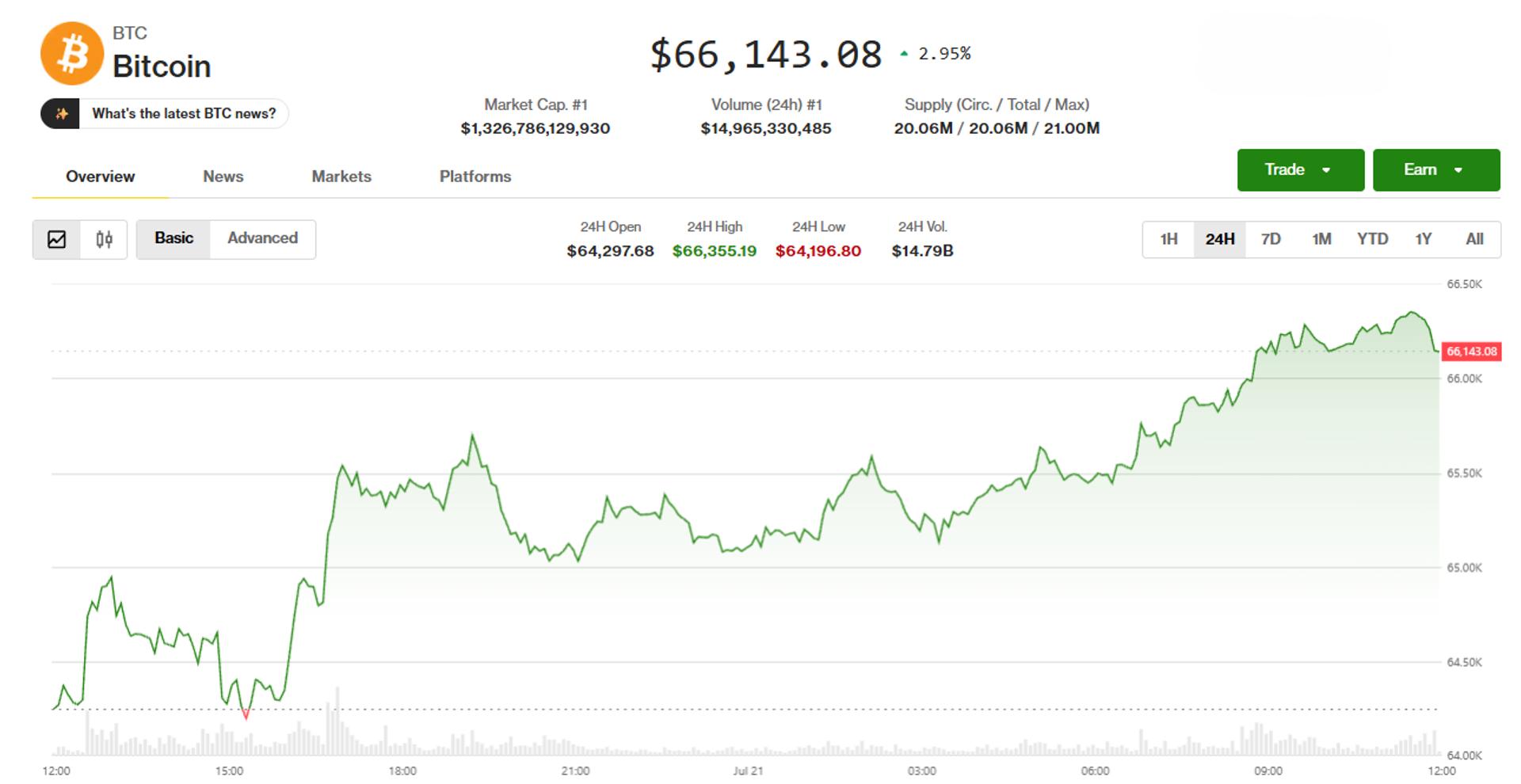
The crypto market rallied on reports suggesting the final hurdle for the long-awaited U.S. Clarity Act may have cleared.
Eleanor Terrett, host of Crypto in America, posted on X that President Donald Trump had agreed to a crucial ethics provision for the crypto market structure bill. The specific language has been shared with a group of Senate Republicans, marking a significant step forward for the legislation.
The ethics provision is a major sticking point in holding back the bill’s passage through Senate. The legislation aims to provide a definitive regulatory framework, clearly distinguishing between digital commodities and securities to end years of enforcement-led oversight.
Bitcoin rallied above $66,000, gaining 3.5% in 24 hours to its highest in just over a month. Othe cryptocurrencies, including ether (ETH), BNB and XRP (XRP) posted even larger gains. Among industry, the standout is the CoinDesk DeFi Select Index, which surged 9%.
Additional tailwinds came from Asia, where the selloff in semiconductor stocks that dragged crypto lower last week reversed, fueling to a broad risk rally.

Gate Europe’s CEO Giovanni Cunti says the Markets in Crypto-Assets Regulation (MiCA) has raised the long-term operating burden for firms already authorized to serve EU customers, warning that some licensed providers may eventually decide they cannot afford the compliance costs.
Speaking to Cointelegraph’s Chain Reaction on Monday, Cunti argued that MiCA’s stricter requirements have tightened competition—particularly for newcomers—and that the market may now be too small for some businesses to sustain the resources required to operate under the EU framework.
Key takeaways
- MiCA compliance costs are increasingly viewed as a barrier for some licensed crypto-asset service providers (CASPs), according to Gate Europe’s CEO.
- The July 1 end of MiCA’s 18-month transition period forced a retrenchment in some services across Europe, while licensed firms continued under the new regime.
- Regulatory burden may push certain startups and projects to launch outside the EU to preserve room for product iteration and growth.
- Despite the pressure, ESMA’s CASP authorizations continue to expand, though at a slower pace since the transition deadline.
- As the market contracts from “thousands” of operators to “hundreds,” remaining providers may benefit from customer migration rather than losing users.
MiCA’s transition deadline changed who can serve EU users
MiCA is the EU’s comprehensive regulatory framework for crypto assets. The bloc’s 18-month transition period ended on July 1, meaning crypto firms serving EU customers needed authorization under MiCA or otherwise had to stop offering regulated services.
Cointelegraph previously reported that the deadline triggered service changes from several exchanges in parts of Europe while firms sought MiCA approvals. A notable example is Binance, which Cointelegraph said was unable to secure a MiCA license before the deadline. The result was a patchwork of restrictions depending on jurisdiction—an early sign that the authorization process would determine who could continue operating as usual.
Gate Europe warns some licensed firms may not endure
Cunti’s central concern is not simply that compliance is costly, but that the costs and staffing requirements needed to operate continuously under MiCA could outweigh the revenue potential for some firms—especially those that acquired a license expecting the broader market to remain large.
He told Cointelegraph that “quite a few” firms that obtain MiCA licenses may ultimately lack the capacity to sustain the “cost and the resources” required “in the long term.”
For investors and operators, the implication is straightforward: in a regulated environment with ongoing obligations, survival increasingly depends on business scale and risk management—not only on obtaining a license once. That can favor larger, better-capitalized platforms and reduce room for smaller providers that cannot spread compliance overhead across higher volumes.
Regulation may drive projects to other jurisdictions
Beyond business continuity, Cunti also suggested that MiCA’s stricter approach could affect where new crypto products and projects choose to launch. He said MiCA strengthens investor protections, but also leaves less space for innovation compared with jurisdictions that apply lighter regulatory requirements.
That, he argued, may lead some teams to choose non-EU markets as a first stop. “We may need to be prepared that some projects, possibly some important projects, may be looking at other jurisdictions with different guidelines,” Cunti said.
At the same time, the EU framework still appears to be gaining institutional traction. ESMA continues to add CASPs to its public register, indicating that the compliance pathway exists—though Cunti’s comments point to a tougher economic reality for firms after authorization.
ESMA licensing continues, but momentum is slower
According to ESMA updates cited by Cointelegraph, the number of companies authorized under MiCA has kept rising. On Friday, ESMA added 14 crypto-asset service providers to its register, bringing the total to 294. Cointelegraph noted that this followed the addition of 37 firms in ESMA’s first update after the July 1 transition deadline.
While the steady increase shows that regulatory onboarding is continuing, Cunti framed the broader effect as a reshaping of competition rather than a simple expansion of the market. He pointed to the difference between the pre-MiCA landscape—when, in his view, there were “thousands of operators”—and the post-deadline environment, which is now closer to “hundreds.”
From a market-structure perspective, this distinction matters. A shrinking number of compliant providers can reduce choice and increase regulatory concentration, but it can also redirect demand. Cunti suggested that customers still want access to EU-regulated services and therefore may migrate toward the remaining compliant platforms rather than leaving the ecosystem entirely.
“So definitely there is a big opportunity for all of us,” he said, adding that “there is an ongoing migration because customers do not want to lose access to this market.”
ESMA’s role also remains active as regulators oversee how major venues adapt. Earlier coverage from Cointelegraph referenced an ESMA warning that brought Binance’s EU service changes into scrutiny—another signal that MiCA implementation is ongoing, not a one-time switch.
What to watch next
The key question after MiCA’s transition is whether authorization translates into sustainable operations. Readers should watch for evidence that some licensed firms scale down, exit, or consolidate—alongside continued ESMA licensing updates and any further regulatory scrutiny over how exchanges restrict services in different EU regions.


In attempting to modernize and better meet its customers’ needs, MoneyGram has partnered with the Stellar network, which has underpinned many of the company’s blockchain initiatives over the past five years. But the company has also started exploring other ecosystems: while Stellar remains a core partner, MoneyGram has also become a validator on Solana and Tempo. For MoneyGram, the immediate payoff isn’t speculative crypto activity, it’s replacing legacy financial rails.
Today’s cross-border settlement still largely depends on banking hours and weekday processing. Blockchain-based infrastructure, Soohoo argued, enables real-time settlement around the clock, reducing operational costs while improving the customer experience.
“We believe if we do it right, we can achieve all three,” he said, referring to helping customers save time, effort and money. Instant settlement also allows MoneyGram to lower back-office costs, savings the company hopes to eventually pass on through lower prices. Currently, MoneyGram’s fees start at $1.89 and vary depending on what country you send them to.
Soohoo doesn’t believe consumers need to understand the technology powering those improvements. He compared blockchain to the processors inside Apple’s iPhone.
“I can’t tell you what processor is inside my iPhone,” he said. “I just know it’s faster.” In the same way, he argued, remittance customers care about whether money arrives quickly and reliably, not whether it traveled over a blockchain.

July has been historically a positive month for bitcoin and this edition hasn’t disappointed so far. The cryptocurrency began the month on the wrong foot, dipping below $58,000 for the first time in nearly two years, but it rebounded swiftly in the following weeks.
Earlier today, it rocketed past $66,000 for the first time in over a month, gaining over $8,000 since that July 1 low. Here are some of the possible reasons behind it.
Whale and ETF Accumulation
As June was coming to an end and it became known that it would be a highly painful month for the asset with a nosedive of over 20%, we outlined several factors that had to change in July for a price resurgence. One of them was the ETF inflows. The financial vehicles went on a violent eight-week withdrawal-only streak, which was finally snapped a couple of weeks ago.
Moreover, investors continued to pour funds into the ETFs, which ended two weeks in the green in a row for the first time in months. July 20 extended the streak as the funds attracted almost $227 million.
The second major reason for the price revival is whale behavior. Data shared by CryptoQuant indicated that large market participants holding between 1,000 and 10,000 BTC increased their 60-day net accumulation to roughly 66,700 units, which is close to the recent record seen a month ago.
“This is the cohort’s strongest accumulation reading since February 17, when net accumulation briefly exceeded 106,000 BTC.”
News From the US
The third reason has a more macro scent. It came a week ago when the US CPI numbers for June were announced, showing softer-than-expected inflation rates. BTC rallied immediately after the news went live as lower inflation reduced the pressure on the Fed to hike interest rates. Similar market conditions are regarded as beneficial for risk-on assets like bitcoin.
Last but perhaps most importantly at the moment comes a development on the CLARITY Act. After the odds of approval dropped toward 30% just days ago, reports emerged that the White House had agreed on an ethics package for the key legislation and sent the language to certain Senate republicans for further validation.
Although the details are still scarce, industry experts believe this is a major step in the right direction for the bill, and it increases the chances for a 2026 approval.
The post 4 Key Reasons Behind Bitcoin’s (BTC) Rally Above $66K appeared first on CryptoPotato.


Prism, a token that pays a share of trading fees to everyone who holds it, is relaunching on a new Ethereum contract after disclosing that an attacker spent most of July siphoning off nearly 40% of those fees. The original PRISM token, which the project is now abandoning, plunged about 91% in the… Read the full story at The Defiant

10 Dystopian Movies That Are Perfect From the First Scene to the Last

Teni – Money (Lyrics)

‘Jekyll and Hyde’ Harrogate man jailed for kicking woman


-
 NewsBeat5 days ago
London Mayor Sadiq Khan handed a peerage by Keir Starmer alongside 15 other Labour figures… just days before the PM leaves No10
-

 Fashion4 days ago
Weekend Open Thread – Corporette.com
-

 Politics3 days ago
The House | The City of London can help the new chancellor deliver growth in every postcode
-

 Politics6 days ago
Young campaigners urge incoming PM to act on outdoor junk food ads
-

 Crypto World6 days ago
CFTC blocks Kalshi from unwinding Michigan trades after court order
-
 Crypto World4 days ago
Two July Windows Left: The CLARITY Act’s Senate Fight and What Failure Means
-

 Crypto World3 days ago
Ripple Payments Joins MiCA With 14 Firms, Does It Mean Anything For XRP?
-

 Business5 days ago
Nvidia Stock Slips After Big Tuesday Rally as Huang Confirms Vera Rubin Chip Is Now in Production Today
-

 Politics2 days ago
Democrats look to World Cup watch parties to register thousands of voters
-
 Entertainment6 days ago
Disney’s Most Ambitious Failed Star Wars Attraction Is Coming to SDCC
-

 Crypto World4 days ago
Ripple wins EU-wide access as ESMA adds it to MiCA register
-

 Crypto World5 days ago
Injective Submits SEC Transfer-Agent Registration to Onchain Ownership Records
-

 Crypto World6 hours ago
Grayscale Files For Worldcoin ETF, WLD Registers Sharp Rise
-

 Business5 days ago
Palantir Shares Rise After Expanded Nvidia Partnership and Fresh Analyst Upgrades Ahead of Earnings Day
-

 Tech14 hours ago
Sail Virtually Aboard The “Itanic” With IA-64 Emulator
-
 Tech11 hours ago
Turtle Beach Command Series KB7 review: a nifty screen-equipped gaming keyboard
-

 Tech7 days ago
Dark Secrets Emerge When Jailbreaking LLMs
-

 NewsBeat4 days ago
Registration is now open for March for Men with Kev 2026
-

 News Videos7 days ago
XRP BOMBSHELL… XRP OMBOARDED FOR TRANSACTIONS!!!
-

 NewsBeat1 day ago
Unregistered fitter used Gas Safe logo on business flyers
You must be logged in to post a comment Login