
Crypto World
Polymarket hit $1B revenue as 20 states call it gambling



A prediction market that went from zero revenue to a billion dollar run rate in six months is signing deals with major sports leagues while state attorneys general line up to call it illegal gambling.
Summary
- Polymarket crossed $1 billion in annualized revenue by late June 2026, just six weeks after lifting its U.S. waitlist, driven by taker fees on trading volume that did not exist before January 2026
- The platform signed a multiyear deal with Major League Baseball worth up to $300 million, became the ATP Tour official prediction market provider with streaming rights to 20,000 matches, and expanded its Sportradar partnership to cover 300,000 matches across more than 20 leagues
- Twenty states are locked in active litigation against prediction market platforms, arguing that sports event contracts are illegal gambling under state law, while 44 state attorneys general signed a letter telling the CFTC it has no authority over sports prediction markets
- The CFTC has sued nine states to defend its exclusive jurisdiction over event contracts, but the Ninth Circuit Court of Appeals ruled on Aug. 28, 2026 that states can regulate prediction markets as gambling, setting up a likely Supreme Court fight
- Polymarket is seeking to raise $1 billion at a valuation above $20 billion, up from the $9 billion valuation Intercontinental Exchange paid when it took a $2 billion stake in October 2025
The sports league playbook
The revenue numbers tell only part of the story. What changed the industry in 2026 is who decided to stand next to it.
On March 19, Major League Baseball named Polymarket its exclusive prediction market partner in a multiyear deal reported at $150 million to $300 million over three years. The agreement grants Polymarket exclusive access to official league data and the right to use MLB team logos and marks. No other prediction market platform can operate with MLB branding. Under the terms, MLB and Polymarket will coordinate to restrict markets that present an integrity risk, specifically excluding individual pitches, manager decisions, and umpire performance from the platform.
Commissioner Rob Manfred signed a memorandum of understanding directly with the CFTC and its chairman, Michael Selig. It was the first such agreement between the regulator and a major American sports league. The MOU stipulates that the two entities will share information and regularly discuss issues that may affect game integrity. Manfred had previously stated that formal prediction market deals would “aid in overall game integrity.”
The timing carried an irony that the league did not address publicly. Less than a year earlier, MLB had issued a warning to players characterizing prediction market use as a violation of its sports betting policies. The league reversed that position through the Polymarket partnership without acknowledging the contradiction.
MLB was not the first league to move. The NHL, MLS, and UFC had already signed official prediction market partnerships. But the MLB deal was the largest in dollar terms and the first to include a direct regulatory agreement with the CFTC. It set the template that the ATP Tour would follow months later.
On Aug. 3, 2026, Polymarket became the ATP Tour official prediction market provider under an agreement with Tennis Data Innovations. The deal covers 20,000 ATP Tour and ATP Challenger Tour matches per season, with rights extending across qualifying and the main draw. Registered U.S. users can watch relevant matches directly through the prediction market product, with official ATP data and odds supplied through Sportradar.
Then on Aug. 27, Sportradar and Polymarket announced a significant expansion of their data partnership. The revised agreement covers more than 20 global sports leagues and competitions, supporting approximately 300,000 matches each year. The coverage now includes the Bundesliga, Euroleague Basketball, the Chinese Basketball Association, the National Basketball League, tennis Grand Slams, and UTR Pro events, in addition to the previously announced ATP Tour, MLB, NHL, MLS, and UFC partnerships.
Sportradar CEO Carsten Koerl described the deal as cementing the company’s role as “the foundational infrastructure powering this ecosystem.” Polymarket president of sports business development Ari Borod called it “unprecedented scale.”
The money behind the platform
The sports partnerships reflect institutional confidence that extends beyond media deals. Polymarket has attracted capital at a pace that compresses what usually takes a decade of corporate development into months.
In October 2025, Intercontinental Exchange, the parent company of the New York Stock Exchange, took a $2 billion stake in Polymarket at a $9 billion valuation. The investment went beyond cash. ICE became a global distributor of Polymarket event-driven data, providing its customers with sentiment indicators on topics of market relevance. The two companies agreed to partner on future tokenization initiatives.
By March 2026, Polymarket had closed another round at a $15 billion valuation, raising $600 million. The CFTC had finalized its approval for Polymarket to operate as a designated contract market in the United States. The platform launched with a waitlist in December 2025 and lifted restrictions for general access in May 2026.
As of early August 2026, Polymarket was in talks to raise an additional $1 billion at a valuation above $20 billion. Its competitor Kalshi was valued at $22 billion in May and was pursuing additional capital that would price the company at $40 billion.
CEO Shayne Coplan, a 27-year-old college dropout who founded the company in 2020, has described the platform as an information market rather than a betting venue. He has said prediction markets let people “put your money where your mouth is” when they disagree with consensus, and his long-term vision is to expand beyond headline events into a broader almanac covering a wider range of markets. That vision now includes a partnership with Nasdaq to launch prediction markets tied to private-company valuations, IPO timing, and secondary trading.
Twenty states and a letter from 44
While leagues and exchanges were signing deals, state regulators were filing lawsuits. Twenty states are locked in active litigation over whether prediction market contracts are subject to state laws governing sports betting.
The legal offensive did not begin as a coordinated campaign. It started with individual actions. Tennessee issued cease-and-desist letters to Polymarket and other platforms in January 2026. Arizona filed what became the first criminal charges against a prediction market platform in the U.S. when it targeted Kalshi for operating an illegal gambling operation. Nevada filed a civil enforcement action arguing that prediction markets constitute illegal sports gambling under state law, forcing both Polymarket and Kalshi to halt operations in the state.
Rhode Island sued Kalshi and Polymarket, arguing they operate as illegal gaming platforms. Massachusetts prompted a preemptive federal lawsuit from Polymarket, which sought to prevent state regulators from blocking its operations. Wisconsin, Michigan, Washington, Connecticut, Illinois, New Jersey, and New York all filed their own actions, each arguing some variation of the same claim: prediction markets look like sports betting, they act like sports betting, and they should be regulated as sports betting.
The jurisdictional fight escalated when 44 state attorneys general signed a letter to the CFTC in late July 2026. Only attorneys general from Florida, Georgia, New Hampshire, Missouri, and Texas declined to sign. The letter told the commission it has no authority to regulate sports-related event contracts on prediction market platforms. The states described the platforms as a “new form of casino” preying on young people and accused them of dodging regulations and failing to pay state taxes. The Tax Foundation, a nonpartisan research group, estimated the lost state tax revenue at $2 billion per year.
The gambling industry itself has been a driving force behind the state actions. Traditional sportsbooks and casinos view prediction markets as a competitive threat that operates without gaming licenses, without state tax obligations, and without the regulatory compliance costs that licensed operators bear. Their lobbying has pressed state officials to treat prediction markets as unauthorized competitors rather than novel financial products.
The CFTC caught in between
The Commodity Futures Trading Commission has taken the position that event contracts traded on its registered exchanges are financial derivatives, not gambling, and that federal law gives it exclusive jurisdiction. CFTC Chairman Michael Selig has described prediction markets as “the next crypto,” comparing them to the early expansion of blockchain products and stressing the need to maintain CFTC oversight.
The agency has backed that position with lawsuits of its own. The CFTC sued Arizona, Connecticut, and Illinois in April 2026, then added New York, Wisconsin, Minnesota, and Rhode Island in subsequent filings. In total, the commission has sued nine states to defend what it sees as its exclusive right to regulate the platforms. In each case, the CFTC sought a declaratory judgment that federal law grants it exclusive authority over event contracts and requested permanent injunctions preventing states from enforcing their gambling laws against registered prediction market operators.
The most dramatic moment came on Aug. 11, when the CFTC invoked emergency powers for only the seventh time in its history. New York Attorney General Letitia James had filed a lawsuit against KalshiEX seeking $36 billion in damages, and the CFTC used Section 8a(9) of the Commodity Exchange Act to order Kalshi to continue operating nationwide.
But the agency is also trying to build a regulatory framework that might address state concerns. On June 10, the CFTC proposed amendments to Regulation 40.11 that would create a three-step test for event contracts: whether a product is an event contract, whether it involves a listed activity, and whether trading would conflict with the public interest. Sports contracts tied to player injuries and markets linked to wars, terrorism, political violence, or assassinations would face stricter examination. The CFTC also instructed regulated platforms to stop displaying contracts using American-style gambling odds in August, a concession to the argument that the presentation itself signals gambling rather than derivatives trading.
The commission is caught between two constituencies. It wants to support an industry that generates revenue, attracts institutional capital, and sits within its regulatory mandate. But it cannot ignore 44 state attorneys general telling it to back off, a federal appeals court ruling against its position, and a growing body of evidence that some prediction market products look indistinguishable from the sports bets available at any licensed sportsbook.
The Ninth Circuit ruling changes the math
On Aug. 28, 2026, a three-judge panel of the Ninth Circuit Court of Appeals ruled unanimously that states can regulate prediction markets as gambling. The case originated from Nevada, where regulators had moved to ban Kalshi. The panel, composed entirely of Trump-appointed judges, wrote that “the substance of the sports event contracts offered on Kalshi’s exchange is sports gambling.”
The ruling is the largest courtroom victory to date for the states in their campaign against prediction markets. It directly contradicts an earlier Third Circuit decision that had sided with prediction platforms, halting New Jersey from applying its state gaming laws against the companies. The circuit split creates the conditions for the Supreme Court to take the case. Legal experts widely expect a petition for certiorari within months.
The Ninth Circuit opinion carries weight beyond its immediate jurisdiction. It validates the core argument that states have been making since the beginning of the litigation wave: that wrapping a sports bet in the language of derivatives does not change what it is. The panel rejected the CFTC preemption argument, finding that the Commodity Exchange Act does not strip states of their traditional authority to regulate gambling within their borders.
For Polymarket and its competitors, the ruling introduces a scenario in which they would need gaming licenses in every state where they operate. That compliance burden would be prohibitive for a blockchain-based platform designed to operate on a single set of federal rules. It would also expose the platforms to state tax obligations that their current structure avoids entirely.
The integrity question nobody wants to answer
The state lawsuits focus on jurisdiction and taxation. But there is a third issue that neither side has fully addressed: market integrity.
A Bloomberg analysis found that approximately $200 million in Polymarket trades during the first half of 2026 showed characteristics associated with potential insider activity. Much of the suspicious trading was concentrated in geopolitical prediction markets related to Iran and Venezuela. Polymarket referred approximately 100 wallets to law enforcement authorities in response.
The New York City Council opened a separate investigation into the marketing practices of Polymarket, Kalshi, Coinbase, and Gemini Titan after a Wall Street Journal report found that roughly 70% of promotional videos involved simulated trades presented as real activity. The promotional content had generated over 140 million views across social platforms.
Bank of America issued a research note warning of “credit-fueled gambling,” arguing that the blend of prediction markets and easy access to borrowed funds could mirror the dynamics that produced losses in earlier speculative cycles.
These issues complicate the narrative that prediction markets are simply a more efficient form of price discovery. The platforms argue they provide the wisdom of crowds, real-time consensus on future events backed by real money. Critics argue that the crowds include insiders trading on nonpublic information, influencers promoting fake trades, and retail users accessing leveraged positions they do not fully understand.
The law nobody updated
The legal framework governing this collision was not built for blockchain-based prediction markets. State gambling laws were written decades before anyone imagined a platform where users could trade event contracts on whether Bitcoin would close up or down in the next five minutes. The Commodity Exchange Act was designed to regulate agricultural futures, not sports outcome derivatives.
The CFTC has tried to stretch its statutory authority to cover prediction markets by classifying event contracts as swaps, a category of derivative the commission regulates under the 2010 Dodd-Frank Act. But former CFTC and SEC Chairman Gary Gensler has publicly argued that the agency is not authorized under Dodd-Frank to regulate prediction markets as they currently operate. His position suggests that even the federal regulatory framework may need congressional action to hold up.
The CLARITY Act, which would have provided clearer regulatory authority for digital asset markets, has seen its odds collapse on Polymarket from 82% to 16% over the course of 2026. Congress has shown little appetite for addressing the jurisdictional gap, leaving courts to sort out a regulatory question that was never designed to be resolved through litigation.
Meanwhile, the industry continues to grow. Prediction markets processed more than $50 billion in volume during the World Cup alone, exceeding traditional sportsbooks. Five-minute crypto markets, where users bet on whether a single candlestick will close up or down, now account for more than half of trading volume on both Polymarket and Kalshi. The products are getting shorter, faster, and harder to distinguish from pure gambling.
The question is whether the law will catch up before the next billion. Every month that passes without a resolution adds volume, adds users, and adds complexity to the eventual reckoning. Prediction market platforms are building infrastructure at a pace that assumes federal preemption will hold. If it does not, the unwinding will be expensive, disruptive, and without precedent in American financial regulation.
What to watch
- Supreme Court petition: the Ninth Circuit and Third Circuit split on whether states can regulate prediction markets as gambling, which creates a strong basis for Supreme Court review. A cert petition is expected before the end of 2026.
- CFTC final rule on event contracts: the proposed amendments to Regulation 40.11 are in the comment period. The final rule will determine which categories of prediction markets survive federal scrutiny and which face restrictions.
- State tax enforcement: if the Supreme Court sides with states, prediction market platforms could face retroactive tax claims. The Tax Foundation estimate of $2 billion in annual lost state revenue provides the financial incentive for aggressive enforcement.
- Polymarket funding round outcome: the company is seeking $1 billion at a valuation above $20 billion. Whether investors commit at that price after the Ninth Circuit ruling will signal how the capital markets assess the regulatory risk.
- Five-minute market volume share: the proportion of total volume coming from ultra-short-duration contracts is a leading indicator of whether the platforms are drifting toward pure gambling or maintaining their derivatives framing.
What is Polymarket and how does it make money?
Polymarket is a blockchain-based prediction market platform where users trade event contracts that pay out based on future outcomes. The platform generates revenue through taker fees on trading volume, which range from 3 to 7 basis points depending on the market category. Makers pay no fees and receive rebates funded by taker volume.
How did Polymarket reach $1 billion in annualized revenue?
Polymarket went from zero revenue in 2025, when it operated without trading fees, to more than $1 billion in annualized revenue by late June 2026. The milestone came six weeks after the platform lifted its U.S. waitlist and coincided with the 2026 FIFA World Cup, which generated roughly $5 billion in trading volume on the platform.
What is the Polymarket MLB deal worth?
Major League Baseball named Polymarket its exclusive prediction market partner in a multiyear deal reported at $150 million to $300 million over three years. The agreement includes exclusive access to official league data and the right to use MLB team logos and marks.
Why are states suing prediction market platforms?
Twenty states are in active litigation arguing that sports event contracts on prediction market platforms constitute illegal gambling under state law. The states contend that prediction markets are unlicensed sportsbooks that avoid gaming regulations and state tax obligations. The gambling industry has backed these legal challenges.
What did the Ninth Circuit Court of Appeals rule about prediction markets?
On Aug. 28, 2026, a unanimous three-judge panel of the Ninth Circuit ruled that states can regulate prediction markets as gambling. The panel wrote that the sports event contracts offered on prediction market exchanges constitute sports gambling, rejecting the argument that federal derivatives law preempts state authority.
What is the CFTC doing about prediction markets?
The CFTC has sued nine states to defend its exclusive jurisdiction over event contracts, invoked emergency powers to keep platforms operating, and proposed new rules that would create a three-step evaluation framework for event contracts. The agency argues that prediction market contracts are financial derivatives regulated exclusively at the federal level.
How many matches does the Polymarket Sportradar partnership cover?
The expanded Sportradar-Polymarket partnership covers more than 20 global sports leagues and competitions and approximately 300,000 matches per year. The coverage includes the ATP Tour, MLB, NHL, MLS, UFC, Bundesliga, Euroleague Basketball, and several other leagues.
Will the Supreme Court decide whether prediction markets are gambling?
Legal experts widely expect the Supreme Court to take up the question after the Ninth Circuit and Third Circuit reached opposite conclusions. The Ninth Circuit ruled that states can regulate prediction markets as gambling, while the Third Circuit sided with the platforms. This circuit split is the typical condition that prompts Supreme Court review.
Disclaimer: This article is for informational purposes only and does not constitute financial advice. Always do your own research before making investment decisions. Information is accurate as of Aug. 31, 2026.

A consortium of 21 major financial institutions says it will form a dedicated company to develop and issue regulated stablecoins, signaling another push by traditional banks and asset managers toward dollar-denominated digital money.
The group, announced Tuesday, includes Bank of America, Goldman Sachs, Citi, Deutsche Bank, UBS, Santander, MUFG and Fidelity Investments. The consortium’s stated goal is to launch a US dollar stablecoin in the first half of 2027, contingent on forming the company and satisfying other conditions.
Key takeaways
- The consortium’s planned launch of a US dollar stablecoin is targeted for the first half of 2027, subject to corporate formation and other requirements.
- After the initial dollar product, the group intends to expand into other G7-denominated stablecoins, with a euro coin identified as the next priority.
- The stablecoin design is positioned for compliance with the US GENIUS Act and, where applicable, the EU’s MiCA framework.
- The membership has more than doubled since an earlier October initiative involving 10 banks exploring a reserve-backed model.
- Broader institutional momentum is building across regions, including examples from Singapore’s regulatory discussions and multiple launches by established firms.
A wider coalition builds toward regulated stablecoins
According to the consortium’s announcement, the new venture is expected to address wholesale, institutional and retail use cases. Proposed applications include cross-border payments and digital asset settlement—areas where stablecoins can potentially reduce friction compared with legacy settlement workflows.
The group also emphasized regulatory alignment. Its initiative is intended to comply with both the US GENIUS Act and the European Union’s Markets in Crypto-Assets Regulation (MiCA), where applicable. That matters for market participants because stablecoin issuance, distribution, and reserve management typically face heightened scrutiny once products move from pilots into mainstream financial rails.
In addition, the consortium says it plans to broaden beyond a single denomination. After the dollar release, it sees a euro stablecoin as the next major step—an approach that reflects both currency demand and the regulatory expectations different regions may impose.
From a 10-bank probe to 21 institutions
The initiative expands on an earlier effort announced last October. At the time, an initial group of 10 banks said they were exploring a 1:1 reserve-backed form of digital money available on public blockchains. By Tuesday, the consortium’s membership had more than doubled, bringing together institutions spanning North America, Europe, East Asia, the Middle East and Africa.
That expansion suggests the stablecoin conversation has shifted from individual exploration to coordinated planning—often a prerequisite for building shared standards, clarifying reserve and issuance mechanics, and navigating cross-border legal requirements.
While the consortium has not detailed issuance mechanics in the announcement excerpt provided, its stated timeline and compliance framing indicate it expects regulatory conditions to be central to execution rather than an afterthought.
Why GENIUS and MiCA matter for adoption
Stablecoin adoption has accelerated in recent years, and the consortium explicitly ties its strategy to clearer regulatory pathways. In the US, the GENIUS Act is referenced as a key driver for how a compliant stablecoin could be issued and used. In the EU, MiCA provides a framework that has influenced how market players structure offerings and disclosures.
For investors and builders, the practical difference between “stablecoin growth” and “regulated stablecoin issuance” is significant. Regulatory clarity can influence bank participation, custodial relationships, settlement partnerships, and the willingness of traditional payment networks to integrate stablecoin rails.
Even outside Europe and the US, regulators are actively shaping the boundaries. According to a separate Tuesday announcement from Singapore, the city-state is considering allowing jointly issued cross-border stablecoins into its regulatory regime, revisiting an earlier decision to restrict the framework to domestic issuance. That kind of evolution can be important for consortia, because cross-border stablecoin models often require coordination between jurisdictions.
Institutional momentum already shows the market’s pull
The consortium’s plan arrives amid broader signs of mainstream engagement. Earlier in 2025, a Fireblocks survey of 295 executives found that 90% of respondents were using or planning to use stablecoins. That kind of adoption intent can help explain why large financial firms are now looking beyond experimentation and toward structured issuance strategies.
Developments across the industry also illustrate how quickly participation has broadened. Societe Generale’s crypto subsidiary has issued euro- and dollar-denominated stablecoins, while Fidelity has launched its US dollar-pegged FIDD stablecoin. Meanwhile, Standard Chartered has backed a Hong Kong dollar stablecoin venture. These examples suggest that while the consortium targets a future launch, parts of the market have already moved into live offerings and distribution experiments.
There is also a competitive element to this landscape. As major firms test stablecoin use cases—from custody and settlement to payments—regulators and counterparties gain real-world evidence for how products should operate. In that context, the consortium’s emphasis on compliance with GENIUS and MiCA reads as both a risk-management decision and a roadmap for scaling.
What to watch next
For now, the key unknown is execution: the consortium’s ability to finalize corporate structure, meet regulatory requirements, and define reserve and issuance arrangements at launch will determine whether a first-half-2027 dollar stablecoin becomes a practical on-ramp for institutions—or remains a high-level plan. Investors and market participants should track how the group formalizes governance, how regulators interpret stablecoin rules in each jurisdiction, and whether euro expansion timelines follow quickly after the initial US dollar rollout.


Core says the incident is contained and its planned forward upgrade will not roll back the network or reverse previously confirmed transactions.
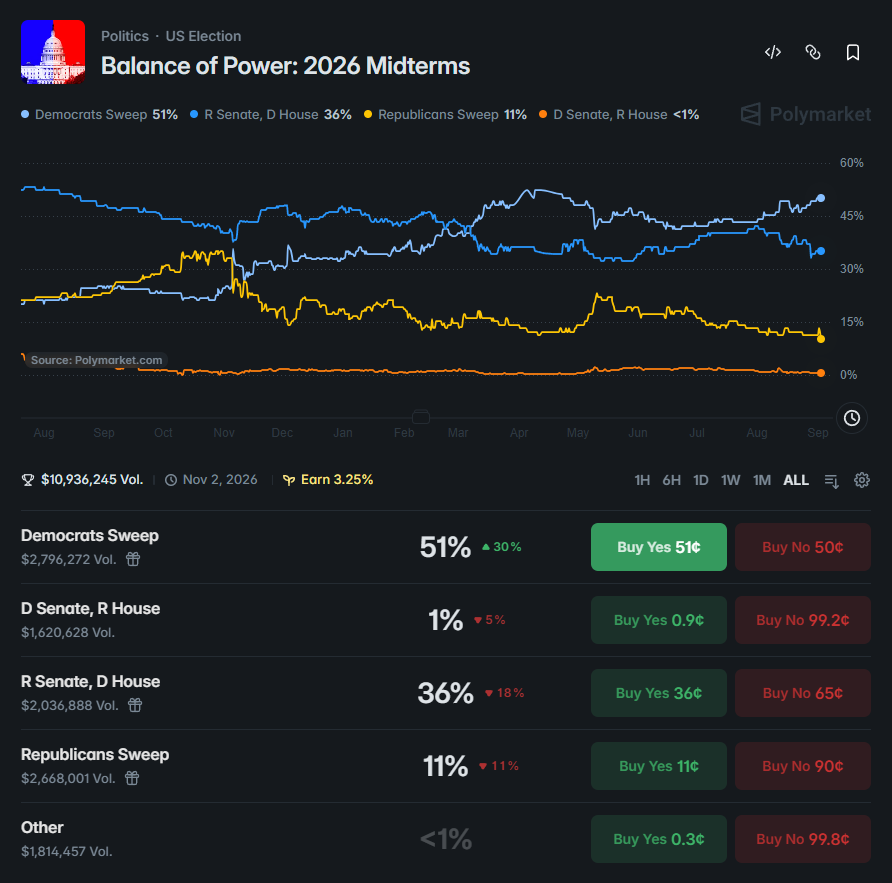
Cryptocurrency-based prediction platform Polymarket now gives Democrats better-than-even odds of sweeping both chambers of Congress in November. Trump’s approval ratings are sliding, and gas prices just hit a fresh record.
The odds have moved fast. A Democratic sweep sat at just 26% a year ago and 45% one month ago.
Democrats Gain Ground as Trump’s Support Slides
Polymarket’s 2026 midterms market, called Balance of Power, puts the odds of a Democratic sweep at 51%. The House looks decided, with Democrats holding 89% odds. The Senate is closer, with Democrats at 51%.

Republicans currently control both chambers of Congress. Elections are set for Nov. 3.
Trump’s Approval Rating Drops for A Number of Reasons
The shift tracks Trump’s sliding approval. Some surveys put his support as low as 32% to 34%.
A Financial Times and FocalData poll found most Americans say their finances have worsened under Trump. A majority of independents agreed.
A separate Reuters and Ipsos poll found Democrats now edge out Republicans on the economy. Voters split 37% to 36% in the Democrats’ favor, ending nearly a decade of Republican advantage on the issue.
Rising gas prices are adding to the pressure. The national average hit a record $4.056 a gallon in August.
That breaks the previous high of $3.940, set in 2022. The conflict with Iran keeps energy markets on edge.
Trump has defended the price spikes as a necessary cost of pushing Iran toward denuclearization. He said he would never apologize because he did the right thing.
Trump has also moved to court Venezuelan oil supply. He met with industry executives this week to try to cool prices.
Election Day is two months away. The question now is whether Republicans can reverse the slide, or whether Polymarket’s odds keep drifting toward a Democratic sweep.
The post Crypto Bettors Give Democrats 51% Odds to Sweep the Midterms appeared first on BeInCrypto.
Goldman Sachs, Jane Street Group, and Millennium Management were the three largest reported holders of spot XRP ETFs in second-quarter 13F filings, according to Bloomberg Intelligence data shared by James Seyffart on August 31.
The filings show that institutional exposure has grown alongside a sharp increase in XRP ETF inflows, even as the Ripple token itself has pulled back from its August highs.
Advisors Dominate XRP ETF Holdings
Bloomberg’s compilation puts Goldman Sachs well ahead of other reported holders, with $87.4 million in ETF exposure representing 84 million XRP. Jane Street followed with just under 16 million XRP, worth $16.6 million, while Millennium Management held 15.5 million tokens valued at about $16.2 million.
Intesa Sanpaolo ranked fourth with $14.4 million in exposure, followed by Marex UK Holdings at $8.1 million. Citadel Advisors also appeared in the filing data, although its XRP exposure fell by $645,000. But SIG Holdings recorded a much larger reduction, with its reported XRP exposure down by roughly $4.6 million.
Across the identified holders, total exposure reached $183.5 million, representing about 176.4 million XRP. Bloomberg also grouped the holders by category and found investment advisors far ahead of the other groups, with $120.9 million in exposure. Hedge fund managers accounted for $25.1 million, brokerages for $17.9 million, and banks for $14.8 million.
ETF Demand Rises While XRP Price Cools
The numbers come as demand for spot XRP ETFs has picked up, with the funds attracting $110.5 million during the week ending August 28, their strongest five-day inflow since the first week of December 2025, when they drew in more than $230 million. SoSoValue data shows another $5.6 million entered the products on August 31, taking cumulative net inflows to about $1.67 billion, with total net assets reaching roughly $1.45 billion.
Meanwhile, the token itself was trading near $1.40 at the time of writing, having hit a multi-month high of $1.70 last week. Although that price represents a nearly 9% dip over seven days, it is still 28% higher than where it was a month ago and almost 40% up from its level two weeks ago. That said, XRP’s value is still nearly half of what it was this time last year, and it is stuck approximately 62% below its all-time high of $3.65 recorded in July 2025.
Traders are now watching the $1.35 to $1.38 zone closely, since a break below could open the door to more downside, while analyst Ali Martinez fingered $1.60 as the next major resistance level were XRP to attempt another recovery.
The post These Wall Street Giants Are the Biggest Holders of Spot XRP ETFs appeared first on CryptoPotato.


Donald Trump Jr. is deepening his ties to Polymarket through a new $300 million investment from 1789 Capital, his venture firm. He also holds a paid advisory role, and equity, at rival Kalshi, giving him a stake in whichever platform wins.
1789 Capital is contributing $300 million to Polymarket’s $1 billion round, valuing the platform at $21 billion. Trump Jr. separately holds a Kalshi stake, granted in 2025 and worth $300,000 at the time, before Kalshi’s valuation climbed to $22 billion.
Advisor to Both Sides
Trump Jr. became a paid strategic advisor to Kalshi in January 2025. He joined Polymarket’s advisory board seven months later, alongside 1789 Capital’s initial investment in the platform.
The arrangement gives the president’s son financial or advisory ties to the two largest prediction market platforms in the country. Both compete for the same users and the same regulatory outcomes.
Front Office Sports flagged the dual role at the time, noting that advising two direct rivals raises its own conflict-of-interest questions. Kalshi has told CNBC that Trump Jr.’s advisory work concerns marketing strategy, not regulatory matters.
A Direct Line to Regulators
The New York Times reported that Trump Jr. privately urged Republican attorneys general to stop pursuing prediction markets. The remarks came in March, at a closed-door gathering in New Orleans. He argued that traditional gambling companies were driving the pushback to protect their own market position. The Times cited people familiar with the matter.
The Commodity Futures Trading Commission has sued nine states this year to block state regulation of prediction markets. Eight of those states have Democratic attorneys general. Arizona has gone further than most, filing criminal charges against Kalshi in March over unlicensed gambling.
Trump Jr.’s dual advisory roles sit inside that fight. Any state loss for Kalshi or Polymarket touches a business he is tied to twice over.
President Trump has separately backed the industry. He called prediction markets a new class of financial product in May. He also argued that the CFTC’s authority over them should stay intact. His son’s financial interests in both leading platforms now sit atop that same policy debate.
The post Trump Jr. Now Profits From Both Sides of the US Kalshi, Polymarket Rivalry appeared first on BeInCrypto.
Prediction market platform Kalshi says it has permanently barred two US political candidates from trading on its event contracts after compliance investigations found activity that Kalshi described as violating rules against insider influence. The actions follow a broader wave of scrutiny directed at prediction markets, including investigations tied to potential manipulation of politically sensitive markets.
In separate settlement notices announced Friday, Kalshi’s compliance team reported that it imposed a lifetime suspension and a $71,356 penalty on former Republican congressman George Santos, while Laurie Buckhout—also a Republican candidate—received a three-year trading suspension plus a $2,590 penalty. Both cases relate to contracts that Kalshi says could be influenced by the candidates’ own actions.
Key takeaways
- Kalshi reports it permanently suspended George Santos from trading on its prediction market platform and imposed a $71,356 penalty.
- Kalshi reports it suspended Laurie Buckhout for three years and imposed a $2,590 penalty.
- Both actions were tied to Kalshi findings that each person traded in markets connected to events in which they had decision-making influence, which Kalshi says its rules prohibit.
- The disciplinary steps come as prediction markets remain in the crosshairs of US state and federal regulators debating jurisdiction and market-manipulation risk.
- As of Tuesday, Kalshi still listed election-related event contracts tied to Buckhout’s North Carolina race.
Why Kalshi took action
Kalshi framed both settlements around a core compliance principle: its market rules prohibit trading by anyone who can influence the outcome of the underlying event tied to a contract. In the platform’s rules, Kalshi states that if a trader is a decision maker—or has any direct or indirect influence, “no matter the scale and importance of the influence”—on the outcome of an underlying event, the trader is prohibited from entering trades on markets for those contracts.
According to Kalshi’s disclosures, Buckhout violated this restriction by trading around event contracts connected to her own political race. Kalshi said Buckhout announced her candidacy in North Carolina’s 1st congressional district and that she was subsequently added as an option for a contract tied to the outcome of the congressional election.
For Santos, Kalshi said its investigation found he engaged in trading activity in certain markets related to his attendance at the State of the Union address in February 2026—again, a scenario Kalshi characterized as falling under its prohibition on trading when the trader can influence the underlying event.
Penalties, suspensions, and what Kalshi said about cooperation
Kalshi’s compliance department reported the settlements in two documents published with its regulatory notices. For Santos, Kalshi said the disciplinary action took the form of a permanent suspension from trading on Kalshi markets, accompanied by a $71,356 penalty. For Buckhout, Kalshi reported a three-year suspension and a $2,590 penalty.
Kalshi’s notices also included differing language about cooperation. In Buckhout’s case, Kalshi stated that she “cooperated with the inquiry” and agreed to the three-year trading ban and penalty. In Santos’ case, Kalshi did not similarly state that he cooperated with its investigation, leaving an important procedural detail unaddressed in the company’s public notice.
These measures are notable because they represent one of the first lifetime bans Kalshi has imposed since the platform’s launch in 2021, according to the article’s framing. For participants who trade on event contracts, the message from Kalshi’s compliance team is that the company intends to treat “influence” broadly—especially when the underlying event is tied to a person’s public role or political activity.
Prediction markets face escalating political and regulatory scrutiny
The Kalshi actions arrive at a moment when prediction market platforms are under intensified review from both state and federal lawmakers. The underlying concern is not simply whether markets are speculative, but whether certain contracts are vulnerable to manipulation when insiders can affect outcomes.
Earlier this year, the issue was highlighted by federal action involving Kalshi-tied event contracts. According to the article, President Donald Trump’s teleprompter operator, Gabriel Perez, was fined $172,000 by US regulators after trading event contracts on Kalshi related to Trump’s speeches. That case underscores how regulatory attention can focus on politically linked markets—particularly where traders may have privileged access or ability to impact the event that drives settlement.
More broadly, Kalshi and other prediction market platforms—including Polymarket—have faced lawsuits brought by individual state gaming authorities alleging that the platforms facilitate illegal betting on sporting events. At the same time, the chair of the US Commodity Futures Trading Commission (CFTC), Michael Selig, has argued that the CFTC has “exclusive jurisdiction” over prediction markets and has said the agency will take legal action against states that challenge that position.
Last month, the CFTC invoked emergency authority in response to New York’s attempt to block Kalshi from offering contracts tied to sports, elections, and other events, according to the cited coverage. This ongoing jurisdictional dispute is part of the larger fight over how US regulators classify prediction markets and who has the authority to regulate them.
Where the candidates stand after the settlement
Kalshi’s sanctions are tied to trading behavior, but they also intersect with ongoing political campaigns. The notices indicate Buckhout remains a Republican candidate for North Carolina’s 1st congressional district in the 2026 midterm elections, while Santos was previously expelled from Congress in December 2023 amid fraud allegations.
After Kalshi’s settlement was announced, Santos said on X that Kalshi was an “unserious company.” Buckhout, according to reported comments, characterized her actions as a “dumb mistake.” While those reactions provide political context, what matters for traders and users is Kalshi’s clear enforcement of its own rules against trading while influencing underlying event outcomes.
Importantly for market participants, Kalshi still lists event contracts tied to the outcome of Buckhout’s North Carolina race. As of Tuesday, the platform reportedly showed Democratic incumbent Don Davis at a 63% chance versus Buckhout at 41%—meaning the settlement does not appear to have removed the election market itself, only restricted Buckhout’s trading access.
Readers should watch how Kalshi continues to handle conflicts of interest in politically linked contracts, and whether regulators—especially the CFTC—treat these enforcement actions as evidence that prediction markets need stronger compliance guardrails or as support for the company’s broader regulatory stance. The next signals to monitor are additional disciplinary notices and any new court activity that could reshape how prediction markets are governed in the US.


Pantera Capital founder Dan Morehead calls the US Treasury’s expanded bond buyback plan a bluff that backfired. He ties Bitcoin’s 26% August rally directly to it.
Speaking on Bloomberg Crypto, Morehead argued investors saw through Treasury Secretary Scott Bessent’s move almost immediately.
The Buyback That Backfired
On August 19, Bessent doubled the Treasury’s bond buybacks to ease borrowing costs. The program lets the government repurchase its own debt to influence bond yields. The cap rose to at least $4 billion per operation.
Morehead said the increase looked tiny against the $2 trillion in bonds the Treasury must sell every year. Highlighting the gap, he argued, only exposed the depth of the debt problem rather than solving it.
“It backfired because everyone could see they are off by three orders of magnitude.”
Dan Morehead, Pantera Capital founder, Bloomberg
Bitcoin’s Best August Since 2021
Bitcoin climbed 26% in August, its strongest month since November 2025. It marked the first net positive August since 2021, briefly topping $81,000. BTC traded near $77,258 at press time, per BeInCrypto data.
Fed Chair Kevin Warsh struck a different tone at Jackson Hole. He argued stronger growth could lift rates and reduce the appeal of yield-free assets like bitcoin. Both gold and Bitcoin retreated after the speech, giving Morehead’s bullish debt thesis its clearest pushback yet.
Morehead called crypto a macro trade that benefits whenever governments keep expanding debt. He pointed to Pantera’s call that Bitcoin would peak at $117,542 on August 10, 2025, a forecast that held. He argued the same four-year cycle model now points to another leg higher once this pullback ends.
Bitcoin peaking on the exact day Pantera called years earlier means the current pullback fits the same script, according to Morehead. He said the pattern has held for the 13 years his fund has tracked it.
Morehead expects a new upswing to begin near the end of this year, followed by another two to three year run.
The post Pantera's Dan Morehead Calls Bessent's Bond Buyback a ‘Bluff' That Backfired appeared first on BeInCrypto.


A two-month-old Layer 2 built by a stock brokerage is now processing more daily decentralized exchange volume than chains that have existed for years, and the market is only beginning to pay attention.
Summary
- Robinhood Chain recorded roughly $945 million in daily decentralized exchange volume on Aug. 25, 2026, a new all-time high for the network and nearly double its previous record of $563 million set on July 8.
- The chain, which launched its public mainnet on July 1, has processed more than $47 billion in cumulative DEX volume in under two months, placing it fifth among all chains by 30-day volume at $15 billion.
- Uniswap serves as the dominant trading venue on the chain, and cumulative tokenized stock volume through Uniswap surpassed $1 billion by Aug. 21.
- Total value locked on Robinhood Chain surged from $4 million in June to roughly $1.4 billion by late August, a trajectory that no Ethereum Layer 2 has matched at this stage of its lifecycle.
- The 90-day gas subsidy that covers transaction fees through the end of September 2026 raises a central question: whether volume holds once users start paying for their own trades.
How Robinhood built a top-five chain in 56 days
Robinhood Chain is an Ethereum Layer 2 built on Arbitrum Orbit, the chains-as-a-service framework that runs on the Nitro stack. It settles directly to Ethereum and uses Ethereum blobs for data availability. Block times run at 100 milliseconds, faster than Arbitrum One at 250 milliseconds and Monad at 300 milliseconds. The gas token is ETH.
The mainnet went live on July 1 at Robinhood’s “The World is Flat” keynote at the Old Royal Naval College in London. Within eight days, Uniswap swap volume on the chain had reached $500 million. By July 11, the chain was processing 7.6 million daily transactions and had recorded $3.1 billion in DEX volume in its first week alone.
By the end of July, Robinhood Chain had topped Ethereum in 24-hour application revenue. It had briefly surpassed Base in daily active users, logging 324,000 wallets against Base’s 275,000 on July 21. And it had placed itself in the top five chains globally by 30-day DEX volume, sitting behind Solana, BNB Chain, Ethereum, and Base with roughly $15 billion in monthly throughput.
For context, Arbitrum One’s 30-day DEX volume during the same period was roughly one-quarter of that figure. Robinhood Chain, using the same underlying technology, was running four times the volume of the chain it forked from.
The volume breakdown: what is actually trading
The Aug. 25 record was not driven by a single asset class. Three distinct categories of activity converged on the same day.
The first was memecoin speculation. Pons, a token launched through the chain’s launchpad ecosystem, accounted for roughly half of all DEX volume at its peak. CASHCAT, Robinhood Chain’s first breakout memecoin, had previously hit a $156 million market cap before Pons overtook it in late July. On Aug. 30, Pons alone contributed $445 million of the chain’s $874.8 million in volume that day, demonstrating the degree to which a single venue can dominate chain-level metrics.
The second was tokenized equities. Robinhood launched Stock Tokens as a flagship product at mainnet, offering ERC-20 representations of stocks like NVIDIA, Apple, GameStop, and SpaceX that trade around the clock in more than 120 countries. These tokens give holders economic exposure to the underlying stock rather than legal ownership of shares. By Aug. 21, cumulative tokenized stock volume through Uniswap had surpassed $1 billion. A tokenized Nasdaq-100 tracker called QQQB drove 288 percent of July’s tokenized equity volume, suggesting heavy concentration in index products.
The third was leveraged derivatives. Arcus launched pTokens on Aug. 25, wrapping leveraged perpetual accounts into transferable ERC-20 tokens including pBTC3x and pHOOD3x. The platform also began accepting tokenized stock collateral at a 50 percent loan-to-value ratio, creating a direct bridge between equity exposure and leveraged crypto trading that has no equivalent on any other chain.
The timing of the Aug. 25 spike also mattered. Bitcoin had rallied sharply since Aug. 17 on what Bloomberg called a record $2.7 billion wave of short liquidations, the largest since records began in 2021. A White House crypto meeting and a U.S. Treasury move to double long-dated bond buybacks added fuel. Bitcoin reached near $81,500 and Ether gained nearly 29 percent in a single week. That macro tailwind lifted activity across every chain, but Robinhood Chain captured a disproportionate share because its zero-fee environment made it the path of least resistance for traders looking to rotate quickly between assets.
The stablecoin layer underneath the trading activity tells its own story. Stablecoin market capitalization on Robinhood Chain reached $640 million by late August, with USDe from Ethena accounting for the bulk of inflows. Robinhood Earn, a decentralized lending product launched alongside the mainnet, offers an estimated 7 percent yield on USDG, the stablecoin developed in partnership with Paxos. The yield product serves as an anchor for capital that might otherwise leave the chain between trading sessions, giving the ecosystem a retention mechanism that pure trading chains typically lack.
The infrastructure advantage Robinhood brought to the table
Most Layer 2 networks launch with a technical thesis and then spend months or years trying to attract users. Robinhood reversed the sequence. The company brought 27 million funded brokerage accounts, an existing mobile wallet, a compliance infrastructure built over a decade of regulatory engagement, and a brand that, whatever crypto natives think of it, is synonymous with retail trading for an entire generation of investors.
CEO Vlad Tenev framed the ambition in a recent interview: “Crypto is becoming the infrastructure that powers financial markets.” On Aug. 7, he described Robinhood Chain as the fastest-growing chain in history, noting that it reached 100 million cumulative transactions faster than any other network. Bitmine Chairman Tom Lee separately called the launch “one of the biggest crypto success stories” of 2026.
The revenue model also differs from most Layer 2 networks. Under the Arbitrum Expansion Program, 8 percent of chain revenue goes to a treasury controlled by governance token holders and 2 percent funds a developer guild. Robinhood keeps the rest. In July alone, the chain generated roughly $3.6 million in transaction fees, making it the top revenue-producing Layer 2 across the entire Ethereum ecosystem at 38 percent of the estimated $6.3 million in total L2 fees collected that month.
The company’s Q2 2026 earnings, reported on July 29, showed total revenue of $1.31 billion, beating Wall Street estimates. Net income rose 48 percent year over year to $573 million. Robinhood is not a startup hoping its chain will subsidize losses. It is a profitable company with a stock trading above $100 that can afford to invest in chain infrastructure without needing the chain itself to be immediately profitable.
The gas subsidy question
The single most important variable in Robinhood Chain’s near-term trajectory is the 90-day gas fee subsidy that covers all transaction costs through the Robinhood Wallet. The promotional period, which began at mainnet launch on July 1, runs through approximately Sept. 29, 2026.
In mid-August, Robinhood reduced the subsidy threshold from $5 per transaction to $0.50, a 90 percent cut that suggests the company is already tapering the benefit rather than cutting it off all at once. The move signals a gradual transition rather than a cliff.
But the subsidy has clearly inflated activity metrics. When transactions cost nothing, the friction that normally separates casual browsing from actual trading disappears. The 16,000 new tokens created daily at peak memecoin activity in July were possible in part because launching a token was free. The 5.5 million daily transactions on Aug. 25 included activity that would not have occurred at even minimal gas costs.
The precedent from other chains is mixed. Base launched with heavily subsidized gas and retained strong activity after costs normalized, in part because Coinbase’s distribution kept funneling users to the network. Blast, by contrast, saw activity crater after its incentive programs wound down. The question for Robinhood Chain is whether the brokerage’s 27 million accounts provide a durable demand floor that subsidies merely accelerated, or whether the subsidy itself created demand that will not survive its removal.
There is a middle scenario that the binary framing obscures. Volume could fall significantly from the Aug. 25 peak and still leave Robinhood Chain as a top-ten chain by DEX activity. A 60 percent drop from $945 million would still produce roughly $380 million in daily volume, which would place it ahead of most Layer 2 networks even without subsidies. The relevant question is not whether volume declines after the subsidy ends, because it almost certainly will, but whether the floor is high enough to sustain the ecosystem’s economic model.
The corporate chain land grab
Robinhood Chain did not launch into a vacuum. It entered a market where every major financial technology company appears to be building its own chain. Coinbase has Base. Stripe acquired Bridge and is building payment infrastructure on it. Circle launched a new standard for stablecoin interoperability. Robinhood followed with its own Arbitrum-based rollup.
The pattern is clear: consumer fintech companies have concluded that owning the execution layer is more valuable than renting space on someone else’s chain. The economics are straightforward. A chain operator captures sequencer revenue, controls the fee schedule, and can subsidize specific types of activity to drive adoption. A tenant on another chain pays whatever fees the market demands and has no control over the user experience at the infrastructure level.
The comparison to Base is instructive. Base launched in August 2023 and has had three years to build its ecosystem. Its total value locked stands at roughly $5.47 billion as of late August 2026, compared to Robinhood Chain’s roughly $1.4 billion. Base processes more daily transactions on average. But Robinhood Chain closed the gap on several metrics in weeks rather than years, briefly surpassing Base in daily active users and consistently ranking within striking distance on DEX volume.
The difference is maturity versus momentum. Base has accumulated three years of liquidity, developer tooling, and protocol deployments. Robinhood Chain has a brokerage with 27 million accounts and a product, tokenized equities, that no other chain offers at the same scale.
The DEX-to-CEX ratio and what it means
Robinhood Chain’s volume spike arrived during a broader structural shift in crypto trading. In July 2026, decentralized exchanges handled spot volume equal to 24.14 percent of centralized exchange volume, the highest ratio since The Block began tracking the metric in 2019. The ratio has roughly tripled in under three years, rising from below 10 percent for most of 2024 to its current level.
The irony is that the shift is being driven in part by centralized companies. Robinhood, a centralized brokerage, is routing volume through a decentralized exchange layer. Coinbase, a centralized exchange, is doing the same through Base. The line between centralized and decentralized finance is blurring in ways that do not fit neatly into the narratives that either side prefers.
For Robinhood specifically, the chain creates a flywheel that its centralized app cannot replicate. Stock Tokens traded on Uniswap generate fees that flow back to the Robinhood Chain ecosystem. Users who start with tokenized equities discover memecoin trading, lending protocols, and leveraged products. The chain becomes a surface area for financial experimentation that a regulated brokerage app cannot legally offer through its primary interface.
This is the strategic logic that the market has largely missed. Robinhood Chain is not a marketing exercise. It is a mechanism for Robinhood to offer products and services that its regulated brokerage cannot provide directly, while still capturing economic value from the activity.
The concentration risk
The bull case for Robinhood Chain is compelling, but the data also reveals structural vulnerabilities that the headline volume numbers obscure.
On Aug. 30, a single protocol, Pons, generated 51 percent of the chain’s $874.8 million in daily volume. When one venue does half of all throughput, the chain’s activity metrics become a proxy for that venue’s performance rather than a measure of ecosystem health. If Pons loses momentum, the chain’s volume numbers could drop by half overnight without any change to the underlying infrastructure.
The tokenized equity market, while growing, remains concentrated as well. QQQB, a single Nasdaq-100 tracker, drove the majority of July’s tokenized stock volume. A dozen stocks clear at least $500,000 in daily volume, but the breadth of adoption is still narrow relative to the potential market.
Total value locked tells a similar story. Robinhood Chain’s TVL has surged to $1.4 billion, but this remains roughly one-quarter of Base’s $5.47 billion. The chain’s TVL-to-volume ratio is unusually high, meaning it generates more trading activity per dollar locked than most chains. That can be read as capital efficiency or as evidence that volume is being amplified by zero-cost transactions and speculative turnover rather than deep, sticky liquidity.
Stock Tokens also remain unavailable to U.S. residents, which excludes the majority of Robinhood’s 27 million funded accounts from the chain’s flagship product. The addressable market for tokenized equities is currently limited to users outside the United States, a significant constraint on growth.
The reflexive fee structure on Pons adds another layer of fragility. Eighty percent of the protocol’s fees fund automated token buybacks and burns. By Aug. 29, 29 percent of the original one billion token supply had been retired. That mechanism creates a self-reinforcing loop in rising markets: higher volume generates more fees, which fund more burns, which reduce supply, which pushes prices higher, which attracts more volume. In falling markets, the same loop works in reverse. Volume drops, burns slow, the supply compression narrative weakens, and traders move to the next opportunity. Chains built on reflexive tokenomics tend to experience sharp drawdowns when sentiment shifts.
What Robinhood Chain means for Ethereum
Robinhood Chain settles to Ethereum. Every transaction on the chain ultimately posts data to the Ethereum mainnet through blobs. This means that Robinhood Chain’s activity, all $47 billion of it, contributes to Ethereum’s security budget and reinforces the network’s role as a settlement layer.
For Ethereum, the emergence of corporate-backed Layer 2 networks is a double-edged development. On one side, chains like Robinhood and Base bring millions of users into the Ethereum ecosystem who would never interact with the mainnet directly. They generate blob fees, consume blockspace, and create economic gravity around ETH as a gas token.
On the other side, these chains capture most of the value at the execution layer. Robinhood keeps the bulk of sequencer revenue, sharing only 10 percent with the Arbitrum ecosystem. The users on Robinhood Chain may never know or care that Ethereum exists underneath. The settlement layer becomes invisible infrastructure, essential but unrewarded relative to the activity it supports.
This dynamic is already visible in the fee data. Robinhood Chain surpassed both Ethereum and Base in 24-hour application revenue on Aug. 31, recording $2.66 million. The chain built on Ethereum is generating more application-level revenue than Ethereum itself on certain days.
The tension between Layer 2 growth and Layer 1 value capture is not unique to Robinhood Chain, but the scale makes it unusually visible. Ethereum’s blob fee revenue from all Layer 2 networks remains a small fraction of what those networks generate in sequencer revenue. The argument that Layer 2 activity is inherently good for Ethereum depends on the assumption that demand for blob space will eventually drive meaningful fee revenue back to the mainnet. At current utilization levels, that assumption remains unproven. Robinhood Chain’s success makes the question more urgent without answering it.
The September test
The gas subsidy expires at the end of September. Between now and then, several developments will clarify whether Robinhood Chain’s trajectory is sustainable.
Arcus is expanding its leveraged product suite, adding new pToken pairs and increasing collateral types. If leveraged trading generates durable volume independent of the gas subsidy, it would suggest that the chain has found a product-market fit that goes beyond free transactions.
The DTCC is scheduled to launch tokenized securities infrastructure in October, which could either validate or undermine Robinhood’s first-mover advantage in tokenized equities. If institutional players enter the market with competing infrastructure, the value proposition of Stock Tokens may shift.
And Robinhood itself will face a decision about whether to extend, modify, or eliminate the gas subsidy. The company’s financial position gives it the flexibility to continue subsidizing transactions if it believes the long-term economics justify the cost. With $573 million in quarterly net income, a few million dollars in gas subsidies is a rounding error on the income statement.
What to watch
What is Robinhood Chain?
Robinhood Chain is an Ethereum Layer 2 blockchain built on Arbitrum Orbit technology. It launched its public mainnet on July 1, 2026, and uses ETH as its native gas token. The chain settles directly to Ethereum and features 100-millisecond block times. Its flagship products include tokenized Stock Tokens, decentralized exchange trading through Uniswap, and lending through protocols like Morpho.
How much DEX volume does Robinhood Chain process?
On Aug. 25, 2026, Robinhood Chain recorded roughly $945 million in daily decentralized exchange volume, a new all-time high. The chain has processed more than $47 billion in cumulative DEX volume since launching on July 1. Its 30-day volume of approximately $15 billion places it fifth among all blockchain networks, behind Solana, BNB Chain, Ethereum, and Base.
What are Stock Tokens on Robinhood Chain?
Stock Tokens are ERC-20 tokens that track the price of publicly traded equities like NVIDIA, Apple, GameStop, and SpaceX. They give holders economic exposure to the underlying stock rather than legal ownership of shares. Stock Tokens trade around the clock in more than 120 countries through decentralized exchanges like Uniswap on Robinhood Chain. They are currently unavailable to U.S. residents.
Is there a Robinhood Chain token?
No. Robinhood has not issued a native governance or utility token for Robinhood Chain. The network uses ETH for gas fees. While several community-created tokens like CASHCAT and PONS trade on the chain, none of these are officially affiliated with Robinhood.
How does Robinhood Chain compare to Base?
Base, built by Coinbase, launched in August 2023 and has roughly $5.47 billion in total value locked compared to Robinhood Chain’s $1.4 billion. Base processes more daily transactions on average and has a more mature ecosystem of developer tools and protocols. However, Robinhood Chain closed the gap on several metrics within weeks, briefly surpassing Base in daily active users and ranking within striking distance on daily DEX volume.
What is the gas subsidy on Robinhood Chain?
Robinhood covers transaction fees for users trading through the Robinhood Wallet on Robinhood Chain. This 90-day promotional period began at mainnet launch on July 1 and runs through approximately Sept. 29, 2026. In mid-August, Robinhood reduced the subsidy threshold from $5 to $0.50 per transaction, signaling a gradual taper rather than an abrupt cutoff.
Who can use Robinhood Chain?
Robinhood Chain is a permissionless Ethereum Layer 2, meaning anyone with a compatible wallet can interact with it. However, the tokenized Stock Tokens product is available in more than 120 countries but is not available to U.S. residents. Other DeFi products on the chain, including decentralized exchange trading and lending, are accessible to users globally through wallets like Robinhood Wallet, MetaMask, and others.
How does Robinhood make money from the chain?
Robinhood captures sequencer revenue from transactions processed on the chain. Under the Arbitrum Expansion Program, 8 percent of chain revenue goes to a treasury controlled by Arbitrum governance token holders and 2 percent funds a developer guild. Robinhood retains the remaining 90 percent. In July 2026, the chain generated roughly $3.6 million in transaction fees, making it the top revenue-producing Layer 2 in the Ethereum ecosystem.
Disclaimer: This article is for informational purposes only and does not constitute financial advice. Always do your own research before making investment decisions. Information is accurate as of Aug. 31, 2026.
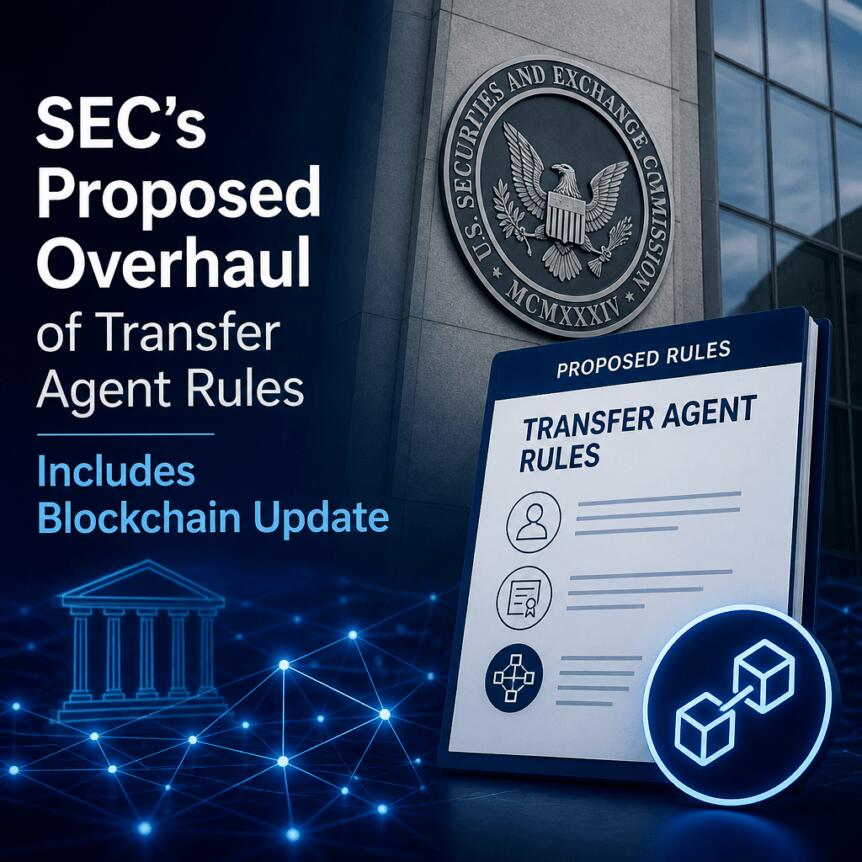
The U.S. Securities and Exchange Commission (SEC) has unveiled a proposal to modernize the rules that govern transfer agents—an increasingly consequential part of the securities market as recordkeeping and issuance infrastructure shifts toward digital and tokenized workflows.
In a filing released as a proposed rule change, the SEC said it wants to update long-standing requirements around transfer agent registration, recordkeeping, safeguarding, and securities transfer operations. The agency also aims to address risks it believes have grown with more automated and blockchain-influenced market infrastructure.
Key takeaways
- The SEC’s proposal would update transfer agent rules to better accommodate “onchain” or blockchain-native recordkeeping models.
- Transfer agents would face expanded reporting and new compliance standards, including requirements tied to restrictive legends and third-party service providers.
- The SEC said its current framework has not been substantively updated since the late 1970s and early 1980s, when paper-based processes dominated.
- The proposal is open for public comment, with deadlines set 60 days after publication in the Federal Register.
- The transfer agent effort aligns with a broader SEC push to adjust securities rules as custody and reporting frameworks are also under review.
Why transfer agent rules are being revisited
Transfer agents play a central role in the lifecycle of securities by maintaining records, facilitating transfers, and helping ensure that ownership and related documentation are handled correctly. The SEC’s proposal argues that the existing regulatory approach no longer fits how market participants are increasingly seeking to operate.
According to the SEC, market participants are actively working to bring blockchain-native transfer agent models to the U.S. market. The agency pointed to systems built around distributed or blockchain-based recordkeeping, tokenized fund administration, and cross-chain interoperability as examples of where current rules may fall short.
The SEC said the current framework does not adequately address newer threats and operational challenges, particularly around cybersecurity, operational resilience, and how securities and investor records should be safeguarded when the underlying infrastructure becomes more digital and automated.
A rules overhaul designed for digital workflows
The SEC’s proposed changes target multiple areas of transfer agent operations. While the filing covers several categories—registration, recordkeeping, safeguarding, and transfers—it also introduces more specific compliance expectations intended to match evolving market mechanics.
The agency said the rule package would expand reporting requirements and introduce new compliance standards. Among the operational elements flagged by the SEC are rules relating to restrictive legends on securities and how transfer agents manage the use of third-party service providers.
For market participants, the practical implication is that transfer agents operating in environments that include automation and digital systems—whether blockchain-based or otherwise—would likely need to reassess controls, documentation practices, and vendor oversight. The SEC’s emphasis on safeguarding investor records signals that documentation integrity and security processes would be a focal point for regulators and for regulated firms when compliance is implemented.
From paper-era regulation to modern security requirements
In the proposal, the SEC explicitly frames the update as long overdue. The agency said its transfer agent rules have not been substantively updated since the late 1970s and early 1980s, when paper certificates and manual recordkeeping were far more common.
This historical gap matters because transfer agent modernization isn’t just a technical upgrade—it can reshape how issuers, broker-dealers, funds, and intermediaries coordinate ownership records. As the market moves toward tokenized products and automated infrastructure, regulators face a policy choice: either treat these developments as operating outside the intent of older rules, or update the regulatory framework so it maps clearly to how transactions and recordkeeping actually work.
The SEC is clearly choosing the latter approach with this proposal, arguing that the existing rules do not sufficiently cover the risk profile that accompanies more digital, interconnected, and software-driven workflows.
What the comment period means for the industry
The proposal is now subject to public comment. The SEC said comments are due 60 days after the rule is published in the Federal Register.
That comment window is likely to be important for developers and regulated entities that are designing “onchain” or blockchain-adjacent transfer agent architectures, as well as for compliance teams that will need to interpret how the proposed requirements apply to real-world operational setups—especially where third parties are involved or where data integrity and cybersecurity controls are central to safeguarding records.
Interested parties will also watch how the SEC balances innovation goals against its stated concerns around operational resilience. In practice, guidance on what constitutes adequate resilience and safeguarding in a more automated environment will affect project timelines, operational costs, and risk management frameworks.
Broader SEC momentum on securities infrastructure
This transfer agent proposal sits within a wider pattern of SEC rulemaking aimed at updating securities-related infrastructure and compliance expectations. According to an analysis provided to clients by law firm Cahill Gordon & Reindel, the SEC has been “on a mission to simplify its rules.” The analysis referenced three major changes the SEC proposed in May to public-company reporting rules, including allowing companies to opt for semiannual reporting, simplifying the filer classification system, and expanding access to streamlined registered securities offerings.
Separately, Cointelegraph previously reported that the SEC sent a proposed overhaul of custody rules for investment advisers and investment companies to the White House for review. While that custody effort addresses a different part of the market than transfer agents, both proposals share a common regulatory concern: clarifying standards for how digital or tokenized assets and records should be handled while remaining compliant with federal securities laws.
For investors and market operators, these overlapping efforts indicate that the SEC is trying to modernize the rules governing not only what gets reported, but also how the plumbing of ownership, custody, and transfer is managed—especially as blockchain-based and tokenized approaches become more visible in U.S. markets.
Readers should watch the SEC’s final wording after the comment process, particularly how it defines compliance expectations for third-party service providers, restrictive legends, and safeguarding obligations in digitally mediated transfer and recordkeeping systems.


XRP rallied 37% in August on a wave of record ETF inflows. The market is pricing momentum. It is not pricing the Sept. 11 mainnet upgrade that hardens Vaults, AMMs, and the Lending Protocol for institutional use.
Summary
- XRP gained 37% in August 2026, its strongest month of the year and the third best August in the token’s history, trailing only 2021 and 2017
- Spot XRP ETFs pulled in $110.49 million during the week ending Aug. 28, a record weekly haul that pushed cumulative net inflows past $1.66 billion
- RLUSD, Ripple’s regulated stablecoin, crossed $1 billion in circulating supply on the XRP Ledger alone, accounting for 82% of all XRPL stablecoin activity
- The fixCleanup3_3_0 amendment, carrying stability patches for Single Asset Vaults, the Lending Protocol, and Automated Market Makers, reached 82.86% validator consensus and could activate on mainnet as early as Sept. 11
- Tokenized real world assets on the ledger grew to $4.34 billion, a nearly 60x increase in under two years, while the XRPL EVM sidechain holds just $25,741 in TVL
The anatomy of a 37% month
August began badly. XRP fell 6.8% in the first two weeks, touching a yearly low of $0.9874 on Aug. 15. The selloff was part of a broader risk off move driven by a strengthening yen carry trade unwind and weak manufacturing data out of China. XRP, like most altcoins, bled into stablecoin pairs on Korean and offshore exchanges.
The reversal began on Aug. 18 and accelerated through Aug. 22. Three catalysts fired in sequence.
First, the U.S. Treasury announced an expansion of its bond buyback program, signaling that liquidity conditions would remain accommodative through the end of the year. Risk assets across the board caught a bid.
Second, Ripple CEO Brad Garlinghouse attended a White House crypto policy summit on Aug. 19 alongside SEC Chairman Paul Atkins. The meeting advanced discussions around the CLARITY Act, which would classify XRP as a digital commodity under CFTC oversight. Though the Senate left Washington on Aug. 8 without voting on the bill, CFTC Chair Mike Selig announced that a market structure framework for crypto would proceed with or without legislation.
Third, on chain data revealed massive whale repositioning. CryptoQuant showed that wallets moving more than one million XRP accounted for 55.3% of all Binance outflows during the week. The exchange supply ratio dropped to 0.03, suggesting large holders were moving tokens into cold storage rather than preparing to sell.
The result was a move from $1.00 to $1.69 in less than a week. XRP briefly touched its six month high before retreating to the $1.35 to $1.50 range as profit taking set in. Still, the 37% monthly gain places August 2026 as the third strongest August in XRP’s recorded history, behind only 2021 (58.9%) and 2017 (45.2%).
For a month that historically averages a 0.43% return, that performance is statistical noise turned into signal. The question is whether August was a one off catch up trade or the beginning of a repricing that reflects what has been building on the network all year.
ETF inflows are telling a different story than the price
The most striking feature of August was not the rally itself but the behavior of spot XRP ETF investors. During the week ending Aug. 28, the seven U.S. listed spot XRP ETFs recorded $110.49 million in net inflows, their strongest weekly haul of 2026 by a wide margin. The previous record, set in mid May, was $60.5 million.
That surge pushed cumulative net inflows past $1.66 billion, with total net assets climbing to $1.44 billion across all funds. Trading activity spiked alongside it, with $363.03 million in weekly volume, the busiest stretch since these products launched in November 2025. For the full month, XRP ETFs recorded $723 million in combined trading volume, a new all time monthly record.
But here is the divergence that makes these flows unusual. As of Aug. 29, XRP traded near $1.38, down 2.3% over 24 hours and 7.8% for the week. ETF investors were buying into a falling price, not chasing momentum. That pattern, accumulation during weakness, is more commonly associated with institutional positioning than retail speculation.
Bitwise’s XRP ETF led the charge with $125 million in single day trading volume on Aug. 20, beating its prior record by 42%. Goldman Sachs disclosed significant XRP ETF positions in its latest quarterly filing. These are not retail day traders buying a breakout. These are allocators building positions that suggest a longer time horizon than the current news cycle.
The question the market has not answered is what those allocators see. The most obvious explanation is the regulatory clarity trade: if XRP receives formal commodity classification through the CLARITY Act or through CFTC rulemaking, the token becomes eligible for a much wider universe of institutional products. But there may be a second thesis embedded in those flows, one that has nothing to do with Washington and everything to do with what is happening on chain.
RLUSD crossed $1 billion and nobody noticed
On Aug. 28, the circulating supply of RLUSD on the XRP Ledger reached $1,024,222,594. That milestone makes RLUSD the dominant stablecoin on XRPL by a wide margin, accounting for 82% of the ledger’s entire stablecoin market. Total RLUSD supply across all chains hit $2.08 billion, the first time the stablecoin crossed the $2 billion threshold since its launch in December 2024.
The growth trajectory is difficult to ignore. At the end of Q1 2026, RLUSD supply on XRPL was roughly $190 million. By the end of Q2, it had climbed to $676.9 million, a 257% increase in one quarter. Ripple minted more than $540 million on the XRP Ledger over the past 30 days alone.
RLUSD is not competing with Tether or Circle for retail stablecoin volume. It is a compliance native instrument designed for institutional settlement. Japan’s Financial Services Agency approved RLUSD as an electronic payment instrument under the Payment Services Act on June 25, with distribution through SBI VC Trade. Ripple received preliminary MiCA authorization in Luxembourg on June 23, opening access across the European Economic Area.
The settlement numbers back this up. The XRP Ledger settled $159.9 billion in the first half of 2026. RLUSD generated approximately $9 billion in transfer volume, accounting for 90% of all stablecoin volume on XRPL. Daily transactions on the ledger hit 3 million on March 15, three times mid 2025 averages, driven by AMM pools, tokenized assets, and RLUSD denominated settlement flows.
This is the part of the XRP story that most price analysis misses entirely. The ledger is not waiting for DeFi to arrive. It is already processing institutional volume at scale. What it needs is for the infrastructure underneath that volume to become production grade.
The Sept. 11 upgrade that nobody is talking about
On Aug. 28, the fixCleanup3_3_0 amendment reached 82.86% validator consensus, with 29 of 35 trusted validators voting yes. If that majority holds for the required 14 day activation window, the amendment will go live on mainnet on Sept. 11.
The name is intentionally boring. This is not a feature release. It is a stability patch, a bundle of bug fixes that harden three financial primitives that launched with known edge cases: Single Asset Vaults, the Lending Protocol, and Automated Market Makers.
The specific fixes matter because they address the kinds of bugs that keep institutional money on the sidelines.
For AMMs, the amendment corrects precision loss during deposits, withdrawals, and clawbacks. It prevents an AMM from being deleted through an unauthorized transaction type. It fixes a divide by zero error in a specific AMMWithdraw calculation. It ensures that AMM liquidity is correctly accounted for in order book calculations. These are not theoretical vulnerabilities. They are rounding errors and edge cases that could cost real money in production.
For Vaults and the Lending Protocol, the amendment adds precision and rounding fixes that prevent failed transactions from incorrectly modifying Permissioned Domains. It unifies freeze and deep freeze checks for transfers involving pseudo accounts.
The amendment also addresses hybrid offers that disappear from permissioned order books and prevents invalid actions involving pseudo accounts.
None of this is glamorous. But consider what it means in practical terms. Before fixCleanup3_3_0, a fund that wanted to deposit into a Single Asset Vault on XRPL would need to account for the possibility that a rounding error could misstate their position. A market maker providing AMM liquidity would need to accept that certain withdrawal sequences could produce incorrect calculations. A lending desk would need to build workarounds for a protocol that could incorrectly modify domain permissions on a failed transaction.
After Sept. 11, assuming activation holds, those edge cases go away. The DeFi primitives on XRPL move from experimental to production ready. That is the transition that ETF allocators may already be positioning for.
The institutional DeFi thesis
The XRP Ledger is building something unusual in the crypto landscape: compliance native DeFi rails aimed at banks, funds, and treasury desks rather than retail speculators.
This explains an apparent contradiction in the data. The XRPL EVM sidechain, which launched in June 2025 to bring Ethereum compatible smart contracts to the XRP ecosystem, holds just $25,741 in total value locked as of July 14. Its largest protocol holds approximately $12,000. One protocol recorded $95,008 in cumulative volume over an entire year.
One year of the XRPL EVM sidechain: what $600M to $12B in promised TVL actually delivered
By any DeFi metric, that is a failure. But the failure reveals something important about where demand actually sits. The EVM sidechain assumed that XRPL needed programmability to attract capital. The data suggests the opposite. The ledger’s actual demand is institutional settlement, and institutional settlement does not need an EVM sidechain with proof of authority consensus and a bridge. It needs native financial primitives that work correctly, with compliance controls built into the protocol layer.
That is precisely what the fixCleanup3_3_0 amendment delivers. Permissioned order books with correct freeze behavior. Vaults that handle rounding correctly. AMMs that account for liquidity properly. Lending protocols that do not modify permissions on failed transactions.
Meanwhile, tokenized real world assets on XRPL grew from roughly $73 million in January 2025 to $4.34 billion by August 2026, a nearly 60x increase in under two years. The ledger has led the market on 90 day RWA inflows, adding $1.9 billion in the most recent period. The XRP Ledger has surpassed 5 billion lifetime transactions.
The thesis is straightforward. If the Sept. 11 upgrade makes XRPL’s DeFi primitives production grade, and if regulatory clarity continues to advance through CFTC rulemaking, the ledger becomes a viable venue for institutional DeFi at a time when tokenized assets and stablecoin settlement are growing exponentially on the network. Ripple’s October Swell conference, which merges with the XRPL Apex developer summit for the first time, could serve as the catalyst that connects the infrastructure story to a broader audience of builders and allocators.
The bear case: revenue, dilution, and the sidechain problem
The bull narrative is compelling, but the numbers contain genuine weaknesses that deserve scrutiny.
Despite settling $159.9 billion in H1 2026, the XRP Ledger generated just $1.18 million in fees, an 81.6% decline from the $6.43 million recorded in H1 2025. Of that $1.18 million, only 10.6% reached XRP holders through the token burn mechanism. The ledger is processing more volume and capturing less value from it.
XRP faces 5.5% annual supply dilution from Ripple’s monthly escrow releases, the lowest rate among major payment tokens but still meaningful at scale. On Aug. 1, Ripple unlocked 1 billion XRP from escrow, valued at approximately $1.08 billion. While most of this typically returns to escrow, the unlocks create a persistent overhang that dilutes holders who are not accumulating. An SEC filing in late August noted that Ripple could accelerate unlock schedules if the CLARITY Act passes, adding another variable to the supply equation.
The EVM sidechain failure raises questions about XRPL’s ability to attract developer talent. A chain with $25,741 in TVL after a full year does not inspire confidence in its ability to compete for the kind of DeFi innovation that drives Ethereum, Solana, or even newer chains.
Open interest data tells a mixed story. Aggregate XRP futures open interest reached $3.44 billion in August, up 42.6% over 30 days. That leveraged positioning cuts both ways. If the Sept. 11 upgrade activates smoothly and regulatory clarity advances, the leveraged longs win. If the amendment loses validator support and falls below 80%, or if the CLARITY Act dies in committee, the unwind could be severe.
Whale behavior is also more nuanced than the accumulation narrative suggests. While large wallets moved significant volumes off Binance, whales also sent 1.451 billion XRP to Binance while withdrawing 231 million. The net flow suggests active repositioning rather than consistent one directional accumulation.
What the fixCleanup vote reveals about XRPL governance
The fixCleanup3_3_0 amendment’s path to activation highlights both the strengths and the vulnerabilities of XRPL’s governance model.
The 82.86% consensus threshold, with 29 of 35 validators voting yes, exceeds the 80% activation requirement. But the margin is thin. If just two validators withdraw support, the amendment falls below threshold, gets rejected, and the 14 day clock resets. This has happened before on XRPL. Amendments that seemed certain to activate have lost momentum when validators changed their positions during the waiting period.
Ripple itself voted in favor on Aug. 12, lending significant weight to the amendment’s chances. But Ripple’s vote also underscores the company’s outsized influence on a ledger that is supposed to be decentralized. The 35 validator Unique Node List is curated, not permissionless. When one company’s vote can swing consensus by nearly 3 percentage points, the governance model invites legitimate questions about centralization risk.
For institutional users, this is a feature, not a bug. Banks and funds prefer a governance model where known, accountable entities make protocol decisions rather than anonymous token holders. But it creates a single point of failure: if Ripple’s interests ever diverge from the broader validator community’s, the company could theoretically block or force amendments that serve its commercial priorities.
The Sept. 11 upgrade is a test of this governance model under real conditions. If it activates cleanly, it validates XRPL’s approach to protocol maintenance. If it stalls, it exposes the fragility of a consensus mechanism that depends on a small number of trusted parties agreeing on a tight timeline.
What separates this rally from previous ones
Every XRP rally invites the same question: is this one different? The honest answer is that the structure of this move contains elements that previous rallies did not.
The November 2024 post settlement rally was driven almost entirely by legal clarity. The price spiked, speculative interest flooded in, and the move faded as traders took profits. There was no underlying change in the network’s capabilities.
The January 2025 ETF launch rally followed a similar pattern. Seven spot products hit the market, pulled in early inflows, and the excitement faded as the broader market turned bearish.
August 2026 is different in one specific way: the rally coincides with a genuine infrastructure upgrade. The fixCleanup3_3_0 amendment is not a roadmap item or a whitepaper promise. It is a bundle of concrete bug fixes, already at 82.86% consensus, with a specific activation date. The DeFi primitives it hardens are already deployed and processing volume. RLUSD has already crossed $1 billion on XRPL. Tokenized assets have already reached $4.34 billion.
The convergence of price action, ETF accumulation, stablecoin growth, and infrastructure hardening in the same month is what makes this moment distinct. Previous XRP rallies were driven by a single catalyst. This one sits on top of at least four independent ones, each verifiable on chain or in fund flow data. Whether the market prices that convergence correctly is a separate question, but the structural case for repricing is stronger than it has been at any point since the settlement.
What to watch
- fixCleanup3_3_0 validator consensus: if support holds above 80% through Sept. 11, the amendment activates and XRPL DeFi stack becomes production grade. Track validator votes on XRPScan.
- CFTC Innovation Advisory Committee actions: Garlinghouse sits on the committee. Any formal rulemaking that classifies XRP as a commodity without waiting for the CLARITY Act would remove the biggest remaining regulatory overhang.
- RLUSD supply on XRPL past $1.5 billion: the stablecoin crossed $1 billion in August. Sustained minting above this pace signals growing institutional settlement demand on the native ledger.
- ETF net inflow trend through September: if weekly flows sustain above $50 million despite the price pullback from $1.69 to $1.35, it confirms institutional accumulation rather than momentum chasing.
- Swell 2026 conference announcements (Oct. 27 to 29): Ripple annual conference merges with the XRPL Apex developer summit for the first time. Any new protocol features or institutional partnerships announced there could catalyze the next leg.
How much did XRP gain in August 2026?
XRP gained approximately 37% in August 2026, making it the token’s best performing month of the year. The move took XRP from a yearly low of $0.9874 on Aug. 15 to a six month high of $1.6963 on Aug. 22, before settling in the $1.35 to $1.50 range by month end.
What is the fixCleanup3_3_0 amendment?
The fixCleanup3_3_0 amendment is a maintenance upgrade for the XRP Ledger that patches bugs in Single Asset Vaults, the Lending Protocol, Automated Market Makers, and pseudo account handling. It does not add new features but hardens existing DeFi primitives for production use. As of Aug. 28, it had 82.86% validator consensus and could activate on Sept. 11.
How much did spot XRP ETFs attract in August?
Spot XRP ETFs pulled in $110.49 million during the week ending Aug. 28, a record weekly haul for 2026 that more than doubled the previous best of $60.5 million set in mid May. Cumulative net inflows across all seven U.S. listed funds reached $1.66 billion, with August recording $723 million in combined monthly trading volume.
What is RLUSD and why does its $1 billion milestone matter?
RLUSD is Ripple’s regulated stablecoin, approved as an electronic payment instrument in Japan and authorized under MiCA in Luxembourg. On Aug. 28, RLUSD’s circulating supply on the XRP Ledger reached $1.024 billion, representing 82% of all stablecoin activity on the network. The milestone signals growing institutional settlement demand on XRPL’s native infrastructure.
Why did the XRPL EVM sidechain fail to gain traction?
The XRPL EVM sidechain, which launched in June 2025, holds just $25,741 in total value locked after a full year of operation. The data suggests that XRPL’s actual demand is institutional settlement, which requires native compliance controls rather than an Ethereum compatible smart contract environment with proof of authority consensus and a bridge.
What is the CLARITY Act and how does it affect XRP?
The CLARITY Act would classify certain digital assets, including XRP, as digital commodities under CFTC oversight rather than securities under SEC jurisdiction. The Senate left Washington in August without voting on the bill, but CFTC Chair Mike Selig announced that a crypto market structure framework would proceed with or without legislation.
How much settlement volume does the XRP Ledger process?
The XRP Ledger settled $159.9 billion in the first half of 2026, with daily transactions reaching 3 million on March 15, three times mid 2025 averages. RLUSD alone generated $9 billion in transfer volume, accounting for 90% of stablecoin activity on the network.
What risks could derail the XRP rally?
Key risks include the fixCleanup3_3_0 amendment losing validator support, the CLARITY Act dying in committee, Ripple’s monthly escrow unlocks creating selling pressure, and the unwinding of $3.44 billion in open interest if sentiment turns negative. Fee revenue on XRPL also fell 81.6% year over year despite growing volume.
Disclaimer: This article is for informational purposes only and does not constitute financial advice. Always do your own research before making investment decisions. Information is accurate as of Aug. 31, 2026.

Shohei Ohtani and Grand Seiko Deepen Their Global Partnership Rooted in Shared Craft of Refinements

21 Financial Firms Including BofA, Citi, and Goldman Plan Stablecoin Launch

Eric Stonestreet & Ferguson Talk ‘Modern Family’ Scrutiny





-

 Fashion4 days ago
Weekend Open Thread: Maeve – Corporette.com
-

 Crypto World5 days ago
Bitcoin’s 22% rally now needs real demand to outlast Treasury liquidity boost
-

 Crypto World7 days ago
Warsh Jackson Hole keynote puts financial innovation first
-

 Business5 days ago
Apple Confirms September 9 Keynote and Reveals Its Full Pre-Order Schedule
-

 Crypto World6 days ago
Elon Musk Grok Bot Promise: We Will Make You Whole if AI Loses Your Money
-

 Business5 days ago
Salesforce Stock Soars 19% as Blowout Earnings and Agentforce AI Growth Silence Software Skeptics
-

 Business4 days ago
Onto Innovation Stock: AI’s Next Bottleneck Is Yield (NYSE:ONTO)
-
 NewsBeat6 days ago
Lindsay Clancy jury braces for closing arguments as judge tells court: ‘You’ve heard all the evidence’ – Live updates
-

 Business7 days ago
Walmart takes aim at younger shoppers with new fashion brand
-

 Crypto World6 days ago
NVIDIA revenue hits $96.2B as AI demand doubles
-

 Crypto World4 days ago
Bitcoin price tests $82K resistance as Brandt stays long
-

 Business5 days ago
iPhone 18 Pro Pre-Orders Could Shift to Saturday as Apple Reportedly Avoids September 11 Anniversary
-
 Crypto World6 days ago
Nvidia Q2 Earnings Reveal $96.2 Billion Beat, So Why Is NVDA Falling?
-

 Crypto World7 days ago
Kraken hit by 12,000 HTX-linked dust transfers
-
 Tech3 days ago
Hugging Face built a $4.5 billion empire on free AI models. Now Nvidia is buying it for $12.9 billion
-

 Tech6 days ago
Claude Cowork gets its own browser that doesn’t touch your tabs, bookmarks, or saved passwords
-

 Crypto World5 days ago
Truflation calls for Fed rate cut after PCE forecast
-

 Tech4 days ago
PaperCut releases second emergency patch for exploited flaws
-

 News Videos3 days ago
Charlie Munger on Robinhood: No one should believe that Robinhood’s trades are free
-

 Sports7 days ago
SV 07 Elversberg 2026/27 season preview: Transfers, pre-season, predicted lineup & predictions
You must be logged in to post a comment Login