
Crypto World
Polymarket Partners With Chainalysis to Detect Insider Trading Activity

Prediction market platform Polymarket is rolling out new monitoring and detection tools following backlash over alleged insider-informed betting activity, partnering with blockchain analytics company Chainalysis to strengthen oversight.
Polymarket said Thursday it selected Chainalysis to provide an onchain market integrity solution aimed at monitoring trading activity and enforcing platform rules.
The detection model is “designed to surface patterns consistent with insider knowledge in prediction markets,” the company said.
The move follows a string of controversies in which traders appeared to profit from non-public or potentially manipulated information tied to real-world events.
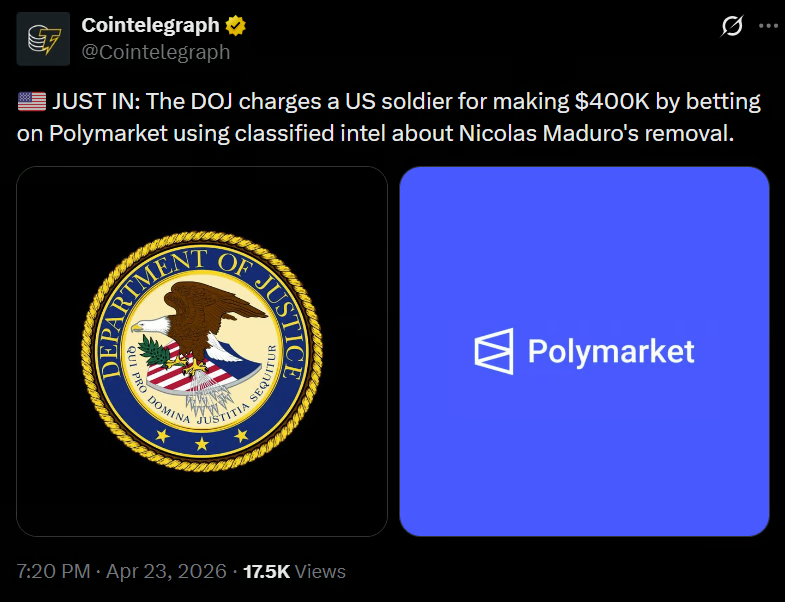
Recent incidents have intensified scrutiny from regulators and the public. In April, the US Justice Department charged a US Army soldier with using classified knowledge to place large winning bets on the US capture of Nicolas Maduro.
The US Senate on Thursday passed an amendment to the chamber’s Standing Rules that would immediately prohibit senators from trading on prediction markets.
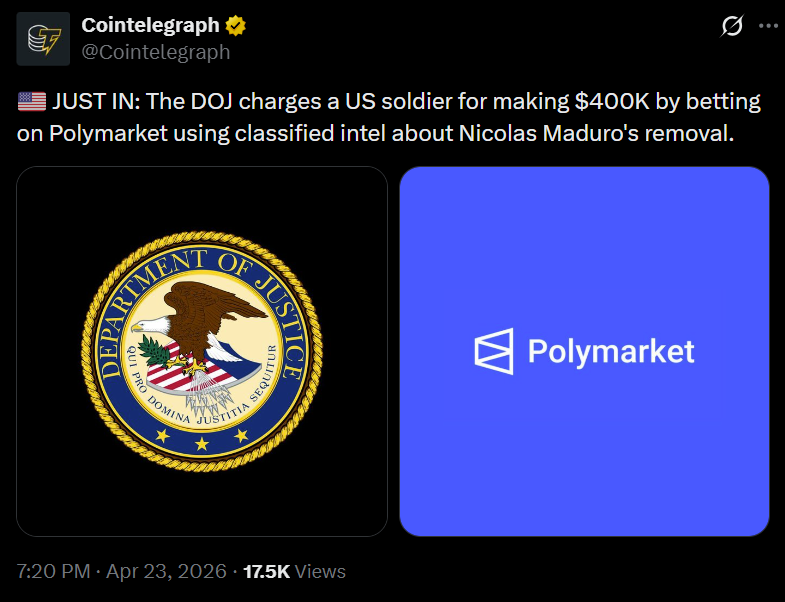
Source: Cointelegraph on X
In response, Polymarket is bolstering safeguards to flag suspicious trading behavior, aiming to curb insider activity and restore confidence in its markets. As Cointelegraph recently reported, the company has already implemented stricter trading safeguards to address concerns about manipulation.
The developments underscore mounting regulatory pressure on crypto-based prediction markets, which critics say enable speculation on sensitive geopolitical and real-world events.
Related: Kalshi mulls crypto expansion with perpetual futures launch: Report
Prediction markets draw surging volumes — and rising scrutiny
Prediction markets are attracting renewed attention as their size and scope continue to expand. A recent report by Bitget Wallet and Polymarket found that monthly trading volumes reached $25.7 billion in March, even as the broader crypto market remained in a prolonged slump.
The data suggests retail participants are driving much of the activity, with a shift away from one-off bets toward more sustained engagement, particularly in sports-related markets.
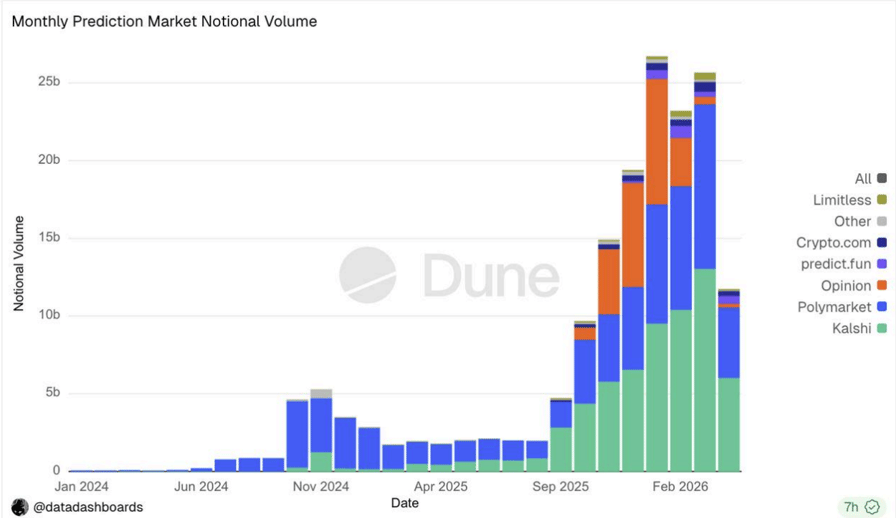
Prediction market trading volumes. Source: BitGet Wallet
At the same time, not all of the attention has been positive. Alongside concerns over market manipulation, a regulatory tug-of-war is emerging between US states and the federal Commodity Futures Trading Commission over how prediction markets should be governed.
New York has recently filed lawsuits against exchange operators Coinbase Financial Markets and Gemini Titan, alleging that their prediction market offerings violate state gambling laws.
Related: New York targets Coinbase, Gemini in fresh crackdown on prediction markets


South Korean prosecutors have requested a 20-year prison sentence for the CEO of crypto deposit service Delio, calling the scale of alleged fraud against thousands of investors “massive.”
During closing arguments at the Seoul Southern District Court on Thursday, prosecutors asked the court to sentence Jeong Sang-ho under the Act on Aggravated Punishment of Specific Economic Crimes, citing what they described as deliberate deception and false promotion that left nearly 2,800 victims without access to their funds, according to the Korean news agency Yonhap.
“The defendant’s active deceptive acts and false promotion have resulted in numerous victims, and the scale of the damage is massive,” prosecutors reportedly said, adding that Jeong was “exacerbating their suffering by evading responsibility and maintaining an uncooperative attitude.”
Delio operated a crypto deposit service that promised investors high-interest returns on coins deposited for a fixed period. On June 14, 2023, the platform abruptly suspended withdrawals, freezing customer assets worth 250 billion Korean won ($169 million). A Seoul court declared the company bankrupt in November 2024.
Related: Dunamu, Hana Financial take blockchain remittance system live with POSCO
Delio CEO acknowledges harm done to investors
Jeong’s legal team acknowledged the harm caused. “We are aware of the victim’s suffering and feel a deep sense of responsibility,” his attorney reportedly said, adding that Jeong would seek to compensate victims if acquitted.
Jeong was indicted in April 2025 on charges of embezzling $169 million in crypto assets from victims over roughly two years, between August 2021 and June 2023.
The first-instance verdict is scheduled for July 16.
Related: Kbank teams with Ripple on overseas blockchain remittance trial
South Korea launches crackdown on exchanges
The news comes amid South Korea’s launch of a regulatory crackdown on crypto exchanges. Earlier this month, the country fined Coinone, the country’s third-largest exchange, and ordered a partial business suspension over Anti-Money Laundering failures.
The action marks the second such crackdown in a few months, following a $24 million fine and six-month partial suspension handed to Bithumb in March for similar Anti-Money Laundering failures. The pressure on exchanges intensified after Bithumb mistakenly sent customers 620,000 Bitcoin, worth around $42 billion at the time, instead of 620,000 Korean won.
Magazine: South Korea gets rich from crypto… North Korea gets weapons


ECB held rates at April 30 meeting but Lagarde stressed rising inflation and growth risks from Iran war, signaling June hike possibility.
Summary
- KelpDAO contributed 2,000 ETH from treasury to Aave-led DeFi United recovery plan
- Funding aims to restore rsETH peg support following April 18 bridge exploit
- DeFi United has raised over $300 million from ecosystem participants to close backing shortfall
KelpDAO announced April 30 it has completed its committed contribution to the recovery fund, providing 2,000 ETH in treasury funds to the DeFi United recovery plan led by Aave, aimed at restoring peg support for rsETH and promoting the system’s return to normal operation. The funding represents a one-time investment intended to restore rsETH to its nominal exchange rate following the $292 million exploit that struck on April 18.
“As part of that commitment, we are contributing 2,000 ETH from our treasury directly to DeFi United,” KelpDAO stated. The protocol emphasized that its internal commitment before any public statement was that “rsETH holders will not be abandoned,” noting the contribution is a direct manifestation of that pledge.
Multi-Protocol Recovery Effort
DeFi United, in collaboration with multiple ecosystem participants including Mantle, Consensys, Arbitrum, Lido Finance, and LayerZero, has formulated a recovery path that includes re-capitalization of the bridging treasury, restoration of oracle functionality, and addressing funding gaps in affected markets. The coalition has tentatively raised more than $302 million to date, much of it from DAOs and crypto businesses within the ecosystem.
Major contributors include Consensys and Joseph Lubin with 30,000 ETH (approximately $69 million), Mantle with 30,000 ETH as a low-interest loan, Aave DAO with a pending vote for 25,000 ETH (approximately $57.5 million), and LayerZero with 10,000 ETH (approximately $23 million). The Arbitrum Security Council also froze 30,766 ETH (approximately $71 million) in attacker funds pending a governance vote.
The April 18 exploit drained 116,500 rsETH—worth about $290 million to $293 million—from KelpDAO’s LayerZero-powered bridge, representing roughly 18% of rsETH’s total supply. The attacker used the tokens as collateral across Aave, Compound v3, and Euler to borrow an estimated $236 million in ETH and WETH, leaving protocols with significant bad debt.
KelpDAO stated its investment helps accelerate the overall repair process, noting that as funds from various parties gradually come into place, collateral support for rsETH will gradually return to normal. The company committed to continue updating the community on progress as the recovery advances.


Polymarket has tapped blockchain analytics firm Chainalysis to deploy an on-chain solution that monitors trading activity and enforces its Market Integrity Rules across the prediction market platform.
The system centers on a detection model built on Chainalysis Data Solutions. It is calibrated to identify patterns that suggest non-public information on the platform.
How the On-Chain Detection Model Works
According to the press release, the agreement combines Chainalysis’ investigative tools, threat prevention capabilities, and professional services for the deployment and training of Polymarket’s staff. The framework builds on a multi-layered monitoring system already operating across the venue.
“This sends a clear signal: insider trading, in addition to all types of fraud and market manipulation, is not welcome on Polymarket, and those who attempt it will be identified,” the press release read.
Every trade, position, and settlement on Polymarket is recorded on a public blockchain. That structure allows live anomaly detection.
Polymarket CEO Shayne Coplan tied the deal to the platform’s transparency-first design.
“Polymarket was built on-chain because transparency matters, and our platform shows what markets can look like when trades are open, traceable, and accountable by design,” he said.
Why Polymarket Is Tightening Insider Trading Surveillance Now
Suspected insider trading on prediction market platforms has become a growing concern, drawing scrutiny from both the crypto community and lawmakers.
Follow us on X to get the latest news as it happens
Platforms have stepped up efforts to counter this. In addition to the new initiative, Polymarket published updated Market Integrity Rules in March covering three prohibited categories of insider trading conduct.
Rival platform Kalshi has similarly bolstered its internal capabilities and policies to address insider trading and market manipulation.
Regulators and law enforcement have moved in parallel. Authorities recently charged a US Army soldier for allegedly using confidential government information to profit from bets on markets tied to the capture of Venezuelan leader Nicolás Maduro. The defendant has pleaded not guilty to the fraud charges.
In a parallel move, the US Senate unanimously approved a resolution barring sitting senators from trading on prediction markets. Together, these developments signal a sector-wide push to clamp down on insider trading as prediction markets scale into the mainstream.
Subscribe to our YouTube channel to watch leaders and journalists provide expert insights
The post Polymarket Targets Insider Trading With New On-Chain System appeared first on BeInCrypto.


Syndicate Labs has confirmed that a leaked upgrade key let an attacker hijack its Commons cross-chain bridge, drain about 18.5 million SYND tokens worth roughly $330,000 plus user funds, and trigger a sharp price crash before the team pledged full compensation and sweeping security fixes.
Summary
- Syndicate Labs’ cross-chain bridge was compromised after a private key leak, with roughly 18.5 million SYND drained and sold.
- The attack, described as highly sophisticated, exploited weak key storage and lack of multisig or hardware signing on upgrade paths.
- Syndicate Labs has pledged to fully compensate all affected users and client chains while rolling out stricter key management and upgrade safeguards.
Syndicate Labs has confirmed that a private key leak allowed an attacker to maliciously upgrade its cross-chain bridge contracts on two networks and siphon approximately 18.5 million SYND, worth about $330,000, alongside roughly $50,000 in user tokens. The team stressed that the incident was contained to specific chains and did not impact the broader Syndicate infrastructure.
In an official statement, Syndicate Labs said the breach followed “multi-stage reconnaissance, infrastructure mapping, and careful execution,” calling it an attack that “demonstrated a high level of technical complexity” while explicitly ruling out insider involvement. The attacker acquired around 18.5 million SYND and rapidly sold the tokens, with external security firms like CertiK tracing proceeds into Ethereum after bridging.
Root cause: weak key storage and upgrade controls
Syndicate Labs identified the root cause as poor operational security around the bridge upgrade keys, admitting that “the private key was stored in a password management tool without an additional layer of encryption.” The team also acknowledged that the upgrade process did not use multi-signature or hardware signatures and lacked “early warning and circuit breaker measures for contract upgrades,” leaving a single compromised key enough to push a malicious implementation.
Following the exploit, SYND’s price fell by more than 30% on some venues as the sell-off hit liquidity, echoing previous bridge hacks that sparked sharp token drawdowns. Similar cross-chain bridge incidents, such as earlier exploits on third-party infrastructure covered in this crypto.news story, have repeatedly underscored the dangers of centralized upgrade keys.
Syndicate Labs has pledged to “fully compensate all affected users,” including returning the 18.5 million SYND drained and providing “additional compensation,” while also “fully compensating affected application chain clients.” The company says it has sufficient reserves to cover losses, mirroring commitments seen in prior DeFi recovery efforts reported in another crypto.news story.
To prevent a repeat, Syndicate Labs has begun hardening its key management by strengthening private key encryption, tightening access controls, and planning to introduce hardware or multi-signature mechanisms alongside real-time monitoring of upgrade paths. The team’s roadmap follows broader industry calls for multisig-controlled bridges and automated circuit breakers, themes highlighted in a separate crypto.news story.
Syndicate’s SYND token remains under pressure as markets digest the attack and await concrete timelines for compensation and security upgrades.
Crypto World
Hassett says Powell’s reappointment could delay Fed rate cuts, with crypto watching closely


Kevin Hassett warns that reappointing Jerome Powell to the Fed Board could delay or dilute Trump-era rate cuts, keeping crypto traders fixated on personnel-driven monetary policy.
Summary
- White House NEC Director Kevin Hassett warned that Jerome Powell’s reappointment to the Fed Board could sway the timing and depth of interest rate cuts.
- The Fed has held its benchmark rate at 3.5%-3.75% in Powell’s final meetings as chair, with markets split over how quickly incoming leadership will ease policy.
- Crypto traders now see Fed personnel politics as a key variable for Bitcoin, Ethereum, and broader digital asset liquidity.
White House National Economic Council Director Kevin Hassett said that Federal Reserve Chair Jerome Powell’s reappointment as a governor “may affect interest rate cut decisions,” injecting new uncertainty into the path of U.S. monetary easing. His comments land just as the Fed keeps its target rate in a 3.5%-3.75% band and as Powell chairs his final policy meetings before stepping down in mid-May.
In recent remarks relayed by U.S. media, Hassett has repeatedly argued that “there is ample opportunity to reduce rates in the upcoming months,” while also acknowledging that the composition of the Fed Board will shape how aggressively cuts are delivered. At Powell’s last meeting as chair, officials again voted to hold rates steady, with four members dissenting—the highest level of disagreement since 1992—underscoring a deeply divided Federal Open Market Committee (FOMC).
Why Powell’s seat matters for crypto
The friction is not just academic: Powell’s reappointment as a governor would keep a seasoned moderate on the Board at the same time President Donald Trump is set to install Kevin Warsh as the next Fed chair, a figure seen as more open to faster easing but constrained by inflation and politics. As Axios reported, Trump officials have recently “softened” their public pressure for immediate cuts, signaling they may “wait for new chairman Warsh and let him lead the next cycle,” a stance Hassett has echoed.
For crypto markets, this tug-of-war over the pace of cuts directly feeds into liquidity, risk appetite, and dollar strength. When the Fed cut rates in late 2025, Bitcoin (BTC) and Ethereum (ETH) both saw renewed inflows as lower real yields pushed investors out the risk curve, a pattern tracked across multiple crypto.news stories. With the federal funds rate still anchored at 3.5%-3.75% and no cuts yet in 2026, major tokens have traded in tighter ranges despite sporadic rallies in Bitcoin and Ethereum.
If Powell’s continued presence tilts the Board toward a slower easing path, that could cap near-term upside for high-beta assets like altcoins even as long-term crypto adoption remains intact. Prior crypto.news coverage of Fed transition risks in this story and of macro-driven sell-offs in another story has shown how quickly Bitcoin and DeFi tokens can reprice when rate expectations shift.
Traders are now closely watching communications from Hassett, Warsh, and Powell for clues on the first cut’s timing, with futures markets still pricing only modest reductions in 2026 despite Trump’s preference for “substantially lower” rates. Any surprise acceleration or delay in cuts—driven by Powell’s reappointment dynamics—will likely move not just Treasurys and equities, but also the entire digital asset complex.
Stablecoin payments company Kast Kast has hired former US Securities and Exchange Commission (SEC) communications official Stephanie Allen as head of corporate and policy communications, as the company builds out its licensing and policy operation following an $80 million funding round last month.
Kast said Thursday that Allen will work with senior leadership on policy and communications as the company prepares to launch Kast Business and expand further across North America, Latin America and the Middle East. The company said the hire is tied to its next phase of growth and regulatory engagement.
Allen previously served as acting director of the SEC’s Office of Public Affairs and earlier held senior media relations and speechwriting roles at the agency. Kast said she also advised the SEC’s Crypto Task Force, though that role does not appear in the SEC’s public biography of Allen.
The hire reflects how stablecoin companies are adding policy and communications talent as they move closer to regulated financial services and try to expand across multiple jurisdictions. For Kast, the appointment comes as it pushes deeper into business accounts, cross-border payments and compliance-heavy growth markets.
“We’re excited to welcome Stephanie to the Kast team,” said KAST’s chief corporate affairs officer, Brad Jaffe. “Her knowledge of the policy and regulatory landscape stemming from her leadership position at the SEC and deep U.S. public and private sector experience will help drive KAST’s momentum.”
The hire comes over a month after Kast raised $80 million to fund the expansion of its payment infrastructure platform, reaching a $600 million valuation.
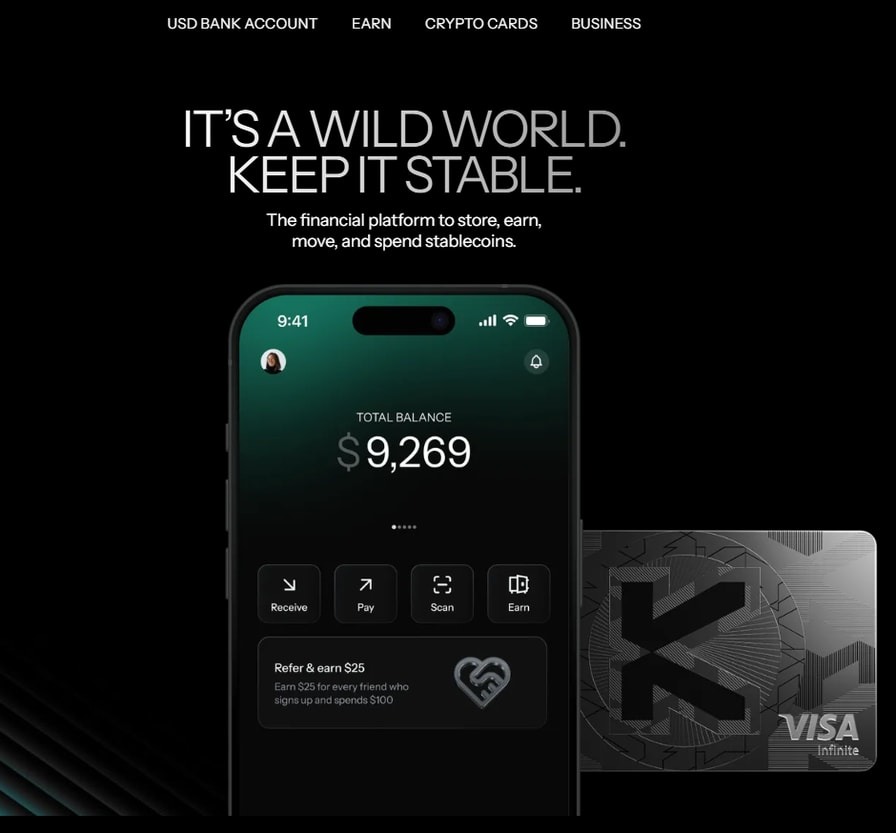
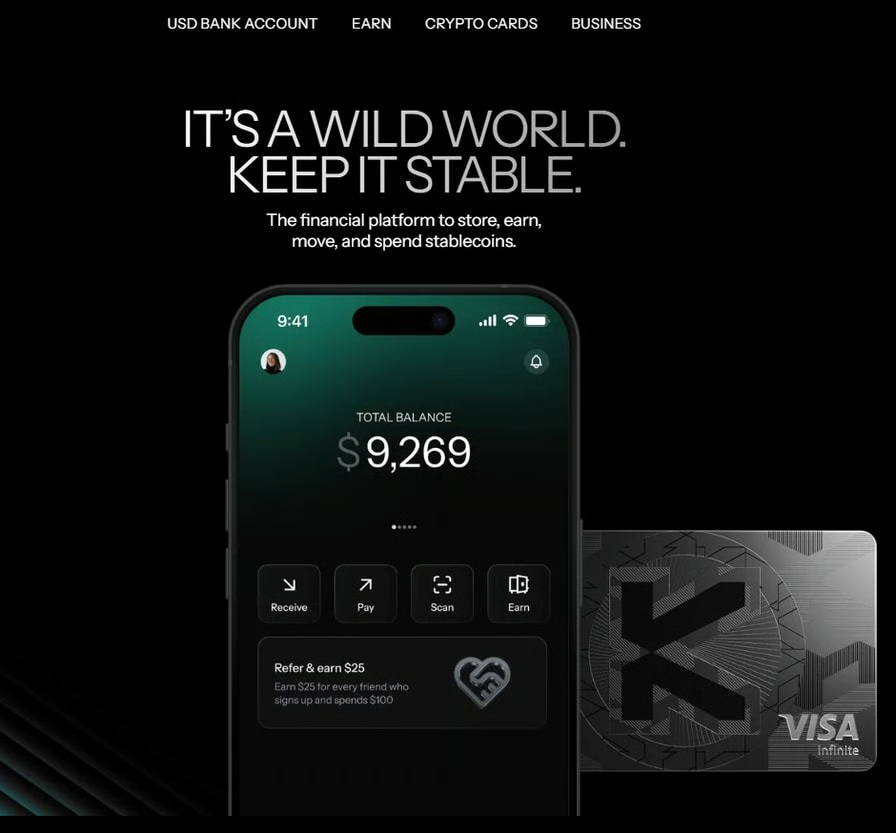
KAST stablecoin payment firm, homepage. Source: Kast.xyz
Kast offers payment cards and US dollar-denominated accounts to users in over 150 countries, with plans to launch savings and remittance products under its neobank interface.
Related: Fireblocks launches tool for institutions to earn yield on stablecoins
Stablecoin momentum cools
Stablecoin transfer volume dropped 19% to $8.31 trillion over the past month, while stablecoin market capitalization rose 2.06% to $305.29 billion over the same period, Cointelegraph reported Tuesday, citing data from RWA.xyz.
The data suggests that the growing value held in dollar-denominated stablecoins does not translate to growing onchain activity, as fewer dollars are being moved across blockchains despite the growing stablecoin supply.
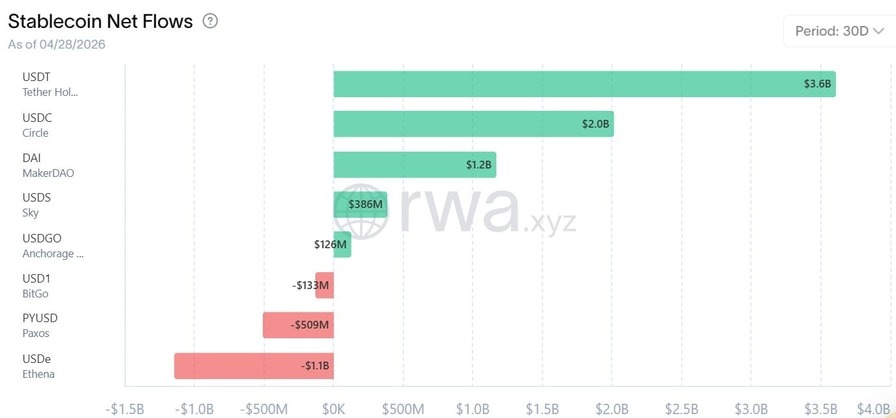
30-day stablecoin net flows as of April 28, 2026. Source: RWA.xyz
Still, asset manager Fidelity’s Q2 Signals Report showed that Ethereum’s stablecoin transfer values had recently exceeded historical averages, with transfer value over the past 12 months surpassing $18 trillion.
Fidelity said that the network activity signals that stablecoins are increasingly being used for payments, settlement and onchain access to US dollars, despite the broader crypto market sentiment.
Stablecoin transfer volume reached a record $1.8 trillion in February, according to data provider Allium.


Polymarket is rolling out an onchain integrity monitor with Chainalysis to detect insider trading and manipulation across its prediction markets and reassure regulators and institutions.
Summary
- Polymarket is launching an on-chain market integrity monitoring system, built with Chainalysis, to police insider trading and manipulation across its DeFi prediction markets.
- The system will run real-time analytics on trades, positions, and settlements on public blockchains to flag suspicious behavior and support enforcement of platform rules.
- Polymarket says the move aims to set a new compliance benchmark for prediction markets and reinforce its role as a trusted source of market information for crypto and traditional finance.
Polymarket has unveiled a comprehensive on-chain market integrity monitoring solution designed to track trading behavior across its platform and enforce strict market conduct rules. The system is being developed in partnership with blockchain analytics firm Chainalysis and will cover the full DeFi lifecycle on Polymarket, including real-time analysis of trading flows, user holdings, and settlement data, with a particular emphasis on detecting insider trading and market manipulation.
According to Polymarket, every transaction on the platform already settles on a public blockchain, and this new framework is meant to weaponize that transparency rather than treat it as a mere byproduct. By layering multi-stage monitoring over open ledgers, the platform aims to automatically surface anomalous patterns—such as suspiciously timed position builds ahead of key events or coordinated wash trading—so they can be investigated and sanctioned under its market rules.
The company stresses that the collaboration is also aimed at external stakeholders, not just internal policing. Because activity is on-chain, the enhanced monitoring is expected to help regulators and law enforcement obtain verifiable evidence of misconduct, potentially speeding up investigations and making enforcement more robust. Polymarket says this combined toolkit is intended to establish “a new compliance standard in the predictive market field,” framing the platform less as a regulatory outlier and more as a testbed for transparent, auditable market structure.
Founder and CEO Shayne Coplan reiterated that the platform has prioritized transparency and traceability since launch, arguing that prediction markets can only influence serious capital and institutional users if their order flow is both visible and credibly monitored. He said the Chainalysis partnership will further entrench Polymarket’s position as a “trusted source of market information,” especially as crypto-native prediction markets increasingly inform pricing in broader risk assets, including equities, rates, and major tokens like Bitcoin and Ethereum.

The US Senate on Thursday unanimously approved a resolution banning its members and staff, who are often exposed to sensitive information, from using prediction markets.
The resolution, passed by unanimous consent, changed the Senate’s rules and took immediate effect.
“Engaging in any way in a prediction market or trying to place bets where we might have inside information deteriorates the confidence that our constituents have in us,” Republican Senator Bernie Moreno, who introduced the resolution, said on the Senate floor.
“By changing the standing rules of the Senate, what we’re doing is allowing our constituents to know, once and for all, that no member of the United States Senate, no member of the staff of the United States Senate, can ever use that inside information as a way to monetize this job whatsoever,” he added.

Source: Bernie Moreno
The resolution comes after a special forces soldier involved in the plan to capture former Venezuelan President Nicolás Maduro was charged last week, on April 23, with using classified information to make bets on Polymarket, as lawmakers also air concerns over well-timed bets on the Iran war. He has pleaded not guilty.
Senate Democratic leader Chuck Schumer said on the Senate floor that “of all the issues we debate in Washington, this falls clearly in the category of a ‘no-brainer.’”
“We must never allow Congress to turn into a casino where members representing the public can gamble on wars, or economic crises, or elections,” he said.
Related: Insider trading backlash forces Polymarket to step up surveillance
“We should go further; this is a good start, but not enough,” Schumer said. “The administration and its employees must apply these very same rules too, particularly this administration, which shows such a troubling affinity to corruption and self-dealing.”
Republican Representative Ashley Hinson posted to X that she would introduce a similar resolution to ban the use of prediction markets in the House.
Polymarket posted on X that it fully supported the Senate resolution and its terms of service “already prohibit such conduct, but codifying this into law is a step forward for the industry.”
Tarek Mansour, co-founder and CEO of rival prediction market platform Kalshi, also celebrated the resolution in a post on X, adding that it “already proactively blocks members of Congress and enforces against insider trading.”
Magazine: How to fix suspected insider trading on Polymarket and Kalshi

Spain appears to be the strongest retail market for Circle’s euro-pegged stablecoin EURC on the Brighty platform, with Brighty data indicating a clear regional concentration in 2025 and the first quarter of 2026. In that period, Spanish activity accounted for roughly 36% of EURC transactions and about 25% of EURC-related volume, a signal that euro-stablecoin usage for everyday payments is taking hold in select European markets. According to Brighty data reviewed by Cointelegraph, this pattern positions Spain as a leading early adopter in euro-stablecoin retail usage within the broader MiCA-era regulatory landscape.
“For Spanish users, EURC functions essentially as a standard euro on a card with no exchange rate friction when transacting against USDC,” Brighty co-founder Nick Denisenko said. The observation underscores how EURC can simplify euro-denominated payments for retail customers, particularly when paired with card-based spending and stablecoin yield features.
Cointelegraph’s review of Brighty’s dataset also highlights a broader market dynamic: euro tokens remain a minority segment relative to USD-pegged stablecoins like Tether’s USDt and Circle’s USDC, even as policymakers push to expand the euro’s role in crypto markets. The data offer an early glimpse into how euro stablecoins may be used in European retail payments as regulatory frameworks like MiCA come into force.
Key takeaways
- Spain accounted for about 36% of EURC transactions and 25% of EURC volume in 2025 through the first quarter of 2026, signaling a retail-oriented adoption pattern.
- EURC is the largest euro-pegged stablecoin by market share, representing around 49% of the euro-stablecoin market cap (approximately $887 million) according to CoinGecko.
- Spain shows the clearest retail usage of EURC with low average transaction sizes—about 49 euros per payment—compared with other European markets that display more mix between retail and higher-value transfers.
- Italy ranks second in EURC activity (about 15.5% of transactions and 18% of volume), followed by Germany (roughly 13% of transactions and 19% of volume), while France is notable for higher average transactions (~€171).
- Denisenko argues that Spain’s combination of early adoption, retail-focused usage, and broad institutional awareness makes it the clearest early hub for euro-stablecoin activity under MiCA.
Spain as a retail EURC hub
Data from Brighty shows Spain leading EURC activity within the platform’s footprint, with a clear tilt toward everyday, low-value transactions. The typical EURC payment in Spain is around €49, placing the euro-stablecoin usage squarely in the realm of consumer purchases, P2P transfers, and other retail payments rather than large-scale transfers or institutional settlements.
Denisenko notes that Spanish users have been among the earliest adopters of EURC on Brighty and have shown robust engagement with yield features tied to stablecoins. This combination—early adoption, retail-friendly transaction sizes, and active use of yield mechanics—helps explain why Spain stands out in Brighty’s euro-stablecoin analytics.
From a regulatory and market-structure perspective, the Spanish pattern aligns with a broader intention to normalize euro-stablecoin usage within a MiCA-ready environment. The MiCA framework seeks to bring regulatory clarity to crypto-asset service providers and issuers of asset-backed tokens in the European Union, potentially smoothing the path for banks and payments ecosystems to integrate euro-stablecoins into everyday retail flows.
Cross-country usage patterns and value segmentation
Italy ranks second in Brighty’s EURC metrics, accounting for about 15.5% of EURC transactions and 18% of EURC volume. The data imply a mix of retail and higher-value use cases in Italy, rather than a narrow retail-only pattern. Germany follows with roughly 13% of transactions and 19% of volume, where the average EURC payment size stands at about €105 ($123).
France stands out for its comparatively higher average transaction size of roughly €171 ($186) per EURC payment, indicating a greater share of larger transfers or higher-value payments within the country’s EURC activity. This contrast suggests a diversification of EURC use cases across Europe, from everyday consumer purchases to larger-value transfers that may involve corporate or high-net-worth clients.
Despite these country-specific dynamics, euro-stablecoins in Europe remain a relatively small slice of the broader stablecoin market when viewed against USD-pegged tokens. The euro-stablecoin segment’s total market capitalization sits well below the USD-backed tier, a gap that policymakers and market participants have been monitoring as MiCA implementation progresses and as banks explore euro-stablecoin integrations.
Regulatory and institutional implications for euro-stablecoins in Europe
The Spain-centric retail pattern observed on Brighty has notable implications for compliance, licensing, and cross-border operations within the European Union. Under MiCA, euro-stablecoins face a regulated environment designed to standardize issuance, disclosures, and safeguarding of user funds, with potential licensing prerequisites for issuers and service providers operating across member states. Spain’s apparent readiness—both from consumer familiarity with crypto and from the apparent willingness of local banks to engage with euro-stablecoins—could serve as a case study in how MiCA compliance and banking integration might unfold in practice.
Brighty’s experience in Spain, including interactions with major Spanish banks where staff demonstrate a high level of competence, suggests that institutional readiness may accelerate the deployment of euro-stablecoin-based payments and yield features for retail users. This aligns with a broader European push to expand the euro’s role in digital finance while maintaining robust regulatory oversight and consumer protections.
Where EURC and other euro-stablecoins fit within the MiCA framework remains a key question for operators, banks, and policymakers. The ongoing evolution of licensing regimes, cross-border oversight, and interoperability with fiat rails will shape how euro-stablecoins scale in retail channels. The comparative patterns across Italy, Germany, and France provide a preliminary map of how different market segments may respond to MiCA’s regulatory contours, with Spain potentially serving as an early operational benchmark for compliance-ready, retail-focused euro-stablecoin activity.
Closing perspective
The Brighty dataset paints a valuable early picture: Spain stands out as the clearest retail-focused hub for EURC within Europe, reflecting a combination of consumer familiarity, institutional readiness, and a regulatory environment moving toward MiCA-aligned clarity. As MiCA-backed euro-stablecoins continue to gain traction, observers should monitor how cross-border EU usage develops, how banks expand euro-stablecoin integrations, and how transaction sizes and channel mix evolve beyond Spain’s initial lead. The coming quarters will reveal whether Spain’s early lead translates into broader regional patterns or remains a selective, country-specific anomaly shaped by local financial ecosystems.
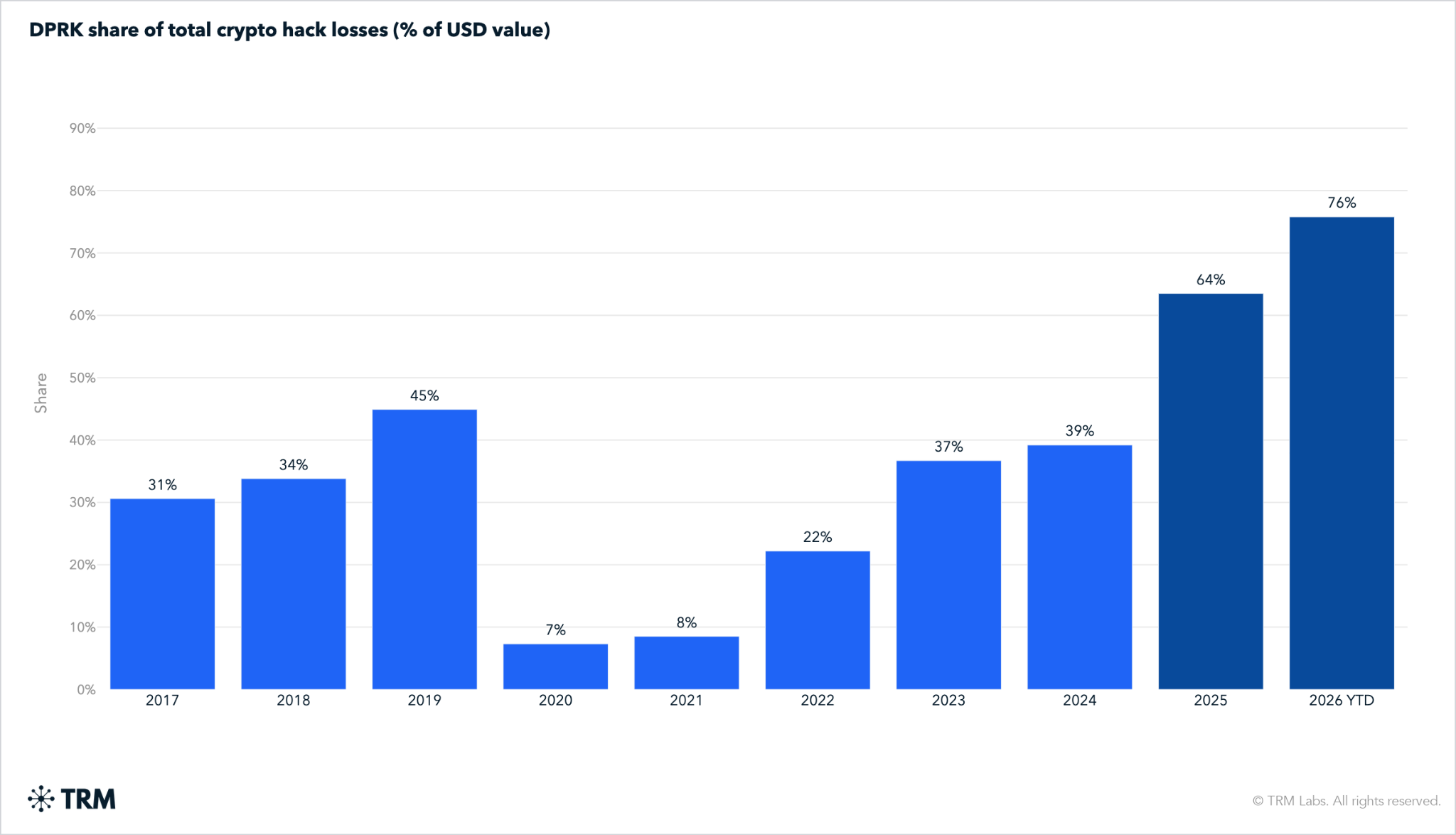
North Korean hackers accounted for 76% of all crypto hack losses through April, according to TRM Labs.
The report revealed that hackers from two distinct groups stole roughly $577 million across two attacks in 2026.
2 North Korean Heists Drove 76% of 2026 Crypto Hack Losses
The Drift Protocol breach and the KelpDAO bridge exploit landed in the same month. Together, they accounted for just 3% of this year’s incident counts, but the bulk of the stolen value. Notably, both these hacks are attributed to North Korean actors.
“North Korean hacking groups accounted for 76% of all crypto hack losses in 2026 through April — not because North Korea launched a wave of attacks, but because two attacks totaling USD 577 million dwarfed everything else,” TRM Labs wrote.
The Drift exploit on April 1 cost the Solana-based perpetual exchange $285 million. In a follow-up incident report, the Drift team noted that the attack was the outcome of a six-month intelligence operation tied to North Korean actors. The fallout reached well beyond Drift, impacting several protocols.
Solana yield platform Carrot was among them. The team announced its shutdown on April 30. Carrot has set May 14 as the final deadline for users to withdraw remaining balances from Boost, Turbo, and CRT positions before forced deleveraging begins.
Follow us on X to get the latest news as it happens
Meanwhile, on April 18, attackers drained 116,500 rsETH, worth roughly $292 million, from KelpDAO’s cross-chain bridge. This has become the largest DeFi hack so far this year.
Investigations suggested that the Lazarus Group’s TraderTraitor was the likely actor behind the hack. The aftermath spread across the space. Aave and the broader DeFi TVL plunged sharply after the exploit.
North Korea’s Share of Crypto Theft Keeps Climbing
North Korean groups have become the dominant force in crypto theft. They drained at least $2.02 billion in digital assets during 2025 alone.
Their share of total hack losses has risen sharply over recent years. The figure sat below 10% in 2020 and 2021, climbed to 22% in 2022, then reached 37%, 39%, and 64% in the years that followed. The 76% reading through April 2026 marks the highest sustained level on record.
TRM analysts note that the attack frequency has not increased. Pyongyang’s top hacking teams still run a small number of carefully chosen operations each year, choosing precision over volume.
What has shifted is the “sophistication of the attacks.” TRM suggests that North Korean operators may be integrating AI tools into reconnaissance and social engineering operations.
“TRM analysts have begun to speculate that North Korean operators are incorporating AI tools…a development consistent with the increasing precision of attacks like Drift, which required weeks of targeted manipulation of complex blockchain mechanisms, rather than North Korea’s traditional emphasis on simple private key compromises,” the report read.
The development raises pressing questions about AI-driven attack capabilities and whether crypto protocols can keep pace with this new threat vector.
Subscribe to our YouTube channel to watch leaders and journalists provide expert insights
The post North Korea Claims 76% of 2026 Crypto Hack Losses in Just Four Months appeared first on BeInCrypto.

Romanian leader of online swatting ring gets 4 years in prison

Burglar barricaded himself in house after jumping from bin and knocking down man

Chip shops sell cheap catfish as ‘traditional fish and chips’

Manchester United reach agreement with Casemiro over contract clause amid transfer speculation

US brings back mandatory military draft registration

Steven Gerrard disagrees with Gary Neville over ‘shock’ Chelsea and Arsenal claim | Football


-

 Tech3 days ago
Register Renaming | Hackaday
-

 Fashion6 days ago
Weekend Open Thread – Corporette.com
-
 Crypto World5 days ago
Hyperliquid $HYPE Rally Builds Momentum as AI Sector Enters Prove-It Phase
-

 Politics3 days ago
Drax board avoid their own AGM, accused of greenwashing & environmental racism
-
 Sports5 days ago
IPL 2026: Ruturaj Gaikwad registers slowest fifty of the season, enters all-time unwanted list | Cricket News
-

 Tech3 days ago
Images of Samsung’s rumored smart glasses have leaked
-

 NewsBeat5 days ago
LK Bennett closes all stores after entering administration
-

 Tech4 days ago
Why Blue Badges Disappeared From Toyota Hybrids
-

 Fashion2 days ago
Kylie Jenner’s KHY Enters a New Era with ‘Born in LA’
-

 Crypto World7 days ago
Michael Saylor says BTC winter is over. Market analyst disagrees, says bitcoin was in a pullback
-
 Entertainment5 days ago
Mariah Carey Slams Deposition Claims In Brother’s Lawsuit
-

 Business2 days ago
Most Commercial Energy Audits Miss the Real Losses
-
 NewsBeat7 days ago
Trump threatens to review UK’s claim to Falkland Islands and punish Nato allies over Iran war disagreement
-

 Business4 days ago
(VIDEO) Charlize Theron Climbs Times Square Billboard to Promote New Netflix Thriller ‘Apex’
-

 Business7 days ago
Jeanine Pirro announces closure of Federal Reserve building cost probe
-

 Tech5 days ago
OpenAI’s Sam Altman apologizes for not reporting ChatGPT account of Tumbler Ridge suspect to police
-

 Tech5 days ago
Microsoft to roll out Entra passkeys on Windows in late April
-

 Crypto World3 days ago
CFTC’s AI will review U.S. crypto registration applications, chairman tells CoinDesk
-
 Crypto World6 days ago
Nvidia (NVDA) Stock Jumps 5% as Intel Earnings Ignite Semiconductor Rally
-

 Tech5 days ago
OpenAI CEO apologizes to Tumbler Ridge community
You must be logged in to post a comment Login