
Crypto World
postal service may run out of cash



The USPS crisis reached Congress in mid-March when Postmaster General David Steiner testified before the House Oversight Subcommittee on Government Operations that the agency will run out of cash in less than 12 months at its current rate and may be forced to stop delivering mail.
Summary
- Steiner told lawmakers directly: “At our current rate, we’ll be out of cash in less than 12 months,” adding that “less than a year from now, the Postal Service will be unable to deliver the mail if we maintain the status quo”; pressed for a specific date, he said USPS could exhaust funds as early as October 2026 if it pays all obligations on schedule, or February 2027 if it continues deferring some payments
- USPS lost $9 billion last fiscal year, $9.5 billion in 2024, and $1.3 billion in just the first quarter of 2026; it has posted annual losses almost every year since 2007 as traditional mail volume has fallen by nearly 50 percent over the past 20 years
- The agency is asking Congress to increase its borrowing limit with the Treasury Department and to allow higher stamp prices; it is also exploring options including cutting delivery from six days to five or three days per week, closing post offices, and raising first-class stamp prices from the current 78 cents to $1 or more
Federal News Network reported that USPS has since taken one unilateral step to conserve cash: suspending contributions to the Federal Employees Retirement System, a move that could free up to $15 billion by delaying required pension payments through September 2030. The Postal Regulatory Commission granted a waiver allowing the deferral. That buys time but does not fix the structural problem.
USPS does not receive tax dollars for operating expenses. It funds itself through stamps and service fees. As email, texts, and online payments have replaced letters and check-mailing, first-class mail, the agency’s most profitable product, has collapsed in volume. Amazon, USPS’s largest package customer, has announced plans to cut the volume it sends through the agency by as much as two-thirds by September.
The practical consequences of a USPS cash failure extend well beyond mail delivery delays. Approximately 6 percent of diabetes prescriptions in the US are delivered by mail. Roughly 3.7 million Medicare enrollees live in areas where pharmacy access is limited and rely on postal delivery for medications. Rural communities, which are legally entitled to the same delivery service as urban areas under USPS’s universal service obligation, would be disproportionately exposed if service is cut. The Government Accountability Office released a report alongside the Steiner testimony calling the USPS business model “unsustainable” and stating that “urgent action” is needed.
What Congress Is Being Asked to Do
Steiner’s ask to Congress has three parts: raise the borrowing limit with the Treasury so USPS can access more capital, allow the agency to set prices more freely by removing the current once-per-year rate increase cap the Postal Regulatory Commission imposed through 2030, and give USPS flexibility on its universal service obligation. Republican committee members pushed back, questioning whether USPS had exhausted all internal cost-cutting options before asking for a bailout. Committee chair Rep. James Comer noted that Congress had already passed the Postal Service Reform Act in 2022, which saved USPS $107 billion in total costs.
What Happens to Mail If Nothing Changes
As crypto.news has reported, the federal legislative calendar in 2026 is under severe pressure from the Iran war, the CLARITY Act negotiations, and midterm positioning; a USPS rescue bill would compete for floor time against all of those priorities. As crypto.news has noted, disruptions to government-dependent services, including postal delivery of financial documents, checks, and regulatory notices, carry spillover effects into markets that rely on physical document flows. Steiner told lawmakers simply: “The mail will stop” if the agency cannot meet its obligations, including delivery of prescription drug packages.


Key Takeaways
- Spot Bitcoin ETFs in the U.S. attracted $1.97 billion during April, marking the strongest monthly performance in 2026
- A significant agreement was announced by Coinbase regarding critical language in prominent U.S. cryptocurrency legislation
- The CLARITY Act may be signed into law by the president as early as summer 2026
- Hacking groups linked to North Korea accounted for 76% of cryptocurrency theft losses in 2026 up to April
- Provisions within the CLARITY Act addressing stablecoins may permit certain reward mechanisms while restricting deposit-like yield offerings
The past week in cryptocurrency markets centered around regulatory developments, institutional capital movements, and cybersecurity concerns. Price action yielded the spotlight to fundamental stories reshaping market infrastructure.
April Delivers Strongest Bitcoin ETF Performance of 2026
Spot Bitcoin ETFs in the United States attracted approximately $1.97 billion throughout April, representing the most robust monthly inflow figure for 2026, based on information from SoSoValue.
This metric carries significance as ETF capital flows provide one of the most transparent indicators of institutional appetite. The data demonstrates that sophisticated investors continue allocating capital to Bitcoin through regulated investment vehicles.
Earlier months in 2026 showed softer inflow patterns. The April rebound indicates renewed institutional participation in the space.
Market participants now monitor ETF flow metrics with intensity comparable to quarterly financial reports. Robust inflow periods can generate positive momentum throughout the wider cryptocurrency ecosystem.
Landmark U.S. Cryptocurrency Legislation Advances
Coinbase announced that negotiators reached consensus on an important component of sweeping U.S. cryptocurrency legislation. Reuters coverage indicated this breakthrough could facilitate Senate passage.
Senate Banking Committee Chairman Tim Scott is championing the legislation, dubbed the CLARITY Act. According to Yahoo Finance reporting, he aims to secure presidential approval by summer 2026.
Should the measure become law, it would establish new operational requirements for cryptocurrency platforms and create definitive token classification standards. The legislation would also delineate jurisdictional boundaries between the SEC and CFTC for digital asset supervision.
From a market perspective, this bill represents the most tangible opportunity for comprehensive regulatory clarity in recent memory.
Stablecoin Provisions Generate Industry Focus
Recently released CLARITY Act language includes provisions governing stablecoins. CoinDesk coverage highlighted that the current draft would permit cryptocurrency companies to provide certain stablecoin reward programs while prohibiting yield products resembling traditional bank deposits.
Stablecoins function as foundational infrastructure within the cryptocurrency ecosystem. Their applications span trading pairs, payment processing, decentralized finance protocols, and international money transfers.
The central policy question concerns whether cryptocurrency platforms can distribute rewards without triggering banking regulations. The resolution will fundamentally influence capital circulation patterns across crypto markets.
Favorable regulatory treatment could unlock growth opportunities for stablecoin issuers and trading platforms. Conversely, overly restrictive frameworks may force business model adaptations.
North Korean Threat Actors Dominate 2026 Crypto Theft Statistics
According to TRM Labs analysis, cybercriminal organizations operating from North Korea were responsible for 76% of total crypto hack losses recorded in 2026 through the end of April.
The majority of stolen value stemmed from two major incidents. Combined losses from the Drift Protocol compromise and KelpDAO bridge vulnerability reached $577 million.
This trend reveals an evolution in attack patterns. Rather than numerous smaller breaches, a concentrated number of sophisticated, high-value exploits now comprise the majority of annual theft totals.
Cross-chain bridges and decentralized finance protocols continue representing the most vulnerable attack surfaces. For individual investors, security considerations remain among the most immediate risks when participating in cryptocurrency markets.
The TRM Labs analysis encompasses theft data through April 2026.

TLDR
- Annual stablecoin transaction volume is projected at $17.2 trillion for 2026
- Increasing velocity allows existing stablecoin supply to process more transactions without proportional market cap expansion
- The stablecoin market has expanded by approximately $100 billion year-over-year, exceeding $300 billion when yield-generating tokens are included
- JPMorgan forecasts market capitalization will only reach $500-$600 billion by 2028, far below trillion-dollar predictions
- Business-to-consumer and merchant transactions are experiencing the fastest expansion, with Asian markets dominating adoption
The stablecoin sector is experiencing unprecedented transaction activity, yet the circulating supply may not expand proportionally. This assessment comes from banking giant JPMorgan.
In a recent analysis spearheaded by managing director Nikolaos Panigirtzoglou and his team, the emphasis was placed on escalating stablecoin velocity as the critical metric. Velocity represents the frequency at which individual stablecoin units circulate within a given timeframe.
Elevated velocity enables a constrained stablecoin supply to facilitate substantially greater transaction throughput. Consequently, even with dramatic increases in stablecoin-based payments, the aggregate market capitalization need not expand proportionately.
“As stablecoin payment infrastructure achieves broader adoption, operational efficiency improves, driving velocity higher,” the research team explained. “Elevated velocity will probably constrain the overall expansion trajectory of the stablecoin ecosystem.”
Current onchain stablecoin transaction activity stands at approximately $17.2 trillion annually, extrapolated from 2026 year-to-date metrics. This substantial figure demonstrates genuine advancement in practical stablecoin utilization.
The aggregate stablecoin market capitalization has increased by nearly $100 billion in the past twelve months. Including yield-bearing variants, the total surpasses $300 billion.
This expansion has actually exceeded the broader cryptocurrency market’s performance, which analysts interpret as evidence that stablecoins serve purposes beyond speculation or serving as trading collateral.
Payment Applications Fuel Expansion
According to JPMorgan’s analysis, business-to-consumer and merchant payment applications are accelerating faster than peer-to-peer transfers. The bank referenced data from venture capital firm a16z crypto to substantiate this finding.
Peer-to-peer transactions continue to represent the dominant portion of total stablecoin activity. However, the migration toward merchant-based payments indicates stablecoins are penetrating mainstream commercial applications.
Asian markets continue to lead global stablecoin adoption, according to the analysts.
JPMorgan also highlighted the enactment of the GENIUS Act in the United States as a catalyst for increased transaction volume. This legislation established more definitive regulatory guidelines for stablecoin operations.
JPMorgan Maintains Conservative Forecast
This analysis represents a continuation of JPMorgan’s skeptical stance toward optimistic stablecoin forecasts. In December 2024, the research team stated they did not anticipate the stablecoin market achieving trillion-dollar valuations.
Their forecast indicated the market would approximate $500 to $600 billion by 2028. Previously in May 2024, they characterized trillion-dollar predictions from other analysts as “excessively optimistic.”
The current report maintains this conservative outlook. While robust transaction growth is undeniable, the fundamental dynamics of velocity suggest market capitalization will likely expand more gradually than raw transaction figures might imply.
Asian territories maintain their position as global leaders in stablecoin activity, with merchant payment integration continuing to broaden, according to the latest data referenced in JPMorgan’s analysis.


Spirit Airlines halted all operations early on May 2, 2026, ending 34 years of service. A fuel cost surge tied to the U.S.-Iran War wiped out the carrier’s path back to profitability.
The final flight landed in Dallas shortly after 1 a.m. EST, with the systemwide shutdown set for 3 a.m. Spirit had filed for Chapter 11 in November 2024 and again in August 2025 before preparing for Chapter 7 liquidation.
Fuel Costs From the Iran War Broke the Math
Jet fuel prices roughly doubled after the Iran conflict escalated in early 2026. Supply disruptions through the Strait of Hormuz drove the spike. Spirit reported the war added $10 million to $15 million a week to its costs.
Fuel typically accounts for between 25% and 33% of airline operating expenses. For an ultra-low-cost carrier built on thin margins, the macro shock left no room to absorb the increase. Pandemic-era debt and grounded Pratt & Whitney aircraft had already weakened the balance sheet.
The $500 Million Bailout That Never Closed
Spirit had been negotiating roughly $500 million in federal aid under the Trump administration. Bondholders balked at terms that would have handed the U.S. government an equity stake. Republican lawmakers also resisted the package.
Talks stalled while the airline burned through cash reserves. Spirit confirmed all flights were cancelled and customer service was offline.
“It is with great disappointment that on May 2, 2026, Spirit Airlines started an orderly wind-down of our operations, effective immediately.”
— Spirit Airlines official statement
Spirit’s exit removes between 1.8% and 3.4% of U.S. domestic capacity. Analysts expect fares on overlapping routes to climb roughly 20% on average.
Up to 17,000 jobs, including contractors, are at risk in the wind-down. JetBlue and Frontier said they would help stranded Spirit passengers with rebookings.
The post Iran War Doubles Fuel Costs, Spirit Airlines Shuts Down After 34 Years appeared first on BeInCrypto.

Bitcoin has stalled below the $100,000 threshold, marking a run of almost five months without a breakout above that level. As of the latest market close, BTC hovered around $78,250 after a February nadir of about $60,000, underscoring a slow, grinding recovery amid broader market dynamics. In parallel, tech markets—especially AI-focused equities—have captured the spotlight, with investors rotating capital away from crypto in search of different risk-reward profiles. Nvidia (NVDA), the leading AI stock by market cap, has gained about 5.08% since the start of the year, while Bitcoin has faced a roughly 10% dip over the same period, illustrating a diverging performance within risk assets.
MN Trading Capital founder Michael van de Poppe suggested that Bitcoin may not require a fresh narrative to push back above $100,000. In a post on X, he asked what narrative would drive BTC to the milestone and concluded that “price moves upwards, and the narrative will create itself.” He continued that “price action and the math of accumulation” should guide decisions, noting that certain price regions still look favorable for accumulation as the market awaits catalysts.
“Price moves upwards, and the narrative will create itself,” van de Poppe said, adding: “That’s why simply using math, statistics, and logic is required in order to succeed, and that these regions on Bitcoin are still good for accumulation.”
Key takeaways
- Bitcoin has not traded above $100,000 in nearly five months, with the last instance on Nov. 13. As of now, BTC sits around $78,000s, reflecting a delayed breakout from a broader downtrend since the Oct. 10 liquidation event.
- Over the past 30 days, Bitcoin has risen about 14.5% according to CoinMarketCap, but the year-to-date picture remains negative versus some tech peers, underscoring a split in risk sentiment.
- Market attention has shifted toward AI and other tech sectors, contributing to a comparatively underwhelming price action for BTC despite ongoing macro considerations such as inflation, rates, and regulation.
- Regulatory signals and potential legislative clarity around crypto—especially the CLARITY Act—are seen by some insiders as meaningful for the sector, though opinions vary on how much they will move BTC prices in the near term.
- Analysts highlight that while policy advances may ease long-term adoption, they are unlikely to serve as immediate, decisive catalysts for a sharp BTC rally without accompanying macro or liquidity-driven dynamics.
Bitcoin’s price arc and the search for catalysts
The path to a sustained breakout above $100,000 has been uneven. The most consequential recent event was the October liquidation episode, which many market participants trace as a turning point contributing to a multi-month downtrend. Bitcoin’s bounce off mid-year lows brought it back toward the $78,000 area, but it has struggled to sustain momentum above the round-number threshold. The absence of a clear, persistent narrative has left traders relying more on mathematical models and defined accumulation zones than on a single, obvious driver.
Analysts have long debated what could light a fresh fire under Bitcoin. Some have framed the topic around broader macro policy and market structure—particularly the interplay between Federal Reserve policy, inflation expectations, and liquidity conditions. In recent months, attention has also centered on potential regulatory catalysts, including proposed legislation in the United States that could define clearer rules for the industry and stablecoin markets.
Policy catalysts and market outlook
On the regulatory front, opinions are mixed about how much a policy milestone could lift Bitcoin’s momentum. Veteran trader Peter Brandt told Cointelegraph in December that while the CLARITY Act would represent a positive step for the broader crypto industry, it is unlikely to act as a major catalyst for a fresh pricing surge in Bitcoin. “Is it a world-shaking macro development? No. Needed for sure, but not something that should redefine value,” Brandt remarked.
Meanwhile, major players have pressed for a swift resolution to policy debates. Coinbase chief legal officer Faryar Shirzad stated on Friday that “It’s time” for the CLARITY Act to be finalized, referencing newly published stablecoin yield provisions that could shape the regulatory landscape. And at a Bitcoin Conference in Las Vegas this week, White House crypto advisor Patrick Witt teased a forthcoming “big announcement” concerning President Donald Trump’s proposed Bitcoin reserve, signaling continued political attention to crypto policy developments.
Beyond policy, market watchers keep an eye on potential demand catalysts such as spot Bitcoin ETFs and the ongoing evolution of institutional adoption. In the near term, however, investors appear to be waiting for a confluence of favorable liquidity conditions, clearer regulatory clarity, and a convincing price impulse from macro fundamentals or sector-specific catalysts before committing to a sustained rally above $100,000.
For investors and traders, the current landscape underscores a nuanced risk-reward dynamic. The narrative around Bitcoin remains self-generated to a degree—prone to acceleration as price action crosses key thresholds and accumulation zones prove fruitful. Yet the market’s bifurcation—between crypto-focused momentum and broader tech and policy developments—means that a breakout could hinge on a combination of factors, rather than a single event.
As the market navigates these crosswinds, participants will be watching for renewed liquidity signals, fresh regulatory milestones, and any unexpected macro shifts that could tip BTC back into the spotlight. The trajectory remains uncertain, but the path forward will likely be defined by how the price responds to the next set of catalysts and how the narrative evolves in tandem with data-driven momentum.
Sources: CoinMarketCap data on Bitcoin price performance; Nvidia stock performance data; Cointelegraph reporting on the CLARITY Act and market commentary; remarks from Peter Brandt via Cointelegraph; Faryar Shirzad statements on regulatory timing; Patrick Witt remarks at the Bitcoin Conference in Las Vegas.


The S&P 500 just closed at another record high while bitcoin made another run to the $80,000 level earlier Saturday.
The largest crypto traded at $78,180 in Asian hours Saturday, up 0.8% on the week and recovering from a Wednesday low near $75,500 that came on the back of fresh Iran military escalation reports. The bounce arrived alongside Friday’s reports that Tehran had relayed a new ceasefire proposal to Washington through Pakistan, which sent WTI crude falling nearly 3% to around $102 a barrel.
Equities had a much better week. The S&P 500 closed 0.3% higher Friday at an all-time high, marking a fifth straight weekly gain on the back of strong tech mega-cap earnings.
The Nasdaq 100 advanced 0.9% to its own record. Apple gained 3.2% after a better-than-expected revenue outlook. Oracle climbed 6.5% on news it had joined the list of AI firms working with the Pentagon’s classified networks.
A big crypto development was on the policy side.
The Senate released the long-negotiated Clarity Act compromise text Friday, ending months of negotiations between crypto firms and bank lobbyists. The agreement, hashed out by Senators Thom Tillis and Angela Alsobrooks, would ban stablecoin issuers from offering yield based purely on holding reserves but preserves activity-based reward programs that crypto firms structure as incentives for using their platforms.
Coinbase, which had been at the center of the talks, signaled support immediately, with Chief Legal Officer Paul Grewal stating the language “preserves activity-based rewards tied to real participation on crypto platforms and networks, which is what the bank lobby said they wanted.”
A markup, the Senate Banking Committee hearing where the bill gets formally debated and amended, can now proceed and clears the way for the legislation to advance further in the Senate. Treasury and the CFTC would have a year after the bill becomes law to write the detailed rules around what crypto firms can and cannot do with yield products.
Meanwhile, Daniel Reis-Faria, CEO of ZeroStack, said in a note that bitcoin’s range-bound trading reflects broader macro indecision rather than crypto-specific weakness.
“Bitcoin staying below the $78,000 mark isn’t really about crypto right now, it’s about what’s happening in the broader market. The Fed holding rates wasn’t a surprise, but there is no clear direction on what comes next, and that’s keeping investors from stepping in.”
Reis-Faria pointed to ETF outflows and softer demand as the symptoms. “It doesn’t mean institutions are leaving the market, it just means they’re not increasing their exposure right now. If money starts coming back in, especially from institutions or through ETFs, Bitcoin can move higher pretty quickly.”
Other majors were mixed. Ether held $2,310, XRP at $1.39, solana at $84.57, all close to flat on the week. Dogecoin was the standout, up nearly 10% on the week to $0.105 with futures open interest hitting a year-high earlier in the week.
The setup heading into next week is the same one that has held all month. Bitcoin needs a fresh catalyst to break decisively above $78,000, and the most likely sources, Fed clarity, ETF re-acceleration, or a Hormuz reopening, are all sitting outside the market’s control.
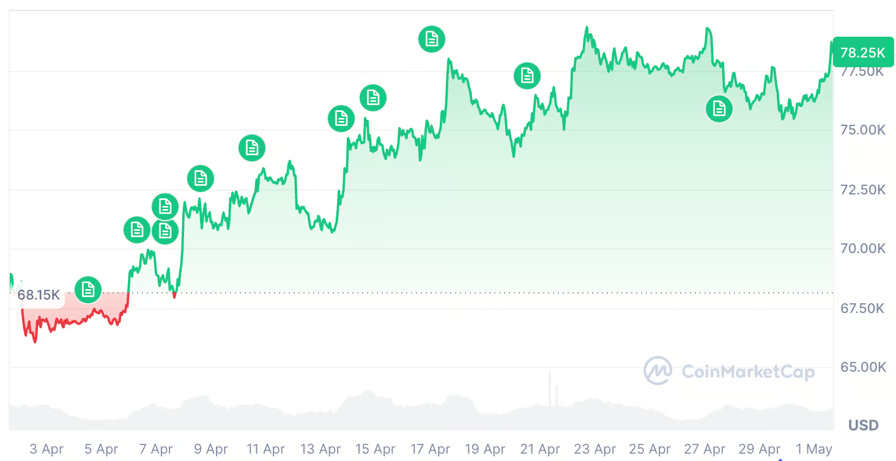
Bitcoin may not need a new story or catalyst to push back above the psychological $100,000 level, which it has not traded above in nearly five months, according to MN Trading Capital founder Michael van de Poppe.
‘“There doesn’t need to be a narrative that pushes the price upwards,” van de Poppe said in an X post on Friday, after asking, “What narrative will bring Bitcoin to $100K?”
“Price moves upwards, and the narrative will create itself,” van de Poppe said, adding:
“That’s why simply using math, statistics, and logic is required in order to succeed, and that’s why these regions on Bitcoin are still good for accumulation.”
Van de Poppe pointed out that attention has rotated elsewhere in the technology industry, with AI and other sectors “taking the spotlight” away from Bitcoin in recent months. At the time of market close on Friday, the stock price of Nvidia (NVDA), the largest AI stock by market capitalization, is up 5.08% since Jan. 1, while Bitcoin (BTC) is down around 10% over the same period.
Bitcoin hasn’t traded above $100,000 in almost five months
The last time Bitcoin traded at $100,000 was Nov. 13, just a month after the Oct. 10 $19 billion crypto market liquidation event, which many market participants attributed to the recent five-month downtrend. Bitcoin fell to a yearly low of $60,000 in February and has since recovered to $78,250 at the time of publication, according to CoinMarketCap.

Bitcoin is up 14.49% over the past 30 days. Source: CoinMarketCap
Many crypto market participants still believe that Bitcoin needs a strong narrative to drive its price higher. In recent times, attention has centered on US Federal Reserve interest rate decisions, regulatory developments in the US, and spot Bitcoin exchange-traded fund (ETF) inflows as potential catalysts.
Some also point to the potential passage of the US CLARITY Act, which aims to provide clearer rules for the industry, as a possible driver of Bitcoin’s upside.
Some say the CLARITY Act will not boost Bitcoin’s price
Others are not so sure. Veteran trader Peter Brandt told Cointelegraph in December that the CLARITY Act would be a positive step for the industry, but is unlikely to act as a major catalyst for upward movement in Bitcoin’s price.
Related: Repeated Bitcoin profit taking near $77K suggests rally is losing steam
“Is it a world-shaking macro development? Nope. Needed for sure, but not something that should redefine value,” Brandt said.
Coinbase chief legal officer Faryar Shirzad said on Friday that “It’s time” for the CLARITY Act to be finalized after new stablecoin yield provisions were published on Friday.
Meanwhile, White House crypto advisor Patrick Witt said at the Bitcoin Conference in Las Vegas this week that a “big announcement” on US President Donald Trump’s Bitcoin reserve is coming within weeks.
Magazine: AI-driven hacks could kill DeFi — unless projects act now
Key Highlights
- Compromise language for the CLARITY Act prohibits stablecoin issuers from distributing yield based purely on passive holdings
- Platforms can continue providing rewards connected to genuine user engagement and network participation
- The agreement between Senators Thom Tillis and Angela Alsobrooks emerged after extensive negotiations
- Coinbase praised the outcome, with CEO Brian Armstrong urging immediate markup proceedings
- Prediction market participants on Polymarket now estimate a 55% probability of 2026 passage, jumping 9 points in one day
A contentious disagreement between traditional financial institutions and cryptocurrency companies regarding stablecoin yield programs has reached resolution, removing a significant obstacle from the Digital Asset Market Clarity Act’s legislative path.
Senators Thom Tillis and Angela Alsobrooks unveiled compromise legislative language Friday that explicitly prohibits cryptocurrency platforms from distributing interest or yield to users based solely on stablecoin ownership.
Traditional banking institutions expressed worry that yield-generating stablecoin products would function similarly to deposit accounts, diverting capital from conventional lenders and constraining their lending capacity.
The negotiated framework prevents crypto platforms from offering returns that are “economically or functionally equivalent” to deposit account interest.
Nevertheless, the agreement permits rewards linked to what legislators define as “bona fide activities.” This provision enables platform users to generate returns through active engagement with cryptocurrency platforms and blockchain networks, rather than through passive asset retention.
[[LINK_START_0]]Coinbase[[LINK_END_0]] participated extensively in the negotiation process and faced the greatest business implications. Chief Policy Officer Faryar Shirzad acknowledged that banking interests secured more limitations than crypto advocates preferred, though the fundamental capacity to provide activity-driven rewards remained intact.
[[LINK_START_0]]Coinbase[[LINK_END_0]] CEO Brian Armstrong responded concisely on X: “Mark it up.” Chief Legal Officer Paul Grewal emphasized that the framework “preserves activity-based rewards tied to real participation on crypto platforms and networks.”
Operational Implications for Cryptocurrency Platforms
An industry insider indicated that companies must transition from a “buy and hold” approach to a “buy and use” framework to meet the requirements for permissible rewards under the revised regulations.
The legislative text mandates that the Treasury Department and the Commodity Futures Trading Commission initiate rulemaking procedures within twelve months of enactment. These proceedings will establish precise definitions for qualifying activities.
Regulatory agencies will have authority to evaluate elements including account balance, holding duration, and activity characteristics when formulating these guidelines. The text incorporates anti-circumvention provisions as well.
Legislative Calendar and Senate Proceedings
Galaxy Digital head of research Alex Thorn indicated that publication of the compromise text signals the Senate Banking Committee may schedule markup proceedings “as soon as the week of May 11.”
Thorn cautioned that banking sector opposition efforts are anticipated to intensify following disclosure of the finalized legislative language.
Senator Bernie Moreno recently projected the legislation would reach completion by late May. Senator Cynthia Lummis declared on April 11, “It’s now or never.”
The Clarity Act encountered delays earlier this year when a scheduled January markup was abruptly postponed.
Polymarket prediction market participants currently assess a 55% likelihood that the CLARITY Act receives presidential approval in 2026.
President Donald Trump has elevated cryptocurrency regulatory reform among his second-term priorities. Cryptocurrency enterprises have historically functioned within ambiguous regulatory frameworks, which industry leaders contend has restricted business expansion opportunities.
Key Highlights
- BTC surged past $78,000 following Iran’s submission of a revised peace proposal via Pakistani diplomatic channels
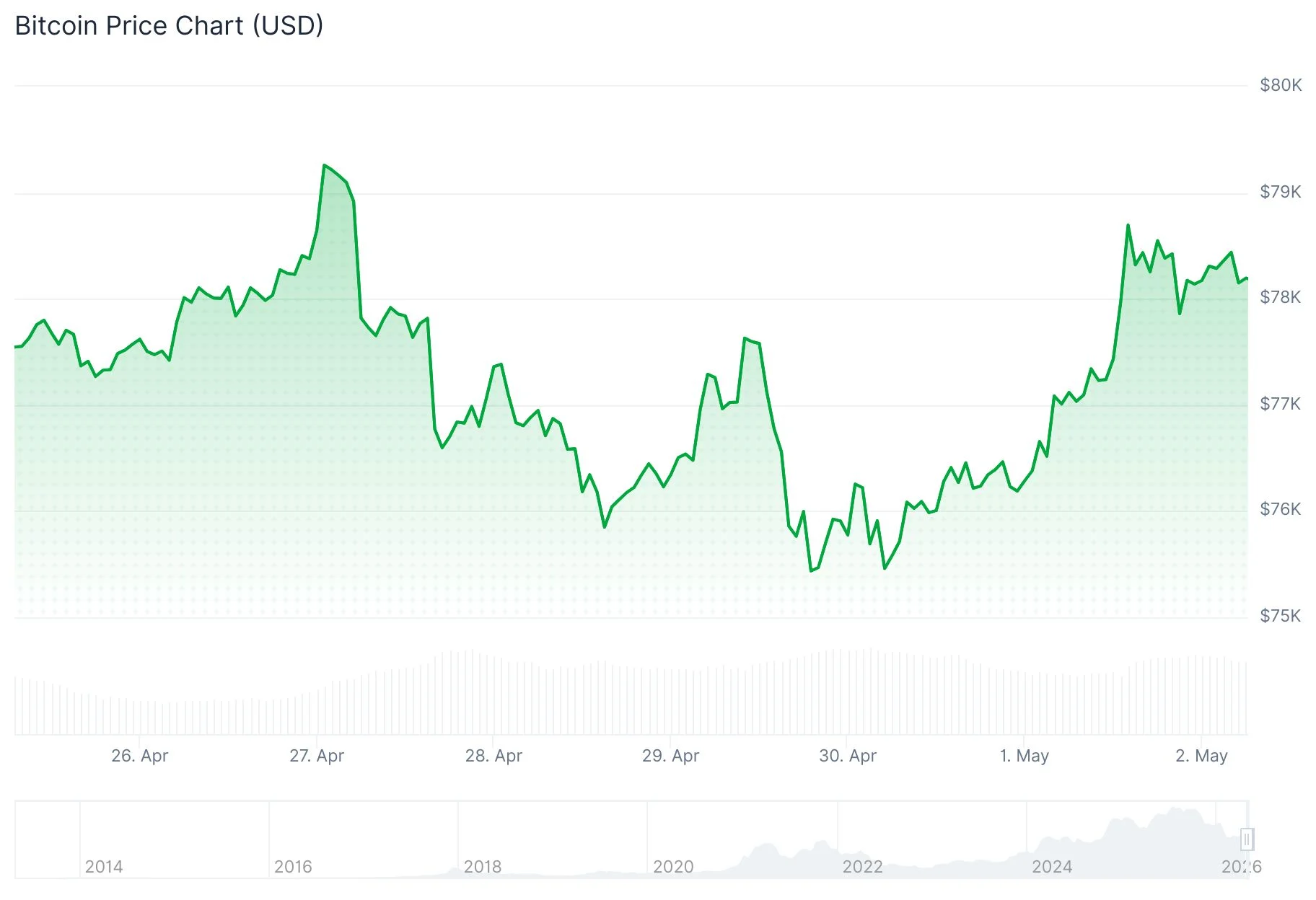
- Bitcoin reached approximately $78,800, registering over 3% gains during Saturday’s trading session
- Active diplomatic negotiations continue as Washington delivered updated conditions to Tehran
- Spot Bitcoin ETFs recorded $1.97 billion in April inflows, marking 2026’s strongest monthly performance
- Technical analyst Ali Charts identifies critical support zones at $54,145 and $43,316 that remain untested this cycle
Bitcoin pushed above the $78,000 threshold on Saturday following reports that Tehran had delivered an updated peace proposal to United States mediators via Pakistan.
This diplomatic development followed President Donald Trump’s rejection of Iran’s previous offer, which proposed reopening the Strait of Hormuz in return for ending the American blockade at the critical oil passage. Speaking to the press, Trump remarked that Iran “wants to reach a deal badly.”
Per Axios reporting, Tehran responded to Washington’s most recent modifications to a preliminary agreement framework. White House special envoy Steve Witkoff transmitted a series of requirements to Iranian officials, primarily centered on reintegrating nuclear concerns into the agreement’s language.
At press time, BTC was exchanging hands near $78,800, representing a greater than 3% increase from its intraday bottom around $76,000, per TradingView market data.
Commodity markets reacted simultaneously to the diplomatic progress. Brent crude futures declined to approximately $106, shedding more than 4% during the session, as market participants factored in reduced geopolitical risk.
The wider cryptocurrency sector experienced parallel upward momentum. Approximately $2.1 billion worth of Bitcoin and Ethereum options contracts reached expiration on the same trading day, contributing to heightened market fluctuations.
Bitcoin ETF Products Post Strongest 2026 Monthly Flows
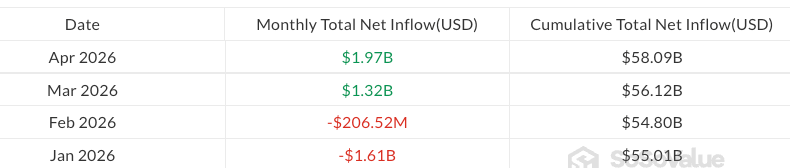
The price appreciation aligned with exceptional institutional demand for Bitcoin investment vehicles. U.S. spot Bitcoin ETF products accumulated $1.97 billion during April, surpassing March’s $1.37 billion and establishing the year’s peak monthly intake, based on SoSoValue analytics.
BlackRock’s iShares Bitcoin Trust (IBIT) dominated inflows with approximately $2 billion in net contributions. Conversely, Grayscale’s GBTC experienced the most significant withdrawals at roughly $280 million.
The Morgan Stanley Bitcoin Trust ETF (MSBT), which debuted April 8, attracted $194 million without recording any outflow sessions throughout the month.
Aggregate net contributions across all Bitcoin ETF products since their inception have now exceeded $58 billion. For 2026 year-to-date, Bitcoin ETFs maintain approximately $1.47 billion in net positive flows following withdrawal periods during January and February.
Critical Support Zones Remain Untouched in Current Cycle
Cryptocurrency market analyst Ali Charts highlighted Bitcoin’s MVRV Pricing Bands as an essential framework for determining cyclical bottom formations. According to Ali Charts’ analysis, Bitcoin has traditionally established its price floor within the 1.0 to 0.8 MVRV band range—representing the territory where market valuation trades at or beneath its collective acquisition cost.
As of late April 2026, these technical thresholds are positioned at $54,145 for the 1.0 marker and $43,316 for the 0.8 marker. Ali Charts emphasized that Bitcoin has yet to approach these price territories during the present market cycle.
Bitcoin delivered a 12% appreciation during April, representing its most robust monthly showing since April 2025, when it climbed over 14%.
Crypto World
Bitcoin quantum proposal offers Satoshi Nakamoto a way to prove control without moving BTC
Bitcoin’s quantum computing concerns have always had a Satoshi problem inside it.
Millions of bitcoin sitting in old wallets with exposed public keys could be vulnerable to theft if powerful enough quantum computers arrive. That includes the roughly 1.1 million bitcoin attributed to pseudonymous creator Satoshi Nakamoto, currently worth around $84 billion.
The obvious defense is a soft fork (or an upgrade to existing network rules) that eventually stops allowing spends from those legacy address types, forcing holders to move into quantum-safe formats before attackers can derive their private keys.
Prominent developer Jameson Lopp and five other developers proposed exactly that in mid-April through BIP-361, which would phase out quantum-vulnerable addresses on a five-year timeline and freeze any coins that fail to migrate.
That proposal created a different problem, however. Satoshi, and every other long-dormant holder, would have to wake up publicly or risk losing access to their assets.
Dan Robinson, a general partner at Paradigm, published a proposal Friday for a way around that trade-off that revolves around the concept of Provable Address-Control Timestamps, or PACTs.
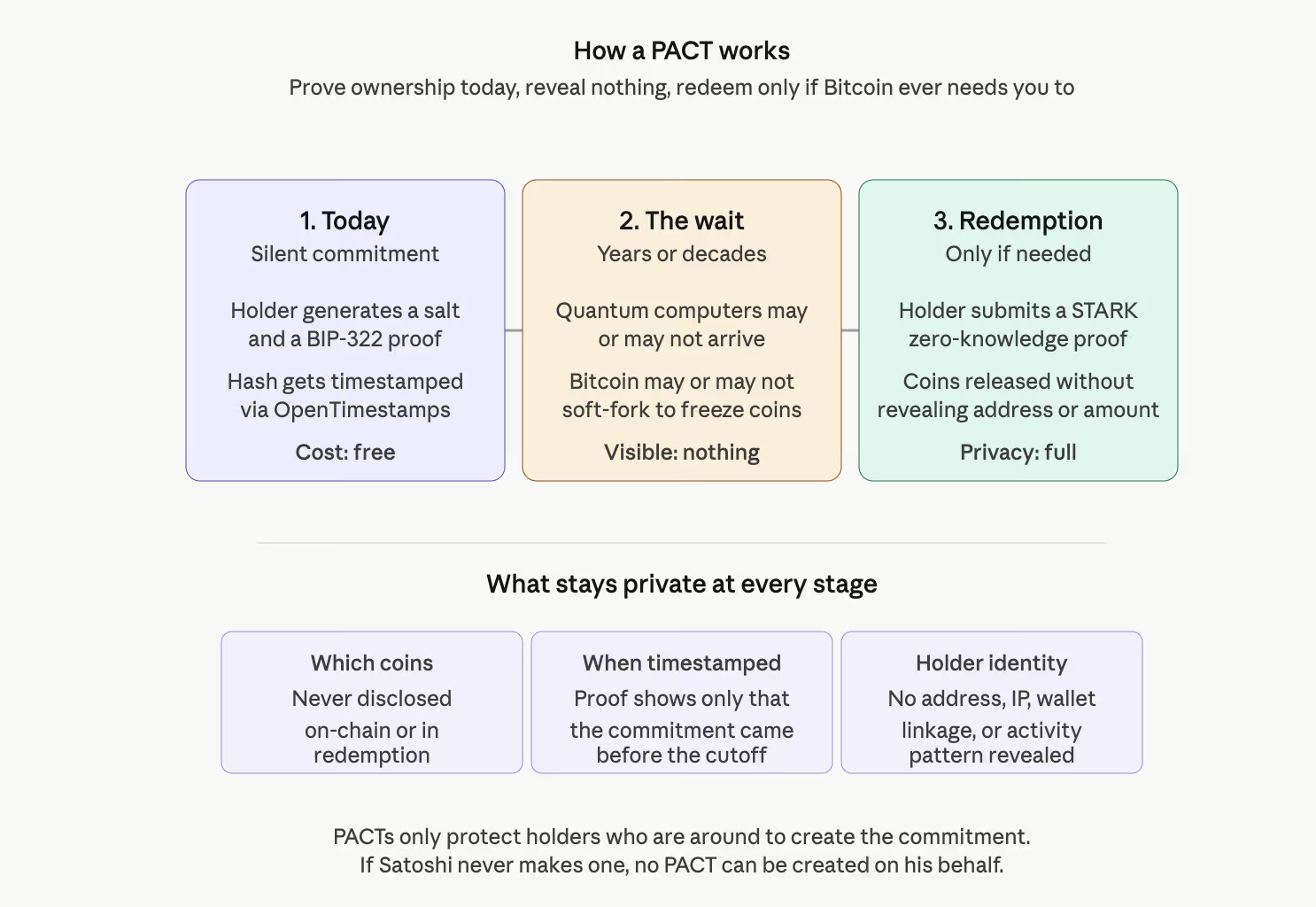
The core idea is not to move coins but timestamp proof of ownership at a specific date and reveal nothing to the public until the owners of those wallets actually need to spend.
A holder generates a random salt, which is a piece of secret data used to make a cryptographic commitment unique and unguessable, and uses BIP-322, a standard for signing messages from a Bitcoin address without spending from it, to produce a proof of ownership.
The salt and proof are bundled together into an onchain commitment and timestamp it through OpenTimestamps, a free service that anchors data onto the Bitcoin blockchain through a single batched transaction. The salt, proof, and timestamp files stay private.
If Bitcoin later activates a soft fork that freezes quantum-vulnerable coins, the protocol could include a rescue path that accepts a STARK proof, a type of zero-knowledge proof that remains secure against quantum computers, showing the holder created their commitment before quantum hardware existed.
The holder submits that proof when they want to spend, and the network releases the coins. The redemption reveals nothing about which address, which amount, or even when the original timestamp was created.
These PACTs also address a specific gap in BIP-361 by including a rescue path for wallets derived through BIP-32, the deterministic key generation standard introduced in 2012. Pre-2012 wallets, including most of Satoshi’s known addresses, do not use BIP-32 and cannot be rescued through that path.

As such, Robinson stated that the PACTs require Bitcoin to eventually adopt a STARK verification protocol, which would itself need a separate soft fork with broad community consensus.
The verification infrastructure does not exist in Bitcoin currently and would need what Robinson calls “substantial new plumbing,” such as multisig wallets, complex scripts, and hardware wallet support that would all need careful standardization.
That last constraint is the one PACTs cannot work around.
The protocol only protects Satoshi if Satoshi himself, or whoever currently controls those keys, makes the commitment. If Satoshi is genuinely gone, no PACT can be retroactively created. The coins remain exposed to whichever scenario plays out first, quantum theft or community freeze.
What PACTs do offer is a way to make the BIP-361 debate less binary. The current freeze proposal forces a choice between protecting against quantum theft and respecting dormant property rights.
Whether Satoshi will use it is the question PACTs cannot answer.
Key takeaways:
- Bitcoin options markets price in low odds of BTC reaching $84,000 in May, while the monthly futures basis rate reflects weakness.
- Significant Bitcoin accumulation by listed companies and rising spot Bitcoin ETF inflows absorb mining supply, reducing the impact of potential selling.
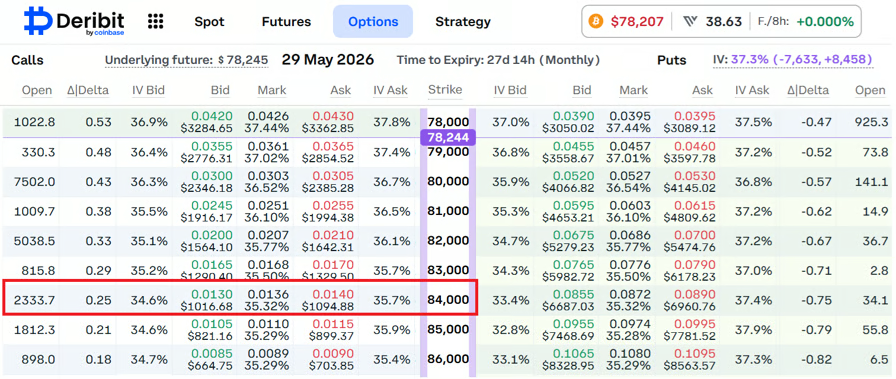
Bitcoin (BTC) reclaimed the $78,000 level amid broader risk-on sentiment, as the S&P 500 Index jumped to an all-time high on Friday. Despite 15% gains over the past 30 days, options markets are pricing in 25% odds that Bitcoin will trade above $84,000 by the end of May.
Derivatives markets remain skeptical of further gains, although institutional spot demand remains solid.

Bitcoin monthly options at Deribit. Source: Deribit
Bitcoin call (buy) options with a May 29 expiry and an $84,000 strike price traded at 0.0136 BTC, or $1,063. Considering there are 27 days left until expiry, the implied probability for Bitcoin price gaining 8% in May stood at 25%. Bitcoin put (sell) options have consistently traded at a premium over the past month, indicating heightened demand for downside price protection.

Bitcoin options 30-day delta skew (put-call) at Deribit. Source: Laevitas
The delta skew measures the gap between put and call options, which usually ranges between -6% to +6% in balanced markets. When professional traders are unwilling to take downside price exposure, the indicator jumps above the 6% neutral threshold, a level that has been the norm for the past month. A similar trend has also been prevalent in BTC futures markets.

Bitcoin 2-month futures basis rate. Source: Laevitas
The Bitcoin monthly futures basis rate usually trades at a 4% to 8% premium relative to regular spot markets to account for the cost of capital. However, this metric has displayed weakness over the past 30 days. The lack of demand for bullish leveraged positions can be partially explained by Bitcoin’s 12% decline year-to-date in 2026.
Bitcoin accumulation by spot ETFs and listed companies
While derivatives traders show little confidence that Bitcoin will reach $84,000, US-listed spot Bitcoin exchange-traded funds (ETFs) tell a different story. These instruments accumulated $1.3 billion in net inflows during March and another $2 billion in April, driving total net assets above $100 billion. This metric is commonly used as a proxy for institutional investor demand.
Related: Bitcoin’s surge to $77K pressures shorts, but absent spot and long leverage caps rallies

US-listed spot Bitcoin ETFs monthly net flows, USD. Source: SoSoValue
Similarly, listed companies have added massive Bitcoin positions to their reserves over the last 30 days. These include 56,235 BTC from Strategy (MSTR US), 5,075 BTC from Metaplanet (3350 JP), and 929 BTC from Strive (ASST US). By acquiring more than the equivalent of five months of future Bitcoin mining supply, these companies greatly reduce potential sell pressure.
The lack of demand for bullish Bitcoin derivative exposure does not invalidate the odds that the BTC price will reach $84,000 or higher by the end of May. As long as institutional appetite remains solid, the bullish momentum should continue.
Two killed in Russian attack on bus in Kherson
This Week in Crypto: ETF Momentum, Legislative Progress, and Security Threats

Self-driving cars will no longer go scot-free in California as penalties go into effect

Manchester United reach agreement with Casemiro over contract clause amid transfer speculation

US brings back mandatory military draft registration

Steven Gerrard disagrees with Gary Neville over ‘shock’ Chelsea and Arsenal claim | Football

JUST CONFIRMED!!! XRP HOLDERS TRUMP ALL IN for CRYPTO

Live Trading – Crypto , Gold and US OIL with Trump | 1 May 2026 | Crypto Trading Live

Best financial management tip in telugu | Save money by 50 30 20 rule | Money saving idea | #viral
-

 Tech5 days ago
Register Renaming | Hackaday
-
Crypto World7 days ago
Hyperliquid $HYPE Rally Builds Momentum as AI Sector Enters Prove-It Phase
-

 Politics4 days ago
Drax board avoid their own AGM, accused of greenwashing & environmental racism
-

 Tech5 days ago
Why Blue Badges Disappeared From Toyota Hybrids
-

 Tech4 days ago
Images of Samsung’s rumored smart glasses have leaked
-
 Sports6 days ago
IPL 2026: Ruturaj Gaikwad registers slowest fifty of the season, enters all-time unwanted list | Cricket News
-
 Tech13 hours ago
Trump’s 25% EU auto tariff breaches Turnberry Agreement that also covers semiconductors and digital trade
-

 NewsBeat6 days ago
LK Bennett closes all stores after entering administration
-

 Fashion3 days ago
Kylie Jenner’s KHY Enters a New Era with ‘Born in LA’
-
 Entertainment7 days ago
Mariah Carey Slams Deposition Claims In Brother’s Lawsuit
-

 Business3 days ago
Most Commercial Energy Audits Miss the Real Losses
-

 Crypto World4 days ago
CFTC’s AI will review U.S. crypto registration applications, chairman tells CoinDesk
-

 Business5 days ago
(VIDEO) Charlize Theron Climbs Times Square Billboard to Promote New Netflix Thriller ‘Apex’
-

 Business3 days ago
Barclay Brothers Avoid Bankruptcy: HSBC Drops High Court Petitions After IVA Deal
-
 Sports13 hours ago
Paul Scholes issues Marcus Rashford reality check as agreement emerges over Man United star
-

 Tech6 days ago
Microsoft to roll out Entra passkeys on Windows in late April
-

 Tech6 days ago
OpenAI’s Sam Altman apologizes for not reporting ChatGPT account of Tumbler Ridge suspect to police
-
 Business2 days ago
Tesla Officially Registers Elon Musk’s Stock: What Investors Need to Know
-

 Tech6 days ago
OpenAI CEO apologizes to Tumbler Ridge community
-

 Tech4 days ago
Get Ready for More Brain-Scanning Consumer Gadgets
You must be logged in to post a comment Login