
Crypto World
Private credit’s cracks spark a new tug of war with Wall Street banks


Wall Street, Manhattan, New York.
Andrey Denisyuk | Moment | Getty Images
Wall Street banks may finally be getting a long-awaited opening to claw back market share from private credit lenders.
After a decade in which private credit lenders grew rapidly and took over a large share of financing for leveraged buyouts, signs of strain in that sector, along with easing bank rules, may now be shifting the balance.
“This is an opportune time for banks to regain market share from private credit funds,” Moody’s chief economist Mark Zandi told CNBC in an email.
“Interest rates have declined and banking regulation has eased. Private credit lenders are also struggling with the fallout from their previously aggressive lending,” he highlighted.
Private credit’s rapid ascent was fueled in part by banks’ retreat. Following the Federal Reserve’s aggressive rate hikes and the 2023 banking crisis, lenders tightened underwriting and pulled back from riskier deals. Borrowers, particularly private equity firms, increasingly turned to direct lenders offering faster execution and looser terms.
The tug of war is just starting. The rules have been relaxed, so it’s only natural that banks want to get back some of their market share in private credit.
Jeffrey Hooke
Johns Hopkins Carey Business School
At its peak, the shift was dramatic. According to PitchBook data, banks’ share of buyout financings above $1 billion fell to just 39% in 2023, down from about 80% in the five years prior. That share has since recovered to just over 50% in 2025.
And the tide may be turning further.
Private credit is facing mounting challenges. Years of aggressive lending are starting to backfire, as higher interest rates make it harder for heavily indebted borrowers to repay loans and increase default risks. Investor demand for liquidity is also rising, with some clients seeking to pull money after years of locking up capital.
Moody’s Zandi expects the sector to “experience more credit problems in the coming months,” citing fallout from geopolitical tensions, higher borrowing costs and structural pressures in industries such as software. Consumer and healthcare borrowers may also come under strain.
Regulatory changes offering tailwinds
Over the medium term, regulatory changes could also further tilt the playing field.
“Our anticipation of deregulation from the Trump administration includes a likely weakening of the Basel III Endgame implementation, with the U.S. Treasury explicitly aims to redirect business lending back into the banking sector,” Shannon Saccocia, chief investment officer at Neuberger Berman, told CNBC via email.
The Basel III “Endgame” framework is a regulatory overhaul finalized in 2017 in the wake of the 2008 global financial crisis. It was designed to standardize how large banks calculate risk and to establish a capital floor that requires lenders to hold more reserves against loans, particularly higher-risk corporate and leveraged lending.

That has made bank lending less competitive versus private credit funds in recent years, said market veterans.
A weakening or reversal in the Basel III Endgame will raise competition for private credit lenders, Saccocia added, a stance echoed by other market veterans.
“Banks should quickly fill any void left by more cautious private credit lending, said Zandi, pointing to a more favorable regulatory backdrop and improving funding conditions for traditional lenders.
Recent Federal Reserve proposals to adjust the regulatory capital framework could “position banks to be more competitive on the lending front in hopes of regaining at least some share of their original commercial banking foothold,” noted Lukatsky.
Recent deals, such as the multi-billion-dollar leveraged loan financings for Electronic Arts and Sealed Air, signal a strong appetite among banks to execute “jumbo” transactions when market conditions allow.
Private credit still competitive
However, private credit’s grip is far from broken just yet. Direct lenders continue to compete aggressively, offering unitranche loans that bundle different types of debt into one package at a single interest rate.
Blackstone and Ares, for example, were among 33 lenders that reportedly provided about $5 billion in financing to back investment firm Thoma Bravo’s acquisition of logistics company WWEX Group, underscoring how private credit firms can still fund large buyout deals even as banks begin to re-enter the market.
Pitchbook’s global head of credit and U.S. private equity Marina Lukatsky noted that the expected rebound in buyouts and dealmaking has yet to materialize this year, as uncertainty around trade policy, interest rates and geopolitics has slowed activity. With fewer deals taking place, demand for financing has declined across both banks and private credit.
For banks to make a meaningful comeback, borrowing costs in syndicated loans, which are large loans arranged by banks and funded by a group of lenders, need to become more competitive, she added. Additionally, large buyout activity needs to pick up, and the broader economic outlook needs to improve.
Crucially, private credit retains structural advantages that are difficult for banks to replicate, including speed, certainty of execution and flexible conditions, which some borrowers may continue to value in volatile markets, noted some experts.
That said, a comeback is on the cards.
“The tug of war is just starting,” said Jeffrey Hooke, senior lecturer in finance at Johns Hopkins Carey Business School
“The rules have been relaxed, so it’s only natural that banks want to get back some of their market share in private credit.”



Ukraine has complicated President Donald Trump’s efforts to stabilize oil markets amid the Iran war, amplifying risks for financial markets, including cryptocurrencies.
For nearly a month, markets have been gripped by a single concern: the Iran war. Disruptions in the Strait of Hormuz – a critical oil chokepoint – have driven prices sharply higher, stoking fears of sticky inflation, a risk-off shift, and renewed Fed rate hikes.
To cool things down, the Trump administration quickly lifted sanctions on Russian crude for the short term, opening the tap to compensate for oil supply disruptions caused by the Iran war.
It came across as a solid plan to stabilize energy markets until Ukraine blew it up.
This week, Ukraine launched drone strikes on ports and refiners in Russia’s Leningrad, leading to what one observer described as “the most serious threat” to the country’s oil exports since Putin’s full-scale invasion of Ukraine in 2022.
The damage is significant, with roughly 40% of Russia’s oil export capacity offline. Oilprice.com editor Michael Kern described it as “a logistics problem first – and a supply problem second,” underscoring that moving oil to buyers is now as difficult as producing it.
“In conjunction with the war in the Middle East and de facto closure of the Strait of Hormuz and subsequent oil/LNG production outages, the Russian disruption adds a fresh element to already sky-high oil prices,” Kern noted.
In other words, oil prices may remain elevated longer than initially expected. For risk assets, including bitcoin and other cryptocurrencies, that’s an issue because higher sticky energy prices could lead to sticky inflation, potentially putting pressure on global central banks to raise borrowing costs and drain liquidity.
Traders are already prepping for a potential Fed rate hike in the short term. According to Bloomberg, flows in the options market tied to overnight interest rates indicate traders are wagering on a rate increase within two weeks.
Taken together, these factors suggest bitcoin’s recent resilience may face tests, with the $65,000–$75,000 range vulnerable to a downside break.
At press time, bitcoin traded near $68,500, down nearly 2% over the past 24 hours, according to CoinDesk data. WTI oil, which slipped nearly 10% to $83.95 per barrel on Monday, has since bounced back to $93.50. Brent crude is once again trading above the $100 mark.
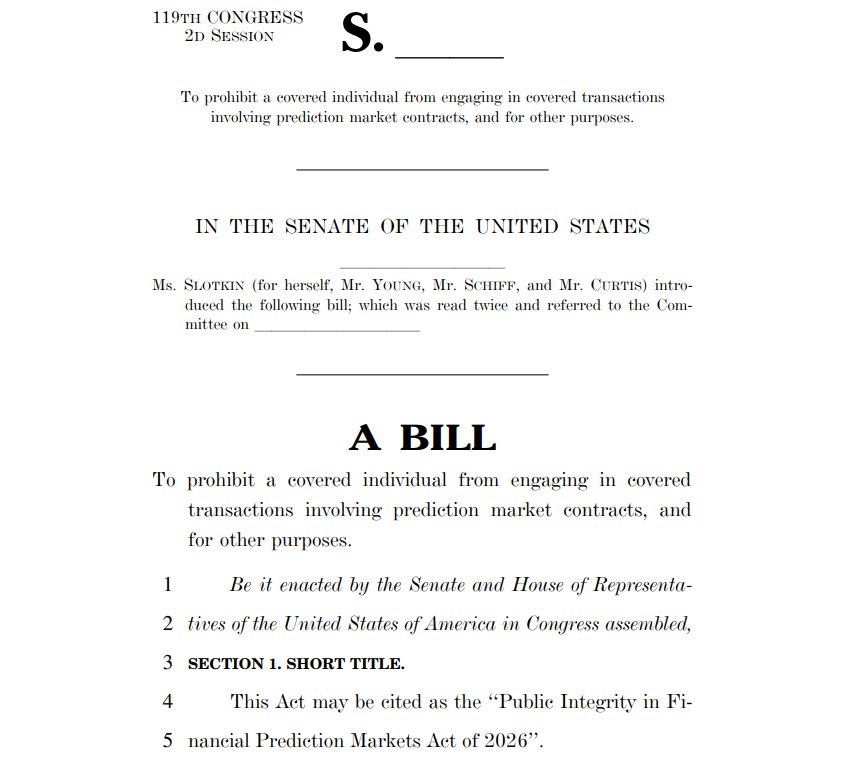
US lawmakers have introduced a second bill this week aimed at curbing prediction market insider trading by government officials, amid growing concerns over such activity on major platforms such as Kalshi and Polymarket.
In an announcement on Thursday, US lawmakers Todd Young, Elissa Slotkin, John Curtis and Adam Schiff unveiled the bipartisan Public Integrity in Financial Prediction Markets Act of 2026.
“No one should be profiting off the information and knowledge gained as a public servant, period,” Slotkin said, adding: “This bill is an important first step in placing common sense rules around prediction markets, and it has real teeth to ensure those who break these rules face real consequences.”
The bill underscores growing unease that prediction markets could become a new frontier for insider trading, as bets tied to real-world events blur the line between wagering and financial activity.
Bill aims to stop insider profiteering
The latest bill, which has been introduced in the second session of the 119th Congress, aims to prohibit government executives from using “insider information to bet on a prediction market contract.”

If enacted, the Public Integrity in Financial Prediction Markets Act of 2026 would cover the president, vice president and politicians across Congress, the House of Representatives and the Senate.
It would also cover political appointees and “employees of an Executive agency or independent regulatory agency.”
The bill defines insider information as anything that a “reasonable investor would consider important in making a decision related to a prediction market contract and is not publicly available.”
It also outlines reporting requirements under which a government official must report any contract wagers over $250 within 30 days to the supervising ethics office. The individual must include “the number of contracts purchased, price of contract, date and time of transaction, name of contract, position taken on contract, name of trading platform used, profit or loss made on transaction.”
The penalties will see individuals charged the greater of $500 or double the amount of profit made from the prediction market contract.
Related: SEC is no longer a ‘cop on the beat‘ on crypto, says US lawmaker
The bills come amid an increasing number of state and federal lawmakers taking aim at prediction markets.
It also marks the second bill introduced this week to try to stop government officials from using insider information to profit on prediction markets, the first being the PREDICT Act introduced by US Representative Adrian Smith and Representative Nikki Budzinski on Tuesday.
However, the PREDICT Act focuses on preventing insider trading on prediction markets relating to political events, policy decisions and other government actions.
Recently, both Kalshi and Polymarket have made attempts to tighten their rules to stop insiders wagering on their platforms.
Magazine: Nobody knows if quantum secure cryptography will even work
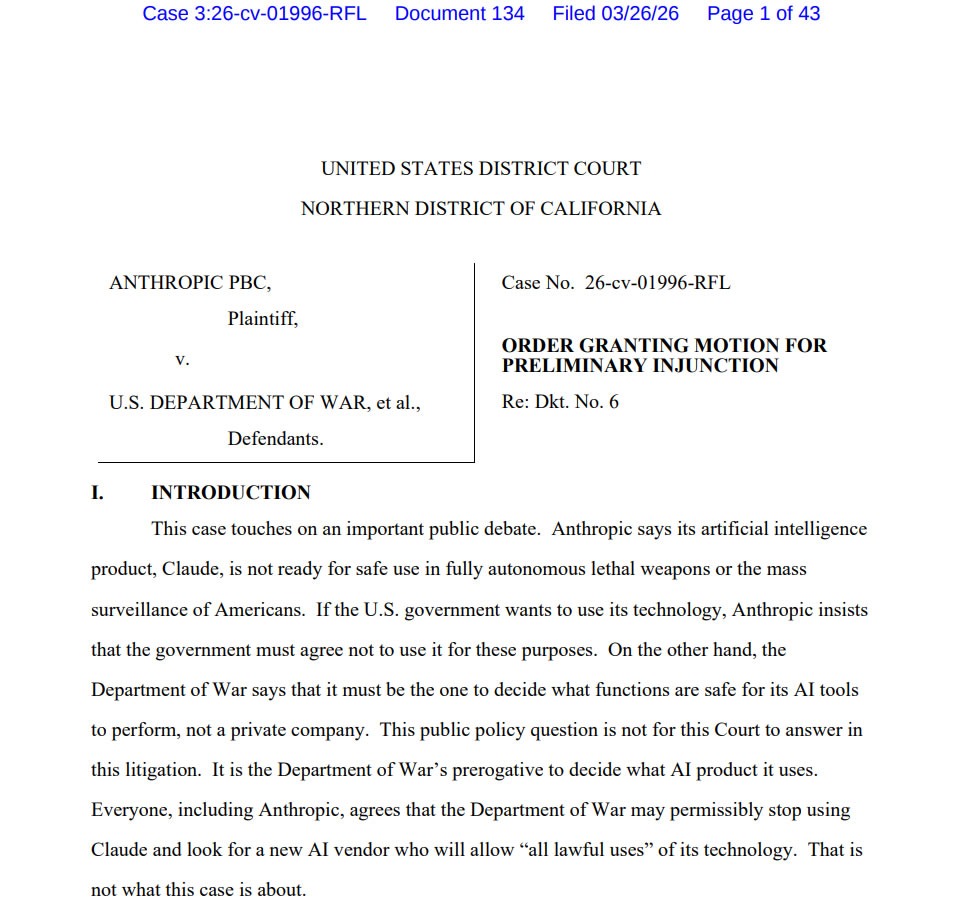
A US federal judge in San Francisco has granted Anthropic’s request for temporary reprieve after the Pentagon’s designation of the company as a supply chain risk.
In an order on Thursday, Judge Rita Lin of the District Court for the Northern District of California ordered a preliminary injunction against the Pentagon over the label. It also temporarily halts a directive from US President Donald Trump ordering federal agencies to stop using Anthropic’s chatbot, Claude.
“Nothing in the governing statute supports the Orwellian notion that an American company may be branded a potential adversary and saboteur of the US for expressing disagreement with the government,” said Judge Lin.
Anthropic was the top player in enterprise AI markets with 32%, ahead of OpenAI on 25%, as of 2025, according to Menlo Ventures. A government-wide ban on Anthropic would plummet this position.
The judge said that these “broad punitive measures” taken against Anthropic by the Trump administration and Defense Secretary Pete Hegseth appeared “arbitrary, capricious, [and] an abuse of discretion.”
The order came after Anthropic filed a lawsuit in a Columbia federal court on March 9, alleging that Hegseth overstepped his authority when he designated the company a national security supply-chain risk.

Anthropic opposed autonomous weapons and mass surveillance
The dispute stems from a deal in July 2025 between the AI firm and the Pentagon on a contract to make Claude the first frontier AI model approved for use on classified networks.
Negotiations collapsed in February with the Pentagon seeking to renegotiate, insisting Anthropic allow military use of Claude “for all lawful purposes” and without restrictions.
Anthropic maintained that its technology should not be used for lethal autonomous weapons and mass domestic surveillance of Americans.
On Feb. 27, Trump ordered all federal agencies to cease using Anthropic products. “The Leftwing nut jobs at Anthropic have made a DISASTROUS MISTAKE trying to STRONG-ARM the Department of War,” he wrote on Truth Social.
A 90-minute court hearing took place in San Francisco on March 24, during which Judge Lin pressed government lawyers on whether Anthropic was being punished for publicly criticizing the Pentagon.
Classic illegal First Amendment retaliation
“Punishing Anthropic for bringing public scrutiny to the government’s contracting position is classic illegal First Amendment retaliation,” the March 26 ruling stated.
Anthropic said in a statement that it was “grateful to the court for moving swiftly, and pleased they agree Anthropic is likely to succeed on the merits.”
Magazine: Nobody knows if quantum secure cryptography will even work

Tech-focused asset manager ARK Invest said it will start using Kalshi’s prediction market data to improve how it makes its investment decisions, one of the latest cases demonstrating the broader value of prediction market data beyond trading.
According to a statement from Kalshi, ARK will use prediction market data to gauge real-time expectations and guide its existing market-based research, in addition to analyzing performance indicators such as trading volume, regulatory approvals and technological milestones. ARK will also use the data for risk management and hedging strategies.
“Bringing prediction markets into institutional workflows is a natural next step for innovation in financial research,” ARK Invest founder and CEO Cathie Wood said Thursday, while the company’s research director, Nick Grous, said prediction markets “offer some of the purest expressions of risk around key economic and company-specific outcomes.”
Prediction markets became one of the hottest use cases in crypto last year and have consistently surpassed $10 billion in monthly trading volume. Prediction market data has also increasingly been seen by institutions, including the Federal Reserve and Cornell University, as valuable for making decisions that require a pulse on the market.
In a post on X, Wood also said ARK has been working with Kalshi to list markets on topics it is curious about on the prediction markets platform, including macroeconomic data and scientific milestones.
Kalshi CEO Tarek Mansour noted that “a few of these are already live on Kalshi, including non-farm payroll markets, deficit-to-GDP ratio markets, business KPIs, and more.”

Fed, Cornell eye opportunity in prediction markets
Last month, researchers at the US Federal Reserve argued that Kalshi can better measure macroeconomic expectations in real time than its existing solutions and thus should be incorporated into the Fed’s decision-making process.
Related: Polymarket tightens rules to curb manipulation, insider trading risks
“Kalshi markets provide a high-frequency, continuously updated, distributionally rich benchmark that is valuable to both researchers and policymakers,” the Fed researchers said at the time.
Predictions market data from Polymarket has also been researched at Cornell University to study how traders reacted to political events in real time, such as Donald Trump and Joe Biden’s presidential debates and the assassination attempt on Trump in 2024.
Magazine: IronClaw rivals OpenClaw, Olas launches bots for Polymarket — AI Eye

DeFi is evolving—and River is leading the charge. With its innovative chain-abstraction stablecoin system, River enables cross-chain collateralization, liquidity, and yield generation without bridging assets. Powered by the omni-CDP stablecoin satUSD, users can leverage, earn, and scale natively across multiple ecosystems.
Unlock Yield with One Click
River’s Smart Vault deploys your funds across DeFi and institutional-grade CeDeFi strategies. It also mints satUSD and deposits it into staking pools, letting you earn rewards effortlessly.
🔗 Access yield instantly: Smart Vault
Core Modules
Omni-CDP: Cross-Chain Collateral, No Bridges Needed
River’s omni-CDP module is the first cross-chain CDP built on LayerZero’s OFT standard, enabling users to collateralize BTC, ETH, BNB, or liquid staking tokens (LSTs) on one chain and mint satUSD on another—natively, with zero bridging or wrappers required.
- Deposit BTC, ETH, BNB, or LST as collateral
- Mint satUSD on any integrated chain
- Earn staking rewards by depositing satUSD into River’s pools
Prime Vault: Institutional-Grade Security & Yield
For institutions, Prime Vault offers maximum security and predictable returns. By integrating with leading custodians and regulated partners, assets remain safe while generating yield through River’s stablecoin ecosystem.
🔗 Explore institutional access: Prime Vault
satUSD+: Liquid Yield from Protocol Revenue
River’s Yield module introduces satUSD+, a liquid, composable ERC-20 token representing a staked satUSD position. Holders automatically earn protocol fees without manual claiming or restaking.
Key Benefits of satUSD+:
- Accrues revenue from CDP operations and system usage
- Fully composable across other DeFi protocols
- Redeemable at any time for the underlying satUSD
Where does the yield come from?
- Minting, redemption, and liquidation fees from Omni-CDP
- satUSD adoption across chains and applications
- Future integrations with lending markets, partner incentives, and revenue-sharing
💡 Unlike inflationary reward models, River’s yield is backed by real protocol activity, ensuring sustainable and tangible returns.
🔗 Mint or swap to get satUSD: River Mint
🔗 Stake satUSD to earn satUSD+: Staking
River4FUN: Social Engagement Meets On-Chain Rewards
River4FUN turns community activity into on-chain governance and rewards. Stake any token, connect your X account, and earn River Pts by posting, referring, and voting.
- Initial airdrop for connecting X
- Stake tokens to accumulate River Pts
- Vote and earn campaign rewards
🔗 Join the fun: River4FUN
Smart Vault: Yield Without Risk
River’s Smart Vault allows users to deposit assets such as BTC, ETH, or USDT and earn returns without incurring liquidation risk. Funds are deployed across DeFi and institutional-grade strategies, while satUSD is minted and staked automatically to maximize yield.
River is redefining cross-chain DeFi, making yield generation, staking, and stablecoin utility seamless, secure, and scalable. Whether you’re an institutional investor, a DeFi enthusiast, or just exploring yield opportunities, River offers a single ecosystem to earn, leverage, and grow your crypto assets.
RIVER OFFICIALS
Website | X | LinkedIn | Telegram | GitHub | YouTube
REQUEST AN ARTICLE


Disclosure: This article does not represent investment advice. The content and materials featured on this page are for educational purposes only.
Crypto scams surge as AI-powered fraud and fake exchanges exploit urgency and weak user verification.
Summary
- Crypto scams surge as fake exchanges and AI fraud exploit urgency, costing users billions in stolen funds.
- Not all exchangers are equal — grey-zone platforms pose risks with unclear rules, weak support, and opaque processes.
- Safe crypto use starts with verification; users must assess risk, payment methods, and urgency before transactions.
The crypto exchange market looks deceptively simple until funds are drained. Fake websites are cheap to clone, brands are easy to mimic, and when in a hurry to beat a price move, proper checks often feel like a waste of time. That’s exactly why scammers love urgency.
Crypto fraud isn’t just a headline anymore — it’s a multi-billion-dollar machine. According to Chainalysis’ 2026 Crypto Crime Report, scams and fraud schemes stole an estimated $17 billion in cryptocurrency throughout 2025. Impersonation attacks jumped more than 1,400% year-over-year, while AI-powered scams delivered up to 4.5 times higher returns than traditional operations. The message is clear: a polished site and quick replies no longer mean safety.
The danger goes beyond outright scams. There are plenty of grey-zone exchangers — services with vague rules, no real support, and zero transparent process. The fix is simple: stop trusting, start verifying. Look for the signals that actually cost money and time to fake — clear policies, stable support channels, and a repeatable transaction flow.
Before anything is verified: Know the risk profile
“Exchanger” means different things to different people in crypto. There are classic web exchangers where a request is created and funds are sent straight through the site. Then there are OTC desks that handle cash or bank transfers offline. Aggregators only show ratings and don’t touch the money themselves. And finally, hybrid models that start online but finish with a bank wire or in-person meeting.
Each type carries its own risks: temporary custody of funds, address spoofing, chargeback threats, or even having to verify physical cash. Before a user checks a single thing, they need to lock down their own parameters — how much they are moving, how fast they need to move it, and which payment method they’re using. The bigger the amount or the tighter the deadline, the stricter the verification needs to be. In crypto, the more convenient something feels, the more it usually works against someone.
Red flags that show up before money moves
Pricing bait
If the rate looks 2–3% better than what is seen on CoinMarketCap, Kraken, or Binance for the exact same pair and payment method, treat it as a yellow flag. A legitimate service will say the exact net amount someone will receive after every fee — upfront. Vague answers or sudden rate changes once a user has started are classic bait-and-switch moves.
Communication pressure
Pushy messages like “act now or the rate disappears,” offers to jump to Telegram or WhatsApp, or sudden changes to wallet or card details after confirmation — these are textbook red flags. Address substitution is still one of the easiest and most effective ways to lose funds.
Process chaos
If every step feels improvised, the network isn’t clearly specified, or addresses arrive only as screenshots, that’s poor operational maturity. Predictable, documented flows cut manipulation risk dramatically.
Technical and identity signals
Lookalike domains (one extra letter, different TLD), inconsistent branding across pages, or zero external presence are instant warnings. Phishing and impersonation remain among the top fraud techniques, according to the FBI’s Internet Crime Complaint Center.
Wallet addresses should be locked into the order, not floating in chat. If the service can’t confirm the exact network or changes details without formal approval, walk away.
Support and accountability
No official support channels, everything running through a single private account, or zero response-time guarantees — these scream low accountability. Professional services publish escalation procedures upfront.
How to read reviews without getting fooled
Reviews can help, but they’re easy to game. Pay attention to how they spread over time (steady growth beats sudden explosions), specific details (city, transaction type, exact timing), and consistency across platforms like Trustpilot, Reddit, and forums.
Identical phrasing, pure marketing slogans, or 200 new five-star reviews in a week are classic manipulation signs. Treat reviews as one data point among many — never the only one.
Proof points: Signals that are expensive to fake
The real test isn’t how pretty the website is — it’s how clearly the service explains what happens when things go wrong. Does it spell out fees, cancellation rules, wrong-network procedures, and dispute steps?
Services that publish these policies openly make their entire process auditable. Repeatable steps — fixed rate locking, clear confirmation points, documented receipt verification — show real operational maturity.
Stable brand presence (long domain history, consistent contacts, the same tone everywhere) and proper multi-channel support with published SLAs are equally hard to imitate.
Practical 10-minute verification workflow
- Compare the offered rate against 2–3 market references.
- Ask for the exact net amount that’ll be received after all fees.
- Check domain age and brand consistency (WHOIS or SecurityTrails works great).
- Read the policies and full transaction flow.
- Scan review patterns across multiple platforms.
- For anything over $5k–10k, run a quick 1–5% test transaction first.
Apply this checklist to any platform. Services with clear, published steps and policies — like 001k.exchange — stand out immediately against random or temporary exchangers.
Real-world micro-scenarios
- Last-minute wallet change like “We updated the address — here’s the new one.” Risk level: critical. In a safe process the address is locked in the order and any change requires official confirmation.
- Review explosion: 200 new five-star comments in a week. Could be a campaign, artificial hype, or a short-lived project. Always cross-check six-month history and proof points.
- Unclear net amount: Rate shown, but fees only appear at the end. Simple fix: insist on the final net figure before anything is sent.
Conclusion
In crypto, polished websites and fast replies are cheap. A transparent, repeatable process is not.
Red flags tell someone when to stop. Reviews help them ask smarter questions. Proof points show them what’s actually real.
The strongest signal isn’t trust — it’s verifiability. Run the checklist, and quickly separate professional exchangers from the rest. Platforms that publish clear steps, policies, and support rules set the benchmark worth measuring everything else against.
Disclosure: This content is provided by a third party. Neither crypto.news nor the author of this article endorses any product mentioned on this page. Users should conduct their own research before taking any action related to the company.

David Sacks, a venture capitalist who became a special White House official under US President Donald Trump last year, has wrapped up his 130-day tenure as crypto and AI czar but will continue to shape policy in a new role.
“We’ve now used up that time,” Sacks told Bloomberg on Thursday, noting that he will continue making policy recommendations across a broad range of tech industries as co-chair of the President’s Council of Advisors on Science and Technology (PCAST).
Sacks has been an influential figure in the White House since Trump’s appointment in 2025, acting as the president’s key adviser on technology.
The new role will overlap with his previous role as crypto and AI czar, noting that he and other members would “study issues together” before issuing official recommendations to regulators.

As the crypto and AI czar, Sacks helped the President’s Working Group on Digital Asset Markets release a 166-page report in July, which outlined recommendations on how the crypto industry should be regulated.
More recently, on March 20, Sacks helped the Trump administration put out an AI framework that seeks to empower AI innovation and workplace development while protecting children and intellectual property rights.
Sacks also played a role in the passage of the stablecoin-focused GENIUS Act in July and continues to push for crypto market structure legislation, such as the CLARITY Act.
A report from Fox Business, quoting a senior adviser to the president, said Sacks will continue serving as AI and crypto czar while taking on a broader portfolio.
“David will always be his crypto and AI czar, but to the admin more broadly, this new role will allow him to advise on a broader range of critical tech issues,” they said.
PCAST may be more AI-focused than crypto
PCAST will consist of 13 tech leaders spread across AI, crypto, health care and quantum computing.
Among the members joining Sacks are Nvidia’s Jensen Huang, Meta’s Mark Zuckerberg, AMD’s Lisa Su, Oracle’s Larry Ellison, Andreessen “a16z” Horowitz’s Marc Andreessen and Dell Technologies’ Michael Dell.
The only crypto-native member is Fred Ehrsam, who co-founded Coinbase with CEO Brian Armstrong in 2012 before co-founding crypto-focused VC Paradigm in 2018.
Related: SEC is no longer a ‘cop on the beat’ on crypto, says US lawmaker
Sacks said a primary focus of PCAST is to ensure America’s AI strategy is aligned between the federal and state governments:
“The problem that we’re seeing right now is that you’ve got 50 different states regulating this in 50 different ways, and it’s creating a patchwork of regulation that’s difficult for innovators to comply with.”
“So what the president has called for is one rulebook,” he added.
Magazine: Big Questions: Can Bitcoin save you from the dreaded Cantillon Effect?
Sharp late-session selling and rising leverage suggest a bigger move is coming, with downside risk building.


Bitcoin fell to $68,507 on Friday morning, down 3.2% over the past 24 hours and 2.7% on the week, after a familiar pattern played out for the fifth consecutive week: a de-escalation headline followed immediately by an escalation headline.
U.S. president Donald Trump extended his deadline for Iran to reach a ceasefire deal by 10 days and said talks were going “very well.” Brent crude dipped 1.3% to $106. Then the Wall Street Journal reported the Pentagon is looking at sending up to 10,000 additional ground troops to the Middle East, and whatever relief had built evaporated.
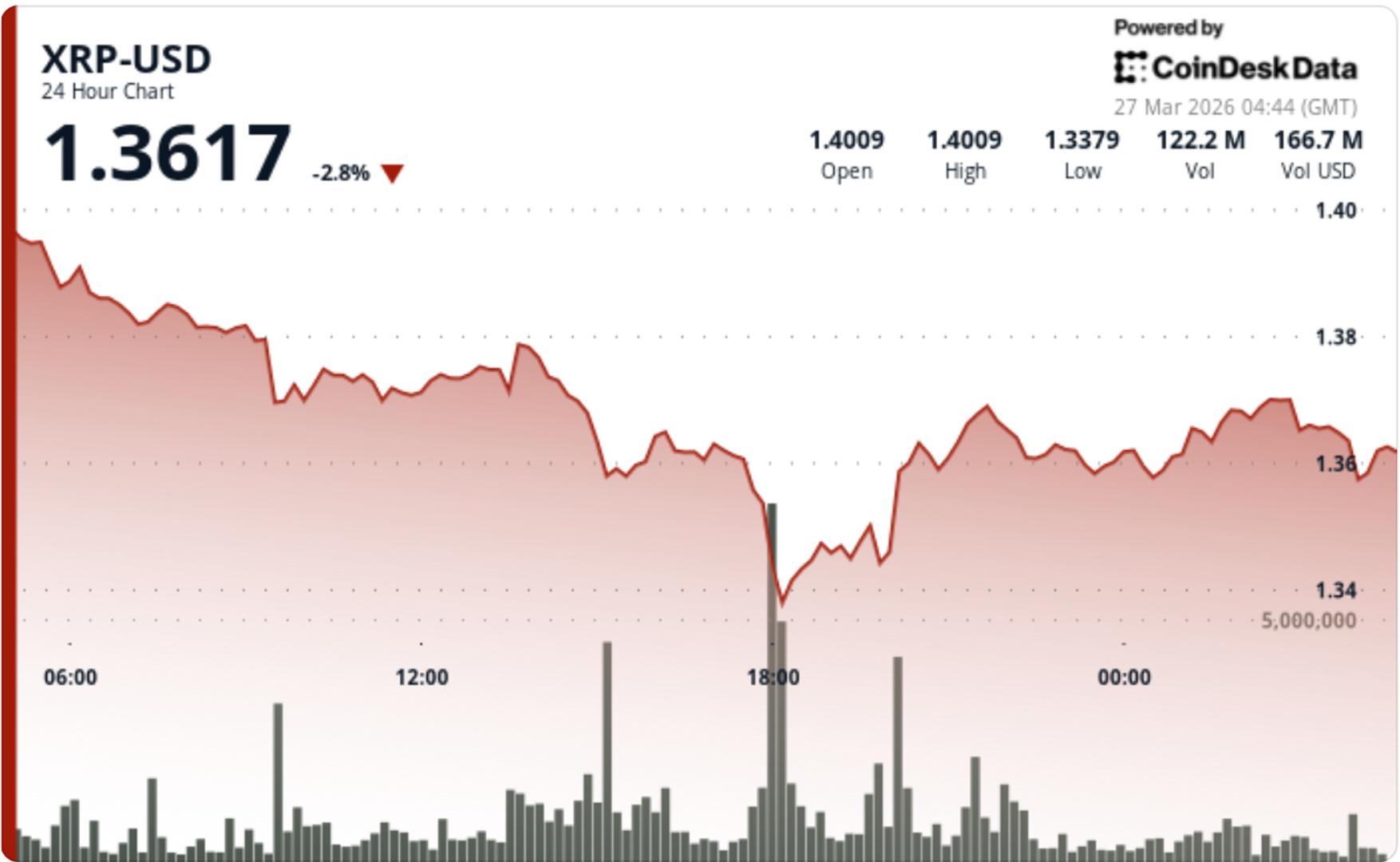
The broader crypto market shed nearly 1% to a total cap of $2.4 trillion. Ether dropped 4.6% to $2,050, back below the level it’s been fighting to hold all month. Solana fell 5.3% to $85.93. XRP lost 2.8% to $1.36, now down 6.5% on the week. BNB slid 2.3% to $626. Dogecoin dropped 2.8% to $0.091. Tron was the only major in the green at 1.2% daily and 2.4% weekly.
Asian equities fell 0.6% on Friday after Wall Street hit its lowest level since September on Thursday. South Korean tech stocks led losses, with Samsung and SK Hynix dragging the KOSPI down 2.3%. Taiwan dropped 1.2%. The war’s fifth week is producing the same pattern as the first four, where headline-driven whipsaws that leave everyone stopped out and the underlying trend unresolved.
FxPro chief market analyst Alex Kuptsikevich noted that the crypto market cap is approaching its 50-day moving average but still holding above it, which he called “a bullish sign.”
The market “must make an early decision,” he said, “either break through the uptrend line from early February or confirm the 50-day MA as support and break the downtrend.”
The institutional data beneath the price action tells a different story from the daily selloff.
Bitcoin ETFs have attracted $2.5 billion over the past month, according to Bloomberg, offsetting nearly all the outflows that had been ongoing since January. BlackRock’s bitcoin ETF has ranked among the top 2% of all ETFs by inflows year-to-date. Net bitcoin outflows from exchanges last month signaled a shift toward accumulation, with investors buying coins and withdrawing them to self-custody.
BlackRock itself offered a notable framing this week, saying that large investors are concentrating in bitcoin and ether while shunning the broader altcoin market.
The 10-day extension on the Iran deadline pushes the next binary event to early April.


Retail investors are reportedly the largest cohort in Strategy’s high-yield, low-volatility “Stretch” shares, which have been used to buy more than $1 billion worth of Bitcoin this year.
Around 80% of the owners of Strategy’s “Stretch” perpetual preferred shares (STRC) are owned by retail, said Strategy CEO Phong Le on Wednesday.
“Retail investors prefer low-volatility, high-yield digital credit,” he added.
The figure suggests that retail investors are still interested in exposure to Bitcoin, even though it is down about 45% from its all-time high.
Strategy’s executive chairman, Michael Saylor, has been stepping up sales and marketing of Stretch following the drop in Bitcoin and company stock, pitching the shares as a way to get exposure to BTC without the volatility.
In March, Strategy used around $1.2 billion from at-the-market sales of STRC to buy Bitcoin, though it switched back to using the sale of common stock in its most recent buy.
“Normally, the hardest thing in the world to do is to sell a new credit instrument to a retail investor,” Saylor said Thursday at the 2026 Digital Asset Summit in New York.
“11% is a big number.”
“Am I offending you if I call it a money market fund?” – @SullyCNBCDigital Credit is redefining yield.
Today we discussed Stretch $STRC on @PowerLunch. pic.twitter.com/oirw3PGZBi— Michael Saylor (@saylor) March 26, 2026
Speaking on CNBC’s “Power Lunch” on Thursday, Saylor said, “the idea is to create an onramp for people who believe Bitcoin is going to be around for the long term, but they can’t handle the volatility in the near term.”
He added that Stretch strips the first 10% to 11% of annual Bitcoin (BTC) returns and passes it to the credit investor. STRC is “way overcollateralized,” but Strategy is betting that Bitcoin will rise more than 11% per year, and “our equity holders are going to make a fortune,” while credit investors are happy with 11%, he said.
Related: Strategy halts Bitcoin buying via STRC: Will BTC price dip again?
Strategy’s common stock (MSTR) is down 19% this year and almost 71% from its July 2025 all-time high of $456, according to Google Finance. The Stretch shares, meanwhile, pay annual dividends of about 11.5%, higher than US Treasurys, which currently yield about 4%.
The investments are perpetual derivatives, meaning they do not have a maturity date, so Strategy never has to pay investors back like a bond, and they can be held indefinitely, earning dividends. The dividend rate is variable and adjusts monthly with market conditions.
The goal of these adjustments is to keep the trading price anchored near $100, making it behave more like a high-yield savings account than a volatile stock or crypto asset.
Saylor looks to double down on Stretch
In February, the company said it would rely more on its preferred stock sales to acquire Bitcoin.
It went further this week, revealing plans via a Securities and Exchange Commission filing on Monday to raise up to $21 billion by selling Strategy stock and another $21 billion from Stretch, via new at-the-market programs.
Magazine: Nobody knows if quantum secure cryptography will even work

Netflix ‘Love is Blind’ star jailed for attempting to kill his ex who he met on show

Amidst sell-off, Nifty Top 10 Equal Weight Index looks like a good bet
“Survivor 50”'s Charlie Davis reacts to being called the 'dumbest player here' by Dee


-
 Crypto World6 days ago
NIO (NIO) Stock Plunges 6.5% as Shelf Registration Sparks Dilution Worries
-
 NewsBeat2 days ago
Manchester United reach agreement with Casemiro over contract clause amid transfer speculation
-

 Fashion6 days ago
Weekend Open Thread: Adidas – Corporette.com
-

 Politics6 days ago
Jenni Murray, Long-Serving Woman’s Hour Presenter, Dies Aged 75
-

 Crypto World5 days ago
Best Crypto to Buy Now: Strategy Just Spent $1.57 Billion on Bitcoin During Fear While Early Investors Quietly Enter Pepeto for 150x Potential
-

 Crypto World5 days ago
Bitcoin Price News: Bhutan Sells $72 Million in BTC Under Fiscal Pressure, but the Smart Money Entering Pepeto Sees What the Market Does Not
-

 News Videos1 day ago
Parliament publishes latest register of MPs’ financial interests
-

 Sports4 days ago
Remo Stars and Kano Pillars Strengthen Survival Hopes in NPFL
-

 Sports4 days ago
Gary Kirsten Accuses Pakistan Cricket Board Of ‘Interference’, Mohsin Naqvi Responds
-

 Tech4 days ago
Give Your Phone a Huge (and Free) Upgrade by Switching to Another Keyboard
-

 Business5 days ago
No Winner in March 21 Drawing as Prize Rolls to $133 Million for Next
-

 Sports7 days ago
2026 Kentucky Derby horses, odds, futures, preview, date: Expert who nailed 12 Derby-Oaks Doubles enters picks
-

 Tech4 days ago
AI enters the chat: New Seattle dating app relies on tech to facilitate meaningful human connections
-
Business6 days ago
Columbia Sportswear enters $500 million credit agreement with JPMorgan Chase
-

 Tech5 days ago
Today’s NYT Connections Hints, Answers for March 22 #1015
-

 News Videos4 days ago
Ch 9 Financial Management Part 1 | Detailed One Shot | Class 12 Business Studies Boards 2026
-

 Business9 hours ago
Instagram, YouTube Found Responsible for Teen’s Mental Health Struggle in Historic Ruling
-
 Crypto World6 days ago
Small-cap Russell 2000 enters correction territory
-

 Business5 days ago
Will Duke Basketball Win It All? Duke Basketball Enters Second Round as Third Favorite to Claim NCAA Title
-

 Business7 days ago
(VIDEO) BTS Drops ‘ARIRANG’ Album Today, Marking Epic Post-Military Comeback With Live Concert
You must be logged in to post a comment Login