
Crypto World
Prosecutors find drafts of secret deal linking Milei to LIBRA, Hayden Davis



A confidential blockchain advisory agreement between Libra co-creator Hayden Davis and Argentinian president, Javier Milei, has been discovered on a suspect’s phone during the country’s ongoing investigation into the collapse of the LIBRA token.
That’s according to La Nación and sources familiar with the results of a January 9 report led by the Public Prosecutor’s Office (MPF).
The department’s computer experts reportedly recovered multiple copies of the agreement from Mauricio Novelli’s seized phone. The document appeared in exchanges between himself and Davis as various drafted iterations before the final version was signed by Milei.
The Argentinian president reportedly still denies the existence of the “confidential agreement” that cemented Davis’ role as the country’s blockchain advisor and, in turn, his association with LIBRA’s launch on February 14, 2025.
Novelli is part of a group of lobbyists, alongside Manuel Terrones Godoy and Sergio Morales, who allegedly helped launch and profited from LIBRA’s collapse.
Read more: Javier Milei disbands crypto unit he set up to investigate himself
Prosecutor Eduardo Taiano said that the MPF’s findings mean that the undersecretary of presidential affairs, who reports to Milei’s sister, General Secretary Karina Milei, will now have to confirm whether or not she has copies of the secret agreement.
The report also found Novelli played a key role in organizing the LIBRA launch and maintained contact with both Milei and his sister, Davis, Terrones Godoy, Morales, and Julian Peh, the CEO of the KIP protocol, which helped launch the token.
Multiple messages between Novelli and other parties were also found to have been deleted, but some messages were recovered after forensic extraction.
“All individual conversations and those related to WhatsApp groups made up of Novelli, Terrones Godoy and Sergio Morales were found to be empty or had been deleted,” analysts claimed.
One exchange involved Cardano founder Charles Hoskinson who accused Terrones Godoy of demanding a five-figure sum of money to meet Milei.
Hoskinson was promised “magical things will happen,” but refused the offer.
Hayden Davis-linked wallets sent $1M USDC after signing deal
Argentinian outlet Clarín revealed that Milei had signed a “confidential agreement” with Davis 15 days before the launch of LIBRA. It was subject to a non-disclosure agreement and required Davis to provide unpaid blockchain advice “ad honorem.”
Davis would “provide professional support, in line with global trends in decentralization and technological modernization, ensuring the highest quality and confidentiality at every stage of the advisory process.”
On the day it was signed, two payments of USDC worth roughly $1 million, were sent from Davis-linked wallets to the wallet of 75-year-old Orlando Rodolfo Mellino, a retiree with no real address, who then sent the funds to a wallet linked to Novelli.
Read more: LIBRA case judge orders full disclosure of Javier Milei bank accounts
La Nación reports that after a year, the investigation into LIBRA has been carried out at varying speeds, and has witnessed delays in key areas, such as the disclosure of the report into Novelli’s devices. It adds that Milei is yet to hire a lawyer to represent himself.
Meanwhile, Davis appeared to be walking free as of December 2025. Crypto analytics firm Bubblemaps recently claimed that Davis had made $15 million from Pump Fun’s private token sale just six months after LIBRA’s launch.
However, Bubblemaps then deleted its findings after Pump Fun’s pseudonymous CEO, Alon Cohen, called it defamatory “misinformation.” He said, “No one from the team ever spoke to the guy, I didn’t even know he existed until after the scandal.”
Got a tip? Send us an email securely via Protos Leaks. For more informed news and investigations, follow us on X, Bluesky, and Google News, or subscribe to our YouTube channel.

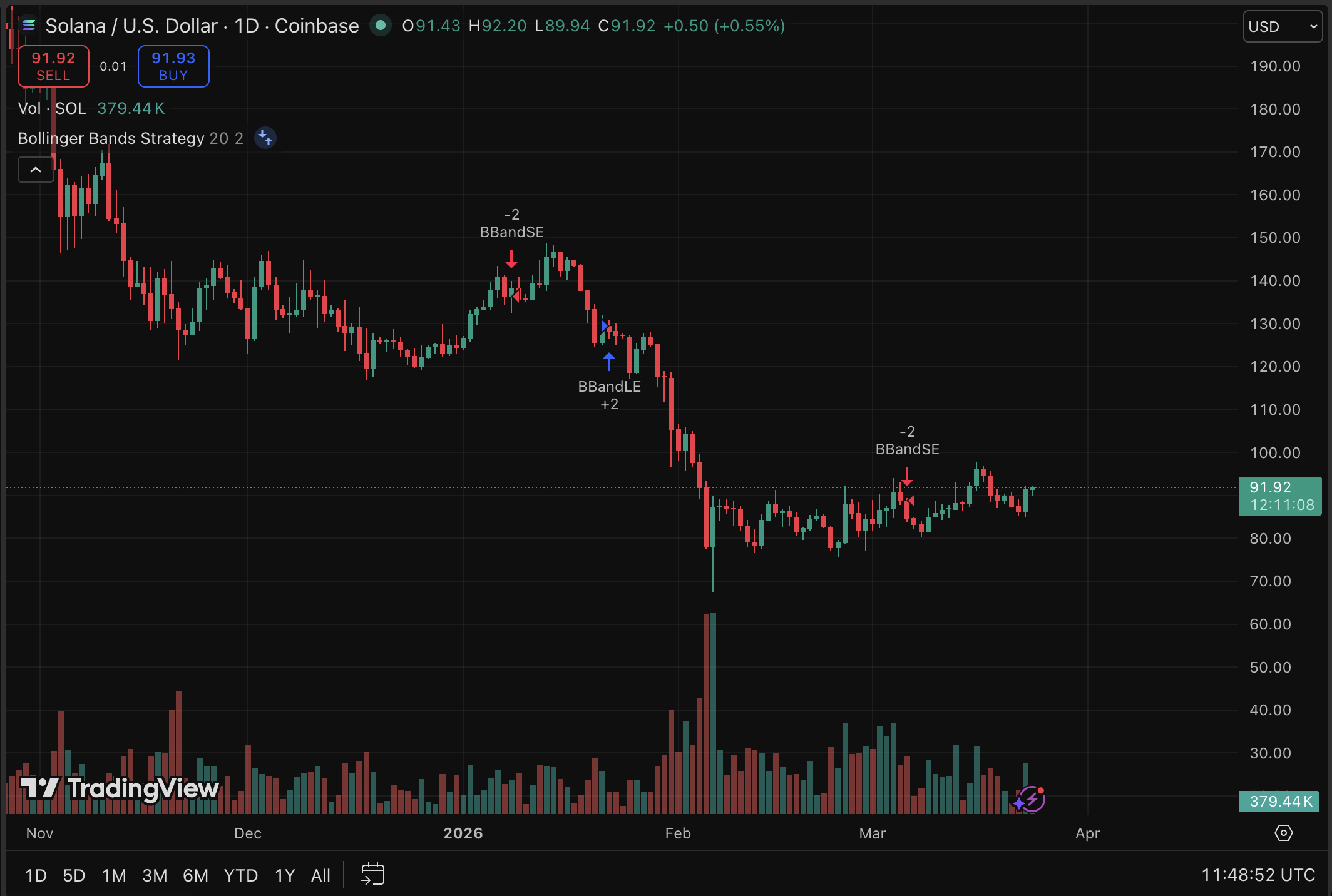
Solana price is trading at a pivotal $90.92, caught in a technical vice that creates a sharp dichotomy between immediate bearish signals and optimism prediction for a 2026 recovery.
Data indicate the asset is forming a “rising wedge” while trading below its critical 200-week moving average. This setup places SOL in a precarious spot following its breakdown from the $120–$145 consolidation zone earlier this cycle.
The market remains split. While long-term charts map a steady rebuild through the rest of the year, short-term indicators warn of a potential cascading drop if support levels fail, essentially creating a binary outcome for those navigating the current volatility.
Discover: The best pre-launch token sales
Solana Price Prediction: Can SOL Hold Support With $59 Drawdown Risk?
Solana’s price action shows a significant contraction, hovering in chopped consolidation near its 20-day EMA ($88.93) with a neutral RSI of ~51.63, pointing to market indecision. The chart structure below the $96 resistance level looks increasingly fragile; technical analysts point to a “horrendous” rising wedge on the 3-day chart.
If the lower trendline currently near the $80.27 “line in the sand” fails, the setup confirms a continuation, potentially opening the door to a 44% measured move toward $59.

Trading volumes reflect this hesitation, with major DEX activity dropping from $118bn to just $44.5bn weekly in early 2026. This contraction in on-chain volume suggests that institutional buy-side pressure is drying up at these levels.
A confirmed breakdown of the head-and-shoulders neckline near $107 has already occurred, shifting the probability toward the downside. Unless SOL reclaims the $104 pivot rapidly, the path of least resistance remains lower, forcing traders to evaluate hedging strategies against a deeper correction.
Discover: The best crypto to diversify your portfolio with
Maxi Doge Targets Early Mover Upside as Solana Tests Key Levels
While major caps like Solana grind through choppy consolidation and face potential 30-40% drawdowns, capital often rotates into high-volatility narratives seeking maximum leverage exposure.
The current market stagnation above $80 pushes traders toward assets that embrace risk rather than avoid it, specifically projects with lower market caps and higher momentum potential compared to established L1s.
Maxi Doge ($MAXI) enters this vacuum, targeting the “degen” trading culture directly. Positioned as a 240-lb canine juggernaut built for “1000x leverage trading mentality,” the project has raised $4.7 million in its current presale round.
At $0.000281 right now, Maxi Doge combines viral gym-bro humor with specific utility: holder-only trading competitions and a Maxi Fund treasury designed for liquidity management.
Unlike standard meme tokens that rely solely on hype, $MAXI integrates a “Leverage King” culture aimed at active traders who are bored by the sideways chop of altcoins like Solana. With features like 36% APY staking and leaderboard rewards, it attempts to capture the aggressive capital flow looking for early-stage multipliers.
Disclaimer: Cryptocurrencies are highly volatile and risky investments. Always do your own research (DYOR) before investing; this is not financial advice.
The post Solana Price Prediction: Can Solana Break The Bearish Structure? appeared first on Cryptonews.

TLDR
- Ledger completed a $50 million secondary share sale in the fourth quarter of last year.
- An existing investor sold shares, and the company did not raise new capital from the transaction.
- CEO Pascal Gauthier led the deal and said Ledger is preparing for all eventualities.
- Gauthier stated that the company could remain private or pursue a public offering based on market conditions.
- Earlier reports indicated that Ledger explored a potential U.S. IPO at a valuation above $4 billion.
Ledger disclosed a $50 million secondary share sale completed in the fourth quarter of last year. The company confirmed that an existing investor sold shares to provide liquidity. However, CEO Pascal Gauthier said Ledger will keep its public listing options open.
The company structured the deal as a secondary transaction rather than a primary capital raise. As a result, Ledger did not issue new shares or raise fresh funds. Instead, an early investor sold their stake, according to a Bloomberg report. A company spokesperson confirmed the details to The Block.
Gauthier led the transaction and coordinated with the selling shareholder. He told Bloomberg, “My job is to prepare the company for all eventualities.” He added that Ledger could remain private or pursue a public offering depending on market conditions.
Ledger completes $50 million secondary sale in Q4
Ledger executed the $50 million secondary sale during the fourth quarter. The transaction allowed one early investor to exit without affecting the company’s capital structure. The company confirmed that it did not receive proceeds from the share sale.
Bloomberg reported that Gauthier led the deal with the existing shareholder. A Ledger spokesperson later confirmed the transaction details publicly. However, the company did not disclose the identity of the selling investor.
Earlier reports stated that Ledger explored a potential U.S. IPO. Those reports suggested a valuation above $4 billion if the company proceeds. Still, Ledger has not finalized any listing plans.
Ledger last raised primary capital in 2023. That funding round valued the company at about $1.5 billion. The company has not announced a new primary funding round since then.
Ledger expands U.S. presence and product suite
Ledger has increased its focus on the United States in recent months. The company opened a new office in New York to support institutional outreach. It also appointed former Circle executive John Andrews as chief financial officer.
The company stated that the New York office will strengthen ties with banks and asset managers. It also aims to build relationships with other institutional clients. The CFO appointment supports this expansion strategy.
Over the past six months, Ledger has expanded beyond its hardware base. The company launched a next-generation Nano device for retail users. It also rebranded Ledger Live as the Ledger Wallet app.
The updated Ledger Wallet now includes in-app trading features. It also offers portfolio analytics and a redesigned “Earn” section. The company said the Earn section surfaces yield opportunities within the app.
Ledger continues to develop enterprise-focused security tools. These products target institutional clients seeking custody and infrastructure services. The company confirmed these initiatives as part of its broader expansion strategy.

Invesco, with over $2T in AUM, will become the first TradFi asset manager to use Superstate’s digital transfer agent infra.
Invesco, one of the world’s largest asset managers with $2.2 trillion in assets under management, will become the investment manager of Superstate’s flagship tokenized U.S. Treasuries fund USTB, the two firms announced Tuesday, March 24.
Under the arrangement, Invesco’s Global Liquidity team — which manages over $200 billion in money market and short-duration assets — will take over day-to-day portfolio management of USTB, while Superstate continues to run the fund’s on-chain infrastructure, including blockchain-based settlement and digital transfer agency services.
Invesco will be the first asset manager to use Superstate’s digital transfer agent rails, per the release. The transition is expected to close in Q2 2026, after which the fund will be renamed the Invesco Short Duration US Government Securities Fund while keeping the USTB ticker, smart contracts, and token address.
USTB, which launched in February 2024, has grown from a proof-of-concept into the sixth largest tokenized treasury product globally, per data from RWAxyz, with over $794 million in total value. The fund directly holds U.S. government securities, with assets tokenized across Ethereum, Solana and Plume, though the vast majority of value is on Ethereum.
The Invesco deal reflects a broader pattern of traditional finance partnership with blockchain native firms like Superstate, rather than building on-chain infrastructure itself. Robert Leshner, Superstate’s CEO and the founder of Compound, called the arrangement “the blueprint for how funds and ETFs will come onchain.”
Superstate expanded beyond tokenized treasuries into tokenized stocks with the launch of its Opening Bell platform last May. More recently, the firm announced direct on-chain equity issuance, enabling SEC-registered public companies to issue new shares directly on Ethereum and Solana.
For Invesco, the deal represents the payoff of a multi-year digital assets buildout the firm says dates back to 2019.
Also today, in similar partnership between a TradFi giant and a major tokenization player, the NYSE named Securitize as its first digital transfer agent to mint blockchain-native stocks and ETFs on its upcoming Digital Trading Platform.
This article was written with the assistance of AI workflows. All our stories are curated, edited and fact-checked by a human.
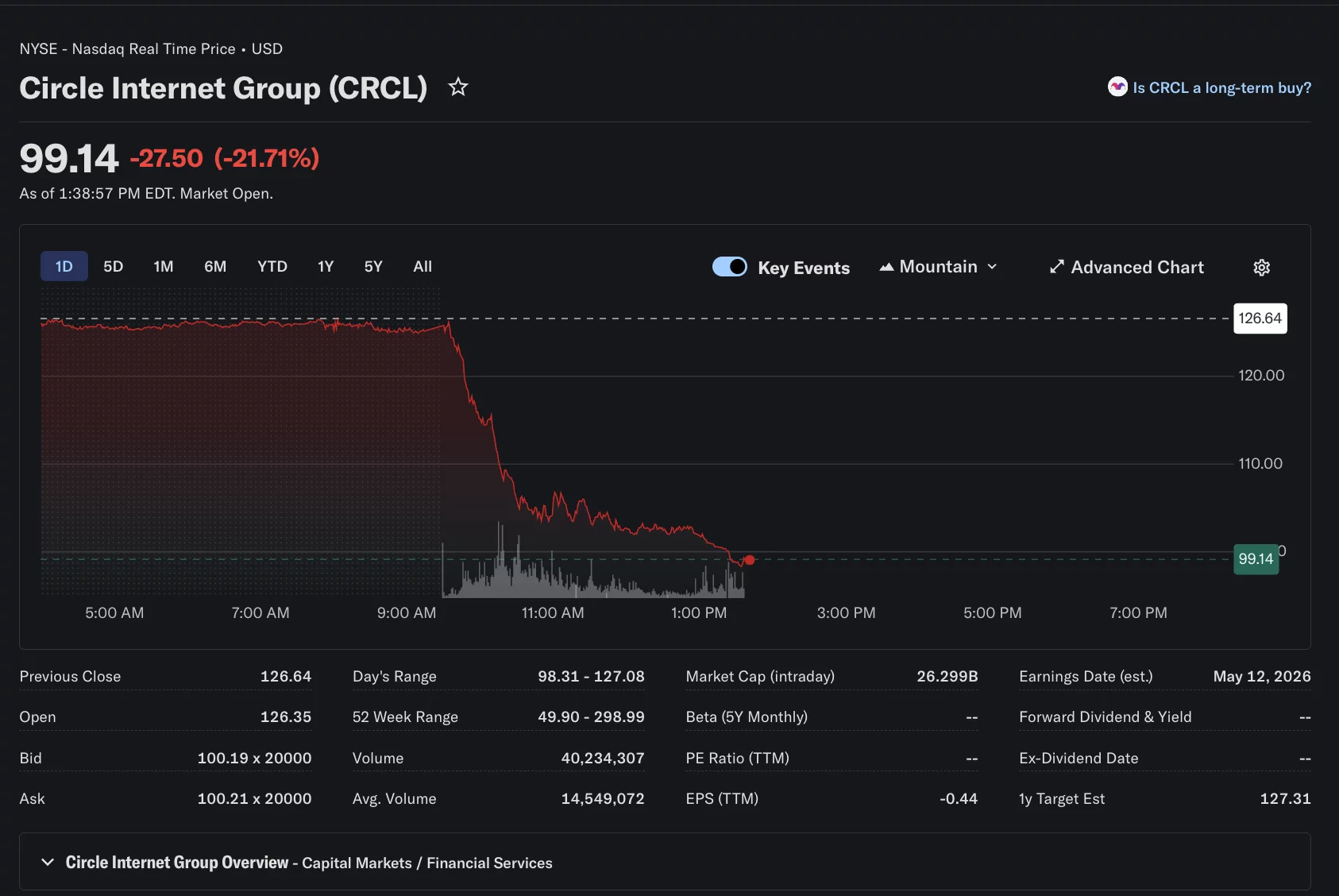
Circle (CRCL) sank about 22%, its worst drop since June 2025, after a tougher CLARITY Act draft threatened to ban stablecoin yield, clashing with booming USDC growth.
Summary
- Circle Internet Group (CRCL) stock is trading around $98.71, down about 22% on the day and roughly 18% below Monday’s close, its steepest slide since June 2025.
- The sell-off follows reports that the latest draft of the U.S. CLARITY Act would sharply limit or ban yield and rewards on stablecoins, directly hitting Circle’s USDC-centric business model.
- The move wipes billions from Circle’s market value even as USDC circulation and on-chain usage climb, highlighting the tension between regulatory risk and underlying product growth.
Circle Internet Group shares plunged on Tuesday after fresh reports that U.S. lawmakers are tightening a key stablecoin bill to restrict yield and rewards, triggering an aggressive sell-off in one of the market’s highest-beta crypto stocks.
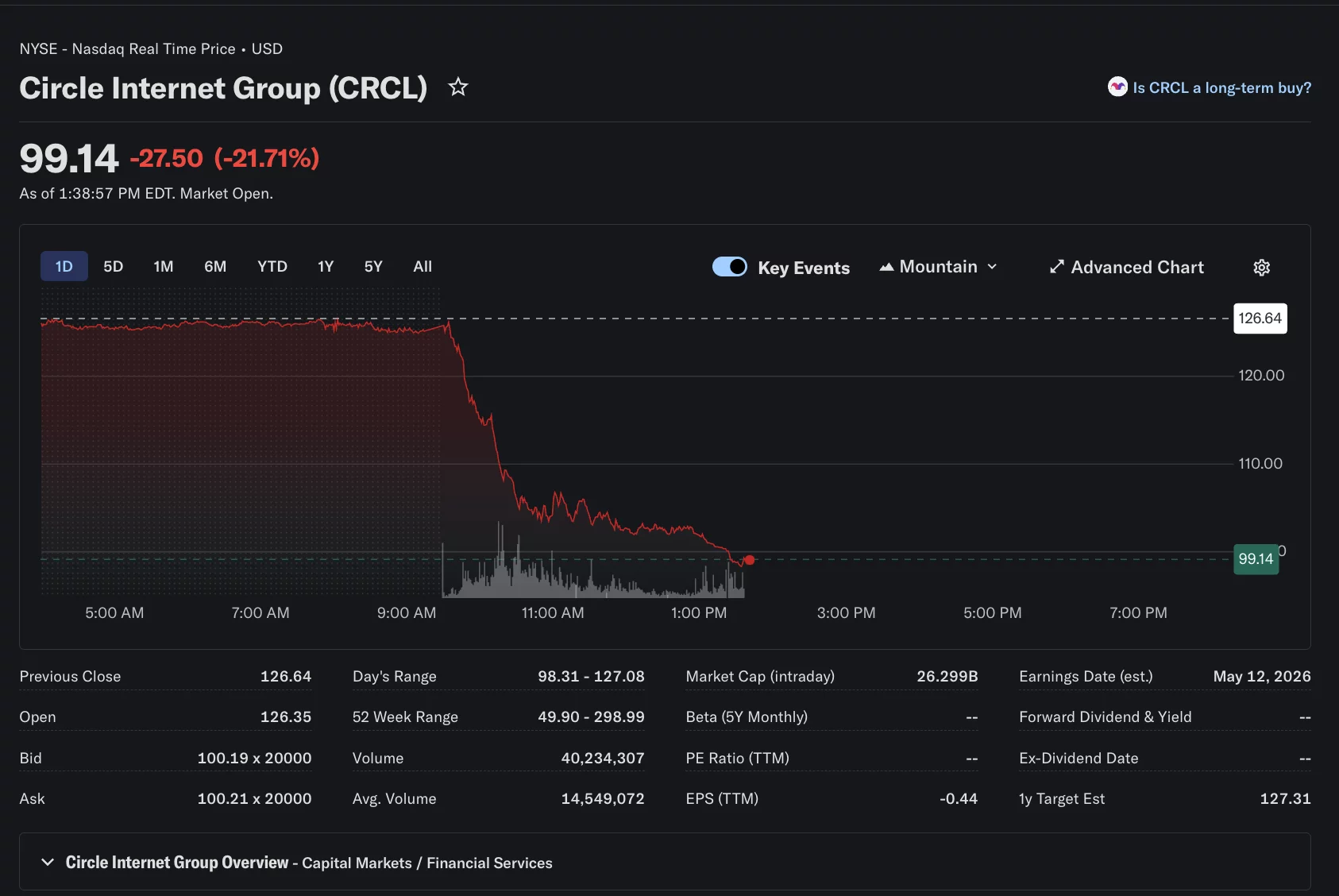
Real-time data shows Circle trading at about $98.71 on the NYSE under ticker CRCL, down $27.93 or 22.05% on the day, with intraday lows near $98.31 after opening at $126.35 and closing Monday at $126.64. Intellectia.ai and other market trackers said the drop reached roughly 18% by midday, marking Circle’s largest one-day percentage decline since June 2025.
Circle’s slump came alongside a broader crypto-equities sell-off, with Coinbase (COIN) down more than 7% to roughly $178.10 and Robinhood (HOOD) off 4.7%, after a draft of the CLARITY Act circulated in Washington. According to summary of the draft, the latest language would “ban yield on stablecoins across exchanges,” effectively prohibiting interest-style rewards on tokens like USDC, a core revenue lever for both Circle and Coinbase. The bill is being viewed as a direct threat to Circle’s stablecoin-payments and rewards infrastructure, calling the proposed limits on yield “critical” to its platform economics and a key driver of Tuesday’s 22% intraday fall.
The price action is striking because it collides with still-strong fundamentals for USDC. Yahoo Finance recently noted that Circle’s stock nearly tripled from its $31 IPO price on June 5, 2025 and at one point almost touched $299, buoyed by optimism around U.S. stablecoin legislation. Circle’s own “Internet Financial System in 2026” report highlighted that USDC in circulation has expanded sharply alongside rising reserve income, while Intellectia.ai cited Baird as telling clients that USDC outstanding averaged $75.2 billion through March 15, up 6% since the firm’s last earnings report. Baird raised its price target on Circle to $138 from $110 and reiterated an Outperform rating, arguing there is a “real path” to new revenue via products like Circle Payments Network and Arc Blockchain.
Reuters reported in February that Circle beat Wall Street expectations for fourth-quarter revenue on the back of stronger stablecoin circulation and higher interest income on reserves, sending the stock up nearly 30% in a single session at the time. Yet CRCL now trades below $100, roughly 35% below last week’s peak near $150 and more than 20% off the intraday highs it set earlier in March, even as USDC leads 2026 stablecoin flows and on-chain usage has jumped 600% year-to-date. That disconnect between booming token metrics and a stock that has just erased nearly a fifth of its value in one day captures the core investor dilemma: as long as U.S. lawmakers treat stablecoin rewards as quasi-banking, Circle’s equity seems to know be trading as much on the Hill’s mood as on USDC’s growth curve.

XRP has cleared virtually every fundamental prediction hurdle its community spent years anticipating, yet the price action tells a grimly different story. Despite the conclusion of the SEC case, the launch of spot ETFs, and a formal classification as a digital commodity alongside Bitcoin, XRP currently trades near $1.40, down over 40% since January highs. While the regulatory runway is clear, the token’s market response has been lethargic.
Data from recent ETF filings reveals a concerning gap between narrative and reality: XRP price predictions vary wildly, but actual institutional adoption is lagging. Despite $1.44 billion in total inflows, only 16% of XRP ETF assets are tied to institutional filers. This suggests the massive institutional wave bulls have priced in has not actually arrived.
— BSCN (@BSCNews) March 23, 2026
 ANALYSIS: 53% OF TRANSACTIONS ON $XRP LEDGER ARE FOCUSED ON PAYMENTS
A fresh analysis of 5,000 $XRPL blocks, roughly four hours of network activity, found that 53.2% of over one million sampled transactions were payment-related, with $RLUSD accounting for 92,699 transfers and… pic.twitter.com/0ZQzi3m2mO
The resulting XRP price prediction landscape is now fractured, with analysts offering long-term targets that range from capitulation to mathematical impossibility.
Discover: The best pre-launch token sales
XRP Price Prediction: Can Ripple Price Hit $4.00 Before 2030?
Five analysts with Wall Street and institutional credentials have published 2030 price targets for XRP, and the disparity is jarring. The forecasts range from under $1.00 to an eye-watering $1,000. It is critical to contextualize that upper bound: a $1,000 XRP price would necessitate a $61 trillion market cap, a figure larger than every stock market on the planet combined.
For those focused on probability rather than lottery tickets, the $4 to $10 range appears to be the “rational bull” zone. However, even the lower end of this target requires a market cap between $244 billion and $610 billion.

While top-five crypto assets have reached these levels in past cycles, XRP faces significant headwinds. Competing altcoins like BNB are eroding dominance, and the token currently struggles to reclaim the $1.50 resistance level.
The technical invalidation is clear. If XRP fails to convert $1.40 into support on the weekly timeframe, a retest of the psychological $1.00 support becomes the base case (what are bulls waiting for?). As Changelly analysts note, the divergence between successful corporate developments at Ripple and the stagnant token price suggests the market has structurally repriced the distinct value of the asset itself.
Discover: The best crypto to diversify your portfolio with
LiquidChain Targets Early Mover Upside as XRP Stagnates
While XRP investors wait for a multi-trillion dollar capitalization just to see a 3x return, smart money is increasingly rotating into infrastructure plays where market cap constraints are non-existent. The rotation trade is currently favoring Layer 3 (L3) protocols like LiquidChain ($LIQUID), which solves the liquidity fragmentation issues plaguing older networks.
LiquidChain is positioning itself as the “Cross-Chain Liquidity Layer,” utilizing a proprietary Deploy-Once Architecture that fuses Bitcoin, Ethereum, and Solana into a single execution environment. Rather than betting on a single payment rail like XRP, LiquidChain provides the infrastructure for developers to access liquidity across all major chains simultaneously.
The project’s metrics reflect high urgency from early adopters. LiquidChain has already raised more than $600K in its ongoing presale, with tokens currently priced at just $0.0143. This entry price offers a completely different risk-to-reward profile compared to mature, especially with more than 1700% APY in staking rewards. The protocol’s promise of “sub-second finality” and verifiable settlement addresses the speed limitations that legacy chains still struggle with.
Disclaimer: This article is not a solicitation or financial advice. Crypto assets are volatile and risky. Always do your own research (DYOR).
The post XRP Price Prediction: Fundamental Good, Price Lags appeared first on Cryptonews.

Delaware is rewriting its banking code for the first time since 1981 to capture the regulated stablecoin market, once a world-leading corporate registration hub, is Delaware crypto the next big thing?
Senate Bill 19, introduced Monday, proposes a bespoke licensing regime that treats stablecoin issuers less like tech startups and more like financial institutions under the direct supervision of the State Bank Commissioner.
This is a strategic counter-offensive. After losing major industry players like Coinbase to Texas last year, Delaware is leveraging its status as the incorporation capital of the world to set a new standard for digital assets. The message to the market is clear: the state is no longer relying on passive corporate friendliness; it is building active regulatory infrastructure.
- Legislative Scope: Senate Bill 19 creates a specific licensing framework for issuers under the Delaware Payment Stablecoin Act.
- Market Friction: The move aims to reverse the exodus of crypto firms triggered by dissatisfaction with the Chancery Court.
- Federal Alignment: Definitions in the bill mirror the federal GENIUS Act to ensure future regulatory compatibility.
How the Delaware Payment Stablecoin Act Works
Senate Bill 19 is not symbolic. It is a banking framework.
Placing stablecoin issuers under the State Bank Commissioner means strict reserve auditing and solvency standards. This is not a money transmission law gray area anymore. It is institutional-grade infrastructure with real teeth.
The bill explicitly adopts language from the federal GENIUS Act. That is deliberate. Issuers licensed in Delaware will not face obsolescence when Washington finalizes federal guidelines. The frameworks are designed to align.
— BSCN (@BSCNews) March 24, 2026
 NEW: DELAWARE BILL MANDATES 1:1 RESERVES FOR STABLECOIN ISSUERS
Delaware has unveiled new legislation to regulate stablecoins. The bill places issuers under a state banking structure.
The proposed law requires full reserve backing. Each issued stablecoin must be matched… pic.twitter.com/IaZ2AkG5ZF
The bifurcation is clear. You are either a licensed, bank-grade issuer in Delaware or you are operating in the regulatory wilderness. That distinction is exactly what institutional investors need to start holding large stablecoin balances with confidence.
The politics behind the bill matter too. Coinbase reincorporated in Texas last year over issues with Delaware’s Chancery Court. Governor Matt Meyer’s administration is using this bill to stop the bleeding. A tailored regulatory environment is Delaware’s bet to recapture the jobs and tax revenue it has been losing.
The liquidity implications are direct. Compliant, state-chartered stablecoins carry less counterparty risk. If Delaware-licensed stablecoins get treated as cleaner collateral, DeFi protocols and exchanges start prioritizing them over offshore alternatives. Regulatory clarity historically precedes liquidity expansion.
But the barrier to entry rises with it. Banking framework language means capital requirements that will flush out smaller algorithmic and under-collateralized projects. Circle and Paxos benefit. Everyone else gets squeezed.
The stablecoin market was already trending toward winner-take-all. Delaware just accelerated it.
Delaware Crypto Ambitions: State Action Preempts Federal Gridlock
Delaware is capitalizing on a federal power vacuum. While the conflict over SEC oversight continues to stall comprehensive national legislation, states are moving to capture the market. By aligning its definitions with the proposed federal GENIUS Act now, Delaware is positioning its license to potentially serve as a passport under future federal regimes.
This creates pressure on Congress. If Delaware establishes a functional, high-volume banking framework for stablecoins, it sets a de facto national standard.

The official statement from Senate Democrats emphasizes “democratizing financial services,” but the subtext is regulatory arbitrage. Delaware wants to be the jurisdiction that defines what a compliant digital dollar looks like before the Federal Reserve does.
Delaware built its legacy on corporate law. Now it is betting it can build the same moat around digital dollars. The state is not waiting for permission from Washington; it is writing the rulebook itself.
Discover: The best new crypto in the world
The post Delaware Moves to Regulate Stablecoins Under Banking Framework appeared first on Cryptonews.


BitGo Prime (BTGO) and Susquehanna Crypto said they are partnering to provide institutional clients with over-the-counter (OTC) access to prediction market trades, using digital assets held on BitGo’s platform as collateral.
The offering targets hedge funds, family offices and high-net-worth investors, allowing them to transact in event-driven contracts without relying on retail platforms or converting crypto holdings into cash, the companies said in a press release Tuesday.
Liquidity will be provided by Susquehanna Crypto, with trades executed bilaterally through BitGo’s OTC desk. The firms said transactions will follow standard derivatives documentation frameworks. Investors use over-the-counter desks mainly to trade large or complex positions without disrupting the market or exposing their strategy.
The structure mirrors how institutions already trade traditional derivatives, where assets remain in custody and positions are collateralized rather than fully funded upfront. In contrast, most prediction market activity today takes place on retail platforms that require pre-funding and offer limited integration with institutional custody systems.
Institutional investors are increasingly using prediction markets as a hedging tool, taking positions on event outcomes, such as elections, policy decisions or macroeconomic shifts, to offset risks in their broader portfolios. By pricing discrete, real-world events, these markets offer a way to hedge tail risks that are difficult to capture with traditional instruments such as equities, rates, or options.
Prediction markets have seen rapid growth, with trading volumes topping roughly $40 billion–$45 billion in 2025, up several-fold year over year as retail participation surged and platforms like Polymarket and Kalshi gained traction.
At the same time, institutional interest has begun to build, with hedge funds and banks increasingly using these markets for price discovery around political and economic events, even as infrastructure and regulatory uncertainty continue to limit broader adoption.
Regulatory fragmentation has also slowed adoption. In the U.S., platforms like Kalshi operate under Commodity Futures Trading Commission oversight, while others, such as Polymarket, remain offshore, limiting access for domestic institutional capital. That has pushed many firms to explore alternative structures that better align with existing compliance frameworks.
The companies said the new offering is designed to address those gaps by combining custody, collateral management and OTC execution into a single workflow. By allowing investors to trade against crypto collateral without moving assets off-platform, the model aims to bring prediction markets closer to the infrastructure institutions already use in other asset classes.
Read more: AI agents are quietly rewriting prediction market trading


Balaji Srinivasan’s viral X post argues libertarianism only works with Lee Kuan Yew‑style order, using Singapore to link his crypto, network‑state and U.S. debt theses.
Summary
- Balaji Srinivasan, former CTO of Coinbase and general partner at Andreessen Horowitz, posted a four-line political thesis on March 24 arguing that functional libertarianism requires a pragmatic, order-driven state to underpin it — drawing the largest engagement of any crypto-adjacent post on X in the past 12 hours.
- The tweet — which accumulated 60.6K views, 185 reposts, 1.3K likes, and 89 replies within hours — invoked Singapore’s founding prime minister Lee Kuan Yew as the embodiment of a governance model that makes free markets and open trade sustainable in the real world.
- In a follow-up reply, Srinivasan cited Singapore’s Housing Development Board flats, Health Savings Accounts, and ethnic-resentment restrictions as proof that the optimal political model occupies multiple ideological quadrants simultaneously — a framework he compared to combining programming paradigms rather than choosing one.
Balaji Srinivasan (@balajis), former chief technology officer of Coinbase and former general partner at Andreessen Horowitz, posted a terse but widely discussed political and philosophical argument on X on March 24, contending that libertarianism as an ideology can only function when paired with the kind of disciplined, order-driven governance associated with Singapore’s late founding prime minister Lee Kuan Yew — a post that generated 60.6K views and 185 reposts within hours of publication.
“Libertarianism in theory requires Lee Kuan Yew in practice,” Srinivasan wrote. “Order and borders are prerequisites for liberty and prosperity. Tolerance and internationalism enables trade and capitalism. Pragmatism about the scope of the state minimizes the scope of the state.” The four-sentence formulation is a deliberate compression of a political philosophy Srinivasan has developed across years of writing and public speaking, and one that sits at the intersection of his views on crypto, network states, and sovereign city models.
Who Was Lee Kuan Yew — and Why Does It Matter to Crypto?
Lee Kuan Yew served as Singapore’s prime minister from 1959 to 1990, transforming a former British colony with no natural resources into one of the world’s wealthiest and most stable economies. His model combined strict rule of law, low corporate taxes (17%), no capital gains tax, rigorous anti-corruption enforcement, and open trade — while maintaining firm social controls on speech and behavior that Western libertarians would typically reject. By 2020, foreign investment in Singapore had grown to $92 billion, up from $1.2 billion in 1980.
For Srinivasan, Lee Kuan Yew has long represented a practical answer to the central failure of libertarian political theory: that without the preconditions of order, property rights, and enforceable contracts, free markets cannot function. It is an argument with direct resonance in the crypto world, where stateless financial infrastructure and decentralized governance have repeatedly collided with the practical need for regulatory clarity, institutional trust, and enforceable rules.
The Follow-Up: Singapore as a Multi-Paradigm Model
In a reply to the thread, Srinivasan elaborated, pointing to Singapore as a state that operates across all four quadrants of conventional political mapping. “Singapore does things like HSAs and HDB flats (top left) and also restricts behavior likely to cause ethnic resentment (bottom left),” he wrote. “I think of political paradigms as akin to programming paradigms. Often you use” — with the remainder visible only upon expanding the post — the implication being that pragmatic governance, like good code, selects the best tool for each problem rather than adhering dogmatically to a single ideology.
The framing echoes ideas Srinivasan has been developing publicly for several years. In December 2025, the Financial Times reported on Srinivasan’s efforts to build self-governing network states and experimental cities — initiatives backed by venture capital and cryptocurrency funding — describing him as a central figure in a movement to create new governance structures outside the traditional nation-state framework.
A Philosopher-Investor With Stakes in the Crypto Future
Srinivasan is not merely a commentator. He has repeatedly argued that the U.S. faces an unfixable $175 trillion in fiscal obligations when future entitlement promises are included, calling it “a national bankruptcy” to be resolved through money printing — a thesis that directly underpins his conviction in Bitcoin and hard-capped digital assets as exit vehicles from fiat debasement. He has also argued that crypto is the foundational currency of AI economies, positioning decentralized financial infrastructure as the rails on which autonomous agents will eventually transact.
That the post garnered more than 60,000 views and drew responses ranging from memes to academic political theory charts suggests Srinivasan has touched a live nerve — not only in crypto circles, but among a broader audience wrestling with the gap between libertarian ideals and the institutions required to make them work.


- Mantle’s DeFi TVL surges, surpassing major rival networks.
- Mantle (MNT) price lags despite strong ecosystem growth.
- The key MNT price levels to watch are the $0.75 resistance and the $0.65 support.
Mantle (MNT) network’s DeFi ecosystem has expanded rapidly and overtaken Sui in total value locked (TVL).
The milestone reflects a sharp increase in capital flowing into Mantle, even as broader market conditions remain uncertain.
In just one month, Mantle’s ecosystem has recorded a significant surge in locked assets, signalling rising confidence from both users and developers.
According to data obtained from DeFiLlama, Mantle’s total value locked in DeFi is currently valued at around $632.17 million, while that of Sui stands at $589.5 million.

This kind of growth is rarely accidental and often points to deeper structural strength within a network.
Mantle’s DeFi expansion
The surge in Mantle’s DeFi activity has been driven by a combination of strategic positioning and ecosystem development.
One major factor behind the growth is its focus on real-world assets, which continues to attract institutional interest.
By integrating traditional financial instruments into blockchain systems, Mantle is positioning itself for long-term adoption rather than short-term speculation.
Another key driver is its connection to centralised exchange infrastructure, which helps onboard liquidity more efficiently.
This hybrid model allows users to move seamlessly between centralised and decentralised finance, reducing friction that often limits adoption.
At the same time, integrations with major DeFi protocols have boosted activity across lending and borrowing markets.
These developments have helped create a steady inflow of capital rather than relying on temporary incentives.
Such consistency is often a sign of a maturing ecosystem rather than a hype-driven spike.
Despite this strong growth, the price of MNT has not followed the same upward trajectory.
This divergence between fundamentals and price action is becoming increasingly noticeable.
MNT price struggles to reflect strong fundamentals
While the network’s DeFi metrics continue to improve, MNT remains significantly below its previous highs.
The token is still trading far from its peak, reflecting broader weakness across the altcoin market.
Short-term price action has also been mixed, with recent declines interrupting what appeared to be a recovery phase.
This suggests that traders are still cautious, even in the face of improving fundamentals.
Market sentiment continues to play a dominant role, especially with altcoins reacting closely to movements in Bitcoin.
Without a strong catalyst, MNT has struggled to build sustained upward momentum.
This creates a situation where the asset shows promise on paper but remains technically fragile.
Such conditions often lead to periods of consolidation before a clearer trend emerges.
Mantle price forecast
The near-term outlook for MNT is defined by a tight range that is likely to determine the next major move.
The $0.75 level stands out as the most important resistance zone, acting as a barrier that bulls have yet to overcome.

A confirmed move above this level would signal a shift in short-term momentum and could open the door for further upside towards $0.8642 and even $0.9223 as projected by CoinLore.
On the downside, the $0.65 level is providing immediate support and remains critical for maintaining stability.
A break below this support would reinforce the current bearish structure and increase the risk of further declines.
For now, the price remains trapped between these two levels, creating a clear decision zone for traders.
Until a breakout or breakdown occurs, the current bounce should be treated with caution.
If buyers manage to push the price above resistance, it could mark the beginning of a recovery phase supported by strong fundamentals.
However, failure to hold support would likely confirm that bearish pressure is still dominant in the short term.


Securitize will become the first digital transfer agent eligible to mint blockchain-based securities on NYSE’s upcoming Digital Trading Platform
The New York Stock Exchange and real world asset (RWA) tokenization platform Securitize have signed a Memorandum of Understanding to collaborate on tokenized securities infrastructure, the two companies announced on Tuesday.
Under the deal, Securitize will become the first digital transfer agent — a transfer agent that uses a blockchain-based ledger and smart contracts to process transactions — eligible to mint tokenized securities for issuers on NYSE’s upcoming Digital Trading Platform.
Per the release, NYSE plans to work with Securitize as a premier design partner to develop a digital transfer agent program supporting on-chain settlement of tokenized securities transactions. The two firms will also collaborate on setting regulatory, operational, and technology standards for the emerging digital transfer agent category — effectively writing the rulebook for institutional-grade tokenized securities infrastructure.
“As we explore how tokenization can enhance capital markets, it is critical that new infrastructure is developed in a way that preserves the trust, transparency, and protections investors expect,” said NYSE Group president Lynn Martin in the announcement.
Securitize CEO Carlos Domingo framed the tie-up as proof that tokenization is maturing beyond experimentation. “This is about building tokenization in a way that works within real market structure,” he said.
As part of the broader collaboration, Securitize Markets is expected to join the NYSE’s Digital Trading Platform as a broker-dealer participant, supporting liquidity for issuer-sponsored tokenized securities.
The deal comes amid a period of rapid growth for the wider tokenized RWA sector. RWAs became Wall Street’s gateway to crypto in 2025, with on-chain tokenized assets tripling to nearly $19 billion over the course of the year — a figure analysts project could reach $2 trillion by 2030.
Securitize is the tokenization platform behind BUIDL, the U.S. Treasuries fund from BlackRock, with a market cap of over $2 billion. Securitize is the tokenization platform for RWAs totaling over $3 billion in distributed asset value across ten blockchain networks, with over $1 billion on Ethereum per RWAxyz. Last year, the firm partnered with risk manager Gauntlet to bridge private credit funds into DeFi protocols.
NYSE first announced it was planning to launch a platform for 24/7 tokenized securities trading in January, as The Defiant reported.
This article was written with the assistance of AI workflows. All our stories are curated, edited and fact-checked by a human.

The betrayal of white working-class boys

‘I want to apologise’: England batter Ben Duckett pulls out of IPL

Apple Confirms It’s Bringing Ads to Maps as Part of New Apple Business Platform


-
 Crypto World4 days ago
NIO (NIO) Stock Plunges 6.5% as Shelf Registration Sparks Dilution Worries
-

 Fashion4 days ago
Weekend Open Thread: Adidas – Corporette.com
-

 Politics4 days ago
Jenni Murray, Long-Serving Woman’s Hour Presenter, Dies Aged 75
-

 Crypto World3 days ago
Best Crypto to Buy Now: Strategy Just Spent $1.57 Billion on Bitcoin During Fear While Early Investors Quietly Enter Pepeto for 150x Potential
-

 News Videos6 days ago
RBA board divided on rate cut, unusually buoyant share market | Finance Report | ABC NEWS
-

 Crypto World3 days ago
Bitcoin Price News: Bhutan Sells $72 Million in BTC Under Fiscal Pressure, but the Smart Money Entering Pepeto Sees What the Market Does Not
-

 Politics6 days ago
The House | The new register to protect children from their abusers shows Parliament at its best
-

 Tech5 days ago
inKONBINI Lets You Spend Summer Days Behind the Register
-

 Crypto World6 days ago
Canada’s FINTRAC revokes registrations of 23 crypto MSBs in AML crackdown
-

 Sports1 day ago
Remo Stars and Kano Pillars Strengthen Survival Hopes in NPFL
-
 NewsBeat6 days ago
Residents in North Lanarkshire reminded to register to vote in Scottish Parliament Election
-

 News Videos6 days ago
PARLIAMENT OF MALAWI – PAC MEETING WITH REGISTRAR OF FINANCIAL ON AMARYLLIS HOTEL – INQUIRY LIVE
-

 Politics5 days ago
Gender equality discussions at UN face pushbacks and US resistance
-

 Business2 days ago
No Winner in March 21 Drawing as Prize Rolls to $133 Million for Next
-

 Business6 days ago
Who Was Alex Pretti? 5 Key Facts About the ICU Nurse Killed by Federal Agents in Minneapolis
-

 Sports1 day ago
Gary Kirsten Accuses Pakistan Cricket Board Of ‘Interference’, Mohsin Naqvi Responds
-

 Tech2 days ago
Give Your Phone a Huge (and Free) Upgrade by Switching to Another Keyboard
-

 Sports4 days ago
2026 Kentucky Derby horses, odds, futures, preview, date: Expert who nailed 12 Derby-Oaks Doubles enters picks
-
Sports5 days ago
Vikings Free Agency Enters Phase 2 with Key Questions
-

 Tech7 days ago
Subnautica 2 might finally be entering early access in May
You must be logged in to post a comment Login