
Crypto World
Protocol upgrade decouples consensus from execution to solve scaling bottlenecks



High-performance blockchains often run into the same architectural limit, where the execution sits directly in the path of consensus. In a conventional synchronous model, validators must first execute the transactions inside that block to confirm the resulting state transitions are valid.
The design keeps the network deterministic, but it also turns computation into a shared bottleneck. Whether they involve richer smart contract logic, cross-system coordination, or heavier state updates, the more complex the transactions are, the more the network’s speed depends on how quickly validators can process them.
The slowest computation on that path can end up constraining the pace of the entire system. Many networks have already spent years improving finality, networking efficiency and block propagation.
Execution has become the next architectural constraint. Rather than only optimizing how quickly validators reach agreement, newer designs are starting to ask whether execution needs to remain inside the consensus loop at all.
Shifting to an asynchronous computation pipeline
CTDG Dev Hub participant MultiversX removes that constraint with Supernova, now live on testnet, by decoupling consensus from execution so the network can agree on blocks before processing their transactions.
Before Supernova, block production followed a sequential pattern. A proposer selected transactions, executed them locally and proposed a block with those results. Validators then had to re-execute the same transactions before voting, which placed execution squarely on the consensus-critical path.
Supernova changes that order: The proposer selects transactions and proposes the block without executing them first. Validators verify that the proposal follows protocol rules and can vote immediately, while execution continues asynchronously in the background. The resulting execution output is normally referenced and notarized in the next block header, so execution trails consensus by roughly one block, or about 600 milliseconds.
Decoupling execution from consensus creates an immediate validity problem: The network must still determine whether a proposed transaction is likely to remain valid before execution catches up. Supernova addresses that with a virtual mempool state.
The mempool looks beyond the latest executed chain state and tracks pending nonces, expected balance consumption and transactions that have already been proposed but whose execution results have not yet passed consensus. Proposers get a forward-looking view of account activity and can select transactions that should still execute successfully once their turn arrives.
MultiversX also adds two safeguards around the new pipeline. The Execution-Result Inclusion Estimator, or EIE, caps how many execution results can be referenced in a block based on what minimum-spec nodes can safely process. Meanwhile, automatic backpressure reduces block capacity if execution falls too far behind, giving the system time to catch up.
Collaborative growth within the decentralized ecosystem
The upgrade also fits into Cointelegraph Decentralization Guardians’ broader work with MultiversX. Cointelegraph joined the network as a validator through the CTDG program in March 2026, extending the relationship into infrastructure participation.
MultiversX is also an official CTDG Dev Hub partner, connecting the protocol to a broader community of developers and blockchain users. The relationship already has practical depth as the MultiversX Foundation delegated to the CTDG validator, and the Dev Hub team built a dedicated validator dashboard on MultiversX.
From a builder perspective, in-shard finality lands as soon as the proof is available, usually within the same round at around 100–250 milliseconds, alongside more predictable execution conditions. These conditions matter most for applications that depend on tight feedback loops, such as high-frequency DeFi primitives, onchain order books and other systems that begin to break down when latency enters the user experience.
Supernova has already been producing 600-millisecond blocks on the live testnet and devnet since Aug. 20, with the broader goal of making onchain interactions feel immediate. Mainnet activation is expected to follow on Sept. 10, 2026. The transition reflects a wider push toward blockchains that behave more like responsive application infrastructure than delayed settlement engines.



The U.S. government has transferred a small amount of Bitcoin seized from Alameda Research’s Binance.US accounts three years ago, renewing attention on how federal agencies will handle the remaining assets.
Summary
- The transferred Bitcoin came from Alameda-linked accounts seized from Binance.US three years ago.
- Arkham reported the transaction but did not identify it as a sale.
- Earlier Alameda-linked transfers sent nearly $2.9 million in seized crypto through government-controlled wallets.
- Federal rules generally restrict sales of Bitcoin placed in the U.S. Strategic Bitcoin Reserve.
Arkham Intelligence reported the transaction on Aug. 26, describing the amount as small and tracing the Bitcoin to Alameda accounts on Binance.US that U.S. authorities seized three years earlier.
The blockchain analytics firm did not publish the amount in its indexed post or identify the receiving address. Arkham also did not say that officials had sold the Bitcoin, leaving the transaction’s purpose unconfirmed.
“The US Government just moved a small amount of Bitcoin that had been seized from Alameda accounts on Binance US, 3 years ago,” Arkham said.
Arkham then asked whether the government would begin liquidating the remaining Bitcoin connected to Alameda. The question was not tied to an announcement from the Department of Justice, the Treasury Department, or another federal agency.
The Bitcoin transfer does not confirm a sale
Moving Bitcoin between addresses records a change in custody or location on the blockchain, but the transaction alone does not show whether the asset has been sold. A transfer to another government wallet may involve custody, accounting, or security management, while movement to an exchange can make a future sale possible without proving one occurred.
The destination is especially important because federal agencies have regularly used Coinbase Prime to store and manage seized digital assets. Coinbase’s institutional platform offers both custody and trading services, meaning a deposit there can support several purposes.
In July, U.S. government-linked wallets transferred nearly $297 million in seized Bitcoin and Ether to Coinbase Prime. The transaction included about 3,940 BTC and 30,014 ETH tied to separate enforcement cases, according to earlier transaction coverage.
Bitcoin connected to Ryan Farace, an online drug dealer known as “Xanaxman,” and the closed BTC-e exchange formed part of the July transfer. Ether linked to a separate money laundering case also moved to Coinbase Prime.
No public blockchain record can show whether an exchange deposit resulted in an executed trade unless additional evidence reveals a conversion or movement of the sale proceeds. The same limitation applies to the latest Alameda-linked Bitcoin transaction.
Alameda assets have moved several times in 2026
Federal wallets have processed other seized assets tied to Alameda and FTX during 2026, providing a record of how authorities have handled smaller token holdings.
In May, Arkham said the government moved about $1.89 million in Render, Uniswap, The Sandbox, Mask Network, and Axie Infinity tokens to Coinbase Prime. The analytics firm traced the tokens to approximately $13 million in Alameda assets seized from Binance accounts more than three years earlier.
Another transaction followed in June, when government-controlled wallets transferred nearly $984,000 in FTX- and Alameda-linked cryptocurrency. At least $768,000 of the total went to Coinbase Prime, as crypto.news reported at the time.
Arkham said the June assets would go to the FTX estate to help repay creditors. The transaction included Chainlink and several smaller tokens, while the remaining amount moved through addresses connected to the same seized asset group.
Federal wallets had also moved more than $33 million in Alameda-linked cryptocurrency in December 2024. According to an Arkham report, the batch included about $18 million in Ether, $13 million in BUSD, and smaller amounts of Wrapped Bitcoin, Shiba Inu, and Axie Infinity.
Arkham said the 2024 assets moved to a newly created address and noted that no official purpose had been announced. The firm presented creditor distributions, wallet consolidation, and asset management as possible explanations rather than confirmed reasons for the transfers.
U.S. reserve rules limit some Bitcoin sales
President Donald Trump’s March 2025 executive order established the Strategic Bitcoin Reserve and directed the Treasury Department to fund it with Bitcoin finally forfeited through criminal or civil proceedings.
Under the order, Bitcoin deposited into the reserve cannot be sold and must remain a U.S. reserve asset. A recent Bitcoin reserve explainer estimated that the federal government held approximately 198,000 BTC as of mid-2026, although public trackers produce different totals based on the addresses and legal categories they include.
The White House order does not place every seized coin under an absolute ban on disposal. It allows agencies to return assets to verified victims, comply with court orders, support law enforcement operations, and meet requirements under federal forfeiture laws.
Legal status, therefore, determines how a particular holding can be handled. Bitcoin that has been finally forfeited and transferred into the reserve receives different treatment from property still involved in a court case, creditor recovery process, or victim compensation plan.
The White House also created a U.S. Digital Asset Stockpile for forfeited assets other than Bitcoin. Treasury has more room to manage or sell tokens held in the stockpile, while the order gives Bitcoin placed in the reserve a general no-sale policy.
No federal agency has said whether the Bitcoin moved on Aug. 26 had entered the reserve, remained assigned to the FTX recovery process, or fell under one of the order’s exceptions.
FTX creditors remain tied to the seized assets
Alameda Research operated as the trading firm associated with FTX before the exchange collapsed in November 2022. Federal prosecutors later said FTX founder Sam Bankman-Fried used customer deposits to finance Alameda’s operations, investments and loan repayments.
The Justice Department said Bankman-Fried misappropriated billions of dollars deposited by FTX customers and gave Alameda access to the funds. A federal jury convicted him in November 2023 on seven counts, including wire fraud, securities fraud conspiracy, commodities fraud conspiracy, and money laundering conspiracy.
In March 2024, U.S. District Judge Lewis Kaplan sentenced Bankman-Fried to 25 years in prison. The Justice Department said the sentence included forfeiture of more than $11 billion, while prosecutors placed FTX customer losses at more than $8 billion.

Altcoins have taken a leading role in the latest crypto market rally, as trading activity and market capitalization surged alongside Bitcoin’s sharp move higher. This comes after an extended period of low volatility and subdued trading volumes.
According to CryptoQuant analyst Darkfost, investor attention and capital have moved strongly toward altcoins, “potentially signaling a broader resurgence of risk appetite across the market.”
Biggest Dominance Surge in 2 Years
Bitcoin gained nearly 25% over the past week, while altcoins significantly amplified the broader market trend. The total altcoin market capitalization, measured through Total2 and excluding Ethereum, increased by around $135 billion during the same period. Darkfost said that the scale of the move highlights how quickly capital has entered the altcoin segment.
A notable change was also seen in trading activity. On Binance, which represents nearly 40% of altcoin trading volume across exchanges, these tokens accounted for as much as 65% of total volume at their peak. At that point, Bitcoin made up just 21% of volume, while Ethereum accounted for 13.6%.
Darkfost explained that altcoins had not held this much of Binance’s trading volume in two years. The gap between the assets indicates a clear redistribution of liquidity across the market, as these tokens attracted a larger share of trading activity than Bitcoin and Ethereum.
The shift came after several announcements from Trump on August 19, including his call for the US to purchase large amounts of BTC and for Congress to pass the Clarity Act. Darkfost said the announcements helped push liquidity into altcoins.
Impulse Surges to 93%
The strength is also showing up in market breadth. Altcoin Vector said its ‘Altcoin Impulse’ reading jumped to 93%, which suggested that the rally has spread across a large part of the market. However, it considers breadth above 75% overextended, meaning the move could face exhaustion or a reset.
Analyst Matthew Hyland had previously predicted that alts could deliver returns of 10x to 1000x, comparing the June sell-off to the March 2020 market collapse. Hyland had said that June was essentially an altcoin version of the 2020 crash and pointed to Ethereum, Cardano and other tokens as examples that could see outsized gains if the comparison plays out.
He had also said many of these tokens could recover within a few months rather than taking years to regain lost ground.
The post Altcoin Volume Dominance Hits Two-Year High as Traders Pour $135B Into the Market appeared first on CryptoPotato.


In 2023, the regulator tried to narrowly restrict the places investment advisers could park clients’ crypto assets, but the new approach is still shrouded in secrecy.


The funds are $390 million short of October 2025’s inflow total after cutting their year-to-date net outflow deficit by more than half.

When money is tight, 47% of respondents seek lower-cost or free ways to experience joy, while 42% save up before spending. Some make steeper trade-offs: 20% cut back on necessities, and 13% take on debt or use credit.
In the previous three months before the survey, 38% of respondents cut back on dining out, 34% on shopping, 27% on entertainment, 25% on travel, and 21% on their hobbies. People were less willing to sacrifice time with or money spent on loved ones. Just 17% cut back on social time with friends, 11% on spending to help others, and 9% on their pets.
For many Americans, luxury looks less like extravagance and more like breathing room. When asked what counts as luxury today, 56% of respondents said vacations. But that was followed by half of respondents who said having money left after paying bills was a luxury. Around 47% of respondents said being able to save and still enjoy life, and eating out without worrying about the bill were also luxuries.


Cointelegraph is committed to providing independent, high-quality journalism across the crypto, blockchain, AI, and fintech industries.
All news, reviews, and analyses are produced with full journalistic independence and integrity. For more details on our standards and processes, please read our Editorial Policy.
Crypto World
Rallies as Agentforce ARR Surges Over 240% and Strong AI Growth Drives Record Q2 Results

TLDR
- Salesforce CRM rallies after Q2 results show strong AI growth and higher guidance.
- Agentforce ARR jumps over 240% as Salesforce expands enterprise AI adoption.
- Salesforce raises FY27 revenue outlook after delivering record quarterly results.
- Strong margins and cash flow growth support Salesforce’s latest market rally.
- Data 360 growth accelerates as Salesforce strengthens its AI platform strategy.
Salesforce Inc. (CRM) stock jumped after hours as quarterly results showed stronger demand for artificial intelligence products and services. The company reported record second quarter results with revenue growth, higher margins, and expanding enterprise adoption. Salesforce raised its fiscal 2027 revenue outlook after strong performance across its platform.
Agentforce Growth Lifts Salesforce Platform Performance
Salesforce expanded its Agentforce business as annual recurring revenue exceeded $1.5 billion during the second quarter. The figure increased more than 240% year over year, reflecting stronger demand for automated business solutions. Agentforce and Data 360 annual recurring revenue reached nearly $3.9 billion after rapid expansion.
The company delivered 7 billion Agentic Work Units across Agentforce and Slack since launch. It processed 3.2 billion units during the second quarter, showing increased platform activity. Slack reported stronger growth as Slackbot users increased more than 150% quarter over quarter.
Salesforce recorded higher data usage as Data 360 processed 104 trillion records during the quarter. The figure represented a 355% year over year increase from broader customer adoption. The platform also handled 22 terabytes of unstructured data during the period.
Salesforce Reports Strong Financial Results and Raised Outlook
Salesforce generated $11.3 billion in second quarter revenue, marking an 11% year over year rise. Subscription and support revenue reached $10.8 billion after including the Informatica contribution. The company also posted stronger profitability with a 20.5% GAAP operating margin.
The company reported diluted earnings per share of $4.29, increasing 119% year over year. Non-GAAP diluted earnings per share reached $5.90, rising 103% from the previous year. Operating cash flow increased 71% to $1.3 billion during the quarter.
Salesforce raised its fiscal 2027 revenue forecast to between $46.1 billion and $46.4 billion. The updated guidance represents annual growth of 11% to 12% for the business. The company expects subscription and support revenue growth to remain above 12%.
Salesforce Expands AI Strategy Through New Business Initiatives
Salesforce continues strengthening its enterprise platform through new artificial intelligence capabilities and acquisitions. The company expects Contentful and Fin transactions to close during the third quarter. These additions will support broader platform expansion and customer service improvements.
The company maintained its fiscal 2027 non-GAAP operating margin target at 34.3%. It also expects free cash flow growth to remain between 4% and 5% year over year. Salesforce continues executing its $25 billion accelerated share repurchase program.
Salesforce remains focused on improving business workflows through data management and automation tools. The latest results highlight continued demand for enterprise technology solutions. The company’s quarterly performance shows stronger momentum across its products and services.

Crypto users generated at least $457 billion in taxable activity on public blockchains in 2025, Chainalysis estimates. Americans produced $112.6 billion of it, more than any other country.
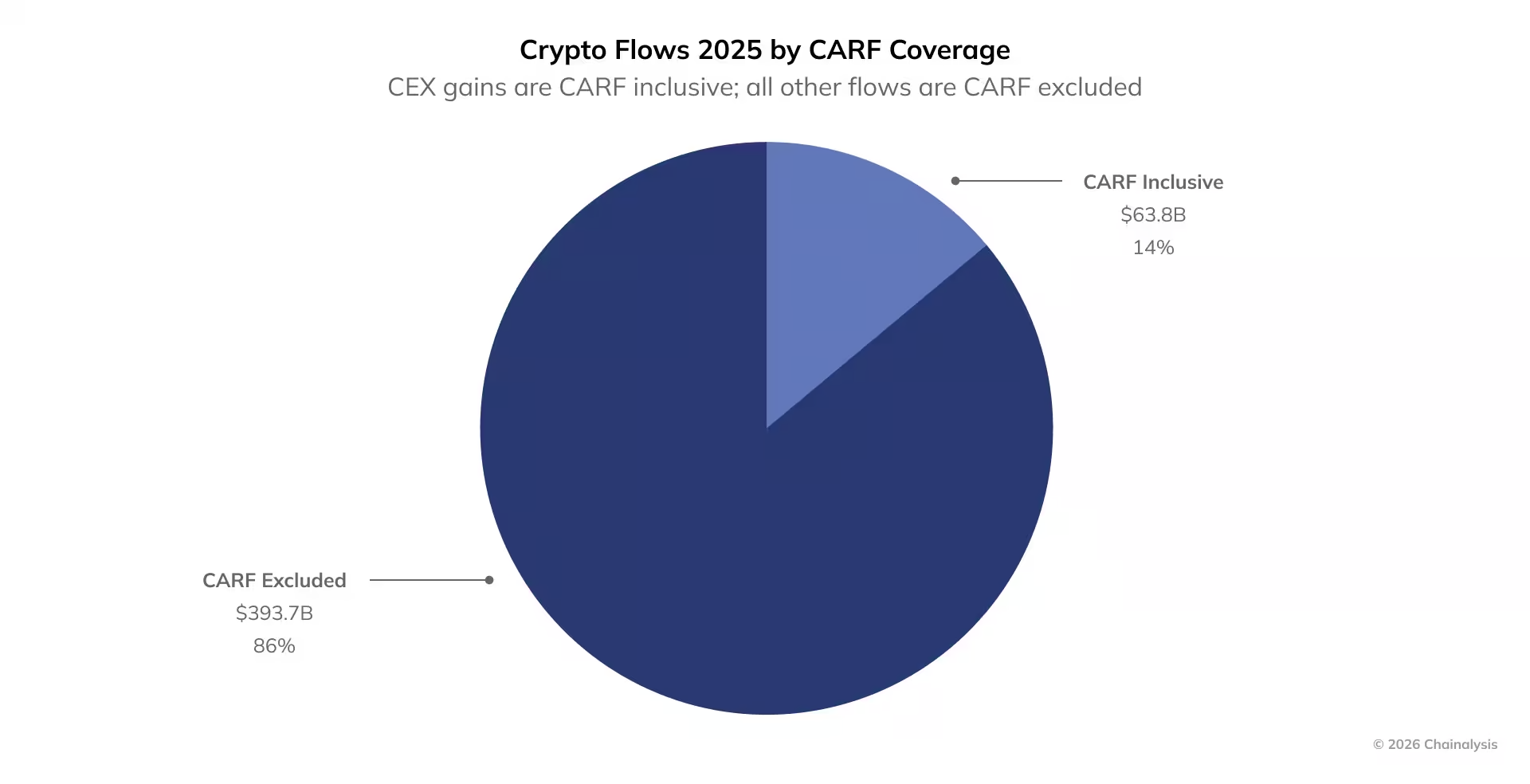
Tax offices will see almost none of it. The global reporting rules now rolling out capture just 14% of those flows.
Where the $457 Billion in Crypto Taxable Activity Sits
The Chainalysis estimate spans six blockchains, including Bitcoin, Ethereum, and Solana. It counts trading gains, income from mining, staking, and lending, and everyday crypto payments.
Trades locked inside centralized exchange order books never touch a blockchain. The real total is therefore higher.
Payments were the standout, making up $64.6 billion of the US total, which dwarfs the $30.1 billion in trading gains. That matters because payments are among the flows tax agencies struggle most to track.
North America led all regions with $134.6 billion, just ahead of the European Union’s $125.1 billion.
For smaller economies, the money is hard to ignore. Nigeria’s $4.4 billion in taxable flows equals 12.3% of everything its government collects. Kenya’s $1.1 billion equals 5.6%. Portugal’s $2 billion was double its national deficit.
Numbers like these keep lawmakers circling. Brussels has already faced pushback over a $23 billion revenue forecast. Berlin, meanwhile, is weighing Germany’s crypto tax exemption in its 2027 budget.
CARF Rules Will Capture Only a Sliver
Governments thought they had an answer. In 2022, the Organisation for Economic Co-operation and Development (OECD) released the Crypto-Asset Reporting Framework (CARF).
It borrows the playbook that cracked open offshore bank accounts, making exchanges report customer transactions across borders. Data sharing starts in 2027.
However, CARF only works where a company stands in the middle. Chainalysis maps just 14% of on-chain taxable activity to events the framework covers. The other 86% moves through decentralized exchanges, peer-to-peer transfers, and self-custody wallets that report to no one.

The gaps run deeper, where mining rewards, staking yields, and lending income largely escape CARF. The rules are not retroactive, so years of past activity stay dark. Exchanges often cannot see what a coin cost when it was bought elsewhere.
The US shows the scale of the problem. Senators have pointed to studies suggesting a crypto tax gap of at least $50 billion a year.
Meanwhile, the Form 1099-DA rules born in the 2021 infrastructure law are projected to recover $28 billion over a decade. Spread out, that is less than $3 billion a year against a $50 billion annual hole.
Dozens of jurisdictions begin exchanging CARF data in 2027, with more joining by 2029. The framework will finally give tax offices a window into crypto. The harder question is what they do about the 86% still outside it.
The post Governments Can See Just 14% of the $457 Billion Crypto Tax appeared first on BeInCrypto.
The world’s leading cryptocurrency exchange warned its users that certain operations will be temporarily halted later this week.
Prior to that, it revealed the delisting of three altcoins, which will take effect at the start of September.
What Binance Users Need to Know
The company announced that it will briefly suspend deposits and withdrawals on the Ethereum network on August 27 to support wallet maintenance. The process is expected to take about one hour, after which operations will resume.
As usual, Binance assured that it will handle all technical requirements involved for all affected users and said that trading of tokens on the aforementioned network will not be impacted.
Upgrades of this type are routine and typically carry no significant complications for clients. The company supported wallet maintenance on the Ethereum blockchain in May this year, and months later it temporarily paused TRX deposits and withdrawals to perform a similar process. There were no reports of issues, and operations were quickly restored.
Besides backing such upgrades, Binance is known for thoroughly reviewing all digital assets listed on its platform and removing those that fail to meet the necessary criteria, including the team’s commitment to the project, network stability against attacks, community engagement, trading volume, liquidity, and other factors.
As a result of its latest analysis, it decided to terminate all services with ICON (ICX), Secret (SCRT), and Storj (STORJ). The delisting is scheduled for September 3, when all spot trading pairs of the aforementioned tokens will be removed.
The announcement came less than a week ago, and since then the involved coins have been charting painful declines. SCRT, for instance, has registered another 25% collapse in the past 24 hours alone.

Similar Effect in the Past
Price slumps following such news shouldn’t come as a surprise. After all, Binance remains the biggest crypto exchange, and withdrawing support results in shrinking liquidity, diminished availability, and reputational damage.
A similar thing happened at the start of August when the company said goodbye to Across Protocol (ACX), Hashflow (HFT), PIVX (PIVX), Vulcan Forged PYR (PYR), Vanar (VANRY), and Viction (VIC). Back then, PIVX and PYR took the biggest blow, both nosediving by approximately 20% in a single day.
Double-digit declines were observed with Alchemix (ALCX), Ardor (ARDR), NFPrompt Token (NFP), and Marlin (POND) in June, when Binance delisted them as well.
The post 2 Important Binance Updates Concerning ETH and Other Altcoin Traders appeared first on CryptoPotato.

Epidemiologists believe it could be among the largest documented foodborne illness events in U.S. history.
“We’ve never seen anything like that before,” Hamilton says.
The volume of food affected is higher than average
While the total number of recalls has been about average, USDA-regulated recalls affected more than 37 million pounds of food during the first half of 2026—the highest it has been in a decade.
At the same time, epidemiologist and former CDC adviser Katelyn Jetelina says that it’s very hard to tell just how bad this summer’s outbreaks have been—and our lack of federal data does not help.
“Our data is just not great in the United States,” she tells TIME. “We’re patching things together to try to figure out what is reality versus concern and public perception, and it’s hard to know where the line is.”

Buy Crypto Mining Machine In India | cheapest crypto miner india | mining setup

Newspaper headlines: ‘Britons lost in Nepal flood’ and ‘Regal has landed’

Plug-in solar panels are coming to a shop near you – what to know





-

 Fashion5 days ago
Weekend Open Thread: Madewell – Corporette.com
-

 Crypto World24 hours ago
SpaceX stock could rise 75% to $240, JPMorgan says
-

 Business4 days ago
Musk’s Tesla, SpaceX Confirm $16.8 Billion ‘Terafab’ Chip Plant as World’s Largest Building in Texas
-

 Crypto World5 days ago
anatomy of crypto’s biggest liquidation event since 2021
-

 Crypto World2 days ago
A $30 Billion AI Fund Implodes, Now the SEC Is Investigating Wall Street’s Role
-

 Politics4 days ago
6 months on, Irish renters crushed by effects of government housing bill
-
 NewsBeat5 days ago
The ‘Lucky Dip Gang’ causing carnage for clicks: After five thugs were killed speeding in the wrong direction on a motorway, GUY ADAMS investigates a sick new trend… and why police aren’t even allowed to pursue them
-

 Crypto World20 hours ago
Did Trump Just Move SpaceX Stock With One Truth Social Post?
-

 Business4 days ago
Mystery AI Model ‘Ox Alpha’ Draws Developers With Free Access as Chinese Lab Origins Remain Debated
-

 News Videos7 days ago
Don’t Leave Your Financial Future To Chance | August 19, 2026
-

 Business6 days ago
Five Below: Kids Discount Retailer Reaps Rich Rewards
-

 Business2 days ago
Moderna CEO warns China is pouring state money into mRNA technology
-

 Business5 days ago
UK firms in critical financial distress rise 9% to 53,756
-

 Business2 days ago
NVIDIA Stock Drops Nearly 2 Percent to $210 on Seventh Losing Day Ahead of Critical AI Earnings
-

 Sports4 days ago
Deshaun Watson fires back at Browns fans after being booed: ‘It’s a disrespectful thing’
-

 Crypto World6 days ago
Optimism-funded team's deciding vote shifts $49 million in OP tokens away from users
-

 Tech7 days ago
OpenAI confirms ChatGPT is down as logins and signups fail
-
 Crypto World4 days ago
Google Gemini AI Predicts Ethereum Could Become the Trade Retail Misses in 2026
-

 Business7 days ago
PayPal and Venmo now accepted for tuition at several universities
-
 Crypto World5 days ago
Nvidia Stock Suffers Longest Losing Streak Since 2022: Will Q2 Earnings End It?
You must be logged in to post a comment Login