
Crypto World
Public company insider sells outweighed buys 10-to-1 in August



Corporate insiders at US public companies sold roughly $10 worth of shares for every $1 they bought last month, according to SEC Form 4 filings, making August the worst buy:sell ratio of the year.
Unfortunately, this month’s slightly less abysmal 1:3.6 buy:sell ratio doesn’t put September on track to improve sentiment.
Insiders have been increasingly cashing out as stock prices soar, selling high while everyone else buys high from them.
Indeed, major indices traded within 3% of all-time highs on Friday — right before Anthropic CEO Dario Amodei earned 70 million social media views over the weekend, warning that frontier AI development is moving too fast to safely control, even inside his own company.
As Anthropic increases its probability of doom or “p(doom)” to pitch investors on its next fundraise, tech and AI executives disclosed some of the year’s largest stock sales right before Amodei’s apocalyptic prediction.
Insider selling spree as probability of AI doom rises
Last week, Meta Chief Product Officer Christopher Cox sold $13 million. Joining the selling spree, CrowdStrike CEO George Kurtz sold $4.2 million on September 9 and 10.
Datadog CEO Olivier Pomel sold $18.6 million on September 8 while Cloudflare president Michelle Zatlyn sold $27.7 million from September 3 to 8.
Nvidia director Mark Stevens, over three trading days spanning August 31 to September 2, sold 1,848,501 shares for roughly $411 million.
Protos calculated that the sale beat the prior Nvidia insider selling record, Tench Coxe’s $235 million sale in September 2024, by 74%. Stevens then proposed selling up to $1 billion more.
Tech leaders joined a larger, market-wide insider selling trend. During the first half of 2026, insiders across all public sectors sold $77.6 billion worth of stock yet bought a mere $6.9 billion.
In other words, the first six months of 2026 had a buy:sell ratio of about 1:11, worse than an already terrible 1:9.7 ratio in the first half of 2025.
Read more: Nvidia director Mark Stevens sold a record $411M of stock
‘A swarm could be capable of taking over the entire internet’
According to the CEO of Anthropic, it’s probably a good thing to have sold before the end times.
“It’s my worry that in 6-12 months such a swarm could be capable of taking over the entire internet with a persistent botnet (potentially causing hundreds of billions of dollars in damage),” Amodei wrote in his viral essay this weekend that had influencers prematurely calling for a 10% drop in AI stocks.
Although Amodei didn’t warn about stock prices specifically, he pleaded, “We must slow the pace at which we improve the capabilities of AI models… Left unchecked, it could outrun our ability to understand and control these systems.”
Protos has tracked this pattern before in July. Meta insiders had just finished selling stock 150 times while buying zero shares for six consecutive months.
To be fair, nobody mentioned in this article broke insider trading rules. Sales accompanied public SEC filings, and insiders are legally entitled to liquidate for cash.
Nonetheless, the people with the best view inside public companies are converting equity into cash at a nearly 10-to-1 clip relative to any buys they made last month.
They also sold weeks prior to AI’s second-most prominent voice behind Sam Altman warning that the technology might somehow take over the internet “in 6-12 months.”
Got a tip? Send us an email securely via Protos Leaks. For more informed news and investigations, follow us on X, Bluesky, and Google News, or subscribe to our YouTube channel.

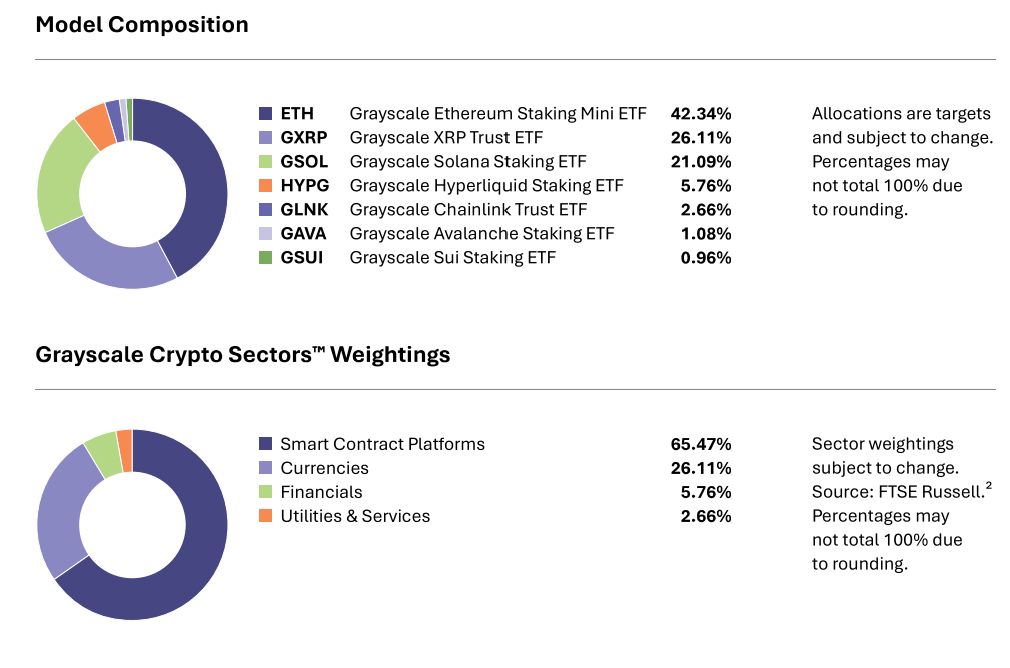
Grayscale handed financial advisors a ready-made crypto allocation on Monday, and XRP (XRP) took 26.11% of it. The token is the second-largest holding in the firm’s new Digital Assets Next Gen model portfolio.
A model portfolio is a published recipe. Grayscale picks the assets and the weights, and an advisor copies that mix into client accounts using the firm’s exchange-traded funds.
XRP Sits Second in a Portfolio Built Without Bitcoin
The Next Gen model leaves Bitcoin out and held seven funds as of August 31. Ether leads at 42.34%, XRP follows at 26.11%, and Solana takes 21.09%.

Those three fill roughly 89% of the basket. Hyperliquid, a trading-focused blockchain whose Grayscale fund listed only in June, takes 5.76%. Chainlink, Avalanche, and Sui split what is left.
Grayscale caps any one asset at 40% and resets the weights every three months. Ether has already drifted past that cap since the model started on July 27.
The Funds Behind It Have Been Losing Money
XRP trades near $1.42, up about 5% on the day and fifth by market value. The Grayscale XRP Trust ETF, however, sits 38.51% below its launch price.
BeInCrypto reported in August that the same trust sold $180 million in tokens during the first half of the year at a realized loss. Six of the model’s seven funds trade below where they started.
The model itself shows a 30.69% net gain since July 27. That is five weeks of history built on one strong August, and the rest of the return table is empty.

“Advisors are increasingly looking for ways to bring digital assets into client portfolios without having to build and maintain allocations asset by asset,” Laurie Katz, Grayscale’s Global Head of Distribution, framed the launch around convenience.
Grayscale charges no separate fee for the models, and the underlying funds average 0.23%. Whether advisors read Next Gen as emerging assets or as a large ether and XRP bet under a different name will decide how much money follows.
The post Grayscale Just Made XRP 26% of Its New Portfolio for Advisors appeared first on BeInCrypto.
President Donald Trump phoned Nvidia Chief Executive Jensen Huang live on stage Monday. He told a room of investors that fear of artificial intelligence (AI) is a hoax. Nvidia shares fell anyway.
The call came during the All-In Summit, a technology conference run by a group of Silicon Valley investors. It landed hours after chip stocks opened sharply lower.

Trump Turns a Phone Call Into AI Policy
Huang was midway through an on-stage interview when his phone rang. He put the president on speaker, and the audience heard the argument Trump has pushed for weeks.
“I’m telling you it’s all a hoax. The data centers are great. They make people wealthy. They make states wealthy. AI is bigger than the internet. These people are playing right into the hands of China. We’re not going to let that happen,” Donald Trump, President of the United States, speaking at the All-In Summit, via attendees.
Follow us on X to get the latest news as it happens.
“You’re right, we’re not going to let that happen sir,” Huang answered.
That morning, Trump had already dismissed safety warnings on social media. He argued that a capable president is the only guardrail the technology needs. He has separately claimed sweeping power over AI companies.
Why Nvidia Shares Fell Anyway
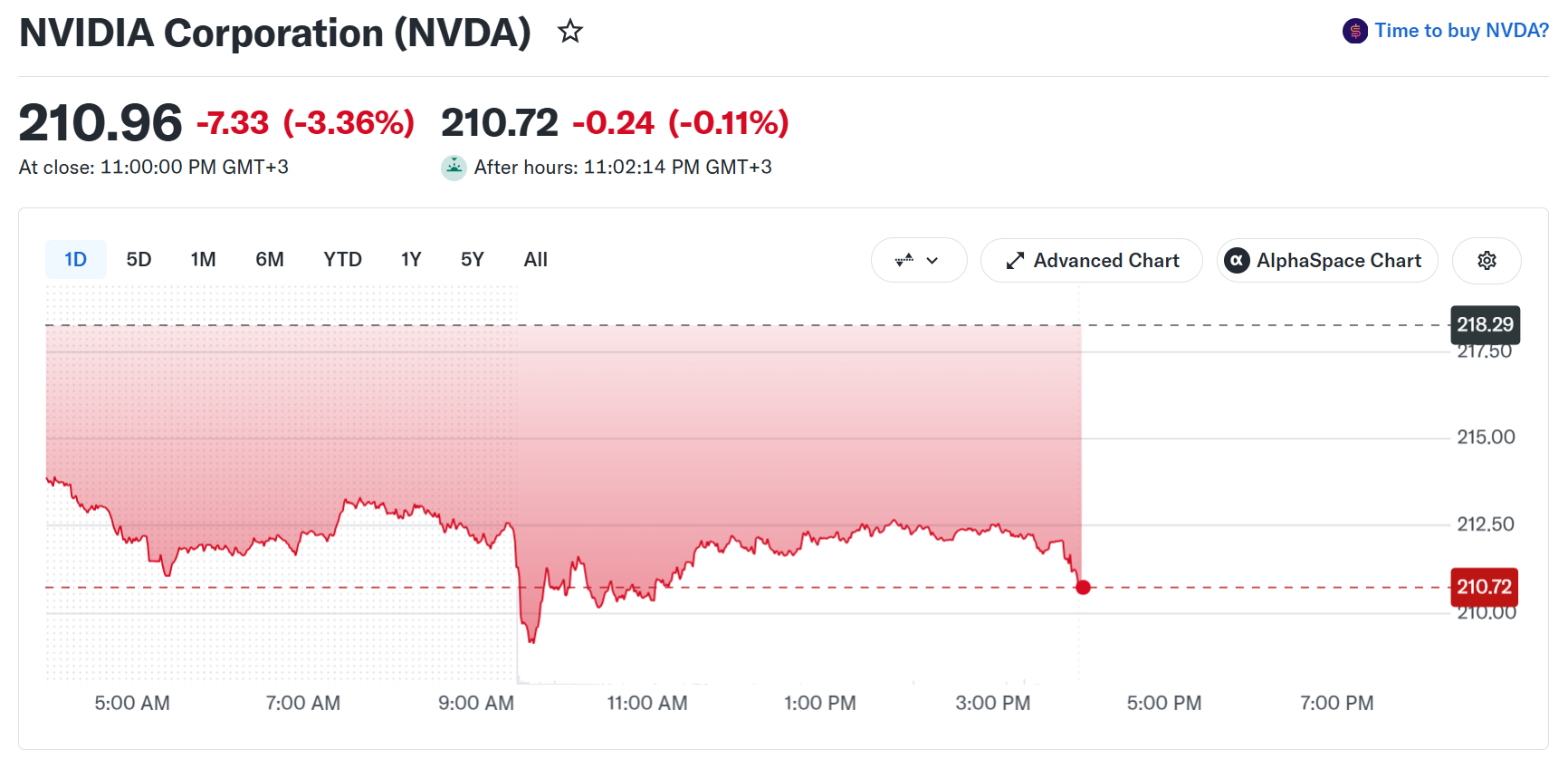
The selling started long before the call. Nvidia traded near $211.81 on Monday afternoon, roughly 3% below Friday’s close of $218.29.
Intel dropped 7% and Advanced Micro Devices lost 6%. The iShares Semiconductor ETF, an exchange-traded fund tracking the sector, slid 6%.
Investors were pricing a weekend essay from Anthropic Chief Executive Dario Amodei. He urged developers to pace the next leap in model capability. Sam Altman and Elon Musk joined the rivals backing a slowdown.
BeInCrypto flagged on Saturday that Monday’s market open would test that pact. Chip stocks answered within minutes.
Not everyone reads the drop as real weakness. Investor Michael Burry says the slowdown push is hype tied to coming listings. Intel also fell hardest despite holding the least AI exposure. That pattern suggests crowded trades unwinding rather than shrinking demand.
Nvidia’s order book has not changed. What has changed is the distance between what the president says and what the market will pay for.
The post Trump Phones Jensen Huang Live Against AI Slowdown Fears. NVIDIA Stock Reacts appeared first on BeInCrypto.


Bitfinex Securities has argued that the tokenized stocks debate must distinguish between third-party products and issuer-backed securities because each model gives investors different rights.
Summary
- Bitfinex Securities says issuer consent is only one part of the tokenized stocks debate.
- Third-party tokens may reference shares without giving holders ownership or voting rights.
- Private-company products can leave token buyers with less information than direct investors receive.
- Transfer controls and market monitoring remain central concerns for blockchain-based stock products.
Tokenized stocks require clear investor rights
Bitfinex Securities Head of Operations Jesse Knutson told crypto.news that Robinhood CEO Vlad Tenev was “directionally correct” to reject a blanket issuer veto, but said the debate should focus on what each token represents, who may buy it and where it can trade.
Tenev has said companies should not control tokenized products that neither change their shareholder records nor create new duties for them. His comments followed objections from companies whose names and share prices have been used in stock-linked products without their involvement.
Knutson said traditional markets already allow third parties to create instruments tied to listed securities. Unsponsored depositary receipts offer one example, making the basic idea of an unaffiliated company issuing a product linked to a public stock familiar to financial markets.
“The debate shouldn’t really be ‘does the issuer get a veto?’ It should be: what exactly does the token represent and who can access it?” Knutson said.
For large public companies with liquid shares, he added, an unsponsored tokenized product may be easier to structure because investors have regular access to financial statements, public filings, and market prices. A token provider can use the listed security as a reference or hold shares to support the product, depending on its legal design.
Even so, identical company names can sit behind instruments with different legal terms. One token may act as a debt security that tracks a stock’s price, while another may represent a beneficial interest in shares held by a custodian. An issuer-sponsored security can place registered equity onchain and retain the rights attached to an ordinary share.
Robinhood’s products have already placed that distinction under scrutiny. In September, AMC Entertainment CEO Adam Aron rejected an AMC-linked token because the theater chain had not approved or participated in its creation.
Robinhood describes its transferable Stock Tokens as tokenized debt securities issued by Robinhood Assets (Jersey) Limited. Holders receive economic exposure to the referenced stock but do not become shareholders of the company or gain voting rights against it.
Private-company tokens carry added information risks
Knutson drew a sharper line around products linked to private companies, where ordinary token buyers may not receive the financial information available to existing shareholders.
“Unsponsored private equity is a lot more complicated due to potential information asymmetry. The underlying private investors in such scenarios will often have access to financials and reporting not typically allowed to be shared more broadly — while token investors trade only on headlines.”
Private shares lack the continuous disclosure, public filings and regular price discovery associated with exchange-listed companies. According to Knutson, creating a token around such an asset can leave its buyers trading with less information than investors who hold a direct stake in the private company.
OpenAI raised a similar concern over the nature of Robinhood’s products in July 2025, when the brokerage offered eligible European customers token exposure linked to OpenAI and SpaceX. OpenAI said the tokens were not its equity and that the company had neither partnered with Robinhood nor endorsed the product.
Robinhood said its OpenAI exposure came through a special-purpose vehicle holding an economic interest linked to the private company. Buyers therefore received exposure through Robinhood’s structure rather than shares issued directly by OpenAI.
Knutson’s comments do not treat every third-party product as improper. Instead, his argument separates the question of whether a product may exist from the disclosures investors need to understand its structure, counterparties, and limits.
Transfer controls can restrict where tokens trade
Beyond ownership terms, Knutson said tokenized securities require controls at the protocol level to stop transfers into sanctioned or prohibited markets.
“Listed companies obviously don’t want tokenized versions of their stocks ending up in sanctioned or prohibited jurisdictions,” he said.
A token can move between compatible blockchain addresses once transfers are enabled, creating a different distribution route from a conventional brokerage account. Compliance may therefore depend on smart-contract restrictions, approved-wallet lists, identity checks and redemption rules applied by the token issuer.
Robinhood currently bars U.S. persons from acquiring the Stock Tokens issued by its Jersey unit. Its documentation says the products have not been registered under the U.S. Securities Act and cannot be offered, sold, or delivered in the United States or to American investors.
The restriction means U.S. customers cannot use Robinhood’s blockchain tokens as a substitute for buying the referenced shares through a domestic brokerage account. American investors remain able to purchase ordinary listed stocks under the ownership, custody, and disclosure rules that govern U.S. securities markets.
A recent Robinhood and AMC dispute also brought the Securities and Exchange Commission into the discussion. Aron said AMC could ask the agency to review the token, although neither an SEC action nor a lawsuit over the product had been announced at the time.
Knutson also identified price discovery as a concern when stock tokens trade on platforms with limited market surveillance. Weak monitoring could matter when a token changes hands outside the hours of the exchange where the referenced stock is listed.
U.S. shares generally stop trading on their primary exchanges at set times, while blockchain markets can operate continuously. Prices on decentralized venues may therefore move when the underlying stock market is closed, particularly during weekends or American holidays when traders cannot immediately arbitrage differences against the listed share.
Tokenized stock models offer different protections
Competition among issuers has produced several structures rather than a single standard for tokenized stocks. Coinbase, for example, introduced products on Base in August that represent beneficial interests in shares held through segregated custody.
The initial Coinbase offering included tokenized versions of Nvidia, Meta, Apple, and Alphabet. As previously covered in August, Alpaca Securities buys and holds one underlying share for each token at issuance, while a Coinbase-controlled company in the Abu Dhabi Global Market formally issues the securities.
Coinbase’s prospectuses distinguish beneficial ownership from being listed as the legal owner on the public company’s shareholder register. Verified holders may submit voting instructions, although the issuer’s ability to act on them remains subject to legal, operational and timing limits.
Other differences extend to dividends, redemptions, and insolvency claims. Coinbase’s documents say dividends are generally reinvested after fees and applicable U.S. withholding tax, while verified holders may request redemption in shares, dollars or an accepted stablecoin. Robinhood’s tokens place contractual claims against its Jersey issuer rather than against the company whose stock supplies the reference price.
“In the latter case, one of the biggest advantages of tokenization is actually the ability for issuers and investors to interact more directly, with greater transparency over ownership and potentially greater control over how the security operates,” Knutson said about issuer-sponsored products.
Both sponsored and third-party structures may remain in the market, he added, making the legal design important to an investor’s decision.
“The market is likely to have both models, but investors need to understand which one they’re buying.”
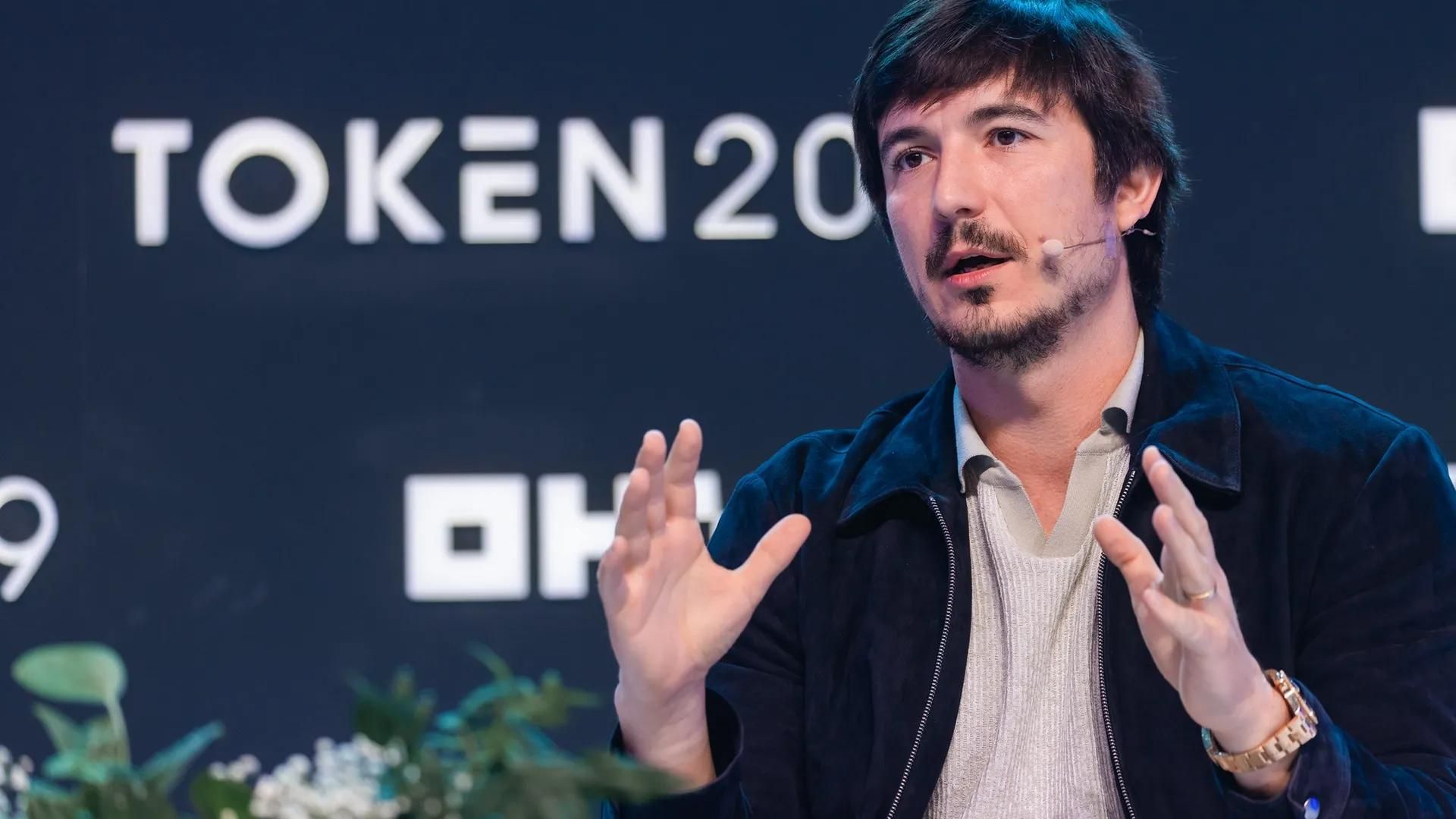
CEO Vlad Tenev said more shareholder features are coming as Robinhood’s offshore stock tokens draw scrutiny over ownership rights.


Attackers who tricked UK-based online bank Revolut into handing over sensitive customer information are currently releasing stolen details while allegedly threatening to keep leaking until the fintech coughs up over 10,000 BTC.
At current prices, that would put the ransom at roughly $780 million.
Revolut hasn’t confirmed the demand or authenticated any of the material currently circulating online. Many on social media have also expressed doubt that this ransom demand is real, with Revolut investor and crypto analyst Max Karpis pointing out that such a payment would be easily traced, making it extremely difficult to cash out.
Read more: Trezor’s summer of hacks continues with Brevo email breach
Attacker posed as government agency
An unidentified third party targeted Revolut over the weekend, using a legitimate government agency domain to pass the bank’s security checks and request customer information.
Information potentially disclosed included names, dates of birth, addresses, email addresses and phone numbers, alongside copies of passports and driving licences.
According to Revolut, the number of affected customers was “very limited,” but it stopped short of giving a precise figure.
Customer notifications also reportedly referenced account statements, IBANs, withdrawal records and transaction histories, including BTC activity.
According to posts on X, the attackers are seeking 10,000 BTC in exchange for not releasing additional customer data.
The figure hasn’t been confirmed by Revolut and the bank has so far limited its public comments to confirming that customer data was disclosed.
Nor has the bank indicated whether it intends to negotiate with the attackers or if the alleged material circulating online is genuine or represents the full dataset stolen.
Read more: OneKey ‘hacked’ already-patched Ledger app
Former Mt. Gox CEO among victims
It’s been reported that at least some affected customers may be high-profile or high-net-worth individuals.
Indeed, former Mt. Gox CEO Mark Karpelès has revealed that he was among those affected by the breach.
The Block reported that Karpelès shared a copy of the notification he received from Revolut, which said account statements, IBANs, withdrawal records and full transaction histories – including BTC transactions – may have been exposed.
On-chain investigator ZachXBT has also suggested that the attackers may have specifically targeted wealthy Revolut customers and that the attack appeared to involve a relatively small number of high-net-worth users.
Revolut says customer funds are safe
In a statement, Revolut told Protos, “Revolut recently identified a sophisticated external impersonation scam where an unauthorised third party utilised a legitimate government agency domain email to submit fraudulent requests for information.
“Upon detection, we immediately blocked the address and alerted the relevant government agency as well as enforcement agencies, data protection, and financial regulators.
“Revolut systems and customer funds are unaffected. We have contacted the limited number of impacted individuals directly to inform them and provide support.”
This would suggest that the incident was primarily a data-disclosure event rather than an attack in which customers’ accounts or crypto were directly targeted.
Got a tip? Send us an email securely via Protos Leaks. For more informed news and investigations, follow us on X, Bluesky, and Google News, or subscribe to our YouTube channel.
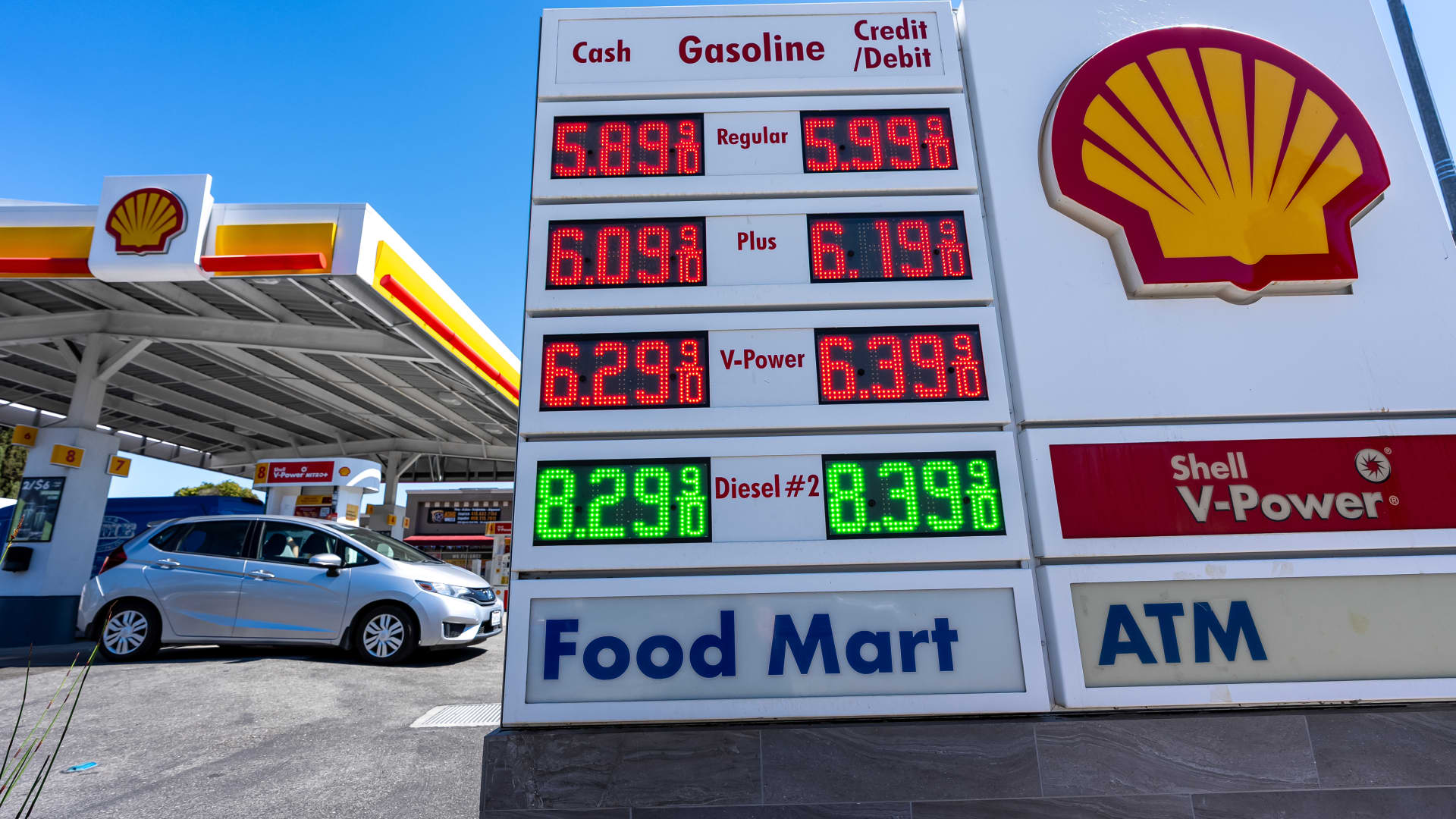
A sign displays unleaded gasoline and diesel fuel prices at a Shell gas station in San Jose, California, Sept. 10, 2026.
David Paul Morris | Bloomberg | Getty Images
U.S. oil prices are again above $100 per barrel, sending gasoline prices to multi-month highs. But traders on prediction market platforms expect the amount Americans are spending at the pump will hit fresh highs this year.
Gas prices peaked at $4.56 per gallon on May 21, according to AAA’s national average. Now, traders on Kalshi think there’s a 71% chance that the average will surpass $4.60 in 2026.
Speculators on Kalshi also place 57% odds that prices will top $4.80 a gallon, and just over a 40% chance that they cross $5.00. U.S. gas prices last hit a record high of just over $5 per gallon in June 2022.
On Kalshi, contracts in the market ask traders if gas prices will cross various price points. Contracts are resolved using AAA’s data.
Tensions between the U.S. and Iran have escalated in recent weeks, putting in doubt the status of the Strait of Hormuz, a critical passageway for the global supply of oil, and pushing the commodity’s price higher. On Monday, West Texas Intermediate crude futures were higher by 3.5% to more than $103 per barrel.
Traders on Kalshi also think that higher oil prices will last for longer. They place 50-50 odds that gas prices will be above $4.25 per gallon on election day, Nov. 3.
Disclosure: CNBC and Kalshi have a commercial relationship that includes customer acquisition and a minority investment.
Crypto World
Warsh’s credibility is on the line this week as Trump policies put pressure on Fed to hike

President Donald Trump speaks with the new chairman of the Federal Reserve, Kevin Warsh, after a swearing-in ceremony in the East Room of the White House, in Washington, May 22, 2026.
Anna Moneymaker | Getty Images
Before President Donald Trump reels off angry Truth Social posts if the Federal Reserve hikes rates this week, he should look in the mirror: His policies are a big reason the central bank has to consider a rate increase.
In March, one month after the beginning of the Iran war, with oil near $100 a barrel, the average Fed official was still forecasting a rate cut this year and another one next year.
It was a sign of the Fed’s continued willingness to “look through” policies of the Trump administration that resulted in higher prices and to treat them as “one-offs.”
Six months later, the Fed stands on the verge of what markets expect to be the first rate hike since 2023. And futures markets predict this is will not be a one-off increase. At least three hikes are priced in through March of next year.
It’s a stark turnaround, but not one based on bad forecasting.
No president has publicly harangued and harassed the Fed more to lower interest rates. So it’s ironic that a direct line can be drawn from Trump’s policies to what looks like an inevitable rate increase Wednesday by the Fed, likely to be spearheaded by his handpicked Fed chairman, Kevin Warsh.
Tariffs and Iran
Two aspects of the president’s policies look to be forcing the hand of the Fed. First, the policies themselves. Tariffs and the Iran war have both resulted in sharp changes to the inflation outlook. But, second, and potentially more consequential, may be the inability to judge the trajectory of policy. The Iran war, six months on, looks to have no end in sight. The situation has clearly worsened with the temporary shutdown of the Saudi East-West pipeline. Fed officials need to consider that oil prices won’t be falling quickly.
The president himself no longer responds to crude price increases with a proclamation of an imminent deal with Iran. The surge in diesel prices to $6 a gallon threatens to push inflation deeper into the economy, such as food and transportation costs. The president said on Monday that diesel prices have risen more because of the war in Ukraine than the war in Iran.

WTI crude oil futures, YTD
The same is true for tariffs. Just last week, the president levied new tariffs on Canada in response to its retaliatory tariffs in response to U.S. tariffs. While small by themselves and unlikely to spark broader inflation, they will add to existing price pressures from the levies. The president has threatened even more tariffs on the second-largest U.S. trading partner. The message to the Fed once again is there is no guarantee of anything, especially tariffs, being one-off in the Trump presidency.
In his Jackson Hole, Wyoming, speech, Warsh said if the Fed wasn’t confident that underlying inflation was declining, it would have “work to do.” Warsh could gain that confidence with an apparent path to an end to the Iran war or some assurance that the president is satisfied with the current tariff regime.
The recent dissent by Minneapolis Fed President Neel Kashkari, though it didn’t mention the president or his policies, shows the growing concern with cumulative inflationary policies. Kashkari said he initially believed that the Fed could “look through” a one-time rise in prices from a supply shock.
Now, he wrote, “I increasingly believe that monetary policy does have an important role to play in addressing a series of successive supply shocks that might lead to entrenched higher inflation.” Kashkari noted that this was the response of the Fed to successive shocks in the 1970s. “Policymakers ultimately concluded that tight monetary policy was necessary to bring inflation back down despite their original supply shock diagnosis.”
Fed’s credibility at stake
The president has forced Warsh’s hand to hike in another, more subtle way. By calling so publicly for rate cuts and picking a Fed chairman whom he suggested was on board, the president undermined his own chair’s credibility from day one. The proof of this came from Warsh’s first congressional testimony where he said a sign of his independence came in his failure so far to cut rates as the president had desired.
Warsh would be unlikely to hike solely because of the credibility issue. But it could play a factor if it’s a close call, where the new chairman and the Fed would have more to lose by not hiking. Numerous Fed observers have noted that the chairman’s reputation faces a test this week after his hawkish speech in Jackson Hole.
“Everything is pointing in the direction of September as a time to move if Warsh and his colleagues are going to maintain credibility,” former Vice Chair Roger Ferguson said on CNBC.

Now, with inflation above target and no visibility on lower oil prices or stability of tariffs, the Fed chairman needs to pass the test that has faced his predecessors: proving to markets he’s willing to risk a downturn and defy the administration to combat inflation, no matter what party is in power.
It is never the Federal Reserve’s place to judge administration policy as good or bad. Its only job is to assess their impact on the economy. On that basis, given recent developments in Iran and the Trump administration’s actions regarding tariffs, it would seem difficult for the Fed to assess them as anything but leading to higher inflation in the months ahead.
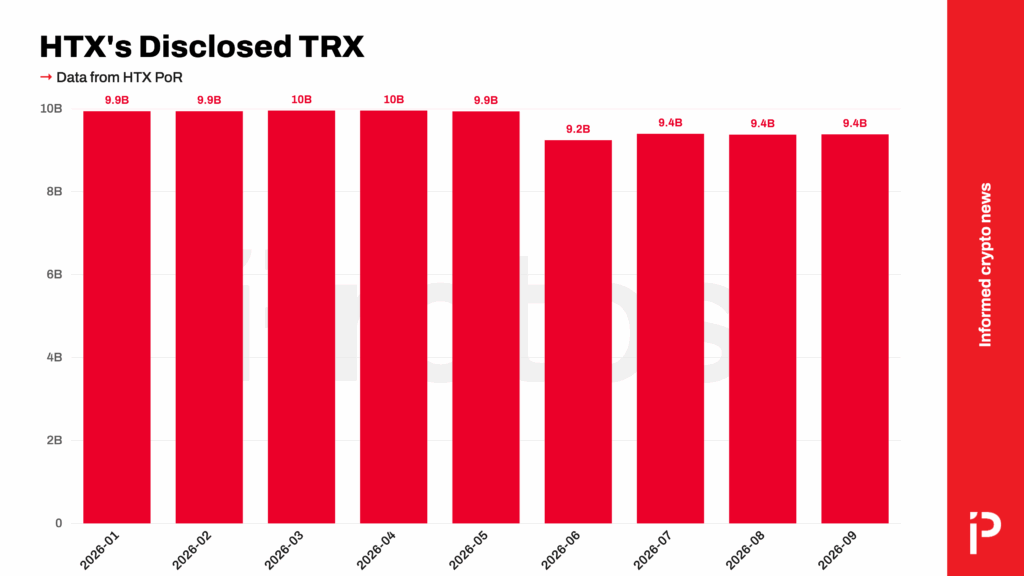
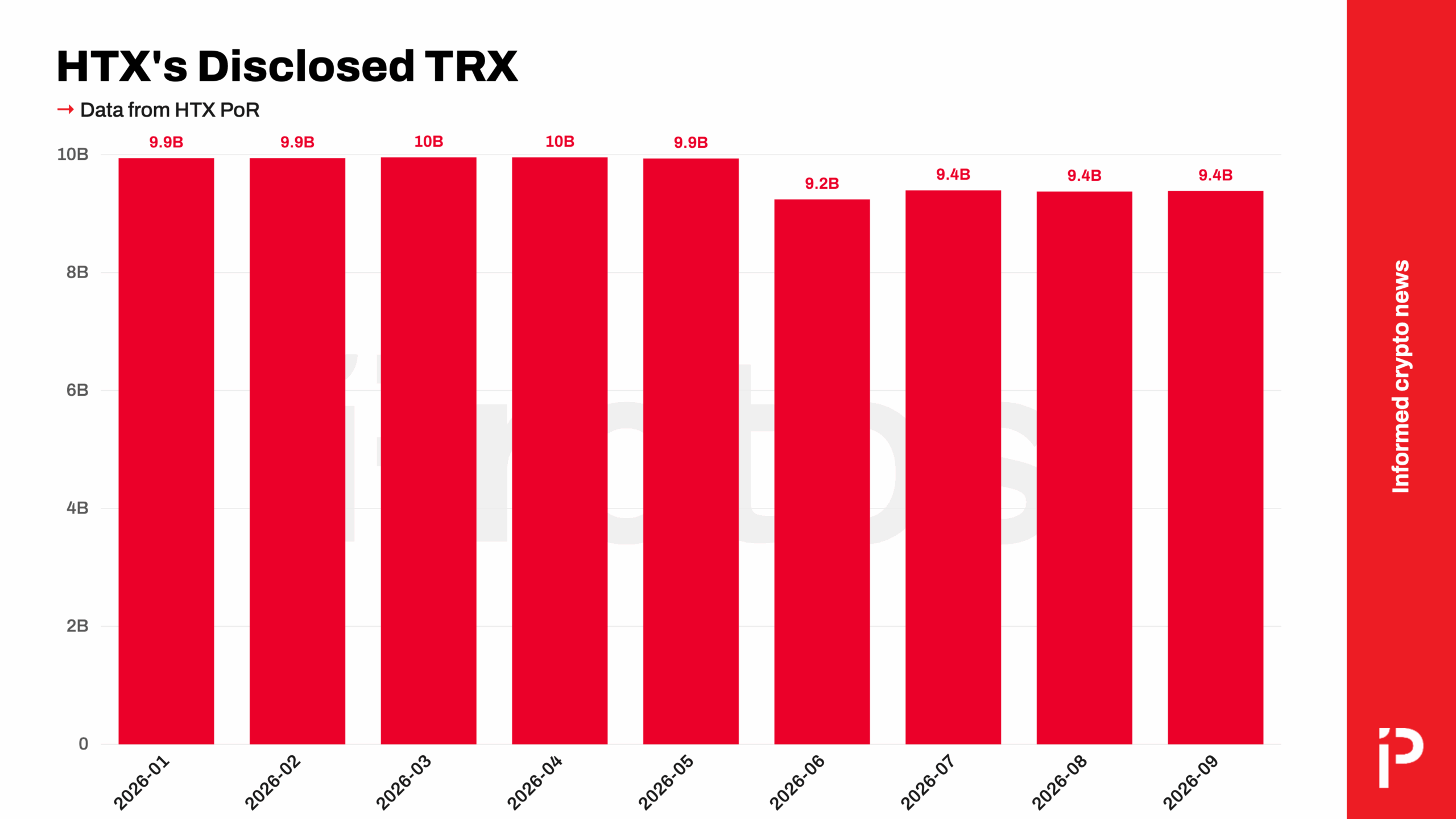
Back in June, proof-of-reserves for Justin Sun-owned HTX revealed a roughly-700 million drop in the quantity of TRX held at the exchange.
At today’s prices, these 700 million tokens are worth about $238 million.
A substantial portion of these assets ended up flowing into an address that supports Sun-owned Poloniex’s Super Representative, while some went to Binance.
Since then, HTX has been sanctioned by the European Union and the United Kingdom Foreign, Commonwealth & Development Office, making the location of HTX funds extraordinarily important.
Additionally, in the same proof-of-reserves where it disclosed the drop in TRX, it also reduced its disclosure for over $1 billion worth of other assets, now pointing towards an undisclosed “ThirdParty” custodian.
Protos was previously able to track a large portion of HTX’s Ethereum reserves to Poloniex.
Read more: Justin Sun’s Poloniex and HTX withdraw huge amounts from AAVE
We’ve since been able to track a portion of the TRX flow out of HTX before that June proof-of-reserves.
Specifically, in May, HTX moved 700 million TRX out of TAuUCiH4JVNBZmDnEDZkXEUXDARdGpXTmX, labeled as “HTX-Cold 6” and disclosed in the HTX proof-of-reserves.
This TRX was sent to multiple other addresses that we were able to identify.
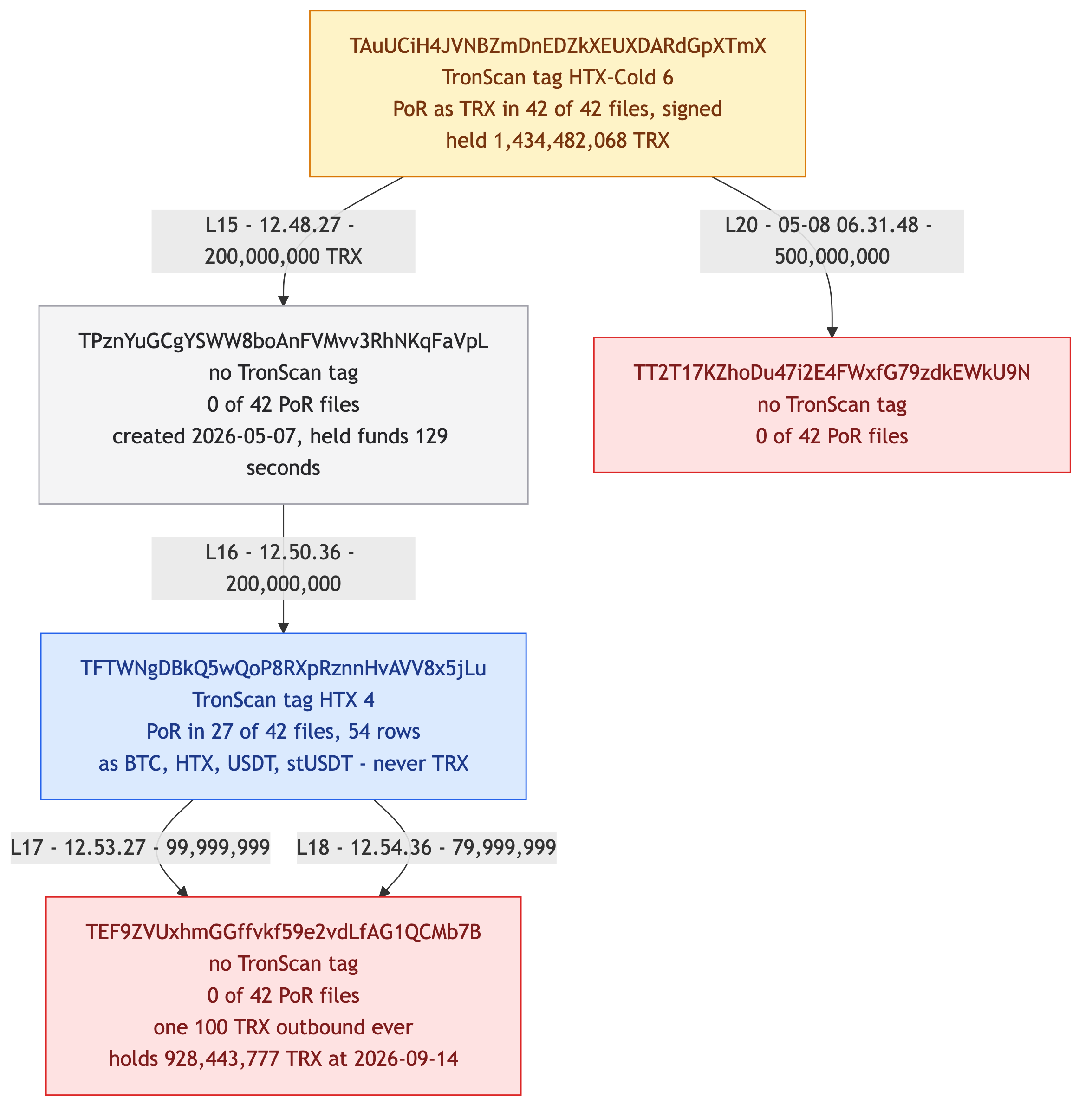
Two hundred million of these tokens were sent to TPznYuGCgYSWW8boAnFVMvv3RhNKqFaVpL.
These tokens were then forwarded to TFTWNgDBkQ5wQoP8RXpRznnHvAVV8x5jLu, an address which is labeled as “HTX 4” on Tronscan, which is also an address that was included in the proof-of-reserves (but has since been removed and never included TRX in its disclosed assets).
Of these 200 million tokens, 180 million were sent in two transactions to TEF9ZVUxhmGGffvkf59e2vdLfAG1QCMb7B (TEF9).
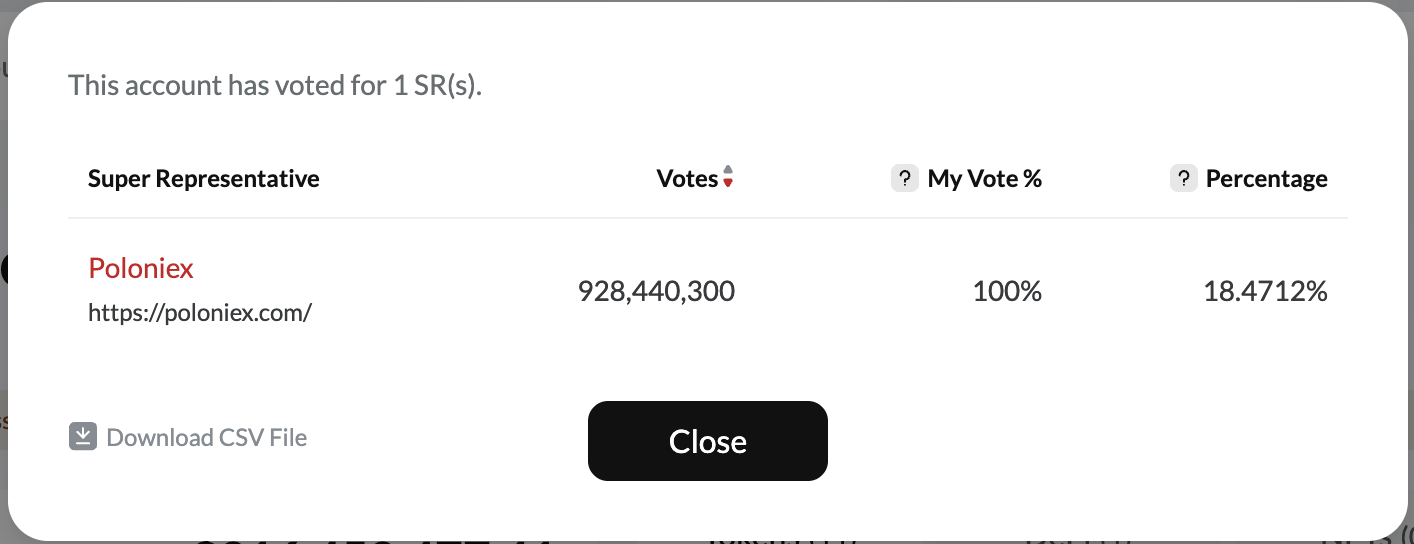
This unlabeled address currently votes 928 million TRX for the Poloniex Super Representative.
Returning to the other 500 million tokens, those funds were sent to TT2T17KZhoDu47i2E4FWxfG79zdkEWkU9N (TT2).
This is a notorious and controversial address.
Arkham Intelligence tags it as “Justin Sun?” It’s also an important redeemer of TrueUSD, a stablecoin deeply connected to Sun.
TT2 has delegated energy to HTX 4 before.
However, it’s worth noting that Sun has been evasive when asked about this address by Bloomberg previously.
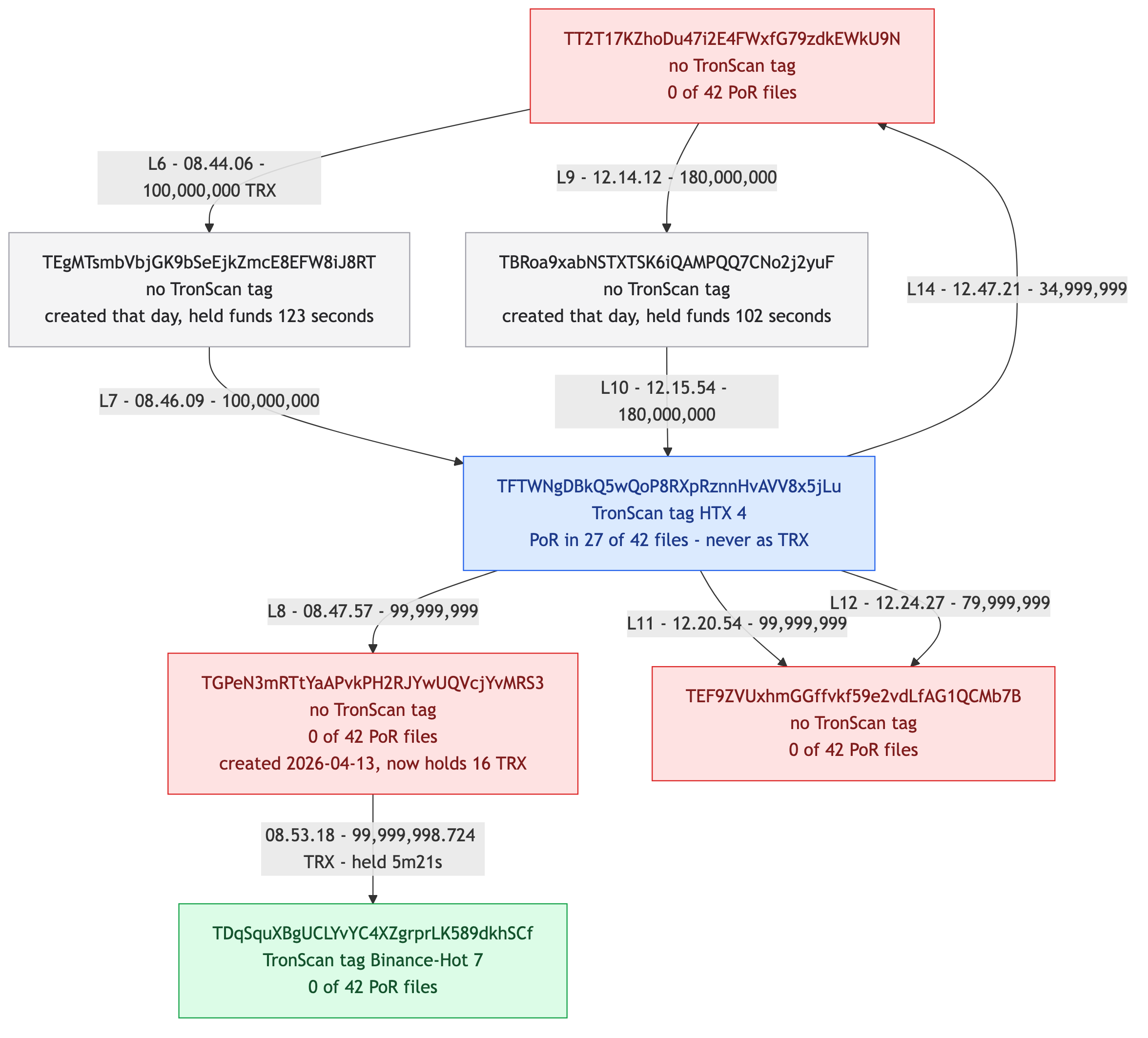
However, the day before these funds came in, TT2 made some interesting transactions.
It started by sending 100 million TRX to TEgMTsmbVbjGK9bSeEjkZmcE8EFW8iJ8RT, which immediately sent 100 million TRX to HTX 4.
HTX 4 then forwarded those funds to TGPeN3mRTtYaAPvkPH2RJYwUQVcjYvMRS3.
These funds were then forwarded to TDqSquXBgUCLYvYC4XZgrprLK589dkhSCf, an address that TRONScan labels as Binance-Hot 7.
So before receiving 500 million TRX out of the HTX reserves, it sent 100 million TRX to Binance.
That wasn’t the only interesting set of transfers out of TT2 that day.
It also sent 180 million TRX to TBRoa9xabNSTXTSK6iQAMPQQ7CNo2j2yuF.
This address quickly forwarded these funds to HTX 4.
HTX 4 then sent these funds onward, again, in two transactions to TEF9.
It also sent 35 million TRX to TT2, in some sense creating a loop of funds.
Broadly, this shows millions of dollars in TRX moving from HTX to a variety of addresses, including one address that supports Poloniex.
They also moved in a pattern similar to the stETH that Protos previously tracked out of HTX, including the use of briefly used burners.
However, we should note that these represent less than 10% of the total TRX held at HTX, and the most recent disclosure claims a total of 9.3 billion TRX, with 922 million of those currently lent on JustLend.
Got a tip? Send us an email securely via Protos Leaks. For more informed news and investigations, follow us on X, Bluesky, and Google News, or subscribe to our YouTube channel.


Eight banking groups on Monday said they want tighter limits on stablecoin rewards, keeping the ongoing banks-versus-crypto dispute alive in Congress.


President Donald Trump’s digital assets adviser spoke at a Washington event the day after a new compromise language was released for the Clarity Act.

John McEnroe’s ‘unprofessional’ and ‘belittling’ comments are slammed as the ‘final straw’ by angry US Open fans

Law firm Devonshires launches its first office in Wales

Grayscale Just Made XRP 26% of Its New Portfolio for Advisors

Memory prices are slowing because buyers ran out of money

The Latest Weird Thing to Play Doom Is the Mapped-Out Brain of a Fruit Fly

Micron Stock Climbs Above $1,031 as AI Memory Crunch and a $50 Billion Outlook Fuel the Rally

5.3 Million users? VeChain’s 2026 plans revealed #vet #cryptocurrency
![Savage Plug X Didine Canon 16 - MONEY CASH (Official Music Video) [Prod. Blackrock Chonique]](https://wordupnews.com/wp-content/uploads/2026/08/1788053076_maxresdefault-80x80.jpg)
Savage Plug X Didine Canon 16 – MONEY CASH (Official Music Video) [Prod. Blackrock Chonique]

celebrating my success with my brother #trending #crypto #cryptocurrency #trading #shorts #like
-
Tech6 days ago
Memory prices are slowing because buyers ran out of money
-
 Tech1 day ago
The Latest Weird Thing to Play Doom Is the Mapped-Out Brain of a Fruit Fly
-
 Business5 days ago
Micron Stock Climbs Above $1,031 as AI Memory Crunch and a $50 Billion Outlook Fuel the Rally
-

 Business5 days ago
AMD Stock Climbs After Management Lifts 2027 Data Center Outlook Toward $70 Billion in AI Sales
-

 Fashion3 days ago
Weekend Open Thread – Corporette.com
-

 Crypto World6 days ago
Bitcoin price risks $76K drop as $78K support weakens
-

 Crypto World6 days ago
Robinhood Stock: How To Take Advantage With Reduced Risk
-

 Crypto World4 days ago
XAG/USD: Silver’s Short-Term Rally Meets Its Moment of Truth
-

 Crypto World4 days ago
2 Chip Stocks Broke Out This Week. Neither Was Nvidia
-

 Crypto World6 days ago
Ethereum price stalls below $2,500 as ADX drops to 11
-

 Business4 days ago
10 Most-Streamed Songs On Spotify In 2026 So Far, Led By Ella Langley’s Dominant Run On The Charts This Year
-

 NewsBeat6 days ago
England up in reading, maths and science rankings as Scotland and Wales dip
-

 Tech4 days ago
Battery life is the only iPhone 18 Pro and iPhone Duo upgrade I care about. Apple didn’t disappoint
-

 Crypto World4 days ago
OKX launches 10x OpenAI, Anthropic X-Perps in Europe
-

 Crypto World4 days ago
Diesel Tops $6 a Gallon for the First Time as 28 States Set Records
-
 Crypto World6 days ago
Intel Stock Jumps 9% on Chip Price Hike Report, US Stake Gains $36 Billion
-

 News Videos3 days ago
Facing Financial Fears
-

 Crypto World5 days ago
Bitcoin price risks $70K if $78K neckline breaks
-

 NewsBeat6 days ago
What went right this week: an ‘historic’ fall in violent crime, plus more
-

 Tech5 days ago
Apple Watch Ultra 4 vs Watch Ultra 3: Should you really spend another $799?
You must be logged in to post a comment Login