
Crypto World
Read this before you click on any Robinhood email



Robinhood customers received some particularly convincing phishing emails this weekend. The messages, which appeared to come directly from the company, featured authenticated headers, were correctly signed, included a genuine sender’s address, were sent from an authentic email server, and weren’t caught by spam filters.
Worse, the email from [email protected] even earned Gmail’s automatic route into the same conversation threads as legitimate, prior security alerts from Robinhood.
The only fraudulent things about the email were obscure technical irregularities and its contents, a phishing call-to-action seeking login information.
By Sunday night, hackers used Robinhood’s own notification pipeline to render their assault.
Analysis of the exploit went viral on social media soon after.
Robinhood phishing emails were ‘kinda beautiful’
Security researcher Abdel Sabbah posted an analysis of the event, calling it “kinda beautiful” with a sinister connotation. Unfortunately, he was right.
To craft the attack, the hacker first utilized a Gmail “dot trick,” a well-known Google feature whereby Gmail routes [email protected], [email protected], and [email protected] to the same inbox.
Gmail, unlike the rest of the internet, ignores dots in the part of the address before the @ symbol, so all of those variants deliver to the same inbox.
Because Robinhood, unlike Gmail, doesn’t normalize the dotted variants, an attacker used a “dot” modified version of Robinhood’s legitimate customer emails.
Next, the attacker set the device name on the new account to a block of raw HTML. When Robinhood’s “unrecognized activity” email is generated, the template inserts that device name without sanitizing it, rendering the nefarious HTML.
The result, in Sabbah’s words, is what appeared to be “a real email from [email protected], DKIM pass, SPF pass, DMARC pass, with a phishing CTA.”
That CTA or “call to action,” of course, is a fake security alert email with a hyperlink to an attacker-controlled webpage that harvests login credentials and two-factor authentication codes.
The ultimate goal, like almost all phishing campaigns, was to steal customer’s money — in this case, from their Robinhood account.
Read more: Robinhood pays $605M to buy Sam Bankman-Fried’s stake
Think before you click on any email
Many crypto influencers warned people about the convincing emails.
Ripple’s David Schwartz amplified the warning. “Any emails you get that appear to be from Robinhood (and may actually be from their email system) are phishing attempts,” he posted. Quoting Sabbah’s thread, Schwartz added, “It’s quite sneaky.”
In April 2025, Ethereum Name Service Lead Developer Nick Johnson documented an almost identical exploit involving emails that appeared to send from Google itself.
Attackers used a similar series of tricks to use Google’s own infrastructure to deliver DKIM-signed phishing emails from [email protected].
The lesson then is the lesson now: beware of clicking any link in any email, no matter how authentic it appears.
Traditional anti-phishing advice tells users to check the sender domain and look for authentication failures. None of that helped here. The domain appeared real. The signatures appeared real. Only the intent was criminal.
Robinhood’s own scam guidance tells customers to verify the sender’s email domain and lists @robinhood.com as the authentic example.
Protos reached out to Robinhood for comment but didn’t receive a reply prior to publication time. In Nasdaq trading today, the common stock of Robinhood opened flat for trading relative to Friday’s closing print.
Got a tip? Send us an email securely via Protos Leaks. For more informed news, follow us on X, Bluesky, and Google News, or subscribe to our YouTube channel.


Ripple Advances Cross-Border Payment Testing
Ripple has strengthened its presence in Asia through a fresh collaboration with K-Bank in South Korea. The agreement focuses on testing blockchain-based remittance systems between multiple financial networks. This initiative reflects a broader push toward faster and more transparent global payments.
XRP Gains Utility Through Institutional Use Cases
The partnership highlights growing institutional interest in XRP as a bridge asset for cross-border settlements. Ripple’s payment network often uses XRP to facilitate liquidity between different fiat currencies. Therefore, this collaboration strengthens its relevance in real-world financial applications.
The remittance tests will cover corridors such as the United Arab Emirates and Thailand. These regions provide active payment routes with strong demand for efficient cross-border transfers. As a result, the pilot program targets meaningful transaction flows instead of isolated testing scenarios.
Meanwhile, Ripple continues to expand its network through additional partnerships across financial services sectors. Earlier collaborations in South Korea included work with insurance and settlement platforms. This consistent expansion supports XRP’s positioning within regulated financial ecosystems.
Wallet Integration and Compliance Focus
K-Bank is also developing internal digital wallet solutions to support blockchain-based financial services. These wallets aim to manage digital assets while meeting strict compliance requirements. However, in-house development requires additional time and resources for certification processes.
Ripple offers an alternative through its software-based wallet infrastructure designed for institutional use. The platform includes built-in compliance tools such as security modules and layered authorization systems. Therefore, it can reduce development time while maintaining regulatory standards.
Both approaches highlight the importance of compliance in blockchain adoption within traditional banking systems. Anti-money laundering checks and sanctions screening remain critical for large-scale deployment. As a result, the partnership emphasizes secure and compliant integration of new technologies.
Regulatory Context and Market Expansion
South Korea continues to explore regulatory frameworks for digital assets and stablecoins within its financial system. K-Bank has indicated plans to align its blockchain initiatives with upcoming legislation. This approach ensures that new technologies remain compatible with future legal requirements.
Ripple’s broader strategy also aligns with regulatory developments across global markets. The company works with financial institutions that require secure and compliant infrastructure for digital payments. Consequently, partnerships like this one support gradual adoption within regulated environments.
The collaboration reflects a wider trend of banks testing blockchain systems before full-scale deployment. Institutions increasingly explore distributed ledger technology to improve efficiency and transparency. As a result, initiatives like this signal steady progress toward modernized global payment systems.
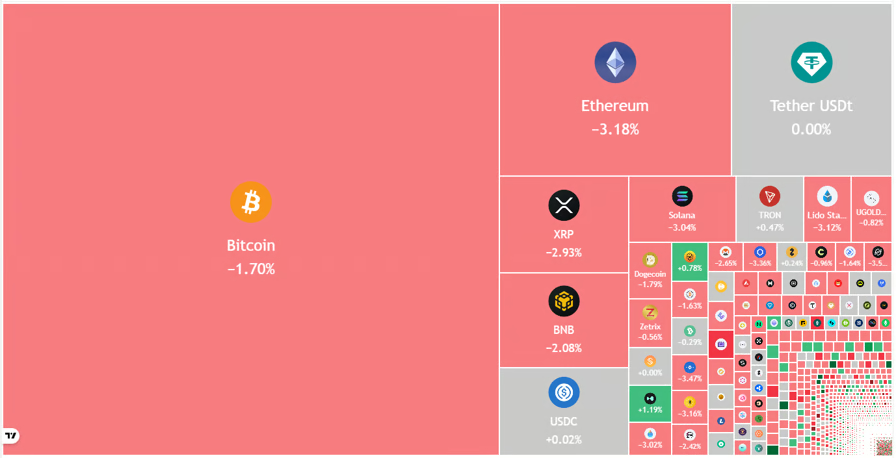
Key points:
- Bitcoin continues to face resistance near $79,500, but the trajectory remains up as long as the price holds above $76,000.
- Most major altcoins are not showing any directional bias, suggesting a near-term consolidation.
Bitcoin (BTC) attempted to rise above $79,500, but the bears held their ground. BTC investor and author Michael Terpin told Cointelegraph that BTC risks falling to $57,000 in October 2026, based on a study of the “historical average” drawdown of about 1 year from a market-cycle top. Terpin added that BTC will have to rise above $100,000 for the bull market to resume.
Another negative view came from Bitcoin analyst Matthew Hyland, who said in a post on X that the “larger expected consensus outcome for BTC is another leg lower by October.” Veteran trader Peter Brandt also opined in an X post that BTC may form “an investable low” in September or October.
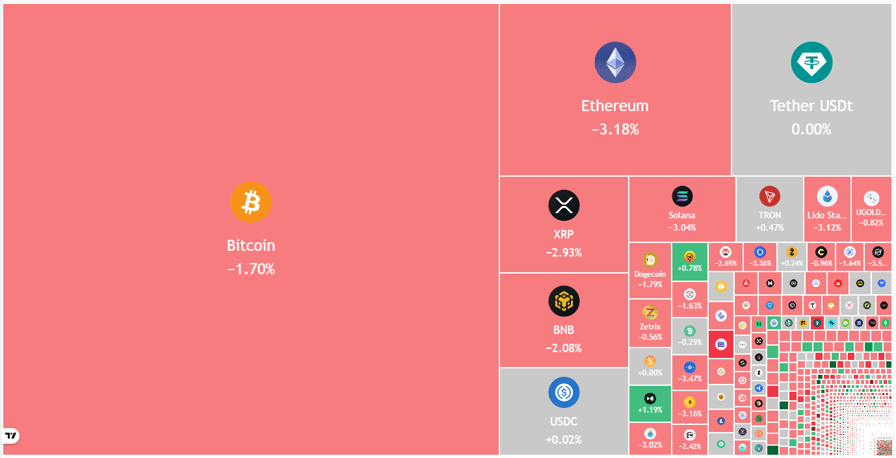
Crypto market data daily view. Source: TradingView
While several analysts expect a fall in BTC, crypto sentiment platform Santiment has a different view. Santiment said in a post on X that BTC wallets holding between 10 and 10,000 BTC have added 40,967 BTC since April 10, while retail investors holding less than 0.1 BTC have accumulated 46 BTC during the same period. If whales continue to buy and retail investors book profits, that may signal a long-term bull run.
Could BTC and the major altcoins rebound off the support? Let’s analyze the charts of the top 10 cryptocurrencies to find out.
S&P 500 Index price prediction
The S&P 500 Index (SPX) rose to a new all-time high on Friday, indicating that the bulls are in command.
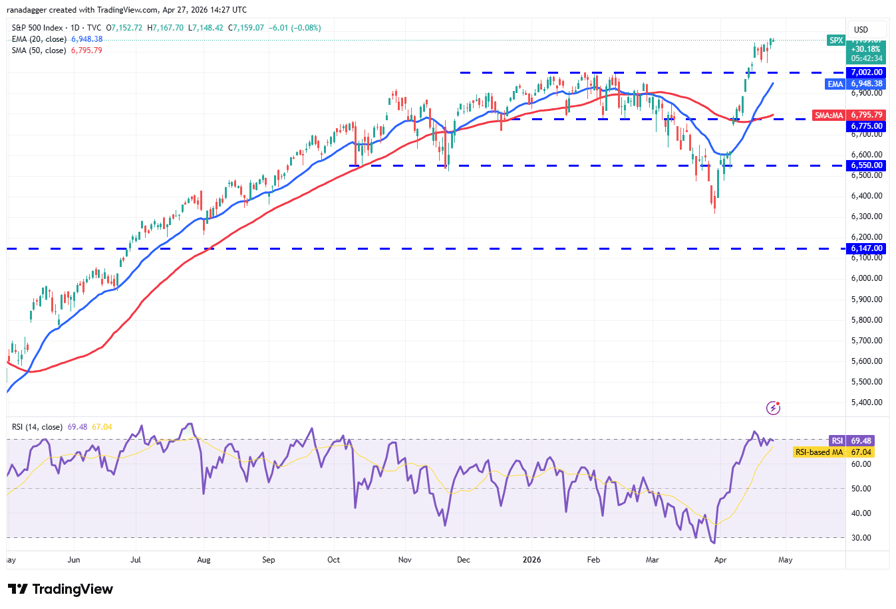
SPX daily chart. Source: Cointelegraph/TradingView
The upsloping 20-day exponential moving average (6,948) and the relative strength index (RSI) near the overbought zone suggest the up move may continue. The next levels to watch on the upside are 7,500 and then 7,877.
Sellers will have to swiftly yank the price back below the 20-day EMA to weaken the bullish momentum. If they manage to do that, the index may tumble to the 50-day simple moving average (6,795).
US Dollar Index price prediction
The US Dollar Index (DXY) reached the moving averages, where the bears are posing a stiff challenge.
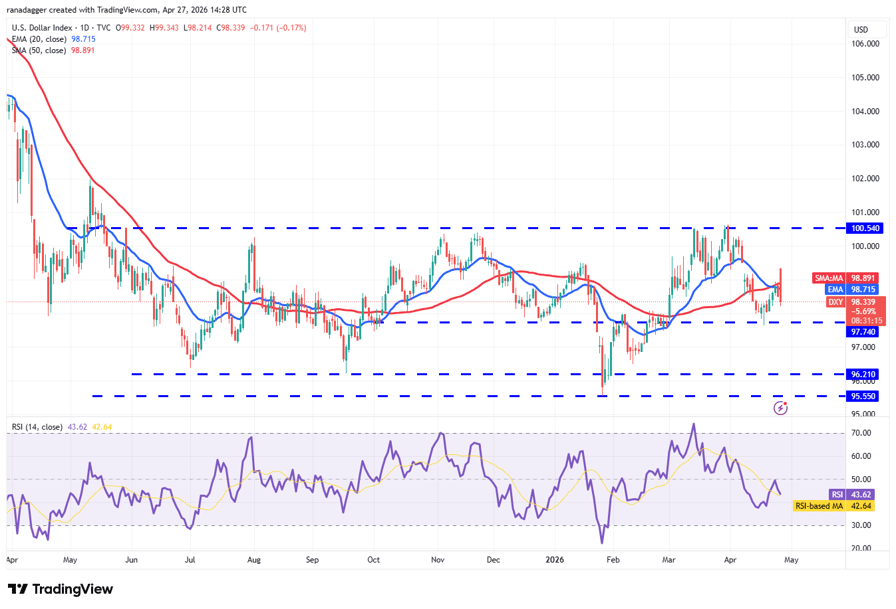
DXY daily chart. Source: Cointelegraph/TradingView
The bears will attempt to push the price toward the 97.74 level, where buyers are expected to step in. However, if the bears push the price below the 97.74 level, the index may sink toward the 96.21-95.55 support zone.
On the upside, the bulls will need to sustain prices above the moving averages to increase the likelihood of a rally toward the 100.54 level. The bears will attempt to keep the index inside the 95.55 to 100.54 range by selling near the overhead resistance.
Bitcoin price prediction
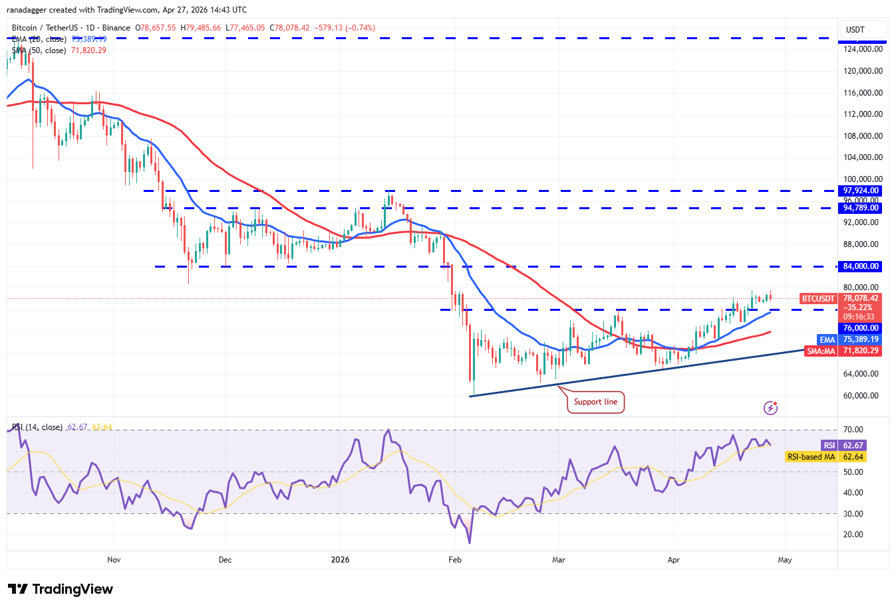
BTC has been sustaining above the breakout level of $76,000, indicating that the bulls are not hurrying to book profits.
BTC/USDT daily chart. Source: Cointelegraph/TradingView
The upsloping moving averages and the RSI in the positive zone signal that the path of least resistance is upward. If buyers thrust the price above $80,000, the BTC/USDT pair may skyrocket to $84,000.
Time is running out for the bears. They will have to quickly pull the BTC price below the 20-day EMA to gain the upper hand. The pair may then decline to the 50-day SMA ($71,820), signaling that the bears are active at higher levels.
Ether price prediction
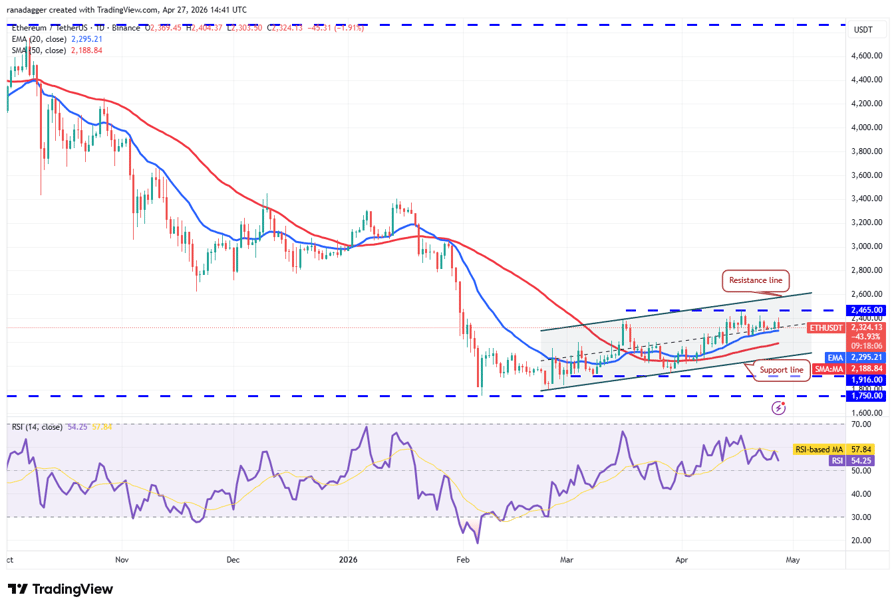
Ether (ETH) remains above the 20-day EMA ($2,295), but bulls have failed to push it above the $2,465 resistance.
ETH/USDT daily chart. Source: Cointelegraph/TradingView
Sellers will attempt to strengthen their position by pulling the ETH price below the 20-day EMA. If they succeed, it suggests the ETH/USDT pair may remain within the ascending channel for a while longer.
Buyers will have to thrust the price above the resistance line to seize control. The pair may then soar to $3,050. Sellers will be back in the driver’s seat on a close below the support line.
XRP price prediction
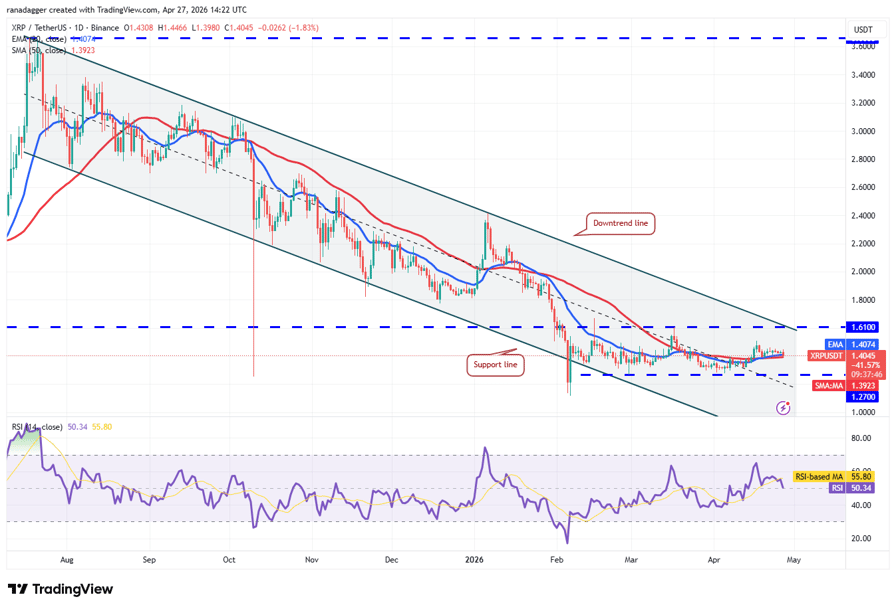
XRP (XRP) remains stuck inside the $1.27 to $1.61 range, indicating buying on dips and selling on rallies.
XRP/USDT daily chart. Source: Cointelegraph/TradingView
The 20-day EMA ($1.40) has started to turn up gradually, and the RSI is near the midpoint, indicating that the bulls have a slight edge. There is minor resistance at $1.51, but if it is crossed, the XRP/USDT pair may reach the downtrend line. A break and close above the downtrend line signals a potential trend change. The pair may then rally to $2.
Sellers are likely to have other plans. They will attempt to pull the XRP price back below the moving averages, retaining the pair inside the range.
BNB price prediction
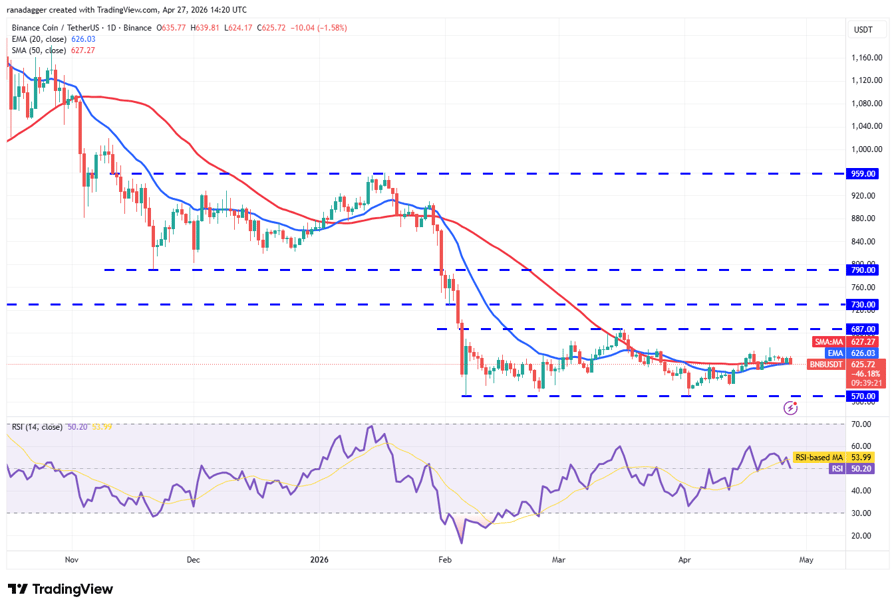
BNB (BNB) is finding support at the moving averages, but the bulls have failed to trigger a strong bounce off them.
BNB/USDT daily chart. Source: Cointelegraph/TradingView
Buyers will need to drive the BNB price above $654 to signal strength. The BNB/USDT pair may then test the $687 resistance level, a critical level to watch. If buyers pierce the $687 level, the pair may jump to $730 and then to $790.
Instead, if the price turns down from the current level or the overhead resistance and breaks below the moving averages, it suggests the pair may remain within the $570 to $687 range for a few more days.
Solana price prediction
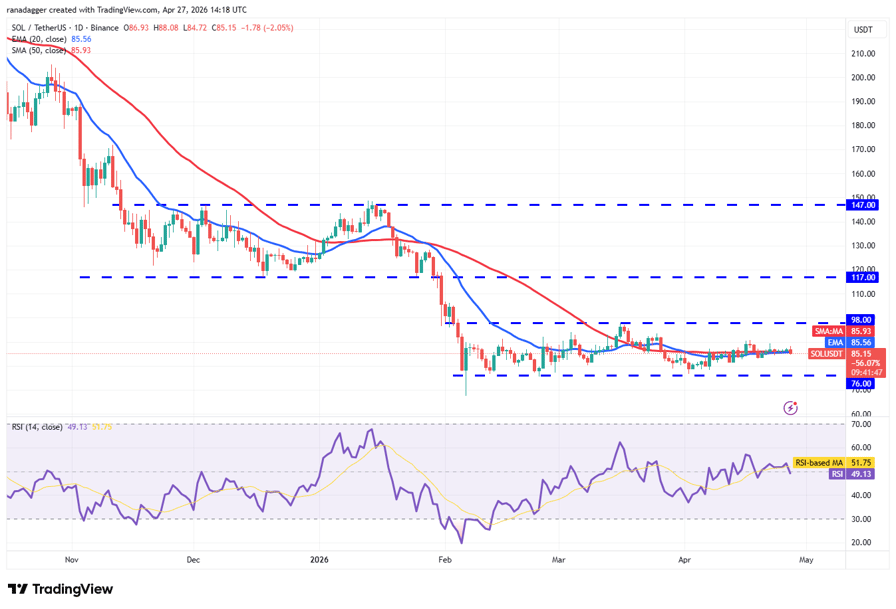
Solana (SOL) continues to trade near the moving averages, indicating a balance between supply and demand.
SOL/USDT daily chart. Source: Cointelegraph/TradingView
There is a minor obstacle at $90.73, but if that level is broken, the SOL/USDT pair may reach the $98 resistance. Sellers are expected to defend the $98 level with all their might, as a close above it opens the doors for a rally to $117.
Alternatively, if the SOL price turns down from the current level or the overhead resistance and breaks below $82.94, it suggests that the bears are attempting to take charge. The pair may then collapse to the $76 support.
Related: First 21-week trend line reclaim since October 2025: Five things to know in Bitcoin this week
Dogecoin price prediction
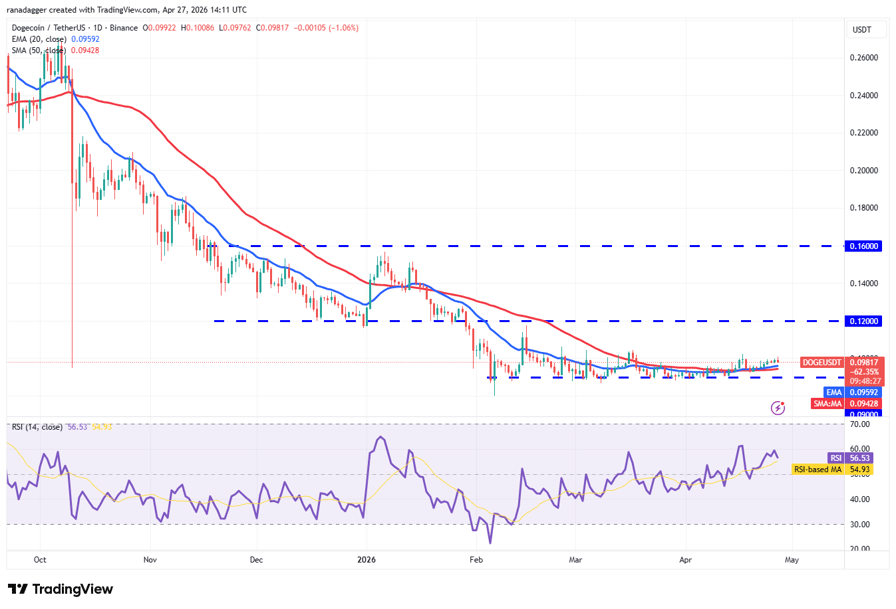
Dogecoin (DOGE) has been gradually moving higher but is expected to face selling in the $0.10 to $0.11 zone.
DOGE/USDT daily chart. Source: Cointelegraph/TradingView
If the DOGE price turns down from the overhead resistance zone, it is expected to find support at the moving averages. A sharp bounce off the moving averages increases the possibility of a rally to the $0.12 level.
Contrarily, if the price turns down and breaks below the moving averages, it signals that the bears remain sellers on rallies. The DOGE/USDT pair risks resuming the downtrend if the $0.09 support breaks down.
Hyperliquid price prediction
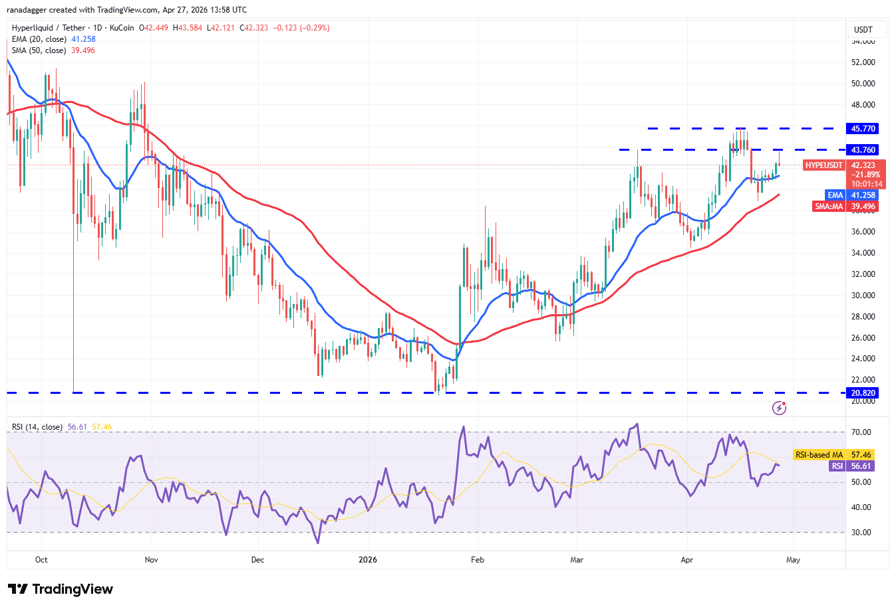
Hyperliquid (HYPE) resumed its northward march after breaking above the $41.88 resistance on Sunday.
HYPE/USDT daily chart. Source: Cointelegraph/TradingView
The uptrend is facing selling pressure in the $43.76 to $45.77 zone, as seen in the long wick on the candlestick. Sellers will attempt to sink the HYPE price below the 20-day EMA ($41.25), opening the door to a drop toward the 50-day SMA ($39.50).
Conversely, if the price rises above the current level or the 20-day EMA and breaks above $45.77, it signals that the bulls remain in control. That may propel the HYPE/USDT pair toward the $50-$51.43 resistance zone.
Cardano price prediction
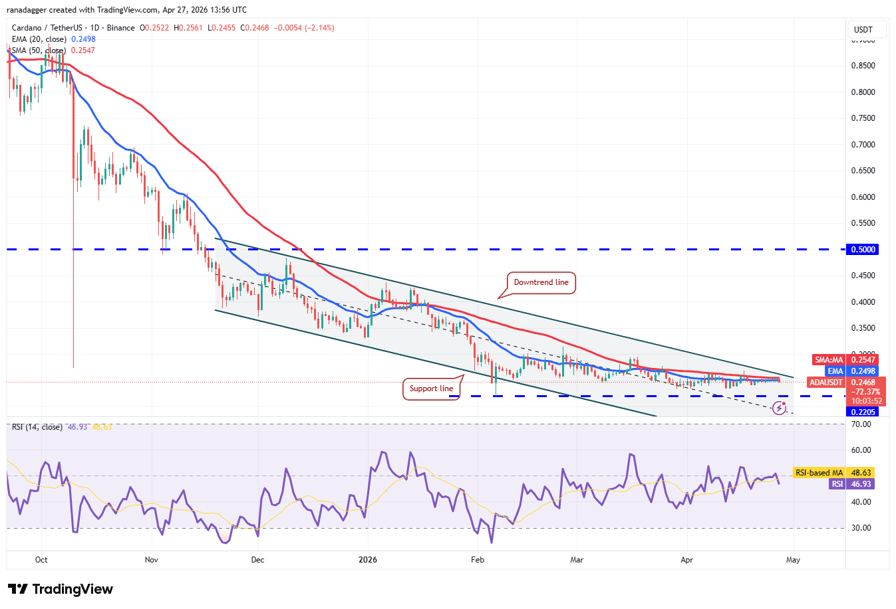
Cardano (ADA) has been clinging to the moving averages for several days, improving the prospects of an upside breakout.
ADA/USDT daily chart. Source: Cointelegraph/TradingView
The downtrend line is the crucial resistance to watch out for as a close above it signals a potential short-term trend change. The ADA/USDT pair may surge to $0.32, then to $0.37.
On the contrary, if the ADA price turns down sharply from the downtrend line, it suggests that the bears are aggressively defending the level. The pair may then slump to the $0.22 support.

TLDR
- MARA Holdings launched a new foundation to strengthen the Bitcoin network resilience.
- CEO Fred Thiel announced the initiative at the Bitcoin Conference in Las Vegas.
- The foundation will focus on addressing quantum computing risks to Bitcoin.
- MARA aims to support a sustainable transaction fee market for long-term security.
- The initiative will fund open source development across scaling and mining tools.
MARA Holdings introduced a new foundation in Las Vegas to strengthen bitcoin’s long-term resilience. CEO Fred Thiel announced the plan during the Bitcoin Conference on Monday. He said the effort will address quantum risks and reinforce the network’s economic model.
MARA Targets Bitcoin Security and Quantum Preparedness
Thiel said Bitcoin remains the most important decentralized system in operation today. However, he warned that the network’s future depends on active stewardship. He stated, “Bitcoin is the most important decentralized system ever created, but its future is not guaranteed.”
He described Bitcoin as a public utility that no single entity controls. Yet he stressed that participants must share responsibility for its survival. He added, “Decentralization doesn’t mean it runs on itself; it means responsibility is distributed.”
The MARA Foundation will focus on protecting Bitcoin’s core properties as sound and durable money. It will support research on emerging threats, including quantum computing. The foundation will also study ways to sustain the network’s security budget.
Thiel said transaction fees must eventually replace declining block rewards. Therefore, the foundation will encourage the development of a sustainable fee market. It will also examine technical measures that strengthen network defense.
MARA Expands Open Source Support and Global Access
MARA confirmed it will fund open source developers working on scaling and mining tools. The company will also back improvements to the user infrastructure. These steps aim to increase network reliability and efficiency.
The foundation will promote self-custody solutions across different regions. It plans to expand multilingual resources for global users. It will also provide technical education programs for developers and operators.
Policy engagement will form another part of the initiative. MARA intends to work with regulators through structured outreach. The company said it will provide educational materials to support informed discussions.
As part of the launch, MARA pledged $100,000 to one nonprofit organization. Three groups will compete for the award through a community vote. The company said this process reflects its commitment to shared ecosystem responsibility.
Thiel reiterated that distributed systems require collective effort. He framed the foundation as a long-term commitment beyond mining operations. He confirmed the initiative will operate independently from MARA’s bitcoin and AI mining units.
The announcement took place during a keynote address at the Bitcoin Conference. MARA did not disclose a fixed annual budget for the foundation. The company confirmed the $100,000 grant marks the first public allocation.
MARA stated that further funding details will follow in later updates. The foundation will begin operations immediately after the conference. Community voting for the nonprofit award will open in the coming weeks.



Stablecoins have “quietly become core financial plumbing” and pushed on‑chain finance past a “point of no return,” according to a new a16z crypto framework that recasts programmable dollars as the base layer for a multi‑chain, banking‑as‑a‑service stack and a coming wave of on‑chain credit.
Summary
- a16z crypto’s report, “The New Stack of Global Finance: The Stablecoin Edition,” argues that stablecoins have evolved from niche trading tools into a global settlement layer and “banking‑as‑a‑service” stack for programmable dollars.
- The paper slices today’s chains into general‑purpose, payment‑specific, and institutional networks, all increasingly tethered by stablecoins as the common settlement asset, from consumer wallets to permissioned bank rails.
- a16z says payments are only “the first act,” predicting large‑scale stablecoin issuance will support a parallel on‑chain credit system and extend US dollar reach into emerging markets via any internet‑connected wallet.
Stablecoins have quietly become core financial plumbing and pushed on-chain finance past the “point of no return,” according to a new framework report from a16z crypto. Titled “The New Stack of Global Finance: The Stablecoin Edition,” the analysis argues that what started as a niche trading tool has morphed into a global settlement layer and a new kind of “banking as a service” stack that is already reshaping how money moves.
In the report, a16z crypto writes that stablecoins have evolved into “fundamental financial pipelines,” with programmable dollars now embedded in consumer apps, fintech platforms, and institutional workflows. The firm describes a new BaaS model in which on-chain issuers and infrastructure providers offer “instant, API‑native balance sheet services” that sit beneath wallets, exchanges, neobanks, and even traditional institutions.
“The transition to on-chain finance has crossed the point of no return,” the authors conclude, arguing that even if prices correct, the underlying rails will continue to scale in volume and sophistication.
The report slices today’s blockchain landscape into three core categories: general-purpose chains like Ethereum, Solana, and layer‑2 networks; payment‑specific chains such as Stripe’s Tempo; and institutional networks like Canton, which target regulated participants and permissioned workflows.
Each category, a16z says, is increasingly tethered together by stablecoins that act as the common settlement asset, whether the end user is a retail gamer or a global bank.
On the banking side, a16z pushes back on the idea that regulatory bottlenecks are still insurmountable. “The bottlenecks in the banking industry are easing,” the report notes, pointing to a growing roster of crypto‑friendly banks actively wiring on‑chain infrastructure into fiat payment systems.
At the same time, the competitive frontier for issuers has shifted from raw market share to regulatory positioning, with leading stablecoin firms “vying to obtain OCC national trust charters” and other licenses that would anchor them more firmly inside the U.S. banking perimeter.
Crucially, the paper frames payments as only “the first act.” The more important “second act,” in a16z’s view, will be credit.
“The large‑scale issuance of stablecoins will give rise to a new on‑chain credit market, allowing capital to form outside the traditional banking system,” the report says, predicting that on‑chain collateral, reputation systems, and programmable covenants will underpin a parallel credit stack layered on top of stablecoin rails.
Finally, the authors stress that this is not just a crypto story, but a geopolitical one.
Stablecoins, they argue, “enhance the dominance of the dollar” by exporting dollar access into any app or wallet with an internet connection, while simultaneously giving emerging‑market users a more direct, censorship‑resistant channel into the U.S. currency than their domestic banking systems typically provide.
TLDR
- DeFi United has raised more than 132,000 ETH, valued at over $300 million, to address losses from the Kelp DAO exploit.
- Consensys and Ethereum co-founder Joseph Lubin pledged 30,000 ETH to support the coordinated recovery effort.
- Circle Ventures confirmed it is purchasing AAVE tokens to help stabilize the protocol after the exploit.
- The exploit involved unbacked rsETH minted through a compromised LayerZero bridge and used as collateral on Aave.
- Aave service providers proposed allocating 25,000 ETH from the DAO treasury to support the recovery plan.
DeFi United has secured more than 132,000 ETH valued at over $300 million to address losses from the Kelp DAO exploit. Consensys and Ethereum co-founder Joseph Lubin pledged 30,000 ETH to support the recovery. Circle Ventures also confirmed AAVE token purchases to reduce pressure on the lending protocol.
DeFi Coalition Accelerates Funding Drive
Circle Ventures announced it is buying AAVE tokens to support market stability. The firm stated, “Strong DeFi infrastructure does not build itself.” It added that Aave helps shape onchain finance and supports its broader community.
At the same time, Consensys and Joseph Lubin committed 30,000 ETH to the coordinated recovery plan. Aave confirmed the pledge on Monday and credited the contribution for accelerating progress. It said, “The recovery would not be progressing as it is without them.”
Consensys-backed treasury firm Sharplink will also provide strategic advice to the initiative. The combined effort has now raised more than 132,000 ETH. That amount equals over $300 million at current market prices.
Aave and Partners Target rsETH Shortfall
The exploit occurred after an attacker minted unbacked rsETH through a compromised LayerZero bridge. The attacker then used the tokens as collateral on Aave to borrow assets. This sequence left Aave with bad debt tied to the unbacked rsETH.
DeFi United directs contributions to close the remaining shortfall linked to rsETH. Last week, Aave service providers proposed allocating 25,000 ETH from the protocol’s DAO. That allocation equals nearly $58 million based on recent prices.
As of Monday, the broader effort had raised roughly $235 million worth of Ethereum before the latest pledges. Lido DAO proposed contributing up to 2,500 ETH to the plan. Ether.fi also proposed up to 5,000 ETH to support the recovery.
Kelp DAO pledged 2,000 ETH to help restore rsETH backing. Dozens of individuals have also transferred smaller amounts of ETH and stablecoins. X user DCF GOD estimated that the funding gap had already been filled if all proposals passed.
Data from The Block shows total value locked across DeFi protocols stands at nearly $82 billion. That figure reflects a decline of over 25% from $110 billion at the start of the year.
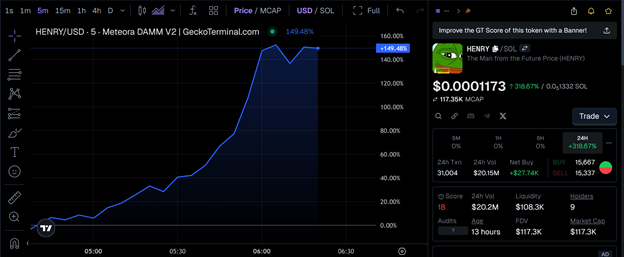
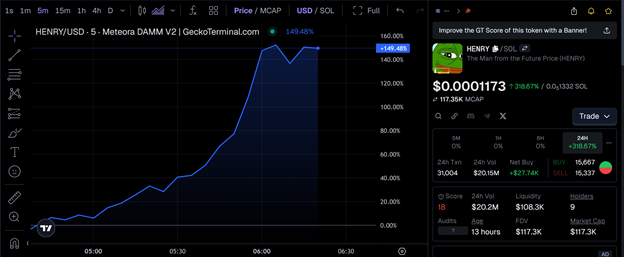
Henry ($HENRY), an Ethereum-based meme coin, rallied nearly 320% on Monday. A viral 2023 post appeared to predict the alleged White House shooter’s name, fueling “time travel Pepe” speculation.
Wallet trackers show the token’s market cap is somewhere between $500,000 and $1.8 million. Extreme volatility persisted throughout the session.
White House Shooter Conspiracy Sparks Pepe Frenzy
On April 25, 2026, a gunman identified as Cole Tomas Allen, 31, rushed a Secret Service checkpoint. The incident happened at the Washington Hilton during the White House Correspondents’ Dinner.
One agent was struck in his protective vest before Allen was subdued and arrested.
Within hours, online sleuths resurfaced a single dormant X (Twitter) post from December 2023 by the account @HenryMa79561893.
The post contained only the text “Cole Allen” alongside a glitchy collage. The image featured Pepe the Frog and US President Trump at a formal dinner.
The official Pepe (PEPE) account on X quote-tweeted the post on April 26 with the caption “time travel pepe.” That endorsement drew hundreds of thousands of views and routed speculators toward meme coin plays tied to the prophecy theme.
On-chain observers noted the $HENRY contract had been deployed roughly 342 days earlier. The token was repurposed around the Henry Martinez narrative just before the rally.
Some traders called the rebrand a fake-OG move, while others defended it as the original deployment. HENRY meme coin rallied by almost 320% on this news, and was trading for $0.0001173 as of this writing.
Copycat HENRY tokens have also surfaced on Solana, with most traders treating the Ethereum version as the original prophecy.
It is worth noting that the rally may not hold, as such momentum often depends on continued attention from the broader community.
However, fresh details about Allen could further invigorate volatility, potentially undermining the durability of the time-travel narrative.
The post Meme Coin Based on White House Shooter Conspiracy Rallies 320% appeared first on BeInCrypto.
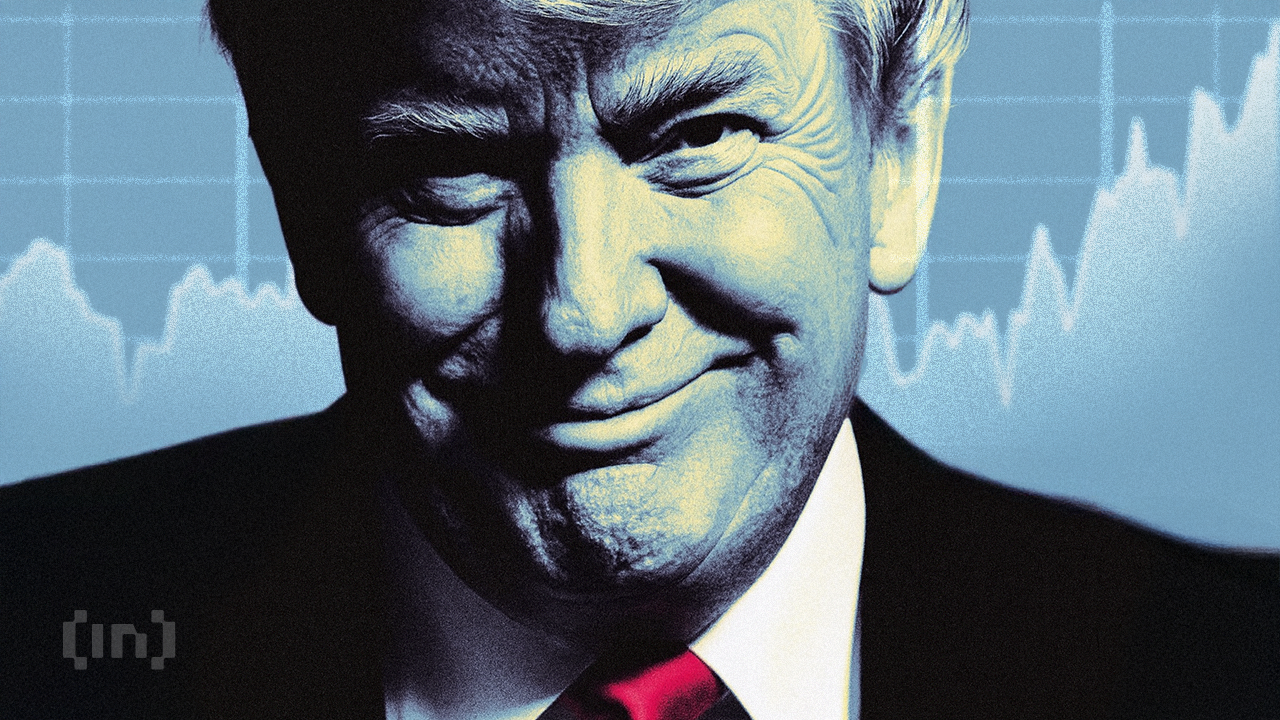
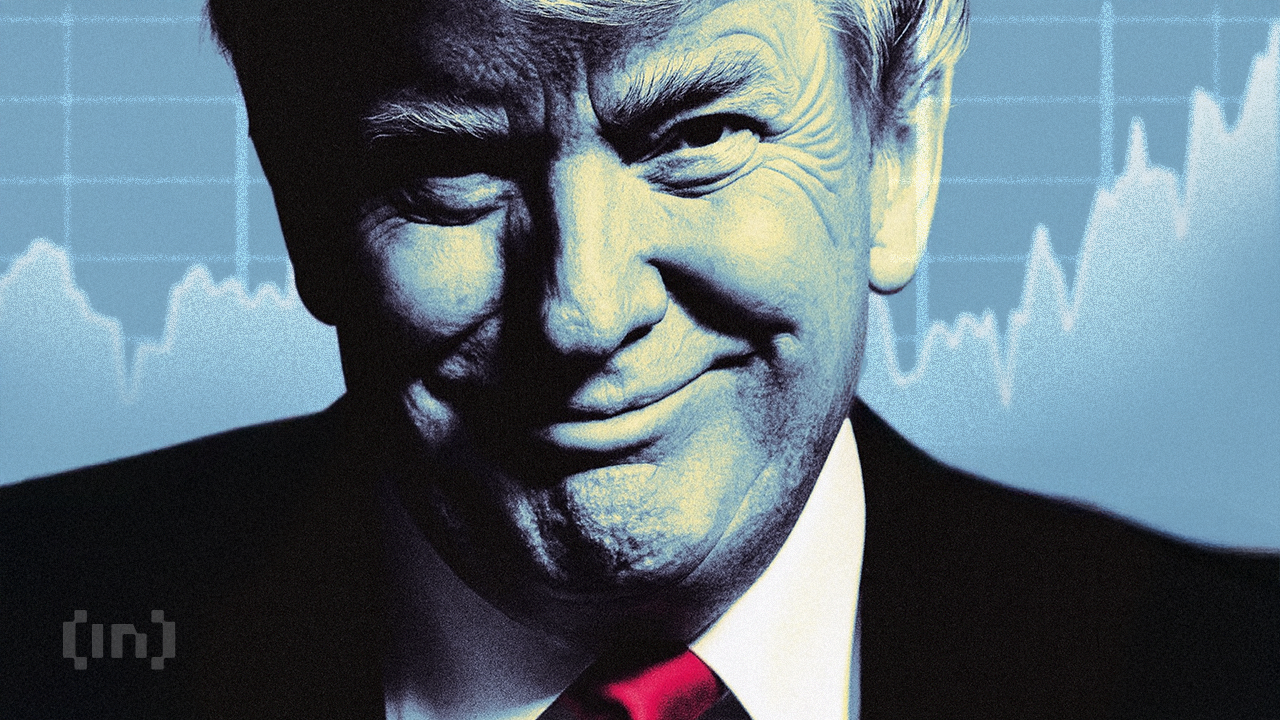
President Donald Trump bought up to $161 million in bonds during March 2026. The disclosure came in a Periodic Transaction Report released by the US Office of Government Ethics.
The filing arrives days before the Federal Open Market Committee meets to decide on interest rates. The vote could move bond prices broadly across the market.
Filing Shows Heavy Bond Buying Across Sectors
The filing lists 175 transactions, with 164 purchases and 11 sales. Trump’s report uses value brackets rather than exact dollar amounts. The bond purchases total at least $51 million at the low end of those ranges.
Many of the largest trades fell into the $1 million to $5 million bracket. Most of those positions were municipal bonds or US Treasuries. The combined upper-end value across all transactions reaches about $161 million.
The buys also covered corporate debt from Nvidia, Microsoft, Goldman Sachs, and Boeing. Other issuers named in the filing include Citigroup, Netflix, General Motors, Broadcom, and Meta.
The disclosure also lists a high-yield bond exchange-traded fund.
Fed Rate Decision Could Move Bond Prices
The Federal Open Market Committee begins its two-day meeting on Tuesday. The committee releases its rate decision on Wednesday at 2 p.m. Eastern.
The Fed last cut its benchmark rate by 25 basis points in December, its third reduction of 2025.
Treasury yields fell after that decision, and bond prices rose across the market. The 10-year yield dropped more than three basis points immediately afterward.
A second cut would likely produce a similar response, since bond prices generally move inversely to interest rates. Markets will watch Wednesday’s vote for guidance on whether the bond rally has further room to extend.
The post Trump Bought Millions in Treasury Bonds Days Before Fed Rate Cut Decision appeared first on BeInCrypto.
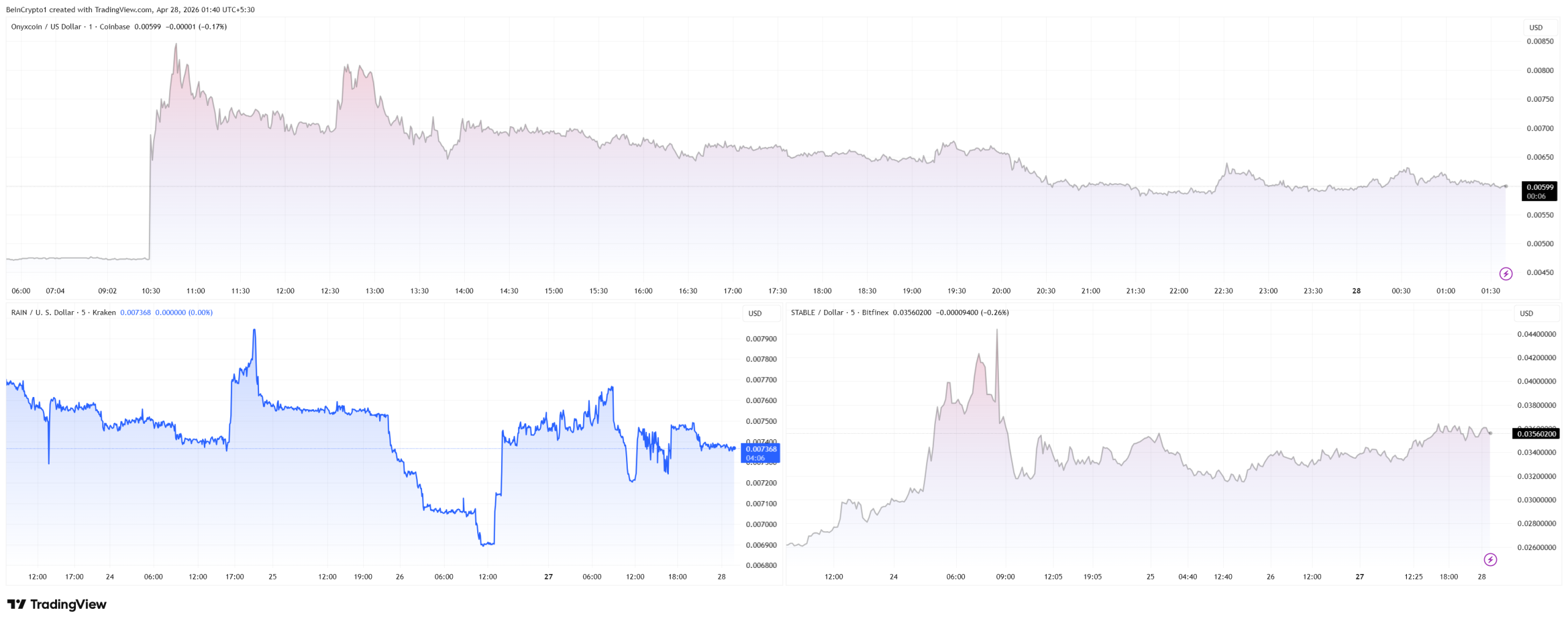
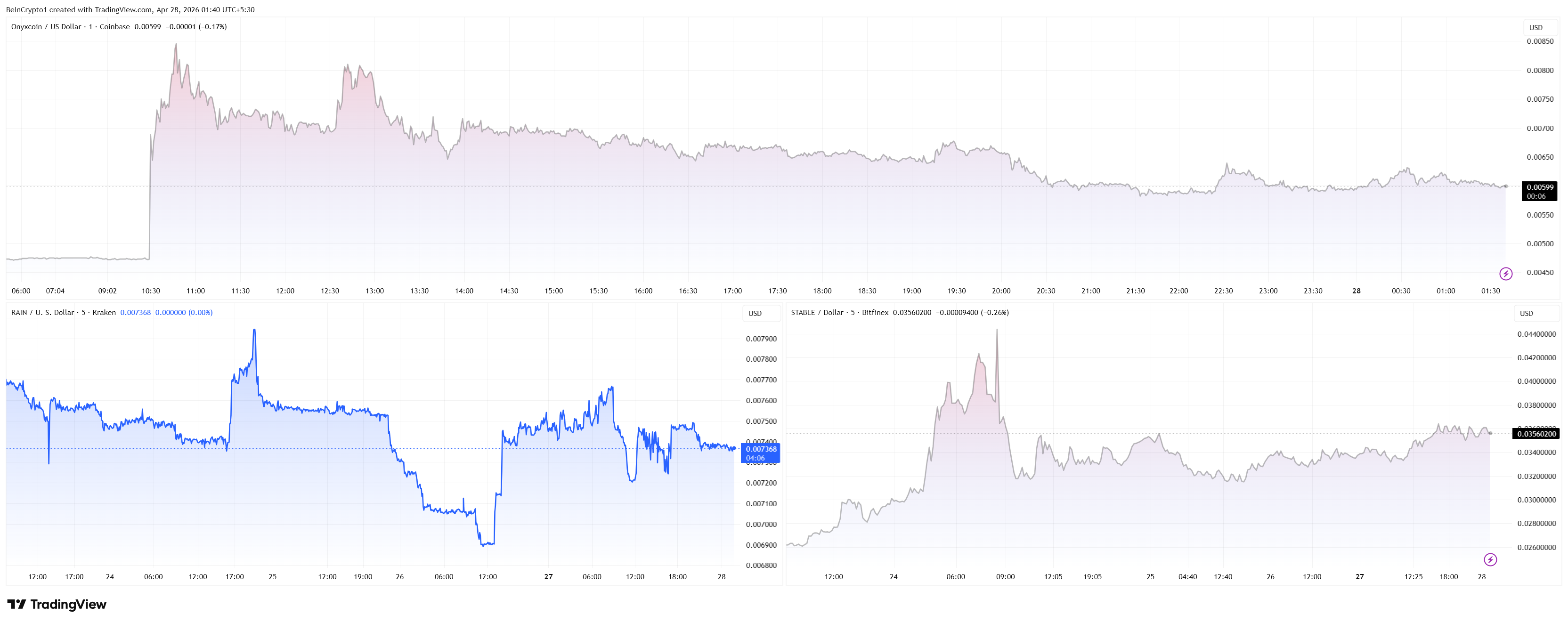
Three altcoins entered the final week of April 2026 at sharply different technical inflection points. Onyxcoin (XCN) printed a 47% daily gain while Rain (RAIN) and STABLE held their Fibonacci structures.
The three setups span a breakout retest, a neutral consolidation, and a healthy pullback. Each chart prints distinct signals on the daily timeframe heading into May.
Onyxcoin (XCN) Surges to Lead Altcoins in Final Week of April
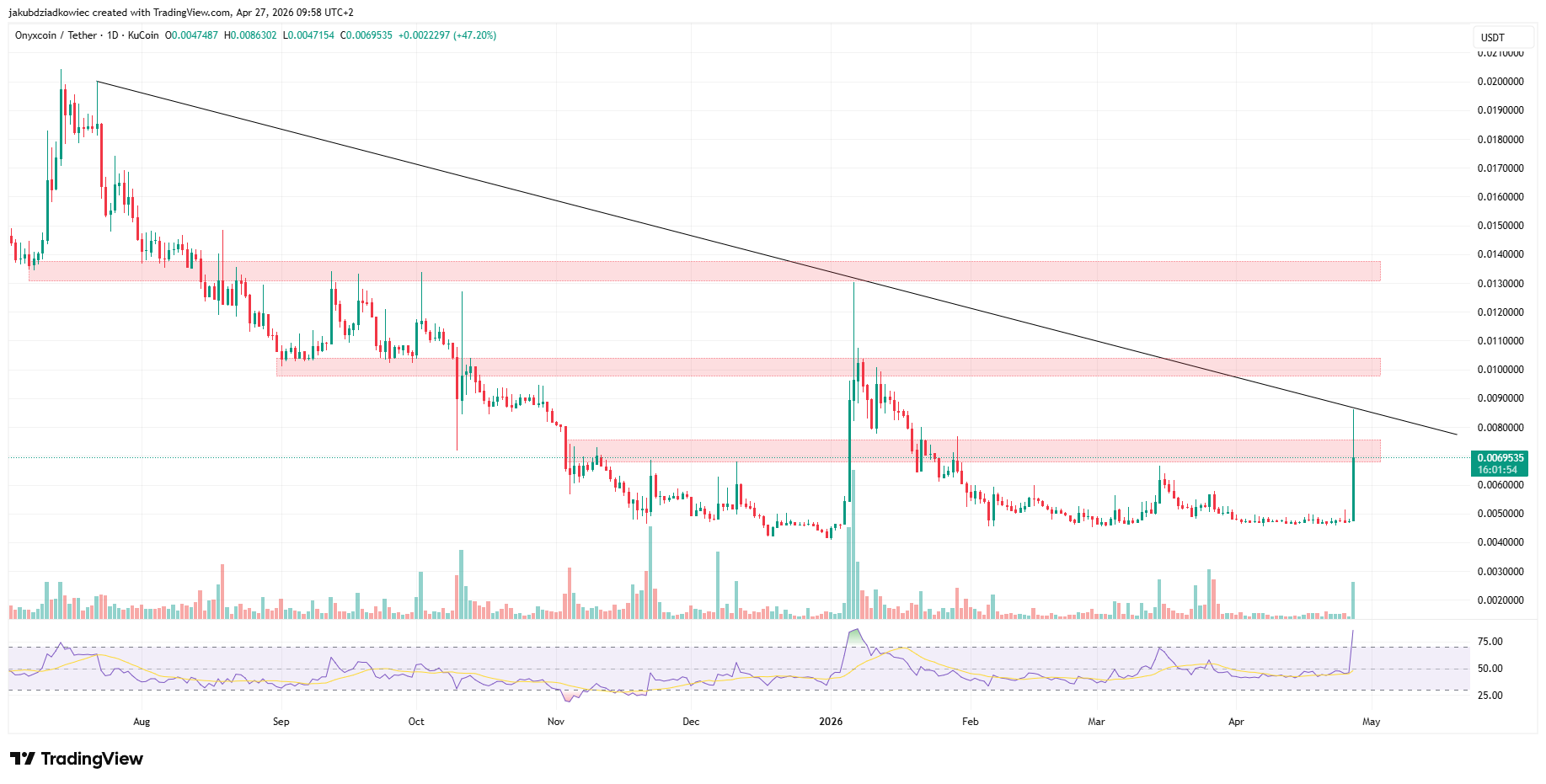
Onyxcoin (XCN) led the group on April 27 with a 47.20% daily gain. Price pushed to $0.0086 intraday, its highest level since mid-January. XCN has since pulled back to $0.0069, retesting the resistance zone between $0.0068 and $0.0075.
The Upbit listing provided the catalyst, but the daily structure still looks fragile. The price remains below a descending trendline that dates back to July 2025. Overhead resistance at $0.010 and $0.013 caps any sustained breakout attempt.
The Relative Strength Index (RSI) broke out sharply to the upside, suggesting momentum favors the bulls. However, volume on the breakout candle came in below the prior demand spikes from March 26 and January 6.
If XCN fails to reclaim the $0.0068 to $0.0075 zone as support, the rally may be short-lived. A clean daily close above the descending trendline would shift the structure and open a path toward $0.010.
Rain (RAIN) Sits Between Fibonacci 0.382 and 0.5 as Volume Dries Up
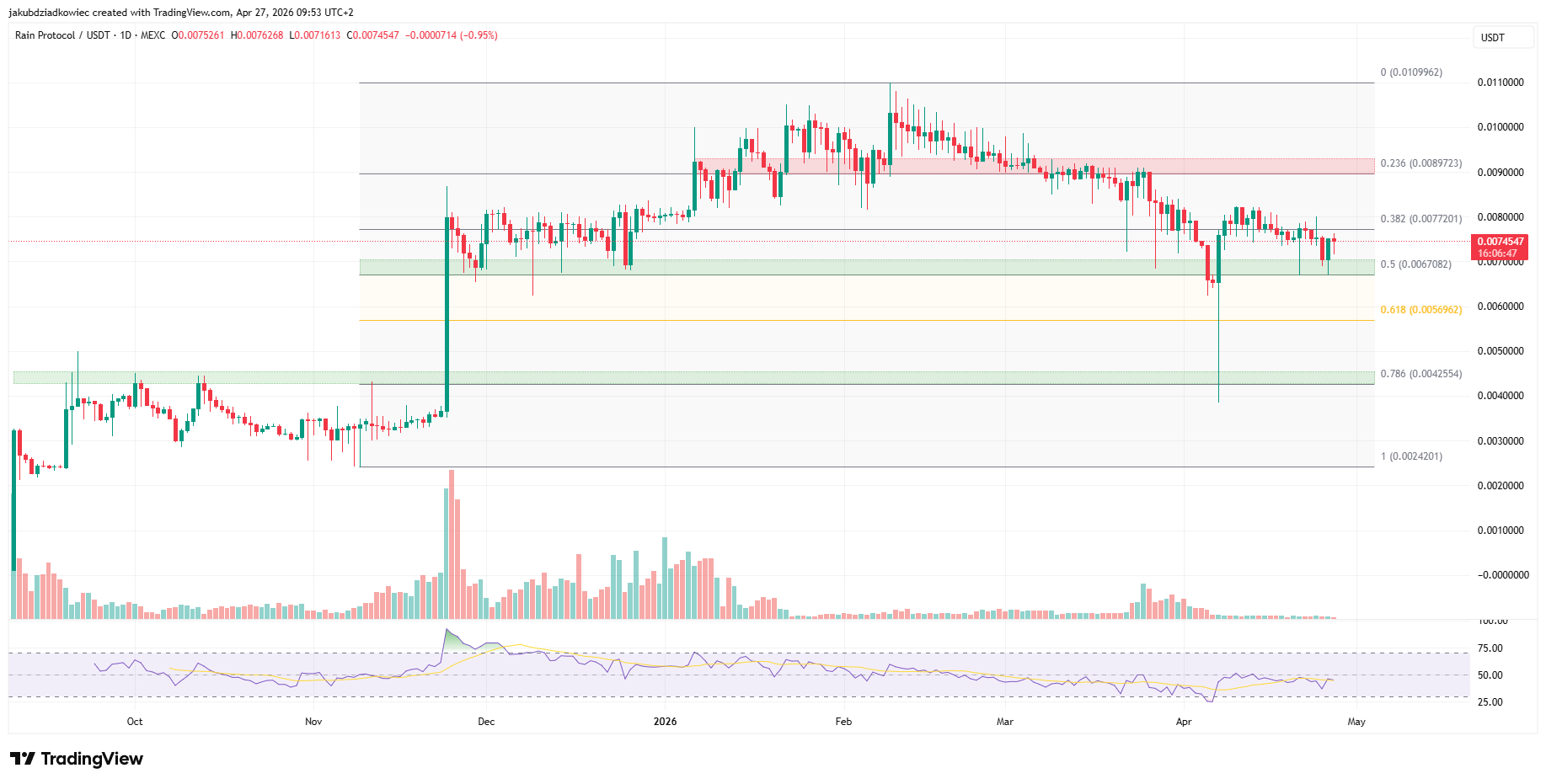
Rain (RAIN) trades at $0.00745 on the daily chart. The token sits between the 0.382 Fibonacci retracement at $0.0077 and the 0.5 retracement at $0.0067. The grid runs from the November 9, 2025, low of $0.0024 to the February 9, 2026, high of $0.011.
The 0.5 level has acted as the first line of support for several weeks. Price has repeatedly tested the area, only to bounce. RSI sits at roughly 46, a neutral reading, and daily volume has compressed to the lowest range of the year. Neither buyers nor sellers are pressing the tape.
A deeper correction would target the 0.786 Fibonacci at $0.0042, the next major demand zone visible on the chart. To the upside, the 0.236 Fibonacci at $0.009 marks the first resistance. That level would be the immediate target if buyers step back in.
The setup is binary. Continued absence of volume keeps RAIN coiling between Fibonacci levels. The breakout direction will likely come from a broader altcoin rotation rather than token-specific demand.
STABLE Holds Higher Highs After Tagging W-Pattern Target
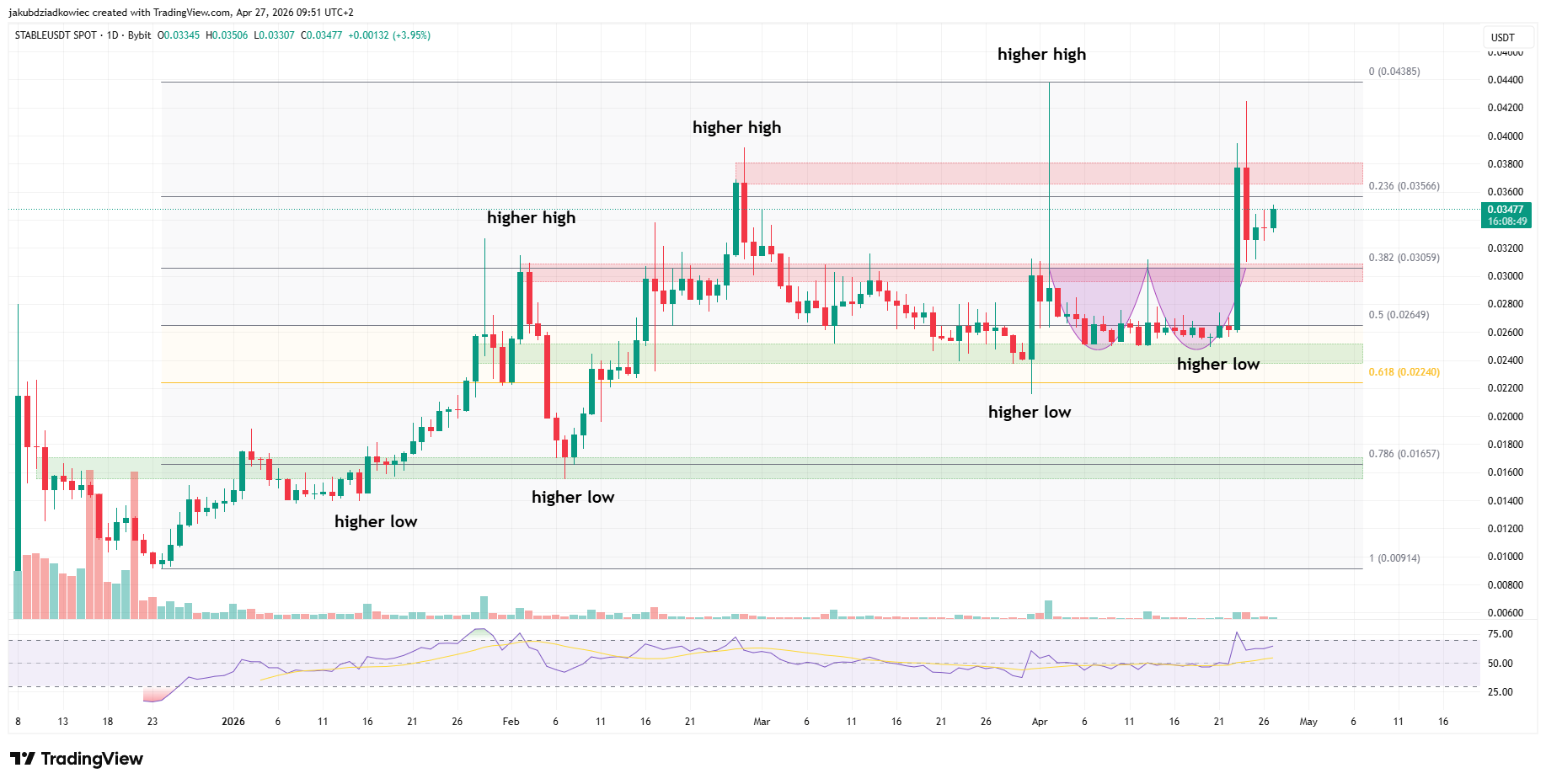
STABLE was the cleanest technical structure of the three. Price hit the W-pattern target from the prior BeInCrypto analysis on April 23. The token then tagged resistance at $0.037 and corrected to the 0.382 Fibonacci at $0.0306 before bouncing.
The daily chart continues to print higher highs and higher lows, the textbook signature of a healthy uptrend. RSI sits at approximately 65, just below the overbought threshold. Price trades at $0.03477 with a 3.95% daily gain.
The next test sits at $0.037, the same level that capped the prior leg up. A daily close above this band, which extends to $0.038, would confirm continuation. The break would likely open a path toward $0.04385, the swing high marked on the Fibonacci grid.
Volume has been declining through the bounce, which signals weakening momentum even as price advances. The structure looks intact. A failure to break $0.037 with conviction would set up another retest of the 0.382 Fibonacci at $0.0306. STABLE remains one of the more constructive altcoins of the cycle on the daily timeframe.
The post 3 Altcoins to Watch in Final Week of April With Onyxcoin Up 30% appeared first on BeInCrypto.
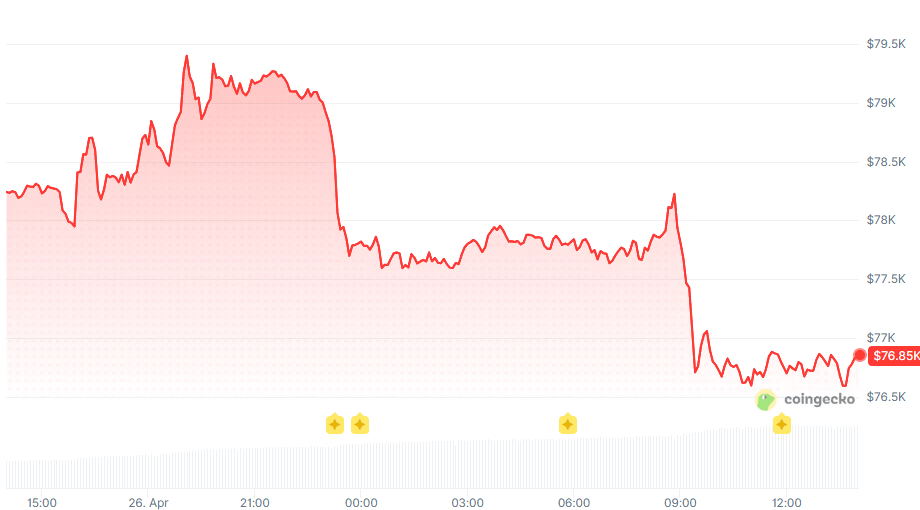
Crude oil jumped as Trump called off Iran peace talks, dragging BTC back below $77,000 and triggering $288 million in long liquidations.
Bitcoin failed at the $80,000 level for the third time this month on Monday, briefly tagging $79,500 before reversing sharply, as a renewed move higher in oil prices amid stalling U.S.-Iran peace talks pushed risk assets into the red ahead of this week’s FOMC decision.
BTC last changed hands at around $76,800 per CoinGecko, down 1.8% over the past 24 hours but still up 1.2% on the week. Ether (ETH) led losses among the majors, falling 3.3% to $2,287. Meanwhile, SOL traded near $84, down 3%, XRP at $1.39, down 2.8%, and BNB at $623, down 2%.

Total crypto liquidations reached $435 million over the past 24 hours, according to CoinGlass, with more than 108,000 traders liquidated.
Stalled Peace Talks
President Donald Trump on Sunday called off a planned Pakistan trip by two senior U.S. negotiators, stalling a fresh round of peace talks even as Iran reportedly sent Washington a new proposal over the weekend. The Strait of Hormuz remains under a U.S. naval blockade.
The risk-off backdrop is unfolding two days before the April 28-29 FOMC meeting. CME FedWatch puts the odds of a rate hold at 100%, with the federal funds rate expected to remain in the 3.50-3.75% range. April carries no fresh dot plot or Summary of Economic Projections, leaving Chair Jerome Powell’s tone the focal point for traders. The Bureau of Economic Analysis releases its advance Q1 GDP estimate on Thursday, with PCE and the Employment Cost Index expected the same morning.
ETFs
U.S. spot Bitcoin ETFs pulled in $823.7 million in net inflows during the week ending April 24, the fourth consecutive positive week, per SoSoValue. April month-to-date inflows now exceed $2.4 billion, nearly double March’s total. Total BTC ETF AUM stood at $102.64 billion as of Friday, with the products holding 1,322,094 BTC, or roughly 6.3% of the circulating supply.
Spot Ether ETFs added $155 million for the week, their third consecutive positive week, while spot Solana ETFs added $9.4 million and spot XRP ETFs added $15.7 million.
Elsewhere
Strategy disclosed its fourth consecutive weekly Bitcoin purchase, adding 3,273 BTC for $255 million at an average price of $77,906, with the latest fill now sitting roughly 1.4% above spot. Total holdings stand at 818,334 BTC, acquired for roughly $61.81 billion at an average cost basis of $75,537, with chairman Michael Saylor citing a 9.6% year-to-date BTC yield. The buy follows last week’s $2.54 billion accumulation of 34,164 BTC, the firm’s largest since 2024.
In DeFi, Aave founder Stani Kulechov said the DeFi United recovery fund has reached the level needed to fully re-collateralize rsETH following the April 18 KelpDAO bridge exploit, subject to pending governance votes. Consensys and Ethereum co-founder Joe Lubin committed up to 30,000 ETH, while the Solana Foundation said it would lend USDT on Aave for the first time.
Outlook
With oil at multi-week highs, and four mega-cap tech names (Microsoft, Alphabet, Meta, Amazon) reporting Wednesday evening after the FOMC decision, the path of least resistance for crypto this week runs through the macro tape rather than crypto-native catalysts.
Crypto World
Western Union (WU) gears up stablecoin launch to settle global transactions without SWIFT


Western Union (WU) is preparing to roll out a stablecoin strategy that could reshape how the 175-year-old money-transfer company settles payments across its global network.
CEO Devin McGranahan said on the company’s first-quarter earnings call that Western Union’s U.S. dollar stablecoin (USDPT) is in the final stages of readiness and is expected to launch next month. The firm announced in October that the digital dollar will run on Solana (SOL) and will be issued with federally chartered crypto bank Anchorage Digital.
Western Union plans to use the stablecoin first as an alternative to the interbank settlement rails it uses today to move money between the company and its agents.
“We are not originally launching [USDPT] as consumer-facing,” McGranahan said. “We are launching it as an alternative to the interbank SWIFT settlement network that we use today.”
That matters, he said, because Western Union’s business still depends on legacy banking systems that settle only on business days and can take two or three days in some markets. Stablecoins could allow the company to settle with partners in real time, including over weekends and holidays, while reducing capital tied up in the system, he added.
The second piece of the company’s strategy is the Digital Asset Network (DAN), which lets crypto wallet companies offer Western Union as a cash-out option. Through that network, wallet users will be able to convert digital assets into local currency through Western Union’s retail footprint, McGranahan said.
The company said its partner pipeline represents tens of millions of crypto wallets globally.
Western Union also plans to launch a Stable Card, expected later this year. It will let customers hold funds in stablecoins and spend through card networks. McGranahan said the card could be useful in inflation-sensitive markets where customers want access to U.S. dollar-denominated value with everyday spending utility.
“We expect to begin rolling this out across dozens of markets with an initial wave targeted for later this year,” he said.
Western Union’s stablecoin push comes as its core remittance business faces pressure, with rival fintechs and crypto payments firms increasingly using blockchain tech for cross-border payments. MoneyGram, for example, is looking to Circle’s USDC stablecoin, while Stripe launched its own stablecoin infrastructure with a payments-focused chain Tempo.
Read more: DoorDash is bringing stablecoin payments to masses with Stripe-backed blockchain

Drax board avoid their own AGM, accused of greenwashing & environmental racism

TOI Exclusive | Sabastian Sawe’s London blitz makes us marathoners believe limits are meant to be pushed: Sawan Barwal | More sports News

Dirac Spaces Brings Immersive Car Audio and Spatial Sound to Vehicles

Manchester United reach agreement with Casemiro over contract clause amid transfer speculation

US brings back mandatory military draft registration

Steven Gerrard disagrees with Gary Neville over ‘shock’ Chelsea and Arsenal claim | Football


-

 Fashion3 days ago
Weekend Open Thread – Corporette.com
-
Crypto World2 days ago
Hyperliquid $HYPE Rally Builds Momentum as AI Sector Enters Prove-It Phase
-

 Tech4 hours ago
Register Renaming | Hackaday
-

 Politics5 days ago
Making troops accountable for war crimes threatens US alliance, ex-SAS colonel warns
-

 Politics5 days ago
Disabled people challenge government SEND proposals over segregation concerns
-

 Business4 days ago
Patterson-UTI Energy, Inc. (PTEN) Q1 2026 Earnings Call Transcript
-

 Business5 days ago
Rolls-Royce Voted UK’s Most Iconic Trade Mark as IPO Register Hits 150
-
 Crypto World6 days ago
Five Value Stocks with Recovery Potential in 2026: PayPal (PYPL), Nike (NKE), and More
-
 Sports1 day ago
IPL 2026: Ruturaj Gaikwad registers slowest fifty of the season, enters all-time unwanted list | Cricket News
-

 Politics5 days ago
Starmer handler McSweeney to be dragged from shadows by Foreign Affairs Committee
-

 Politics5 days ago
Zack Polanski responds to home secretary’s taser threat
-
Politics5 days ago
Wings Over Scotland | How To Get Away With Crimes
-

 Crypto World6 days ago
New York sues Coinbase, Gemini over prediction market offerings
-
Entertainment6 days ago
Sydney Sweeney cameo cut from “The Devil Wears Prada 2”, source explains why (exclusive)
-
 Business6 days ago
HCL Tech share price tank over 9% after weak Q4. JPMorgan, HSBC & 3 others cut target price
-

 Politics5 days ago
‘Iran is still a nuclear threat’
-

 Crypto World6 days ago
Crypto’s great hope in Senate’s Clarity Act still has a path to survive tight calendar
-
 Sports5 days ago
Tim Bradley names the current best in the world: “Better than Inoue and Usyk”
-

 NewsBeat2 days ago
LK Bennett closes all stores after entering administration
-

 Fashion6 days ago
Kilkenny Design New Beauty Arrivals for Spring 2026
You must be logged in to post a comment Login