
Crypto World
Rebound or Trap at the Channel Mid-Line? (Bitcoin Price Prediction)

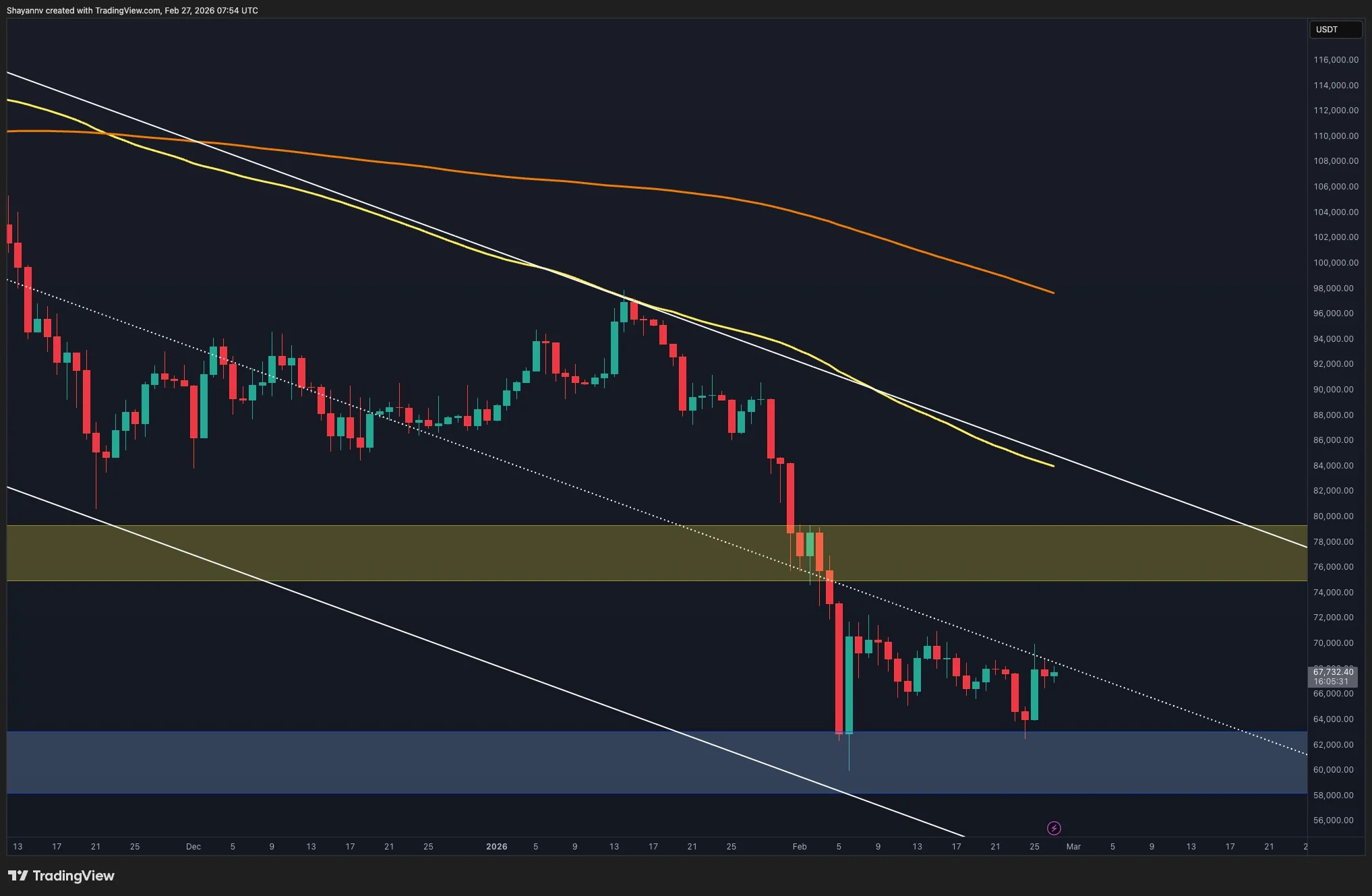
After weeks of aggressive selling pressure and a sharp liquidation cascade toward the $60K region, Bitcoin is now attempting to stabilize. The recent rebound from the $62K area has pushed the price back toward a technically critical level: the channel’s mid-boundary. This level has repeatedly acted as dynamic resistance throughout the downtrend, making the current reaction highly important for the short-term direction.
Bitcoin Price Analysis: The Daily Chart
On the daily timeframe, the bounce from $62K was technically clean. That zone acted as a strong demand and absorbed the aggressive selling pressure that triggered the previous flush. However, as the price approaches the channel’s mid-line, upside momentum is beginning to compress. The market is no longer impulsive — it is hesitating. Historically, this level has rejected multiple times, and until it is reclaimed on a daily closing basis, the broader structure remains corrective rather than bullish.
If Bitcoin can secure a strong daily close above this mid-boundary with follow-through buying, the structure shifts. In that case, the next logical magnet sits in the $75K–$80K supply region. That area contains prior distribution and would likely be the next test of strength. On the other hand, if price fails here and loses the $66K–$67K short-term support region, the market risks rotating back toward $62K. A breakdown below that level would reopen the path toward the lower boundary of the channel and confirm continuation of the larger downtrend.
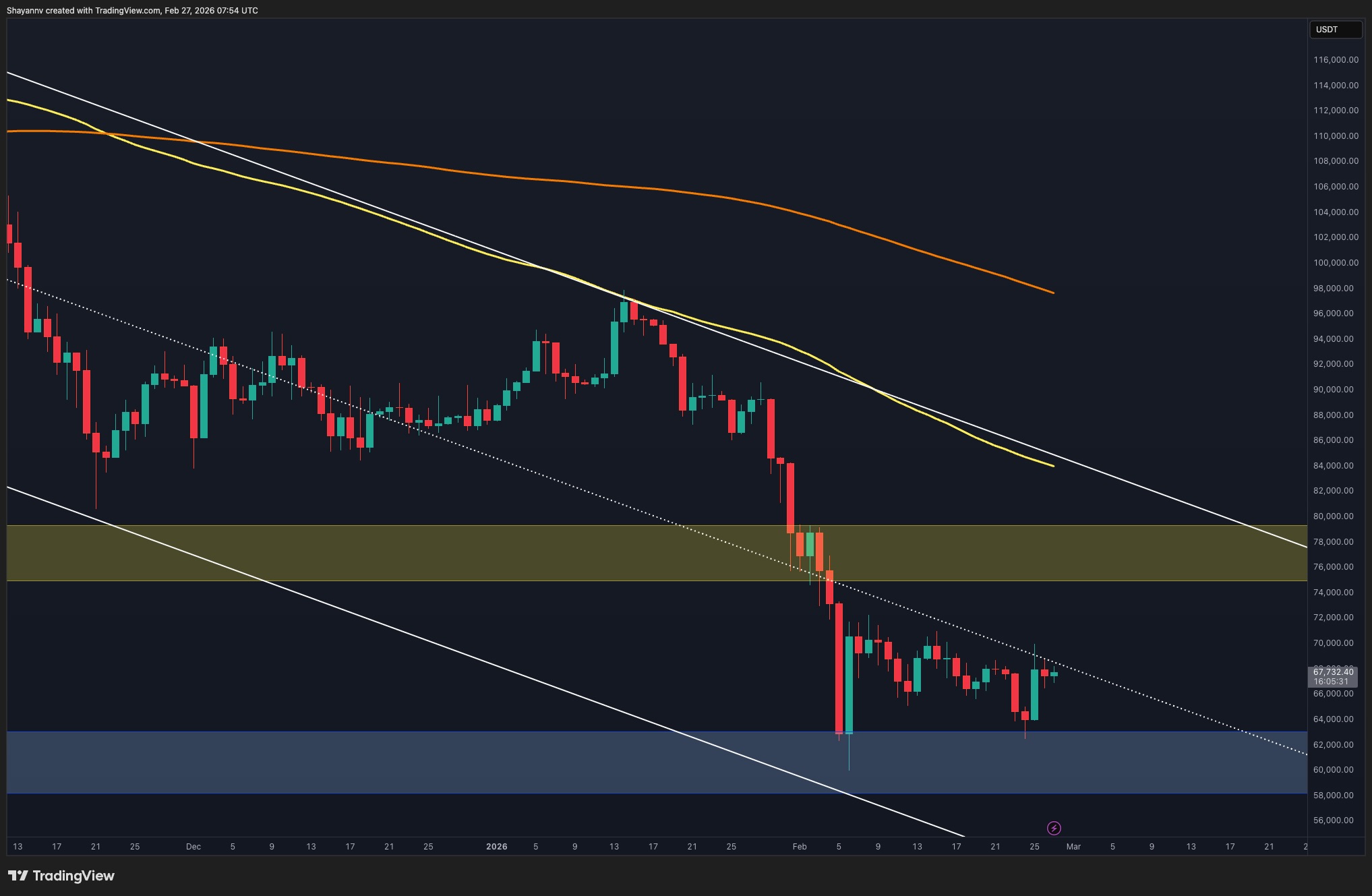
BTC/USDT 4-Hour Chart
On the 4-hour chart, the structure is more constructive. The recent breakout above the triangle formation at $67K signaled short-term bullish pressure returning to the market. That breakout shifted momentum, but price is now compressing between the broken triangle trendline below and the channel mid-line of $70K. This creates a short-term decision range.
A controlled pullback toward the broken triangle resistance-turned-support would be technically healthy and could provide the base for another push higher. If that support holds, continuation toward $70K becomes increasingly probable. However, losing that level would invalidate the breakout and suggest the move was merely a relief rally.

Sentiment Analysis
From a liquidity perspective, the Binance BTC/USDT liquidation heatmap shows a notable cluster of short liquidations building above $70K. This area stands out clearly as a leverage pocket. Liquidity tends to act as a magnet, especially when positioned above price during a recovery phase. If Bitcoin manages to break above the channel mid-line and build acceptance, a move into that $70K region could trigger a short squeeze, accelerating upside volatility as overleveraged shorts are forced to close.
Overall, Bitcoin is in a transitional phase. The short-term structure has improved, momentum is stabilizing, and liquidity sits overhead. Yet the daily chart still shows price trapped beneath a major dynamic resistance within a broader descending channel. Until that level is decisively reclaimed, the larger structure remains fragile.
The next daily close around the channel mid-boundary will likely determine whether this rebound evolves into a squeeze toward $70K and beyond, or whether it becomes another rejection that pulls price back toward $62K and reactivates the dominant downtrend.

Binance Free $600 (CryptoPotato Exclusive): Use this link to register a new account and receive $600 exclusive welcome offer on Binance (full details).
LIMITED OFFER for CryptoPotato readers at Bybit: Use this link to register and open a $500 FREE position on any coin!
Disclaimer: Information found on CryptoPotato is those of writers quoted. It does not represent the opinions of CryptoPotato on whether to buy, sell, or hold any investments. You are advised to conduct your own research before making any investment decisions. Use provided information at your own risk. See Disclaimer for more information.


How farming turned into a parallel economy—and why it’s starting to crack
There was a time when airdrops were simple: use a protocol early, get rewarded later. A nice little “thank you” for taking a risk when nobody cared.
Now? It’s a full-blown industrial complex.
Not an incentive anymore—an entire economy optimized around extracting incentives.
And honestly, it’s starting to look like DeFi accidentally invented its own version of late-stage capitalism… complete with weird productivity theater.
1. From “users” to “farm units.”
At some point, users stopped behaving like users.
They became:
- Wallet clusters
- Activity generators
- Sybil-resistant puzzle solvers
- “Engagement farmers” running 37 tabs like it’s a second job
Instead of asking “Does this protocol help me?”
The question quietly shifted to:
“What do I need to do to look valuable enough to qualify for a drop?”
That’s a big psychological flip.
Because now usage isn’t about need—it’s about performance.
Protocols didn’t just gain users. They gained actors in an incentive play.
2. The rise of “airdrop choreography.”
If you’ve been around, you’ve seen it:
- Bridge funds in
- Swap a few tokens
- Provide liquidity for exactly long enough to register
- Mint random NFTs “just in case.”
- Interact once per week, like a calendar reminder, with financial consequences.
This isn’t DeFi usage.
It’s an airdrop choreography.
Every move is calculated around invisible scoring systems:
- volume thresholds
- wallet age
- interaction frequency
- “organic behavior” simulations (the funniest lie of all)
People aren’t using protocols.
They’re auditioning for them.
3. Protocols joined the game (and made it worse)
Here’s the uncomfortable truth:
Protocols know what’s happening.
And instead of stopping it, many leaned in.
Why?
Because fake engagement still looks like growth.
So we got systems that quietly reward:
- activity over retention
- volume over conviction
- complexity over usefulness
And suddenly:
“Fake it till you earn it” became product strategy.
We ended up with engagement loops that feel productive but often collapse after the snapshot.
It’s like building a gym where everyone is only there the day before weigh-ins.
4. The hidden cost: hollow ecosystems
On paper, metrics look amazing:
- TVL spikes
- wallet counts explode
- transaction activity goes vertical
But underneath?
A ghost city after the snapshot.
When incentives leave, so does the “community.”
What remains is:
- abandoned liquidity pools
- inactive wallets
- Discord servers full of “gm” messages from three months ago
- founders quietly pretending that “market conditions changed.”
The harsh reality:
If your ecosystem dies when rewards stop, it was never alive—it was rented.
5. The moment airdrops stop working
Here’s the big question: what happens when the meta breaks?
We’re already seeing early signals:
1. Fatigue
Users are tired of optimizing 14-step farming strategies for diminishing returns.
2. Skepticism
People now assume every “points system” is just delayed disappointment.
3. Capital inefficiency
Farmers rotate faster than protocols can even measure behavior properly.
So the loop starts collapsing:
- Incentives lose signal value
- Farming becomes noise
- Protocols can’t distinguish real users from professional farmers
- Real users leave because everything feels gamed
Eventually, the system stops rewarding anything meaningful.
6. The irony: incentives created anti-incentives
Airdrops were supposed to bootstrap adoption.
Instead, they created:
- short-term behavior maximization
- fake retention metrics
- mercenary user bases
- endless “points meta” economies
In trying to incentivize real usage, protocols accidentally incentivized optimized non-usage behavior.
That’s the paradox:
The more you reward behavior, the less meaningful that behavior becomes.
7. What comes next (if anything survives)
The next phase won’t be “no airdrops.”
It will be smarter ones—or at least more resistant to farming:
- Rewards tied to long-term retention, not snapshots
- Reputational systems instead of pure activity metrics
- Economic design that punishes rotation velocity
- Or (controversial take) fewer incentives altogether
But the biggest shift won’t be technical.
It’ll be philosophical:
Stop asking “how do we get users to farm us?”
Start asking “why would someone stay if there’s nothing to farm?”
Final thought
The Airdrop Industrial Complex is what happens when incentives become the product instead of the tool.
It built one of the most creative economies in crypto history…
…and one of the most fragile.
Because anything designed to be gamed will be gamed.
And once the game stops being fun, or profitable, or worth optimizing—
Players leave.
No announcement. No drama.
Just empty wallets where “engagement” used to be.
REQUEST AN ARTICLE


Bankrupt crypto exchange FTX’s sister company Alameda Research “unstaked” roughly $16 million worth of Solana’s SOL token and moved the same to an address linked to creditor repayments, according to data source Arkham.
Unstaking refers to the process of withdrawing crypto assets that were previously locked up in a proof-of-stake (PoS) network to help secure the blockchain and earn rewards.
The latest move follows a familiar pattern: unstake coins and route them to addresses used to reimburse creditors. About a month ago, Alameda did the same, directing funds to the same distribution address. That prior move ultimately raised expectations that the funds were part of an ongoing creditor repayment process tied to the firm’s restructuring.
While there has been no formal confirmation that this specific tranche will be distributed imminently, the repetition of the pattern suggests continuity in the process rather than an isolated movement.
SOL, the native token of programmable blockchain Solana, has a market capitalization of $47.26 billion, which makes it the seventh-largest digital asset in the world. As of writing, SOL traded near $82, largely unchanged on a 24-hour basis, but down significantly from its all-time high of $293 hit in January last year.
Alameda, founded by Sam Bankman-Fried in 2017, began as a quantitative trading shop focused on arbitrage opportunities in digital assets, exploiting price differences across exchanges and markets.
At its peak, Alameda was a major liquidity provider across crypto markets and was deeply embedded in the ecosystem, trading billions in volume and operating across spot, derivatives, and structured products.
Alameda still holds about 3.5 million SOL worth $294.10 million, per Arkham.


The South Korean central bank has called for cryptocurrency exchanges to implement their own “circuit breakers” to pause trading and prevent market panic after a clerical error at Bithumb led to the accidental transfer of $42 billion in Bitcoin to its customers.
Summary
- The Bank of Korea is urging the government to mandate trading curbs on cryptocurrency platforms to prevent market destabilization caused by operational failures.
- The central bank reports that the lack of internal controls led to a February incident where Bithumb accidentally distributed $42 billion in Bitcoin due to a clerical error.
- New regulatory proposals suggest that exchanges should implement automated systems to detect human mistakes and verify internal asset balances against the blockchain in real time.
The Bank of Korea (BOK) stated in a payments report released Monday that officials should adopt trading curbs modeled after the Korea Exchange to freeze activity during sudden price swings.
This recommendation follows a massive clerical error in February, where Bithumb, one of the country’s largest platforms, accidentally distributed over $40 billion in Bitcoin to its users.
The central bank highlighted a significant gap in oversight between digital asset platforms and traditional finance. “Currently, the virtual asset industry lacks internal control mechanisms and faces lower regulatory intensity compared to established financial institutions,” the BOK noted.
Officials argued that new rules are essential to prevent a repeat of recent disruptions, stating, “Consequently, as similar incidents could occur at other virtual asset exchanges, it is necessary to strengthen relevant regulations to prevent them in advance.”
The proposal arrives as South Korean legislators work on a new regulatory framework for the industry. The BOK urged that these specific safety measures be woven into the upcoming laws “to enhance the safety and transparency of virtual asset exchange operations.”
The Bithumb incident
The push for reform stems from an early February event where Bithumb mistakenly sent out 620,000 Bitcoin—valued at roughly $42 billion at the time—to customers. The error occurred when the system processed a transfer as cryptocurrency instead of the intended 620,000 Korean won, a sum worth only about $400.
The massive influx of coins triggered an immediate market crash on the platform. As recipients began selling their windfall, other investors panicked, further dragging down the price.
While Bithumb managed to halt trading and reverse most of the transfers within minutes, 1,788 BTC had already been liquidated. The exchange had to use its own corporate reserves to cover the resulting $125 million shortfall.
To mitigate such risks, the central bank suggested that platforms must deploy systems specifically designed to catch “erroneous payments caused by human error.”
The report also recommended a requirement for exchanges to run automated checks that sync internal records with blockchain data to immediately spot any asset discrepancies.
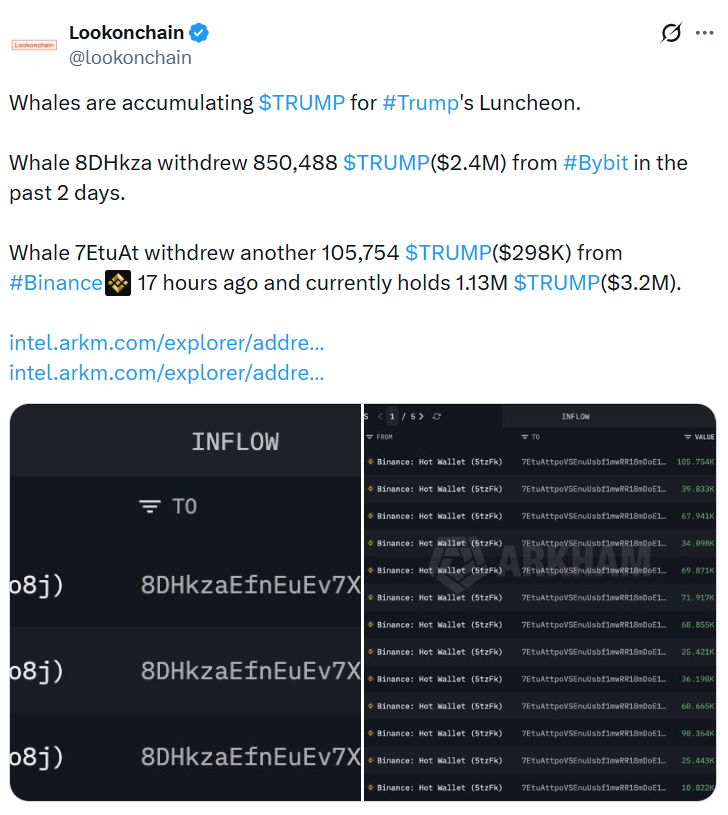
Crypto whales have continued to load up on the TRUMP memecoin ahead of the luncheon at US President Donald Trump’s Mar-a-Lago residence in Florida this month, which offers entry to the largest holders.
One whale withdrew about 105,754 TRUMP from Binance on Saturday to add to its stash of 1.13 million TRUMP, worth about $3.2 million, according to blockchain analytics firm Lookonchain said in an X post on Sunday.
Two days earlier, another whale withdrew 850,488 Trump from the crypto exchange Bybit.
On Monday, another holder increased their TRUMP stash to more than 368,000 tokens after withdrawing from BitMart, and a fourth whale boosted their stash to over one million tokens after withdrawing from Bybit, according to blockchain explorer Solscan.
Critics have accused Trump of using his position as US president for personal financial gain through the scheme. Democratic lawmakers have introduced bills to limit political influence and profits from memecoins.

The top 297 token holders are invited to a luncheon on April 25 at Trump’s Mar-a-Lago residence. The event has billed the president as the keynote speaker and offered a private reception for the top 29 holders, despite the White House Correspondents’ Association Dinner in Washington, D.C., being the same day.
TRUMP drops 33% since March announcement
Trump’s announcement of the luncheon in March saw TRUMP spike more than 50% to a peak of $4.35. However, the memecoin has since dropped by over 33% to trade at $2.80 as of Monday, according to CoinGecko.
Dominick John, an analyst at Zeus Research, told Cointelegraph the price is likely being pushed lower as retail-driven market selling overwhelms already thin liquidity, forcing continuous repricing.
“At the same time, insider supply overhang means even small distributions from concentrated wallets can absorb whale bids, limiting any meaningful upside follow-through,” he added.
Crypto data analytics platform CoinCarp lists 642,882 TRUMP holders, with over 91% of the supply concentrated among the top 10 wallets and over 97% among the top 100 wallets.
Token spiked after the crypto gala announcement last year
Trump held his first “crypto gala” dinner in May 2025, a few months after his Jan. 20 inauguration as US president, which drew concern from critics who accused him of using his position for personal financial gain.
Related: Bessent ramps up pressure on Congress to pass CLARITY Act
The token peaked at $15.59 about a month before the event, but fell as the event drew closer, gradually falling to $8.90 a month after the event.
John said this time around, the token could stage a recovery, with the 2026 midterms acting as a potential sentiment multiplier and other positive announcements. Catalysts and early signs of institutional accumulation could help establish a floor and trigger reflexive upside, he said.
“One catalyst to watch is the potential for event-driven launches like the Trump Billionaire Game, which could generate the social buzz needed to drive short-term upside momentum,” John added.
Magazine: Bitcoin quantum-safe without upgrade? CZ’s 2031 crypto vision: Hodler’s Digest, April 5 – 11

Key Takeaways
- A cybercriminal created 1 billion unauthorized bridged DOT tokens on Ethereum through a fraudulent message exploit
- The illegitimate tokens were liquidated in a single swap, generating approximately 108.2 ETH (roughly $237,000)
- The security breach involved the Hyperbridge gateway smart contract operating on Ethereum
- Polkadot’s core relay chain and authentic DOT tokens remained completely secure
- Shallow liquidity in the bridged token market prevented more substantial financial losses
A malicious actor capitalized on a security flaw within the Hyperbridge gateway smart contract deployed on Ethereum, creating 1 billion bridged Polkadot tokens through unauthorized means.
Cybersecurity monitoring company CertiK identified and reported the breach. Their analysis revealed the perpetrator deployed a fabricated message to assume administrative privileges over the bridged DOT token contract operating on Ethereum.
https://twitter.com/CertiKAlert/status/2043557571609731268?s=20
Leveraging these elevated permissions, the hacker generated 1 billion tokens through a single malicious transaction.
Onchain analytics platform Lookonchain documented that this massive token supply was immediately liquidated through one comprehensive transaction.
[[LINK_START_1]]https://twitter.com/lookonchain/status/2043558598111048126?s=20[[LINK_END_1]]
The perpetrator obtained 108.2 ETH from this mass sale, valued at approximately $237,000 during the transaction.
This comparatively modest profit demonstrates the shallow liquidity available for the bridged asset on Ethereum.
Since the wrapped variant had minimal holders and trading volume, the market lacked sufficient depth to purchase a billion tokens at anything approaching fair value.
Scope of Impact Analysis
The security incident exclusively affected the Ethereum-based representation of DOT and did not compromise Polkadot’s primary relay chain infrastructure. The legitimate DOT cryptocurrency on the Polkadot ecosystem sustained zero damage.
Only the synthetic, cross-chain representation of DOT existing on [[LINK_START_0]]Ethereum[[LINK_END_0]] fell victim to this attack.
Bridged cryptocurrencies serve as blockchain-agnostic representations of native assets. Their integrity relies entirely on the security architecture of underlying smart contracts.
The Hyperbridge infrastructure facilitates interoperability between disparate blockchain networks. A security weakness in its gateway contract seemingly provided the vulnerability exploited in this incident.
Official Responses and Ongoing Analysis
At the time this report was compiled, neither Polkadot’s development team nor Hyperbridge protocol operators had released formal public statements.
The precise technical methodology employed remains under investigation. Complete confirmation of the attack vector is pending.
Cross-chain bridge exploits and interoperability infrastructure vulnerabilities have emerged as persistent security challenges throughout the cryptocurrency ecosystem.
For this particular incident, the monetary impact remained relatively contained when compared against other bridge compromises, where malicious actors have successfully extracted hundreds of millions in digital assets.
CertiK’s preliminary assessment identified message forgery as the technique enabling administrative privilege escalation, though comprehensive post-incident analysis documentation has not yet been published.
Current verified data confirms the attacker’s wallet address collected 108.2 ETH following the token liquidation, with no additional malicious activity detected at publication time.



Aave Labs is set to receive a massive capital injection following the approval of a strategic roadmap designed to scale the protocol.
Summary
- The Aave DAO has approved a $25 million stablecoin grant and a 75,000 AAVE token allocation for Aave Labs to fund ongoing protocol development.
- Aave Labs will transition to a DAO-funded operating model where revenue from specific products flows directly into the treasury rather than being retained by the core team.
- The approved framework establishes Aave V4 as the long-term technical foundation and introduces a new governance structure to manage the protocol brand and institutional expansion.
According to the governance dashboard, the Aave DAO voted on Saturday to grant the development team $25 million in stablecoins and 75,000 AAVE tokens. The funding, part of the “Aave Will Win” framework, passed with roughly 75% support.
The stablecoins will be distributed over the next 12 months to cover operational costs, while the token package will vest over a four-year period to keep developers incentivized.
This decision changes how the protocol handles its finances. Under the new model, revenue from products like Aave Pro will go directly to the DAO treasury rather than staying with Aave Labs.
In exchange, the DAO takes over the responsibility of funding the lab’s core operations. The protocol, which currently holds over $25 billion in total value locked, also officially recognized Aave V4 as its long-term technical architecture.
Founder Stani Kulechov described the move as a defining moment for the ecosystem.
“Aave Will Win is the most important proposal in Aave’s history and it just passed with a landslide,” Kulechov shared on X.
“If you own AAVE, you own not just the economic rights of the protocol, but the brand, the users, and the integrations,” he added.
Aave Labs noted that the industry is changing as traditional fintech firms and institutions move on-chain. With regulatory clarity improving in several regions, the team plans to focus exclusively on Aave-linked products to stay ahead of the competition. They believe the winners of the next decade will be the ones who can capture new markets quickly.
Despite the successful vote, the path to approval was not without tension. Some community members questioned the sheer size of the $25 million package and the voting power tied to the 75,000 tokens. These disagreements previously led the Aave Chan Initiative, a prominent delegate, to scale back its involvement with the DAO, citing concerns over how the proposal process was handled.
Looking ahead, the framework also includes plans for a new foundation to manage the Aave brand. This follows a failed attempt in January to transfer intellectual property to the DAO, a topic that has sparked ongoing debate about how much control the community should have over the protocol’s identity. Future grants for specific product launches will still require separate votes from the DAO.


Polkadot’s (DOT) bridged token on Ethereum has reportedly fallen victim to an exploit. According to reports, an attacker minted 1 billion bridged DOT.
Onchain tracker Lookonchain noted that after this, the attacker dumped the entire supply in a single transaction, netting 108.2 ETH (approximately $237,000).
Follow us on X to get the latest news as it happens
Blockchain security firm CertiK flagged the exploit targeting the Hyperbridge gateway contract. An attacker used a forged message to gain unauthorized control. According to the firm, the attacker was able to manipulate the admin role of a Polkadot token contract on Ethereum, enabling the minting of 1 billion tokens.
The attack did not compromise Polkadot’s native relay chain or the DOT token on Polkadot itself. It targeted only the bridged, or wrapped, representation of DOT.
The incident raises fresh concerns about crypto security. Neither Polkadot nor Hyperbridge had issued an official response at the time of writing. This is a developing story, and further details will be updated as more information becomes available.
The post Bridged Polkadot Reportedly Hit by Exploit as Attacker Mints 1 Billion DOT Tokens appeared first on BeInCrypto.


The European Central Bank has thrown its weight behind a proposal to give the EU’s markets watchdog direct control over the continent’s largest crypto firms.
Summary
- The European Central Bank has endorsed a plan to transfer oversight of large crypto firms and cross-border trading platforms to the European Securities and Markets Authority.
- The central bank warned that centralized supervision is necessary to prevent financial shocks from migrating into the traditional banking system as the two sectors become increasingly linked.
- Implementation of the new regime faces opposition from member states like Malta that argue the current regulatory framework is too new to be overhauled.
The ECB issued a formal opinion on Friday stating that it fully supports moving the oversight of “systemically important” cross-border entities, including major trading platforms and crypto-asset service providers (CASPs), to the European Securities and Markets Authority (ESMA).
According to the central bank, these proposals “constitute an ambitious step towards deeper integration of capital markets and financial market supervision within the Union.”
While the opinion does not legally bind lawmakers, it provides significant political momentum for what would be the most substantial change to EU digital asset rules since the Markets in Crypto-Assets (MiCA) framework began its rollout in 2023.
Curbing “forum shopping” in the crypto sector
Under current MiCA rules, crypto firms can obtain a license in a single EU member state and then “passport” those services across the entire bloc. This setup has led to a fragmented landscape where companies select specific countries based on favorable local oversight.
For instance, Kraken operates out of Ireland, while Coinbase and Bitstamp are based in Luxembourg. Bitpanda maintains its primary presence in Austria, though its asset management division is registered in Germany.
The central bank argues that “transferring authorisation, monitoring and enforcement powers for all CASPs” from national bodies to ESMA would “ensure supervisory convergence, reduce fragmentation and mitigate cross-border risks in crypto-asset markets, thereby supporting financial stability and the integrity of the single market.”
Opposition to the change has emerged from countries like Malta, a prominent hub for digital asset firms. Critics there argue the move is premature, noting that specific MiCA requirements for service providers only became fully active in December 2024.
The ECB, however, pointed to the growing ties between traditional lenders and the crypto industry as a reason for urgency. It warned that banks offering crypto services or partnering with digital asset firms could allow volatility to transmit “shocks into the financial system.”
To prevent this, the bank highlighted “the need for a centralised Union supervisory regime for CASPs, capable of addressing the systemic risks posed by CASPs with significant activities, preventing risk migration into the banking system and safeguarding financial stability.”
For the plan to succeed, the ECB noted that ESMA must receive enough funding and personnel to manage the increased workload of policing the sector. The proposal now moves to a period of negotiation between EU governments and lawmakers, meaning it will likely be several months before the changes are finalized in law.
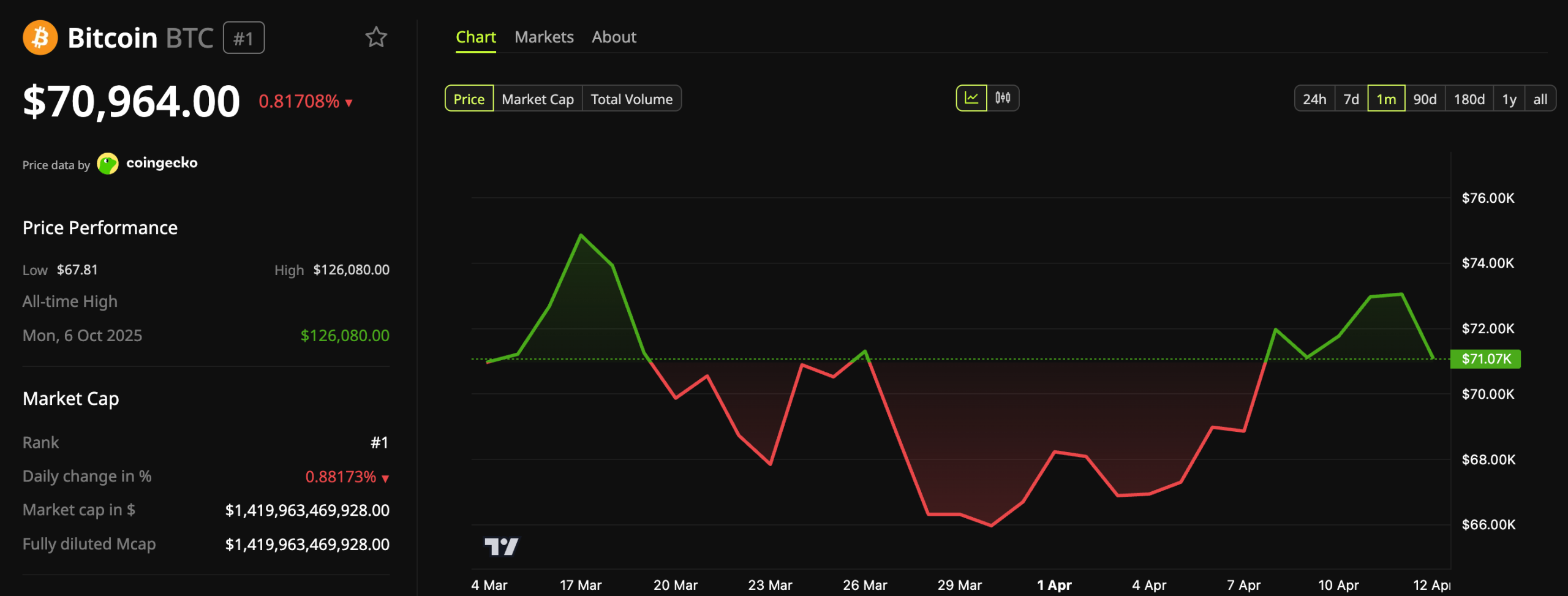
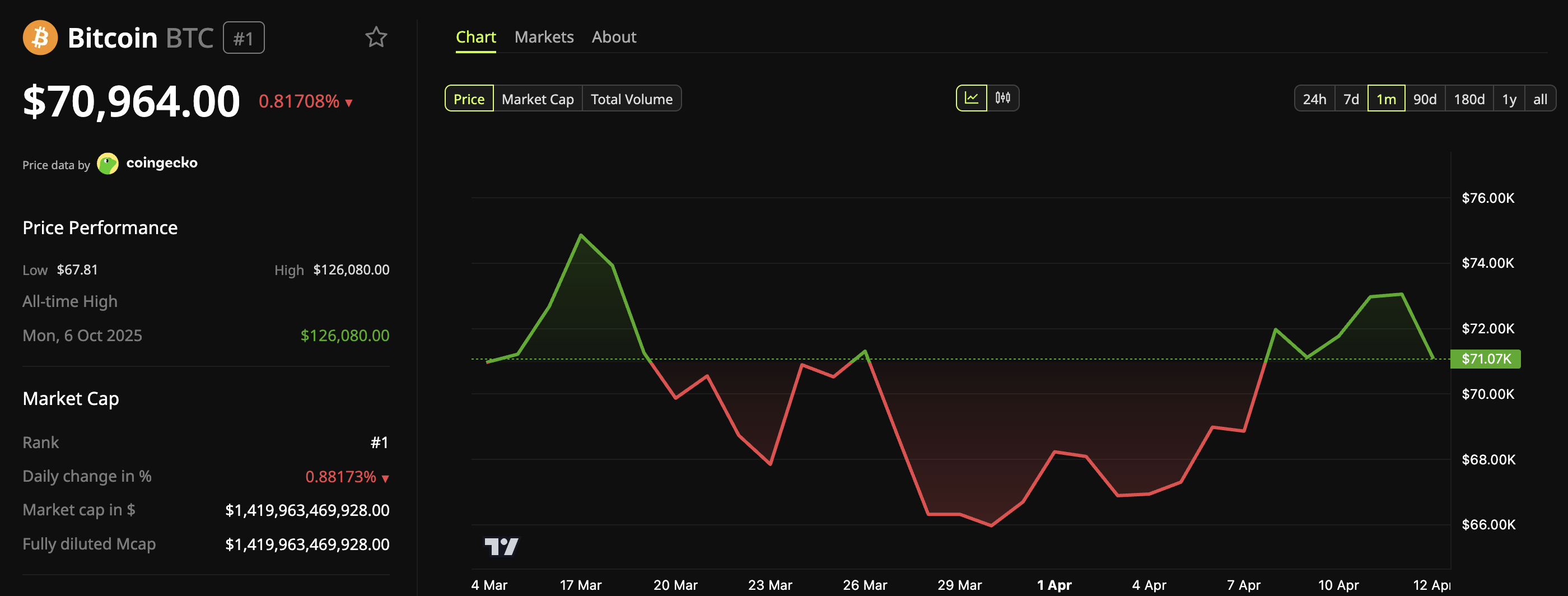
Bitcoin’s (BTC) price dropped nearly 3% since the weekend after US-Iran ceasefire talks failed in Islamabad.
The largest cryptocurrency slipped below $71,000 today. It was trading at roughly $70,960 at press time.
On-Chain Data Reveals a Wealth Transfer as Bitcoin Drops on US-Iran News
However, on-chain data tells a different story beneath the surface-level panic. According to an analyst, the military tension spooked retail investors, but institutional capital kept buying. Five key metrics support this thesis.
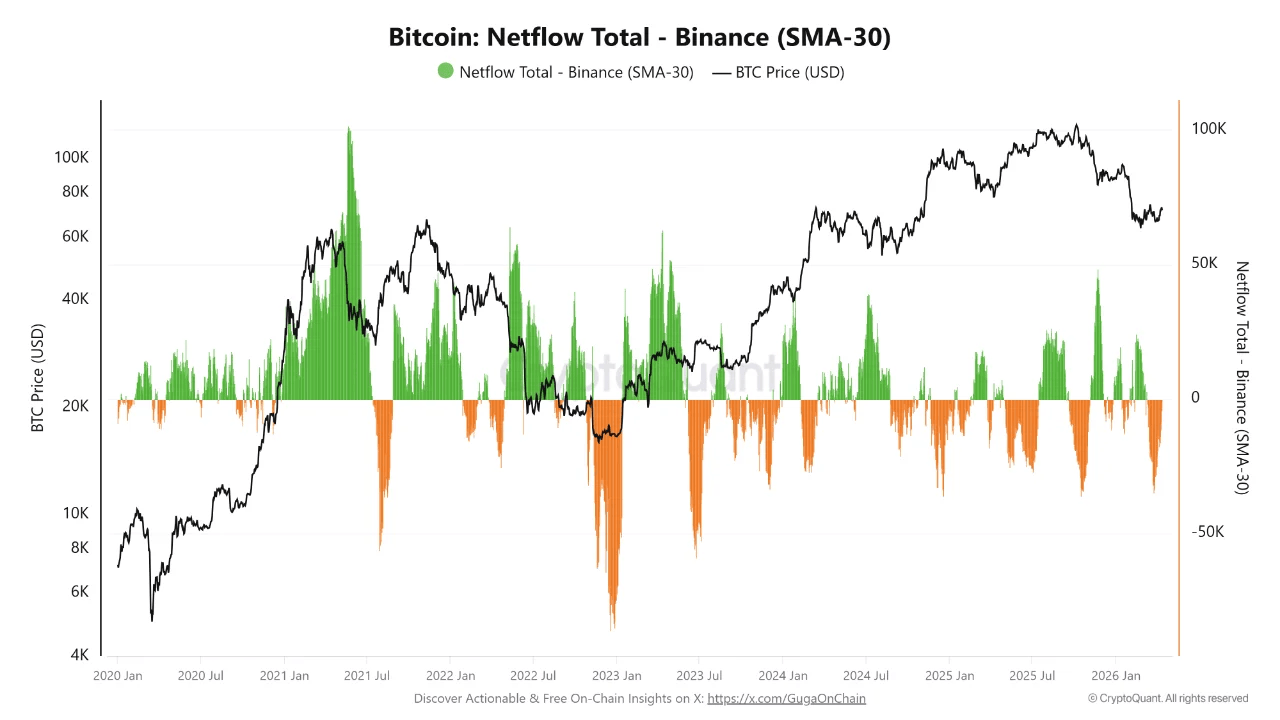
First, Bitcoin’s Total Netflow on Binance (SMA-30) registered an average of roughly -1,350 BTC, worth about $96 million. Negative netflow indicates coins leaving Binance at an aggressive pace.
Follow us on X to get the latest news as it happens
Second, the Short-Term Holder Spent Output Profit Ratio (SOPR) across all exchanges sits at 1.0018.
“The mathematical verdict is irrefutable: realizing losses predominated over the last 182 days, of which 148 (81.32%) were below 1.00. Today, these investors liquidate their positions practically at ‘breakeven’ to escape the volatility, delivering cheap liquidity into the hands of those who dictate the rules of the game,” the analyst wrote.
Third, global exchange reserves fell to about 2.69 million BTC, sitting below the seven-day moving average. That gap represents roughly 4,500 BTC, about $316 million, withdrawn to cold storage during peak geopolitical uncertainty.
“The scenario proves that today’s drop is not a trend reversal, but a brutal wealth transfer disguised as macroeconomic panic. The data shows that betting against the market in the face of this structural liquidity drought is putting yourself in front of an institutional steamroller,” the post added.
Bitcoin Whale Behavior Confirms the Shift
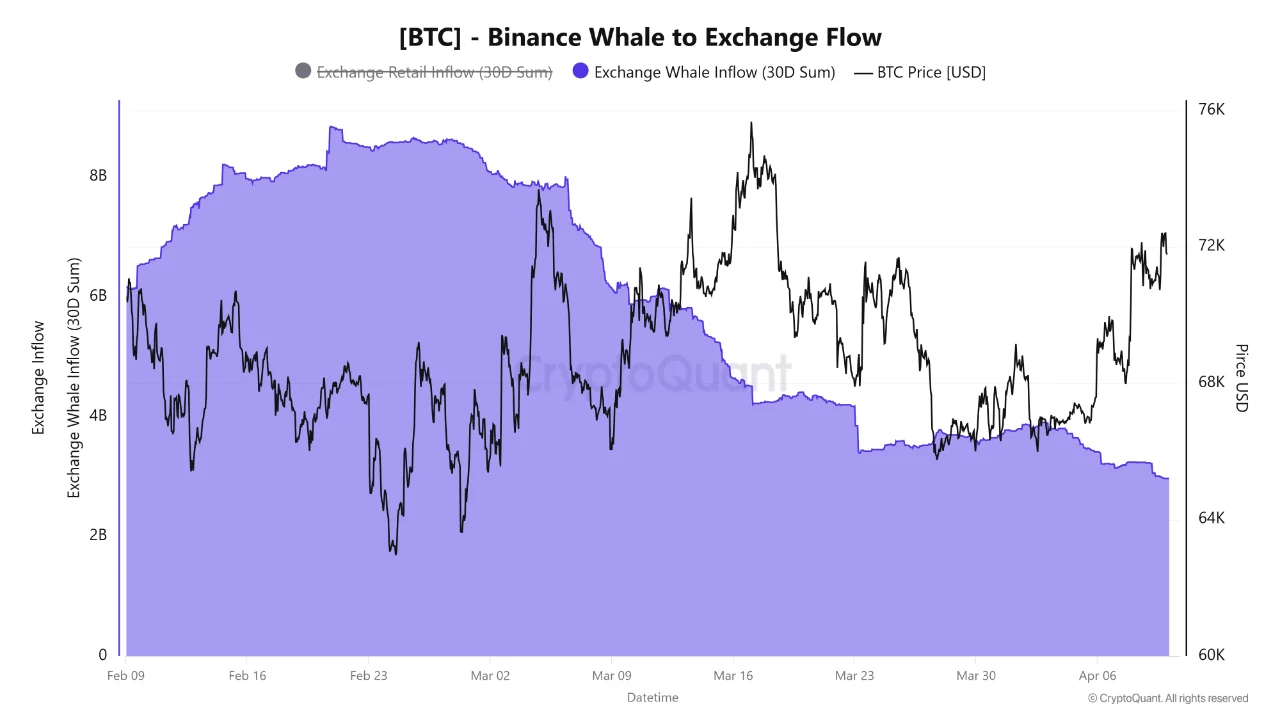
A separate analysis by Amr Taha reinforced this reading. The 30-day whale inflow to Binance fell to $2.96 billion. The inflow fell below $3 billion for the first time since June 2025.
Declining whale inflows suggest large holders have stopped sending BTC to exchanges for potential sale.
At the same time, Long-Term Holder (LTH) Realized Cap Change over 30 days rose to $49 billion on April 9. That marked its second return to that level since March 26.
Meanwhile, Short-Term Holder (STH) Realized Cap Change fell to -$54 billion, its third drop below -$50 billion since early March. According to the analyst, weaker holders distribute while long-term holders absorb available supply.
Whether this accumulation translates into a price recovery will depend on whether the US-Iran stalemate escalates further or yields a diplomatic breakthrough in the days ahead.
Subscribe to our YouTube channel to watch leaders and journalists provide expert insights
The post 5 On-Chain Signals Suggest Bitcoin’s War-Driven Dip Masks a Quiet Wealth Transfer appeared first on BeInCrypto.
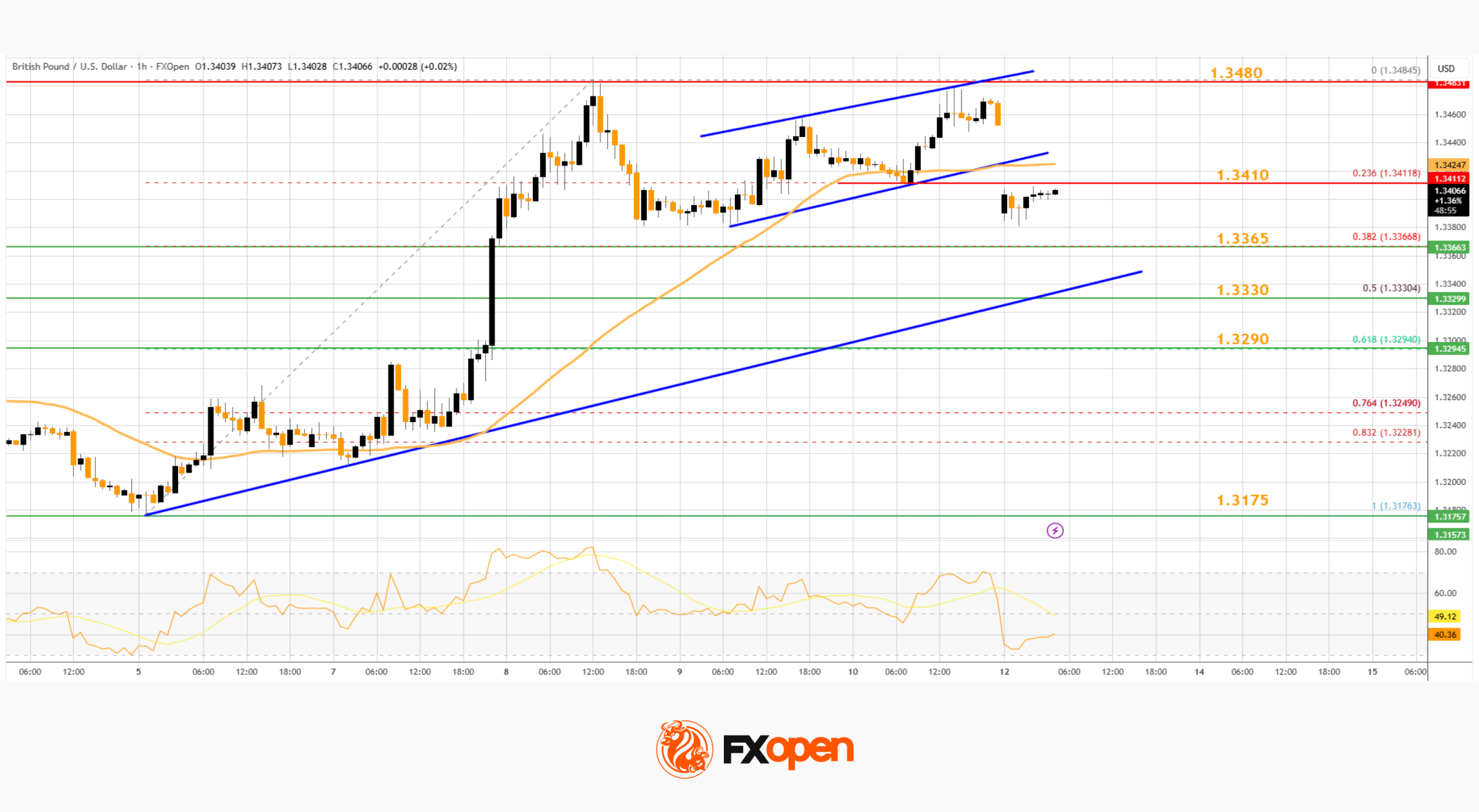
GBP/USD started a downside correction from 1.3480. USD/CAD is gaining bullish momentum and might clear 1.3880 for more upside.
Important Takeaways for GBP/USD and USD/CAD Analysis Today
· The British Pound rallied toward 1.3500 before the bears appeared.
· There was a break below a rising channel with support near 1.3410 on the hourly chart of GBP/USD at FXOpen.
· USD/CAD is showing positive signs above the 1.3835 pivot zone.
· There was a break above a key bearish trend line with resistance at 1.3830 on the hourly chart at FXOpen.
GBP/USD Technical Analysis
On the hourly chart of GBP/USD at FXOpen, the pair gained pace for a move toward 1.3300. The British Pound even climbed above 1.3450 before the bears appeared against the US Dollar.
A high was formed at 1.3485, and the pair started a minor downside correction. The pair traded below 1.3440, a rising channel, the 50-hour simple moving average, and the 23.6% Fib retracement level of the upward move from the 1.3176 swing low to the 1.3485 high.
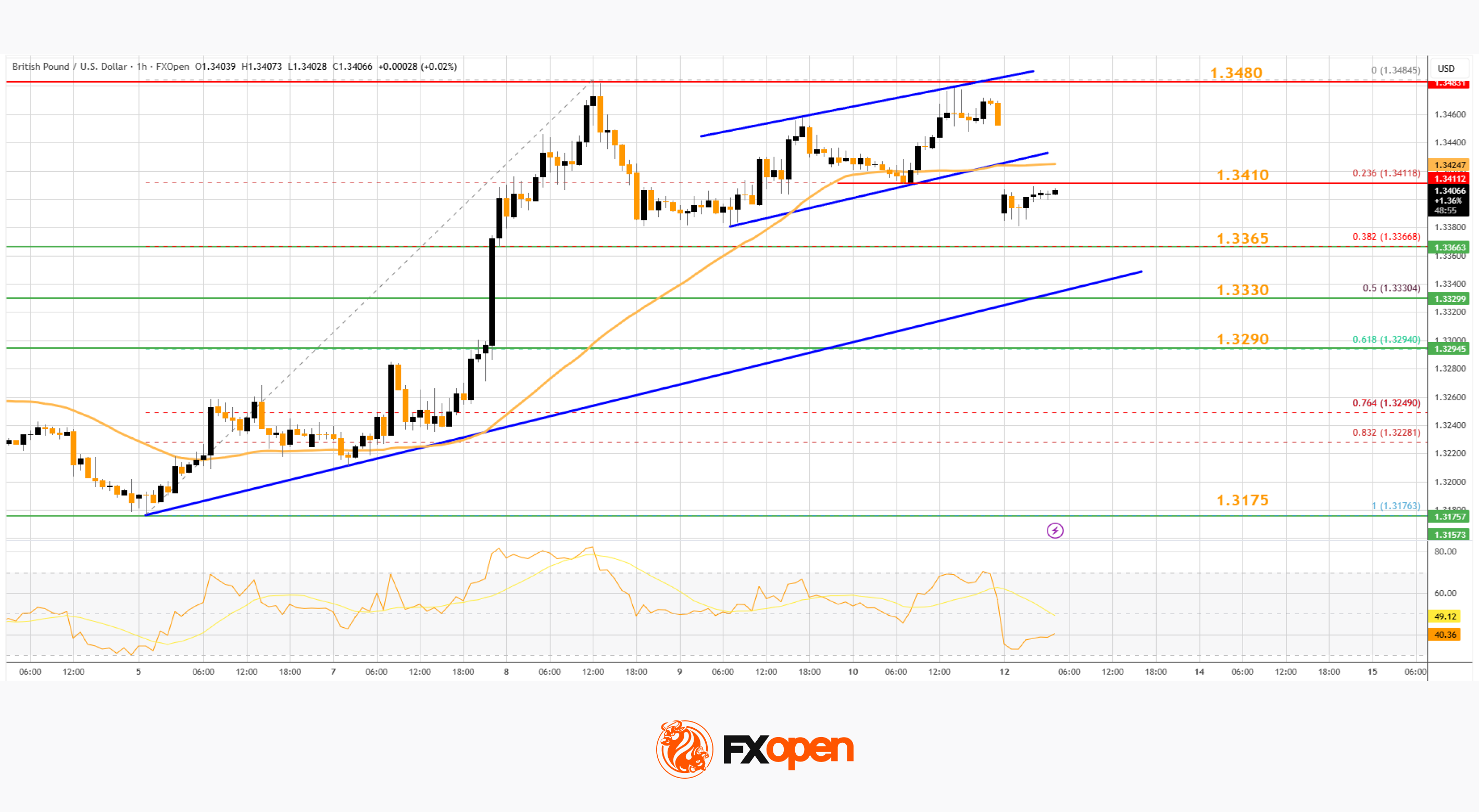
Finally, the bulls appeared near 1.3380, and the pair started a consolidation phase. Immediate hurdle on the upside is near 1.3410 and the 50-hour simple moving average.
The first major resistance is 1.3480. The main sell zone sits at 1.3500. A close above 1.3500 might spark a steady upward move. The next stop for the bulls might be near 1.3620. Any more gains could lead the pair toward 1.3650 in the near term.
If there is a fresh decline, initial bid zone on the GBP/USD chart sits at 1.3365. The next major area of interest could be 1.3330, the 50% Fib retracement, and a connecting bullish trend line, below which there is a risk of another sharp decline. In the stated case, the pair could drop toward 1.3175.
USD/CAD Technical Analysis
On the hourly chart of USD/CAD at FXOpen, the pair formed a strong base above 1.3800. The US Dollar started a fresh increase above 1.3820 and 1.3850 against the Canadian Dollar.
More importantly, there was a break above a key bearish trend line with resistance at 1.3830. The pair even climbed above the 50% Fib retracement level of the downward move from the 1.3928 swing high to the 1.3799 low.
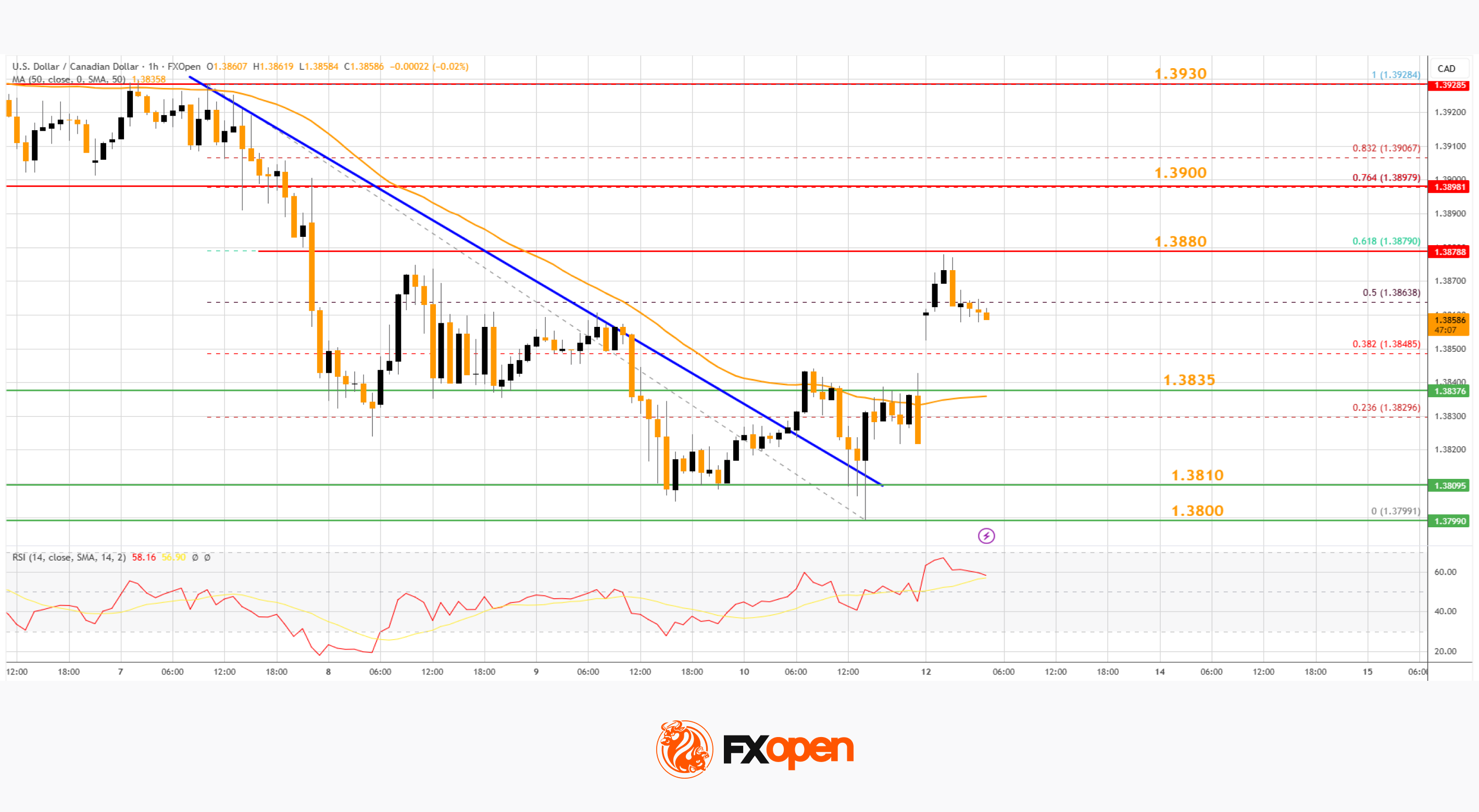
The pair is now consolidating above the 50-hour simple moving average. If there is another increase, the pair might face hurdles near 1.3880 and the 61.8% Fib retracement.
A clear upside break above 1.3880 could start another steady increase. In the stated case, the pair could test 1.3900. A close above 1.3900 might send the pair toward 1.3930. Any more gains could open the doors for a test of 1.3980.
Initial support is near the 50-hour simple moving average and 1.3835. The next key breakdown zone could be 1.3810. The main hurdle for the bears might be 1.3800 on the same USD/CAD chart.
A downside break below 1.3800 could push the pair further lower. The next key area of interest might be 1.3765, below which the pair might visit 1.3720.
Trade over 50 forex markets 24 hours a day with FXOpen. Take advantage of low commissions, deep liquidity, and spreads from 0.0 pips (additional fees may apply). Open your FXOpen account now or learn more about trading forex with FXOpen.
This article represents the opinion of the Companies operating under the FXOpen brand only. It is not to be construed as an offer, solicitation, or recommendation with respect to products and services provided by the Companies operating under the FXOpen brand, nor is it to be considered financial advice.

The Great Airdrop Industrial Complex

‘Marshals’ Pushes ‘Yellowstone’s Kayce Dutton Into New Soapy Territory, for Better and Worse

10 Jaw-Dropping Money Stats About the Average American


-

 Politics3 days ago
US brings back mandatory military draft registration
-

 Fashion3 days ago
Weekend Open Thread: Veronica Beard
-
 Sports3 days ago
Man United discover Nico Schlotterbeck transfer fee as defender reaches Dortmund agreement
-

 Tech5 days ago
How Long Can You Drive With Expired Registration? What Florida Law Says
-

 Politics16 hours ago
World Cup exit makes Italy enter crisis mode
-

 Crypto World4 days ago
Canary Capital Files SEC Registration for PEPE ETF
-

 Fashion7 days ago
Massimo Dutti Offers Inspiration for Your Summer Mood Board
-

 Business2 days ago
Tesla Model Y Tops China Auto Sales in March 2026 With 39,827 Registrations, Beating Cheaper EVs and Gas Cars
-

 Fashion6 days ago
Let’s Discuss: DEI in 2026
-

 Crypto World5 days ago
Bitcoin recovers as US and Iran Agree a Ceasefire Deal
-

 Politics3 days ago
Malcolm In The Middle OG Turned Down ‘Buckets Of Money’ To Appear In Reboot
-
 NewsBeat9 hours ago
Pep Guardiola and Gary Neville agree over Arsenal title problem that benefits Man City
-

 Business3 days ago
OpenAI Halts Stargate UK Data Centre Project Over Energy Costs and Copyright Row
-

 Business2 days ago
Ireland Fuel Protests Enter Day 5 as Blockades Spark Shortages and Government Prepares Support Package
-

 Tech7 days ago
Italian court says Netflix must refund customers up to $576 over price hikes
-

 Tech7 days ago
Haier is betting big that your next TV purchase will be one of these
-

 Tech7 days ago
Gamer Restores the Original PlayStation Portal From Two Decades Ago
-

 Tech7 days ago
The Xiaomi 17 Ultra has some impressive add-ons that make snapping photos really fun
-

 Tech7 days ago
Samsung just gave up on its own Messages app
-

 Tech7 days ago
Save $130 on the Samsung Galaxy Watch 8 Classic: rotating bezel, sleep coaching, and running coach for $369
You must be logged in to post a comment Login