

Crypto World
Market Analysis: GBP/USD Holds Firm, USD/CAD Bulls Target Breakout Move

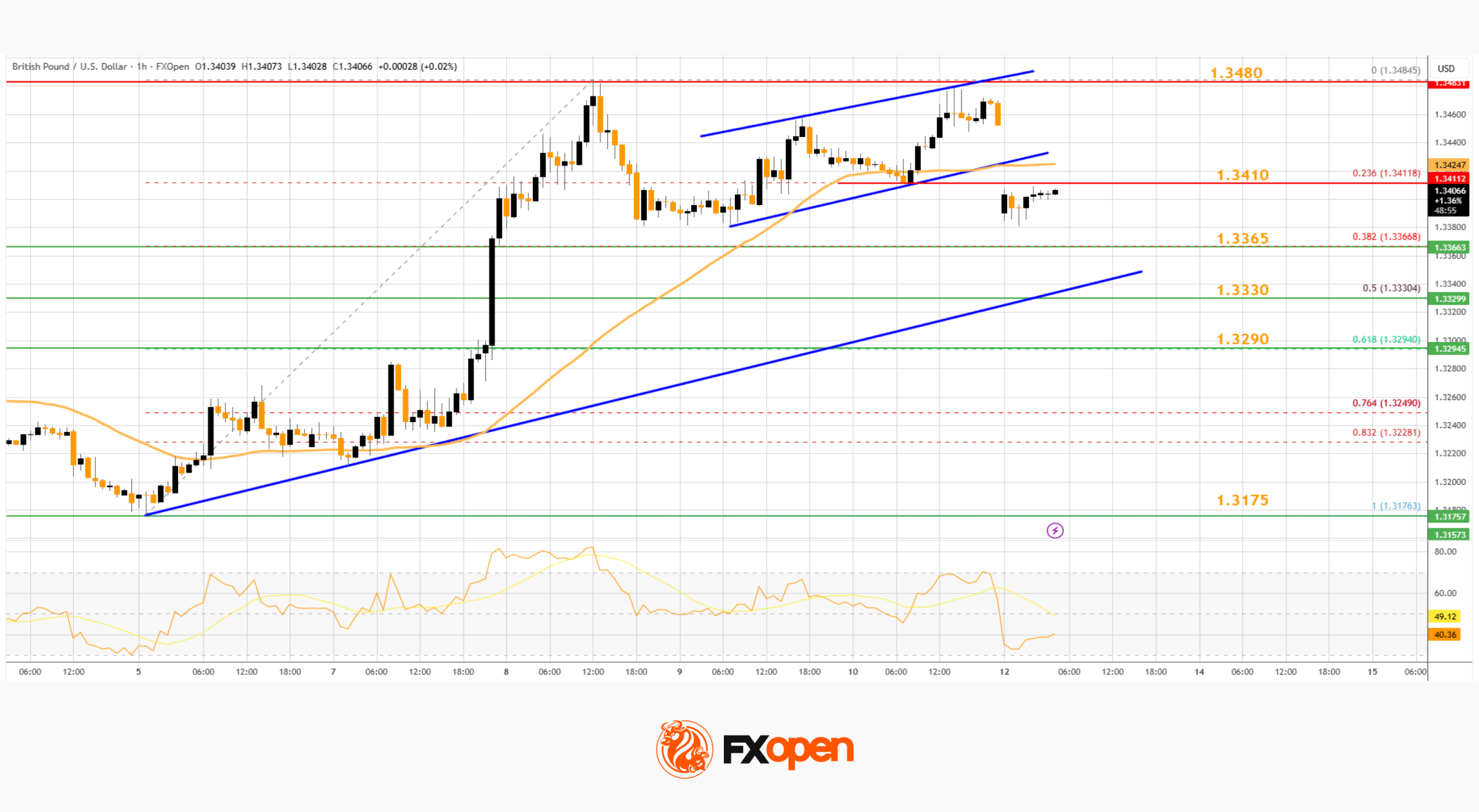
GBP/USD started a downside correction from 1.3480. USD/CAD is gaining bullish momentum and might clear 1.3880 for more upside.
Important Takeaways for GBP/USD and USD/CAD Analysis Today
· The British Pound rallied toward 1.3500 before the bears appeared.
· There was a break below a rising channel with support near 1.3410 on the hourly chart of GBP/USD at FXOpen.
· USD/CAD is showing positive signs above the 1.3835 pivot zone.
· There was a break above a key bearish trend line with resistance at 1.3830 on the hourly chart at FXOpen.
GBP/USD Technical Analysis
On the hourly chart of GBP/USD at FXOpen, the pair gained pace for a move toward 1.3300. The British Pound even climbed above 1.3450 before the bears appeared against the US Dollar.
A high was formed at 1.3485, and the pair started a minor downside correction. The pair traded below 1.3440, a rising channel, the 50-hour simple moving average, and the 23.6% Fib retracement level of the upward move from the 1.3176 swing low to the 1.3485 high.
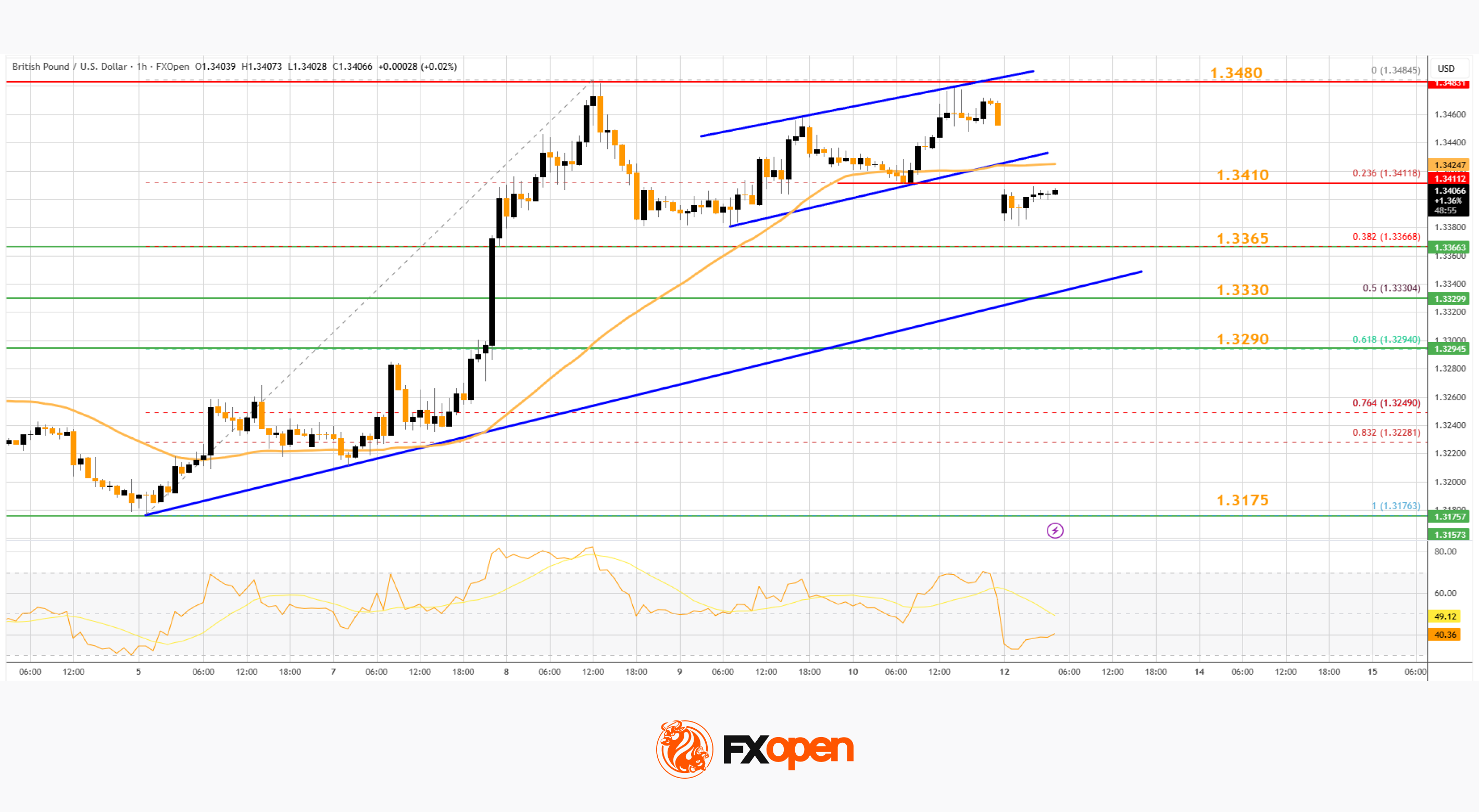
Finally, the bulls appeared near 1.3380, and the pair started a consolidation phase. Immediate hurdle on the upside is near 1.3410 and the 50-hour simple moving average.
The first major resistance is 1.3480. The main sell zone sits at 1.3500. A close above 1.3500 might spark a steady upward move. The next stop for the bulls might be near 1.3620. Any more gains could lead the pair toward 1.3650 in the near term.
If there is a fresh decline, initial bid zone on the GBP/USD chart sits at 1.3365. The next major area of interest could be 1.3330, the 50% Fib retracement, and a connecting bullish trend line, below which there is a risk of another sharp decline. In the stated case, the pair could drop toward 1.3175.
USD/CAD Technical Analysis
On the hourly chart of USD/CAD at FXOpen, the pair formed a strong base above 1.3800. The US Dollar started a fresh increase above 1.3820 and 1.3850 against the Canadian Dollar.
More importantly, there was a break above a key bearish trend line with resistance at 1.3830. The pair even climbed above the 50% Fib retracement level of the downward move from the 1.3928 swing high to the 1.3799 low.
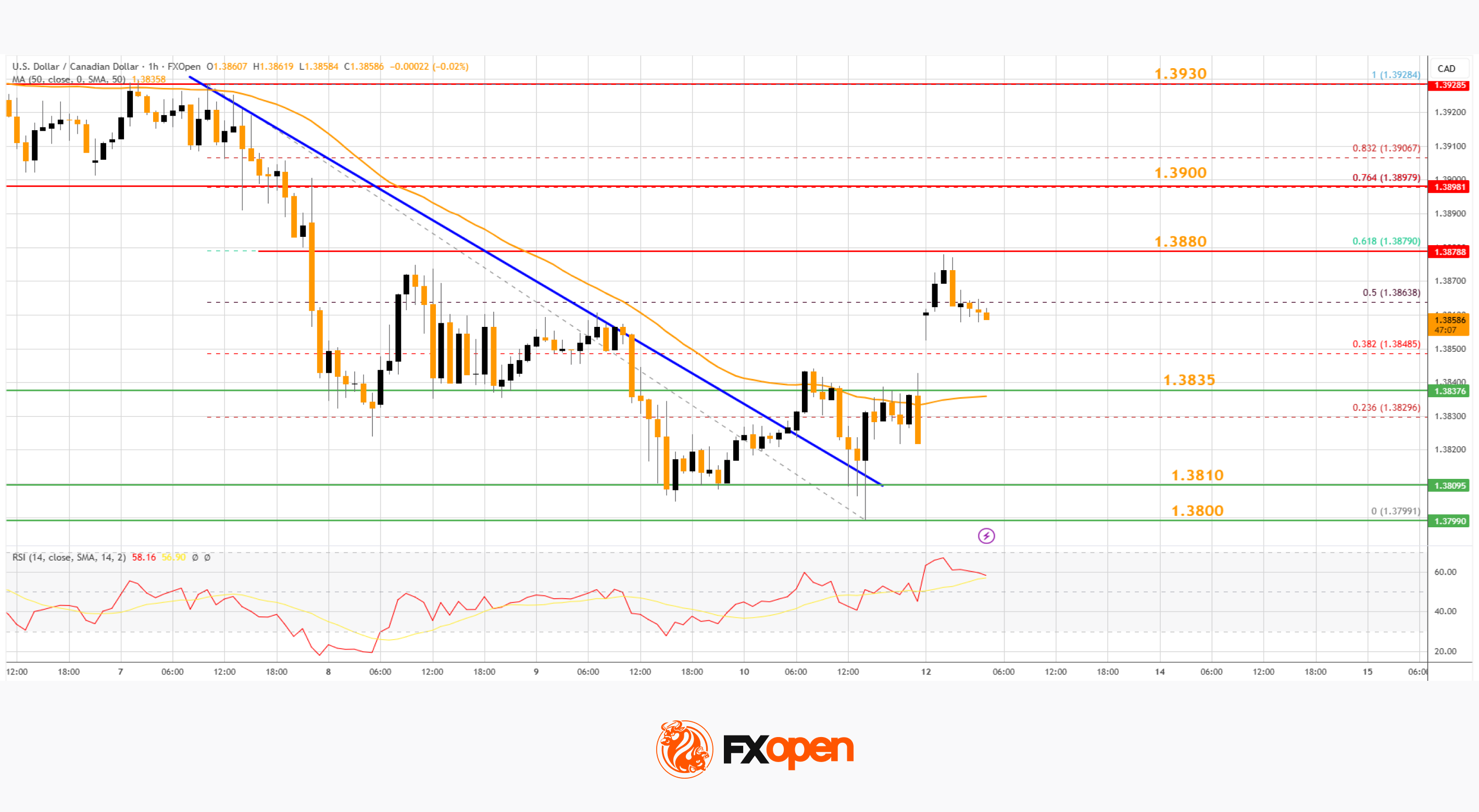
The pair is now consolidating above the 50-hour simple moving average. If there is another increase, the pair might face hurdles near 1.3880 and the 61.8% Fib retracement.
A clear upside break above 1.3880 could start another steady increase. In the stated case, the pair could test 1.3900. A close above 1.3900 might send the pair toward 1.3930. Any more gains could open the doors for a test of 1.3980.
Initial support is near the 50-hour simple moving average and 1.3835. The next key breakdown zone could be 1.3810. The main hurdle for the bears might be 1.3800 on the same USD/CAD chart.
A downside break below 1.3800 could push the pair further lower. The next key area of interest might be 1.3765, below which the pair might visit 1.3720.
Trade over 50 forex markets 24 hours a day with FXOpen. Take advantage of low commissions, deep liquidity, and spreads from 0.0 pips (additional fees may apply). Open your FXOpen account now or learn more about trading forex with FXOpen.
This article represents the opinion of the Companies operating under the FXOpen brand only. It is not to be construed as an offer, solicitation, or recommendation with respect to products and services provided by the Companies operating under the FXOpen brand, nor is it to be considered financial advice.

Crypto World
Nvidia (NVDA) CEO Calls on Super Micro to Strengthen Export Controls Amid Smuggling Probe

Key Takeaways
- Jensen Huang called on Super Micro Computer (SMCI) to strengthen its export compliance measures during his arrival in Taipei over the weekend.
- Authorities in Taiwan have detained three individuals accused of falsifying export documents while shipping Super Micro AI servers with Nvidia chips to China.
- This incident follows a March U.S. federal indictment accusing Super Micro’s co-founder and accomplices of orchestrating a ~$2.5 billion smuggling operation involving Nvidia-powered servers destined for China.
- Huang disclosed that China represents part of Nvidia’s anticipated $200 billion addressable market for the forthcoming Vera CPU.
- While H200 chips have received export approval for China, no deliveries have occurred to Chinese buyers to date.
Nvidia’s chief executive Jensen Huang touched down in Taipei over the weekend and immediately confronted the escalating concerns surrounding Super Micro Computer (SMCI) and alleged AI chip smuggling operations to China.
Addressing media at Songshan Airport, Huang emphasized that Nvidia maintains “rigorous” standards when briefing partners on U.S. export regulations. He expressed his expectation that Super Micro will “enhance and improve” its compliance framework to avoid future violations.
His remarks follow an announcement from Taiwan’s Keelung District Prosecutors’ Office that three individuals were detained earlier this week. The suspects allegedly filed false shipping documents to facilitate the export of Super Micro servers—equipped with cutting-edge Nvidia AI processors—to destinations including China, Hong Kong, and Macau.
Super Micro has not issued an immediate statement in response to media inquiries. The company previously indicated its dedication to safeguarding advanced American technology and pledged to reinforce its international trade compliance operations.
This marks another chapter in Super Micro’s ongoing export control challenges. Earlier this year in March, federal prosecutors in the United States indicted Super Micro co-founder Yih-Shyan “Wally” Liaw alongside two associates for allegedly orchestrating a conspiracy to smuggle approximately $2.5 billion in Nvidia-equipped servers to China using shell entities across Southeast Asia.
Liaw has entered a not guilty plea. Super Micro maintains that it is not a defendant in the case and is actively cooperating with authorities.
While the Taiwan detention is administratively separate from the U.S. federal charges, both investigations share significant overlap. Each case involves similar alleged smuggling networks—utilizing intermediary companies to circumvent U.S. export restrictions and funnel prohibited Nvidia AI technology into China.
A Bloomberg investigation published earlier this month identified a firm associated with Thailand’s national artificial intelligence initiative as potentially facilitating the transfer of Super Micro servers to Chinese entities. That reporting named Alibaba (BABA) among several ultimate recipients.
China Remains Central to Nvidia’s Growth Strategy
Despite ongoing export control controversies surrounding its products, Huang made clear that China continues to factor prominently in Nvidia’s future revenue projections.
Speaking to journalists at the airport, Huang revealed that China is incorporated into the $200 billion total addressable market estimate he presented for Nvidia’s next-generation Vera CPU during the company’s earnings call on May 20th.
Nvidia’s H200 processor has secured U.S. licensing for Chinese exports, with approximately ten Chinese companies authorized to acquire the technology. Yet remarkably, zero H200 units have reached any Chinese customer thus far.
Huang characterized the Chinese market as “very important” and “very large,” stating it “would be terrific” to supply it. Nevertheless, recent discussions between President Trump and Chinese President Xi Jinping in Beijing this month yielded no resolution on export matters.
Taiwan Events: GTC and Computex
Huang’s Taiwan visit precedes Nvidia’s GTC Taipei conference and his keynote address at Computex, slated for June 1st. Industry observers anticipate he will unveil detailed information about the software architecture underlying Nvidia’s Vera Rubin platform.
He characterized the platform as “the largest product launch, probably in the history of Taiwan.” Every Vera Rubin NVL72 system incorporates nearly 2 million individual components and engages approximately 150 Taiwanese supply chain partners.
According to current reports, Super Micro shipments connected to the smuggling investigations remain suspended, with both U.S. and Taiwan authorities continuing their active inquiries.

After declining to about $74,000 on Saturday, Bitcoin’s price recovered to $77K yesterday and seems to have stabilized at that level.
The move follows a statement from the US President Donald Trump on the state of affairs with Iran and the potential for a permanent peace, although the market seems to have accepted it as an extension of the current ceasefire.
Bitcoin Price Stable at $77,000, Important Week Ahead
As we reported earlier today, crypto markets have remained mostly flat over the past 24 hours. They did go through a weekend boost after the US President hinted at a “largely negotiated” deal with Iran.
Analysts also hinted that the ceasefire is likely to be extended for another 60 days.
“It also appears further progress has been made toward a 60-day ceasefire extension for the Iran war.” – Wrote the Kobeissi Letter.
That said, Bitcoin is trading slightly above $77,000 and remains stable on Memorial Day, with markets closed.

However, the week ahead holds important economic events, namely:
- Consumer confidence data for May – on Tuesday
- April’s PCE inflation data – on Thursday
- US Q1 2026 GDP data – on Thursday
It’s also important to note that spot Bitcoin ETFs marked one of their worst weeks from May 18 to May 22, noting more than $1.2 billion in outflows. Ethereum ETFs also suffered, while other products like SOL, XRP, and HYPE funds saw increases in assets under management.
Altcoins Flat, HYPE Rally Cools Off
Many altcoins have also traded relatively flat over the past 24 hours, especially those with the largest market capitalizations. ETH is more or less where it was yesterday; BNB is up 0.5%, TRX by 0.3%, while XRP, SOL, DOGE, and ADA are down 0.3%.

One of last week’s best performers, HYPE, seems to be slowing down after surging by more than 40% in the past seven days. That said, the altcoin continues to show considerable strength and is already ranked as the 11th-largest project in the industry by total market capitalization.
The best performers from the past 24 hours include DEXE, which increased by 20%, STABLE, up 15%, and XDC Network (XDC), up 9.6%. On the flipside, Uniswap’s UNI is down 2.7%, making it today’s worst-performing altcoin, followed by Kaspa and Sui.
The post Bitcoin Price Stabilizes at $77K as President Trump Updates on Iran Deal: Market Watch appeared first on CryptoPotato.
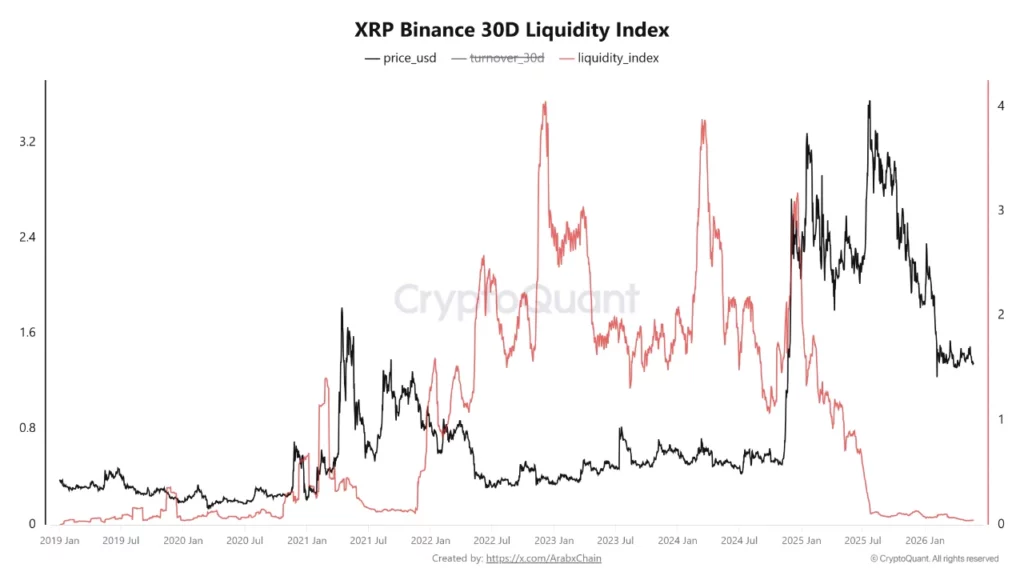
XRP market depth on Binance has dropped to its weakest level since January 2020, according to CryptoQuant analyst Arab Chain.
Summary
- XRP Binance liquidity index fell near 0.043, its lowest reading since January 2020, CryptoQuant data shows.
- Binance whales withdrew $49.2 million in XRP as price returned to a repeated accumulation zone.
- XRP trades near $1.36, below short-term moving averages, with $1.40 still blocking recovery.
The analyst said XRP’s 30-day liquidity index on Binance fell to about 0.043 while the token traded near $1.34.
The reading points to a sharp fall in available liquidity compared with earlier market phases. Arab Chain said the index had previously reached readings above 3 and 4 points between 2022 and 2024, when XRP saw stronger trading activity and higher volatility.
XRP Binance liquidity falls to a six-year low
Low liquidity does not give a direct bullish or bearish signal on its own. However, thinner market depth can make XRP more sensitive to large orders because fewer bids and asks sit near the current price.
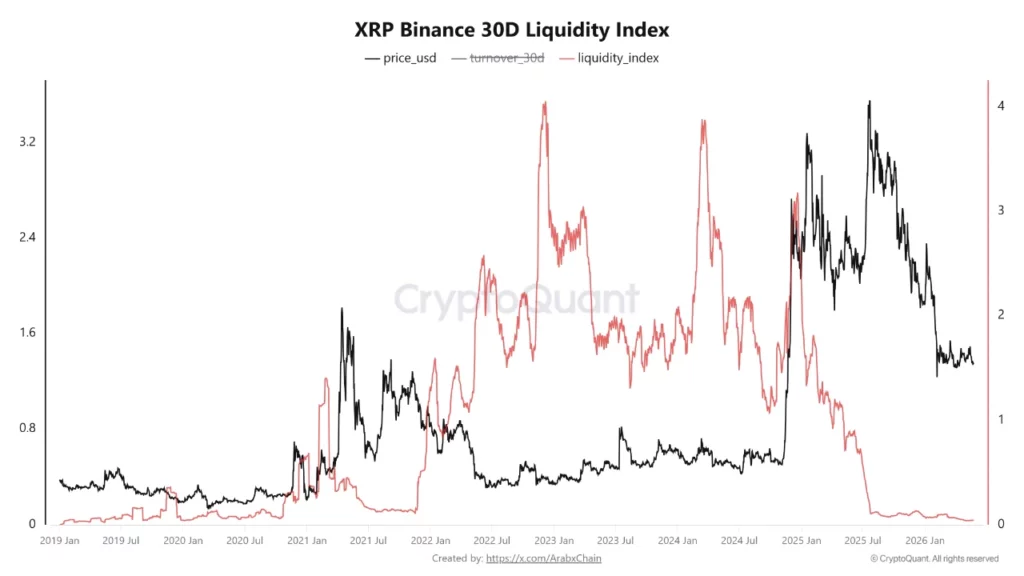
That means sudden buying or selling can move price faster than usual. For traders, the current setup creates a market where volatility can rise even if daily volume remains modest.
The drop also signals weaker speculative activity on Binance. Arab Chain said the decline may show reduced new liquidity inflows and a more cautious market structure.
The update comes as XRP remains stuck near the same range it has traded around for months. The $1.35–$1.40 area now carries added focus because it connects thin liquidity with repeated whale activity.
Binance whales withdraw XRP near $1.35
CryptoQuant analyst Amr Taha reported that XRP whales withdrew $49.2 million from Binance on May 22 while the token traded below $1.35. In exchange-flow terms, negative whale netflow means large holders moved more XRP away from Binance than they sent in.
That move matters because it happened during price weakness, not after a strong rally. Whale withdrawals during weakness can show that some large holders are reducing available exchange supply instead of preparing to sell.
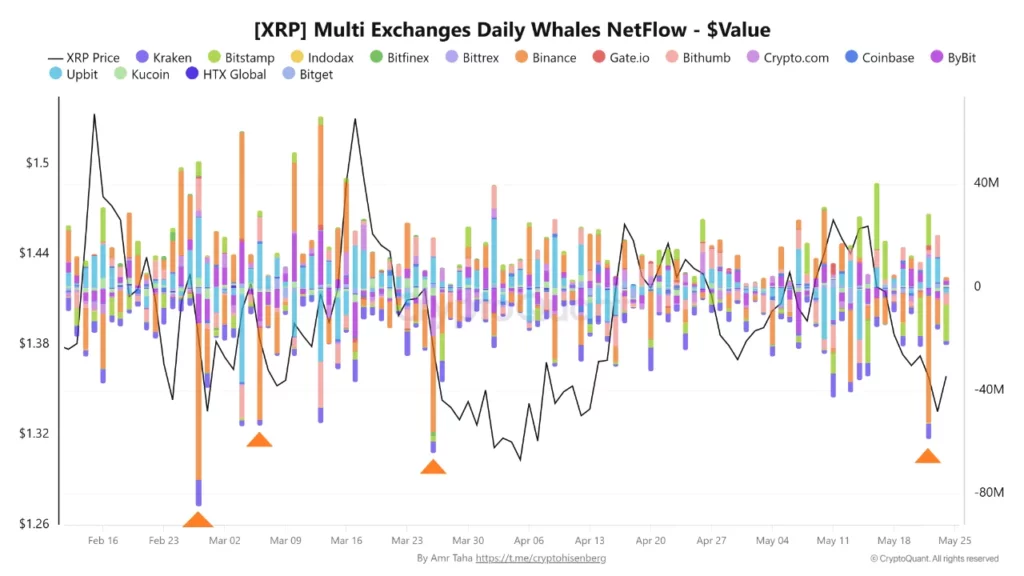
The May 22 reading also followed similar whale behavior earlier this year. Taha cited negative Binance whale netflows of $60.7 million on Feb. 27, $35.5 million on March 6, and $37 million on March 26.
All four signals appeared near the $1.35–$1.40 range. That makes the zone one of the clearest recent areas of repeated Binance whale withdrawals.
Still, whale withdrawals do not confirm an immediate rebound. They can reduce potential sell-side supply, but price still needs stronger demand and a clean technical breakout.
XRP price stays below key moving averages
XRP traded at $1.36 on May 25, 2026, according to crypto.news price data. The token was up 0.23% over 24 hours, while its 24-hour trading volume stood at about $1.35 billion.
The same data showed XRP trading between $1.34 and $1.37 over the past 24 hours. XRP ranked fifth by market cap, with a market value of about $84.23 billion.
The short-term chart remains weak. XRP traded near $1.3584, below the 9-day moving average at $1.3663 and the 21-day moving average at $1.4051.
That structure keeps pressure on buyers unless XRP reclaims the $1.36–$1.40 area. The shorter moving average also remains below the longer one, which keeps the near-term trend neutral-to-bearish.
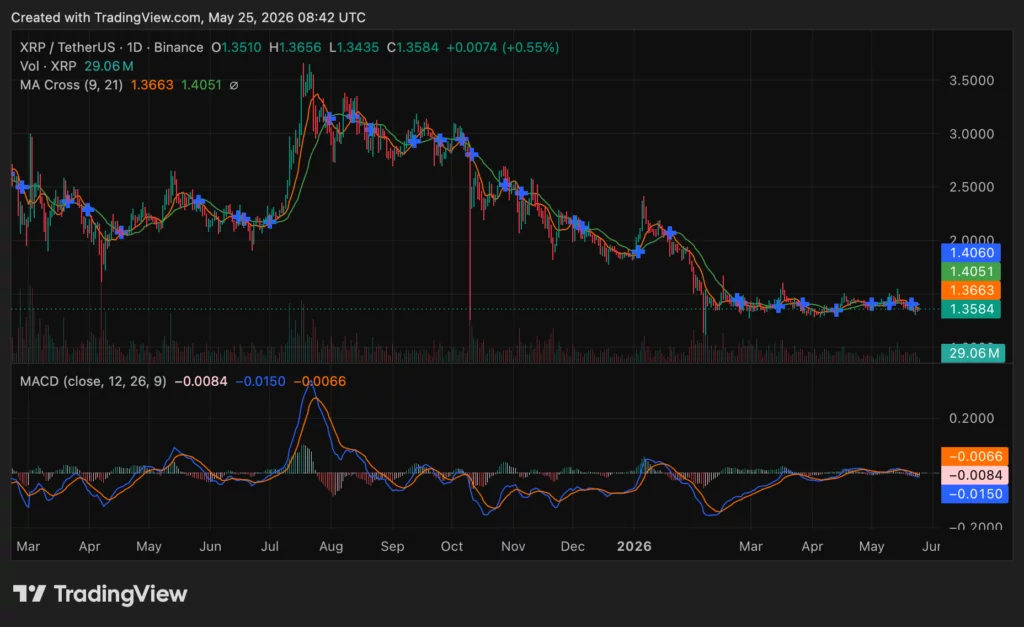
Immediate support sits near $1.3435, close to the daily low. Resistance stands near $1.3663, followed by the larger $1.4051–$1.4060 zone.
Volume near 29.06 million XRP remains low compared with earlier selloff spikes. That shows the latest bounce has not yet drawn strong market participation.
The MACD also remains below the zero line. The MACD reading near -0.0150, signal line near -0.0066, and negative histogram near -0.0084 show weak bearish momentum.
Traders watch $1.40 and $1.50 resistance
Related crypto.news coverage said XRP recently traded near $1.37 as exchange-flow data showed cooling deposit pressure. The same report said Binance and Coinbase had shifted toward withdrawal-led transactions, which may show easing exchange selling pressure. XRP stayed within a range, with support near $1.29–$1.35 and resistance near $1.50.
Separate crypto.news coverage showed a large XRP options trader collected $224,500 in premiums by betting XRP would stay near $1.40 through June 26. The trader sold 1.5 million contracts each of the $1.40 call and put options on Deribit.
That options trade fits the wider range-bound setup. Crypto.news noted that XRP had traded between $1.30 and $1.50 for roughly 60% of 2026, making the $1.40 area a key short-term price zone.
Crypto Patel also cautioned against aggressive upside targets without enough liquidity, structure, or a clear catalyst map. The analyst said $10 remains a long-run target, while the best accumulation area sits between $1 and $0.70.
CRYPTOWZRD said XRP closed indecisively and continued to hold a range. The analyst said a move above $1.40 could open upside, while a rejection near that level could set up a move back toward $1.32.
Disclosure: This article does not represent investment advice. The content and materials featured on this page are for educational purposes only.


- The malware spread through npm, PyPI, and Rust packages in coordinated waves.
- It steals crypto wallets, SSH keys, and cloud developer credentials.
- AI coding tools were also targeted through malicious config files.
A coordinated malware campaign known as TrapDoor has hit software ecosystems widely used by crypto and blockchain developers.
Security researchers identified dozens of malicious packages spread across major open-source repositories, all designed to steal sensitive developer data such as wallet keys, cloud credentials, and source code access tokens.
Instead of a single malicious upload, attackers deployed multiple packages in waves using different accounts.
This approach made the activity harder to detect at the early stages and allowed the malware to blend into routine dependency updates.
Coordinated attack across major developer ecosystems
The TrapDoor operation affected at least three major package ecosystems: npm, PyPI, and Crates.io.
Together, researchers identified more than 30 malicious packages and over 300 affected versions distributed within a short window.
The activity reportedly began around May 22, 2026, although GitHub reported unauthorized access to internal repositories on May 20. It then escalated quickly over the following days.
The packages were not isolated incidents. Instead, they appeared to be part of a coordinated release strategy involving multiple developer accounts.
This structure suggests planning rather than opportunistic abuse. Each package carried similar behavior patterns and pointed to a shared malicious framework used by the attackers.
How the TrapDoor malware operates inside developer systems
Once installed, TrapDoor packages execute automatically through standard build and installation processes used in modern development environments.
In JavaScript packages, malicious code is triggered through post-install scripts, which run immediately after a dependency is added.
In Python packages, the malware can activate during import, allowing it to execute without any explicit function call.
Rust packages use build scripts to achieve the same result during compilation.
After execution, the malware scans local systems for valuable data. This includes SSH keys, API tokens, and configuration files commonly used in cloud and blockchain development workflows.
It also targets browser-stored credentials and environment variables, which often contain sensitive authentication data.
Stolen information is then sent to external servers controlled by the attackers.
In some cases, the malware attempts to maintain persistence by modifying startup processes or inserting malicious hooks into development tools.
Crypto-focused targeting and high-value data theft
What makes this campaign particularly concerning is its focus on crypto-related development environments.
The malware specifically searches for crypto wallet-related files and credentials linked to platforms such as Coinbase, MetaMask, Binance, and Solana-based tools.
It also targets cloud infrastructure credentials from providers like AWS and GitHub access tokens.
These are especially valuable because they can provide attackers with direct access to private repositories, deployment pipelines, and backend systems.
In addition, the malware attempts to collect SSH keys that could allow remote access to developer machines or production servers.
This combination of targets gives attackers a wide range of entry points into both personal and enterprise systems.
AI development tools also under pressure
One of the more unusual elements of the TrapDoor campaign is its interaction with AI-assisted development environments.
Some malicious packages include configuration files designed to influence coding assistants and automated development tools.
Files such as .cursorrules and CLAUDE.md were reportedly used to manipulate AI coding assistants into performing actions that could expose sensitive information.
Instead of directly hacking systems, the attackers attempted to exploit how AI tools interpret project instructions.
This approach reflects a shift in attack methods.
Rather than targeting only code execution, the campaign also attempts to influence developer workflows that rely on AI-generated suggestions and automated analysis.
Internet Computer (ICP) led every major blockchain in transaction volume over the past 30 days.
Its volume reached roughly 6.5 billion on the Chainspect rankings dated May 24.
Follow us on X to get the latest news as it happens
The figure more than doubled Solana’s count of 2.9 billion. Fogo, BNB Chain, and TRON rounded out the top five on the same chart. Each network posted under 500 million transactions, leaving ICP and Solana alone at the top of the activity rankings.
This highlights strong network activity. Internet Computer splits its workload across more than 49 subnets. Each subnet runs an independent consensus, allowing the chain to scale horizontally instead of through a single execution layer.
Chainspect data shows ICP has processed 287 billion transactions since its May 2021 launch. The network currently processes 2,891 transactions per second, with 10.4 million in the past hour alone.
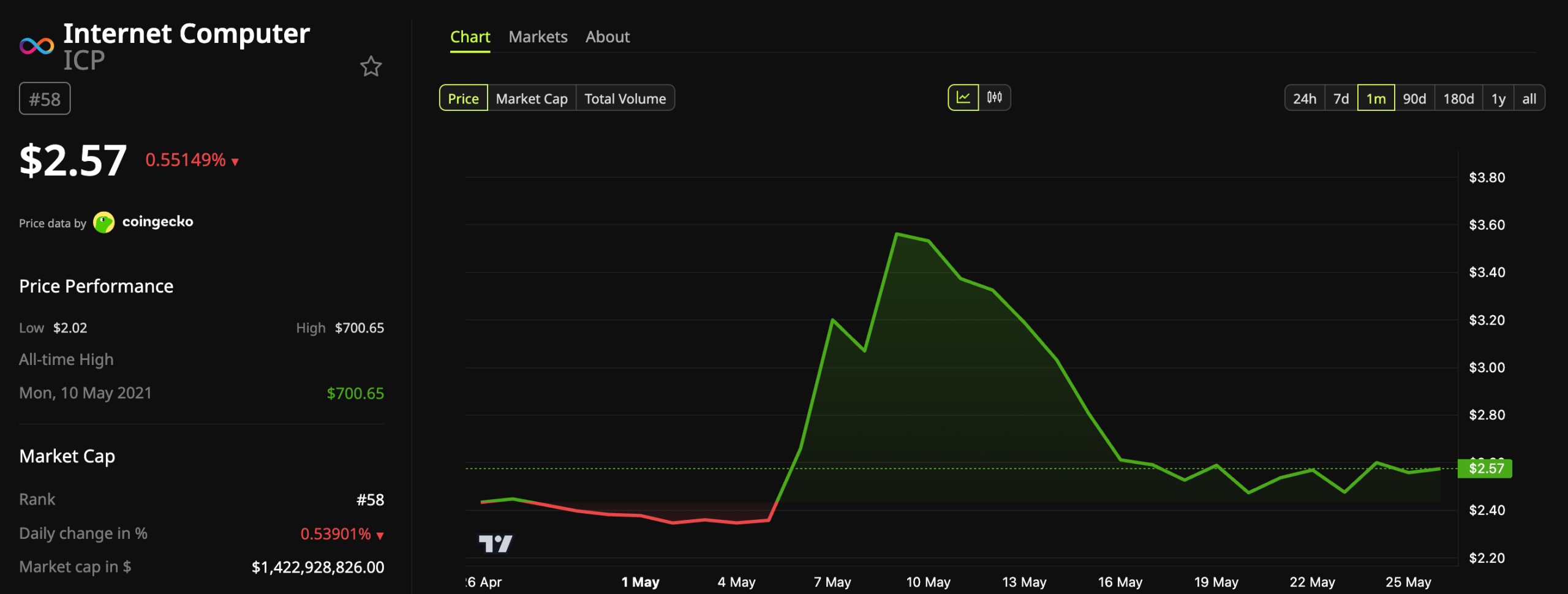
Despite the strong network activity, the price has faced headwinds. ICP token surged nearly 49% in early May. However, the altcoin has given up most of its gains, dropping over 28% since May 9.

At press time, ICP traded at $2.57, down 0.55% over the past day. The volume surge points to network health, but it has not yet sparked a meaningful price recovery. Whether the gap closes anytime soon remains an open question.
Subscribe to our YouTube channel to watch leaders and journalists provide expert insights
The post Internet Computer Beats Solana and BNB Chain in 30-Day Activity Race appeared first on BeInCrypto.


A lawsuit filed in a New York court in May 2026 seeks to declare a claimant known as Noah Doe the legal owner of more than 39,000 dormant Bitcoin (BTC) wallets, targeting a combined 3.79 million BTC.
They reported the addresses to the NYPD and sent on-chain and press notices to potential owners, though questions have since emerged about whether the notifications actually reached the wallets that hold the funds.
Lawsuit Targets Satoshi Nakamoto’s Alleged Stash
The amended complaint names wallets attributed to Satoshi Nakamoto alongside early miner addresses, Casascius Coin holdings, and wallets linked to hackers and unidentified entities. The combined face value of those addresses runs into hundreds of billions of dollars at current bitcoin prices. Recurring debates about Satoshi’s alleged Bitcoin holdings and the Bitcoin creator’s identity have long shown how difficult it is to attribute early wallets with any certainty.
Ripple CTO David Schwartz, known on X as JoelKatz, offered a dry take on the case. One post had observed that a court might one day approve “something dumb like this” and that any such ruling would carry little practical weight. Schwartz, who recently flagged a major BitLocker security flaw and shared his meme coin investing views, agreed but carved out one exception.
Bitcoin SV (BSV) is the Craig Wright-linked fork that has historically adopted governance positions. Critics argue these choices make it more open to external legal pressure than the main network. Wright himself has pursued court-ordered claims over BTC-related assets and intellectual property in the past. This lends Schwartz’s quip a pointed edge.
Why Bitcoin’s Node Network Would Simply Ignore the Ruling
Bitcoin itself operates without any central authority capable of enforcing a forced ownership transfer. Thousands of independent node operators globally maintain the protocol. None of them would implement a change to satisfy a court order. Any ruling purporting to transfer dormant BTC would be enforceable only under specific conditions. This requires that private keys could be seized through traditional legal channels. However, this condition does not apply to the wallets at the center of this suit.
The post Ripple EX-CTO Mocks Lawsuit Claiming Ownership of 3.7 Million Abandoned Bitcoins appeared first on BeInCrypto.
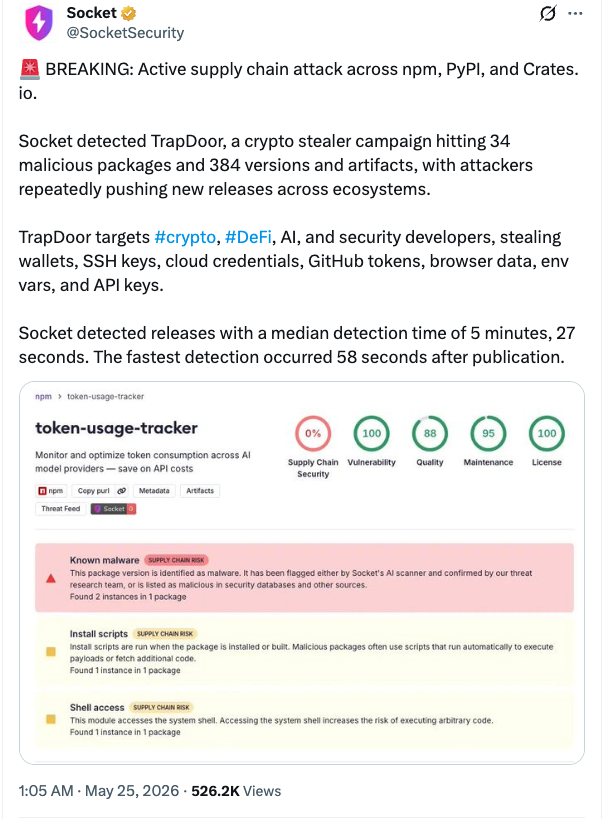
An active supply chain attack is targeting crypto and artificial intelligence developers in a bid to steal crypto, data or credentials, says the developer platform Socket.
Socket said in a report on Sunday that it discovered the malware campaign, which it dubbed “TrapDoor,” on Friday, and the campaign has deployed more than 34 malicious packages and 384 related versions, with attackers repeatedly pushing new releases across ecosystems.
TrapDoor targets crypto, decentralized finance, AI, and security developers, stealing wallet data, Secure Shell, or SSH keys, cloud credentials, GitHub tokens, browser extension data and API keys, Socket said.
The malware also targets popular crypto wallets, including Coinbase, Binance, Solana, Sui, Aptos, and MetaMask in addition to the Brave internet browser, Socket chief technology officer Ahmad Nassri said on Sunday.
Nassri said the malware injects hidden instructions to “hijack your AI coding assistant,” targeting Claude and Cursor. “The goal appears to be to trick AI assistants into running a ‘security scan’ or similar workflow that causes secret discovery and exfiltration,” Socket said.
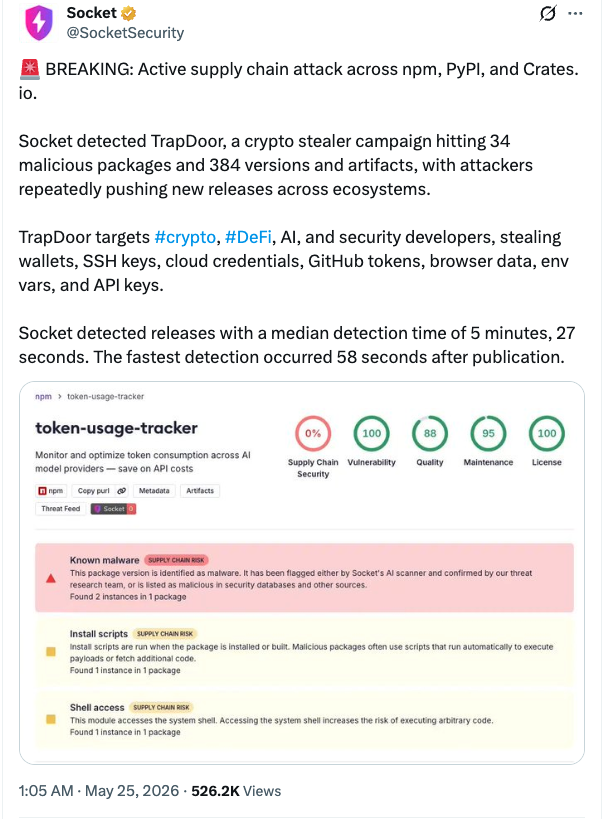
Source: Socket
Crypto and AI developers have increasingly become targets as malicious actors have been loading poisoned packages into “app stores” for developers, knowing they will install them as part of their normal workflow, often without checking.
TrapDoor specifically targets popular developer resources such as npm (node package manager), the package store for JavaScript/Node.js developers, the language behind most websites and web apps.
It was also found in PyPI, the equivalent for Python developers, which is widely used in data science, AI, and automation, and Crates, the same thing for Rust developers.
Related: GitHub investigates unauthorized access to internal repositories
The malicious package names are crafted to look like “development helpers, project setup tools, model routing utilities, prompt engineering packages, Solidity tooling, and Sui or Move build helpers,” Socket said.
“This gives the campaign broad reach across adjacent developer communities where crypto wallets, cloud credentials, GitHub tokens, and SSH keys are likely to be present,” it added.
Developer platform GitHub has been used to disseminate the malicious packages, Socket said, adding the attack appeared to be AI-assisted.
“The GitHub activity shows signs of rapid, AI-assisted-style iteration: broad security-themed scaffolding, generic lure repositories, prompt-injection documentation, and partially implemented extraction concepts mixed with working malware components.”
GitHub itself was compromised on May 20 when it reported unauthorized access to its internal repositories following the compromise of an employee’s device.
Magazine: Polymarket seeks Japan entry, Harvard dumps entire ETH position: Hodler’s Digest


After years of research, engineering, and community collaboration, Panther Protocol is now live on Polygon.
This community-driven milestone introduces a new primitive for decentralized finance: programmable privacy — infrastructure designed to enable confidential on-chain interactions while supporting verifiable compliance when required.
The Panther interface is accessible at: https://pantherdao.app
A New Phase for Privacy in DeFi
Panther combines zero-knowledge cryptography, non-custodial architecture, and DAO governance to explore how privacy and accountability can coexist in decentralized environments.
Users interact directly with smart contracts while retaining full control of their assets, with cryptographic proofs generated locally in their own browser or device.
Compliance Without Surveillance
The initial deployment includes a compliance-enabled zone powered by credentials issued by independent providers such as AMLBot via PureFi tooling.
Participants present zero-knowledge attestations on-chain, allowing the protocol to verify eligibility without exposing personal data or transferring identity information to the DAO or protocol infrastructure.
This model demonstrates a path toward privacy-preserving compliance compatible with institutional participation.
Connected to Real DeFi
The system is designed to integrate with existing decentralized liquidity sources, enabling confidential interactions without isolating users from broader DeFi markets.
Panther Reward Points (PRPs)
The network introduces Panther Reward Points (PRPs), a participation-based mechanism that recognizes protocol activity.
Users accrue PRPs through actions such as interacting with privacy-enabled zones and other qualifying protocol interactions, according to rules defined by Panther DAO governance.
PRPs are intended to support long-term ecosystem participation and alignment as Panther infrastructure develops across additional chains and integrations.
Built for the Long Term
Panther’s architecture includes Forensic Data Escrow, enabling governed disclosure of encrypted metadata under defined conditions, alongside a roadmap that includes:
- Multi-chain expansion
- Additional integrations and adapters
- New zones and participation models
A grant approved by Panther DAO will support open-source development work intended to enable a potential future community deployment on Base.
About Panther Protocol Foundation
Panther Protocol Foundation is a non-profit organization that supports the ecosystem through research funding, open-source development grants, and ecosystem initiatives.
The Foundation does not operate the protocol, deploy smart contracts, host interfaces, custody assets, or provide financial or digital asset services.For more information, visit www.panther.org
The post Programmable Privacy Is Live: Panther Protocol Deploys on Polygon appeared first on BeInCrypto.

Crypto has never been just about money. It’s about moments—short-lived bursts of coordination where attention, incentives, and speculation collide to create what can only be described as temporary economies.
These economies don’t behave like traditional markets. They emerge fast, scale brutally, and often dissolve just as quickly. Yet in their brief existence, they move billions, shape narratives, and test the limits of human behavior at internet speed.
Let’s break down what they are, why they exist, and what they’re quietly teaching us about the future of digital finance. ⚡
What Are “Temporary Economies”?
A temporary economy in crypto is a short-lived financial ecosystem built around incentives designed to expire or decay rapidly.
They typically form around:
- Token launches or airdrops
- Liquidity mining programs
- GameFi reward cycles
- NFT mints and hype windows
- Points systems and “seasonal” campaigns
- Viral DeFi incentive loops
At their core, they are coordination machines powered by incentives, not long-term productive structures.
Unlike traditional economies, they don’t assume permanence. They assume velocity.
Why Crypto Keeps Creating Them
Crypto is uniquely suited to temporary economies for a few structural reasons:
1. Incentives Are Programmable
Smart contracts allow projects to write behavior into existence literally. Reward trading? Done. Reward liquidity? Easy. Reward attention? Increasingly common.
This makes experimentation cheap—and failure fast.
2. Capital Is Highly Mobile
In traditional finance, capital moves slowly through regulation, friction, and trust barriers.
In crypto, capital moves like water on a hot pan.
If yields appear somewhere else, liquidity evaporates instantly.
3. Attention Is the Real Currency
Many crypto ecosystems are not competing for users—they’re competing for attention cycles.
Temporary economies are often just sophisticated attention traps wrapped in financial incentives.
4. Speculation Is the Default Behavior
Let’s be honest: most participants aren’t farming “protocol growth.” They’re farming asymmetry—the chance that early entry beats later exit.
That expectation alone creates the conditions for short-lived economies.
The Anatomy of a Temporary Economy
Most of these systems follow a predictable lifecycle:
Phase 1: Spark 🔥
A new incentive is introduced:
- Airdrop rumors
- Yield opportunity
- NFT mint
- Points system
Attention floods in.
Phase 2: Acceleration 🚀
Participants rush to:
- Maximize rewards
- Loop capital
- Optimize strategies
- Spread alpha on social platforms
This phase feels like innovation—but it’s usually optimization.
Phase 3: Saturation 🧨
Returns start compressing:
- Too much capital enters
- Rewards dilute
- Fees rise, or benefits decrease
Smart money begins exiting.
Phase 4: Dissipation 🌫️
The incentive ends or loses meaning.
Liquidity leaves.
Attention moves on.
The economy collapses or becomes a shadow of itself.
Why People Keep Coming Back
Despite the predictable lifecycle, participation never slows. Why?
Because temporary economies offer something powerful:
1. Speed of Wealth Discovery
Traditional systems reward patience. Crypto rewards timing.
2. Psychological Engagement
Every cycle feels like:
“This time, I might be early.”
That belief alone is enough to sustain participation.
3. Community Momentum
Temporary economies create intense social bonding:
- Telegram groups
- Twitter threads
- Strategy sharing
- Competitive farming culture
People aren’t just chasing yield—they’re participating in a game of collective timing
The Dark Side: Inevitability of Extraction
Here’s the uncomfortable truth:
Most temporary economies extract more value in attention and capital than they distribute in rewards.
Not always maliciously—but structurally.
Common outcomes include:
- Late entrants subsidizing early exits
- Reward dilution through over-participation
- Token inflation without sustainable demand
- Short-term hype replacing long-term utility
The system doesn’t need to “scam” anyone. It just needs to cycle faster than participants adapt.
Are They All Bad? Not at All.
Temporary economies are not inherently destructive. In fact, they serve important roles:
1. Bootstrapping Liquidity
No liquidity → no network.
Temporary incentives solve the cold-start problem.
2. Market Discovery Mechanisms
They help identify:
- Demand for new primitives
- User behavior patterns
- Product-market fit signals
3. Innovation Stress Testing
They force protocols to prove resilience under:
- Extreme usage spikes
- Arbitrage pressure
- Behavioral chaos
The Evolution: From Temporary to Sustainable
The real challenge in crypto today is not creating temporary economies—it’s graduating from them.
The next generation of protocols will need to:
- Convert attention into retention
- Convert incentives into utility
- Convert speculation into participation
- Replace “yield loops” with “value loops.”
We are slowly moving from:
“Farm and exit” systems
to
“Engage and persist” systems
But the transition is far from complete.
Final Thoughts
Temporary economies are not bugs in crypto—they are features of an experimental financial internet.
They represent:
- Speed over stability
- Incentives over institutions
- Behavior over belief
And while they can feel chaotic, even extractive, they are also the raw material from which more durable systems will eventually emerge.
The real question is not whether temporary economies will disappear.
It’s whether we will learn fast enough to build something that lasts beyond them. 🧠⚡
REQUEST AN ARTICLE
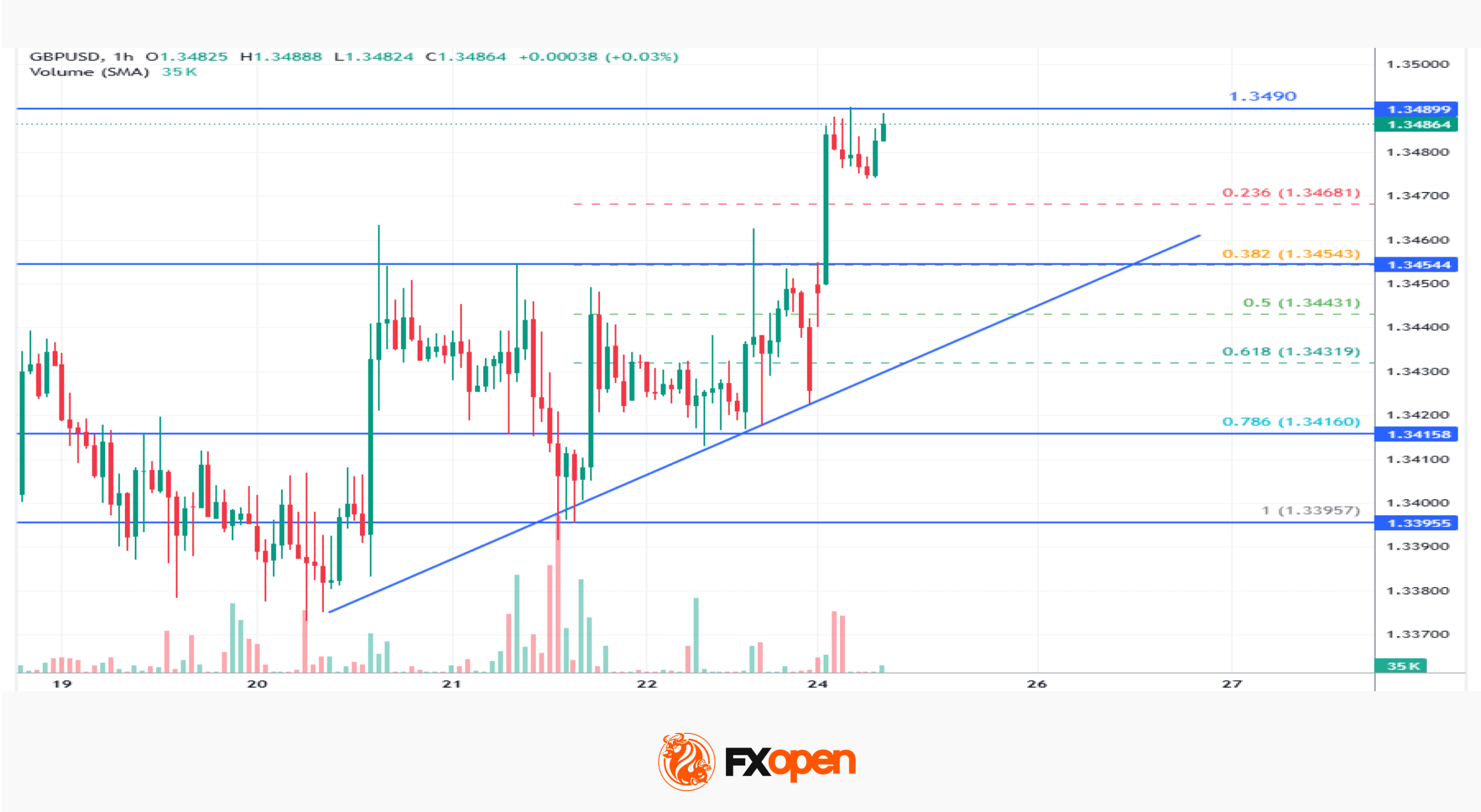
GBP/USD is showing positive signs above 1.3440 and 1.3460. EUR/GBP declined and is now consolidating losses below 0.8680.
Important Takeaways for GBP/USD and EUR/GBP Analysis Today
· The British Pound started a fresh increase above 1.3420 to enter a positive zone.
· There is a bullish trend line forming with support at 1.3450 on the hourly chart of GBP/USD at FXOpen.
· EUR/GBP is trading in a bearish zone below the 0.8660 pivot level.
· There is a connecting bearish trend line forming with resistance near 0.8650 on the hourly chart at FXOpen.
GBP/USD Technical Analysis
On the hourly chart of GBP/USD at FXOpen, the pair remained well-bid above 1.3350. The British Pound started a decent increase above 1.3400 against the US Dollar.
The bulls were able to push the pair above the 50-hour simple moving average and 1.3440. The pair even climbed above 1.3480. A high was formed at 1.3490, and the pair is now consolidating gains above the 23.6% Fib retracement level of the upward move from the 1.3395 swing low to the 1.3490 high.
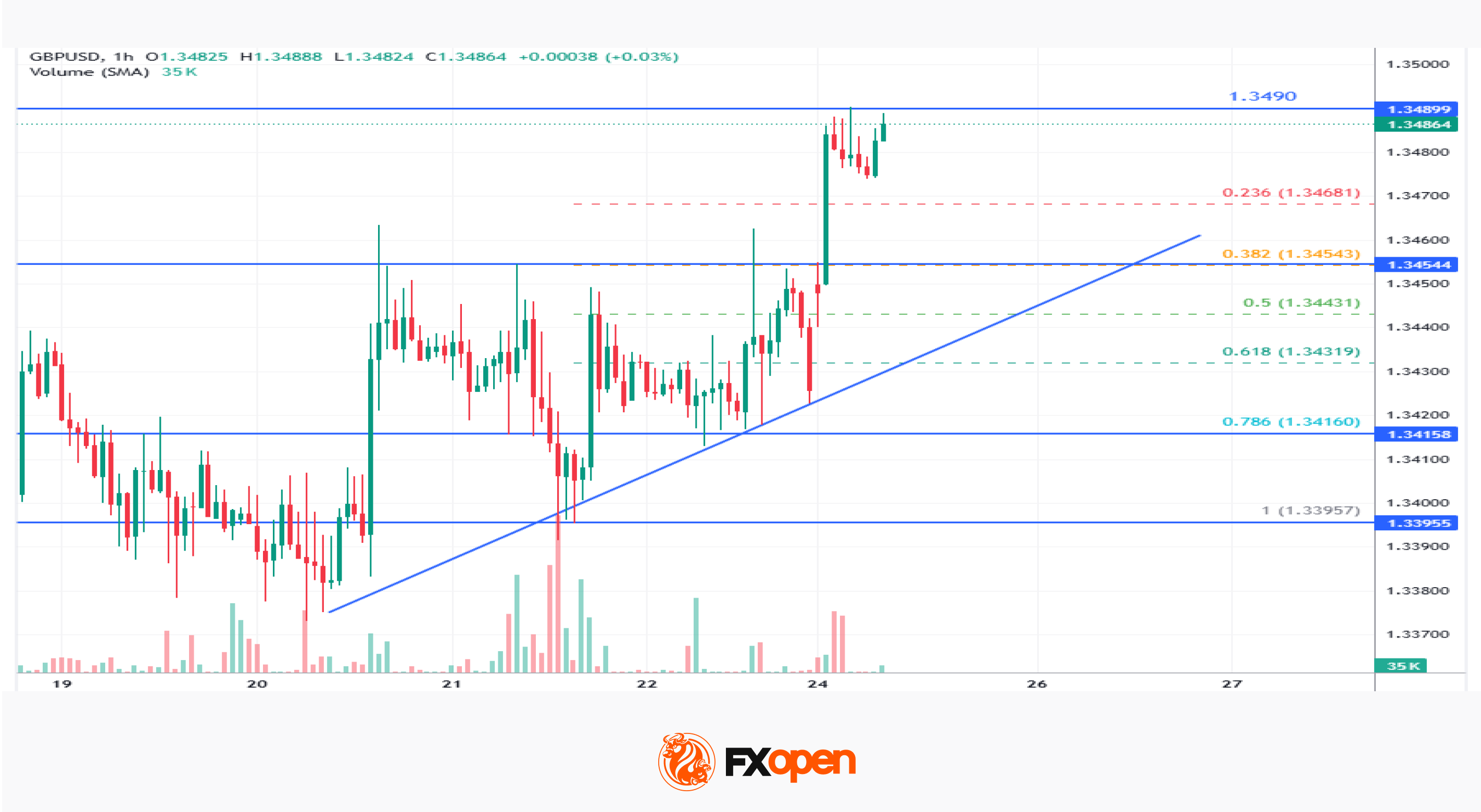
On the upside, the GBP/USD chart indicates that the pair is facing resistance near 1.3490. The next hurdle for the bulls could be 1.3500. A close above 1.3500 could open the doors for a move toward 1.3550. Any more gains might send GBP/USD toward 1.3600.
On the downside, the bulls might remain active near 1.3450. There is also a bullish trend line forming with support at 1.3450. If there is a downside break below 1.3450, the pair could accelerate lower.
The first major support could be at 1.3430 and the 61.8% Fib retracement, below which the pair could test 1.3470. The next key area for the bulls could be 1.3415, below which the pair could test 1.3395. Any more losses could lead the pair toward 1.3350.
EUR/GBP Technical Analysis
On the hourly chart of EUR/GBP at FXOpen, the pair started a steady decline from well above 0.8700. The Euro traded below 0.8680 against the British Pound.
The EUR/GBP chart suggests that the pair even declined below 0.8660 and the 50-hour simple moving average. A low was formed at 0.8630, and the pair is now consolidating losses below the 23.6% Fib retracement level of the downward move from the 0.8730 swing high to the 0.8630 low.
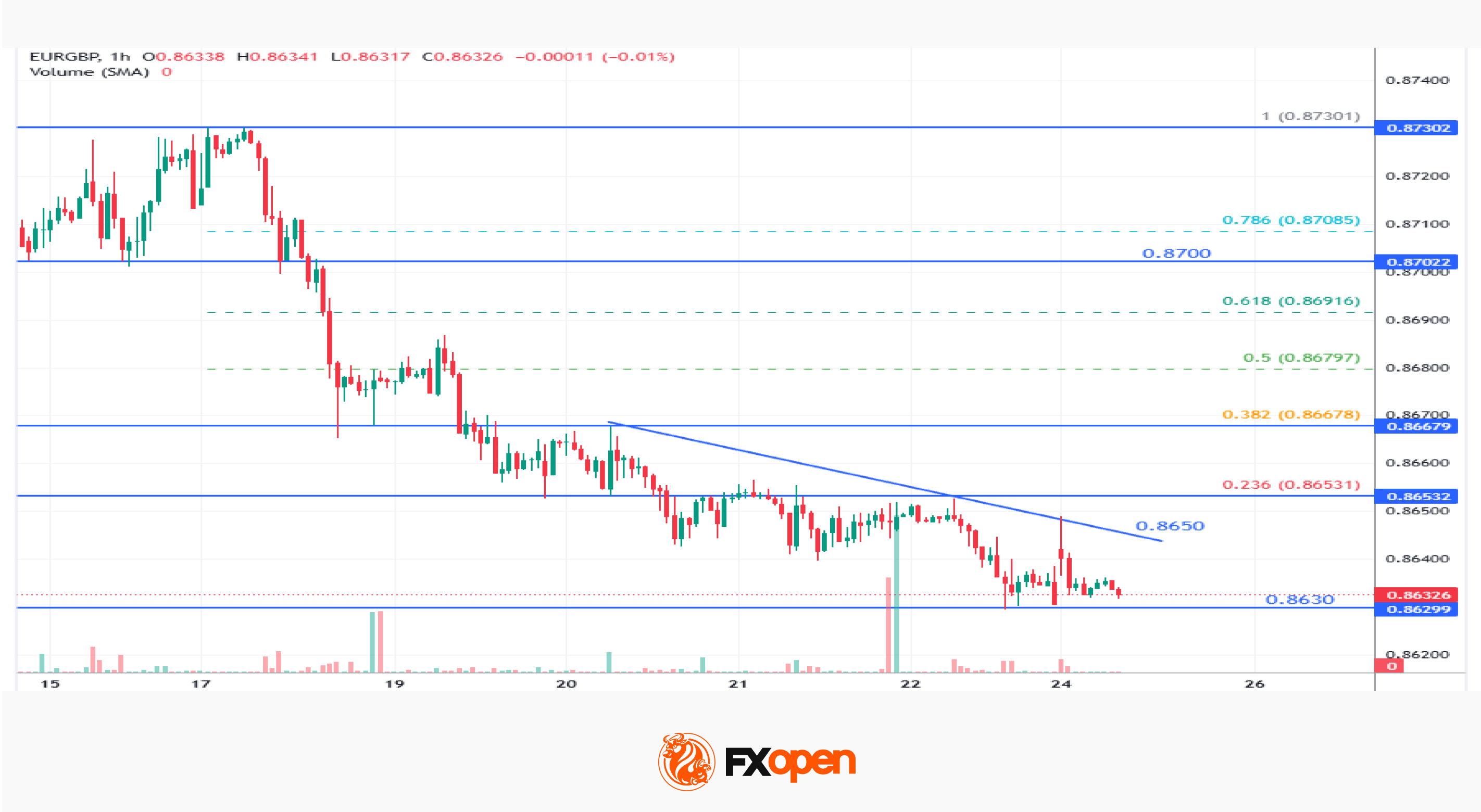
The pair is now facing resistance near a connecting bearish trend line at 0.8650. The next major barrier for the bulls could be 0.8665 and the 38.2% Fib retracement.
A close above 0.8665 might accelerate gains. In the stated case, the bulls may perhaps aim for a test of 0.8670. Any more gains might send the pair toward the 0.8730 pivot. The main hurdle for the bulls might be at 0.8780.
Immediate support could sit near 0.8630. The first key zone migbt be at 0.8600. A downside break below 0.8600 might call for more downsides. In the stated case, the pair could drop toward 0.8565.
Trade over 50 forex markets 24 hours a day with FXOpen. Take advantage of low commissions, deep liquidity, and spreads from 0.0 pips (additional fees may apply). Open your FXOpen account now or learn more about trading forex with FXOpen.
This article represents the opinion of the Companies operating under the FXOpen brand only. It is not to be construed as an offer, solicitation, or recommendation with respect to products and services provided by the Companies operating under the FXOpen brand, nor is it to be considered financial advice.

Novak survives hostile crowd, shaky start to win French Open opener | Other Sports News

Kalshi And Rhode Island Sue Each Other In Latest Challenge To Prediction Markets

WHY $1000 XRP MIGHT HAPPEN SOON!?!


-

 Crypto World4 days ago
Blockchain.com files with SEC for U.S. IPO
-

 Fashion3 days ago
Holiday Weekend Open Thread – Corporette.com
-

 Crypto World3 days ago
Bitcoin Accumulation Weakens as BTC Realized Losses Hit $600M
-

 Business3 days ago
Dell Technologies DELL Stock Surges 15% on AI Server Momentum and Analyst Upgrades in 2026
-

 Crypto World3 days ago
Space X IPO Is ‘Bad News’ for Tech Stocks: But What About Bitcoin?
-

 Politics3 days ago
Makerfield: a tale of two social-media histories
-

 Crypto World2 days ago
Robinhood crypto COO Tanya Denisova exits
-

 Crypto World3 days ago
MicroStrategy’s Saylor Says Miners No Longer Set Bitcoin Price, Another Force Has Taken Over
-

 Business16 hours ago
NYT Strands Answers May 24 2026 Revealed for Puzzle No. 812 Theme Summer Essentials
-
 Tech3 days ago
A 0.12% parameter add-on gives AI agents the working memory RAG can’t
-

 Tech3 days ago
WhatsApp ads could make Irish debut after discussions with DPC
-

 Crypto World3 days ago
AI infrastructure race heats up as IREN pitches full-stack strategy, WhiteFiber lands $160M deal
-

 Tech3 days ago
You Can Now Add ChatGPT To PowerPoint
-

 Business3 days ago
Trump Invests $1M-$5M in Kura Sushi USA Chain With 27 California Locations
-
 Crypto World7 days ago
Revolut Launches Dogecoin Debit Card Across UK and EU
-
 NewsBeat4 days ago
Charity run by Reform leader Malcolm Offord accused of ‘law breaking’ over Scottish registration
-

 Sports3 days ago
2026 CJ Cup Byron Nelson leaderboard: Brooks Koepka finds putting stroke in Round 1
-
Business3 days ago
Goldman Sachs reinstates Ageas stock coverage with neutral rating
-

 Crypto World5 days ago
Exa Labs raises $250 million in funding led by a16z
-

 Crypto World3 days ago
Trump Media’s Bitcoin Stash Shrinks Again as 2,650 BTC Lands on Crypto.com
You must be logged in to post a comment Login