
Crypto World
Red Cross Deploys Blockchain-Based Digital Aid Platform


Creu Roja (Spanish Red Cross) has revealed a novel, privacy-preserving, digital aid platform based on blockchain, with verifiable donor transparency.
According to the press release, Barcelona-based technical infrastructure company BLOOCK collaborated on the platform’s development.
The new product integrates enterprise IT systems with blockchain. Developers utilised Ethereum on the public blockchain side, as well as Solidity smart contracts for ERC-20-based credit issuance.
Among other tech points, they noted Ionic for the mobile wallet, and “role-based access control with digital signatures throughout.”
The announcement claims that the construction “ensures that even if external systems were compromised, the blockchain itself contains no exploitable personal information.”
Moreover, Creu Roja deploys the zero-knowledge technology by the human and AI verification platform Billions Network (formerly Polygon ID). The platform digitises the entire aid lifecycle from donation to disbursement, promising that “no personal data ever touches the public blockchain.”
The goal is to provide donors with complete traceability and financial transparency, while preserving the privacy and dignity of recipients.
Therefore, RedChain’s hybrid trust model enables all aid recipients’ information to be kept entirely off-chain in Creu Roja’s controlled systems. Spending data also stays off-chain, with corresponding on-chain verification hashes. “The complete audit trail can be reconstructed from on-chain proofs without ever exposing personal data,” the developers claim.
Francisco López Romero, CTO at Creu Roja, Catalunya, commented that “people seeking assistance shouldn’t have to choose between getting help and protecting their privacy.” Therefore, the organisation designed this new system “so donors can verify their contributions made a real difference, and beneficiaries can access support without fear of being tracked, profiled, or stigmatised.”
Replacing Manual and Paper-Based Processes
The announcement highlighted that the novel platform simplifies the entire process. It removes the traditional paper-based workflows and prepaid cards. Instead, a digital system “separates what donors need to know from what they don’t.”
Recipients do not need a bank account or credit history, Creu Roja says. They receive digital aid credits in the form of ERC-20 tokens on Ethereum smart contracts. These tokens land directly into personal mobile wallets.
Also, nothing marks these credits as “aid.” Recipients spend them via QR codes at authorised local merchants “in transactions indistinguishable from any normal purchase.”
At the same time, donors and administrators can follow aggregated aid flows in real time. This enables them to see the allocated amount, the spent amount, and where each euro went, the organisation says.
Why Is This Platform Needed?
Creu Roja noted that there is growing scrutiny of international aid delivery. Affected communities can’t receive proper and effective assistance due to a lack of transparency, corruption, and favouritism.
And even though blockchain solutions existed prior to this platform’s implementation, most require recipients to give up their personal data, including biometrics.
What this may lead to, even if unintentionally, is to vulnerable populations being exposed to surveillance, profiling, and discrimination, Creu Roja says.
“The BLOOCK’s approach demonstrates how humanitarian organisations can combine accountability, privacy, and digital efficiency without introducing new risks for the people they serve,” the press release says.
— Creu Roja Catalunya (@CreuRojaCAT) February 2, 2026
 Descobreix en el Digital Solidari de gener les nostres accions humanitàries més destacades del mes.https://t.co/LHXbPf3wlK pic.twitter.com/eDF5bGcGS1
Moreover, per Evin McMullen, CEO and co-founder at Billions Network, Creu Roja built a credential system, not a surveillance one.
“Recipients hold proof of their eligibility in their own wallet. They present it when needed, reveal nothing else, and move on with their lives. That’s how identity should work everywhere and especially in humanitarian and public-interest systems. You own your credentials, you decide what to share, and no one builds a profile on you without your consent,” he writes.
Lluís Llibre, CEO of BLOOCK, added that “blockchain should certify truth, not store content.” This is what the platform’s architecture enables. “Every transaction generates a cryptographic proof that’s permanently anchored and independently verifiable, but the proof contains no personal information.”
Meanwhile, the announcement said that the BLOOCK platform processed more than 952,000 cryptographic transactions and over 257,000 data validations to date.
The post Red Cross Deploys Blockchain-Based Digital Aid Platform appeared first on Cryptonews.

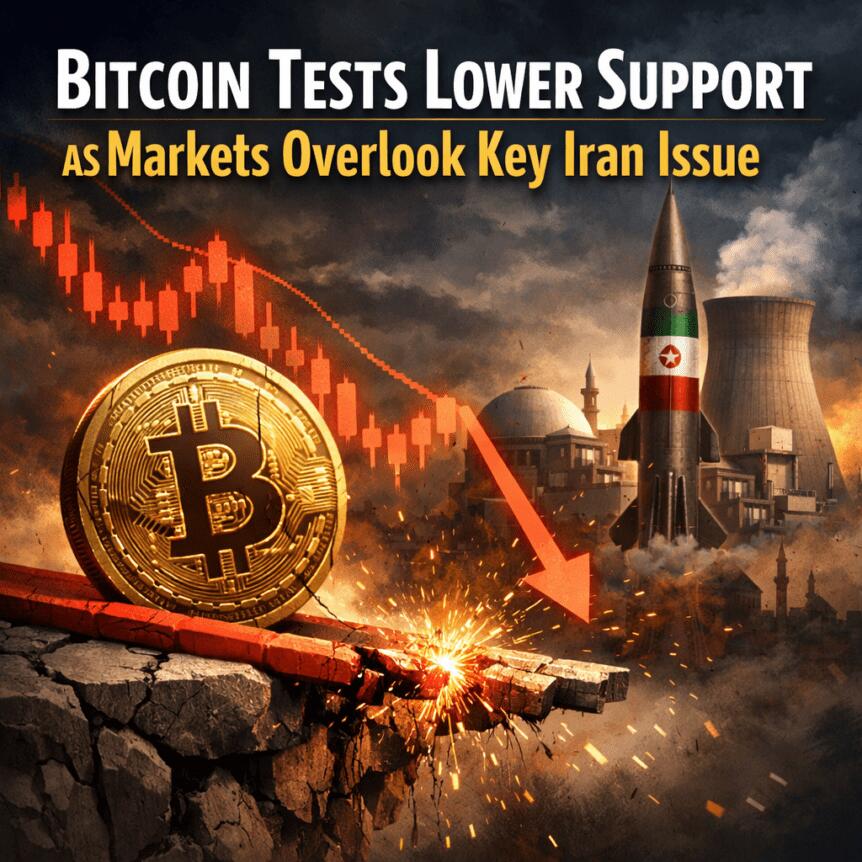
Bitcoin traded near $74,000 as U.S. markets opened, extending a cautious relief rally as investors weighed potential renewed ceasefire talks between the U.S. and Iran. The broader risk-on backdrop supported U.S. equities, with the S&P 500 approaching record territory, while oil prices cooled on bets that geopolitical tensions could ease.
Analysts cautioned that the move might be fragile. While geopolitical headlines offered relief, the underlying tensions—particularly Iran’s uranium enrichment program—remain unresolved. Market observers noted the absence of a clear macro shift, and options markets did not show unambiguous signals of a fresh Bitcoin breakout.
Key takeaways
- Bitcoin hovered in the mid-70,000s, with a recent test near 76,000 forming an “equal high” rather than a decisive breakout.
- Stocks climbed toward earlier highs, and WTI crude slipped, but the relief rally is viewed as temporary unless durable progress appears on Iran’s enrichment and broader macro risks.
- QCP Capital warned that the market is discounting the blockade’s impact but has not seen a lasting consolidation; enrichment remains the core sticking point.
- Traders described Bitcoin as “decision time,” with consolidation in place and the options market not fully confirming a clean breakout.
Geopolitics and markets feed crypto sentiment
On the geopolitical front, U.S. President Donald Trump claimed in Truth Social that China opted not to supply weapons to Iran, a development traders weighed as part of a broader diplomatic signal. The comments, alongside lingering tensions around the Strait of Hormuz, contributed to a mixed risk appetite as WTI crude traded below the $90 threshold and the precious metals and debt markets offered mixed directions.
Meanwhile, the S&P 500 reclaimed its yearly open level on Monday and rose to intraday highs near 6,988, closing in on fresh all-time levels. In notes on the stance of markets, QCP Capital emphasized that while equities rebounded and oil softened, the real test lies in the durability of the relief rally. In their Market Color update, the firm cautioned:
“Long-end yields barely budged, gold held its levels, and the bond market, which should be front-running an inflation relief trade more aggressively, did not follow through. When oil drops and the 10-year barely twitches, rates are telling you this is a reduction in headline risk, not a genuine resolution.”
Analysts stressed that Iran’s uranium enrichment remains the core sticking point. Reports indicate Iran continues with elevated enrichment levels, around 60%, far above U.S. demands to keep it below 20%. The gap suggests that headlines alone may not translate into a lasting accord unless Tehran signals meaningful concessions.
As the week unfolds, the market appears to price in relief from geopolitical frictions while maintaining vigilance over the longer-term risk this scenario still poses to energy prices, inflation expectations, and risk assets alike.
Bitcoin’s “decision time” on the charts
Bitcoin’s price action has drawn careful scrutiny from traders who argue that the latest move is more about consolidation than a fundamental breakout. The bounce above the March high of around $76,000 drew commentary from market observers who characterized it as an “equal high” rather than a sweep of previous tops. “Liquidity games still in play,” noted trader Jelle, who added that BTC “technically tagged those previous highs” but did not convincingly clear them, suggesting the move could reverse swiftly unless a clean breakout occurs.
“Liquidity games still in play. BTC technically tagged those previous highs — but I’m viewing this as an equal high rather than a sweep, barely went above it. Keep an eye out for a real sweep above there; that’ll likely catch a lot of traders off guard.”
Other voices urged caution. Daan Crypto Trades summarized that BTC/USD has touched the 76k level and is now in a consolidation phase with a slow, marginally higher trajectory since the start of April. QCP Capital echoed this sentiment, noting that while price action has been “grinding higher,” the options market has not confirmed a clean breakout and the broader regime remains unchanged: the Fed’s stance remains restrictive, and liquidity conditions stay tight. In their words:
“The broader regime has not changed. The Fed is still boxed in, sitting near zero net cuts for the year after the oil shock repriced the easing path, while liquidity conditions remain tight. This is a geopolitical relief rally, not a macro regime shift.”
What comes next for BTC and risk assets
With the macro environment still driven by geopolitical headlines and central-bank policy uncertainty, Bitcoin’s next move hinges on whether relief translates into durable momentum. The market appears to be pricing in a temporary easing of the energy-price premium, but the absence of a confirmed breakout implies that traders should brace for ongoing volatility unless there is credible progress on Iran’s nuclear talks that could alter the risk landscape.
For investors, the key signals to watch include a sustained upside beyond the 76,000 level with broad participation across volatility and derivative markets; a synchronized move across equities, bonds, and commodities; and any tangible progress in talks over Iran’s nuclear program that could alter risk appetite. Until those elements converge, the current rally may reflect tactical repositioning rather than a structural shift in the crypto market.
As geopolitical developments continue to evolve, readers should stay alert to policy cues and headline risk that can rapidly reframe risk tolerance for crypto plays.
In the near term, the market’s focus remains on whether a credible breakthrough is achieved on Iran-related tensions and how such a development would influence liquidity and risk assets, including Bitcoin.
Crypto World
Zoomex Launches ZoomexStocks: Trade Global Equities with USDT + Limited-Time Fee Rebate Campaign


Crypto trading platform Zoomex today officially announced the launch of ZoomexStocks, enabling users to trade global equity assets directly using USDT—without the need for a traditional brokerage account.
At launch, 12 major U.S. equity-related assets are available, covering leading tech stocks, core indices, and crypto-related equities, including Apple, Tesla, and NVIDIA. Users can start trading with as little as 5 USDT.
To celebrate the launch, Zoomex is introducing a limited-time trading fee rebate campaign, offering up to 100 USDT in rebates to further lower the barrier to entry.
Breaking Traditional Barriers: A Stock Trading Experience Designed for Crypto Users
ZoomexStocks introduces a new way to access equity markets—distinct from traditional brokerage systems—allowing users to manage both crypto and stock exposure within a single account:
• No brokerage account required — trade directly with an existing Zoomex account
• No fiat deposits needed — supports USDT / USDC trading
• Simplified workflow — no platform switching or cross-border transfers
This product is purpose-built for crypto-native users, enabling frictionless access to global markets.
Three Core Asset Categories
The initial launch includes three categories to support diverse trading strategies:
Tech Stocks
Apple (AAPLx), Tesla (TSLAx), Alphabet (GOOGLx), NVIDIA (NVDAx), Meta (METAx), Amazon (AMZNx)
Index Assets
Nasdaq (QQQx), S&P 500 (SPYx)
Crypto-Related Stocks
MicroStrategy (MSTRx), Robinhood (HOODx), Circle (CRCLx), Coinbase (COINx)
With a unified account, users can seamlessly manage cross-asset allocation and strategy execution within a single platform.
Transparent Pricing & Liquidity Design
ZoomexStocks uses a price-mirroring mechanism based on real market data, referencing major exchanges such as Nasdaq and NYSE:
• Real-time price synchronization to minimize deviation
• Profit and loss calculated based on price movements
• Buy and sell anytime for enhanced liquidity
Note: ZoomexStocks provides exposure to the price performance of underlying assets and does not represent direct ownership of equities.
24/7 Trading: Beyond Traditional Market Hours
Unlike traditional stock markets, ZoomexStocks supports 24/7 trading, allowing users to:
• Position ahead of weekends
• React instantly to macro or industry news
• Dynamically hedge between crypto and equity assets
This model offers greater flexibility and aligns with the always-on nature of crypto markets.
Limited-Time Trading Fee Rebate Campaign
To encourage users to explore the new product, Zoomex is launching a promotional campaign:
• 100% rebate on stock token trading fees during the campaign
• Maximum rebate per user: 100 USDT
• Total prize pool: 50,000 USDT
• Rewards distributed within 7 working days after the campaign ends
Users must register for the campaign to qualify – it is possible to join here.
A Zoomex product lead commented:
“ZoomexStocks is not about replicating traditional brokerages—it’s about offering crypto users a more intuitive way to access global assets.”
“By lowering barriers and simplifying the process, we aim to enable users to manage multi-asset portfolios within a single platform.”
For more information about Zoomex US stock-related assets, please visit
About ZOOMEX
Founded in 2021, Zoomex is a global cryptocurrency trading platform with over 3 million users across more than 35 countries and regions, offering 700+ trading pairs. Guided by its core values of “Simple × User-Friendly × Fast,” Zoomex is also committed to the principles of fairness, integrity, and transparency, delivering a high-performance, low-barrier, and trustworthy trading experience.
Powered by a high-performance matching engine and transparent asset and order displays, Zoomex ensures consistent trade execution and fully traceable results. This approach reduces information asymmetry and allows users to clearly understand their asset status and every trading outcome. While prioritizing speed and efficiency, the platform continues to optimize product structure and overall user experience with robust risk management in place.
As an official partner of the Haas F1 Team, Zoomex brings the same focus on speed, precision, and reliable rule execution from the racetrack to trading. In addition, Zoomex has established a global exclusive brand ambassador partnership with world-class goalkeeper Emiliano Martínez. His professionalism, discipline, and consistency further reinforce Zoomex’s commitment to fair trading and long-term user trust.
In terms of security and compliance, Zoomex holds regulatory licenses including Canada MSB, U.S. MSB, U.S. NFA, and Australia AUSTRAC, and has successfully passed security audits conducted by blockchain security firm Hacken. Operating within a compliant framework while offering flexible identity verification options and an open trading system, Zoomex is building a trading environment that is simpler, more transparent, more secure, and more accessible for users worldwide.
For more info: ZOOMEX Website | X | Telegram | Discord
The post Zoomex Launches ZoomexStocks: Trade Global Equities with USDT + Limited-Time Fee Rebate Campaign appeared first on BeInCrypto.
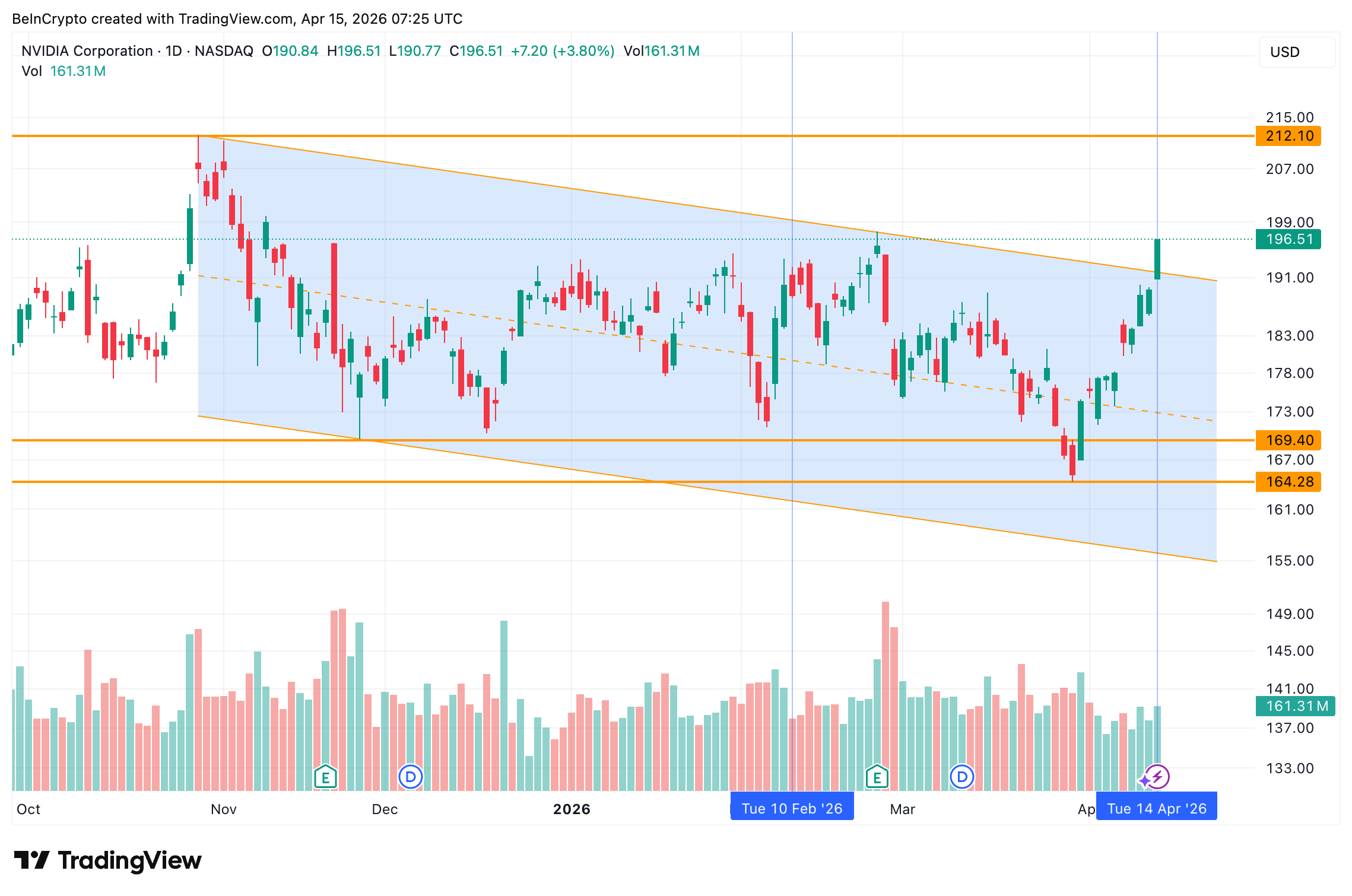
Nvidia (NVDA) stock price closed April 14 at $196.51, up 3.80%, marking a 4-day winning streak. The move broke NVDA out of a falling channel that had held since late October.
Yet a proprietary indicator reveals something the price chart alone does not show. The broader semiconductor sector has been gaining strength far faster than Nvidia itself. NVDA appears to have been carried to its breakout rather than leading it.
Channel Break With Volume as Three Green Bars Confirm the Push
Nvidia stock price has traded inside a falling channel on the daily chart since October 29, 2025. Every rally attempt over the past six months stalled at the channel’s upper trendline before reversing.
That changed on April 14. NVDA broke above the channel’s upper boundary with four consecutive green volume bars. Volume hit 161.31 million shares on the breakout candle. The rising sequence confirms that buying pressure built progressively rather than arriving in a single spike.
Want more insights like this? Sign up for Editor Harsh Notariya’s Daily Newsletter here.
The breakout is structurally significant. It marks the first clean exit from the bearish channel since NVDA peaked in late October. However, a channel breakout only tells half the story. The question is whether Nvidia earned this move on its own merits or was pushed through by a broader force. And can the breakout even hold?
The Chip Sector Outran Nvidia and Dragged It to a Breakout
BeInCrypto’s NVDA versus SOXX Relative Performance indicator is a proprietary tool. It normalizes both to a common baseline and tracks which is gaining faster in real time.
The VanEck Semiconductor ETF (SOXX), a fund that tracks the broader chip sector, currently reads on the normalized scale. NVDA sits lower. The gap has been widening since February 10. Between February 10 and April 14 another thing happened. SOXX trended higher while NVDA trended lower on the relative scale. Yet NVDA stock still broke out.
A similar gap-widening happened in late November as SOXX led NVDA. This eventually helped the Nvidia share price avoid a drop under $169.47.
The implication is clear. The sector was fueled by TSMC’s record earnings, CoreWeave’s AI deals, and soft PPI data.
That created enough upward force to lift even its underperformer through resistance.
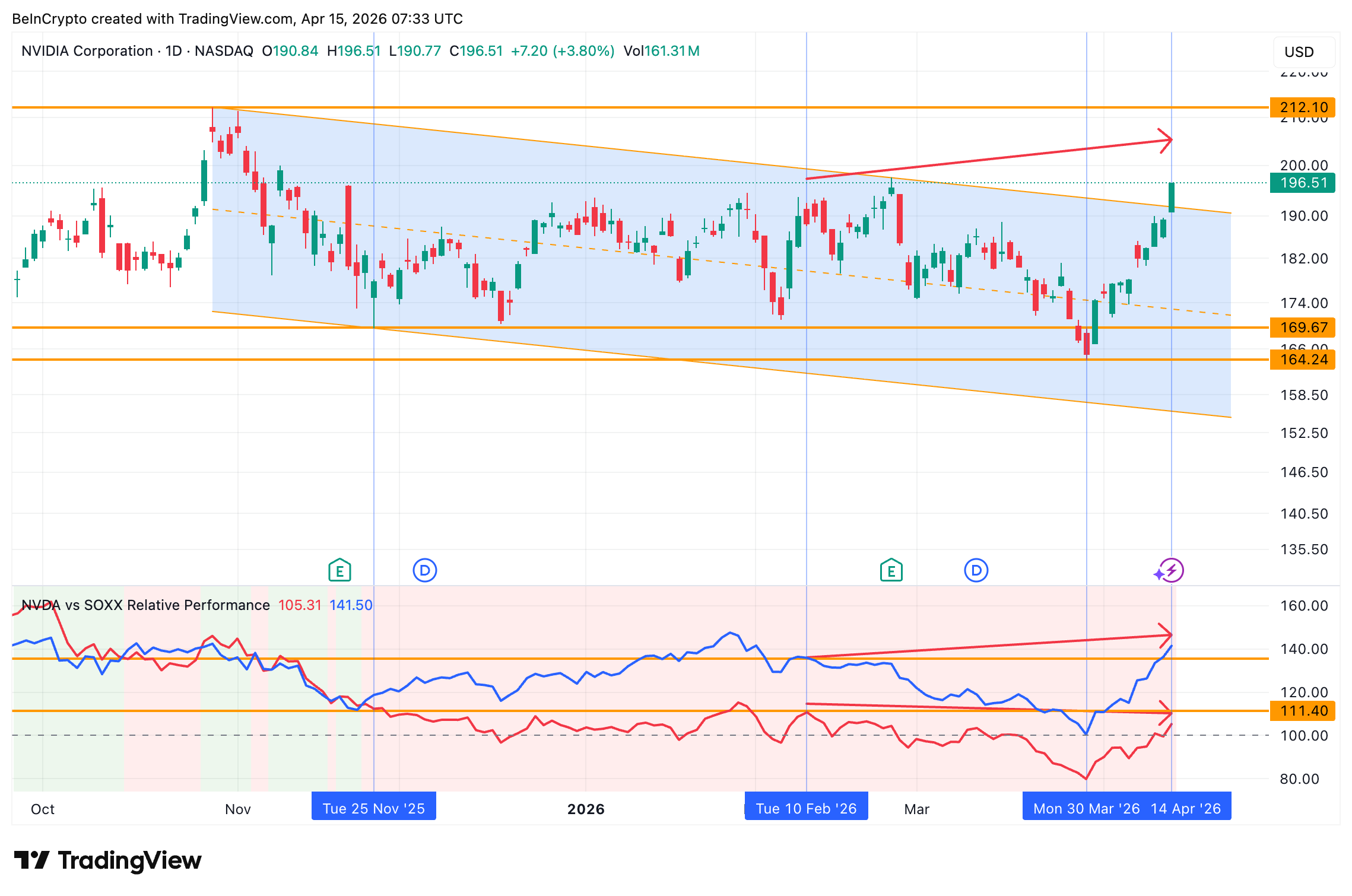
The year-to-date numbers confirm the gap. SOXX is up roughly 28% in 2026. NVDA has gained just 4%. The chip sector outpaced Nvidia by 24 percentage points.
Meanwhile, options positioning on NVDA reflects cautious optimism rather than outright conviction. On February 10, the put-call volume ratio, which compares bearish bets against bullish bets, stood at 0.69.
As of April 14, it has dropped to 0.41. Call activity is rising, but the open interest ratio held steady near 0.85. That means traders are adding new bullish bets without unwinding existing hedges. The positioning mirrors the SOXX story. Money is flowing in, but with protection still in place.
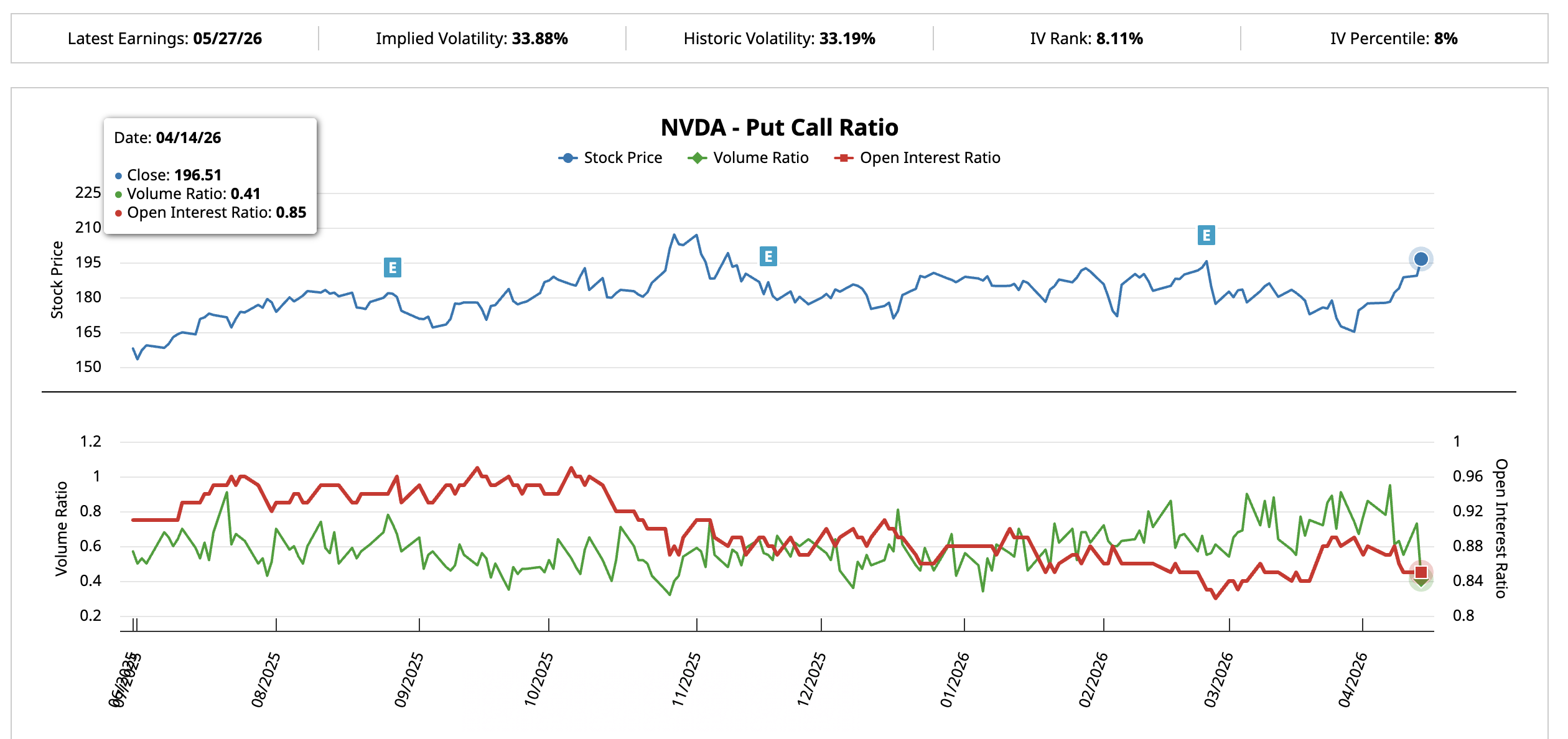
The sector tailwind and cautious options positioning both support the breakout. However, without NVDA closing the performance gap with SOXX, the rally risks being a passenger’s ride.
Nvidia Stock Price Levels That Decide If the Breakout Holds
The daily price chart maps where Nvidia stock price must deliver. NVDA has broken above $193.88, the 0.618 Fibonacci level. That zone was rejected earlier in 2026 and has been reclaimed until now.
Holding above $193.88 keeps the breakout intact. The next target sits at $201.92, the 0.786 Fibonacci, just 2.84% above the current price. That level also aligns with the psychological $200 mark. Beyond $200, $212.17 comes into focus, matching the October high.
Yet with NVDA lagging the sector by 24 points, conviction at higher prices depends on closing that gap. If SOXX stalls and NVDA keeps climbing, leadership shifts. If SOXX keeps rising while NVDA flatlines, however, the sector-driven lift fades.
Nvidia stock price support sits at $188.23, the 0.5 Fibonacci level. A loss of that exposes $182.58. However, the channel breakout only fully weakens below $164.28.
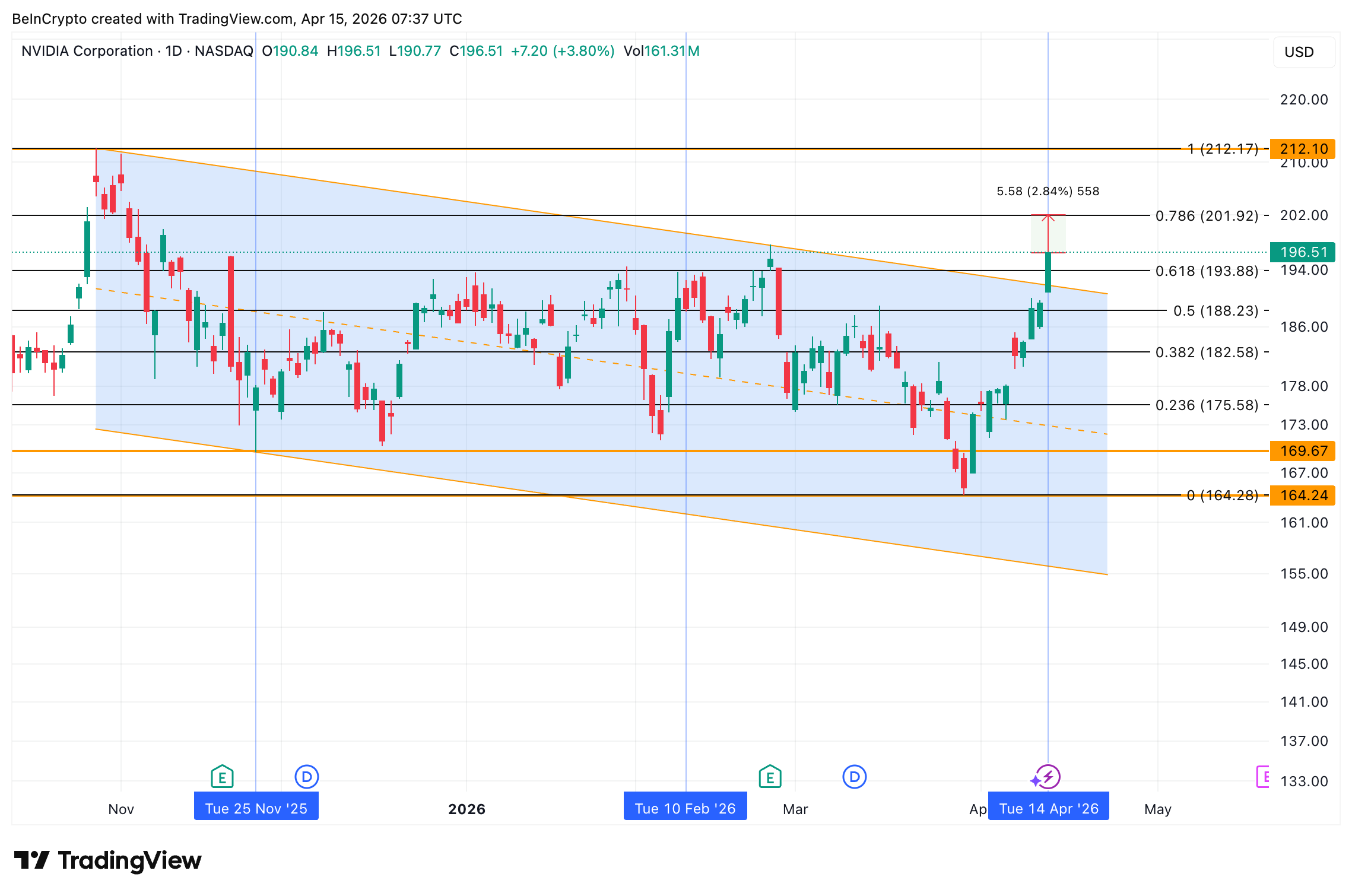
A daily close above $201.92 confirms the breakout has legs. A drop below $193.88 sends NVDA back into the range the chip sector spent six months pushing it out of.
The post Nvidia Rode the Chip Sector to a 6-Month Breakout: Can It Lead Now? appeared first on BeInCrypto.
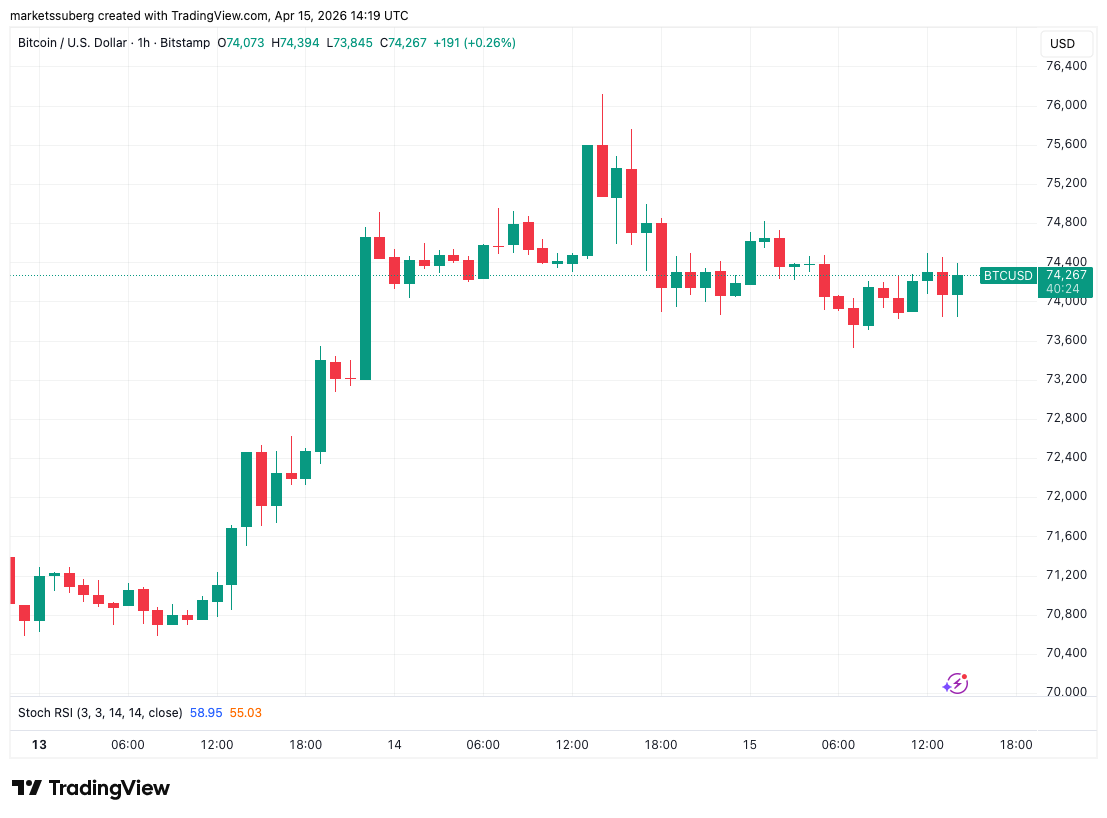
Bitcoin (BTC) circled $74,000 at Wednesday’s Wall Street open as US stocks edged higher on news that the US and Iran may be open to another round of ceasefire negotiations.
Key points:
-
Bitcoin consolidates as analysts warn that stocks may be too optimistic over geopolitical relief.
-
The S&P 500 approaches new all-time highs despite questions over Iran’s uranium enrichment.
-
Bitcoin traders note missing components to support a true trend change.
Iran conflict lacks “genuine resolution”
Data from TradingView showed declining BTC price volatility after a trip to two-month highs the day prior.

Stocks continued a recovery on the day as US President Donald Trump said that China had opted not to send weapons to Iran.
“China is very happy that I am permanently opening the Strait of Hormuz. I am doing it for them, also – And the World,” he wrote in a post on Truth Social.
“This situation will never happen again. They have agreed not to send weapons to Iran.”

President Trump referenced the ongoing blockade of the Strait of Hormuz, a key global oil gateway, as WTI crude dropped below $90 to a new April low on the day.
Commenting, trading company QCP Capital was cautious about discounting the ongoing impact of the US-Iran war.
“Equities recovered, oil sold off, and crypto caught a bid. But the more important signal was what failed to confirm the move,” it wrote in its latest “Market Color” update.
“Long-end yields barely budged, gold held its levels, and the bond market, which should be front-running an inflation relief trade more aggressively, did not follow through. When oil drops and the 10-year barely twitches, rates are telling you this is a reduction in headline risk, not a genuine resolution.”

QCP pointed to Iran’s uranium enrichment as a sticking point in the process of diffusing geopolitical tensions.
“The reason is enrichment. Iran is at 60% enriched uranium, while the US wants levels below 20%. That gap does not close with a framework headline. It closes with a concession Tehran has not signalled it is prepared to make,” it continued.
“Previous ceasefires have lasted weeks, while the enrichment issue has remained unresolved since 2015. Markets are trading the former, but the latter still sits at the core of the risk.”

On Monday, the S&P 500 reclaimed its yearly open level, going on to hit local highs of 6,988 on the day, coming within 15 points of new all-time highs.
BTC price “decision time” due
Bitcoin traders preserved earlier skepticism over market strength.
Related: Oil price surges 8% on Iran tensions: Five things to know in Bitcoin this week
Trader Jelle described the latest trip to $76,000 as an “equal high” that “barely went above” February’s peak.
Liquidity games still in play.$BTC technically tagged those previous highs – but I’m viewing this as an equal high rather than a sweep, barely went above it.
Keep an eye out for a real sweep above there; that’ll likely catch a lot of traders off guard. pic.twitter.com/dxO9cgDRY3
— Jelle (@CryptoJelleNL) April 15, 2026
“Bias remains down, but doubt shorts get a free ride from here,” he added in another of his latest posts on X.
Daan Crypto Trades, meanwhile, predicted that BTC/USD would soon face “decision time.”
“Price tapped the $76K high from March and is consolidating in this area currently. Low timeframe grind higher since the start of April which has been making some marginally higher highs and lows,” he summarized to X followers.

QCP also noted price action “grinding higher,” while warning that options markets were “not confirming a clean breakout.”
“The broader regime has not changed. The Fed is still boxed in, sitting near zero net cuts for the year after the oil shock repriced the easing path, while liquidity conditions remain tight,” it concluded.
“This is a geopolitical relief rally, not a macro regime shift. Last week’s trade was to fade the blockade. This week’s question is whether investors should fade the relief.”
This article is produced in accordance with Cointelegraph’s Editorial Policy and is intended for informational purposes only. It does not constitute investment advice or recommendations. All investments and trades carry risk; readers are encouraged to conduct independent research before making any decisions. Cointelegraph makes no guarantees regarding the accuracy or completeness of the information presented, including forward-looking statements, and will not be liable for any loss or damage arising from reliance on this content.


Bitcoin developers and researchers have proposed a mechanism to freeze coins vulnerable to quantum computing attacks as an incentive for users to upgrade their security.
Bitcoin developers and researchers proposed BIP-361, a mechanism to freeze quantum-vulnerable coins as a private incentive for users to upgrade their security posture. The proposal, published Wednesday, aims to address the long-term threat posed by quantum computing to legacy Bitcoin addresses that lack quantum resistance.
According to the proposal authors, freezing lost or abandoned quantum-vulnerable coins would effectively increase the relative value of all other coins in circulation by reducing the total active supply. The mechanism is designed to encourage voluntary migration to quantum-resistant address formats before quantum computing capabilities advance to a point where they pose an active threat to the Bitcoin network.
Sources: Cointelegraph
This article was generated automatically by The Defiant’s AI news system from publicly available sources.

More than 420 million people now hold cryptocurrency worldwide — yet the overwhelming majority still trade manually, emotionally, and inconsistently. The result is predictable: they buy tops, sell bottoms, and hand their edge to the market every single cycle.
The best trading bot for crypto doesn’t just automate button-clicks. Done right, it applies a disciplined, rules-based (or AI-driven) strategy around the clock, without fear, fatigue, or FOMO. But “done right” is the hard part. The market is flooded with bots that are expensive to configure, opaque about performance, and quick to blow up accounts when volatility spikes.
This guide cuts through the noise. We’ll explain exactly how crypto trading bots work, break down the major strategy types, review the top platforms available in 2026, and give you a practical framework for choosing — and safely running — your first automated strategy. Whether you’re a complete beginner, an intermediate trader ready to step up from manual execution, or someone burned by Telegram signal groups, this guide is for you.
Disclaimer: Crypto trading carries significant risk. Past performance of any bot or strategy does not guarantee future results. Always use risk management controls and only allocate capital you can afford to lose.
Table of Contents
- How Crypto Trading Bots Actually Work
- Bot Strategy Types Explained
- AI-Powered vs. Rule-Based Bots: What’s the Real Difference?
- The Best Crypto Trading Bots in 2026 (Reviewed)
- Head-to-Head Comparison: Strategy Type, AI, Pricing, and Best For
- How to Choose the Right Bot for Your Goals
- How to Set Up Your First Crypto Bot Safely (Step-by-Step)
- What Can Go Wrong — and How to Protect Yourself
- Performance Metrics That Actually Matter
- Crypto Trading Strategies: A Plain-Language Primer
- Frequently Asked Questions
How Crypto Trading Bots Actually Work
A crypto trading bot is software that connects to an exchange via API and executes buy and sell orders automatically based on a pre-defined set of rules or an AI model’s output. There is no magic. The bot is only as good as the strategy it runs.
Here is the basic loop:
1. Data ingestion — The bot continuously reads market data: price, volume, order book depth, and (in AI-powered systems) on-chain signals, sentiment feeds, or macroeconomic indicators.
2. Signal generation — A rule fires (“price crossed the 20-period moving average”) or an AI model produces a probability output (“65% probability of upward move in next 4 hours”).
3. Order execution — The bot sends a buy or sell instruction to the exchange. Speed matters: institutional-grade systems execute in milliseconds.
4. Position management — Stop-loss, take-profit, trailing orders, and position sizing rules activate automatically.
5. Logging and reporting — Every trade is recorded for performance analysis.
In practice, what this looks like is a bot running at 3 AM on a Tuesday when Bitcoin drops 8% in 20 minutes. A well-configured bot executes its stop-loss without hesitation. A human trader — asleep, or panicking — does not.
The critical limitation: bots optimise around historical patterns. When the market enters a regime it has never seen before — a black swan, a regulatory shock, a coordinated whale manipulation event — the bot has no special foresight. Human oversight remains essential.
Bot Strategy Types Explained
Understanding the strategy a bot runs is more important than the brand name on the platform. Here are the five major approaches:
Dollar-Cost Averaging (DCA) Bots
DCA bots buy a fixed dollar amount of an asset at regular intervals, regardless of price. This reduces the impact of volatility on entry price and suits long-term holders who believe in an asset’s trajectory.
Best for: Passive investors, beginners, long-term BTC/ETH accumulation. Risk profile: Low to medium. DCA doesn’t prevent capital loss in a prolonged bear market; it only smooths entry points.
Grid Trading Bots
Grid bots place a ladder of buy and sell orders at preset intervals above and below a price. They profit from price oscillation within a range, collecting small margins on each grid level filled.
Best for: Sideways or range-bound markets. Grid bots struggle in strong trending conditions — a market that breaks out of the grid range can cause significant losses. Risk profile: Medium. Grid width, number of levels, and total capital allocation are the key risk variables.
Momentum / Trend-Following Bots
These bots identify directional trends using indicators (RSI, MACD, moving averages, Bollinger Bands) and ride the move. They enter on breakouts and exit when momentum stalls.
Best for: Trending markets (bull runs, post-news breakouts). Risk profile: Medium to high. Momentum strategies suffer in choppy or whipsawing conditions.
Arbitrage Bots
Arbitrage bots exploit price discrepancies between exchanges or between spot and futures markets. They buy where the asset is cheaper and simultaneously sell where it is more expensive.
Best for: Institutional traders with low latency infrastructure. Retail arbitrage margins have compressed significantly as competition has intensified. Risk profile: Low per-trade risk, but execution speed and API reliability are critical.
Quantitative (Quant) Strategy Bots
Quant strategies use statistical models, factor-based analysis, or machine learning to identify repeatable edges in market data. This is the approach used by hedge funds and institutional trading desks — and increasingly, by platforms like SaintQuant, which deploys 18+ live quantitative strategies across crypto markets.
Unlike simple indicator-based rules, quant models analyse multiple data dimensions simultaneously, adapt to changing volatility regimes, and apply rigorous risk controls (position limits, drawdown thresholds, correlation management). SaintQuant makes this institutional-grade approach accessible to everyday traders through its managed strategy tiers — no coding, no configuration required.
Best for: Traders seeking consistent, risk-adjusted returns without having to build or manage strategies themselves. Risk profile: Varies by tier. Plans range from Low (Starter/Basic DCA) to High (Institutional Pro, Hedge Fund, Quant Fund Apex scalping strategies).
AI-Powered vs. Rule-Based Bots: What’s the Real Difference?
The term “AI” is used loosely in crypto bot marketing. Here is an honest breakdown:
| Feature | Rule-Based Bot | AI-Powered Bot |
| How signals are generated | Fixed IF/THEN logic (e.g., RSI crosses 30 → buy) | Machine learning model trained on historical + live data |
| Adaptability | Static — rules don’t change unless you change them | Dynamic — model can re-weight factors as market conditions shift |
| Transparency | High — you can see every rule | Low to medium — “black box” risk for complex models |
| Setup complexity | Moderate — requires user configuration | Lower for managed platforms; high for custom ML model building |
| Performance in regime changes | Degrades unless manually updated | Can adapt, but may also overfit or fail in novel conditions |
| Best used for | Beginners learning automation; specific, well-tested strategies | Experienced traders or managed platform users seeking systematic edge |
The honest answer: Most consumer-facing “AI bots” use relatively simple machine learning (signal classification, basic NLP sentiment) rather than sophisticated deep learning. True AI-driven quant systems require large proprietary datasets, continuous model retraining, and institutional-grade infrastructure. Platforms like SaintQuant operate at this level, deploying models that analyse order flow, volatility regimes, and cross-asset signals simultaneously.
The Best Trading Bot for Crypto in 2026 (Reviewed)
SaintQuant — Best AI-Powered Crypto Trading Bot for Reliable, Risk-Adjusted Returns
Best for: Passive income seekers, complete beginners, and disillusioned signal followers who want professional-grade automation without building strategies from scratch.
What makes it different: SaintQuant is not a bot-builder. It is a fully managed, AI-powered quantitative trading platform. Rather than asking you to configure indicators or pick a grid range, SaintQuant gives you access to a tiered suite of pre-built strategies — each combining machine learning, deep learning, and proven quantitative models — and handles all execution automatically.
The model is simple: sign up, choose a plan that matches your risk profile and capital size, deposit funds, and the platform runs 24/7 across major crypto exchanges on your behalf. At the end of each contract period, your original capital plus earned profit is returned to your account.
In practice, what this looks like: A user signs up in under three minutes, selects a strategy tier (ranging from the $99 free Starter trial to institutional tiers for larger capital), and lets SaintQuant’s AI handle the rest — no indicator-tuning, no grid-width decisions, no overnight monitoring required.
Strategy Tiers (as of April 2026):
| Plan | Capital | Duration | Target Daily ROI | Bot Type | Risk |
| Starter (Free Trial) | $99 | 10 days | ~1.00% | DCA | Low |
| Basic | $150 | 5 days | ~1.35% | DCA | Medium |
| Advanced | $500 | 10 days | ~1.48% | Grid | Medium |
| Pro | $1,000 | 14 days | ~1.55% | Grid | Medium |
| Elite | $2,500 | 20 days | ~1.62% | Grid | Medium |
| Premium | $6,000 | 25 days | ~1.75% | Grid | Medium |
| Institutional | $15,000 | 30 days | ~1.80% | Swing | Medium |
Target ROI figures are based on historical performance. All trading carries risk; past results do not guarantee future returns.
Key Features:
- 10 tiered strategy plans spanning DCA, Grid, Swing, and Scalping bot types
- AI + machine learning + deep learning models that adapt to live market conditions
- Built-in risk management: position controls, drawdown limits, diversified strategy execution
- 24/7 automated trading across major cryptocurrency exchanges
- No subscription fees — a small processing fee applies at withdrawal only
- Free $99 Starter trial to evaluate performance before committing larger capital
- Mobile app available; supports 9 languages for a global user base
Pricing: Plans start at $99 (free 10-day trial). No monthly subscription. Visit saintquant.com/page/strategies for current plan details. Experience Level: Beginner to Institutional
3Commas — Best for Multi-Exchange Active Traders
Best for: Traders who want hands-on control across multiple exchanges with structured entry/exit workflows.
3Commas is one of the most established automation platforms in the market, offering DCA bots, grid bots, and its flagship SmartTrade terminal. SmartTrade lets you set complex conditional orders — take-profit, stop-loss, trailing — from a single interface connected to multiple exchanges simultaneously.
The platform also integrates with TradingView, routing external signals directly into live orders. A basic AI assistant provides configuration suggestions, though these are primarily parameter recommendations rather than autonomous strategy generation.
Key Features: SmartTrade terminal, DCA and grid bots, TradingView signal routing, AI-assisted configuration suggestions, basic backtesting. Pricing: From ~$12.42/month (annual plan). Free tier available with limitations. Supported Exchanges: Binance, Bybit, OKX, Kraken, KuCoin, and others. Experience Level: Intermediate to Advanced
Risk Note: 3Commas requires active monitoring. The platform does not manage your risk for you — stop-loss configuration and position sizing are the user’s responsibility.
Cryptohopper — Best for Strategy Marketplace and Automated Switching
Best for: Traders who want access to pre-built strategies and automated strategy rotation without coding from scratch.
Cryptohopper’s standout feature is its Algorithm Intelligence system, which scores and rotates between strategies based on current market conditions. Rather than locking into one approach, the platform attempts to switch to whichever strategy is performing best in real time — a form of meta-strategy automation.
The Strategy Marketplace allows users to subscribe to third-party strategies, which lowers the barrier to entry but also means performance is dependent on the strategy creator’s skill.
Key Features: Strategy Marketplace, Algorithm Intelligence (strategy rotation), visual Strategy Designer, copy trading, backtesting and paper trading. Pricing: Free Pioneer plan; paid plans from ~$24.16/month. Supported Exchanges: Binance, Bybit, OKX, Coinbase Advanced, Kraken, KuCoin, and others. Experience Level: Beginner to Advanced
Coinrule — Best for Beginners Who Want No-Code Automation
Best for: Complete beginners who want to learn automation without touching a line of code.
Coinrule uses an IF-THEN rule builder with drag-and-drop interface, pre-built templates, and a demo exchange so users can test strategies without risking real funds. The learning curve is genuinely low. The tradeoff is limited strategy depth — the IF-THEN framework is powerful enough for simple momentum or DCA rules, but cannot replicate the sophistication of a quantitative model.
Key Features: No-code rule builder, strategy templates, demo exchange for paper trading, AI-assisted strategy optimisation. Pricing: Free tier; paid plans from $29.99/month. Supported Exchanges: Binance, OKX, Bybit, Bitget, Coinbase Advanced, Kraken, KuCoin, and others. Experience Level: Beginner
Pionex — Best Free Built-In Bots
Best for: Beginners who want free, zero-configuration bots on a built-in exchange.
Pionex is a centralized exchange that includes 10+ built-in trading bots at no extra cost — you only pay the standard trading fee (0.05%). The bots cover grid trading, DCA, and volatility-based strategies. The recent addition of PionexGPT allows users to describe their trading idea in plain English and have the system translate it into a configured bot — a genuinely useful feature for non-technical beginners.
Note: Pionex.com is not available in the US, though Pionex.US operates in 47 states.
Key Features: 10+ free built-in bots, PionexGPT (plain-English bot configuration), demo mode, low trading fees. Pricing: Free (0.05% trading fee). Exchange: Built-in Pionex exchange. Experience Level: Beginner
Bitsgap — Best for Multi-Exchange Unified Terminal
Best for: Active traders who operate across multiple exchanges and want a single dashboard.
Bitsgap aggregates connections to 15+ exchanges into one terminal, offering grid bots, DCA bots, and the COMBO futures bot. Its AI Assistant suggests bot configurations and portfolio allocations based on current market conditions — a useful starting point for configuring parameters, though users should validate suggestions with their own backtesting.
Key Features: Unified multi-exchange terminal, AI Assistant for configuration suggestions, backtesting, demo mode, advanced grid and DCA bots. Pricing: From ~$18/month. Supported Exchanges: Binance, Bybit, OKX, Coinbase Advanced, Kraken, KuCoin, Bitget, and others. Experience Level: Intermediate
HaasOnline — Best for Developers and Advanced Customisation
Best for: Quantitative traders and developers who want full scripting control over strategy logic.
HaasOnline’s differentiator is HaasScript — a proprietary scripting language that gives advanced users complete control over execution logic, including market-making strategies, arbitrage, and custom technical indicator combinations. It is the most powerful platform on this list for users who can leverage it, and the most complex for those who cannot.
Key Features: HaasScript visual and code editor, market-making and arbitrage strategies, built-in backtesting and paper trading. Pricing: From ~$23/month. Experience Level: Advanced / Developer
TradeSanta — Best for Quick Cloud Setup with Templates
Best for: Traders who want to get a simple bot running in under 30 minutes without deep configuration.
TradeSanta is cloud-based, beginner-friendly, and template-driven. Setup is genuinely fast. The trade-off is limited customisation depth — for users who want to go beyond the templates, the platform’s ceiling is lower than 3Commas or HaasOnline. But for the target audience (quick start, low friction), TradeSanta delivers.
Key Features: Strategy templates, long and short bot options, trailing take-profit, 24/7 customer support. Pricing: From ~$18/month. Supported Exchanges: Binance, Kraken, OKX, and 6+ others. Experience Level: Beginner to Intermediate
Head-to-Head Comparison: Strategy Type, AI, Pricing, and Best For
| Platform | Primary Strategy Type | True AI? | Monthly Cost (approx.) | Best For | US Available? |
| SaintQuant | DCA / Grid / Swing / Scalping | Yes (ML + deep learning) | From $99/plan (no subscription) | Fully managed, passive returns | Yes (global) |
| 3Commas | DCA, Grid, SmartTrade | Partial (parameter suggestions) | $12.42+ | Multi-exchange active traders | Yes |
| Cryptohopper | Rule-based + Strategy Rotation | Partial (Algorithm Intelligence) | Free / $24.16+ | Marketplace users | Yes |
| Coinrule | Rule-based (IF-THEN) | Partial (optimisation hints) | Free / $29.99+ | No-code beginners | Yes |
| Pionex | Grid, DCA, GPT-configured | Partial (PionexGPT) | Free (0.05% fee) | Free bot beginners | Pionex.US only |
| Bitsgap | Grid, DCA, COMBO | Partial (AI Assistant) | $18+ | Multi-exchange terminal users | Yes |
| HaasOnline | Custom scripted strategies | No (scripting, not ML) | $23+ | Developers / quant traders | Yes |
| TradeSanta | Template-based | No | $18+ | Quick-start beginners | Yes |
How to Choose the Right Bot for Your Goals
Before you sign up for anything, answer these four questions honestly:
1. How much time do you want to spend managing your trading? If the answer is “as little as possible,” a fully managed platform like SaintQuant is the right fit — you deposit funds, choose a plan, and the system does everything else. If you enjoy chart analysis and active configuration, a tool like 3Commas or Bitsgap gives you that hands-on control.
2. What is your risk tolerance? Grid bots in sideways markets are relatively low-risk. Momentum bots in trending markets are higher-risk. Quant strategies with institutional risk management sit in a measured middle ground, targeting risk-adjusted returns rather than maximum upside.
3. What is your technical level? No-code tools (Coinrule, TradeSanta) are genuinely accessible for beginners. HaasOnline requires coding knowledge. Managed platforms (SaintQuant) require no technical skill at all — the complexity is handled for you.
4. What outcome are you actually trying to achieve? Passive income? Active trading income? Portfolio growth with reduced volatility? The right answer shapes the right tool.
How to Set Up Your First Crypto Bot Safely (Step-by-Step)
There are two distinct setup paths depending on whether you choose a managed platform (like SaintQuant) or a self-directed bot builder (like 3Commas or Bitsgap). Both are covered below.
Path A: Managed Platform (SaintQuant)
Step 1: Register — Create a free account at saintquant.com in under three minutes.
Step 2: Browse Strategies — Review the Strategies page. Each plan shows the bot type (DCA, Grid, Swing, Scalping), duration, target daily ROI, and risk level. Start with the free $99 Starter trial to evaluate real performance before committing larger capital.
Step 3: Deposit — Fund your account with your preferred cryptocurrency. Funds are held in institutional-grade cold storage.
Step 4: Activate Your Strategy — Select your chosen plan and confirm. The AI system takes over immediately — no further configuration required.
Step 5: Monitor (Lightly) — Check your dashboard periodically. At the end of the contract period, your capital plus earned profit is returned automatically.
Path B: Self-Directed Bot Builder (3Commas, Bitsgap, Coinrule, etc.)
Step 1: Choose Your Platform — Match the platform to your goals using the comparison table above.
Step 2: Create API Keys (Correctly) This is where most beginners make dangerous mistakes. When creating API keys on your exchange:
- Enable trade permissions only — never enable withdrawal permissions
- Enable IP allowlisting where available — restrict the key to the bot platform’s IP ranges
- Create a separate key for each bot platform — never reuse keys
- Store keys securely and rotate them every 90 days
Step 3: Start in Paper Trading / Demo Mode Before committing real capital, run your chosen strategy in demo mode for at least 2 weeks across different market conditions. Record performance and drawdown.
Step 4: Start Small with Real Capital Your first live allocation should be a small percentage of your intended total — 10–20%. Observe for 2–4 weeks. Verify that live performance aligns with demo results within a reasonable margin.
Step 5: Monitor, Don’t Abandon Automation does not mean zero oversight. Check your bot’s performance weekly at minimum. Review drawdown against your maximum acceptable threshold. Pause and reassess if the market enters a regime significantly different from backtest conditions.
Step 6: Rebalance and Refine As you gain confidence, expand allocation to strategies performing consistently. Reduce or pause strategies showing deteriorating Sharpe ratios. Diversify across multiple uncorrelated strategies where possible.
What Can Go Wrong — and How to Protect Yourself
Automation is powerful. It is not foolproof. Here are the most common failure modes:
API Key Compromise If your API key is stolen (phishing, data breach, insecure storage), an attacker with trade permissions can liquidate your positions or execute loss-generating trades. Use trade-only keys, IP allowlists, and two-factor authentication on both your exchange and bot platform accounts.
Exchange Outages Exchanges go down. During high-volatility events — exactly when you need execution most — APIs can throttle or fail. Platforms with robust error-handling (SaintQuant’s 24/7 execution infrastructure, for example) manage this more reliably than simple rule-based bots.
Overfitting in Backtests A backtest that shows 300% annual return usually means the strategy was curve-fitted to historical data that will never repeat exactly. Validate with out-of-sample data and paper trading. A realistic backtest on a robust strategy should show modest, consistent returns with manageable drawdown — not spectacular results.
Black Swan Events No bot can predict a Terra/LUNA-style collapse, a major exchange hack, or a sudden regulatory ban. Always maintain a maximum drawdown threshold and a manual override plan.
Strategy Regime Failure A grid bot configured for a $25,000–$35,000 BTC range will lose money if BTC breaks decisively above or below that range. Bots need to be monitored and parameters updated when market structure changes fundamentally.
Performance Metrics That Actually Matter
When evaluating any bot or strategy, look beyond “profit percentage.” These metrics tell a more complete story:
Sharpe Ratio: Measures return relative to risk taken. A Sharpe above 1.0 indicates better-than-average risk-adjusted performance. Above 2.0 is excellent. A strategy showing 200% annual return with a Sharpe of 0.3 is taking far more risk than the headline suggests.
Maximum Drawdown (Max DD): The largest peak-to-trough loss observed. If a strategy’s max drawdown is 60%, ask yourself: can you hold through a 60% paper loss without withdrawing? Most people cannot.
Win Rate vs. Risk/Reward Ratio: A strategy with 40% win rate but 3:1 reward-to-risk can be very profitable. A 90% win rate with 1:10 risk/reward is a disaster waiting to happen. These two metrics must be evaluated together.
Calmar Ratio: Annualised return divided by maximum drawdown. A Calmar above 2.0 is considered good. This is particularly useful for comparing strategies that chase different return/risk profiles.
Recovery Factor: How long does the strategy typically take to recover from its largest drawdown? A strategy with a 3-month recovery time is far more tolerable than one requiring 18 months.
Crypto Trading Strategies: A Plain-Language Primer
What Is Cryptocurrency Trading Automation?
Cryptocurrency trading automation means using software to execute trades based on predefined rules or AI models, removing the human from the execution loop. The goal is not to remove human judgment entirely — strategy design still requires it — but to ensure execution is consistent, fast, and emotionally neutral.
Why Automated Strategies Outperform Manual Trading for Most People
Humans are not wired for financial markets. We anchor on entry prices, hold losers too long, cut winners too early, and trade impulsively on news events. Automation enforces discipline that is extraordinarily difficult to maintain manually, especially through prolonged drawdowns.
Crypto markets also operate 24/7 — a significant structural advantage for bots over human traders who need to sleep.
The Role of Market Analysis in Strategy Design
Even the best automation requires periodic human oversight to validate that market conditions still match strategy assumptions. Tools like TradingView, CoinGecko, and on-chain analytics platforms (Glassnode, Nansen) provide the data layer that informs strategic decisions at the portfolio level — which strategies to run, and when to pause them.
Frequently Asked Questions
Q: What is the most reliable crypto trading bot in 2026? A: Reliability depends on what you’re optimising for. For a fully managed, AI-powered approach with no configuration required, SaintQuant offers a tiered suite of DCA, Grid, Swing, and Scalping strategies — each with defined contract periods, built-in risk management, and capital returned at period end. For self-directed automation, 3Commas and Cryptohopper have well-established track records. “Most reliable” for a beginner is the platform that requires the least manual intervention to avoid costly mistakes.
Q: Can crypto trading bots make money for beginners? A: Yes — but with important caveats. Bots enforce discipline and execute 24/7, which gives beginners structural advantages over manual trading. However, a poorly configured bot can lose money just as fast as a bad manual trader. The safest entry point for beginners is a managed platform like SaintQuant, which offers a $99 free 10-day trial so you can evaluate real performance before committing larger capital. For self-directed platforms, always start in demo/paper trading mode.
Q: What is the best free trading bot for crypto? A: SaintQuant offers a $99 free Starter plan (10-day trial, AI QuickStart DCA strategy) with no subscription commitment — your capital and profit are returned at the end of the period. Pionex also offers 10+ free built-in bots with only a 0.05% trading fee. Coinrule has a free tier for rule-based automation. For serious capital, a paid plan with robust risk management is worth the investment.
Q: How much money do I need to start with a crypto bot? A: SaintQuant’s entry point is $99 for the free Starter trial, with paid plans beginning at $150 (Basic, 5-day DCA strategy). Self-directed platforms like Coinrule and Pionex have no hard minimums but practical minimums of $200–$500 to generate meaningful returns across grid levels. Institutional-tier strategies naturally require larger capital allocations.
Q: Are crypto trading bots legal in the US and Australia? A: Yes. Automated crypto trading is legal in both the US and Australia. You remain responsible for tax obligations on trading profits. In Australia, the ATO treats crypto as property and capital gains tax applies to profits — SaintQuant operates under Australian jurisdiction (SAIN PTY LTD, QLD). In the US, the IRS treats crypto as property. Use crypto tax software to track bot-generated trades accurately.
Q: What is the difference between a trading bot and a copy trading platform? A: A trading bot executes a strategy on your account automatically based on pre-set rules or AI models. Copy trading mirrors another trader’s manual trades in real time. Managed platforms like SaintQuant go further — they deploy proprietary AI strategies entirely on your behalf, with no need to connect your own exchange account via API.
Q: Can I trust AI crypto trading tools? A: AI crypto tools vary enormously in quality. Most consumer “AI bots” use simple signal classification rather than sophisticated machine learning. SaintQuant explicitly uses artificial intelligence, machine learning, and deep learning models — and publishes its strategy types, risk levels, and historical target ROI data openly on its Strategies page. When evaluating any AI trading platform, look for disclosed strategy logic, verifiable performance data, transparent fee structures, and regulatory-grade security practices.
Q: What is cryptocurrency market analysis and do bots do it automatically? A: Market analysis involves evaluating price patterns, volume, on-chain data, macroeconomic factors, and sentiment to make trading decisions. Advanced AI bots like those powering SaintQuant’s strategies scan real-time market data across major exchanges continuously to inform each execution decision. Rule-based bots apply specific indicator logic. Neither replaces the need for periodic human review of whether a strategy still fits current market conditions.
The Bottom Line: Choosing the Best Trading Bot for Crypto
The best trading bot for crypto is the one that matches your goals, your risk tolerance, and your willingness to engage with the platform — not the one with the most features or the most aggressive marketing.
For passive income seekers and beginners who want professional-grade results without the complexity of building strategies from scratch, SaintQuant’s managed AI trading plans are the most accessible entry point in 2026. Start with the free $99 Starter trial — no subscription, capital and profit returned at the end of the 10-day period — and scale up from there. For active traders who want hands-on control, 3Commas and Bitsgap deliver mature, feature-rich platforms. For complete beginners testing the waters at zero cost, Pionex and Coinrule’s free tiers offer genuine on-ramps.
Whatever you choose: start small, verify performance before scaling, and never allocate more than you can afford to lose.
Ready to experience AI-powered crypto trading without the setup headache? Explore SaintQuant’s strategies and start your free trial →
Disclaimer: This is a Press Release provided by a third party who is responsible for the content. Please conduct your own research before taking any action based on the content.



The governance proposal would give early token buyers the ability to start unlocking their tokens in two years — notably, after Trump’s second presidential term ends.
World Liberty Financial (WLFI), the DeFi project tied to the Trump family, has posted a governance proposal restructuring token unlocks for all major holder categories, covering over 62 billion WLFI tokens in total.
Under the proposal, early supporters — presale buyers who purchased WLFI at either $0.015 or $0.05 per token — would see their more than 17 billion locked tokens placed on a 2-year cliff followed by a 2-year linear vest, with tokens beginning to unlock at year two and fully distributed by year four. Per the proposal, the unlock takes effect from the date that the proposal passes.
The initial WLFI presale began a year and a half ago, in mid-October, 2024, as The Defiant reported at the time. The proposed unlock and vesting schedule would mean early buyers will have to wait a total of five and a half years before their tokens are fully unlocked and distributed.
That timeline would notably extend well past January 2029, when Donald Trump’s second term as U.S. president ends.
Founders, team members, and partners, which hold a collective 45.2 billion WLFI, face a stricter schedule: a 2-year cliff with a 3-year linear vest, plus an immediate 10% burn of their allocation upon passage, per the proposal.
The proposed schedule does not replace a previous one, as the World Liberty team noted in the proposal and an X announcement today. WLFI’s original sale terms gave early buyers no guaranteed unlock date, and tokens could remain locked indefinitely, with any release contingent on a governance vote.
Holders who decline the new schedule remain under those original indefinite terms, per the proposal.
WLFI is currently trading around $0.08, down over 75% from its all-time high near $0.33, which it reached soon after launch.
Mounting Controversy
Earlier this week, WLFI’s largest investor, Justin Sun, publicly clashed with the project, alleging a hidden blacklisting function in the token contract gives WLFI unilateral power to freeze holder assets. WLFI responded by threatening legal action and calling Sun’s claims baseless.
The conflict follows reporting that WLFI borrowed roughly $75 million in stablecoins using its own WLFI tokens as collateral on Dolomite — a lending protocol co-founded by WLFI’s own CTO — drawing comparisons to prior DeFi blow-ups involving founder self-collateralization.
The latest governance vote runs for seven days with a 1 billion WLFI quorum threshold.
This article was written with the assistance of AI workflows. All our stories are curated, edited and fact-checked by a human.


President Donald Trump says China agreed to stop arming Iran. He tied the claim to efforts to permanently reopen the Strait of Hormuz.
The US is enforcing a naval blockade on Iranian ports. Bitwise analysts argue the crisis could expand Bitcoin’s (BTC) role in global finance.
Trump Declares China Partnership, Beijing Pushes Back
In a Truth Social post, Trump said he was “permanently opening” the Strait, predicting that President Xi Jinping “will give me a big, fat, hug” during an upcoming visit.
“China is very happy that I am permanently opening the Strait of Hormuz…They have agreed not to send weapons to Iran,” wrote Trump in the post.
The post came days after peace talks between VP JD Vance and Iranian officials collapsed in Islamabad. The US began a targeted blockade of Iranian ports around April 13.
Forces interdicted vessels and cleared mines near one of the world’s most critical oil routes.
The Strait handles roughly 20% to 30% of the global seaborne oil trade. Prolonged disruption threatens higher energy costs and supply chain risks worldwide. Shipping data shows traffic remains severely curtailed.
China’s Foreign Ministry offered a sharply different view. Spokesperson Guo Jiakun called the blockade “a dangerous and irresponsible move.”
He said it would “aggravate confrontation” and “undermine the already fragile ceasefire.”
Beijing denied US intelligence claims about weapons transfers to Iran. Officials called the allegations “groundless smears” and said China follows strict export controls.
No independent confirmation of a formal arms agreement has surfaced.
Bitwise Says Crisis Expands Bitcoin’s Addressable Market
The standoff has sharpened debate about BTC’s function beyond a store of value. Since US and Israeli airstrikes began on February 28, Bitcoin has gained 12%. The S&P 500 fell 1%, and gold dropped 10% over the same period.
Bitwise CIO Matt Hougan argued the outperformance stems directly from the conflict. He framed Bitcoin’s potential as a currency like an out-of-the-money call option that gained value as geopolitical volatility increased.
Iran’s decision to collect bitcoin tolls of roughly $1 per barrel from ships transiting the strait bolsters that thesis. The toll system could generate an estimated $21 million per day in crypto inflows. Hougan said the move points to a reality that “transcends the current conflict.”
“If Bitcoin starts to take on a dual role as both a store of value (like gold) and an actual currency (like the dollar), we may need to revise our targets higher,” wrote Hougan.
Bitwise head of research Ryan Rasmussen echoed that assessment. He said their internal price targets “are too low.” If BTC captures both roles, “$1 million per bitcoin begins to look like a starting point,” he added.
BTC traded for $73,894 as of this writing, holding gains from a recent rebound to its highest level since early February.
Whether the Strait fully reopens depends on fast-moving negotiations between Washington and Tehran.
The post Is Donald Trump Bluffing About China To Reopen the Strait of Hormuz? appeared first on BeInCrypto.
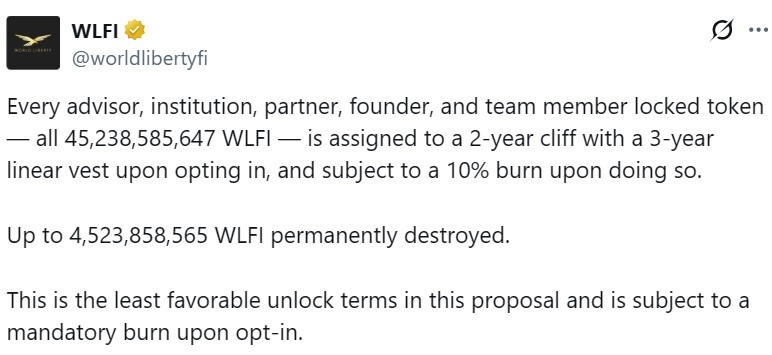
Decentralized finance (DeFi) platform World Liberty Financial on Wednesday posted a governance proposal that would place 62.28 billion locked WLFI tokens under new multiyear vesting schedules and introduce a potential burn for founder, team, adviser and partner allocations.
Under the proposal, early supporters’ locked tokens would face a two-year cliff followed by a two-year linear vest. Founder, team, adviser and partner allocations would face a two-year cliff followed by a three-year linear vest if those holders opt in to the new terms.
The plan also provides for a burn of up to 4.52 billion WLFI tokens, or 10% of the founder, team, adviser and partner allocation. Holders who do not accept the new vesting terms would remain locked indefinitely.
The move formalizes a phased unlock approach previously signaled by the project, offering a structured release of tokens while avoiding a near-term increase in supply. It comes as the Trump-linked platform faces growing pressure from holders and broader scrutiny of its governance.

WLFI proposal follows backlash, governance scrutiny
The proposal follows mounting criticism from early WLFI buyers over prolonged lockups and limited liquidity. On April 10, the project said it would introduce the proposal after some holders threatened legal action.
Additional scrutiny emerged around the platform’s governance structure and decision-making process.
On Monday, Tron founder Justin Sun, who previously invested $30 million in WLFI, criticized the platform over transparency concerns, alleging that prior governance votes were dominated by a small number of wallets and lacked meaningful participation. In response, WLFI threatened to file a lawsuit against Sun.
Related: Trump faces renewed backlash as Trump-linked crypto tokens hit lows
On the same day, Sun urged WLFI to disclose who controls key wallets tied to its smart contracts, warning that the setup could allow significant control, including the ability to freeze tokens.
The proposal also follows recent concerns around WLFI’s treasury activity and market performance. On Saturday, WLFI fell to a new all-time low, just days after wallets linked to the project used billions of tokens as collateral to borrow about $75 million in stablecoins.
Magazine: Singapore isn’t a ‘crypto hub’ — it’s something better: StraitsX CEO


Key takeaways
- DOGE is down 0.5% and continues to trade below the $0.10 psychological level.
- The coin has been consolidating and could rally higher in the near term.
Dogecoin (DOGE), the largest meme coin with a market capitalization of $14.27 billion, represents over 0.50% of the $2.49 trillion cryptocurrency market as of Wednesday.
Dogecoin underperforms despite a disinflationary model
Dogecoin defends its inflationary model, stating that inflation will decrease gradually to 3.1% from 3.6% as the total DOGE supply increases.
The assumption driving this claim is that demand for the meme coin will remain steady, supported by its robust community that uses DOGE for tipping, institutions launching DOGE-focused Exchange Traded Funds (ETFs), and its growing use in Decentralized Finance (DeFi) services.
While the narrative suggests a stable demand, it may not guarantee sustained positive pressure on DOGE’s price.
While Dogecoin’s fixed issuance model reduces inflation relative to the increasing supply, it does not necessarily reduce the overall supply, as deflation would. The continued minting of 5 billion DOGE per year could become a persistent downside risk, especially during periods of low demand.
Dogecoin’s strategy emphasizes practical usage as a currency rather than hoarding, and it incentivizes miners to secure the network. However, the ongoing supply pressure may limit the effectiveness of this disinflationary model in the long term.
In addition to this, institutional demand for DOgecoin remains muted. Since the launch of DOGE spot ETFs on November 24, there have been just 15 days of inflows, totaling a net asset value of $10.80 million. With 79 days showing no flows and two days with net outflows, institutional interest in DOGE remains limited.
The Dogecoin Treasury currently holds just over 780.54 million DOGE, which represents 0.51% of the total DOGE supply. Gaining further institutional support is key for Dogecoin to progress into the global financial system, providing the demand necessary to support the disinflationary model.
DOGE could rally above $0.10 if the bulls regain control
The DOGE/USD 4-hour chart remains bearish and efficient despite the broader crypto market rallying recently. At press time, DOGE is trading at $0.094 after rejecting at the $0.098 swing high earlier this week.
The RSI of 55 is above the neutral 50, indicating a fading bearish momentum. The MACD lines are also above the zero region, adding further bullish narrative to the pair.

If the bulls regain control, DOGE could surpass the $0.098 swing high and hit the $0.10 psychological level for the first time since March 16.
However, if the bearish correction persists, DOGE could retest the Sunday low of $0.09012 in the near term.

Trump: War 'Close To Over'

‘Stepped’ apartment and retail block would be one of town centre’s tallest

Bitcoin tests lower support as markets overlook key Iran issue

Why Israel is blocking foreign journalists from entering

Bitcoin: We’re Entering The Most Dangerous Phase

Alan Cumming Brands Baftas Ceremony A ‘Triggering S**tshow’

WOW XRP IS SAFER THAN BITCOIN AGAINST QUANTUM COMPUTING THREATS #crypto #cryptocurrency #xrp

Ripple XRP TIME IS TRULY RUNNING OUT PLEASE WAKE UP!!!

XRP JUST IN!! ELON MUSK BLOCKING CRYPTO?! TRUMP GIVES HIS FINAL WARNING TO IRAN!
-

 Politics5 days ago
US brings back mandatory military draft registration
-
 Sports5 days ago
Man United discover Nico Schlotterbeck transfer fee as defender reaches Dortmund agreement
-

 Fashion5 days ago
Weekend Open Thread: Veronica Beard
-

 Politics5 days ago
Malcolm In The Middle OG Turned Down ‘Buckets Of Money’ To Appear In Reboot
-

 Politics3 days ago
World Cup exit makes Italy enter crisis mode
-

 Crypto World6 days ago
Canary Capital Files SEC Registration for PEPE ETF
-

 Business5 days ago
Tesla Model Y Tops China Auto Sales in March 2026 With 39,827 Registrations, Beating Cheaper EVs and Gas Cars
-

 Crypto World2 days ago
The SEC Conditionalises DeFi Platforms to Be Avoided for Broker Registration
-

 Crypto World2 days ago
SEC Signals Exemption for Crypto Interfaces From Broker Registration
-

 News Videos8 hours ago
Secure crypto trading starts with an FIU-registered
-
 NewsBeat3 days ago
Pep Guardiola and Gary Neville agree over Arsenal title problem that benefits Man City
-

 Business5 days ago
OpenAI Halts Stargate UK Data Centre Project Over Energy Costs and Copyright Row
-

 Business4 days ago
Ireland Fuel Protests Enter Day 5 as Blockades Spark Shortages and Government Prepares Support Package
-

 Politics5 days ago
LBC Presenter Mocks Trump Over Iran War Failures
-

 Crypto World5 days ago
Federal judge blocks Arizona from bringing criminal charges against Kalshi
-
 NewsBeat3 days ago
JD Vance announces ‘no agreement’ with Iran over nuclear weapons fear
-

 NewsBeat1 day ago
Trump and Pope Leo: Behind their disagreement over Iran war
-

 Tech6 days ago
A version of Windows 10 released a decade ago is now eligible for additional security patches
-

 Crypto World1 day ago
SEC Proposes Certain Crypto Interfaces Don’t Need to Register as Brokers
-

 Business5 days ago
IMF retains floor for precautionary balances at SDR 20 billion
You must be logged in to post a comment Login