

Crypto World
Render Hits 4-Month High as New Wallets Pile Into the Network

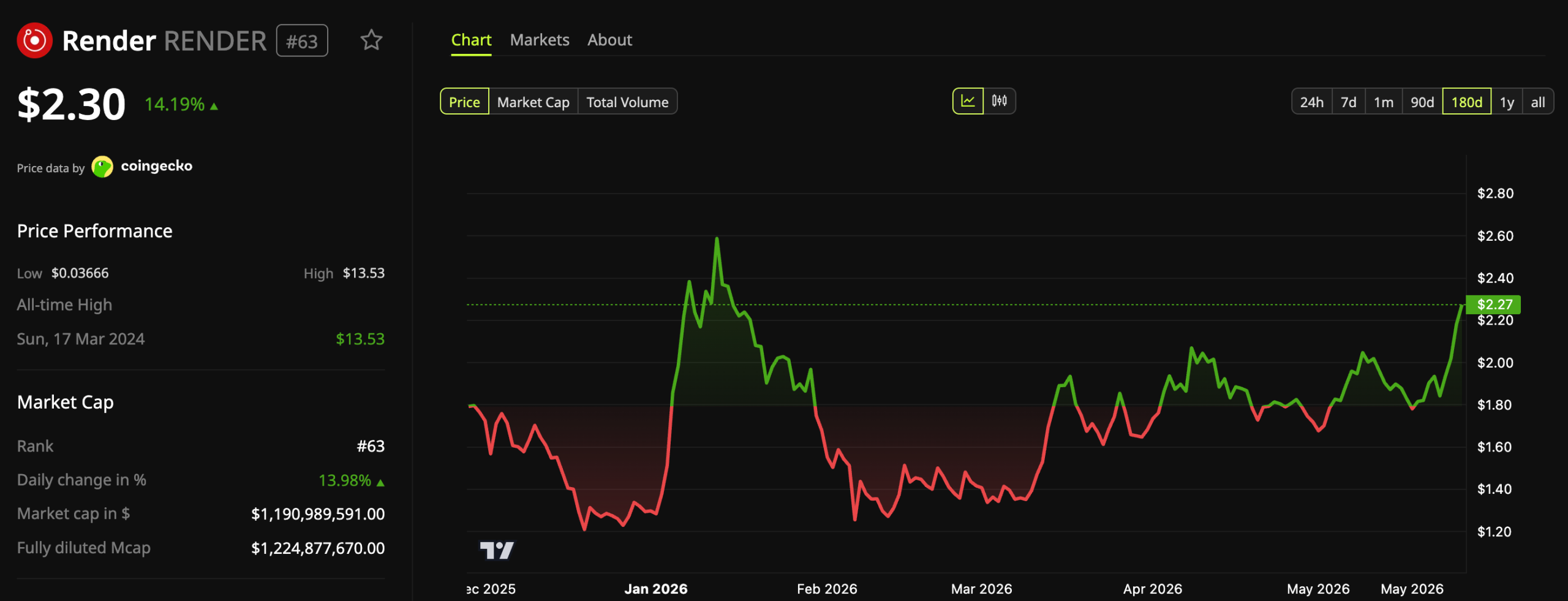
Render’s native token, RENDER, climbed to a four-month high of $2.32 on Tuesday, extending its recent rally as network activity and investor interest in AI-linked infrastructure projects accelerated.
At press time, the token traded near $2.30, up 14.19% over the past 24 hours. The latest move also outpaced gains across the broader cryptocurrency market, with traders continuing to rotate into artificial intelligence-related digital assets.

Follow us on X to get the latest news as it happens
RENDER Outperforms Bitcoin and Ethereum With Double-Digit Daily Rally
According to a recent analysis by BeInCrypto, RENDER has trended higher since May 18, with sizable buying volume backing the move. The rally has separated itself from speculative pump.
The report added that easing geopolitical tensions involving Iran helped improve sentiment toward AI-linked assets.
On-chain data further highlighted the surge in activity across the Render ecosystem. Blockchain analytics platform Santiment noted that daily active addresses jumped to 394, while 118 new wallets joined the network.
“These two metrics are important because they measure how many unique wallets are actively interacting with the network and how many new participants are entering the ecosystem,” the post read.
AI Infrastructure Demand Anchors the Move
Meanwhile, Santiment explained that most of Render’s 2026 momentum stems from expanding demand for AI infrastructure. The project has cemented its role as a decentralized GPU computing network for training, machine learning, and advanced rendering workloads.
The network expanded its GPU base throughout the year, integrating tens of thousands of units and supporting newer NVIDIA hardware.
The rally also aligns with a wider rotation into US-aligned AI tokens, with compute infrastructure names drawing fresh investor flows.
Whether the token holds above $2.3 remains to be seen. Sustained on-chain expansion in the coming sessions will reveal if the breakout has staying power.
Subscribe to our YouTube channel to watch leaders and journalists provide expert insights
The post Render Hits 4-Month High as New Wallets Pile Into the Network appeared first on BeInCrypto.

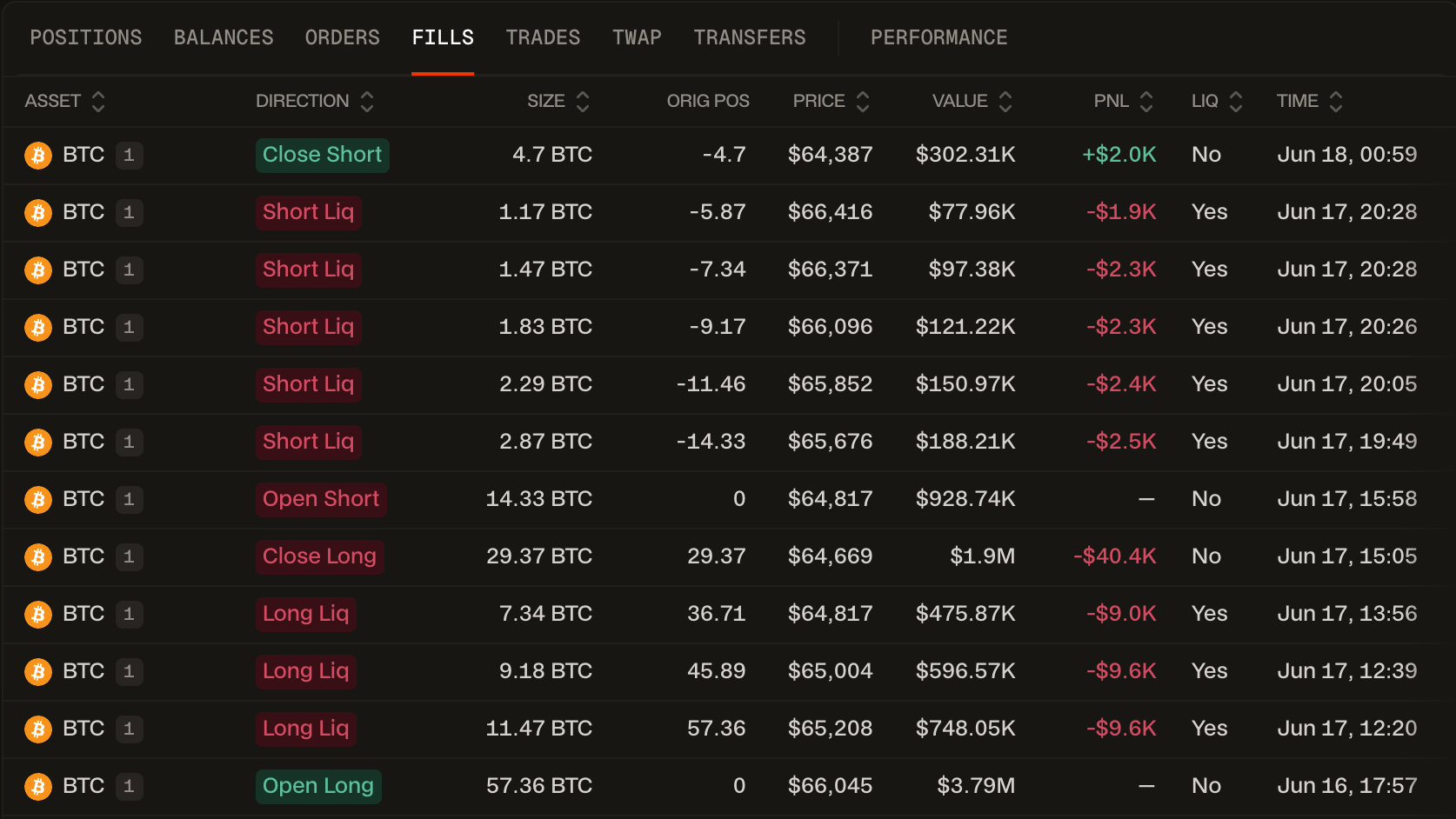
Andrew Tate, founder of the Real World, a company that sells online education courses on trading, lost nearly $100,000 while betting on Bitcoin (BTC) between Wednesday and Thursday.
Key takeaways:
- Tate’s wallet balance drops to $14,000 from $100,000 in a day.
- The social media influencer has lost around $804,000 on Hyperliquid.
Tate’s wallet balance drops to just $14,000
A Hyperliquid wallet reportedly linked to Andrew Tate opened a 57.36 BTC long position on Wednesday, with an entry price near $66,000, according to data resource HyperDash.
The trade was worth about $3.79 million, backed by roughly $100,000 in USDC, implying leverage of around 40x.
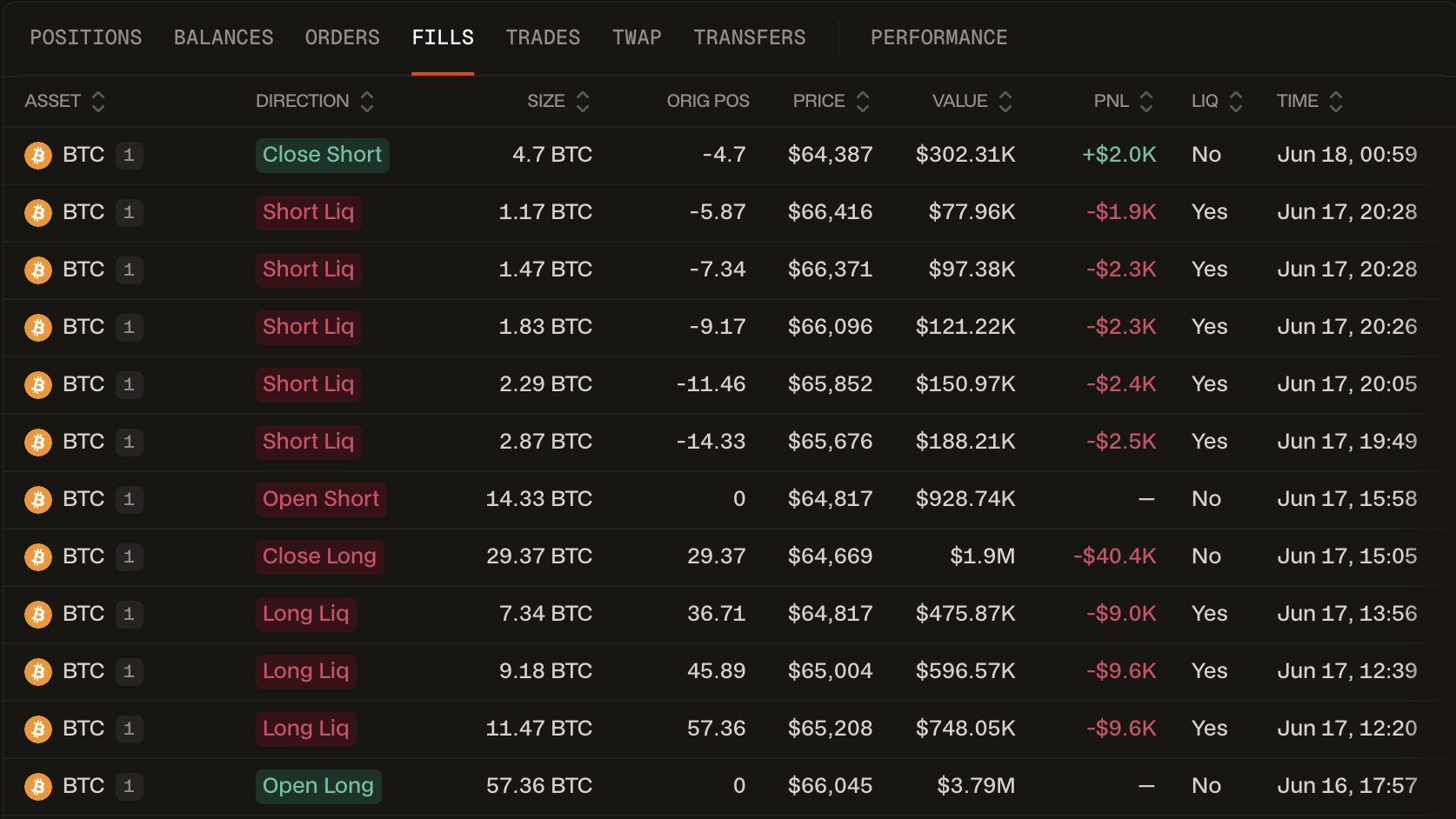
Andrew Tate’s filled order history. Source: HyperDash
The position began unwinding on Thursday as Bitcoin fell toward the mid-$64,000 area. Ultimately, the long trade recorded about $68,600 in cumulative realized losses.
The wallet then switched direction, opening a 14.33 BTC short position worth about $1 million at $64,817. That trade was also hit as Bitcoin rebounded, with five short liquidation fills.
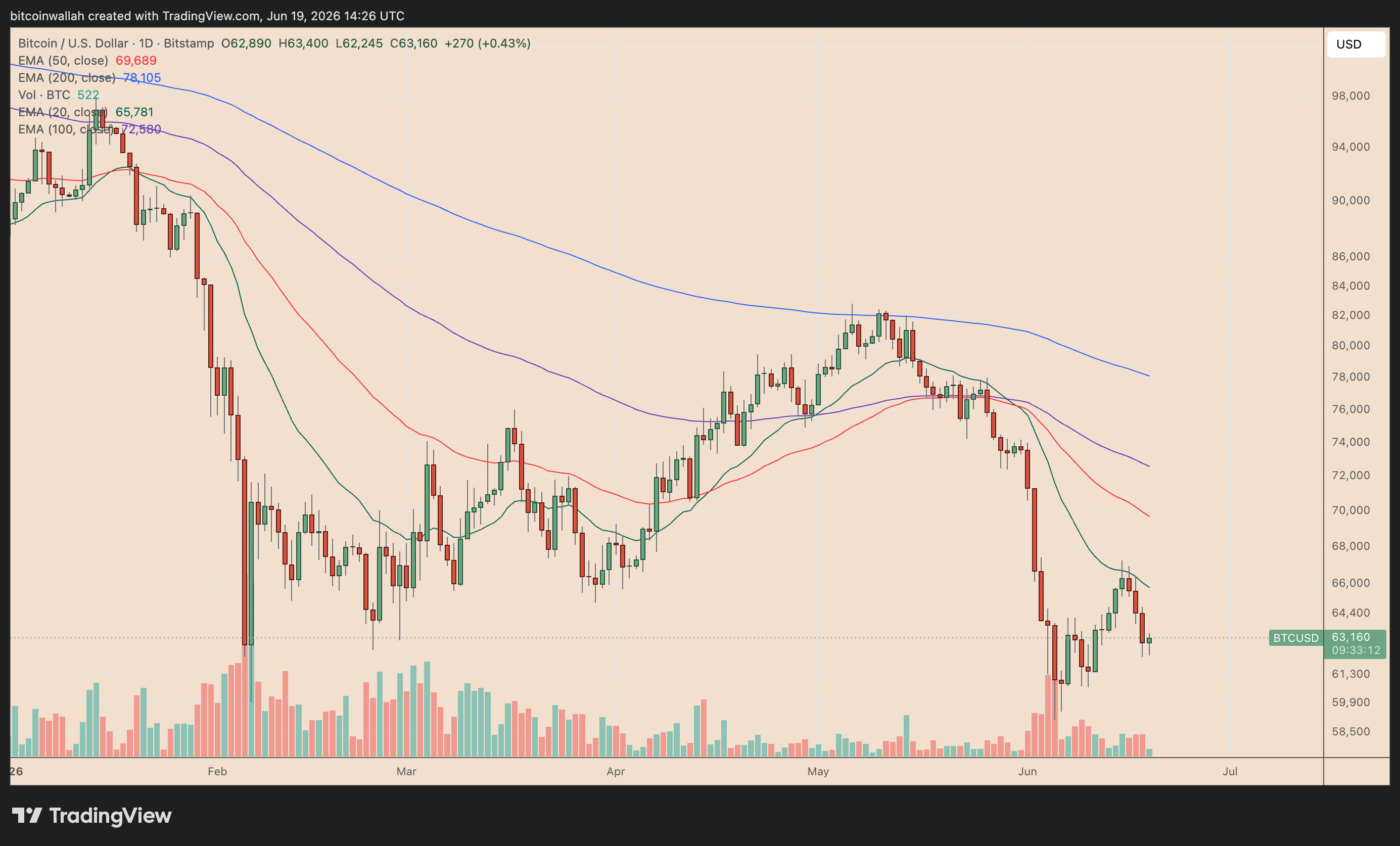
BTC/USD daily chart. Source: TradingView
By June 18, the account balance had fallen to around $14,000, thus losing almost the entire deposit.
Tate’s Hyperliquid portfolio is down nearly $804,000
Andrew Tate’s crypto trading issues on Hyperliquid began well before 2026.
For instance, in November 2025, his 40x BTC long position was liquidated for $235,000 on Nov. 14. By Nov. 18, multiple longs near $90,000–$95,000 were wiped out, leaving the account near zero.
Related: Bitcoin to $145K by October? Why this ‘crazy accurate’ 4chan prediction is sketchy
In another instance, Tate lost around $67,500 on World Liberty Financial (WLFI) positions ahead of a token unlock that triggered a sharp drop in September 2025. He re-entered the same trade almost immediately and lost again.
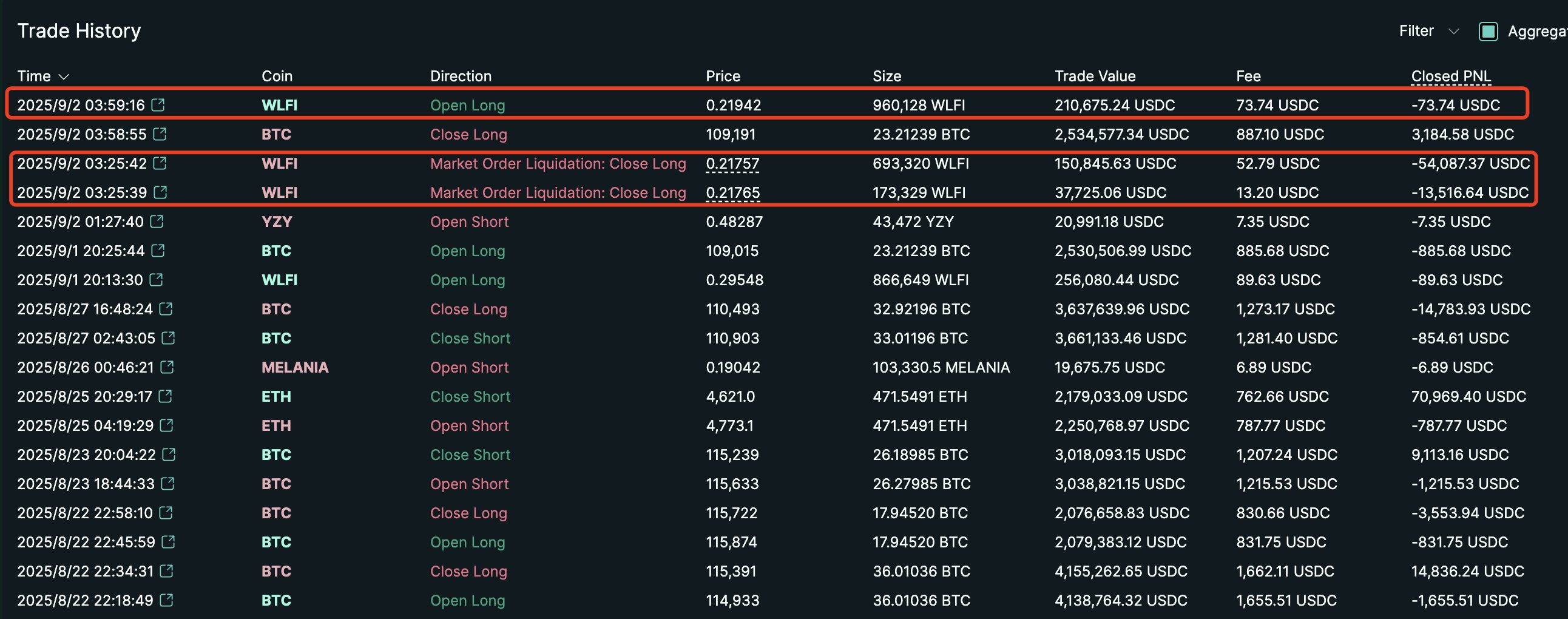
Screenshot of Tate’s WLFI positions from 2025. Source: HyperDash/Lookonchain
As of Friday, Tate’s all-time performance tab showed perpetual futures losses of $803,800, extending a drawdown that began in early 2025 and deepened again after the latest June liquidation streak.
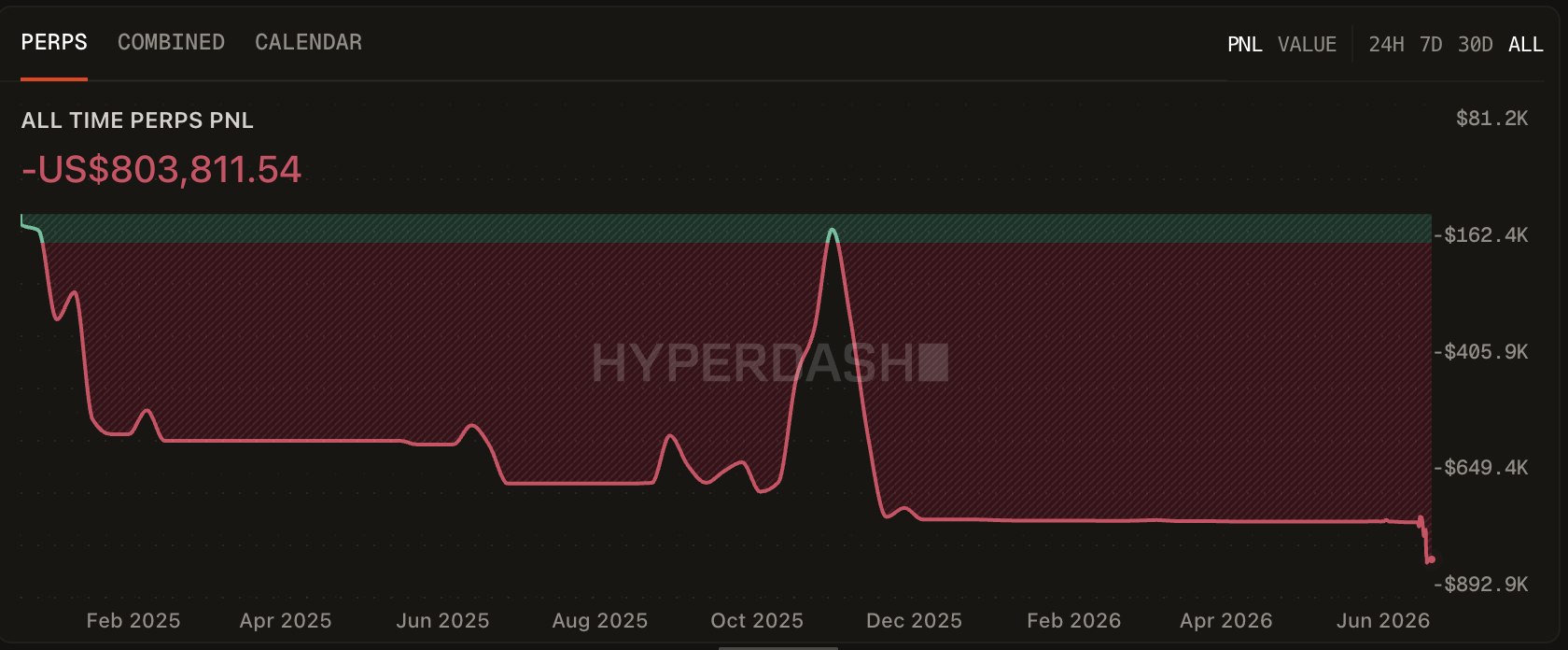
Tate’s profit-and-loss from all perp trades. Source: HyperDash
The trades show how quickly a leveraged account can lose capital in volatile market conditions, even when the underlying asset moves only a few percentage points.

Celsius founder and former CEO Alexander Mashinsky has been permanently banned from trading in markets overseen by the US Commodity Futures Trading Commission (CFTC) after a federal court approved a consent order resolving the regulator’s 2023 enforcement case against him.
The order, entered by the US District Court for the Southern District of New York, also permanently prohibits Mashinsky from violating certain anti-fraud provisions of the Commodity Exchange Act and CFTC regulations and bars him from registering with the agency in the future.
Celsius Collapse Fallout
The CFTC sued Mashinsky and Celsius Network in July 2023. It had alleged that the company operated a digital asset platform where customers deposited cryptocurrencies that were pooled together and used to generate revenue. Customers were told they would receive weekly interest payments or rewards from those activities.
According to the complaint, Mashinsky and Celsius misled hundreds of thousands of customers between 2018 and at least June 2022 by making false or misleading statements about the platform’s safety, profitability, and regulatory standing.
The regulator alleged that Mashinsky repeatedly promoted Celsius through public videos, livestreams, blog posts, social media content, and the company’s website. In those communications, he reportedly portrayed Celsius as a safe place to store digital assets and compared it to a traditional banking alternative while also advertising high-yield returns for customers.
However, the CFTC claimed that Celsius took on increasingly risky investment strategies to generate the returns it had promised. These strategies allegedly included making millions of dollars in uncollateralized loans and participating in risky decentralized finance agreements that were not subject to regulation. While customers continued to be told that their assets were secure and generating rewards, the company was allegedly suffering major losses.
According to the complaint, customer funds were not as secure as Celsius had previously claimed, and the company ultimately filed for bankruptcy. The regulator said Celsius received approximately $20 billion worth of customer funds during its operations. In July 2023, the court entered a separate consent order imposing a permanent injunction against Celsius itself, which left Mashinsky as the sole remaining defendant in the CFTC’s civil case.
Mashinsky’s Sentencing
The CFTC case was separate from but related to a criminal case filed by federal prosecutors in New York on July 11, 2023, involving the same alleged actions by Mashinsky. The founder later pleaded guilty on December 3, 2024, to one count of commodities fraud and one count of securities fraud.
He was sentenced on May 8, 2025, to 12 years in prison and was ordered to pay a $50,000 fine. The court also required him to forfeit $48.39 million for his role in the commodities and securities fraud committed at Celsius.
The post Celsius Founder Alex Mashinsky Permanently Banned From CFTC-Regulated Markets appeared first on CryptoPotato.
Tom Lee, chairman of BitMine Immersion Technologies, the largest corporate holder of Ether, dismissed a warning from a former Ethereum Foundation contributor that the network's core development faces a funding crisis, saying there is "zero chance" of a shortfall. "In my opinion, zero chance of this… Read the full story at The Defiant


Axelar has disabled its Secret Network bridge connections after a security incident resulted in the loss of roughly $4.7 million worth of bridged assets.
Summary
- Axelar disabled Secret Network bridge routes after a $4.7 million exploit tied to a Secret-side ICS-20 contract.
- The company said the incident appears limited to Axelar-bridged assets on Secret Network, with no impact on its core protocol.
- Binance Research previously estimated DeFi exploits triggered $13 billion in TVL outflows and pushed leverage ratios to 2021 highs.
According to Axelar, the exploit affected assets transferred from the Axelar chain to Secret Network through the Cosmos Inter-Blockchain Communication framework.
Early findings from the investigation indicate the issue is linked to the Secret-side ICS-20 smart contract used in the IBC connection between the two networks rather than Axelar’s core infrastructure.
As part of its immediate response, Axelar said its emergency committee shut down the Secret and Secret-SNIP connections to prevent further losses. The interoperability protocol also stated that it had contacted relevant exchanges and law enforcement agencies while its investigation remains ongoing.
Secret Network operates as a privacy-focused blockchain that encrypts transaction data while allowing smart contract code to remain verifiable on-chain.
Through its integration with Axelar, developers have been able to support private cross-chain applications, including confidential decentralized finance activity, private NFT transactions, and anonymous governance functions.
Exploit appears limited to a single bridge connection
Details shared by Axelar indicate that the incident is confined to assets on the Secret Network that were bridged from Axelar. The company said no evidence currently suggests that other IBC connections, Secret-native assets, or additional Axelar integrations were affected.
At the same time, Axelar emphasized that its core protocol remained operational throughout the incident. The team said the suspected vulnerability was isolated to the Secret-side contract involved in processing transfers from Axelar into the Secret ecosystem.
A full post-mortem is expected once the investigation is completed. Until then, the affected bridge routes will remain disabled as engineers continue reviewing the attack path and assessing the extent of the losses.
The incident adds to a growing list of security breaches that have disrupted crypto infrastructure projects in recent weeks. Earlier this month, Humanity Protocol disclosed recovery measures after a June 8 exploit that forced the project to retire its original H token across Ethereum, BNB Chain, and Humanity Mainnet.
According to Humanity Protocol, affected users will receive replacement H tokens through an airdrop tied to a newly deployed audited ERC-20 contract on Ethereum. The project stated that the breach resulted from stolen credentials rather than vulnerabilities in its token contracts, bridge infrastructure, or Safe setup.
Recent exploits continue to pressure crypto projects
Security incidents have also had consequences beyond immediate token losses. Earlier this week, crypto payments platform Pyra announced plans to wind down operations after determining it could not recover from the financial and user impact of the Drift exploit.
Against that backdrop, Axelar’s response has focused on containing the Secret Network incident while investigators determine how the exploit occurred. The company said it will provide additional details once its review is complete and has maintained that no other parts of the Axelar network appear to be affected based on current findings.
As crypto.news reported earlier, Binance Research estimated that DeFi exploits in April alone contributed to roughly $13 billion in total value locked outflows across decentralized finance protocols, reducing available liquidity throughout the sector. The research arm also found that the on-chain leverage ratio climbed to around 38%, a level last seen in 2021, as TVL declined faster than borrowing activity.

U.S. Representative Bryan Steil, chair of the House subcommittee on digital assets, has introduced legislation aimed at preventing members of Congress—and certain family members—from profiting through prediction markets tied to public-policy decisions and “political outcomes.” The proposal, described in a Thursday notice from Steil’s office, would create a narrowly tailored restriction focused on event contracts that reference government action rather than all forms of political or market participation.
The bill reflects ongoing legislative efforts to address concerns that prediction markets could be used to translate privileged information into financial gain. It also adds a new compliance layer for platforms operating in the United States, particularly those marketing policy-relevant event contracts to U.S. users and institutions.
Key takeaways
- Steil’s proposed “Stop Lawmakers from Predicting Act” would bar members of Congress, along with spouses and dependent children, from placing bets on policy-aligned event contracts.
- The restriction targets wagers tied to specific government policies, government actions, and “political outcomes,” with no blanket ban on all prediction-market activity.
- Violations would trigger a financial penalty of either a $2,000 fee or 10% of the prohibited bet’s value, depending on the bill’s enforcement mechanism.
- The legislation would not explicitly extend to White House officials; the proposal instead focuses on elected members of Congress.
- The move comes amid an active regulatory jurisdiction dispute in which the CFTC has sought federal control over prediction market oversight.
What the Stop Lawmakers from Predicting Act would change
According to Steil’s announcement, the Stop Lawmakers from Predicting Act is designed to prevent public officials from “wagering on public policy issues and political outcomes.” The bill’s stated focus is not on whether lawmakers may use prediction markets as participants broadly, but on whether they may place event-contract bets that map directly onto governmental policies, specific actions by the government, and political developments.
The proposal specifically contemplates restrictions for “members of Congress, their spouses, and dependent children.” It would prohibit those individuals from using prediction market platforms—such as Kalshi and Polymarket—for contracts that are aligned with government policy or political results.
Steil’s office outlined a penalty framework for violations. Under the bill, prohibited participants would be subject to either a $2,000 fee or a penalty equal to 10% of the value of the affected bets, depending on the application of the statute. If Congress passes the act and the president signs it, the proposal would reportedly take effect 180 days after enactment.
Why it matters for compliance and institutional oversight
In practice, the bill would require prediction market operators to consider how to identify and restrict access by covered persons. Unlike broad trading prohibitions that target entire classes of market activity, this proposal aims at a defined subset: contracts tied to government actions and policy outcomes.
For compliance teams, that distinction matters. Platforms would need to define contract categories with sufficient specificity to determine which events are “policy-aligned” or concern “political outcomes,” and then implement controls that can flag when a covered person attempts to place a wager. The requirement also creates a compliance question for affiliates, payment processors, and customer due diligence processes: who must be screened, what documentation is necessary, and how sanctions and penalties would be monitored.
For institutional observers, the bill also functions as a legislative attempt to address reputational and governance concerns around the fairness of markets whose payoffs depend on political events. Even when a prediction market is structurally legal, policymakers and regulators frequently assess the risk of insider access, information asymmetry, and conflicts of interest—issues that are closely connected to broader AML/KYC and ethics compliance frameworks.
Limited scope: Congress-focused, not White House officials
Steil’s draft does not specifically establish a blanket prohibition on U.S. lawmakers using prediction market platforms, and it likewise does not broadly outlaw wagers on sporting events. Instead, it targets contracts tied to government policies, government actions, and political outcomes—categories that would likely require platform-specific classification and careful legal interpretation.
The proposed restriction is also notable for who is not included. The legislation does not explicitly bar White House officials, including the president and vice president. Coverage of the issue has also pointed to the involvement of Donald Trump Jr., who has been described as a strategic adviser to Kalshi, and to Polymarket, which has been referenced as having a sponsorship connection to a White House event.
Cointelegraph reported that Steil’s office was contacted for comment but did not receive an immediate response. That incomplete public record underscores an unresolved compliance gap: while Congress-focused restrictions could be implemented relatively directly, questions about broader conflicts of interest and political influence may persist if other officials remain outside the bill’s defined scope.
The broader fight over prediction market jurisdiction
Steil’s proposal arrives during an active federal regulatory dispute over prediction markets. Under the Trump administration, the Commodity Futures Trading Commission (CFTC) and its chair, Michael Selig, have argued that the agency has “exclusive jurisdiction” over regulation and enforcement for prediction market activity.
Cointelegraph has previously reported that the CFTC filed multiple lawsuits against state-level authorities that sought to restrict or ban prediction market platforms. The CFTC’s argument rests on the view that certain event contracts can be regulated as “swaps” under the Commodity Exchange Act—rather than ordinary bets—placing them within federal oversight.
Some legal experts have suggested that the ongoing jurisdiction battle could escalate further, potentially reaching the U.S. Supreme Court. If courts determine that the CFTC’s characterization is controlling, it could reshape the compliance landscape for platforms by centralizing federal enforcement rather than leaving states to impose varying restrictions.
That jurisdictional context is important to the new bill because it highlights a split between two overlapping regulatory aims: (1) enforcing insider-conflict and ethics concerns through legislation aimed at specific public officials, and (2) establishing which regulator has authority over the underlying trading instrument and platform activity. A bill that restricts participation by covered individuals does not automatically resolve instrument classification disputes; similarly, federal jurisdiction rulings do not determine how conflict-of-interest rules apply to lawmakers.
As enforcement frameworks develop, prediction market operators may face multi-layer compliance expectations: platform-level controls for participant eligibility and event-type categorization, alongside ongoing monitoring for activities that regulators might characterize as covered derivatives under federal law.
Closing perspective
While the Stop Lawmakers from Predicting Act targets a specific conflict-of-interest risk tied to policy and political event contracts, its prospects depend on congressional action and how it is operationalized by exchanges and market operators. The parallel CFTC jurisdiction litigation will likely remain a key driver of regulatory certainty, and the legal outcome may influence how quickly platforms can standardize compliance across states and federal enforcement positions.

Bitcoin mining is increasingly becoming less about pure exposure to BTC price moves and more about building a business around electricity, compute supply chains, and AI-related infrastructure. The change is being reinforced by signals from outside crypto, including a report that Nvidia is seeking to raise $20 billion through a bond sale to fund additional AI expansion.
At the same time, other parts of the industry are showing resilience or momentum. Tokenized real-world assets continue to grow even as the broader crypto market struggles, while Ripple is expanding its payments footprint in Africa through an investment in Flutterwave. Separately, former FTX CEO Sam Bankman-Fried’s attempt to overturn his fraud conviction has failed, according to an appeals panel in Manhattan.
Key takeaways
- A reported $20 billion Nvidia bond offering underscores the scale and durability of the AI investment cycle that some Bitcoin miners are positioning to support.
- Bitcoin mining firms are increasingly targeting AI hosting and high-performance computing opportunities as mining margins tighten.
- Tokenized real-world assets have surpassed $43 billion in total value of onchain financial assets, with Token Terminal citing a 37% increase over six months.
- Ripple’s investment in Flutterwave is another step in expanding stablecoin and payments infrastructure across Africa, where cross-border payments demand is rising.
- Sam Bankman-Fried’s appeal to overturn his fraud conviction was denied by a Manhattan appeals panel.
Nvidia’s bond plan highlights why miners are looking beyond hash rate
According to Bloomberg, Nvidia is pursuing a multi-part bond offering totaling $20 billion to finance future AI-related investments and refinance existing debt. The report also notes that the longest-dated bonds are expected to carry meaningfully higher yields than comparable U.S. Treasury securities, reflecting investor pricing for longer-duration risk and returns.
The relevance for crypto comes from how the economics of mining have been shifting. For years, many miners effectively operated as leveraged vehicles for BTC: mining profitability tended to track Bitcoin’s price and difficulty dynamics, leaving little room for a broader corporate identity. But with mining economics under pressure and power costs remaining a constant constraint, miners have been exploring a new angle—using their energy access and data center capabilities for AI compute workloads.
As Cointelegraph previously reported, the AI and data center trend has created practical opportunities for miners, since many of their facilities already support high-density computing. Companies such as HIVE Digital, Hut 8, CleanSpark, and TeraWulf have been positioning themselves as AI infrastructure providers, effectively treating energy and hosting as primary assets rather than secondary byproducts of mining.
While Nvidia’s funding plan is not a direct endorsement of Bitcoin mining, it is a reminder that major AI infrastructure buildouts tend to be multi-year investments. That duration matters: investors and operators typically need a longer runway when converting electrical and facilities capability into new revenue streams. The key watchpoint is whether AI hosting demand continues to absorb capacity fast enough to offset ongoing mining margin compression.
Tokenized RWAs keep expanding even as crypto sentiment softens
The tokenized real-world asset market continues to grow despite weakness across wider crypto markets. Token Terminal reports that the total value of onchain financial assets has surpassed $43 billion—an increase of 37% over the past six months—suggesting ongoing institutional and product-level experimentation rather than a purely speculative boom.
Tokenized funds dominate the category, accounting for nearly 80% of all onchain financial assets, though other forms are gaining attention. Commodities and tokenized stocks are gradually strengthening their presence, indicating that issuers are exploring more than one blueprint for bringing traditional asset exposure onchain.
The momentum is also being reinforced by longer-term projections from major banks. Standard Chartered expects tokenization to help drive decentralized finance toward a $2.7 trillion market capitalization by 2030, while Citigroup projects tokenized RWAs could reach $5.5 trillion over the same period. Even if exact outcomes differ, these forecasts point to a consistent theme: large financial institutions see tokenization as a structural opportunity that could eventually scale beyond pilots.
For market participants, the practical implication is that the RWA sector may behave differently from mainstream crypto narratives. Growth appears tied to product distribution and balance-sheet-backed use cases, which can be less correlated with day-to-day volatility than trading-heavy segments.
Ripple doubles down on African payments with Flutterwave investment
Ripple has invested an undisclosed amount in Flutterwave, one of Africa’s fastest-growing remittance and payments firms, in a deal valuing the fintech at $3.3 billion. The investment is expected to connect Ripple’s RLUSD stablecoin, Ripple Payments platform, and XRP Ledger infrastructure with Flutterwave’s payments reach.
Flutterwave operates across 35 countries, and this partnership aims to strengthen Ripple’s stablecoin-based rails for cross-border transfers. The pitch aligns with the broader industry demand for faster settlements and lower-cost remittances, especially in regions where traditional correspondent banking can be slow or expensive.
This development also fits Ripple’s continuing strategy to deepen its presence in Africa. In October, Ripple partnered with South Africa’s Absa Bank to provide institutional digital asset custody solutions—another area where regulatory frameworks and institutional adoption tend to matter as much as technology. Taken together, the Flutterwave investment suggests Ripple is seeking both market access and the operational capacity to serve institutional and consumer payment flows.
Manhattan appeals panel rejects Sam Bankman-Fried bid to overturn conviction
Former FTX CEO Sam Bankman-Fried failed to overturn his fraud conviction after a three-judge appeals panel in Manhattan upheld the verdict, finding that he received a fair trial. The denial comes after an appeal that challenged the conviction stemming from FTX’s collapse.
In an opinion attributed to Circuit Judge Barrington Parker, the court highlighted a central contradiction in Bankman-Fried’s conduct during the period leading to FTX’s failure: while he was publicly reassuring customers, investors, and regulators that customer funds were safe, the judge wrote that he was simultaneously using FTX funds for personal purposes, including spending on real estate, political contributions, and investments.
Bankman-Fried was convicted on fraud and conspiracy charges tied to the collapse of FTX and sentenced to 25 years in prison in 2024, according to earlier reporting. In addition, Cointelegraph reported that he formally applied for a presidential pardon from U.S. President Donald Trump, with the request appearing on the Pardon Attorney website in early June.
For observers, the outcome means the legal fight does not reset the underlying conviction. While additional post-conviction steps may still be possible in the future, this appeals decision closes a key chapter and keeps attention on the enforcement trajectory following one of crypto’s most consequential corporate failures.
Looking ahead, the most important signal to track is whether the AI infrastructure shift can convert into durable, measurable revenue for mining operators—especially as power and equipment costs remain the real battlefield. Meanwhile, tokenized RWAs will likely remain a key barometer for whether onchain finance can sustain growth through traditional finance’s adoption cycles, even when broader crypto markets cool off.
This article was originally published as AI’s Role in Reshaping Miner Strategy: Is It the Way Out? on Crypto Breaking News – your trusted source for crypto news, Bitcoin news, and blockchain updates.
Crypto exchange WhiteBIT has obtained authorization under the European Union’s Markets in Crypto-Assets Regulation (MiCA) from Austria’s Financial Market Authority, allowing the company to offer regulated crypto services across the European Economic Area through a single license.
Under MiCA, crypto companies authorized in one European Union member state can passport their services across the European Economic Area without obtaining separate licenses in each jurisdiction. WhiteBIT said the authorization will support the launch of a dedicated European platform, whitebit.eu.
WhiteBIT said W Group, its parent company, serves more than 35 million customers globally. Founded in 2018, the exchange has partnerships with Visa, FACEIT, FC Barcelona, Juventus and Ukraine’s national football team.
Austria did not extend grandfathering provisions for virtual asset service providers beyond Dec. 31, 2025, making it one of the first European Union jurisdictions to fully transition to the MiCA framework.
According to comments previously provided to Cointelegraph by Austria’s Financial Market Authority, the regulator has licensed nine crypto-asset service providers under MiCA and described application volume as “significant.”
Related: Polish president vetoes crypto bill for third time ahead of MiCA deadline
MiCA deadline approaches for crypto firms
WhiteBIT’s approval comes less than two weeks before the European Union’s MiCA transition period expires on July 1. After that date, crypto companies operating under legacy national registrations must either hold a MiCA license or stop serving clients in the bloc.
The approaching deadline has increased scrutiny on exchanges that have yet to secure authorization. Earlier this week, Reuters reported that Greece’s market regulator was preparing to reject Binance’s MiCA application, while The Big Whale said France may be the exchange’s last remaining path to a MiCA license before the deadline.
Data shared with Cointelegraph by OKX Europe suggests the MiCA transition could affect a meaningful share of Europe’s crypto market. The company found that roughly 7.6 million of the 18.5 million crypto app downloads recorded in Europe between May 2025 and May 2026 were linked to exchanges that were not listed on public MiCA authorization registers.
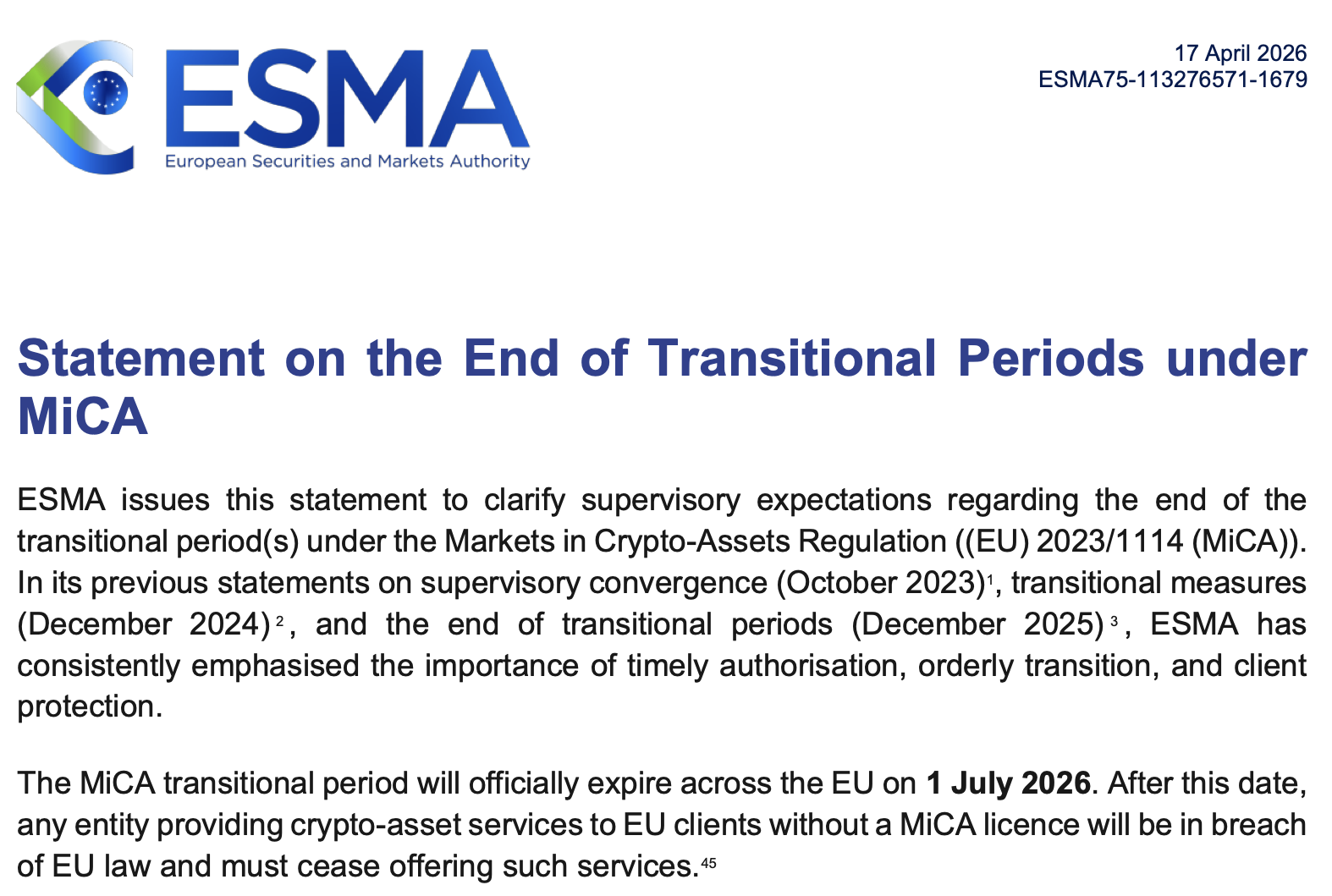
Statement on the end of transitional periods. Source: ESMA
The European Securities and Markets Authority has said companies that remain unauthorized after July 1 should implement wind-down and client migration plans rather than continue operating while applications remain under review.
Magazine: The end of anon? AI could unmask crypto’s hidden identities

Key Takeaways
- Advanced Micro Devices delivered $7.4 billion in Q1 2026 revenue, marking a 36% year-over-year increase powered by exceptional data center performance
- The Data Center division at AMD reached an all-time high of $3.7 billion, representing 57% growth driven by EPYC CPUs and Instinct accelerators
- Intel generated $13.6 billion in Q1 2026 revenue with only 7% growth, while posting a GAAP loss of $0.73 per share
- Analysts assign AMD a Moderate Buy rating with an average target of $430.68, compared to Intel’s Hold consensus around $83.35
- Intel’s Q2 guidance projects revenue between $13.8 and $14.8 billion, indicating stabilization without meaningful expansion
The semiconductor sector’s two biggest names—AMD and Intel—are experiencing dramatically different trajectories as we move through 2026.
While AMD continues its ascent as a growth powerhouse, Intel remains mired in proving its turnaround strategy can deliver tangible results.
AMD Demonstrates Powerful Momentum
Advanced Micro Devices announced first-quarter 2026 revenue of $7.4 billion, representing a robust 36% increase compared to the prior-year period.
Advanced Micro Devices, Inc., AMD
The company achieved GAAP net income of $709 million. The headline achievement came from the Data Center business, which posted unprecedented revenue of $3.7 billion—a 57% year-over-year jump.
This impressive performance was fueled by escalating demand for EPYC server chips and Instinct GPU solutions. Meanwhile, the Client division also delivered impressive results, climbing 68% to reach $2.3 billion.
These financial results demonstrate that AMD has successfully transformed from a traditional processor manufacturer into a major force in data center infrastructure and artificial intelligence hardware.
Analyst community response has been overwhelmingly positive. MarketBeat data reveals 44 analysts tracking AMD, with consensus landing at Moderate Buy—comprising 30 Buy recommendations, 12 Hold ratings, and only 1 Sell. The average price target over the next 12 months stands at $430.68.
Intel Continues Its Turnaround Journey
Intel reported Q1 2026 revenue of $13.6 billion, reflecting modest 7% year-over-year growth. However, the company recorded a GAAP loss of $0.73 per share.
Adjusted for non-GAAP items, the company posted earnings of $0.29 per share. For the second quarter, management provided guidance of $13.8 billion to $14.8 billion, suggesting the business is stabilizing but not experiencing meaningful growth.
Intel maintains significant advantages including substantial scale, an extensive customer base spanning personal computers, servers, and manufacturing operations. Yet the company hasn’t demonstrated the operational momentum visible at AMD.
The company’s recovery hinges on improved processor competitiveness, advancement in its foundry operations, and development of competitive AI solutions. These critical improvements haven’t yet materialized in financial performance.
Analyst opinion mirrors this cautious outlook. According to MarketBeat, Intel carries a Hold consensus from 41 analysts, with 10 Buy ratings, 26 Hold recommendations, and 4 Sell ratings. The average 12-month price target hovers around $83.35.
Investment Implications
The choice between these semiconductor giants ultimately depends on growth visibility. AMD demonstrates undeniable traction in data centers and AI infrastructure, supported by strong profitability.
Intel presents potential upside if its restructuring succeeds. However, that opportunity remains contingent on execution improvements that haven’t yet materialized.
AMD represents the proven growth play. Intel represents the speculative turnaround opportunity. Your choice depends on your risk tolerance and patience for uncertainty.



Charles Schwab has entered the prediction markets business through a partnership with Cboe Global Markets, introducing new contracts tied to the performance of the S&P 500.
Summary
- Charles Schwab is partnering with Cboe to launch S&P 500 prediction-style options contracts in the coming months.
- The new product will use options contracts, differing from the futures-based markets offered by Kalshi and Polymarket.
- Schwab’s prediction market push comes as the firm expands crypto services for both retail investors and financial advisors.
According to a Wall Street Journal report, the brokerage firm is working with Cboe to launch all-or-nothing options contracts that allow investors to take positions on where the benchmark U.S. stock index will finish. The product places Schwab alongside firms such as CME Group and Interactive Brokers, which have already expanded into prediction-style trading products.
People familiar with the matter told the Journal that the contracts are expected to become available to Schwab customers in the coming months. Unlike platforms such as Kalshi and Polymarket, which primarily offer futures-based event contracts, Schwab’s product will be structured as options.
The launch comes as competition intensifies among firms seeking to capitalize on growing demand for event-driven trading products. Recent activity has pushed prediction markets beyond political and sports outcomes into financial markets, where traders increasingly use contracts tied to economic and market events.
Schwab is focusing on stock market outcomes
Details reported by the Wall Street Journal indicate that Schwab’s initial offering will concentrate on measurable financial outcomes rather than the wider range of events available on platforms such as Kalshi and Polymarket. Discussions between Schwab and Cboe have also included the possibility of introducing contracts linked to other market indexes.
In addition to the all-or-nothing contracts, the Journal reported that Schwab plans to introduce an options product designed to provide partial payouts when traders come close to predicting an index’s closing level. The feature would use a Cboe mechanism known as the “plus zone,” allowing participants to receive some compensation even when their forecast is not exact.
Institutional interest in prediction markets has accelerated in recent months. Kalshi recently disclosed that institutional trading volume increased 800% over a six-month period as the company expanded its Wall Street presence and product lineup.
Meanwhile, data from DefiLlama shows Polymarket generated approximately $1.5 million in fees over the previous 24 hours and around $10 million during the last seven days, highlighting continued activity across crypto-native prediction platforms.
Crypto expansion continues alongside new market products
Schwab’s move into prediction-style contracts arrives as the firm continues building out its digital asset business.
As reported by crypto.news earlier in June, Schwab revealed plans to extend direct crypto services from retail investors to registered financial advisors. The company is targeting 2027 for spot cryptocurrency trading, transfers, and custody capabilities on its advisor platform, bringing crypto-related account management and asset servicing into its wealth management operations.
The advisor initiative follows the rollout of Schwab Crypto, the company’s spot Bitcoin and Ethereum trading service for retail customers. Schwab previously confirmed a phased launch of direct access to Bitcoin and Ethereum, with select U.S. clients already gaining access this year.
Taken together, the firm’s expansion into prediction-style contracts and cryptocurrency services adds new trading and investment products as established brokerages compete for a larger share of retail and advisor activity.


Charles Schwab is working with Cboe Global Markets to launch a new type of options contract that would allow customers to make yes-or-no wagers on the performance of the S&P 500, marking the brokerage’s first move into prediction markets, according to a Wall Street Journal report.
The feature is expected to roll out to Schwab customers in the coming months, the Journal reported, citing people familiar with the matter.
Unlike traditional prediction market platforms such as Polymarket and Kalshi, which typically offer futures-style contracts tied to the outcome of events, Schwab’s product would function more like a binary option, in which the contract would pay a fixed cash amount or expire worthless depending on whether the S&P 500 closes above or below a specified target price.
Schwab and Cboe are also in talks to offer a similar product tied to a Cboe feature known as the “Plus Zone,” which would allow traders to receive a partial payout when their prediction is close to the final outcome, even if the index does not finish exactly at the target level.
Full Circle Lithium announces $5M private placement

Alpha Liquidations? Andrew Tate Loses Nearly $86K on Leveraged Bitcoin Bets

2 Years Later, ‘Tracker’s Biggest Series Mystery Still Hits Like a Punch to the Gut


-

 Business5 days ago
No Jackpot Winner as $257 Million Prize Rolls Over to $269 Million Monday Draw
-
 Crypto World5 days ago
Zimbabwe Requires Crypto Businesses to Register Annually Under New FIU Regulations
-

 Crypto World7 days ago
Bitget enters Argentina’s regulated crypto market through PSAV registration
-

 Tech7 days ago
NanoClaw integrates JFrog registries to secure AI agent downloads
-
 Entertainment5 days ago
Matt Damon’s Viral Sci-Fi Thriller Has Taken Over HBO Max
-

 Business5 days ago
Anthropic staff to meet White House officials next week, Axios reports
-

 Tech5 days ago
As AI companies race to go public, who else is along for the ride?
-
 Crypto World5 days ago
Bitcoin could crash to $48,000, if this historical pattern is triggered
-

 Politics5 days ago
“Israel’s” ban on ICRC visits ruled illegal, but Knesset moves to stop them permanently
-
 NewsBeat5 days ago
Warning of disruption as Cardiff Crossrail works to start
-

 News Videos5 days ago
Financial Accounting | Last Day Revision Strategy and Booster | CMA Inter – June 2026
-
 NewsBeat5 days ago
what doctors are seeing in ebike crashes
-
 NewsBeat5 days ago
Tributes to former deputy head teacher at Cambridge school among death and funeral notices
-

 Entertainment6 days ago
Deion Sanders Shares Powerful Post After Viral Advice To Deiondra
-
 Entertainment5 days ago
Kate Middleton Glare Goes Viral After Kids Booed At Royal Event
-

 Crypto World5 days ago
XRP ETFs Outperform As Bitcoin And Ethereum Funds Extend Outflow Trend
-
 Crypto World5 days ago
Market Preview: SpaceX (SPCX) IPO Record, Federal Reserve Meeting, and Iran Nuclear Agreement
-

 Business5 days ago
Invesco Quality Income Fund Q1 2026 Commentary
-

 Tech5 days ago
Over 400 Arch Linux packages compromised to push rootkit, infostealer
-
 Entertainment7 days ago
44 Years Later, This Is the Greatest Star Trek Quote in Sci-Fi History
You must be logged in to post a comment Login