

Crypto World
Ripple-linked token slips as traders watch $1.35 support

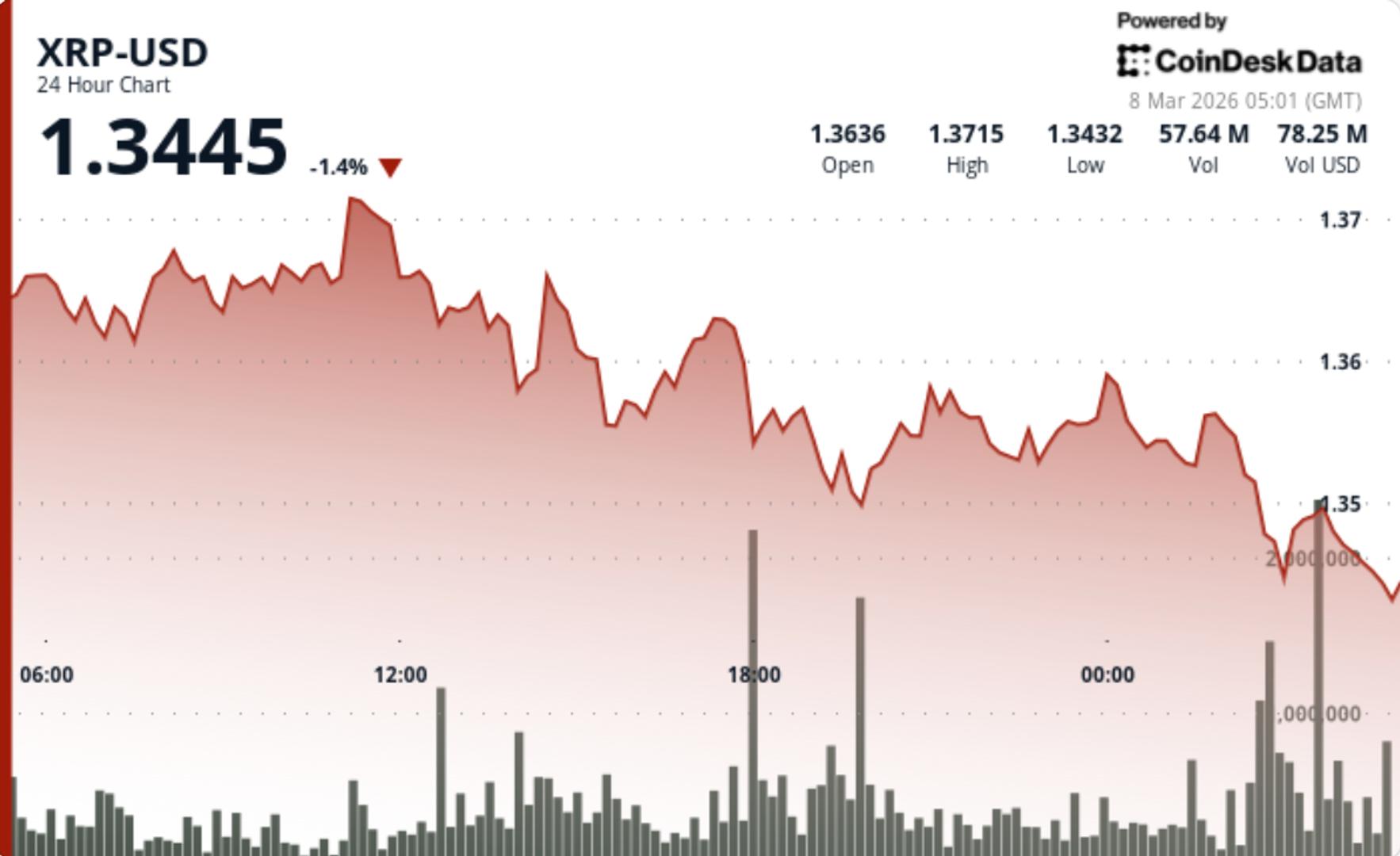

XRP edged lower after a technical breakdown earlier in the session, with buyers now attempting to stabilize price near the $1.35 support area.
News Background
- XRP has remained under pressure in recent sessions as the token trades within a broader corrective structure that has persisted since late February.
- Price action has largely been driven by technical positioning rather than new catalysts, with traders focusing on key support and resistance levels as the market consolidates.
- Institutional flows have been mixed during the period. XRP-linked investment products recorded moderate outflows earlier in the week while derivatives activity declined slightly, suggesting reduced speculative participation as the market digests recent volatility.
Price Action Summary
- XRP slipped from $1.3666 to $1.3554 over the 24-hour session
- The token traded within a relatively tight 1.9% range
- A sharp volume spike drove price briefly down to $1.3473
- Price later recovered toward $1.35–$1.36 as buyers stepped in
Technical Analysis
- The most notable move occurred when XRP briefly broke down toward $1.347 during a surge in trading volume, confirming selling pressure below the $1.36 area. That move reinforced $1.36–$1.37 as a short-term resistance zone after repeated rejection attempts.
- Despite the breakdown, buyers quickly defended the $1.35 region, triggering a modest rebound and forming a sequence of higher lows on shorter timeframes. This suggests dip demand remains active even as the broader trend remains weak.
- Price is now compressing between support near $1.35 and resistance around $1.36–$1.37, a tightening range that often precedes a directional move once liquidity builds.
What traders say is next?
- Market participants are focused on whether XRP can maintain support near $1.35.
- If the level holds, the token may continue consolidating before attempting another push toward $1.36–$1.37 resistance, where a breakout could reopen upside toward the $1.40 region.
- A decisive break below $1.35 would shift attention toward deeper support near $1.30–$1.32, signaling the corrective trend may extend further.


TLDR
- A class action lawsuit has been filed against Kalshi challenging how the platform settled a prediction market related to Ali Khamenei’s potential removal as Iranian Supreme Leader.
- Contract holders expected complete $1 payouts following Khamenei’s reported death on Feb. 28, but the platform enforced a previously disclosed “death carveout” provision.
- Trading activity in the market exceeded $54 million; the two primary plaintiffs maintained positions valued at approximately $259.84.
- The platform refunded all trading fees and compensated net losses, maintaining that no participant suffered financial harm, though plaintiffs demand full contractual payments plus additional damages.
- Platform co-founder Tarek Mansour defended the decision, noting the provision was disclosed upfront and aligns with company policy against profiting from death-related outcomes.
Legal action has been initiated against prediction market platform Kalshi through a class action complaint submitted to the US District Court for the Central District of California. At the heart of the dispute is the platform’s settlement methodology for a market questioning “Ali Khamenei out as Supreme Leader?”
We stand by principle and law:
1. Kalshi didn’t deviate from its market rules. They were clear that death did not resolve the market to “Yes”.
2. Kalshi’s rules prevented a ‘death market’, where traders directly profit from death. This is a good thing (+ we’re a US based… https://t.co/gXMeQECFLz
— Tarek Mansour (@mansourtarek_) March 6, 2026
Participants in this market were wagering on whether Iran’s Supreme Leader would vacate his position before March 1, 2026. Those purchasing “yes” positions anticipated receiving the complete $1 per share value should the predicted outcome materialize.
Following widespread media coverage reporting Khamenei’s death on Feb. 28, market participants assumed their positions would yield maximum returns.
However, Kalshi implemented what the company terms a “death carveout provision.” Under this mechanism, when a leader’s departure results exclusively from death, market resolution occurs at the final trading price rather than distributing full payments to winning positions.
Legal representatives for the plaintiffs contend this provision was obscured within technical documentation. Their argument centers on the claim that typical traders would not reasonably discover this condition before committing funds.
According to the complaint, the carveout language was “not incorporated into the user-facing rules summary.” The filing further asserts the disclosure method failed to adequately notify any “reasonable consumer.”
The legal documents note that Kalshi subsequently conceded their initial disclosures contained “grammatically ambiguous” language.
While the two identified plaintiffs maintained positions worth roughly $259.84, the overall market generated more than $54 million in trading activity.
Kalshi’s Response to the Lawsuit
Tarek Mansour, co-founder of Kalshi, provided a public statement regarding the controversy via X. He emphasized the platform maintains a longstanding prohibition on markets enabling participants to gain financially from death outcomes.
“We don’t list markets directly tied to death,” Mansour stated. He emphasized the provision existed within market terms and wasn’t concealed from users.
Kalshi provided full reimbursement for all associated trading fees and compensated net losses connected to the market. According to company statements, every trader was made financially whole.
Mansour additionally recognized opportunities for improvement in how the platform presents rule disclosures to users before position entry.
What Plaintiffs Are Seeking
The refund measures have not satisfied the plaintiffs. Their legal action pursues compensatory damages matching the complete anticipated payout values.
Additionally, they seek punitive damages intended to prevent comparable practices going forward.
The complaint characterizes the carveout mechanism as “predatory” and constituting an “unfair business practice,” noting that with an 85-year-old leader amid escalating military tensions, death represented the most probable scenario.
The company recently completed a funding round establishing an $11 billion valuation. This milestone arrived as prediction markets experience unprecedented trading volumes throughout 2026.
TLDR:
- Strategy currently holds 720,000 BTC and targets 1.5 million, requiring roughly $55 billion in new capital raised
- The company uses preferred stock and convertible notes, meaning Bitcoin is not pledged for automatic liquidation triggers
- Strategy’s liquidity covers debt and dividends for up to 2.5 years, eliminating any need to sell Bitcoin during downturns.
- Owning 1.5 million BTC would place Strategy above Satoshi’s estimated holdings, making it the largest single Bitcoin holder.
Strategy, led by Michael Saylor, has set a target to acquire up to 1.5 million Bitcoin. Saylor confirmed this goal during a recent CNBC interview. The company currently holds approximately 720,000 BTC.
Achieving that number would require an additional 780,000 coins. At current market prices, that amounts to roughly $55 billion in new capital.
Why Strategy Is Not at Risk of a Margin Call
A recurring debate in crypto markets centers on whether Strategy could face a margin call. The question resurfaces each time Bitcoin experiences a notable price decline.
However, the firm’s financial structure is specifically built to prevent that scenario. Strategy does not hold Bitcoin against automatic liquidation requirements. Unlike leveraged traders, the company’s exposure does not carry margin requirements tied to price movements.
The company instead raises funds through instruments backed by its Bitcoin treasury as collateral. These instruments include preferred stock and convertible notes.
Milk Road, a widely followed crypto outlet, reported that “the BTC isn’t pledged in a way that triggers automatic liquidation.” That structural detail is one that many critics overlook when assessing the company’s risk.
Furthermore, Strategy’s current liquidity covers debt and dividend obligations for roughly two to two-and-a-half years. That coverage requires no Bitcoin sales during the period.
As a result, Saylor has substantial time to manage market conditions without liquidating holdings. That extended cushion is a key part of the company’s risk management framework.
Beyond that, Saylor holds additional levers before any sale would become a consideration. He can refinance existing debt or raise fresh capital through new offerings. Even in a scenario where Bitcoin dropped to $1, Saylor says Strategy would not face forced liquidation.
Saylor’s Plan to Become Bitcoin’s Largest Institutional Holder
Reaching 1.5 million Bitcoin would place Strategy above every known holder of the asset. That includes the estimated dormant supply held by Satoshi Nakamoto, Bitcoin’s anonymous creator.
No existing corporate wallet or known individual currently holds Bitcoin at that scale. That distinction would make Strategy the most concentrated institutional Bitcoin holder in history.
Saylor has framed this target as reasonable within the context of Bitcoin’s capped supply. He views acquiring between 3% and 7% of the total 21 million Bitcoin as a fair and defensible position. That outlook drives continued buying, regardless of short-term price fluctuations.
To close the gap from 720,000 to 1.5 million BTC, Strategy needs approximately $55 billion in additional capital. The company plans to raise these funds through equity issuances and debt offerings. Each successful raise converts directly into more Bitcoin on the balance sheet.
As Milk Road noted, “The accumulation is the strategy. The structure is why it keeps running.” Saylor’s method is disciplined and long-term in focus.
The 1.5 million Bitcoin target remains the clearest expression of that approach. For long-term Bitcoin observers, that level of institutional commitment carries considerable weight.
TLDR:
- Florida’s SB 1568 passed 37-0, making it the first U.S. state stablecoin regulatory framework.
- Stablecoin issuers must hold 1:1 reserves in cash or U.S. Treasuries under Florida’s new law.
- Payment stablecoins are classified as non-securities under Florida law, ending years of legal uncertainty.
- Issuers exceeding $10B must shift to federal oversight under the GENIUS Act signed in July 2025.
Florida has become the first U.S. state to pass a dedicated stablecoin regulatory framework. Senate Bill 1568 cleared the Florida legislature with a unanimous 37-0 vote.
The bill outlines licensing requirements for stablecoin issuers operating within the state. Governor Ron DeSantis is expected to sign the legislation into law soon. If signed, the law will take effect on October 1, 2026.
SB 1568: Rules That Govern Florida’s Stablecoin Issuers
Under the new bill, stablecoin issuers must maintain reserves at a 1:1 ratio. Accepted reserve assets include cash and U.S. Treasury instruments.
All issuers must also register as money services businesses in Florida. Additionally, they are required to follow anti-money laundering and know-your-customer rules.
Large transactions must be reported to state regulators under SB 1568. These requirements bring stablecoin operations under the same level of scrutiny as traditional financial services.
The rules are designed to protect consumers while creating a more predictable operating environment. Crypto businesses now have a clear regulatory path to follow in Florida.
One of the most consequential parts of the bill addresses the legal classification of stablecoins. Payment stablecoins are explicitly defined as non-securities under Florida law.
This settles a long-running debate within both the crypto and legal communities. For years, regulators and courts struggled to categorize stablecoins under existing securities frameworks.
Milk Road reported on this development via X, noting: “Payment stablecoins are explicitly not securities under Florida law. That’s a direct answer to years of legal ambiguity.”
The 37-0 vote removed any trace of partisan division from the process. That level of agreement on a financial regulation bill is notably rare in any state legislature.
The $10 Billion Threshold and the Federal Handoff
A built-in threshold is one of the more forward-looking elements of SB 1568. Stablecoin issuers that exceed $10 billion in outstanding issuance must notify Florida regulators.
After crossing that mark, they must either transition to federal oversight or stop issuing new coins. This mechanism creates a structured handoff between state and federal jurisdiction.
The federal framework connected to this handoff is the GENIUS Act. President Trump signed the GENIUS Act into law in July 2025.
Florida’s bill is structured to align with that federal legislation, not compete against it. Smaller issuers operate under Florida’s rules, while larger ones move to the federal level.
This tiered structure reflects a practical approach to regulating a fast-growing market. State oversight handles smaller players carrying lower systemic risk.
Federal oversight steps in when an issuer reaches a scale that affects national markets. The $10 billion mark serves as the clear dividing line between both systems.
Other states are now closely watching what Florida has done. The unanimous vote and the bill’s straightforward structure offer a ready-made template.
Florida’s framework may shape how stablecoin regulation spreads across the U.S. in 2026. The next milestone remains DeSantis’s signature and the October 1 launch date.
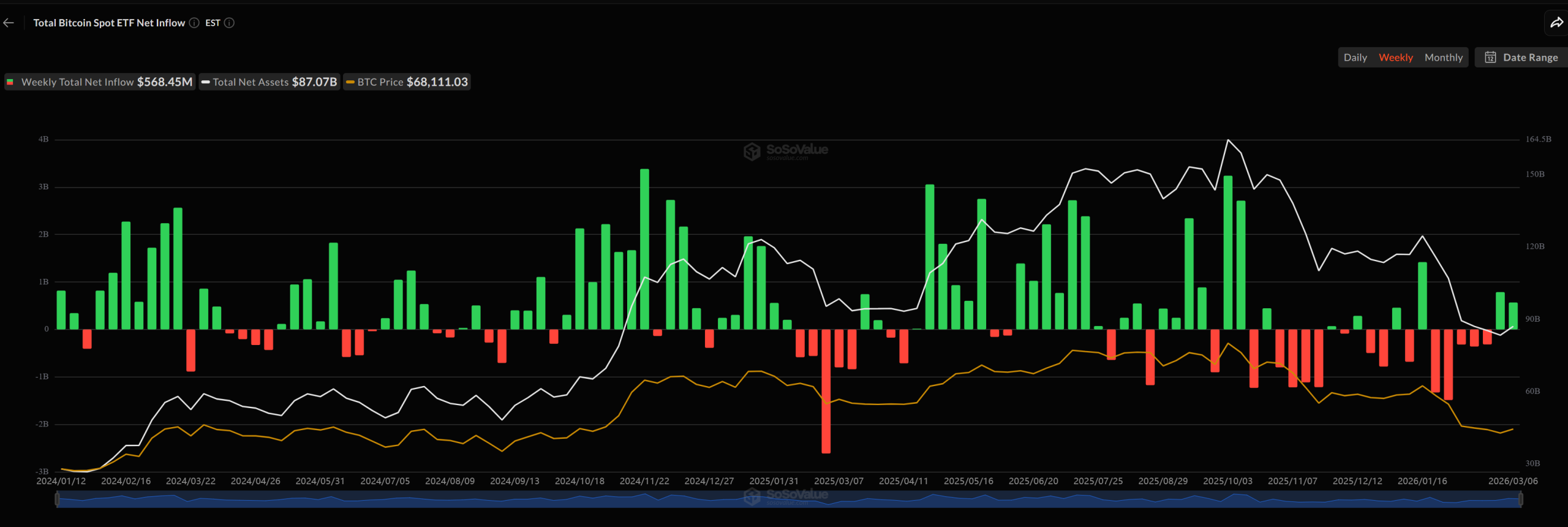
US spot Bitcoin exchange-traded funds recorded their second consecutive week of net inflows, marking the first back-to-back weekly gains in five months.
Spot Bitcoin (BTC) ETFs attracted roughly $568.45 million in net inflows this week, according to data from SoSoValue. The products also posted positive flows of about $787.31 million the previous week, showing renewed investor appetite after several weeks of sustained outflows.
Before the recent turnaround, US spot Bitcoin ETFs endured a prolonged period of investor withdrawals, recording roughly $3.8 billion in cumulative outflows over a five-week streak. The biggest weekly withdrawal during the streak occurred in the week ending Jan. 30, when spot Bitcoin ETFs recorded about $1.49 billion in net outflows.

Daily flows were mixed during this week. Spot Bitcoin ETFs recorded inflows of $458.19 million on Monday, followed by $225.15 million on Tuesday and a larger $461.77 million on Wednesday. The momentum reversed in the final sessions, with the funds seeing $227.83 million in outflows on Thursday and $348.83 million in redemptions on Friday.
Related: US Bitcoin ETFs Post $462 Million Inflows as BTC Tops $73K
Ether ETFs see weekly inflows
US spot Ether (ETH) ETFs also recorded their second consecutive week of net inflows. The funds attracted roughly $23.56 million in net inflows for this week after posting $80.46 million in inflows the previous week, , marking their first back-to-back weekly gains since early October last year.
Before the rebound, spot Ether ETFs faced a sustained withdrawal streak, recording more than $1.38 billion in cumulative outflows across five consecutive weeks. The largest weekly outflow occurred during the week ending Jan. 23, when the funds recorded roughly $611 million in net redemptions.
Meanwhile, the funds saw mixed results throughout the latest reporting week. They recorded $38.69 million in inflows on Monday, followed by $10.75 million in outflows on Tuesday. Inflows returned on Wednesday with $169.41 million, but the momentum faded later in the week.
Related: Bitcoin Whales Shift Billions Into ETFs Like BlackRock’s IBIT
Bitcoin ETFs match 15 years of gold ETF inflows in 2 years
In a Saturday post on X, Fernando Nikolić, Blockstream’s director of marketing, noted that Bitcoin ETFs have already matched roughly 15 years of cumulative inflows seen by gold ETFs in less than two years, despite gold having a decade-and-a-half head start in the ETF market.

Nikolić added that the milestone occurred during a 46% Bitcoin drawdown and several months of negative price performance, arguing that institutional demand remained strong even amid market weakness.
“Anyone still arguing about whether bitcoin is ‘digital gold’ is wasting their breath,” he wrote. “Bitcoin isn’t trying to be gold. Bitcoin is making gold look slow,” he added.
Magazine: Bitcoin may take 7 years to upgrade to post-quantum — BIP-360 co-author
TLDR:
- Global Liquidity holds a 90% correlation to Bitcoin and 97% to the Nasdaq since 2012, per Raoul Pal
- US Total Liquidity bottomed three months ago and is now accelerating, a bullish signal for crypto markets
- Stablecoin issuance grew 50% last year with transaction volumes now running in the trillions of dollars
- Weekly and daily DeMark indicators are aligning to signal a full crypto trend reversal within two weeks
Global Liquidity remains the most dominant macro factor in crypto markets, according to GMI founder Raoul Pal. Amid growing bearish sentiment, Pal pushed back in a detailed social media post.
Despite the fear gripping crypto traders, he cited a broad range of converging macro signals. His analysis draws on over a decade of macro and on-chain data. It covers Bitcoin correlations, business cycles, regulatory trends, and technical chart indicators.
Liquidity Conditions Continue to Support a Market Recovery
Pal noted that Global Liquidity has a 90% correlation to Bitcoin and a 97% correlation to the Nasdaq since 2012. The metric is currently growing at around 10% annually with no signs of slowing. GMI financial conditions, which lead Global Liquidity by six months, remain in an easing trend.
US Total Liquidity created a brief air pocket following the government shutdown. That metric bottomed three months ago and is now accelerating its recovery.
Since US Total Liquidity leads the crypto market by about three months, the timing aligns well. The recovery in this metric supports near-term price strength in digital assets.
The business cycle is also accelerating, which drives corporate earnings and broader risk appetite. China is expanding its balance sheet, adding further to the global liquidity picture.
The eSLR mechanism allows US banks to expand credit and absorb treasury issuance. These combined forces reinforce the overall liquidity environment.
Additional US rate cuts would boost disposable income and increase risk-taking behavior. Tax refunds landing on bank balance sheets add to credit creation capacity.
Together, these factors build a stronger foundation for liquidity-driven market gains. Pal sees these as converging tailwinds, not isolated developments.
Regulation, Stablecoins, and Technicals Align for a Reversal
In the same post, Pal pointed to the CLARITY Act as a near-term catalyst for institutional flows. The bill would allow banks and asset managers to engage directly with blockchain technology.
A large wave of institutional capital is reportedly waiting on this regulatory clarity. If passed, the legislation could unlock substantial new demand for digital assets.
Stablecoin issuance grew by 50% last year and continues to accelerate. Transaction volumes are now running in the trillions of dollars and still climbing.
The current US administration is widely regarded as the most crypto-supportive in history. These structural tailwinds support a broader and more sustained adoption trend.
On the technical side, weekly DeMark indicators are expected to form a solid base within two weeks. Daily DeMark setups are also stacking up in a favorable direction.
Any further weakness would likely complete both the daily and weekly signals. This would indicate full trend reversal potential, according to Pal.
The main risk Pal flagged is how long elevated oil prices persist. The next two weeks are the critical window for market direction.
If conditions align as expected, Pal anticipates a positive outcome for crypto prices. Markets remain gripped by fear, but the macro data points clearly higher.


Disclosure: This article does not represent investment advice. The content and materials featured on this page are for educational purposes only.
As Ethereum and Solana recover, investors rotate capital into DeFi utility projects built on major Layer-1 networks.
Summary
- As crypto markets stabilize, lending protocol Mutuum Finance gains traction, raising $20.7m and growing to 19k investors.
- Mutuum Finance is building dual lending markets on Ethereum, combining instant liquidity pools with flexible peer-to-peer loans.
- Its MUTM token is priced at $0.04 as the protocol prepares P2C and P2P lending markets ahead of launch.
After a volatile start to the year, the cryptocurrency market is showing signs of stabilization, with several major digital assets moving within narrower ranges. This period of consolidation often follows sharp market corrections, as selling pressure begins to ease and market participants reassess positioning.
During these phases, attention typically shifts from short-term volatility to longer-term fundamentals. Investors and analysts tend to focus on which networks continue to demonstrate technical resilience while broader market sentiment resets.
The March recovery phase and whale accumulation
Historically, March is often viewed as a month of recovery and structural reset within the top altcoin industry. Following the “tax loss harvesting” and portfolio rebalancing that typically occur in January and February, the third month of the year has frequently seen the start of new accumulation cycles.
In 2026, similar patterns are being discussed across the market. With the total cryptocurrency market capitalization hovering around $2.41 trillion, several analysts note that large holders tend to adjust their positions during consolidation phases in anticipation of potential shifts in market momentum.
Two primary assets currently dominating whale interest are Ethereum (ETH) and Solana (SOL). Ethereum is currently trading near $1,950 to $2,000, struggling to break a major resistance wall at $2,150. Despite this, institutional activity is high; for instance, BlackRock recently recorded a $41.9 million single-day purchase of ETH, signaling long-term confidence.
Similarly, Solana (SOL) is currently trading near $85, following a localized pullback after its recent 14% rally stalled at the $92 resistance. Despite this price dip, network engagement remains high, with daily new addresses recently peaking at 8.7 million, signaling sustained organic demand. Whales and institutional traders are watching these levels closely; while the $85 mark serves as a critical support floor, a decisive break and daily close above the $98 to $100 psychological barrier would be required to confirm the end of the current consolidation phase.
Market rotation and the rise of new protocols
When top cryptocurrencies like Ethereum and Solana begin to show signs of recovery, capital often rotates into the broader ecosystem of projects built on top of them. This is because a stable “Layer-1” network provides the security and liquidity needed for decentralized applications to thrive. Investors who missed the initial entry into ETH or SOL frequently look for utility projects that solve specific problems like decentralized lending, insurance, or cross-chain communication.
Mutuum Finance (MUTM), a new crypto protocol centered on non-custodial lending and borrowing, is one of the projects being discussed in this context. By utilizing the security of the Ethereum network, Mutuum Finance allows users to interact with their assets through audited smart contracts.
The project has recorded growth during this consolidation phase, raising over $20.7 million in funding. With a community of 19,000 individual investors, the protocol is gaining traction as it nears its full market launch. Currently, the native MUTM token is priced at $0.04.
Preparing P2C and P2P infrastructure
Mutuum Finance is distinguished by its dual-market architecture, which is designed to provide both speed and flexibility. The team is currently preparing two distinct lending markets:
Peer-to-Contract (P2C): This model is being developed to provide instant liquidity. The concept involves users depositing assets such as ETH or USDT into a shared smart contract pool, from which borrowers could draw funds without waiting for a specific lender. A user might provide ETH as collateral to access USDT in a single transaction. Interest rates in this model would be managed by an automated algorithm that adjusts based on pool usage.
Peer-to-Peer (P2P): This marketplace model is intended to give users more control over loan terms. In a P2P setup, lenders and borrowers could negotiate interest rates and loan durations directly. This could be useful for specialized assets that may not fit standard liquidity pools. For example, a borrower might offer Dogecoin (DOGE) as collateral and arrange a loan with a lender at a custom rate for a set duration.
Current features and user testing
The Mutuum Finance V1 Protocol is currently live on the Sepolia testnet, allowing users to evaluate the system’s features in a risk-free environment. This functional demo is a critical part of the project’s Phase 3 roadmap, ensuring the code is battle-tested. Currently, users can test several core mechanics.
Lenders can deposit testnet ETH and receive mtTokens (mtETH receipts), which are yield-bearing digital assets that grow in value as the protocol collects interest from borrowers. For instance, a user who deposits 20 ETH into a liquidity pool would see their mtETH balance become redeemable for 21 ETH over time as the lending activity accrues. This system allows users to verify the accuracy of the interest distribution algorithm in a risk-free environment.
Moving to LTV and Debt Management, participants can test the stability of the Loan-to-Value system. If a user provides $4,000 in testnet collateral with a 75% LTV, the protocol allows them to borrow a maximum of $3,000. This helps users understand how to maintain a healthy “Equity Buffer,” ensuring their positions remain safe from the protocol’s automated liquidation bots if the market price of their collateral fluctuates.
To simplify the user experience, the V1 version also features Risk Presets, categorized as Safe, Balanced, and Aggressive. These settings allow users to automatically adjust their LTV and borrowing limits based on their personal risk tolerance.
By selecting a “Safe” preset, for example, the system might limit the user to a more conservative 40% LTV, providing a much larger safety margin for those new to decentralized lending and ensuring a smoother learning curve on the testnet.
With a functional testnet, a reported user base of around 19,000, and over $20.7 million in capital, Mutuum Finance is advancing its technical infrastructure for non-custodial lending. Observers note that the development of these transparent lending mechanisms is likely to be an important factor for the protocol’s longer-term growth, regardless of short-term market movements.
Disclosure: This content is provided by a third party. Neither crypto.news nor the author of this article endorses any product mentioned on this page. Users should conduct their own research before taking any action related to the company.


Disclosure: The views and opinions expressed here belong solely to the author and do not represent the views and opinions of crypto.news’ editorial.
Tokenization reaching Wall Street is a headline. Building compliant, liquid, enforceable on-chain markets is the real test. Without infrastructure, issuance is just digitization.
Summary
- Issuance isn’t innovation: Tokenizing equities is a milestone, but without compliant trading, liquidity, lending, and enforceable rights, digital securities remain cosmetic upgrades.
- Wall Street’s cadence is breaking: 24/7 markets and instant settlement are reshaping investor expectations, making fixed hours and delayed clearing structurally outdated.
- Infrastructure decides the outcome: Purpose-built rails embedding compliance, custody, and secondary liquidity will determine whether tokenization integrates into core finance or stalls at experimentation.
For much of its history, the New York Stock Exchange (NYSE) has run on human energy. The reality of Wall Street: Traders filled the floor, hand signals flew across a sea of people, and paper tickets were passed from one desk to another. The market opened with a bell and closed with another, compressing the world’s capital into a daily ritual.
Even as technology replaced paper with screens and servers, the structure remained recognizable. Trading hours were fixed, settlement followed a prescribed cycle, and ownership records were maintained in centralized systems. The infrastructure was continuously refined to keep pace with innovation, but its foundations rarely shifted.
While each century welcomed a technological leap that widened participation and improved efficiency, the underlying cadence of the markets — open, close, settle — remained intact. But now that cadence is being challenged.
Retail investors today operate in a financial environment that feels fundamentally different from the one equity markets were designed for. Capital moves instantly, markets are global and always on. Crypto trading has normalized 24/7 access, near-instant settlement, and the ability to trade in dollar amounts rather than discrete units. Against that backdrop, waiting for an opening bell or a multi-day settlement cycle increasingly feels out of step with modern financial behavior.
In January 2026, the NYSE and its parent company, Intercontinental Exchange (ICE), made that shift explicit by announcing plans to develop a tokenized securities platform, signaling that tokenization is moving from the margins of finance to the core.
The timing is not coincidental. Tokenization has quickly become one of the most defining themes in global markets. What started as a crypto-native experiment has matured into a multi-asset shift, with equities, commodities, and other real-world assets increasingly being structured as blockchain-based representations. These allow assets to be fractionalized, traded continuously, and settled with greater efficiency than traditional systems allow.
Governments have also taken notice and have started exploring tokenization concepts at the sovereign level. At the World Economic Forum in Davos, Binance co-founder Changpeng Zhao shared he is in discussions with multiple governments interested in tokenizing national assets. He framed it as a way for governments to unlock value upfront, then reinvest the earnings to develop industries, attractions, and trading markets.
However, the real question shifts from issuance to infrastructure, since issuing a token is a milestone, but it’s only the starting point. Markets aren’t defined solely by issuance; they depend on liquidity, compliance, and enforceability. The difficult part is building systems that can support compliant trading, sustain secondary liquidity, integrate lending and borrowing, and operate within enforceable regulatory frameworks.
This distinction is why purpose-built platforms for real-world asset tokenization have become increasingly important. Mavryk Network, for example, is a purpose-built Layer 1 blockchain focused specifically on the tokenization of real-world assets. Rather than operating as an application on an existing chain, which can leave systemic risks such as governance decisions and validator incentives outside the platform’s control, Mavryk was designed specifically to support regulated financial instruments. Its architecture embeds compliance logic directly into its token standards and integrates trading and lending infrastructure, moving beyond simple digitization to functional onchain markets. The platform was built on the premise that RWAs are not just tokens but regulated financial instruments tied to real legal rights, and that they require infrastructure that reflects that reality.
That distinction matters. Many projects have the tools to tokenize an asset, but few are built for what comes after issuance. As tokenization shifts from experimentation to institutional deployment, the strength of its underlying infrastructure will determine how far this transformation can go, and whether digital markets stall, stay parallel to traditional finance, or become the next evolution of capital markets.
TLDR
- Nevin Shetty, former chief financial officer, covertly transferred $35 million in corporate assets to cryptocurrency platforms without authorization
- Funds were deposited into decentralized finance protocols offering annual yields exceeding 20%
- The May 2022 Terra crash eliminated virtually all invested capital
- Following conviction on four wire fraud charges, Shetty received a 24-month prison sentence
- The unauthorized investments resulted in approximately 60 job losses and nearly bankrupted the organization
A federal court has sentenced Nevin Shetty, who previously served as CFO for a Seattle-based software company, to 24 months behind bars after he illegally diverted $35 million in corporate assets into cryptocurrency ventures under his personal control.
The sentence was delivered by a Seattle federal judge after a nine-day trial that wrapped up on November 7, 2025. The jury delivered guilty verdicts on all four wire fraud charges.
Shetty assumed the chief financial officer position at the startup in March 2021. Company policy explicitly mandated that all corporate funds remain in low-risk, conservative investment vehicles such as money market accounts.
Ironically, despite participating in drafting these investment guidelines, Shetty established a cryptocurrency consulting entity named HighTower Treasury in early 2022. The venture had zero additional customers.
After learning in April 2022 that he would be stripped of his CFO responsibilities due to inadequate job performance, Shetty took action. Over a twelve-day period from April 1 to April 12, 2022, he executed wire transfers totaling $35,000,100 from a Chase banking location near his residence into HighTower Treasury accounts.
Not a single board member or executive colleague had knowledge of these transactions.
Shetty subsequently allocated the capital into DeFi lending protocols. These platforms advertised interest rates of 20% annually or higher.
During the initial thirty days, the positions generated approximately $133,000 in gains.
When the Crypto Market Collapsed
The initial profits proved short-lived. When the Terra blockchain ecosystem imploded in May 2022, it catalyzed a broader cryptocurrency market downturn. By May 13, 2022, Shetty’s portfolio had depreciated to essentially worthless.
Facing the reality that $35 million had evaporated, Shetty disclosed his actions to two executive colleagues. His employment was terminated on the spot.
U.S. District Judge Tana Lin emphasized the devastating impact of the fraud. The capital loss compelled the company to terminate roughly 60 employees and brought the business to the brink of insolvency.
Shetty faced indictment on wire fraud counts in May 2023. His conviction came in November 2025 following the jury trial, with sentencing occurring in March 2026.
Crypto Fraud Cases Continue in U.S. Courts
This prosecution represents just one among numerous prominent cryptocurrency fraud proceedings that have advanced through federal courts recently.
FTX CEO Sam Bankman-Fried, for instance, received a 25-year sentence in 2024. His attorneys have filed appellate briefs, and as of Friday, the U.S. Court of Appeals for the Second Circuit has yet to render a decision following oral arguments heard in November.
Beyond the two-year incarceration period, Shetty faces an order to make full restitution of the $35 million. Following his release, he must complete three years under supervised probation.
TLDR:
- ZEC surged over 700% from sub-$50 levels, briefly hitting $750 and nearing a $10 billion market cap in 2025.
- Winklevoss Capital and Cypherpunk Technologies poured over $76 million into ZEC during the peak privacy narrative rally.
- Zcash DeFi TVL collapsed from $30 million to under $2 million weeks before the governance crisis became public news.
- ECC’s full leadership resigned in January 2026, triggering an instant 14–25% price drop and a $7 billion valuation loss.
ZEC, the native token of Zcash’s privacy protocol, experienced one of crypto’s sharpest reversals in recent memory.
Over just a few months, the asset gained over 700%, drew billions in institutional capital, then shed most of its value.
ZEC Rally Built on Privacy Narrative and Institutional Demand
From sub-$50 levels in late summer 2025, ZEC surged more than 700% within a matter of weeks. The token climbed to $400 in October before briefly touching a peak near $750 in November.
That pace placed it among the top performers across the entire crypto market. It also briefly overtook Monero in market capitalization, pushing total valuation close to $10 billion.
The surge was not purely speculative. Privacy had returned as one of the most discussed themes in the industry. A report from a16z’s State of Crypto documented a notable rise in online searches around privacy-focused tools.
Prominent figures like Arthur Hayes and Naval Ravikant backed the concept of privacy-first transactions, framing it as a natural evolution beyond standard crypto infrastructure.
Institutional capital moved in quickly after that narrative gained ground. Cypherpunk Technologies purchased $18 million in ZEC.
Winklevoss Capital added more than $58 million, while Grayscale reopened its Zcash Trust to buyers. These purchases collectively created a strong base and helped sustain upward momentum.
The November 2025 halving further shaped market conditions. Block rewards dropped from 3.125 to 1.5625 ZEC per block.
Separately, the ZIP-1015 lockbox mechanism redirected 12% of rewards going forward. Together, these supply-side changes reinforced the bullish case during that period.
TVL Collapse and Governance Crisis Erased $7 Billion in Value
Even before any governance news emerged, early warning signs appeared within the ecosystem. At the rally’s peak, Zcash DeFi recorded over $30 million in total value locked.
That figure fell to under $2 million within weeks. Prices, however, remained elevated, creating a visible gap between on-chain activity and market valuation.
That kind of disconnect tends to precede broader corrections in crypto markets. When capital exits an ecosystem quietly, it often reflects weakened conviction among active participants. The token price held on sentiment alone, while actual on-chain usage told a different story.
The breaking point arrived in January 2026. The entire leadership team of the Electric Coin Company resigned following a governance conflict with the Zcash Bootstrap nonprofit board.
As @ourcryptotalk reported, prices fell between 14% and 25% almost immediately after the announcement surfaced.
Despite the resignations, Zcash’s core protocol continued operating without interruption. The departing developers formed a new independent company and resumed work on privacy tools, including continued development of the Zashi wallet.
However, market confidence had already shifted. ZEC’s valuation fell from nearly $10 billion to around $3 billion, erasing over $7 billion in total market value across the period.
Key Takeaways
- Technical analyst ChartNerd forecasts XRP may decline to $1 through a liquidity sweep before reversing higher.
- Exchange-traded funds tracking XRP saw their first weekly capital exodus since January 30, with outflows exceeding $4 million.
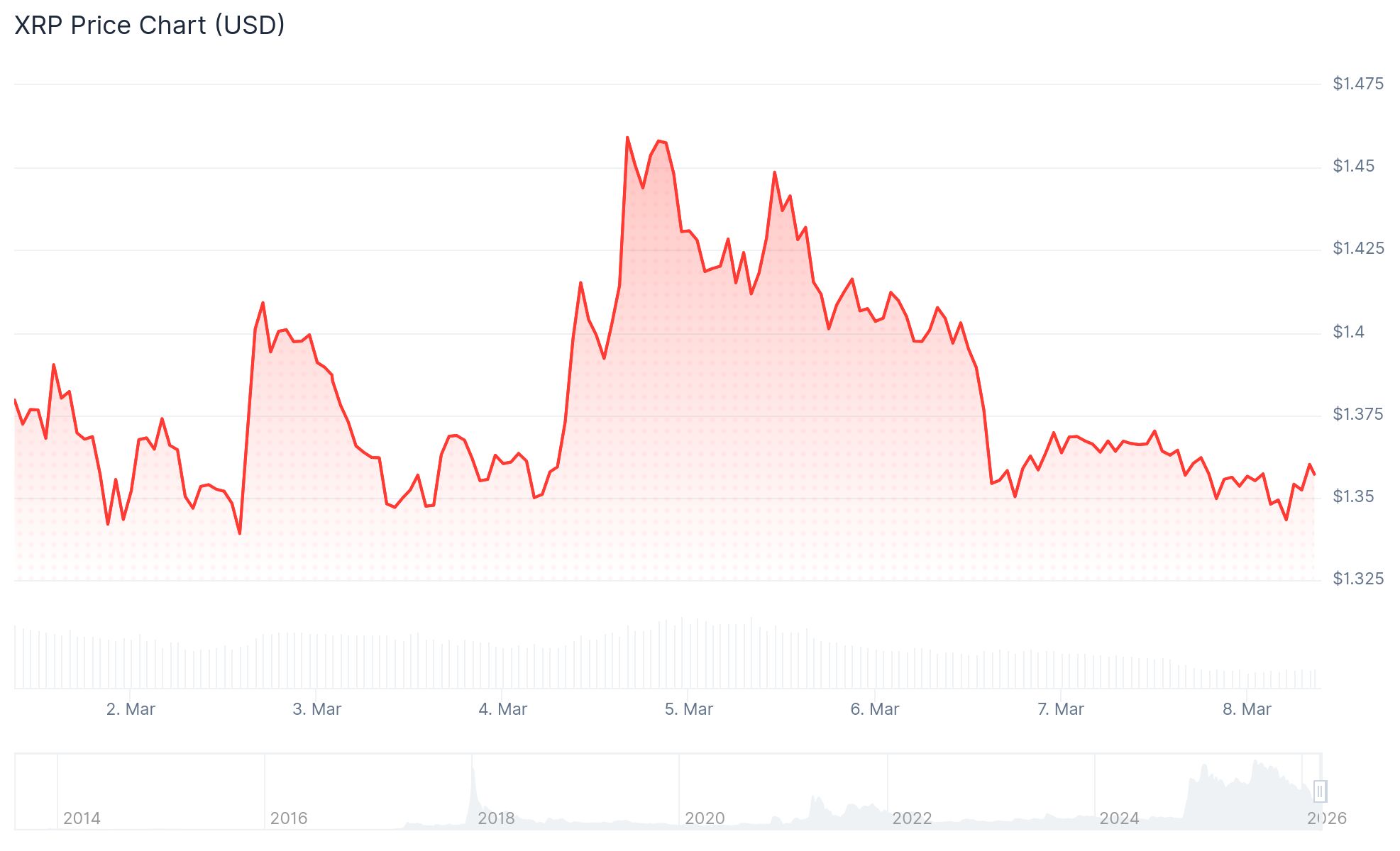
- The digital asset currently hovers around $1.35 following a brief decline to $1.347 amid increased selling pressure.
- Ripple’s CEO Brad Garlinghouse expressed optimism about long-term holders being rewarded within a five-year timeframe.
- Large holder activity, tracked via the Flow 30-DMA indicator, has shifted positive for the first time since late 2024.
XRP maintains its position near $1.35 following a challenging week characterized by institutional fund withdrawals, technical resistance, and cautionary price forecasts. Despite near-term headwinds, Ripple’s leadership maintains an optimistic long-range outlook.
The cryptocurrency declined from $1.3666 to $1.3554 throughout the previous 24-hour period, momentarily reaching $1.347 as trading activity intensified. Support emerged around the $1.35 threshold, with the asset subsequently consolidating within a narrow corridor between $1.35 and $1.37.
Technical analyst ChartNerd shared analysis on X suggesting XRP might retreat to $1, highlighting significant liquidity concentration between $1 and $1.20. Additional liquidity pools exist around the $1.80 level.
According to ChartNerd, the probable March trajectory involves an initial push toward $1.80, subsequently followed by a pullback into the $1 zone. This pattern represents a classic “liquidity grab” — a strategic price movement intended to activate stop-loss orders before a possible trend reversal.
Exchange-Traded Funds Experience First Weekly Capital Flight Since January
Data from SoSoValue reveals XRP exchange-traded funds recorded net weekly withdrawals slightly exceeding $4 million. This represents the initial weekly capital exodus observed since January 30.
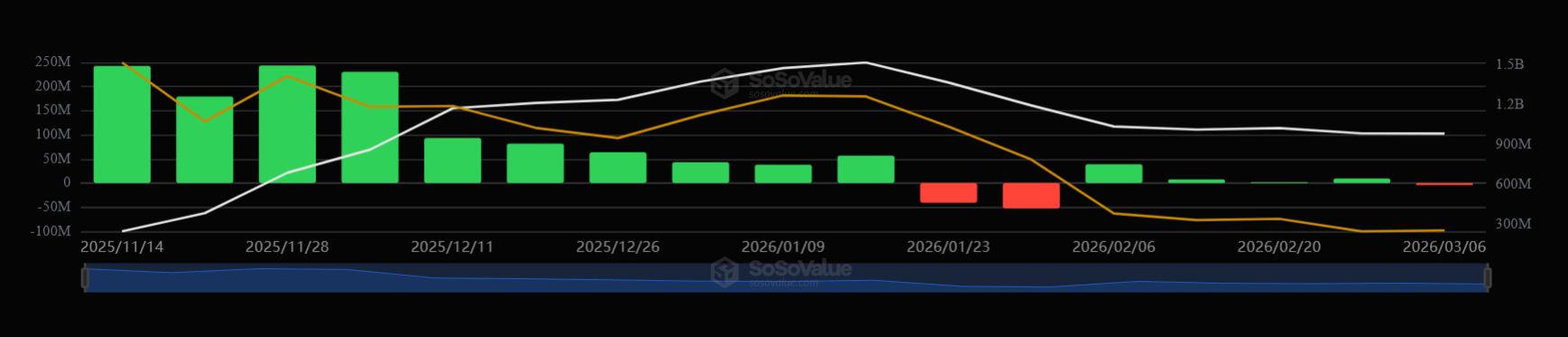
These investment vehicles attracted capital during the week’s opening three trading sessions before momentum shifted on March 5 and 6. March 6 witnessed particularly heavy redemptions totaling $16.62 million — representing the largest single-session withdrawal since January 29.
Meanwhile, Bitcoin, Ethereum, and Solana ETFs experienced parallel outflows measuring $349 million, $83 million, and $8 million respectively throughout the identical timeframe.
Ripple Executive Emphasizes Strategic Patience
Speaking at the XRP Australia 2026 gathering, Ripple’s CEO Brad Garlinghouse conveyed to participants that today’s investors might discover themselves in a “very happy place” over a five-year horizon.
Garlinghouse highlighted the growing momentum behind institutional blockchain integration, encompassing asset tokenization, stablecoin deployment, and distributed ledger settlement infrastructure.
He characterized advancement as incremental progression rather than a singular transformative event. “There’s not one switch; there are hundreds and thousands of switches,” he explained.
Evernorth’s CEO Asheesh Birla emphasized that genuine financial industry transformation requires approximately a decade. He noted that immediate price fluctuations frequently fail to capture the underlying technological evolution.
One encouraging blockchain metric: the XRP Whale Flow 30-DMA indicator has registered positive territory for the first instance in over ninety days, indicating renewed accumulation by substantial holders.
XRP presently defends the $1.35 support threshold, with market participants monitoring closely for a decisive directional breakout.

(VIDEO) Israel Strikes Iranian Fuel Depots in Tehran, Netanyahu Vows ‘Many Surprises’

Kalshi Hit With Class Action Lawsuit Over Khamenei Market Settlement

10 Classic Cartoons That Have Aged Like Fine Wine


-

 Politics5 days ago
Alan Cumming Brands Baftas Ceremony A ‘Triggering S**tshow’
-
Business2 days ago
Form 8K Entergy Mississippi LLC For: 6 March
-

 Fashion2 days ago
Weekend Open Thread: Ann Taylor
-

 NewsBeat7 days ago
‘Significant’ damage to boarded-up Horden house after fire
-

 Tech3 days ago
Bitwarden adds support for passkey login on Windows 11
-

 Entertainment6 days ago
Baby Gear Guide: Strollers, Car Seats
-
 Sports3 days ago
499 runs and 34 sixes later, India beat England to enter T20 World Cup final | Cricket News
-

 NewsBeat6 days ago
Is it acceptable to comment on the appearance of strangers in public? Readers discuss
-

 Sports15 hours ago
Three share 2-shot lead entering final round in Hong Kong
-

 Video6 days ago
How to Build Finance Dashboards With AI in Minutes
-

 Fashion7 days ago
On the Scene at the 57th Annual NAACP Image Awards: Teyana Taylor in Black Ashi Studio, Colman Domingo in Yellow Sergio Hudson, Chloe Bailey in Christian Siriano, and More!
-

 Sports5 hours ago
Braveheart Lakshya downs Lai in epic battle to enter All England Open final | Other Sports News
-

 Business4 days ago
Guthrie Disappearance Enters Fifth Week as Family Visits Memorial
-
 NewsBeat6 days ago
Ukraine-Russia war latest: Belgium releases video showing forces boarding Russian shadow fleet oil tanker
-

 Crypto World6 days ago
Why Nexo Is Reentering the US After the 2023 Crypto Lending Crackdown
-

 NewsBeat3 days ago
Piccadilly Circus just unveiled ‘London’s newest tourist attraction’ and it only costs 80p to enter
-

 Tech6 days ago
Cynus Chess Robot: A Chess Board With A Robotic Arm
-

 Video6 days ago
LPP + Financial Maths + Numerical Applications | One Shot | Applied Maths | Target Board Exams 2026
-
 NewsBeat6 days ago
Handcuffed presenter Jonathan Ross’ sweet admission about marriage to wife of 38 years
-
 Sports5 days ago
Jack Grealish posts new injury update as Man City star enters crucial period