
Crypto World
Ripple Returns to Korea as Major XRP Company Awaits Nasdaq Listing


XRP trades at just a nod above $1.40 as Ripple ecosystem builds toward a Korean stage while one of its own veterans eyes Wall Street. The token is stuck in a tight band, and today’s news out of Seoul raises a question worth asking: Does event buzz actually move price?
XRPL Korea, organizer of XRP Seoul 2026, unveiled its second speaker lineup today, adding names from Doppler Finance, Flare, t54 Labs, Variational, Evernorth, and Squid. The standout: Evernorth CEO Ashish Birla, an early Ripple team member whose firm is pursuing a Nasdaq listing via SPAC merger with a stated goal of building a $1 billion XRP reserve.
Please welcome @ashgoblue, CEO of @evernorthxrp. — XRP SEOUL 2026
Asheesh leads Evernorth's vision and strategy. A 25+ year Silicon Valley veteran, he helped scale Ripple from a startup to 1,000+ employees. Oct 3, 2026 |
 Grand Hyatt Seoul
 https://t.co/tkFQwpiGRQ
 Apply to speak:… pic.twitter.com/f93AYdwawO
 (@XRPSEOUL) September 4, 2026
Meanwhile, Flare co-founder Hugo Philion will also speak on smart-contract functionality for XRP and Bitcoin in DeFi. This is a detail that fits the institutional narrative Ripple has been building around the XRP Ledger.
None of this has translated into buying pressure yet. Volume sits elevated near $1.4–$1.8 billion in 24 hours, but that’s indecision, not conviction. The setup below explains why.
Discover: The Best Token Presales
Can Ripple XRP Price Hit $1.80 This Week?
At $1.41, Ripple sits just below its recent range ceiling, with resistance clustered at $1.43–$1.46 and support at $1.39–$1.40. RSI reads 41, neutral, not oversold, while MACD stays bearish, and declining volume on recent upticks hints at a ceiling forming rather than a breakout brewing.
XRP remains above both its 50-day moving average ($1.19) and 200-day moving average ($1.28), which keeps the medium-term trend technically intact even as short-term momentum stalls.

The scenarios are straightforward. The best one is a clean break above $1.43 that opens a retest of $1.50, and consolidation above that level could extend toward $1.60–$1.68, with a more aggressive $1.80 target still in play off the $1.32 bounce. Or we could see a continued chop between $1.39 and $1.43 while the market waits for confirmation.
The last scenario is what holders don’t want to see, a failure to hold $1.35 sends XRP toward $1.28, with $1.22 as the next stop if that breaks. Trading volume data will likely confirm direction before headlines do.
Earn $50 and Enter $300K Prize Draw on EdgeX
LiquidChain Targets Early Mover Upside as XRP Tests Key Levels
XRP holders watching this range have a reasonable thesis. Evernorth’s Nasdaq path and a $1 billion reserve target are real long-term signals. But at a market cap already pricing in institutional adoption, the upside from $1.40 to $1.80 is a 28% move, not a multiple. That’s the ceiling problem large-cap holders keep running into: real catalysts, capped returns.
That’s where earlier-stage infrastructure plays start to look different. LiquidChain ($LIQUID) is a Layer 3 protocol fusing Bitcoin, Ethereum, and Solana liquidity into a single execution environment. It’s a unified layer where developers deploy once and access all three ecosystems, rather than building separate bridges for each.
A little of this chain. A little of that chain. — LiquidChain (@getliquidchain) September 7, 2026
Then things get interesting.  pic.twitter.com/ybu9a1L0o0
Current presale price sits at $0.014953, with $960K raised so far. Core features include Single-Step Execution and Verifiable Settlement, aimed at cutting the fragmentation that plagues cross-chain DeFi today.
Investors can research LiquidChain directly before deciding.
Trade Crypto on Bybit and Get a Chance to Win Our $1,000 USDT Airdrop
The post Ripple Returns to Korea as Major XRP Company Awaits Nasdaq Listing appeared first on Cryptonews.


The UK’s Financial Conduct Authority (FCA) is reportedly in discussions about whether to ease its long-standing ban on prediction market platforms for retail investors, according to a report from The Times.
The FCA imposed the restriction in April 2019, arguing that many prediction markets resemble binary options—products it had prohibited from being sold to retail consumers. Now, if the FCA were to move away from that position, platforms that have been operating primarily outside the UK could see their compliance models and market access in the country change significantly.
Key takeaways
- The FCA’s retail ban on prediction market-style binary options dates back to April 2019.
- According to The Times, the FCA has contacted prediction market companies to discuss potentially lifting the restriction for UK-based retail investors.
- UK retail users have reportedly used VPNs to access platforms such as Kalshi and Polymarket, both operating in the US.
- Any UK regulatory shift could expose platforms to a similar regulatory patchwork risk that exists in the US.
Why the FCA’s 2019 ban matters
The original FCA prohibition was tied to how prediction markets can be structured—often as event-based contracts that pay out based on whether a specific outcome occurs. In its April 2019 action, the FCA said companies were “prohibited from selling, marketing or distributing binary options to retail consumers,” a category that includes binary options offered to individuals outside a more restricted framework.
At the time, the FCA’s executive director of strategy and competition, Christopher Woolard, described binary options as “gambling products dressed up as financial instruments.” That framing helped justify a permanent retail ban rather than a limited restriction or additional disclosure requirements.
Contact signals potential regulatory shift
In Friday’s Times report, the FCA is said to be weighing lifting the ban for UK retail investors and has reached out to prediction market companies as part of those discussions.
While the details of the proposal are not specified in the report, the fact that the regulator is engaging directly suggests the FCA may be re-evaluating whether prediction markets should remain grouped with binary options as retail products. For investors and traders, the practical implication would be the possibility of regulated or at least more clearly permitted access pathways in the UK, rather than relying on offshore services.
For platforms, regulatory engagement can be a turning point: it signals that market access could become less dependent on workarounds and more dependent on compliance with UK rules—if the FCA decides the product structure can be reconciled with its retail-protection framework.
UK users reportedly bypass restrictions
The Times report also highlights how some UK retail participants may have already been finding ways around the FCA’s limitations. It says many have used virtual private networks (VPNs) to access prediction market trading—executing trades on Kalshi and Polymarket, both of which operate in the United States.
That matters because a ban that prompts consistent circumvention can become harder for regulators to enforce in the real world. It can also create a compliance mismatch: retail users may be actively participating in markets that the UK regulator views as unsuitable, even if those users are technically accessing platforms from outside the UK’s jurisdictional boundaries.
The report notes that market analysts have projected strong growth for the broader prediction market industry. Bernstein Research, as reported by CNBC, previously speculated that total prediction market trading volume could reach around $240 billion in 2026 and about $1 trillion by 2030.
If the FCA were to loosen the UK retail prohibition, the UK could become part of that growth story—though whether it does so through outright permission or a more restrictive licensing model would likely determine how quickly retail participation expands.
US legal pressure could foreshadow the next regulatory test
Any UK relaxation would not necessarily eliminate legal uncertainty for prediction market operators. The main reason is that the industry’s structure—event contracts that resemble wagers—has triggered a regulatory and legal debate in the US between state-level gaming authorities and federal oversight.
The article notes that US challenges are already unfolding through lawsuits. Last week, New Jersey officials petitioned the Supreme Court to hear their case against Kalshi, potentially leading to clarification over how state and federal authority apply to prediction markets.
That dynamic illustrates what could happen if the FCA revises its approach: even if the UK decides to allow retail participation, the global industry still has to contend with unresolved questions about classification—whether these contracts are best treated as financial instruments, regulated derivatives, or gambling products.
As a result, UK policy changes may shift where the compliance burden falls, but not necessarily remove it. Operators could still need to design products and distribution methods that satisfy multiple regulators across jurisdictions.
What to watch next
UK readers should watch for any formal FCA consultation, guidance, or policy statements that specify what changes—if any—would be required for platforms to offer prediction market products to retail investors. Until then, the key open question remains whether the FCA will distinguish prediction markets from binary options in practice, or keep the same underlying treatment while adjusting enforcement or access channels.


Organized crime groups in Ireland have been storing cryptocurrency private keys and seed phrases in rented vaults alongside cash and luxury goods as criminals spread their assets across different forms, according to the head of the country’s Criminal Assets Bureau.
Summary
- Irish organized crime gangs are storing crypto private keys and seed phrases in rented vaults alongside cash, watches and other valuables.
- Ireland’s Criminal Assets Bureau said crypto use among criminal groups remains relatively basic, with cash still dominant in drug trafficking.
- Ireland is preparing for new EU anti money laundering rules covering large cash transactions, crypto service providers and other regulated businesses.
- CAB has realized more than €130 million from a 6,000 BTC holding seized from a cannabis grower as authorities continue working through the wallets.
The Sunday Independent reported that Detective Chief Superintendent Michael Gubbins, who heads the Criminal Assets Bureau, said investigators had encountered the practice during their own cases and had raised the issue with Ireland’s Anti-Money Laundering Steering Committee.
Gubbins said rented vaults can contain access credentials for cryptocurrency wallets alongside assets traditionally associated with criminal proceeds.
“Could be cryptocurrency keys or cash or watches or could even be passports,” he said. “Again, it’s from our experience, what we would have seen around those matters.”
Private keys allow users to authorize transactions from crypto wallets, while a seed phrase can be used to restore access to a wallet. Losing either can permanently prevent an owner from accessing funds, while someone who obtains them may be able to take control of the associated cryptocurrency.
Irish crime gangs are spreading assets across crypto and cash
Gubbins said criminal groups have turned to cryptocurrency partly to spread the risk of having their assets seized and because they believe digital assets provide anonymity.
“They believe there’s an anonymity attached to it,” he said.
The CAB chief pointed to drawbacks for criminals using crypto, including price volatility and the possibility of losing passwords or other credentials needed to access their wallets.
Despite its increased presence in investigations, Gubbins described crypto use among Irish criminal groups as “still quite basic.” Cash continues to dominate the proceeds generated by organized crime, particularly drug trafficking.
“It’s still a cash business for those engaged in drug trafficking,” he said.
Ireland has already identified digital assets as a significant financial crime risk. As crypto.news previously reported, the Department of Finance classified crypto assets as a “very significant” money laundering and terrorist financing risk in its 2026 National Risk Assessment.
The assessment cited risks including crypto-related fraud, sanctions evasion and difficulties surrounding tax enforcement, while the government set out plans for further standards covering crypto-related sources of funds.
Ireland followed the assessment in August with its first national AML strategy, which runs through 2030 and places additional attention on digital asset transactions involving self-hosted wallets and overseas crypto firms.
Under the framework, regulated crypto service providers must conduct enhanced checks on certain transfers involving private wallets. For transfers above €1,000, firms must take steps to assess whether a customer owns or controls the self-hosted address involved.
EU anti-money laundering rules tighten cash and crypto checks
The findings reported by CAB come as Ireland prepares for another stage of the European Union’s anti-money laundering framework.
EU rules taking effect in July 2027 will impose a €10,000 maximum on cash payments for goods and services, although member states can adopt lower limits. Obliged businesses handling occasional cash transactions of at least €3,000 will have to identify and verify the customer.
Crypto-asset service providers face separate customer due diligence requirements under the regulation. They will need to conduct customer checks on occasional crypto transactions worth at least €1,000, while applying identification measures to transactions below that level.
The framework brings crypto-asset service providers, crowdfunding operators and several other sectors within the EU’s updated anti-money laundering regime. It contains measures covering self-hosted crypto addresses, requiring service providers to identify and assess money laundering and terrorist financing risks linked to transfers involving them.
Ireland’s Anti-Money Laundering Steering Committee is part of the preparation for the changes. Chaired by the Department of Finance, the committee brings together agencies including the Criminal Assets Bureau, Central Bank of Ireland, An Garda Síochána and Financial Intelligence Unit Ireland.
Ireland’s MiCA transition period ended in December 2025, meaning firms previously operating under domestic registrations needed authorization under the Markets in Crypto-Assets framework or another lawful route to continue providing covered services. The country’s latest crypto compliance rules have since placed more attention on transactions involving self-hosted wallets.
Professional money launderers remain part of Irish crime networks
CAB investigations have encountered professional money launderers who move funds on behalf of criminal groups, according to Gubbins.
Some operators use hawala, an informal value transfer system where money deposited with one operator in one country can be paid through another operator elsewhere without the original cash physically crossing the border.
Gubbins said professional laundering services can charge commissions of roughly 6%.
During one investigation involving the system, CAB seized €230,000 from a safe deposit box held at a private vault company.
The use of vaults for cash, luxury goods and crypto credentials gives investigators another physical component to cases involving digital assets. Although cryptocurrency itself exists on a blockchain, control ultimately depends on the credentials required to authorize access to the associated wallet.
Irish authorities have confronted that problem directly while trying to recover one of the largest cryptocurrency holdings seized in the country.
CAB works through 6,000 BTC seized from cannabis grower
CAB has been trying to access 12 Bitcoin wallets containing a combined 6,000 BTC seized from convicted cannabis grower Clifton Collins in 2019.
Collins had acquired the Bitcoin in late 2011 and early 2012 using proceeds from his cannabis operation. He divided the holdings across 12 wallets containing roughly 500 BTC each and wrote the private keys on paper before hiding them inside the aluminum cap of a fishing rod case at a rented property.
The fishing equipment disappeared after the property was cleared following his arrest, leaving authorities unable to access the Bitcoin despite having seized the assets.
Progress came in March when CAB, working with Europol’s European Cybercrime Centre, accessed the first wallet containing 500 BTC. Europol provided technical expertise and decryption resources for the operation, though authorities did not disclose how they recovered access.
A second 500 BTC wallet was secured in May, taking the recovered amount to 1,000 BTC. By July, authorities had gained control of another 500 BTC, raising the total accessible amount to 1,500 BTC.
Activity connected to the holdings continued in late August, when another Collins-linked wallet moved 500 BTC worth nearly $40 million at the time. No statement from CAB, An Garda Síochána or Europol accompanied that transaction, leaving its purpose unconfirmed.
Gubbins told the Sunday Independent that more than €130 million of the roughly €360 million holding has now been realized as CAB continues working through the seized wallets.
The agency returned almost €15 million in recovered assets to the Irish exchequer last year.
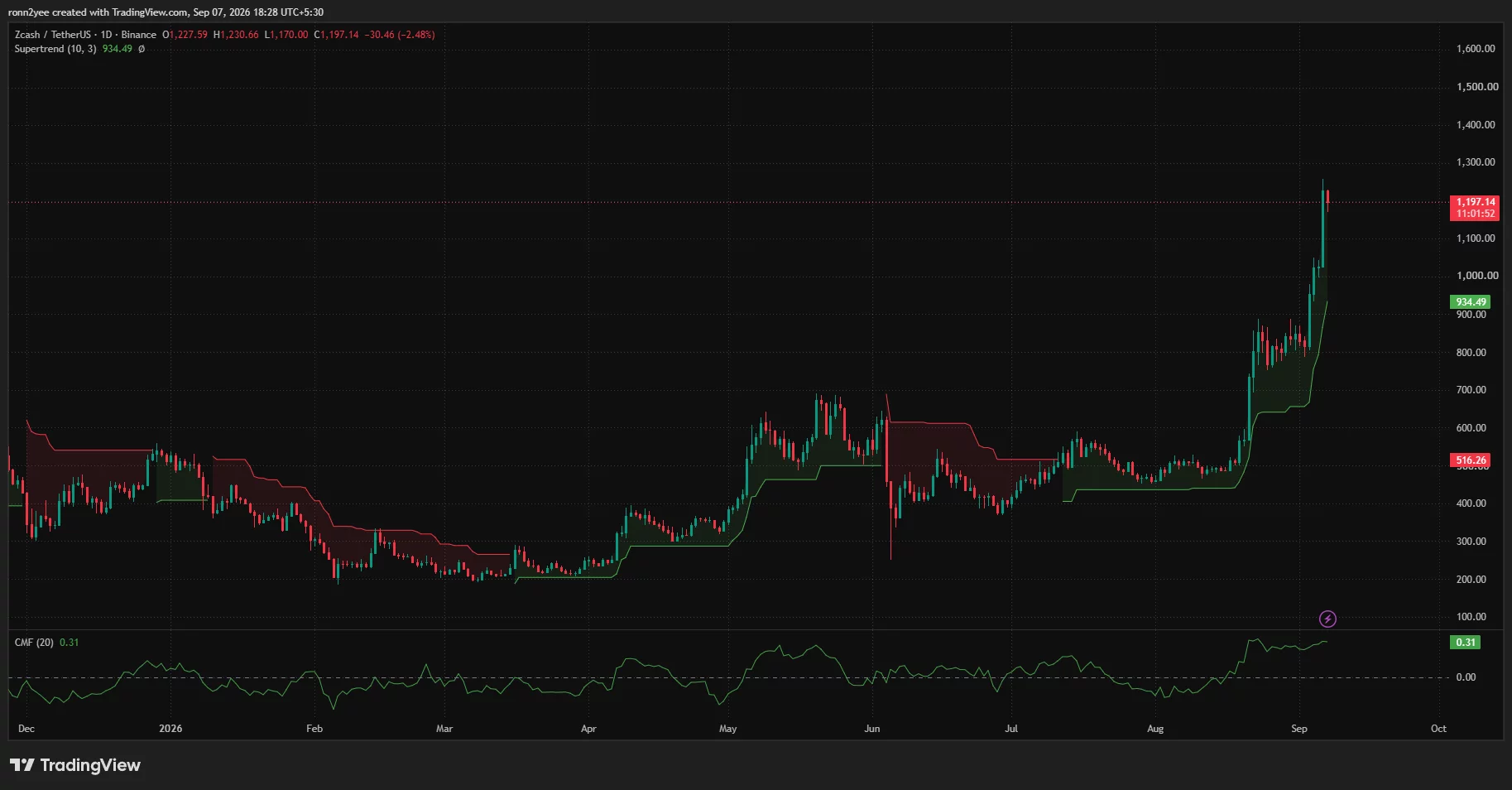
Zcash price traded near $1,197 on Sept. 7 after gaining roughly 43% over the week, as its breakout above $1,000, ETF demand, and short liquidations fueled the rally.
Summary
- Zcash price gained about 43% from its Sept. 1 opening price of $829.69.
- The daily Supertrend remains bullish, with its trailing support near $934.
- 4-hour Bollinger Bands place immediate resistance around $1,273 and support near $1,098.
- Liquidation clusters near $1,240 and $1,260 could shape ZEC’s next move.
Zcash price holds above $1,190 after 43% rally
According to data from crypto.news, Zcash (ZEC) price traded near $1,197 on Sept. 7 after one of its strongest weekly advances in recent history. The privacy coin rose by about 43% from its Sept. 1 opening price of $829.69, outperforming several major crypto assets during the period.
The rally accelerated after buyers cleared resistance near $888 and pushed ZEC through the psychological $1,000 level on Sept. 4. Price later reached an intraday high of approximately $1,230 before easing as traders took profits.
The daily chart shows ZEC opening Sept. 7 at $1,227.59 before retreating by about 2.5% to $1,197.14. Despite the pullback, the token remains well above its recent breakout zone and the daily Supertrend level at $934.49.
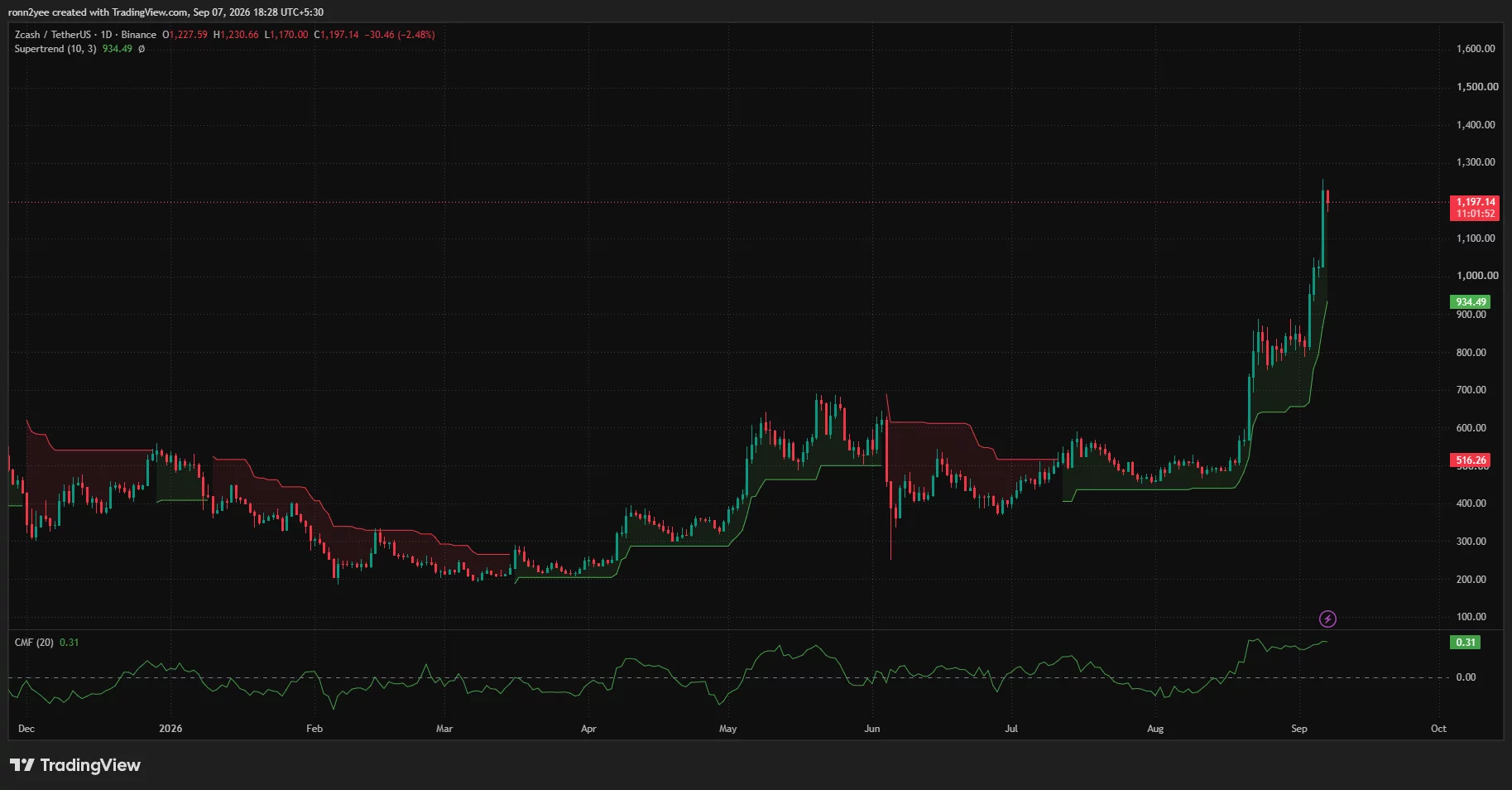
Chaikin Money Flow stands at 0.31 on the daily chart. A positive reading indicates that buying pressure continues to outweigh selling pressure, although the vertical nature of the advance raises the risk of wider price swings.
US-listed ETF and short squeeze support ZEC
The rally followed Grayscale’s conversion of its Zcash Trust into the ZCSH exchange-traded fund. The product began trading on NYSE Arca on Aug. 25 and became the first US-listed exchange-traded product dedicated to ZEC, according to Grayscale.
ZCSH opened a regulated brokerage route for US investors seeking exposure to Zcash without holding the token directly. Grayscale reported more than $400 million in fund assets after the launch, although part of the increase reflected ZEC’s rising market value rather than new capital alone.
Derivatives positioning amplified the spot-led move. ZEC’s break above $1,000 reportedly liquidated approximately $34.5 million in short positions within 24 hours, forcing bearish traders to repurchase contracts as prices climbed. Open interest also rose from around $1.6 billion to more than $2.4 billion during the broader advance.
Higher open interest shows that traders are adding leveraged exposure, but it does not identify whether those positions are bullish or bearish. The combination of rising leverage and thinner order books can intensify moves in either direction.
Demand for Zcash’s privacy features has provided another part of the market narrative. Earlier crypto.news reporting showed that roughly 30% of the circulating supply had moved into shielded pools by May, while shielded transactions accounted for 59.3% of activity.
ZEC faces resistance between $1,240 and $1,273
The 4-hour chart shows ZEC consolidating after its near-vertical advance. Price remains above the Bollinger Band midpoint at $1,097.81, while the upper band stands at $1,272.67.
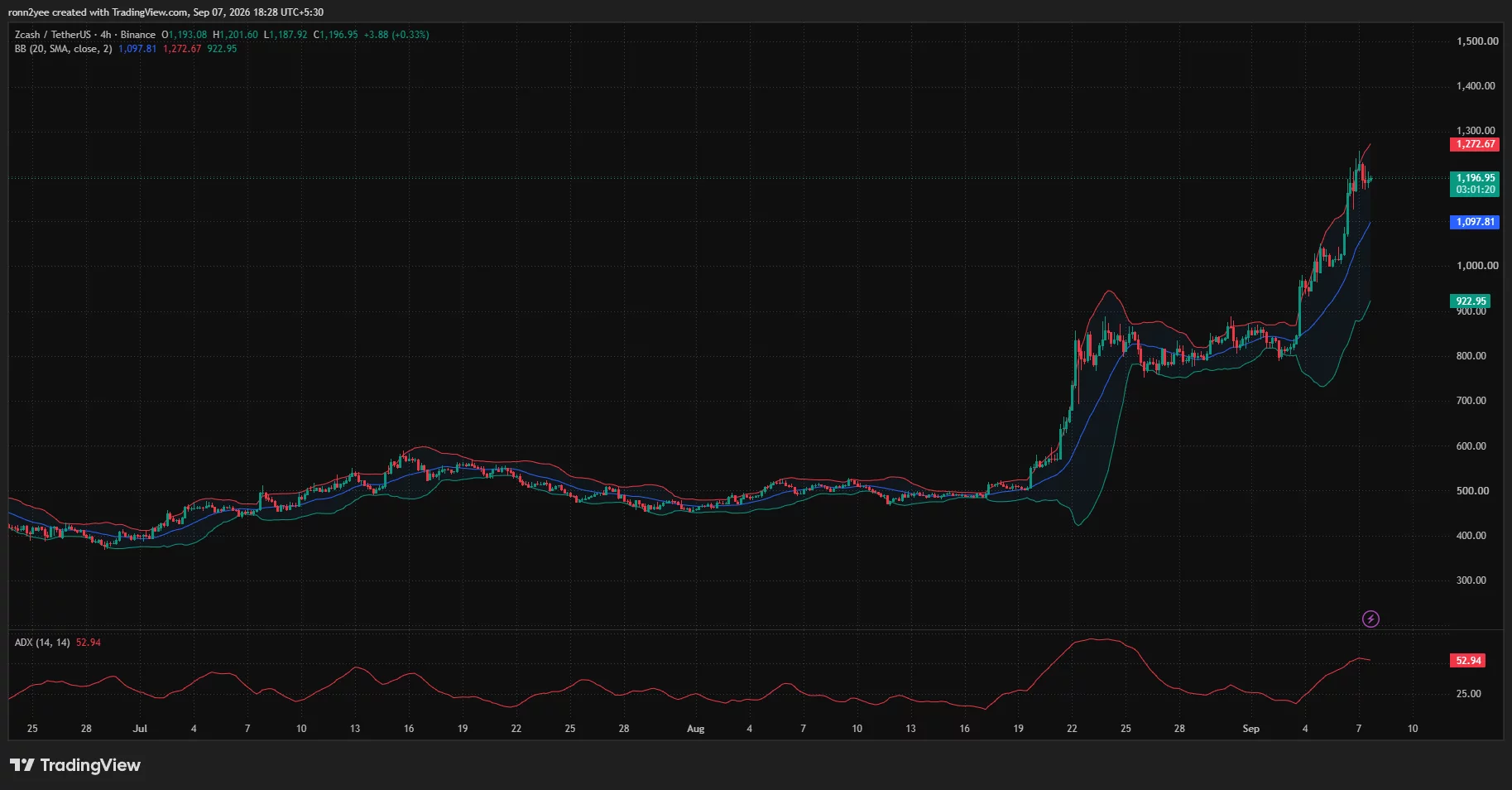
A 4-hour close above $1,273 would indicate that buyers have absorbed the latest profit-taking. Such a move could clear the path toward $1,300 before traders test the larger $1,500 target.
The Average Directional Index is at 52.94 on the 4-hour timeframe. Readings above 25 generally indicate a strong trend, meaning the existing bullish move retains momentum. ADX measures trend strength rather than direction, however, and does not rule out a sharp correction.
The 24-hour liquidation heatmap places the nearest large overhead liquidity concentrations around $1,235–$1,245 and $1,258–$1,265. A break into those areas could force remaining short positions to close, adding market buy orders.
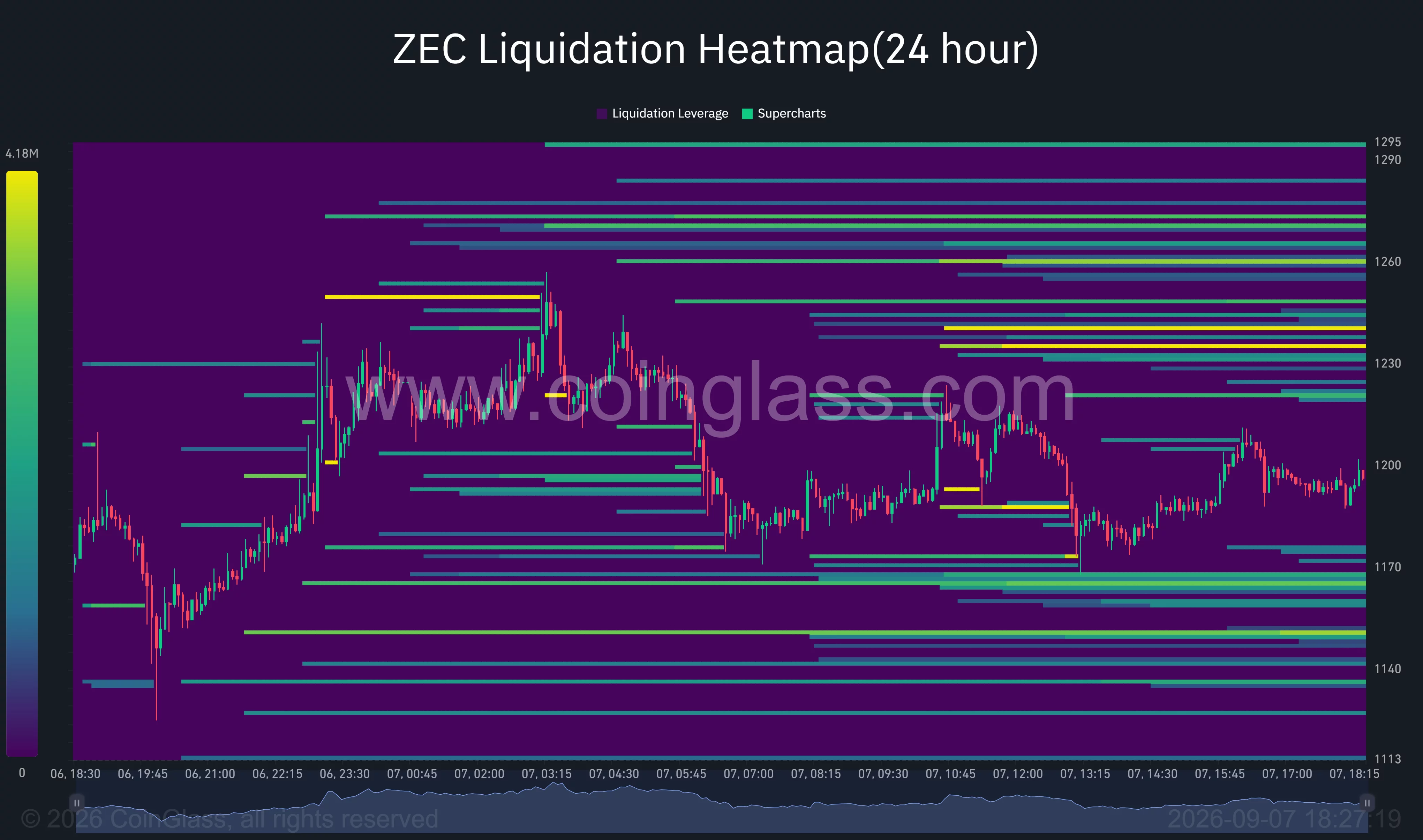
Downside liquidity has accumulated around $1,160–$1,168, followed by clusters near $1,148–$1,153 and $1,134–$1,140. Losing $1,160 could therefore produce a quicker drop as leveraged long positions come under pressure.
The 4-hour Bollinger midpoint near $1,098 is the next broader support. A sustained move below that level would weaken the immediate trend and expose the former $1,000 breakout area. Daily Supertrend support near $934 remains the main bullish invalidation level.
Analyst sees $1,500 after pennant breakout
Team LAMBO Charts described ZEC’s move as a breakout from a large bullish pennant that had contained price for several months. The analyst said the original $1,000 objective had already been exceeded and identified $1,500 as the next major target.
The projection represents an advance of about 25% from the current price. Reaching it would require ZEC to break the $1,240–$1,273 resistance region and establish support above the recent high.
The bullish structure would remain intact while ZEC holds above its breakout levels, according to the analyst. Failure to defend $1,098 would instead suggest that momentum is cooling and raise the risk of a retest of $1,000 or $934.
US investors also face risks beyond the chart. Zcash remains more volatile than larger cryptocurrencies, and the rapid expansion in derivatives exposure may leave the market vulnerable to liquidation-driven reversals. ZCSH is also not registered under the Investment Company Act of 1940, according to crypto.news, giving it a different investor-protection framework from a conventional registered fund.
ZEC therefore retains a bullish technical structure, but its next direction may depend on whether buyers can turn the $1,240–$1,273 area into support before leveraged positioning becomes overcrowded.
Disclosure: This article does not represent investment advice. The content and materials featured on this page are for educational purposes only.

In Cardano news Today, ADA price trades at $0.218, down -1.5% over the past 24 hours, a modest pullback that comes on the heels of a sharp weekly advance. The pause looks tactical rather than structural. Last week’s ADA surged nearly +11%, and the coin is still holding gains that most altcoins haven’t matched.
Derivatives data tells a split story. CoinGlass’ long-to-short ratio reads 0.94, technically bearish positioning, while the OI-weighted funding rate flipped positive on Saturday and now sits at 0.0097%, meaning longs are paying shorts to stay in the trade. That’s not a small detail.
Recent coverage of ADA demand dynamics adds context on why buyers keep stepping in despite mixed signals. CryptoQuant data show large whale orders building in futures markets, a mild bullish signal even as other on-chain metrics remain neutral.
Broader crypto markets are grinding higher in a moderate risk-on tone, and ADA’s price action increasingly looks like a technical story. It is driven by moving averages, Fibonacci bands, and momentum indicators, rather than by fresh headlines.
Cardano News: Can ADA Hit $0.24 This Week?
Dead Coin or Maximum Opportunity? — Cryptollica (@Cryptollica) September 7, 2026
 $ADA is back in the kind of zone where the market usually stops asking for patience and starts writing obituaries. That is exactly what makes it interesting.
Price has been pushed back into a major historical support area that already… pic.twitter.com/e1LQ5s1dxu
ADA is holding above its 50- and 100-day EMAs, both clustered near $0.200, a level that has served as a floor throughout the recent consolidation.
The RSI sits near 61, firm without being overheated, and the MACD line has turned marginally positive, a gradual shift toward buyers even as the longer-term downtrend line still caps price from above.
Immediate support lands at the 50% retracement near $0.213, backstopped by the 100-day EMA around $0.200 and the 38.2% Fibonacci level close to $0.195. That band forms the demand zone that bulls need to defend; a break below opens the door to $0.173, then $0.150.
On the upside, resistance clusters at the 61.8% Fibonacci retracement around $0.231, a horizontal cap near $0.236, and the 200-day EMA at roughly $0.243.
Bull case: a clean break above $0.245 confirms that the corrective advance extends toward $ 0.26+.
Base case: chop between $0.213 and $0.236 while the market digests last week’s move.
Bear case: a fail at $0.213 support drags price back toward the $0.195 Fibonacci band. Live tracking data and exchange price feeds are worth watching into the next session for confirmation either way.
Make Your Prediction Count With $25 For Free on Kalshi
Bitcoin Hyper Targets Early Mover Upside as Cardano Tests Key Levels
With the latest Cardano news, ADA’s setup is rewarding patience rather than adrenaline. Even a clean break above $0.245 only gets holders back to levels seen earlier this year, solid, but hardly the kind of asymmetric return that moves portfolios.
At Cardano’s market cap, doubling requires tens of billions in fresh capital. That math is exactly why traders are rotating capital toward earlier-stage infrastructure plays where the upside math works differently.
Bitcoin Hyper ($HYPER) is building the first Bitcoin Layer 2 with native SVM integration, targeting execution speeds faster than Solana while settling back to Bitcoin’s base layer.
The presale has raised $33,112,509.12 at a current token price of $0.0136858, with staking rewards available at a high APY. Its decentralized canonical bridge aims to solve Bitcoin’s long-standing programmability gap without compromising base-layer security.
Broader macro tailwinds, including shifting FOMC expectations that favor scalability projects, provide a supportive backdrop. Research Bitcoin Hyper before the presale window closes.
Gain Access to New Bitcoin Layer 2 Early Here
This article is not financial advice. Crypto markets are highly volatile and presale investments carry elevated risk. Always conduct independent research.
The post ADA Price Momentum Points to Cautious Upside Extension This Week appeared first on Cryptonews.


Solana is targeting September 9 for Transaction v1, a new format that raises the maximum serialized transaction size from 1,232 bytes to 4,096 bytes.
Summary
- Solana plans to raise maximum transaction size from 1,232 bytes to 4,096 bytes Wednesday mainnet.
- Transaction v1 remains optional, while legacy and v0 formats continue operating under existing size limits.
- Applications reading blocks must support version one or risk errors when encountering the new format.
- V1 removes address lookup tables and stores resource limits directly within each transaction’s configuration metadata.
- Solana’s official roadmap labels mainnet activation pending, making the September 9 schedule potentially changeable still.
The increase gives developers about 3.3 times more transaction space. Solana’s official roadmap says the additional capacity can accommodate zero-knowledge proofs, large multisignature operations, batches and some onchain signature schemes.
Large operations previously had to be divided into several transactions when their instructions, signatures and account information exceeded the 1,232-byte ceiling. That process added complexity because one transaction could succeed while another step failed.
Transaction v1 could let developers combine more of those instructions into one atomic operation. Either every instruction succeeds or the entire transaction fails. The model could benefit trading routes, confidential transfers, cross-chain operations and applications processing complex cryptographic proofs.
The upgrade does not raise Solana’s limit of 64 referenced accounts per transaction. Applications can include more data and instructions, but they cannot automatically interact with more accounts.
Existing Solana transactions will remain valid
Transaction v1 is optional. Wallets and applications can continue sending legacy and v0 transactions under the existing 1,232-byte limit. Users do not need to migrate tokens, exchange SOL or complete a claim before activation.
Developers must deliberately adopt the new format to access its larger capacity. The Solana documentation identifies three supported formats: legacy, v0 and v1. Each format organizes account addresses and resource limits differently.
The v0 format uses Address Lookup Tables, or ALTs, to represent account addresses through compressed one-byte indexes. V1 removes ALTs and places complete 32-byte account addresses directly inside the transaction.
This creates a trade-off. V1 provides a larger overall envelope, but applications that rely heavily on lookup tables may spend more bytes representing the same accounts. Solana’s technical analysis found that 90% of sampled transactions would add fewer than 1,400 bytes when converted from v0 to v1.
Infrastructure providers must update their software
The main compatibility risk applies to services that read blocks and transactions. Remote procedure call providers must set their maximum supported transaction version to one. Otherwise, requests could fail when they encounter a v1 transaction.
Indexers, explorers and analytics services must also change how they retrieve resource limits. Legacy and v0 transactions place compute limits and priority-fee settings inside ComputeBudget instructions. V1 stores them in a dedicated transaction configuration.
Outdated services could therefore display incorrect information. For example, an explorer might show a zero priority fee even though the user paid one. Fee sponsors and applications that check transaction limits must read the new configuration rather than scan old-style instructions.
Applications sending v1 transactions must explicitly set compute-unit and loaded-data limits because both default to zero. Developers should test transaction construction, signing and decoding before moving production traffic to the format.
September 9 remains a targeted activation date
Solana Foundation Vice President of Technology Jacob Creech identified September 9 as the planned mainnet date. As crypto.news previously reported, the upgrade is included in Anza’s Agave 4.2 rollout.
However, the official roadmap still labels the mainnet feature as “not activated.” It also says Anza’s release schedule is “tentative and subject to change.” Testnet and devnet have already activated the feature, according to the latest Foundation status page.
The size increase comes from SIMD-0296, while SIMD-0385 defines the v1 format. Jacob Creech and Andrew Fitzgerald co-authored both proposals.
The 4,096-byte ceiling was selected partly because four kilobytes matches a common memory-page size used by validator hardware. Larger transactions will also consume additional bandwidth, although the upgrade introduces no separate fee charged per byte.
Transaction v1 remains separate from Solana’s rent reductions, shorter slot targets and Alpenglow consensus redesign. In related coverage, crypto.news reported that Alpenglow targets approximately 150-millisecond finality, with October remaining a development target rather than a guaranteed activation date.
Crypto World
Metaplanet CEO breaks silence but shareholders say the hard questions remain unanswered
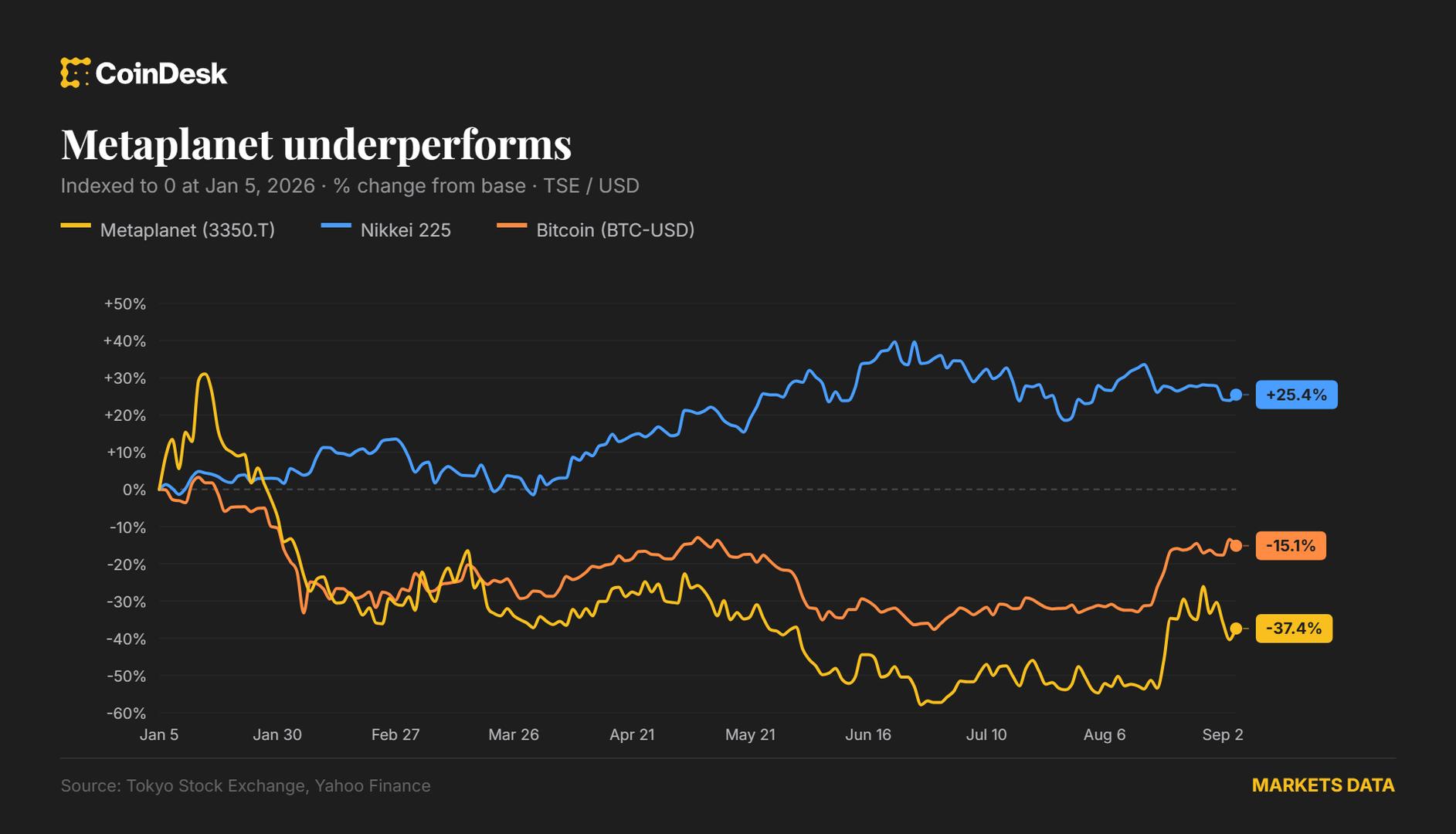
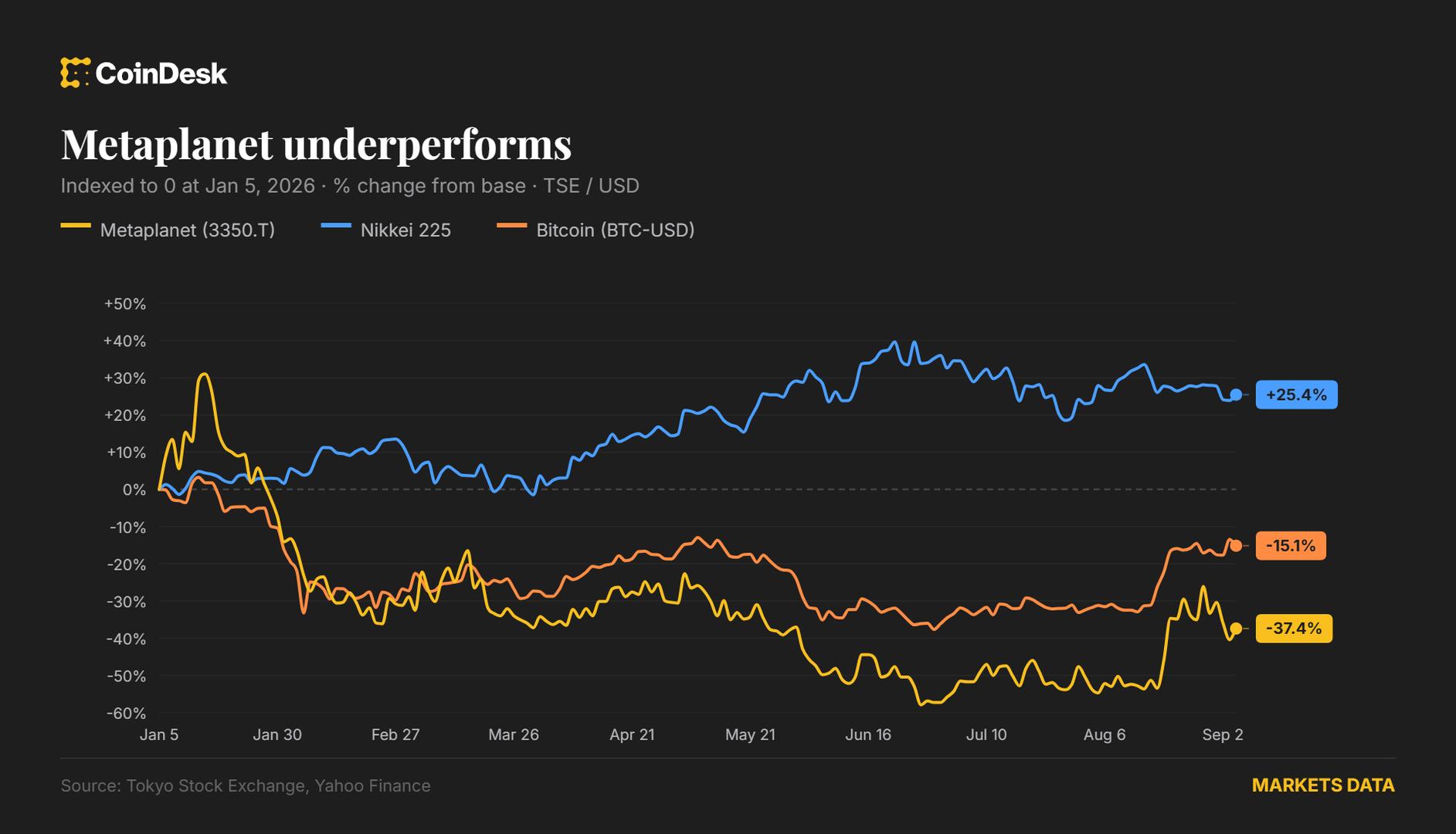
Simon Gerovich said Metaplanet had not adequately explained the structure, and denied involvement in MMXX Ventures’ trading decisions.
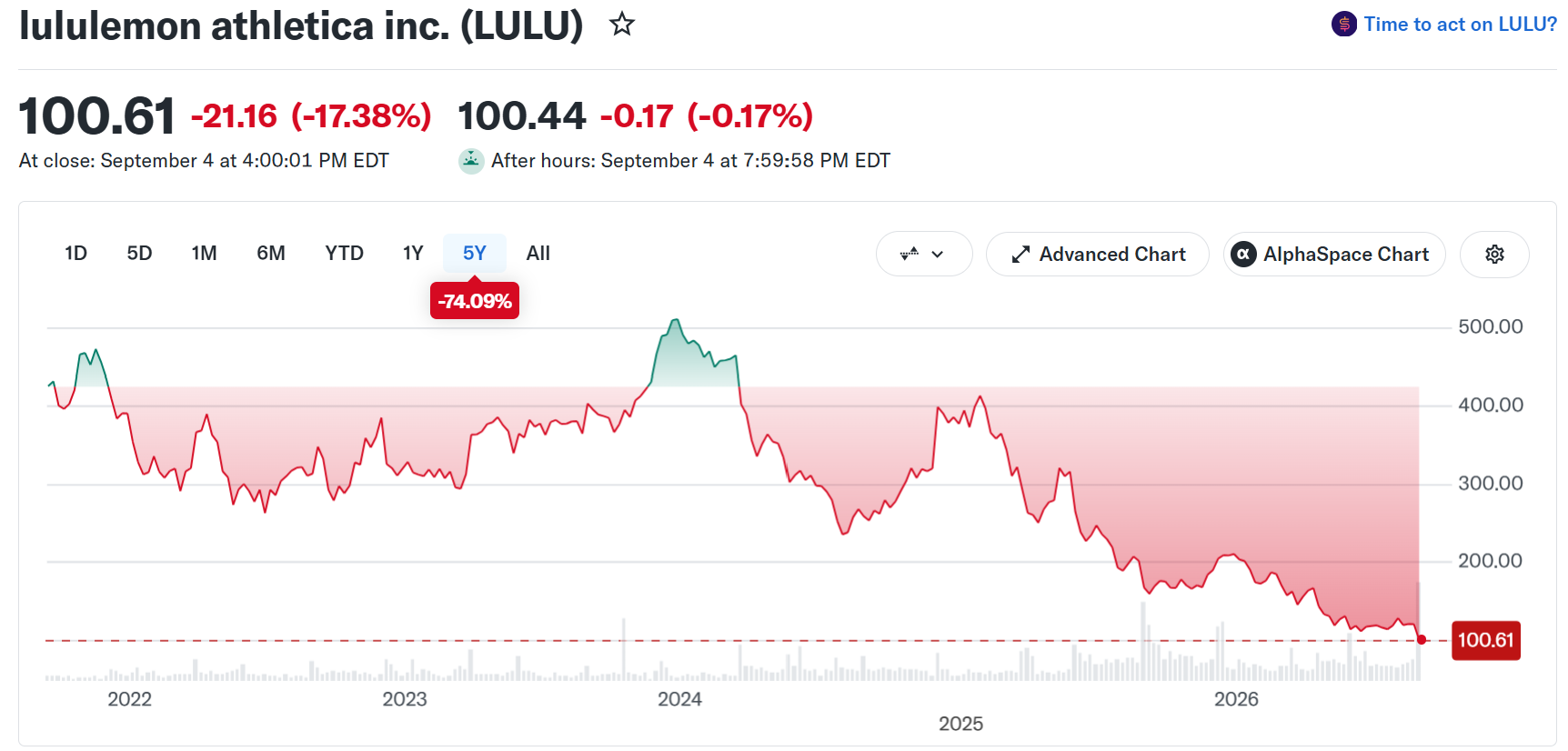
Lululemon Athletica (LULU) closed Friday at $100.61, down 17.38% in a single session. That is about 80% below the $511.29 peak it hit in December 2023. Its founder is now in divorce court.
The Nasdaq-listed sportswear retailer has cut its sales forecast three times this year. Days after the latest cut, reports confirmed founder Chip Wilson is divorcing without a prenuptial agreement.

A Third Guidance Cut Pushed Lululemon to an 8-Year Low
Guidance is a company’s own forecast of what it expects to sell. Lululemon has lowered its 2026 forecast from $11.35 billion in March to $10.35 billion now.
Second-quarter revenue fell 4% to $2.4 billion. Comparable sales, a measure that counts only stores open for at least a year, dropped 9%.
Profit looked healthier than the business. Earnings of $2.92 a share included a one-off $134.5 million refund on import tariffs.
BeInCrypto reported the stock’s drop to eight-year lows on September 4. Shares have not recovered, and the company expects third-quarter sales to fall another 10% to 11%.
Why the Founder’s Divorce Matters to Shareholders
Wilson and his wife, Shannon “Summer” Wilson, opened a family case in the Supreme Court of British Columbia in April. There is no prenuptial agreement.
Follow us on X to get the latest news as it happens
Wilson and connected entities hold 9.9 million shares, or 8.7% of the company, according to a May securities filing. That block was worth just under $1 billion at Friday’s close. Roughly 1.1 million of those shares are already attributed to Summer Wilson.
British Columbia law protects what each spouse owned before the marriage. The growth in that value during the marriage is split evenly by default. Lululemon went public in 2007, five years after the couple wed.
Wilson ended a campaign to unseat directors in May, accepting two board seats and an 18-month truce with the board.
New chief executive Heidi O’Neill starts this week. She inherits falling sales and a shrinking North American business. The founder’s voting bloc now sits inside a sealed courtroom.
The post Lululemon Stock Crashed 80%, and Founders are Now Divorcing appeared first on BeInCrypto.


Ethereum developers have committed EIP-8141, known as Frame Transactions, to the network’s 2027 Hegotá upgrade, putting native account abstraction on the path to becoming part of Ethereum’s standard transaction system.
Summary
- Ethereum developers have scheduled EIP-8141 Frame Transactions for inclusion in the Hegotá upgrade planned for 2027.
- Frames separates transaction authorization, gas payment and execution, allowing an app or another account to cover a user’s ETH transaction fee.
- The proposal could let users transact with stablecoins without holding ETH while validators continue receiving network fees in ether.
- Frames can bundle related actions such as token approvals and trades so permissions are reversed if the accompanying transaction fails.
- Programmable validation could allow accounts to rotate private keys or adopt quantum resistant authentication without moving assets to a new address.
Core developers moved EIP-8141 from Considered for Inclusion to Scheduled for Inclusion during the Aug. 27 All Core Developers Execution call, according to the Hegotá Meta EIP. The change gives Frames a formal place in the planned upgrade, though the proposal remains a draft and its technical details can still change before deployment.
Ethereum co-founder Vitalik Buterin, one of the proposal’s 10 authors, drew attention to the work on Sunday after months of development.
“A lot of important progress on Frames (EIP-8141) has been quietly happening over the last few months,” Buterin wrote on X, recommending the updated specification.
The proposal addresses several restrictions built into ordinary Ethereum accounts, including the requirement that the account initiating a transaction must hold ether to pay the network fee.
Frame Transactions could let apps pay Ethereum gas
Ethereum currently requires transaction fees to be paid in ETH. A wallet holding stablecoins or other tokens cannot move those assets unless it has enough ether to cover the transaction.
EIP-8141 separates the different parts of a transaction into programmable frames covering authorization, fee payment and execution. The account sending assets and the account paying the gas would no longer need to be the same.
A payments application could therefore pay the ETH fee for a user or accept stablecoins from the user while handling the required ether payment itself. Validators would continue receiving fees through Ethereum’s existing fee system, while the wallet holder would not need to acquire ETH first.
The design moves several features associated with account abstraction into Ethereum’s normal transaction flow. Existing implementations such as ERC-4337 can already support sponsored gas and programmable wallets, but they use separate infrastructure including UserOperations, bundlers and paymasters.
ERC-4337 has operated on Ethereum since 2023 without requiring a change to the base protocol. Its UserOperations are sent through a separate mempool, collected by bundlers and passed to an EntryPoint contract that handles validation and execution.
As crypto.news previously reported in August, smart account technology can support gas sponsorship, passkeys, social recovery and other wallet controls that are unavailable to conventional externally owned accounts.
Frame Transactions would bring similar programmability into Ethereum’s protocol instead of requiring users to depend on a separate transaction system.
EIP-8141 would bundle related actions
Frames could change transactions that currently require several separate approvals.
A token trade, for example, can require a user to first approve a decentralized application to spend a token and then submit another transaction to execute the trade. If the second step fails, the spending permission can remain active.
EIP-8141 allows related operations to be grouped so they succeed or fail together. An approval attached to an unsuccessful trade could therefore be reversed as part of the same transaction.
The system works by dividing a transaction into frames with separate jobs. One frame can verify authorization, another can determine how gas is paid, while subsequent frames execute the requested operations.
Programmable validation would give accounts more control over what Ethereum recognizes as a valid transaction. Instead of every externally owned account relying on the same fixed authentication process, accounts could run verification rules through Ethereum Virtual Machine code.
Ethereum researchers have been working toward this type of native account abstraction for years. EIP-7702, proposed by Buterin and other developers in 2024, previously sought to give externally owned accounts access to smart contract wallet functions while maintaining compatibility with ERC-4337.
Frame Transactions could allow Ethereum keys to change
The validation changes extend beyond gas payments and transaction batching.
Conventional Ethereum externally owned accounts are controlled by private keys using the Elliptic Curve Digital Signature Algorithm. A private key cannot simply be replaced while keeping the same account under the traditional model. Losing the key can permanently remove access to the assets it controls, while a compromised key can give an attacker control of the account.
Frames would let an account define its own validation logic, opening the door to key rotation and different authentication systems without requiring the user to transfer assets to a new address.
Programmable validation could eventually allow Ethereum accounts to replace current signature methods with cryptography designed to withstand quantum computers.
Buterin placed quantum security higher on Ethereum’s technical roadmap in an August update, alongside work on native rollups, privacy and changes to the network’s storage architecture.
He had previously outlined a quantum resistance roadmap covering Ethereum’s consensus signatures, data availability systems, wallet cryptography and zero-knowledge proofs. That plan identified ECDSA, which controls ordinary Ethereum accounts, as one component that could eventually need replacement if sufficiently powerful quantum computers are developed.
EIP-8141 provides one route for accounts to adopt different signature schemes because verification rules would no longer be fixed to a single private-key model.
Hegotá will follow Ethereum’s Glamsterdam upgrade
Hegotá is planned for 2027 and will follow Glamsterdam, Ethereum’s next network upgrade.
Developers were still narrowing Hegotá’s scope in August. At the time, Frame Transactions remained under consideration while EIP-7805, or Fork-choice enforced Inclusion Lists, was the only proposal formally scheduled for the upgrade.
The Aug. 27 decision has since moved EIP-8141 into the scheduled category alongside EIP-7805.
Before that decision, developers had been comparing EIP-8141 with EIP-8130 as competing approaches to native account abstraction. The discussions included how Ethereum could avoid incompatible account-abstraction standards between Layer 1 and Layer 2 networks while retaining flexibility for different transaction designs.
Glamsterdam, meanwhile, remains ahead of Hegotá in Ethereum’s upgrade schedule. Developers have been testing its planned changes through development networks, with the upgrade centered on Enshrined Proposer-Builder Separation and Block-Level Access Lists.
The upgrade includes changes to Ethereum’s gas accounting as well. The Ethereum Foundation warned wallet developers in August that EIP-8037 could affect software relying on the assumption that every basic ETH transfer costs 21,000 gas, because transfers creating new state would face an extra charge.
EIP-8141 cannot be used on Ethereum mainnet today. Its specification remains in draft status while developers continue implementation and testing work ahead of Hegotá’s planned 2027 deployment.
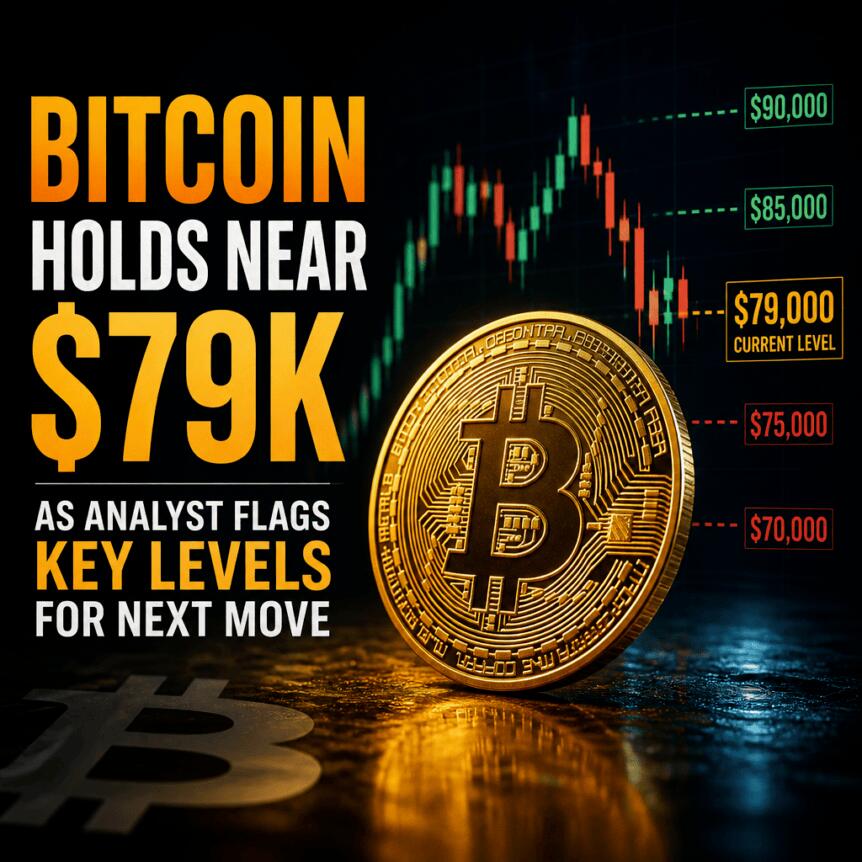
Bitcoin remains near $79,033 as its latest pullback keeps traders focused on critical price levels. The cryptocurrency slipped from $80,530 after reaching a recent local high near $82,262. However, analyst Michael van de Poppe expects Bitcoin to avoid a deep correction despite the recent weakness.
Bitcoin Price Holds Above Key Support
Bitcoin traded around $79,033 at press time, extending a consolidation phase around the $80,000 area. Meanwhile, the cryptocurrency has struggled to regain the momentum that pushed it toward $82,262 last week. However, the latest decline has not yet changed the broader technical structure identified by van de Poppe.
The recent move followed stronger-than-expected US employment data, which pressured market sentiment across risk assets. Consequently, Bitcoin retreated from its recent high as traders reassessed expectations for US monetary policy. Still, strong spot Bitcoin ETF inflows have provided additional support for the market.
Van de Poppe has maintained a positive longer-term outlook despite Bitcoin’s short-term price weakness. He considers the current consolidation a normal phase that could precede another upward move. Furthermore, he has identified levels below $74,000 as potential areas where buying activity could increase.
$82,850 Resistance Could Set Bitcoin’s Next Direction
The $82,850 level now represents an important resistance area for Bitcoin’s immediate price structure. A sustained move above that level could strengthen bullish momentum and open the path toward higher prices. Therefore, traders may use the resistance zone as an important reference during the next market move.
Bitcoin also faces several support levels that could determine the depth of any further decline. The key levels include $75,545 and $73,674, which could provide short-term support during renewed selling pressure. If Bitcoin loses those areas, the price could move toward $71,000 or potentially approach $70,000.
However, a decline below $74,000 could also create a potential buying opportunity, according to van de Poppe’s market assessment. That view suggests the analyst considers moderate weakness part of the broader Bitcoin market cycle. At the same time, Bitcoin must recover key resistance levels before confirming another strong upward move.
US Inflation Data Could Influence BTC’s Next Move
Macroeconomic conditions could play a major role in Bitcoin’s direction as markets prepare for fresh US inflation figures. The upcoming Consumer Price Index and Producer Price Index reports could provide new signals about inflationary pressure. Consequently, the data could affect expectations surrounding the Federal Reserve’s future interest-rate decisions.
Higher-than-expected inflation could strengthen expectations for tighter monetary policy and increase pressure on risk-sensitive assets. Bitcoin often responds to shifts in liquidity conditions, interest-rate expectations, and broader market sentiment. Therefore, stronger inflation figures could limit Bitcoin’s ability to reclaim its recent highs.
Meanwhile, September rate-hike expectations have increased, with prediction markets placing the probability near 50%. This shift reflects uncertainty surrounding the Federal Reserve’s policy path following recent economic data. As a result, Bitcoin could remain range-bound until traders receive clearer signals from inflation and monetary policy.
Bitcoin’s current structure therefore centers on the $82,850 resistance and the $75,545 to $73,674 support zone. A breakout above resistance could revive bullish momentum, while a breakdown below support could expose lower targets. For now, BTC remains near $79,033 as technical levels and US economic data shape its next major move.

In Trump crypto news, US employers added 162,000 jobs in August, far above the roughly 65,000 economists had expected, while the unemployment rate held steady at 4.1%.
Bitcoin’s reaction was immediate: the asset slid from above $81,000 into a range spanning the high-$78,000s to low-$80,000s as traders repriced expectations for near-term Federal Reserve policy.
The question now is whether a single strong report derails a rally that institutional flows have spent weeks rebuilding, or simply adds uncertainty ahead of the September 15–16 meeting.
— Coin Bureau (@coinbureau) August 31, 2026
 BREAKING: Trump pushes back on Fed Chair Warsh's rate hike signal, "Our interest rates are too high."
The president says the US should have "the LOWEST interest rates in the world" and called talk of raising rates "ridiculous." pic.twitter.com/GgkuBtWYjT
Why the Jobs Report Revived Rate-Hike Bets
August’s payroll growth was well above the roughly 31,000 average monthly gain recorded over the trailing 12 months, marking a sharp rebound from the softer hiring seen earlier in the summer.
That kind of acceleration weakens the case for immediate rate cuts and gives the Fed more reason to hold, or potentially tighten, policy at its next meeting.
Traders responded by increasing expectations that the Fed could raise rates rather than cut them, a repricing that showed up quickly in Bitcoin’s price action.
The shift reflects market expectations ahead of the meeting rather than a policy decision, but those expectations can influence risk assets before the Federal Open Market Committee delivers its verdict.

Trump Crypto News: Lower-Rate Push Meets a Hawkish Data Signal
Donald Trump used Truth Social to press the Federal Reserve to lower rates, arguing that the United States had become a stronger credit and should have lower borrowing costs. He also criticized the Fed Board’s approach and called on it to act patriotically.
The market’s reaction moved in the opposite direction. A stronger labor market is typically read as reducing the urgency for cuts, and traders raised rate-hike expectations after the report rather than pricing in the easing Trump was seeking.
Why Bitcoin Is Exposed to the Fed Debate
Bitcoin’s sensitivity to Fed policy has been on display through the summer. Fed Chair Kevin Warsh’s hawkish Jackson Hole speech sent Bitcoin down to $77,000 and pushed rate-hike odds to 57%, illustrating how policy language can move prices before an actual decision.
That reversed on September 3, when Fed Governor Christopher Waller’s more neutral remarks triggered a 5% rally in Bitcoin and coincided with $730.8M in net inflows into Bitcoin ETFs.
Rate-hike odds subsequently fell toward 50%, leaving markets close to a coin toss between a hike and a hold heading into the jobs report, even with Trump putting pressure on the Fed via his crypto social media platform.
The inflow figure is notable because institutional demand continued even as rate expectations shifted. The August jobs numbers moved sentiment back toward the hawkish side, but it did not change the recently strengthened ETF flows.
Supercharge Your Trading in 2026 With BloFin AI Trading Bots
Trump Crypto News: What the September Fed Meeting Could Mean for Bitcoin
In other Trump crypto news, the September 15–16 meeting is the next decision point, while the period leading up to it remains focused on adjusting expectations.
If strong labor data keeps rate-hike expectations elevated into the meeting, restrictive policy would remain the central concern for Bitcoin and other risk-sensitive assets.
An unexpected cut could trigger a sharper Bitcoin rally, given the recent strengthening in institutional ETF flows. However, a cut prompted by a serious economic slowdown would carry a different signal.
Past scenarios indicate that crypto could initially sell off if easing is tied to visible economic deterioration rather than a more favorable policy backdrop.
For now, markets remain close to a genuine toss-up between a hike and a hold, with the August jobs report tilting sentiment toward the hawkish side without settling the outcome.
Discover: The Best Crypto to Diversify Your Portfolio
The post Trump Crypto News: BTC $81,000 Rejection Puts September Fed Meeting in Focus appeared first on Cryptonews.

Incredible sight to sea! Winners and runners-up of the Underwater Awards Australasia are revealed

UK Regulator Considers Easing Prediction Markets Ban, Report Says

Cayuna, Chameleons target first franchise title





-

 Fashion3 days ago
Weekend Open Thread: Beyond Yoga
-
 Crypto World3 days ago
Bitcoin price stalls near $82K as key resistance holds
-

 Politics3 days ago
Best Gaming Laptops, CPUs, TVs, And Keyboards To Upgrade Your Set Up For GTA VI
-

 Tech3 days ago
The Birds Outside, Drawn For You Automatically
-

 Crypto World4 days ago
IMF Says El Salvador’s Post-Review Bitcoin Purchases Used No Public Funds
-
 Crypto World3 days ago
U.S. added stronger than expected 162,000 jobs in August as labor market bounced back
-

 Sports4 days ago
Alexandre Pato consortium’s Northampton Town investment approved
-

 Sports4 days ago
Commanders’ Chig Okonkwo is a top breakout fantasy football candidate
-

 Sports3 days ago
Golden Eaglets Drawn in Group B for 2026 WAFU B U17 Championship
-
 Crypto World3 days ago
XRP price breaks falling channel as bulls target $1.53
-

 Politics4 days ago
A new European chapter for Gibraltar
-

 Politics3 days ago
How To Avoid Winter Colds: 4 Everyday Habits That Spread Germs, Says Pharmacist
-

 Politics4 days ago
The House | Bin the lectures, bring gossip and be ready to banter: how the new PM should prepare for his Trump encounter
-

 Crypto World3 days ago
From warning to listing: UK’s largest retail investment platform opens access to crypto ETNs
-

 Crypto World3 days ago
FinCEN flags $12.7B tied to Southeast Asia crypto investment scams
-

 Tech3 days ago
A Worthy Android Ereader, With Some Tradeoffs
-

 Tech3 days ago
How To Edit Claude’s Memory
-

 Crypto World3 days ago
Trezor Data Breach Impacts 67,000 More US Customers
-

 Politics4 days ago
33 Cosy Autumn Home Decor Ideas: Blankets, Pumpkin Decorations, And Candles
-

 Tech3 days ago
beyerdynamic AVENTHO Y Debuts at IFA 2026 and Makes Wireless Headphones Less Disposable
You must be logged in to post a comment Login