

Crypto World
Ripple Whales Control Nearly 70% of Supply as XRP Eyes Major Breakout

XRP climbed past $1.50 on Thursday as large holders added to their positions and traders reacted to fresh movement around the US CLARITY Act.
According to data shared by Santiment, the asset’s largest holders are sitting on more of the token than they have in eight years, with wallets holding at least 10 million XRP now controlling a combined 45.83 billion tokens, worth roughly $68.5 billion.
The Numbers Behind the Move
Santiment’s data shows that those whales collectively account for 68.5% of XRP’s circulating supply. That is not a minor data point, since a handful of large holders controlling such a large portion of any asset means their conviction often matters more than retail flow, and right now they appear to be betting on something specific.
That something could most likely be the Digital Asset Market Clarity Act, which was passed on May 14 by the US Senate Banking Committee 15-9 in a bipartisan vote. This cleared it for the next stage in Congress after months of delays.
The market response was immediate, with XRP posting gains of more than 7% on the day, going from around $1.43 to $1.54, a level it last hit in March. One analyst on X, writing under the handle Moon God, argued the move had broken a descending technical pattern that had been forming since February and called $1.52 and $1.60 as the next levels to watch.
Meanwhile, permabull EGRAG Crypto pointed to $1.80 as a more meaningful target, adding that XRP needs to reclaim and hold that level as macro support to confirm structural strength.
On the ETF side, the picture was also moving, with data from SoSoValue showing XRP ETFs pulling in $18.52 million in net inflows for the day, outpacing Ethereum and Solana ETFs, and improving significantly on the $5.31 million from May 12 and the zero showing on May 13.
Bitwise’s XRP product alone accounted for $7 million, while Canary Capital’s XRPC fund added $4.87 million. Cumulative net inflows across all XRP ETF products have now reached $1.37 billion.
XRP Cools After CLARITY Jump
At the time of writing, XRP was trading around $1.46, up more than 5% in the past week and over 7% across 30 days but still some 5% off the high it hit following the CLARITY vote.
There is one note worth flagging, though: leverage on Binance has climbed to its highest level in two months, with the Estimated Leverage Ratio reaching approximately 0.179. That kind of build-up makes the market more sensitive to sudden moves in either direction.
The post Ripple Whales Control Nearly 70% of Supply as XRP Eyes Major Breakout appeared first on CryptoPotato.

Over the past month, Solana (SOL) spiked 10%, yet it remains below the psychological $100 milestone.
One popular crypto analyst is optimistic that the price may surge well above that level, but such a breakout would require the overcoming of a key resistance zone.
The Necessary Conditions
As of press time, SOL trades at around $91, while its market capitalization stands just below $53 billion. According to Ali Martinez, the price has been moving within a well-defined channel since February, identifying the upper boundary at $98 and the lower at $78. He forecasted a potential bounce if SOL makes a successful breakout above the ceiling and set $88 as “the pivot point.”
“We recently tested that $98 resistance, which resulted in a quick rejection. Now, I am seeing Solana bounce. This suggests we could be gearing up for another retest of the channel top to determine if a breakout is finally in the cards,” he stated.
Martinez believes that a daily close above $98 could open the door to a surge toward $107, with a secondary target at $117. At the same time, if that level continues to hold as heavy resistance, the price may retreat to $88 and even to the $78 floor.
Earlier this month, the analyst revisited Solana, describing the $77-$94 range as a “no-trade” zone. Back then, he suggested that if buying pressure picked up, the price could surge toward $96.
Prior to that, Martinez noted that SOL’s Bollinger Bands have squeezed, which has historically been a precursor of a major breakout. However, the direction of the move (up or down) can not be determined.
Another X user who recently gave their two cents on the matter is Globe of Crypto. In their view, closing above $99 could set the stage for a solid rise toward $160-$170.
The Bold Forecast
X user Marino also chipped in, predicting that SOL could climb above $500 in the coming years. He supported his bullish outlook by pointing to Solana’s accelerating adoption, rising usage, growing network value, increased staking, the launch of new apps, and other positive factors that reinforce the ecosystem’s strength.
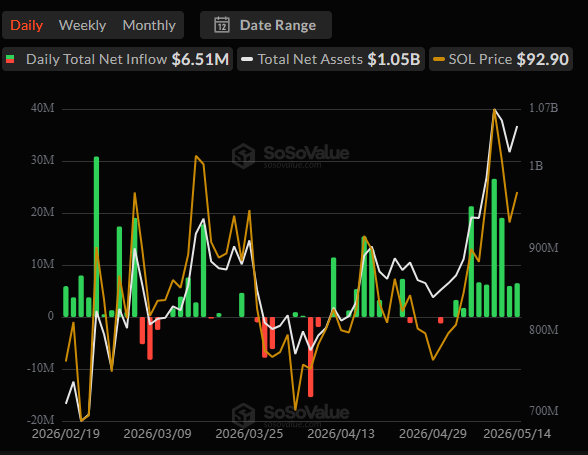
The analyst added that inflows into spot SOL ETFs could also spark a rally, and data show that lately these products have indeed attracted millions of dollars of fresh capital. Since their introduction, the financial vehicles have generated a cumulative total net inflow of approximately $1.12 billion.
“If Solana keeps compounding adoption at this pace into the next cycle & if macro conditions are positive. Then $500+ in 2029 feels absolutely possible,” Marino concluded.
The post Solana (SOL) at a Turning Point: What Will Define the Next Breakout? appeared first on CryptoPotato.


Disclosure: This article does not represent investment advice. The content and materials featured on this page are for educational purposes only.
Poly Truth and Meme Punch stand out among below-$1 crypto picks alongside Sei in 2026 market watchlist.
Summary
- Crypto markets are targeting sub-$1 tokens again, with Poly Truth, Meme Punch, and Sei gaining attention.
- Poly Truth is an AI prediction market tool that turns event data into probability-based reports using a 3-part system.
- Meme Punch is a play-to-earn meme game where players earn MEPU through PvP battles and in-game progression.
A lot of coins sit well under $1, but only some have the setup to actually move toward it. The next crypto to hit $1 will probably come from a project that has more going for it than a low price tag.
This article looks at three picks worth a closer look right now. Poly Truth (PTRUE) and Meme Punch (MEPU) are still in presale, and Sei (SEI) is already listed and building momentum. Different stages, different stories, but all three are worth knowing.
Next crypto to hit $1: 3 Picks to watch
Three projects worth a closer look for those who are scanning for the next sub-$1 token with real upside.
1. Poly Truth (PTRUE)
Poly Truth is a prediction market intelligence tool. Not a trading platform, not a bot. The concept is that users receive AI-powered analysis that indicates which outcome the data actually supports and why, rather than speculating on prediction events.
The team constructed the platform’s three-part system around three characters. The Runners are AI bots that search the internet for information on current prediction events. The AI analyst known as the Starlet calculates probability scores, looks for patterns, and cross-references the sources. The Presenter delivers the final report in plain language.
A few things worth noting:
- 11.5 billion tokens are available, and it is based on Ethereum.
- Ten percent of the supply is reserved for staking rewards, and forty percent is allotted to the presale.
- Audited by Coinsult and SolidProof; both reports are available to the public.
- Team tokens have a 3-month cliff and a 12-month vest.
- ETH, BNB, SOL, USDT, USDC, card, and SEPA are among the available payment methods.
2. Meme Punch (MEPU)
The play-to-earn cryptocurrency game Meme Punch is based on a simple idea. Play and get real cryptocurrency after winning, as opposed to holding a memecoin and waiting for a pump.
Five iconic meme-inspired characters — Pepe, Doge, Floki, Brett, and Pudgy Penguin — compete for supremacy in this medieval battle arena. Choose a knight, engage in PvP combat, move up the leaderboard, and receive in-game rewards in the form of MEPU. The token has actual use outside of speculation since it can be used within the game to access weapons, skins, and special abilities.
Features worth knowing:
- Built on Ethereum, with a total supply of 10 billion MEPU.
- 40% of supply goes to the presale, with 14.5% for staking and 9.5% for in-game rewards.
- Marketing allocation sits at 16.5%, aimed at reaching gamers outside the crypto bubble.
- Payment options cover ETH, BNB, SOL, USDT, USDC, and card.
3. Sei (SEI)
Sei is a high-speed Layer 1 blockchain built around fast trading, gaming, and other apps that need performance. After months of sideways action, it’s one of the better stories on exchanges right now.
The price action tells the recovery story clearly. SEI was sitting near $0.054 in mid-April, broke above the descending channel in early May, hit a peak of around $0.078 on May 10, and now trades near $0.067. That’s a 24% move off the April low, with the chart showing higher lows building.
A few catalysts are behind it:
- The Giga upgrade is rolling out through 2026, targeting over 200,000 transactions per second with sub-400ms finality.
- EVM migration is set to complete by June 15, 2026, opening the door to Ethereum developers and apps.
- Xiaomi partnership has SEI’s wallet preinstalled on devices outside China and the US, exposing the chain to a massive global user base.
Why these picks are worth watching
Each of the three picks holds its position for a different reason, but they all have one thing in common. Price alone won’t be enough for the next cryptocurrency to reach $1. It will require a strong reason for consumers to continue purchasing.
In order to provide prediction market traders with a real advantage, Poly Truth is developing an AI research tool. A memecoin can be transformed into a playable game with in-game features with Meme Punch. Real adoption is being pushed by Sei through the Giga upgrade, an EVM migration, and a partnership with Xiaomi.
The point is the combination of stages. The smaller entry and larger upside, should they land, are offered by the presales. SEI provides a project that is already demonstrating ecosystem progress and recovery. It’s important to be aware of the various bets and timelines.
Disclosure: This content is provided by a third party. Neither crypto.news nor the author of this article endorses any product mentioned on this page. Users should conduct their own research before taking any action related to the company.
SpaceX’s IPO prospectus does something rare. It strips public investors of the right to remove the chief executive. The same filing warns that his departure could be existential.
The contradiction is structural, not accidental. The S-1 asks markets to fund a single founder. It also asks them to accept a pay package whose triggers exist only in projection.
The SpaceX IPO Hardwires Single-Point Failure
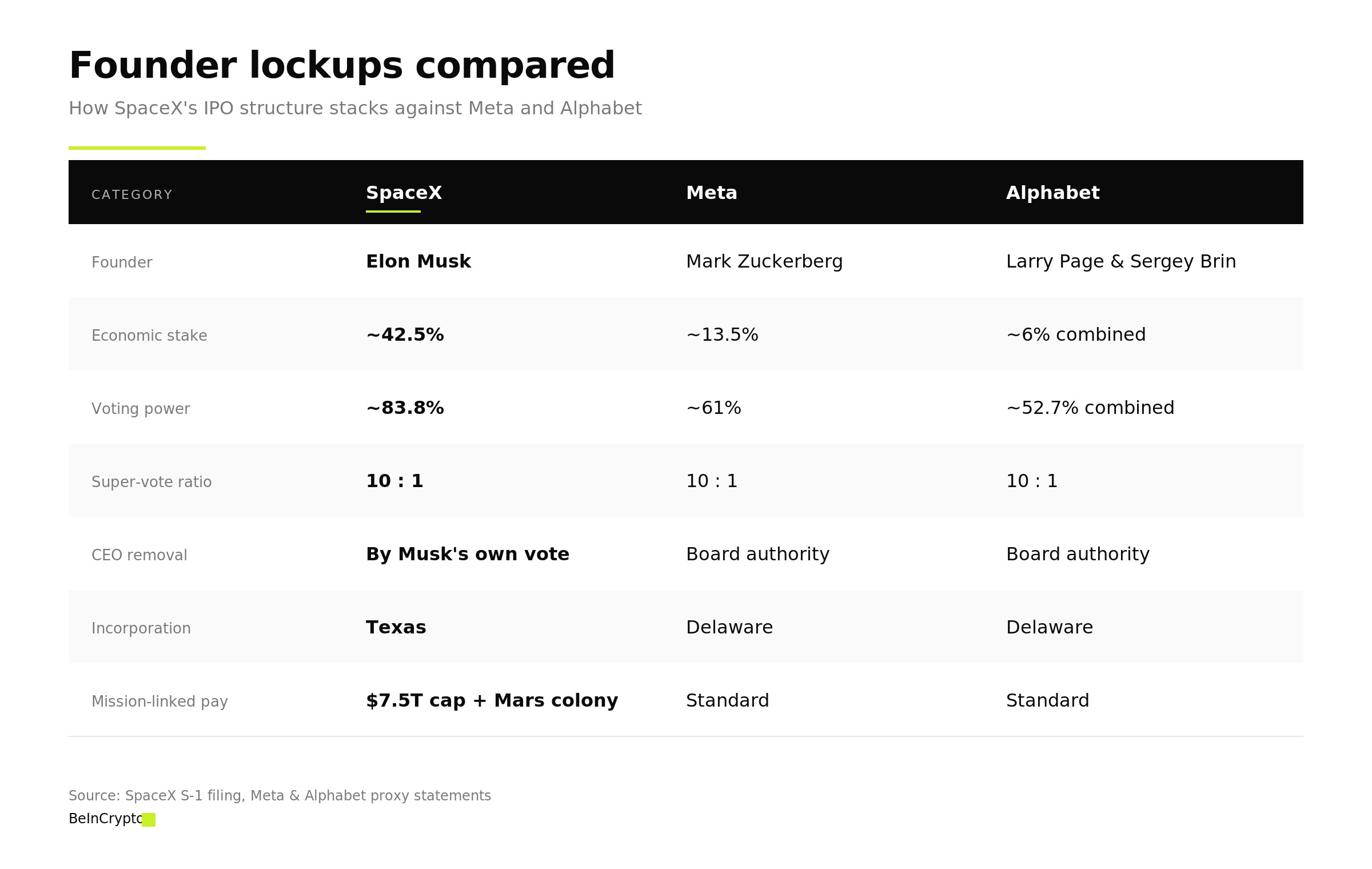
Musk holds about 42.5% of SpaceX equity but 83.8% of voting power through Class B super-voting shares. The S-1 states removal from his roles requires a Class B vote. He controls those votes outright.
Harvard Law professor Lucian Bebchuk called the arrangement “not common.” Boards typically retain formal removal authority. The structure collapses that authority into Musk’s voting bloc, leaving a self-veto in its place.
The filings flag Musk’s loss as a multi-page risk factor. They cite his overlapping commitments at Tesla, xAI, X, Neuralink, and The Boring Company.
No structured succession framework appears, and no deputy is positioned to take over.
Corporate Feudalism Returns to Public Markets
Texas incorporation, mandatory arbitration, and a controlled-company exemption sit alongside a 3% or $1 million floor on shareholder proposals. The filing itself states public shareholders’ influence will be limited or eliminated.
Pension fund officials have already pushed back. CalPERS, the New York State Comptroller, and the New York City Comptroller signed a joint letter.
They call the Musk-led structure a departure from accepted public-company standards.
SpaceX argues the structure protects long-horizon goals from short-term shareholder pressure.
That defense does not address removal mechanics. Founder lockups at Meta and Alphabet look modest by comparison.

A $7.5 Trillion Mars Milestone Is Not a Valuation
The main pay tranche awards Musk up to 200 million Class B shares. It vests only if SpaceX reaches a $7.5 trillion market capitalization. The same trigger requires a permanent Mars colony of at least one million residents.
The $7.5 trillion threshold sits above the combined market value of Apple, Microsoft, and Saudi Aramco. The Mars criterion has no precedent, no infrastructure to project against, and no off-world regulatory framework.
Neither benchmark fits standard valuation methods.
A second tranche grants up to 60.4 million shares for orbital data centers with 100 terawatts of compute. The award mirrors xAI’s terrestrial AI race. The S-1 admits such operations may not be commercially viable.
That is the price of single-point governance combined with speculative pay design. Investors are asked to fund a company they cannot influence and price milestones no model can value.
The only person who could fail the mission is the one allowed to define it.
The post $1.75 Trillion SpaceX IPO Hardwires Elon Musk As Single-Point Founder Risk appeared first on BeInCrypto.
Crypto World
Arkham Intelligence Reports 90%+ Token Concentration in $LAB Project Trading at $4B Market Cap


Blockchain intelligence firm Arkham flags extreme insider ownership concentration in $LAB, which has surged 3000% in three months.
Payward, the parent of cryptocurrency exchange Kraken, is cutting 150 jobs ahead of its planned U.S. stock-market listing. The reduction affects about 5% of its 3,000-person global workforce.
The move forms part of a broader optimization push aimed at improving margins. Management wants a leaner financial profile before going public.
Layoffs Continue a Multi-Year Lean-Out
The latest cuts extend a sustained workforce reduction that began in October 2024. Payward eliminated about 400 roles then, or roughly 15% of staff.
The reduction followed shortly after Arjun Sethi joined David Ripley as co-CEO. Further cuts then followed in early 2025 as the company merged overlapping teams.
A Payward spokesperson declined to address specific personnel decisions. The company continually evaluates its structure to align talent with strategic priorities.
Meanwhile, hiring continues in select growth areas, including derivatives, payments, and tokenized assets.
Workforce optimization has become a common pre-IPO playbook for crypto firms. Therefore, trimming costs strengthens key profitability metrics that public investors scrutinize.
IPO Plans Remain on Hold
Payward filed a confidential S-1 registration statement with the SEC in November 2025. The filing targets a public valuation near $20 billion.
However, the firm paused its listing timeline in March 2026. Weaker performance among recent crypto listings had cooled investor appetite.
Co-CEO Arjun Sethi has publicly stated the company is roughly 80% ready to go public. His comments signal the S-1 remains active despite the delay.
Meanwhile, Payward continues to expand through acquisitions, including NinjaTrader for derivatives and Reap Technologies for stablecoin payments.
Payward closed an $800 million funding round at the time of the SEC filing. The round established the $20 billion valuation now informing IPO discussions.
The financing followed a wave of secondary investments from traditional finance partners.
Whether Payward returns to the IPO queue this year may hinge on how the next wave of crypto listings performs.
The post Kraken Parent Payward Makes Deep Cuts as IPO Pressure Mounts appeared first on BeInCrypto.
CME Group and ICE have reportedly warned the CFTC and Capitol Hill officials that Hyperliquid’s decentralized perpetual futures platform could enable market manipulation and sanctions evasion.
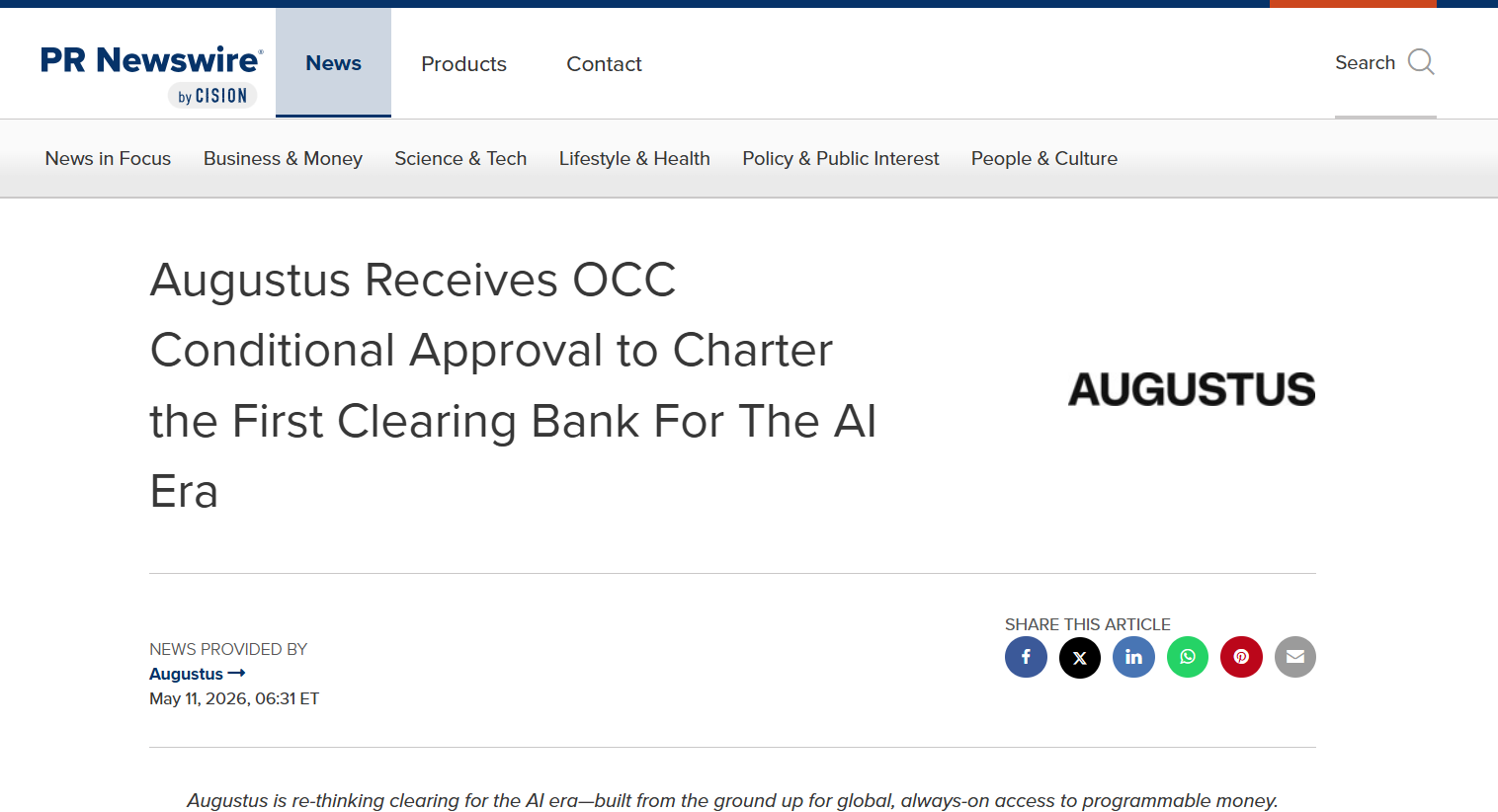
Augustus Bank’s CEO, Ferdinand Dabitz, says legacy clearing banks cannot truly rebuild their cores for artificial intelligence and programmable money, as his startup moves closer to launching a US national bank designed around both.
The Office of the Comptroller of the Currency (OCC) granted conditional approval for Augustus Bank N.A. on Monday under the Guiding and Establishing National Innovation for US Stablecoins (GENIUS) Act, which created a federal framework for payment stablecoins and clarified how banks and certain nonbank entities can issue and integrate dollar-pegged tokens under federal oversight.
Augustus now plans to establish a full-service national bank in Dallas, Texas, focused on fully reserved stablecoins, AI-driven compliance and automation-heavy back-office processes. Dabitz told Cointelegraph it was just “a couple of months” from full approval and launch. However, final approval remains subject to pre-opening conditions.
The company is targeting the “broken” correspondent clearing business dominated by global banks such as Citi, arguing that incumbents cannot fully re-platform systems built for humans, not machines, that still close on weekends and rely on decades-old cores.
“The short answer is replacing them,” Dabitz said when asked whether Augustus could coexist alongside traditional clearing banks.
Augustus bets stablecoins and AI can remake clearing
Augustus began life in Berlin in 2021 as Ivy, a euro-clearing fintech that built a transaction banking platform for non-US financial institutions, fintechs and crypto firms.
Augustus received conditional OCC approval this week. Source: PR Newswire
The bank already runs euro payments and instant settlement for clients, including crypto exchange Kraken. “The clearing bank bond is truly broken,” he said, arguing there’s an opportunity to “rethink it as an application and deliver something pretty terrific.”
Related: JPMorgan to launch tokenized money market fund for stablecoin issuers
Central to Dabitz’s pitch is the belief that large banks can upgrade legacy infrastructure but cannot fundamentally rebuild around AI and tokenized money. “I’ve come to the conclusion it’s impossible to re-platform a bank,” he said.
Augustus plans a three-layer stablecoin model: using stablecoins as a funding rail for payments, as a treasury and liquidity tool to release what Dabitz estimates is around $3 trillion in trapped idle capital, and as the interface layer for AI agents interacting directly with money.
He said the model could enable real-time treasury optimization and allow AI systems to become “first-class customers” of the bank, handling tasks such as liquidity management and transaction monitoring on behalf of corporates.
Competition from banking giants
Dabitz’s argument comes as major banks accelerate their own AI and digital asset initiatives.
JPMorgan Chase says it invests more than $18 billion annually in technology, including AI, and Citi reported over $6.1 billion in clearing-related revenue in Q1 alone, highlighting the scale of the incumbent profit pool Augustus is targeting.
Dabitz argues his team can still move faster because it is designing AI and stablecoin workflows into its operating model from the outset rather than retrofitting existing systems.
Related: Argentine banks testing JPMorgan’s JPM Coin to speed up settlements: Report
He also described the US banking market as structurally under-innovated, noting that banking is unusually labor-heavy compared with other major industries, with people rather than assets forming a major part of operating costs.
Pushing AI deeper into banking operations
Augustus wants to compress processes such as transaction monitoring, case handling and suspicious activity reporting from “20 hours to 20 minutes” using AI, with humans supervising the systems rather than manually performing every step.
Critics question whether a young, AI-focused bank with a 25-year-old leader at its helm can safely automate compliance-heavy operations without introducing model risk, explainability problems or operational failures.
Dabitz said that only makes the challenge “more exciting” and that the company plans to work closely with regulators and banking executives to ensure “the checks and balances and the harness for the AI to operate in a safe and sound manner.”
Magazine: Bitcoin will not hit $1M by 2030, says veteran trader Peter Brandt
THORChain developers announced that one of six Asgard vaults was compromised, resulting in approximately $7.4M in unauthorized outbound transactions before the network halted signing activity.


Tokenized ETFs have crossed $430 million in total onchain market cap, with Ondo Finance’s IVVon token surging 150% in the past month on Ethereum.


Gemini’s “agentic trading” lets AI models like ChatGPT and Claude plug into user accounts via MCP, executing crypto trades autonomously and turning AI from signal vendor into primary CEX client.
Summary
- Gemini has wired its full trading API into Anthropic’s Model Context Protocol, so compatible AI agents can pull market data, query order books, place orders and manage positions directly from user‑linked accounts.
- Users set budgets, strategies and caps, while modular “Trading Skills” give agents DCA, grid, multi‑leg and risk tools, making a growing slice of Gemini’s resting and market orders originate from opaque, black‑box models.
- Unlike TON’s non‑custodial “Agentic Wallets,” which push autonomy to Telegram edge wallets, Gemini centralizes agentic activity inside a regulated CEX perimeter, recasting AI as a client type that humans merely configure.
Gemini has rolled out “agentic trading,” a feature that lets AI systems like ChatGPT and Claude connect directly to user accounts and execute crypto trades autonomously on the exchange, rather than just spitting out trade ideas for humans to click. The move quietly shifts AI from being a glorified signal service to being a client class in its own right, with opaque, proprietary models now sourcing, routing, and managing a chunk of CEX order flow on their own.
According to Gemini’s own blog, “agentic trading means your AI agent acts on your behalf — placing trades, monitoring markets, and managing risk automatically,” with users defining strategies and constraints while the agent handles execution. Under the hood, Gemini has integrated its full trading API with the Model Context Protocol (MCP), an open standard originally built by Anthropic that lets AI agents call external tools and services; compatible models include Claude and ChatGPT, which can query markets, place orders and adjust positions over time. Third‑party write‑ups emphasize that Gemini is the first regulated US exchange to expose a dedicated “agentic” interface, turning centralized exchange infrastructure into a native venue for autonomous trading agents rather than just human click‑flow and traditional algos.
Gemini heats up the AI race
Practically, the system is built around modular “Trading Skills” — pre‑built functions AI agents can invoke to get real‑time market data, inspect order‑book depth and spreads, and pull historical candle data, with more complex order‑routing and risk modules promised over time. Users link their accounts to an AI model via MCP, set budget and risk limits, and then let the agent run strategies that can range from simple DCA or grid trading to multi‑leg structures and volatility plays, with Gemini stressing that “human oversight remains part of the design” through caps and rules. But the microstructure implication is obvious: once enough people plug in agents and walk away, a material share of resting and market orders on Gemini will be coming from black‑box models tuned to optimize for particular objectives, not from human decision cycles.
That changes who you are actually trading against. Historically, the story was “retail vs HFT vs a few prop‑shop algos”; now Gemini is effectively advertising “AI as a client type,” more akin to how prime brokers have algorithmic clients that are not directly human‑decisioned on each trade. In high‑volatility periods, tightly coupled agent strategies can amplify feedback loops — especially if many users are copying off the same “AI signals” or fine‑tuning similar models on overlapping data — and you can easily imagine clusters of agents front‑running naive human behavior or unintentionally engaging in coordinated patterns that look a lot like cartelized flow.
There is a clean contrast here with TON’s on‑chain “Agentic Wallets.” TON is pushing autonomy to the network edge: agents live in Telegram, manage non‑custodial wallets on TON, and interact with DeFi directly on an L1. Gemini is doing the opposite: recenters agentic trading inside a regulated, custodial CEX, where AI agents are tightly coupled to one exchange’s API and compliance perimeter. In both cases the future is the same: the next “HFT villain” in crypto will not be a named firm on the other side of your order, but a swarm of un‑audited models, systematically optimized around the fee, tax and KYC constraints their operators face — and increasingly treated by the infrastructure itself as the primary customer, with humans demoted to parameter‑setters and occasional override buttons.

Hundreds of thousands expected in London on 78th anniversary of Nakba
A Tidal Wave of Comp Picks Could Soon Crash into the Minnesota Vikings

PreFlight Slicer Brings Added Part Strength Feature, And Many More

Manchester United reach agreement with Casemiro over contract clause amid transfer speculation

US brings back mandatory military draft registration

Steven Gerrard disagrees with Gary Neville over ‘shock’ Chelsea and Arsenal claim | Football


-

 Fashion7 days ago
Weekend Open Thread: Marianne Dress
-

 Fashion4 days ago
Coffee Break: Travel Steam Iron
-

 Fashion5 days ago
What to Know Before Buying a Curling Wand or Curling Iron
-

 Politics4 days ago
What to expect when you’re expecting a budget
-

 Tech5 days ago
Auto Enthusiast Carves Functional Two-Stroke Engine from Solid Metal
-

 Politics6 days ago
Politics Home Article | Starmer Enters The Danger Zone
-
 Business6 days ago
Ignore market noise, India’s long-term story intact, say D-Street bulls Ramesh Damani and Sunil Singhania
-

 Tech4 days ago
GM Agrees To Pay $12.75 Million To Settle California Lawsuit Over Misuse Of Customers’ Driving Data
-

 Crypto World5 days ago
CZ says US crypto rivals tried to block Trump pardon
-

 Crypto World6 days ago
PROS explodes 48% as Upbit and Bithumb listings ignite demand
-

 Tech4 days ago
GM agrees to $12.75M California settlement over sale of drivers’ data
-

 Entertainment7 days ago
YNW Melly Denied Bond Again Ahead Of Double Murder Retrial
-

 Crypto World7 days ago
Kraken Parent Seeks OCC Charter, Signaling Regulated Banking Access
-
Crypto World2 days ago
Bitcoin Suisse expands with Digital Asset License and Investment Business Act Registration Approval in Bermuda
-

 Sports7 days ago
Why Nathan Mackinnon Remains the Hart Trophy Favourite over Connor McDavid and Nikita Kucherov | NHL
-

 Sports7 days ago
After Waka Waka, Shakira now drops first teaser for FIFA WC 2026 song | FIFA World Cup 2022
-

 Entertainment7 days ago
Bethenny Frankel Says She Loves ‘Torturing’ Men
-
 Crypto World7 days ago
Solana UFO Meme Coins Surge After Pentagon Reveals Alien Files
-

 Politics3 days ago
Pakistan to enter Chinese capital market as war inflation bites
-

 Entertainment7 days ago
Young and the Restless Next Week: Cane & Matt Both Arrested in Shocker!
You must be logged in to post a comment Login