

Crypto World
Robinhood Partners With dYdX Labs to Launch Arcus DEX

Robinhood is pushing deeper into tokenized markets and perpetual trading, partnering with the team behind the dYdX decentralized exchange to relaunch the protocol as Arcus on Robinhood Chain. The move links a retail-focused trading brand with on-chain derivatives infrastructure, aiming to bring around-the-clock access to US equity exposure and perpetual products.
According to posts from Arcus on X, dYdX is now Arcus and the protocol will launch on Robinhood’s Arbitrum-based layer 2 network, which went live the same day. The dYdX Foundation said the dYdX blockchain itself is not affected, adding that Arcus is a separate offering built through infrastructure created by dYdX Labs in partnership with Robinhood.
Key takeaways
- dYdX is rebranded into Arcus and positioned for a launch on Robinhood Chain, Robinhood’s Arbitrum-based layer 2.
- dYdX Foundation says the original dYdX blockchain remains unchanged and continues to be community-owned.
- Arcus plans tokenized stock trading and perpetuals, including the ability for tokenized stocks to be used as collateral.
- Robinhood Chain is being marketed as a venue for expanded tokenized-asset access as regulators show interest in bringing such products to market.
- Early ecosystem integration efforts are already forming, with wallet and swap-platform partners announcing support for Robinhood Chain.
Arcus launches on Robinhood Chain with tokenized stocks and perps
Arcus describes its goal as removing access barriers for traditional market participants who—according to the protocol—have historically been “shut out” of equities, commodities, and index exposure due to geography, market hours, and institutional restrictions. In a blog post titled “Arcus x Robinhood: Trade Stocks & Perpetuals 24/7”, Arcus says the protocol was built specifically to reduce those barriers.
The protocol states that it will support perpetual products and tokenized stock trading, with the initial products scheduled to go live this month. Arcus also says tokenized stocks can be used as collateral for perpetuals—an approach that, if it scales, could connect retail stock-like exposure to continuously traded derivatives.
In addition, Arcus claims it will provide access to “pre-IPO markets.” The details of which tokenized instruments qualify for that claim are not specified in the provided materials, so users will likely need to watch the protocol’s product rollout and collateral eligibility before assuming full parity with traditional pre-IPO access channels.
dYdX Foundation: dYdX blockchain remains community-owned and “not affected”
While the product is branded as Arcus, the dYdX Foundation sought to clarify that the broader ecosystem is not being rewritten around Robinhood. In its statement, the Foundation said that Arcus is a distinct, independent product built on separate infrastructure and that the dYdX blockchain is not affected in any way. It also reiterated that the dYdX blockchain would continue operating and remain community-owned.
That distinction matters for existing users and liquidity providers who associate dYdX with a specific chain and governance structure. Instead of a direct migration of the original chain, Arcus appears positioned as a parallel protocol offering—one that Robinhood’s users can reach through Robinhood Chain.
Arcus also said Robinhood’s crypto technology arm, Robinhood Crypto, made an investment in Arcus, though it did not disclose further terms or figures in the materials provided.
Robinhood’s tokenized-assets and perp push meets competitive pressure
This development arrives as tokenized assets and on-chain derivatives move from “niche” to mainstream attention. The article framing points to renewed momentum as regulators in the US have shown interest in allowing tokenized products to come to market more easily. (For context, the provided coverage references SEC-related proposals around tokenized US stocks.)
Robinhood’s interest in perpetual trading also reflects how quickly trading formats can shift user behavior in crypto markets. The provided material notes that traders have been increasingly active on the crypto perpetual futures platform Hyperliquid, whose token reportedly climbed nearly 150% so far this year, as earlier coverage highlighted a surge in open interest and market attention. Robinhood’s bet appears to be that tokenized equities plus perpetual mechanics—traded on a familiar retail rail—could draw demand beyond traditional spot-only approaches.
More broadly, the competitive dynamic is not limited to crypto exchanges. Major retail-oriented trading platforms have expanded their offerings to remain competitive, and the provided coverage points to examples such as Coinbase expanding access to thousands of stocks. It also notes Coinbase’s earlier 2023 move into building its own Ethereum layer-2, Base, which has grown significantly, according to DeFiLlama data referenced in the provided text.
Robinhood Chain now adds another front in this trend: blending a consumer brand’s market access with on-chain infrastructure built for tokenized instruments and derivatives.
Ecosystem signals: wallets, swaps and first movers on Robinhood Chain
Alongside the Arcus announcement, additional ecosystem support was highlighted. The provided materials report that Bitget Wallet partnered with Robinhood Crypto to integrate Robinhood Chain, enabling users to trade tokenized stocks. Separately, decentralized exchange aggregator 1inch said it would be among the first major swap platforms to support Robinhood Chain.
These integrations are important because they determine how quickly new assets and liquidity can become accessible to end users. Tokenized stocks and perpetuals are only as practical as the rails that let retail participants reach them—through wallets, swaps, and routing infrastructure—without unnecessary friction.
The combination of an exchange-like retail pathway (Robinhood) and DeFi-style liquidity tools (wallet integrations and aggregators) suggests Robinhood Chain is aiming to be more than a closed ecosystem. However, the true depth of support—such as which specific tokenized stocks will be available first, how collateral is handled across markets, and what the onboarding experience looks like—will only become clear after the protocol’s rollout begins.
As Arcus products go live on Robinhood Chain this month, the key details to watch are collateral rules for tokenized stocks, the breadth of available perpetual markets, and whether liquidity and execution quality improve quickly enough for retail traders accustomed to centralized-style trading speed. The dYdX Foundation’s assurance that the original dYdX chain remains unchanged should reduce concern about existing governance and infrastructure, but users will still want to confirm how Arcus will function as a separate, Robinhood-connected product.

Crypto World
Metaplanet (3350) buys another $170 million of bitcoin expanding treasury to 43,000 BTC


Metaplanet (3350) announced the purchase of an additional 2,823 BTC ($170.7 million), bringing its total treasury to 43,000 BTC ($2.6 billion).
The acquisition cements the Tokyo listed firm as the third largest publicly traded company holding bitcoin, trailing only Strategy MSTR) and Twenty One Capital (XXI), according to data tracked by Bitcoin Treasuries.
Metaplanet closed 3.5% higher at 207 yen ($1.28) on Thursday following the announcement.
Alongside the bitcoin purchase, the company released its second quarter FY2026 results for its Bitcoin Income Generation business. The division generated approximately 1.75 billion yen ($10.85 million) in operating revenue during the quarter, taking first half revenue to approximately 4.72 billion yen.
Metaplanet uses bitcoin options to generate recurring income while expanding the company’s bitcoin holdings. On a trailing 12-month basis, revenue reached approximately 11.4 billion yen.
The latest results reinforce Metaplanet’s dual strategy of aggressively accumulating bitcoin while generating recurring cash flow from its Bitcoin Income Generation business.
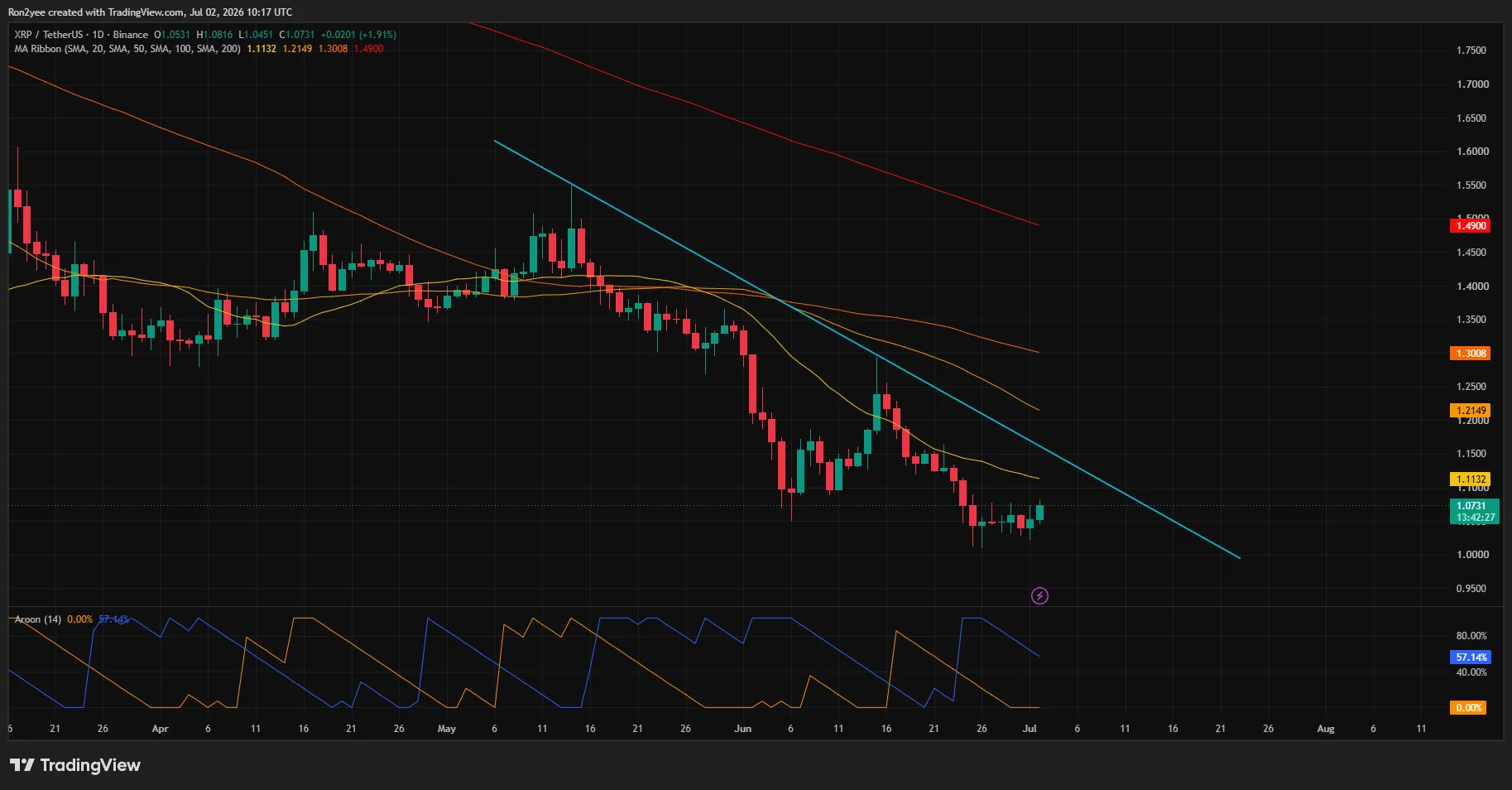
XRP has rebounded toward the stubborn $1.07 resistance after Ripple’s latest XRP Ledger lending plans and rising network activity revived buying interest, but another breakout attempt now faces a level that repeatedly rejected bulls throughout June.
Summary
- XRP has rallied back to the stubborn $1.07 resistance after Ripple’s lending roadmap and stronger on-chain activity revived buying interest.
- Technical indicators show improving short-term momentum, but major moving averages and a descending trendline continue to cap the uptrend.
- A breakout above $1.07-$1.09 could trigger a short squeeze toward $1.15, while rejection risks another test of the $1.03-$1.00 support zone.
According to data from crypto.news, XRP (XRP) climbed nearly 5% from around $1.03 to an intraday high near $1.08 on July 2 before stalling at the same resistance level that repeatedly rejected buyers throughout late June.
The recovery followed Ripple’s announcement of an institutional-focused XRPL Lending Protocol alongside its monthly escrow release, where 300 million XRP entered circulation while 700 million tokens remained locked. Because only a fraction of Ripple’s holdings reached the market, dilution concerns eased, and buyers stepped back in.
On-chain activity strengthened alongside the price recovery. Daily active addresses on the XRP Ledger jumped more than 72%, while new wallet creation reached its highest level in roughly three months as investors accumulated after XRP’s June decline.
Exchange balances also continued falling as coins moved into self-custody, reducing immediately available supply during the latest rally.
Historical seasonality has also added support. July has consistently ranked among XRP’s strongest months over recent years, encouraging systematic traders to rebuild long exposure after the second quarter ended. The move also came as Bitcoin stabilized above $60,000, allowing capital to rotate back into several large-cap altcoins.
XRP remains trapped below long-term resistance despite improving momentum
The 1-day chart shows XRP still trading beneath every major moving average despite the latest bounce. The 20-day moving average sits near $1.11, followed by the 50-day around $1.21, the 100-day near $1.30, and the 200-day close to $1.49. A descending trendline connecting lower highs since May continues to cap every recovery attempt, leaving the primary trend bearish until those barriers are reclaimed.
On the 4-hour chart, however, buyers have regained short-term momentum. XRP has pushed back above recent consolidation lows and is once again testing the $1.075-$1.08 resistance zone that rejected advances several times during June.
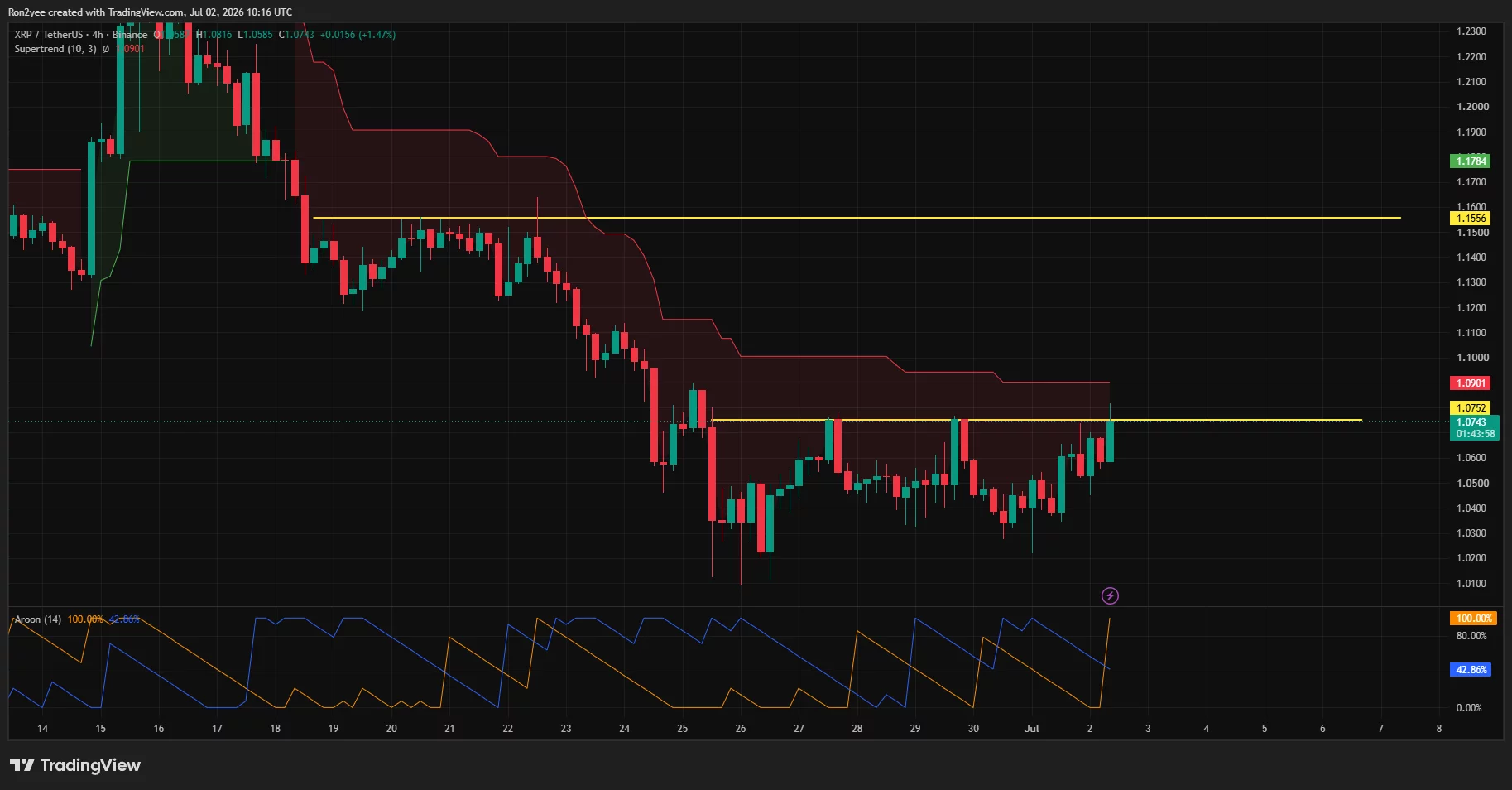
The Supertrend indicator still remains bearish near $1.09, making that level the first confirmation hurdle before bulls can target the next resistance around $1.15. A successful break there could expose the declining 20-day average near $1.11 first before opening room toward $1.21.
Meanwhile, the Aroon indicator presents a mixed picture across timeframes. The daily chart still favors sellers, while the four-hour reading has shifted decisively toward buyers after Aroon Up surged to 100%, suggesting short-term momentum has strengthened even though the larger trend has yet to reverse.
Derivatives positioning also supports the importance of the current price zone. CoinGlass liquidation data shows one of the largest short liquidation clusters sitting between $1.08 and $1.10.
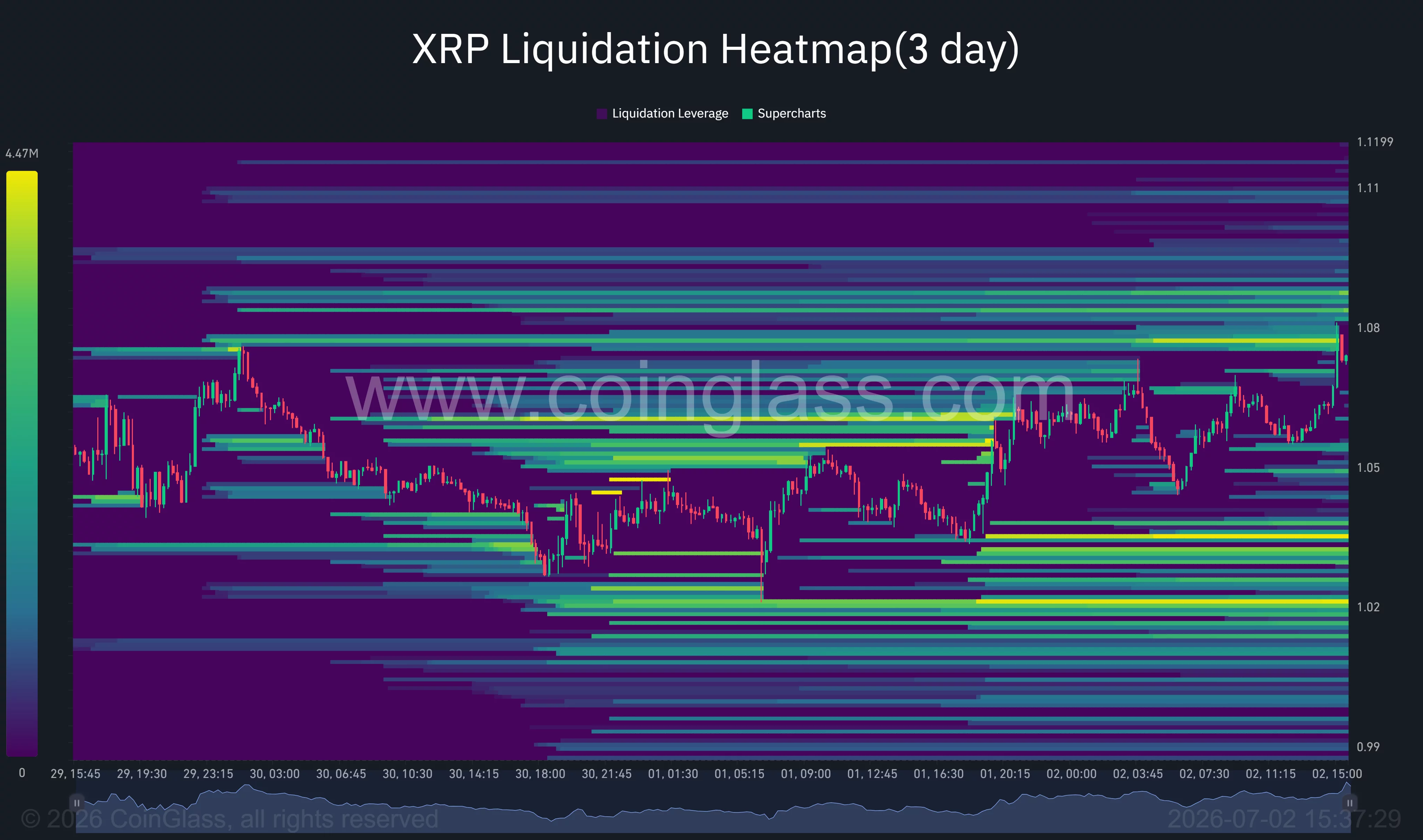
A decisive move through that range could trigger forced buying from leveraged short positions and accelerate a squeeze toward $1.11 and potentially $1.15. On the downside, sizeable long liquidation pools remain concentrated around $1.03 and $1.02, making those levels important support if the breakout attempt fails.
Commenting on the current structure, analyst ChartNerd wrote in a July 2 X post:
“Relief is possible from this $1.00 low but the overall trend remains down for now.”
The analyst also noted that XRP has historically remained under pressure after losing its 20-week exponential moving average and argued that reclaiming roughly $1.35 would be needed to restore a higher-timeframe bullish trend.
Failure at $1.07 would keep sellers in control
Several risks continue to challenge the recovery despite improving sentiment. XRP remains roughly 70% below its July 2025 peak near $3.66 after months of restrictive monetary policy, weaker crypto market liquidity, and delayed regulatory progress in the U.S.
The postponement of the U.S. CLARITY Act removed one of the largest anticipated policy catalysts, while elevated Treasury yields have continued limiting capital flows into higher-risk assets.
Technically, another rejection near $1.07-$1.09 would reinforce the descending trendline that has controlled price action for nearly two months. A drop below $1.03 would expose the psychological $1.00 support once again, and losing that level could send XRP toward the next demand zone around $0.98.
Conversely, a clean close above the Supertrend and repeated June highs would invalidate the immediate bearish structure and give buyers their strongest opportunity in weeks to extend the recovery toward $1.15 and then the cluster of moving averages above $1.20.
Disclosure: This article does not represent investment advice. The content and materials featured on this page are for educational purposes only.
Ethereum has a “wall of worry” where negative sentiment is meeting staking absorption, reported CryptoQuant on Tuesday.
The Coinbase Premium, a measure of institutional interest, is 230% below its three-month average, while Binance funding rates are deeply negative, signaling caution from US institutions and leveraged traders, it added.
Despite this wall of negativity, ETH’s price has stayed stable over the past week rather than breaking down.
ETH Staking Hits Record 40M
Meanwhile, the Ether supply is tightening as stablecoin balances on Binance are draining while staking inflows have surged 65%, “suggesting long-term holders are locking up supply even as short-term traders de-risk,” it stated.
“While traders are shorting or de-risking on Binance, long-term holders are actively locking supply into the staking contract.”
This combination of deep pessimism and a shrinking liquid/exchange supply is a classic pattern, which historically creates fragile conditions for short traders if selling pressure exhausts.
The analysts concluded that monitoring the reversal of the Coinbase Premium will be the primary signal for a shift in this regime.
Ethereum’s Wall of Worry: Negative Sentiment Meets Staking Absorption
“Historically, when speculative sentiment is this depressed while organic supply is being absorbed by staking, it creates a fragile environment for short-sellers.” – By @CryptoOnchain pic.twitter.com/C8XO4Omlmp
— CryptoQuant.com (@cryptoquant_com) June 30, 2026
The staking figures speak for themselves, with a record amount of ETH off the table and locked up.
ETH staking has hit an all-time high of 40 million, which equates to 33% of the entire supply, according to Ultrasound.Money.
Additionally, the validator exit queue is just 9,248 ETH, while more than 2.9 million ETH are in the entry queue.
Bitmine chair Tom Lee said that crypto is a hyper-volatile asset, and some macro headwinds are weighing on ETH, such as markets seeing a Fed hike, Clarity Act purgatory, AI FOMO, and private credit hurting flows.
However, there are also some tailwinds, including the tokenization megatrend, crypto downstream of AI, money becoming digital/software, and peak pain, he said in a recent interview.
ETH Price Outlook
Despite these tailwinds, ETH prices remain depressed, with the asset dipping to an intraday low of $1,550 on Tuesday.
There was little momentum during Wednesday morning Asian trading, with ETH lifting to $1,585. The longer it stays at current levels, the greater the chances of another leg down, especially if Bitcoin loses support at $58,000.
The post Staking Surge Tightens Supply, But Negative Sentiment Still Dominates Ethereum appeared first on CryptoPotato.
Crypto World
Standard Chartered Launches USDC Minting and Redemption Service for Institutional Clients

TL;DR
- Standard Chartered has become the first G-SIB to offer institutional clients direct USDC minting and redemption services.
- The new solution allows eligible clients to access USDC without opening a separate account with Circle.
- Initially launching through the bank’s DIFC operations, the service supports settlement, treasury, and liquidity management.
- The partnership underscores growing institutional demand for regulated stablecoin infrastructure despite rising competition in the sector.
Standard Chartered, currently at the fore front of the stablecoin adoption campaign, has introduced a new service that enables institutional clients to mint and redeem USDC directly through the bank, marking a significant step in the integration of traditional banking with digital assets.
Developed in partnership with Circle Internet Group, the issuer of USDC, the offering makes Standard Chartered the first Global Systemically Important Bank (G-SIB) to provide institutional access to USDC minting and redemption through a single banking relationship.
Unlike existing arrangements, eligible clients will not need to open separate accounts with Circle. Instead, they can access USDC minting and redemption through Standard Chartered’s institutional platform, allowing them to move between fiat currencies and blockchain-based assets within a unified banking environment.
The service will initially be available through the bank’s Dubai International Financial Centre (DIFC) operations, with plans to expand into additional markets as regulatory approvals are secured.
New Service Aims to Bridge Traditional Banking and Digital Assets
Standard Chartered said the new capability is designed to simplify how institutions interact with regulated stablecoins by combining banking services, custody, and digital asset infrastructure into a single offering.
The bank expects the solution to support a wide range of institutional activities, including on-chain settlement, treasury operations, and liquidity management, while also laying the foundation for future payment-related use cases. By embedding USDC access into its existing institutional banking platform, Standard Chartered aims to provide clients with the governance, compliance, and risk management standards associated with a global financial institution.
The launch also reflects growing demand among corporations and financial institutions for regulated stablecoin infrastructure capable of supporting cross-border transactions and digital asset operations. Starting in the UAE further reinforces the country’s position as an emerging hub for regulated blockchain and digital asset innovation.
Partnership Highlights Stablecoin Adoption Despite Growing Competition
The partnership, just barely a month after another one with CoinMENA, represents another milestone for Circle as it continues expanding the reach of USDC through established financial institutions. Bringing a global systemically important bank into its ecosystem could strengthen USDC’s position among institutional users seeking regulated access to stablecoins.
The announcement also comes just hours after renewed attention on Circle’s competitive position in the stablecoin market. As earlier reported, Circle’s shares recovered modestly after a sharp selloff triggered by the launch of the OpenUSD consortium, an initiative backed by more than 140 organizations, including major financial and technology companies such as Stripe, Coinbase, Visa, Mastercard, and BlackRock.
While some analysts have warned that increasing competition could pressure USDC’s market position over time, Standard Chartered’s decision to integrate USDC into its institutional banking services signals that demand for regulated stablecoin infrastructure continues to grow.



Bitcoin climbed above $61,000 on Thursday, up about 4.1% over 24 hours, per CoinDesk data, its firmest footing so far this week after a sell-off sent the asset to as low as $58,200 earlier.
The lift came from the Federal Reserve. Chair Kevin Warsh told the European Central Bank’s forum in Sintra, Portugal, that inflation risks had come down, his first notably softer comment since a hawkish June rate outlook set off weeks of outflows from U.S. bitcoin exchange-traded funds.
The move stood out because it came against a rough day for tech.
South Korea’s Kospi index fell 7.9% on Thursday after Samsung Electronics and SK Hynix shed a combined $290 billion in market value, the second time this month the index has buckled on worries about artificial-intelligence chips, according to Bloomberg.
Meta added to the unease with plans to sell spare computing power to outside customers, a move that revived the question of whether the AI infrastructure buildout has run ahead of real demand.
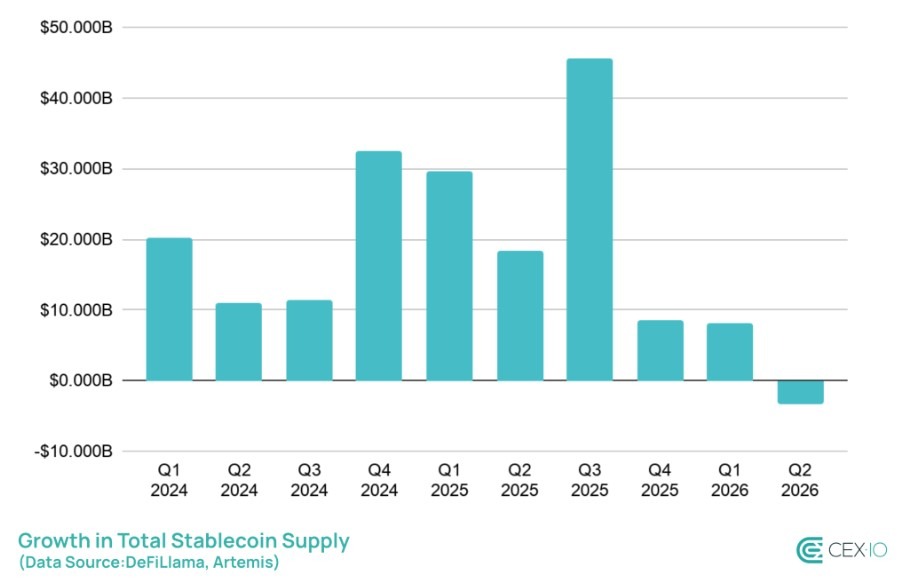
Yield-bearing stablecoin supply fell by more than $3.5 billion in the second quarter of 2026, reversing nearly three years of quarterly growth as crypto-native products contracted and Treasury-backed tokens expanded.
Crypto exchange CEX.IO reported Thursday that the category declined by 15% during Q2. Ethena’s sUSDe lost 52% of its supply, shedding nearly $2 billion, while Sky’s sUSDS declined by 16%.
Treasury-backed products moved in the opposite direction. BlackRock’s BUIDL grew by 2%, Circle’s USYC increased by nearly 16% and Ondo Finance’s USDY rose by over 66%, highlighting a widening divide between crypto-native yield assets and products backed by traditional assets.
The divergence came as the broader stablecoin market recorded its first quarterly contraction since the third quarter of 2023, according to CEX.io. Total supply fell to $312 billion in Q2, while adjusted transaction volume declined by 5.5%.
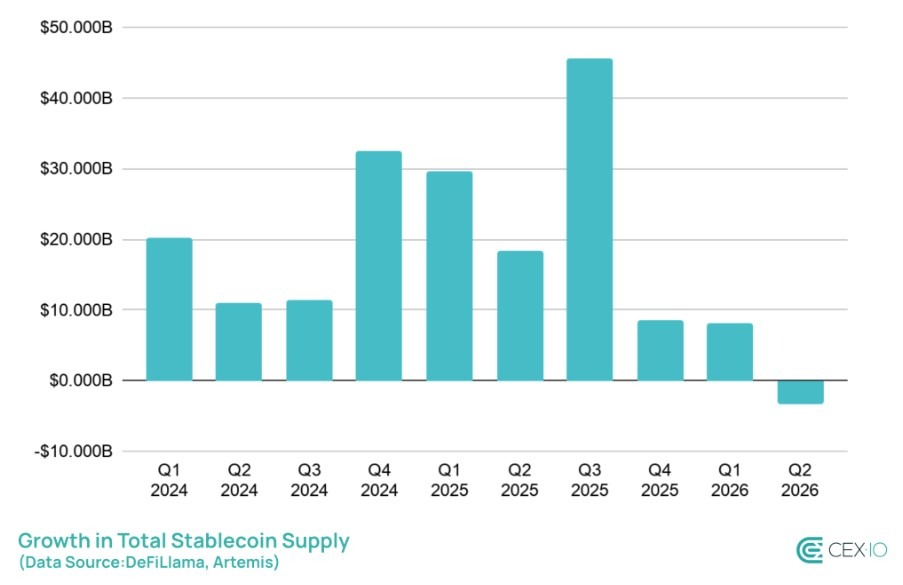
Supply growth per quarter, compiled by CEX.io. Source: CEX.io
Stablecoin slowdown deepens after weaker Q1 signals
The Q2 decline marks a sharp reversal from the start of 2026. In Q1, stablecoin supply increased by about $8 billion to a record $315 billion, with yield-bearing products among the main growth drivers.
However, signs of weakening organic demand had already emerged early in the year. During the first quarter, retail-sized transfers fell by 16%, while automated activity accounted for roughly 76% of stablecoin transaction volume.
The slowdown continued through Q2. According to CEX.io, total stablecoin transaction counts fell by 530 million to 4.48 billion, the largest quarterly decline on record. However, transfers below $250 increased by 5% to $19.39 billion, suggesting that smaller peer-to-peer payments were more resilient than larger automated and trading flows.
Related: Financial companies join forces for US dollar stablecoin, keeping reserve earnings
Contraction comes amid weaker crypto market activity
The stablecoin contraction also adds to broader concerns about weakening activity across crypto markets. On Wednesday, institutional data provider Talos identified declining stablecoin supply alongside spot Bitcoin (BTC) exchange-traded fund (ETF) outflows and slower Bitcoin purchases by Strategy as three key demand channels that weakened in Q2.
Tanay Ved, senior research associate at Talos, told Cointelegraph that a recovery in stablecoin supply would signal “fresh capital coming back into the ecosystem more broadly” and help support onchain liquidity.
Ved said spot ETF flows remain the most important demand channel to watch because they tend to reflect more durable shifts in institutional appetite. However, he added that ETF flows, corporate Bitcoin purchases and stablecoin supply often move together when market momentum changes.
Magazine: Japanese pension fund tips 1% in crypto, G7 urges action on NK hackers: Asia Express
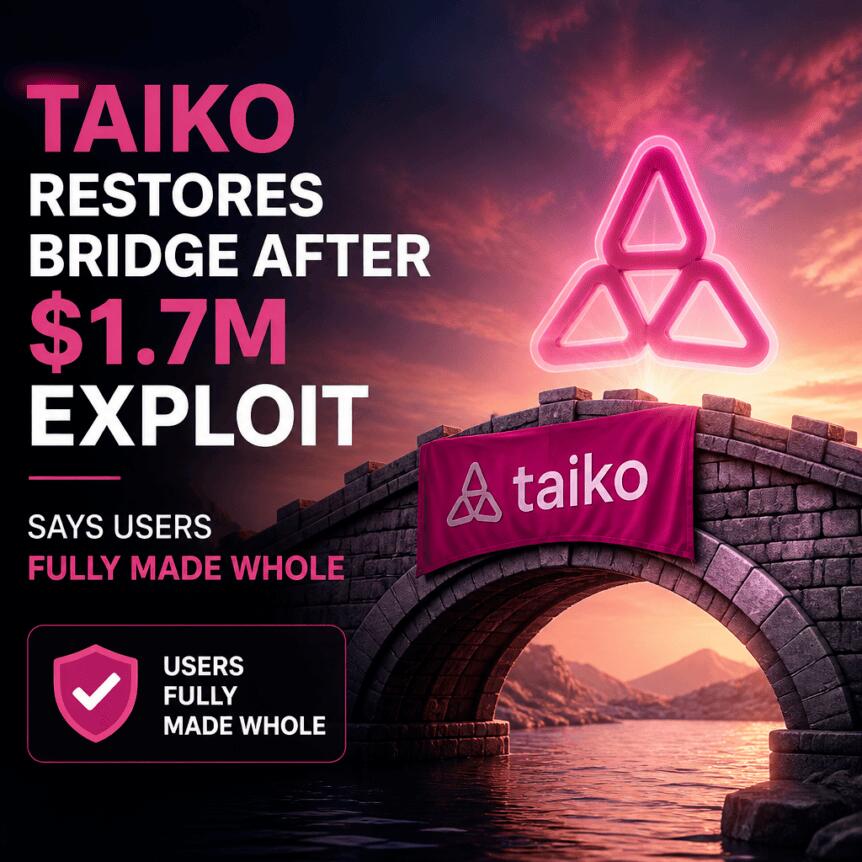
Ethereum layer-2 network Taiko has brought its bridge back online after an exploit on June 21 disrupted withdrawals and movement of funds. The protocol announced on Thursday that users can once again transfer assets to and from the network following completion of the last step in its multi-stage recovery process.
Taiko said it has made affected users whole and that any remaining withdrawal limits are intended as temporary safeguards rather than an ongoing restriction on normal bridge usage. The reopening concluded an 11-day period during which the bridge remained closed while security fixes were implemented and the bridge’s 1:1 backing status was restored.
Key takeaways
- Taiko reopened its bridge after an 11-day outage tied to a June 21 exploit.
- In its recovery update, Taiko said it restored full operations and completed the final stage of a four-step plan.
- The protocol stated affected users have been fully reimbursed, while any remaining withdrawal limits are temporary precautions.
- Taiko previously said the incident involved compromised chain-state verification that allowed forged proofs and unauthorized withdrawals.
- The network has not yet detailed exactly how its 1:1 bridge backing was restored or whether any stolen assets were recovered.
Bridge reopening after a four-stage recovery
On Thursday, Taiko posted that transfers to and from the Taiko network were operational again after users completed the last stage of the protocol’s recovery steps. The announcement framed the reopening as the end of the most disruptive phase of the incident response, when the bridge was paused to prevent further unauthorized movement.
The bridge disruption stemmed from a compromise of the chain-state verification mechanism used by Taiko. According to earlier reporting cited by Cointelegraph, the attacker’s access enabled forged proofs to be accepted, which in turn allowed withdrawals from Taiko’s Ethereum vault.
Taiko said the bridge is now operating with restored backing and that the network had progressed through four stages to address the issue. The project also indicated it had verified that the finalized state of the chain does not include forged checkpoints or attacker-controlled claims that could still be executed.
What went wrong on June 21
The exploit took place on June 21. The core failure, as described in the reporting that accompanied Taiko’s response, was the attacker’s compromise of Taiko’s chain-state verification mechanism. That meant the system could accept proofs that should not have been valid, creating a path for unauthorized withdrawals through the bridge to the underlying Ethereum vault.
Security companies cited in the earlier coverage said the incident may have resulted in up to $1.7 million being taken. The event highlights a recurring risk in cross-chain bridge architectures: when verification assumptions break, attackers can exploit proof-handling logic to move assets away from intended custody rules.
Following the bridge reopening, Taiko’s token briefly rose to around $0.35 before falling back to roughly $0.14. That short-lived move reflected renewed market access to transfers, though the token’s trading range suggests investors remained cautious about the full details of the incident and remediation.
Security fixes, backing restoration, and remaining limits
Taiko had already laid out its recovery plan on Sunday, describing a four-stage approach. The network said it deployed security fixes and then verified the chain’s finalized state to ensure it contained no forged checkpoints or attacker claims. It also stated that the changes were submitted through its security council and reviewed by independent security experts.
After those software and verification steps, Taiko said the system then replenished the bridge so that assets issued on the layer-2 network are backed 1:1 by assets held on Ethereum. With the bridge now reopened, that backing restoration is central to the protocol’s claim that users can transfer funds again without taking on unmanaged bridge risk.
As an extra layer of caution, Taiko introduced conservative withdrawal quotas. The project said these limits are not expected to interfere with normal bridge usage, though it did not specify the quota size or how long the temporary restrictions would remain in effect.
Notably, Taiko has not publicly explained the specific operational steps it used to restore the bridge’s 1:1 backing, nor has it stated whether any of the assets taken during the exploit were recovered. The protocol indicated it would publish a full postmortem describing the incident and its response, which is likely to be a key point of follow-up for users and auditors.
Why this matters for users and the broader DeFi stack
For Taiko users, the bridge is the key interface between the layer-2 environment and Ethereum, so keeping it closed affects everything from liquidity movement to routine redeployments of capital. By reopening the bridge and stating that affected users were made whole, Taiko is attempting to restore user confidence and reduce the operational friction that comes with paused cross-chain movement.
For the wider market, the episode is another reminder that layer-2 bridging continues to concentrate risk around proof verification and custody assumptions. Even when the impact is limited relative to the size of the broader ecosystem, an exploit that forces bridge shutdowns can interrupt DeFi operations and affect how quickly liquidity can be rebalanced across networks.
The decision to implement withdrawal quotas after reopening also signals the trade-off protocols are increasingly making after incidents: restoring functionality while controlling the rate at which funds can exit, giving teams time to monitor systems and confirm that the fixes behave as intended in real-world conditions.
Going forward, the most important items for Taiko users to watch are the promised postmortem—especially any detail on how 1:1 backing was restored and whether recovery occurred—and how long the temporary withdrawal limits remain in place. Those answers will help determine whether the reopening is purely operational restoration or the start of a longer stabilization period for the bridge and surrounding smart contract components.

Private-equity firms IVEST Consumer Partners and Cloverlay have sold the Care Bears brand of plush toys and related rights to Authentic Brands Group.
Authentic Brands, a company focused on entertainment, sports and media, owns intellectual property that generates more than $36 billion in annual retail sales. The Care Bears operation, run under IVEST by Cloudco Entertainment, is on track to exceed $750 million in retail sales by the end of this year.
Copyright ©2026 Dow Jones & Company, Inc. All Rights Reserved. 87990cbe856818d5eddac44c7b1cdeb8


OpenAI has explored the idea of granting the U.S. government a 5% equity stake as part of efforts to strengthen ties with the Trump administration and broaden public participation in the benefits of artificial intelligence, the Financial Times reported on Thursday.
The proposal, which remains in the conceptual stage, was reportedly raised by OpenAI CEO Sam Altman during early discussions with U.S. officials, the FT said, citing two people familiar with the talks.
The idea would see leading U.S. AI companies contribute similar shares of equity to a public investment vehicle, drawing inspiration from Alaska’s Permanent Fund, which distributes returns from state investments to residents.
The initiative is intended to address growing political scrutiny of the industry by giving the public a direct financial stake in the sector’s long-term growth. Discussions reportedly involved senior Trump administration officials, including Commerce Secretary Howard Lutnick and Treasury Secretary Scott Bessent, although any such arrangement would likely require Congressional approval.
It’s unclear whether other companies with interests in AI, including Anthropic, Google (GOOG) and Meta (META), would support the proposal, the FT said.
OpenAI, the developer of ChatGPT, declined to comment to the FT. CoinDesk has reached out to OpenAI for further comment.
The San Francisco-based company confidentially filed draft IPO paperwork with the U.S. Securities and Exchange Commission (SEC) in June. The company has since indicated it has not committed to a listing timeline. Recent reports suggest advisers are weighing a delay until 2027.
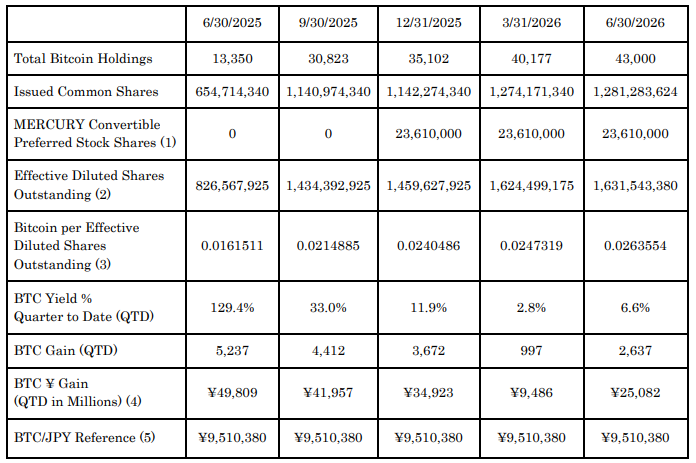
Metaplanet hit the 43,000 BTC milestone on July 2. The Tokyo-based firm now ranks as the world’s third-largest corporate Bitcoin treasury, trailing only Strategy and Twenty One Capital across the entire global corporate holder ranking.
The move cements Japan’s rising role in the corporate Bitcoin accumulation race.
What the Metaplanet 43,000 BTC Milestone Means
A corporate Bitcoin treasury is a company that holds Bitcoin as a strategic reserve asset on its balance sheet. Metaplanet added 2,823 BTC during the second quarter of 2026. Furthermore, the purchase brought total holdings to exactly 43,000 BTC as of July 2.
The average acquisition price landed at roughly 12.71 million yen (~$80,000) per Bitcoin. Moreover, the effective purchase price dropped to around 12.09 million yen (~$77,000) thanks to income from its Bitcoin Generation business. That segment generated $10.95 million in Q2 revenue.
Follow us on X to get the latest news as it happens.
The scale is now considerable. Metaplanet’s total Bitcoin investment stands at approximately 659.25 billion yen (~$4.2 billion). Furthermore, the holdings were valued at roughly 409 billion yen (~2.6 billion) as of June 30. The overall average cost basis sits at 15.33 million yen (~102,500) per BTC.
The BTC Yield metric confirms the momentum. Metaplanet reported a strong Bitcoin yield of 6.6% during the quarter. As a result, the firm continues to grow its Bitcoin per share metric, one of the key performance indicators for corporate treasury strategies of this type globally.

Metaplanet Ranks Third Behind MicroStrategy and Twenty One Capital
The corporate Bitcoin leaderboard is now clear. Strategy (formerly MicroStrategy) leads with holdings exceeding 847,000 BTC. Furthermore, Twenty One Capital holds the second spot. Metaplanet now ranks third globally, surpassing other major players, including MARA Holdings.
“Congrats to Metaplanet on reaching ₿43,000 and becoming the #3 corporate Bitcoin treasury in the world,” Michael Saylor wrote on X. He added that Metaplanet is proving the Bitcoin treasury strategy is now genuinely global.

The company has scaled rapidly since adopting the strategy in 2024. CEO Simon Gerovich has used equity offerings, debt instruments, and options strategies to accumulate BTC. Moreover, the approach helps minimize the shareholder dilution associated with these aggressive corporate purchases.
The balance sheet also remains strong. Total debt and preferred stock represent only about 23% of Bitcoin’s net asset value. As a result, Metaplanet has substantial room to continue accumulating. The move solidifies Japan’s role in the growing global race to adopt Bitcoin by corporations.
Subscribe to our YouTube channel to watch leaders and journalists provide expert insights.
The post Metaplanet Hits 43,000 BTC Milestone, Now the World’s 3rd Largest Corporate Holder appeared first on BeInCrypto.

West Country becomes fastest-growing investment market in UK as megadeals drive growth

Metaplanet (3350) buys another $170 million of bitcoin expanding treasury to 43,000 BTC

How Jerry Lewis Unleashed The Largest Financial Crisis on Himself


-

 Fashion6 days ago
Weekend Open Thread: Staud – Corporette.com
-

 Politics6 days ago
The House | Manchesterism won’t survive the painful trade-offs unless it gets citizens on board
-

 Crypto World2 days ago
Strategy authorizes up to $1.25B in Bitcoin sales under new capital plan
-

 Politics6 days ago
Potential 2028er World Cup attendee leaderboard
-

 Business6 days ago
Asia stock markets slide as tech shares slump
-

 News Videos4 days ago
MAJOR BITCOIN & MARKET UPDATE!!!! (MUST WATCH ASAP!!!)
-

 Tech7 days ago
A Look At A Gaggle Of Transputer Boards
-
 Crypto World7 days ago
Dell (DELL) Shares Tumble Over 5% Following Analyst Downgrade to Hold
-

 Crypto World5 days ago
Coinbase, Circle Deepen Crypto Stock Losses Despite Resilient S&P 500
-

 Business2 days ago
Australia treasurer says alleged access of prime minister’s bank data ’incredibly concerning’
-

 Crypto World5 days ago
Kraken's xStocks Opens Bending Spoons IPO Registration to EEA Retail
-

 Sports6 days ago
FIH Pro League: India defeat Pakistan 7-1, register biggest win of campaign | Other Sports News
-

 Crypto World6 days ago
Bitcoin Sparks $600M Hourly Liquidations With $65,000 Set To Become Resistance
-

 Tech2 days ago
Anonymous researcher drops 0-day ‘exploitarium’ repo
-

 Tech4 days ago
Bluekit phishing kit adopts browser-in-the-middle for login theft
-

 Tech5 days ago
Russian hackers now target Signal backup recovery keys
-
Crypto World6 days ago
Hyperliquid Named on Singapore MAS Investor Alert Register
-

 Crypto World6 days ago
RTX holders must register wallets before token distribution begins
-

 Sports22 hours ago
Broncos roster: OL Ben Powers (No. 74) entering final year of contract
-
 Business3 days ago
The AI boom won’t burst all at once. It will pop in ‘rolling bubbles’: Macquarie
You must be logged in to post a comment Login