

Crypto World
Russia Completes Final Readings on Crypto Regulation Bill

Cointelegraph is committed to providing independent, high-quality journalism across the crypto, blockchain, AI, and fintech industries.
All news, reviews, and analyses are produced with full journalistic independence and integrity. For more details on our standards and processes, please read our Editorial Policy.

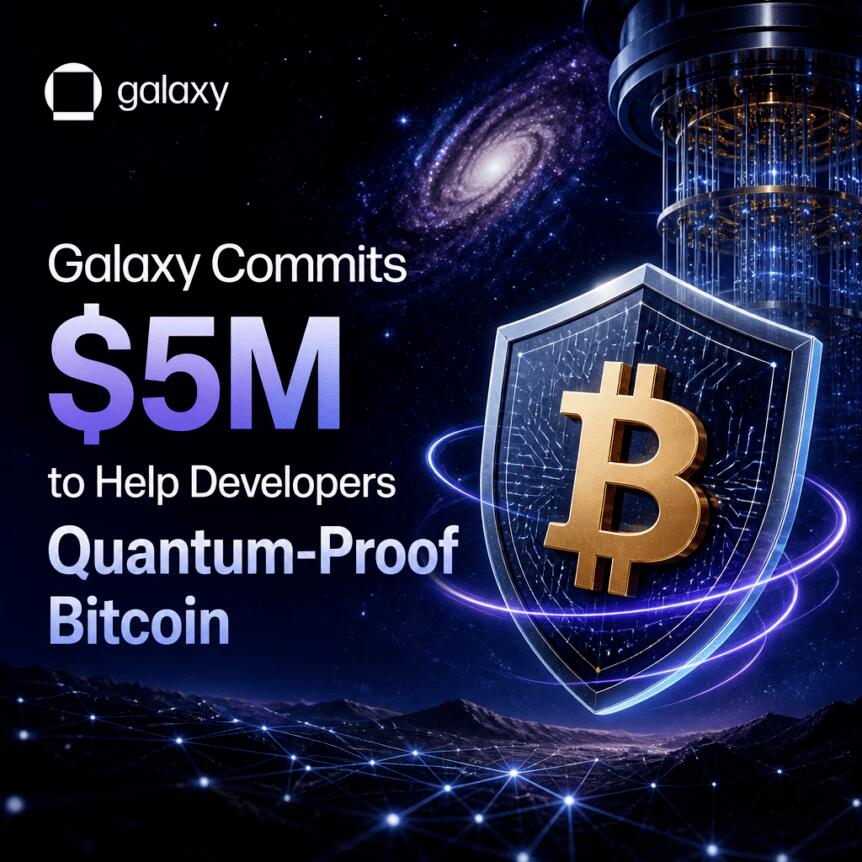
Galaxy Digital has launched a new push to accelerate post-quantum security work for Bitcoin, pledging up to $5 million in grants for open-source developers. The initiative is designed to support research and engineering across quantum-resistant upgrades, including cryptography research, migration tooling, and formal security reviews.
Alongside the funding, the company announced the formation of a quantum advisory council as part of its Bitcoin Quantum Readiness Initiative. Galaxy said Tuesday that the council will bring together researchers with backgrounds spanning cryptography, applied security, and academic computing—an attempt to turn abstract “quantum risk” discussions into concrete development roadmaps.
Key takeaways
- Galaxy Digital is offering up to $5 million in open-source grants aimed at post-quantum cryptography work for Bitcoin-related systems.
- The grant scope covers more than algorithms, including Bitcoin signature schemes, wallet/custodian migration tools, and security audits.
- A new quantum advisory council under the Bitcoin Quantum Readiness Initiative includes researchers from the University of Calgary, MIT, and Boston University.
- Market debate over timelines remains unsettled, with some executives arguing there’s decades before a meaningful threat while other research emphasizes preparation windows.
- Existing standards momentum matters because NIST has already published post-quantum encryption standards that could inform future Bitcoin migrations.
What Galaxy Digital is funding
Galaxy’s announcement ties its grant program to practical components of a potential Bitcoin post-quantum transition. According to the company’s statement, the funding will support “quantum-resistant upgrade proposals” and post-quantum cryptography research, with additional emphasis on Bitcoin signature schemes.
The proposal also explicitly targets the implementation layer that many teams often treat as an afterthought: wallet and custodian migration tooling. That matters because even when a cryptographic replacement is theoretically possible, moving users, keys, and custody infrastructure to new standards typically requires careful engineering, operational planning, and risk-managed rollouts.
Galaxy also said the grants include support for formal security audits—an area that can be decisive for institutional adoption, especially when new cryptographic constructions may be unfamiliar to auditors or deployed systems.
Who is on Galaxy’s quantum advisory council
Galaxy Digital’s Quantum Readiness Initiative adds an advisory layer through a council that includes Barry Sanders, professor and scientific director of Quantum City at the University of Calgary; Damien Bérubé, an MIT Sea Grant Knauss fellow; and Eran Tromer, professor of computer science at Boston University.
While advisory councils don’t directly change Bitcoin protocol code, they can influence which research paths are prioritized, how proposals are evaluated, and what “readiness” criteria developers should meet. For builders, that can reduce uncertainty by clarifying the kinds of cryptographic schemes and migration methods most likely to survive scrutiny.
Galaxy’s earlier announcement of the Bitcoin Quantum Readiness Initiative provides the broader context for this step: the new grants and council are positioned as ways to convert readiness planning into deliverables that can be used by open-source contributors.
https://www.galaxy.com/newsroom/galaxy-launches-bitcoin-quantum-readiness-initiative
How much Bitcoin could be exposed?
Concerns about quantum risk have sharpened around how future quantum computers could affect cryptographic systems currently used to secure Bitcoin. Analytics provider Glassnode has argued that a sizable portion of Bitcoin’s supply could be exposed if “cryptographically relevant” quantum computers emerge.
As reported by Glassnode via a Cointelegraph-linked analysis, around 30% of Bitcoin’s supply could be at risk. Glassnode’s breakdown further distinguishes between coins it considers “structurally unsafe” (about 10% of supply due to output type) and “operationally unsafe” (about 20% of supply tied to key or address management practices).
That split matters for investors and developers because it suggests two different problem categories. “Structural” concerns relate to the cryptographic assumptions embedded at the protocol or script level, while “operational” concerns point to practices that exchanges, custodians, and wallet operators can potentially adjust faster than they can rewrite protocol fundamentals.
The timeline fight: “decades” vs “years”
Perhaps the biggest unresolved question behind any post-quantum plan is timing. The community’s debate remains active, with different researchers and executives placing drastically different weights on when quantum capabilities could become dangerous to today’s signature schemes and related cryptographic assumptions.
Blockstream CEO Adam Back argued in November 2025 that Bitcoin faces no “meaningful quantum threat” for at least the next 20 to 40 years. He framed this as sufficient runway for adoption of post-quantum cryptography standards approved by the US National Institute of Standards and Technology (NIST).
At the same time, other research emphasizes a shorter preparation horizon. NIST released its first set of finalized post-quantum encryption standards for key establishment and digital signatures in August 2024, including algorithms that could support future migrations across industries and potentially Bitcoin-related upgrades.
NIST’s standardization is important to the debate because it reduces the “unknown unknowns” around what algorithms might be considered credible at the cryptographic policy level.
Beyond general standards, practical migration proposals are already circulating. In December 2025, Blockstream Research published a paper proposing a hash-based signature scheme as a “promising path for securing Bitcoin in a post-quantum world.” The proposal, as described in coverage, targets replacing Bitcoin’s ECDSA and Schnorr signatures with a scheme designed so that security relies solely on cryptographic hash functions.
And while Back’s long timeline suggests extensive lead time, Bernstein has argued for a shorter window: in an April report referenced in coverage, Bernstein suggested Bitcoin “has about three to five years to prepare” for a post-quantum security upgrade.
Why this matters now even if the threat is distant
Even if quantum breakthroughs are decades away—as some industry leaders expect—the hard part is rarely the cryptography alone. It’s the migration: coordinating changes across wallets, custodians, infrastructure providers, developer ecosystems, and the security processes that institutions use to deploy and maintain cryptographic systems.
Galaxy’s grant design reflects that reality. By funding not only quantum-resistant proposals but also wallet and custodian migration tooling and formal audits, the program acknowledges that “readiness” is an engineering and operational challenge, not just a theoretical one.
For Bitcoin holders, the near-term takeaway is less about expecting immediate protocol changes and more about watching whether the community converges on migration paths that can be implemented safely and iteratively—without forcing rushed transitions if timelines shift.
Readers should watch how Galaxy’s grants translate into concrete open-source deliverables—especially any proposals that connect signature-layer changes to realistic wallet and custody migration plans—and whether ongoing research narrows the gap between long-range quantum timelines and shorter “prepare now” arguments.
Dinari, an issuer of tokenized U.S. equities, and tZERO Group, a blockchain-based financial infrastructure provider, said Wednesday they are partnering to build an operating framework that would let broker-dealers offer tokenized U.S. stocks. The companies described the effort as a "strategic… Read the full story at The Defiant
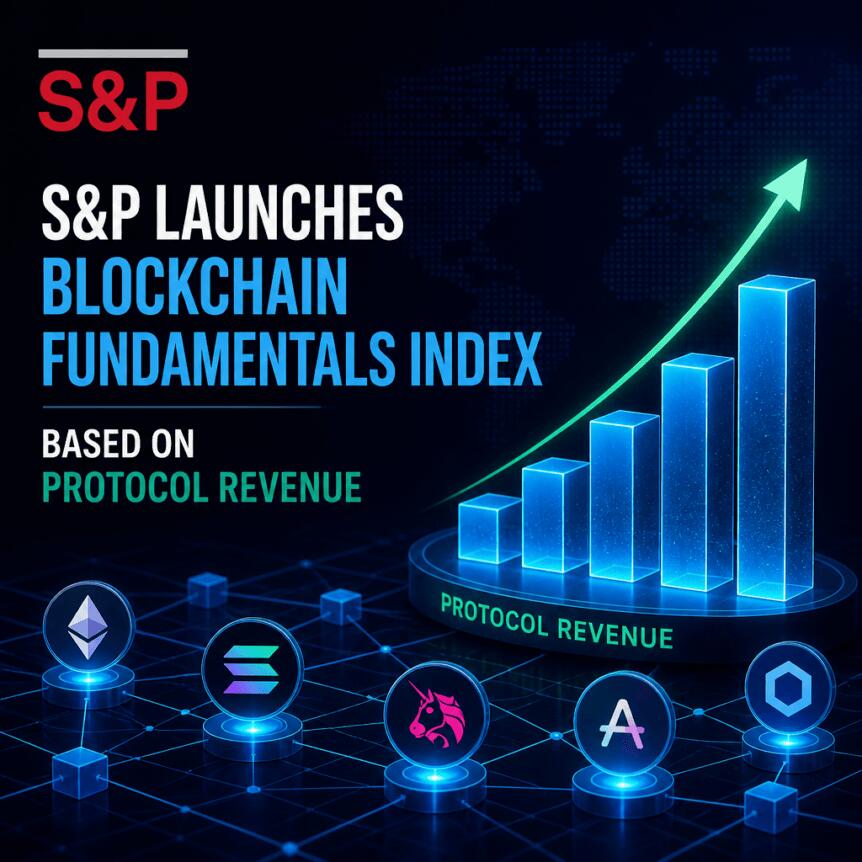
S&P Dow Jones Indices and Pantera Capital have launched a new rules-based digital asset index designed to evaluate blockchain networks and protocols using protocol revenue rather than token prices or pure market capitalization. The move signals a continued shift toward “productive activity” metrics as institutional players look for benchmarks that better reflect real-world usage.
In an announcement on July 21, the firms said the index is intended for institutional allocation and could be used as the basis for investment products or as a reference portfolio for actively managed strategies. The methodology also aims to help investors distinguish established on-chain business activity from more speculative exposure.
Key takeaways
- Protocol revenue is central: networks are selected and ranked based on aggregate protocol revenue over the prior two quarters.
- Liquidity and size gates apply: eligibility requires minimum thresholds for protocol revenue, market capitalization, and liquidity.
- Concentration is controlled: the largest holding is capped at 35%, while most other constituents are capped at 20%.
- Quarterly rebalancing: the index is recalculated and rebalanced on a quarterly schedule.
- Bitcoin and XRP are not included at launch: per S&P’s methodology discussion, BTC and XRP are the largest non-constituents versus the S&P Cryptocurrency Broad Digital Asset Index.
A revenue-based benchmark for “productive” blockchain activity
Traditional crypto benchmarks often track assets using market capitalization or token price movements. By contrast, S&P and Pantera’s index focuses on protocol revenue to measure how much economic value is being generated by the networks and the applications built on them. The firms draw from the S&P Cryptocurrency Broad Digital Asset Index, but filter the eligible universe using minimum thresholds for protocol revenue, market capitalization, and liquidity.
After networks pass the eligibility requirements, they are ranked by aggregate protocol revenue across the previous two quarters. Weighting then uses adjusted market capitalization, subject to portfolio construction rules. According to S&P, the framework is designed to emphasize established blockchain activity and reduce reliance on exposure that may be driven mainly by speculation.
This distinction matters for investors because protocol revenue is intended to function as a proxy for sustained usage and monetization, whereas market cap and token price can reflect expectations and sentiment even when on-chain monetization is weaker. The index’s quarterly rebalancing also means the benchmark can respond to changes in protocol performance over time, rather than remaining tied to a static basket.
Initial constituents and what’s different versus a broad benchmark
The index launched with 18 constituents. In S&P Dow Jones Indices’ Indexology blog post, the five largest holdings at launch were Ether (ETH), BNB (BNB), Solana (SOL), TRON (TRX), and Hyperliquid (HYPE).
The blog post also highlights a key selection contrast: Bitcoin (BTC) and XRP (XRP) were identified as the largest non-constituents compared with the S&P Cryptocurrency Broad Digital Asset Index. That outcome is consistent with a methodology that prioritizes protocol revenue-based eligibility and ranking. In other words, assets can be large by market cap yet still fail to become constituents if they do not meet the index’s revenue criteria as defined under the benchmark rules.
For allocators, this is one of the index’s most practically important implications. A revenue-driven selection mechanism changes not only what investors own, but also what risks the benchmark is implicitly targeting—shifting away from pure token beta toward networks whose protocol economics are feeding the index construction process.
Why institutions are pushing beyond market-cap indexes
The launch comes as the broader industry continues to develop institutional-grade crypto benchmarks. These efforts are unfolding alongside traditional finance firms expanding crypto capabilities and the growing adoption of tokenized assets, which increases demand for standardized measurement frameworks.
In the US, ETF and index activity has accelerated. Hashdex launched the Nasdaq Crypto Index US ETF on Feb. 14, 2025, which was described as the first multi-asset spot crypto exchange-traded fund in the United States. Franklin Templeton followed six days later with the Franklin Crypto Index ETF, tracking Bitcoin and Ether through the US CF Institutional Digital Asset Index, which is market capitalization-weighted.
Other benchmark approaches have also emerged. In April, MarketVector Indexes and Coinbase Asset Management launched the Coinbase Store of Value Index, which combines Bitcoin with tokenized gold using an inverse-volatility weighting model—an example of how benchmark design can shift exposure toward different portfolio goals.
Market participants have argued that as crypto ecosystems evolve, diversification across networks and strategies may become more operationally attractive. Earlier coverage referenced Bitwise chief investment officer Matt Hougan stating that crypto index funds are expected to be a major theme in 2026 as investor needs grow and the market becomes more complex. The core rationale, as described, is that it is increasingly difficult to predict which blockchain networks will prove durable winners, making diversified index solutions a pragmatic way to obtain broad exposure.
S&P’s latest step in digital asset benchmark expansion
Beyond this new product, S&P Dow Jones Indices has been broadening its digital asset benchmark footprint. Last October, S&P introduced the S&P Digital Markets 50 Index, which combines 15 cryptocurrencies with 35 publicly traded companies tied to the crypto ecosystem. That earlier index illustrates how S&P is experimenting with different ways to connect crypto exposure to both on-chain activity and publicly traded crypto-adjacent equities.
With the new protocol-revenue index, the emphasis is narrower and more specific: measure blockchain networks through the economics of their protocols. Investors watching for benchmark evolution should pay attention to whether revenue-based methodologies gain traction in index-tracked products, and how issuers translate those rules into investable strategies—particularly in terms of transparency around revenue estimation and how methodology changes affect index constituents over time.
Next, investors and portfolio managers will likely focus on how the benchmark performs as protocols’ monetization trends shift quarter to quarter, and whether the revenue-based framework attracts liquidity and product sponsorship comparable to traditional market-cap indexes.
Coinbase has opened SUI staking with a one-token minimum and estimated annual rewards of 1.4% to 3.3% as Sui tests resistance near $0.78.
Summary
- Coinbase has introduced SUI staking with estimated annual rewards of 1.4% to 3.3%.
- SUI is testing $0.78 resistance, with a confirmed breakout targeting roughly $0.91.
- Sui’s Hashi testnet lets over 25 partners test Bitcoin-backed financial applications.
Coinbase announced the rollout on July 22, giving eligible customers a way to stake SUI and collect rewards without moving their tokens away from the exchange. The company presented the service as a direct account feature, although access depends on the customer’s location.
You can now stake SUI – directly on Coinbase.
Instant rewards, accumulated straight to your account. Less time spent searching, and more time spent earning. pic.twitter.com/7PdKdUJ4MH
— Coinbase 🛡️ (@coinbase) July 22, 2026
“You can now stake SUI — directly on Coinbase,” the exchange wrote in its announcement, adding that rewards accumulate in customer accounts.
Eligible users can begin with as little as 1 SUI, according to Coinbase. Estimated returns range between 1.4% and 3.3% per year, but the exchange’s quoted rate may change because staking returns depend on network conditions and other factors.
Rather than following a weekly or monthly payment schedule, Coinbase will distribute SUI rewards after each 24-hour network epoch. The exchange will also add those rewards to the customer’s staked balance through automatic compounding, allowing later payouts to accrue on the updated amount.
Regional restrictions still apply to the product. Coinbase noted that staking is unavailable in some jurisdictions and described the published return range as an estimate rather than a guaranteed yield. The company also stated that its announcement did not constitute investment advice or a recommendation to buy or sell SUI.
Staking access adds a fresh SUI catalyst
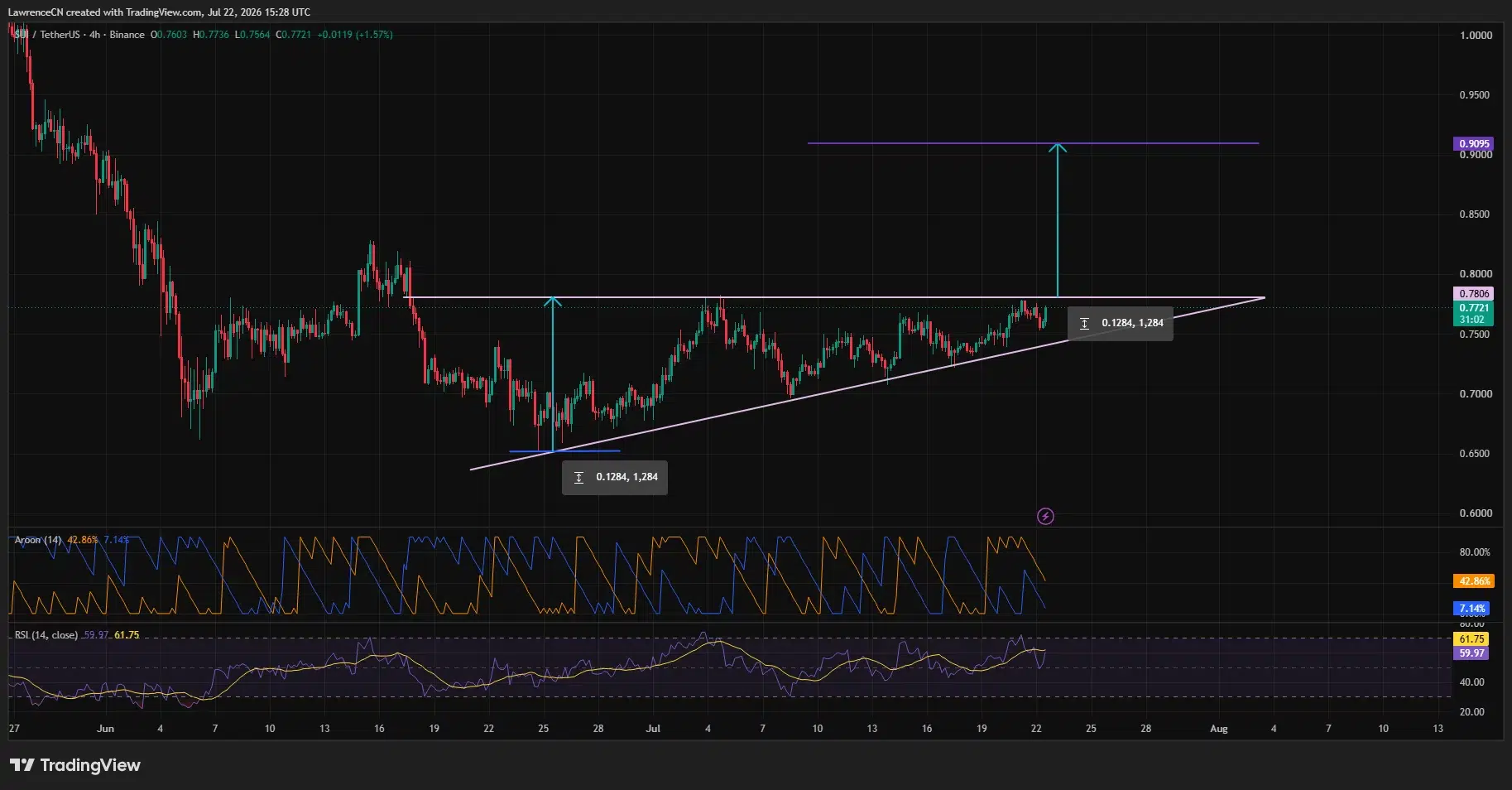
SUI traded near $0.772 on Binance when the supplied TradingView charts were captured on July 22, placing the token just below a resistance area that has rejected several advances since June.
On the 4-hour chart, SUI has formed a series of higher lows against horizontal resistance near $0.7806. This structure resembles an ascending triangle, with its rising trendline extending from the late-June low near $0.65 toward the current price.
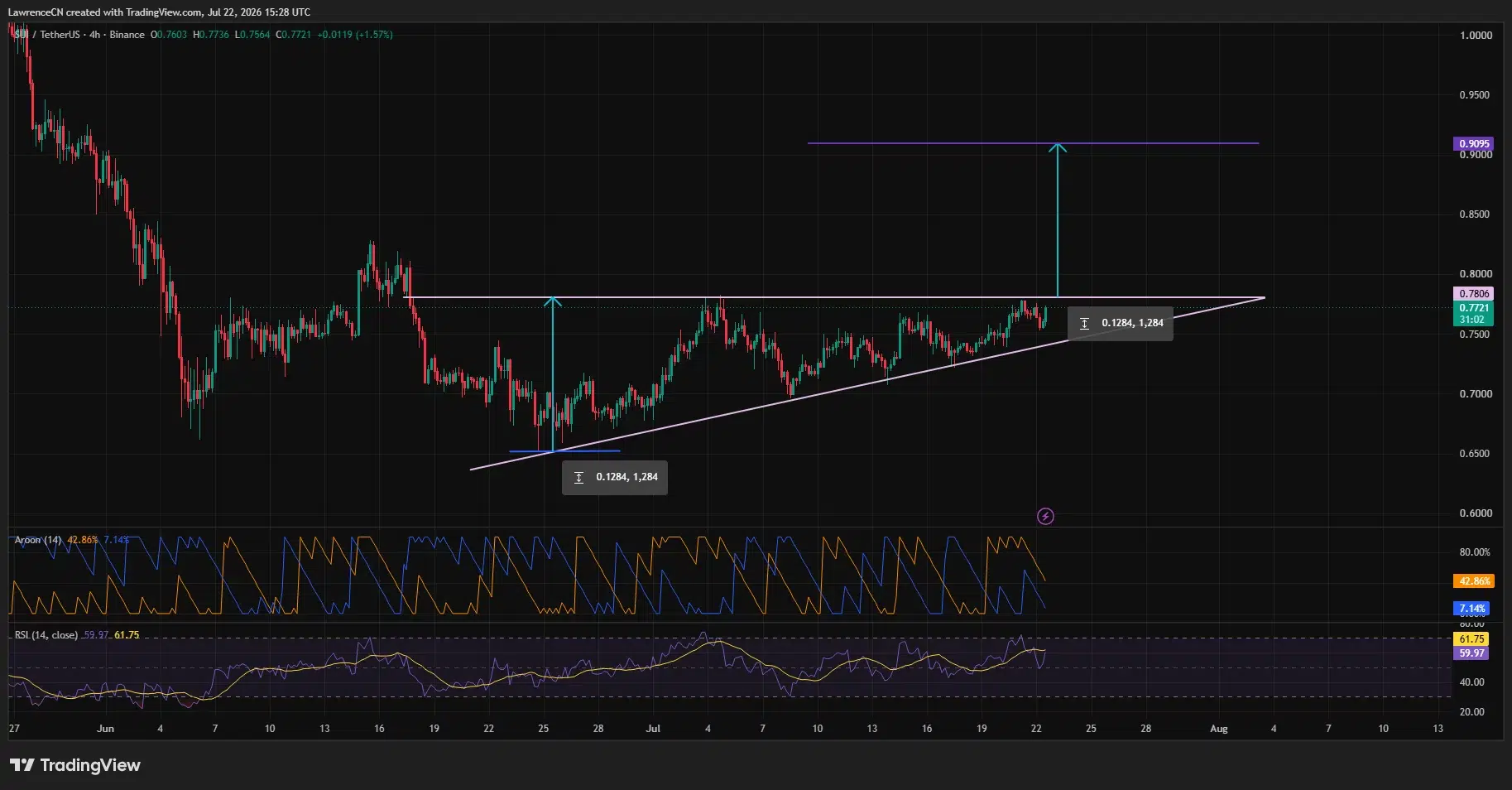
A 4-hour close above $0.7806 would confirm the breakout only if buying activity follows, according to the chart structure. The pattern’s measured move points toward approximately $0.9095, representing a potential increase of about 16.7% from the breakout line rather than a guaranteed target.
Momentum readings offer mixed but generally constructive signals. The 4-hour relative strength index stood at 59.97, below its signal average of 61.75 and well short of the usual overbought threshold at 70. SUI therefore retains room to advance, although the slight RSI slowdown shows that buyers have not yet secured the breakout.
The Aroon indicator provided a more cautious reading, with Aroon Down at 42.86% and Aroon Up at 7.14%. Under that indicator, the higher downside reading suggests that recent upward momentum has weakened even as price continues to hold its rising support line.
Daily indicators present a firmer accumulation picture. The supplied chart shows the MACD line at 0.0063, above the signal line at 0.0040, while the positive histogram was beginning to expand. Chaikin Money Flow stood at 0.10, indicating that buying pressure exceeded selling pressure during the measured period.
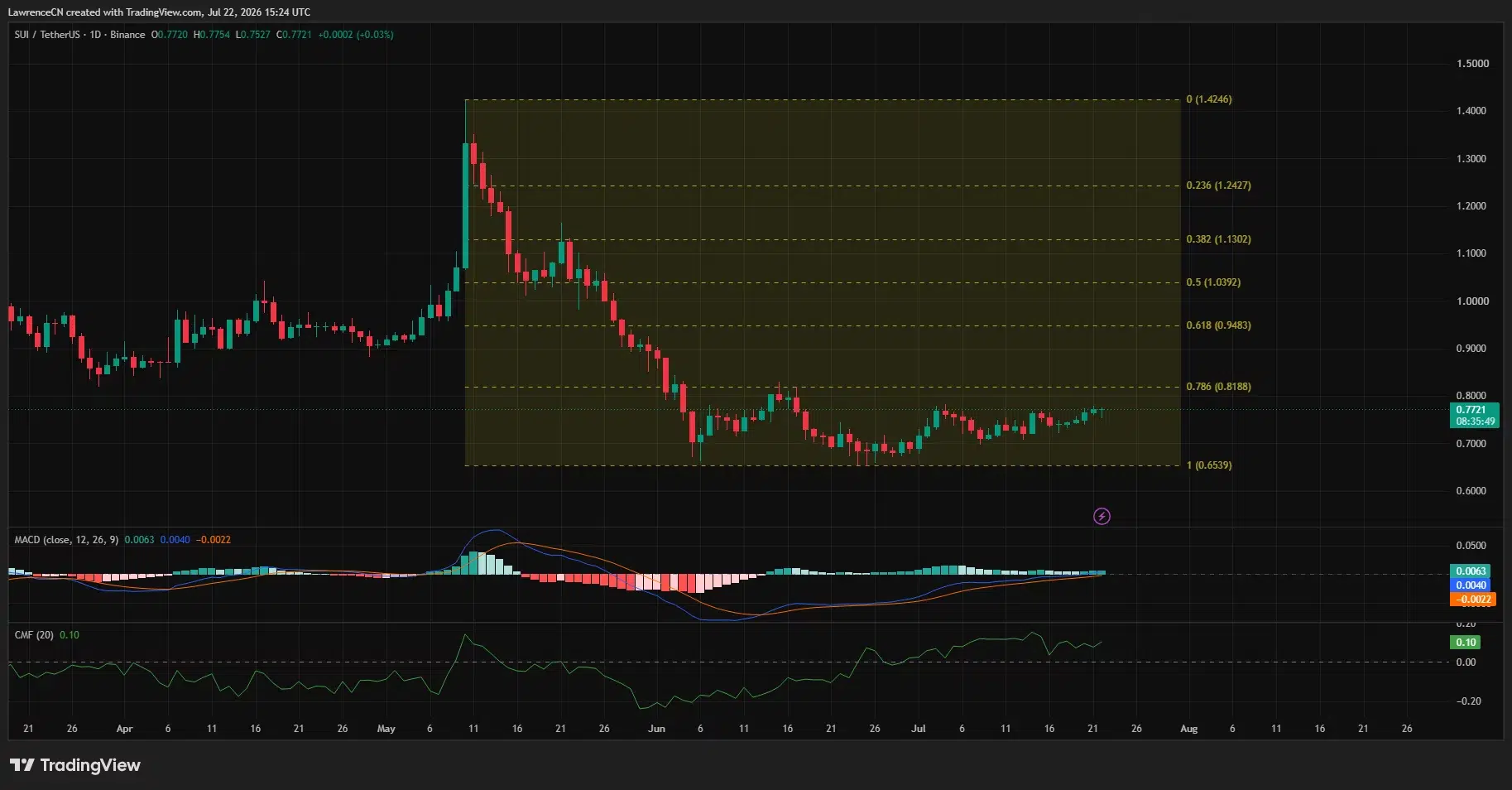
SUI must first clear $0.8188, the 78.6% Fibonacci retracement of its decline from $1.4246 to $0.6539, before the daily chart can support a larger recovery. Above that barrier, the displayed Fibonacci levels place the next resistance zones at $0.9483 and $1.0392.
Failure to break the $0.78–$0.82 area would keep SUI inside its current consolidation. Based on the charts, the rising 4-hour trendline provides initial dynamic support near $0.74, while the daily swing low at $0.6539 remains the main downside level.
Hashi testnet expands Bitcoin activity on Sui
Arriving alongside the Coinbase rollout, Sui’s Hashi testnet has given developers, institutions, custodians and infrastructure providers a place to test Bitcoin-backed financial applications before a mainnet release. The Sui Foundation stated that more than 25 ecosystem partners had joined the testing phase.
Hashi combines Sui’s network with a security system known as the Guardian Layer, according to the foundation. The protocol is designed to give participants additional control over Bitcoin used as collateral while keeping transactions transparent and programmable onchain.
Through the testnet, participating firms can experiment with BTC-backed lending, credit products and yield strategies without deploying those services on the final network. The Sui Foundation also identified Wave Digital Assets as a launch partner involved in the institutional testing effort.
Coinbase’s staking release also arrived on the day the exchange and the U.S. Securities and Exchange Commission ended a long-running Freedom of Information Act dispute. As reported by crypto.news earlier today, the SEC agreed to pay Coinbase $150,000 as part of the settlement.
Coinbase shares did not follow the positive product news during the session. According to Yahoo Finance data, COIN fell 3.65% to $169.42 intraday, separating the stock’s performance from SUI’s attempt to break its short-term resistance.
Disclosure: This article does not represent investment advice. The content and materials featured on this page are for educational purposes only.


The UK Treasury has set Q1 2027 for its first tokenized sovereign bond transaction, but the project has remained dependent on finding a workable method to settle its cash leg on-chain.
Summary
- The UK plans to issue its first tokenized sovereign bond by Q1 2027.
- Missing on-chain cash infrastructure remains the main barrier to institutional settlement.
- Regulators are exploring stablecoins, tokenized deposits and central bank money for payments.
CoinDesk reported that the missing payment mechanism has held back institutional use of digital bonds for almost seven years, even as governments and financial firms have built platforms for issuing tokenized securities.
Known as the Digital Gilt Instrument, or DIGIT, the pilot will test whether distributed ledger technology can reduce costs and improve the operation of UK capital markets. HM Treasury first announced the project in 2024 before selecting HSBC’s Orion platform through a competitive process in February 2026.
According to a July 16 Treasury update, HSBC received Gate 2 approval under the Digital Securities Sandbox on July 13. The decision made HSBC the first sandbox participant cleared to provide live digital securities depository services.
The first DIGIT transaction will take place on HSBC Orion by the end of the first quarter of 2027, subject to the pilot meeting its remaining conditions. Chancellor Rachel Reeves also instructed the Treasury to prepare for possible additional issuances if the initial transaction succeeds.
HSBC’s platform had supported more than $3.5 billion of digital bond issuance across sovereign, central bank, corporate and financial institution markets as of February, the bank told Reuters. HM Treasury has separately appointed law firm Ashurst LLP to provide legal services for the pilot.
The government also plans to list the bond through the London Stock Exchange Group. Reuters reported that the UK wants to become the first major advanced economy to issue a digital sovereign bond, placing DIGIT ahead of similar work among other G7 members.
On-chain cash remains the missing market rail
Although the UK has selected an issuance platform, industry participants told CoinDesk that technical infrastructure alone cannot support a functioning tokenized debt market. Investors must also have a regulated way to exchange cash and securities on the same or connected digital networks.
Current options remain limited by the absence of common on-chain payment standards, established sterling stablecoins and final regulatory rules, according to CoinDesk. Without a dependable cash asset, institutions may still need to move money through conventional banking systems, reducing the settlement benefits offered by tokenized bonds.
Varun Paul, Fireblocks’ global business lead for central banks and financial market infrastructure, told CoinDesk that natively digital bonds could permit instant settlement and allow collateral to move between venues without delays tied to existing systems.
The Bank of England and Financial Conduct Authority have acknowledged the cash-settlement problem. In a joint paper on tokenization, the authorities committed to helping identify settlement options for DIGIT while considering whether the instrument could qualify as collateral in the Bank’s monetary operations.
Bank of England Governor Andrew Bailey also said the central bank would work to make the digital gilt eligible for use as collateral in its market operations, according to Reuters. The Bank plans to upgrade the securities and collateral system supporting those operations in 2027, which could eventually allow direct connections to tokenized asset ledgers.
For settlement in central bank money, the Bank has targeted 2028 for a synchronization service linking digital ledgers with sterling held through its real-time gross settlement system. Its May consultation said the service should allow the asset and payment sides of a transaction to settle at the same time.
Because that system is scheduled to arrive after DIGIT’s first transaction, private settlement assets could play an earlier role. The Bank and FCA said they were working to permit regulated sterling and foreign-currency stablecoins in the Digital Securities Sandbox alongside tokenized deposits.
DIGIT could draw new demand for UK debt
Despite recent changes in Britain’s political leadership, Paul expects the digital gilt program to retain sufficient institutional support from HM Treasury, the Bank of England and the FCA.
“I expect that there is sufficient momentum behind this,” Paul told CoinDesk, adding that the project could support demand for UK government debt.
The potential demand comes as the UK carries almost £3 trillion in outstanding public debt, according to Office for National Statistics figures cited by CoinDesk. Paul argued that placing sovereign debt on-chain would change how capital moves through financial markets rather than merely replacing existing back-office records.
Separate work by the Bank of England could also expand the payment options available to tokenized markets. During City Week 2026, Deputy Governor Sarah Breeden outlined a system in which traditional deposits, tokenized bank deposits, regulated stablecoins and a possible digital pound could operate together.
Breeden said distributed ledger technology could reduce costs, while smart contracts could automate conditional payments and post-trade processes such as collateral transfers and coupon payments. Under the Bank’s model, atomic settlement would allow money and securities to move simultaneously, limiting the risk that one side of a transaction completes without the other.
The Bank is also considering longer operating hours for its RTGS and CHAPS systems, including movement toward near-continuous settlement. Its joint paper with the FCA said extended hours would support digital asset ledgers that can operate around the clock.
While DIGIT’s first sale will test only one sovereign bond, the Treasury has already linked further issuance to the pilot’s success. Progress beyond that transaction will depend on whether regulators, banks and payment providers can connect tokenized securities with reliable sterling settlement before the Q1 2027 deadline.
Institutional crypto trading platform Talos has integrated with Kalshi, allowing select clients to trade the prediction market operator’s event contracts and crypto perpetuals through the same infrastructure they already use for digital assets, eliminating the need for a separate connection.
Talos will offer algorithmic order types including Iceberg, TWAP and POV, along with multi-leg execution for perp-to-perp and perp-to-spot spread trades. The company said institutional clients will also be able to execute block trades in Kalshi contracts through its request-for-quote platform using participating over-the-counter liquidity providers.
Later this year, Talos plans to extend its dealer software to brokers and trading platforms, allowing them to offer Kalshi event contracts directly to customers where permitted. The company also plans to launch a unified prediction market data feed that standardizes events, trades, order books, open interest and implied probabilities across venues.
The integration lowers the operational hurdles for hedge funds, market makers and other professional trading firms already using Talos to add regulated prediction markets alongside their existing crypto trading activity.
Related: Kalshi says CFTC, Michigan orders leave it in ‘impossible position’
Prediction markets hit record trading volumes
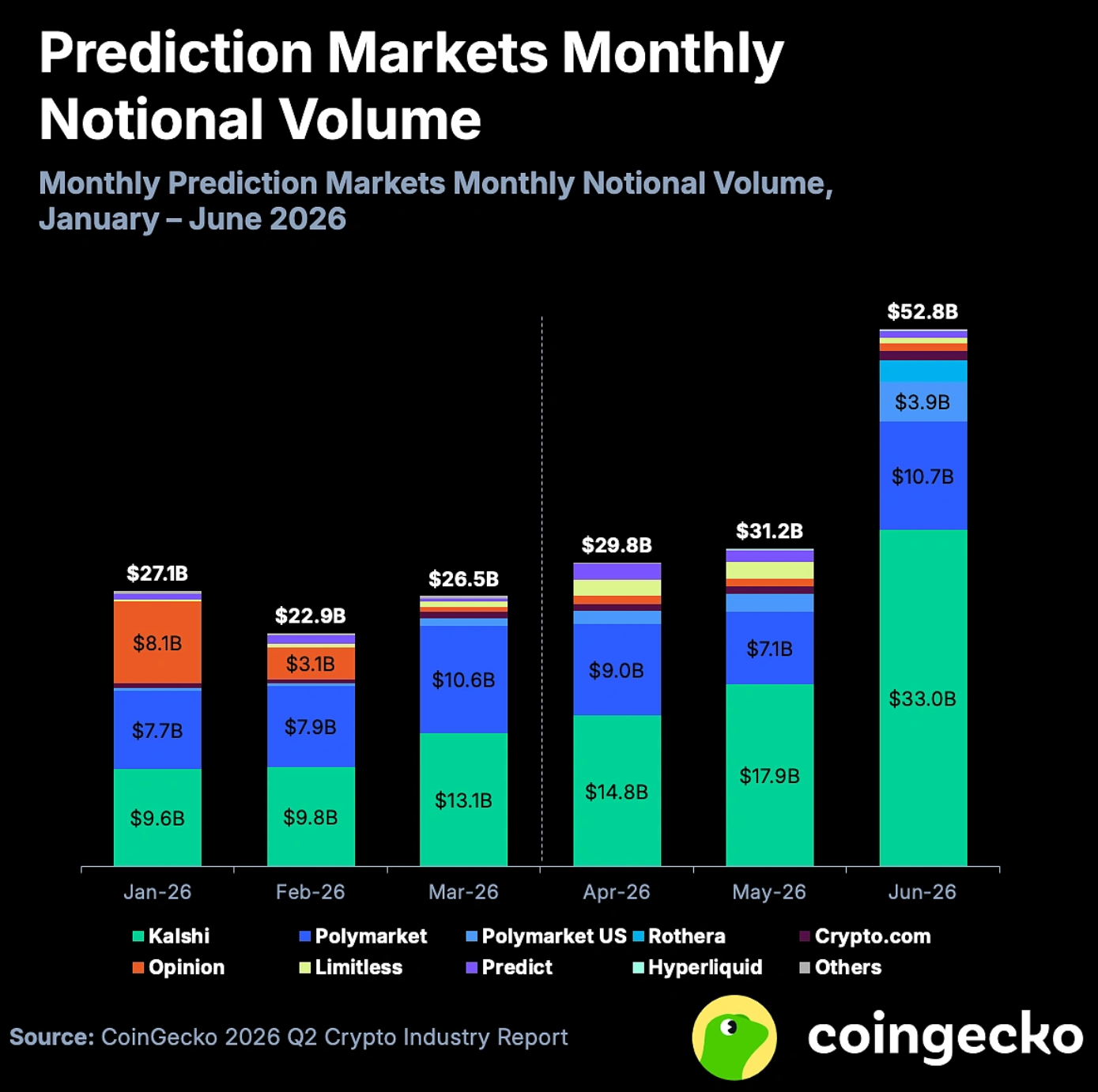
The Talos integration comes as prediction markets attract record trading activity and growing institutional interest. According to a report from CoinGecko, notional trading volume reached $113.8 billion in the second quarter, up 48.7% from the previous quarter, while June’s $52.8 billion in notional volume marked a new monthly record.
CoinGecko attributed the surge to a packed sports calendar, including the UEFA Champions League final, NBA Finals, Stanley Cup, FIFA World Cup and Wimbledon. On Polymarket, sports contracts accounted for 81% of June trading volume, up from 40% in January.
Kalshi expanded its lead among prediction market platforms, increasing its market share to 58.9% from 42.4% in the first quarter. Polymarket’s share fell to 30.2% from 35.8%, while Rothera, the Robinhood and Susquehanna International Group-backed venture launched in May, climbed to fourth place in June with $2.1 billion in notional trading volume.
Prediction markets monthly notional volume. Source: CoinGecko
Despite the rapid growth, prediction markets continue to face legal and regulatory headwinds. In the United States, Kalshi is battling several state regulators over whether its sports event contracts constitute illegal gambling, a dispute many legal observers believe could ultimately reach the US Supreme Court.
The industry is also facing growing scrutiny over potential insider trading. Earlier this year, six Polymarket traders reportedly made about $1 million by correctly betting on US military strikes against Iran before the attacks became public.
Last week, a White House teleprompter operator was placed on unpaid leave after allegedly making more than $100,000 betting on Kalshi markets tied to President Donald Trump’s speeches.
Magazine: Binance & OKX users face $1,900 fines in Vietnam, Coinbase in China? Asia Express


Artificial intelligence (AI) agents are the next “killer” use case for blockchain and cryptocurrency, according to investment management giant Franklin Templeton’s head of digital assets and innovation.
Sandy Kaul said in a X post on Wednesday that the AI agent economy will increase demand for blockchain protocols hosting machine-to-machine micropayments, as legacy card networks are unsuitable for agentic payments due to high fees and settlement times.
“To capture the AI growth opportunity today, most investors buy shares of AI-aligned companies and related verticals. But will the same playbook work for agentic AI,” Kaul said in the introduction to his more-than-1,800 word post.
He said blockchain networks such as Aptos, Solana and the BNB Chain are more suited for the agentic economy, as they settle transactions in seconds, faster than the one-to-three business-day settlement time of the Visa network.
In a joint report published last Wednesday, payments giant Visa and investment thesis platform Artemis argued that traditional cards built for low-frequency human commerce are insufficient for AI agents, which need infrastructure with near-zero fees and faster settlement to make agentic micropayments commercially viable.
Visa’s crypto division and Stripe-backed Tempo both launched AI tools in March. Visa’s allows AI agents to make same-day payments.
Some machine payment protocols are boasting signs of adoption. The x402 payment protocol developed by Coinbase processed $15 million in adjusted volume across over 109 million adjusted transactions since it was launched in May 2025, according to Visa and Artemis’ joint report.
Magazine: How South Korea is using AI to detect crypto market manipulation

The Head of Digital Assets and Innovation for a $2 trillion asset manager “just said to buy ETH,” commented former BlackRock VP and host of Milk Road Daily, John Gillen, on Tuesday. His statement came in response to a lengthy post on X from Franklin’s Sandy Kaul on the use cases for crypto in agentic AI payments.
Most investors buy shares of AI-aligned companies to capture the growth opportunity today, he said. US stock markets have boomed with the S&P 500 climbing 20% over the past year to an all-time high in early June, largely driven by tech and AI stocks.
However, the same playbook may not work for agentic AI, he said.
Ethereum is the AI Bet
AI agents can independently initiate, track, and fulfill transactions, and estimates suggest agentic commerce could reach $3 to $5 trillion by 2030.
Legacy payment rails with high fees and slow transaction times do not work for micropayments. Additionally, AI agents cannot open bank accounts or access financial services, which have rafts of strict KYC requirements.
Therefore, it is likely that AI agents will use decentralized blockchains to transact, and Ethereum and its layer-2 networks are the current industry standard with the largest developer base and institutional support.
“I believe what will become increasingly clear in coming years is that in order to capture the value of decentralized networks and businesses, investors will need to buy the cryptocurrencies and altcoins being issued by those entities.”
“Such investments are likely to become key holdings in portfolios, especially for those looking to capture the emerging agentic AI opportunity,” he added.
The Head of Digital Assets and Innovation for a ~$2T Asset Manager just said to buy $ETH
“I believe what will become increasingly clear in coming years is that in order to capture the value of decentralized networks and businesses, investors will need to buy the cryptocurrencies… https://t.co/KeaHLq7Aid
— John Gillen – WartimeEthereum.eth (@BitcoinJesusETH) July 21, 2026
In April, the IMF released a report stating that agentic AI will reshape payments and standards are already being developed.
“A growing set of industry actors, including payment networks, technology platforms such as Ethereum, and AI model providers, are in a race to experiment with these capabilities,” it said.
Crypto commentator Leo Lanza said on Tuesday that “everyone sees Ethereum as a tokenization bet,” adding:
“Almost nobody sees it as an AI bet. But AI agents will need financial rails to hold assets, settle payments, and transact with each other.”
ETH Price Nudges Higher
Ethereum prices hit a seven-week high of $1,945 on Tuesday, and it has largely held on to those gains into early trading on Wednesday.
The asset was changing hands for $1,930 at the time of writing, up 27% since its cycle low on June 26 and nudging ever closer to the psychological $2,000 barrier
The post Franklin Templeton Exec Calls Agentic AI Crypto’s ‘Killer Use Case’ as ETH Nears $2K appeared first on CryptoPotato.


Paradigm, a crypto-focused venture capital firm co-founded by Matt Huang, said Wednesday it raised $1.2 billion for its fourth fund to invest across crypto, artificial intelligence and robotics. Huang announced the raise in a post on his official X account, writing the new vehicle will fund… Read the full story at The Defiant
Digital asset infrastructure provider BitGo and OTC Markets Group, the operator of regulated over-the-counter securities markets, plan to partner on digital asset trading and custody infrastructure for broker-dealers, a move that could expand institutional access to tokenized securities through existing market infrastructure.
The companies said Wednesday that the proposed alliance will serve more than 150 broker-dealers using OTC Link ATS, an alternative trading system regulated by the US Securities and Exchange Commission. If implemented, participating broker-dealers would be able to quote, trade and settle digital asset securities using the same electronic trading infrastructure they currently use for over-the-counter and US equity markets.
Under the proposal, BitGo Bank & Trust would act as the qualified custodian, while settlement would be facilitated through BitGo’s Go Network. The proposed framework is initially intended to support digital asset securities, with the potential to expand to tokenized assets and commodities as regulatory frameworks evolve.
The announcement comes as traditional financial institutions increasingly explore tokenized versions of real-world assets, while US regulators have moved toward establishing clearer rules for digital asset markets.
In December, BitGo received final approval from the US Office of the Comptroller of the Currency to operate as a federally chartered national trust bank, allowing it to provide qualified custody services under federal banking oversight.
Investors lifted OTC Markets Group’s stock price roughly 2.7% by midday on Wednesday, to $53.50 a share on thin volume.
Related: SoFi taps BitGo to provide infrastructure for bank-issued stablecoin
Why broker-dealers matter for tokenization
Broker-dealers could play a major role in the transition to tokenized securities because they already operate within established regulatory and market frameworks. By integrating digital asset trading and custody into existing infrastructure, the BitGo-OTC Markets alliance could reduce operational barriers for broker-dealers looking to offer tokenized securities without requiring them to adopt entirely new crypto-native systems.
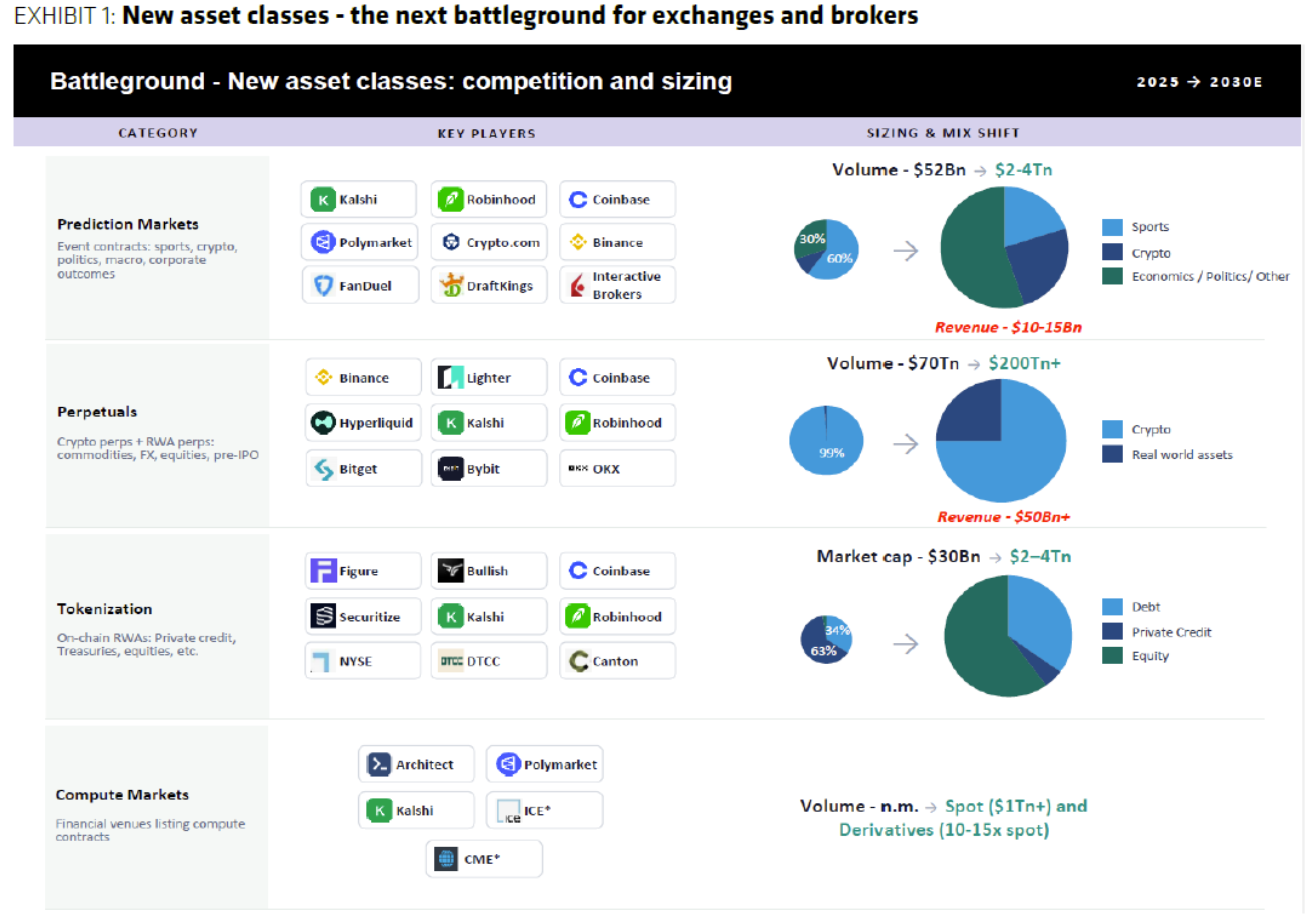
The proposed alliance comes as the market for tokenized securities continues to expand. Analysts at Bernstein have projected that the value of tokenized real-world assets could reach up to $4 trillion by 2030, driven by broader adoption across equities, commodities, and other financial assets.
The announcement also follows similar efforts by companies including Securitize and Cantor Fitzgerald to bring tokenization to capital markets, including initial public offerings and follow-on equity offerings.
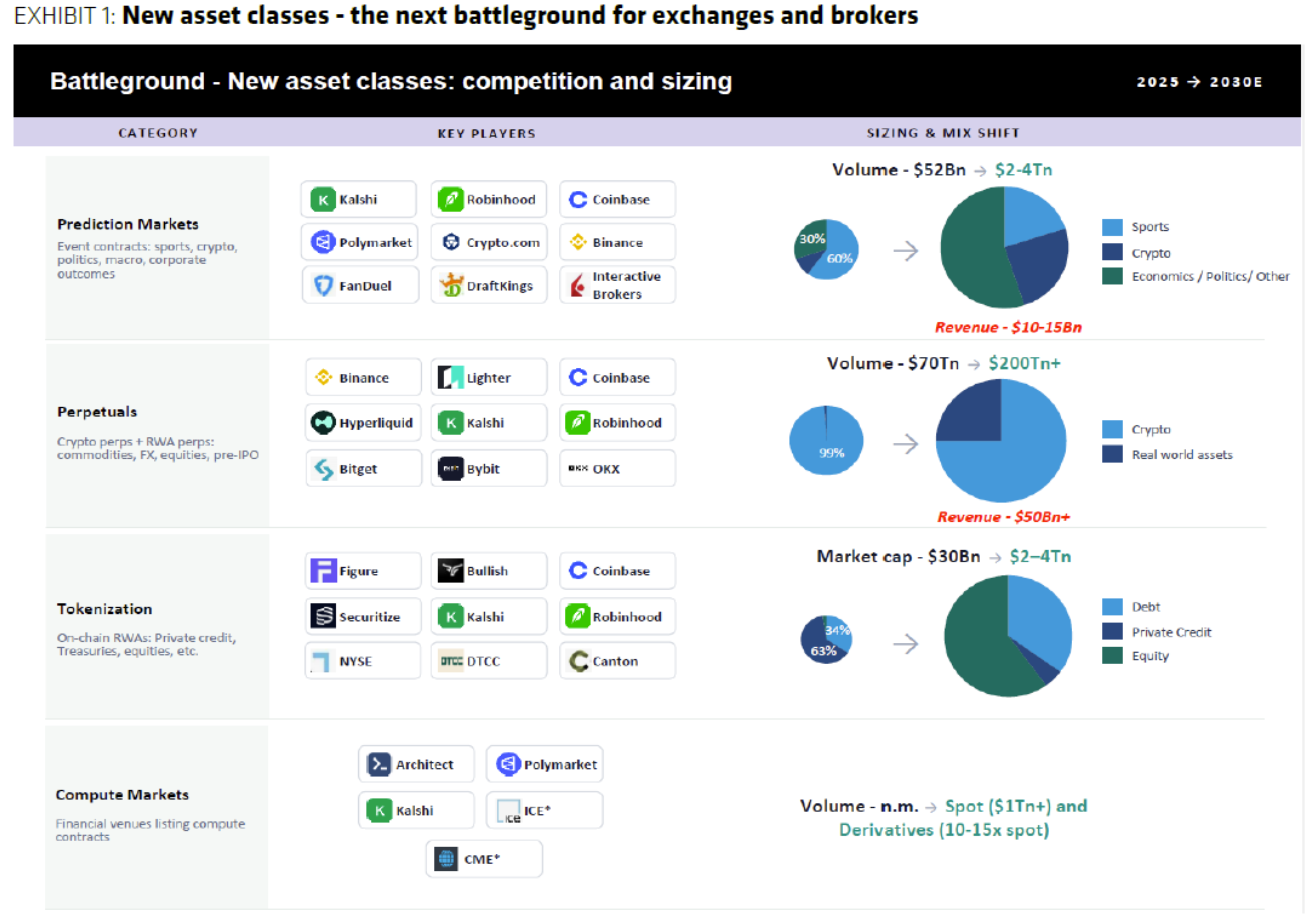
Bernstein analysts identified tokenization and prediction markets as the next assets “battleground” for exchanges and brokers. Source: Bernstein
Related: Tradable’s $1B Stellar deal adds to institutional tokenization boom

Cambridgeshire star unrecognisable in Hollywood movie worlds away from EastEnders

Wall St dips as Big Tech earnings, rising oil in focus

Galaxy Commits $5M to Help Developers Quantum-Proof Bitcoin


-
 NewsBeat6 days ago
London Mayor Sadiq Khan handed a peerage by Keir Starmer alongside 15 other Labour figures… just days before the PM leaves No10
-

 Fashion5 days ago
Weekend Open Thread – Corporette.com
-

 Politics5 days ago
The House | The City of London can help the new chancellor deliver growth in every postcode
-
 Crypto World6 days ago
Two July Windows Left: The CLARITY Act’s Senate Fight and What Failure Means
-

 Crypto World5 days ago
Ripple Payments Joins MiCA With 14 Firms, Does It Mean Anything For XRP?
-

 Business7 days ago
Nvidia Stock Slips After Big Tuesday Rally as Huang Confirms Vera Rubin Chip Is Now in Production Today
-

 Politics3 days ago
Democrats look to World Cup watch parties to register thousands of voters
-

 Crypto World5 days ago
Ripple wins EU-wide access as ESMA adds it to MiCA register
-

 Crypto World2 days ago
Grayscale Files For Worldcoin ETF, WLD Registers Sharp Rise
-

 NewsBeat3 days ago
Unregistered fitter used Gas Safe logo on business flyers
-

 Tech2 days ago
Sail Virtually Aboard The “Itanic” With IA-64 Emulator
-

 Crypto World6 days ago
Injective Submits SEC Transfer-Agent Registration to Onchain Ownership Records
-

 Business7 days ago
Palantir Shares Rise After Expanded Nvidia Partnership and Fresh Analyst Upgrades Ahead of Earnings Day
-
 Tech2 days ago
Turtle Beach Command Series KB7 review: a nifty screen-equipped gaming keyboard
-

 NewsBeat6 days ago
Registration is now open for March for Men with Kev 2026
-
 Business21 hours ago
New Jersey voter registration controversy explained: How 6,600 noncitizens got on the rolls, and what happens next
-
 Crypto World6 days ago
Claude Fable 5 Slips to Second in AI Coding Leaderboard
-

 News Videos6 days ago
Money | Class 12 Economics | CBSE Board Exam 2026-27
-

 Business6 days ago
Banco Bilbao Vizcaya Argentaria, S.A. (BBVA) Discusses Global Macro Environment and Economic Outlook for Core Markets Transcript
-

 Crypto World5 days ago
Kaspersky exposes OkoBot’s 20-module crypto wallet attack
You must be logged in to post a comment Login