
Crypto World
Russian telecom giants prepare to accept digital ruble payments from Sept. 1



Russia’s MTS, Rostelecom and MegaFon have prepared to accept digital ruble payments from Sept. 1 as Russia begins the first mandatory stage of its nationwide central bank digital currency rollout.
Summary
- MTS, Rostelecom and MegaFon are preparing to accept digital ruble payments from Sept. 1.
- MTS will support the CBDC across services integrated with MTS Pay, while Rostelecom will initially offer one time website payments.
- Russia’s Sept. 1 rollout will also require eligible large merchants and major banks to support digital ruble transactions.
- Wildberries and Ozon are also preparing to accept digital ruble payments from the same date.
Vedomosti reported that the three major telecommunications operators are preparing their payment systems for the launch, with MTS offering digital ruble transactions across services connected to MTS Pay while Rostelecom and MegaFon work on their own integrations.
MTS plans to make the payment option available without restricting it to particular products or services. Customers will initially be able to use digital rubles through the My MTS mobile app and the company’s online store, while other services using the MTS Pay payment module can also support the option.
For customers, the process will work much like Russia’s Faster Payments System. A user with a digital ruble account can select the digital ruble at checkout, choose a participating bank and approve the transaction through the bank’s interface, according to MTS.
The digital ruble account itself is held on the Bank of Russia’s platform, with commercial banks providing customers access through their apps. The central bank issues the CBDC and operates the underlying platform, while one digital ruble remains equal in value to one conventional ruble.
Rostelecom will begin digital ruble payments on its website
Rostelecom is completing technical work with what it described to Vedomosti as one of Russia’s largest banks, although the telecommunications company did not identify the lender.
At launch, customers will be able to use digital rubles for one-time payments made through Rostelecom’s official website. The operator plans to add the payment option to customer accounts later, extending the service beyond the first web-based implementation.
Regular payments and automatic account top-ups will take longer. Rostelecom said the functions will be introduced as the Bank of Russia’s digital ruble platform becomes technically capable of processing them.
MegaFon is also preparing to add the digital ruble as another payment option for its customers. VimpelCom, which operates under the Beeline brand, declined to comment on its plans, according to the report.
The telecom launches put some of Russia’s largest recurring-payment businesses among the first major companies moving onto the CBDC infrastructure. MTS alone plans to use its existing MTS Pay integration instead of building a separate payment route for each product, allowing the digital ruble option to work wherever the module has already been installed.
Digital ruble rollout puts large merchants on Sept. 1 deadline
The telecom preparations come days before a legal deadline that will require part of Russia’s largest retail and service sector to support digital ruble payments.
Under Bank of Russia rules, merchants with revenue above 120 million rubles in the previous calendar year must provide the payment option by Sept. 1 if they met the required banking conditions at the start of 2026, including having an electronic payment acceptance agreement with a bank recognized as significant in Russia’s payment-services market.
The requirement will expand in stages. From Sept. 1, 2027, businesses with annual revenue above 30 million rubles that meet the applicable banking requirements will come under the rollout. Another stage will follow in September 2028 for other merchants with revenue of at least 20 million rubles, while certain smaller outlets and locations without internet access are exempt.
As crypto.news previously reported on July 3, the first stage also requires Russia’s largest banks to provide customers access to digital ruble services from Sept. 1. Bank of Russia Governor Elvira Nabiullina said preparations for the scheduled rollout were ready at the time.
Russia has classified the digital ruble as a third form of its national currency alongside cash and existing non-cash rubles. Individuals will not be required to open a digital ruble account, and the Bank of Russia says accounts cannot be created automatically without the customer choosing to do so.
Access will be provided through participating banking apps. Russia’s 12 systemically important banks include major lenders such as Sberbank, VTB, T-Bank and Alfa-Bank, with customers expected to gain access to the CBDC platform through their existing banking interfaces.
Russia’s two largest online marketplaces have also prepared for the September launch. Wildberries and Ozon said they plan to begin supporting digital ruble payments from Sept. 1, adding some of the country’s largest e-commerce platforms to the first stage of commercial adoption.
Ozon has said it will initially accept the digital ruble in a testing mode alongside existing payment methods before expanding access to its customer base. Wildberries has said its implementation is being carried out in line with central bank requirements and current regulations.
Digital ruble payments will remain free for consumers
For individuals, transferring digital rubles to another person or paying a company carries no platform fee under the Bank of Russia’s tariff structure.
Businesses are also receiving a temporary fee exemption. The Bank of Russia has set a zero tariff for applicable business transactions through the end of 2026, while a 0.3% charge of up to 1,500 rubles per customer-to-business transfer is scheduled to apply from Jan. 1, 2027 for most commercial payments.
Customers can fund a digital ruble account by transferring regular non-cash rubles from their bank account. The Bank of Russia has set a limit of 300,000 rubles per month on the amount an individual can move from personal bank accounts into the digital ruble account.
The restriction applies to account funding, not to the total amount a user may ultimately hold after receiving digital rubles from other people or organizations, according to the central bank. Digital rubles can also be transferred back to a conventional bank account before being withdrawn as cash.
The payment rollout follows several years of testing. Russia began piloting the digital ruble with a limited group of banks and users in August 2023, gradually adding participants and transaction types before moving toward the 2026 commercial rollout.
Implementation has required substantial changes inside the banking sector. In October 2024, banks raised concerns that connecting to the CBDC platform could cost smaller institutions between 120 million and more than 200 million rubles because banks would need to update core systems, compliance software and other technology.
The phased timetable gives smaller financial institutions additional time to make those changes, while the largest banks enter first. The Bank of Russia has said universal-license banks will follow in September 2027, with banks holding basic licenses entering the system during the next stage in September 2028.
Russia is rolling out digital ruble alongside new crypto rules
The Sept. 1 CBDC expansion is arriving as Russia also changes the legal framework governing private cryptocurrencies, although the two systems remain legally separate.
On July 6, Sberbank disclosed plans to introduce a cryptocurrency wallet and digital asset depository after Russia’s new digital asset rules take effect. The lender also considered providing customers access to foreign crypto exchanges subject to final regulatory conditions.
Later in July, the Bank of Russia outlined operating rules for regulated cryptocurrency exchanges, digital asset depositories and digital currency accounts. The proposed regime includes registration requirements and capital rules for depositories while preserving restrictions on retail investor access.
Private cryptocurrencies and stablecoins remain prohibited as ordinary domestic payment instruments under Russia’s crypto framework, while approved uses can include regulated investment activity and certain cross-border transactions. The digital ruble, by comparison, is issued directly by the Bank of Russia and is being introduced as legal national currency for domestic payments.
From Sept. 1, merchants covered by the first-stage rules can begin accepting the CBDC by opening a digital ruble account through a participating credit institution and configuring their payment equipment. The Bank of Russia says payments can use a universal QR code, with funds credited to a merchant’s digital ruble account in real time.

The US dollar has resumed its decline following a corrective recovery, as the support behind the currency proved insufficient to sustain the rebound. Selling pressure increased as long-term US Treasury yields fell amid reports that the US Treasury was prepared to expand its bond-buyback operations. Larger buybacks support the government bond market and can contribute to lower yields, reducing the dollar’s interest-rate advantage and limiting its recovery.
At the same time, geopolitical tensions surrounding Iran continue to support demand for the US dollar as a safe-haven asset. So far, however, this factor has not been strong enough to generate a sustained appreciation in the currency.
Today, markets will focus on a fresh batch of US economic data. Revised second-quarter GDP figures, the core Personal Consumption Expenditures (PCE) price index, personal income and spending data, and durable goods orders are all due to be released.
According to forecasts, US GDP growth could be revised down from 2.1% to 1.5%, while the core PCE price index is expected to show annual growth of 3.3% and a monthly increase of 0.2%. A combination of slower economic growth and persistent inflationary pressure could complicate the Federal Reserve’s policy decisions, leaving policymakers to balance the risk of economic weakness against the need to keep inflation under control.
Markets will also be watching comments from Federal Reserve officials for clues about how policymakers are assessing current inflation risks and signs of an economic slowdown.
USD/CHF
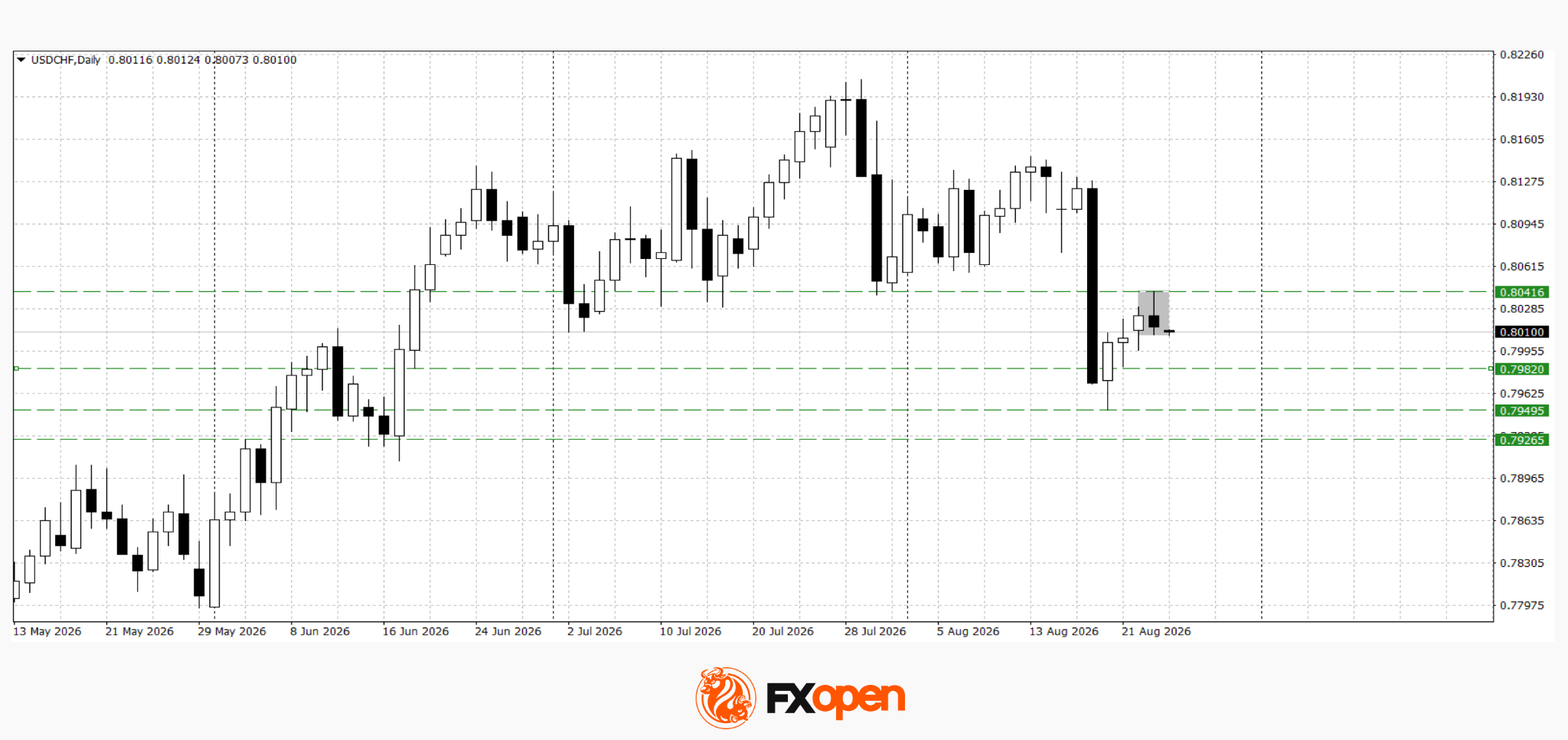
USD/CHF fell back towards 0.8000 after recovering to 0.8045 last week, forming a dark cloud cover pattern in the process.
If dollar weakness continues, the pair could break below 0.7980 and move towards the recent low around 0.7950. The bearish scenario would be invalidated if the price establishes itself firmly above 0.8045.
Key events for USD/CHF:
- today at 11:00 (GMT+3): Swiss ZEW Economic Expectations;
- today at 15:30 (GMT+3): US core Personal Consumption Expenditures (PCE) price index;
- today at 15:30 (GMT+3): US GDP.
USD/CAD
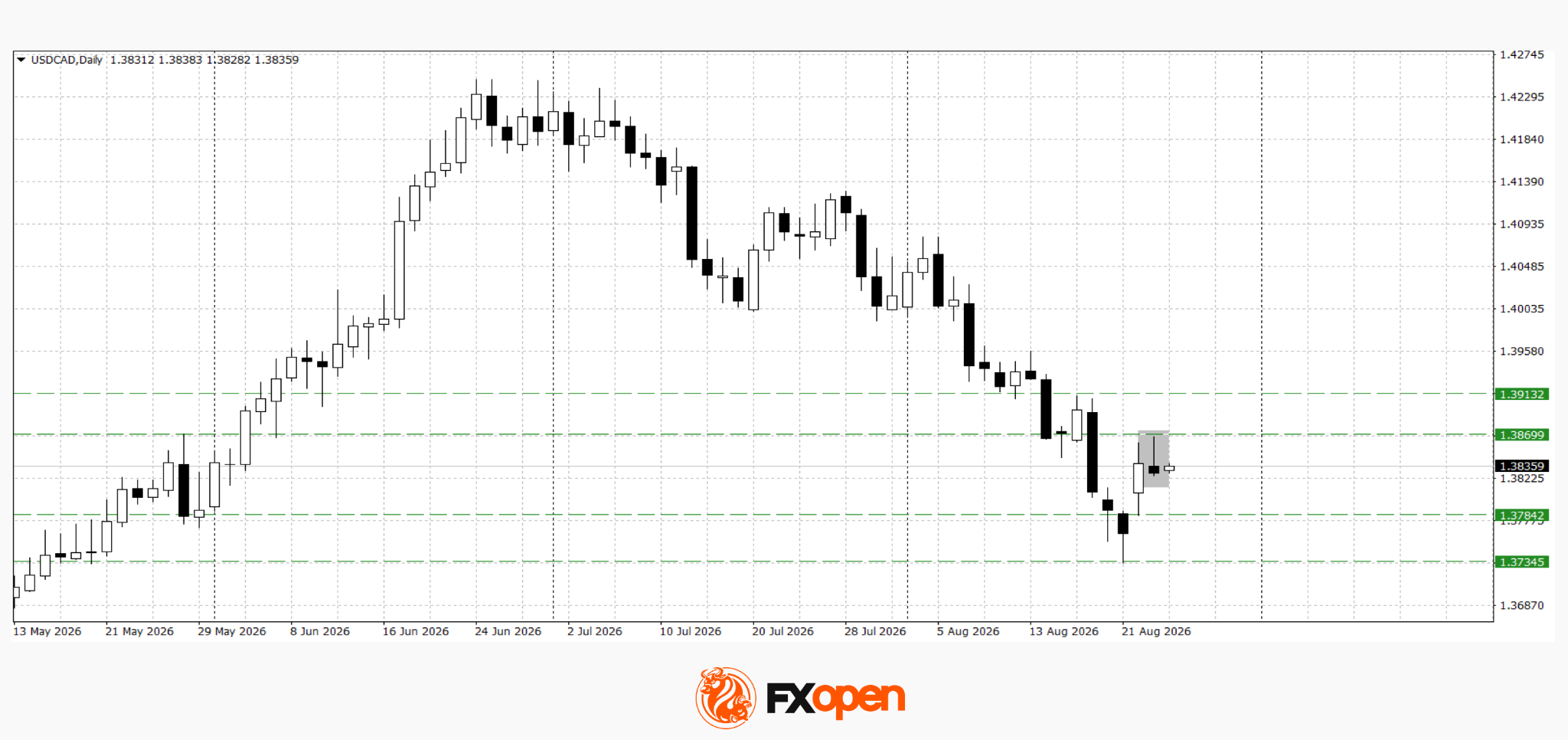
USD/CAD has also resumed its decline following an unsuccessful attempt to extend the recent recovery. Technical analysis points to a potential move towards the 1.3740–1.3780 area, with a dark cloud cover pattern having formed on the daily chart.
A renewed corrective recovery could develop if the pair establishes itself firmly above 1.3870.
Key events for USD/CAD:
- today at 15:30 (GMT+3): Canadian wholesale sales;
- today at 17:30 (GMT+3): US crude oil inventories;
- today at 18:45 (GMT+3): speech by Thomas Barkin, a member of the Federal Open Market Committee (FOMC).
The dollar’s recovery is losing momentum as Treasury yields decline, although geopolitical tensions continue to provide some support for the US currency as a safe-haven asset.
The next moves in USD/CAD and USD/CHF will depend heavily on today’s US economic data and the market’s reaction to fresh signals from the Federal Reserve. Weaker-than-expected figures could increase pressure on the dollar and support further declines in both pairs, while stronger data could restore some demand for the US currency and trigger another corrective recovery.
Trade over 50 forex markets 24 hours a day with FXOpen. Take advantage of low commissions, deep liquidity, and spreads from 0.0 pips (additional fees may apply). Open your FXOpen account now or learn more about trading forex with FXOpen.
This article represents the opinion of the Companies operating under the FXOpen brand only. It is not to be construed as an offer, solicitation, or recommendation with respect to products and services provided by the Companies operating under the FXOpen brand, nor is it to be considered financial advice.


Claude now watermarks AI-generated text to comply with European Union transparency rules. OpenAI and Google add invisible fingerprints to AI-generated images. And Substack is touting a feature that scans pieces for signs of AI. Will we finally be able to tell what’s real on the Internet? My take: not even close.
In fact, AI watermarks and detectors may leave us worse off by creating a false sense of confidence in content marked as genuine.
Watermarks and detectors are gaining traction as we lose our ability to trust our senses online. Look up the Will Smith eating spaghetti test, and you’ll see just how far AI has come. A 2023 AI-generated video shows the actor slurping spaghetti, face distorted, in a way that breaks physics. By 2025, AI was producing lifelike renditions. Deepfakes are so good that experts recommend families develop secret codewords to identify one another.
“But I know a fake when I see it,” someone might say.
Unfortunately, research consistently shows that you do not. This can feel especially hard to accept given the abundance of AI slop rocketing around the Internet. You may even start to think you can sniff out offending content. It might work, for a little bit. It almost never lasts. Any signal that becomes discernible is one a sophisticated actor will find ways to avoid.
We’ve seen this story before. During the earliest days of the Internet, visual polish at least told you something. Major institutions had the resources needed to produce well-designed websites. Janky-looking sites, on the other hand, screamed “scam!” Information experts directed Internet users to dwell on features such as design, broken links, and typos. But when the Internet changed, the advice didn’t.
A study I led, published in 2022, found that 96% of America’s leading colleges and universities offered outdated advice on how to evaluate online information—long after platforms like Wix, Squarespace, and Photoshop made it easier for bad actors to create fake but convincing-looking websites. Inexpensive software made slick graphics ubiquitous. Educators, however, continued to instruct Internet users to search for visual clues like a game of Where’s Waldo?
The most dangerous legacy of this aesthetic fixation is the inverse illusion: the cognitive tendency to believe that if the presence of a signal proves one thing, its absence proves the opposite. Yes, a site with misspellings that claims to show aliens still isn’t legit. But a beautiful site with a dot-org domain can also be harmful. In 2019, our research group found that nearly half of hate groups had dot-org domains. Bad actors know how to adopt the trappings of credibility.
The same is true with AI. Even if visible flaws sometimes linger, their absence doesn’t mean content is genuine. Yet, too often, experts offer surface-level clues to identifying AI-generated content. This is why in the lead-up to the 2024 elections, Stanford Professor Sam Wineburg and I warned about public officials who advised citizens to pay attention to lighting, strange shadows, or other visual cues to identify deepfakes, even after AI content stopped making these errors. Many 2026 guides to spotting AI content mislead readers with the same poor advice.
Which brings us to AI watermarks and detectors. These approaches, based on hidden signals in content, promise that while we can’t always spot the signs, their algorithms can.
I’m not a software engineer. Yet I was able to easily strip metadata from some AI-generated images just by screenshotting them. Anthropic confirms that file metadata can be “stripped through format conversion, re-saving, screenshots, or other means.” Watermarks like SynthID are stronger and can persist after screenshots. But I was able to use a free online tool to remove a SynthID watermark.
Google admits that the accuracy of detecting watermarked AI text is “greatly reduced” when users thoroughly rewrite what they generate, and that it “is not designed to directly stop motivated adversaries from causing harm.” More broadly, open-weight AI models that can run locally, outside platform terms and conditions, guarantee the spread of unmarked content.
Third-party detectors, too, have a spotty track record. I’ve regularly run AI-generated text through detectors that said it was human and vice versa. Many studies of text, image, and audio detectors find that they don’t work very consistently, and yet, their findings are used as the basis for public accusations. Every detector must confront an arms race with humanizer tools and other workarounds motivated actors find.
I would argue that the biggest problem for detectors and watermarks remains the inverse illusion. Just because content lacks a watermark doesn’t mean it wasn’t produced or edited with AI. As Anthropic notes: “lack of a detected mark doesn’t mean the content wasn’t AI-generated or processed.” Deferring judgment to AI detectors leaves us vulnerable to bad actors who know how to launder content and make it pass muster.
This is a confusing time. Many of us are, understandably, uncertain. In one recent pilot, our research group showed 117 students a confident chatbot answer about local history with hallucinated facts. Half said they weren’t sure if it was true. One student said AI is sometimes right and sometimes wrong and “you never know which is which.”
But just because we can’t trust our eyes or place full faith in detectors doesn’t mean we can’t trust anything. Rather than hunt for visual clues or outsource judgment to detectors and watermarks, we can turn to reputation and context. It’s easy to fake content. It’s much harder to fake a good reputation that’s validated by credible sources.
The next time you see unfamiliar content online, resist the urge to ask, “Does this look like AI?” or run the content through a detector. Instead, ask yourself, “Do I trust where this information is coming from?” Open a new tab and check if reputable people and organizations confirm what you’re seeing.
In an era of dwindling trust, we should not fork over ours to cheap signals or cheap software.
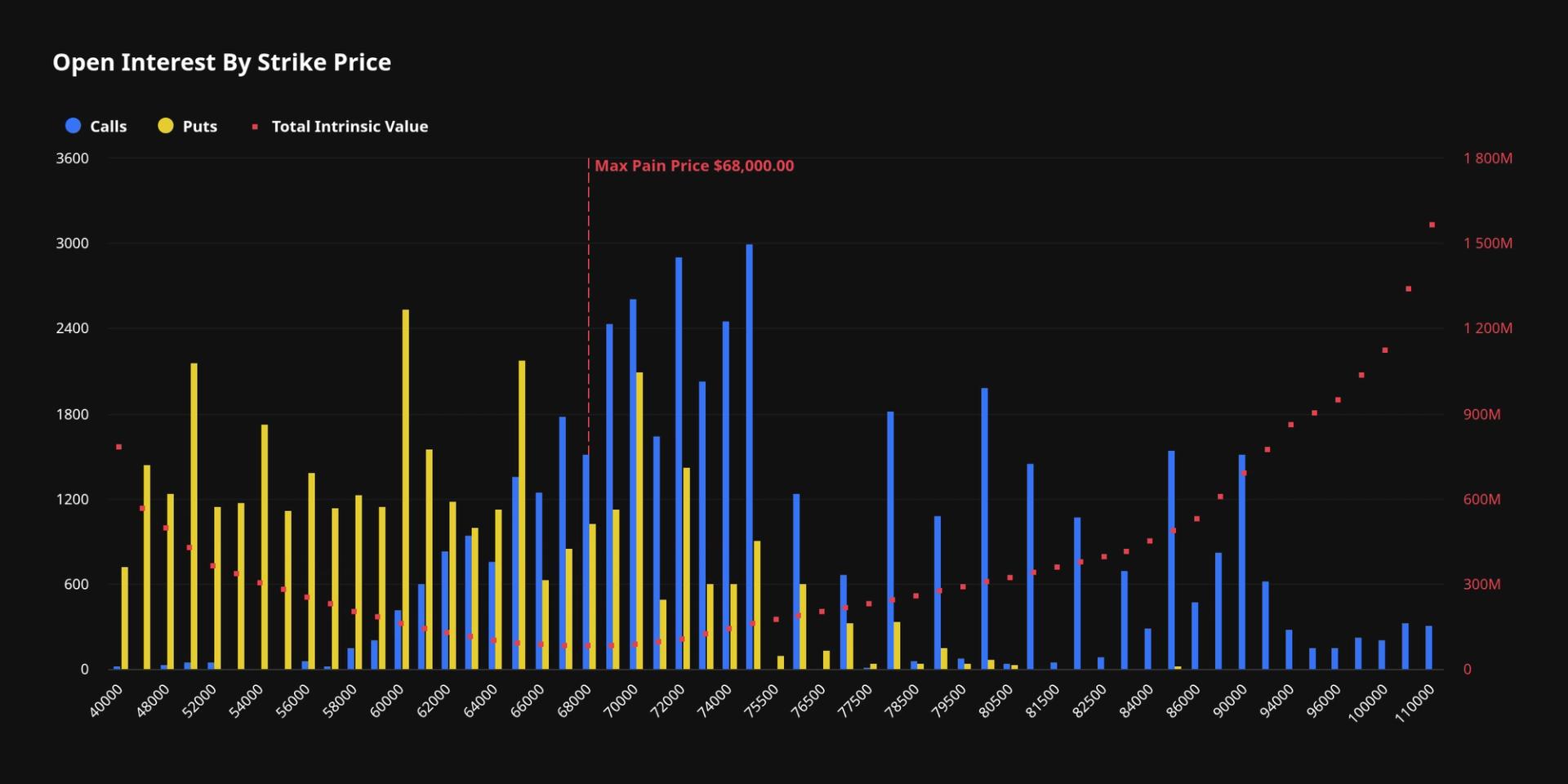
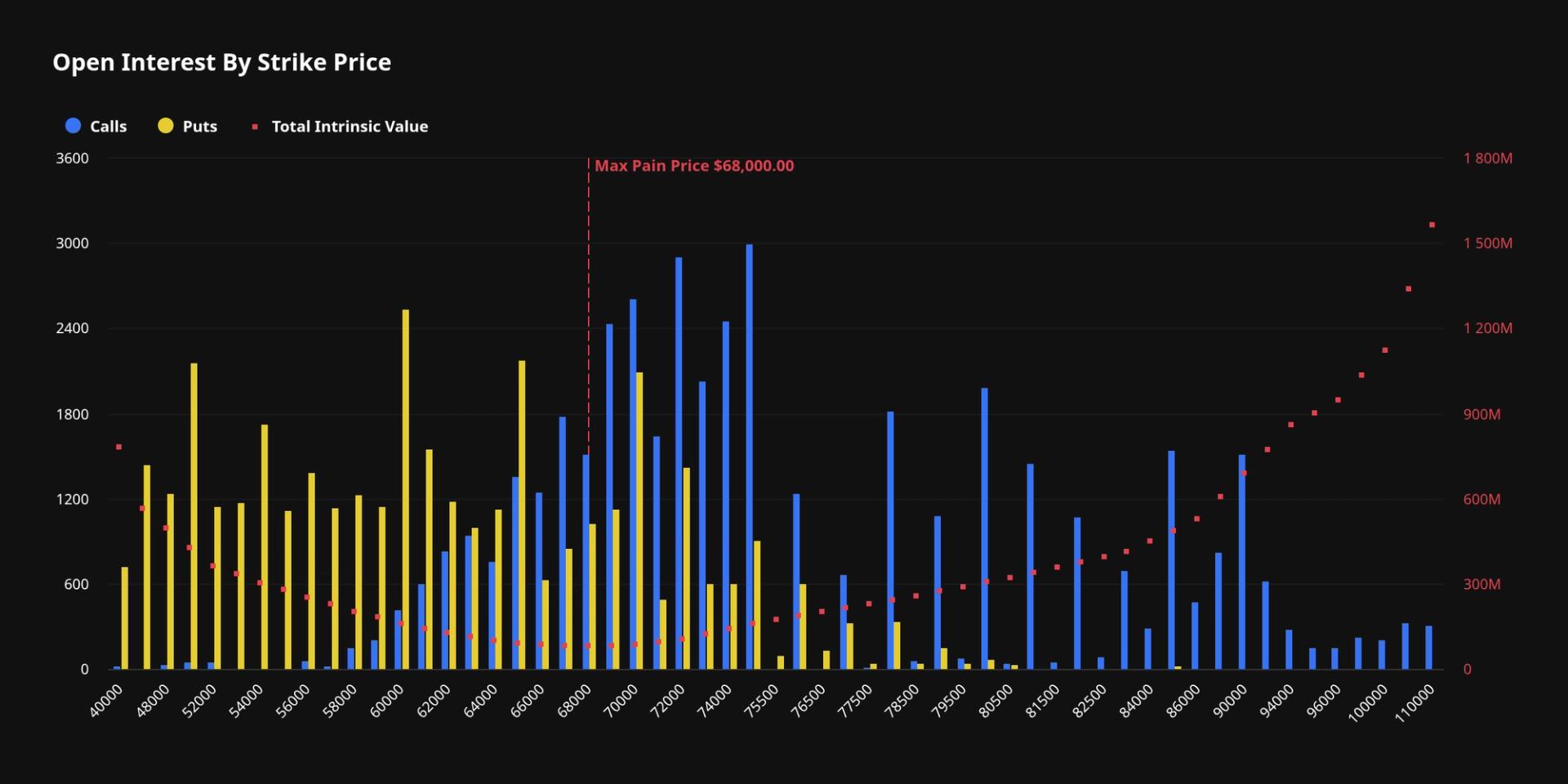
Friday’s expiry follows bitcoin’s surge from $62,000 to $80,000, leaving market makers with increased exposure to manage around several key strike prices.

Standard Chartered Bank (Hong Kong) has become the first authorized bank to distribute HKDAP, a regulated Hong Kong dollar-backed stablecoin issued by Anchorpoint Financial. The bank said it is now working with eligible institutional clients and partners as part of a phased rollout, with early use cases focused on tokenized fund settlements, treasury operations and cross-border payments.
Standard Chartered’s announcement comes less than a couple of weeks after Anchorpoint began offering beta access to HKDAP via HashKey Group and OSL. The expansion into a traditional banking distribution channel marks a notable step for firms looking to use stablecoins within regulated financial workflows rather than solely through crypto-native venues.
Key takeaways
- Standard Chartered Bank (Hong Kong) is the first authorized distributor of HKDAP, extending the stablecoin’s reach into conventional banking distribution.
- HKDAP distribution is rolling out in phases, starting with institutional clients and partner-led pilots tied to settlement, treasury, and payments.
- The bank plans HKDAP-linked subscriptions and settlements for tokenized money market funds in the fourth quarter.
- Anchorpoint’s broader licensing and oversight framework is tied to Hong Kong’s Stablecoins Ordinance, including reserve backing, redemption, governance, and AML requirements.
Bank distribution moves from sandbox to mainstream channels
In its announcement, Standard Chartered Bank (Hong Kong) said it is engaging eligible institutional clients and partners on practical applications for HKDAP. According to the bank, the initial focus areas include tokenized fund settlements, treasury operations, and cross-border payments, which generally require reliability, clear operating procedures, and strong compliance controls.
The move also expands HKDAP’s distribution footprint beyond the beta access routes already provided through HashKey Group and OSL. Standard Chartered characterized the rollout as phased, and it added that it expects to introduce new commercial applications over the coming months.
For market participants, the key shift is where stablecoin access is landing. While stablecoins often circulate via exchanges, OTC desks, and other crypto infrastructure, a bank-authorized distribution channel can simplify onboarding for institutions that prefer established compliance and settlement pathways.
Planned use cases: tokenized money markets and internal settlement
Standard Chartered outlined several specific near- and mid-term applications for HKDAP. The bank said it intends to offer HKDAP-based subscriptions and settlements for tokenized money market funds with both international and local asset managers in the fourth quarter. In addition, it plans to use the stablecoin for intragroup settlements across its banking network in the near term.
The bank’s near-term intragroup settlement plan matters because it targets a high-frequency, process-driven environment where operational efficiency and reconciliation are central. Stablecoins, when paired with regulated licensing and redemption mechanisms, can reduce friction in value transfer and settlement timing—at least in theory and in early pilots—though outcomes will depend on how counterparties and internal systems integrate.
Standard Chartered also positioned the distribution as a way for eligible clients to access HKDAP through a regulated banking channel, tying stablecoin usage to payments, settlement and treasury management activities.
Anchorpoint’s licensing trajectory under Hong Kong’s stablecoin framework
HKDAP is issued by Anchorpoint Financial, an entity created as a joint venture involving Standard Chartered’s Hong Kong arm, telecommunications company HKT, and Web3 investment company Animoca Brands. Standard Chartered is the largest shareholder, and Anchorpoint operates as a subsidiary of the bank.
Earlier in the process, the partners announced plans for an HKD-backed stablecoin in February 2025, after participating in the Hong Kong Monetary Authority’s (HKMA) stablecoin issuer sandbox that began in July 2024. By August 2025, they formally established Anchorpoint Financial and moved toward obtaining an issuer license.
Hong Kong’s regulatory groundwork is anchored in the Stablecoins Ordinance, which took effect on Aug. 1, 2025. Before that date, the HKMA issued supervisory guidelines and published a public register of licensed issuers—elements designed to create transparency around who can legally operate within the framework.
On April 10, the HKMA granted what were described as the first stablecoin issuer licenses, including to Anchorpoint and HSBC’s Hong Kong banking arm. The licensing process is governed by requirements aimed at reserve backing, redemption, governance, and Anti-Money Laundering (AML) controls.
Against this backdrop, Standard Chartered’s role now shifts from participation in a licensing regime to actively distributing a regulated stablecoin. In other words, the story is no longer only about whether issuers can meet regulatory standards—it’s also about whether established financial institutions can deploy stablecoin rails for real financial products.
Regulated stablecoins vs. the risk of impersonation
Hong Kong’s push for regulated stablecoins has also been accompanied by public warnings about counterfeit or unauthorized assets. Earlier coverage from Cointelegraph noted that Hong Kong warned of fake stablecoins impersonating HSBC and Anchorpoint. That serves as a reminder that even as regulation improves legitimacy, end-users and institutions still need clear verification steps when evaluating stablecoin products and counterparties.
With Standard Chartered now distributing HKDAP through a conventional banking channel, the primary value for institutional users may be reduced uncertainty around compliance status and operational legitimacy—assuming integration and custody arrangements remain tightly aligned with the licensed framework.
Investors and market participants will likely watch how quickly HKDAP moves from institutional pilots into broader tokenized fund workflows, and whether the planned Q4 subscriptions and settlements for tokenized money market funds come to fruition as described. The next signal to monitor is the pace and scope of additional “commercial applications” Standard Chartered expects to introduce, since that will indicate how much regulatory-ready demand exists beyond initial settlement and treasury use cases.

“D-Day marked a historic campaign with our allies,” Bessent said Monday. “Today, in that same spirit, we are launching an economic onslaught against Iran’s financial connections around the globe.”
After the measures were announced, Tehran’s Economy Minister Seyed Ali Madanizadeh said the government was prepared to counter the newly-unveiled U.S. sanctions.
“They want to launch an economic terrorist attack against us. We also have our own tools, and we know the rules of this game,” he said in response to Bessent’s announcement during a televised interview with Iranian state media Monday.
“This time, they shouldn’t think that our approach is purely defensive; they should also expect an attack from us.”
Although the Iranian minister did not elaborate on what such an attack would entail, he said the country had developed plans in preparation for the economic threats.
“Plans have been developed for various scenarios, including what actions should be taken if they attempt to cause damage in the financial sector or in the country’s financial relations,” he said, adding that “the global financial system is not structured in a way that allows anyone to claim they can cut off” Iran’s economy.
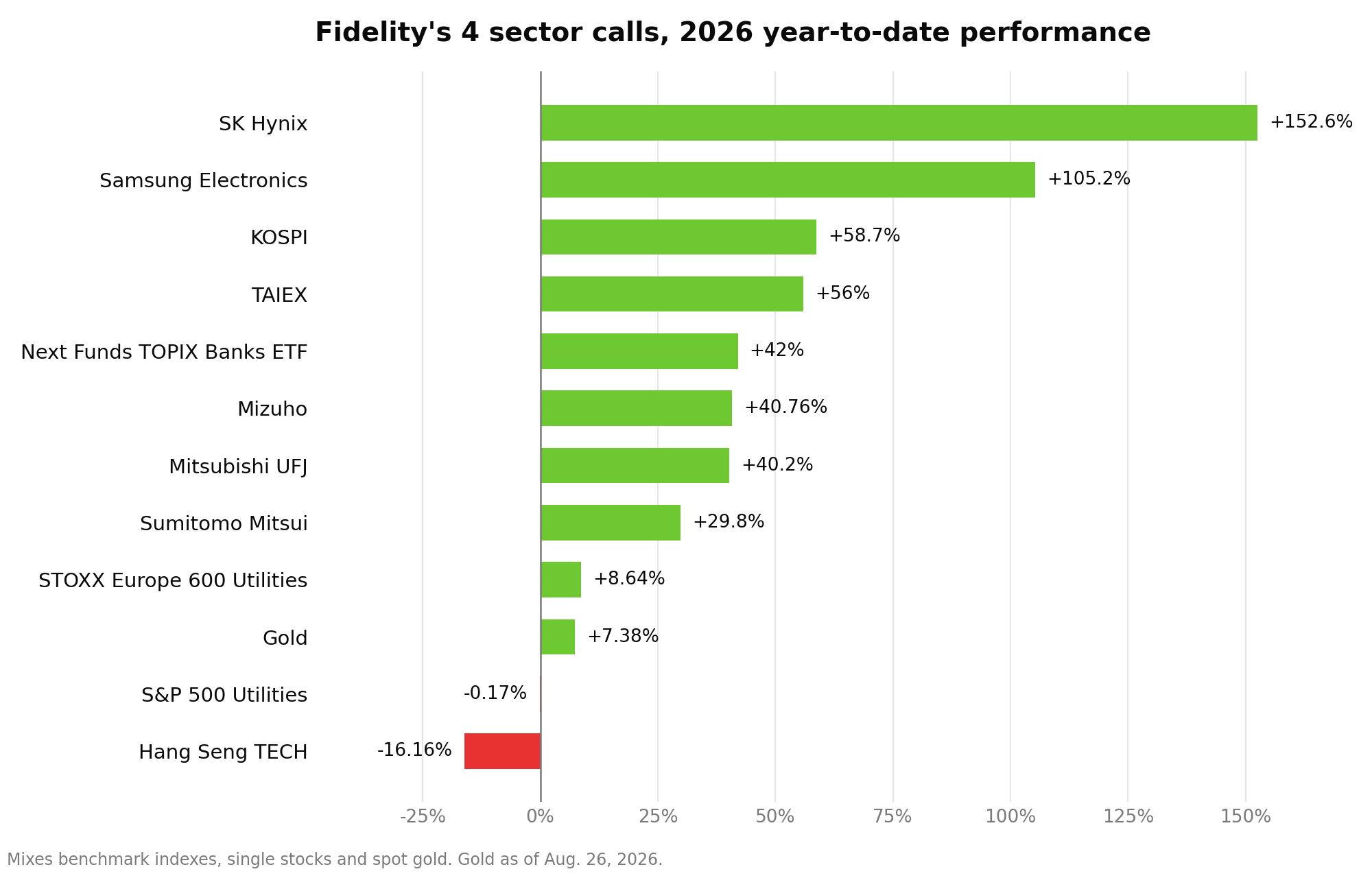
Fidelity International says inflation has settled into markets as a structural force rather than a passing shock. It identified 4 areas investors can look to.
The investment management firm’s list includes banks, artificial-intelligence supply chains, power-supply businesses, and gold.
Why Fidelity Thinks Structural Inflation Is Here to Stay
Government deficits, artificial intelligence (AI) capital spending, tight labor markets, trade barriers, and energy disruptions all underlie the firm’s structural inflation call.
“Inflation increasingly appears here to stay, rather than being a short-lived phenomenon,” the firm said.
Developed economies are now in a sixth consecutive year above target, according to Fidelity. The firm argues that central bankers “might have declared a premature victory.”
US data supports part of that argument. Consumer prices held at 3.4% in the 12 months through July, well above the Federal Reserve’s 2% goal. Core inflation ran at 2.5%.
The equity guidance stays general. Within equities, the firm said to look to businesses that could benefit from rising prices and persistent supply shortages. Diversification, it adds, matters more when price pressure persists.
Notably, the outlook names no individual companies. Every call sits at the sector or country level.
Follow us on X to get the latest news as it happens
The 4 Sectors and How They Have Already Traded
Since Fidelity named no index or ticker, sector benchmarks offer the closest available read on how each call has traded. Bank equities lead the list. Fidelity singled out Japanese lenders, citing a striking improvement in profitability.
The Next Funds TOPIX Banks ETF, which tracks the performance of the TOPIX Banks Index, has gained 42% this year. Mizuho added 40.76%, Mitsubishi UFJ 40.2%, and Sumitomo Mitsui 29.8%.
Technology firms across South Korea, Taiwan, and onshore China form the second call. The firm said they stand to benefit from shortages and price inflation driven by growing AI demand.

In this sector, South Korea’s KOSPI is up 58.7% in 2026, despite persistent volatility. SK Hynix has more than doubled, up 152.6%, and Samsung Electronics rose 105.2%.
Taiwan’s tech-heavy TAIEX has climbed 56%. China’s Hang Seng TECH Index, however, is down 16.16%.
Next, the firm pointed to power supply businesses from the US, Europe, and Japan. The S&P 500 Utilities Index is down 0.17% for the year, while the STOXX Europe 600 Utilities index has gained 8.64%.
Gold rounds out the list, alongside metals and miners tied to electrification. It traded up 7.38% for the year on August 26, after climbing about 13.8% during August alone.
Subscribe to our YouTube channel to watch leaders and journalists provide expert insights
The post Fidelity Sees Inflation Staying, Points to 4 Market Sectors appeared first on BeInCrypto.
Judge Katherine Polk Failla adjourned the retrial in light of Storm’s pending motion for acquittal and related request for a continuance.
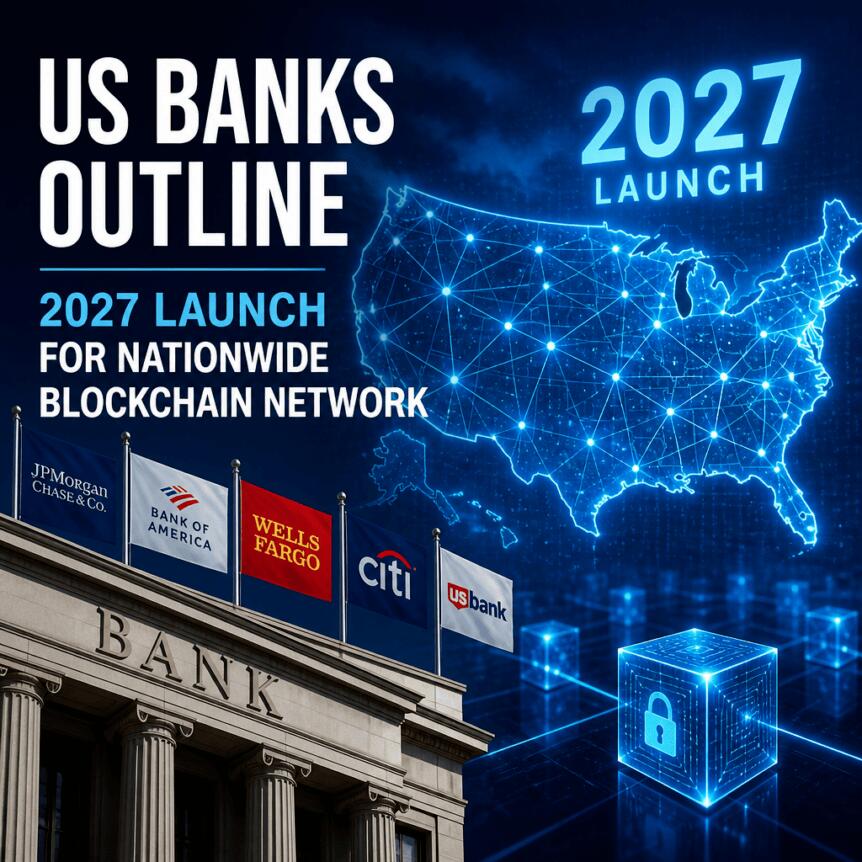
BankChain Alliance, a group formed by 39 US state banking associations, says it is building an industry-owned blockchain network for banks with a targeted launch in 2027. The network is intended to support capabilities such as smart payment tools, tokenized deposits, stablecoins, and automated settlement.
In an announcement shared Tuesday, BankChain said it wants the system to be interoperable with other blockchains and that it is currently selecting a technology partner. While the alliance says the participating associations represent thousands of financial institutions across the United States and plans to invite banks nationwide to take ownership of stakes, the release did not specify which individual banks have committed, nor did it outline governance or funding details.
Key takeaways
- BankChain Alliance is targeting a 2027 launch for a bank-owned blockchain network backed by 39 state banking associations.
- The planned use cases include smart payments, tokenized deposits, stablecoins, and automated settlement.
- BankChain says it is aiming for interoperability with other blockchains, while also selecting a technology partner.
- The announcement does not name committed banks or explain how the network will be governed and financed.
- BankChain joins multiple US bank-led initiatives developing onchain rails for regulated deposits and payments.
A new bank-led network with broad onchain ambitions
BankChain’s pitch is notably wide compared with many early banking pilots that focus on a narrow slice of payments infrastructure. According to the alliance’s announcement, the network is intended to handle both programmable payment functions and settlement automation, while also extending into areas that are often politically and operationally sensitive for traditional banks—especially tokenized deposits and stablecoins.
Just as important for adoption, BankChain frames tokenized deposits as part of the “bank money” landscape rather than an alternative outside the regulated system. The broader implication is that the network could enable near real-time or always-on transfer experiences without changing the fundamental legal and accounting nature of customer funds.
Tokenized deposits: why “programmability” is the central difference
One recurring theme across US banking initiatives is the distinction between independently issued stablecoins and tokenized deposits. In related reporting from the industry’s onchain efforts, The Clearing House previously described an “onchain money” concept aimed at clearing and settling tokenized deposits between banks while connecting blockchain activity to existing payment systems.
That distinction matters because tokenized deposits represent claims on specific banks. As The Clearing House’s plan (as cited in earlier coverage) is designed to keep customers’ funds on bank balance sheets, it potentially allows banks to offer automated, programmable transfers while preserving how those funds are treated within the banking framework.
For investors and practitioners watching the sector, this approach highlights a practical path toward onchain utility: rather than relying solely on stablecoins issued by third parties, banks can experiment with programmable rails that remain grounded in regulated deposit structures.
How BankChain fits into a wave of onchain consortiums
BankChain is not developing in isolation. Since late 2025, multiple US banking consortia have been announced or accelerated, often targeting shared infrastructure for deposits and payments while trying to satisfy compliance and operational requirements.
In June, The Clearing House announced an onchain money initiative with support from major institutions including JPMorgan Chase, Bank of America, Citi, BNY, and Wells Fargo. The concept described in that announcement focuses on clearing and settlement for tokenized deposits between banks and on bridging blockchain activity with existing payment systems.
Regional banks are also pursuing separate models. According to the Cari network update cited in earlier coverage, Cari—built with Huntington, First Horizon, M&T Bank, KeyBank, and Old National—launched a minimum viable product in March and had attracted more than 30 participating banks by July. Another initiative, the DTX Consortium, has been advanced by the Independent Bankers Association of Texas; IBAT said in June that membership exceeded 50 banks as it prepared a tokenized-deposit pilot.
BankChain’s addition reinforces a clear pattern: instead of a single unified standard emerging immediately, the US banking ecosystem appears to be experimenting with multiple consortium architectures in parallel, each with different partners, scopes, and timelines.
Stablecoins inside bank networks: interoperability and governance remain open questions
BankChain’s inclusion of stablecoins alongside tokenized deposits and settlement automation reflects a broader trend in which dollar-linked assets are increasingly discussed not just as consumer-facing products, but as plumbing within banking infrastructure. However, how such assets would be used—and under what oversight—remains central to how these networks could scale responsibly.
The announcement also points to interoperability as a design goal, saying the network will be interoperable with other blockchains. For banks, interoperability is attractive because it can reduce lock-in and potentially simplify integration with existing workflows and future rails. At the same time, achieving interoperability at institutional grade typically requires careful standards around identity, settlement finality, risk controls, and messaging—areas not addressed in the BankChain release.
Just as notable is what BankChain did not disclose. The announcement did not name specific banks that have committed to join, and it did not provide details on governance or funding. Those omissions are significant because governance determines who can change network rules, manage risk parameters, and define upgrade paths—while funding impacts timelines, incentives, and long-term operational sustainability.
Until those details are clarified, the most actionable signal for market participants may be the network’s stated direction rather than its near-term operating reality: a coordinated industry approach aimed at bringing onchain settlement closer to mainstream bank rails.
What to watch next
For the next phase, readers should focus on whether BankChain identifies participating banks publicly, provides a clearer governance and funding model, and details how its interoperability plan will work in practice—especially around how tokenized deposits and stablecoins would be introduced and controlled within a regulated environment.
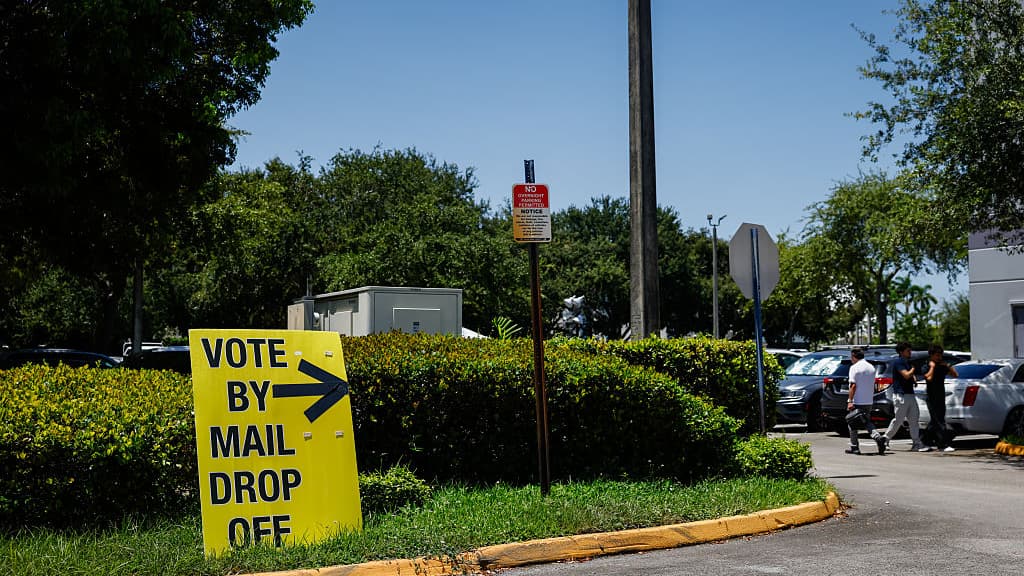
“Congress must still pass the SAVE America Act to secure future elections. We should’ve passed it months ago,” he continued in reference to the Act which is still awaiting approval in the Senate.
Lee also responded to Gov. Shapiro’s commitment to continue legal challenges against the President’s Executive Order. “Why are you so determined to let non-citizens vote?” he said.
“Bravo! Glad to see the Supreme Court get this one right. Election integrity is nonnegotiable,” said Rep. Keith Self of Texas, also pushing the Senate to approve the SAVE Act.
“This is a major win for the security of American elections,” said White House spokesperson Lauren Bis in a statement to TIME. “These are commonsense measures that protect the security of mail-in ballots and ensure only Americans are electing American leaders.
What does the ruling mean for federal elections, and how did we get here?
On June 25, U.S. District Judge Indira Talwani in Boston ordered an injunction on provisions of Trump’s March Executive Order. Those provisions direct the Department of Homeland Security and Social Security Administration to create “state citizenship lists” that cover eligible voters, and the Postal Service to create rules that would end sending absentee ballots to individuals not on a state’s mail-in or absentee participation list.
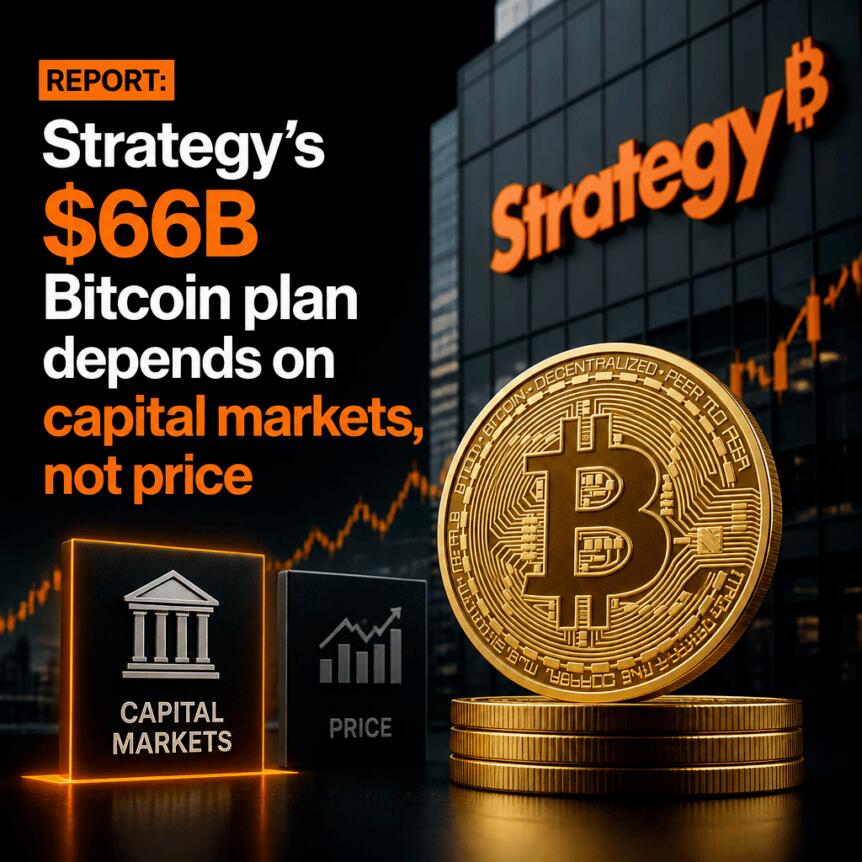
Strategy’s large Bitcoin holdings may provide a cushion against a sharp price drop, but a new analysis argues the company’s real vulnerability is less about Bitcoin volatility and more about how easily it can keep accessing capital markets. In a report shared with Cointelegraph, Regime Intelligence frames the risk as a potential mismatch between Strategy’s balance-sheet obligations and its ability to raise or refinance funds without turning to more frequent Bitcoin sales.
The study points to Strategy’s 840,447 BTC treasury sitting behind approximately $22 billion in debt and preferred claims. That structure, the report argues, makes Strategy’s “Bitcoin accumulation” model dependent on sustained funding capacity to cover large annual obligations, estimated at about $1.76 billion—figures that investors should weigh when evaluating downside scenarios.
Key takeaways
- Regime Intelligence says Strategy’s exposure is driven more by ongoing access to capital markets than by a near-term Bitcoin liquidity or price shock.
- Its stress test suggests Bitcoin would need to fall about 96% before the value of holdings no longer covers its convertible notes—shifting the danger to cash-flow obligations rather than forced liquidation.
- Strategy still must service roughly $1.76 billion in annual preferred dividends and interest even if Bitcoin prices fall significantly.
- Investors should monitor Strategy’s preferred share price and cash reserves; the report’s author says reserves currently cover about 2.6 times the annualized charges.
- The analysis warns that if financing conditions worsen during a prolonged decline, raising new capital could become “progressively more difficult or expensive,” potentially reversing the accumulation plan.
Where the balance-sheet risk really sits
A common concern around Bitcoin treasury firms is that a fast drop in BTC prices could trigger forced selling or margin-like calls. Regime Intelligence’s framework pushes back on that intuition for Strategy, emphasizing how the company’s liabilities behave differently from a conventional Bitcoin-backed margin loan.
According to the report, Strategy’s debt structure does not work as a margin product tied to BTC price movements. That means there is no BTC-linked liquidation trigger that automatically compels the firm to sell its holdings simply because Bitcoin falls.
Instead, the report frames the critical question as whether Strategy can continue financing its obligations without needing to shrink its Bitcoin exposure. In its scenario analysis, Regime Intelligence calculates that Bitcoin would have to decline by roughly 96% before Strategy’s BTC holdings and reserves would no longer cover its convertible notes. In other words, the “balance-sheet coverage” point is far away.
The nearer risk is cash flow: Strategy must continue paying preferred dividends and interest. Under the report’s assumptions, those annual charges total about $1.76 billion, regardless of BTC’s spot price.
Capital markets are the flywheel
Regime Intelligence argues the real stress is not “Will BTC crash?” but “Can Strategy keep the funding flywheel running?” In the author’s view, the ability to refinance, raise, or otherwise secure capital is what allows Strategy to meet obligations without selling more Bitcoin than its accumulation strategy intends.
“In my opinion, MSTR’s principal challenge is to keep the flywheel running in order to cover the annual debt and preferred charges,” Sherif Saad, the report’s author, told Cointelegraph.
Saad also highlighted specific indicators investors can watch. He pointed to Strategy’s preferred share price and its cash reserves, noting that cash currently covers about 2.6 times its annualized charges. That coverage metric matters because it determines how long Strategy can keep paying obligations even if market access tightens.
But the report’s most important warning is about what happens when multiple risks stack at the same time. Saad said the problem becomes more serious during a prolonged BTC decline if Strategy’s share-related measures deteriorate alongside Bitcoin’s price—conditions that can raise the cost of capital or make financing harder to secure.
“During a prolonged BTC decline, the problem becomes more serious if MSTR’s share price and mNAV decline at the same time,” Saad said, adding that capital would then become “progressively more difficult or expensive.”
This matters because it suggests Strategy’s accumulation strategy could be forced to pivot earlier than investors might expect—depending not only on BTC price performance, but also on how equity and preferred pricing respond to market stress.
Why recent BTC sales changed the debate
Much of the attention around Strategy’s treasury strategy historically centered on executive chairman Michael Saylor’s long-running messaging about not selling Bitcoin. That stance is often interpreted by Bitcoiners as a commitment to protect BTC exposure even during periods when operational or financial obligations arise.
Still, Strategy began selling Bitcoin this year, which surprised some market participants who expected “never-sell” to dominate decision-making. Cointelegraph previously reported that Strategy sold BTC four times since May, including a recent sale of 1,690 BTC. The proceeds, according to Cointelegraph’s earlier coverage, were used to fund preferred stock dividends, carry out share repurchases, and build a growing US dollar reserve.
While these sales counter the simplest version of a never-sell narrative, Strategy’s leadership has continued to emphasize that the overall accumulation trend remains favorable. Strategy CEO Phong Le, according to Cointelegraph reporting earlier this year, reminded investors that the company has accumulated “about 25 times more” Bitcoin than it has sold so far this year. Le also told CNBC that Strategy intends to resume Bitcoin purchases later this year.
Regime Intelligence’s analysis provides a lens for interpreting that approach: selling may be used as a tactical tool, but the overarching strategy depends on sustained access to capital markets—because without it, the company may find itself leaning more heavily on reserves and additional BTC sales to meet recurring obligations.
What investors should watch next
For now, Regime Intelligence’s stress test suggests Strategy is not threatened by an acute BTC price collapse in the way margin-based structures might be, since the coverage threshold for convertible notes appears far below current levels. The more practical uncertainty lies in how financing conditions evolve if a prolonged downturn hits both Bitcoin and Strategy-linked market metrics. Investors should watch Strategy’s preferred share pricing, reserve levels, and signs that capital raising is becoming more expensive—because those factors determine whether the accumulation “flywheel” can keep running.

Rumer Celebrates Dad Bruce Willis’ ‘Huge Win’ Amid Dementia

Britons will be urged to stock up on tinned food and bottled water in new ‘national resilience campaign’ by Government to prepare for risk of extreme weather or cyber attacks

Intuit's Plunge Offers A Buying Opportunity





-

 Fashion5 days ago
Weekend Open Thread: Madewell – Corporette.com
-

 Business4 days ago
Musk’s Tesla, SpaceX Confirm $16.8 Billion ‘Terafab’ Chip Plant as World’s Largest Building in Texas
-

 Crypto World4 days ago
anatomy of crypto’s biggest liquidation event since 2021
-

 Crypto World1 day ago
A $30 Billion AI Fund Implodes, Now the SEC Is Investigating Wall Street’s Role
-

 Politics4 days ago
6 months on, Irish renters crushed by effects of government housing bill
-
 NewsBeat4 days ago
The ‘Lucky Dip Gang’ causing carnage for clicks: After five thugs were killed speeding in the wrong direction on a motorway, GUY ADAMS investigates a sick new trend… and why police aren’t even allowed to pursue them
-

 Business3 days ago
Mystery AI Model ‘Ox Alpha’ Draws Developers With Free Access as Chinese Lab Origins Remain Debated
-

 News Videos6 days ago
Don’t Leave Your Financial Future To Chance | August 19, 2026
-

 Business7 days ago
Marvell Shares Jump 7% as Google Chip Deal Confirms Custom AI Silicon Partnership, Analysts
-

 Business6 days ago
Five Below: Kids Discount Retailer Reaps Rich Rewards
-

 Business2 days ago
Moderna CEO warns China is pouring state money into mRNA technology
-

 Business5 days ago
UK firms in critical financial distress rise 9% to 53,756
-

 Business1 day ago
NVIDIA Stock Drops Nearly 2 Percent to $210 on Seventh Losing Day Ahead of Critical AI Earnings
-

 Fashion7 days ago
Jimmy Choo Autumn 2026 collection
-

 Business6 days ago
PayPal and Venmo now accepted for tuition at several universities
-

 Crypto World6 days ago
Optimism-funded team's deciding vote shifts $49 million in OP tokens away from users
-

 Sports3 days ago
Deshaun Watson fires back at Browns fans after being booed: ‘It’s a disrespectful thing’
-
 Entertainment6 days ago
10 Most Perfect Fantasy Shows of the Last 25 Years
-

 Tech6 days ago
OpenAI confirms ChatGPT is down as logins and signups fail
-
 Crypto World3 days ago
Google Gemini AI Predicts Ethereum Could Become the Trade Retail Misses in 2026
You must be logged in to post a comment Login