

Crypto World
Saylor Challenges BIP-110 With “110 Reasons” Against the Proposal


Bitcoin’s internal debate over how to curb network spam and non-monetary data has intensified after Michael Saylor published a detailed critique of Bitcoin Improvement Proposal 110 (BIP-110). In a long post on X.com dated Sunday, Saylor argued that a proposed temporary fork to restrict certain types of data on the Bitcoin network is the wrong solution—despite acknowledging that the underlying concerns raised by supporters are legitimate.
Introduced in December 2025, BIP-110 has become one of the more prominent protocol-level disputes in the Bitcoin development community since the Blocksize Wars of 2015–2017, when scalability questions sparked intense disagreement over whether changes should risk a chain split. Saylor’s intervention comes as Ordinals activity has cooled from its 2023 peak, raising questions about how urgent such a protocol change really is.
Key takeaways
- Saylor supports the goals behind BIP-110—such as protecting validation and affordable payments—but rejects the proposal’s mechanism as a remedy.
- BIP-110 would only move forward if 55% of validating nodes signal support during a Bitcoin “block period,” and recent support levels have been low.
- Ordinals inscriptions have fallen sharply from their August 2023 highs, potentially reducing the immediate pressure driving urgency for protocol-level fixes.
- The debate mirrors past governance tensions, including the Blocksize Wars, where disagreements over enforcement and network rules frequently threatened to split the ecosystem.
Saylor’s critique: shared goals, different fix
According to Saylor’s post on X.com, his argument is aimed at the proposal itself rather than people who support it. He said many Bitcoiners he respects back BIP-110 for reasons including keeping validation accessible, shielding node operators from unwanted costs, preserving low-cost payments, and preventing Bitcoin from drifting into general-purpose data storage.
Saylor emphasized that he agrees with those objectives but disagrees with the proposed remedy. In the same post, he framed his stance as a call to preserve “neutral rules, hard consensus, open markets, and permissionless innovation,” while stressing that vigorous disagreement should not turn into personal factionalism.
As of Sunday at 12 p.m. ET, Saylor’s post had accumulated 879,000 views, along with 692 replies and 852 retweets, highlighting how quickly the discussion has spread beyond core developer circles.
What BIP-110 would change—and why approval is difficult
Protocol changes like BIP-110 are not automatically activated; they depend on broad agreement among validators. BIP-110 cannot be enacted unless 55% of Bitcoin nodes validating blocks signal support for the proposal during a Bitcoin block “period.”
Based on the latest period referenced in reporting, period number 475—covering blocks 955,584 to 957,599—showed only about 1% of blocks in support. That figure suggests that, even if the proposal is technically live for discussion, it currently lacks the signaling momentum required for activation.
This approval threshold matters for investors and operators because it determines whether the change is likely to take effect in practice versus remaining a contested idea within the dev community. A proposal that fails to reach the required support level may still influence future policy debates, but it is less likely to produce immediate network-level consequences.
The spam-bloat dispute meets a cooling Ordinals market
The BIP-110 controversy is tied to concerns about “non-monetary transactions” and data patterns that proponents describe as spamming. BIP-110 was introduced to limit Ordinals-style inscriptions and other arbitrary data that supporters argue can overload the network and distract from Bitcoin’s primary function as peer-to-peer cash.
However, the political and technical urgency of such proposals is harder to gauge when on-chain activity is shifting. The dispute comes while Ordinals activity is reported to be near all-time lows. According to Dune Analytics data cited in the source material, fewer than 10,000 Ordinals are inscribed into the Bitcoin blockchain daily over the last month—down from more than 400,000 per day during its peak in August 2023.
Lower inscription volumes can change the risk calculus for both sides of the debate. Supporters of protocol limits may argue that even reduced activity can still set harmful precedents for how data is used on-chain. Opponents may counter that if demand and congestion pressure have already eased, a fork—especially one that introduces restrictions—becomes harder to justify without more consensus.
Backers, critics, and echoes of earlier Bitcoin governance fights
BIP-110 was introduced by pseudonymous developer “Dathon Ohm,” with backing that includes Ocean protocol founder Luke Dashjr, according to the source. On the opposition side, Blockstream CEO Adam Back is cited as a vocal critic of BIP-110.
Back has previously described the proposal as an attempt to police other people, arguing that Bitcoin’s decentralization should prevent any faction from imposing its preferred rules on the broader community. The objection is framed not only as technical but ideological—rooted in the cypherpunk principle of permissionless, censorship-resistant money.
Meanwhile, supporters of BIP-110 argue that Ordinals-driven bloat represents a serious threat that demands action. They also maintain that BIP-110 would not cause a chain split, a concern raised by those wary of temporary restrictions. Supporters further argue the fork is intended to be limited—described as a one-year constraint—so that it would not invalidate fee-paying transactions over the long run.
These arguments have led to parallels with the Blocksize Wars between 2015 and 2017, when disagreements over how to scale Bitcoin and whether to risk contentious changes sharpened into a broader debate about enforcement and legitimacy. In both cases, the underlying question is the same: how should the network evolve under pressure while preserving decentralized governance?
In this current cycle, the data points being used by each side are not symmetrical. Saylor is not denying that bloat concerns exist; he is questioning whether the governance approach—introducing temporary restrictions through a fork-like mechanism—is compatible with Bitcoin’s broader commitment to neutrality and hard consensus. At the same time, low recent Ordinals activity weakens one common justification for immediate intervention: that the network is actively under severe strain from inscriptions.
As the debate continues, readers should watch two things closely: whether BIP-110’s support signals rise toward the 55% activation threshold in subsequent block periods, and whether Ordinals activity meaningfully returns or stays subdued. Those developments will likely determine whether the proposal remains a theoretical flashpoint—or becomes a real test of how Bitcoin manages conflict over data usage and network rules.

In a deja vu moment mimicking the start of the previous business week, BTC’s price dipped by over a grand as most financial markets opened.
Most larger-cap alts have followed suit with minimal losses. ZEC, though, has dumped the most from this cohort of crypto assets, plunging by over 6%.
BTC Fights for $64K
Recall that last Monday began on an even more painful note. At the time, bitcoin had calmed at around $64,000 before the bears took control and drove it south to under $62,000. However, the softer-than-expected US CPI numbers for June propelled an impressive rally that drove BTC to its highest price tag in approximately three weeks at $65,600.
Nevertheless, the cryptocurrency failed to sustain its momentum and quickly slipped back down to $62,500 on Friday. The bulls stepped up again and helped it recover to $64,000 by Saturday morning.
The weekend was more positive, as BTC managed to climb higher and even touched $65,000 on Monday morning. History repeated itself, though, and it fell to $63,700 earlier today. It has recovered some ground, but it still trades at just below $64,000.
Its market capitalization remains below $1.290 trillion, while its dominance over the altcoins has stalled at 57%.

PI and PUMP – Pump
As reported yesterday, Pi Network’s native token skyrocketed suddenly by double digits and tapped the coveted support-turned-resistance $0.10 level. It has maintained most of the gains, and it’s now fighting to take that line down as well. The other impressive performer today is PUMP, which has rocketed by over 20% to $0.002. In contrast, HASH has dumped by over 9%.
ZEC has lost the most value from the larger-cap alts, sliding below $530 after a 6.5% daily drop. RAIN, BCH, UNI, and TAO have dropped by up to 3% daily.
Most other larger caps have declined by up to 1%, such as ETH, BNB, XRP, SOL, and HYPE.
The total crypto market cap has erased around $20 billion daily and is down to $2.250 trillion on CG.

The post Pi Network’s PI and PUMP Rocket Daily, Bitcoin Fights For $64K: Market Watch appeared first on CryptoPotato.
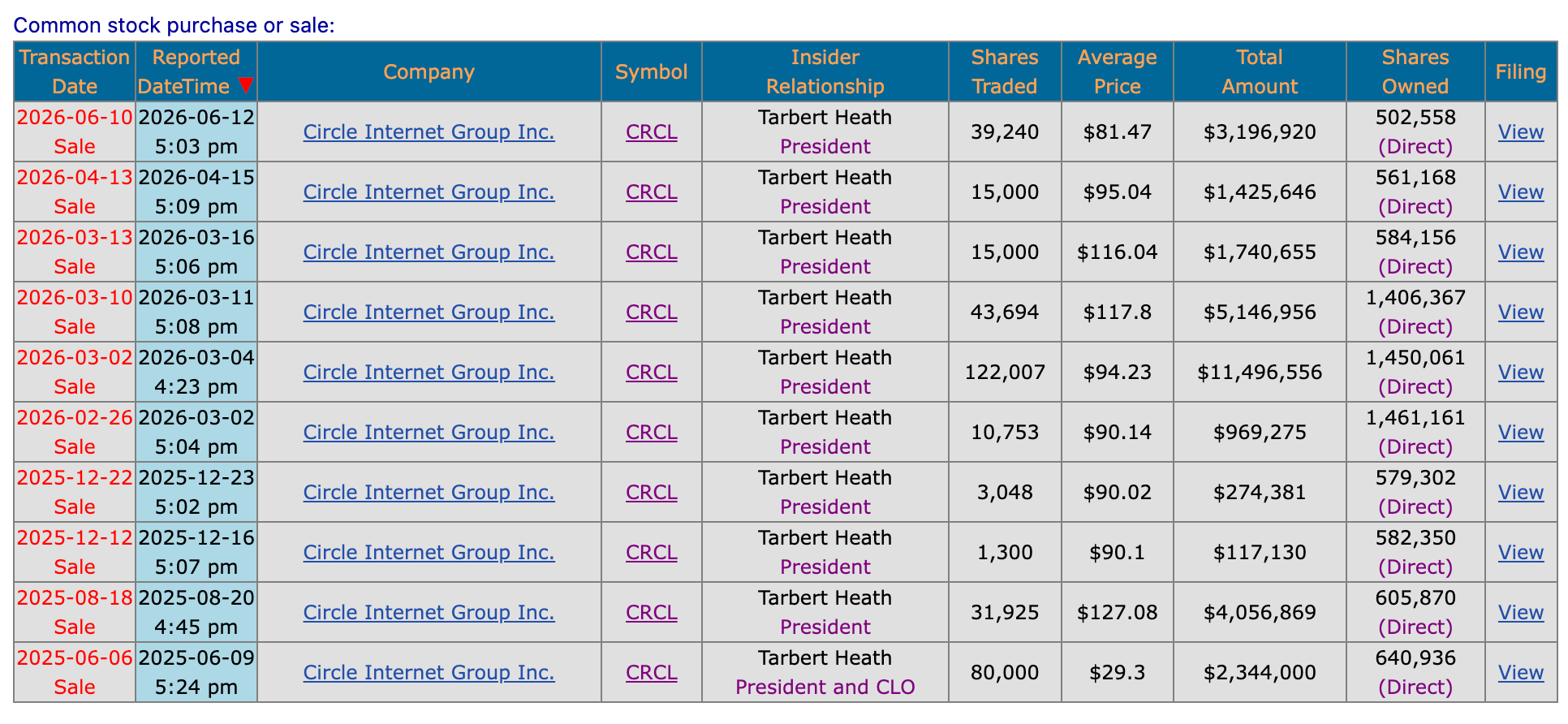
Circle President Heath Tarbert has sold more than $30 million in Circle Internet Group (CRCL) stock since the June 2025 IPO.
The selling comes amid a 76% stock collapse, and he continues to call for patience. Still, the filings tell a duller story. Most trades were scheduled far ahead and executed automatically.
What the Filings Show
Tarbert has sold shares in 7 of the 13 months since Circle went public. His largest sale came on March 2, 2026. He offloaded 122,007 shares, worth about $11.5 million, according to SEC Form 4 filings.
Eight of the ten sales were executed under a Rule 10b5-1 plan. These plans are written trading schedules that executives adopt while unaware of material nonpublic information. The broker then executes trades automatically, giving the insider a defense against insider trading claims.
Follow us on X to get the latest news as it happens

The other two came at share offerings. Tarbert sold 80,000 shares around the June 2025 IPO. He sold an additional 31,925 shares in an August secondary offering.
So most of the selling carries no signal about his outlook. Roughly $24.4 million ran on preset schedules. Those trades are consistent with routine equity compensation diversification.
The Long Game Defense Meets Wall Street Doubt
Meanwhile, on Fox Business this month, Tarbert addressed the stock’s 76% drop from about $260 to $62. He pointed to Circle’s Arc blockchain build-out and the firm’s focus on building the infrastructure for a “full-stack internet platform.”
“Circle is playing a long game… in the long run, the stock is going to take care of itself,” he said.

Still, Wall Street is less patient. Mizuho cut CRCL to Underperform this month. It lowered its price target to $50 from $85, about 21% below recent levels.
Analyst Dan Dolev flagged Open USD as the main threat. The rival launched June 30 with backing from more than 140 firms, including Visa and Mastercard.
Subscribe to our YouTube channel to watch leaders and journalists provide expert insights
The post Circle’s President Sold Over 360,000 Shares, The Filings Explain Why appeared first on BeInCrypto.

Bitcoin price is holding the low to mid $64,000s on Monday after geopolitical fears, which rattled its prediction last week. As of now, BTC trades around $64,200 after slipping modestly over the past 24 hours, while still staying comfortably above last week’s lows. The real question is whether this is genuine relief buying or simply a classic dead cat bounce.
Secretary of State Marco Rubio confirmed Monday that the US remains open to a diplomatic resolution with Iran, even as US Central Command acknowledged another wave of strikes in the region. That mix of military action and diplomatic messaging is the sort of “bad, but not worse” outcome markets often welcome. Unsurprisingly, Bitcoin bounced from its weekend lows soon after Rubio’s remarks made the rounds.
Meanwhile, the macro backdrop still deserves respect. Global risk assets remain jumpy as traders react to every headline tied to the Iran conflict. Even so, Bitcoin’s ability to defend the $64,000 level through the worst of the recent news gives bulls something tangible to lean on. Sometimes, not falling is its own victory.
Of course, one calm headline does not erase weeks of uncertainty. If diplomatic progress continues, Bitcoin could build on its recovery and challenge higher resistance. However, another escalation would likely send volatility racing back, reminding traders that headlines, not charts, are still calling the tune.
Discover: The Best Token Presales
Bitcoin Price Prediction: Break $70,000 While Iran Tensions Simmer?
Price action across major trackers tells a clean consolidation story. Bitcoin is range trading at around $64,200, with its daily volume sitting at $16.3 billion, enough to support the range but hardly the fireworks that usually spark a breakout.
Support in the low $64,000s has survived repeated tests over the past week. Meanwhile, resistance remains stacked between $67,000 and $70,000. That area has turned back rallies before and could do it again unless a strong macro catalyst forces short sellers to blink. The weekly performance remains modest, showing buyers have not abandoned Bitcoin despite the Iran headlines.

Three scenarios are worth watching. In the bullish case, diplomatic progress lifts risk appetite, allowing Bitcoin to reclaim $67,000 and challenge the $70,000 ceiling. The base case keeps military action contained while talks drag on, leaving Bitcoin stuck between roughly $64,000 and $67,000. Not exciting, but markets rarely ask for permission to be boring.
The bearish price prediction arrives if tensions escalate without meaningful diplomatic progress, and crack support near $64,000, and send Bitcoin toward the low $60,000s. Watch exchange inflows and realized price closely. Those metrics often whisper before price starts shouting. The macro picture still matters, but right now the headlines are driving the bus, while the long-term structure waits for its turn.
Trade Butcoin on Bybit and Get a Chance to Win Our $1,000 USDT Airdrop
Bitcoin Hyper Targets Early-Mover Upside as BTC Tests Key Levels
Bitcoin holding $64,000 is constructive, but the upside math at a $1.28 trillion market cap is compressing. A move to $70,000 is just a 9% gain. That’s real money, but it’s not the asymmetry that moves portfolio needles for traders with a higher risk tolerance.
Bitcoin Hyper ($HYPER) is positioned directly at the intersection of Bitcoin’s two biggest structural gaps: slow throughput and near-zero programmability.
The project is building the first Bitcoin Layer 2 with Solana Virtual Machine (SVM) integration, meaning smart contract execution that claims to outperform Solana’s own speeds, while settlement anchors to Bitcoin’s security model.
What the data shows: the presale has raised $32.9 million at a current token price of $0.0136834, with staking available for early participants. The project is approaching a $33 million milestone, a level of presale traction that reflects genuine demand, not just launch-day noise.
Features include a Decentralized Canonical Bridge for BTC transfers and high-speed, low-cost transaction execution layered over Bitcoin’s base security. If the SVM-on-Bitcoin thesis plays out, early presale entry at sub-$0.02 pricing is the window that closes first.
Research Bitcoin Hyper before the next pricing tier locks in.
Discover: The Best Crypto to Diversify Your Portfolio
The post Bitcoin Price Prediction: BTC Rises as Marco Rubio Says Iran Deal Remains Open appeared first on Cryptonews.
The Nasdaq 100 (US Tech 100 Mini on FXOpen) remains caught between two opposing forces: cooling inflation on one side, and persistent geopolitical instability on the other. On 14 July, June’s CPI print came in softer than expected, easing near-term Fed tightening bets and triggering a broad rebound across tech stocks, particularly semiconductors, which had been under heavy pressure.
That relief, however, has been repeatedly tested by renewed US-Iran hostilities, which pushed oil prices higher and lifted US Treasury yields, weighing on rate-sensitive growth names throughout the week. Every attempt at recovery has coincided with a brief easing of tensions, only for fresh escalations to reintroduce volatility days later.
Beneath the surface, semiconductors remain the index’s clearest fault line: even as broader sentiment improves, doubts over the sustainability of AI-driven valuations continue to trigger selective selling in the sector. Meanwhile, SpaceX’s addition to the index on 8 July has added a steady stream of passive buying, while the start of earnings season has kept investors’ attention split between fundamentals and geopolitics.
Technical Analysis of the Nasdaq 100
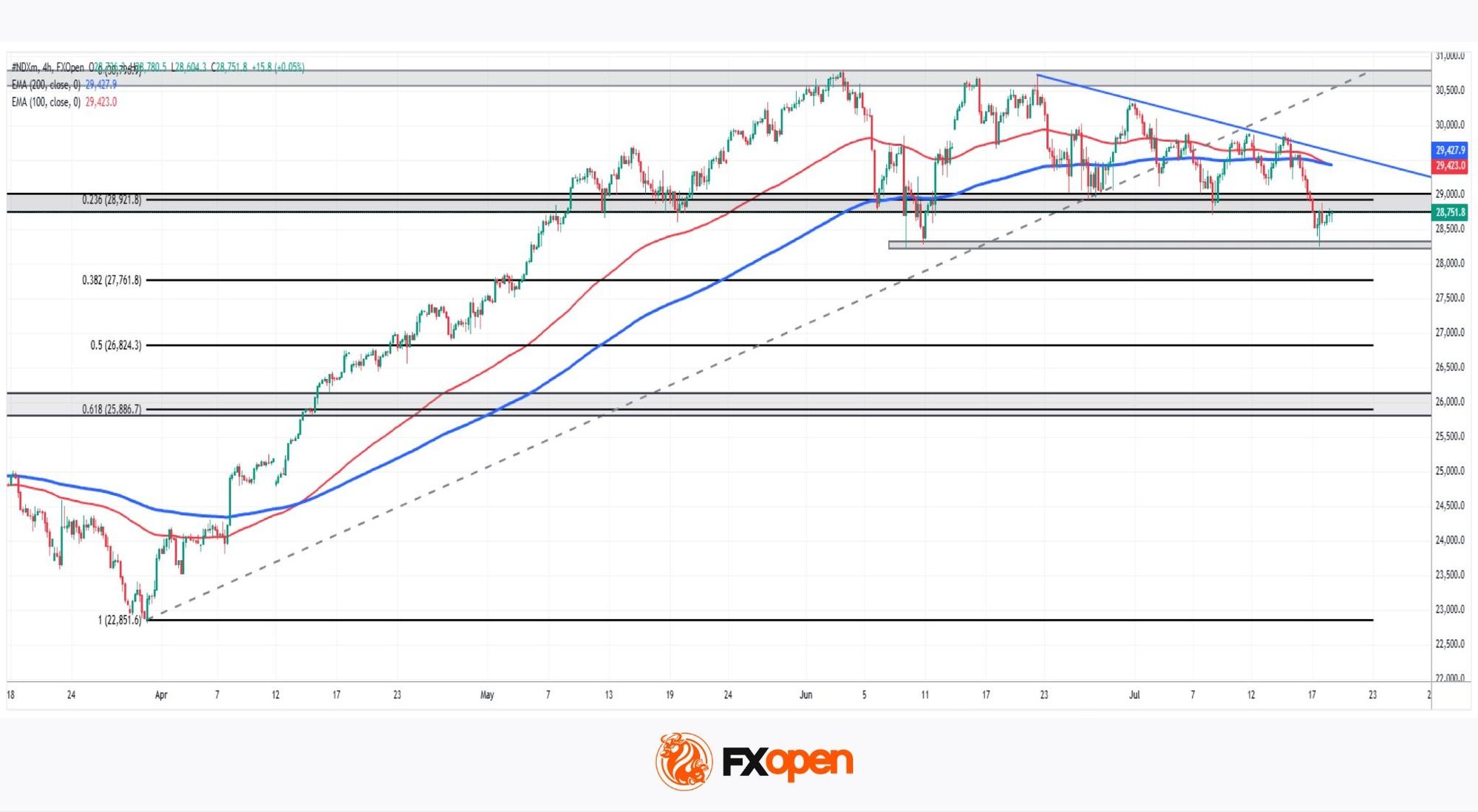
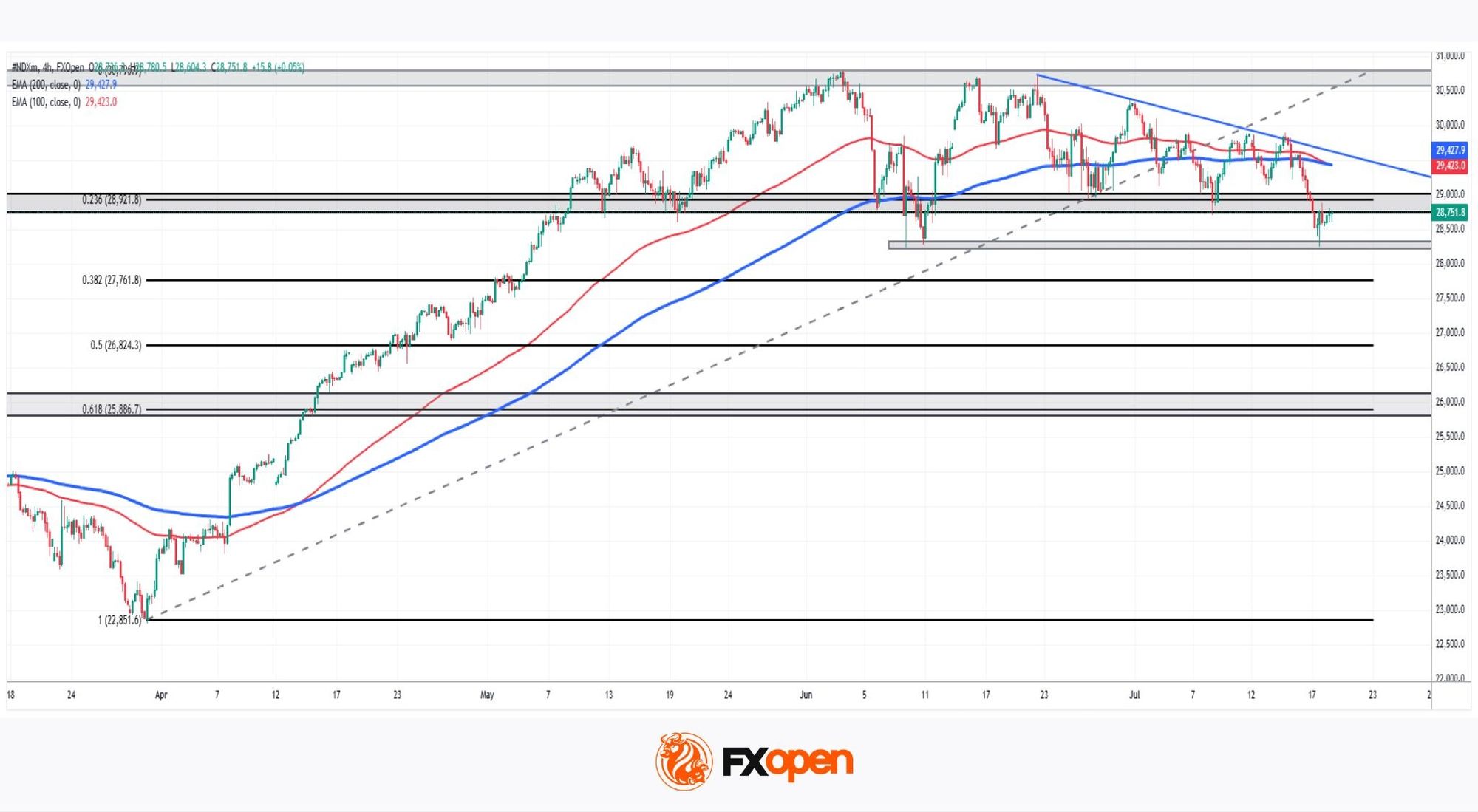
As the chart shows, after testing the 30,000 zone on three separate occasions, the Nasdaq 100 (US Tech 100 Mini on FXOpen) has struggled to build fresh momentum, entering a consolidation phase with a bearish tilt. This is clearly visible in the descending trendline that has been respected for roughly a month, alongside the index’s inability to print higher highs.
Bullish Scenario
As with other risk assets, geopolitics remains the primary driver of the index’s true direction. Should tensions stay contained rather than escalate further, the Nasdaq has room to extend its recovery. Technically, price finds itself at a decisive juncture: after bouncing from the 28,200-28,300 zone, which had already acted as a floor in early June, the index now faces its first real test at the 28,800-29,000 area. This zone, a former support level now turned resistance, is the key level to watch. A confirmed breakout above it could signal renewed strength and reopen the path back into the broader 29,000-30,000 consolidation range.
Bearish Scenario
With geopolitical risk still running high, sentiment toward risk assets remains fragile. Technically, the Nasdaq 100 (US Tech 100 Mini on FXOpen) appears to have broken down from the two-month consolidation range, losing the 29,000 support in the process. The formation of the descending trendline reflects the index’s failure to generate higher highs, a clear sign of underlying weakness. Adding to this picture, the 100- and 200-period EMAs on the 4H chart are now crossing—the same signal that preceded April’s strong bullish reversal, this time playing out in the opposite direction.
The 29,000 resistance now holds the key to the next move. Can the Nasdaq 100 (US Tech 100 Mini on FXOpen) reclaim its footing, or is this only the beginning of the correction traders have been waiting for?
Trade global index CFDs with zero commission and tight spreads (additional fees may apply). Open your FXOpen account now or learn more about trading index CFDs with FXOpen.
This article represents the opinion of the Companies operating under the FXOpen brand only. It is not to be construed as an offer, solicitation, or recommendation with respect to products and services provided by the Companies operating under the FXOpen brand, nor is it to be considered financial advice.

Key takeaways
- Solana (SOL) traded lower on Monday, extending its corrective trend from early July.
- Institutional demand remains subdued, with SOL ETFs recording less than $1 million in inflows for a second consecutive week.
- Futures Open Interest declined while trading volume surged 78%, pointing to increased market activity but weaker conviction.
Solana (SOL) edged lower on Monday, continuing its recent correction as both institutional and retail market indicators pointed to weakening demand.
Although trading activity has picked up sharply over the past 24 hours, declining futures positioning and muted exchange-traded fund (ETF) inflows suggest investors remain cautious about the token’s near-term outlook.
The combination of slowing institutional participation and growing bearish sentiment has kept SOL under key technical resistance levels.
Institutional investors continue to favor Bitcoin and Ethereum
Demand for Solana-focused investment products remained subdued last week.
According to CoinGlass data, SOL exchange-traded funds (ETFs) attracted approximately $948,210 in net inflows, following $930,430 the previous week.
While inflows remained positive, they were significantly lower than those recorded by the two largest cryptocurrencies: Bitcoin ETFs, with $75.67 million in weekly inflows, and Ethereum ETFs with $105.44 million in weekly inflows.
The figures suggest institutional investors continue allocating capital toward more established digital assets rather than increasing exposure to Solana.
Retail trading activity increased sharply despite the recent price weakness. CoinGlass data shows that the futures trading volume jumped 78% to $5.37 billion over the past 24 hours. Meanwhile, the Open Interest (OI) slipped slightly to $4.77 billion.
The combination of rising trading volume and declining Open Interest typically suggests positions are being closed rather than new bullish positions being established.
Meanwhile, funding rates have turned slightly negative, falling to approximately 0.0023%, indicating traders are increasingly willing to pay to maintain short positions.
This shift points to growing bearish sentiment among derivatives traders despite elevated market activity.
Solana price prediction: Will SOL fall toward $70?
From a technical perspective, Solana continues to trade within a short-term bearish structure.
On the four-hour chart, SOL remains below both the 50-period EMA at $76.32 and the 200-period EMA at $76.51.
These moving averages continue to act as immediate resistance, limiting the token’s recovery attempts.
Technical indicators present a mixed picture. The Relative Strength Index (RSI) is hovering around 49, indicating neutral momentum with neither buyers nor sellers holding a decisive advantage.
Meanwhile, the Moving Average Convergence Divergence (MACD) has turned modestly positive, suggesting buying pressure is gradually improving.
However, the bullish momentum remains too weak to overcome the prevailing downward trendline.
If selling pressure continues, traders will be watching the following support levels:
- $73.50 — S1 Pivot support.
- $72.80 — Descending trendline support.
- $70.62 — S2 Pivot support.
A decisive move below the $72.80–$73.50 support zone could accelerate losses toward $70.62.
For the bullish outlook to improve, Solana must first break above its descending resistance trendline near $77.27.
If buyers reclaim this level, the next upside targets become the $81.92 resistance.
A sustained close above the trendline would weaken the current bearish structure and increase the probability of a broader recovery.

Solana continues to face headwinds from both institutional and retail markets. While trading activity has surged, declining Open Interest, weakening funding rates, and modest ETF inflows indicate investors remain cautious.
Unless SOL breaks above the $77.27 resistance level, the correction that began in early July is likely to continue, with $70.62 emerging as the next major downside target.
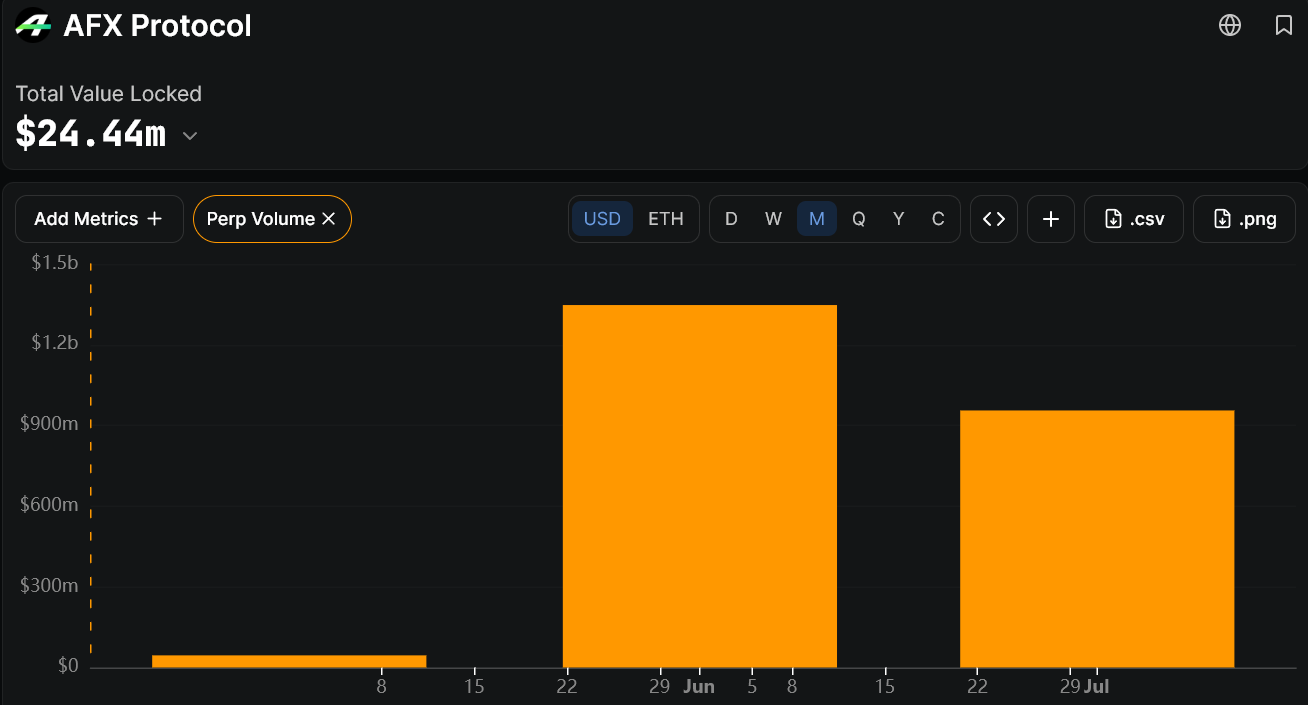
Perpetual futures have become one of crypto’s busiest on-chain trading categories, with the top 10 perp DEXs recording $6.7 trillion in volume during 2025. This growth has intensified competition among exchanges seeking faster execution, deeper liquidity, and a greater share of derivatives activity.
AFX is one such competitor, recording more than $1.3 billion in cumulative perpetual volume within a little over a month of its mainnet launch, according to Head of Growth Ken C. Its ALP liquidity vault attracted more than $21 million over the same period, providing an early indication of demand across its crypto and traditional asset markets.
In an interview with BeInCrypto, Ken discussed AFX’s sovereign blockchain, its plans for AI-powered trading, and a self-funded token model centred on community participation.

A Sovereign L1 Built Around Perpetual Trading
“The order book, matching, the settlement, the margin and the risk systems are all designed around trading from day one,” Ken said.
A sovereign L1 gives AFX control over execution, settlement and risk management across its perpetual markets. Ken linked this choice to the demands of leveraged trading, where congestion can alter an order at the moment a trader enters or exits.
“Your chain could be congested because someone is minting NFTs,” he said, describing how unrelated activity on a shared network can affect a Bitcoin trade.
AFX reports finalization of around 100 milliseconds, which Ken compared with a human blink lasting between 100 and 400 milliseconds. Even a small delay can affect entry prices, exits, liquidation risk and automated strategy performance.
“Slow execution can negatively impact your trade performance,” he said. Consistent finalization gives human traders and algorithmic systems a more predictable environment during volatile periods.
Preparing AFX for AI Agent Trading
“We want to be known as the platform built for traders and tuned for AI agents,” Ken said.
AFX is developing native APIs and SDKs for automated strategies, while scoped wallets and symbol-specific subaccounts define access. Risk limits, kill switches and test environments give users control over agent activity.
“Predictable execution is everything,” Ken said. AFX uses a dedicated fair-ordering mempool to reduce front-running and sandwich attacks, helping automated systems receive consistent treatment when they submit orders under comparable conditions.
The exchange plans an AI agent trading competition during the second season of its points programme. Ken also compared upcoming event-led tools with “Bloomberg Terminal plus event-led AI agent trading.”
Giving Agents Verifiable Performance Histories
“Every order, fill and liquidation can be verified,” Ken said.
Users can review which assets an agent traded, when it entered or exited, which prices it received and how it behaved during volatile periods. These records also show whether an agent followed its assigned strategy and remained within its risk limits.
“If you are trusting an AI agent with capital, you need more than just a screenshot. You need a verifiable track record,” he said.
On-chain histories allow strategy developers to demonstrate performance through recorded execution, while users can compare agents using the same underlying data.
Liquidity Supports Markets Beyond Crypto
“Listing more markets is easy. Making them tradable is the hard part,” Ken said.
AFX offers perpetual exposure across crypto and several traditional asset categories, including stocks and commodities. The ALP vault provides base and backstop liquidity, and held more than $21 million at the time of the interview.
AFX pairs vault liquidity with market-specific open interest caps and a multi-stage liquidation engine. These controls support trading during sharp price movements and reduce exposure to manipulation.
“The first users are active traders, but over time we expect more professional traders and AI agents to come on board,” Ken said.
AFX now plans to expand its available markets, participation routes and agent controls. Early volume and vault deposits give the exchange a base for attracting professional liquidity and supporting automated systems alongside human traders.
The post AFX Reaches $1.3 Billion in Perpetual Volume Through a Self-Funded Model appeared first on BeInCrypto.


Hyperliquid said its HIP-4 upgrade, which introduced “outcome trading” to the decentralized exchange, will support permissionless deployment of the contracts in a future enhancement.
Once live, anyone will be able to offer a prediction market on the platform, subject to templates approved by validators, Hyperliquid said on Telegram on Sunday. In the meantime, they remain under the authority of validators.
Prediction markets, a sector dominated by Polymarket and Kalshi, allow participants to bet on event outcomes and have evolved into a multibillion-dollar sector of the blockchain industry. Users take positions on events from central bank interest-rate decisions to who performs at the Super Bowl halftime show.
The growing popularity of the platforms — the FIFA World Cup, which wrapped up Sunday with Spain winning its third title, drew more than $50 billion in bets — has attracted centralized trading platforms like Coinbase and Robinhood into the sector to offer customers a one-stop shop for predictions markets alongside more conventional financial trading.
Crypto World
Bitcoin price slips under $64K as Middle East tensions and China’s Kimi K3 launch rattle markets
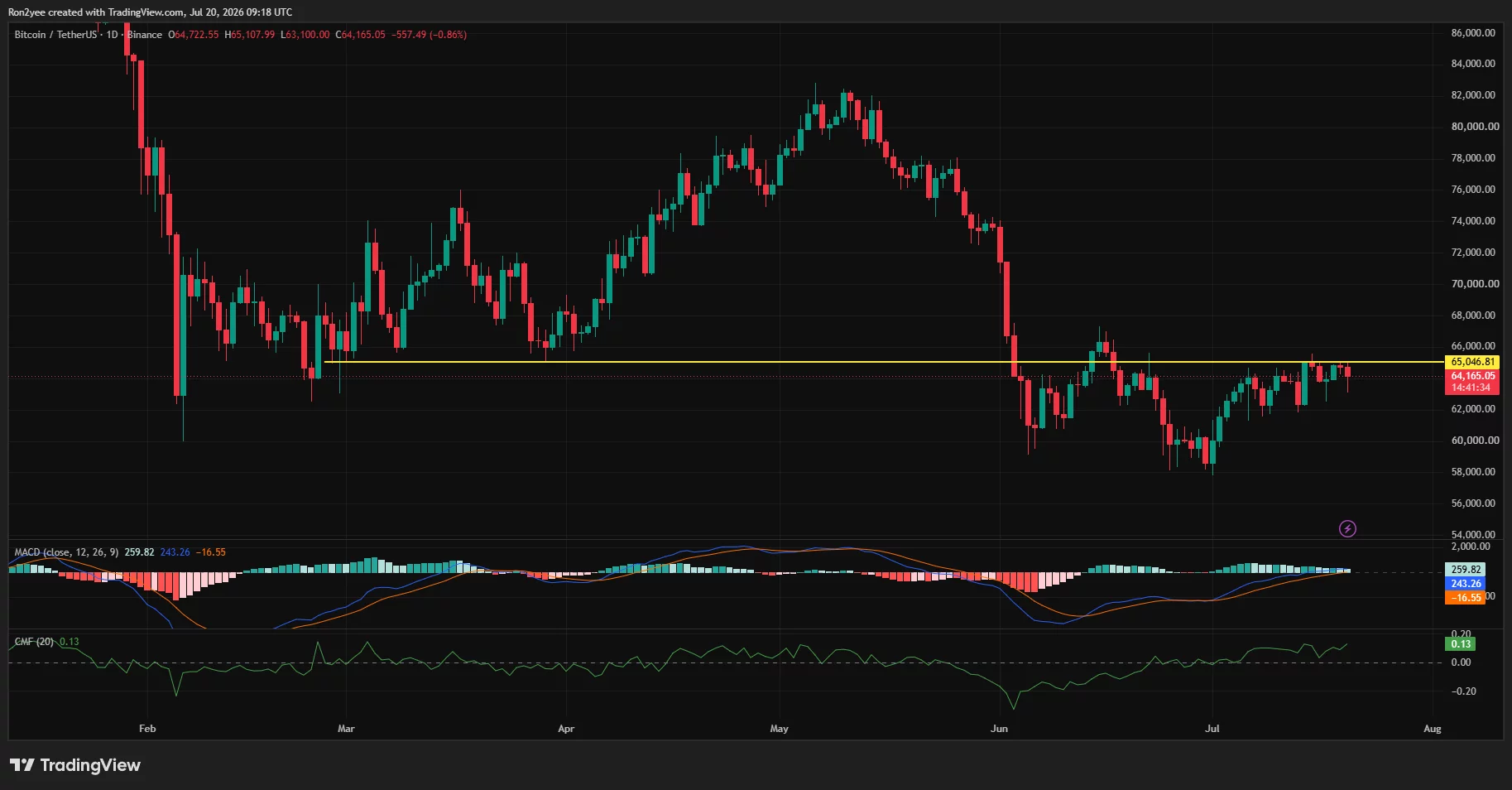
Bitcoin price has slipped below $64,000 as renewed US-Iran tensions, volatile oil prices, and a technology-sector sell-off tied to China’s Kimi K3 launch drove investors away from risk assets.
Summary
- Bitcoin price fell below $64,000 as Middle East tensions and Kimi K3 rattled risk markets.
- BTC must reclaim $65,047 to confirm a sustained recovery toward $67,000.
- A break below $62,708 could expose the $60,000 support and trigger further liquidations.
According to data from crypto.news, Bitcoin (BTC) price fell nearly 2% to $63,785 on Monday before recovering toward $64,000, still down about 1% over the past 24 hours. The Crypto Fear & Greed Index remained in “Fear” territory at 29, while Ether, XRP, BNB, and Dogecoin also posted slight daily losses.
Middle East risks intensified after a projectile set a vessel ablaze in the Strait of Hormuz, forcing its crew to abandon ship before a tugboat rescued them. US strikes also killed one person in Tabriz, while Tehran condemned attacks on the unfinished Darkhovin nuclear facility.
CENTCOM separately reported that a US service member died during the controlled detonation of an unexploded Iranian drone in northern Iraq.
The attacks initially drove crude oil higher as traders assessed the threat to Middle Eastern production and shipping. Brent briefly exceeded $85 per barrel before falling toward $82 after Iran’s Foreign Ministry confirmed that international mediators had submitted proposals to reduce tensions.
Tehran also left the door open to negotiations with Washington if talks served Iran’s national interests. The diplomatic opening reduced immediate supply fears, although attacks on vessels, Iranian cities, and nuclear infrastructure kept the risk of another oil-price surge in place.
Technology stocks added another source of pressure after Beijing-based Moonshot AI released Kimi K3, a 2.8 trillion-parameter model designed for coding and agent-based tasks. Moonshot’s internal tests placed Kimi K3 ahead of several Western rivals in frontend coding, although those performance claims await independent confirmation when the model weights become available.
The launch intensified concerns that cheaper Chinese models could disrupt US artificial intelligence companies and their semiconductor suppliers. Bitcoin has traded closely with technology-heavy equity indices during recent risk-off sessions, leaving the cryptocurrency exposed as investors reduced positions across speculative markets.
US equity funds recorded $4.8 billion in withdrawals during the week ended July 15, according to LSEG Lipper data cited by Reuters. The Philadelphia Semiconductor Index lost 8.48% during the same period, while growth funds suffered $7.18 billion in net redemptions.
Bitcoin price must reclaim $65,000 to confirm a sustained recovery
Bitcoin’s daily chart shows repeated failures around $65,047, a former support level that has turned into resistance. Buyers have tested the barrier several times since early July, but each attempt has ended without a daily close above it.
A decisive close over $65,047 would restore the recovery structure and expose the June swing high near $67,000. Until then, Bitcoin remains inside the range between roughly $60,000 and $65,000 that has controlled price action for most of July.
On the 4-hour chart, BTC has fallen below its 20-period simple moving average at $64,206 but remains close to the 50-period average at $64,024. The 100-period SMA at $63,642 offers the next support, followed by the 200-period SMA near $62,708.
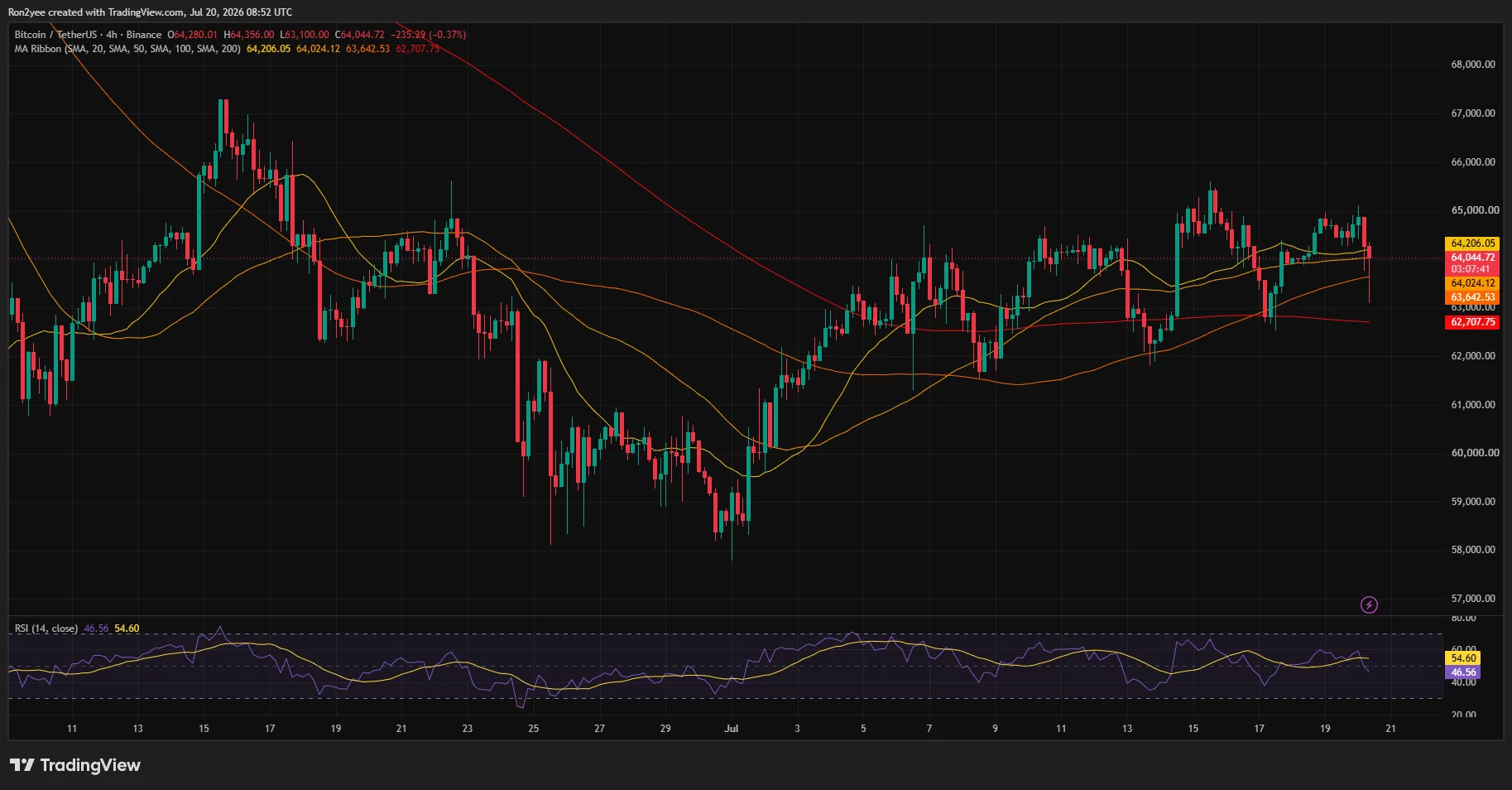
4-hour relative strength has dropped to 46.56, below its moving average of 54.60. The reading shows that sellers have regained control of short-term momentum, though BTC has not yet entered oversold territory.
Daily momentum presents a mixed picture. The MACD histogram has slipped below zero to -16.55 as the MACD and signal lines converge, raising the risk of a bearish crossover. However, the Chaikin Money Flow reading remains positive at 0.13, which shows that capital has not left the market at the same pace as the price decline.
According to trader Daan Crypto Trades, Bitcoin is still attempting to close above its weekly 200-period moving average, but a stronger advance is needed to challenge the weekly 200-period exponential moving average.
“Until then, we’re just caught in this $60K choppy price range.”
Spot Bitcoin ETFs have provided limited relief after more than eight weeks of heavy withdrawals, SoSoValue data shows. US-listed funds posted a second consecutive week of net inflows, while BlackRock’s IBIT helped drive a $132 million inflow on Friday despite a $4.2 million withdrawal from Fidelity’s fund. The improvement remains too small to establish aggressive institutional accumulation.
The three-day liquidation heatmap places the largest overhead liquidity concentration around $65,200 to $65,500. A move into that band could force leveraged short positions to close and help BTC challenge the daily resistance near $65,047.
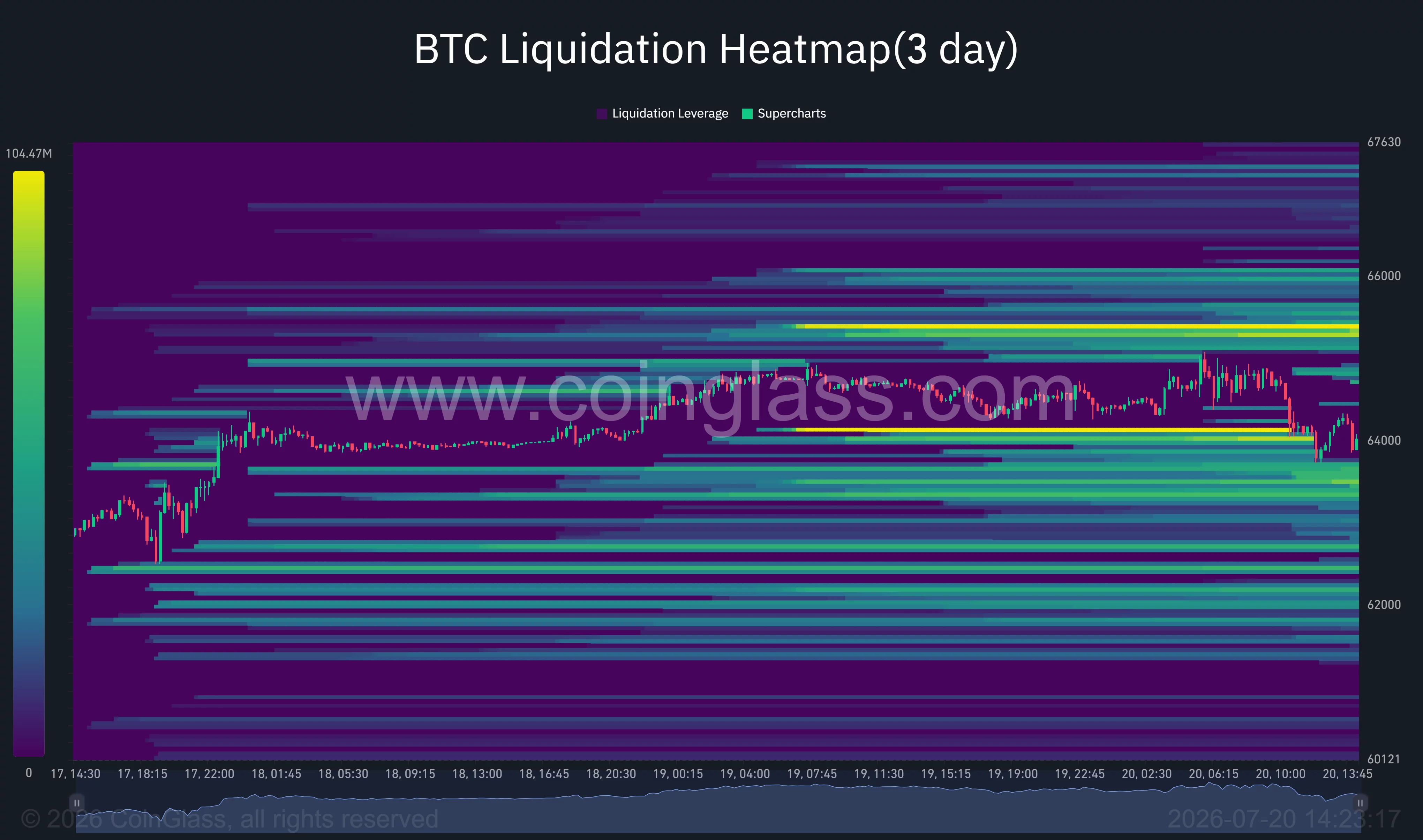
Below the market, liquidation pools sit between $63,300 and $63,600, with another concentration around $62,500 to $62,800. Price frequently moves toward dense leverage zones, making either cluster a potential target if volatility expands.
Loss of $62,700 would expose Bitcoin to another capitulation leg
Bitcoin’s recovery thesis would weaken if sellers force a 4-hour close below the 100-period SMA at $63,642. A subsequent break under the 200-period SMA at $62,708 would expose $60,000, followed by the late-June low near $58,000.
Analyst Ardi warned that the current bear-market decline has not produced the severe capitulation seen before previous cycle bottoms. In his view, either months of range-bound trading must exhaust sellers or a deeper liquidation event must clear the remaining leverage.
Oil remains the main external risk. Failed US-Iran negotiations or renewed threats to regional energy routes could send crude higher again, revive inflation fears, and reinforce the Federal Reserve’s higher-for-longer policy stance.
For bulls, a daily close above $65,047 would invalidate the immediate bearish setup and open the path toward $67,000. Without that breakout, Bitcoin remains vulnerable to another sweep of leveraged positions below $63,600.
Disclosure: This article does not represent investment advice. The content and materials featured on this page are for educational purposes only.
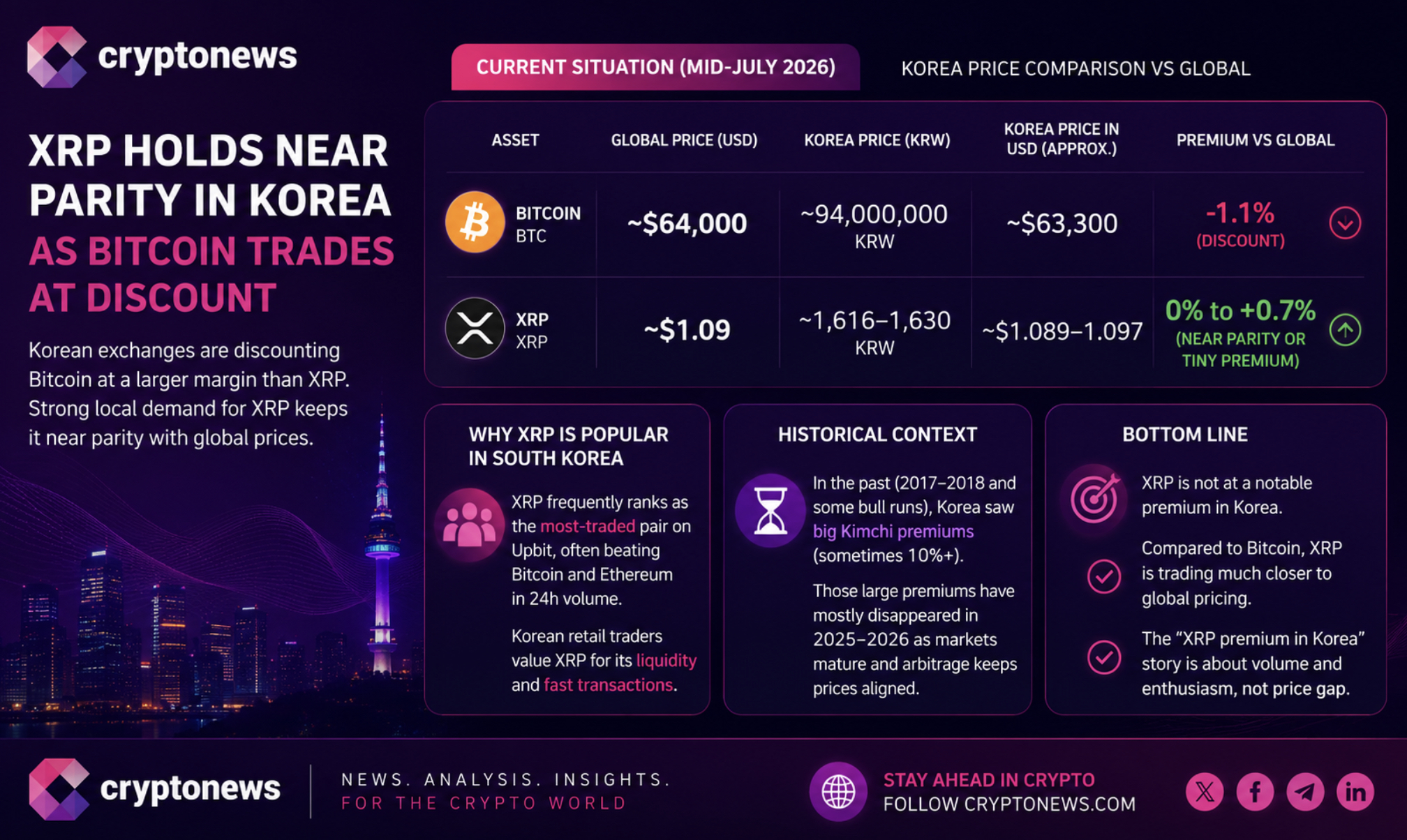
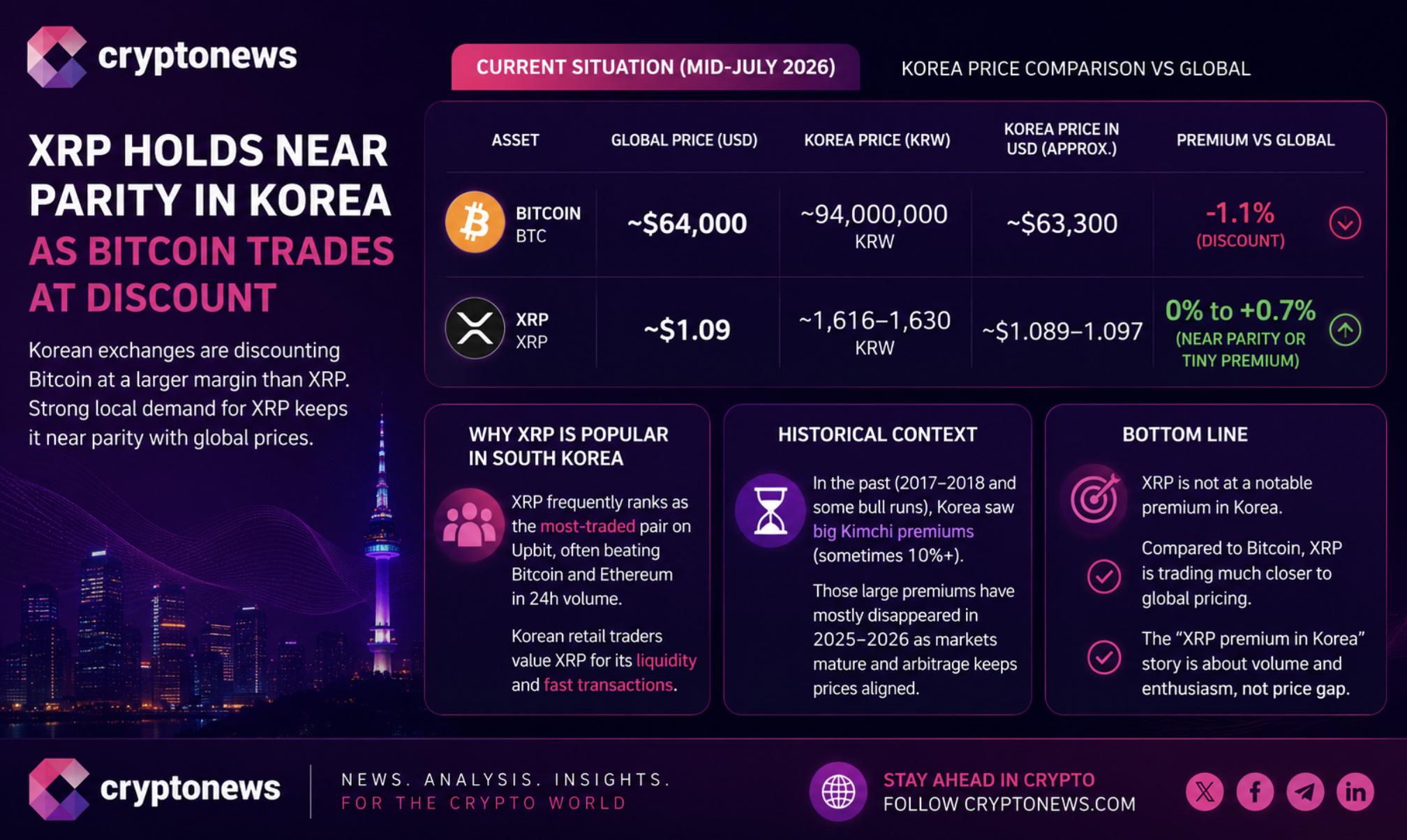
XRP is trading around $1.09 with little price change over the past 24 hours, but the prediction worth watching is not from the chart. It is in the premium spread. Korean exchanges are discounting Bitcoin more heavily than XRP, a subtle but telling divergence. When Korean traders hold one coin tighter, it often hints at stronger local conviction. That gap could matter more than the next flashy candle.
Over the past 48 hours, crypto markets have been trapped in a narrow range. Bitcoin hovers around the mid $64,000 area, while Asian altcoin activity has remained surprisingly lively despite the lack of a clear trend. South Korean exchanges, long known for driving retail momentum, continue showing stronger relative demand for XRP than for Bitcoin.
Meanwhile, macro events still call the tune. Inflation data and central bank comments remain the biggest catalysts for risk appetite across crypto. Even so, XRP has managed to defend the $1.05 area, keeping the current structure intact. That gives bulls something to work with, even if nobody is popping champagne yet.
The technical setup remains tight. The next resistance test should reveal whether the Korean bid is an early clue or just another market quirk. Either way, conviction usually shows up before the fireworks, not after.
Discover: The Best Token Presales
XRP Price Prediction: Can it Push Toward $1.30 on Korean-Driven Volume?
XRP is trading around $1.09, posting a modest weekly gain of about 1%. That is constructive, although nobody would call it a sprint. Its market capitalization sits near $68 billion, backed by roughly 62.4 billion circulating tokens. Trading volume remains fairly subdued, which is the honest catch. The Korean premium reflects positioning, not a volume-fueled breakout.
The chart still favors patience, as the $1.05 area has repeatedly attracted buyers, gradually building a solid base instead of a reversal. Meanwhile, resistance sits around $1.13, with a stronger ceiling between $1.20 and $1.30. Price action continues to hover just above $1.09, leaving momentum balanced rather than committed.
The bull case is straightforward. Korean demand strengthens, fresh regulatory headlines improve sentiment, and XRP clears $1.13 before challenging the $1.20 to $1.30 zone. If momentum traders join the move, that ceiling could finally crack. Markets rarely send engraved invitations, so the first breakout often feels awkward.
The base case remains a sideways grind between roughly $1.05 and $1.13 as traders wait for macro data. The bear case appears if Bitcoin stumbles on a hawkish surprise and XRP loses the $1.05 support zone. That would weaken the current base and delay any breakout story. XRP’s all-time high near $3.84 remains the long-term benchmark, but reaching it would require a very different market backdrop.
Trade XRP on Bybit and Get a Chance to Win Our $1,000 USDT Airdrop
LiquidChain Targets Early-Mover Positioning as XRP Tests Key Levels
XRP consolidating at $1.09 with a $68 billion market cap means the upside math is real but not dramatic at the current entry. A move to $1.30 is a 19% gain, worthwhile, but it requires macro tailwinds, regulatory news, and sustained Korean volume all cooperating simultaneously.
As of today, traders looking for asymmetric exposure in the current cycle are increasingly scanning early-stage infrastructure plays where the entry price reflects genuine risk, not institutional markup.
LiquidChain ($LIQUID) is an L3 infrastructure project positioning as a cross-chain liquidity layer. Its core proposition is the fusion of Bitcoin, Ethereum, and Solana liquidity into a single execution environment.
The Order builds. — LiquidChain (@getliquidchain) July 15, 2026
Brick by brick. Layer by layer.  ⟁https://t.co/vqvBcdSQYC pic.twitter.com/tcfMNP4lNq
The architecture includes a Unified Liquidity Layer, Single-Step Execution, Verifiable Settlement, and a Deploy-Once model for developers (one build, full ecosystem access). The presale is currently priced at $0.01481, with $910K raised to date.
The infrastructure thesis of solving cross-chain fragmentation rather than adding another chain is a credible problem statement at a stage where price reflects early positioning rather than market validation. Research LiquidChain here if the L3 infrastructure angle fits your current thesis.
Discover: The Best Crypto to Diversify Your Portfolio
The post XRP Price Prediction: Can Korean Demand Trigger XRP’s Next Breakout? appeared first on Cryptonews.


Crypto’s major events this week are set in Washington D.C. A House Financial Services subcommittee opens with a hearing on oversight of the Financial Crimes Enforcement Network.
The Office of the Comptroller of the Currency’s (OCC) comment period on proposed GENIUS Act rules extending anti-money laundering and sanctions standards to stablecoin issuers closes July 24.
The Commodity Futures Trading Commission’s (CFTC) window on 24/7 trading and perpetual-style bitcoin futures closes July 27, three months after the regulator cleared the first regulated bitcoin perpetual on Kalshi. The GENIUS Act turned one this month, and the rules built on it are still being written.
The macro calendar centers on Thursday’s European Central Bank decision, with markets pricing a hold.
Traders will also be monitoring geopolitical developments and oil prices for potential clues about what markets may do next.
What to Watch
(All times ET)
- Crypto
- Macro
- July 20, 8:30 a.m.: Canada CPI YoY for June (Prev. 3.2%); Core CPI YoY (Prev. 2.2%)
- July 22, 2:00 a.m.: U.K. CPI YoY for June (Prev. 2.8%); Core CPI YoY (Prev. 2.6%)
- July 23, 8:15 a.m.: European Central Bank interest-rate decision est. 2.4% (Prev. 2.4%), followed by press conference at 8:45 a.m.
- July 23, 8:30 a.m.: U.S. Initial Jobless Claims for period ending July 18 (Prev. 208K)
- July 23, 7:30 p.m.: Japan CPI YoY for June (Prev. 1.5%); Core CPI YoY est. 1.6% (Prev. 1.4%)
- July 24, 4:00 a.m.: Eurozone S&P Global Composite PMI Flash for July est. 50.0 (Prev.50)
- July 24, 9:45 a.m.: U.S. S&P Global Composite PMI Flash for July (Prev. 51.9)
- July 24, 9:45 a.m.: U.S. S&P Global Manufacturing PMI Flash for July (Prev. 53.9)
- July 24, 9:45 a.m.: U.S. S&P Global Services PMI Flash for July (Prev. 51.2)
- Earnings
- July 21: Interactive Brokers Group (IBKR), post-market, $0.61
- July 22: CME Group (CME), pre-market, $2.99
- July 22: Tesla (TSLA), post-market, $0.44
- July 23: Nasdaq (NDAQ), pre-market, $0.95
Token Events
- Governance Votes & Calls
- ENS DAO is voting on an executable proposal to establish a new security council for a two-year term, granting proposal-cancellation power to the newly elected multisig and contract. Voting ends July 20.
- Lido DAO is voting to launch a permissionless community staking module and adopt a case-by-case penalty framework for Curated Module v2 node operators. Voting ends July 20.
- Superfluid DAO is voting on the nominee selection phase for its security council election, where delegates can distribute votes among three contenders. Voting ends July 21.
- Compound DAO to vote on a proposal to update the cbBTC price feeds in its AERO, USDC, USDS and WETH markets on Base to use the new SVR price feeds. Voting ends July 21.
- Arbitrum DAO is voting to ratify improvements to its security council election process, including extending member terms from one to two years. Voting ends on July 23.
- ZKsync DAO is voting on the ZIP-16 v31 protocol upgrade to introduce Priority Mode and to unify the shared codebase between ZKsync Era and ZKsync OS. Voting ends July 23.
- Unlocks
- July 20: LayerZero (ZRO) to unlock 4.6% of its circulating supply worth $20.59 million.
- July 20: Starknet to unlock 2.6% of its circulating supply worth $5 million.
- July 21: Avalanche (AVAX) to unlock 0.7% of its circulating supply worth $23.3 million.
- July 21: to unlock 1.2% of its circulating supply worth $24 million.
- July 23: Arbitrum (ARB) to unlock 1.4% of its circulating supply worth $12.3 million.
- July 24: to unlock 1.5% of its circulating supply worth $57.7 million.
- July 25: Humanity Protocol (H) to unlock 2.7% of its circulating supply worth $15.6 million.
- July 26: Toncoin (TON) to unlock 0.9% of its circulating supply worth around $69.9 million.
- Token Launches
Conferences
Pi Network’s PI and PUMP Rocket Daily, Bitcoin Fights For $64K: Market Watch

10 Greatest Low Fantasy Books of All Time

Keir Starmer Resigns As Prime Minister After 2 Years


-
 NewsBeat4 days ago
London Mayor Sadiq Khan handed a peerage by Keir Starmer alongside 15 other Labour figures… just days before the PM leaves No10
-

 Fashion3 days ago
Weekend Open Thread – Corporette.com
-

 Politics2 days ago
The House | The City of London can help the new chancellor deliver growth in every postcode
-

 Politics5 days ago
Young campaigners urge incoming PM to act on outdoor junk food ads
-

 Crypto World4 days ago
CFTC blocks Kalshi from unwinding Michigan trades after court order
-
 Crypto World3 days ago
Two July Windows Left: The CLARITY Act’s Senate Fight and What Failure Means
-

 Business4 days ago
Nvidia Stock Slips After Big Tuesday Rally as Huang Confirms Vera Rubin Chip Is Now in Production Today
-

 Crypto World2 days ago
Ripple Payments Joins MiCA With 14 Firms, Does It Mean Anything For XRP?
-

 Politics21 hours ago
Democrats look to World Cup watch parties to register thousands of voters
-

 Crypto World3 days ago
Ripple wins EU-wide access as ESMA adds it to MiCA register
-
 Entertainment5 days ago
Disney’s Most Ambitious Failed Star Wars Attraction Is Coming to SDCC
-

 Crypto World4 days ago
Injective Submits SEC Transfer-Agent Registration to Onchain Ownership Records
-

 Business4 days ago
Palantir Shares Rise After Expanded Nvidia Partnership and Fresh Analyst Upgrades Ahead of Earnings Day
-

 Tech6 days ago
Get Your ESP32 Sunny Side Up With This Solar Dev Board
-

 News Videos6 days ago
XRP BOMBSHELL… XRP OMBOARDED FOR TRANSACTIONS!!!
-

 NewsBeat3 days ago
Registration is now open for March for Men with Kev 2026
-

 Tech6 days ago
Dark Secrets Emerge When Jailbreaking LLMs
-
 Sports5 days ago
New Cornerback Enters Vikings Trade Rumor Mill
-

 News Videos3 days ago
Money | Class 12 Economics | CBSE Board Exam 2026-27
-

 Business3 days ago
Banco Bilbao Vizcaya Argentaria, S.A. (BBVA) Discusses Global Macro Environment and Economic Outlook for Core Markets Transcript
You must be logged in to post a comment Login