

Crypto World
Saylor distances himself from STRC-backed DeFi after stablecoin wobble



For months, Strategy (formerly MicroStrategy) founder Michael Saylor frequently reposted news about DeFi protocols using a variety of tokens and blockchains backed by Strategy’s STRC.
Now that their stablecoins and other yield farming tokens have wobbled, he wants everyone to know he was only sharing news, not endorsements.
STRC is one of Strategy’s stocks. It usually trades near $100 and pays a variable, 11.5% annualized dividend. Due to its high current rate of payouts, DeFi yield farmers find STRC appealing to tokenize through a variety of protocols, proprietary tokens, and blockchains.
Saylor took to social media today to clear up any misunderstanding about his frequent and prominent reposts about these non-bitcoin (BTC) tokens.
In his view, the free publicity he gave them was merely a series of non-endorsement “notifications.”
Saylor isn’t a BTC maximalist by the strictest of definitions. Indeed, despite Bitcoin branding and orange coloring across his company, website, and even attire, Saylor has spoken positively about alternative blockchains such as Ethereum and BNB Chain, so long as their utility improves adoption of BTC or Strategy’s securities like MSTR and STRC.
At altcoin conferences, he acknowledges the work of alternative blockchains in distributing proxies for BTC and Strategy exposure.
The timing is his disclaimer wasn’t subtle. In recent days, STRC-backed stablecoins like apxUSD and sUSDat started trading well below their prior $1 targets.
Within the last week, the STRC-backed sUSDat on Ethereum traded 9.5% below its $1 target, and apxUSD similarly traded below $0.91.
Both mirrored a crash in STRC, a stock that Strategy tries to keep trading near $100 despite it hitting $90.38 on Friday.
DeFi protocols Saylor ‘notified’ everyone about
In addition to social media reposts, Saylor named DeFi builders himself on stage at the Bitcoin 2026 conference, presenting three projects using STRC powered by a variety of altcoins: Apyx, Saturn, and Hermetica.
For example, Apyx uses DeFi protocols to transform STRC exposure into a type of synthetic dollar, apxUSD.
Saturn does roughly the same through its sUSDat token while another protocol, Pendle, slices STRC-backed tokens into ostensibly stable tokens as well as yield tokens like apyUSD.
Traders then loop their assets to borrow and re-borrow, manufacturing leveraged yields atop STRC that can reach higher than 38%.
Saylor didn’t merely tolerate this machinery, he repeatedly amplified these DeFi projects through reposting “notifications.”
For example, when STRC slipped, Saylor reposted Apyx declaring, “We just bought the $STRC dip.”
Saylor reposted Saturn touting its increasing STRC exposure.
He reposted Pendle celebrating roughly half a billion dollars in STRC-linked deposits.
Although Saylor claims he never endorsed them, the protocols themselves never hid their devotion.
Indeed, Saturn’s account describes its team as “Disciples of @Saylor” while Strata, another builder in the convoluted stack of STRC-backed DeFi, used Saylor’s own terminology, “The Bitcoin Credit flywheel is spinning.”
Read more: Strive’s $50M STRC bet is already underwater
The most prominent bitcoin buyer sells
During the last week of May, Strategy sold 32 BTC, its first sale since 2022. The price of BTC immediately crated.
Saylor had spent years swearing he had no intention to sell Strategy’s BTC. Nonetheless, after the world’s most prominent buyer turned into a seller, BTC dropped from above $73,000 to near $62,000 within the month of June alone.
Unfortunately, the typically stable STRC fell with it, and the DeFi tokens that used STRC as backing inherited that volatility. A synthetic dollar is no more stable than the asset backing it.
The DeFi protocols Saylor broadcast to millions of his followers on X and other media appearances are declining in value along with STRC, so now he insists his reposts were only ever harmless notifications.
Got a tip? Send us an email securely via Protos Leaks. For more informed news and investigations, follow us on X, Bluesky, and Google News, or subscribe to our YouTube channel.

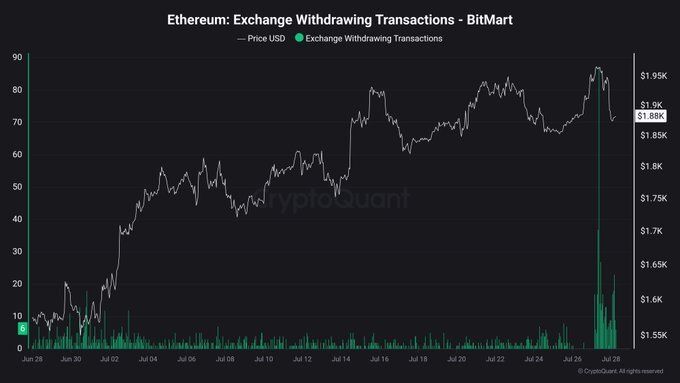
Ethereum withdrawals from BitMart have jumped to their highest level in a year. Users are rushing to pull ETH before the exchange finishes winding down its trading platform.
The exchange had frozen withdrawals briefly, then reopened them within the last day. That reopening triggered an immediate rush for the exits.
BitMart’s move followed a July 26 announcement confirming it would shut down trading entirely over the coming months. Years of declining liquidity had already pushed the exchange out of the top 10 by trading volume. The notice still caught many remaining users off guard.
Ethereum Withdrawals Hit a 2026 High
Data tracked via the blockchain analytics platform CryptoQuant highlights this massive exodus. The metrics reveal Ethereum withdrawal transactions from BitMart climbing past every prior reading since July 2025. That marks a clear signal that holders are moving funds off the exchange while they still can.
The surge tracks closely with BitMart’s own shutdown timeline. Registrations, deposits, and new trading orders paused on July 26. Full trading services end on August 26. Withdrawals stay open through January 2027, giving remaining users a narrow but real window to retrieve their holdings before the final deadline.
BitMart’s exit adds to a run of 2026 shutdowns. Its own token, BitMart Token (BMX), tumbled after the wind-down announcement rattled traders. The closure landed just three days after derivatives exchange BitMEX confirmed its own exit from the market.
Decentralized exchange Dango also halted its blockchain this month. The project shut down entirely after finding no path to lasting success, becoming the third notable platform to close in July alone.

Analysts Call the Wave a Healthy Reset
Historically, exchange failures spark brief panic before conditions settle. Several analysts, meanwhile, are reading these closures as a healthy correction rather than a warning sign for the broader market.
Some traders view the shakeout as clearing out weaker platforms, not as evidence of wider contagion. Smaller exchanges carrying similar liquidity problems could face the same pressure to consolidate or close before the year is out, industry watchers suggest.

Ethereum (ETH) itself has held steady through the turmoil. The token is trading near $1,881, according to the latest BeInCrypto data. Trading volume across the broader market has stayed largely unaffected by the BitMart news, suggesting the impact remains contained to the exchange itself.
Therefore, the withdrawal rush looks like an isolated reaction to one exchange’s closure rather than a market-wide flight from centralized platforms. Ethereum’s price action, in particular, shows little sign of stress spilling beyond BitMart’s own user base.
Still, the pattern raises a question for the rest of 2026. More struggling exchanges could follow BitMart, BitMEX, and Dango toward the exit before the year ends. For now, BitMart users have a shrinking window to move their funds. The CryptoQuant data suggests many are taking it while they still can.
The post Ethereum Withdrawals From BitMart Surge After Wind-Down Notice appeared first on BeInCrypto.
Lido, one of the largest liquid staking platforms on Ethereum, has rolled out an upgrade to its staking infrastructure aimed at improving how validators operate while supporting greater decentralization. The change centers on Curated Module v2, a new component within Lido’s validator system.
According to a Lido update published Monday, the upgrade adds support for Ethereum’s 0x02 withdrawal credentials. That support is expected to let validators raise their effective balance from the familiar 32 ETH threshold to sizes of up to 2,048 ETH, depending on how validators are configured.
Key takeaways
- Curated Module v2 is designed to improve validator efficiency by enabling validator effective balances to scale up to 2,048 ETH via Ethereum’s 0x02 withdrawal credentials.
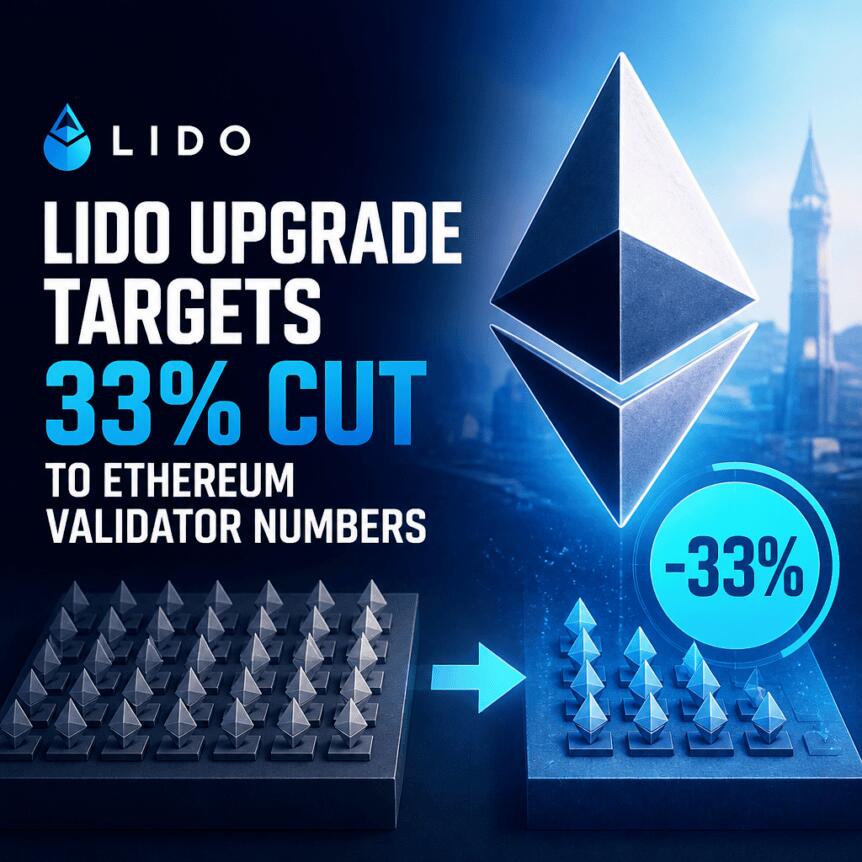
- Lido projects the migration could reduce validator count from about 880,000 to roughly 628,000—a drop of around one-third.
- The upgrade is expected to impact Ethereum’s consensus layer (validator set size and related messages) rather than execution-layer activity like transaction fees.
- Lido is adding bonding and penalty accountability mechanisms for node operators as part of the upgrade.
- Lido says no staker action is needed because the migration is handled at the protocol level.
What Curated Module v2 changes
At the core of the upgrade is the introduction of 0x02 withdrawal credentials support. Lido says this enables validators to increase their effective balance, moving beyond the 32 ETH effective balance commonly associated with how validators are structured.
Lido’s update frames this as a step toward a leaner, more efficient validator footprint. By allowing validators to operate with larger effective balances, Lido expects fewer validators are needed to secure and attest on the network at comparable levels of staked participation.
Importantly, Lido emphasizes that the change is not meant to alter the execution layer—the part of Ethereum responsible for ordering transactions and determining gas costs and fee levels. Instead, Lido says the upgrade should primarily affect how the consensus layer is maintained, including the number of validator messages required to keep the network running.
Projected validator count reduction—based on Lido estimates
Lido said the migration has not started yet and that the figures it shared are projections from its modeling. Under those assumptions, Lido expects the validator count could fall from around 880,000 to about 628,000, representing an approximate 33% decrease.
The practical implication for investors and network participants is that a smaller validator set can change the operational dynamics of staking at scale. Even if overall security assumptions remain grounded in Ethereum’s consensus rules, the structure of who participates and how often messages are produced can differ when fewer validators are responsible for the same underlying economic weight.
Still, because these are Lido’s projections and the migration has not begun, the direction and magnitude of real-world change may depend on how validators and the wider ecosystem adopt and configure the new credentials over time.
Accountability upgrades for node operators
Beyond changing validator sizing, Lido’s update introduces new accountability measures for its node operators. Lido specifically mentioned bonding and penalty mechanisms, indicating that operator security and performance expectations may be enforced more directly through economic incentives and disincentives.
The update also suggests future stake distribution could weigh additional factors. Lido said more emphasis could be placed on operator performance, fees, and contributions to Ethereum’s broader ecosystem—signals intended to reward not just participation, but sustained operational quality and active involvement.
For users who rely on Lido’s liquid staking token—rather than operating validators themselves—the significance is indirect but meaningful. Upgrades that adjust operator incentives and monitoring can influence reliability and service continuity, which in turn can affect user confidence in the system’s robustness.
However, Lido’s message does not specify exact parameter thresholds or the detailed mechanics of how the bonding and penalties will be applied over time. Readers should watch for subsequent technical documentation or governance updates that clarify those operational details as the migration approaches.
Protocol-level migration: no staker action required
Lido said Curated Module v2 represents the “next major step” in its evolution toward operator incentives, bond-based security, and governance improvements. In its update, Lido also stated that no action is required from stakers, because the upgrade will be handled at the protocol level.
That matters for the practical day-to-day of stETH holders. If the change is fully protocol-managed, users should not need to redeploy wallets, move assets, or change validator relationships during the transition—reducing the operational risk that often accompanies large staking infrastructure shifts.
At the same time, the migration timing is a key unknown in the near term. Lido has not indicated that the upgrade is already underway, and it noted the validator count changes are based on projections. Once execution begins, the market will likely look for evidence that real validator set changes align with the expectations Lido has laid out.
For now, the most important things to monitor are whether the consensus-layer effects match Lido’s estimated validator reduction, and how the new operator accountability mechanisms perform once validators begin migrating to the configuration enabled by 0x02 withdrawal credentials.


Lido has introduced a major upgrade to its Ethereum staking infrastructure that supports higher validator balances and projects a one-third reduction in validator count through its new Curated Module v2.
Summary
- Lido has launched Curated Module v2, allowing Ethereum validators to increase their effective balance from 32 ETH to as much as 2,048 ETH.
- The protocol estimates the upgrade could reduce Ethereum’s validator count by about one third while improving consensus layer efficiency.
- New bonding and penalty mechanisms have been introduced to strengthen accountability for Lido’s node operators.
According to a Monday update from Lido, the latest version of its Curated Module adds support for Ethereum’s 0x02 withdrawal credentials, allowing validators to raise their effective balance from 32 ETH to as much as 2,048 ETH.
The protocol said the change is designed to improve validator operations while continuing its push toward a more decentralized staking network.
Lido projects fewer Ethereum validators
Under the proposed migration, Lido estimates Ethereum’s validator count could decline from roughly 880,000 to about 628,000. The protocol said the migration has not yet started and stressed that the figures are projections based on its current modeling rather than live network data.
Lido said reducing the number of validators would lower the volume of validator messages processed on Ethereum’s consensus layer, making validator management more efficient.
According to the protocol, the change does not alter activity on Ethereum’s execution layer, meaning transaction processing, gas fees, and user-facing network costs are not expected to change as a result of the upgrade.
No action is required from stETH holders because the migration will be handled at the protocol level, Lido said.
Curated Module v2 adds new rules for node operators
Alongside the infrastructure update, Lido has introduced new accountability measures for node operators participating in its curated staking module.
According to the protocol, Curated Module v2 includes bond requirements and penalty mechanisms intended to strengthen operator responsibility. Future stake allocation may also consider factors including operator performance, fee structures, and contributions to Ethereum’s ecosystem rather than relying solely on existing allocation methods.
Describing the release as the next stage in the protocol’s development, Lido said the upgrade combines new operator incentives with bond-backed security mechanisms and governance improvements that are intended to improve the operation of its validator set over time.
While validator balances can now grow well beyond Ethereum’s original 32 ETH limit through the updated withdrawal credentials, the protocol said the changes remain focused on validator management and do not modify Ethereum’s core staking rules.
Institutional use of Lido has continued to expand
The infrastructure upgrade follows several initiatives by Lido this year to strengthen its position across both retail and institutional staking markets.
Earlier this month, Anchorage Digital integrated Lido into its institutional platform, allowing clients to mint and burn wrapped staked Ether (wstETH) without moving assets outside the firm’s regulated custody environment.
According to Anchorage Digital, the integration allows institutions to gain Ethereum staking exposure while continuing to use the custody, reporting, governance, and settlement systems already available on its platform.
At the time, Anchorage Digital co-founder and chief executive Nathan McCauley said liquid staking had become an important part of institutional participation in Ethereum because it reduces operational complexity while keeping assets within regulated custody.
Separately, Kean Gilbert, head of institutional relations at the Lido Ecosystem Foundation, said institutional demand for custody-based staking has increased as staking infrastructure and regulatory frameworks have matured. Gilbert also said Lido has spent more than $4 million on smart contract audits, received an A+ security rating from independent firms including Credora, and has operated without a smart contract exploit since launching in 2020.
According to Gilbert, Lido distributes staked Ether across more than 900 node operators, with no single operator responsible for more than 1% of the network, reducing reliance on individual participants.
Governance changes have accompanied protocol development
The latest infrastructure release follows governance initiatives introduced by the protocol earlier this year.
In March, Lido DAO proposed using up to 10,000 stETH from its treasury to conduct a one-time buyback of LDO tokens after describing the governance token as trading well below what it viewed as the protocol’s underlying fundamentals. The proposal called for purchases to be executed in 1,000 stETH batches, with token holders voting on each tranche before additional buybacks could proceed.
At the time, the DAO said Lido remained the largest liquid staking protocol on Ethereum with approximately 23% market share despite a decline in LDO’s market price. Financial figures released alongside the proposal showed protocol revenue fell 23% to $40.5 million during 2025, while operating costs improved 13% year over year and the protocol’s take rate increased from 5% to 6.11%.
The Curated Module v2 rollout adds another protocol-level update as Lido continues adjusting its staking infrastructure, governance framework, and institutional offerings while preparing for the migration to Ethereum’s updated validator credential system.
Crypto World
Bitcoin Price Prediction: BTC Slides in Asian Hours, Moving in Tandem with Korean KOSPI

Bitcoin price is trading near $63,480 as selling accelerated during the Asian session, sending BTC prediction slipped into a bearish area. The move reflects rising caution across risk assets rather than a crypto-specific event.
South Korea’s KOSPI fell sharply, pressuring major chipmakers including Samsung and SK Hynix. That sparked another round of risk-off trading across global markets. Bitfinex analysts noted Bitcoin often tracks equities during macro-driven selloffs but can decouple during company-specific events.
Even so, today’s market has kept the correlation intact. Meanwhile, the U.S. Senate has delayed action on the CLARITY Act while prioritizing a Russia sanctions bill, removing a near-term regulatory catalyst for crypto.
Attention now shifts to Wednesday’s Federal Reserve rate decision. Traders will also watch Thursday’s Core PCE inflation report and second-quarter GDP data. Together, those releases are expected to shape expectations for interest rates and likely determine Bitcoin’s next major move.
Discover: The Best Crypto to Diversify Your Portfolio
Bitcoin Price Prediction: Recover to $70,000 Before the Fed Decision Wednesday?
Bitcoin is trading near $63,400, holding just above the key $63,000 support level. The past 24 hours saw a range between $63,038 and $65,598. Sellers continue defending the upper end, while buyers have kept $63,000 intact. A confirmed break below that level could expose $60,000, with stronger support waiting between $54,000 and $57,000.
Technically, BTC remains locked inside a consolidation range between $61,000 and $66,000. Some analysts still see a bear flag that could resolve lower if selling pressure persists. However, a weekly RSI bullish divergence near the 200-week SMA continues to support the longer-term recovery case. Similar setups have previously appeared near major cycle lows.

A bullish outcome would require Bitcoin to reclaim and hold above the $65,600 resistance zone after the Federal Reserve decision. That could open the door to a move toward the low $70,000s, with $79,000 remaining a possible upside target if momentum strengthens.
The base case remains range-bound trading between $61,000 and $66,000 until key macro data arrives. Thursday’s Core PCE inflation report could provide the next directional catalyst. On the downside, a confirmed close below $63,000, combined with continued weakness in Asian equities, would increase the odds of a retest of $60,000.
The CLARITY Act delay remains a meaningful headwind. Some institutional participants had viewed the legislation as a supportive near-term catalyst. With that timeline pushed back, traders are focusing instead on macro events and whether risk appetite returns after this week’s data releases.
Trade Bitcoin on Bybit and Get a Chance to Win Our $1,000 USDT Airdrop
Bitcoin Hyper Targets Early-Mover Upside as Bitcoin Tests Key Levels
When spot BTC is rangebound and regulatory catalysts are delayed, capital looking for asymmetric exposure tends to scan earlier in the risk curve. That’s the context worth understanding here, not as a replacement thesis, but a parallel one.
The macro-driven rotation dynamic is well-established: pressure at the large-cap level historically accelerates attention toward infrastructure plays with structural differentiation.
Bitcoin Hyper ($HYPER) is positioned precisely at that intersection. It is the first Bitcoin Layer 2 with Solana Virtual Machine (SVM) integration, bringing sub-second finality, low-cost smart contract execution, and a decentralized canonical bridge for BTC transfers, all while inheriting Bitcoin’s base-layer security.
The project has raised close to $33 million at a current presale price of $0.0136838, with staking available for presale participants. The USP is genuine infrastructure differentiation: not another EVM fork, but SVM performance on a Bitcoin security layer, faster execution than Solana, while anchored to BTC’s trust model.
Research Bitcoin Hyper and review the presale details here.
The post Bitcoin Price Prediction: BTC Slides in Asian Hours, Moving in Tandem with Korean KOSPI appeared first on Cryptonews.


Hyperliquid’s SK Hynix perpetual contract briefly fell about 17.9% on July 28 after an unusually low pre-market trade in South Korea fed into the contract’s oracle pricing.
Summary
- 17.9% intraday decline followed one anomalous NXT trade involving only a single SK Hynix share.
- Trade.xyz operates the SKHX market and is investigating the oracle-driven move, Hyperliquid representatives said publicly.
- HIP-3 deployers control oracle inputs, leverage settings and settlements for markets they independently create themselves.
The market, officially listed as xyz:SKHX, tracks the U.S. dollar value of one common SK Hynix share traded in South Korea. Hyperliquid’s interface displays the contract as SKHYNIX-USDC and permits leverage of up to 10 times.
A Hyperliquid representative said the market was deployed and operated by Trade.xyz under the HIP-3 framework. Trade.xyz is investigating and plans to publish an update after reaching a conclusion, according to a statement reported by ChainThink.
One SK Hynix share triggered the initial price anomaly
The disruption began shortly after South Korea’s alternative exchange, NextTrade, opened its pre-market session. One SK Hynix share changed hands at 1.272 million won, 29.96% below the previous close of 1.816 million won.
The trade briefly placed the stock at its daily lower price limit. Korean reports attributed the print to a possible order error combined with limited liquidity during the early session. The underlying price later moved back above that isolated trade.
On-chain tracker HyperInsight said SKHX dropped from about $1,128.20 to $927 as the external price change moved through the oracle and mark-price system. The contract later recovered above $1,100.
The event occurred during a broader decline in South Korean semiconductor shares. SK Hynix closed the regular Seoul session at 1.55 million won, down 14.65%, although that closing move was less severe than the initial one-share print.Trade.xyz documentation states that the SKHX oracle tracks one SK Hynix common share and converts its Korean won price into U.S. dollars using the prevailing exchange rate.
That design allowed the unusual NXT transaction to affect the on-chain contract even though it involved only one share. Leveraged positions linked to the mark price could then face liquidations or automatic deleveraging as the contract moved lower.
DefiLlama’s later snapshot showed SKHX at approximately $1,067, down 13.7% over 24 hours. Open interest stood near $406 million after falling about 20%, while daily volume exceeded $1 billion. These figures can continue changing as positions are opened and closed.
There is no verified evidence that Hyperliquid’s blockchain or smart contracts were compromised. The available information points to an external market print passing through Trade.xyz’s pricing methodology.
HIP-3 makes Trade.xyz responsible for market operation
HIP-3 allows independent teams to launch perpetual markets on Hyperliquid while using the network’s order books, margin system and liquidation engine. The deployer defines the contract, selects its oracle and controls leverage limits and settlement.
Hyperliquid’s API documentation says deployers supply oracle prices, external perpetual prices and as many as two additional mark-price inputs. The protocol combines those values with a local price based on the best bid, best offer and latest trade. Deployers are expected to consider unusual market conditions when designing price feeds. They must stake 500,000 HYPE and can face slashing for misconduct involving their markets.
As previously reported, Hyperliquid’s HIP-3 framework places oracle selection and market controls with outside deployers. That structure expands the number of tradable assets but makes each deployer’s price methodology central to risk management.
Trade.xyz has not published its conclusion
Trade.xyz had not issued a final incident report when checked. Key unanswered questions include which NXT price inputs entered the oracle, whether filters operated as designed and whether any safeguards will change.
The market remained active after the disruption. Hyperliquid’s documentation allows deployers to halt trading, adjust open-interest limits or settle a contract, but no permanent SKHX suspension had been announced.
Notably, other decentralised exchanges have also introduced perpetual contracts for Korean stocks, increasing the links between thin local trading sessions and continuously operating crypto derivatives.
The next verified update is expected from Trade.xyz. Any final assessment should clarify whether the contract behaved according to its published rules or whether its oracle methodology requires changes.


The IMF said Brazil’s stablecoin market has expanded rapidly since 2017, with cross-border crypto flows growing faster than traditional capital flows.
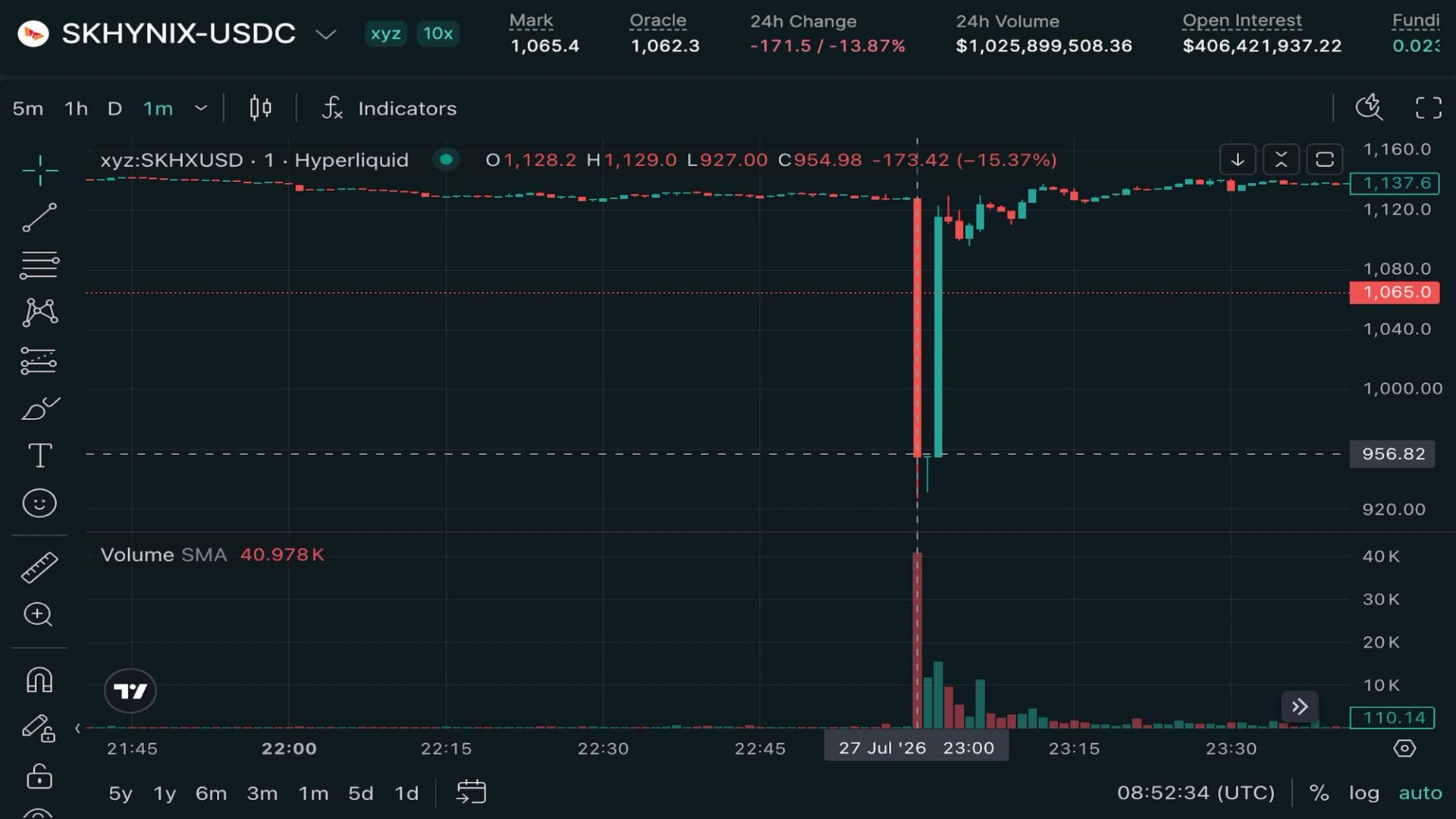
Perpetual futures tied to SK Hynix, a South Korean chipmaker whose American depositary receipts debuted on Nasdaq earlier this month, suffered a flash crash on Hyperliquid shortly before the underlying share price came under pressure in its home market.
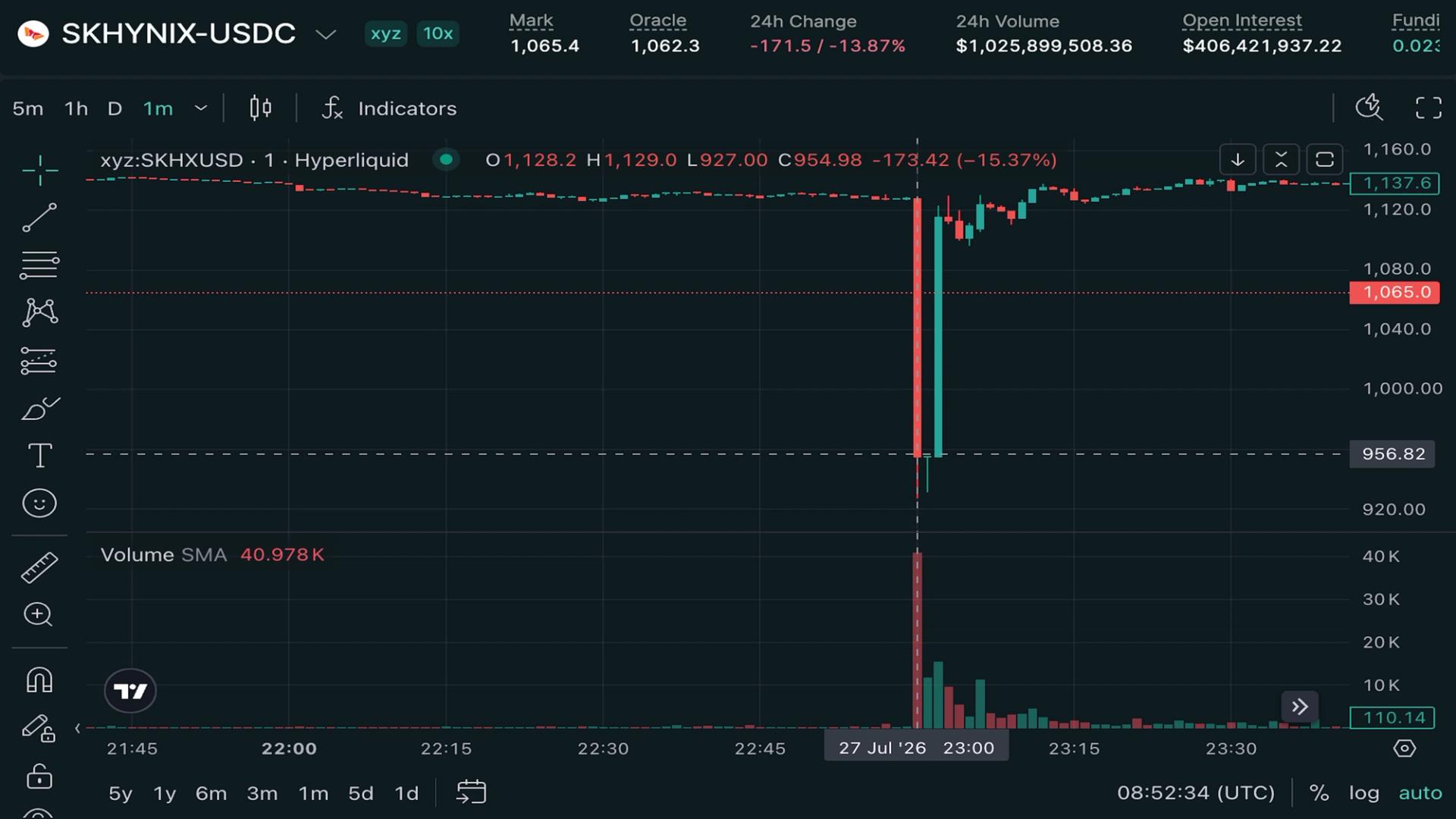
Between 23:00 UTC and 23:01 UTC, the price of perpetuals tracking the Seoul-traded stock crashed 20% to $900, according to data from Hyperliquid. The price rebounded to over $1,000 the very next minute and was recently priced at $1,092. The contract is traded and denominated in dollar-pegged stablecoin USDC.
An hour later, the Korean stock market opened on a negative note, led by chipmakers. By the end of the day, SK Hynix shares had dropped by 15% to 1,550,000 won ($1,762). Other losers included Samsung Electronics and carmaker Hyundai Motor. The benchmark Kospi index fell 11%.
SK Hynix ADRs, 10 of which equal one share, fell 4.5% in pre-market trading to $136.51.
Hyperliquid, the leading perpetuals-focused decentralized exchange, has emerged as a hot favorite of traders looking to express their view on traditional assets, especially since the onset of the Iran war in late February. The exchange had not responded to a request for comment by publication time.


BitMEX is now facing legal action alleging it withheld trader collateral and engaged in insider trading. The new lawsuit accuses Hayes and fellow co-founders, Ben Delo and Samuel Reed, of designing a system to retain customers’ collateral and transfer the remaining bitcoin to the platform’s insurance fund.
“One lawsuit won’t move the market, but allegations involving 622 BTC (worth over $40.5 million) of withheld collateral reinforce the oldest doubt in crypto: your funds are safe until the day they aren’t,” said Samuel Videau, chief technology officer at Genius. “What’s ending is opacity,the model where you wire assets to a black box and take the operator’s word for it.”
The overall crypto derivatives market has barely flinched. The perpetual swap product BitMEX built now generates the bulk of trading activity on larger exchanges like Binance and OKX, alongside traditional platforms like the Chicago Mercantile Exchange (CME).
“The derivatives market is now much larger and more diversified,” said Edwin Cheung, executive director at crypto trading platform Gate. “Most displaced volume is likely to be absorbed by other established platforms.”
The shift suggests exchanges now need scale, regulatory compliance and broader services to survive, rather than relying on retail trading alone.
Although most of the cryptocurrency market has turned red today, some altcoins are taking the storm worse than others. This is typically true for Pi Network’s native token, and today is no exception.
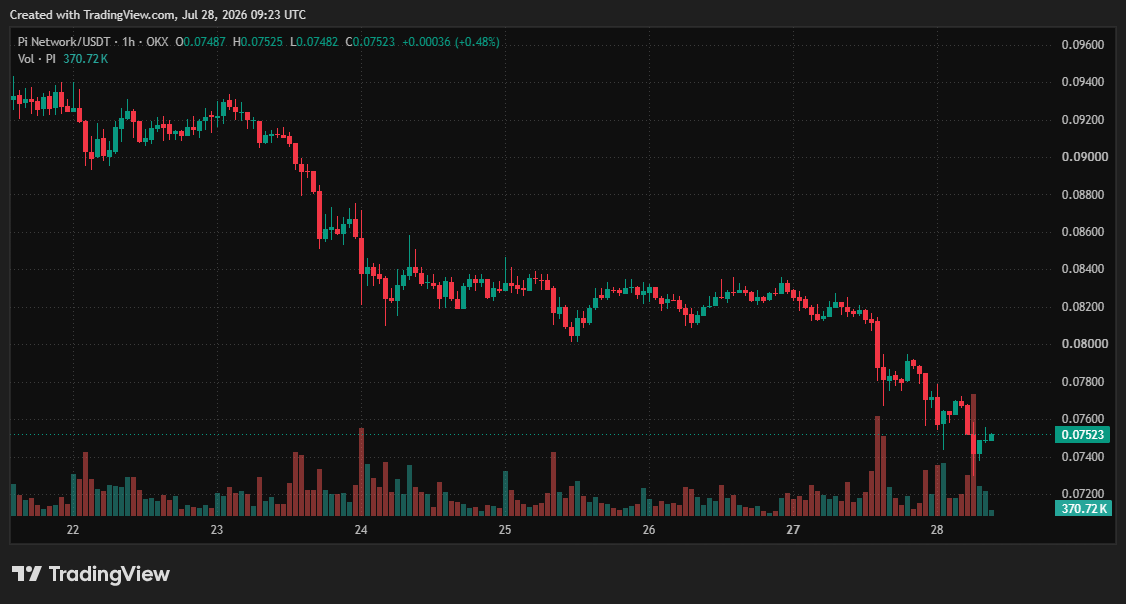
The asset has plummeted by 9% in the past 24 hours and has come painfully close to breaking below $0.07, which would mean a fresh all-time low.
PI Crashes Again
Looking at PI’s price performance, you can easily quote one of the most recognizable songs of all time, which was immortalized from the TV show Friends. It just hasn’t been PI’s day, week, month, or even a year. Aside from a few impressive but very brief pumps, such as the one in March that sent the asset to $0.30 within days, the bears have been in total control, pushing it to a new low after a new low.
The last example came precisely two weeks ago. At the time, PI had broken below the crucial $0.10 support and went into price discovery territory (but on the wrong side). It kept plunging until it finally found some support at $0.07, but only after it had charted a new all-time low.
Although the bulls reemerged at this point and helped it recover some ground to $0.10 in the following 10 days or so, the overall bearish sentiment remained high, and the inevitable transpired. PI was rejected once again, plummeted to $0.08, and after a few days trading above that line, it broke below it in the past 24 hours.
Hours ago, the asset tanked below $0.074, coming about 5% away from its ATL. Although it has rebounded slightly to over $0.075 now, it remains deep in the red daily (-9%) and weekly (-19%).
Washed Out Sentiment
Even before PI’s nosedive to $0.074, popular analyst Ben (co-founder of BSCNew) commented that the sentiment around the asset remains “as washed out as I have seen it.” And all of that comes despite the continuous updates, redesigned apps, and protocol upgrades delivered by the Core Team.
As such, Ben commented that his position is still unchanged as he cares about “shipping cadence more than the weekly candle.” And, he concluded that “the cadence is accelerating.”
Other accounts dedicated to covering Pi Network news, such as Pi Town, are also supportive of what the team is doing, and seemingly remain unfazed by the overall price calamity of the native token.
The post Pi Network Price Nears Record Low: What ‘Washed Out’ Sentiment Means for PI Holders appeared first on CryptoPotato.
The Hyperliquid Policy Center and Multicoin Capital submitted a joint comment to the US Commodity Futures Trading Commission (CFTC) on July 27th.
They expressed support for the agency’s proposed prediction market framework but also pressed for two changes that could affect how on-chain event contracts are designed and approved.
The filing is a direct response to the CFTC’s “Prediction Markets; Public Interest Determinations” proposal published earlier in June. It aims to amend Regulation 40.11 and seeks to establish a 90-day process for reviewing event contracts that may involve gaming, war, terrorism, assassination, or other activities listed in the Commodity Exchange Act, among other things.
HPC and Multicoin called the plan a “clear and well-reasoned framework.” They argued that prediction markets belong under the CFTC’s exclusive federal jurisdiction.
The letter also states that regulating prediction markets on a state level, creating “fifty separate state regimes,” would fragment national derivatives markets.
Prediction markets topped $50 billion in trading volume last month, and the biggest names in traditional finance are moving in.
Today, with @multicoin, we filed a joint comment supporting the @CFTC ‘s proposed prediction markets framework.
These markets have grown up. The… https://t.co/pYG4mevmbT
— Hyperliquid Policy Center (@HyperliquidPC) July 27, 2026
Settlement: Key Regulatory Test
The first concern that the group outlines is related to the use of one word in the Commodity Exchange Act: “involve.” Under the statute’s rule, the CFTC can review contracts that involve certain listed activities and prohibit them when they are contrary to the public interest.
The letter supports an interpretation focused on settlement. Instead of treating trading itself as gaming, regulators would have to examine the event that determines the payout. A contract would fall within the special rule when settlement directly turns on illegal activity, not merely because buying it resembles placing a wager.
In addition, the group asked for more examples. Edge cases may include certain contracts with several potential paths to settlement or products that reference a sensitive activity only indirectly. Clear illustrations would help exchanges and developers assess regulatory exposure before having to commit resources to a launch.
Transparency Could Become a Competitive Requirement
The second recommendation concerns what happens after a review under Regulation 40.11. Under the current proposal, the CFTC would publish written findings when it blocks a contract and explain how that particular decision fits with earlier findings.
HPC and Multicoin argue that this could create an information gap: an approval, including by inaction, can reveal as much about the regulatory boundaries as a prohibition. Without any public reasoning, other platforms may repeat the same legal work, seek guidance, or avoid products that could have been permissible.
In any case, it’s interesting to follow developments surrounding the letter and whether the CFTC would adopt the two requested changes. This could be a signal that regulators are actively listening to industry experts and attempt to legislate in a way that’s both fair to anyone involved.
The post Hyperliquid and Multicoin Push CFTC Toward One Prediction Market Rulebook appeared first on CryptoPotato.

Maximize Education book appeal collects 5,000 books

Coca-Cola (KO) Q2 2026 earnings

Ethereum Withdrawals From BitMart Surge After Wind-Down Notice

Renter of Home in Anne Heche Crash Denies Settlement With Son

No Jackpot Winner as $257 Million Prize Rolls Over to $269 Million Monday Draw

Weekend Open Thread: Staud – Corporette.com

6 Smart Financial Habits That Can Make You Wealthy | Money Management Tip #youtubeshorts#motivation

make money printer #diymoney #cartoonbox se #money #experiment #experiment projectmoney

FOMC Meeting Explained | Gold & Bitcoin Biggest Move This Week? | Interest Rate Decision #shorts
-

 Fashion4 days ago
Weekend Open Thread: Brooks Brothers
-

 NewsBeat7 days ago
How a former Blue Peter presenter stunned America’s Got Talent judges
-

 Tech1 day ago
Intel is reversing course and bringing hyper-threading back to its server chips
-
 Business6 days ago
New Jersey voter registration controversy explained: How 6,600 noncitizens got on the rolls, and what happens next
-
 Entertainment7 days ago
Johnny Depp’s R-Rated Gothic Cult Classic Gets New Release Ahead of Sydney Sweeney Remake
-

 Crypto World5 days ago
Ethics, other provisions in crypto Clarity Act to be further discussed
-

 Politics24 hours ago
Luke Littler dismantles Gerwyn Price to retain title in Blackpool
-
 Sports2 days ago
Commonwealth Games boxing: Jadumani Singh seals dominant 5-0 win over Pakistan’s Sumama Rehman to enter quarter-finals | Commonwealth Games News
-

 Sports4 days ago
2026 3M Open leaderboard: Scottie Scheffler finds putter in Round 1, sits three back
-

 Fashion4 days ago
16 Dresses for the High Summer Event
-

 News Videos5 days ago
The Peugeot Family: How 200 Years of an “Old Money” Dynasty Died in A Boardroom
-

 Politics2 hours ago
The Part of the Electric Transition Nobody Wants to Discuss
-

 Politics2 days ago
Spain sweeps the board at 2026 World Cup with individual awards
-

 News Videos2 days ago
BITCOIN JUST ENTERED THIS CRITICAL ZONE…
-
 Entertainment4 days ago
A New Post-Apocalyptic Gundam Anime Series Blasts Into SDCC
-

 Crypto World2 days ago
XRP Ledger adds $2.6B as RWA inflows rank second
-

 Tech3 days ago
Anthropic launches Claude Opus 5, a cheaper AI model for coding, agents and enterprise workflows
-

 Crypto World5 days ago
Uniswap (UNI) pushes deeper into tokenized RWAs with permissioned trading pools
-

 Crypto World3 days ago
Ripple bought a bank in pieces. The $4 billion audit
-

 Entertainment2 days ago
Sara Gilson Killed By Husband After Viral “Pedophile” TikTok Video
You must be logged in to post a comment Login