
Crypto World
SEC allows Franklin Templeton funds to invest in onchain money fund



The SEC said it will not pursue enforcement action if Franklin Templeton’s funds start investing cash in the asset manager’s own tokenized money market fund.

[Update, Aug. 14, 07:56 UTC: This article was updated to clarify Andre Cronje’s role in developing Fantom’s working network and his former role as Sonic Labs chief technology officer.]
Most decentralized finance (DeFi) protocols are no longer truly decentralized, according to Andre Cronje, founder of DeFi platform Flying Tulip and the technical architect who led the development of Fantom’s working network.
“I don’t think DeFi exists anymore outside of those very small niches,” Cronje told Cointelegraph during Thursday’s Chain Reaction X Spaces show.
He argued that “true DeFi” needs to be decentralized, immutable and without an intermediary, adding: “That statement isn’t really true for pretty much any other protocols running today.”
It’s an idea that Cronje has been raising for months. Earlier this year, he said much of DeFi is “no longer DeFi” in the strict sense, as builders debate whether circuit breakers and other emergency controls are now necessary to protect users from exploits.
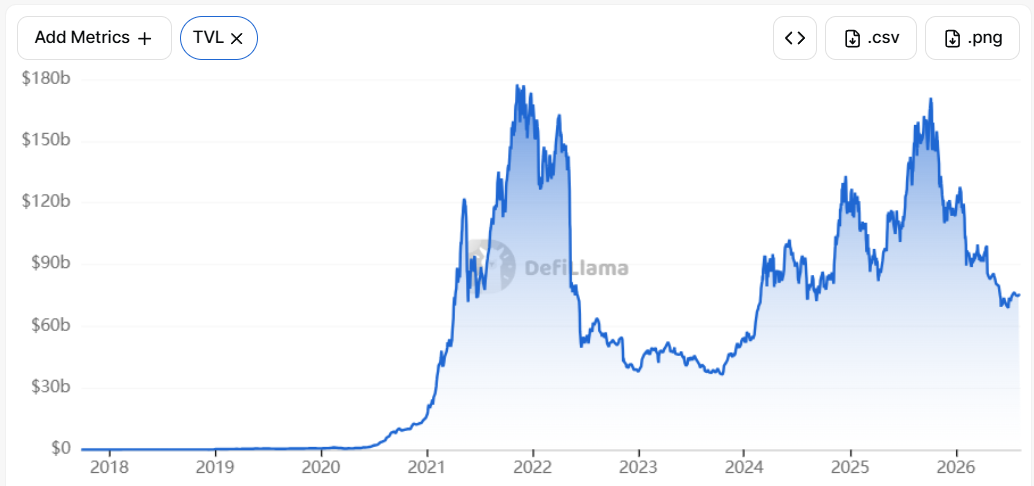
Total value locked (TVL) in DeFi more than halved over the past 10 months, to $75 billion at the time of writing from $167 billion in early October 2025, according to DefiLlama.
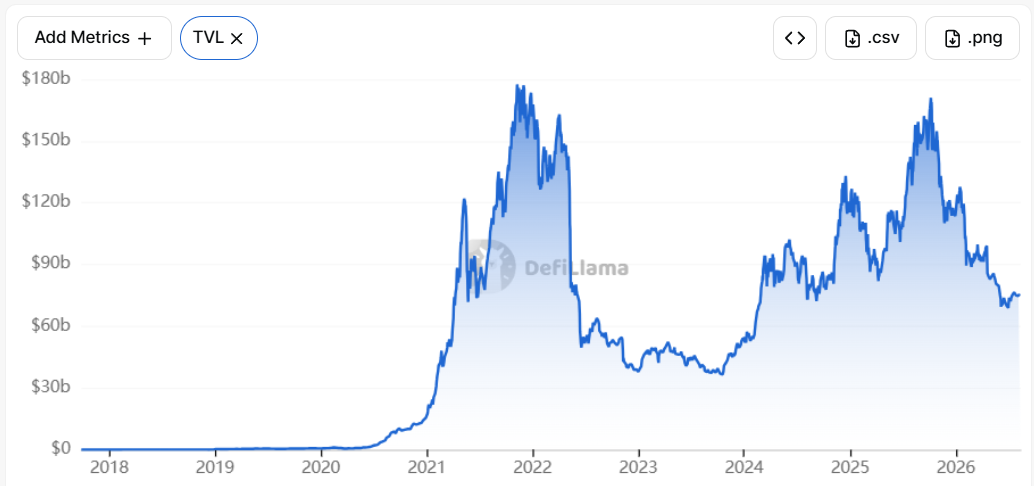
DeFi TVL, all-time chart. Source: DefiLlama
He’s not alone in this thinking. The European Central Bank has also questioned whether decentralized autonomous organizations (DAOs) are sufficiently decentralized to remain outside regulators’ scope. In a March working paper, the ECB looked at Aave, MakerDAO, Ampleforth and Uniswap and found that the top 100 governance token holders controlled more than 80% of the supply in each protocol, based on holdings snapshots from November 2022 and May 2023.
The ECB authors said these findings call into question the inherent decentralization of DAOs and whether they should remain outside of the bloc’s Markets in Crypto-Assets Regulation (MiCA) as “fully decentralized” services.
Related: Wintermute to pour $1B into AI, high-frequency trading amid TradFi expansion: Report
DeFi departed from decentralization
Cronje contended that DeFi departed from its inherent decentralization into a new financial paradigm called “onchain finance or open finance.” To support this, he said:
“We’ve long since moved on from [DeFi]. Because your intermediary now is a company, it’s a decision maker, it’s a curator, it’s a risk committee, it’s all the traditional kind of things we saw in banking. ”
However, Cronje argued that this doesn’t exclude the existence of true DeFi and added that he still sees true innovation among some DeFi protocols.
Cronje is among the most respected founders in DeFi. The Sonic blockchain, whose design and development Cronje led as Sonic Labs chief technology officer, claims to be the fastest Ethereum Virtual Machine chain that reached a “true” 720-millisecond finality in a testnet environment.
Previously, Cronje founded Yearn.finance and the Keep3r Network.
Magazine: Why Ethereum developers want ‘one-click staking’ for institutions


RedotPay’s plans for a US stock market debut have reportedly been delayed as the stablecoin payment company prepares to expand into the country.
The company delayed plans for a US initial public offering (IPO) while it seeks regulatory approvals and contends with legal disputes involving Binance, Bloomberg reported on Friday, citing people familiar with the matter.
A RedotPay representative declined to comment on the timing of an IPO to Cointelegraph. The representative instead pointed to the company’s US expansion, saying RedotPay obtained a money transmitter license in the US this week and is preparing to launch its product in the country.
The reported setback follows a nearly $473 million lawsuit filed by Binance affiliates and comes as RedotPay works to expand its regulatory footprint in the US and other markets.
RedotPay’s IPO ambitions surfaced in February
RedotPay, founded in 2023 and based in Hong Kong, first emerged as a potential US public-market entrant in February, when reports surfaced that the company was considering a New York listing.
RedotPay has reportedly been working with JPMorgan Chase, Goldman Sachs and Jefferies Financial Group on a listing that could raise more than $1 billion. At the time, the company was seeking a valuation of more than $4 billion.
Related: Bithumb sets 2028 IPO timetable as it overhauls internal controls
Separately, RedotPay has reportedly been in talks to raise up to $150 million in new funding amid organizational changes and preparations for a potential IPO. “As we transition from an early-stage startup to a unicorn, we are evolving our organizational structure and talent pool to support our ongoing growth trajectory,” RedotPay told Cointelegraph in March.
Binance lawsuit adds legal pressure
Binance affiliates sued RedotPay’s founders in Hong Kong earlier in August, seeking nearly $473 million in damages over allegations that they diverted hundreds of thousands of customers from Binance to RedotPay.
The plaintiffs allege that RedotPay’s founders used confidential information obtained through their previous work with Binance to build a competing payments business and attract Binance users. RedotPay rejected the allegations and told Cointelegraph it would “vigorously defend all claims.”
The dispute has also spilled into Singapore, where Binance and RedotPay disagree over the fate of a related case. RedotPay told Cointelegraph this week that it expected Binance to discontinue the case, while Binance rejected that account and said its claims remain active.
Magazine: Inside the fake crypto startup that fooled North Korean IT workers

“When we look at Gen Z, which has grown up amid constant chaos and really a loneliness epidemic, it makes sense why this cohort would be moving into religion as an organized form of not only community and a sense of belonging, but it also gives them purpose and a way to find meaning in a world that has felt very chaotic,” Janfaza says.
Gross, who recently moved to Fort Lauderdale, says it seems to him that, in New York, “definitely the numbers are up.” His TikToks of St. Joseph’s in Greenwich Village show packed pews. Sometimes, he says, people have to stand in the back.
And he attributes that to young people craving community, particularly in the aftermath of the COVID-19 pandemic.
“I mean, some people may call us the crisis generation; there’s been a lot of stuff that we’ve gone through that has made us feel anxious, uncertain, lost, not loved, lack of community,” Gross says.
“And in times like that,” he says, people may feel like, “‘I can’t play this game of life alone, and I need somebody else that I can put my trust in, and someone else that I can believe in, and someone else that I know at the end of the day loves me and is going to lead me down a path for a greater good.’”
The price of Ethereum has declined consistently over the last seven days. Many factors could be responsible for this trend, including the activity (buying and selling of ETH) of large traders, commonly known as whales.
Ethereum price chart for the last 7 days. Source: Coinmarketcap.com
To find out if whales are responsible, we analyzed Ethereum trading data for decentralized exchanges (DEX) from Dune Analytics for the last seven days and answered four important questions.
- Have large traders been buying or selling ETH?
- Has their activity increased or decreased over this period?
- Which whale groups are driving the activities and capital flows?
- Are these activities responsible for the ETH price decline?
We categorized whales into three cohorts, placing them in $100K–$500K, $500K–$1M, or $1M–$5M. The analysis shows that while whales have been active within this period, they are not directly responsible for the price decline.
No Strong Buying Or Selling Bias
The data shows that large DEX traders had a slight buying bias, buying approximately $358 million of WETH and selling approximately $352M during the period, with a $6M net difference. This difference isn’t significant, indicating a nearly balanced buying and selling pattern within the last seven days.
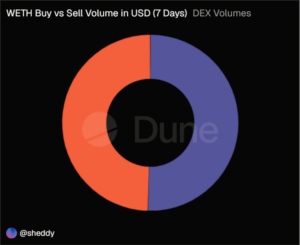
Whale buy vs sell volume for the last seven days. Source: Dune.com
High Volatility But No Clear Trend
Whale activity showed no clear trend over the last seven days, as there is no clear increase or decrease. However, sharp differences in activity are clear, with a huge decline over the weekend indicating significant volatility. This shows that large traders have been active in the market.
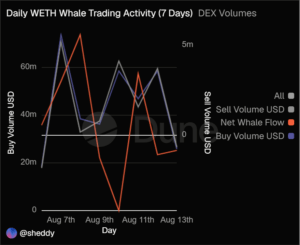
Whale activity showing volatility in the last 7 days. Source: Dune.com
Smaller Size Whales Drive Activity But Capital Flow
Large traders with amounts ranging from $100K–$500K accounted for 86% of whale activity by transaction count. This shows that moderately large traders were the most frequent participants over the period.
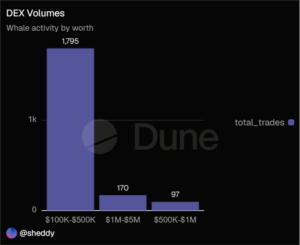
Whale trading counts. Source: Dune.com
However, the $1M–$5M cohort, with only 8.7% of trades, comes very close in terms of trading volume at 45.13%, compared to 45.64% for the $100K–$500K cohort. This indicates that while moderately sized whales are the most frequent participants, larger whales have a disproportionately greater impact on capital flows despite their significantly fewer transactions.
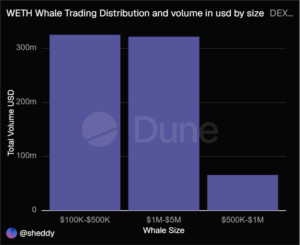
Whale trading volume in USD. Source: Dune.com
ETH Price Decline Unrelated To Whale Activity
Despite sharp differences in the large traders’ activities by day, ETH price declined consistently, while whale trading volume fluctuated without a corresponding trend over the period in focus. This shows that the price decline has no direct link with large trader activities in the last seven days.
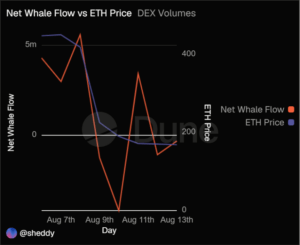
Ethereum price with respect to whale activity. Source: Dune.com
Conclusion
The data reveals that while there is no clear trend in the activity of whales over the last seven days, ETH price continued to fall. The findings suggest that whale activity over this period is not directly responsible for the price decline.
However, the analysis only considers data for the last seven days, which may be too short a period to give an accurate picture of what is really going on. Also, the price decline may be driven by other factors such as general current sentiment among retail traders, who ultimately are the majority of the market.
An interesting direction to also consider, which this analysis doesn’t cover, would be to determine where large traders are sending their ETH to—whether to centralized exchanges (CEX) or to private wallets. The finding could give important insight into the minds of these big players and tell us what to expect from the market next.

Bitcoin investors received what should have been a fairly supportive and positive combination of macroeconomic data in the past week, starting with the weak US jobs report last Friday.
However, the asset failed to produce any significant gains, again. Moreover, it has lost some traction and is actually down on a weekly scale, currently struggling to remain above $63,000. Why is that?
Why No Gains, BTC?
After the jobs report from a week ago, which managed to push BTC beyond $65,000 briefly, all eyes turned to the US CPI data on Wednesday. As reported, the July numbers came broadly in line with expectations, initially leading to a brief rebound to $64,400 before Bitcoin gave the gains back and resumed the downtrend it was already on as the business week progressed.
The subsequent PPI report was even more encouraging, with producer prices remaining flat month-over-month, contrary to expectations of a 0.2% increase. CryptoQuant weighed in on the matter and added that Treasury yields declined, while US equities posted some gains. Under normal circumstances, this combination should have provided some relief for risk-on assets, but BTC has failed to make a move upward.
Their analysis indicated that the explanation may have less to do with the macro environment and considerably more to do with a simple problem: Bitcoin buyers are nowhere to be seen in the spot market.
The report explained that such trading activity remains subdued, while flows into the US BTC ETFs have remained relatively weak in the past several days. Even more importantly, the Coinbase Premium Index continues to be almost entirely in negative territory for three months, and it now sits at around -0.1%.
The analysts added that the seven-day average spot trading volume across major exchanges dropped from nearly $9 billion in late June to under $4 billion on August 12. This 55% decline came even as BTC’s price recovered 8% within the same timeframe.
The Real Price Test
CQ identified Bitcoin’s short-term holder cost basis at around $68,700 as a major obstacle to the asset’s path forward, as it’s a level at which investors who bought relatively recently could exit at breakeven if the cryptocurrency reaches it.
As such, a surge to $65,000 won’t be enough to confirm that the broader trend has changed. They believe a more sustainable recovery would require several developments at once: renewed, significant ETF inflows, such as those from the previous week; stronger spot volume; a return to a positive Coinbase Premium; and a decisive break above $68,700.
The post Bitcoin Shrugged Off Good CPI and PPI Data: Why Is BTC Still Stalling? appeared first on CryptoPotato.
Sending USDT over the TRON network is particularly popular because of its speed and broad adoption. That said, TRC-20 transfers also require network resources.
When a wallet doesn’t have enough TRON Energy, TRX may be burned to cover the remaining cost of executing the smart contract. For users who make frequent transfers, renting energy provides an alternative to staking a large amount of TRX solely to generate network resources.
This is exactly the type of use case that TronBid’s marketplace is built around. It brings together users who want to rent TRON energy and holders of staked TRX who have unused energy or bandwidth they want to monetize.
Instead of offering only one way to acquire energy, TronBid combines a P2P marketplace, instant energy rental, a Telegram bot, a calculator, and API access in one single ecosystem. Its marketplace also allows both buyers and sellers to create their own orders, giving participants more flexibility over pricing and rental terms.

What is TronBid?
TronBid brings forward a marketplace and a rental platform for TRON network resources, primarily focused on energy and bandwidth.
TRON energy is consumed whenever smart contracts are executed on the network. Naturally, this includes the primary use case for the blockchain: USDT TRC-20 transfers. If an address doesn’t have sufficient energy available, TRX can be burned to cover the required network resources. As mentioned above, instead of staking a large amount of TRX themselves, users can receive temporarily delegated energy from another wallet.
TronBid creates the infrastructure needed to satisfy this delegation process.
Those users who need resources can rent energy through a ready-made package or participate in the marketplace directly. At the same time, those whose staked TRX generates unused resources are able to offer those resources to others while keeping complete ownership of their TRX.
How the TronBid Marketplace Works
The main TronBid Marketplace is essentially a P2P market for TRON energy and bandwidth. Its current structure gives users several ways to interact depending on whether they are buying or selling resources.
A buyer can create a buy order and specify the amount of energy or bandwidth needed, the price per unit, and the desired rental duration. Sellers, on the other hand, are able to review active orders and fulfill the ones that match the resources and the terms they are willing to provide.

TronBid also supports the ability for sellers to push their own offers, meaning that sellers can specify the resource, amount, asking price, and rental terms.
The goal is to complete a two-sided marketplace where buyers are not limited to waiting for a fixed rental price, and sellers are not limited to searching through existing buyer orders. Both sides can initiate a potential transaction.
A Two-Sided Market for TRON Energy
The two-sided structure is one of the most interesting features of the current TronBid platform.
A user who wants to rent TRON Energy has two basic options within the marketplace:
- Create a buy order with a preferred amount, price and rental period.
- Choose an existing seller offer and purchase Energy under the displayed terms.
Sellers have similar flexibility:
- Fulfill an existing buyer order.
- Create their own sell offer with a chosen amount, price and rental term.
This allows supply and demand to play a more direct role in price discovery.
Instead of all transactions depending on a centrally defined rental rate, buyers can signal what they are prepared to pay while sellers can signal what they are prepared to accept. U.Today has previously described TronBid’s open-market approach as a model where Energy providers compete on price, while the current TronBid platform expands that marketplace structure with dedicated seller-created offers.
Features of TronBid: Closer Look
Evidently, the platform is built around buying, selling, and renting energy on TRON, but let’s have a closer look at some of its more interesting features.

- Quick Rent
Users who need energy immediately can use TronBid Quick Rent to select a package, enter a TRON address, pay in TRX, and receive delegated energy automatically without having to wait for a match on the marketplace.
- Telegram Bot
TronBid’s official Telegram bot provides another quick and convenient way to access energy rental services, particularly for mobile users.
- API Access
Businesses and developers can integrate automated TRON energy rentals into wallets, payment services, exchanges, and other applications.
Conclusion
TRON Energy rental gives users an alternative to relying solely on TRX burning or staking large amounts of TRX when interacting with smart contracts such as USDT TRC-20.
TronBid approaches this market from several directions.
Users who want to rent TRON Energy can choose between instant fixed-package rental and a P2P marketplace.
Those who already have unused resources can sell TRON Energy or Bandwidth while retaining ownership of their staked TRX. Buyers and sellers can both create marketplace orders, while Telegram and API access extend the service beyond the main website.
The post TronBid: A Flexible Marketplace to Rent and Sell TRON Energy appeared first on CryptoPotato.
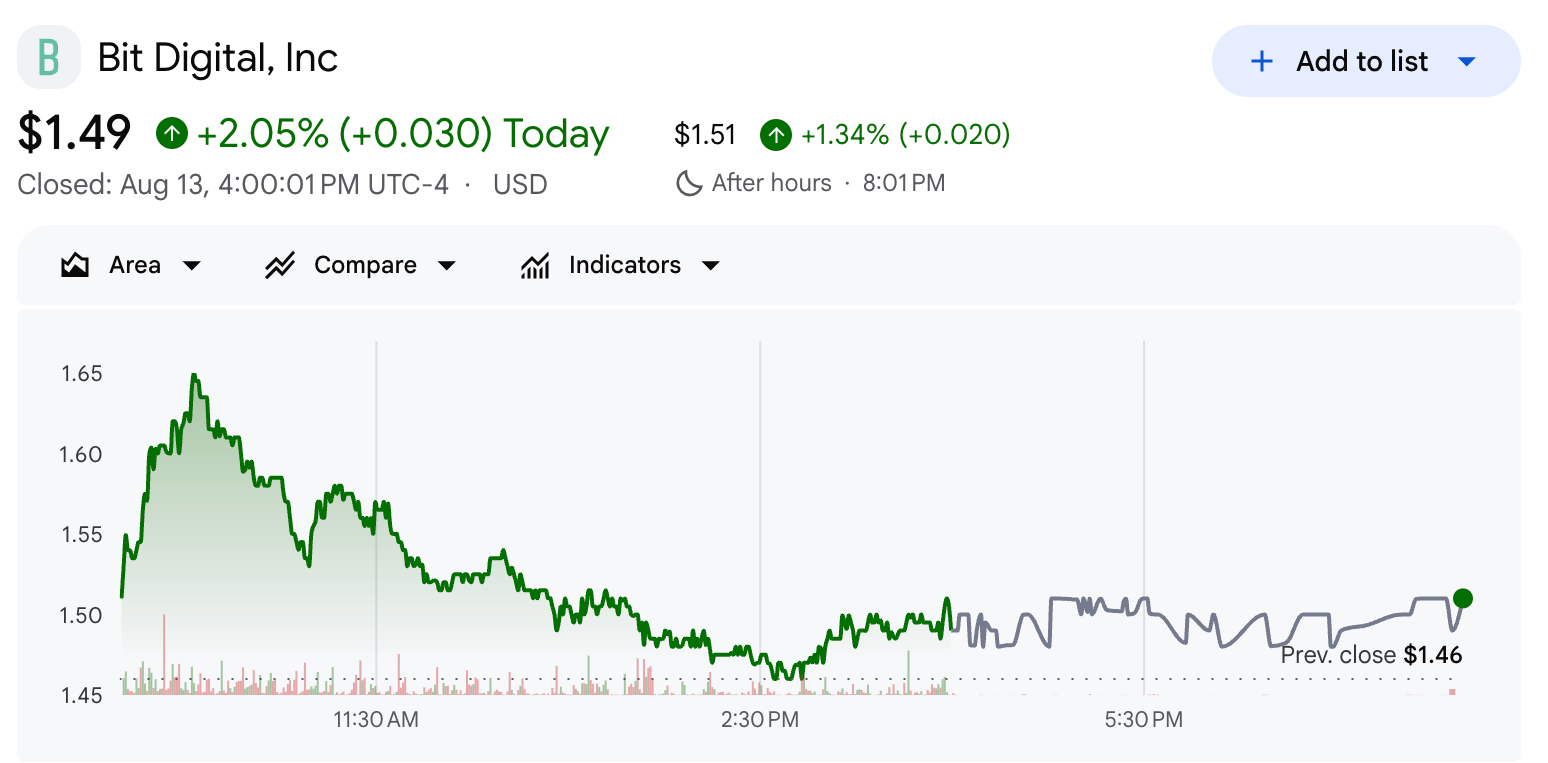
Bit Digital stock climbed after the company reported a $107.2 million net loss for the second quarter, breaking from the sell-off that punished rival crypto-linked shares this week.
The Nasdaq-listed Ethereum (ETH) treasury and artificial intelligence (AI) infrastructure firm booked $32.1 million in revenue. That marks a 15% gain over the first quarter.
Investors Look Past Bit Digital’s Quarterly Loss
Investors appeared to focus on the operating line rather than the headline loss. The stock added 2.05% to close at $1.49 on Thursday, then gained another 1.34% to $1.51 after hours.
Follow us on X to get the latest news as it happens

That reaction stood apart from the rest of the week’s crypto earnings slate. Bitdeer slid roughly 20% after its August 10 report, while Forward Industries fell 1.36% after hours despite closing the session higher.
The pattern was also observed earlier in other major crypto equities such as Coinbase, MARA Holdings, and CleanSpark.
Roughly $86 million of Bit Digital’s loss came from non-cash digital asset movements and non-operating items. That included a $46 million impairment on liquid staked ETH, which the company says was not a realized loss.
The loss also narrowed. Bit Digital lost $146.7 million, or $0.45 per diluted share, in the first quarter. This quarter’s figure was $0.31 per share.
Meanwhile, the operating businesses grew. Cloud services revenue climbed 42% to $23.8 million at a gross margin near 58%. Group gross profit reached $18.6 million.
Ethereum Treasury Now Funds the AI Business
Bit Digital held 164,310.5 Ethereum as of June 30. It bought 8,568 ETH for $20 million on May 11 and sold none during the quarter. The company raised $50 million against a portion of that treasury.
It also used its own balance sheet to commit up to $150 million to WhiteFiber through a delayed draw facility for the NC-1 data center campus. Bit Digital’s 27 million WhiteFiber shares carried an implied value of nearly $1.05 billion at quarter-end.
CEO Sam Tabar argued the market has not caught up to that shift.
“Our operating results improved through the quarter. Our valuation did not. The market continues to value Bit Digital primarily as a passive digital asset treasury, and the Board is currently evaluating our options to address that disconnect,” he said.
WhiteFiber has signed new multi-year cloud agreements worth more than $540 million in aggregate contract value since its last earnings call. Tabar said the wider portfolio should produce over $200 million in annualized revenue once fully deployed.
Subscribe to our YouTube channel to watch leaders and journalists provide expert insights
The post Bit Digital Stock Rises Despite $107.2 Million Q2 Loss appeared first on BeInCrypto.
Crypto World
The Biggest Bitcoin Bear Keeps Adding to Their Short Position as BTC Price Slides Further

Bitcoin’s breakout attempt faced another rejection at $65,000 earlier this week, and the bears appear to be in control once again, driving the asset south to under $63,000.
One particular bear has garnered the community’s attention with massive short positions that they keep building on.
Data provided by Lookonchain indicates that the unknown market pessimist continues to increase their leveraged position, which has now grown to 2,000 BTC. The analysts described them as the “largest on-chain BTC bear.”
Although the trader is currently well in the green on their position, sitting on an unrealized profit of nearly $2 million at today’s prices, their liquidation levels are not far off.
The current price at which the bear will be wiped out is just over $63,500, which makes the position even riskier. For now, though, it’s quite beneficial since BTC has seemingly lost the $63,000 support despite the positive CPI and PPI data from earlier this week.
Gambler 0xff84 keeps adding to his $BTC short and now holds a 2,000 $BTC($125.37M) short, with an unrealized profit of $1.79M.
He is now the largest on-chain $BTC bear.
Liquidation price: $63,528.92https://t.co/OGB2Ch9tfI pic.twitter.com/fxldgN0j5x
— Lookonchain (@lookonchain) August 14, 2026
According to analysts at CryptoQuant, the cryptocurrency has failed to rally due to several factors: the Coinbase Premium has remained in the negative for three months, the spot Bitcoin ETFs have seen weaker inflows, and there’s not enough spot trading volume across all centralized exchanges.
The post The Biggest Bitcoin Bear Keeps Adding to Their Short Position as BTC Price Slides Further appeared first on CryptoPotato.


Upbit and Bithumb will end trading support for Storj (STORJ), JasmyCoin (JASMY) and ThunderCore (TT) on Sept. 14 after concluding that the issues behind earlier warning designations remained unresolved.
Summary
- Upbit will delist STORJ, JASMY and TT on September 14 after warning issues remained unresolved.
- Bithumb announced matching delistings, setting the same September 14 trading cutoff for all three tokens.
- Withdrawals on Upbit remain available until October 14, giving holders one month after trading ends.
- Storj Labs entered Chapter 11 in July, while its decentralized storage network continues operating normally.
- ThunderCore disputes the exchanges’ concerns, saying its network, issuance mechanism and operations remain normal currently.
Upbit’s notice covers STORJ/KRW, STORJ/BTC, JASMY/BTC, JASMY/USDT, TT/KRW and TT/BTC, with trading scheduled to stop at 3:00 p.m. KST. Bithumb independently confirmed the three delistings Friday.
All open orders will be canceled when support ends. Upbit will keep withdrawals available until Oct. 14. Bithumb separately announced the same Sept. 14 trading cutoff and Oct. 14 withdrawal deadline for all three assets, confirming that the action is not limited to one Korean exchange.
Upbit says the warning issues were not resolved
Upbit first placed STORJ under a trading warning on July 28. The exchange said its review considered disclosure of important information, the substance and sustainability of the project and its actual progress. Deposits were suspended when the warning was issued, and Upbit said it would decide during the Aug. 10 to Aug. 14 review window whether to extend, remove or escalate the designation.
The warning came two days after Storj Labs filed for Chapter 11 protection in the U.S. Bankruptcy Court for the Northern District of West Virginia. Storj said case No. 5:26-bk-00512 was intended to address legacy liabilities while keeping its decentralized storage business operating. Upbit did not say the bankruptcy filing by itself caused the delisting.
As crypto.news reported, Storj Labs filed for Chapter 11 while keeping its cloud services active. The company has also floated a possible ownership mechanism for STORJ holders in a reorganized business. That remains a proposal rather than a confirmed recovery for token holders, and any arrangement would depend on the bankruptcy process.
JASMY and TT failed to clear later reviews
Upbit designated JASMY and TT as warning assets on July 31 and suspended deposits. For JASMY, the exchange cited shortcomings in disclosures about matters capable of materially affecting the asset, alongside concerns involving business substance, sustainability and actual progress.
For TT, Upbit also raised questions about the project’s operations, while the original review covered issuance and circulation related concerns. Bithumb’s final notice said the warning reasons for STORJ, JASMY and TT had not been resolved. No new Jasmy response addressing Friday’s delisting was identified in the official materials reviewed.
The decisions come as Korean exchanges continue applying post-listing reviews to supported assets. In related coverage, Upbit moved to remove NKN after its warning review, another case in which a caution designation preceded termination of trading support.
ThunderCore disputes the exchanges’ assessment
ThunderCore has disputed the characterization behind TT’s warning designation. In an Aug. 1 statement, the project said plans involving TT had been publicly communicated and that changes to issuance, network parameters and token economics had been disclosed to Upbit and Bithumb. It maintained that “the network, the issuance mechanism, and the project’s operational condition remain normal.” That is ThunderCore’s position and conflicts with the exchanges’ decision to maintain their concerns.
ThunderCore also updated its circulating supply estimates in June after a governance proposal allowed block issuance to be adjusted from zero to 135 TT by vote. Its official blog lists a new Aug. 14 update concerning Upbit and Bithumb trading support, but both exchanges still proceeded with delisting.
What happens next for STORJ, JASMY and TT
Upbit users can trade the six affected pairs until 3:00 p.m. KST on Sept. 14. Any unfilled buy or sell orders will then be canceled. Withdrawals remain supported until 3:00 p.m. KST on Oct. 14, giving users another month to move assets to compatible wallets or other venues.
Bithumb set the same dates and warned that withdrawal processing may require advance address registration. The exchange also said technical support can become limited after the withdrawal window closes. Delisting does not disable the underlying networks or tokens, but it removes the affected trading markets from two major South Korean venues.


Baltimore has sued prediction market operators Kalshi and Polymarket, accusing both of running unlicensed sportsbooks in the city.
Mayor Brandon Scott and the City Council filed the complaints Thursday in Circuit Court for Baltimore City.
Baltimore Sues Kalshi and Polymarket
The city says both platforms let residents bet on game winners, point spreads, point totals, and player statistics. Those propositions match products sold by licensed sportsbooks, according to the complaints.
Both companies call them event contracts. However, Baltimore argues they function as sports bets and amount to unlawful gambling under Maryland law.
Furthermore, the lawsuit claims that the missing licenses free both firms from the tax bills, audits, and player-protection rules that licensed operators carry.
The complaints also allege the platforms advertise in ways that suggest their products are lawful and properly supervised. The city says that impression draws in inexperienced bettors and problem gamblers who stand to lose money.
“These companies are running sportsbooks without licenses and betting that a new label will put them above the law. It won’t. Baltimore will not let multibillion-dollar companies put profits over people and harm our communities through illegal gambling,” Mayor Scott said.
The city wants an injunction blocking both platforms from taking transactions from residents. It also seeks civil penalties of up to $1,000 per violation per day. Restitution for affected consumers and disgorgement of profits round out the demands.
“For each violation of the CPO, and for each day that a violation was committed, Plaintiff is entitled to civil penalties of up to $1,000. Baltimore City Code Art. 2, § 4-4,” the lawsuit reads.
Follow us on X to get the latest news as it happens
Cities and States Widen the Prediction Market Fight
Baltimore joins a growing list of jurisdictions taking prediction markets to court. Kentucky Attorney General sued Kalshi and Polymarket in June alongside casino game operator VGW.
Wisconsin’s Department of Justice brought Dane County lawsuits in April, naming Kalshi, Polymarket, Robinhood, Coinbase, and Crypto.com. Nevada moved earliest, halting Kalshi entirely in March through a 14-day restraining order.
Meanwhile, the New York City Council opened a probe into prediction markets on Wednesday. Speaker Julie Menin gave the platforms 14 days to disclose city user numbers and revenue.
However, federal preemption remains the industry’s core defense, and it has worked. Whether a city ordinance survives that same argument is the next test.
Banks Keep Their Distance Too
Institutional caution runs alongside the legal pressure. The Financial Times reported that JPMorgan ended its banking relationship with Polymarket last year amid regulatory concerns. The prediction-market platform has since moved to another lender.
JPMorgan has nevertheless retained some links to Polymarket, including inviting CEO Shayne Coplan to speak at a Miami conference.
Subscribe to our YouTube channel to watch leaders and journalists provide expert insights
The post Polymarket Faces Baltimore Lawsuit and Lost JPMorgan Banking Relationship appeared first on BeInCrypto.

Bridlington man pleads not guilty at Hull Crown Court

Bullish 2026 Q2 – Results – Earnings Call Presentation (NYSE:BLSH) 2026-08-14

‘DeFi Doesn’t Exist Anymore’ Just Onchain Finance: Andre Cronje


-

 Fashion7 days ago
Weekend Open Thread: Mattifying Sunscreen
-

 Fashion7 days ago
Frugal Friday’s Workwear Report: Cap-Sleeve Pointelle Crewneck Sweater
-

 News Videos6 days ago
Can Astrology Help Find Gold and Silver Trends? A Financial Astrology Guide
-

 Tech7 days ago
Rinn Pharma & Biopharma to join NordicPharmaTrain network
-

 Business5 days ago
How to Start a Cleaning Business: A Step-by-Step Guide
-

 Business5 days ago
Datadog: Best Of Breed For Multiple Reasons
-

 Business5 days ago
BDC Weekly Review: Private BDC Q2 Numbers Are Strong
-
 NewsBeat2 days ago
Communication cards help banking customers access services or report scams
-
 Business3 days ago
Oil Price Today (August 11): Crude oil rises to $88 after Trump’s compensation demand dents Hormuz opening. Here’s why
-

 Fashion7 days ago
Weekly News Update, 8.6.26 – Corporette.com
-

 Fashion7 days ago
Irina Shayk Wows in REVOLVE Los Angeles’ Summer Styles
-

 Fashion5 days ago
Amazon Sundays: Closet Care Before Fall
-

 Politics6 days ago
Be quiet, Miriam! – spiked
-

 Business6 days ago
Mutual Fund Manager Scoops Up Beaten-Down Stocks
-

 Politics5 days ago
Ben-Gvir’s crocodile project halted but abuses at Ketziot Prison continue
-

 Entertainment7 days ago
Warren Hudson’s Dad Releases Audio Of Threats
-
 Entertainment6 days ago
10 R-Rated Drama Movies That Can Be Called Masterpieces
-

 Politics7 days ago
Welsh independence campaign group YesCymru sets 2032 referendum target
-

 Business6 days ago
SharkNinja Keeps Eating
-

 Politics6 days ago
Calls to permanently pedestrianise central Belfast following festival success
You must be logged in to post a comment Login