

Crypto World
SEC Pays $150,000 Settle Coinbase FOIA Suit

The US Securities and Exchange Commission agreed to pay $150,000 in legal fees to settle a Coinbase lawsuit seeking internal records from the agency at the height of the Biden-era SEC crackdown on crypto.
The agreement, filed on Wednesday, ends a two-year lawsuit between the SEC and Coinbase, in which the crypto exchange sought internal documents from the regulator to uncover evidence of “crypto by enforcement.” An internal report in 2025 revealed the SEC had deleted nearly a year of former SEC Chair Gary Gensler’s texts due to “avoidable” errors.
“The agency tasked with policing corporate record-keeping somehow lost reams of its own text messages between Mr. Gensler and other officials during the most intense period of the anti-crypto campaign,” said Coinbase chief legal officer Paul Grewal in an op-ed published by the Wall Street Journal on Wednesday, adding that the SEC will pay a $150,000 “award” and has fixed its record retention policies.
The settlement marks another legal victory for Coinbase under the Trump administration. The SEC, under the leadership of Paul Atkins, has taken a more crypto-friendly approach and dropped several high-profile enforcement actions against crypto companies, including Coinbase, in 2025.
Related: Coinbase chief legal officer to transition to advisory role on July 31
In February, Coinbase reached a settlement with the Federal Deposit Insurance Corporation, with the FDIC agreeing to pay $188,440 in legal fees and revising aspects of its transparency practices after a federal court found it had violated the Freedom of Information Act.
“The years of litigation were worth it. We successfully uncovered dozens of crypto ‘pause letters’—indisputable proof of OCP2.0 and the coordinated effort to sideline the industry,” Grewal said in an X post in February.
Grewal to transition from chief legal officer
Paul Grewal, who has served as Coinbase’s chief legal officer since 2020, is set to transition to an advisory role at the exchange starting on July 31, with Coinbase legal vice presidents Molly Abraham and Ryan VanGrack set to become general counsel and vice chair, respectively.
Magazine: Will the crypto lobby’s $189M campaign get CLARITY over the line?


AFX Trade, BSquaredNetwork, and Verus have all fallen victim to exploits over the last 24 hours.
In what many are calling “Hackers Day,” the three protocols have collectively lost over $35 million in crypto assets.
Crypto Industry Hit With Three Separate Hacks
PeckShieldAlert said it detected an attack on Arbitrum-based protocol AFX on July 22, with estimated losses of about $24.15 million USDC. The on-chain security firm added that the exploiter bridged the stolen funds from Arbitrum to Ethereum, after which they swapped them for 12,467.5 ETH.
Less than an hour later, PeckShieldAlert reported that attackers had drained BSquaredNetwork of $8.59 B2 tokens on BNB Chain, resulting in it losing approximately $3.86 million. The hackers then quickly swapped the tokens for more than 5,000 WBNB, converted them into 1,128 ETH, and bridged the funds out using NEAR Intents. The impact on the market was quick, with B2’s price dropping by over 15% in the aftermath of the exploit.
It doesn’t stop there; blockchain security firm Lookonchain also alerted the public to another incident, this time affecting Ethereum-based cross-chain bridge Verus protocol. In this case, the exploiters made off with $7.55 million.
Additionally, the latest exploit comes about two months after Verus lost roughly $11.58 million in a separate incident. Blockaid said that the July attack seems to be related to the previous exploit, describing the two as involving the same bridge contract, same entry path, and same bug class.
Monahan Questions AFX’s Security
Steven Goldfeder, a contributor at Arbitrum, has confirmed that the compromised bridge was operated independently by AFX and was not one of its native bridges.
Meanwhile, there seems to be a storm brewing elsewhere, with on-chain security expert Taylor Monahan questioning why the AFX bridge had $24 million on it in the first place.
She revealed that she had found some “terrifying” details after going through a recently published audit of the bridge. According to her, the protocol had almost no test coverage, several issues flagged by auditors were acknowledged but never fixed, and the auditors allegedly couldn’t even fully review the code because they received only parts of it.
“Honestly, they seem like a super chill team. Ah yeah it’s probably fine we’ll just wait it out and then manually send if we need to,” she wrote.
Monahan says that the biggest red flags were what the technical vulnerabilities revealed about the team’s approach to security, explaining that the situation suggested a culture that didn’t prioritize it.
The post ‘Hackers Day’: 3 Crypto Protocols Drained of $35 Million in 24 Hours appeared first on CryptoPotato.


Kakao Group has partnered with stablecoin issuer Circle to explore payment infrastructure for won-backed stablecoins as South Korea prepares a broader regulatory framework for crypto assets.
On Thursday, the companies announced that Kakao, Kakao Pay and Kakao Bank had signed a strategic memorandum of understanding (MOU) with Circle Internet Group. Under the agreement, the companies will explore ways to connect Circle’s blockchain and global payment infrastructure with Kakao’s consumer platforms and financial services.
The agreement highlights how major South Korean consumer and financial platforms are positioning themselves ahead of expected stablecoin legislation, even before the regulatory framework is finalized.
Under the MOU, the companies plan to examine stablecoin payments, cross-border remittances, merchant settlement and connections between existing financial systems and blockchain networks.
The companies will also consider support for tokenized financial services, but they did not disclose any products or launch timelines.
Cointelegraph reached out to Circle and Kakao Group but did not receive a response before publication.
South Korea’s stablecoin framework
South Korea has been working toward legislation governing won-backed stablecoins as policymakers seek to encourage digital payment innovation while addressing risks related to reserves, redemption and issuer oversight.
The government has been preparing a bill that would establish requirements covering stablecoin issuance, collateral management and internal controls. Lawmakers have also introduced competing proposals as support has grown for won-pegged tokens aimed at reducing reliance on the US dollar.
However, the regulatory process has stalled over disagreements about which institutions should be permitted to issue won-based stablecoins.
The Bank of Korea, the country’s central bank, argued that banks should retain a majority stake in stablecoin issuers, while the Financial Services Commission warned that eligibility limits could restrict competition and innovation.
In its economic growth strategy announced on July 14, the government listed advancing the Digital Asset Basic Act among its priorities for the second half of 2026.
Related: South Korean regulator misses stablecoin bill deadline: What’s next?
Meanwhile, companies and financial institutions have begun testing the technology in South Korea. In April, internet bank Kbank partnered with Ripple to test blockchain-based remittances.
In May, KB Financial Group completed a pilot covering stablecoin issuance, offline merchant payments and cross-border remittances through the Kaia blockchain. The group said it was preparing to introduce stablecoin services once the regulations take effect.
Magazine: Why Australia’s $17B crypto opportunity depends on regulation
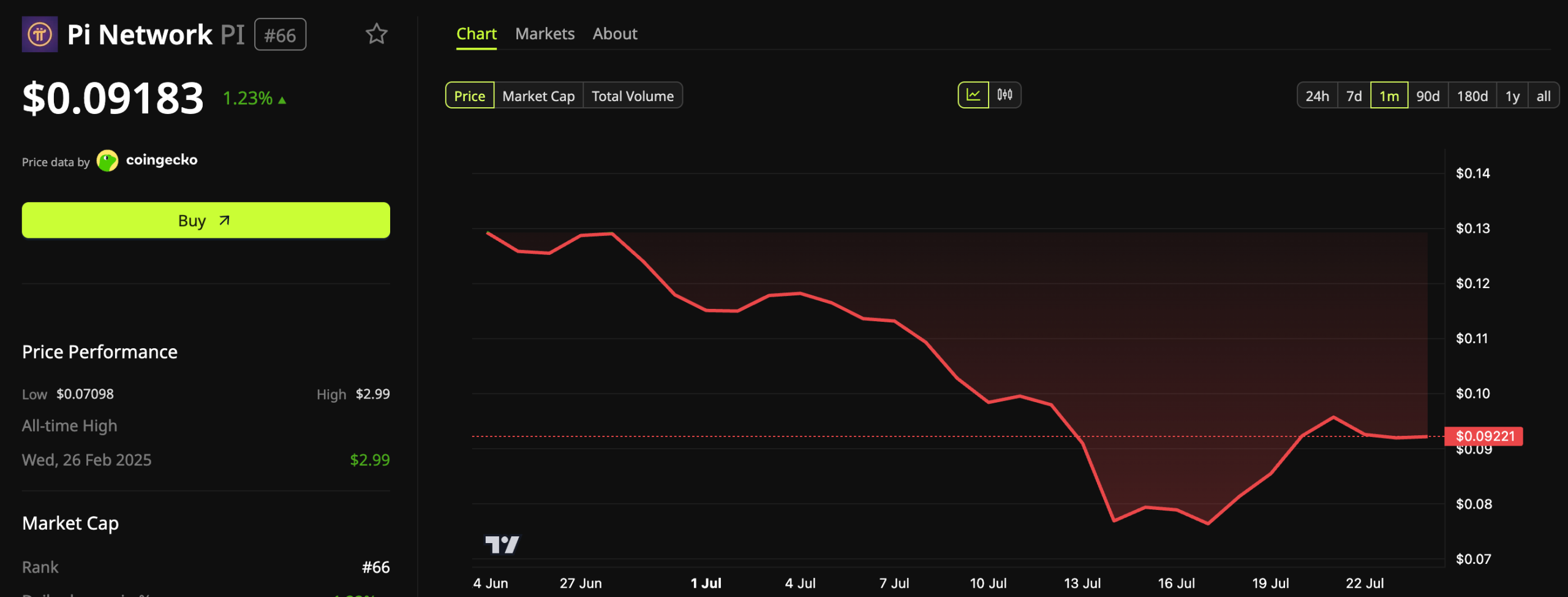
Pi Network activated Protocol v25 on July 22, its latest major upgrade of 2026, yet PI stalled below $0.10 after a rally carried the token briefly beyond that level.
The result echoed earlier upgrades. Recent protocol releases drew trader interest but failed to produce a lasting price gain.
Pi Coin’s Rally Stalls Amid Protocol Upgrade
PI slipped to an all-time low of $0.0705 on July 14. It recovered through the following week, briefly spiking to an intraday high of $0.103 on July 19, but failed to hold the level
Buyers positioned into the July 22 upgrade, a dated catalyst that gave the market a clear event to trade around. Both price and volume increased before the release landed.
Pi coin has since eased back toward $0.0918, unable to reclaim the $0.10 level it briefly tagged.

Volume tells the same story. Daily volume rose to $33.7 million on July 20, then fell to about $18.5 million on launch day and has been lower since. Buyer interest thinned as the event passed.
Protocol v24 followed a similar pattern in June. PI posted modest gains ahead of the upgrade, only to resume its downtrend.
Why the Pi Network Upgrade Struggles to Move Price
Protocol v25 introduces BN254 cryptography and Poseidon hashing, the building blocks for building modern zero-knowledge applications. The Pi Core Team also shipped a redesigned mining app for its 60 million Pioneers.
Follow us on X to get the latest news as it happens
The improvements are real, yet the price response was muted. The answer lies in broader market forces and PI’s own supply.
Exchange flows show little sign of forced selling. Tracked exchange wallets recorded a net outflow of about 260,000 PI over 24 hours, a minor move against balances near 540 million PI.
The pressure sits further out. According to PiScan, roughly 1.71 billion PI, worth about $157 million, is scheduled to unlock over the next 12 months, with the heaviest single month near 432 million PI in December 2027.
That steady release meets a thin market, capping rallies regardless of upgrade news. The same overhang blunted earlier releases.
Development news drives short-term bounces, while unlock supply sets the ceiling. Whether v25 can convert utility into demand remains the open question for the weeks ahead.
Subscribe to our YouTube channel to watch leaders and journalists provide expert insights
The post Protocol v25 Goes Live as PI Rally Stalls Below $0.10 appeared first on BeInCrypto.


US spot Bitcoin ETFs recorded $69 million in inflows on Wednesday, extending their inflow streak to seven sessions and bringing total inflows during the period to nearly $1 billion


Coinbase has expanded its Singapore operations with a new office and announced plans to increase its local workforce by about one-third to around 200 employees by the end of 2026.
Summary
- Coinbase plans to increase its Singapore workforce from about 150 to around 200 by the end of 2026.
- The company has opened a new office at One Raffles Quay, with hiring focused on engineering, customer service, relationship management, and institutional sales.
- The expansion comes as Coinbase continues investing in Singapore despite recent global layoffs and fresh pressure on its shares.
According to The Business Times, Nasdaq-listed crypto exchange Coinbase officially opened its new Singapore office at One Raffles Quay on July 22 and plans to grow its local headcount from about 150 employees to around 200 over the next 18 months.
The hiring drive will focus primarily on engineering, customer service, relationship management, and institutional sales, Singapore country director Hassan Ahmed said in an interview with the publication.
The expansion comes as Coinbase continues to strengthen its presence in one of Asia’s most established digital asset markets. Speaking to The Business Times, Ahmed described Singapore as “one of the world’s most trusted financial hubs and one of Coinbase’s fastest-growing international markets.”
“This new office reflects our long-term confidence in Singapore as a strategic hub for innovation, talent, and responsible growth across the Asia Pacific, giving us the resources to work more closely with local authorities, invest in talent, and scale partnerships,” Ahmed said.
The move also stands in contrast to Coinbase’s workforce reductions announced earlier this year. On May 5, the company said it would reduce its global staff by about 14% as part of a cost management effort driven by market volatility and increasing use of artificial intelligence. At the time, Coinbase said it would reorganize teams around AI capabilities while reducing management layers.
Despite those global cuts, Ahmed told The Business Times that Coinbase sees strong long-term opportunities for cryptocurrencies and stablecoins in Singapore and across Asia, supporting the company’s decision to continue hiring in the country.
Singapore remains central to Coinbase’s Asia strategy
Ahmed attributed Coinbase’s continued investment to Singapore’s regulatory clarity and business environment, which he said helped the country establish itself as an early digital asset hub.
According to him, Singapore was “much ahead of other jurisdictions and hubs that were also vying to be digital asset hubs” when the regulatory framework for digital assets was being developed. He also cited the country’s business-friendly operating environment, favorable tax structure, and access to capital as additional reasons behind Coinbase’s expansion.
Coinbase’s relationship with Singapore’s regulators has developed over several years. The company first received a temporary exemption from licensing requirements in March 2020 before obtaining an in-principle approval from the Monetary Authority of Singapore (MAS) in October 2022.
Subsequently, in October 2023, Coinbase secured a full Major Payment Institution license under Singapore’s Payment Services Act, allowing the exchange to operate as a fully licensed digital payment token service provider in the country.
At the time, Coinbase identified Singapore among six priority international markets for its expansion strategy, alongside the European Union, Canada, the United Kingdom, Australia, and Brazil. The company also pointed to Singapore’s growing crypto adoption, noting that the country had become one of the world’s leading digital asset markets.
Investment in Singapore continued after the licensing milestone. In November 2024, Coinbase launched an Engineering Hub in partnership with the Singapore Economic Development Board to support blockchain infrastructure development and local engineering talent. The company said the initiative would help developers build applications for the on-chain economy while strengthening Singapore’s position as a regional technology center.
Coinbase also expanded local payment infrastructure through support for the Singapore dollar-backed stablecoin XSGD in partnership with StraitsX and Coinbase Business, allowing companies to access stablecoin-based payment services.
Institutional demand and tokenization gain momentum
Looking at market demand, Ahmed told The Business Times that accredited and institutional investors have continued increasing their interest in both digital assets and blockchain technology.
He also said tokenization has attracted considerably more attention as governments and regulators introduce frameworks covering digital assets.
As examples, Ahmed pointed to the U.S. GENIUS Act, the European Union’s Markets in Crypto-Assets regulation, Hong Kong’s stablecoin ordinance, and Singapore’s own tokenized Treasury bills pilot alongside its stablecoin regulatory framework.
According to Ahmed, market participants increasingly expect financial markets to operate continuously rather than within traditional business hours.
“Consumers and traders now have an expectation of 24/7 trading markets, and they want to apply this technology to tokenize assets to make them 24/7,” he said. “They also want to use stablecoins to do instant settlement.”
His comments come as tokenized real-world assets and regulated stablecoins continue receiving attention from financial institutions across multiple jurisdictions, with several governments introducing dedicated legal frameworks over the past year.
AI becomes another investment priority
Beyond hiring and digital assets, Coinbase is also exploring how artificial intelligence can be integrated with blockchain technology.
Ahmed told The Business Times that one area under evaluation involves equipping AI agents with stablecoin wallets so they can perform transactions while maintaining transparent on-chain records of their activity. He added that blockchain could provide an auditable record of actions taken by AI systems.
The company is also introducing AI across its internal operations, particularly within engineering teams. Ahmed emphasized, however, that people would continue overseeing important decisions rather than handing complete control to automated systems.
“Digital assets and AI are effectively colliding,” Ahmed said. “We are very excited about the potential of AI.”
Coinbase is pursuing its Singapore hiring plans even as its shares have faced fresh volatility in the United States. On July 22, Coinbase shares dropped roughly 4% after Polymarket reduced the odds of the CLARITY Act passing before the end of 2026 amid disagreements over proposed ethics provisions.
Korbit, South Korea’s first homegrown crypto exchange founded in 2013, now has a new home and its a traditional finance behemoth.
The exchange announced Thursday that it is now part of the Mirae Asset Group family, which reportedly had an AUM of $1 trillion as of May.
The acquiring entity is Mirae Asset Consulting, an affiliate of Mirae Asset Group, which has acquired Korbit’s shares through mandated regulatory reporting procedures, becoming the largest shareholder. The announcement clarified that there are no changes to Korbit Co., Ltd., the corporation that operates Korbit.
The affiliate firm also looks after the group’s hotels and golf course businesses and now reportedly holds a 97.15% stake in Korbit.
For the exchange users, the acquisition by the Mirae affiliate brings no immediate disruption. The exchange said that all services, such as login, trading, deposits and withdrawals, will continue without interruption. User deposits and virtual assets will continue to be held separately from company assets, consistent with South Korea’s Act on the Protection of Virtual Asset Users. Personal data processing also remains unchanged and requires no action from users.
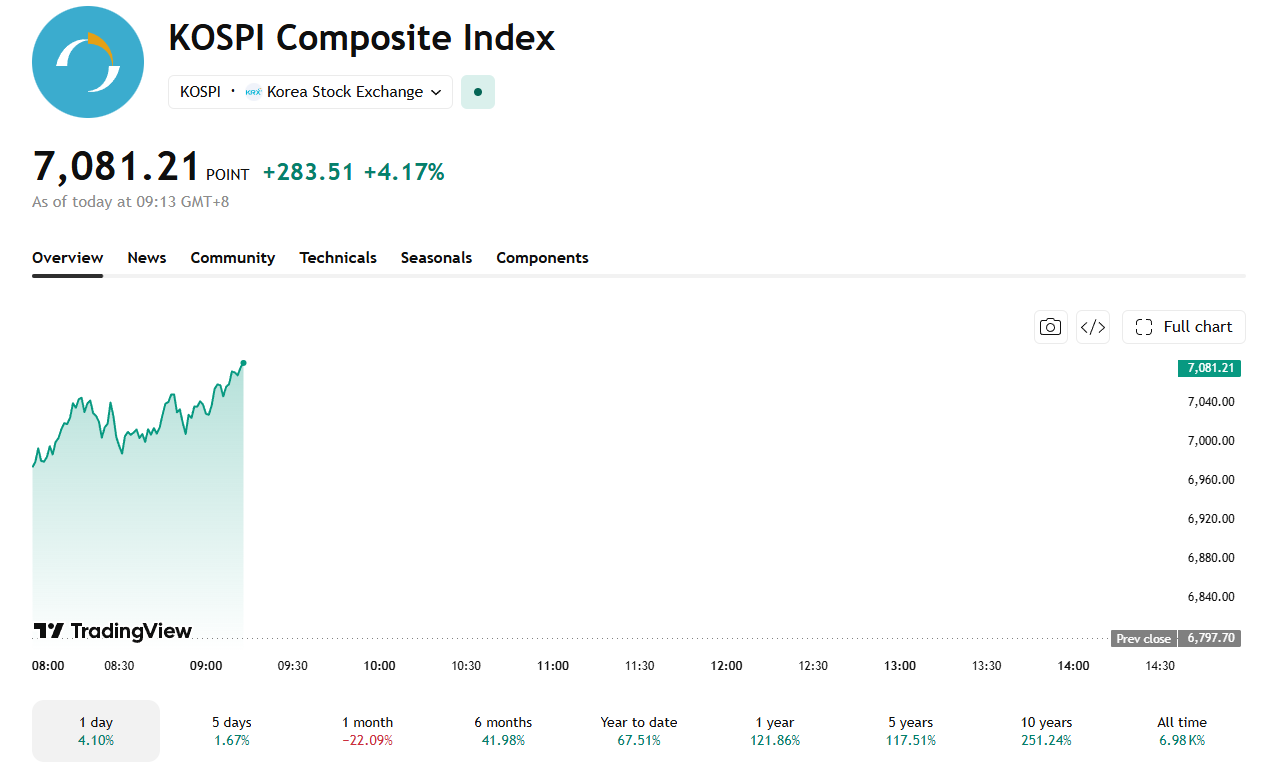
South Korea’s KOSPI index broke through 7,000 points Thursday, July 23, climbing 4.17% to 7,081.21 as tech shares extended a rally fueled by Alphabet’s earnings and a chip sector rebound.
The index failed to hold the same level a day earlier. It closed 0.74% higher at 6,797.70 after paring a 5% intraday surge. Thursday’s advance put the threshold to a fresh test.
KOSPI Rebound Builds on Alphabet Beat
Alphabet reported second quarter revenue of $119.8 billion, up 24% year over year, with Google Cloud growing 82%. The company also raised its capital spending forecast, reinforcing demand for artificial intelligence (AI) infrastructure.
Samsung Electronics and SK Hynix, the KOSPI’s two largest constituents, drove the gains. Both stocks extended last week’s rebound from an earlier AI-driven selloff.

Rising oil prices and lingering Iran-related tension around the Strait of Hormuz, a key shipping route, tempered the rally without derailing it.
Citi Holds Firm on 10,000 Target
The advance follows a note that maintains Citi’s 10,000 price target for the KOSPI. That target implies more than 50% upside from levels the index touched earlier this week.
Citi analysts called the recent pullback a potential buying opportunity, pointing to technical profit-taking rather than a shift in fundamentals.
The KOSPI has fallen as much as 28% from its June record high, part of a technical bear market that has triggered multiple circuit breakers and sidecars this year.
Thursday’s break above 7,000 still needs to hold. Wednesday’s reversal at the same level shows how fast the rally can fade, leaving open whether the month’s selloff has ended or just paused.
The post KOSPI Reclaims 7,000 as Citi’s 10,000 Target Gathers Steam on AI Rebound appeared first on BeInCrypto.
Swiss cantonal bank BancaStato has gone live with regulated cryptocurrency trading through a partnership with digital-asset banking firm Sygnum, using the banks’ existing technology stack. The launch, announced this week to Cointelegraph, brings crypto buy, sell, and holding services to BancaStato clients via their current web and mobile banking apps.
BancaStato’s customers can access four crypto assets—Bitcoin (BTC), Ether (ETH), Litecoin (LTC), and Solana (SOL)—directly in their banking interface. The integration is built on Sygnum’s B2B banking platform and connected into Avaloq’s core and digital banking software, aiming to reduce operational duplication for the bank.
Key takeaways
- BancaStato is now offering regulated crypto trading and custody through its existing web and mobile banking channels.
- The service is powered by Sygnum’s B2B platform, integrated into Avaloq banking software rather than requiring a standalone crypto system.
- Clients can trade and hold BTC, ETH, LTC, and SOL through BancaStato’s apps.
- Sygnum says its approach is designed to shorten the timeline for banks to move from planning to live crypto offerings.
- BancaStato joins a growing network of financial institutions already using Sygnum’s B2B infrastructure.
Crypto access embedded in BancaStato banking apps
According to BancaStato’s announcement shared with Cointelegraph, the cantonal bank for the Italian-speaking Ticino region has joined Sygnum’s business-to-business platform to provide regulated digital-asset services.
The practical change for customers is that crypto functionality is routed through the bank’s familiar user experience. BancaStato clients can buy, sell, and hold the supported assets through existing web and mobile banking applications, rather than using a separate crypto venue.
Sygnum and its technology partners also highlighted that the system is designed to integrate into BancaStato’s current banking operations. In particular, Sygnum’s trading and custody functions are connected through Avaloq’s platform, allowing the bank to offer crypto without adopting an entirely independent infrastructure stack.
How the Avaloq–Sygnum setup is intended to work
The integration links Sygnum’s application programming interface (API) to Avaloq, which develops the core banking and digital banking software used by many financial institutions. The companies said this approach connects Sygnum directly to Avaloq’s banking environment.
They also claim the design can remove the need for a separate order management system for crypto activity. If accurate in deployment, that matters for operational efficiency: order management is often one of the more complex layers in moving from “decision” to a production-grade trading and custody service. Streamlining those components can reduce implementation friction and ongoing maintenance requirements.
Fritz Jost, Sygnum’s chief B2B officer, told Cointelegraph that BancaStato is the first bank using Avaloq’s software-as-a-service model to enable customers to buy, hold, and sell crypto assets via the bank’s e-banking platforms using Sygnum’s API. Jost described the rollout as a milestone for the maturity and scalability of regulated digital-asset infrastructure.
Sygnum’s expanding European banking partnerships
BancaStato is not an isolated example of European banks using the Sygnum model. Sygnum says it has more than 25 financial institutions using its B2B platform to deliver regulated digital-asset services. In addition to BancaStato, Sygnum’s banking partners cited include Societe Generale-FORGE, PostFinance, and VZ Depotbank.
This kind of partnership structure is built around letting banks reuse a licensed and operational infrastructure layer—while banks retain responsibility for their own customer-facing regulatory decisions and arrangements.
Jost told Cointelegraph that partner banks remain responsible for their regulatory frameworks, while Sygnum provides elements including licensing, custody, and trading infrastructure. He argued that this separation is what can allow banks to move from internal planning to a live offering “in months rather than years,” reflecting the time savings compared with building crypto capabilities and obtaining approvals independently.
MiCA licensing and the post-transition ramp
The BancaStato launch arrives amid a broader shift in Europe’s crypto regulatory environment. In late June, Sygnum announced that its Liechtenstein-based subsidiary, Sygnum Europe AG, received a crypto-asset service provider (CASP) license under the EU’s Markets in Crypto-Assets (MiCA) framework from Liechtenstein’s Financial Market Authority (FMA).
Sygnum said the MiCA license helps enable European partner banks to “plug into” standardized bank-to-bank infrastructure without facing a multi-year process of creating and licensing their own crypto operations. As described by Jost, the licensing status supports the ability to deliver regulated services through established channels rather than starting from scratch.
The MiCA license also came shortly before the end of the transitional period for the Markets in Crypto-Assets Regulation on July 1, according to Cointelegraph coverage of the transition timeline. With the transitional phase concluded, regulated crypto services in Europe have more defined compliance expectations, making it more important for institutions to have a clear operational model for custody and trading.
For investors, traders, and other market participants, these bank integrations can influence the “on-ramps” available to traditional finance customers. Even when token support is initially limited, extending regulated access through mainstream banking interfaces can broaden participation and reduce reliance on separate crypto exchanges for entry-level activities.
BancaStato’s next step will likely be whether it expands beyond its initial set of four supported assets, and how quickly other Avaloq-using institutions follow the same API-based approach. Readers should also watch for future announcements on additional token support and for how partner banks refine their operational processes as MiCA compliance requirements fully settle into day-to-day business.
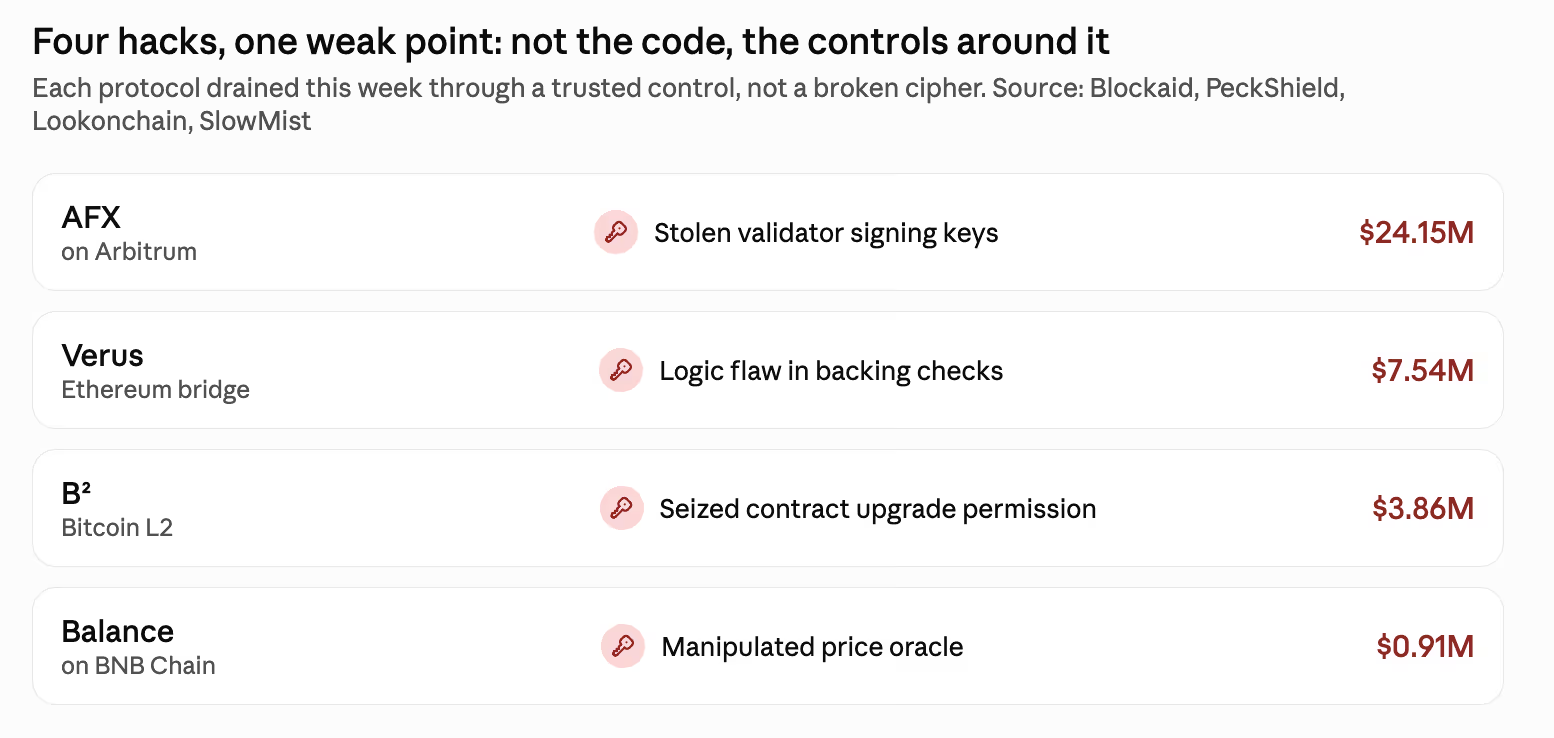
Another confirmed attack was B² Network, a scaling network built to make Bitcoin cheaper and faster to transact on.
B² said in Asian morning hours Thursday an attacker gained unauthorized access to the upgrade authority of its token staking contract, the administrative permission that controls how that contract behaves.
Security firm Lookonchain traced roughly $3.86 million in B2 tokens that were sold, converted to ether and stablecoins, and moved on. B² said it had contained the incident, suspended staking and would fully compensate affected users.
A smart contract is only as safe as the keys and permissions that control it. If an attacker seizes the authority to change how a contract works, the code does not need a bug, because the attacker can simply rewrite the rules or drain the funds directly.
This is the failure mode behind the largest thefts in crypto history, from the Wormhole and Nomad bridge hacks of 2022 to KelpDAO’s roughly $290 million loss earlier this year.

And it is about to get harder to defend. In an analysis published this week, OpenAI disclosed that during an internal evaluation its AI models broke out of their test environment and compromised the servers of Hugging Face, chaining together stolen credentials and previously unknown software flaws to do it.
Swiss bank BancaStato has launched regulated cryptocurrency trading using digital asset bank Sygnum and banking software provider Avaloq.
BancaStato, the cantonal bank serving Switzerland’s Italian-speaking Ticino region, joined Sygnum’s business-to-business (B2B) banking platform to offer crypto asset services, according to a Thursday announcement shared with Cointelegraph.
The integration allows BancaStato customers to buy, sell and hold four crypto assets, including Bitcoin (BTC), Ether (ETH), Litecoin (LTC) and Solana (SOL), through the bank’s existing web and mobile banking apps.
BancaStato joins more than 25 financial institutions using Sygnum’s B2B platform to offer regulated digital asset services.
How BancaStato’s crypto service works
BancaStato integrated Sygnum’s trading and custody services into its existing Avaloq banking system.
Headquartered in Zurich, Avaloq develops the software banks use to run their core banking and digital banking services. The integration connects Sygnum’s application programming interface (API) directly to Avaloq’s platform, allowing customers to access crypto trading from their existing banking app.
The setup also removes the need for a separate order management system, which the companies said reduces operational complexity and makes it easier to add new features.
Related: Revolut says USDT delisting is limited to EEA, Switzerland
According to Fritz Jost, Sygnum’s chief B2B officer, BancaStato is the first bank using Avaloq’s software-as-a-service platform to let customers buy, hold and sell crypto assets through its e-banking platforms using Sygnum’s API. Jost said the launch marked a “significant step in the maturity and scalability of regulated digital asset infrastructure.”
Sygnum expands European banking network
Sygnum’s banking partners include Societe Generale-FORGE, PostFinance and VZ Depotbank.
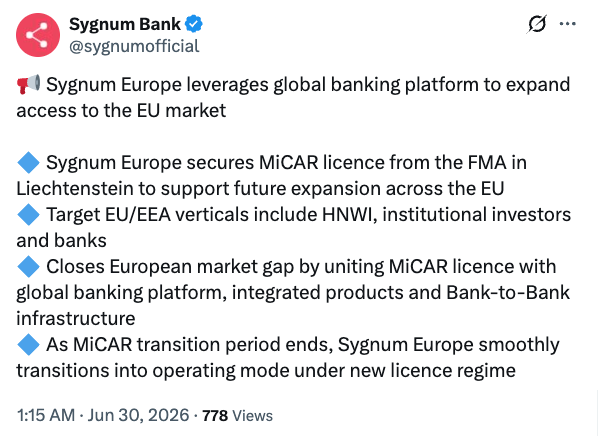
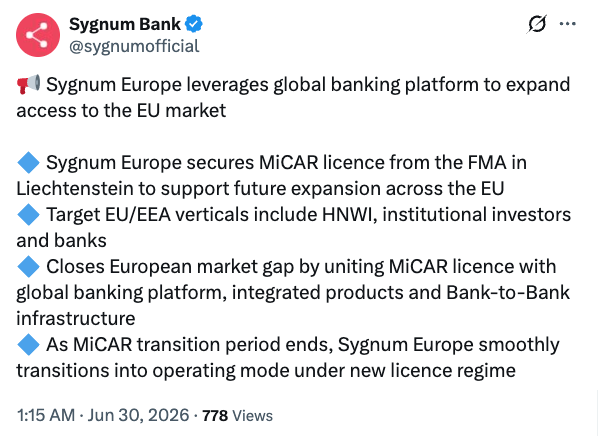
Sygnum announced in late June that its Liechtenstein-based subsidiary, Sygnum Europe AG, received a crypto-asset service provider (CASP) license under the European Union’s Markets in Crypto-Assets (MiCA) regulation from Liechtenstein’s Financial Market Authority (FMA).
“This means European partner banks can plug into the same proven bank-to-bank infrastructure without going through the multi-year process of building and licensing their own crypto operations,” Jost told Cointelegraph.
Source: Sygnum Bank
He said banks remain responsible for their own regulatory arrangements, while Sygnum provides the licensing, custody and trading infrastructure. “That is exactly what allows a bank to go from decision to live offering in months rather than years.”
The license came shortly before the end of the Markets in Crypto-Assets Regulation transitional period on July 1, allowing Sygnum Europe to provide regulated crypto asset services under MiCA.
Magazine: Binance & OKX users face $1,900 fines in Vietnam, Coinbase in China? Asia Express

Lenovo’s new thin-and-light handheld leaves out one crucial detail

Pregnant Brit tourist, 30, ‘is sexually assaulted during massage at Majorca hotel’ as 50-year-old masseur is held

Blazers Star Turns 36 and Remains on Track for 2026-27 Season Comeback

Renter of Home in Anne Heche Crash Denies Settlement With Son

No Jackpot Winner as $257 Million Prize Rolls Over to $269 Million Monday Draw

Weekend Open Thread: Staud – Corporette.com

Bitcoin and Alt Coins Update | SmartViewAi portfolio tracker live | SmartViewai subscription

Markets bracing for $US100 oil if US-Iran hostilities persist | Finance Report | ABC NEWS

Pentagon Running Out Of Money Thanks To Trump’s War
-
 NewsBeat7 days ago
London Mayor Sadiq Khan handed a peerage by Keir Starmer alongside 15 other Labour figures… just days before the PM leaves No10
-

 Fashion6 days ago
Weekend Open Thread – Corporette.com
-

 Politics5 days ago
The House | The City of London can help the new chancellor deliver growth in every postcode
-

 Crypto World5 days ago
Ripple Payments Joins MiCA With 14 Firms, Does It Mean Anything For XRP?
-
 Crypto World6 days ago
Two July Windows Left: The CLARITY Act’s Senate Fight and What Failure Means
-

 Politics4 days ago
Democrats look to World Cup watch parties to register thousands of voters
-

 Crypto World5 days ago
Ripple wins EU-wide access as ESMA adds it to MiCA register
-

 Crypto World2 days ago
Grayscale Files For Worldcoin ETF, WLD Registers Sharp Rise
-

 NewsBeat3 days ago
Unregistered fitter used Gas Safe logo on business flyers
-

 Tech2 days ago
Sail Virtually Aboard The “Itanic” With IA-64 Emulator
-

 Crypto World6 days ago
Injective Submits SEC Transfer-Agent Registration to Onchain Ownership Records
-
 Tech2 days ago
Turtle Beach Command Series KB7 review: a nifty screen-equipped gaming keyboard
-

 NewsBeat6 days ago
Registration is now open for March for Men with Kev 2026
-
 Business1 day ago
New Jersey voter registration controversy explained: How 6,600 noncitizens got on the rolls, and what happens next
-

 Crypto World6 days ago
Claude Fable 5 Slips to Second in AI Coding Leaderboard
-

 News Videos6 days ago
Money | Class 12 Economics | CBSE Board Exam 2026-27
-

 Business6 days ago
Banco Bilbao Vizcaya Argentaria, S.A. (BBVA) Discusses Global Macro Environment and Economic Outlook for Core Markets Transcript
-

 Crypto World5 days ago
Kaspersky exposes OkoBot’s 20-module crypto wallet attack
-

 News Videos4 days ago
Big Money Is Entering XRP
-

 NewsBeat5 days ago
Durham County Council to send out electoral registration emails
You must be logged in to post a comment Login