

Crypto World
SecondFi Traces Cardano Wallet Exploit to Address-Level Issue

A vulnerability in Cardano-based wallet SecondFi allowed attackers to drain user funds, resulting in major losses.
SecondFi on Wednesday confirmed it had identified the root cause of the exploit and is now engaging with Cardano ecosystem platforms and blockchain investigators to address the issue.
The company also said it triggered emergency measures that secured roughly 129 million ADA, which is being transferred to an independent third-party custodian and held for affected users pending verification.
The platform on Tuesday estimated that around 16 million ADA, or $2.4 million, was affected across 374 addresses.
Cardano founder Charles Hoskinson said SecondFi is not an Input Output Global product and stressed that there is no ownership, control, or business relationship between the wallet and IOG.
SecondFi traces exploit to an address-level issue
SecondFi has not released a comprehensive post-mortem as of publication, but has issued multiple statements confirming a security breach caused by a vulnerability in its Cardano web wallet generation software.
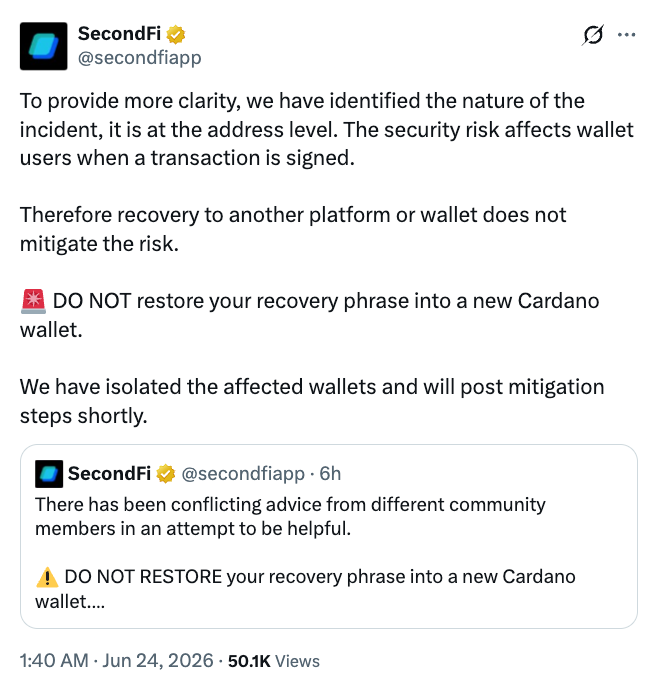
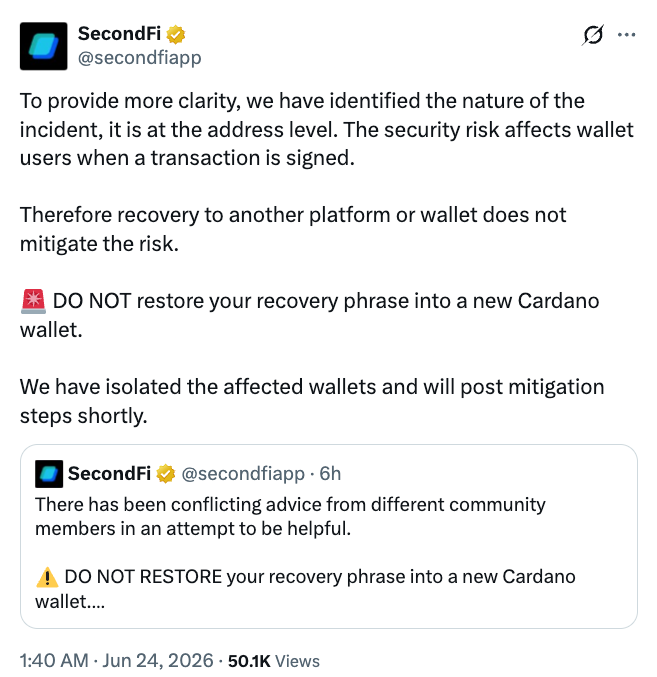
It said the root cause of the incident was an issue at the address level that affects users when they sign transactions.
Source: SecondFi
“SecondFi’s wallet software exposed the private keys it generated,” Mitchell Amador, CEO of security company Immunefi, told Cointelegraph.
Amador said that while the blockchain remained secure, the code that generates the keys is the “part nobody audits like a contract.” He added that attackers have increasingly shifted focus toward infrastructure that creates or stores crypto keys rather than blockchain protocols.
Related: AI models led to a ‘vulnerability apocalypse’ in crypto security: Immunefi CEO
“Recovery to another platform or wallet does not mitigate the risk,” SecondFi said, advising users not to restore their recovery phrases into new Cardano wallets. The guidance differed from recommendations by some community members, who urged users to migrate affected wallets and move funds to newly created addresses.
“We didn’t write the code,” says Hoskinson
SecondFi is a self-custodial platform built on Cardano that rebranded from the Yoroi wallet in April 2026. Yoroi was developed by Emurgo, which describes itself as the “for-profit arm of Cardano,” and was launched as the first open-source light wallet for the Cardano blockchain.
Hoskinson said IOG’s incident response team has been in contact with SecondFi since Monday and that the platform requested an independent security audit.

Source: Charles Hoskinson
In a Tuesday video posted on X, Hoskinson stressed that IOG “is not Emurgo,” adding that the company has no influence over Emurgo and cannot speak on its behalf regarding the exploit.
“We didn’t write the code and we’re not connected to it,” he said.
Magazine: Japanese pension fund tips 1% in crypto, G7 urges action on NK hackers: Asia Express

Crypto World
Lummis Sets July as Senate Floor Deadline for Clarity Act, Tells Dimon to Read the Bill


Senator Cynthia Lummis announced Wednesday morning that the Digital Asset Market Clarity Act will reach the Senate floor in July, setting the first hard public commitment to a floor date from the bill's lead sponsor. Lummis made the announcement on Fox Business's "Mornings with Maria," saying the… Read the full story at The Defiant


Months of negotiations have brought the CLARITY Act to its final review stage, with Senator Cynthia Lummis confirming a July 4 release of the updated text ahead of a Senate push later in July.
Summary
- Senator Cynthia Lummis said the final CLARITY Act text will be released around July 4 for public review.
- Senate leaders are working to schedule floor consideration of the crypto market structure bill in July.
- Law enforcement groups and anti-trafficking advocates continue to oppose Section 604 over AML and oversight concerns.
According to Lummis, who spoke with Fox Business host Maria Bartiromo, Senate negotiators are preparing to publish the updated legislative text after months of discussions involving lawmakers, industry stakeholders, and banking representatives. She said the bill will be made available for one final round of feedback before lawmakers seek a Senate floor vote later in July.
Speaking during the interview, Lummis said negotiations on the legislation have been ongoing since last Labor Day and have required extensive work to address concerns raised throughout the drafting process. She stated that lawmakers spent thousands of hours examining issues tied to both the CLARITY Act and the recently debated GENIUS Act while also considering objections raised by parts of the banking industry.
Following the publication of the text, Lummis said Senate leadership is working to secure floor time next month. She added that discussions with Senate Majority Leader John Thune are focused on placing the legislation on the chamber’s July agenda.
Senate prepares next step for crypto market structure bill
The expected release comes as lawmakers continue refining a framework intended to establish regulatory boundaries for digital asset markets in the United States.
During the interview, Lummis pushed back against criticism from JPMorgan CEO Jamie Dimon, who had argued that the bill could allow crypto companies to offer rewards programs resembling interest-bearing banking products without being subject to the same safeguards as traditional financial institutions.
Responding to those concerns, Lummis said the criticism does not accurately reflect the legislation’s current language. She pointed to Section 301 of the bill, which she said was revised during negotiations to address issues raised by banks and regulators.
According to Lummis, the updated provisions ensure that rewards offered by crypto firms are not linked to account balances in a way that resembles interest payments. She also said the legislation includes additional anti-money laundering measures that were incorporated during the drafting process.
Her remarks come as lawmakers continue balancing demands from the crypto industry with concerns raised by traditional financial institutions over consumer protections and regulatory consistency.
Section 604 continues to attract opposition
While Senate negotiators move toward publication of the final text, several organizations have recently urged lawmakers to reconsider another part of the legislation.
As crypto.news previously reported, four law enforcement organizations sent a letter to Acting Attorney General Todd Blanche and White House digital assets adviser Patrick Witt, warning that Section 604 could create regulatory gaps and make investigations involving digital assets more difficult. The groups argued that the provision could weaken Know Your Customer and Anti-Money Laundering requirements compared with standards applied in traditional finance.
Section 604 incorporates the Blockchain Regulatory Certainty Act and would prevent certain non-custodial participants, including open-source developers, self-custody tool providers, software contributors, and some decentralized finance infrastructure operators, from automatically being classified as money transmitters.
Separately, the Alliance to End Human Trafficking urged Senate Republican Leader John Thune and Senate Democratic Leader Chuck Schumer to revisit the same provision. The organization said the proposed language could create ambiguities that complicate efforts to monitor financial activity linked to human trafficking, organized crime, child exploitation, sanctions evasion, and other illicit conduct.
Those objections add to the list of issues lawmakers are weighing as the CLARITY Act enters what Lummis described as its final public review phase before Senate consideration.


Ripple won a regulatory milestone in Japan this week — but it needed a rival blockchain to do it.
Earlier today, SBI VC Trade, a crypto arm of the $11 billion Japanese financial giant SBI Holdings, listed Ripple’s dollar-pegged stablecoin for trading, heralding it as the country’s first “Type 4 electronic payment instrument” under Japan’s revised Payment Services Act.
However, the only Ripple USD (RLUSD) tokens that SBI traders in Japan can deposit or withdraw are on the Ethereum blockchain.
The irony is rich. Ethereum is the primary competitor of the XRP Ledger (XRPL), the blockchain that Ripple incubated.
The Japanese approval of RLUSD as its first Type 4 instrument is unambiguous. The supported chain is Ethereum, and RLUSD on any other chain will not be accepted for deposit, including XRPL-based RLUSD.
Additional blockchains could earn approval in the future, although regulators have not specified any particular timeline for review.
Type 4 electronic payment method
Japan’s 2023 amendments to its Payment Services Act created a dedicated regulatory bucket for fiat-pegged stablecoins.
These “electronic payment instruments” separated digital money-type tokens from ordinary crypto assets like ether or XRP, which aren’t pegged in value to any fiat currency.
Pursuant to Article 2 of the act, Type 1 instruments include currency-denominated value usable for payment to and tradable with unspecified persons, Type 2 covers value instantly exchangeable with Type 1, and Type 3 covers instruments with specific trust beneficiary rights.
Type 4 is a residual, catch-all slot for property value designated, by cabinet office ordinance, as otherwise equivalent in value to the first three categories.
It’s the bucket regulators can reach for when an instrument doesn’t fit cleanly anywhere else.
That residual quality explains the awkward legal footnote in SBI VC Trade’s own announcement. The RLUSD token is not a trust beneficiary right under US law, the company noted, yet SBI workers were able to help it gain Type 4 classification for Japanese purposes anyway after establishing its financial equivalencies to the USD to the satisfaction of regulators.
The Type 4 label is as much a classification as a regulatory admission that Ethereum has some superiority over the XRPL.
RLUSD didn’t slot neatly into the three main categories, but thanks to the help of Ethereum, it was able to gain a catch-all designation.
It’s issued by Standard Custody & Trust Company, a New York-chartered Ripple subsidiary, and is backed by dollar deposits and short-term Treasuries subject to monthly, third-party attestations.
It’s the second dollar stablecoin on the SBI VCTRADE platform, which has handled Circle’s USDC since March 2025. USDC is a Type 3 instrument in Japan.
An XRP milestone using Ethereum
Still, XRP influencers framed the event as a win. RLUSD started trending on X.
The president of SBI VC Trade billed the listing as a milestone and credited Ripple Labs for the momentous occasion.
Jack McDonald, Ripple’s senior vice president for stablecoins, praised Japan’s regulatory clarity and applauded RLUSD’s ability to link Japanese institutions with global liquidity.
Neither executive dwelt on which blockchain was actually linking up the liquidity.
“They launched this one on ETHEREUM,” one account posted in reply to celebratory coverage.
A separate post highlighted the fine print on the approval. RLUSD is live “on Ethereum ONLY” as a Japanese Type 4 electronic payment instrument and capped at roughly $6,200 per transaction, a ceiling that matches the 1 million yen per-transaction limit set in SBI VC Trade’s own announcement.
Most of RLUSD already lives on Ethereum
The Japanese listing isn’t an anomaly. Indeed, despite being a Ripple project, the majority of RLUSD tokens have historically existed outside of the XRPL.
As Protos reported on June 15, around $879 million of the token in circulation was parked on Ethereum, ahead of roughly $760 million on the XRP Ledger.
Read more: Ripple dumps XRP to pump RLUSD — still 0.2% the size of USDT
Ethereum’s dominance had been wider earlier in the cycle, with Ethereum holding close to 88% of RLUSD supply as recently as October 2025.
Coin listing sites like CoinMarketCap reinforce the preeminence of Ethereum-based RLUSD, listing RLUSD’s primary blockchain as Ethereum and pointing to the token’s ERC-20 contract address as its primary smart contract, rather than any XRP Ledger issuance.
Dwarfing the size of XRPL, Ethereum gave RLUSD deeper liquidity, mature DeFi venues like Aave and Curve, and a far larger base of dollar-stablecoin holders.
For a Japanese exchange wiring up a new asset, Ethereum-based RLUSD was the quickest path to approval and trade listings.
Got a tip? Send us an email securely via Protos Leaks. For more informed news and investigations, follow us on X, Bluesky, and Google News, or subscribe to our YouTube channel.
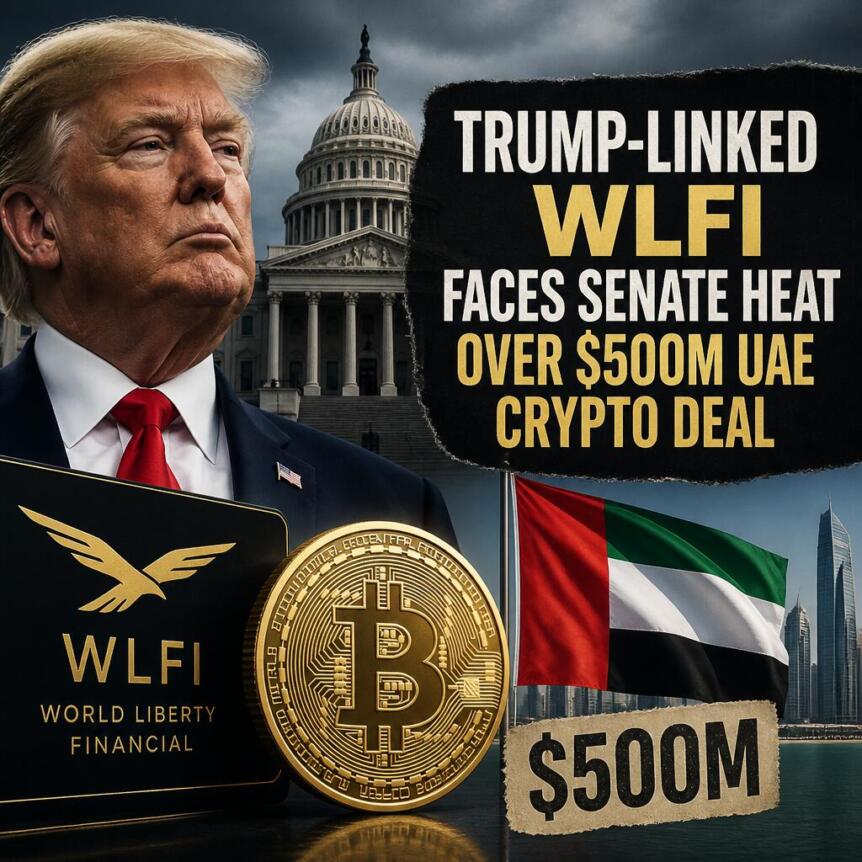
Congressional scrutiny has intensified around World Liberty Financial (WLFI) after Senate Democrats raised concerns about a major foreign-linked investment. The lawmakers are seeking additional information about a reported transaction involving entities connected to the United Arab Emirates. Meanwhile, the issue has emerged alongside ongoing debates over digital asset legislation in Washington.
Senate Democrats Seek Review of WLFI UAE Investment
Five Democratic senators have urged Republican committee leaders to examine a reported investment involving WLFI. The lawmakers requested a congressional hearing and highlighted potential conflicts linked to foreign interests. As a result, the issue has drawn fresh attention to the company’s ownership structure.
According to the senators, the investment agreement was completed shortly before Donald Trump returned to office. They stated that a UAE-linked partner received a 49% stake in WLFI through the arrangement. Additionally, the lawmakers reported that foreign buyers paid $218 million to entities connected to Trump and envoy Steve Witkoff.
The senators identified Sheikh Tahnoon bin Zayed Al Nahyan as the lead investor in the transaction. They argued that the reported ownership structure raises questions about foreign influence. Consequently, they requested sworn statements from administration officials and others connected to the deal.
The lawmakers also pointed to policy developments that occurred after Trump took office. They noted that the UAE received more than $1.4 billion in arms approvals since January 2025. Furthermore, exports of advanced artificial intelligence chips exceeded $1 billion during the same period.
Democrats want authorities to clarify what officials knew about the reported payments and timing. Therefore, they are seeking records and testimony from relevant parties. The request forms part of a broader effort to examine potential conflicts involving public officials.
The inquiry adds another layer of political pressure on WLFI and its associated projects. At the same time, lawmakers continue to debate how digital asset businesses should operate. As discussions continue, congressional committees may face increased pressure to address the concerns.
Clarity Act Debate Adds New Dimension to Dispute
The controversy has surfaced while Congress continues work on the CLARITY Act. The legislation aims to establish a clearer regulatory framework for digital assets. Therefore, lawmakers remain engaged in negotiations over several key provisions.
Senate Democrats have proposed ethics measures tied to the legislation. The proposal would restrict federal officials from creating, promoting, or sponsoring crypto assets. Consequently, the amendment could affect projects associated with current government officials.
The proposed restrictions could impact crypto ventures linked to Trump. Lawmakers specifically referenced World Liberty Financial and the TRUMP meme coin. As a result, the debate has expanded beyond market regulation and into ethics oversight.
White House crypto adviser Patrick Witt has become involved in discussions surrounding the bill. Reports indicate that he is working to address concerns related to the ethics provisions. Meanwhile, lawmakers continue to negotiate the final structure of the legislation.
Supporters of the ethics proposal argue that stronger safeguards would reduce potential conflicts. However, opponents maintain that broad restrictions could affect participation in emerging technologies. Therefore, the issue remains a key point of disagreement in Congress.
The dispute highlights the growing intersection between digital assets and national politics. At the same time, regulators and lawmakers continue shaping future crypto policy. As congressional discussions move forward, both the WLFI inquiry and the CLARITY Act debate are expected to remain prominent topics.


Cboe, one of the largest U.S. derivatives exchanges, said it is entering the prediction-market arena and is reviving binary options on the S&P 500 index after abandoning them more than a decade ago, a move that brings it into competition with platforms such as Kalshi and the crypto-native Polymarket.
A binary option is a yes-or-no bet that pays a fixed amount if an outcome occurs, in this case whether the benchmark U.S. equity index crosses a specific level. That is close to what Polymarket and Kalshi already offer, though their offerings go beyond stock market forecasts to cover political and sporting outcomes as well as other topics.
The introduction follows Cboe’s success with same-day S&P 500 options, contracts that expire within hours and now make up about 30% of U.S. options volume, calling attention to the demand for fast, outcome-based trades.
“Investors increasingly seek products that allow them to express a specific view on future events and market outcomes,” said Milan Galik, CEO of Interactive Brokers, which is carrying the binary contracts, in a statement.
The contracts will also become available on Charles Schwab later this year.
Second time round
Cboe has tried this market before. It first listed binary options on the S&P 500 and the Cboe Volatility Index in 2008, but they failed to draw interest and were pulled, with the last such contract expiring in 2017.


YZi rejected suggestions that the settlement amounts to a takeover, a person close to the settlement told CoinDesk in an interview, describing it instead as a governance reset intended to unlock shareholder value. The firm also stressed that Binance founder Changpeng “CZ” Zhao was not involved in the initiative.
The investment firm was rebranded from the venture arm of crypto exchange Binance in 2024. Following Zhao’s release from prison that year, he took a more active role in venture project. YZI Labs is often referred to as Zhao’s family office – the name for an investment vehicle that manages a family’s wealth. YZi, however, says its structure is different, as it does not involve itself in estate planning, tax structuring and other similar functions.
YZi’s goal is to reposition CEA as a leading BNB treasury vehicle, comparable to Strategy’s (MSTR) role in bitcoin markets. The firm argues that CEA’s shares trade at a significant discount to the value of its underlying BNB holdings, a gap it believes can be narrowed through governance reforms and a clearer operating strategy.
The move comes as digital asset treasury companies enter what some investors describe as a second phase of development. While early treasury firms focused primarily on accumulating crypto assets, newer models are increasingly looking to generate revenue from ecosystem participation and infrastructure businesses tied to those holdings.


Arredondo argues that the industry has spent years building separate blockchain networks, stablecoins and digital money projects, but has spent less time ensuring those systems can work together.
“We need to move the market from everyone doing their own very cool things to actually thinking about standard-setting across the piece.”
The issue has become more important as governments, banks and private companies increasingly experiment with tokenized deposits, stablecoins and central bank digital currencies (CBDCs).
Arredondo pointed to the European Union (EU) as an example of a jurisdiction seeking to accommodate multiple forms of digital money simultaneously.
The EU’s approach allows stablecoins, tokenized bank deposits and central bank money to coexist under the same broad framework, she said.
Wall Street’s crypto role
The growing role of banks, asset managers and large financial institutions in crypto has divided the industry. Some early crypto supporters argue the sector is moving away from its original goals of decentralization and disintermediation.
Arredondo sees it differently. “The early crypto vision raised fundamental economic questions and brought them to the mainstream,” she said.
For Arredondo, the rise of institutional crypto does not mean the industry’s early ideas failed.
Instead, she sees it as evidence that ideas first developed inside the crypto sphere are increasingly being adopted by mainstream finance. “It shouldn’t be disappointing that we are maintaining the pillars that have long anchored trust in money.”

Key Points
-
President Trump postpones housing legislation signing, halting CBDC prohibition.
-
Legislation includes provision blocking Federal Reserve digital dollar until 2030.
-
Signing contingent on Congressional passage of SAVE America Act.
-
Stablecoin exemptions preserved within housing legislation framework.
-
Senate faces mounting pressure on cryptocurrency regulatory framework discussions.
President Donald Trump has postponed the implementation of a federal prohibition on central bank digital currencies by canceling Wednesday’s scheduled signing ceremony for comprehensive bipartisan housing legislation. The measure includes provisions preventing the Federal Reserve from launching a digital dollar until 2030, though Trump has made his approval conditional on separate voting reform legislation.
President Conditions Housing Bill on Electoral Reforms
Through a Truth Social announcement, Trump canceled the ceremony mere hours before its scheduled start. He indicated that Congressional approval of the SAVE America Act must occur before he proceeds with the housing package. This decision immediately created uncertainty surrounding the housing bill’s CBDC prohibition language.
The SAVE America Act mandates citizenship verification for individuals registering to vote in federal elections. Proponents characterize this requirement as necessary election integrity protection, while critics contend it may disenfranchise legitimate voters. Trump has urged Senate Republicans to expedite the measure despite minimal Democratic backing.
Congressional approval for the housing bill was substantial, with the House voting 358 to 32 following Senate passage at 85 to five. This bipartisan support demonstrated rare legislative consensus across party lines. Nevertheless, Trump chose to delay the signing despite broad congressional backing.
Digital Currency Ban Embedded in Housing Legislation
The 21st Century ROAD to Housing Act focuses predominantly on housing availability, cost reduction, mortgage regulations, and development obstacles. Yet legislators inserted provisions prohibiting the Federal Reserve from developing or distributing a retail CBDC. This restriction extends through December 31, 2030.
The language encompasses digital instruments that function similarly to central bank digital currencies. Conversely, it carves out private dollar-denominated assets operating on transparent, permissionless, and decentralized networks. This exemption safeguards eligible stablecoins from the federal prohibition.
Trump has previously instructed federal departments to refrain from creating, distributing, or advocating for a United States CBDC absent explicit legislative authority. While the Federal Reserve has conducted digital currency research, no digital dollar has been introduced. The congressional language would codify existing administrative policy into statutory law.
Postponement Creates Uncertainty for Crypto Regulatory Framework
Trump retains the option to sign the housing legislation once Congress addresses his voting reform priorities. Constitutional mechanisms also permit the bill to become law without presidential signature. However, formal transmission procedures and legislative scheduling will dictate available timeframes.
This postponement may generate additional concerns regarding the Digital Asset Market Clarity Act. That legislation would establish regulatory jurisdiction for digital assets and allocate supervision among federal agencies. Trump has expressed support for establishing permanent market structure frameworks for the cryptocurrency industry.
The CLARITY Act awaits Senate deliberation, potential modifications, and ultimate floor consideration. Concurrently, legislators are negotiating ethics requirements concerning political figures’ involvement in digital asset enterprises. The housing bill dispute now introduces another political prerequisite to an already congested Senate agenda.
Trump has not explicitly threatened vetoes against market structure legislation or other cryptocurrency bills. However, his linkage of unrelated measures may decelerate congressional progress across multiple policy domains. The CBDC prohibition consequently remains entangled with broader controversies involving housing policy, electoral procedures, and digital asset oversight.

Several Democrats and one Republican who were supported by more than $8 million worth of ads funded by cryptocurrency-aligned political action committees (PACs) won their respective US primaries on Tuesday, setting up their candidacies for the November election.
Party primaries for US House of Representatives and Senate candidates in Utah, Maryland and New York resulted in wins for many aligned with crypto industry interests. PACs like Fairshake and its affiliates, largely backed by crypto companies Coinbase and Ripple Labs, spent a combined $8 million on media to support the candidates it considered likely in favor of digital asset policies for the next session of Congress.
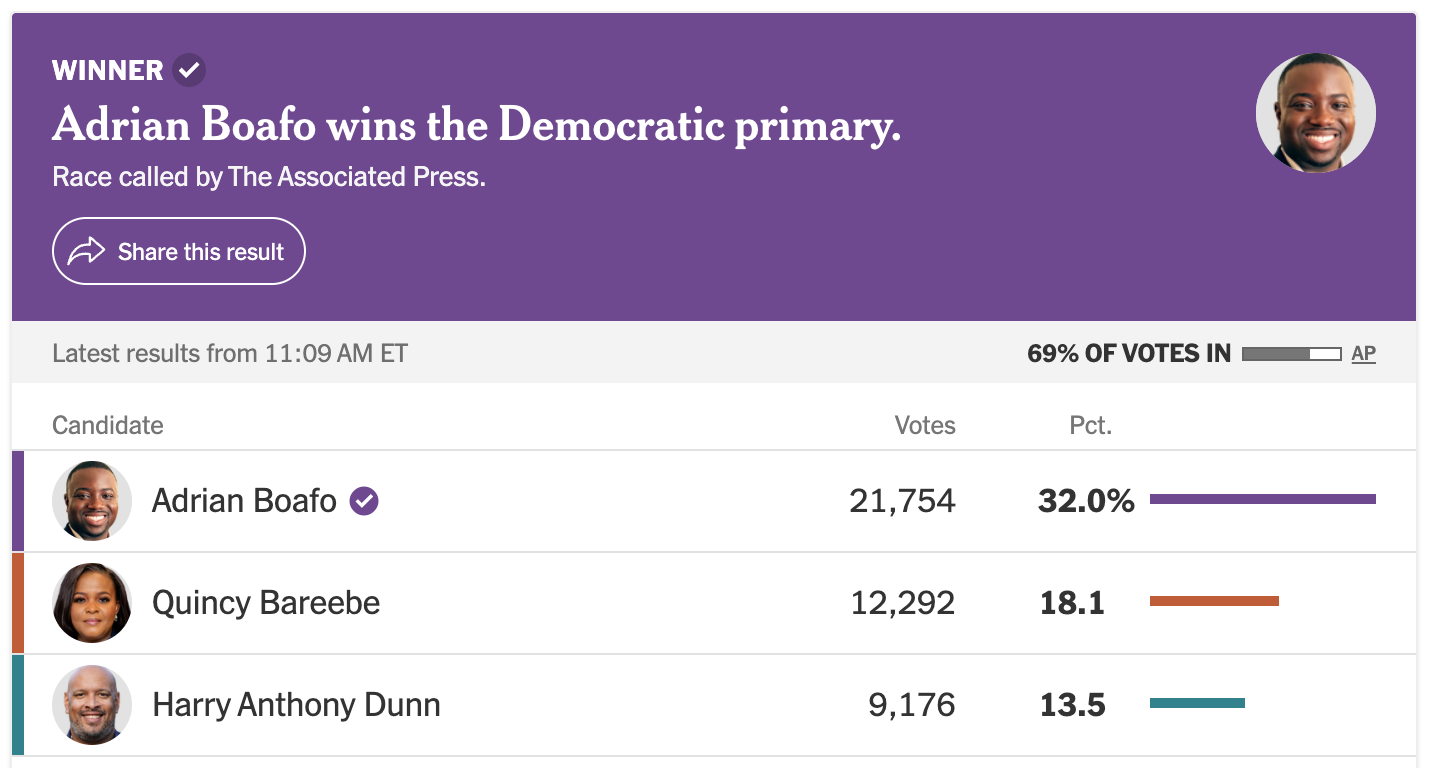
In New York, Democrat Ritchie Torres won a primary for the state’s 15th congressional district with 71.9% of the vote, while in Utah, Republican Blake Moore won in the 2nd district with 57.5% of the vote. Fairshake affiliate Protect Progress reported $5.5 million in expenditures to support Adrian Boafo, who won the Democratic primary for Maryland’s 5th district with 32% against other candidates who opposed “spending from crypto billionaires.”
“We went big and we went early,” said Fairshake spokesperson Geoff Vetter. “We did our part to move Adrian Boafo from fifth place to the halls of Congress.”
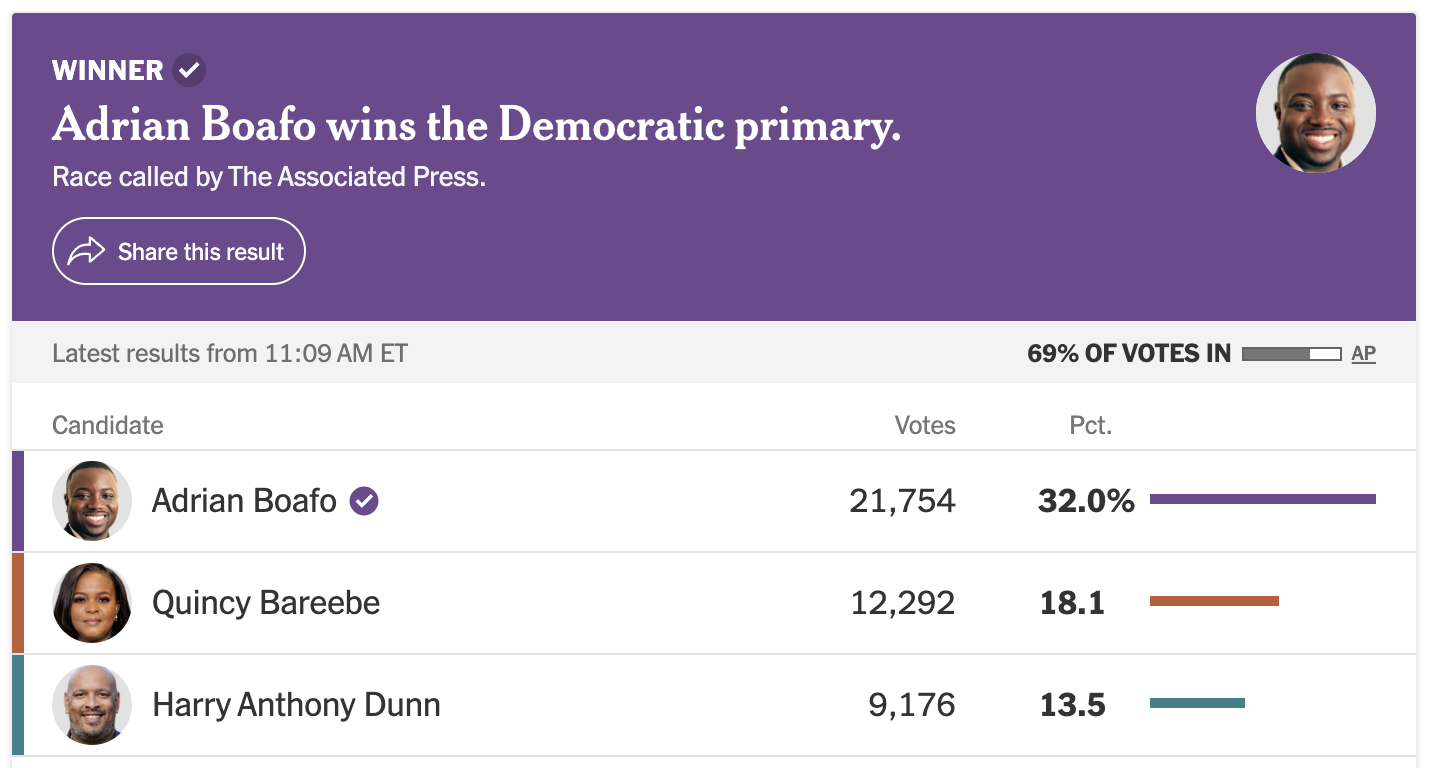
Source: The New York Times
Fairshake, which reported having “$150 million cash on hand” in June after its spending in several US state primaries, may have already influenced voters in key elections in its attempts to send candidates to Congress it considers to be “pro-crypto.” Other PACs aligned with crypto interests that have reported spending on 2026 candidates included Fellowship, backed by Cantor Fitzgerald and Anchorage Digital, and the Blockchain Leadership Fund, a hybrid PAC backed by Anchorage and Chainlink Labs.
Related: Trump cancels signing of housing bill with CBDC ban
Not every pro-crypto candidate emerged a winner on Tuesday. Alex Bores, a Democrat running in New York’s 12th District, lost to Micah Lasher. He criticized Bores in a June debate, saying that he potentially benefitted from Ripple Labs co-founder Chris Larsen spending $3.5 million to support his campaign.
Next primaries in Colorado and Arizona, but no reports of spending yet
Many expect Fairshake and other crypto-aligned PACs to turn their attention to candidates in Colorado and Arizona next. The two states are scheduled to hold primaries on June 30 and July 21, respectively, but Fairshake affiliates had not disclosed significant spending in any of the races as of Wednesday.
In 2024, the PAC and its affiliates poured more than $10 million into media to support Ruben Gallego’s Senate race in Arizona and $2.1 million for Democratic Representative Yadira Caraveo in Colorado’s 8th district. Gallego won his race, while Caraveo lost in the November 2024 election to Republican Gabe Evans.
Magazine: AI is banking the unbanked in Africa… faster than crypto
Crypto World
Bitcoin Price Prediction: CryptoQuant Believes Strategy Ought to Pause Its Bitcoin Purchases

Bitcoin price is trading around $62,000, with relatively no movement, but it’s doing little to mask a deeper structural prediction that is playing out publicly. CryptoQuant has issued a pointed recommendation. According to CryptoQuant analyst, Strategy, the Michael Saylor-led corporate Bitcoin buyer should stop accumulating BTC and focus on rebuilding cash reserves before its preferred stock situation turns into a full credibility crisis.
CryptoQuant’s head of research, Julio Moreno, outlined the pressure points in a Tuesday report. Strategy’s preferred stock STRC hit a record 17.5% discount to par value last week, closing at $82.50 against its $100 par. Cash reserves have dropped 38% since January 2026, partly because Strategy retired $1.5 billion in convertible notes, shrinking its dividend buffer at exactly the wrong moment.
Not just the above, Strategy’s dividend obligations have ballooned from $300 million annualized at the start of the year to $1.2 billion today, a nearly fourfold increase in under six months. STRC’s dividend coverage has collapsed from over seven years to just 14 months.
Now, for Strategy, selling Bitcoin to close the gap isn’t going to be straightforward either. It currently carries an aggregate unrealized BTC loss of roughly $10.6 billion, with every coin purchased in 2024, 2025, and 2026 underwater at current prices.
Strategy’s bind matters to the market because it removes one of the most consistent marginal buyers from the demand side, at a moment when on-chain data already points to significant weakness across the board. Can Bitcoin survive this?
Discover: The Best Crypto to Diversify Your Portfolio
Bitcoin Price Prediction: Recover to $81,000, or a Drop to $55,000?
Bitcoin’s current setup reads bearish on most metrics that matter. CryptoQuant’s cycle framework also classifies this as a bear phase, with 30-day apparent demand down approximately ‑63,000 BTC, a level consistent with distribution. The Coinbase premium remains negative, signaling U.S. spot buyers are not stepping in to absorb sell-side pressure. Bitcoin is already down 50% from its October all-time high near $126,080.
On the downside, CryptoQuant’s base case targets $55,000 as the structural bear-market bottom, or 20% below current levels. Standard Chartered has flagged a similar downside risk toward $50,000 before any sustained push toward $100,000. The $55,000–$56,000 zone represents the confluence of prior accumulation levels, and where realized-loss exhaustion has historically resolved prior cycles.

Don’t Miss Out on Our $1,000 USDT Airdrop on ByBit
The bull case is conditional, not dismissed. CryptoQuant’s own scenario analysis allows for a relief rally into the $71,500–$81,200 band if geopolitical and macro tensions ease materially. The “Trader Realized Price” near $81,200 capped the last bear-market rally in January 2026 and would likely act as resistance again. Current long positioning data suggests the market is not pricing a clean breakout, and it’s pricing uncertainty.
The most likely scenario is a consolidation between $60,000 and $66,000 near-term, with the $55,000 target in play if demand metrics deteriorate further. Invalidation of the bearish thesis requires a sustained close above $81,200 on volume.
Discover: The Best Token Presales
Bitcoin Hyper Eyes Early-Stage Upside as BTC Buyers Wait on the Sidelines
With Bitcoin price prediction tumbling and its large institutional buyers potentially sidelined and spot demand contracting, the near-term upside on BTC itself looks capped, at least until macro conditions shift. That dynamic is pushing some traders to look earlier in the risk curve, specifically at infrastructure plays building on top of Bitcoin rather than trading it outright.
Bitcoin Hyper ($HYPER) is positioning directly in that gap. It’s a Bitcoin Layer 2 protocol integrating the Solana Virtual Machine, making it, by design, the first BTC L2 capable of delivering SVM-powered smart contracts while settling on Bitcoin’s security layer.
The pitch addresses Bitcoin’s core bottlenecks: slow finality, high fees, and the absence of programmable execution. The presale has raised $33 million at a current token price of $0.0136821, with staking available during the presale phase.
Early participants also access a Decentralized Canonical Bridge for BTC transfers, the infrastructure layer that makes the SVM integration usable in practice, not just on paper.
The post Bitcoin Price Prediction: CryptoQuant Believes Strategy Ought to Pause Its Bitcoin Purchases appeared first on Cryptonews.

Can USA really win the FIFA World Cup? Why host nations always pack a punch | FIFA World Cup 2026

Europe's digital euro is one step closer, designed to cut out Visa and Mastercard

Brothers both given three-year sentences for Newcastle street attack


-

 Fashion5 days ago
Weekend Open Thread: Miami – Corporette.com
-

 Entertainment4 days ago
Renter of Home in Anne Heche Crash Denies Settlement With Son
-

 Tech2 days ago
Microsoft accidentally kills epic Outlook email threads
-
 Sports24 hours ago
Two goals and an assist by sheer aura: Cristiano Ronaldo just entered the World Cup chat
-

 Business4 days ago
Soccer-U.S. defends Iran World Cup travel restrictions, says discussions ongoing
-
Crypto World15 hours ago
Bitcoin (BTC) Dips Below $62K, Ethereum (ETH) Plunges 6% Daily: Market Watch
-

 Politics6 days ago
BBC Reporter Discusses Cross Party Criticism Of Trumps Iran Deal
-

 Crypto World12 hours ago
Securitize Wraps Roubini's SEC-Registered ETF as Dubai VARA Digital Security
-
Business18 hours ago
Entergy settles forward sale agreements, raises $672 million in cash proceeds
-
 Business5 days ago
Wall Street Week Ahead: Investors see Micron earnings as pulse check of AI rally momentum
-

 Politics4 days ago
Andy Burnham and the meaning of Makerfield
-

 Tech6 days ago
AWS enters the context layer race with a graph that learns from agents, not manual curation
-
 Crypto World4 days ago
Can Charles Hoskinson Really Rescue Cardano?
-

 NewsBeat5 days ago
Keir Starmer Allies Question His Chances For No 10
-

 Crypto World5 days ago
HIVE shares jump as $220M AI deal speeds Bitcoin mining pivot
-

 Crypto World4 days ago
Jake Chervinsky accuses CME of protecting derivatives monopoly
-

 Entertainment5 days ago
Jose Alvarado Wants Taylor Swift at More Knicks Games
-
 Tech3 days ago
Signal’s Meredith Whittaker says AI chatbots ‘are not your friends’ and calls Copilot agents a backdoor
-

 Tech2 days ago
Nearly 7,000 fake Amazon domains registered ahead of Prime Day 2026, researchers warn
-

 Business6 days ago
Brexit cost 6% of UK economy, Bank of England company data suggests
You must be logged in to post a comment Login