

Crypto World
Security experts warn advanced AI is about to spark a hacking crisis for both crypto and banks



A major bug found in the top privacy network Zcash, using artificial intelligence, may be a warning sign that similar undiscovered flaws exist across crypto and banking software.
What’s worrying the crypto community is that the bug, which had existed in the network for 4 years, was only found recently by Shielded Labs, a nonprofit developer on the privacy token system, using Anthropic’s newly released Opus 4.8 AI model. The vulnerability, which Zcash said “has been remediated,” if left undetected, could have allowed an attacker to print unlimited counterfeit tokens.
The disclosure had already caused panic among the crypto community and took the Zcash token down nearly 38% in the last 24 hours. Some even said on social media that “Crypto is dead. We should have pivoted to AI.”
Now, the question everyone is asking is: with AI getting better and the world bracing for the release of Anthropic’s newest Mythos model, which is supposed to be much more capable of identifying and chaining together weaknesses across systems, is the crypto industry’s security in jeopardy?
However, the prominent crypto venture capital firm Dragonfly (an early investor in Zcash) and its Managing Partner, Haseeb Qureshi, have a slightly different take on AI and crypto’s security. In his view, AI finding vulnerabilities is a good thing as it will only make the code better.
“While AI found this bug, AI will also deliver the fix for the whole category: formal verification. I’m very bullish on this as the path to harden all software across the industry,” he said on a X post.
While Haseeb’s firm continues to hold Zcash and is bullish on AI’s role in crypto security, Ben Goertzel, the CEO of AI firm SingularityNET, told CoinDesk that similar vulnerabilities aren’t just limited to crypto security, but are likely hiding in the traditional banking system as well.
“Other cryptocurrencies are not vulnerable to this specific bug, which was a simple logic error in the Zcash implementation,” Goertzel said, explaining that other cryptocurrencies are “certainly very much likely to possess similar vulnerabilities, which are likely to be found by AI tools in the coming weeks and months.”
Moreover, Goertzel said that “software infrastructures of banks and other centralized institutions are also very likely to embody serious bugs to be found by AI tools in the near future as well.”
‘Formal verification’
So what is an actual solution for this AI threat?
Both Qureshi and Goertzel said that cryptographical code and global software infrastructure must transition to “formal verification.”
The process is essentially “writing proofs of mathematical theorems in such a way that these theorems can be checked automatically,” as Ethereum’s co-founder Vitalik Buterin explained. He noted that AI-assisted formal verification could become one of the most important tools for cybersecurity, as increasingly advanced AI systems make it easier to discover software vulnerabilities.
And Qureshi echoed that sentiment.
“Formally verified cryptography can’t have implementation bugs by construction,” he said. “Right now AI is surfacing vulnerabilities across all our software–browsers, OSes, and blockchains are no exception,” he added, noting that formally verified software would be the “only path forward for mission-critical software,” which Zcash has made its focus on its roadmap.
Goertzel, meanwhile, explained why developers aren’t already using this formal verification process to make their software ironclad.
He argued that while the “Rust” programming language used by Zcash can be formally verified, developers rarely do it because it requires extra work. Furthermore, Goertzel noted that core Rust libraries often use “unsafe” constructs that are difficult to verify.
However, rewriting them to be safe would make the software slower: A problem, he stated, that could be fixed by using advanced techniques such as “supercompilation” to boost performance.
An asymmetric security war
But implementing those protections is easier said than done, CEO and co-founder of security firm CertiK, Ronghui Gu, told CoinDesk.
Defending against these threats has become an unequal battle, Gu said.
“We’re currently seeing an AI token consumption war in which hackers are highly motivated by profit, he said. “To find an exploit, they can burn a massive number of AI tokens on a single target, such as a project or smart contract.”
Gu explained that profit-driven hackers are currently engaged in a token consumption war, burning massive amounts of computing power to target individual smart contracts. Because security firms must protect hundreds of clients simultaneously, they cannot allocate the same concentrated resources to a single target without incurring significant capital costs.
To shield from this asymmetric risk, Gu said security firms must integrate automated scanners directly into daily development workflows through smaller, on-demand sessions, while relying on mathematical proofs to guarantee that contracts satisfy key security properties.
For Gu, the challenge is no longer simply finding bugs before attackers do; rather, it’s about scaling defenses against these vulnerabilities quickly enough to keep pace with increasingly powerful AI systems.
While the debate over how to stay ahead of such vulnerabilities will likely continue, as AI gets better, faster and smarter, the question for all developers is how to ensure such incidents never happen again.
Perhaps ZODL CEO Josh Swihart (former CEO of Electric Coin Company, a key developer of Zcash) put it aptly:
“The more interesting question is how we ensure that vulnerabilities never happen again. The best answer is formal verification,” Swihart said in his X article, titled “Never Again.“


Cardano has become one of the most talked-about cryptocurrencies after its price briefly dropped below $0.16 for the first time since December 2020, according to on-chain analytics platform Santiment.
The surge in attention appears to be linked to growing concerns surrounding Cardano founder Charles Hoskinson, who recently said he was “taking a break” after warning that the ecosystem could face a “wave of failures” due to project shutdowns and funding difficulties.
Social Frenzy
According to Santiment’s data, the developments triggered a sharp increase in both social activity and on-chain engagement. Cardano’s social dominance climbed to around 0.52%, its highest level in 2026. This means that more than one in every 190 cryptocurrency-related discussions on social media focused on ADA.
At the same time, daily active addresses reached 28,459, representing the highest reading in four months. According to Santiment, the spike in network activity indicates that users were actively interacting with the blockchain as the sharp price volatility created strong divisions among traders. Bearish sentiment appears to be dominating much of the discussion.
Despite the negative market reaction, Santiment explained that Cardano continues to have one of the most loyal and vocal communities in the crypto sector. The analytics firm said ADA holders have, for years, remained committed through multiple market cycles, and have often supported the network during periods when institutional participation was limited.
“The next few weeks and months will likely be a make-or-break stretch for the #15 market cap, as the community hopes institutionals consider entering into positions while prices are now at 5.5 year lows. Many investors are now looking for ecosystem growth, successful project launches, and of course some more positive future words from Hoskinson to validate the long-term vision that Cardano supporters have championed for years.”
Cardano – Brazilian Olympic Committee
In a separate development, the Cardano Foundation announced a partnership with the Brazilian Olympic Committee (COB) to bring blockchain, artificial intelligence (AI), and Internet of Things (IoT) technologies into the country’s sports sector.
According to the organizations, the three-year collaboration will focus on identity and certification systems, fan engagement, equipment tracking, and improving governance and transparency. The first pilot projects are expected to launch in the coming months.
The post Cardano (ADA) Faces Make-or-Break Moment as Social Buzz and Network Activity Explode appeared first on CryptoPotato.

Jane Street is evaluating plans for a new data center as the quantitative trading firm seeks greater computing capacity to support artificial intelligence development and expanding trading operations. According to a Bloomberg report, the company has started preliminary discussions with businesses in the technology, cryptocurrency, and financial sectors regarding a potential facility.
The proposed project could provide between 100 and 200 megawatts of computing capacity. The company has not selected a location and has not finalized the size of the facility. However, the discussions reflect the firm’s growing focus on securing long-term infrastructure to meet increasing computational requirements.
Computing Capacity Becomes a Strategic Focus
Jane Street has significantly increased its demand for processing power in recent years and currently operates tens of thousands of graphics processing units, commonly known as GPUs. These processors support artificial intelligence workloads and large-scale computational tasks.
Last month, Jane Street co-head of technology Ron Minsky outlined the company’s long-term plans for infrastructure growth. He explained the firm expects to achieve a tenfold increase in computing capacity over time. Minsky also stated that Jane Street aims to expand from tens of thousands of GPUs to hundreds of thousands in the coming years.
The company views computing resources as an important factor in supporting research and development efforts. Minsky noted that available computing power currently limits some research projects, experiments, and new initiatives. As a result, Jane Street continues to invest in additional infrastructure to support future growth.
AI Development Drives Infrastructure Demand
Jane Street intends to use the proposed data center primarily for internal operations. The facility would support the training of proprietary artificial intelligence models that assist with trading-related activities, including asset price forecasting and data analysis.
The company already operates a data center in Dallas and supplements its infrastructure through cloud service providers, including CoreWeave. The planned facility would add another layer of computing resources and help support future technology projects.
Minsky also highlighted the importance of a distributed infrastructure strategy. He explained that a single facility cannot provide enough power to meet all future requirements. Therefore, the company expects to continue expanding computing resources across multiple locations.
Strong Trading Performance Supports Expansion
Jane Street’s infrastructure plans coincide with a period of substantial business growth as the firm reported a record $39.6 billion in trading revenue during the previous year. In the first quarter of this year, trading revenue reached $16.1 billion, more than double the figure recorded during the same period a year earlier.
The company continues to pursue more complex trading strategies and longer-duration positions across global markets. Consequently, demand for computing resources has increased as systems process larger volumes of data around the clock.
At the same time, competition for AI-related computing power is growing across the quantitative trading industry. Bloomberg reported that several firms are sourcing GPUs through cloud providers and secondary markets. This trend highlights the increasing importance of computing infrastructure as financial firms expand their use of artificial intelligence and advanced data-driven strategies.
Crypto World
XRP Ledger Prepares Version 3.2.0 Mainnet Upgrade Following Recent Network Improvements
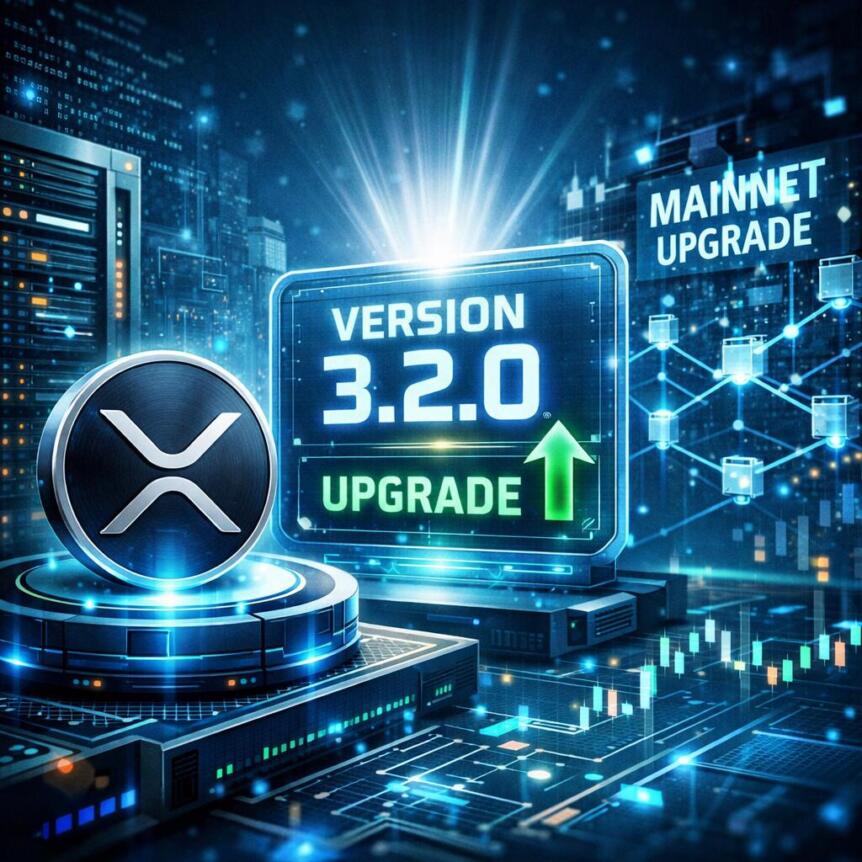
XRP Ledger Advances Toward Version 3.2.0 Deployment
The XRP Ledger ecosystem is preparing for another major mainnet upgrade as version 3.2.0 approaches release. The update introduces a software rebranding initiative and requires infrastructure operators to adjust their systems. Furthermore, the development follows the successful rollout of version 3.1.3 and continues the network’s upgrade roadmap.
XRP Ledger Operations announced that version 3.2.0 will reach the network in the near future. Consequently, the ecosystem has begun preparations for another important infrastructure transition. The update arrives shortly after the network completed its previous mainnet upgrade.
The upcoming release includes a significant change to the software powering the blockchain. Specifically, developers will rename the core software from rippled to xrpld. As a result, validators and node operators must adjust their existing configurations.
Infrastructure providers across the network will need to update their operational environments. Therefore, the transition will affect multiple participants responsible for maintaining network functionality. The operations team is also preparing guidance materials to support the migration process.
Software Rebranding Marks Key Network Development
The software name change represents one of the central elements of the upcoming release. Accordingly, the update introduces a new identity for the software package that powers the XRP Ledger. The transition also aligns future development efforts under the xrpld designation.
Visual materials released alongside the announcement highlighted the updated branding. In addition, the materials displayed version 3.2.0 as the next software release. The presentation emphasized both the software transition and the forthcoming deployment.
Community members involved in network validation welcomed the development. Moreover, supporters highlighted the importance of continued protocol improvements despite broader market conditions. The response reflected ongoing confidence in the network’s technical progress.
The upgrade also reinforces XRP Ledger’s focus on long-term infrastructure development. Therefore, developers continue to prioritize network stability and operational efficiency. These efforts remain central to maintaining reliable blockchain performance.
Recent Upgrade Provides Foundation For Next Release
Version 3.2.0 follows the activation of version 3.1.3 on the XRP Ledger mainnet. The earlier upgrade became active at ledger index 104,507,137 on May 27. Consequently, the network completed another scheduled improvement phase before moving forward.
The previous release introduced the fixCleanup3_1_3 amendment. In turn, the change aimed to strengthen long-term network reliability and performance. Developers designed the update to improve operational consistency across the ecosystem.
Older software versions lost compatibility with consensus participation after the activation. Therefore, node operators needed to upgrade their systems to remain connected. The requirement ensured that participants operated under the latest network standards.
Network developers also addressed technical questions following the earlier upgrade. Meanwhile, major amendments received full consensus support during the approval process. The unanimous backing demonstrated strong alignment among network validators.
The forthcoming version 3.2.0 release extends XRP Ledger’s ongoing development cycle. As preparations continue, infrastructure operators are expected to complete the necessary system changes. The upgrade underscores the network’s commitment to modernization, reliability, and continued protocol advancement.


Four of the largest US commercial banks — JPMorgan Chase, Citigroup, Bank of America, and Wells Fargo — are building a shared tokenized deposit network through The Clearing House, the bank-owned payments company, according to a joint press release published Friday. The initiative, which The Wall… Read the full story at The Defiant
Strategy co-founder and executive chairman Michael Saylor said Bitcoin needs “disciplined expansion” through banks, companies, securities, credit and capital markets, laying out a path for the asset as spot exchange-traded fund (ETF) outflows and a broader market sell-off test institutional demand.
On Friday, Saylor published an essay, saying Bitcoin’s base layer should be treated as “sacred infrastructure,” with most innovation occurring through higher layers, applications, custody systems, credit instruments and financial infrastructure.
The comments frame Bitcoin’s next phase as a clash between two institutional channels: passive spot ETF exposure, which has broadened access but remains sensitive to redemptions, and the corporate and credit-market adoption model favored by Saylor’s Strategy.
Saylor argued Bitcoin should become embedded in the machinery of finance rather than depend only on spot buyers or ETF inflows. He said Bitcoin’s future requires balancing adoption, innovation and self-custody while preserving the network’s core properties.
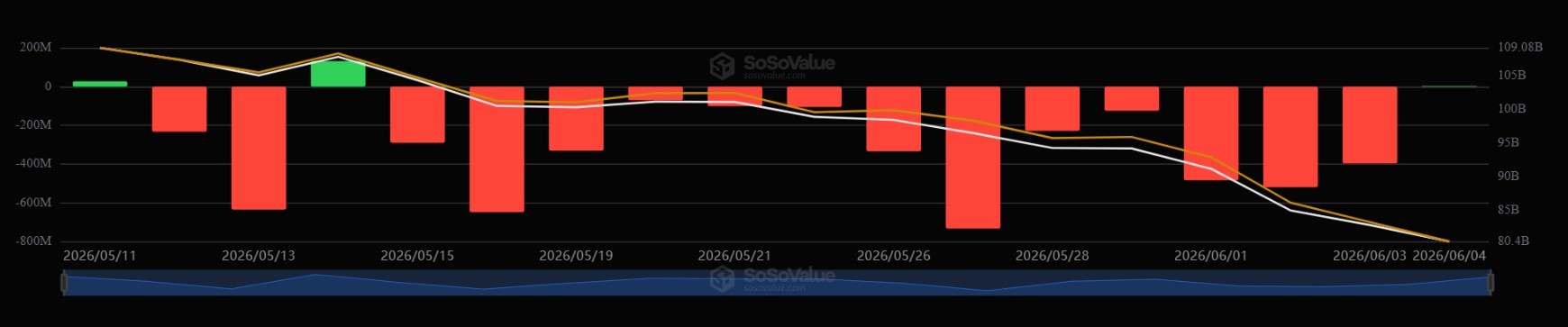
The essay comes during a sharp Bitcoin market sell-off that has put both major institutional channels under pressure. Spot Bitcoin ETFs posted weekly net outflows of $1.42 billion, $1.26 billion and $1 billion in the last three weeks of May, while the current week’s outflows have reached $1.4 billion so far.
Strategy also recently sold 32 Bitcoin to fund preferred stock dividends, its first sale since 2022, denting the “never sell” narrative that has long surrounded Saylor’s corporate Bitcoin strategy.
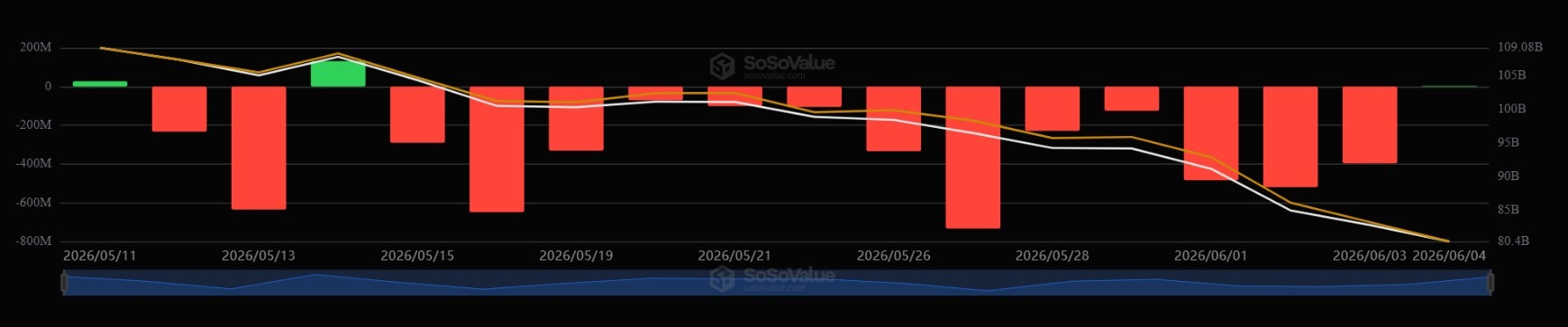
Spot Bitcoin ETF inflows and outflows in the last four weeks. Source: SoSoValue
Analysts split on demand reset
The pressure has sharpened a broader debate over whether Bitcoin’s recent decline is a temporary reset after excessive leverage, or a sign that institutional demand is weakening after months of ETF-led buying.
Lacie Zhang, research analyst at Bitget Wallet, said Bitcoin may already be closer to clearing the episode than equity markets after a $1.8 billion liquidation wave, deeply negative funding rates and a sharp reset in open interest. Zhang said a retest of $55,000 to $57,000 remains possible if outflows persist. She added:
“The key question is not just whether BTC holds $63K, but whether ETF flows stabilize, exchange reserves keep falling, and whale accumulation picks up.”
Nicolai Sondergaard, research analyst at Nansen, gave a more cautious view, saying exchange flow data suggests participants are using Bitcoin’s bounce from around $61,000 to reduce exposure rather than add to positions.
Sondergaard said Bitcoin’s ETF demand narrative has been unwinding since May, and that a durable recovery would require more than the removal of immediate market pressure. Without visible re-entry from institutional buyers, he said the market may struggle to rebuild momentum.
Related: Strategy’s leveraged Bitcoin model has faced its first stress test: Grayscale
Saylor argues for Bitcoin beyond ETFs
Saylor, in his essay, described four broad Bitcoin ideologies: maximalists, capitalists, technologists and fundamentalists. He said each group protects something important, but each can also go too far if its view becomes absolute.
The “disciplined expansion” thesis most closely fits the capitalist view, which treats Bitcoin as digital capital that can be integrated into balance sheets, securities, credit markets, banks, brokers, insurers and asset managers.
That framing differs from ETF-based exposure, where institutional adoption is measured largely through inflows and outflows.
Saylor’s preferred channel points to a more embedded model, where Bitcoin is used in corporate treasuries, collateral structures and capital markets rather than held only through spot investment products.
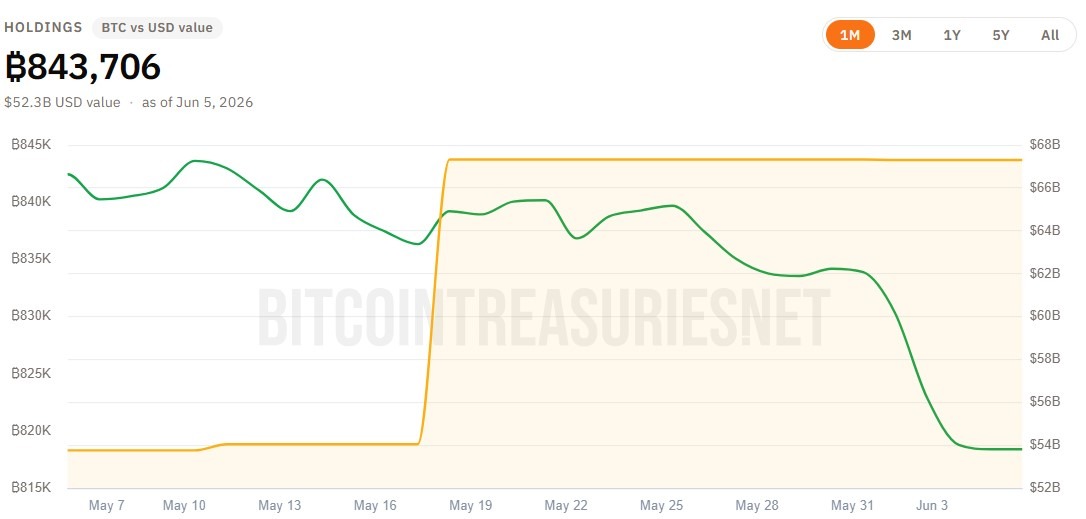
Strategy’s BTC holdings versus USD value. Source: BitcoinTreasuries.net
Magazine: Bitcoin miners are pivoting to AI, so why is the hashrate near ATHs?

The US House Ways and Means Committee circulated seven discussion drafts of bills to address digital asset taxation ahead of a Tuesday hearing on the matter, covering stablecoins, staking, mining and transactions.
Among proposals in the draft legislation are reducing the tax paperwork required for crypto holders, providing clarity for mining and staking tokens and a potential “de minimis” reporting exception for transactions. The seven discussion draft bills preceded a Tuesday hearing on digital asset taxation in the House committee, chaired by Republican Jason Smith.
Crypto industry advocates have been urging US lawmakers to address lessening the reporting burden for taxes on mining and staking as well as eliminating requirements for small crypto transactions through “de minimis” exceptions.
A draft law released by members of Congress in March and officially introduced in May as the Digital Asset PARITY Act proposed a $200 reporting threshold for stablecoin transactions, but not one on cryptocurrencies like Bitcoin.
“We need digital asset tax clarity or activity will never fully onshore,” said The Digital Chamber CEO Cody Carbone in response to the PARITY Act.

Source: Max Miller
Any bill or amendment to legislation addressing crypto tax policy will need bipartisan support in Congress before being signed into law. Although the House hearing is scheduled for Tuesday, US lawmakers in the Senate are expected to focus on a budget reconciliation bill before consideration of a digital asset market structure bill called the CLARITY Act.
Related: Israel’s tax authority ‘disappointed’ in voluntary crypto disclosures: Report
According to Wyoming Senator Cynthia Lummis, the House Ways and Means Committee and the Senate Finance Committee were considering a $300 “de minimus” exemption for Bitcoin transactions. The proposed change to capital gains taxes built upon the Wyoming lawmaker’s draft bill released in July 2025.
Illinois crypto tax expected to be signed into law soon
This week, the Illinois General Assembly signed off on a $56 billion state budget that included provisions for taxing digital assets. If signed into law by Governor JB Pritzker, crypto users can expect to pay a 0.2% tax on transactions through brokers, which also must be registered with the state.
Magazine: Bitcoin miners are pivoting to AI, so why is the hashrate near ATHs?

The biggest banks on Wall Street are reportedly going to launch a tokenized deposit network in the first half of 2027.
The effort is being led by the Clearing House, a real-time payments company co-owned by major financial institutions including JPMorgan Chase, Bank of America, Citigroup, and Wells Fargo.
Project to Bridge Traditional Payments with Blockchain
The Wall Street Journal reports that the project, called “the bridge,” aims to connect traditional banking payment systems to blockchain infrastructure so that tokenized deposits can move instantly with 24/7 settlement. It also states that the underlying blockchain will be built through a partnership with a yet-to-be-selected third-party vendor.
“This is a big move for the banks,” said Clearing House Chief Executive David Watson, who said the industry is facing a “radically different” future when it comes to on-chain payments and finance.
Citi sees the initiative as an extension of the role banks already play in the financial system. The move was “another step that effectively cements” banks’ role in financing, money management, and capital markets, said Shahmir Khaliq, the firm’s head of services.
At the same time, banks have been wary about stablecoins, concerned that their use could divert deposits away from the firms. Financial institutions and crypto institutions have been at loggerheads for months over recently advanced legislation that would allow the latter’s customers to earn interest from their stablecoin holdings.
Demand For Adoption Remains Gradual
The report states that all US banks will have access to the tokenized deposit network, with possible use cases including real-time liquidity management, programmable treasury operations, and cross-border payments. The Clearing House also expects big multinationals to be among its first users.
On the other hand, Mark Monaco, head of global payment solutions at Bank of America, said clients are not “beating down the door” for tokenized deposits yet. However, he also revealed that there is growing interest in the product, further admitting that adoption would take time.
JPMorgan has already dipped its toes with JPM Coin, an in-house tokenized deposit system for settling payments on its private blockchain. More recently, the firm also launched a token on Base for its institutional clients.
The latest development follows last year’s discussions among major financial institutions about creating a joint stablecoin through The Clearing House and Early Warning Services. As much as this is still being explored, WSJ said that some banking executives are still unsure about the benefits that these digital assets offer outside of cross-border payments.
The post Top US Banks to Launch Tokenized Deposit Network: Report appeared first on CryptoPotato.
Singapore-based crypto travel platform Travala has launched a protocol it says lets artificial intelligence agents search, reserve and pay for hotels with USDC (USDC) on layer-2 blockchain Base, extending agentic AI stablecoin payments into travel bookings.
The Travala Travel MCP is live through Claude Desktop, with outside developers able to integrate it into their own travel agents, Travala said in a statement sent to Cointelegraph.
The company said the system connects Travala’s hotel inventory to AI agents through the Model Context Protocol, an open standard for linking AI apps to external tools. Payments use Coinbase’s x402 protocol on Base, with Travala saying the setup allows gasless USDC transactions, near-instant settlement and transaction costs of about $0.01 per booking.
AI travel still needs human approval
However, final payment authorization still requires manual approval from the traveler, meaning it’s not fully autonomous but more advanced than a chatbot that only recommends itineraries.
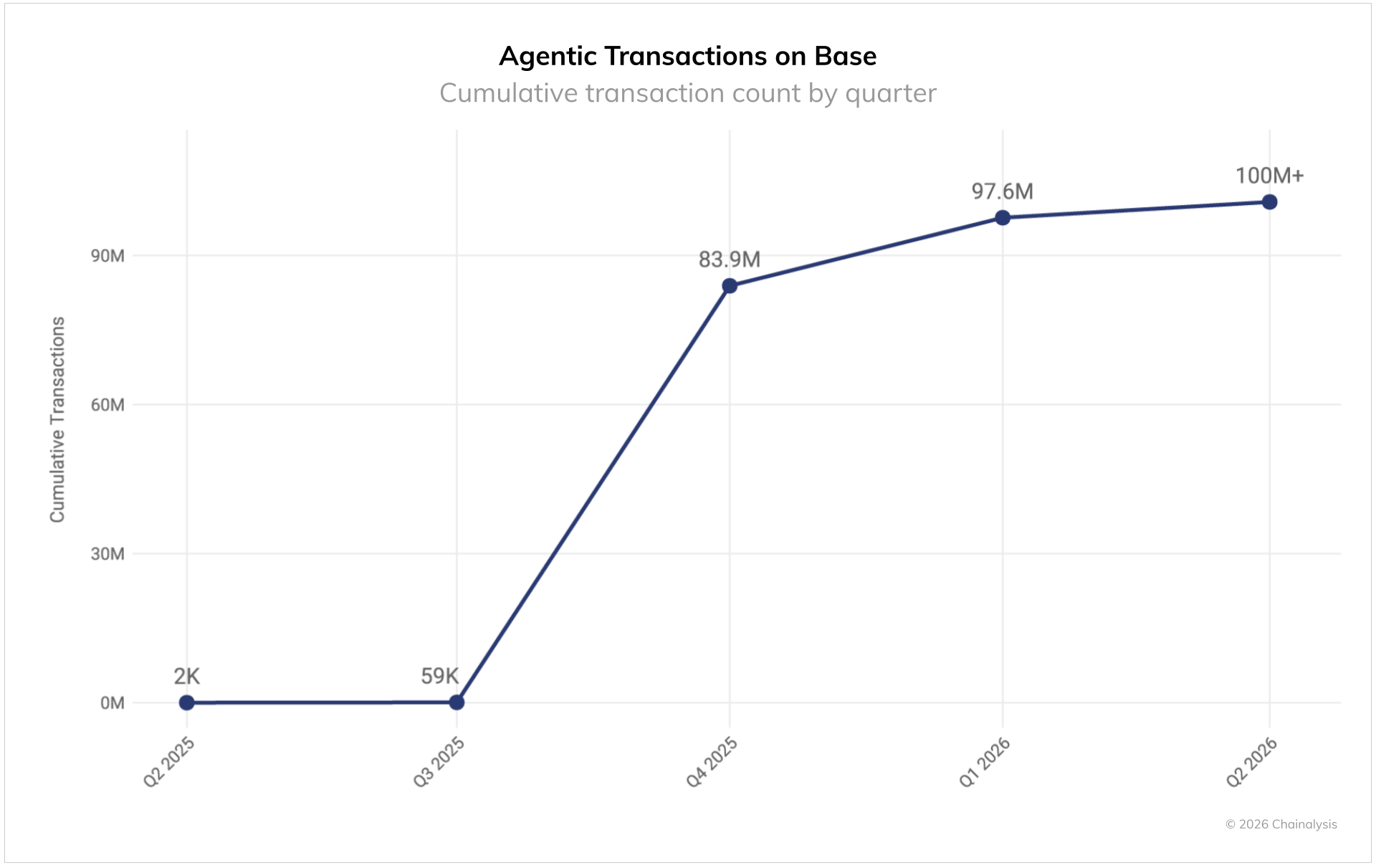
The launch comes as crypto companies try to make stablecoins useful for machine-to-machine commerce and follows a wave of crypto payment infrastructure aimed at AI agents. Cointelegraph reported recently that x402-linked wallets on Base surpassed 100 million transactions, while Fireblocks, MoonPay, Exodus and Oobit have launched products for AI-driven stablecoin payments.
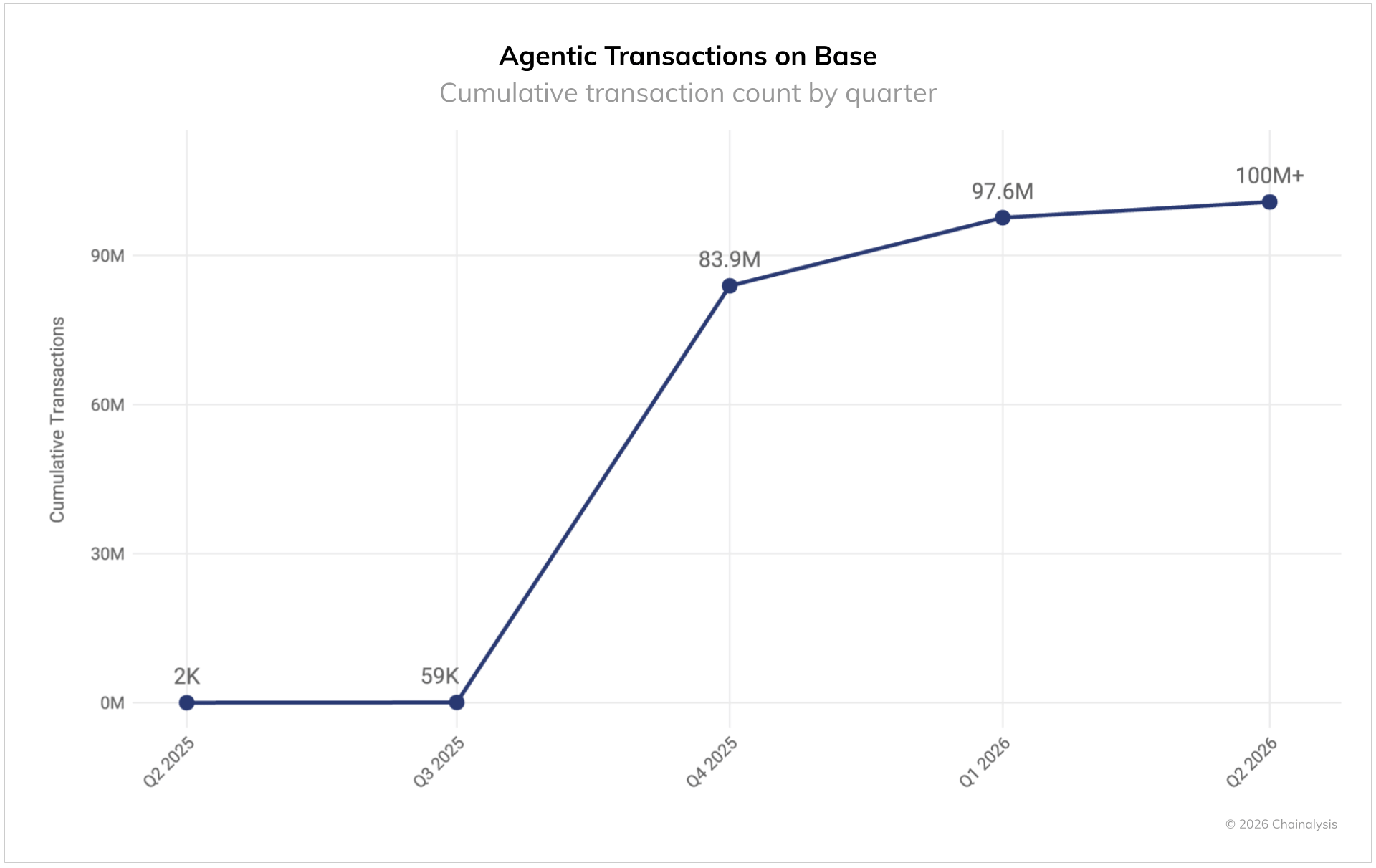
Cumulative agentic transfer volumes on Base. Source: Chainalysis
Travala framed the launch as an early step toward autonomous travel booking, even as travelers still retain final approval over payments, and said it is offering developers a 10% Coinbase Wrapped BTC (cbBTC) rebate on completed stays booked through its agents.
“The launch of the world’s first agentic AI travel protocol marks the death of the checkout button,” Travala CEO Juan Otero said, calling it the start of “a truly autonomous travel economy.”
Travala said the setup uses ERC-7715 session keys, allowing the AI agent to request a payment while keeping final signing authority inside the traveler’s wallet. The company said the protocol can maintain context across searches, bookings and cancellations in a single chat thread.
Related: Coinbase-backed x402 adds batch settlement for AI agent payments
Travala plans broader travel rollout
Travala said the protocol covers more than 2.2 million hotels, including listings from Marriott, Hilton and IHG, which are sourced through its aggregator partners.
The company said it plans to expand the protocol beyond hotels to other travel products, including flights, and expects its Travala (AVA) loyalty token to support future Travel MCP use cases.
Travala was founded in 2017 and competes with crypto-friendly travel platforms such as Sleap.io and Alternative Airlines, though its latest protocol shifts the comparison from crypto checkout toward AI-agent booking infrastructure. The company says it accepts more than 100 cryptocurrencies alongside fiat currencies.
Magazine: AI-driven hacks could kill DeFi — unless projects act now
Additional reporting by Christina Comben.

Key Takeaways
- A defensive rotation is driving capital flows from technology and AI stocks into healthcare equities
- The Health Care Select Sector SPDR Fund surged 3% Thursday, piercing key technical resistance levels
- UnitedHealth and Eli Lilly dominate S&P Health Care index rankings with Quant scores of 3.47 and 3.44
- Artificial intelligence technology enables pharmaceutical companies to evaluate 50 times more drug candidates than traditional methods
- Individual opportunities emerge in companies like Intuitive Surgical, Natera, and Edwards Lifesciences amid broader sector recovery
A stealth rotation into healthcare equities is underway as institutional investors reposition portfolios away from overheated technology names. The convergence of defensive positioning and artificial intelligence breakthroughs is reviving interest in a sector that has languished for years.
Thursday’s trading session saw the Health Care Select Sector SPDR Fund climb 3%, simultaneously breaking through a critical short-term technical barrier. Market analysts interpret this price action as evidence of strengthening sector momentum.
Surging volume in managed care equities signals institutional capital allocation toward healthcare. After years of trailing the broader equity markets, this sector rotation represents a meaningful shift in investor sentiment.
The healthcare segment of the S&P 500 has declined 4% year to date, with projected full-year earnings expansion of merely 4%—the weakest among all sectors.
Political pressure on pharmaceutical pricing, declining Affordable Care Act participation, and Merck’s substantial one-time write-down have created sector headwinds. However, beneath these challenges, pockets of robust growth are emerging.
Artificial Intelligence Transforms Drug Development Pipelines
Pharmaceutical and biotechnology firms are deploying artificial intelligence systems to accelerate and economize drug candidate screening. Shivani Vohra, portfolio manager at Parnassus Investments, notes that computational models now perform tasks historically requiring laboratory personnel.
“Anywhere from five to 50 times the number of early-stage candidates are being looked at,” Vohra said. This technological leap enables companies to identify superior drug candidates with unprecedented efficiency.
This innovation represents a compelling reason for investors to look beyond near-term sector challenges.
Standout Equity Opportunities in Healthcare
[[LINK_START_1]]Eli Lilly[[LINK_END_1]] dominates the sector landscape. The pharmaceutical giant’s GLP-1 medications targeting obesity and diabetes are projected to generate approximately $22 billion in free cash flow this year, with forecasts reaching $47 billion by 2030. The stock currently trades at 31 times forward earnings.
Intuitive Surgical manufactures the widely-adopted da Vinci robotic surgical platform, now considered essential infrastructure across hospital systems. The company is launching its first major platform upgrade in ten years, featuring enhanced computing capabilities and advanced imaging technology. Following a 25% decline over twelve months, shares trade at 40 times earnings.
Natera provides specialized blood diagnostics for prenatal care and oncology applications. Analysts project revenue will exceed $5 billion before decade’s end, more than doubling current levels, though profitability remains elusive.
Edwards Lifesciences is expanding beyond traditional heart valve replacement into emerging, high-growth valve therapy categories. The stock commands a 29 times earnings multiple.
Medline, which completed its public offering in December at $29 per share, recently traded below $35. The medical products supplier operates a private-label business model and trades at 23 times earnings.
Current Quant Rating Landscape
[[LINK_START_3]]UnitedHealth[[LINK_END_3]] and Eli Lilly command the top positions within the S&P Health Care index based on Quant Rating methodology, scoring 3.47 and 3.44 respectively. Both equities have recorded recent price appreciation.
Johnson & Johnson, Thermo Fisher Scientific, and Intuitive Surgical occupy subsequent ranking positions. Notably, no top-weighted holdings currently achieve a bullish Quant Rating exceeding 3.5, with the majority residing in neutral hold territory.
Abbott Laboratories registers the weakest performance score at 2.71, nearing bearish classification.
AbbVie, Gilead Sciences, and Abbott cluster at the lower end of sector rankings.
The overall sector profile suggests cautious optimism, with selective opportunities emerging as healthcare begins establishing a firmer foundation for sustained outperformance.

Crypto World
FairGambling Launches Crypto Casino Review and Analytics Platform With Provably Fair Tools and Extra Rewards
[PRESS RELEASE – New York, USA, June 5th, 2026]
FairGambling, a new transparency and rewards platform for crypto casino players and Bitcoin gamblers, today announced its public launch. The platform combines on-chain analytics, provably fair verification tools, independent crypto casino reviews, live bonus code feeds, and an extra rewards program offering up to 30% rakeback across 40+ major crypto casino operators including Stake, Roobet, Shuffle, BC.Game, Gamdom, Bitcasino, 1win, Winna, Thrill and Duel, with much more to come.
FairGambling launches into a market that processed over $80 billion in crypto casino deposit volume last year. The platform’s analytics layer already tracks $45 billion+ of that flow in real time across the operators it covers. Despite the market’s scale, players still have limited tools to verify fairness, compare operators, or independently assess where their money is going.
Built as a Utility Layer, Not Another Affiliate Site
“Most casino review sites today are just rankings and sign-up bonuses,” said Seb, Co-Founder of FairGambling. “We wanted to build something different. A place where players can actually see what’s happening on-chain, verify their own bets, compare casinos based on data instead of marketing, and earn real rewards on top. All for free, with no obligations. That’s the gap we’re filling, and what’s live today is just the start of what we’re building.”
The platform brings together several player-first tools in one place:
- On-chain crypto casino analytics, tracking real-time deposit volume, market share, unique depositors, and hot wallet activity across 50+ operators
- Provably fair verifier for independently checking game outcomes from Stake, Roobet, Shuffle and other major operators
- Independent crypto casino reviews and ratings scored across 10 weighted categories including fairness, financial transparency, KYC and licensing, compliance, and customer support
- Live bonus code feed aggregating active promotions from supported operators
- Bonus calculator and Stake stats calculator for analyzing personal betting history and rakeback value
- Blackjack trainer for practicing basic strategy
- Extra rakeback rewards program offering up to 30% on supported crypto casinos
Data-Driven Casino Comparison
Unlike traditional affiliate sites that rank casinos based on commercial agreements, FairGambling’s ratings are built from a weighted rubric covering analytics, fairness, financial transparency, bonus structure, compliance, and security. Each operator profile includes deposit volumes, hot wallet visibility, license details, no-KYC policies, bonus testing results showing how much players actually receive back in rewards when wagering a given amount, and side-by-side comparisons against other operators on the same metrics.
The analytics section is open to all visitors and shows live on-chain flows, allowing players to see which operators are processing real volume versus those with thin activity. This is a data point traditionally only available to industry insiders.
Community Reviews and Earning Crypto

FairGambling places verified player reviews at the center of its review system. Verified users can earn crypto rewards for eligible contributions, and the platform requires casino activity verification (such as VIP tier or wager history) before reviews are approved, which is intended to filter out the fake reviews common to other online gambling review sites.
“Trust in this space is broken,” Seb added. “We’re not going to fix that overnight, but giving players the data, the tools, and the rewards to actually engage critically with the operators they use, that’s the foundation. Everything else builds on that.”
The platform helps players find the best crypto casinos based on data, verify game fairness, and earn extra rakeback on top of what casinos already offer. FairGambling is now live and available worldwide, subject to local laws and eligibility requirements.
About FairGambling
FairGambling is a crypto casino transparency and rewards platform that helps players make more informed decisions across major Bitcoin and crypto gambling operators. The platform combines on-chain casino analytics, independent crypto casino reviews and ratings, provably fair verification tools, live bonus code feeds, player stats tools, a blackjack trainer, and an extra rewards program offering up to 30% extra rakeback. FairGambling currently covers 50+ crypto casino operators and has tracked $45 billion+ in historical deposit volume, with more added regularly.
For more information, users can visit FairGambling.com.
Responsible gambling notice: FairGambling is not a casino and does not accept bets or process gambling transactions. The platform provides analytics, reviews, verification tools, and rewards related to third-party crypto casino operators. FairGambling is intended for users aged 18+ or the legal gambling age in their jurisdiction. Gambling involves risk and can be addictive. Please play responsibly and follow all applicable local laws.
The post FairGambling Launches Crypto Casino Review and Analytics Platform With Provably Fair Tools and Extra Rewards appeared first on CryptoPotato.
Reid Hoffman is leaving Microsoft’s board to go ‘founder mode’ with startup Manus

XRP Price FOLLOWING XLM After Big News?!

How a simple blood test could help detect heart damage during breast cancer treatment



-

 Business4 days ago
Jade Biosciences, Inc. (JBIO) Discusses Positive Interim Results From JADE101 Phase I Healthy Volunteer Study and Development Plans Transcript
-
 Tech6 days ago
SpaceX just won a second Golden Dome contract. This one is $4.16 billion.
-

 Sports3 days ago
French Open 2026 results: Alexander Zverev beats Rafael Jodar and will play Jakub Mensik in semi-finals
-
 NewsBeat7 days ago
FIRST NIGHT REVIEW: Take That bring the Circus back to life in spectacular sun-soaked style
-

 Business6 days ago
Is the Spurs Phenom Already Better Than Prime Diesel?
-

 Tech3 days ago
CryZENx Releases Fresh Playable Content Deep Inside Jabu-Jabu for His Ocarina of Time Remake
-

 Politics7 days ago
The House | Inside Andy Burnham’s Makerfield Campaign: “Nobody Thinks This Is In The Bag”
-
Crypto World13 hours ago
LBank Surpasses 25 Million Users Worldwide as AFA Partnership Continues to Drive Global Growth
-

 Business3 days ago
Trump Taps Housing Chief Bill Pulte as Acting Intelligence Director After Gabbard Exit
-
 Entertainment7 days ago
Weak ‘Supergirl’ Box Office Tracking Amid Milly Alcock Backlash
-
 Entertainment6 days ago
One of the Greatest Sitcoms of All Time Shoots Up Apple TV’s Charts 11 Years Later
-

 Business7 days ago
Demand Conditions Improve In Chemicals Sector In April 2026
-
 Crypto World3 days ago
Seagate (STX) Stock Surges to Record High on AI Boom and Legal Settlement
-
 NewsBeat6 days ago
Everything you need to know as Cambridge’s Strawberry Fair returns after cancelled year
-
 Entertainment7 days ago
Britney Spears Shares Troubling Update After Hard Year
-
 Crypto World3 days ago
EU AI Data Center Project Faces Delays as Funding Gaps Grow
-

 Business3 days ago
Aehr Test Systems Stock Soars 17% Amid Surging AI Demand and Conference Spotlight
-
 Business7 days ago
US-led AI investments risk capital destruction: Chris Wood
-
 NewsBeat3 days ago
Republicans balk at Trump’s attempt to appoint a MAGA enforcer to lead National Intelligence
-

 Tech7 days ago
Intel and 3DGS back a $3.3bn glass-substrate plant in India’s Odisha
You must be logged in to post a comment Login