
Crypto World
Self-directed investors power bitcoin (BTC) ETF launch despite Morgan Stanley’s scale



Miami Beach, FL — Morgan Stanley’s newly launched spot bitcoin exchange-traded fund (MSBT) has attracted over $200 million in early demand, and it’s largely without help from its own advisors.
“Almost all of that first week or two of activity was self-directed, meaning it was not our advisors that were selling this,” Amy Oldenburg, the bank’s newly appointed head of digital assets, said during a fireside chat at Consensus in Miami.
The fund, just a few weeks old, has already gathered more than $200 million in assets, an unusually fast start in the traditional ETF market, where most launches struggle to gain traction over a short period of time. Oldenburg said the flows reflect individual investors making their own allocation decisions rather than relying on financial advisors.
The dynamic points to a broader shift.
Crypto exposure is no longer limited to niche or speculative corners of the market. Instead, investors who may already hold digital assets directly are now moving some of that capital into regulated products.
Oldenburg noted “how much activity that we’re fielding in terms of spot crypto holders that are also looking to put assets into ETPs,” describing a transition from decentralized holdings to more traditional investment vehicles.
‘Hybrid world’
However, Morgan Stanley is not betting on a single format. The firm plans to support both ETF access and direct crypto ownership, including spot trading on its wealth platform later this year.
“We’ll live in a hybrid world for quite some time, where we’ll be supporting both the digital native and the traditional business all in one,” Oldenburg said.
That approach reflects a practical challenge facing large financial institutions: clients increasingly hold both stocks and crypto, often across disconnected systems. Bringing those assets into a single view remains a work in progress.
Beyond the ETF, Oldenburg said the bank is exploring how digital assets could reshape market structure more broadly, including faster settlement and tokenized financial products.
“We’re not tokenizing for the sake of tokenizing,” she said. “Ultimately, we want to provide the client more value and better service.”
The effort is part of a longer-term shift rather than a short-term trend. “This isn’t a 2026 project or 2027 project. This is the next decade,” she added.


Kelp DAO is moving its restaking token, rsETH, away from LayerZero’s cross-chain framework and toward Chainlink CCIP after the April exploit that exposed a vulnerability in the DeFi infrastructure. The decision comes as the project, LayerZero and the wider ecosystem debate who bears responsibility for the breach and how best to secure fast-moving cross-chain activity. The incident—one of the largest security shocks this year—saw 116,500 rsETH stolen from a LayerZero-powered bridge and later used as collateral on Aave v3 to borrow wrapped Ether. Kelp said the migration to Chainlink CCIP is a step toward restoring trust and security for rsETH holders and users.
Key takeaways
- Kelp DAO will migrate rsETH to Chainlink CCIP following the April LayerZero exploit, citing security concerns and a desire to harden cross-chain reliability.
- The attack involved the theft of 116,500 rsETH from Kelp’s LayerZero-enabled bridge on April 18, with the tokens subsequently posted as collateral on Aave v3 to borrow wrapped Ether (WETH).
- LayerZero released a postmortem blaming Kelp’s DVN configuration (a single verifier path) for the breach, while Kelp pushes back, saying the 1/1 setup is a common default and that many protocols rely on similar configurations.
- LayerZero announced it will no longer validate cross-chain messages for apps relying on a single DVN and will migrate affected protocols to a multi-DVN model, signaling a broader shift in how cross-chain security is approached.
- The dispute has intensified ongoing concerns about DeFi security, adding fuel to conversations about accountability and best practices in cross-chain architectures, alongside other high-profile incidents such as the Drift Protocol breach.
Cross-chain architecture under scrutiny
The Kelp episode has thrust LayerZero’s cross-chain architecture into the spotlight. LayerZero’s postmortem contends that the breach occurred due to an inadequate DVN (decentralized verifier network) configuration—specifically, relying on a single DVN as the verified path for cross-chain messages instead of requiring multiple independent checks. LayerZero maintains that it advised against this setup, emphasizing that the risk lies in depending on a single chain path for critical asset transfers.
In response, Kelp DAO characterized the postmortem as incomplete and contested LayerZero’s framing of the vulnerability. The project pointed to data suggesting that a substantial portion of LayerZero users operate with a single DVN, a situation Kelp said is not unusual in practice. The DAO argued that the default configurations have historically included multi-DVN setups and that Kelp’s own changes to DVN configuration were not unusual for production environments. The exchange further argued that LayerZero had been aware of the configuration issues and did not provide timely warnings about the associated risks.
The broader debate hinges on whether a single-verification path should ever be acceptable for bridge-like functionality, even if widely used. The incident underscores how quickly a vulnerability in cross-chain messaging can translate into real value loss and liquidity disruption across DeFi protocols tied to the asset. It also highlights the tension between ease of deployment and robust security controls in a rapidly evolving cross-chain landscape.
Kelp’s pivot to Chainlink CCIP and what it means for rsETH
In the wake of the exploit, Kelp DAO said it would migrate rsETH to Chainlink CCIP to strengthen security and reduce exposure to cross-chain messaging risks. The move signals a broader appetite among DeFi projects to diversify or upgrade cross-chain infrastructure after major breaches, especially when tied to restaking mechanisms that rely on cross-chain bridges to facilitate fast, liquidity-efficient operations.
rsETH was designed to represent staked ETH that can be restaked across networks and used as collateral on lenders like Aave. The April incident saw the stolen rsETH being used to back a borrowing position on Aave v3, illustrating how compromised cross-chain liquidity can propagate through DeFi money markets. By transitioning to CCIP, Kelp aims to restore a layer of assurance around asset integrity and cross-chain message validation while maintaining the restaking utility that rsETH offers to users.
The development matters for investors and users who rely on rsETH as part of yield strategies or liquidity provisioning. It also raises questions for builders about how best to architect cross-chain flows that combine speed, security, and resilience. Chainlink CCIP’s approach—emphasizing a trusted, globally verifiable oracle network—offers an alternative that some teams may see as better aligned with enterprise-grade security standards, particularly for critical collateral and staking flows.
LayerZero’s response and the path forward
LayerZero’s leadership contest this narrative with a focus on the security architecture, stating that moving away from single-DVN configurations is a prudent, long-term step for the ecosystem. The company announced it would stop validating or approving cross-chain messages for any application relying on a single verifier and that it is actively migrating protocols using the single-DVN setup to a multi-DVN model. The aim is to reduce single points of failure and improve the integrity of cross-chain message delivery.
LayerZero’s co-founder and CEO, Bryan Pellegrino, publicly pushed back against some of Kelp’s claims, describing portions of the DAO’s narrative as inaccurate. He noted that Kelp’s rsETH had originally operated with multi-DVN defaults and that a later manual change to a 1/1 configuration was not recommended for production systems. Pellegrino argued that the defaults cited by Kelp—multi-DVN paths and, in some cases, DeadDVN configurations that are effectively non-usable—reflect the evolution of LayerZero’s recommended security posture, and he signaled that an external, independent postmortem would soon be published to shed additional light on the incident.
The disagreement has not cooled expectations that more external audits and third-party security analyses will accompany post-incident transparency. The industry has long argued that independent, external reviews are essential for validating internal postmortems and restoring user trust after major cross-chain breaches.
Broader ripple effects in DeFi
The Kelp breach has reverberated through the DeFi ecosystem, reinforcing concerns about how interconnected lending, staking, and cross-chain protocols can become fragile in the face of cross-network attacks. Cointelegraph’s coverage has described the event as a notable episode of contagion that affected the broader crypto lending market and raised the stakes for risk management across bridges and restaking mechanisms. The incident sits alongside other high-profile security events this year, including the Drift Protocol attack that was linked by investigators to North Korean-linked actors, underscoring a pattern of sophisticated cross-chain exploits targeting DeFi liquidity and collateral flows.
As the industry digests these developments, observers will be watching not only the outcomes of Kelp’s migration but also the broader adoption of CCIP versus LayerZero’s approach, and how major protocols balance ease of integration with stringent security controls. The regulatory and market implications—ranging from risk disclosures to the appetite for more end-to-end security guarantees—could shape how new cross-chain solutions are evaluated and deployed in the months ahead.
Meanwhile, Kelp has pledged that a complete external postmortem by independent security firms will be published, which could provide valuable, objective insights into the breach and the efficacy of the surrounding defenses. Until then, investors and builders alike should monitor how rsETH’s transition unfolds, how LayerZero and CCIP-scale cross-chain security strategies evolve, and what practical lessons emerge for securing restaking and collateral flows in a highly interconnected DeFi ecosystem.
As the dust settles, the core question remains: will the cross-chain security debate translate into lasting architectural changes that fortify DeFi, or will it spur a continual cycle of migrations and reconfigurations as protocols chase the latest, seemingly safer, standards? Readers should watch the upcoming security reviews and the continued evolution of cross-chain messaging standards for concrete, actionable guidance in the near term.


The Tennessee Bankers Association has named Stablecore as a preferred digital asset technology provider, giving member banks access to stablecoin, tokenized deposit, and crypto-backed lending infrastructure.
Summary
- Stablecore will help Tennessee banks add stablecoins, tokenized deposits and crypto-backed lending through existing systems.
- The endorsement opens Stablecore to 175 member institutions seeking digital asset tools without in-house builds.
- Stablecoin reward rules remain contested as banks warn yield products may pressure local deposits nationwide.
The move gives Stablecore a path to serve more than 175 member institutions in Tennessee. It also shows how regional banks are looking at digital assets through outside providers instead of building systems from scratch.
In a Tuesday announcement, Stablecore said the partnership will let Tennessee banks offer digital asset products inside their existing banking systems. The company supports stablecoin accounts, payment acceptance, digital asset accounts, on- and off-ramps, tokenized deposits, and asset-backed lending.
Tennessee Bankers Association President and CEO Colin Barrett said infrastructure partners play a role as banks adjust to new customer needs. He said customers would benefit from digital asset tools inside the “secure and trusted environment of their local bank.”
Stablecore CEO and co-founder Alex Treece said banks need a way to offer these services while staying compliant. He said “operationalizing digital asset programs” is an important step for banks this year as they try to retain customers.
Stablecore expands through banking networks
The Tennessee deal follows Stablecore’s entry into the Jack Henry Fintech Integration Network. That network gives fintech firms a faster route to connect with Jack Henry’s bank and credit union core clients.
Jack Henry said the network supports direct fintech connections to its core platforms and helps banks deploy new services faster. It also noted that membership in the network does not mean Jack Henry recommends or endorses each fintech product.
Stablecore’s earlier announcement said the Jack Henry link gives it access to about 1,670 bank and credit union core clients. It also connects to more than 1,000 institutions using the Banno Digital Platform.
Stablecoin rules remain under debate
The bank endorsement comes as U.S. lawmakers continue talks over digital asset market structure and stablecoin rules. Banks and crypto firms have focused heavily on whether stablecoin rewards could pull deposits away from traditional lenders.
In related coverage, banking groups warned that a stablecoin yield loophole could drain deposits from Main Street banks. They urged Congress to close paths that allow crypto platforms to offer yield-like rewards through third parties.
Another recent report said Coinbase opposed Senate language that could restrict stablecoin rewards. Banking groups argued that such rewards may weaken deposits, while crypto firms said rewards remain part of their business model.
For smaller banks, the Stablecore deal offers a way to test digital asset services without running separate crypto systems. That approach may appeal to community lenders that want new products but lack large internal technology teams.


Lawyers seeking to seize $71 million in frozen ether for victims of North Korean terrorism changed their legal strategy Tuesday, arguing in a new court filing that the April 18 rsETH exploit was not theft but fraud, directly countering Aave’s attempt to void a restraining notice blocking the release of the assets.
In a 30-page opposition brief filed in the Southern District of New York, a lawyer representing the North Korean terror victims argues the exploit was not a smash-and-grab theft but a fraudulent lending transaction, and that under longstanding U.S. law, fraudsters who acquire property through deception can obtain legal title to it, even if that ownership is later reversible.
“What actually happened is that North Korea borrowed assets from users of the ‘Aave Protocol’ and did not pay it back, and when the ‘Aave Protocol’ sought to liquidate North Korea’s collateral, the ‘Aave Protocol’ unhappily discovered that the collateral was worthless,” the new filing reads.
“The law is crystal clear that a fraud victim passes title, not merely possession, to a fraudster… Charles Ponzi obtained, through his now-eponymous scheme, ‘defeasible title’ to his victims’ cash,” it continues.
The dispute traces to a cross-chain bridge exploit last month that drained roughly $230 million from Aave, the largest decentralized lending protocol by total value locked.
An attacker, widely attributed to North Korea’s Lazarus Group by forensics firms including Chainalysis and TRM Labs, minted unbacked rsETH tokens, used them as collateral on Aave’s lending markets, and borrowed real ether against the worthless deposits.
Developers tied to the Arbitrum blockchain later intercepted about $71 million before it could be cashed out.
The filing also escalates the dispute beyond New York property law, invoking the Terrorism Risk Insurance Act (TRIA), a post-9/11 federal law that allows people who win court judgments against state sponsors of terrorism to collect those judgments from any U.S.-held property belonging to the country in question.
If the court accepts that theory, Aave’s earlier arguments about New York property law may matter less.
The filing also asks whether Aave has legal standing to challenge the freeze at all, citing the company’s own terms of service, which state that it does not have “possession, custody or control” over user assets, a core aspect of decentralized finance.
Lawyers also pointed out in the filing that the affected users may not need the frozen ether at all. DeFi United, an industry-led recovery fund Aave itself is part of, has raised $327.95 million as of Tuesday morning — more than four times the disputed $71 million.
A hearing is scheduled for Wednesday, May 6, in a Manhattan federal court.


Microsoft’s 2026 Work Trend Index Annual Report shows workers are moving ahead with artificial intelligence (AI) tools. Yet, in many cases, employers fail to redesign systems, incentives, and metrics to capture the value.
The report identifies a “Transformation Paradox.” It suggests that forces driving AI adoption are simultaneously suppressing it.
A Sharp Divide in Workplace AI Readiness
Microsoft analyzed trillions of anonymized Microsoft 365 productivity signals. It also surveyed 20,000 workers across markets, including the US, UK, India, and Japan.
The findings show a sharp gap between individual and organizational readiness. About 58% of AI users say they now produce work that was impossible a year ago. That figure rises to 80% among Frontier Professionals.
“A growing share of workers are using AI in advanced, resourceful ways. The problem? Most organizations aren’t keeping up. In many cases, people are ready. The systems around them are not,” the report read.
Frontier Professionals represent 16% of surveyed AI users. They run multi-step agent workflows, redesign processes, and create shared standards across teams.
Follow us on X to get the latest news as it happens
The Numbers Behind the Paradox
The report highlighted that about 65% of AI users fear falling behind without quick adaptation. However, 45% admit it feels safer to focus on existing goals than to redesign workflows.
Only 13% of workers say their employer rewards reinventing work with AI when results fall short. Meanwhile, just 26% say their leadership is consistently aligned on AI strategy.
“19% of AI users are in the Frontier, the sweet spot where organizational capability and individual readiness are both reinforcing each other. 31% of AI users are misaligned. The rest are still emerging, where both individual AI capability and organizational conditions to support it are still taking shape,” Microsoft said.
The report also noted that the strongest driver of AI impact at work is not the individual, but the organization around them. Organizational factors like culture, manager support, and talent practices account for 67% of AI’s reported impact. By contrast, individual mindset and behavior contribute only 32%.
Therefore, the findings suggest that firms redesigning their operating models now will learn faster and compound advantages over competitors.
Subscribe to our YouTube channel to watch leaders and journalists provide expert insights
The post Microsoft Finds Just 13% of Firms Reward AI-Driven Workplace Reinvention appeared first on BeInCrypto.
Crypto World
bigclash review: registratie, welkomstbonus, betaalmethoden en mobiel voor Belgische spelers


Registratie en eerste stappen bij bigclash
De eerste stap om te kunnen genieten van het spelaanbod op bigclash is het aanmaken van een account. Het registratie‑formulier vraagt om basisgegevens zoals naam, geboortedatum, e‑mailadres en een sterk wachtwoord. Zorg dat je een geldig Belgisch e‑mailaccount gebruikt, want daar ontvang je later de verificatielink. Na het invullen klik je op “Registreren” en volg je de kortste bevestigingsmail.
Vervolgens volgt de KYC‑procedure, oftewel Know‑Your‑Customer, die vereist dat je je identiteit bevestigt. Je moet een foto van je identiteitskaart, een bewijs van adres (bijvoorbeeld een recent rekeningbewijs) en soms een selfie uploaden. De verificatie duurt meestal minder dan 24 uur; zodra deze is afgerond kun je meteen geld storten en met echt geld spelen. Als er onduidelijkheden zijn, reageert de supportafdeling vaak binnen enkele uren via live‑chat.
bigclash staat bekend om een royale welkomstbonus die bestaat uit een matchbonus op je eerste storting en een aantal gratis spins. De exacte voorwaarden verschillen per seizoen, maar over het algemeen krijg je een 100 % match tot €200 plus 50 gratis spins op een populaire slot. De bonus is onderworpen aan een inzetvereiste van 35 x de bonuswaarde, wat redelijk gemiddeld is voor de markt.
Naast de welkomstbonus biedt het casino regelmatige reload‑bonussen, cash‑back‑acties en een loyaliteitsprogramma. Elk van deze promoties heeft eigen wagering‑vereisten en minimale inzetbedragen, dus lees altijd de kleine lettertjes voordat je claimt. Hieronder vind je een korte vergelijking van de drie meest populaire bonussen op dit moment.
| Bonus | Bedrag | Winstkans (RTP) | Wagering‑vereiste |
|---|---|---|---|
| Welkomstpakket | |||
| 100 % tot €200 + 50 spins | €200 + €5 (waarde spins) | 96,2 % | 35 x bonus |
| Reload 50 % tot €100 | €100 | 95,8 % | 30 x bonus |
| Cash‑back 10 % per week | Variabel | — | Geen |
Het is verstandig om de bonus te combineren met spellen die een hoge return‑to‑player (RTP) hebben en een gematigde volatiliteit; zo vergroot je de kans om de inzetvereisten sneller te voldoen. Vergeet ook niet om de tijdslimiet voor elk aanbod in de gaten te houden, want na de deadline vervalt de bonus automatisch.
Betalingsmethoden en opnames
Voor Belgische spelers biedt bigclash een breed scala aan betaalopties, waardoor storten en opnemen vlot gaan. Populaire methoden zijn onder meer iDEAL, Bancontact, creditcards (Visa, Mastercard) en diverse e‑wallets zoals Skrill en Neteller. De minimale storting bedraagt €10, terwijl de maximale per transactie afhankelijk is van de gekozen methode.
Opnames worden doorgaans binnen 24 uur verwerkt, mits er geen openstaande verificatie‑items zijn. Met Bancontact en iDEAL kun je zelfs binnen enkele uren geld ontvangen, terwijl e‑wallets een “instant payout” beloven. Houd er rekening mee dat sommige betalingsproviders een kleine administratieve fee rekenen; deze wordt duidelijk vermeld voordat je de transactie bevestigt.
Een beknopte checklist voor een soepele opname:
- Controleer of je account volledig geverifieerd is.
- Kies een betaalmethode die je eerder hebt gebruikt voor stortingen.
- Vermeld het exacte bedrag en bevestig de aanvraag.
- Wacht op de bevestigingsmail; vaak zie je pas het geld op je rekening.
Spelaanbod: casino, live casino en sportweddenschappen
bigclash beschikt over een uitgebreid spelaanbod dat zowel klassieke slots, tafelspellen als een professioneel live‑casino omvat. De slots variëren van lage tot hoge volatiliteit, met RTP’s tussen de 94 % en 98 %. Favoriete titels zijn onder andere “Starburst”, “Gonzo’s Quest” en “Book of Dead”. Voor spelers die de spanning van een echt casino zoeken, biedt de live‑sectie roulette, blackjack, baccarat en diverse “live dealer” slots.
Naast het casino heeft bigclash ook een sportsbook waar je kunt inzetten op Belgische en internationale sportevenementen. Favoriete markten zijn voetbal, tennis en formulesporten, met competitieve odds en real‑time streaming voor geselecteerde wedstrijden. De mobiele app draait zowel op iOS als Android en levert een vlotte ervaring: alle spellen, bonussen en de sportsectie zijn binnen enkele tikken toegankelijk.
Veiligheid, licenties en verantwoord spelen
bigclash opereert onder een licentie van de Malta Gaming Authority (MGA), wat betekent dat het casino moet voldoen aan strenge regelgeving op het gebied van fairness en spelersbescherming. Alle dataverkeer wordt versleuteld met 128‑bit SSL‑technologie, zodat je persoonlijke en financiële gegevens veilig blijven. Bovendien wordt er regelmatig gecontroleerd door onafhankelijke testbureaus zoals eCOGRA.
Verantwoord spelen staat centraal: het platform biedt tools zoals stortingslimieten, verlieslimieten en zelfuitsluiting. Als je merkt dat je speelgedrag uit de hand loopt, kun je via de klantenservice direct een tijdelijke of permanente pauze aanvragen. Het is raadzaam om deze opties te verkennen zodra je je voor het eerst registreert, zodat je je speelgedrag onder controle houdt.
Klantenservice en ondersteuning
De supportafdeling van bigclash is bereikbaar via live‑chat, e‑mail en telefonisch, zeven dagen per week, 24 uur per dag. De meeste vragen – van verificatie‑issues tot bonusvragen – worden binnen enkele minuten beantwoord via de chat. Voor complexere aangelegenheden, zoals uitbetalingsgeschillen, kun je een ticket indienen; de gemiddelde responsetijd ligt rond de één tot twee werkdag(en).
De help‑sectie op de website bevat een uitgebreide knowledge‑base met artikelen over registratie, betaalmethoden, spelregels en verantwoord gokken. Het is vaak sneller om eerst de FAQ te raadplegen voordat je direct contact opneemt, omdat je daar de meest gestelde vragen al beantwoord vindt.
Mobiele ervaring en app-download
De mobiele app van bigclash is beschikbaar in de App Store en Google Play Store. Na installatie kun je je bestaande account koppelen of direct een nieuw account aanmaken. De app biedt dezelfde bonus‑promoties, dezelfde betaalopties en een volledig geoptimaliseerde versie van het live‑casino, zodat je geen spel mist wanneer je onderweg bent.
Voor spelers die liever geen app installeren, werkt de website volledig responsive: op elke smartphone of tablet zie je dezelfde knoppen en menu’s. Let op dat je een stabiele internetverbinding nodig hebt voor live‑dealer spellen; bij een trage verbinding kan de videostream haperen.
Ben je klaar om te beginnen? Bezoek de officiële bigclash casino voor de meest actuele promoties en meld je vandaag nog aan.
Veelgestelde vragen (FAQ)
- Is bigclash legaal voor Belgische spelers? Ja, het casino heeft een MGA‑licentie en accepteert spelers uit België.
- Hoe lang duurt een opname? De meeste methoden bieden een verwerkingstijd van 24 uur, sommige e‑wallets zelfs binnen een uur.
- Kan ik spelen op mijn mobiel? Zeker, er is zowel een dedicated app als een responsieve website.
- Wat zijn de wagering‑vereisten voor de welkomstbonus? De bonus moet 35 x worden ingezet voordat je een uitbetaling kunt aanvragen.
- Welke betaalmethoden kan ik gebruiken? iDEAL, Bancontact, Visa, Mastercard, Skrill, Neteller en meer.


Iggy Azalea is facing a class-action lawsuit in the U.S. over claims that buyers of her Solana-based MOTHER memecoin were misled about its real-world use cases, business links, and future development.
Summary
- Iggy Azalea faces legal claims over MOTHER token utility promises and business integrations allegedly not delivered.
- The lawsuit says MOTHERLAND used Tether despite being promoted as powered by the MOTHER token.
- MOTHER’s market value dropped sharply after peaking above $136 million in June 2024.
The lawsuit was filed in Manhattan federal court by plaintiff Kenneth Kolbrak on Monday. It names Azalea, whose legal name is Amethyst Amelia Kelly, and seeks damages for MOTHER buyers who lost money after purchasing the token.
The complaint claims Azalea promoted MOTHER as the native token of a wider business ecosystem. That ecosystem allegedly included telecom services, an online casino, a luxury gifting platform, merchandise, and entertainment links.
However, the filing said those claims were “limited, incomplete, contradicted, temporary, or not delivered in a durable way.” The complaint also said the terms tied to market support were not clearly disclosed to consumers.
Kolbrak said he bought MOTHER after seeing public statements about the token’s utility. He claimed he would not have bought the token, or would have paid less, if he had known the alleged claims were not fully delivered.
The lawsuit does not appear to frame MOTHER as a security. Instead, it focuses on consumer protection claims tied to alleged deceptive marketing, payment features, and commercial integrations.
Casino and mobile payment claims face scrutiny
A major part of the lawsuit focuses on MOTHERLAND, an online casino promoted as being “powered by $MOTHER.” The complaint claims that when the casino launched in January 2025, it used Tether for wagering, bonus accounting, and settlement instead of MOTHER.
The filing also questions claims tied to Unreal Mobile. Crypto.news previously reported in June 2024 that Azalea said MOTHER holders would be able to buy smartphones and mobile plans through Unreal Mobile using MOTHER or Solana.
The complaint now claims there is no durable, public MOTHER payment integration on the Unreal Mobile platform as of the lawsuit filing. That claim remains an allegation and has not been tested in court.
Moreover, Azalea had also promoted MOTHER during a wave of celebrity-linked memecoins in 2024. At the time, MOTHER gained attention after Azalea tied it to mobile payments, merchandise, and other planned use cases.
Market maker links are also challenged
The lawsuit also refers to Azalea’s links with crypto market makers Wintermute and DWF Labs. It claims token buyers were not fully told about the terms or risks of those arrangements.
As we reported in July 2024, MOTHER rose after Azalea announced a partnership with DWF Labs. The report said the token jumped more than 30% after the announcement before giving back part of those gains.
MOTHER launched in May 2024 and reached a market value of more than $136 million by mid-June. Its market capitalization has since fallen to about $1.3 million.
Azalea and her representatives had not provided a public comment at the time of reporting. The plaintiffs are represented by Burwick Law, which has filed other lawsuits tied to crypto projects.
Key takeaways:
- While Bitcoin onchain activity and derivatives show a lack of participation from traders, record spot ETF inflows point to strong institutional demand.
- The absence of leveraged longs may actually fuel further upside as sellers are forced to buy back if Bitcoin edges higher.
Bitcoin (BTC) gained 7% over the past week, breaking above $81,000 for the first time in over three months. Despite the strong price performance, data suggest that Bitcoin derivatives lack optimism from investors and this raises questions on the rally’s sustainability.
Bitcoin derivatives fail to mirror investors’ joy over $81,000
Macroeconomic and several onchain metrics point to softening demand.
Bitcoin 2-month futures basis rate. Source: Laevitas
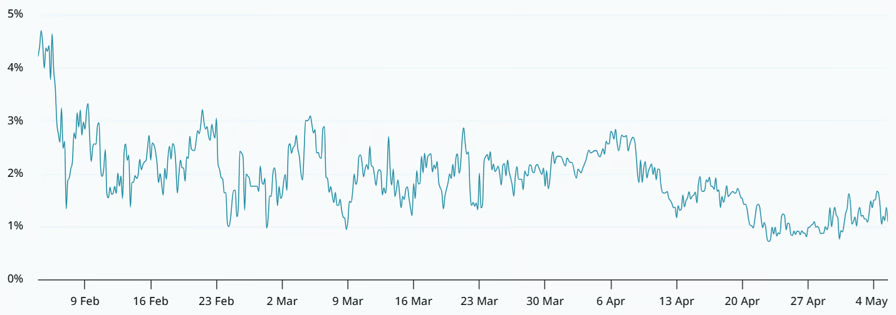
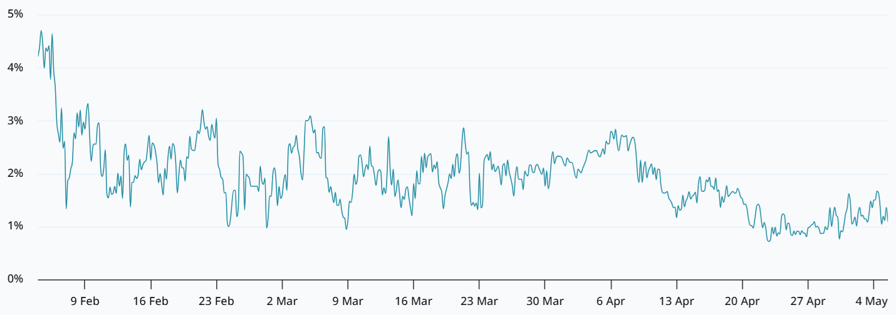
Bitcoin monthly futures traded at a 1% annualized premium (basis rate) relative to spot markets on Tuesday, landing well below the neutral threshold. Typically, sellers demand a 4% to 8% premium to compensate for the cost of capital. This cautious sentiment took hold in late January, when Bitcoin was trading at $90,000, partly explaining the current lack of enthusiasm.
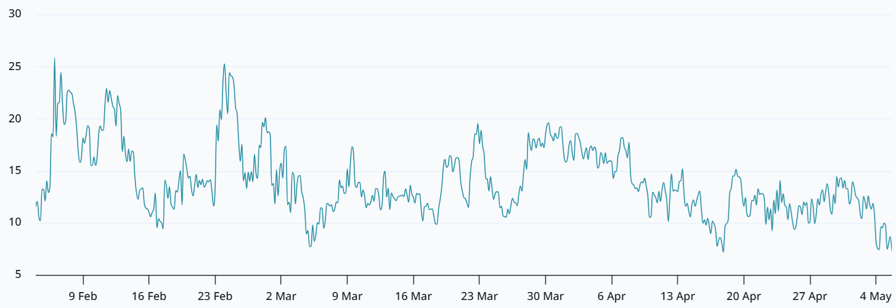
To confirm if the issue is limited to futures, one should assess the demand balance between put (sell) and call (buy) options. Under neutral conditions, these instruments trade within a -6% to +6% premium relative to each other. When professional traders fear downside risks, the delta skew metric moves above 6%.
Bitcoin 30-day options delta skew (put-call) at Deribit. Source: Laevitas
The Bitcoin delta skew moved closer to the 6% neutral threshold on Tuesday, though it remained slightly bearish. Whales and market makers do not appear particularly worried about an imminent crash, but bulls’ conviction has clearly stagnated. With Brent crude oil prices hovering near $110, persistent inflation concerns are weighing on traders’ expectations for economic growth.
US 5-year inflation expectation vs. Euro 10-year government bond yields. Source: TradingView
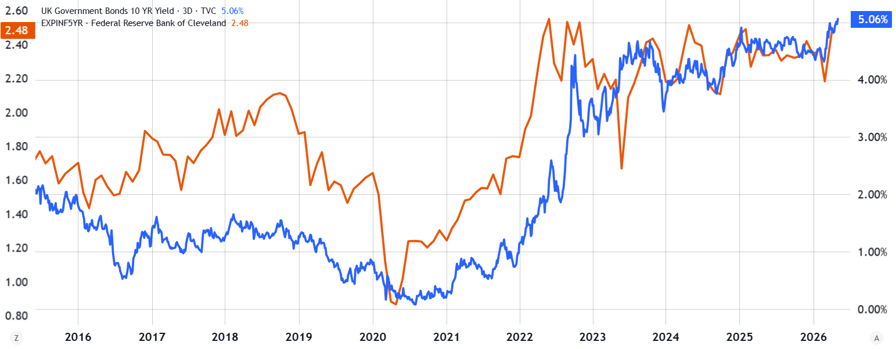
US inflation expectations neared a 10-year high of 2.5%, according to data from the Federal Reserve Bank of Cleveland. Simultaneously, investors are demanding higher returns to hold Eurozone government bonds. Despite these inflationary pressures, the tech-heavy Nasdaq 100 Index surged to an all-time high on Tuesday, signaling a broader risk-on environment.
Declining Bitcoin onchain activity faces heavy spot ETF accumulation
Bitcoin may have benefited from this increased risk appetite, but weak onchain metrics hints with declining retail demand.
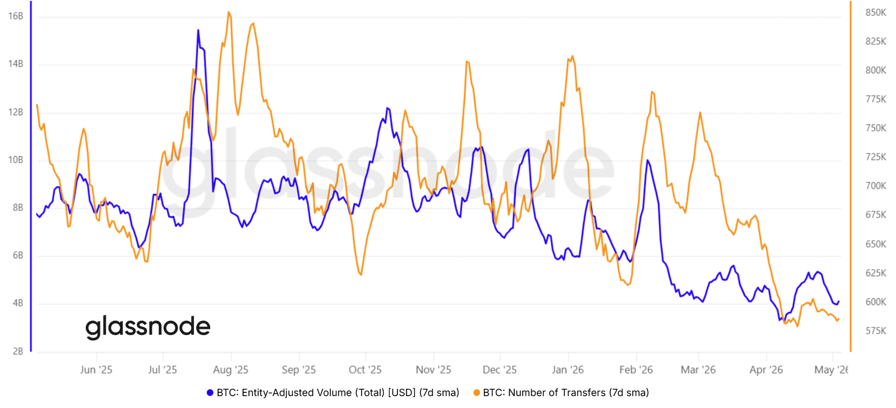
Bitcoin onchain daily volume (USD) vs. number of transfers. Source: Glassnode / Cointelegraph
Daily network transfer volume has plummeted 54% from three months ago, dropping to $4.1 billion. Similarly, the number of transfers is nearing its lowest level in over five years. While Bitcoin’s price action is not strictly dependent on onchain activity, these metrics serve as a proxy for general public interest and adoption.
The temporary pause in Strategy’s (MSTR US) accumulation ahead of its earnings release may have sparked some unwarranted fear. The company, led by Michael Saylor, maintained an aggressive acquisition pace over the previous four weeks. However, analysts expect Strategy to report a quarterly net loss due to its mark-to-market Bitcoin accounting.
Related: Bitcoin turns risk on as stocks hit new highs and miner profits rise: Is $85K BTC next?
Macroeconomic weakness and declining onchain activity negatively impacted Bitcoin derivatives, but the $1.16 billion in net inflows into US-listed Bitcoin spot exchange-traded funds (ETFs) between Friday and Monday suggests rising institutional demand.
Ultimately, the lack of demand for leveraged bullish positions in Bitcoin derivatives might serve as a catalyst for further upside. As prices climb, shorts (sellers) may be forced to close their positions at a loss, fueling additional momentum.
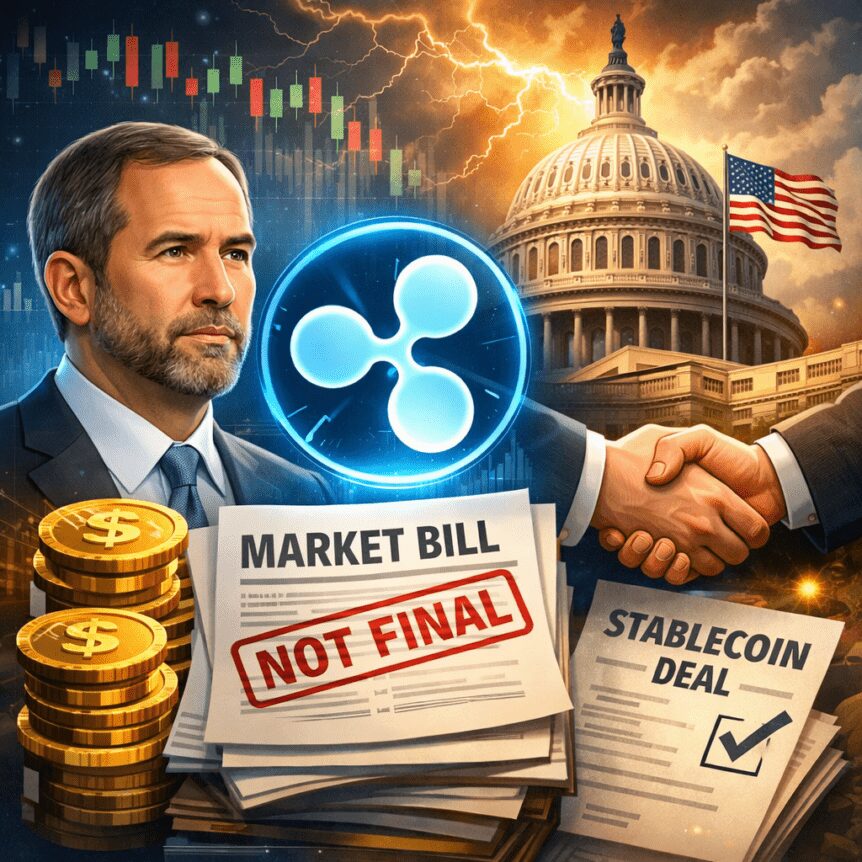
Brad Garlinghouse, the chief executive of Ripple Labs, warned that progress toward the US Senate’s market structure bill for digital assets, known as the CLARITY Act, does not guarantee a smooth ride to passage. Speaking at the Consensus crypto conference in Miami, Garlinghouse stressed that the next two weeks could prove decisive, with the fate of the bill hanging on how lawmakers navigate election-year dynamics and campaign priorities for the 2026 midterms.
Garlinghouse acknowledged that the CLARITY Act is not perfect, but argued that a clearer framework would be preferable to the current regulatory patchwork. “There’s tradeoffs and compromises, but I do think clarity is better than chaos,” he said, signaling a pragmatic if cautious stance on a measure that would shape how digital assets are regulated in the near term. The two-week window emphasized by the Ripple CEO reflects the intensity of political negotiation as the legislation remains unfinished business in the Senate.
The latest twist comes as lawmakers on both sides of the aisle signal potential movement on a related front: a compromise over stablecoin yields. Last week, Senators Thom Tillis and Angela Alsobrooks announced a bipartisan agreement on stablecoin yield provisions that could unlock broader consideration of the CLARITY Act. The developing framework for stablecoins, tokenized equities, and broader market ethics has been one of the primary sticking points delaying action since the House passed the bill in July 2025. The renewed focus on stablecoins is seen as a potential pathway to clearing the way for the CLARITY Act to move through committee and toward a full Senate vote.
Among lawmakers rallying behind the bill, Senator Cynthia Lummis, a long-standing advocate for clear crypto regulation, underscored the urgency in a Tuesday post. “The Clarity Act is not a future priority; it is the priority,” Lummis wrote. “Every corner of the industry is operating under legal uncertainty that Congress has the power to fix. The Senate needs to act.” Her comments reflect the growing sense that a consensus framework could reduce ambiguity for market participants, issuers, and the broader ecosystem ahead of a politically charged cycle.
Key takeaways
- The CLARITY Act’s fate hinges on a brief, high-stakes window as the 2026 midterm cycle intensifies political calculations and campaigning.
- A bipartisan compromise on stablecoin yields, announced by Senators Tillis and Alsobrooks, could shift momentum in favor of advancing the bill.
- The CLARITY Act remains pending in the Senate after being advanced by the Senate Agriculture Committee in January; it would still need approval from the Senate Banking Committee before a full floor vote.
- Regulatory coordination between the SEC and CFTC is intensifying, with a March memorandum of understanding signaling closer oversight alignment as Congress weighs a broader market structure framework.
- Ripple’s leadership has been engaged in ongoing negotiations surrounding the legislation, highlighting industry participation in shaping the regulatory path.
The roadmap and the regulatory backdrop
The CLARITY Act represents a concerted attempt to codify a coherent market structure for digital assets in the United States. Its path to passage has been incremental: the bill was advanced by the Senate Agriculture Committee in a January markup, but still requires clearance from the Senate Banking Committee before it can reach the chamber floor for a vote. The House’s July 2025 passage marked a political milestone, but not a guarantee of cross-chamber consensus, especially given the multifaceted concerns about stablecoins, tokenized securities, and the broader ethics of the crypto economy.
In parallel with the legislative process, regulatory agencies have pursued closer coordination. In March, the U.S. Securities and Exchange Commission (SEC) and the Commodity Futures Trading Commission (CFTC) signed a memorandum of understanding to align their approaches to overseeing the evolving digital asset market structure. The SEC has framed its crypto enforcement and supervisory strategy as an ongoing, iterative process, describing the CLARITY Act as a potential accelerant that could clarify jurisdictional boundaries and reduce legal uncertainty for market participants. SEC Chair Paul Atkins framed the agency’s stance as a starting point rather than a final authority, signaling readiness to adjust as legislation progresses.
The collaboration between the two agencies comes at a time when industry participants have called for clearer rules. The MOU and related statements indicate a willingness to coordinate on registration, compliance, and market surveillance in a way that could provide longer-term certainty for developers, exchanges, and users. However, until Congress acts, the risk of a patchwork regulatory regime persists, underscoring Garlinghouse’s caution about the bill’s prospects and the broader market’s need for clarity.
Why this matters for investors and builders
From an investor and builder perspective, the CLARITY Act could mark a turning point in how digital assets are treated under U.S. law. A clear, codified framework would help institutions assess risk more accurately, potentially lowering the cost of capital for compliant projects and enabling more transparent product development. For traders, the bill could reduce regulatory ambiguity around token classifications and the permissibility of certain activities, such as staking, yield generation, and cross-border offerings.
That said, the process remains uncertain, particularly given the electoral calendar. If the coming two weeks do not yield meaningful movement on the CLARITY Act, activists and stakeholders may push for alternative legislative routes or rely more heavily on regulatory guidance and agency-level actions to shape market behavior in the near term. In this environment, even modest shifts in stablecoin policy or in the allocation of regulatory responsibilities could have outsized effects on market sentiment and project timelines.
What to watch next
The immediate signal to monitor is whether the Tillis–Alsobrooks yield framework gains traction in committee discussions and eventually in floor negotiations. Observers will also be watching how the Banking Committee handles the broader package and whether any compromise language can satisfy both pro-innovation voices and consumer-protection advocates. While Garlinghouse’s remarks emphasize urgency, the reality remains that congressional processes can be slow, especially when elections alter legislative calculus and committee assignment dynamics.
Beyond Congress, the ongoing SEC–CFTC coordination and the framing of crypto regulation in executive discussions suggest that a more predictable regulatory environment could emerge only with a formal bill’s passage. For now, the market should prepare for a period of high political exposure, with potential volatility tied to headlines about yields, stablecoins, and committee votes. Investors and builders alike should consider risk management strategies that assume regulatory clarity will evolve in stages rather than arrive in a single, definitive moment.
As the discourse continues, market participants should stay attentive to official committee agendas, White House outreach, and industry briefings that could signal whether a concrete path to CLARITY is emerging. The coming days will indicate whether the two-week window Garlinghouse highlighted translates into tangible movement or a continuation of the status quo—and what that implies for the timing and composition of any future regulatory framework.

Bitcoin surged about 7% over the past week, reclaiming the $81,000 area for the first time in more than three months. The price move points to renewed risk appetite among investors, but a closer look at the derivatives market and on-chain activity suggests the rally isn’t backed by broad speculative interest. Institutional demand, however, remains visible in the wake of strong spot ETF inflows, underscoring a nuanced dynamic shaping the current cycle.
Key takeaways
- Spot Bitcoin ETFs drew about $1.16 billion in net inflows over the Friday-to-Monday window, signaling persistent institutional demand even as price pushes higher.
- Two-month Bitcoin futures are trading at roughly a 1% annualized premium versus spot, well below the neutral range of about 4% to 8%, indicating cautious leverage among traders.
- The 30-day Bitcoin delta skew for puts versus calls sat near the neutral band (around a 6% threshold) but remained slightly bearish, suggesting limited upside acceleration from hedging activity.
- On-chain activity continues to weaken: daily transfer volume has fallen about 54% from three months ago to roughly $4.1 billion, with the number of transfers near multi-year lows.
- Even with a risk-on tilt in equities, the contrast between price action and on-chain/derivative signals implies a potential for traders to push the narrative further through short-covering if momentum sustains.
Derivatives and price action diverge from on-chain activity
Bitcoin’s price breakout above $81,000 comes as macro factors exert a mixed influence on market sentiment. On the futures front, the 2-month Bitcoin futures basis sits around 1% annualized, well below the neutral range typically observed when the market is comfortable financing levered bets. This suggests that professional traders have not embraced a broad bullish tilt via escalated leverage, even as spot demand strengthens. Laevitas data shows this muted premium on futures as the market remains cautious about the sustainability of the rally.
The options market adds nuance to the picture. The delta skew for Bitcoin’s 30-day options—an indicator of demand for hedges and directional bets—has inched toward the neutral band but stays modestly bearish. In practical terms, the market isn’t pricing in a sharp, imminent downside, but traders aren’t rushing to position heavily for a swift upside either. In a period where macro catalysts loom, such as inflation dynamics and energy prices, this balance reflects a cautious crowd that is watching for a clearer signal before layering in aggressive bets.
Against this backdrop, broader macro indicators complicate the narrative. Brent crude holds elevated levels near $110 per barrel, keeping inflation concerns front and center. US inflation expectations have ticked higher, with signals suggesting a near-term persistence of elevated price pressures. Yet equities, notably the Nasdaq 100, have shown a risk-on tilt, hinting at a market that is pricing in resilience in growth and tech leadership even as inflation remains a watchful eye.
Institutional demand vs. on-chain fundamentals
One of the most striking tensions in this setup is the disconnect between price strength and on-chain activity. Bitcoin’s on-chain metrics have cooled noticeably in recent weeks. Daily transfer volume has declined by more than half from a few months ago, landing near $4.1 billion, while the total number of transfers remains near levels not seen in several years. While on-chain activity is not the sole driver of price, these metrics are often a proxy for retail participation and broader user adoption — a weaker signal at a time when price is rising.
On the institutional side, spot ETF inflows offer a counterpoint. Cointelegraph reported substantial inflows into US-listed Bitcoin spot ETFs, underscoring sustained demand from institutions that are attracted to regulated access to BTC exposure. Within this context, the market appears to be being propped up by a steady stream of capital infrastructure rather than by speculative bets from retail traders. The inflows come amid a period of tempered enthusiasm in the futures and options markets, reinforcing the view that long-hold demand is liveried in the institutionally oriented part of the market.
In a related development, MicroStrategy (Strategy) has been etched into the broader narrative as a case study of ongoing corporate BTC accrual versus earnings pragmatism. The company, led by Michael Saylor, had maintained an aggressive accumulation pace, but reports and market chatter suggest a pause in that accumulation ahead of a forthcoming earnings release. Analysts expect the quarter to show a net loss on a mark-to-market basis due to Bitcoin accounting, highlighting the friction between corporate treasury strategy and short-term earnings reporting.
Taken together, the data point to a market where institutional demand is reinforcing price strength, while retail participation via on-chain activity and leveraged derivatives remains tepid. This dichotomy underscores the importance of watching how ETF inflows evolve, as continued inflows could sustain upside even in the absence of broad-based retail engagement.
What this means for traders and investors
For market participants, the current configuration presents both opportunity and risk. The absence of thick leveraged long exposure in the derivatives market implies that a continued move higher could force short sellers to cover, potentially adding fuel to an ongoing rally. However, the lack of robust on-chain activity and the subdued appetite for risk on the derivatives side counsel caution; a disruption in ETF inflows or a shift in macro momentum could flatten the trajectory quickly.
Investors should monitor a few key developments. First, the trajectory of US-listed Bitcoin spot ETFs remains a critical barometer for institutional appetite. Sustained inflows would lend credibility to a narrative of BTC acting as a beta asset within a broader risk-on regime, particularly if equity markets maintain their uptrend. Second, on-chain metrics deserve ongoing attention as they offer a counterpoint to price action; fresh declines in transfer activity or new waves of network activity could hint at a shift in user behavior or investor base. Finally, earnings signals from major corporate holders, like MicroStrategy, and any material updates on BTC accounting could reframe risk and return expectations for the sector.
In the near term, the market seems to be balancing a constructive price move with an undercurrent of caution. For readers and builders in the space, the message is clear: price resilience is not yet mirrored by on-chain and long-tail derivative activity, so changes in ETF flow or macro momentum could be the decisive catalysts in the weeks ahead.
As the week unfolds, traders will be watching whether spot ETF flows keep pace with price, and whether on-chain activity begins to rebound in tandem with systemic risk-on cues. The path forward remains uncertain, but the ongoing divergence itself offers a meaningful lens into how capital is being allocated across regulated access, leveraged bets, and real network activity.

TLDR
- Arthur Hayes projected that Bitcoin would reach $100,000 after the northern hemispheric summer.
- He set a $125,000 price target for Bitcoin by the end of 2026.
- Dollar liquidity, rather than regulation, drives his current Bitcoin outlook.
- Hayes said wartime financing through commercial banks improves liquidity conditions.
- Geopolitical escalation in Iran could affect the timeline toward $100,000.
Arthur Hayes set a $125,000 Bitcoin target for the end of 2026 during Bitcoin Vegas. He tied the forecast to dollar liquidity, not regulation. He also outlined positions on Ethereum, Hyperliquid, and the CLARITY Act.
He spoke in an interview with Cointelegraph at the event. He projected Bitcoin would reach $100,000 after the northern hemispheric summer. He said Bitcoin will climb to $125,000 by late 2026.
Bitcoin Outlook and Arthur Hayes’ Liquidity Thesis
Arthur Hayes said dollar liquidity will drive Bitcoin higher in this cycle. He argued that wartime financing through commercial banks improves liquidity conditions. He said this liquidity already pushes Bitcoin ahead of the NASDAQ and US SaaS stocks.
He framed the path to $100,000 around geopolitical stability. He said escalation in Iran could disrupt the timeline. However, he added that markets appear to look past current tensions.
He pointed to oil price spreads as evidence that goods continue to move. He said spreads suggest supply flows despite political statements. He concluded that liquidity, not legislation, determines the price path.
He dismissed the CLARITY Act as irrelevant to Bitcoin’s rise. He said, “We don’t need to pander to politicians to get some piece of dog shit legislation passed.” He added that he hopes lawmakers veto the bill.
He argued that a single nation cannot regulate a borderless system. He said the United States represents only 4% to 5% of the global population. He claimed regulation reduces Bitcoin’s core value as an ungovernable asset.
He also questioned the bill’s political momentum. He said committee hearings have produced repeated objections and delays. He stated that he does not see enough electoral pressure to ensure passage.
Hyperliquid, Ethereum, and Portfolio Positioning
Hayes confirmed he purchased more than $1 million in Hyperliquid. He said he sold Bitcoin and Ethereum to fund faster-growing assets. He positioned Hyperliquid as the main beneficiary of that shift.
He said Hyperliquid has paying clients and clear value-return mechanics. He cited buybacks, token burns, and staking rewards as examples. He said he evaluates every asset on real revenue and token economics.
He described Hyperliquid as a permissionless derivatives venue. He said price discovery occurs there during weekends when traditional markets close. He noted that financial publications now cover this activity.
He said the platform allows trading of oil, S&P 500, and NASDAQ contracts. He emphasized that anyone with internet access can participate. He argued this structure mirrors Bitcoin’s open access design.
He said Ethereum may underperform Bitcoin in this liquidity cycle. He stated that his $125,000 target implies Bitcoin dominance within crypto. He added that he does not consider Dogecoin because it lacks revenue and client usage.
He also addressed former President Donald Trump’s crypto pledges. He said Trump “has behaved like a politician.” He concluded that he wants no new action from policymakers before the term ends.


Jalen Duren delivers for Pistons against Cavaliers

LegalZoom Promo Code: Exclusive 10% Off LLC Formations

NYSE Makes Huge Announcement About XRP

Manchester United reach agreement with Casemiro over contract clause amid transfer speculation

US brings back mandatory military draft registration

Steven Gerrard disagrees with Gary Neville over ‘shock’ Chelsea and Arsenal claim | Football


-

 NewsBeat2 days ago
Channel 5 – All Creatures Great and Small series 7 new post
-
 Business6 days ago
Tesla Officially Registers Elon Musk’s Stock: What Investors Need to Know
-
 Tech4 days ago
Trump’s 25% EU auto tariff breaches Turnberry Agreement that also covers semiconductors and digital trade
-

 Entertainment6 days ago
Insider Claims Reason Behind Key & Peele Split
-
 Sports4 days ago
Paul Scholes issues Marcus Rashford reality check as agreement emerges over Man United star
-

 Business7 days ago
Barclay Brothers Avoid Bankruptcy: HSBC Drops High Court Petitions After IVA Deal
-

 Entertainment4 days ago
Met Gala 2026 Rumored Guest List Is Turning Heads
-

 Entertainment6 days ago
Celebrities Who Are Attending the 2026 Met Gala Event
-

 Tech6 days ago
Texas Instruments made a new flagship graphing calculator: the TI-84 Evo
-

 Crypto World6 days ago
Meta (META) starts stablecoin payout to creators in Circle’s USDC on Polygon, Solana via Stripe
-

 Business6 days ago
Strait of Hormuz Remains Heavily Restricted on April 29 Amid Iran Conflict
-
Business5 days ago
Strait of Hormuz Blockade Persists Amid US-Iran Standoff, Sending Oil Prices Soaring
-
 Sports4 days ago
David Benavidez responds to team Canelo saying the fight will never happen
-

 Sports4 days ago
Cavaliers vs. Raptors Game 6 live score, updates, highlights from 2026 NBA playoffs first-round series
-

 Sports6 days ago
Saudi Arabia set to withdraw LIV Golf funding after 2026 season, per reports
-

 Business5 days ago
Two Powerball Tickets Split $143 Million Jackpot in Indiana and Kansas
-
Entertainment5 days ago
New on Prime Video in May 2026 — Full List of Movies and Shows
-

 Entertainment4 days ago
Kylie Jenner Hit With Second Lawsuit From Ex-Housekeeper
-

 Sports6 days ago
Arsenal, Atletico Madrid share draw after penalty drama in Champions League semi-final
-

 Sports4 days ago
Plane crash in Wimberley, Texas kills 5 pickleball players at tournament
You must be logged in to post a comment Login