








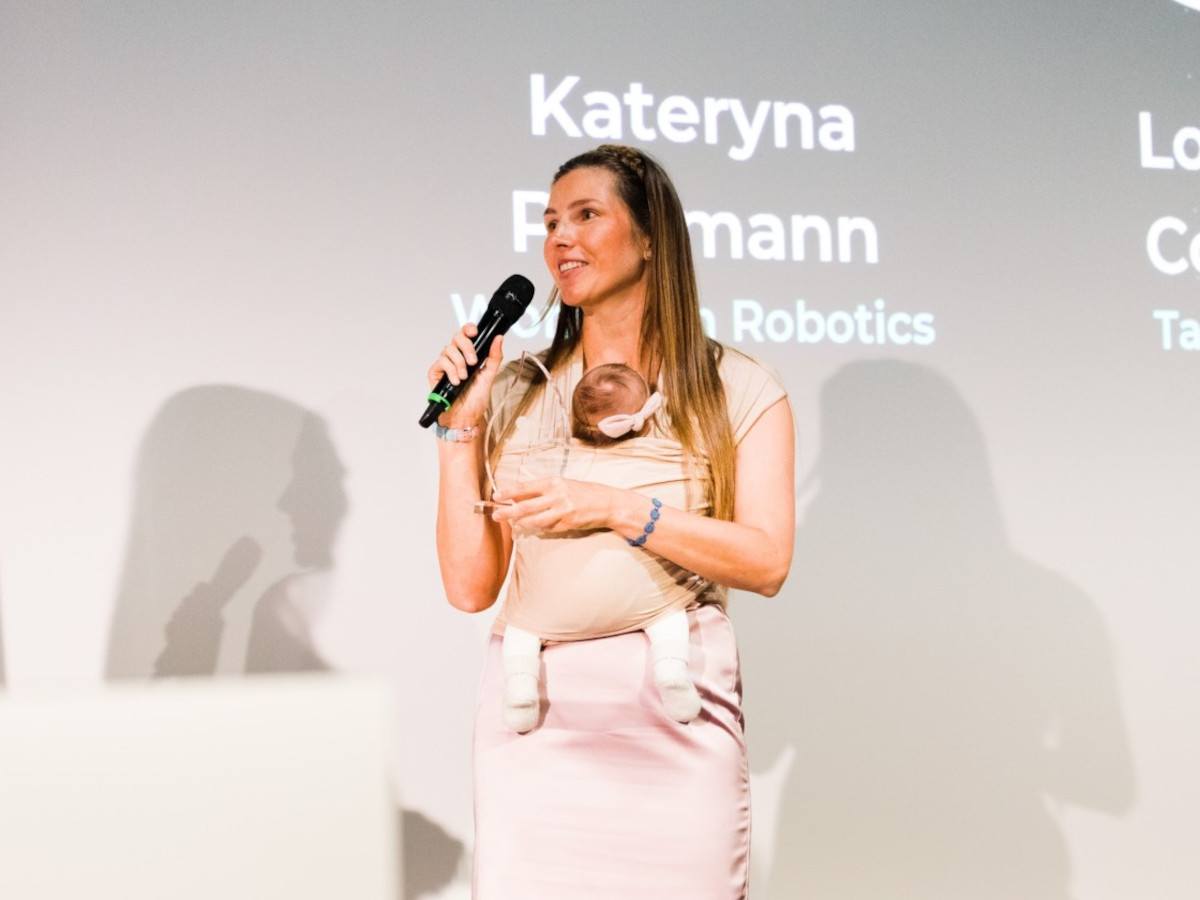

Anybotics’ Kateryna Portmann discusses growing up in the shadow of a major global disaster and how this impacted her view of security in the robotics sector.
“I was born in 1986 in Ukraine, 100km from Pripyat, the year of Chernobyl,” explained Kateryna Portmann, a senior product manager at Anybotics and a co-lead at the Swiss chapter of Women in Robotics.
“That matters to me. Chernobyl represents a cascade of technical design flaws, human misjudgement and governance failure. It shaped how I think about complex systems,” she said, speaking to SiliconRepublic.com.
“When I walk into an industrial site and see how much still depends on manual inspection, I think about risk accumulation. Robotics, done properly, reduces dependency on perfect human behaviour in imperfect environments. What excites me most is not the robot itself, it’s prevention. Early anomaly detection. Reducing exposure. Building systems that act before failure escalates.”
For Portmann, regarding the wider landscape, “we are past the ‘wow phase’ of robotics”, wherein it was enough to show that a robot could walk, scan and autonomously navigate. Amid a global shift, now consumers want evidence, such as uptime numbers, integration roadmaps and cybersecurity documentation.
She said, “That shift changes everything. I believe 2026 will be a filtering year. Many robotics companies ran pilots in 2024 and 2025. This year, those pilots must convert into scaled deployments. If they don’t, funding tightens and consolidation follows. Not everyone will survive. That’s not pessimistic, it’s how industrial markets mature.”
Having spent years working across Asia, Portmann has witnessed what she refers to as hyper-speed scaling, where deployment decisions happen incredibly quickly. However, she warned of the potential dangers when safety frameworks and compliance processes struggle to keep pace with innovation.
“That’s why I’m genuinely happy to now be building robotics in Switzerland, where engineering rigour, certification and risk management are taken seriously from day one.”
She added, “I’ve been inside an aluminium plant where the heat radiates through protective clothing within minutes. I’ve stood in a cement facility where dust fills the air constantly; you feel it in your throat hours later. These are not environments designed for long-term human exposure.
“When I hear fears about robots ‘taking jobs’, I think about those places. The better question is, should people be physically exposed to that risk every day? Our robots inspect and pick up thermal deviations, gas concentrations and unusual acoustic signatures.
“In one facility, early anomaly detection prevented a shutdown that would have cost millions. But equally important, the plant created new internal roles to manage robotics fleets and interpret inspection data. Humans moved up the value chain.”
Robotics transforming STEM
And it isn’t just safety and compliance that is being transformed by advancements in robotics; the entire STEM space is undergoing a reinvention of sorts. Portmann explained that “robotics removes abstraction”.
“In a lab, an AI model performs beautifully. In a power plant, the lens gets dusty. Wi-Fi drops. The floor vibrates. Lighting changes. That’s where theory meets reality.
“This is why robotics forces true interdisciplinary collaboration. Mechanical engineers must understand AI constraints. AI engineers must understand sensor noise and hardware limits. Cybersecurity teams must design for industrial networks, not office environments.”
As a result, education has to evolve to reflect the new reality, Portmann said. She has seen first-hand how unprepared senior leaders can be when making physical AI decisions. She recommended going that little bit further, with structured educational programmes not just for executives, but also for teachers and children.
“We need to teach systems thinking, ethics and human-machine collaboration early, not as an afterthought.”
She finds that “robotics is entering a serious phase” and 2026 is the marker that will test durability. She is of the opinion that many organisations will consolidate and even disappear, with 2027 set to reshape the landscape structurally.
“But despite the competitive pressure, this is one of the most exciting industries to work in, because the stakes are real,” Portmann said.
“I’ve felt the heat of aluminium production. I’ve breathed the dust of cement plants. I was born in the shadow of a nuclear disaster. For me, robotics is not about replacing people. It is about protecting them and building systems responsible enough that we can trust them in environments where human error is simply too expensive.”
Don’t miss out on the knowledge you need to succeed. Sign up for the Daily Brief, Silicon Republic’s digest of need-to-know sci-tech news.






































You must be logged in to post a comment Login