
Crypto World
Senate Has 3 Weeks to Pass the CLARITY Act: Most Important Month in Ripple XRP History?


Ripple XRP is trading at $1.34 on April 7 – up 2.2% on ceasefire-driven risk-on flows, but the price level that matters most in April won’t be set by macro sentiment: it will be set by the Senate Banking Committee.
The CLARITY Act, which would codify XRP’s classification as a digital commodity under CFTC jurisdiction and strip the SEC of primary oversight authority, is targeting a committee markup in the second half of April.
Senator Bernie Moreno has stated publicly that if the bill doesn’t reach the full Senate floor by May, midterm election dynamics push it off the calendar for the rest of 2026. That makes the next three weeks the most consequential legislative window XRP has faced this year.
- Price level: XRP is trading at $1.34 as of April 6, down 63% from its July 2025 peak of $3.65, with Q1 2026 marking its worst quarter in eight years.
- Legislative clock: Senate Banking Committee markup is targeted for late April; Senator Moreno has warned that failure to advance by May effectively kills the bill for 2026.
- Bull case trigger: Banking Committee approval unlocks a projected $4–$8 billion in XRP ETF inflows per Standard Chartered’s Geoffrey Kendrick, with a price target above $1.60.
- Bear case floor: A stall past May combined with Bitcoin breaking below $60,000 puts XRP at risk of sliding toward $0.82, per 24/7 Wall St. analysis.
- Passage odds: Kalshi had 2026 passage odds at ~69% as of March 20; Polymarket currently sits at 63–66%, reflecting residual uncertainty around DeFi provisions and scheduling.
Discover: The best crypto to diversify your portfolio with
What the CLARITY Act Actually Does – and Why April Is the Only Window
The CLARITY Act (H.R. 3633) passed the House with a bipartisan 294–134 vote on July 17, 2025, assigning primary digital commodity oversight to the CFTC while limiting SEC jurisdiction over assets that qualify under the new framework.
The Senate Agriculture Committee advanced its version on January 29, 2026, but the Banking Committee – chaired by Tim Scott – has yet to markup, with unresolved disputes around DeFi regulatory provisions and tokenization treatment holding up the calendar.
The Senate returns from Easter recess on April 13, and Scott’s committee has a targeted markup window in the final two weeks of April.
The stablecoin yield dispute that stalled earlier negotiations appears to be resolving: Senators Tillis and Alsobrooks reached a compromise in principle on March 20 that bans passive yield on stablecoin balances but permits activity-based rewards tied to payments and platform use.
Senator Cynthia Lummis confirmed at the Chamber of Digital Commerce Blockchain Summit that DeFi provisions are finalized, projecting committee markup in late April followed by a mid-2026 floor vote.
The honest read on the scheduling math: Galaxy Research’s Alex Thorn has flagged that with only 18 working weeks remaining before the midterm recess on October 5, each week of delay compresses floor consideration time to the point where 2026 passage becomes structurally implausible without Banking Committee clearance by April’s end.
The SEC and CFTC jointly classified XRP as a digital commodity on March 17 – but that classification is an interpretive release, not statute.
A future administration could reverse it. Banks and large asset managers won’t commit capital at scale on the basis of an administrative determination alone. The CLARITY Act would make the commodity classification permanent federal law, and that distinction is the entire mechanism behind the bull case.
Discover: The best pre-launch token sales
Ripple XRP Might Hit $1.60-Plus If Clarity Clears
This whole Ripple XRP setup is basically riding on one thing, the CLARITY Act, because if it gets through the Banking Committee in late April, that is the switch that brings real institutional money off the sidelines, not just talk but actual flows, and that is where projections like $4–$8 billion in ETF inflows start to matter, especially when we have already seen strong demand even without full legal clarity, which is how you get price pushing through $1.60 and aiming higher.

The key detail most people miss is that this is not just hype around regulation, it is about certainty, because right now institutions can look at Ripple XRP but cannot fully commit, and that is why even something like the SEC CFTC classification did not move things structurally, it helps sentiment but does not unlock capital, while a law like CLARITY changes the rules completely and makes deployment easier.
If that approval gets delayed past May, the whole story weakens fast, because without it XRP just falls back into tracking Bitcoin, and with BTC already moving sideways, that means no strong independent move, and if macro pressure hits again, downside opens quickly.
The timeline shift from Ripple itself is also telling, with expectations already getting pushed back, which is usually a sign things are not as smooth behind the scenes as they look publicly.
So right now everything narrows down to that late April window, because if the committee moves, momentum hits fast, but if it stalls, this turns from a catalyst driven breakout setup into just another range with fading hype.
Research Best Wallet and join the presale before the next price tier.
The post Senate Has 3 Weeks to Pass the CLARITY Act: Most Important Month in Ripple XRP History? appeared first on Cryptonews.



Bitcoin’s recent climb toward $80,000 is showing signs of strain, with low trading volume and muted derivatives activity raising questions about how durable the rally may be.
In a weekly report, 10x Research head Markus Thielen pointed to a disconnect between price action and underlying market participation. “Bitcoin rallied 4.7% over the past week, yet the accompanying data tells a cautious story beneath the surface,” he wrote.
Trading volumes have dropped sharply. Bitcoin weekly volume came in 17% below average, while ether (ETH) volume fell 20%. At the same time, funding rates — a measure of leveraged positioning — remain deeply negative. “Funding rates fell 6.8% to the 3rd percentile and volumes collapsed 33% to the 4th percentile,” Thielen said, adding that the move higher “was driven by spot buying or short covering rather than leveraged long conviction.”
That distinction matters. Spot buying, often linked to institutional demand, tends to be steadier but less explosive than leveraged trades. It also leaves the market without the kind of momentum typically seen in strong bull runs.
Institutional flows have been a bright spot. Bitcoin ETFs have recorded nine consecutive days of inflows, helping push total April inflows to $2.5 billion. Bitcoin dominance has also climbed to 60%, signaling capital is concentrating in the largest cryptocurrency rather than spreading across the market.
Still, Thielen cautioned that the rally’s structure remains fragile. “The market has shifted from a more actively traded environment to one where participants are largely on the sidelines,” he wrote, describing a “low-funding, low-volume regime that historically reflects hesitation rather than momentum.”
Options markets reinforce that view. Volatility has fallen into the lower quartile of its historical range, and traders are pricing in relatively modest price swings over the coming week. “The market is pricing in a relatively calm environment,” the report noted, even as sentiment gauges approach elevated levels.
Ethereum paints a similar picture, though with even weaker participation. Volumes have dropped more than 50%, and derivatives positioning shows limited appetite for risk. “The volume implosion points to a market where conviction remains low, and participants are largely disengaged,” Thielen said.
Despite these signals, the setup is not outright bearish. With leveraged long positions limited, the risk of forced liquidations on the downside is reduced. “Near-term risk/reward is asymmetric to the upside if a catalyst emerges,” Thielen wrote.
That catalyst may come from outside the crypto space. The report highlights macroeconomic developments as the key factor that could determine direction in the days ahead. For now, bitcoin’s rally appears intact, but without stronger participation, it may struggle to hold unless broader market conditions provide support.
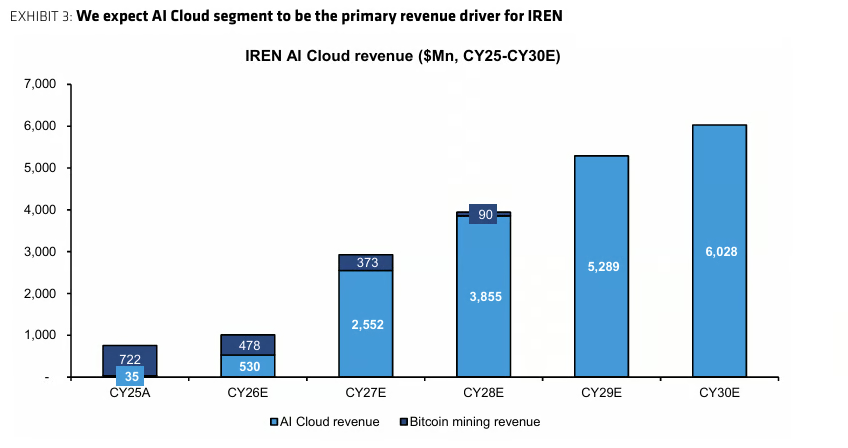
IREN could become the next major Bitcoin miner to transition into AI infrastructure following its multi-billion-dollar deal with Microsoft, underscoring a broader shift in mining economics, according to a new research report from Bernstein.
The Bernstein analysts point to IREN’s rapidly expanding AI cloud division, where around 150,000 GPUs are already contracted, supporting an estimated $3.7 billion in annual revenue run rate once fully functional.
A significant portion of this capacity is tied to a long-term agreement with Microsoft, which has committed to using GPU capacity for AI workloads over five years. The deal also includes substantial customer prepayments, helping fund the infrastructure buildout.
In total, IREN’s roughly $5.8 billion GPU investment is largely funded through a combination of Microsoft customer prepayments and GPU-backed financing facilities, alongside additional cash and capital sources, helping keep borrowing costs relatively low.
Bernstein expects this shift to fundamentally reshape the company’s business model.
“IREN will eventually sunset the Bitcoin mining business as it retrofits existing sites to accelerate cloud deployment,” the analysts wrote.
Rather than shutting down operations outright, IREN is repurposing its existing mining infrastructure, particularly in Texas and British Columbia, by replacing ASIC mining rigs with GPUs designed for AI workloads.
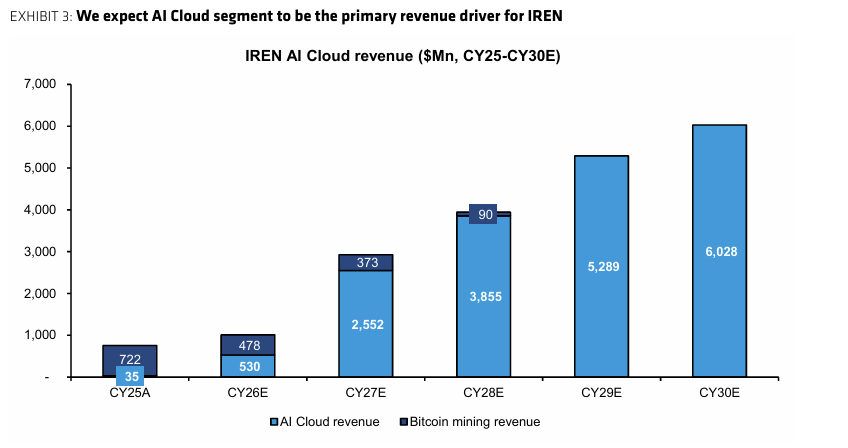
Bernstein expects IREN’s AI cloud revenue to be its primary source of income in the coming years. Source: Bernstein
Monday’s report suggests Bitcoin mining will gradually fade into a legacy segment, with mining revenue declining over time as power capacity is redirected toward higher-margin, contracted AI computing.
IREN is not alone in exploring this pivot. Several mining companies, including TeraWulf and HIVE Digital, have begun reallocating power and capital toward AI and high-performance computing, often alongside their existing Bitcoin mining operations.
Related: AI data center gold rush sparks debate over impact on Bitcoin mining
Bernstein sees nearly 100% upside for IREN stock
Bernstein assigned IREN stock a $100 price target, pointing to significant upside as the company shifts away from Bitcoin mining and toward AI infrastructure.
With the stock currently trading below $50, the target implies a nearly 100% increase from current levels.
The analysts maintained an Outperform rating, even after reducing their previous $125 target, reflecting a more conservative view on dilution and the gradual wind-down of Bitcoin mining.
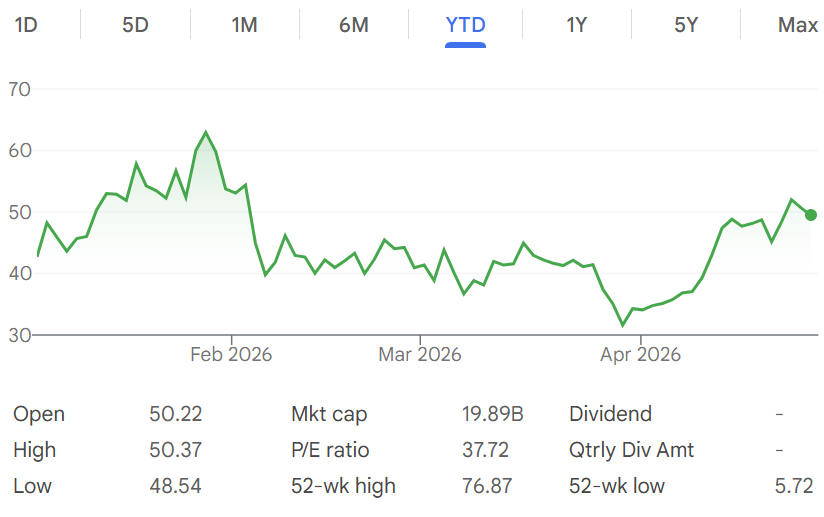
IREN stock. Source: Google Finance
Related: CoreWeave’s $8.5B loan shows how AI is replacing crypto mining finance
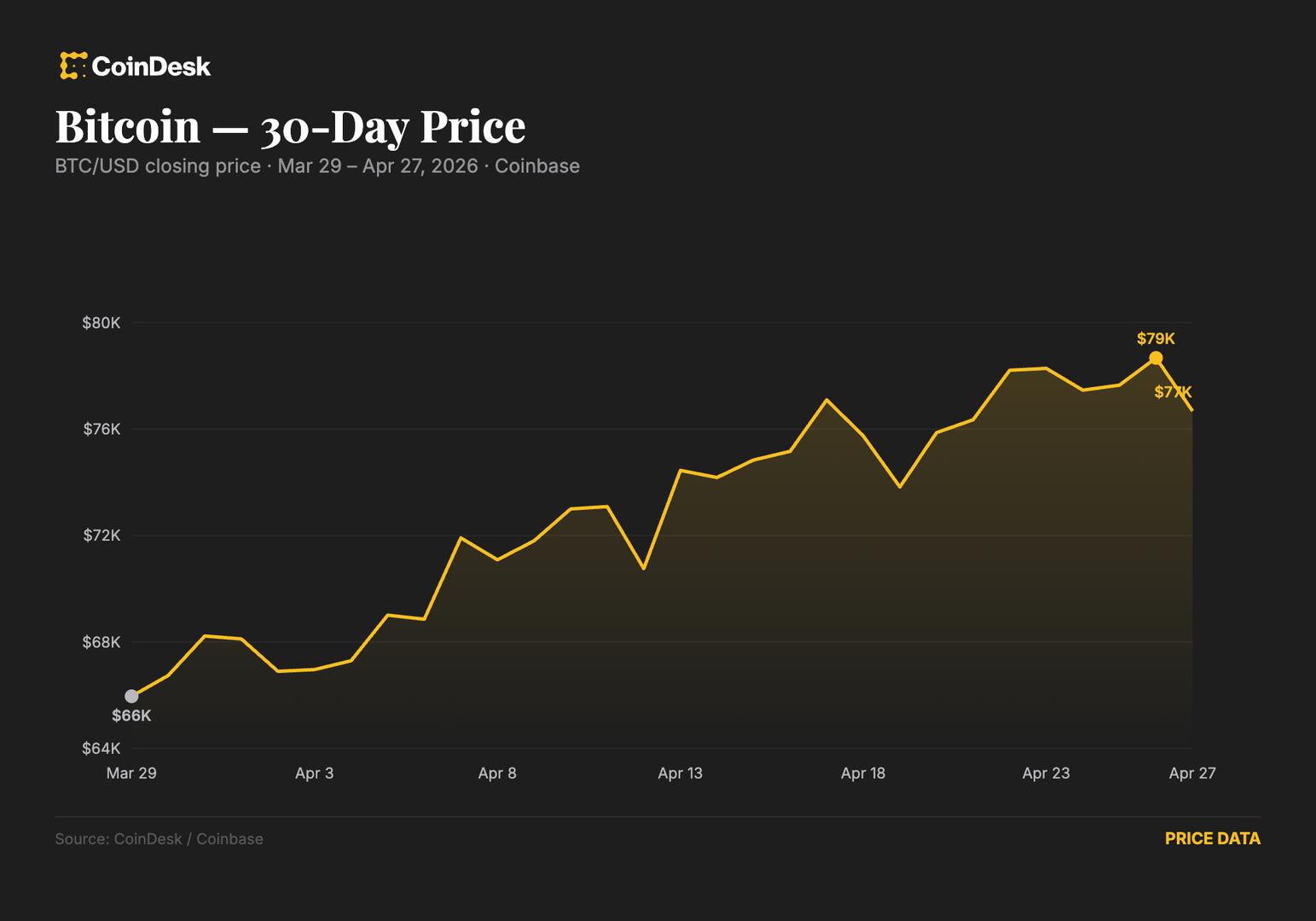
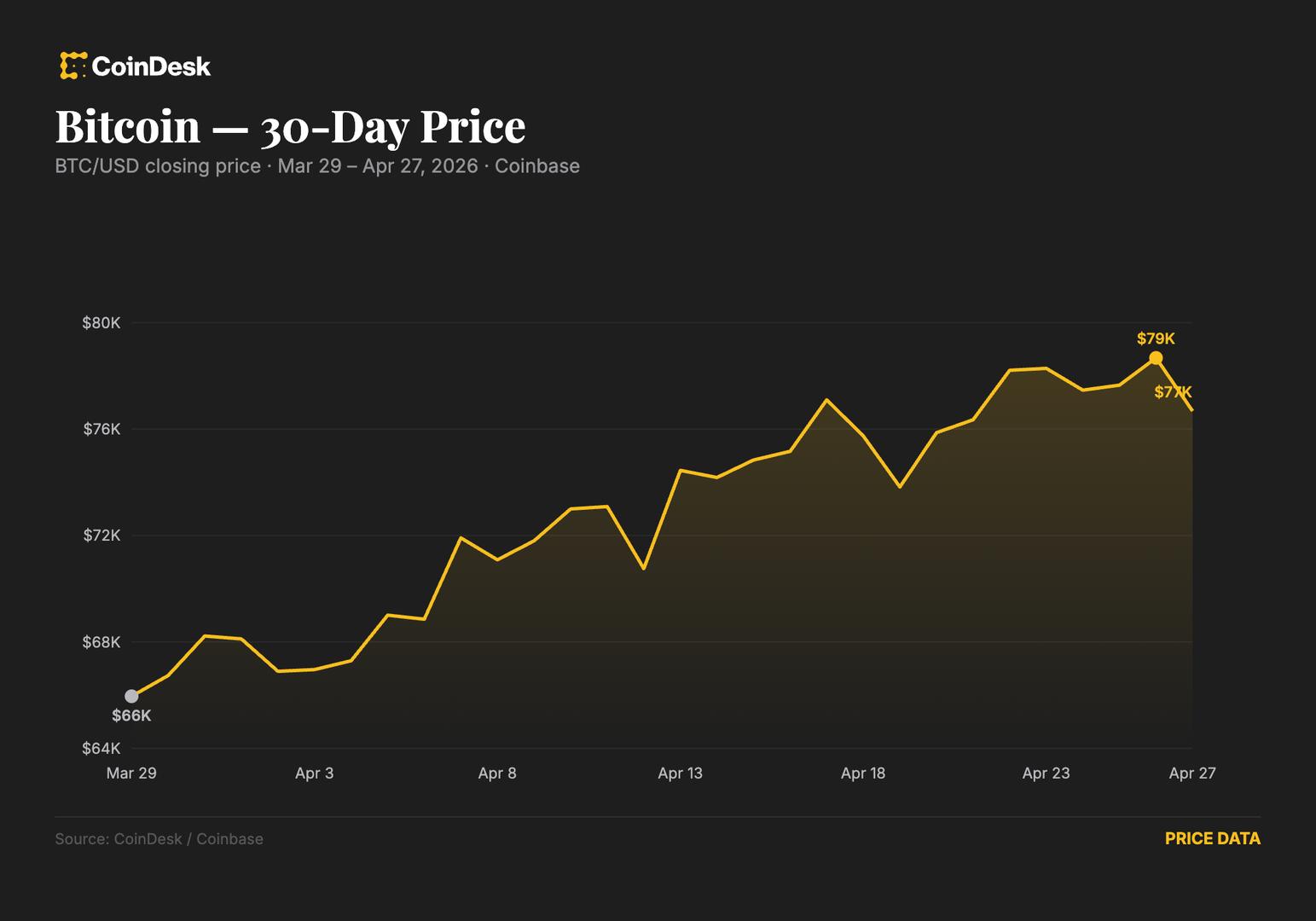
The bitcoin rally toward $80,000 didn’t last long on Monday, with prices slipping back to $76,600 during the U.S. session as geopolitical tensions crept back into focus.
After trading near $80,000 overnight, its highest level since early February, the largest cryptocurrency reversed course and was down about 1.5% over the past 24 hours. Major altcoins followed, with ether (ETH), XRP and solana (SOL) each falling around 3%. CoinDesk 20 Index, a benchmark for the broader digital assets market, fell about 2% on Monday.
The pullback comes as investors grow cautious about the outlook for U.S.-Iran negotiations and the ongoing disruption to the Strait of Hormuz, a key global oil transit route.
According to a Wall Street Journal report, Iran has proposed halting attacks on ships in the strait in exchange for a full end to the war, including lifting the U.S. naval blockade and delaying nuclear talks. The proposal aims to restart stalled negotiations, but uncertainty remains high after President Trump on Saturday canceled sending envoys to Pakistan for negotiating with the Iranian side.
Oil prices continued to rise during the day. Brent crude oil prices, often used as the international benchmark, climbed more than 3% to $107 a barrel, while the West Texas Intermediate crude oil was up 2.6% to $97.
The Nasdaq edged 0.3% lower in morning trading, pulling back from recent record highs, while the S&P 500 was flat, ahead of a big earnings week that includes Mag7 firms such as Alphabet, Meta, Microsoft and Apple.
Meanwhile, crypto-linked stocks declined across the board. Shares of crypto exchange Coinbase (COIN) fell 1.5%, while Circle (CRCL), issuer of the USDC stablecoin, dropped 3.5% and Galaxy Digital (GLXY), a digital asset investment firm, slid nearly 6%.
Short-term holders selling
Under the surface, bitcoin’s price action points to a market struggling to build momentum despite strong institutional demand.
Bitfinex analysts noted that short-term BTC holders sitting in profit have been selling into strength, offsetting fresh demand from ETF buyers and Strategy (MSTR).
“The path of least resistance in the near term is likely consolidation or a pullback toward the $75,000 region,” the analysts said, adding that “a decisive break above $80,000 [is] required to confirm a more durable bullish regime.”
Read more: Bitcoin is climbing on thin volume, leaving rally vulnerable to macro shock

Quick Overview
- Aven introduces crypto-collateralized Visa card with credit limits reaching $1 million
- Product features competitive 7.99% annual rates with repayment periods extending to 10 years
- Platform bridges cryptocurrency holdings with mainstream payment networks via Visa infrastructure
- BitGo provides secure custody services for all cryptocurrency collateral backing the cards
- Card includes 2% cashback rewards program with zero annual membership costs
Aven has unveiled its Bitcoin Visa Card, delivering cryptocurrency-backed credit facilities up to $1 million. This innovative product integrates extended-term crypto-secured financing into the company’s collateral-based card framework. The offering seamlessly connects digital currency holdings with everyday transactions through Visa’s global payment network.
Extended-Term Cryptocurrency Lending Arrives
The Bitcoin Visa Card provides cardholders with fixed-rate financing secured by their bitcoin holdings. Aven has structured repayment schedules extending up to a full decade. The annual percentage rate sits at 7.99% for qualifying borrowers.
This approach represents a departure from typical cryptocurrency lending solutions in today’s marketplace. According to Aven, most bitcoin-collateralized financing carries interest charges exceeding 10%. The company notes that competitors frequently restrict borrowing periods to approximately one year.
Cardholders will deposit their bitcoin collateral with BitGo, the designated custodian for this program. The Bitcoin Visa Card then extends credit based on those deposited assets. This mechanism enables users to unlock liquidity while maintaining their cryptocurrency positions.
Asset-Backed Credit Platform Grows
Aven established its financial technology operation in 2019, concentrating on collateral-secured payment cards. The company leverages various assets including investment portfolios and real estate equity to underwrite consumer credit facilities. The Bitcoin Visa Card now brings this methodology into the digital asset space.
This product aligns with Aven’s core strategy of reducing borrowing expenses through asset-backed lending structures. The platform reports cutting interest costs by half compared to unsecured alternatives. The firm states customers have collectively saved $300 million in interest charges throughout its operating history.
Coastal Community Bank, operating under Washington state banking regulations, serves as the issuing institution for the Bitcoin Visa Card. The product comes without annual membership charges or origination fees. Additionally, cardholders receive unlimited 2% cash rewards on all transactions.
Cryptocurrency Lending Evolution Targets Wider Audience
The Bitcoin Visa Card launches into a sector where crypto-collateralized financing typically features abbreviated timelines. Aven’s objective centers on positioning bitcoin-backed credit as comparable to conventional secured lending products. The fixed-rate, fixed-term structure may attract borrowers prioritizing cost certainty.
This debut demonstrates how financial technology companies continue integrating cryptocurrency assets with consumer credit offerings. The Bitcoin Visa Card merges digital currency ownership with established payment infrastructure. Visa’s worldwide acceptance provides the product with extensive purchasing flexibility.
Aven’s product introduction establishes an additional application for bitcoin extending past speculation and accumulation strategies. The Bitcoin Visa Card allows borrowers to preserve their cryptocurrency exposure while leveraging holdings for credit access. The offering embeds bitcoin-collateralized lending within a conventional card experience.

Crypto World
MARA Holdings targets bitcoin quantum threat and network resilience with new foundation


Las Vegas — MARA Holdings (MARA) CEO Fred Thiel announced the launch of the MARA Foundation at the Bitcoin Conference Monday, outlining a broad effort to support the long-term resilience of the bitcoin network beyond the firm’s bitcoin and AI mining operations.
“Bitcoin is the most important decentralized system ever created, but its future is not guaranteed,” Thiel said, framing the initiative around the idea that the network requires active stewardship.
Thiel described bitcoin as “a public utility that nobody owns, but everybody depends on,” adding that decentralization “doesn’t mean it runs on itself, it means responsibility is distributed.”
The foundation will focus on maintaining bitcoin’s core properties as “sound, durable money,” while advocating for its open and global use. Key priorities include supporting the network’s security budget, particularly the development of a sustainable transaction-fee market, and funding research into emerging risks, such as quantum computing.
MARA also plans to fund open source development across scaling, mining, and user infrastructure, expand access to self-custody, and promote financial sovereignty worldwide.
Education and policy engagement are central to the initiative, including technical training, multilingual resources, and outreach to regulators.
As part of the launch, MARA will award $100,000 to one of three nonprofit organizations, with the recipient chosen by community vote, underscoring Thiel’s call for shared responsibility across the ecosystem.


Robinhood customers received some particularly convincing phishing emails this weekend. The messages, which appeared to come directly from the company, featured authenticated headers, were correctly signed, included a genuine sender’s address, were sent from an authentic email server, and weren’t caught by spam filters.
Worse, the email from [email protected] even earned Gmail’s automatic route into the same conversation threads as legitimate, prior security alerts from Robinhood.
The only fraudulent things about the email were obscure technical irregularities and its contents, a phishing call-to-action seeking login information.
By Sunday night, hackers used Robinhood’s own notification pipeline to render their assault.
Analysis of the exploit went viral on social media soon after.
Robinhood phishing emails were ‘kinda beautiful’
Security researcher Abdel Sabbah posted an analysis of the event, calling it “kinda beautiful” with a sinister connotation. Unfortunately, he was right.
To craft the attack, the hacker first utilized a Gmail “dot trick,” a well-known Google feature whereby Gmail routes [email protected], [email protected], and [email protected] to the same inbox.
Gmail, unlike the rest of the internet, ignores dots in the part of the address before the @ symbol, so all of those variants deliver to the same inbox.
Because Robinhood, unlike Gmail, doesn’t normalize the dotted variants, an attacker used a “dot” modified version of Robinhood’s legitimate customer emails.
Next, the attacker set the device name on the new account to a block of raw HTML. When Robinhood’s “unrecognized activity” email is generated, the template inserts that device name without sanitizing it, rendering the nefarious HTML.
The result, in Sabbah’s words, is what appeared to be “a real email from [email protected], DKIM pass, SPF pass, DMARC pass, with a phishing CTA.”
That CTA or “call to action,” of course, is a fake security alert email with a hyperlink to an attacker-controlled webpage that harvests login credentials and two-factor authentication codes.
The ultimate goal, like almost all phishing campaigns, was to steal customer’s money — in this case, from their Robinhood account.
Read more: Robinhood pays $605M to buy Sam Bankman-Fried’s stake
Think before you click on any email
Many crypto influencers warned people about the convincing emails.
Ripple’s David Schwartz amplified the warning. “Any emails you get that appear to be from Robinhood (and may actually be from their email system) are phishing attempts,” he posted. Quoting Sabbah’s thread, Schwartz added, “It’s quite sneaky.”
In April 2025, Ethereum Name Service Lead Developer Nick Johnson documented an almost identical exploit involving emails that appeared to send from Google itself.
Attackers used a similar series of tricks to use Google’s own infrastructure to deliver DKIM-signed phishing emails from [email protected].
The lesson then is the lesson now: beware of clicking any link in any email, no matter how authentic it appears.
Traditional anti-phishing advice tells users to check the sender domain and look for authentication failures. None of that helped here. The domain appeared real. The signatures appeared real. Only the intent was criminal.
Robinhood’s own scam guidance tells customers to verify the sender’s email domain and lists @robinhood.com as the authentic example.
Protos reached out to Robinhood for comment but didn’t receive a reply prior to publication time. In Nasdaq trading today, the common stock of Robinhood opened flat for trading relative to Friday’s closing print.
Got a tip? Send us an email securely via Protos Leaks. For more informed news, follow us on X, Bluesky, and Google News, or subscribe to our YouTube channel.


Elfa AI begins offering continuous listening and real-time interpretation for AI agents to execute transactions on Solana when market conditions are met.
Elfa AI announced Monday a platform enabling AI agents to listen continuously to market conditions and execute transactions on Solana in real time. The platform interprets data and triggers automated agent actions the moment specified conditions are met, leveraging Solana’s blockchain infrastructure for market-driven decision-making.
The launch positions Elfa AI within the growing ecosystem of automation tools on Solana, targeting traders and developers seeking to capitalize on attention-driven market dynamics through AI-powered execution.
Sources: Solana
This article was generated automatically by The Defiant’s AI news system from publicly available sources.

Crypto investment products extended their inflow streak last week as Bitcoin traded above $76,000, a level not seen since February’s pullback. Crypto exchange-traded products (ETPs) attracted $1.2 billion in fresh inflows, the fourth consecutive weekly gain, according to CoinShares. The run lifted assets under management to $155 billion—the highest level since February 1—while the four-week total reached about $3.9 billion, surpassing March’s prior four-week figure of $2.9 billion. CoinShares head of research James Butterfill framed the shift as evidence of improving institutional demand in the wake of a Bitcoin rally, even as traders prepared for the Federal Reserve’s policy decision later in the month.
Key takeaways
- Bitcoin-led inflows dominated the week, with $932.5 million flowing into BTC ETPs, pushing year-to-date BTC-related inflows to approximately $4 billion.
- US-listed spot Bitcoin ETFs attracted roughly $824 million in inflows, according to SoSoValue.
- Ether ETPs gathered $192 million, the third straight week of gains above $190 million, bringing year-to-date Ether inflows to about $390 million.
- XRP-related funds returned to inflows, adding $56 million after outflows the prior week.
- Short-Bitcoin products saw $16.5 million of inflows, indicating hedging activity within a constructive market backdrop.
- Blockchain equity ETFs posted a record weekly inflow, with about $617 million flowing in over a three-week span, underscoring rising demand for exposure to the broader digital-asset tech sector.
- Regional dynamics remained led by the United States, which accounted for about $1.1 billion in inflows, with Germany at $62 million and Switzerland at $35 million.
Bitcoin gains anchor broader demand for crypto ETPs
Bitcoin’s resilience near and above the $76,000 mark helped anchor the week’s inflows, amplifying the appeal of ETPs as a vehicle for institutional exposure. In addition to the price level, Butterfill noted that the market’s momentum is likely supported by improving fundamentals for crypto products, even as participants tread carefully ahead of the FOMC’s late-April meeting. “The market now turns to the FOMC decision on April 28–29, which is likely contributing to caution at the margin,” he said. The sustained higher price backdrop appears to be translating into continued appetite for BTC-focused ETPs, with the four-week run painting a clearer picture of renewed institutional interest.
Broader asset mix strengthens: Ether, XRP, and hedges
While Bitcoin led the charge, other digital-asset ETPs also showed strength. Ether ETPs registered $192 million of inflows, marking the third consecutive week above $190 million and lifting year-to-date Ether inflows to roughly $390 million. XRP funds rebounded to inflows of $56 million after a prior week’s outflow, illustrating ongoing interest in the wider payments-focused altcoin family. Short-Bitcoin products, a gauge of hedging sentiment, drew $16.5 million—an amount broadly in line with recent averages and suggesting steady hedging demand without dramatic spikes.
Blockchain equities continue to attract interest
Beyond native crypto assets, investors rotated into blockchain equity exchange-traded funds, which experienced a record week of inflows. Over the past three weeks, blockchain equity ETFs accumulated about $617 million in inflows, highlighting a broader appetite for exposure to the technology surrounding digital assets and their ecosystems. This pattern points to a shift where investors are not only chasing price moves but also seeking strategic exposure to the sector’s infrastructure and potential use cases.
Regional dynamics and what they imply
The regional breakdown showed the United States continuing as the dominant driver of inflows, with roughly $1.1 billion moving into crypto ETPs. Europe’s activity remained positive but more modest: Germany saw about $62 million in inflows, while Switzerland reversed last week’s outflows with $35 million of inflows. The concentration of flows in the U.S. underscores the ongoing regulatory and market structure advantages perceived by institutional participants in that region, even as other markets calibrate their own uptake of crypto products.
As the market looks ahead, investors will be watching how the forthcoming Federal Reserve decision shapes risk appetite for crypto investments and whether prices hold above key support levels. With aggregate ETP flows touching new yearly highs and a steady return of institutional interest, the landscape for crypto investment products appears to be shifting toward broader participation, albeit with ongoing caution as macro and policy signals evolve.

Key Takeaways
- Jefferies upgraded AAL price target from $12 to $13 while maintaining Hold rating
- First quarter unit revenue jumped 7.6%, with second quarter projected between 9.5%–10.5%
- Carrier launching $1.14 billion aircraft-backed bond offering
- Rising fuel expenses threaten profitability, potential 2026 loss flagged
- BMO Capital increased target to $13.50; Evercore maintains $14.00 target
American Airlines delivered first quarter results that surpassed Wall Street expectations, reporting a loss of $0.40 per share versus consensus estimates calling for a $0.47 loss. Total revenue reached $13.91 billion, beating the $13.79 billion projected by analysts.
American Airlines Group Inc., AAL
The carrier’s unit revenue expanded 7.6% during the quarter. Management provided guidance for second quarter unit revenue growth in the range of 9.5% to 10.5%.
Following the quarterly report, Jefferies analyst Sheila Kahyaoglu increased her price objective on AAL shares from $12 to $13. Her Hold recommendation remained unchanged.
AAL is presently changing hands near $12.10, trading beneath InvestingPro’s Fair Value calculation of $14.05. This variance indicates potential undervaluation at present price levels.
Jefferies established an annual EPS projection of $0.10, falling within the company’s broad guidance band spanning -$0.40 to +$1.10. The investment firm highlighted opportunities for improved margin execution under favorable market conditions.
BMO Capital similarly lifted its price objective, advancing from $12.00 to $13.50. BMO cited an improved yield environment and noted the first quarter performance exceeded projections.
Raymond James maintained its Market Perform stance, recognizing advancement in narrowing the margin differential with established competitors. Evercore ISI preserved its In Line assessment with a $14.00 valuation target.
Aircraft-Backed Bond Offering Totals $1.14 Billion
Earlier this week, American Airlines initiated a $1.14 billion bond issuance to fund 32 aircraft, including both new deliveries and current fleet assets. The financing package takes the form of enhanced equipment trust certificates, commonly known as EETCs.
The principal tranche comprises a $905 million offering carrying an average maturity of 7.7 years. Initial pricing discussions center around a 5.625% yield.
EETC structures enable sub-investment-grade airlines to tap investment-grade debt channels by pledging aircraft as security. While S&P assigns AAL a B+ corporate rating, sitting four levels beneath investment grade, the senior bonds in this transaction are anticipated to receive an A rating from S&P.
Goldman Sachs, MUFG, and Morgan Stanley serve as lead underwriters for the bond transaction.
Escalating Fuel Expenses Pressure Margins
Increasing oil prices continue pressuring airline profitability industry-wide. Fuel represents one of American’s most substantial operating expenses.
The previous week, management reduced its full-year profit forecast. Leadership cautioned that fiscal year 2026 could conclude with a net loss following the absorption of approximately $4 billion in incremental fuel expenditures.
American simultaneously deferred $300 million in aircraft delivery capital spending from 2026, creating additional financial flexibility.
The airline intends to expand capacity roughly 4% during the current year, approximately double the industry-wide expansion rate. Jefferies indicated that prevailing macroeconomic conditions likely necessitate additional downward adjustment to capacity growth plans.
Based on InvestingPro intelligence, ten analysts have lowered earnings forecasts for the forthcoming reporting period.
AAL shares declined approximately 2.4% on Monday as investors digested the bond offering announcement and earnings developments.
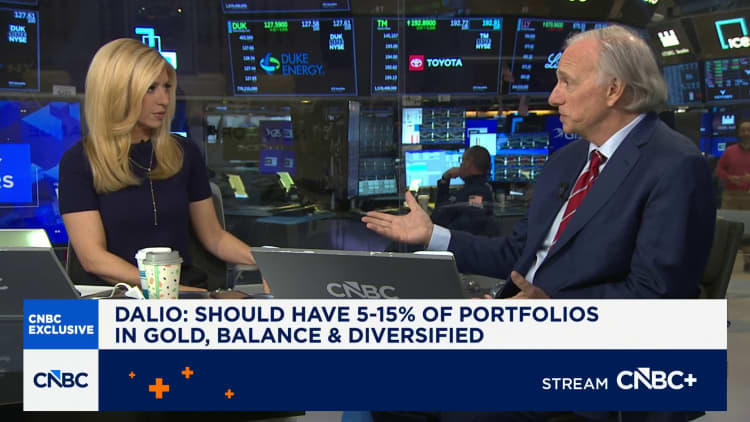

Billionaire investor Ray Dalio warned that the U.S. economy has slipped into a stagflationary environment and said it would be a mistake for potential Federal Reserve chair successor Kevin Warsh to lower interest rates.
The founder of Bridgewater Associates said persistent inflation pressures alongside slowing growth create a backdrop that demands caution from policymakers.
“We are certainly in a stagflationary period,” Dalio said Monday on CNBC’s “Money Movers.” “Because of the issues that are here, in terms of a more immediate inflation, farther from the target.”
Dalio said that if Warsh, who now has a clear path to replacing Jerome Powell as the next leader of the Fed in mid-May, were to cut rates, it would risk damaging confidence in the central bank at a critical moment.
“Certainly, you would not cut interest rates now,” Dalio said. “You will lose your credibility. The Federal Reserve would lose its credibility, particularly now. … If you look at monetary policies by other countries, you’re not going to see them cutting,” he said. “So whatever your benchmarks are, you’re not going to be inclined to cut … not with today’s information.”
Traders are currently pricing in a 100% chance that the Fed will leave rates unchanged at this week’s meeting, with fed funds futures indicating policy is most likely to stay on hold for the rest of the year, according to the CME FedWatch tool.
Dalio said the dramatic rebound in equities made sense despite the ongoing war with Iran because of the strength of corporate earnings. Still, he said he recommends a 5% to 15% allocation to gold as an “effective diversifier.”

The Beloved Sci-Fi Series Destroyed By Battlestar Galactica

Trump’s New Ballroom Desire

Why Matheus Cunha is not in Manchester United squad vs Brentford

Manchester United reach agreement with Casemiro over contract clause amid transfer speculation

US brings back mandatory military draft registration

Steven Gerrard disagrees with Gary Neville over ‘shock’ Chelsea and Arsenal claim | Football


-

 Politics7 days ago
Gary Stevenson delivers timely reminder to register to vote as deadline TODAY
-

 Fashion3 days ago
Weekend Open Thread – Corporette.com
-
Crypto World2 days ago
Hyperliquid $HYPE Rally Builds Momentum as AI Sector Enters Prove-It Phase
-

 Politics5 days ago
Making troops accountable for war crimes threatens US alliance, ex-SAS colonel warns
-

 Politics5 days ago
Disabled people challenge government SEND proposals over segregation concerns
-

 Business5 days ago
Rolls-Royce Voted UK’s Most Iconic Trade Mark as IPO Register Hits 150
-

 Business4 days ago
Patterson-UTI Energy, Inc. (PTEN) Q1 2026 Earnings Call Transcript
-

 Politics5 days ago
Zack Polanski responds to home secretary’s taser threat
-
 Crypto World6 days ago
Five Value Stocks with Recovery Potential in 2026: PayPal (PYPL), Nike (NKE), and More
-

 Politics5 days ago
Starmer handler McSweeney to be dragged from shadows by Foreign Affairs Committee
-
 Sports1 day ago
IPL 2026: Ruturaj Gaikwad registers slowest fifty of the season, enters all-time unwanted list | Cricket News
-
Politics5 days ago
Wings Over Scotland | How To Get Away With Crimes
-

 Crypto World6 days ago
New York sues Coinbase, Gemini over prediction market offerings
-
Entertainment6 days ago
Sydney Sweeney cameo cut from “The Devil Wears Prada 2”, source explains why (exclusive)
-
 Business6 days ago
HCL Tech share price tank over 9% after weak Q4. JPMorgan, HSBC & 3 others cut target price
-

 Politics5 days ago
‘Iran is still a nuclear threat’
-
 Sports5 days ago
Tim Bradley names the current best in the world: “Better than Inoue and Usyk”
-
 Crypto World6 days ago
Crypto’s great hope in Senate’s Clarity Act still has a path to survive tight calendar
-

 NewsBeat1 day ago
LK Bennett closes all stores after entering administration
-

 Fashion6 days ago
Kilkenny Design New Beauty Arrivals for Spring 2026
You must be logged in to post a comment Login