
Crypto World
Sequoia and Wellington in talks to lead $750 million Kalshi funding round



Kalshi, which raised $1 billion in May at a $22 billion valuation, is now the number one prediction market platform by revenue, followed by Polymarket, which was last reported to be seeking funding at $20 billion, following a $600 million investment from the Intercontinental Exchange, the owner of the New York Stock Exchange, at a $15 billion valuation in August.
Kalshi’s annualized revenue increased to $4 billion in July, bolstered mostly by 2026 World Cup betting. Polymarket’s revenue was only $1.1 billion for that same period. Sequoia Capital recently said Kalshi “now claims 95% U.S. market share in prediction markets.”
Most of Kalshi’s revenue comes from sports contracts, which contribute to over 80% of its volume. Kalshi announced Wednesday that Jeff Bandman, the lawyer who helped Kalshi secure a license to be a CFTC-regulated exchange in 2020, is returning to Kalshi as CEO of Kalshi Prime, which serves customers of Kalshi’s margin perpetual futures business.
Neither Sequoia, Wellington nor Kalshi immediately responded to a CoinDesk request for confirmation.



Neutrl has suspended minting, redemptions, and other protocol functions while it assesses an unspecified reserve issue affecting roughly $53.7 million of NUSD in circulation.
Summary
- Neutrl stopped core protocol functions after circumstances affected its reserves.
- Legal counsel advised the suspension while the team determines the scale of the impact.
- NUSD continues to trade near $0.998 despite limited secondary-market volume.
- Neutrl’s reserve dashboard says its financial figures are being recalibrated.
Neutrl pauses redemptions during reserve assessment
Neutrl said in an Aug. 13 X post that it had temporarily paused minting, redemptions, and other protocol functions following circumstances that affected the protocol’s reserves.
Acting on advice from legal counsel, the team said it imposed the restrictions to protect users’ interests and maintain an orderly process while assessing the impact. Neutrl did not provide an expected date for restoring the affected functions.
Users will receive a “clear and orderly process” at the appropriate time, according to the announcement. Details covering the timeline and next steps will be published once they become available.
No reserve asset, custodian, trading venue, or counterparty was identified in the post. Neutrl also did not disclose the value of the affected reserves or state whether the matter involves a realized loss, unavailable liquidity, an inaccurate valuation, or an operational issue.
Without those details, the announcement does not establish whether NUSD remains fully backed. It also provides no basis for identifying a specific reserve strategy or external company as the source of the problem.
NUSD reserve figures await recalculation
Neutrl’s reserve dashboard previously reported $91 million in assets against $90 million of outstanding NUSD as of June 21. The figures represented reserve coverage of 101.12% and a surplus of about $1 million.
At present, the dashboard no longer provides a detailed allocation across assets or venues. Sections covering reserve deployment, capital allocation, and solvency instead state that the figures are “being recalibrated” and will be updated soon.
According to the protocol’s documentation, NUSD is not backed only by cash or short-dated government securities. Neutrl allocates capital among liquid stablecoin holdings, yield-bearing assets, bilateral OTC positions, and market-neutral trading strategies.
OTC assets may be acquired at discounted prices and hedged when the positions are opened, the documentation states. Other returns can come from funding-rate or basis trades structured to reduce exposure to the direction of the underlying crypto market.
Custody, trading and settlement may take place across custodians, centralized venues and smart contracts. Neutrl lists Fireblocks and Ceffu among its custody and key-management partners, while its security page names Cantina, Spearbit, Sherlock, and Hypernative as audit or monitoring providers. The company does not claim that any of the named firms caused the present reserve issue.
In June, a crypto.news guide explained that synthetic dollars using hedged trading strategies carry different risks from fiat-backed payment stablecoins. Returns may depend on funding rates, basis spreads, or asset hedges, leaving holders exposed to market, protocol, liquidity, and counterparty conditions.
Neutrl’s model also relies on a liquid reserve buffer to process withdrawals. A January risk assessment by BA Labs said redemptions falling within the available buffer could normally be completed immediately, while larger requests could depend on the protocol converting or releasing less-liquid positions.
NUSD holds near $1 as liquidity remains limited
NUSD has remained close to its intended dollar value following the suspension. RWA.xyz placed the token at approximately $0.9984, while other available market feeds showed a 24-hour range of about $0.9981 to $0.9991.
Daily trading activity remained thin. Bybit showed approximately $23,000 in 24-hour volume, meaning the quoted price came from a relatively small amount of secondary-market trading.
A stablecoin depeg guide published in July noted that reserve backing can support a dollar peg only when holders can reach those reserves through functioning redemption channels. Neutrl’s direct redemption route is currently unavailable, although NUSD can still trade through decentralized liquidity pools.
Curve’s main NUSD-USDC pool held approximately $3.54 million at the latest available reading. Its balance consisted of about $1.83 million in NUSD and $1.71 million in USDC, leaving the pool split at roughly 52% and 48%.
Earlier liquidity was higher. BA Labs placed the same pool at about $5.2 million in January, with enough USDC at the time to exchange approximately 2.3 million NUSD within a 2% slippage range.
RWA.xyz reported about 53.7 million NUSD in circulation, down 18.4% over the preceding 30 days. Current supply is also well below the $90 million shown on Neutrl’s June reserve snapshot, but neither Neutrl nor the data provider has attributed the decrease to the newly disclosed reserve situation.
The same dashboard counted 615 NUSD holders and 347 active addresses over the previous 30 days. Monthly transfer volume stood near $71.4 million, down about 72% from the preceding period.
Strata restricts products built on Neutrl
Strata Markets also suspended minting and redemptions for structured products tied to Neutrl’s staked NUSD. The restrictions apply to srNUSD and jrNUSD, while Strata said its other markets continue to operate normally.
Under normal conditions, users can deposit sNUSD into Strata and receive either a senior or junior tranche. The senior token, srNUSD, receives a more stable share of the underlying return, while jrNUSD takes the first losses and receives leveraged exposure to yield after the senior allocation is paid.
Strata’s documentation lists a standard redemption fee of 0.05% for the senior tranche and 0.20% for the junior tranche. Fees and withdrawal conditions can change according to the market’s senior-coverage ratio.
CoinGecko placed the displayed market capitalization of srNUSD at about $1.4 million, based on roughly 1.3 million tokens. The tracker said srNUSD had not recorded active exchange trading for 18 days, with its quoted value of about $1.04 taken from the token contract rather than an active market.
Available snapshots placed the junior tranche between approximately $308,000 and $407,000 in on-chain value. Because jrNUSD is designed as the first-loss layer, its treatment will depend on the size and nature of any reserve impact disclosed by Neutrl or Strata.
U.S. rules exclude NUSD from payment stablecoin protections
RWA.xyz categorizes NUSD as a non-regulated synthetic dollar offered to non-U.S. investors. The platform lists Panama as its dispute-resolution jurisdiction and does not identify deposit insurance, a bankruptcy-remote structure, or a U.S. regulatory framework covering the token.
For American users who may have obtained NUSD through decentralized markets, the product does not carry the reserve rules applied to permitted U.S. payment stablecoins. The GENIUS Act framework requires covered issuers to maintain one-to-one backing in assets such as cash, insured deposits, short-dated Treasury bills, and Treasury-backed repurchase agreements.
The law also bars permitted payment-stablecoin issuers from paying yield directly to holders. Synthetic and yield-bearing tokens do not automatically receive payment-stablecoin status, particularly when their returns come from trading strategies or crypto collateral rather than the liquid reserve assets allowed under the statute.
GENIUS Act implementation is scheduled for the earlier of Jan. 18, 2027, or 120 days after regulators finalize the required rules. NUSD’s current product page identifies it as available to non-U.S. investors and lists USDC, USDT, and USDe among the assets accepted through its primary minting process.


Conflux Network has scheduled its v3.1.0 hard fork for Aug. 25, requiring node operators to install the update before seven network proposals and a private security fix take effect.
Summary
- Conflux node operators must install v3.1.0 before the network reaches the Aug. 25 deadline.
- Seven proposals will improve Ethereum compatibility and correct transaction and staking problems.
- CIP-173 is expected to take effect on Aug. 26, one day after the upgrade deadline.
- Conflux will disclose details of a private security fix after the hard fork is completed.
Conflux v3.1.0 requires a mandatory update
Conflux Network said in an Aug. 3 announcement that all nodes must install version 3.1.0 before the blockchain reaches epoch 155140000, which is expected on Aug. 25.
An epoch is a numbered stage in a blockchain’s operation. Conflux has used the target number to set the official deadline because the precise activation time can change depending on how quickly the network produces blocks.
Node operators who update before the deadline can install the new software and restart their systems. Conflux advised operators to complete the process within two days of beginning the update.
Operators who wait until after the target epoch will face a more difficult process. According to the announcement, they will have to remove their existing blockchain data, install the latest version, and download the network records again.
Nodes that remain on older software will no longer be fully compatible with the upgraded blockchain. Conflux warned that affected operators may be unable to download new blocks, process transactions, or continue mining.
The update also requires operators to replace an important settings file with the new copy included in the release. Using the old file will prevent a node from starting because version 3.1.0 applies stricter checks to its settings.
Operators who previously changed where their node stores data or records activity can transfer those choices to the replacement file. Conflux has also provided an updated list of entry points that nodes use when first connecting to other participants on the network.
A separate optional setting can reduce the amount of storage used by a node. Activating it will make the first restart take longer while the software rebuilds a current record of account balances and other network information, but later restarts should return to their normal duration.
Seven Conflux proposals will change network rules
Conflux plans to activate CIP-166, CIP-167, CIP-172, CIP-173, CIP-174, CIP-175 and CIP-176. A CIP, or Conflux Improvement Proposal, describes a planned change to the network’s rules or features.
Three proposals will make Conflux eSpace work more closely with applications built for Ethereum. eSpace is the part of Conflux that supports Ethereum-based smart contracts, wallets, and development tools.
CIP-166 adds a new operation that allows applications to count the empty digits at the start of a computer value. While mainly useful to developers, the change keeps Conflux aligned with a recent Ethereum network standard.
Under CIP-167, Conflux will add direct support for checking a type of digital signature commonly used by passkeys and online identity systems. Passkeys allow users to sign in through methods such as a fingerprint, facial scan, or device security code instead of entering a traditional password.
The proposal may help developers create wallets and applications with more familiar login systems. According to Conflux, the same signature method is already used by WebAuthn, the online authentication standard that supports passkeys.
For U.S.-based developers, the update provides a technical route for building applications that work with passkey systems already available on widely used devices and browsers. The Conflux announcement does not introduce separate trading, tax, or regulatory rules for American CFX holders.
CIP-174 will limit the size of information sent to a calculation-heavy network feature and increase the transaction fee charged for using it. Conflux linked the proposal to two Ethereum changes designed to prevent unusually large requests from consuming too many network resources.
Conflux previously expanded its Ethereum-compatible environment to support wallets, applications, and token transfers built around Ethereum standards. That design recently gained more importance for CFX traders after Upbit restricted deposits and withdrawals to Conflux eSpace.
As crypto.news previously reported, the South Korean exchange warned users that CFX sent through Core Space or another unsupported network could require a lengthy recovery process. Core Space is Conflux’s original operating environment, while eSpace supports Ethereum-compatible tools.
Transaction and staking problems will be corrected
Four proposals focus on flaws found in existing network behavior. CIP-172 will require every transaction added to a block to follow one approved format.
Conflux said the current issue can allow the same transaction to receive more than one identifying code. Since blockchain services use those codes to locate and verify transfers, the update will require a single standard format.
Nodes running the new software will begin rejecting incorrectly formatted transactions before the full hard fork takes effect. The early protection will apply as soon as an operator installs version 3.1.0.
CIP-173 addresses problems in the network’s process for reviewing disputes involving proof-of-stake validators. Validators lock CFX to help confirm network activity and can face penalties when they break the rules.
The proposal will also extend an existing lock on staked CFX to validators who have already started withdrawing their entire deposit. Conflux expects CIP-173 to activate at proof-of-stake block 3749400 on Aug. 26.
CIP-175 corrects a problem affecting certain calls between Core Space and eSpace. In some cases, the network did not properly recognize the permission that one account had given another account to act on its behalf.
CIP-176 fixes how the network prepares stored information for use during a transaction. When the same account appeared several times in a transaction’s access list, Conflux prepared only the information attached to its final appearance. Version 3.1.0 will process all relevant entries.
The software release also improves how the proof-of-stake system handles pending transactions and new block proposals. Conflux said existing nodes will not need to download the entire blockchain again solely because of the internal storage changes included in the release.
Major Conflux upgrades have previously drawn attention to CFX. In July 2025, coverage of Conflux 3.0 recorded a roughly 70% rally from $0.1450 to $0.2416 after the earlier update was announced.
Trading volume and open positions in the derivatives market also rose sharply during that period. The v3.1.0 announcement, however, provides no CFX price forecast and focuses on the steps required from network operators.
Security fix will remain private until the hard fork
Conflux said version 3.1.0 contains a fix for a security weakness but will not publish the related technical details until the network upgrade has been completed.
According to the project, an early disclosure could give attackers enough information to target nodes that have not yet installed the update. Conflux will therefore delay publishing the affected sections of its software until operators have had time to move to the protected version.
The team also warned operators against building their own version from the project’s latest unfinished software. Such copies may not match the official mainnet release and could cause an operator to follow a different version of the blockchain.
Conflux used a similar coordinated process in March 2025 when it repaired a flaw affecting how contracts were placed at blockchain addresses. Earlier security coverage reported that the problem could allow a contract to replace another contract already stored at the same address and return its settings to their original state.
The project said version 2.5 corrected the flaw after the ecosystem team, GraFun, privately reported it. GraFun received 60,000 CFX, including 50,000 CFX for finding the problem and 10,000 CFX for reporting it quickly enough to reduce the risk of exploitation.
Beyond the private security patch, version 3.1.0 repairs several crashes that could be caused by damaged messages from other nodes, incorrect requests sent to the network, or unusual information recorded on-chain.
The update also adds two new tools for eSpace services, improves controls that limit excessive requests, and corrects several errors in transaction records. Conflux has removed an older connection method while keeping the commonly used web and live connection options unchanged.
Additional maintenance work covers a crash during shutdown, excessive activity records during periods of heavy network use, and several outdated software parts. Version 3.1.0 also adds a meter that allows operators to monitor the number of transactions their nodes process in real time.


The CEO of Delio, identified only as Mr. Jeong, received a 15-year prison sentence in South Korea after being found guilty in a $50 million fraud case that affected more than 1,100 people, local news outlet Newsis reported Thursday.
Delio, which went bankrupt in November 2024, accepted bitcoin and ether deposits, promised high yields and then locked customers out of their funds overnight on June 14, 2023. It
“While operating Delio, the defendant falsely obtained a virtual asset trading license and defrauded victims of approximately 70 billion won in virtual assets,” the Seoul Southern District Court said when handing down the sentence against Mr. Jeong.
Prosecutors initially sought a 20-year prison sentence for Mr. Jeong, but the court threw out a lot of the evidence due to procedural deficiencies, which were brought forward by Mr. Jeong’s lawyers. He was initially accused of defrauding 2,800 victims. The defense lawyers are expected to appeal the sentence.
The ruling against Delio is just one more in a series of crypto-related fraud cases in South Korea. Do Kwon, the South Korean co-founder of Terraform Labs behind the TerraUSD (UST) algorithmic stablecoin and Luna token, orchestrated one of the largest frauds in financial history when the ecosystem collapsed in May 2022, wiping out roughly $40 billion in investor funds. In 2022, seven executives of the crypto exchange V Global were sentenced to prison for a $1.7 billion fraud, with former CEO Lee Byung-gul receiving 22 years.


Advances in compact proofs have erased Poseidon’s previous performance advantage, according to researcher Justin Drake.

The City of Baltimore, led by Mayor Brendan Scott, has filed legal actions against two prediction-market platforms—Kalshi and Polymarket—arguing that both companies are effectively running sports-betting operations without the required licenses under Maryland law. The city’s notice, issued Thursday, also alleges that the firms misrepresented the legal status of their products to users.
According to a press release from Baltimore’s mayor’s office, the lawsuits contend that trades on event contracts should be treated as unlawful wagers under state gambling statutes, despite how each company characterizes the instruments. The complaints seek enforcement of consumer protection and gambling-related provisions, framing the dispute as a matter of whether the platforms can operate in Maryland when users are not told—and regulators do not agree—that the activity is legal.
Key takeaways
- Baltimore has sued Kalshi and Polymarket, asserting they run “illegal, unlicensed sports-betting” and mislead users about regulatory status.
- The city’s case centers on whether event contracts are actually wagers under Maryland law, disputing how both platforms describe the products.
- Kalshi’s complaint names multiple trading and brokerage partners, including Robinhood, Webull, and Coinbase, over marketing-related claims.
- The dispute adds to an ongoing U.S. federal-versus-state regulatory fight over prediction markets, with expectations of further appeals.
- Polymarket says city-specific enforcement conflicts with the federal framework for platforms operating under CFTC-registered exchange rules.
Baltimore targets “event contracts” as unlawful wagers
In Thursday’s notice, Baltimore’s mayor’s office said both companies operate what it describes as “illegal, unlicensed sports-betting platforms.” The city’s argument is not limited to licensing; it also alleges that the companies misled users about the legality and regulatory treatment of the products.
The core of the lawsuits is how the event contracts are classified. Baltimore argues that transactions conducted through prediction-market platforms are effectively betting arrangements that should be regulated as gambling under state law. The complaint challenges the platforms’ characterization of these instruments and argues that the trades function as wagers tied to real-world outcomes.
Mayor Brendan Scott said the companies are operating sportsbooks without licenses and suggested that simply rebranding the activity will not change what the city views as the underlying legal nature of the trades.
Kalshi case includes prominent distribution partners
One notable feature of Baltimore’s Kalshi-related complaint is the inclusion of well-known trading and brokerage firms as partners. The city’s filing lists Robinhood, Webull, and Coinbase among entities connected to the prediction-market platform.
Those companies were accused in the lawsuit of deceptive practices tied to marketing. Baltimore’s complaint alleges that promotional materials presented sports contracts in a way that suggested they could be “lawfully be purchased and traded in Maryland.” By naming these partners, the city is also broadening the enforcement target beyond the platform itself, implying that distribution and marketing conduct may be part of the alleged consumer harm.
For market participants, the inclusion of third-party partners raises the stakes of the dispute: if the litigation hinges on how contracts were marketed and interpreted by users, it could influence how other platforms structure compliance, disclosures, and listing terms across different jurisdictions.
Federal CFTC oversight remains the central fault line
Baltimore’s actions land in the middle of a wider regulatory dispute between federal and state authorities regarding prediction markets. Many experts expect these fights to escalate through appeals, potentially reaching the U.S. Supreme Court.
The disagreement reflects a long-running question: whether event contracts offered by prediction markets fall under the Commodity Futures Trading Commission’s (CFTC) regulatory authority. The CFTC, led by Chair Michael Selig, and companies have argued that event contracts on prediction markets meet the definition of “swaps” under federal oversight. State-level authorities, including Baltimore in this case, dispute that characterization and argue that local gambling laws can still apply.
This tension is not theoretical. Baltimore’s lawsuits explicitly frame the activity as illegal and unlicensed sports betting under Maryland law, while federal arguments emphasize that properly structured prediction-market trading is governed by federal rules rather than a patchwork of state requirements.
Polymarket pushes back on local enforcement
Polymarket responded to the lawsuits by arguing that Baltimore’s approach undermines the federal regulatory design for prediction markets. In a statement provided to Cointelegraph, a Polymarket spokesperson said city-specific action contradicts what they describe as the CFTC’s established framework.
The spokesperson added that courts have recognized prediction markets on CFTC-registered exchanges are governed by federal law rather than state-by-state enforcement. In other words, Polymarket’s position is that the legal classification—and the location of regulatory authority—should not change based on a city’s interpretation of gambling statutes.
The dispute matters for traders and users because a patchwork of enforcement could affect where and how prediction-market contracts are accessible, as well as how platforms handle geofencing, disclosures, and compliance processes across states and municipalities.
What comes next for Baltimore’s lawsuits
With both local action and federal oversight claims pointing in different directions, the most immediate question is how courts will treat the legal characterization of event contracts—particularly whether the transactions will be viewed as wagers under state gambling statutes or as instruments that belong within the CFTC’s federal regulatory scope. Readers should watch for how the cases progress through early rulings and whether higher courts are ultimately asked to settle the federal-versus-state divide.


Ether.fi has upgraded its non-custodial neobank with tokenized stocks and metals, portfolio-backed loans near 4%, payments in over 30 currencies, and programmatic ETHFI buybacks.
Summary
- Ether.fi users can trade tokenized assets and hold them inside self-custodial vaults.
- An Aave market on Optimism supports loans against portfolios at rates currently near 4%.
- Cash card users receive 3% cashback, while higher membership tiers remove certain foreign-exchange fees.
- Tokenized stock trading remains unavailable in the United States and some other markets.
Ether.fi neobank combines trading, loans, and payments
According to Ether.fi’s Thursday announcement, the “Summer” release places crypto trading, tokenized real-world assets, portfolio borrowing, and global payments inside one app designed as an alternative to a traditional bank account.
Through an integration with xStocks, eligible users can buy tokenized equities and commodities alongside their crypto holdings. The assets remain in self-custodial vaults rather than accounts controlled by a centralized exchange, while a social recovery feature gives users a way to restore access if they lose their usual credentials.
Ether.fi said the updated interface uses less crypto-focused language as the project seeks users who may want blockchain-based financial services without navigating several decentralized applications. Instead of moving assets between a wallet, lending protocol, trading platform, and payment provider, customers can access the functions through one app.
Borrowing is handled through a new Aave market running on Optimism. Users can provide assets from their portfolios as collateral and obtain loans at standard decentralized finance rates, which Ether.fi said were around 4% at the time of the announcement.
Borrowed funds can be transferred or spent through the Ether.fi Cash card, allowing customers to access money without first selling the assets held in their portfolios. Users can also spend supported assets directly or continue holding yield-bearing positions as collateral.
“With ether.fi, we’re bridging the gap between decentralized finance and everyday financial needs,” Ether.fi CEO Mike Silagadze said.
Silagadze added that the project wants to replace a conventional bank for many users by offering financial tools that have often been limited to institutions and wealthy clients. According to the chief executive, self-custody and decentralized finance make it possible to provide such services without requiring customers to hand over direct control of their assets to the platform.
Card benefits extend across more than 30 currencies
Under the upgraded service, Ether.fi Cash cardholders will receive 3% cashback on purchases. The company has also removed top-up charges, while customers at higher membership levels can make payments without the foreign-exchange fees normally charged by the platform.
Ether.fi said the new deposit and withdrawal connections support more than 30 currencies and payment methods. Apple Pay and Cash App are included among the supported options, giving eligible customers additional ways to move between fiat money and assets held through the app.
Card availability still depends on a user’s country. Silagadze told The Block that people in places where Ether.fi cannot issue its payment card can use the platform’s staking products or fiat deposit and withdrawal connections instead.
The app builds on a card business that already serves about 500,000 users and has issued roughly 150,000 cards, according to figures Silagadze gave to the publication. Ether.fi previously moved the card from Scroll to Optimism, placing the payment product on the same Ethereum scaling network that now hosts its Aave lending market.
Alongside the customer-facing services, the Summer release introduces programmatic purchases of ETHFI, Ether.fi’s governance token. The announcement said the buybacks will be integrated into the app’s financial model, although it did not provide the purchase schedule, funding formula, or volume expected under the program.
Tokenized stocks remain restricted for U.S. users
American customers will not have access to the tokenized stock trading feature at launch. Ether.fi said the service will also remain unavailable in certain other jurisdictions, while access to cards, fiat connections, and other products will depend on local rules.
The restriction is relevant because xStocks products track shares of publicly traded companies but do not necessarily give holders the same legal position as investors who buy stock through a regulated broker. The exact ownership rights, dividend treatment, collateral structure, and redemption terms depend on how each token is issued.
In July, crypto.news previously reported that tokenized equity ownership across five large platforms had climbed 92% in 30 days to 752,000 holders. Robinhood accounted for 328,000 holders, while xStocks ranked second by asset value at $487 million at the time.
Newer data shows competition in the sector has continued to rise. Binance’s bStocks reached $610.6 million and moved ahead of xStocks less than two months after launching, while Token Terminal data placed the tokenized stock market at approximately $2.7 billion.
U.S. access remains tied to an unresolved regulatory debate. In June, the Securities and Exchange Commission was reportedly considering an exemption that could permit some blockchain platforms to offer tokenized public shares in the country.
SEC Commissioner Hester Peirce later indicated that any such framework would probably cover digital versions of existing equities that preserve the rights attached to conventional shares. Synthetic products that only follow a company’s stock price without providing shareholder rights were not expected to qualify under the approach she described.
For American investors, Ether.fi’s geographic restriction means the new app does not yet create a direct route to tokenized equities. U.S. users must rely on whichever staking, payment, borrowing, or fiat services Ether.fi is legally able to offer in their location.
Ether.fi expands beyond its restaking roots
Once centered mainly on Ethereum restaking, Ether.fi has spent 2026 adding payment products and other sources of on-chain income. The protocol lets users stake ETH and receive liquid assets such as eETH and weETH, which can then be used in decentralized finance without requiring holders to withdraw the underlying stake first.
Earlier in August, Ether.fi began removing its weETH restaking exposure from EigenLayer and moving toward Symbiotic infrastructure. Symbiotic permits a range of ERC-20 assets to serve as collateral and separates functions such as operator management, reward distribution, and penalty conditions into modules that individual services can configure.
Real-world assets have become another part of Ether.fi’s product set. In June, the protocol allocated $100 million to a Plume vault containing income strategies linked to institutional assets.
Plume said the vault included overcollateralized credit pools, highly rated collateralized loan obligations, and bond exchange-traded funds. Ether.fi ecosystem head Charles Mountain said the capital included managed funds from the protocol’s liquid ETH, liquid USD, and liquid BTC vaults, which held about $300 million in combined value at the time.
In a separate three-year agreement, Ether.fi committed $3 billion in ETH as validator liquidity to ETHGas, an Ethereum platform that operates markets linked to future blockspace. The protocol’s latest product update allows users to keep staked and yield-bearing assets as collateral while accessing loans, transfers, or card spending from the same portfolio.
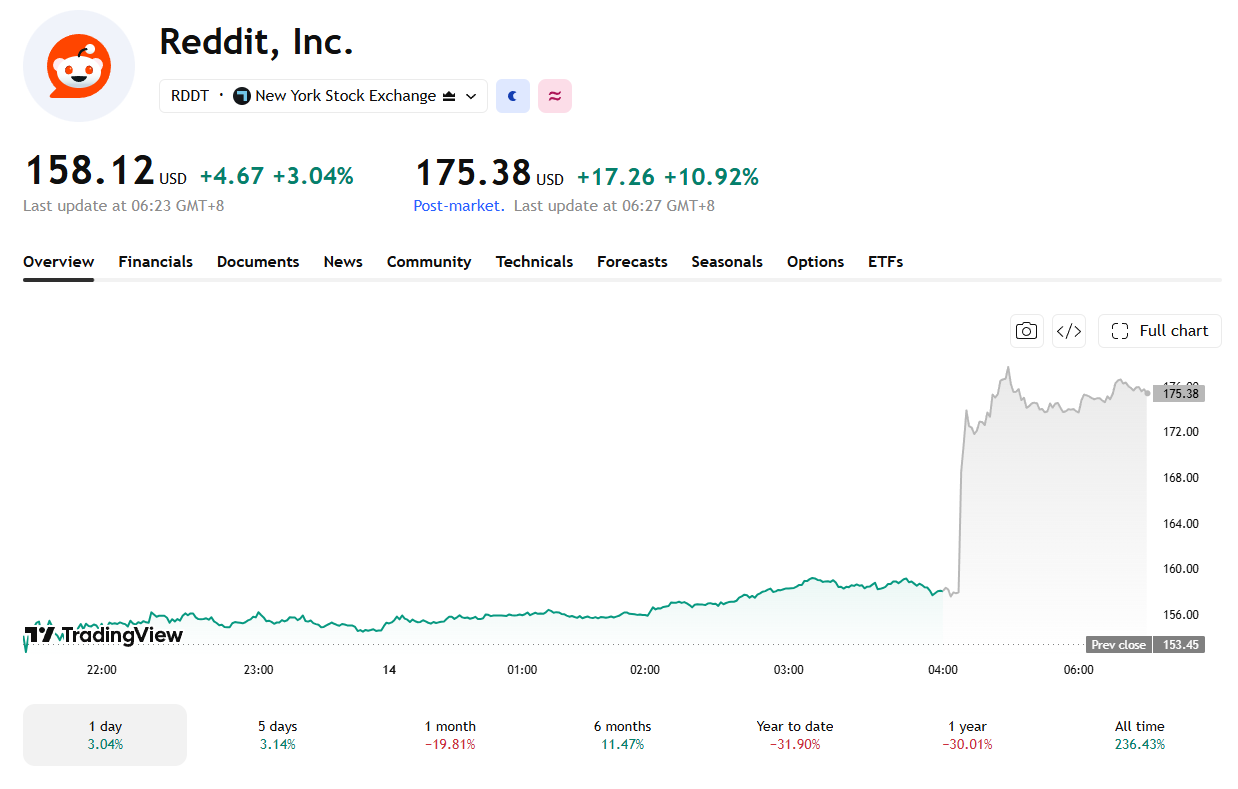
Reddit shares surged 11% in extended trading Thursday after S&P Dow Jones Indices confirmed the platform will join the S&P 500.
Reddit is only the second pureplay social media stock in the benchmark index after Meta.
Reddit’s Index Debut, By the Numbers
S&P Dow Jones Indices said Reddit (RDDT) will replace AvalonBay Communities in the S&P 500 before trading opens on Aug. 18, 2026, once Equity Residential completes its acquisition of AvalonBay.
Reddit shares climbed to $175.38 in postmarket trading following the news, up from Thursday’s $153.12 close, a gain of nearly 11%, according to TradingView data.

Index funds that track the S&P 500 must now buy Reddit shares to match the benchmark, a mechanical demand shock that helps explain jumps like this even absent fresh business news.
The same announcement added Sun Communities to the S&P MidCap 400 effective Aug. 20, replacing Webster Financial as Banco Santander’s acquisition of Webster nears completion.
Reddit’s addition leaves Meta as the only two pureplay social platforms in the S&P 500. Pinterest and Snap both went public earlier but remain too small by market cap for inclusion, and Twitter exited the index once Elon Musk acquired the company and rebranded it X under SpaceX.
A Rally That Follows a Rough Earnings Reaction
Thursday’s pop arrives less than three weeks after Reddit’s second quarter results split investors. The company posted its eighth straight quarter of revenue growth above 60%, yet shares initially sold off after CEO Steve Huffman flagged uncertainty around Reddit’s dependence on Google for new users.
“Search referrals were choppy in the quarter, and traffic was more volatile later in the quarter.”
Steve Huffman, in a letter to Reddit investors
Huffman tied the volatility to Google’s growing use of Gemini-powered AI Overviews, which answer search queries directly on the results page instead of routing users to sites like Reddit. The concern is not unique to Reddit. AI-generated search summaries are reshaping how publishers and crypto projects compete for visibility online.
S&P 500 membership does not resolve that structural question. It does guarantee Reddit a new base of buyers uninterested in the AI-traffic debate, since index funds must now simply hold the stock.
Reddit joins a short list of once-fringe internet companies using S&P inclusion to cement mainstream investor legitimacy. Coinbase joined the index in 2025, a milestone Strategy has not achieved despite its size.
Whether Reddit’s search-traffic risk resurfaces once the passive-buying wave settles is the open question heading into Aug. 18.
The post Reddit Stock Pops 11% on S&P 500 Inclusion Despite Google AI Traffic Concerns appeared first on BeInCrypto.

We worked with a team of labor law scholars, former federal labor officials, worker advocates, and union leaders to develop a Model State Sectoral Bargaining Law to meet this need. The model law would give workers the right to petition a State Labor Standards Board for recognition of a bargaining sector, grant organizing and access rights once minimum support thresholds are met, and create a process through which workers and employers can negotiate sector-wide agreements covering wages, benefits, working conditions, and the use of artificial intelligence and other workplace technology. Every employer in a covered sector would be bound by the resulting agreement, and workplace-level collective bargaining agreements may exceed—but never fall below—the sector-wide standards.
States that act now could immediately ensure that workers ignored by federal law can raise standards for themselves. More broadly, states have an opportunity to build the infrastructure of worker power that this country will need in the years ahead.


Swiss banking firm Swissquote Group (SQN) cut full-year revenue and profit forecasts after first-half net crypto income fell 66.2% to 14.6 million Swiss francs ($18 million).
Crypto trading volume at the Gland, Switzerland-based fintech dropped 63.5% to 2.58 billion Swiss francs, according to its results presentation. The company cut its net revenue outlook for the year by around 30 million francs to 730 million francs.
Swissquote said price declines across most cryptocurrencies caused the business to miss its initial assumptions. Bitcoin , the largest cryptocurrency, fell 33% in the six months ended June 30. Ether , the second-largest, dropped 47% and the CoinDesk 20 Index (CD20) lost 40%.
“The revised guidance now reflects a weaker-than-expected crypto environment,” Swissquote wrote.
Swissquote also booked a 5.3 million-franc loss on the crypto inventory it holds to support trading on its SQX exchange.
Growth in areas such as non-crypto trading and interest income helped keep revenue broadly level and limited the decline in profit. Client assets rose nearly 20% to 96.3 billion francs.
The company’s shares plunged 14% after the announcement.
UPDATE (Aug. 13, 14:05 UTC): Adds areas of growth in penultimate paragraph.

Trump’s push to take over the Kennedy Center began just weeks into his second term, when he overhauled the board—which has historically been made up of a bipartisan group of trustees—by terminating half of its 36 members, including longtime chairman David Rubenstein. He then appointed new members in their place, who elected him as chairman.
Major backlash ensued, with many performers boycotting the venue. When Trump visited the center for a performance of Les Misérables last June, he was met with boos from the crowd. Trump also made the controversial decision to host the 2025 Kennedy Center Honors, an award ceremony commemorating achievements across the arts, in December, becoming the first sitting president to do so.
Congress named the center to honor President John F. Kennedy in 1964 following his assassination in November 1963.
The Kennedy Center is far from the only piece of federal property Trump has sought to put his name or face on during his time as President. The slew of items he has moved to impress with his brand also include limited edition passports, currency, other federal buildings, battleships, and national park passes.

Neutrl halts NUSD redemptions over reserve concerns

The last mid-am standing at Merion wants to sell you something

Investors sue Selena Gomez alleging fraud tied to her mental health startup


-

 Fashion6 days ago
Weekend Open Thread: Mattifying Sunscreen
-

 Fashion7 days ago
Frugal Friday’s Workwear Report: Cap-Sleeve Pointelle Crewneck Sweater
-

 News Videos6 days ago
Can Astrology Help Find Gold and Silver Trends? A Financial Astrology Guide
-

 Business5 days ago
How to Start a Cleaning Business: A Step-by-Step Guide
-

 Tech6 days ago
Rinn Pharma & Biopharma to join NordicPharmaTrain network
-

 Business5 days ago
Datadog: Best Of Breed For Multiple Reasons
-

 Business5 days ago
BDC Weekly Review: Private BDC Q2 Numbers Are Strong
-
 NewsBeat2 days ago
Communication cards help banking customers access services or report scams
-

 Tech7 days ago
Price Hikes May Be Coming for PC Motherboards Next
-
 Business3 days ago
Oil Price Today (August 11): Crude oil rises to $88 after Trump’s compensation demand dents Hormuz opening. Here’s why
-

 Business7 days ago
Brightwater secures funding for WA-first dementia projects
-

 Business7 days ago
Aussie shares lose steam to close record-breaking week
-

 Fashion6 days ago
Weekly News Update, 8.6.26 – Corporette.com
-
 Entertainment7 days ago
Brand New Day’ Characters, Ranked
-

 Fashion7 days ago
The Best Stores Like Ann Taylor
-

 Fashion7 days ago
Irina Shayk Wows in REVOLVE Los Angeles’ Summer Styles
-

 Fashion7 days ago
Burberry Fall 2026 Takes On Commuter Style
-

 Fashion4 days ago
Amazon Sundays: Closet Care Before Fall
-

 Politics5 days ago
Be quiet, Miriam! – spiked
-

 Business7 days ago
South Korea cracks down on Trader Joe’s popular seasoning
You must be logged in to post a comment Login