
Crypto World
Shedding New Light On the Silent Crisis


From our partner Kaiser Permanente.
There is a silent epidemic. Globally, in increasing numbers, young people are facing mental-health issues. Depression is a leading cause of illness among young people. Anxiety is on the rise. Suicide ranks third as a cause of death for 15- to 19-year-olds and is increasingly becoming a health equity issue: African-American girls in grades nine to 12 were 70% more likely to attempt suicide in 2017, as compared with non-Hispanic white girls of the same age.
Unless we act, we will face the repercussions of this epidemic for years. Lives will be shortened, and generations will struggle. Our economic outlook will inevitably be impacted as we collectively face a range of long-term health issues for our workforce.
Twenty years ago, Kaiser Permanente and the Centers for Disease Control and Prevention (CDC) published a landmark study linking childhood trauma to long-term health consequences. This groundbreaking research into adverse childhood experiences (ACEs) continues to inform clinical best practices and approaches that are making a difference.
With the crisis at hand, we recognized a need to go deeper and continue our work in this area. We have recently announced plans to update the ACEs research to identify knowledge gaps, successful programs, emerging best practices and interventions ready to be scaled.
An entire generation is counting on us. We are asking leaders from across health care, business, nongovernmental organizations and academia to make youth mental health and wellness a priority.
Adams is chairman and CEO of Kaiser Permanente.

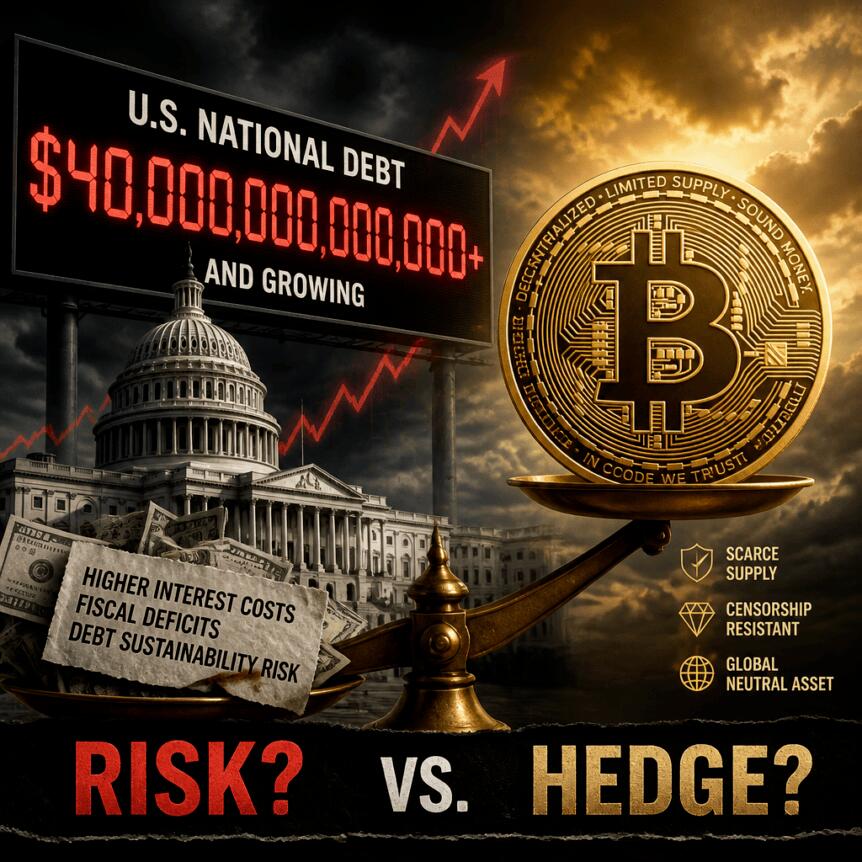
Bitcoin’s latest rally is unfolding alongside a stark escalation in US public finances, as the US federal debt pushed above $40 trillion for the first time and Treasury yields surged to their highest levels since 2007. The developments have reignited discussion among crypto market participants about whether worsening fiscal dynamics strengthen Bitcoin’s longer-term narrative as a scarce, non-sovereign asset.
At the same time, the US Treasury moved to address stress in the bond market. According to Reuters, interest costs have risen sharply, surpassing Medicare to become the federal government’s second-largest budget expense behind Social Security in the first 10 months of fiscal 2026. The debt milestone also coincided with a Treasury action designed to calm a bond selloff, pushing long-term yields higher overall before a targeted response from the department.
Key takeaways
- US federal debt crossed $40 trillion for the first time, renewing debate over whether fiscal instability boosts Bitcoin’s “hard asset” appeal.
- Treasury’s plan to increase buybacks of 10- to 30-year debt aims to blunt rising long-term yields, which can influence risk assets and crypto sentiment.
- Bitcoin was around $72,600 on Thursday morning, up roughly 6% over 24 hours and 15% over a week, according to CoinGecko data.
- Analysts are split on whether debt levels are structurally bullish for Bitcoin—some stress near-term financial conditions, others focus on longer-term hedge demand.
From debt milestone to bond-market pressure
The $40 trillion debt milestone matters because it changes the backdrop for investors across asset classes: more borrowing typically implies greater interest expense and a bigger refinancing need over time. Reuters reported that in fiscal 2026 through the first 10 months, interest costs have climbed to become the federal government’s second-largest budget outlay behind Social Security.
At the same time, a separate Reuters report tied the timing to a Treasury effort to manage a bond selloff. That stress period has coincided with long-term yields reaching their highest point since 2007.
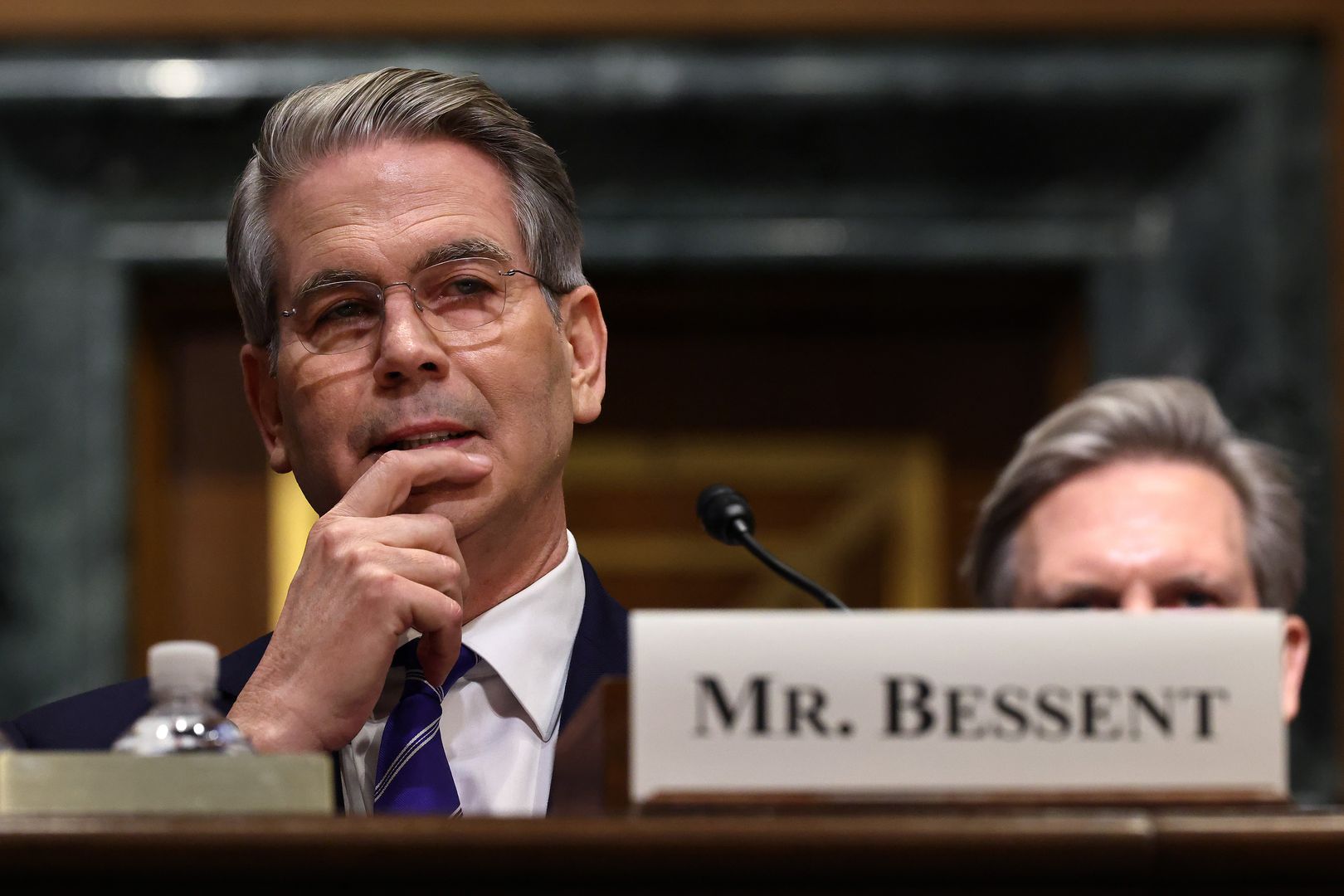
According to Reuters, Treasury Secretary Scott Bessent said Wednesday the department would double buybacks of 10- to 30-year debt to at least $4 billion per operation. The immediate market reaction—initially pushing yields and the US dollar lower—helped support a broader risk-on move, with Bitcoin and gold both rallying.
Bitcoin rises as markets weigh fiscal math
Bitcoin was trading around $72,600 Thursday morning, up about 6% over the previous 24 hours and roughly 15% over the past week, based on CoinGecko data. While the rally has attracted attention for potential policy implications, market observers highlighted that macro factors tied to US rates and the dollar may be playing at least as big a role.
Earlier coverage referenced by Yahoo Finance and others attributed parts of Bitcoin’s surge to optimism around friendlier US crypto policy following President Donald Trump’s meeting with industry executives at the White House on Wednesday. Still, Bloomberg-style attributions were not the only explanation. Analysts cited Treasury buybacks and fiscal conditions as additional drivers affecting the “math” investors use when allocating capital.
Why buybacks could help in the short run—and hurt later
TrendLabs founder and chartered market technician JC Parets argued that the Treasury’s increased purchases of longer-term bonds were likely aimed at pushing back against rapidly rising long-term rates. In an analysis cited by TrendLabs, Parets suggested that if markets begin to believe the government will counter higher long-term yields, it can change the valuation assumptions for a wide range of holdings—including Bitcoin.
“If the market believes the government is going to push back against rapidly rising long-term rates, that can change the math for everything else investors own. Including Bitcoin.”
Other analysts offered a more cautious counterpoint. Bitunix analyst Dean Chen, writing in a market note cited by Cointelegraph, said the debt milestone itself is not automatically bullish for Bitcoin. Chen’s view was that Treasury buybacks may lower long-term yields temporarily and weaken the dollar, but persistent deficits and the continued build-up of financing needs could still push borrowing costs higher again over time.
In that framing, Bitcoin’s direction would depend less on the headline debt number and more on a set of observable financial variables: US dollar strength, long-term Treasury yields, and inflation expectations.
A hedge narrative returns—though “reserve” status remains unproven
Beyond short-term rate dynamics, some analysts focused on the longer-term demand argument. Yield Basis, a DeFi protocol referenced by Cointelegraph, described continued growth in US debt as potentially increasing interest in Bitcoin as a hedge against currency debasement. Their reasoning is rooted in Bitcoin’s fixed supply and the absence of a sovereign issuer, unlike fiat currencies that can be influenced by monetary policy and fiscal financing.
“Whether it will actually become a new reserve asset remains to be seen, but as concerns around fiat currency debasement grow, it will definitely stand out more as a straightforward protective instrument (alongside more traditional assets like gold).”
That position highlights a key tension in the debate: Bitcoin may become more prominent during periods of fiscal strain and money-supply concern, but the step from “hedge” to “reserve” is still not determined by adoption narratives alone. Investors will likely look for sustained shifts in real-world demand signals, not just macro headlines.
What to watch next
For traders and longer-term investors, the immediate question is whether Treasury’s longer-term buyback activity can keep yields from resuming their climb—and whether the US dollar and inflation expectations stabilize. More broadly, the durability of Bitcoin’s rally may hinge on whether the market’s view of fiscal “math” changes from short-term support to persistent concern, or whether deficits ultimately translate into higher borrowing costs again.


Elon Musk’s X has begun exploring USDC and other stablecoins as possible payment methods for creators while preparing to replace its existing revenue-sharing system.
Summary
- X is discussing stablecoin payouts but has not selected a token or confirmed a launch.
- Circle’s USDC is among the payment options being considered for creator rewards.
- Original Content Rewards will replace X’s Revenue Sharing program on Sept. 8.
- U.S. stablecoin payments will operate under rules created by the GENIUS Act.
X considers USDC for creator rewards
CoinDesk reported on Thursday that X is discussing whether to pay creators and other content providers with stablecoins, citing a person familiar with the plans.
Circle Internet Group’s USDC is one of the digital tokens under consideration, although X has not chosen a payment method or disclosed when it could introduce stablecoin payouts. Talks remain active, according to the source, who also works with other social media companies testing stablecoins for influencer commissions.
X did not respond to CoinDesk’s request for comment, leaving the possible payment structure, supported countries and blockchain networks unconfirmed. The report also did not state whether creators would receive stablecoins by default or select them as an alternative to bank payments.
A stablecoin option could allow X to use one dollar-linked asset for creators in several countries, rather than arranging separate transfers through each local banking system. Any practical benefit would still depend on the networks, wallets, conversion services and withdrawal rules selected by the company.
USDC is designed to maintain a one-to-one value with the U.S. dollar and can move across several public blockchains. Circle says the token is issued through its regulated affiliates and backed by reserves intended to support redemption at its stated value.
The reported discussions come as the combined stablecoin market has exceeded $300 billion. While digital dollars remain widely used for crypto trading and settlement, payment companies and online platforms have also begun testing them for contractor, customer and creator payouts.
Original Content Rewards changes how X pays users
Alongside the stablecoin talks, X is preparing to end its Revenue Sharing program and replace it with Original Content Rewards on Sept. 8. The current system will continue through Sept. 7, according to the company’s published schedule.
X said the replacement program is designed to “reward creators who bring original ideas, expertise, reporting, creativity, and commentary to X.”
Under the announced eligibility rules, creators must have at least 500 verified followers and record at least 500,000 Home Timeline impressions from verified users during the previous 90 days. Users must also meet the platform’s other monetization requirements.
Payments will be based on qualified impressions from Premium subscribers viewing eligible original posts in the Home Timeline. X defines a qualified impression as a unique view in which at least half of the post appears on screen.
Eligible material can include original reporting and analysis, user-produced videos and photographs, graphics, illustrations, memes and meaningful commentary. Reposted work, copied material and posts designed mainly to manipulate engagement are not meant to qualify under the revised system.
The company has not said whether stablecoin payments, if adopted, would arrive with the Sept. 8 rewards launch or be added later. No details have been released about wallet support, conversion fees, custody arrangements or how creators could recover funds sent to an incorrect address.
Stablecoin transfers can differ from conventional payouts because blockchain transactions are generally irreversible after confirmation. A platform offering the option would therefore need to decide how it verifies wallets, handles failed transfers and assists creators who lose access to their accounts.
X Money has already added U.S. payment services
X’s interest in stablecoins follows the introduction of financial services inside its main social platform. In July, the company launched X Money for Premium and Premium+ subscribers in the United States, offering deposit accounts, instant transfers and a Visa debit card.
X Money allows eligible users to send funds to other X accounts without transfer fees. Its deposit accounts advertise annual yields of up to 6%, while qualifying purchases made with the X Card can earn 3% cashback.
Cross River Bank provides the banking infrastructure behind the service and holds customer deposits. Funds held directly by the bank can receive Federal Deposit Insurance Corporation protection of up to $250,000, while an optional sweep arrangement can distribute deposits among participating banks and provide eligible users with up to $10 million in aggregate pass-through coverage.
X Payments itself is not a bank or an FDIC-insured institution. The company also had not announced support for Bitcoin, Dogecoin or any stablecoin when it introduced X Money, making the reported creator-payment talks a separate potential use of digital assets.
Crypto experience entered X’s senior product team before the payment rollout. In March, the company appointed Benji Taylor as head of design after he held product and design positions at Aave, Avara and Coinbase’s Base network.
Taylor’s background includes work on crypto wallets, decentralized finance products and consumer applications. His personal website also lists roles connected to xAI and SpaceX, although X has not linked his appointment to the reported USDC discussions.
Musk has previously described payments as one part of his plan to turn X into an application combining social media and financial services. The company’s current U.S. rollout relies on established banking and card infrastructure, while stablecoin payouts would introduce blockchain settlement into at least one part of its creator business.
U.S. stablecoin rules would shape any X rollout
For American users, a USDC payment option would fall within a developing federal framework established by the GENIUS Act. President Donald Trump signed the law in July 2025, creating national rules for payment stablecoin issuers and certain companies that distribute their tokens.
The law requires permitted issuers to maintain one-to-one reserves in approved liquid assets, provide regular disclosures and meet redemption and compliance requirements. Most provisions are expected to take effect on Jan. 18, 2027, unless final implementing rules activate them earlier.
On Aug. 17, the U.S. Treasury Department proposed new rules defining when a payment stablecoin is issued, offered or sold in the United States. The definitions would help determine when an issuer needs a federal or state license and when a digital asset service provider becomes subject to restrictions covering U.S. customers.
Treasury opened the proposal for public comment for 60 days after its publication in the Federal Register. The agency is also addressing how U.S. platforms may offer foreign-issued stablecoins once the law’s distribution restrictions begin.
Circle’s status as a U.S.-based issuer could make USDC relevant to companies seeking dollar-denominated blockchain payments under the new framework. Circle has not publicly confirmed that it is working with X, and the report did not identify the other stablecoins under review.
Creator payouts would also remain taxable income for U.S. recipients regardless of whether X pays them through a bank transfer or a dollar-linked token. The Internal Revenue Service requires taxpayers to report income received in digital assets at its fair market value when received, while later disposals can create separate gains or losses if the asset’s value changes.
Another social media company has already tested a comparable model outside the United States. In April, Meta introduced USDC payouts for selected creators in Colombia and the Philippines, using wallets on Solana and Polygon.
Stripe processes Meta’s stablecoin payments and may provide users with crypto-related tax documents tied to the transactions. Meta’s support page says eligible creators can link a compatible wallet, receive USDC and convert the tokens into local currency through supported services where available.


Crypto World
Why Bitcoin-backed loans need qualified custody and no rehypothecation, according to Arch Lending CTO


Arch Lending co-founder Himanshu Sahay has identified qualified custody, zero rehypothecation, and clear collateral rules as three safeguards needed to reduce risks in Bitcoin-backed lending.
Summary
- Bitcoin-backed loans give long-term holders access to cash without requiring an immediate sale.
- Sahay said independent custody and zero rehypothecation can limit operational and counterparty risks.
- Borrowers still face interest charges, margin calls and liquidation when Bitcoin’s price falls.
- Celsius, BlockFi, and Genesis showed how opaque lending structures can leave customers exposed.
Himanshu Sahay, co-founder and chief technology officer of Bitcoin-backed lending platform Arch Lending, told crypto.news that wealthy Bitcoin holders are increasingly using loans to meet cash needs while keeping their exposure to the asset.
“For long-term Bitcoin holders, borrowing can provide liquidity without requiring them to sell their position,” Sahay said.
Individuals may use the proceeds for another investment or personal expenses, while family offices and businesses can borrow for working capital, according to Sahay. The arrangement allows the borrower to retain ownership of their Bitcoin unless the loan terms trigger a collateral sale.
A recent report on lending found that demand for Bitcoin-backed credit has recovered as investors look for liquidity without selling their holdings. The report said lending platforms have responded to the failures of 2022 by adopting clearer custody arrangements, plainer disclosures and more conservative risk controls.
Bitcoin-backed loans provide cash without an immediate sale
For US investors, selling appreciated Bitcoin generally requires the holder to calculate a capital gain or loss. The Internal Revenue Service treats digital assets held for investment as capital assets and requires taxpayers to report gains or losses when they sell or otherwise dispose of them.
Using Bitcoin as loan collateral does not involve the same immediate sale. Tax treatment can change, however, if the lender liquidates some or all of the collateral, while individual circumstances may create other reporting issues. The IRS advises digital-asset investors to consult a qualified tax professional when determining how a transaction should be reported.
Sahay did not present borrowing as a way to remove financial risk. Interest costs increase the amount that must be repaid, while a drop in Bitcoin’s price can raise the loan-to-value ratio, or LTV, until the borrower faces a margin call.
“Borrowing is not risk-free. It comes with interest costs, margin-call risk, and potential liquidation if the value of the collateral falls.”
Under a typical Bitcoin-backed loan, the LTV compares the outstanding debt with the current value of the pledged Bitcoin. If the asset declines enough, the borrower may need to add collateral or repay part of the loan. Failure to meet the lender’s requirements can lead to the sale of some or all of the Bitcoin.
Artem Ponomarev, founder and CEO of XPlace, made a similar case in an Aug. 18 interview, calling for safer borrowing tools built around conservative LTV limits, continuous collateral monitoring and clear liquidation terms. Ponomarev said borrowers should understand what will happen if their collateral loses value before taking out a loan.
Qualified custody separates collateral from the lender
Sahay described custody as the foundation of a properly structured Bitcoin-backed loan because it determines who controls the private keys and what can happen to the collateral during the loan term.
“At Arch Lending, collateral is held with Anchorage Digital Bank, a federally chartered U.S. bank and qualified custodian,” Sahay said. “Arch Lending does not hold the private keys, and borrower collateral is not rehypothecated.”
The Office of the Comptroller of the Currency granted Anchorage Digital Bank a national trust bank charter in January 2021. According to the OCC, Anchorage received approval to perform fiduciary, agency, and custodial activities after agreeing to capital, liquidity, and risk-management requirements under an operating agreement.
Federal oversight has not placed Anchorage beyond regulatory action. In April 2022, the OCC issued a consent order after finding that the bank had failed to adopt and implement a compliance program that met Bank Secrecy Act and anti-money-laundering requirements. The regulator required Anchorage to appoint a compliance committee and improve its customer due diligence, suspicious-activity monitoring, and independent testing.
Qualified custody is intended to place the assets with an institution that operates under defined regulatory and control requirements. Sahay said the arrangement can reduce operational risks involving private-key management, unauthorized transfers, and the separation of borrower assets.
Custody does not protect a borrower from a falling Bitcoin price, according to Sahay. It also does not prevent a liquidation carried out under the loan agreement after the collateral crosses a specified LTV level.
According to Arch’s website, Anchorage holds collateral in individually segregated wallets, while Arch does not lend, stake, or trade the pledged assets. The company also advertises up to $100 million in insurance coverage through Anchorage, although such insurance applies to specified custody and operational events rather than losses caused by Bitcoin price declines or contractually permitted liquidations.
Arch’s website lists initial Bitcoin LTV ratios of up to 60%. It says borrowers receive warnings and margin calls as the ratio rises, with partial liquidation available to restore the loan to its required level. Exact thresholds and terms can vary by product and loan agreement.
No rehypothecation limits connected lending risks
Rehypothecation occurs when a lender or custodian reuses pledged collateral in another loan, trade or investment. Sahay said a no-rehypothecation policy prevents a borrower’s Bitcoin from being deployed elsewhere while it secures the original loan.
“No rehypothecation protects against a different risk: the collateral being lent out or deployed elsewhere,” he said.
Reusing collateral can expose a borrower to additional counterparties because the lender may depend on another institution to return the assets. If the receiving institution defaults or freezes withdrawals, the original lender may be unable to return the Bitcoin even when the borrower meets the loan obligations.
An October 2025 report on a multi-signature Bitcoin platform described another structure intended to prevent rehypothecation. The Sygnum and Debifi product placed collateral in a wallet requiring approval from three of five signatories, including the borrower, the bank, and independent parties, before the Bitcoin could move.
Sahay said borrowers should examine several parts of a lending agreement rather than rely on one safeguard. Relevant questions include who holds the Bitcoin, whether collateral can be reused, how the lender funds the loan, which LTV thresholds apply, and what happens if either party encounters financial trouble.
Independent custody and no rehypothecation address different risks. Custody controls who can authorize a transfer, while the loan contract determines whether the lender has permission to deploy the collateral. Asset segregation and bankruptcy remoteness involve separate legal questions about whether creditors could claim the Bitcoin if the lending company failed.
The 2022 failures exposed opaque lending structures
According to Sahay, the collapse of Celsius, BlockFi, and Genesis showed why custody, lending, and asset deployment should not be combined without clear disclosures.
“Many of the failed lenders combined custody, lending and asset deployment in ways that made it difficult for customers to understand where their collateral was or how much risk was being taken with it.”
The Federal Trade Commission alleged in July 2023 that Celsius took title to more than $4 billion in customer crypto deposits. According to the agency, Celsius used customer assets to fund its operations, pay rewards, borrow from other institutions, and make risky investments despite telling users that deposits were safe and available.
BlockFi’s problems also extended beyond custody. In February 2022, the Securities and Exchange Commission charged the lender with failing to register its retail interest accounts and making false and misleading statements about the collateral backing institutional loans. BlockFi agreed to pay $100 million to the SEC and 32 US states before filing for bankruptcy in November 2022 following its exposure to FTX.
Genesis Global Capital suspended withdrawals that same month and filed for Chapter 11 protection in January 2023. In May 2024, the New York attorney general secured a $2 billion settlement intended to support recoveries for affected investors and barred Genesis from operating in the state. The attorney general said at least 29,000 New Yorkers had placed more than $1.1 billion into the Gemini Earn program connected to Genesis.
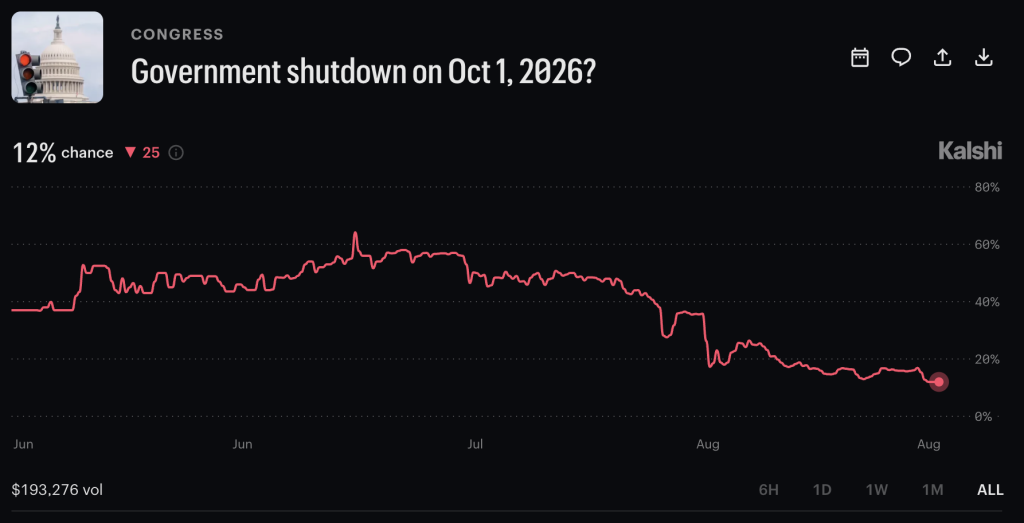
Federal government shutdown odds on Kalshi traded at 15-16 cents as of August 18, implying roughly a 12% chance. That particular market has just north of $193,000 in trading volume.
The price offers a live reading of Washington risk that crypto traders can track alongside broader market developments as they head into the next funding fight.

The figure is a snapshot, not a forecast. The market price can change as appropriations headlines emerge, and the August 18 price may not be the price traders pay when Congress returns from recess in September.
The value of the contract for this analysis lies in the event it prices and its role as a live sentiment indicator for macro risk.
Government Shutdown Odds: Why the Contract Tracks a Real Deadline, Not Just Noise
A government shutdown is a significant issue, as seen during the 2025 funding gap, which led to the furlough of nonessential federal employees. The shutdown began on October 1, 2025, and lasted until the Continuing Appropriations Act was signed on November 12, 2025.
Furloughed employees were paid retroactively, but the Congressional Budget Office projected that the shutdown would result in an $11Bn loss in real GDP by Q1 FY2027, affecting less than 1% of GDP.
Federal employment dropped by 162,000 in October and 6,000 in November, though this was mainly due to deferred resignations rather than the shutdown itself. Key economic data releases were delayed or canceled, complicating assessments of the shutdown’s impact.
Federal Reserve Governor Lisa D. Cook noted that disruptions in government services could slow spending and investment, but these effects were expected to be temporary. The S&P 500 rose during the shutdown, while the U.S. dollar fluctuated but strengthened overall.
Discover: Everyone’s Got a Take. Get $ 5 Free from Kalshi to Actually Trade Yours
Reading Kalshi’s Price as a Dial, Not a Verdict
A 15- to 16-cent YES price indicates a roughly one-in-six market-implied chance, but it is not an official government forecast. It is a trader-set price, with the bid-ask spread and fees affecting how it should be interpreted, as with other prediction market contracts that serve as proxies for real-world outcomes.
The contract’s resolution rules make it more precise than the headline question suggests. It resolves YES only if the federal government is at least partially shut down because of a lapse in appropriations at 10 a.m. ET on October 1, 2026.
A shutdown that begins on October 15 would not satisfy that dated condition. That narrow definition helps explain why the price can move in response to developments in funding talks even before an actual shutdown occurs.
What a Rising Shutdown Premium Can Signal for Bitcoin and Ethereum
The direct causal link between shutdown odds and crypto price action is thin. CRS said it was not certain that financial markets were much affected by the 2025 funding lapse.
For traders following Bitcoin and Ethereum, the contract is therefore better treated as one indicator of Washington-related uncertainty than as evidence of a direct relationship with either asset’s price.
A higher shutdown price would indicate that market participants are assigning a greater chance to a funding lapse at the contract’s specified time. The 2025 shutdown illustrated several potential economic channels: delayed government purchases, delayed data releases, and possible effects on investor confidence.
Whether those concerns coincide with a Bitcoin move tied to broader macro risk depends on wider market conditions rather than the shutdown headline alone.
For Ethereum as well, the Kalshi price is one input, not a standalone trading signal. Traders seeking a connection between Washington risk and changing macro risk sentiment in Bitcoin can compare the contract with other market indicators while keeping its dated resolution rule in view.
Discover: Your Market Calls Are Worth Something. Start with a free $25 on Kalshi
The post Kalshi Government Shutdown Odds in October Slashed appeared first on Cryptonews.

Public Bitcoin miners are pouring large sums into artificial intelligence and high-performance computing (HPC) infrastructure as part of a broader push to diversify beyond pure mining revenue. But new data compiled by BlocksBridge Consulting suggests the transition is still dominated by upfront capital spending, with returns lagging far behind.
In its latest Miner Weekly newsletter, BlocksBridge reports that a group of 15 Bitcoin miners and AI data-center companies spent a combined $30.7 billion on capital assets in their most recent 2026 reporting periods. That figure is 42.6% higher than the $21.53 billion these companies spent over all of 2025. The figures help quantify just how expensive it is to build capacity for AI workloads—often in parallel with continuing mining operations.
Key takeaways
- $30.7B: Total capital asset spending by 15 Bitcoin miners and AI data-center companies in their latest 2026 reporting periods, per BlocksBridge.
- Capex far exceeds AI/HPC revenue: Nine comparable miners spent $5.11B on capex in the first half of 2026 while reporting only $341.2M in directly reported AI/HPC revenue.
- Revenue growth is accelerating: AI/HPC revenue from those nine miners rose to $205.8M in Q2 2026, up 52% quarter-on-quarter.
- Pivot requires more than power and land: BlocksBridge highlights the need for substations, buildings, cooling, networking, and often GPUs.
- Industry funds are reframing the thesis: CoinShares rebranded its strategy ETF to include companies supplying digital power beyond mining alone.
Capex surge highlights the cost of scaling AI-ready capacity
AI and data centers have been widely discussed as diversification paths for Bitcoin mining companies facing a challenging industry backdrop. BlocksBridge’s analysis adds a granular cost lens to that narrative, showing how quickly capital needs expand when miners attempt to convert existing infrastructure advantages into AI-ready computing environments.
According to BlocksBridge, spending was calculated based on cash purchases and allocations to hardware, property, equipment, and other productive assets—after taking into account proceeds and refunds from asset sales. Even with those adjustments, the gap between investment and revenue remains large.
Among Bitcoin miners specifically, the mismatch looks particularly stark. BlocksBridge identifies nine comparable miners that collectively spent $5.11 billion on capital assets during the first half of 2026, generating just $341.2 million in directly reported AI and HPC revenue. That equates to roughly a 15-to-1 capex-to-revenue ratio for the period covered.
Q2 revenue growth suggests demand is building, even if profits lag
While the early spending burden is clear, BlocksBridge also reports signs that AI and HPC revenue is gaining momentum. For the same group of nine miners, total AI and HPC revenue increased to $205.8 million in the second quarter—a 52% quarter-on-quarter rise.
BlocksBridge notes that companies including Core Scientific, TeraWulf, and Bitdeer were among those reporting gains tied to their AI/HPC efforts. The acceleration matters because it indicates the investments are beginning to translate into recognizable business performance, even if the scale of capex still overwhelms what is currently booked as revenue.
For investors and analysts, the immediate implication is that the diversification story is shifting from “planned buildout” to “commercialization,” but with significant timing risk. The cost is already on the balance sheet or cash-flow path; the payoff appears to be arriving later and in uneven increments across companies.
From mining advantage to AI infrastructure: what still must be built
BlocksBridge frames the pivot challenge in practical terms. While miners may have initial advantages—such as access to power contracts and available land—those assets do not automatically become AI-capable capacity. In its reporting, BlocksBridge says that converting such advantages into AI-ready infrastructure typically requires additional components, including substations, buildings, cooling systems, networking equipment, and—depending on the business model—GPUs.
This matters because it clarifies why AI/HPC commercialization can be slower than headline narratives imply. Mining operations can often run with relatively straightforward operational continuity, but AI workloads involve different infrastructure requirements and more intensive engineering to achieve reliability, scalability, and performance.
BlocksBridge also leaves open a key question for the near term: whether any broader improvement in Bitcoin’s price environment will reduce financial pressure on companies still operating large mining fleets. Bitcoin’s price moves can help sentiment and—depending on each firm’s leverage and hedging—may influence how much runway companies have while AI projects ramp.
Earlier this week, Bitcoin rose more than 13% and moved back above $72,000, following a statement by the US Treasury that it would at least double the maximum size of its long-term bond buybacks to $4 billion per operation. That decision was described as aiming to improve liquidity in the Treasury market, initially pushing yields lower and boosting risk appetite.
ETF strategy shifts mirror the broader “digital power” rebrand
In parallel with the infrastructure buildout, parts of the investment industry are adjusting how they package exposure. CoinShares, this week, announced changes to the way its industry-tracking ETF is positioned and branded.
The fund is now called the CoinShares Bitcoin Mining and Digital Power ETF (WGMI). CoinShares reports that the ETF has $222.4 million in assets under management, and that it draws from a broader set of businesses than a pure mining basket. Its “universe includes 29 holdings” spanning bitcoin miners, data center operators, AI semiconductors, power generation, and HPC companies, which CoinShares describes as “the businesses powering the digital economy.” The fund’s details are listed on CoinShares’ site: https://coinshares.com/us/etf/wgmi/.
For market participants, the ETF shift signals that investors are increasingly seeking exposure to the infrastructure layer around compute—not only the economics of mining blocks. Still, BlocksBridge’s capex-to-revenue figures emphasize that this infrastructure layer is currently expensive to build. The critical test will be whether rising AI/HPC revenue can eventually narrow the investment gap as projects move from construction into sustained operating contracts.
Over the next few reporting cycles, readers should focus on whether the revenue ramp continues for individual miners and whether capex intensity begins to cool relative to AI/HPC income. The data already shows acceleration in Q2, but the core uncertainty remains timing: how long it takes for heavy infrastructure spend to convert into durable, scalable returns.
Bitcoin (BTC) has traded through two US market interventions in under three weeks. It moved the opposite way each time. Support for the yen pushed it down. An attack on long yields lifted it 8.8%.
Treasury Secretary Scott Bessent went further on Thursday. He said buybacks could exceed $4 billion per issue and would become routine, while denying that rates drove the decision.
Follow us on X to get the latest news as it happens
Two Interventions, Two Opposite Bitcoin Reactions
The pattern is narrower than it looks. Bitcoin does not reward intervention itself. It rewards the intervention that lowers long-dated US borrowing costs.
The first landed at the start of August. Japan bought its own currency with an estimated $53 billion. The New York Fed then bought yen for the Treasury on August 1.
Washington had not bought yen since 1998. Bitcoin still slipped toward $63,000, down 1.25%, while US stocks closed higher.
Leverage explains why Bitcoin absorbed the yen shock alone. Traders borrow cheaply in yen to buy higher-returning assets, a strategy called the carry trade.
When the yen jumps, those positions cost more to hold. Crypto sits at the riskiest end of that chain, so it sells first.
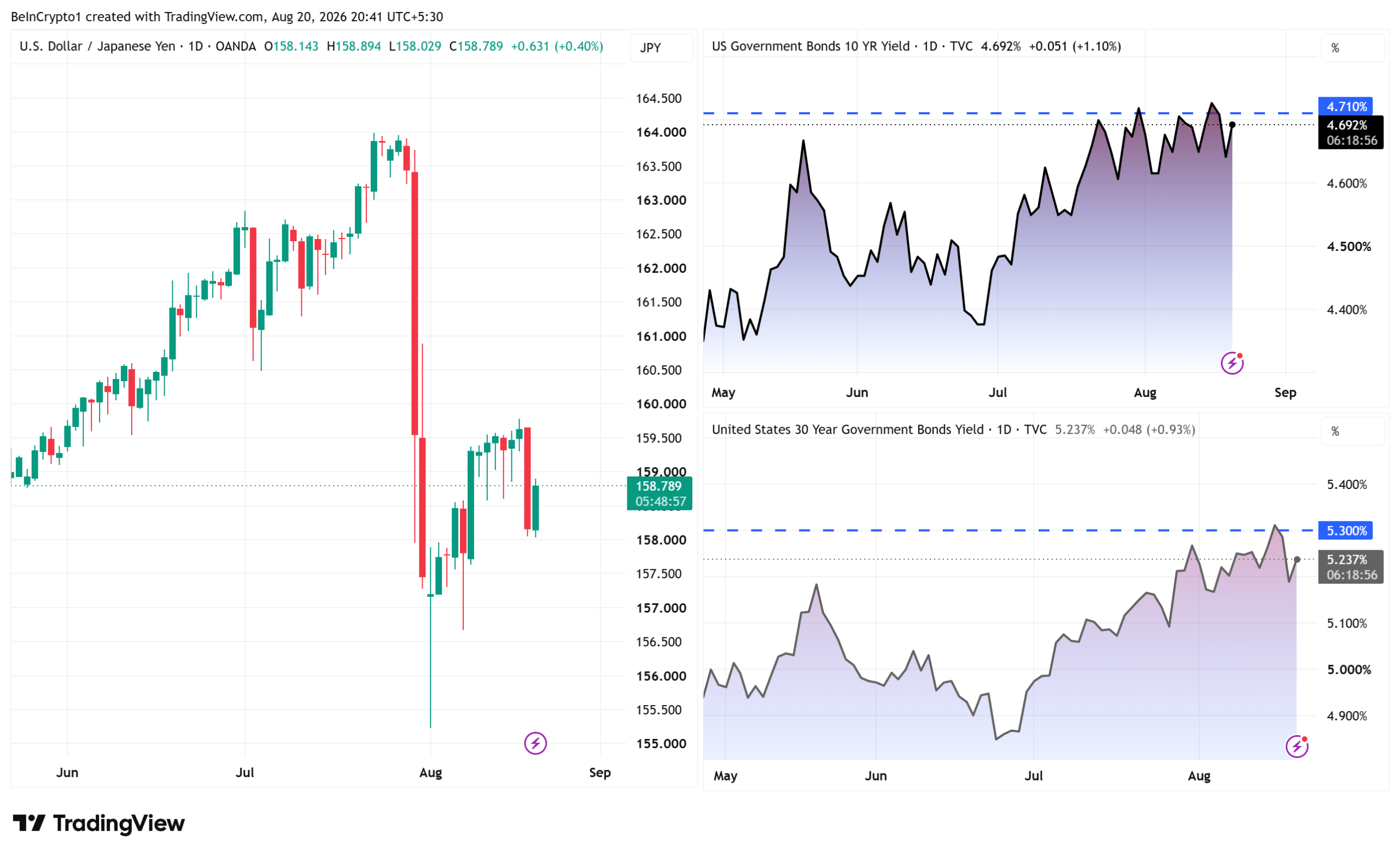
The decisive detail sits in the bond market. Long yields never fell that week. The 10-year finished near 4.74%, its highest since January 2025, while the 30-year held near post-2007 highs.
One reading is that the operation spared Japan from selling US Treasuries. It protected the currency, not the long end, so Bitcoin had nothing to reward.
The second intervention arrived on August 19 and hit the bond market directly. The Treasury doubled its long-end buybacks, raising the maximum size of each operation to at least $4 billion.
That came one day after the 30-year yield touched 5.337%, the highest reading since 2007.
Bitcoin answered within the hour. Roughly $1.23 billion in crypto short positions was liquidated in 60 minutes. BTC traded near $69,803 on Thursday, up 8.8% over 24 hours.
Why Long Yields Matter More Than the Yen
Long-dated yields set the return available for taking almost no risk. A 30-year bond paying more than 5% is hard competition.
Push that yield lower and the calculation flips. Borrowing gets cheaper, the dollar softens, and money travels further out the risk curve.
“When yields drop and the dollar weakens, risk assets tend to rally,” said Jeff Mei. He is chief operating officer at the exchange BTSE.
The two episodes differ on compulsion. Yen strength forces traders out of positions. Falling yields invite them in. The invitation produced the bigger move.
One objection deserves an answer. The 8.8% jump was amplified by traders caught short, not fresh buyers. That is fair, but a squeeze needs a trigger, and the trigger was the yield drop.
What Could Kill the Rally
The threat is the yields themselves. Both interventions have already lost their grip.
USD/JPY changed hands near 158.79 on Thursday, almost back where it started. Two governments spent tens of billions, and the yen intervention has faded.
Bonds unwound faster. TradingView data put the 10-year at 4.692% on Thursday, just shy of the 4.710% it held before the announcement. The 30-year climbed to 5.237% after falling to 5.192%.

Scale explains the fade. The increase adds roughly $14 billion against a market worth more than $30 trillion. None of it starts until September 9.
“While increasing liquidity buy-back operations by $2 billion might seem like rearranging deckchairs on the Titanic given the U.S. national debt of $40 trillion, yesterday’s intervention by the U.S. Treasury has been warmly greeted by investors around the world,” Chris Turner of ING wrote on Thursday.
It captures the gap between flow and signal.
Bessent then moved to close that gap. He said on Thursday that buybacks could top $4 billion per issue, Bloomberg reported. He also said the Treasury would run them routinely, turning a one-off surprise into standing policy.
The treasury executive also called 30-year liquidity particularly poor and said yields do not reflect underlying fundamentals. Both are unusual admissions from a sitting Treasury Secretary.
Yet he denied that rates drove the decision. That sits awkwardly beside the rest, since the market traded it as exactly that.
He added that the deficit has probably peaked under this administration. If so, that weakens the supply pressure behind the $40 trillion US debt load.
Two things would still end the move:
- One is a clean break above 5.34% on the 30-year.
- The other is a hawkish Fed, after minutes showed three officials wanted a hike.
That is the tension now. The flow keeps fading while the commitment keeps growing. Bitcoin’s current price works as a live scoreboard on which one wins.
The post Bitcoin Rewarded 1 of 2 US Interventions. Bessent Just Promised More appeared first on BeInCrypto.
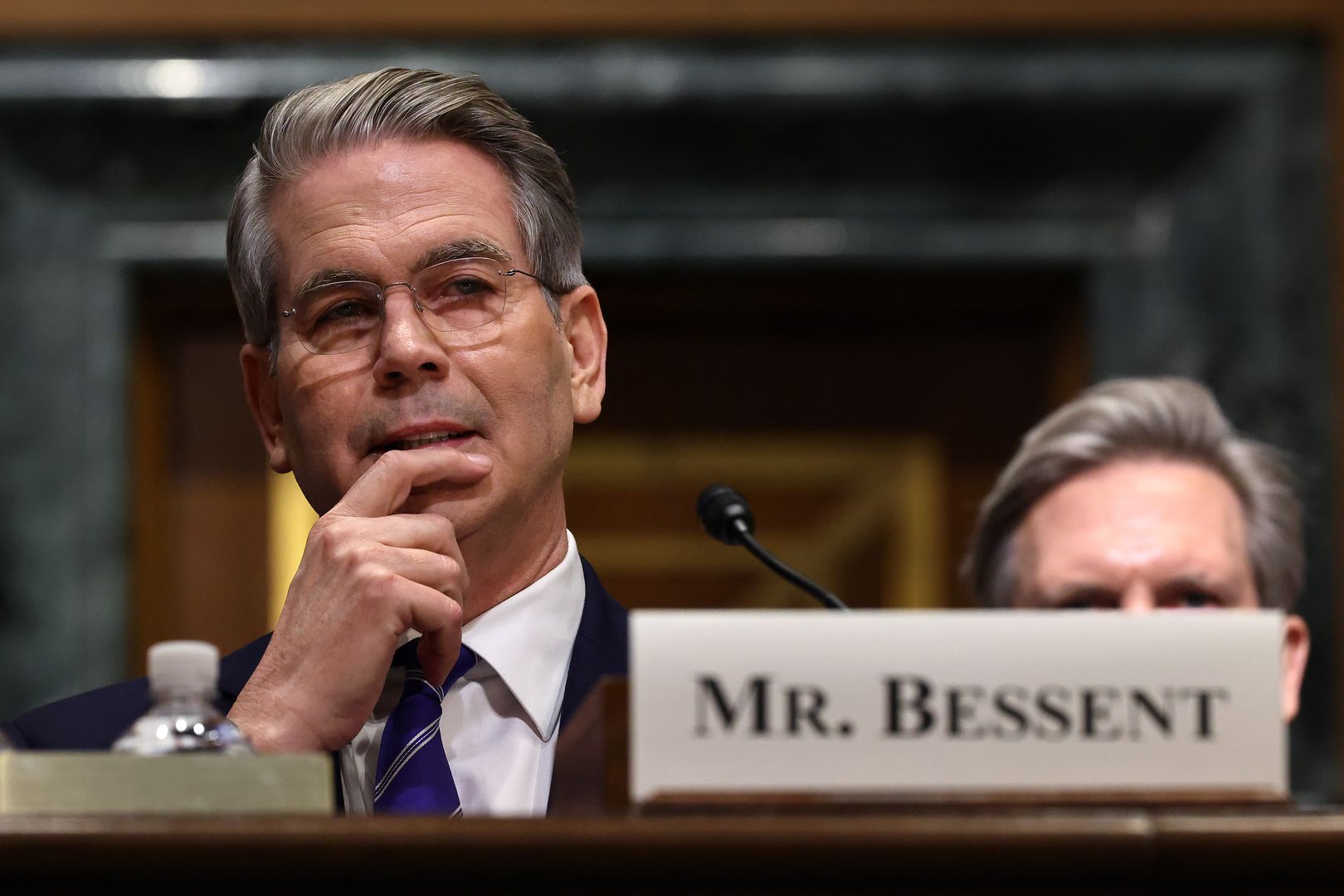
Longtime bond market investor Mark Connors sees routine government bond buybacks improving liquidity and bringing bitcoin’s next rally closer.

Something flipped in the cryptocurrency markets over the past 24 hours or so, and many altcoins have started to pick up the pace after bitcoin’s massive double-digit rally.
Today appears to belong to XRP. The native token of the broader Ripple universe has skyrocketed by 30% in a day or so, surging to $1.30 for the first time since June 1. Recall that the asset slipped below $1.00 just last week for the first time in nearly two years. Its subsequent rebound has been nothing short of impressive.
XRP Whales Continue Accumulating
Perhaps the most notable change in the XRP ecosystem is the recent whale behavior. As reported at the end of the previous week, these large market participants scooped up 72 million tokens in just 24 hours as the asset fought to stay above $1.00.
Citing further data from Santiment Intelligence, popular analyst Ali Martinez noted that they continued with their massive accumulation spree by acquiring over 300 million tokens since the start of the current business week. Their total holdings have skyrocketed from around 16.05 billion on August 16 to approximately 16.36 billion today.
Such large acquisitions have a twofold effect. First, they reduce the immediate selling pressure in the market. Second, they can act as an example for smaller investors who tend to follow whales.
Major Price Targets Emerge
The ever-vocal XRP Army was quick to pick up the native token’s mind-blowing recovery from the $1.00 support. JAVON MARKS celebrated the breakout, suggesting that the asset’s next major run has just started. Moreover, the analyst outlined the subsequent macro target of $15 or higher.
Dark Defender also weighed in on the price move, confirming that XRP had completed its correction. He based the analysis on the assumption that XRP had finished the leg down on all 5 waves on all timeframes.
“There is no 6th limb in the Elliott Wave Theory,” he added, before indicating that the latest rebound signals a strong reversal and a new impulse that can lead the token to $5.85 first and then $9.00.
Although these price targets sound quite optimistic, to say the least, XRP has proven in the past that it’s capable of massive moves shortly after the broader sentiment appeared broken.
The post Ripple Whales Go Crazy as XRP Price Can’t Stop Surging appeared first on CryptoPotato.
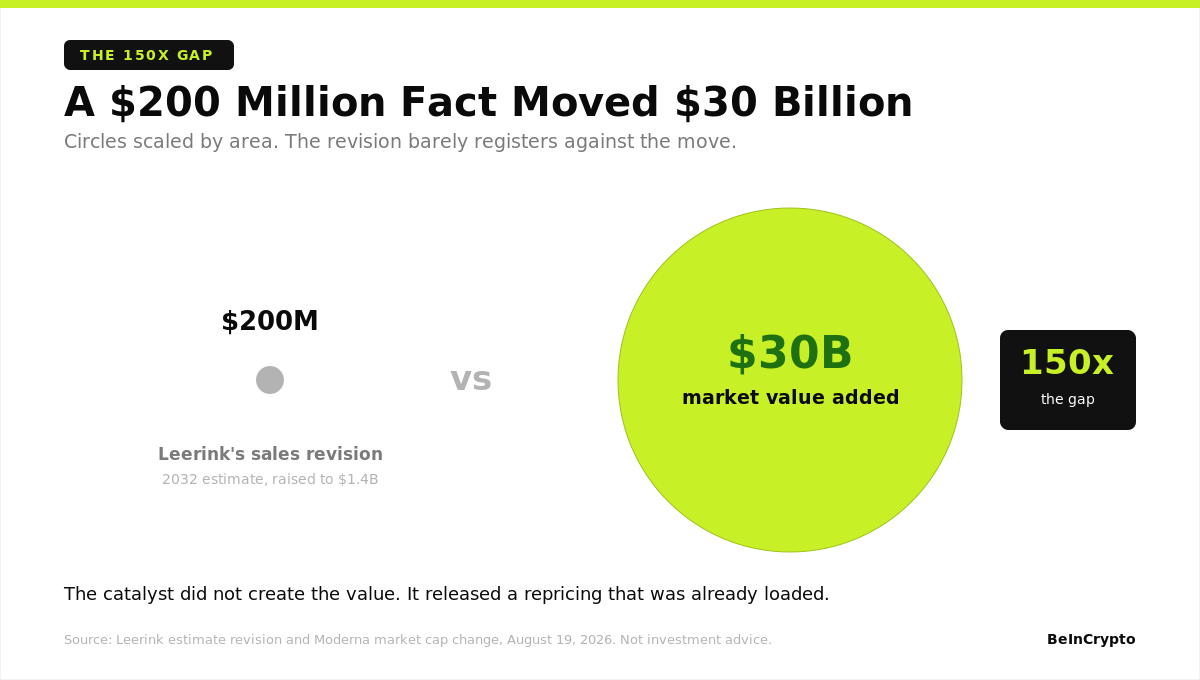
Moderna (MRNA) jumped 177% on Wednesday, and the strangest part is how little news it took. A $200 million estimate change moved $30 billion on the stock market.
Moderna became famous for its COVID vaccine five years ago, and its stock price is now at its highest since mid-2024. So, investors wasted no time taking profits after such a massive rally.
But can the stock price climb further? Or will the rally stop here?
What Actually Made Moderna Jump 130%?
The drug did not do it alone. Leerink’s revised estimate raised its 2032 sales estimate by roughly $200 million. Yet, the stock moved 150 times that amount in a market already at record highs.

Five loaded conditions did the rest. Moderna had collapsed 95% from $484 to $22. The recovery was already running, up 357% in 2026 on a flu approval before the cancer news.

The price sat above all six moving averages while analysts refused to believe with a $52.95 average target under the current price.

And short sellers, traders who borrow shares and sell them betting on a fall, held 13.37% short interest in the freely traded shares, losing $4.8 billion when the readout forced them to buy back.

Moderna Stock Price Prediction: What Wall Street Giants Think
The Moderna move is one of those rare biotech events where the fundamental story genuinely changed overnight. The stock still overshot the immediate fundamentals, and today’s pullback is already showing that.
Ignore the old consensus target of roughly $50. Most of those targets were published before the Phase 3 result and are effectively obsolete.
The post-announcement calls are much more useful.
- Bank of America upgraded Moderna from Underperform to Neutral and increased its price target enormously, from $40 to $170. BofA described the result as a watershed event because it gives Moderna a credible route away from dependence on infectious-disease vaccines.
- Morgan Stanley raised its target from $39 to $89, while keeping Equal Weight. Morgan Stanley now sees much greater value in Moderna’s scalable mRNA platform, but remains much more conservative on share price.
- Brookline Capital: sets a target around $135, with a Buy rating.
- William Blair upgraded Moderna from Market Perform to Outperform, arguing that the Phase 3 result puts Moderna and Merck in position to seek regulatory approval and meaningfully changes Moderna’s diversification prospects.
So the fresh Street debate has suddenly become something like:
View
Approx. valuation
Morgan Stanley / conservative
$89
Brookline / middle
$135
BofA / bullish
$170
Yesterday’s close
$174.38
Current price
~$140
That shows something important – even BofA’s extremely aggressive $170 target was below yesterday’s closing price.
How Long Will the Moderna Stock Rally Last?
There are really two rallies. The short-squeeze/momentum rally probably peaked yesterday. Today’s roughly 20% drop is consistent with that. Once shorts have covered and momentum traders start taking profits, that mechanical buying disappears.
The fundamental revaluation could last much longer. The next major event will likely be publication of the detailed Phase 3 numbers.
So far Moderna and Merck have announced that the endpoints were achieved, without releasing the actual hazard ratios and detailed clinical data.
Analysts still want to see magnitude of benefit, overall-survival trends, safety details and manufacturing economics.
Those detailed results are expected around the ESMO Congress in Madrid, October 23-27. That creates a natural trading window.
Between now and October, Moderna stock is likely to remain extremely volatile, with investors continuously repricing what the full data might show.
If the detailed results are excellent, another leg upward is possible. If they’re statistically positive but clinically less spectacular than investors currently imagine, the stock could fall substantially.
Based on what the market shows today, most analysts put Moderna’s reasonable near-to-medium-term fundamental range around $120-$150.
The post 5 Reasons Why Moderna Stock Jumped 170% and How Far It Can Go appeared first on BeInCrypto.

SANY Nutrition Group opens Arkansas plant

U.S. Debt Surpasses $40T, Renewing Bitcoin Risk vs. Hedge Debate

Kendall Jenner and Kylie Jenner Love This HydroJug Tumbler





-

 Fashion6 days ago
Weekend Open Thread: Ann Taylor
-
 Sports7 days ago
This U.S. Amateur is a glimpse into golf’s future in more ways than you think
-
 Tech6 days ago
11 Ways to Rank Your Videos
-

 Sports6 days ago
Birmingham 2026: Day 6 Timetable for Irish Athletes
-
 NewsBeat6 days ago
Myanmar says over 300,000 Rohingya refugees verified for repatriation as exodus enters ninth year
-

 Politics5 days ago
SEQ Code: The Three Letter Boarding Pass Code That Could Give You The Worst Seat
-

 Tech3 days ago
Qwen3.8-27B runs frontier-class coding agents and reasoning locally, no cloud API required
-

 Tech7 days ago
DeepSeek Harness launches as open source rival to Claude Code, alongside V4-Pro on API with higher prices
-

 Crypto World6 days ago
Pi Network Protocol 27 endgame: last upgrade before what?
-

 Business2 days ago
SMA Solar Technology AG (SMTGY) Q2 2026 Earnings Call Transcript
-

 Crypto World3 days ago
OCC Greenlights Trump Family Crypto Firm for Trust Charter
-
 Tech5 days ago
Every fusion startup that has raised over $100M
-

 Business7 days ago
15 Ways to Make Money From Your Phone (2026 Guide)
-
 Entertainment6 days ago
10 Netflix Shows That Quietly Became Modern Classics
-

 Fashion6 days ago
Weekly News Update, 8.14.26 – Corporette.com
-
 Entertainment5 days ago
Marvel Studios Reveals New X-Men Cast Including Adam Driver and Sadie Sink
-

 News Videos14 hours ago
Don’t Leave Your Financial Future To Chance | August 19, 2026
-

 Crypto World6 days ago
Robinhood Chain Approaches $1B TVL as Uniswap Integration Boosts Liquidity
-

 Business5 days ago
Facebook Down Now? Users Report Login And Loading Problems As Outage Trackers Monitor Ongoing Issues
-

 Fashion6 days ago
Silver bangles for women – Newbridge Silverware
You must be logged in to post a comment Login