
Crypto World
Shiba Inu Unveils an ‘Useful’ Shibarium Update: Details

Shiba Inu has largely stayed out of the spotlight in recent weeks, keeping a low profile and making no major announcements. However, the team has broken its silence with a fresh update concerning its layer-2 scaling solution, Shibarium.
Despite the news, SHIB remains in red territory on both daily and weekly timeframes, and certain factors suggest a deeper decline might be on the way.
What’s New for Shibarium?
Shiba Inu revealed on its official X account that it has implemented “a small but useful” update for Shibarium. Specifically, it refreshed its RPC listing in the Ethereum-lists/chains registry, and Chainlist now has updated connection details.
Several X users applauded the move, saying it has made access to the protocol more convenient. Many others described the update as insignificant and even called the layer-2 scaling solution a scam.
Their frustration may stem from Shibarium’s declining activity. Following an exploit last year, daily transactions processed on the network have fallen to the low thousands and occasionally even the hundreds, highlighting weak user engagement and potentially eroding investor confidence. Recall that prior to the attack, the figure stood in the millions.

SHIB Price Outlook
While Shiba Inu remains the second-largest meme coin, its valuation has slipped by 6% over the last week and now trades at around $0.000005196 (according to CoinGecko). Its market capitalization stands at just north of $3 billion, making it the 33rd-largest cryptocurrency.
Meanwhile, SHIB’s burning program suggests that the bears may remain in control. Data shows that the burn rate has declined by nearly 90% over the past month, meaning a negligible amount of tokens has been sent to a null address.
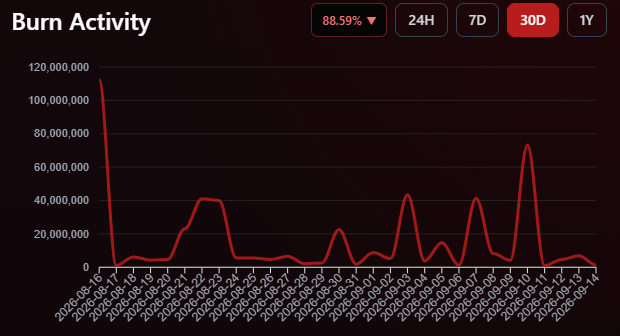
The mechanism’s ultimate goal is to reduce the meme coin’s overall supply and potentially boost its value through scarcity. However, little to no activity on that front poses a serious obstacle to that effort.
Shiba Inu’s seasonal performance is also worth monitoring. September has been a predominantly poor month for the token, with its price ending the period in red three out of five times. We have approximately two weeks left to see whether the green and red September will balance out or bears will strengthen their advantage.
The post Shiba Inu Unveils an ‘Useful’ Shibarium Update: Details appeared first on CryptoPotato.


US lawmakers failed to advance the proposed CLARITY Act in the Senate on Tuesday, delivering a near-term setback for the crypto industry’s push for a clear federal regulatory framework for digital assets.
The Senate voted 49–50 on a motion to invoke cloture—falling short of the 60 votes needed to proceed to the next stage—after Democrats raised concerns tied to US President Donald Trump’s reported crypto investments, according to Cointelegraph’s coverage. Industry representatives described the outcome as disappointing, but argued that regulators’ rulemaking may still be able to narrow the uncertainty.
Key takeaways
- The Senate’s 49–50 cloture vote means the CLARITY Act did not move forward, leaving firms without a new statutory baseline.
- Executives pointed to potential regulatory action by the SEC and CFTC as the most immediate path to practical clarity.
- Legal experts warned that relying on agency guidance and discretionary enforcement could keep compliance burdens high and delay planning cycles.
- There may be another attempt to restart the bill’s momentum after Senator Thom Tillis moved to reconsider the failed cloture vote.
- Market odds for the bill being signed in 2026 reportedly slipped to 5% on Tuesday, reflecting renewed uncertainty.
CLARITY Act stalls after Senate falls one vote short
Tuesday’s vote underscores how difficult it has been for the CLARITY Act to break through procedural hurdles. The motion to invoke cloture—used to limit debate and move legislation forward—came up short, with the Senate unable to reach the 60-vote threshold required to advance the measure.
While the vote did not eliminate the possibility of future progress, it reinforced the gap between crypto’s regulatory needs and the current US framework, which often leaves firms navigating a patchwork of securities, commodities, and state-level money-transmission rules.
According to the article, industry leaders said they were disappointed but not convinced the US is standing still. They argued that agency rulemaking could partially substitute for a stalled legislative effort, at least in the near term.
SEC and CFTC rulemaking seen as the next best route
Ripple CEO Brad Garlinghouse said on X that the lack of legislative momentum would still be met with regulatory work. He pointed to the SEC—under Chair Paul Atkins—and the CFTC—under Chair Rostin Behnam? (Note: the original article cites a CFTC chair “Selig”) as the bodies that could issue rules to “fill the legislative gap,” adding that the industry would remain engaged in the process.
At the Solana Policy Institute Summit on Monday, Atkins committed to producing clearer crypto rules with or without additional legislation, according to the same reporting. The message was that regulators may attempt to reduce ambiguity even as Congress remains gridlocked.
But multiple executives and legal officers cautioned that this approach may only postpone a harder problem. NEAR’s chief legal officer Abhishek Vaidyanathan argued that rejecting the bill leaves companies “completely dependent on agency guidance and ongoing administrative discretion.” In practical terms, he said firms preparing longer-term budgets could still be forced back into case-by-case judgments, repeatedly performing legal work while counterparties treat regulatory uncertainty as an ongoing pricing factor.
Bitget Wallet COO Alvin Kan similarly told Cointelegraph that the bill’s failure continues to cloud how securities, commodities, and money-transmission rules apply across different crypto products.
Why the difference between law and agency guidance matters
The industry’s concern is less about whether regulators will act, and more about predictability. A statute like the CLARITY Act can provide clearer boundaries in one place, while agency decisions can vary based on interpretation, enforcement posture, and the pace of rulemaking.
That distinction became the center of the criticism after Tuesday’s vote. Vaidyanathan highlighted how firms planning for future years—he referenced 2027 budgets—could remain exposed to prolonged uncertainty. If compliance requirements continue to depend on discretion rather than a stable statutory framework, businesses may face higher legal costs, slower product rollouts, and more conservative risk management.
For traders and market participants, ambiguity can also influence market structure: if different entities interpret the same product differently, liquidity and custody arrangements may be shaped by legal risk as much as by economics. Executives’ comments reflect the belief that rulemaking may mitigate uncertainty, but may not fully replace the certainty that comes from comprehensive legislation.
Senator Tillis moves to reconsider; timeline risks remain
Even with Tuesday’s setback, momentum is not entirely gone. The article notes that Senator Thom Tillis moved to reconsider the failed attempt, which could open the door to another cloture vote.
1inch chief legal officer Orest Gavryliak, speaking to Cointelegraph, said the result is a “delay, not a verdict,” arguing that legislation of the CLARITY Act’s scale rarely moves in a straight line and that cloture can be brought again.
However, Vaidyanathan took a more cautious view of immediate prospects, suggesting that the next Congress is more likely to tackle market structure issues. He also pointed to the US legislative calendar: the House had canceled weeks scheduled for September 21 and 28, and the Senate’s state work period begins October 5 ahead of the November 3 election, as cited in the original report. That timing matters because it compresses the available window for lawmakers to act before the election cycle complicates legislative priorities.
In parallel, Polymarket’s odds of the CLARITY Act being signed into law in 2026 reportedly fell to 5% on Tuesday, the lowest probability since the market opened in January, according to the article. While prediction markets are not official indicators, the sharp move suggests that participants see limited near-term legislative momentum.
With the Senate vote failing to reach cloture and executives warning that agency-based solutions may only partially stabilize planning, the key question for readers is how quickly the SEC and CFTC translate Atkins’ commitments into concrete, product-specific rulemaking—and whether the CLARITY Act can regain traction before legislative focus shifts after the election.

U.S. prosecutors have charged two former Robinhood engineers with fraud allegations tied to cryptocurrency token listings, accusing them of using confidential internal information to profit from perpetual futures trades on Hyperliquid.
According to the U.S. Department of Justice (DOJ), Hefu Chai and Huaisong “Jerry” Xiang bought perpetual contracts connected to tokens shortly before those assets debuted on Robinhood Crypto. The DOJ alleges each defendant earned more than $50,000 from the trades between 2025 and 2026.
Key takeaways
- The DOJ alleges Robinhood engineers accessed nonpublic listing plans via a private Slack channel and traded perpetual futures on Hyperliquid ahead of announcements.
- Prosecutors say the alleged strategy relied on opening long positions before tokens listed and closing after their value rose following debut.
- The charges extend insider-trading-style conduct into decentralized derivatives markets, rather than spot token purchases alone.
- Prosecutors argue that company “insider” restrictions do not prevent liability if misappropriated information is used to trade derivatives.
- Both defendants are presumed innocent, and the charges remain allegations.
DOJ alleges inside information drove pre-listing perpetual trades
In a press release describing the case, the DOJ said Chai and Xiang traded based on upcoming listing information they allegedly obtained through Robinhood’s internal systems. Prosecutors allege that each used the information to buy perpetual contracts linked to specific tokens before those tokens were announced as listings on Robinhood Crypto.
After the tokens’ debut, the DOJ claims the defendants closed their positions at higher prices. The agency’s filings state that the alleged profits for each defendant exceeded $50,000.
The alleged mechanism matters for market structure: perpetual futures allow traders to take leveraged exposure without necessarily buying the underlying asset directly. The DOJ’s theory therefore targets a broader category of “derivatives” behavior than cases limited to spot markets.
Robinhood roles, access controls, and alleged policy breaches
The DOJ complaints say Chai worked at Robinhood from around 2021 until May 2026 and served as a technical lead tied to new digital-asset listings. Xiang, prosecutors allege, worked at Robinhood from around 2024 until September 2026 and was a software engineer involved in crypto listings.
According to the DOJ, Robinhood designated both men as “Coin Aware Individuals,” granting them access to a private Slack channel that contained planned listing dates. The DOJ also alleges the engineers traded in a way that violated a company policy restricting members of that group from trading on Robinhood—or any other platform—within 24 hours before or after a listing or delisting announcement.
Prosecutors further allege Chai traded perpetuals ahead of at least 10 listing announcements involving tokens including Cat in a dogs world (MEW), Moo Deng (MOODENG), Aster (ASTER), Plasma (XPL), Hyperliquid (HYPE), Ethena (ENA), and Aerodrome Finance (AERO). For Xiang, the DOJ says the first alleged pre-listing trade involved Popcat (POPCAT) perpetuals in March 2025, followed by trades ahead of at least 10 other listing announcements.
Why prosecutors frame it as law-breaking—then link it to past insider cases
The DOJ’s allegations echo the logic behind earlier U.S. insider-trading prosecutions involving crypto listings. Earlier coverage by Cointelegraph highlighted the 2023 Coinbase insider-trading case, in which a former employee used confidential information to profit from new token listings. That matter involved direct purchases of the underlying asset rather than futures exposure.
In this Robinhood case, the DOJ’s theory extends the alleged misconduct into perpetual derivatives markets. Prosecutors appear to be drawing attention to the fact that insider-style profits can be pursued through leveraged instruments, not only spot buys, and that the legal risk persists even when the trading venue differs from where the listing decision is made.
U.S. Attorney Jamie McDonald said corporate insiders cannot avoid securities and commodities laws by trading misappropriated information through perpetual futures, tokenized securities, or similar instruments.
Charges, potential penalties, and what remains unresolved
Each defendant faces one count of violating the Commodity Exchange Act and one count of wire fraud. The DOJ stated that the Commodity Exchange Act count carries a maximum prison sentence of 10 years, while the wire fraud count carries a maximum of 20 years.
As with all criminal cases, the charges are allegations. Chai and Xiang are presumed innocent unless convicted.
Robinhood did not immediately respond to Cointelegraph’s request for comment by the time of publication.
For traders and builders, the main thing to watch next is how courts treat the DOJ’s attempt to connect insider information to profits generated specifically through perpetual futures on platforms outside the company that made the listing decision. The outcome could influence how aggressively prosecutors pursue “listing-related” conduct across both centralized listings and decentralized derivative trading venues.
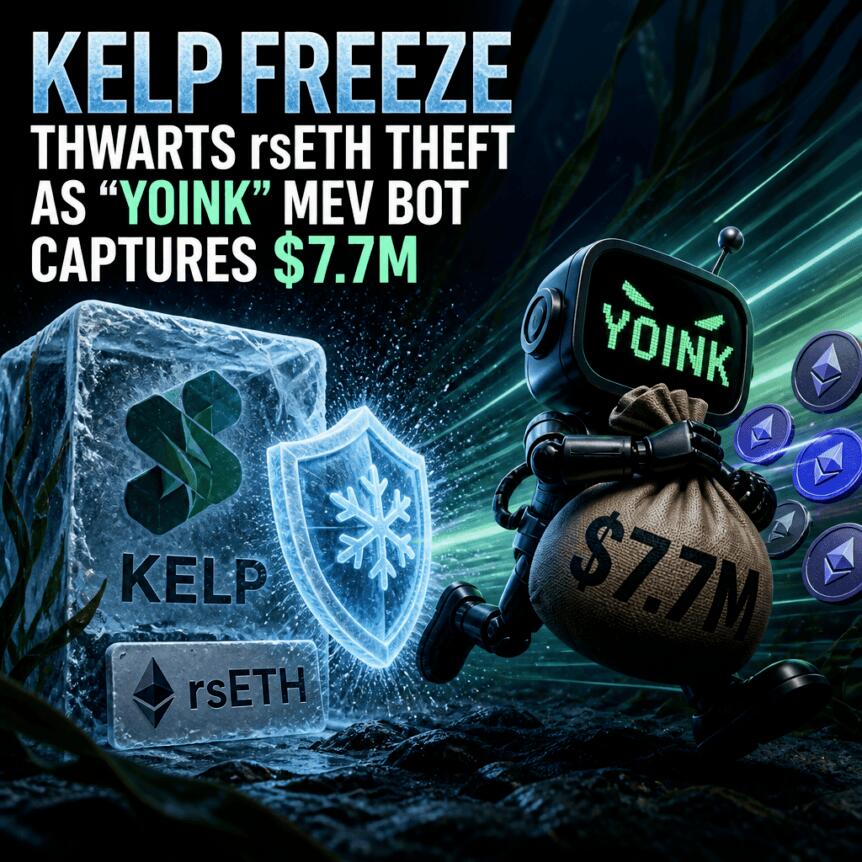
An attacker attempted to drain approximately $7.7 million worth of rsETH from an Ethereum Safe wallet by abusing a custom module tied to the wallet. Instead of successfully exiting with the funds, the operation was interrupted when an MEV bot captured the tokens first, according to blockchain security firm Blockaid.
Blockaid said the exploit used a public “keeper” multicall to route a custom Uniswap v4 liquidity module into an attacker-controlled hooked pool. In that setup, aEthrsETH was unwrapped into rsETH—allowing the attacker to try to take custody of the extracted tokens.
Key takeaways
- Blockaid traced the incident to a custom Uniswap v4 liquidity module connected to a Safe wallet.
- The attacker reportedly targeted rsETH holdings worth about $7.73 million, but an MEV bot intercepted the funds.
- On-chain activity indicates the MEV bot transferred rsETH out before the original exploiter could act.
- Kelp, the rsETH protocol, placed a 24-hour pause on the recipient address as a precaution while stating rsETH remains fully backed.
- Minting, withdrawals, and integrations were reported as continuing normally during the investigation.
From Safe module to attacker-controlled liquidity pool
In its report, Blockaid described a two-stage strategy. First, the attacker leveraged a Safe-related “keeper multicall” as a public execution path. Then, through that multicall, the attacker directed a custom Uniswap v4 liquidity module into a hooked pool created by the attacker.
The key mechanics, per Blockaid, were centered on converting aEthrsETH into rsETH inside the attacker’s pool. This effectively created a route for extracting rsETH from the victim wallet using functionality already wired into the Safe.
Blockaid identified the impacted wallet as belonging to an unidentified Safe user and estimated that roughly $7.73 million in rsETH was taken at the time of its initial reporting.
MEV bot “Yoink” front-runs the exploiter
Rather than letting the exploiter obtain control of the extracted rsETH, the transaction appears to have been front-run by an MEV bot named “Yoink.” MEV bots monitor mempool and transaction patterns to capture opportunities when transactions can be reordered for profit or advantage.
Blockaid said Yoink took the rsETH before the original attacker could secure the funds. Etherscan transaction data linked in Blockaid’s update indicates that Yoink transferred about 18.93 ETH—valued at roughly $46,000 at the time—during the same transaction to an address labeled as a “block builder.”
While this does not by itself clarify the bot’s full profit model, the pattern is consistent with MEV-style routing: the bot captures value in the reordered execution and settles or forwards funds through builder-related infrastructure.
Kelp pauses a receiving address; contracts reportedly safe
After the extraction and interception, the rsETH protocol behind Kelp moved to reduce the risk of further token movement from the implicated destination.
Kelp placed the address that received the funds under a 24-hour pause, temporarily preventing the tokens from being transferred. In an update posted on X, Kelp described the step as a precautionary, wallet-level measure only, adding that its own contracts are safe and that rsETH remains fully backed.
Kelp also said minting, withdrawals, and integrations were continuing normally while it worked with security experts to investigate what happened. In its explanation of the likely attack path, Kelp pointed to the custom module attached to the victim’s Safe as the apparent vector, while stating that Kelp’s core contract layer was unaffected.
What this incident signals for Safe and DeFi modularity
This case underscores how “legitimate” DeFi components can become high-risk when they are wired into wallet automation or custom modules. The exploit did not rely on a claimed vulnerability in Kelp’s contracts; instead, it leveraged a custom Uniswap v4 module and the Safe’s ability to execute preconfigured calls via a public multicall mechanism.
For users and teams operating smart-contract wallets, the lesson is less about any single protocol’s implementation and more about how modules are designed, approved, and monitored. When Safe wallets are configured to route assets through complex strategies—especially ones involving liquidity hooks and public execution helpers—attackers may not need to break contract code. They may only need to steer existing pathways into attacker-controlled counterparty logic.
At the same time, the fact that an MEV bot intercepted the extracted rsETH illustrates another dynamic: even when exploitation succeeds in pulling funds into a usable form, automated market mechanisms can reorder outcomes and reduce the attacker’s ability to complete settlement.
For readers tracking recovery and downstream impacts, the most important immediate variable will be the duration and scope of Kelp’s pause and whether the protocol can identify the remaining movement rights or any other affected addresses. Beyond that, attention will likely shift to what developers and auditors recommend for safely handling custom modules, keeper multicalls, and Uniswap v4 hook integrations in production wallet setups.


A Bank for International Settlements working paper has found that estimates of Bitcoin onchain transfer value can differ by as much as sixfold depending on how researchers treat transaction outputs.
Summary
- BIS researchers found Bitcoin onchain transfer estimates can vary sixfold depending on transaction measurement methodology.
- Bitcoin market capitalization has at times measured four times realized capitalization during sharp price surges.
- Researchers classified 13 million Ethereum contracts while more than 54 million remained outside study categories.
- USDT smart-contract holdings exceeded 20% on Ethereum, while Tron remained near 1% most periods studied.
- Visa filters bots, bridge routing and exchange activity when calculating adjusted stablecoin transaction volume estimates.
The Bank for International Settlements working paper, titled Hidden by complexity? Measuring stablecoin, crypto and decentralised finance ecosystems, was written by Timothy Aerts, Ronald Heijmans, Jan Paulick and Violeta Vuletic and published in September 2026. The research uses data from Bitcoin, Ethereum and Tron collected through Mercurius, a project operated by De Nederlandsche Bank and developed with the BIS Innovation Hub and Deutsche Bundesbank. Read BIS Working Paper 1377
Across the three networks, the Mercurius dataset contains 100 billion records. The paper cautions that the figure represents data points stored through its processing system and should not be read as 100 billion distinct blockchain events. Ethereum and Tron records can overlap between base-layer and smart-contract data, while information can appear at several stages of the processing pipeline.
Bitcoin onchain transfer estimates depend on change handling
For its Bitcoin analysis, the study examined data covering 2009 through 2026, including approximately 1.3 billion transactions and 3.6 billion transaction outputs. Researchers tested three ways of calculating transfer value because Bitcoin’s unspent transaction output, or UTXO, model can return unused funds to the sender as change.
The paper’s upper estimate counts the value of all outputs. An adjusted measure removes outputs sent back to the sending address, which researchers treated as likely change. A conservative lower estimate removes identified self-transfers or, when none can be identified, subtracts the transaction’s largest output under the assumption that smaller outputs represent the economic transfer.
Applying the different methods produced gaps of as much as sixfold in monthly estimates of Bitcoin onchain transfer value. Figure 5 in the study shows raw, adjusted and lower-bound estimates diverging sharply during several periods, especially when Bitcoin activity and prices increased.
Researchers cautioned that their lowest estimate is a conservative heuristic, not a mathematically certain measure. CoinJoin transactions can contain several change outputs, while mixers, spam activity and intermediary transfers create other classification problems that the model does not attempt to remove. The paper found that self-transfer exclusions became more pronounced from March 2016 as address reuse increased.
The authors said commonly quoted metrics can convey “a degree of accuracy that is not supported by the nature of the underlying data.”
Bitcoin market cap changes under alternate valuation methods
The same measurement problem appears when valuing Bitcoin’s supply. The study compared conventional market capitalization with measures that account for long-dormant coins and the price at which individual outputs last moved.
Standard market capitalization applies the current Bitcoin price to all outstanding supply. One alternative in the paper removes UTXOs that have remained untouched for more than 15 years. Using that threshold excluded just over 1.8 million BTC from the calculation, although the researchers stressed that inactivity cannot prove private keys have been lost.
Their data show approximately 3.5 million BTC had remained dormant for more than 10 years, while 1.8 million BTC had not moved for more than 15 years. Yet nearly 24,000 BTC eventually moved after sitting dormant for over a decade, including close to 3,000 BTC that moved after 15 years. The researchers cited those movements as evidence that age-based lost-coin estimates remain uncertain.
A separate measure, realized capitalization, values each unspent output using the Bitcoin price recorded when that output was created after its previous spend. The BIS analysis found conventional market capitalization reached as much as four times realized capitalization during periods of rapid price appreciation. During Bitcoin’s sharp 2022 decline, realized capitalization temporarily stood above conventional market capitalization because older outputs retained their previous valuation.
In related coverage, a crypto.news explainer on Bitcoin realized price describes realized capitalization as the basis for calculating the market’s aggregate onchain cost basis. Crypto.news reported in August that Bitcoin’s realized capitalization rose by more than $4.6 billion during one seven-day period, based on CryptoQuant data. Read the related Bitcoin realized-cap report
Ethereum and USDT create different data problems
Ethereum presented a different challenge because a single transaction can call several smart contracts and generate information across transaction inputs, execution traces and event logs. The BIS researchers examined 67.5 million deployed and active Ethereum contracts and could not place more than 54 million into their technical categories.
Among contracts they could classify, close to 12 million were proxies, 1.4 million were fungible-token contracts and approximately 100,000 were NFT contracts. Researchers used bytecode and standards such as ERC-20 and ERC-721 for classification but warned that adherence to a technical standard does not establish a contract’s economic purpose.
Naming created another source of noise. The paper identified the USDT symbol across roughly 7,000 Ethereum token contracts even though only one represented Tether’s official Ethereum issuance contract. Its analysis excluded the genuine Tether contract when studying imitation or potentially spurious USDT-labelled tokens.
Cross-chain USDT data showed a separate contrast. On Ethereum, the proportion of USDT held in smart contracts climbed above 20% in 2022 and stayed mostly between 15% and 20% until late 2024 before falling into a roughly 10%–15% range. On Tron, smart-contract accounts held around 1% of USDT during most periods examined.
The researchers associated Ethereum’s smart-contract balances with activities including liquidity provision, lending and other DeFi uses. They described Tron USDT as appearing more frequently in transactional and store-of-value activity, while warning that account type remains an imperfect proxy because externally owned addresses can represent payments, exchange custody, remittances or holdings.
In related coverage, crypto.news reported that Tron processed $2.1 trillion in USDT transfers during the second quarter of 2026, citing Messari data, while its USDT supply ended the quarter at $87.9 billion. Read the crypto.news Tron USDT report
BIS favors ranges as Visa filters stablecoin activity
For future measurement work, the authors recommend supplementing single-number estimates with bounded ranges that disclose protocol-specific uncertainty. Their framework calls for technical contract classification, explicit assumptions and separate treatment of an asset’s identity and the blockchain infrastructure on which it operates. The authors described onchain indicators as “noisy approximations rather than direct measures of economic activity.”
The publication is a BIS Working Paper and does not itself introduce a regulation, compliance deadline or reporting requirement. BIS states that Working Paper views belong to their authors and do not necessarily represent the institution or its member central banks.
A comparable filtering process is already visible in the Visa Onchain Analytics dashboard, developed with Allium Labs. Visa separates total stablecoin activity from an adjusted measure designed to filter high-frequency trading, bots, bridge routing, centralized exchange activity, minting and burning, and other transfers that may not resemble ordinary settlement.
A Sept. 16 dashboard snapshot carried by TradingView from Cointelegraph showed $6.4 trillion in total stablecoin transaction volume over the preceding 30 days and $313.1 billion after Visa’s adjustments. The live Visa methodology states that its single-direction filter counts only the largest stablecoin transfer within one transaction, reducing duplicate internal movements generated by complex smart-contract calls.
Visa’s address filter includes transfers in adjusted volume when the activity meets its economic criteria and an address has not sent more than 1,000 transactions or $10 million in volume during a 30-day period. The dashboard classifies activity across payments, DeFi, centralized exchanges, investment and trading, store of value, minting and burning, short-term routing and infrastructure, while transactions below $250 that pass its adjusted filter are classified as retail-sized.
Former Commodity Futures Trading Commission Chairman J. Christopher Giancarlo has said U.S. regulators can continue building crypto rules after the Senate failed to advance the CLARITY Act in a 49-50 procedural vote.
Summary
- The CLARITY Act failed to advance after a 49 to 50 Senate cloture vote fell 11 votes short of the required 60.
- Former CFTC Chair J. Christopher Giancarlo said the SEC and CFTC can continue developing crypto rules under their existing authority.
- Coinbase, Ripple and Senate Banking Chair Tim Scott called for regulators to provide clearer digital asset rules while Congress remains divided.
- The SEC and CFTC have already been working on crypto frameworks that could proceed without passage of the CLARITY Act.
Giancarlo told journalist Eleanor Terrett on Sept. 16 that Securities and Exchange Commission Chairman Paul Atkins and CFTC Chairman Michael Selig remain prepared to use their agencies’ existing powers to establish digital asset frameworks even without new legislation from Congress.
“@SECPaulSAtkins and @ChairmanSelig are determined to do what their jobs require them to do and put in place sound regulatory frameworks that ensure that financial innovation, market modernization and economic growth take place under U.S. law and not outside it,” Giancarlo said.
The comments came hours after senators rejected cloture on the motion to proceed to H.R. 3633, the House-passed Digital Asset Market Clarity Act. The Senate’s official roll call recorded 49 votes in favor and 50 against, leaving the motion 11 votes short of the 60 needed to advance.
Giancarlo, who chaired the CFTC from 2017 to 2019 and became known in the crypto industry as “CryptoDad,” is scheduled to join former CFTC Chairman Timothy Massad and former SEC Commissioners Troy Paredes and Caroline Crenshaw for a panel hosted by Terrett at the Avalanche Summit in New York later Wednesday.
CLARITY Act failure turns attention to SEC and CFTC
The Senate vote has put more attention on the SEC and CFTC after months of work by both agencies on digital asset rules that do not depend on passage of the CLARITY Act.
The bill would have created a statutory division of responsibilities between the SEC and CFTC for digital assets, while establishing registration routes for exchanges, brokers and dealers. It contained provisions covering ethics restrictions for senior government officials and Treasury authority related to payment stablecoins.
Republicans had revised the legislation during negotiations with Democrats before the Sept. 15 vote. The dispute was not limited to how many Democratic proposals were incorporated into the text. Democratic lawmakers maintained that the ethics provisions remained insufficient, particularly in addressing crypto interests connected to President Donald Trump and his family. Associated Press reported that Democrats sought stronger restrictions even after concessions were made on enforcement powers and restrictions covering federal officials.
The ethics issue had remained one of the main unresolved parts of the negotiations in the days before the vote. As crypto.news previously reported, an earlier revised draft restricted public officials, government employees and their spouses from issuing or sponsoring digital assets, while leaving primary enforcement authority with the Justice Department and setting the provision to expire in January 2029.
All Democrats who participated in Tuesday’s vote opposed cloture. Republicans Susan Collins of Maine, Josh Hawley of Missouri, Jerry Moran of Kansas and Thom Tillis of North Carolina voted against the motion as well. Tillis changed his vote for procedural reasons, preserving the ability to seek reconsideration. Reuters reported that the last-minute revisions were not enough to overcome disagreements over ethics and banking provisions.
Sen. Chris Coons of Delaware did not vote. Democratic negotiators including Sens. Kirsten Gillibrand, Mark Warner, Cory Booker, Raphael Warnock, Ruben Gallego, Angela Alsobrooks and Catherine Cortez Masto were among those who voted against advancing the measure.
Industry executives turn to regulators for crypto rules
Coinbase CEO Brian Armstrong said after the vote that the industry “can’t wait on Congress anymore,” arguing that the SEC and CFTC can use existing authority to establish digital asset rules.
His comments followed a position he had taken before the vote. Armstrong had said the industry could receive regulatory clarity regardless of the Senate result because federal agencies were preparing to act if Congress did not. His pre-vote position was reported on Sept. 10, when negotiations over the legislation were still underway.
Ripple CEO Brad Garlinghouse described the result as “this one stings” and called on Atkins and Selig to “fill the legislative gap.”
Senate Banking Committee Chairman Tim Scott, one of the lawmakers behind the bill, took a similar position after midnight Wednesday, saying the SEC and CFTC should “set clear rules of the road for digital assets until Congress legislates.”
Sen. Cynthia Lummis of Wyoming blamed Senate Democrats for the result and argued they were not serious about passing market structure legislation. Democrats disputed the Republican account of the negotiations and maintained that unresolved ethics concerns, including restrictions involving public officials’ crypto interests, required stronger language before they would support the measure.
House Financial Services Committee Chairman French Hill and House Agriculture Committee Chairman Glenn Thompson said after the vote that only Congress could provide lasting statutory certainty, while supporting regulators’ use of existing authority until lawmakers reach an agreement.
Regulators have prepared rules outside the CLARITY Act
Giancarlo has argued for months that agency rulemaking could continue if Congress failed to enact market structure legislation. He retired from law practice at Willkie Farr & Gallagher in April to focus on digital assets, artificial intelligence and public policy.
The SEC has already moved forward with its own crypto framework. On Aug. 18, the agency proposed Regulation Crypto Assets, a 402-page framework containing two registration exemptions and a conditional safe harbor for certain crypto asset investment contracts.
The proposal would allow qualifying issuers to raise up to $5 million over four years under one exemption and as much as $75 million during a rolling 12-month period under another. The Regulation Crypto Assets proposal contains disclosure requirements alongside a pathway under which qualifying tokens could leave investment contract treatment once specified conditions are met.
Atkins had been developing the framework while lawmakers negotiated the CLARITY Act. Before the Senate vote, he said the agency was prepared to continue its crypto work regardless of whether Congress completed market structure legislation. The SEC’s rulemaking does not settle every issue addressed by the bill, including the statutory allocation of jurisdiction between the SEC and CFTC.
Selig has taken a similar approach at the CFTC. The agency has prepared digital asset market structure proposals that could proceed under its existing powers, with the CFTC chairman saying in August that its work would continue regardless of what happened to the legislation. The agency’s planned crypto rules were being developed before the Senate’s September vote.
CLARITY Act can still return to the Senate floor
The failed cloture vote does not remove H.R. 3633 from the Senate calendar. Whether leadership will try again before lawmakers leave Washington ahead of the November elections remains unclear.
Sen. John Kennedy of Louisiana told Terrett after the vote that he “wasn’t surprised” by the result and said the legislation could return during a lame-duck session after the elections. Sen. Ted Cruz of Texas described the measure as “mostly dead.”
Time had already become an issue before Tuesday’s vote. House Republican leaders removed eight voting days from the September calendar, leaving the chamber scheduled to depart Washington on Sept. 17. Any Senate changes to the House-passed legislation would require further House action before a final bill could be sent to the president, as detailed in earlier coverage of the shortened House calendar.
Tillis’s procedural no vote leaves the Senate with an avenue to reconsider the cloture motion. The House-passed version of H.R. 3633 remains on the Senate calendar following Tuesday’s 49-50 vote.

The Senate has failed to advance the CLARITY Act. The necessary 60 votes were not reached, meaning that debate on the legislation will continue.
It is very important to understand that today’s vote wasn’t intended to pass the bill but rather to advance it further toward a final vote. This didn’t happen, which means that now the debate can continue, which will inevitably lead to further delays.
As we recently reported, the Digital Asset Market CLARITY Act includes fundamental provisions that seek to establish a clear divide between what the Commodity Futures Trading Commission and the Securities and Exchange Commission regulate.
Moreover, the text introduces what it calls “ancillary assets,” network tokens whose value may depend on entrepreneurial or managerial efforts, while also treating the tokens as commodities and requiring specific disclosures.
The bill also seeks to address major issues plaguing the decentralized finance field. The latest revisions seek to require CFTC registration for relevant spot digital-commodity activity taking place on centralized DeFi protocols. This may sound controversial, but it essentially targets protocols that appear decentralized yet have identifiable parties who retain meaningful control.
In addition, the companies through which most Americans actually buy and sell crypto are also being put under consideration for regulation. The CLARITY Act seeks to bring exchanges, brokers, and dealers into a defined federal registration and supervision regime.
The post BREAKING: US Senate Fails to Advance Crypto CLARITY Act, Here’s What It Means appeared first on CryptoPotato.

Hyperliquid’s HYPE token needs to grow protocol earnings faster than its supply expands if it wants to hit the $319 price target laid out by Multicoin Capital, according to a breakdown shared by trader Crypto Patel on X today.
The post reframed Multicoin’s original valuation model, arguing that the real question isn’t whether Hyperliquid’s derivatives business keeps growing, but whether that growth can outrun token dilution.
The Math Behind $319
Multicoin’s base case, first published in June, projected Hyperliquid’s derivatives volume climbing from $2.9 trillion in 2025 to $20.2 trillion by 2028.
Apply a 20x multiple to the roughly $8 billion in annual earnings that volume would generate, and you get a $160 billion valuation. Divide that by an adjusted supply of 502 million tokens, and HYPE lands at over $319, more than four times its current price.
Patel framed the real question as, “Can Hyperliquid’s earnings growth outpace token dilution?” According to him, a bigger protocol does not automatically translate into a higher token price if new HYPE keeps entering circulation faster than revenue grows.
A companion chart from RR2 Capital, using data through September 10, layered Multicoin’s 2028 assumptions on top of more recent fee and volume figures, and it showed Hyperliquid currently pulling in about 3.30 basis points on gross perps fees, close to the 3.28 bps Multicoin used in its own model.
It also pegged Hyperliquid’s current share of decentralized derivatives volume at 30%, out of the 32% slice of the total futures market controlled by DEXs.
The scenarios aren’t static, either. Multicoin’s bear case, assuming slower derivatives growth and no meaningful contribution from newer products like HIP-4, puts HYPE closer to $109. Its bull case, built on a 50% CAGR for the derivatives market, gets to $689.
“The bull case depends on Earnings growth, market share, and supply discipline,” Patel wrote.
RR2 Capital shared his concern, pointing out that the risk is “whether earnings can outpace the growing token supply.”
Where Things Stand Now
HYPE has already had a strong year regardless of where the $319 target ends up. As CryptoPotato reported in August, the token hit a new all-time high above $82 late that month while Bitcoin cooled off from its own run.
It has since climbed further, touching $89.60 on September 6, and is now trading around $79, up nearly 38% over the past month and just under 50% in one year.
Meanwhile, Multicoin has been trimming its position even as it publicly backs the long-term thesis, selling 10% of its 4 million HYPE tokens in early September.
HYPE spot ETF flows have also cooled, with a net outflow of about $8 million reported last Friday and total net assets slipping to roughly $434 million from over $480 million earlier in the month as some of that money rotated back out.
The post Hyperliquid’s $319 Target Hinges on Token Dilution: Analyst appeared first on CryptoPotato.

Humanoid robots compete in the 100-meter race during the 2nd World Humanoid Robot Games at the National Speed Skating Oval in Beijing on August 25, 2026.
Wang Zhao | Afp | Getty Images
BEIJING — While frontier U.S. labs have sounded the alarm on artificial intelligence in recent high-profile speeches, Chinese companies have largely kept quiet.
Z.ai, Moonshot, MiniMax, Alibaba and Tencent have not made similar comments, and did not provide any statements when contacted by CNBC about the warnings from Silicon Valley.
It’s important to be prudent about AI, but the publicity is “a little bit oversold,” said Ray Von, founder, CEO and chairman of Tencent-backed OpenPie, a startup building devices for companies to use AI securely on internal data.
“That’s why in China, we don’t pay too much attention to that, because that’s not the first time [the U.S. execs] say these things,” he said in a phone interview Tuesday. “They should just do it.”
OpenAI’s Sam Altman, Elon Musk and Anthropic’s Dario Amodei called for a slowdown in AI development over the weekend due to uncontrollable risks. Despite the rare display of industry unity, Nvidia’s Jensen Huang pushed back by saying speed and safety can happen together, and said developers should act responsibly.
Amodei, in his latest essay, urged U.S. companies to still maintain a lead over China, echoing a paper his company published in May.
China’s foreign ministry on Monday called the U.S. executives’ comments “fear-mongering.” English-language state media op-eds used “Cold War playbook” and “Dr. Frankenstein” to describe the AI warnings.
“Once Chinese companies have created superior AI, we see U.S. companies issuing AI warnings. I don’t think this is a coincidence,” Renjie Guo, founder and CEO of JoyIn, said in Chinese translated by CNBC.
From a philosophical perspective, he expects AI is only as dangerous as its developers. Just like humans, AI will also conclude that “truth, goodness and beauty” are the best approach, he said.
Control from the start
Beijing meanwhile kicked off its own annual cybersecurity week, with the release late on Monday of the third edition of an “AI Safety Governance Framework.” The bilingual document laid out guidelines for labeling AI content and developing systems for rapid AI risk detection.
“I think as China, we are trying AI governance. AI regulation is important. But … in terms of the AI labs, people are talking less about AI safety,” said Alex Lu, founder of LSY Consulting. He described Anthropic’s comments in particular as “marketing communication” meant to support a view that “the only company that can make AI safe[ly] is Anthropic.”
U.S. and Chinese companies have also taken different approaches to AI.
Chinese companies have focused on AI commercialization in the face of U.S. restrictions on access to advanced semiconductors. U.S. companies have meanwhile rushed to develop AGI, or AI with super-human intelligence, and only this year faced more scrutiny from Washington.
Beijing’s efforts to control the tech started far earlier.
For months after OpenAI released ChatGPT, Chinese alternatives were kept from the public until Beijing gave them the green light in the summer of 2023.
By early 2026, Chinese AI chatbots were fighting for users with massive promotions around the Lunar New Year holiday. Several of the models vied with Anthropic’s Claude and OpenAI’s ChatGPT for performance, often at far lower usage costs. The cheaper, open-source Chinese models have gained many users in the U.S. and other countries as a result.
But one thing hadn’t changed: the AI’s silence on topics Beijing deems sensitive.
Ask DeepSeek about what happened on June 4, 1989 — the day of the Tiananmen Square crackdown in Beijing where hundreds or possibly thousands were killed — and it says “I’m not able to help with that.” However, it can explain that Sept. 11, 2001, “was the day of coordinated terrorist attacks in the United States… [that] killed nearly 3,000 people.”
China’s cybersecurity regulator has rolled out processes for approving new generative AI services, especially those likely to influence public opinion. The agency publishes lists of registered models.
Integrating AI across industries is also a significant part of the Chinese government’s plans for economic development over the next five years.
Chinese companies’ development of open-source AI in particular has added support to Beijing’s international cooperation programs, such as the Global AI Governance Initiative and the World Artificial Intelligence Cooperation Organization.
“We should strengthen risk-awareness and ensure that AI is secure and controllable,” Chinese President Xi Jinping said in July at the launch of the world AI organization. Over the weekend, at the BRICS summit in India, Xi added that China would foster AI and tech cooperation among the bloc economies.
Focus on real-world application
Companies in China frequently emphasize the importance of AI’s ability to generate revenue, rather than just rising in intelligence rankings.
“We are not looking for the most [impressive] AI models, but trying to unlock AI potential. You will see a lot of regulations around how AI should be applied,” Lu said, pointing to China’s rules on data security and labeling of AI-generated videos.
The bigger challenge, he said, is addressing the AI models’ penchant for making things up via hallucination. A better AI model helps, but it’s not the most cost-effective way, he said, noting a key approach uses less complex methods known as harness technology and reinforcement learning.
That means many Chinese companies may not need to use cutting-edge AI models.
OpenPie’s Ray Von said his startup is mostly using older models, if not smaller versions, of Alibaba’s Qwen and DeepSeek.
“The vast majority of enterprise,” he said, “they see a lot of productivity increases but they haven’t seen anything generate profits or reduce cost immediately.”
“Right now, the publicity is diverting a lot of attention,” he said. “The application side, the enterprise side, hasn’t seen a lot of result yet.”


Real Vision co-founder Raoul Pal says Bitcoin (BTC), not gold, is the better long-term hedge against currency debasement, arguing the asset’s earlier adoption stage gives it more room to grow than the metal.
Pal made the comparison during a September interview on the Wolf Financial Show. There, he laid out his broader framework for how debasement quietly erodes savings and wages.
Debasement Erodes Savings Every Year
Debasement, Pal says, is the dominant force behind rising asset prices over time. He ties it directly to liquidity cycles that central banks and governments largely control.
He describes debasement as the steady loss of a currency’s purchasing power as central banks expand the money supply.
He estimates this process reduces the value of fiat currencies globally by roughly 8% annually. Wages, he adds, typically track economic growth of around 3%.
That gap, Pal argues, explains why homes and other scarce assets have grown harder to afford for average earners. Bitcoin recently traded near $75,900, according to BeInCrypto data, down about 2% over the past day.
Why Bitcoin Beats Gold, According to Pal
Pal frames gold as base money with no ability to compound in value beyond what the broader economy already reflects. Bitcoin, he says, functions as digital gold with the same scarcity but a much earlier adoption curve.
Pal summarized the idea in one line.
“[T]he digital gold is Bitcoin, but Bitcoin’s earlier in its adoption.”
He made the remark during the interview.
Pal argues that only two asset classes have consistently outpaced the debasement rate. Those are crypto and technology stocks, tracked through the Nasdaq.
He pointed to the Nasdaq’s roughly 19% annual return over 15 years. Crypto, he estimates, has compounded between 45% and 110% annually.
Gold, real estate, and other traditional assets, he said, tend to only track the debasement rate rather than beat it. Pal’s comments echo a wider narrative among macro investors. They increasingly link Bitcoin’s price moves to gold as the debasement trade gains traction.
Whether Bitcoin can sustain that adoption curve remains an open question. Gold’s renewed strength may shape how investors weigh the two assets through 2026.
The post Raoul Pal Says Bitcoin Beats Gold as the Real Debasement Hedge appeared first on BeInCrypto.



David Benavidez makes u-turn on facing Oleksandr Usyk next

Coffee Maker Steam Wand Gets A Safe Outlet

Piddington votes for independence from Britain: Residents approve symbolic measure to leave the UK amid battle to stop new asylum camp that’s four times the size of their village



-

 Fashion5 days ago
Weekend Open Thread – Corporette.com
-

 Business6 days ago
Micron Stock Climbs Above $1,031 as AI Memory Crunch and a $50 Billion Outlook Fuel the Rally
-

 Tech3 days ago
The Latest Weird Thing to Play Doom Is the Mapped-Out Brain of a Fruit Fly
-

 Business6 days ago
AMD Stock Climbs After Management Lifts 2027 Data Center Outlook Toward $70 Billion in AI Sales
-

 Crypto World5 days ago
XAG/USD: Silver’s Short-Term Rally Meets Its Moment of Truth
-

 Business5 days ago
10 Most-Streamed Songs On Spotify In 2026 So Far, Led By Ella Langley’s Dominant Run On The Charts This Year
-
 Crypto World6 days ago
2 Chip Stocks Broke Out This Week. Neither Was Nvidia
-

 Crypto World6 days ago
Pi Network ships Protocol 27 on a network with 14 million users and zero DeFi
-

 Tech5 days ago
Battery life is the only iPhone 18 Pro and iPhone Duo upgrade I care about. Apple didn’t disappoint
-

 Crypto World5 days ago
OKX launches 10x OpenAI, Anthropic X-Perps in Europe
-

 Crypto World5 days ago
Diesel Tops $6 a Gallon for the First Time as 28 States Set Records
-

 Tech6 days ago
Apple Watch Ultra 4 vs Watch Ultra 3: Should you really spend another $799?
-

 News Videos5 days ago
Facing Financial Fears
-
 Crypto World6 days ago
Bitcoin price risks $70K if $78K neckline breaks
-
 Crypto World7 days ago
Bitcoin price holds near $79K as cycle drawdowns narrow
-

 Entertainment6 days ago
Case Sees Major Update As Jury Deliberations Begin
-

 Business3 days ago
Rivals Sam Altman and Elon Musk Rally Behind Dario Amodei’s Call for a Slowdown in AI Development
-

 Crypto World2 days ago
Elon Musk Drops a Bombshell: Grok 5 Could Be the AGI Breakthrough
-
Crypto World5 days ago
Ethereum Price Analysis: Consolidation at $2.5K Tests Momentum as On-Chain Activity Surges
-
Crypto World7 days ago
Ripple Price Prediction: What to Expect for XRP as a Major Macro Week Approaches
You must be logged in to post a comment Login