
Crypto World
Signal in the age of infinite noise



The amount of analysis available to you right now is greater than at any point in human history.
And yet most people have less clarity on what is actually happening than they did five years ago.
What changed is the scale. When analysis was expensive to produce, there was a natural filter. The people producing it had to know something because the cost of being wrong was reputational and financial. Now that cost is basically zero. Anyone can generate a macro take that sounds like it came from a Goldman desk in five minutes. The noise is growing exponentially while real signal stays roughly constant.
The insidious part is that the noise does not look like noise anymore. It looks like signal. Bad analysis used to be obviously bad. Now it is polished, structured, uses the right terminology, cites the right data. The tools most people are using to produce it are optimized to sound right. Whether the output is actually right is a different question entirely.
Telling the two apart is the whole game now. The same systems flooding markets with noise can be used to cut through it. That is what I have spent the past two years proving – publicly, on X, with every call timestamped and nothing deleted, across geopolitics, energy, macro, crypto, and broader markets simultaneously.
The account grew from nothing to over 140,000 followers organically, with no paid promotion and no name attached. Signal Core on Substack, the home of the full forecasting operation, became the #3 best–selling crypto publication on the platform within nine months. In a market drowning in noise, the signal alone was enough.
The moment
The signal-vs-noise problem has arrived at the worst possible time.
The next twelve months will reshape more of the financial, technological, and geopolitical order than the past decade combined. Digital assets are integrating with the traditional financial system at a pace that would have seemed impossible eighteen months ago. Regulatory frameworks stalled for years are being rewritten in real time. AI is transforming how capital gets allocated. Geopolitical orders are realigning. Monetary policy is at an inflection point. The labor market is being restructured in front of us.
These are foundational shifts, arriving simultaneously, and compounding on each other. And this is exactly the moment when the ability to see clearly has collapsed. There has never been more at stake and never less clarity on what is actually going on.
The convergence problem
It is actually worse than a noise problem.
AI is converging everyone toward the same wrong answers simultaneously. When a thousand people use these tools to analyze the same event, they do not get a thousand different perspectives. They get minor variations of the same default output. The tools do not just fail to produce signal – they manufacture false agreement.
Before AI, if five analysts said the same thing, that meant something. Now if five hundred accounts say the same thing, it might just mean they all used the same tool.
What this looks like in practice
In January of this year, the prevailing view was that a direct U.S.–Iran confrontation was unlikely. The diplomatic channels were still open. The market was not pricing meaningful conflict risk. Oil was trading like nothing was coming.
The structural picture told a different story.
More than a month before the strikes began, the indicators were already pointing to a confrontation that was more likely than not. We flagged this publicly on X on January 13 while the crowd was still dismissing the risk. When the strikes hit, and oil nearly doubled, the move caught most of the market off guard. The signal was there. The crowd just was not looking at it.
The inputs we were watching were not exotic. Public statements, internal economic pressure inside Iran, and the absence of certain de–escalation patterns. Anyone with access to the open internet could see the same things. The edge was in synthesis – reading those inputs as a single converging system rather than as separate news streams. That synthesis is the hard part. The inputs are just the inputs. The bottleneck has never been technology. It has been how the technology gets used.
This is the pattern. The information was available. The tools to process it were available. What was missing was the ability to read the signal before the crowd formed around the wrong interpretation.
The scarce resource
Most people use AI to generate. Very few use it to see.
Signal is when you can look at a situation that has the entire market confused and see the structure underneath. It is when you can hold a position that every feed is telling you to abandon, and hold it anyway, because you can see something they cannot.
The challenge for most people is not generating signal themselves. It is recognizing who actually has it. Most analysis is hedged to the point of meaninglessness – strategies for avoiding accountability dressed up as analysis.
The old filter for getting past this was credentials. It no longer predicts who is seeing clearly. Plenty of the biggest calls in recent years have been missed by traditional institutions and caught by people working outside them. What matters now is whether someone is actually seeing what is happening – recognizing patterns the crowd is missing, naming what is real before it is obvious, and being right about it often enough that it holds up over time. Once you can see clearly, you start operating on a different timeline than the rest of the market.
What comes next
We are entering an era where signal is the most valuable and least understood asset in the market. The investors, builders, and allocators who figure this out first will have a structural advantage that compounds over years. The ones who keep consuming the flood without questioning it will keep agreeing with the crowd. And the crowd will keep being wrong at the moments that matter most.
Finding rooms where real signal still shows up is getting harder. Most of the venues that claim to aggregate market intelligence are just amplifying whatever the models already spit out.
Consensus 2026 in Miami is one of the few that still functions as a filter rather than an amplifier. The people who show up have skin in the game. Their disagreements are real. Their agreements were not manufactured by the same five models everyone else is using. That kind of room is getting harder to find anywhere else. Which is why I will be there – hosting a small invite–only session about what signal extraction at scale actually looks like.
The edge will not belong to whoever has the most information, the fastest tools, or the loudest platform.
It will belong to whoever can see clearly when everyone else is drowning in noise.
That is the scarcest resource in markets right now.
And it is only getting scarcer.

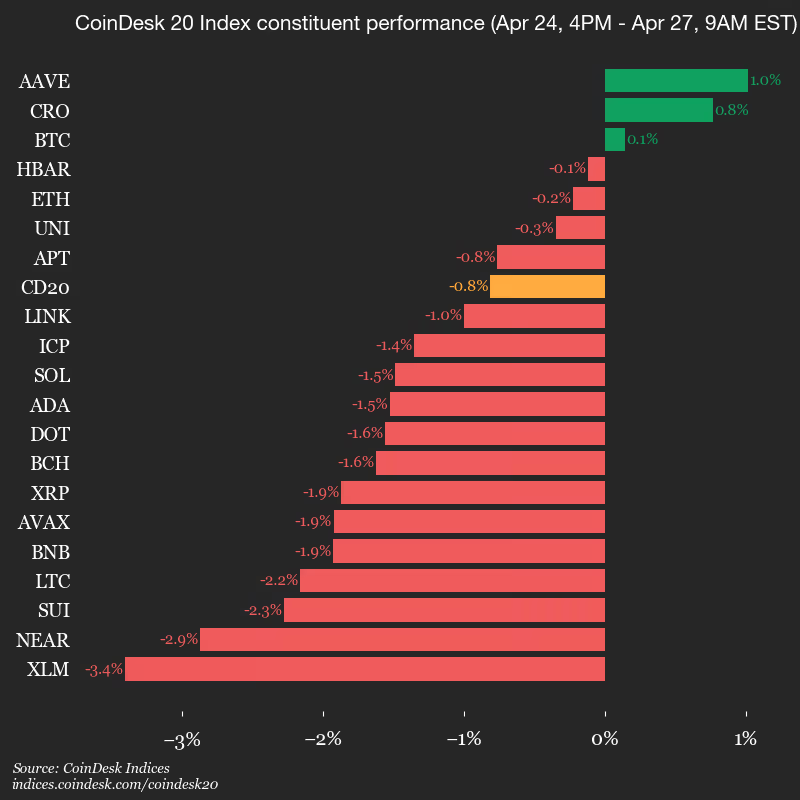
CoinDesk Indices presents its daily market update, highlighting the performance of leaders and laggards in the CoinDesk 20 Index.
The CoinDesk 20 is currently trading at 2106.81, down 0.8% (-17.25) since 4 p.m. ET on Friday.
Three of 20 assets are trading higher.

Leaders: AAVE (+1.0%) and CRO (+0.8%).
Laggards: XLM (-3.4%) and NEAR (-2.9%).
The CoinDesk 20 is a broad-based index traded on multiple platforms in several regions globally.
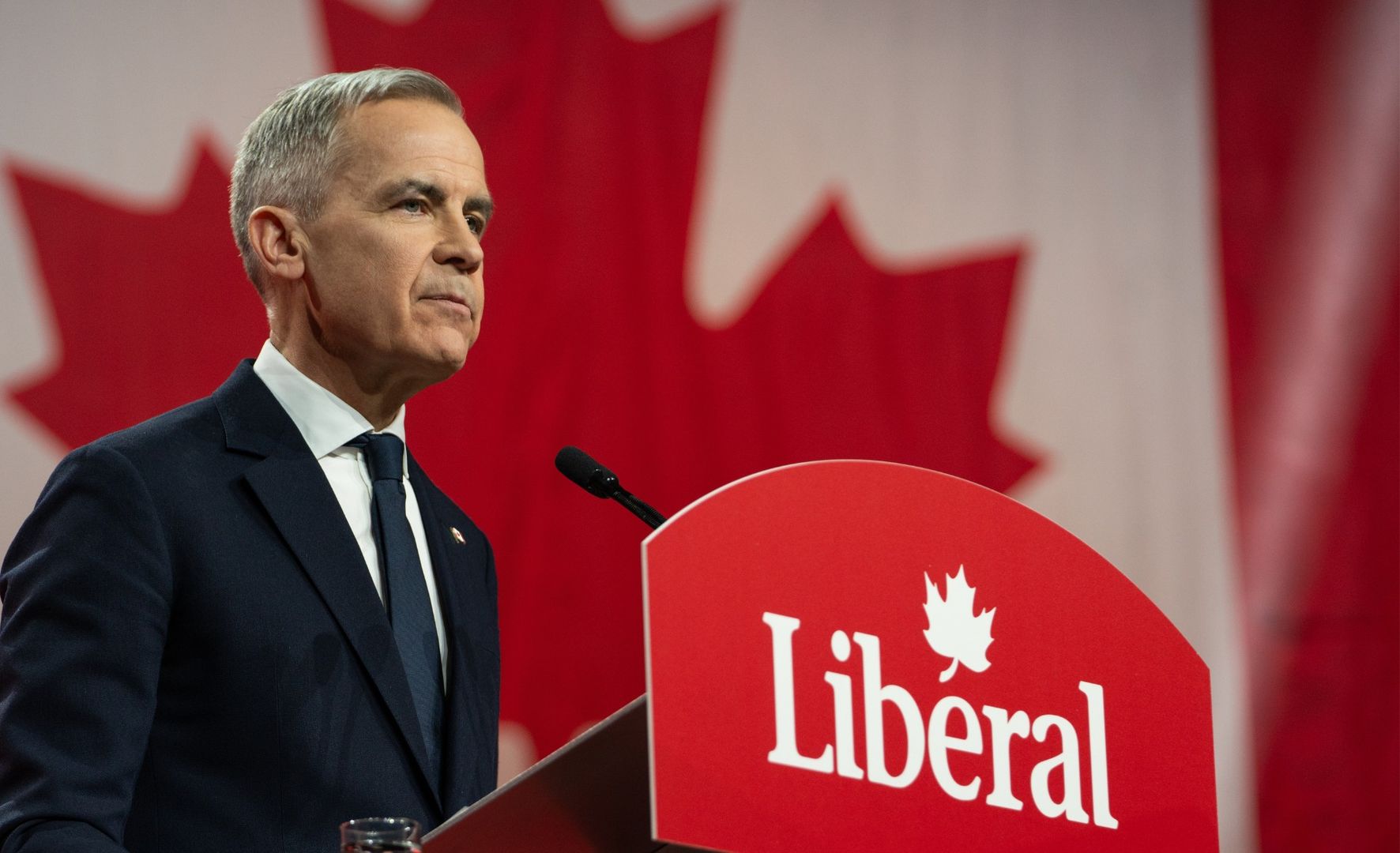
Canada’s proposed ban on crypto political donations moved a step closer to becoming law on Friday, advancing through Parliament with cross-party support and little opposition.
Bill C-25, the Strong and Free Elections Act, passed second reading in the House of Commons and was referred to committee for further review. In Canada’s system, that vote signals lawmakers broadly agree with a bill’s core principles before it faces detailed scrutiny and possible amendments.
The legislation would prohibit political contributions made in crypto, alongside money orders and prepaid payment products, grouping them as funding methods that are difficult to trace.
The ban would apply across the federal system — registered parties, electoral district associations, candidates, leadership and nomination contestants, and third parties that run election advertising.
Recipients would have 30 days to return illegal crypto contributions or remit them to the Receiver General, Canada’s equivalent of the U.S. Treasury.
The bill’s lead defender on the floor was Kevin Lamoureux, the Liberal parliamentary secretary to the government’s House leader, a junior official who helps manage the ruling party’s legislative agenda and acts as a floor spokesperson during debate.
His opening speech walked through AI deepfakes, foreign interference, and administrative penalties. Crypto did not come up, according to an official transcript. Asked by a Liberal colleague to pick from three priorities — foreign interference in nominations, political financing transparency or artificial intelligence — Lamoureux picked AI.
Several Conservative Members of Parliament — the party is led by Pierre Poilievre, who marketed himself as crypto-friendly during the last election — raised questions about political financing rules and how new restrictions would be applied.
But the issue never became a central point of contention.
Conservatives backed sending the bill to committee, while other opposition parties raised concerns about different elements of the legislation, but did not center their arguments on crypto.
The limited resistance also reflects how little crypto has been used in Canadian politics.
Canada has technically allowed crypto donations since 2019, when Elections Canada classified them as non-cash, in-kind contributions similar to property. But no major federal party has publicly accepted crypto, and no contributions have been disclosed in recent elections.
C-25 is itself a re-run. Its predecessor, Bill C-65, contained identical crypto language and died when Parliament was prorogued — suspended without dissolving — in January 2025.
Canada’s Chief Electoral Officer recommended tighter regulation of crypto donations in 2022, then, in November 2024, shifted to recommending an outright prohibition, citing pseudo-anonymity and the difficulty of verifying contributors’ identities.
The U.S. is moving in the opposite direction. The Federal Election Commission has permitted crypto donations to American campaigns since 2014.
Earlier this year, the U.K. passed a law banning crypto donations, citing concerns that digital assets could be used to hide the origins of foreign money in British politics.


The digital assets market entered the second quarter in consolidation mode, but Fidelity Digital Assets said underlying data points to early signs of stabilization beneath the surface.
In its Q2 2026 Signals Report published Monday, the crypto trading firm highlighted improving conditions across a number of key metrics, including unrealized profitability, momentum and network usage.
Rather than focusing solely on prices, the report is framed through a broader lens of risk, positioning and cycle dynamics across bitcoin , ether (ETH) and solana (SOL).
Bitcoin, the largest cryptocurrency, continues to serve as the market’s primary source of resilience, with unrealized profit levels and dominance metrics indicating that capital remains concentrated in the most established and liquid asset during the consolidation phase.
“BTC’s dominance continues to gradually increase after declining throughout the latter half of 2025,” wrote analysts led by Daniel Gray.
The digital asset was trading around $77,000 at publication time.
Crypto markets have turned in a choppy performance in recent months, with bitcoin and other major tokens largely range-bound as investors navigate a complex macro backdrop.
Sticky inflation, shifting expectations around central bank rate cuts and periodic volatility in global equities have weighed on risk appetite, while ongoing regulatory scrutiny in the U.S. and abroad has added another layer of uncertainty.
At the same time, conflicts in Eastern Europe and the Middle East and trade frictions between major economies have contributed to bouts of risk-off sentiment, limiting sustained upside across digital assets.
At the same time, the analysts noted that momentum and profitability indicators are consistent with a corrective period, one that may be laying the groundwork for a more stable market structure.
A notable divergence is emerging between price and network activity. The analysts pointed to sustained usage across Ethereum and Solana, suggesting that demand at the protocol level remains intact even as valuations lag.
Taken together, these signals reflect a market still in recovery, but with structural improvements underway that may not yet be fully reflected in prices, the report said.
Read more: Bitcoin faces near-term pressure as liquidity tightens, Hilbert Group CIO says


Bitcoin’s recent climb toward $80,000 is showing signs of strain, with low trading volume and muted derivatives activity raising questions about how durable the rally may be.
In a weekly report, 10x Research head Markus Thielen pointed to a disconnect between price action and underlying market participation. “Bitcoin rallied 4.7% over the past week, yet the accompanying data tells a cautious story beneath the surface,” he wrote.
Trading volumes have dropped sharply. Bitcoin weekly volume came in 17% below average, while ether (ETH) volume fell 20%. At the same time, funding rates — a measure of leveraged positioning — remain deeply negative. “Funding rates fell 6.8% to the 3rd percentile and volumes collapsed 33% to the 4th percentile,” Thielen said, adding that the move higher “was driven by spot buying or short covering rather than leveraged long conviction.”
That distinction matters. Spot buying, often linked to institutional demand, tends to be steadier but less explosive than leveraged trades. It also leaves the market without the kind of momentum typically seen in strong bull runs.
Institutional flows have been a bright spot. Bitcoin ETFs have recorded nine consecutive days of inflows, helping push total April inflows to $2.5 billion. Bitcoin dominance has also climbed to 60%, signaling capital is concentrating in the largest cryptocurrency rather than spreading across the market.
Still, Thielen cautioned that the rally’s structure remains fragile. “The market has shifted from a more actively traded environment to one where participants are largely on the sidelines,” he wrote, describing a “low-funding, low-volume regime that historically reflects hesitation rather than momentum.”
Options markets reinforce that view. Volatility has fallen into the lower quartile of its historical range, and traders are pricing in relatively modest price swings over the coming week. “The market is pricing in a relatively calm environment,” the report noted, even as sentiment gauges approach elevated levels.
Ethereum paints a similar picture, though with even weaker participation. Volumes have dropped more than 50%, and derivatives positioning shows limited appetite for risk. “The volume implosion points to a market where conviction remains low, and participants are largely disengaged,” Thielen said.
Despite these signals, the setup is not outright bearish. With leveraged long positions limited, the risk of forced liquidations on the downside is reduced. “Near-term risk/reward is asymmetric to the upside if a catalyst emerges,” Thielen wrote.
That catalyst may come from outside the crypto space. The report highlights macroeconomic developments as the key factor that could determine direction in the days ahead. For now, bitcoin’s rally appears intact, but without stronger participation, it may struggle to hold unless broader market conditions provide support.
IREN could become the next major Bitcoin miner to transition into AI infrastructure following its multi-billion-dollar deal with Microsoft, underscoring a broader shift in mining economics, according to a new research report from Bernstein.
The Bernstein analysts point to IREN’s rapidly expanding AI cloud division, where around 150,000 GPUs are already contracted, supporting an estimated $3.7 billion in annual revenue run rate once fully functional.
A significant portion of this capacity is tied to a long-term agreement with Microsoft, which has committed to using GPU capacity for AI workloads over five years. The deal also includes substantial customer prepayments, helping fund the infrastructure buildout.
In total, IREN’s roughly $5.8 billion GPU investment is largely funded through a combination of Microsoft customer prepayments and GPU-backed financing facilities, alongside additional cash and capital sources, helping keep borrowing costs relatively low.
Bernstein expects this shift to fundamentally reshape the company’s business model.
“IREN will eventually sunset the Bitcoin mining business as it retrofits existing sites to accelerate cloud deployment,” the analysts wrote.
Rather than shutting down operations outright, IREN is repurposing its existing mining infrastructure, particularly in Texas and British Columbia, by replacing ASIC mining rigs with GPUs designed for AI workloads.
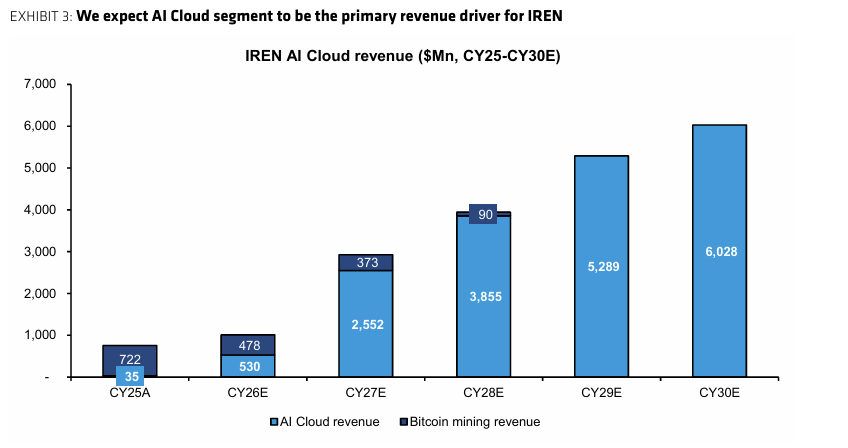
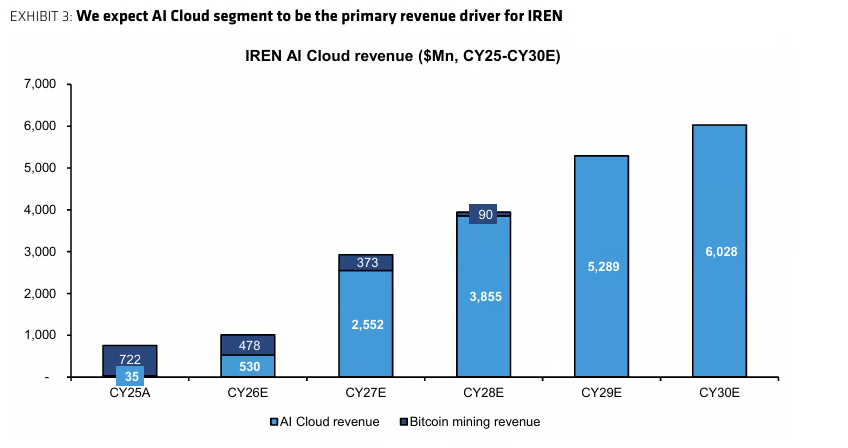
Bernstein expects IREN’s AI cloud revenue to be its primary source of income in the coming years. Source: Bernstein
Monday’s report suggests Bitcoin mining will gradually fade into a legacy segment, with mining revenue declining over time as power capacity is redirected toward higher-margin, contracted AI computing.
IREN is not alone in exploring this pivot. Several mining companies, including TeraWulf and HIVE Digital, have begun reallocating power and capital toward AI and high-performance computing, often alongside their existing Bitcoin mining operations.
Related: AI data center gold rush sparks debate over impact on Bitcoin mining
Bernstein sees nearly 100% upside for IREN stock
Bernstein assigned IREN stock a $100 price target, pointing to significant upside as the company shifts away from Bitcoin mining and toward AI infrastructure.
With the stock currently trading below $50, the target implies a nearly 100% increase from current levels.
The analysts maintained an Outperform rating, even after reducing their previous $125 target, reflecting a more conservative view on dilution and the gradual wind-down of Bitcoin mining.
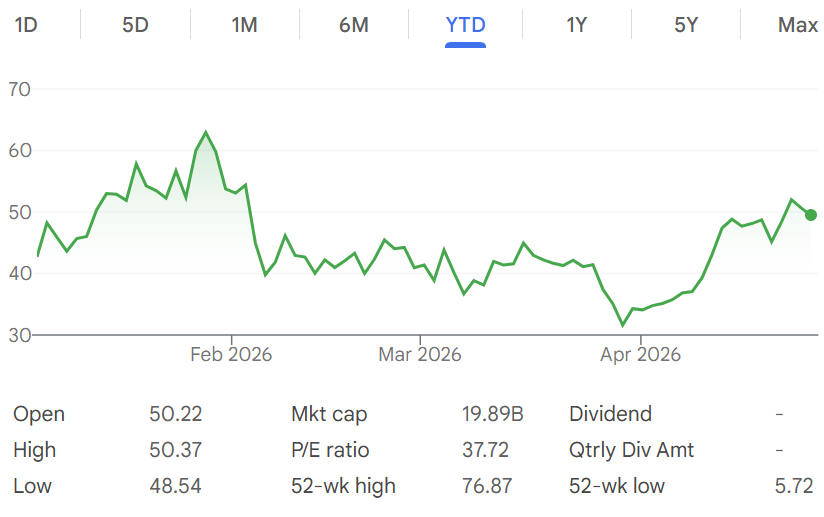
IREN stock. Source: Google Finance
Related: CoreWeave’s $8.5B loan shows how AI is replacing crypto mining finance
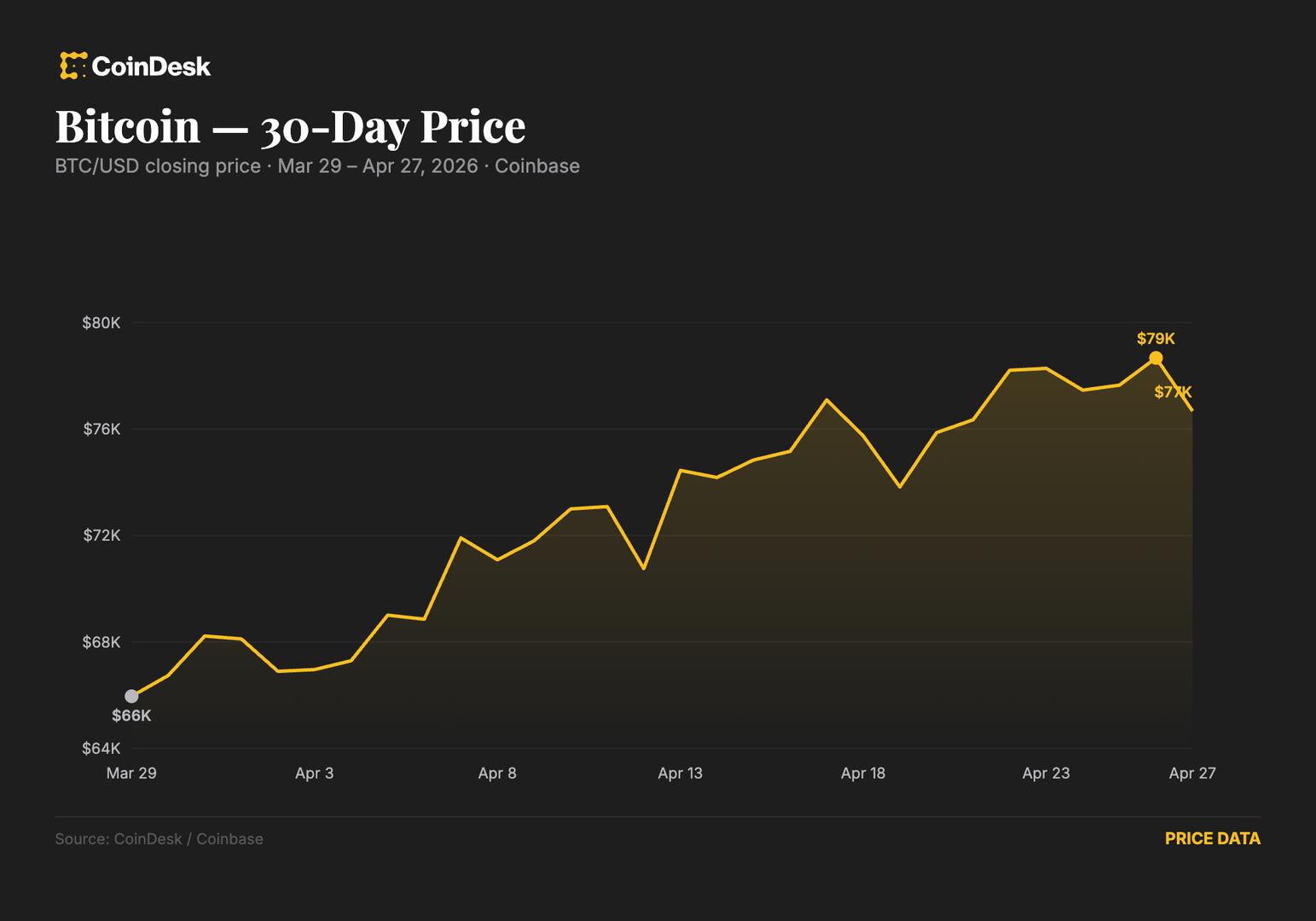
The bitcoin rally toward $80,000 didn’t last long on Monday, with prices slipping back to $76,600 during the U.S. session as geopolitical tensions crept back into focus.
After trading near $80,000 overnight, its highest level since early February, the largest cryptocurrency reversed course and was down about 1.5% over the past 24 hours. Major altcoins followed, with ether (ETH), XRP and solana (SOL) each falling around 3%. CoinDesk 20 Index, a benchmark for the broader digital assets market, fell about 2% on Monday.
The pullback comes as investors grow cautious about the outlook for U.S.-Iran negotiations and the ongoing disruption to the Strait of Hormuz, a key global oil transit route.
According to a Wall Street Journal report, Iran has proposed halting attacks on ships in the strait in exchange for a full end to the war, including lifting the U.S. naval blockade and delaying nuclear talks. The proposal aims to restart stalled negotiations, but uncertainty remains high after President Trump on Saturday canceled sending envoys to Pakistan for negotiating with the Iranian side.
Oil prices continued to rise during the day. Brent crude oil prices, often used as the international benchmark, climbed more than 3% to $107 a barrel, while the West Texas Intermediate crude oil was up 2.6% to $97.
The Nasdaq edged 0.3% lower in morning trading, pulling back from recent record highs, while the S&P 500 was flat, ahead of a big earnings week that includes Mag7 firms such as Alphabet, Meta, Microsoft and Apple.
Meanwhile, crypto-linked stocks declined across the board. Shares of crypto exchange Coinbase (COIN) fell 1.5%, while Circle (CRCL), issuer of the USDC stablecoin, dropped 3.5% and Galaxy Digital (GLXY), a digital asset investment firm, slid nearly 6%.
Short-term holders selling
Under the surface, bitcoin’s price action points to a market struggling to build momentum despite strong institutional demand.
Bitfinex analysts noted that short-term BTC holders sitting in profit have been selling into strength, offsetting fresh demand from ETF buyers and Strategy (MSTR).
“The path of least resistance in the near term is likely consolidation or a pullback toward the $75,000 region,” the analysts said, adding that “a decisive break above $80,000 [is] required to confirm a more durable bullish regime.”
Read more: Bitcoin is climbing on thin volume, leaving rally vulnerable to macro shock

Quick Overview
- Aven introduces crypto-collateralized Visa card with credit limits reaching $1 million
- Product features competitive 7.99% annual rates with repayment periods extending to 10 years
- Platform bridges cryptocurrency holdings with mainstream payment networks via Visa infrastructure
- BitGo provides secure custody services for all cryptocurrency collateral backing the cards
- Card includes 2% cashback rewards program with zero annual membership costs
Aven has unveiled its Bitcoin Visa Card, delivering cryptocurrency-backed credit facilities up to $1 million. This innovative product integrates extended-term crypto-secured financing into the company’s collateral-based card framework. The offering seamlessly connects digital currency holdings with everyday transactions through Visa’s global payment network.
Extended-Term Cryptocurrency Lending Arrives
The Bitcoin Visa Card provides cardholders with fixed-rate financing secured by their bitcoin holdings. Aven has structured repayment schedules extending up to a full decade. The annual percentage rate sits at 7.99% for qualifying borrowers.
This approach represents a departure from typical cryptocurrency lending solutions in today’s marketplace. According to Aven, most bitcoin-collateralized financing carries interest charges exceeding 10%. The company notes that competitors frequently restrict borrowing periods to approximately one year.
Cardholders will deposit their bitcoin collateral with BitGo, the designated custodian for this program. The Bitcoin Visa Card then extends credit based on those deposited assets. This mechanism enables users to unlock liquidity while maintaining their cryptocurrency positions.
Asset-Backed Credit Platform Grows
Aven established its financial technology operation in 2019, concentrating on collateral-secured payment cards. The company leverages various assets including investment portfolios and real estate equity to underwrite consumer credit facilities. The Bitcoin Visa Card now brings this methodology into the digital asset space.
This product aligns with Aven’s core strategy of reducing borrowing expenses through asset-backed lending structures. The platform reports cutting interest costs by half compared to unsecured alternatives. The firm states customers have collectively saved $300 million in interest charges throughout its operating history.
Coastal Community Bank, operating under Washington state banking regulations, serves as the issuing institution for the Bitcoin Visa Card. The product comes without annual membership charges or origination fees. Additionally, cardholders receive unlimited 2% cash rewards on all transactions.
Cryptocurrency Lending Evolution Targets Wider Audience
The Bitcoin Visa Card launches into a sector where crypto-collateralized financing typically features abbreviated timelines. Aven’s objective centers on positioning bitcoin-backed credit as comparable to conventional secured lending products. The fixed-rate, fixed-term structure may attract borrowers prioritizing cost certainty.
This debut demonstrates how financial technology companies continue integrating cryptocurrency assets with consumer credit offerings. The Bitcoin Visa Card merges digital currency ownership with established payment infrastructure. Visa’s worldwide acceptance provides the product with extensive purchasing flexibility.
Aven’s product introduction establishes an additional application for bitcoin extending past speculation and accumulation strategies. The Bitcoin Visa Card allows borrowers to preserve their cryptocurrency exposure while leveraging holdings for credit access. The offering embeds bitcoin-collateralized lending within a conventional card experience.

Crypto World
MARA Holdings targets bitcoin quantum threat and network resilience with new foundation


Las Vegas — MARA Holdings (MARA) CEO Fred Thiel announced the launch of the MARA Foundation at the Bitcoin Conference Monday, outlining a broad effort to support the long-term resilience of the bitcoin network beyond the firm’s bitcoin and AI mining operations.
“Bitcoin is the most important decentralized system ever created, but its future is not guaranteed,” Thiel said, framing the initiative around the idea that the network requires active stewardship.
Thiel described bitcoin as “a public utility that nobody owns, but everybody depends on,” adding that decentralization “doesn’t mean it runs on itself, it means responsibility is distributed.”
The foundation will focus on maintaining bitcoin’s core properties as “sound, durable money,” while advocating for its open and global use. Key priorities include supporting the network’s security budget, particularly the development of a sustainable transaction-fee market, and funding research into emerging risks, such as quantum computing.
MARA also plans to fund open source development across scaling, mining, and user infrastructure, expand access to self-custody, and promote financial sovereignty worldwide.
Education and policy engagement are central to the initiative, including technical training, multilingual resources, and outreach to regulators.
As part of the launch, MARA will award $100,000 to one of three nonprofit organizations, with the recipient chosen by community vote, underscoring Thiel’s call for shared responsibility across the ecosystem.


Robinhood customers received some particularly convincing phishing emails this weekend. The messages, which appeared to come directly from the company, featured authenticated headers, were correctly signed, included a genuine sender’s address, were sent from an authentic email server, and weren’t caught by spam filters.
Worse, the email from [email protected] even earned Gmail’s automatic route into the same conversation threads as legitimate, prior security alerts from Robinhood.
The only fraudulent things about the email were obscure technical irregularities and its contents, a phishing call-to-action seeking login information.
By Sunday night, hackers used Robinhood’s own notification pipeline to render their assault.
Analysis of the exploit went viral on social media soon after.
Robinhood phishing emails were ‘kinda beautiful’
Security researcher Abdel Sabbah posted an analysis of the event, calling it “kinda beautiful” with a sinister connotation. Unfortunately, he was right.
To craft the attack, the hacker first utilized a Gmail “dot trick,” a well-known Google feature whereby Gmail routes [email protected], [email protected], and [email protected] to the same inbox.
Gmail, unlike the rest of the internet, ignores dots in the part of the address before the @ symbol, so all of those variants deliver to the same inbox.
Because Robinhood, unlike Gmail, doesn’t normalize the dotted variants, an attacker used a “dot” modified version of Robinhood’s legitimate customer emails.
Next, the attacker set the device name on the new account to a block of raw HTML. When Robinhood’s “unrecognized activity” email is generated, the template inserts that device name without sanitizing it, rendering the nefarious HTML.
The result, in Sabbah’s words, is what appeared to be “a real email from [email protected], DKIM pass, SPF pass, DMARC pass, with a phishing CTA.”
That CTA or “call to action,” of course, is a fake security alert email with a hyperlink to an attacker-controlled webpage that harvests login credentials and two-factor authentication codes.
The ultimate goal, like almost all phishing campaigns, was to steal customer’s money — in this case, from their Robinhood account.
Read more: Robinhood pays $605M to buy Sam Bankman-Fried’s stake
Think before you click on any email
Many crypto influencers warned people about the convincing emails.
Ripple’s David Schwartz amplified the warning. “Any emails you get that appear to be from Robinhood (and may actually be from their email system) are phishing attempts,” he posted. Quoting Sabbah’s thread, Schwartz added, “It’s quite sneaky.”
In April 2025, Ethereum Name Service Lead Developer Nick Johnson documented an almost identical exploit involving emails that appeared to send from Google itself.
Attackers used a similar series of tricks to use Google’s own infrastructure to deliver DKIM-signed phishing emails from [email protected].
The lesson then is the lesson now: beware of clicking any link in any email, no matter how authentic it appears.
Traditional anti-phishing advice tells users to check the sender domain and look for authentication failures. None of that helped here. The domain appeared real. The signatures appeared real. Only the intent was criminal.
Robinhood’s own scam guidance tells customers to verify the sender’s email domain and lists @robinhood.com as the authentic example.
Protos reached out to Robinhood for comment but didn’t receive a reply prior to publication time. In Nasdaq trading today, the common stock of Robinhood opened flat for trading relative to Friday’s closing print.
Got a tip? Send us an email securely via Protos Leaks. For more informed news, follow us on X, Bluesky, and Google News, or subscribe to our YouTube channel.


Elfa AI begins offering continuous listening and real-time interpretation for AI agents to execute transactions on Solana when market conditions are met.
Elfa AI announced Monday a platform enabling AI agents to listen continuously to market conditions and execute transactions on Solana in real time. The platform interprets data and triggers automated agent actions the moment specified conditions are met, leveraging Solana’s blockchain infrastructure for market-driven decision-making.
The launch positions Elfa AI within the growing ecosystem of automation tools on Solana, targeting traders and developers seeking to capitalize on attention-driven market dynamics through AI-powered execution.
Sources: Solana
This article was generated automatically by The Defiant’s AI news system from publicly available sources.
Wall Street Is Sorting Software Companies Into Winners and Losers
Stellar (XLM) drops 3.4%, leading index lower

Michael Carrick gives Matheus Cunha injury update ahead of Manchester United vs Brentford

Manchester United reach agreement with Casemiro over contract clause amid transfer speculation

US brings back mandatory military draft registration

Steven Gerrard disagrees with Gary Neville over ‘shock’ Chelsea and Arsenal claim | Football


-

 Politics7 days ago
Gary Stevenson delivers timely reminder to register to vote as deadline TODAY
-

 Fashion3 days ago
Weekend Open Thread – Corporette.com
-
Crypto World2 days ago
Hyperliquid $HYPE Rally Builds Momentum as AI Sector Enters Prove-It Phase
-

 Politics5 days ago
Making troops accountable for war crimes threatens US alliance, ex-SAS colonel warns
-

 Politics5 days ago
Disabled people challenge government SEND proposals over segregation concerns
-

 Business5 days ago
Rolls-Royce Voted UK’s Most Iconic Trade Mark as IPO Register Hits 150
-

 Business4 days ago
Patterson-UTI Energy, Inc. (PTEN) Q1 2026 Earnings Call Transcript
-

 Politics5 days ago
Zack Polanski responds to home secretary’s taser threat
-
 Crypto World6 days ago
Five Value Stocks with Recovery Potential in 2026: PayPal (PYPL), Nike (NKE), and More
-

 Politics5 days ago
Starmer handler McSweeney to be dragged from shadows by Foreign Affairs Committee
-
 Sports1 day ago
IPL 2026: Ruturaj Gaikwad registers slowest fifty of the season, enters all-time unwanted list | Cricket News
-
Politics5 days ago
Wings Over Scotland | How To Get Away With Crimes
-

 Crypto World6 days ago
New York sues Coinbase, Gemini over prediction market offerings
-

 Tech1 hour ago
Register Renaming | Hackaday
-
Entertainment6 days ago
Sydney Sweeney cameo cut from “The Devil Wears Prada 2”, source explains why (exclusive)
-
 Business6 days ago
HCL Tech share price tank over 9% after weak Q4. JPMorgan, HSBC & 3 others cut target price
-

 Politics5 days ago
‘Iran is still a nuclear threat’
-
 Sports5 days ago
Tim Bradley names the current best in the world: “Better than Inoue and Usyk”
-
 Crypto World6 days ago
Crypto’s great hope in Senate’s Clarity Act still has a path to survive tight calendar
-

 NewsBeat1 day ago
LK Bennett closes all stores after entering administration
You must be logged in to post a comment Login