

Crypto World
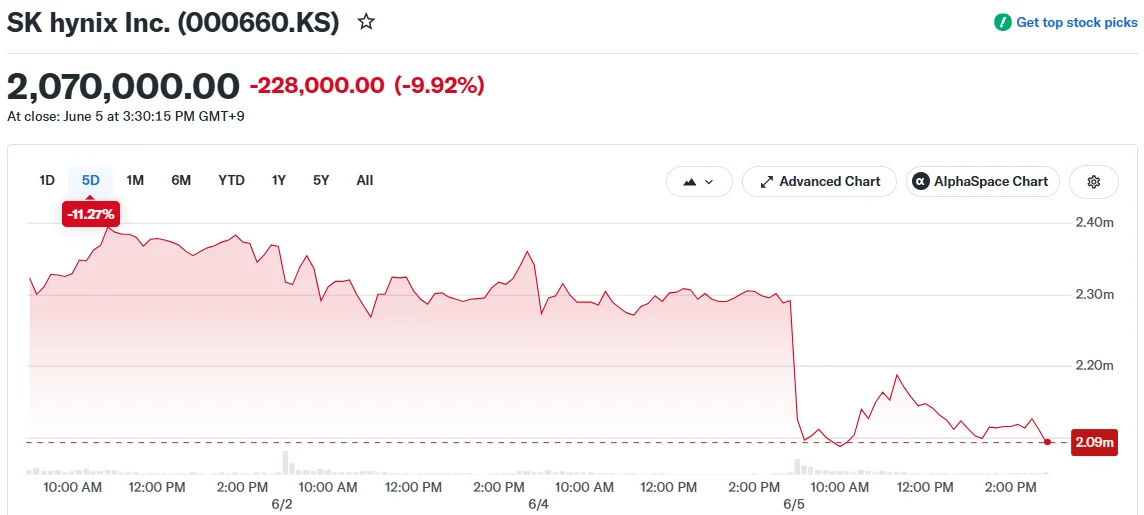
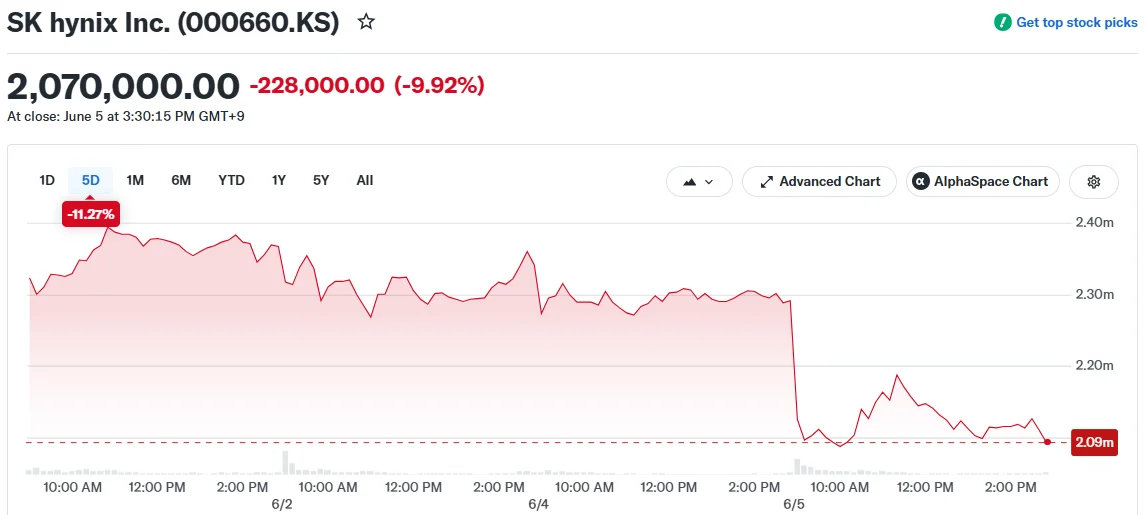
SK Hynix (000660.KS) Stock Surges After Nvidia Taps It for Vera CPU Memory

Key Highlights
- Nvidia CEO Jensen Huang announced SK Hynix will supply DRAM for the new Vera data-center processor
- Partnership expected to expand significantly through late 2026 and continuing into 2027
- Official cooperation agreement between Nvidia and SK Group scheduled for Monday announcement
- Memory supply constraints projected to continue for multiple years amid surging AI demand
- Huang’s South Korea trip includes meetings with Samsung, Hyundai, and LG leadership teams
During a weekend visit to Seoul, Nvidia’s CEO Jensen Huang revealed that SK Hynix DRAM will power the company’s upcoming Vera data-center CPU. The disclosure followed a Sunday meeting between Huang, SK Group Chairman Chey Tae-won, and SK Hynix CEO Kwak Noh-jung at Kkanbu Chicken restaurant, where the executives shared the popular Korean combination of fried chicken and beer known as “chimaek.”
According to Huang, the collaboration between Nvidia and SK Hynix is projected to experience significant expansion from the latter half of 2026 continuing through 2027. Both organizations plan to present their formal partnership strategy to media representatives on Monday morning.
The Vera processor represents Nvidia’s inaugural standalone CPU designed specifically for data centers, positioning the company as a direct rival to Intel’s Xeon processors and AMD’s Epyc chips. Additionally, it competes with proprietary solutions developed by cloud computing leaders such as Amazon’s Graviton processor series.
This partnership solidifies SK Hynix’s status as a critical supplier within the artificial intelligence hardware ecosystem. For shareholders of the South Korean memory manufacturer, this development provides strong evidence that revenue streams from AI infrastructure investments remain robust.
Persistent Supply Constraints Ahead
Huang offered straightforward commentary regarding ongoing supply chain challenges. He indicated that shortages affecting everything from semiconductor wafers to advanced packaging materials and silicon photonics components will remain problematic for the foreseeable future.
“It is going to persist for several years,” he said.
While this presents challenges for companies attempting to secure chip supplies, it reinforces favorable pricing conditions for memory manufacturers including SK Hynix and Samsung.
The demand surge stems from cloud service providers and enterprise organizations accelerating their AI infrastructure deployments. Huang’s remarks indicate that market demand currently exceeds the supply chain’s production capabilities.
Broader Strategic Engagement
Nvidia’s agenda in Seoul extends well beyond the SK Hynix partnership. Huang has scheduled discussions with executives from Samsung Electronics, Hyundai Motor Group, and LG Group throughout his South Korean visit.
He also revealed ongoing conversations with telecommunications companies regarding network infrastructure’s evolving role in AI ecosystems. This suggests that AI computing workloads may progressively expand from traditional centralized data centers into telecommunications network architectures.
Huang characterized the Vera processor as representing a significant advancement in processing technology. Nvidia unveiled Vera during the Computex conference in Taipei in June, where Huang and SK Group Chairman Chey were photographed together at the SK Hynix exhibition space.
The business relationship between Nvidia and SK Hynix encompasses AI supercomputing systems, CPU development, and robotics implementations, Huang noted. He emphasized that both companies are collaborating across numerous industry sectors.
Nvidia (NVDA) stock finished Friday’s trading session at $135.05, reflecting gains exceeding 170% over the trailing twelve months. SK Hynix shares trade on the Korea Stock Exchange under ticker symbol 000660.




PayPal highlighted growth of stablecoins and AI-driven payment tools in Q2 while reporting $8.68 billion in revenue and an $81 million crypto-related earnings adjustment.

Lido Crypto has launched its Core 2026 protocol upgrade, introducing native 0x02 validator support to its largest staking module, restructuring node operator economics around ETH-backed bonds, and setting in motion a validator consolidation that will reduce the total number of Ethereum validators by roughly one-third.
No action is required from stakers, the changes operate entirely at the protocol level.
The upgrade lands at a structurally important moment. Ethereum’s Pectra hard fork introduced EIP-7251, which raised the maximum effective validator balance from 32 ETH to 2,048 ETH via 0x02 withdrawal credentials, but adoption required coordinated infrastructure work at the protocol layer.
Lido’s Core upgrade is effectively the largest single deployment of that new validator architecture on the network.

Lido Crypto Curated Module v2: The Architecture Shift
The Curated Module has secured roughly 90% of all staked ETH in Lido Core since the protocol launched in 2020. Curated Module v2 (CMv2) now brings 0x02 native support to that module, enabling migration of more than 265,000 existing validators from legacy 0x01 withdrawal credentials through consolidation.
The result: the share of ETH secured by compounding validators rises from 32.06% to 52.21%, and the Ethereum validator set shrinks from approximately 880,000 to an estimated 628,000, a reduction of about 29% in attestation messages per epoch, according to the Lido protocol blog.
That attestation reduction matters beyond Lido. Consensus-layer overhead affects every validator on the network, and a 29% cut in per-epoch messages meaningfully reduces networking and processing load for all operators.
This is the clearest way in which Lido’s internal restructuring carries direct implications for Ethereum staking dynamics broadly, fewer validators means a leaner beacon chain, independent of any single protocol’s market share.
CMv2 rolls out in two phases. Phase 1, now live, covers 0x02 validator support, operator classification, bond-based security mechanisms, and streamlined governance. Phase 2, in development, introduces flexible stake distribution, custom operator fees, and a strike system, moving Lido’s curated set toward an explicit market-driven ranking model.
Operator Economics: From Reputation to Bonded Capital
The most significant structural change for node operators is the introduction of ETH-backed bonding and a formal penalty framework. The legacy Curated Module operated on reputation: operators were expected to perform and compensate stakers if losses arose, but there was no locked collateral enforcing that obligation.
CMv2 adds financial skin-in-the-game, covering underperformance, downtime, slashing events, and execution-layer rewards violations.
Alongside bonding, CMv2 introduces a Node Operator Type Framework that formally classifies operators by contribution profile: Decentralization Operators (geographic and client diversity), Extra Effort Operators (capital participation, oracle and deposit security committee roles, LDO governance activity), and Public Good Operators (Ethereum consensus and execution layer client developers).
Seven client teams have been onboarded as curated node operators; as of July 1, 2026, they had collectively received 8,710 stETH, approximately $21 million, in cumulative staking rewards, per the Lido blog.
Governance overhead also decreases under CMv2. Routine administrative updates, previously requiring on-chain DAO votes, are now permissioned to operators and the Curated Module Committee. The DAO retains authority over operator set composition and key parameters, with override and veto rights intact.
Trade Ripple XRP on Bybit and Get a Chance to Win Our $1,000 USDT Airdrop
The post Lido Crypto Validator Consolidation Will Cut Ethereum’s Beacon Chain by 29% appeared first on Cryptonews.
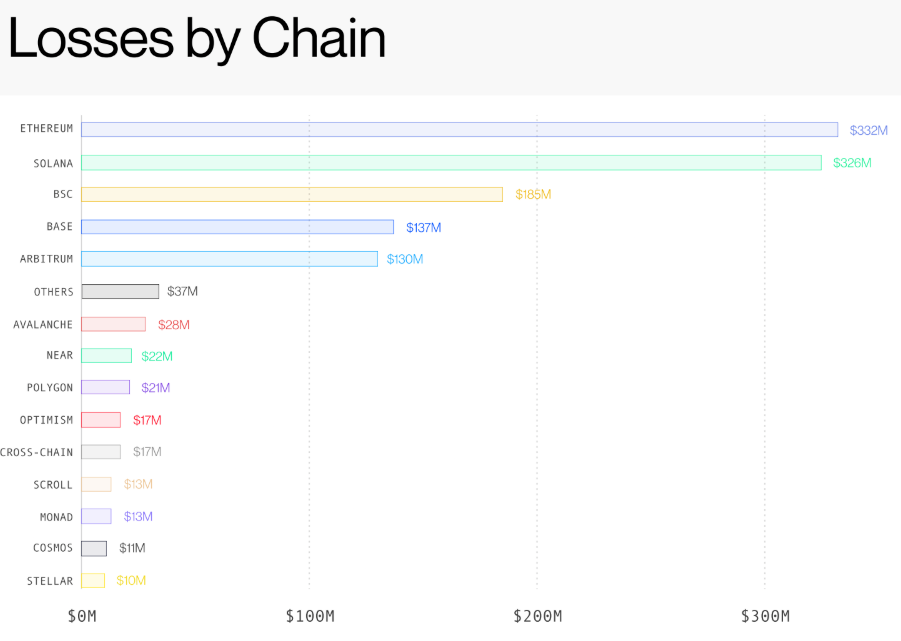
Crypto losses topped $1 billion in the first half of 2026 as the industry recorded its highest number of hacks in a six-month period, according to onchain security platform Blockaid.
Ethereum and Solana recorded the largest losses from incidents affecting their networks, with roughly $332 million and $326 million in stolen funds, respectively, Blockaid said in its H1 2026 security report published Tuesday.
Blockaid tracked 212 security incidents during the period, with the largest single exploit coming from KelpDAO at $292 million, while the platform verified 3.4 times as many high-threshold exploits in H1 2026 as across all of 2025.
Code exploits drove Ethereum incidents, while breaches of keys and signing infrastructure accounted for most Solana losses, according to the report.
Ethereum losses reflected the risks of high-value protocols
Ethereum incurred the highest losses from incidents in H1 2026, with attackers primarily targeting vulnerabilities in applications built on the network.
Blockaid said code exploits dominated Ethereum incidents by count, with major losses also linked to key compromises involving Humanity Protocol and StablR. CoWSwap, an Ethereum-based decentralized exchange, was the only major Ethereum incident in the report classified as a user mistake.
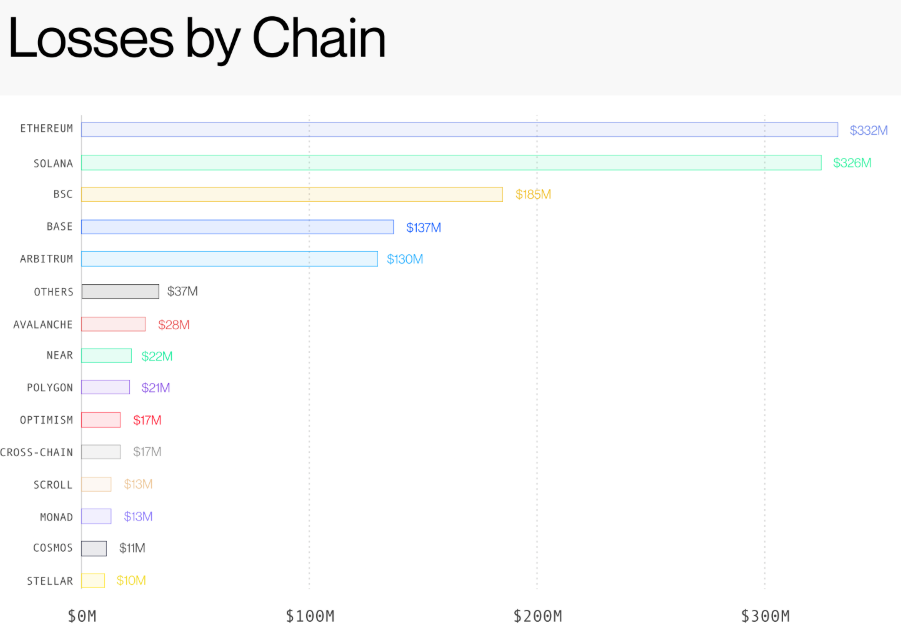
Blockchain losses by network in the first half of 2026. Source: Blockaid.
Blockaid identified several common attack methods targeting Ethereum, including bugs in bridges and smart contracts, unauthorized access to privileged accounts and market manipulation techniques.
The report said Ethereum remains a major target because it hosts many of the crypto industry’s most valuable applications, including restaking platforms, stablecoins and decentralized exchanges.
Solana losses surged as attackers shifted focus
Solana incurred nearly as much in losses as Ethereum during the first half of 2026, a sharp increase from the roughly $127 million in stolen funds the network recorded during 2025.
“2025 had $2.58 billion lost across 63 incidents, concentrated in Q1 by Bybit’s $1.5 billion, with Ethereum and Arbitrum the top chains by stolen-fund flow,” Blockaid CEO Ido Ben-Natan told Cointelegraph.
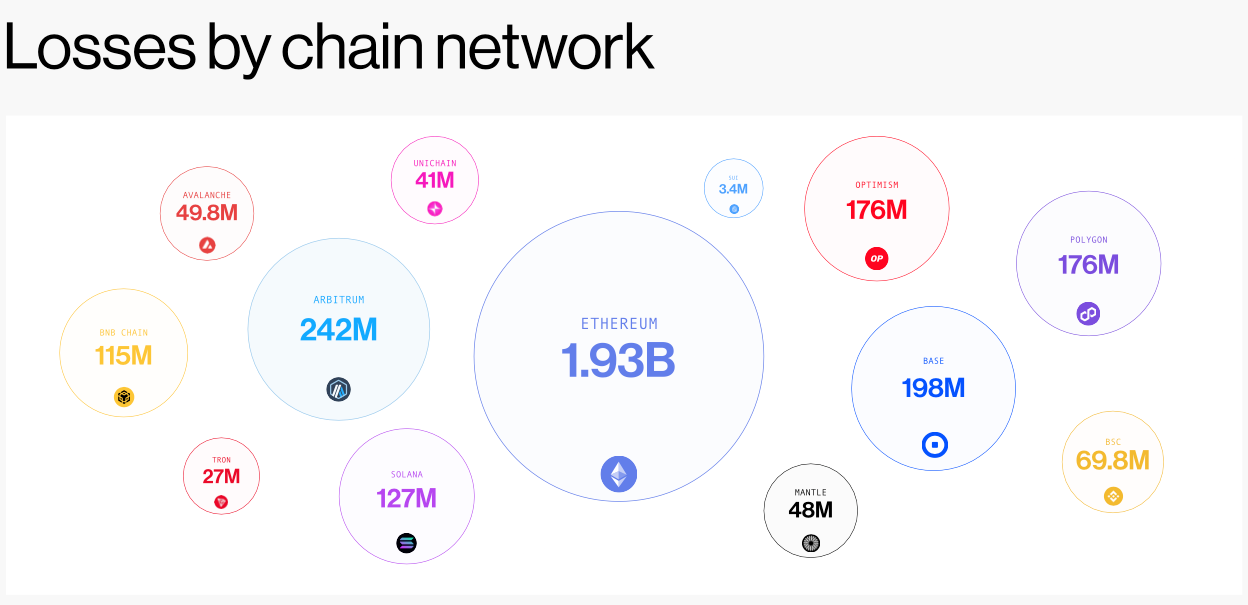
Blockchain losses by network in 2025. Source: Blockaid.
The change did not stem from a rise in smart contract exploits. Instead, compromised keys accounted for more than 98% of Solana’s losses, driven largely by incidents involving Drift Protocol and Step Finance, which Blockaid linked to North Korea-linked cyber groups.
Unlike Ethereum, where attackers primarily exploited vulnerabilities in protocol code, Solana incidents targeted signer infrastructure and organizational security, while a handful of code exploits involving Raydium and Volo accounted for the remaining losses.
Magazine: A quantum roadmap would push Bitcoin much higher: Charles Edwards
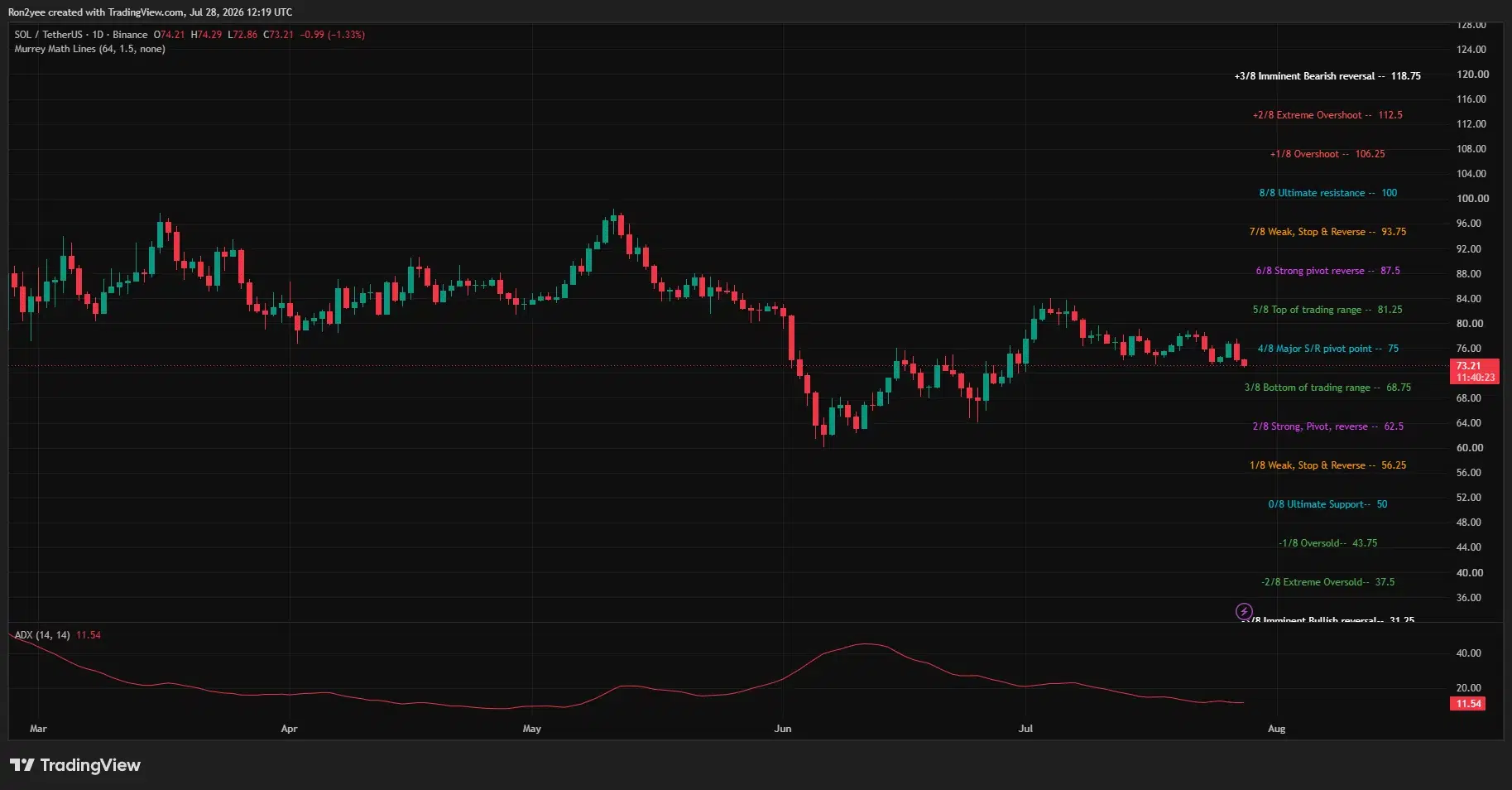
Solana price fell about 5% from its July 27 high near $77 to $73 on July 28 as a break below short-term support triggered long liquidations.
Summary
- SOL price dropped from roughly $77 to $73 after failing to sustain its latest recovery.
- Price has fallen below the $75 major pivot and remains inside a descending channel.
- The 4-hour RSI has declined to 35.57, showing weakening momentum without reaching oversold territory.
- Liquidation clusters near $72.50 and $74 could increase volatility around the current price.
Solana price drops back toward $73
According to data from crypto.news, Solana (SOL) price traded near $73.20 at the time of writing after falling from an intraday high around $77 during the previous session. The move represented a decline of about 5% from peak to trough.
The pullback followed SOL’s latest rejection from the upper half of a descending channel visible on the 4-hour chart. Buyers pushed the token toward $77 on July 27 but failed to challenge the channel’s upper boundary or the wider $78 resistance area.
Selling accelerated after SOL lost the $75 level, which had supported several earlier intraday rebounds. The token subsequently fell toward $73 before entering a narrow consolidation range.
The daily chart showed SOL trading below the Murrey Math major support-and-resistance pivot at $75. Its July 28 candle recorded a low of $72.86, although buyers prevented a sustained fall below $73.
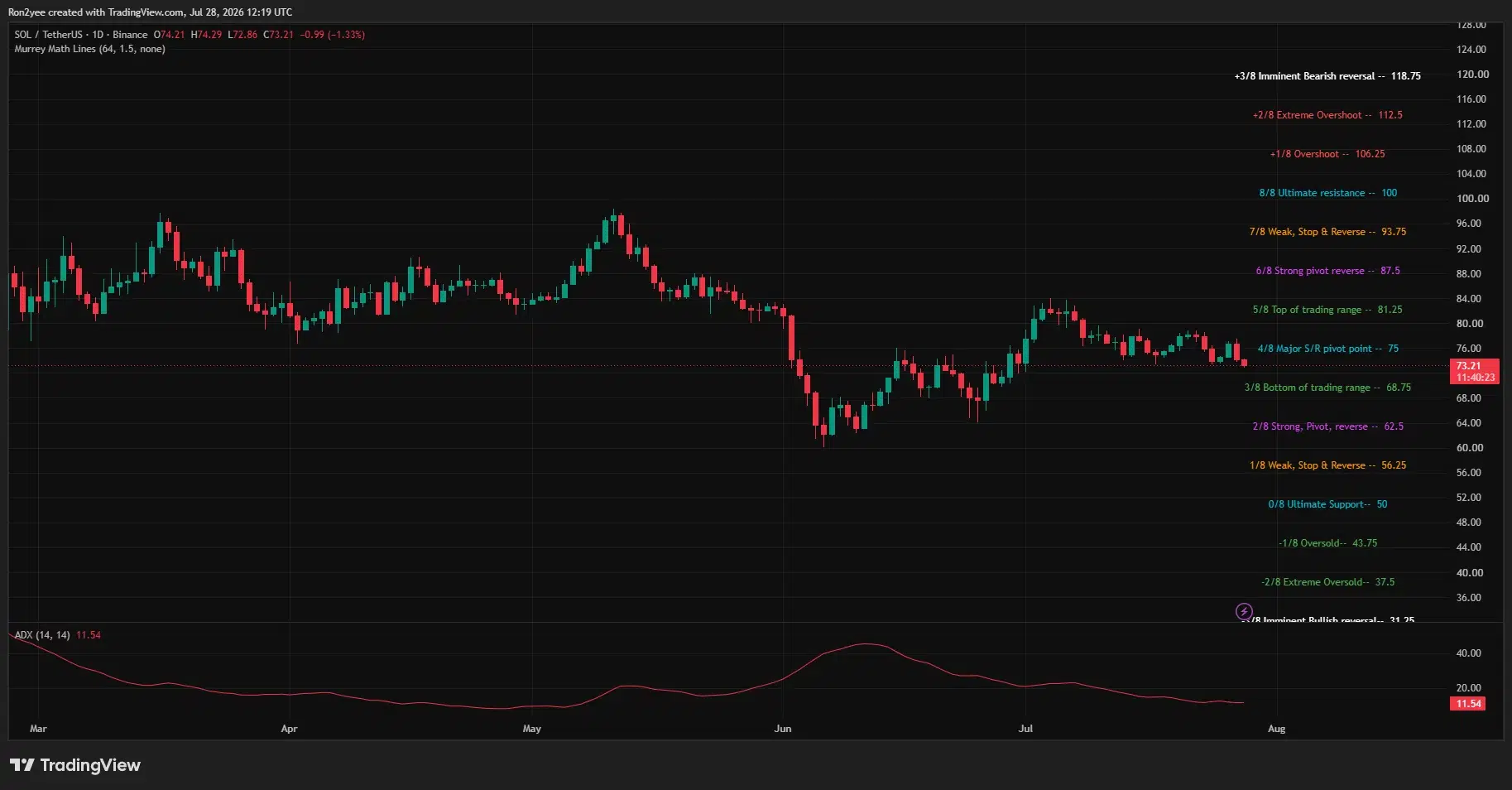
SOL’s decline also came as capital showed a preference for Ethereum. ETH recently reclaimed $1,900, while SOL remained trapped below its July resistance range.
Crypto trader Daan Crypto Trades noted that the pair was beginning to lose its horizontal support area.
“[Solana] needs to break this local consolidation before we can start looking at the range high again.”
Daan added that Ethereum’s recent strength against Bitcoin had left Solana behind, making the ETH ecosystem more attractive while SOL remained weak.
Long liquidations accelerated the sell-off
The three-day CoinGlass liquidation heatmap shows that Solana’s slide cut through several leveraged trading zones between $75 and $73.
SOL first dropped sharply below $75 before falling through another band of liquidity around $73. The move likely forced leveraged long traders to close their positions, adding market sell orders to an already weak spot market.
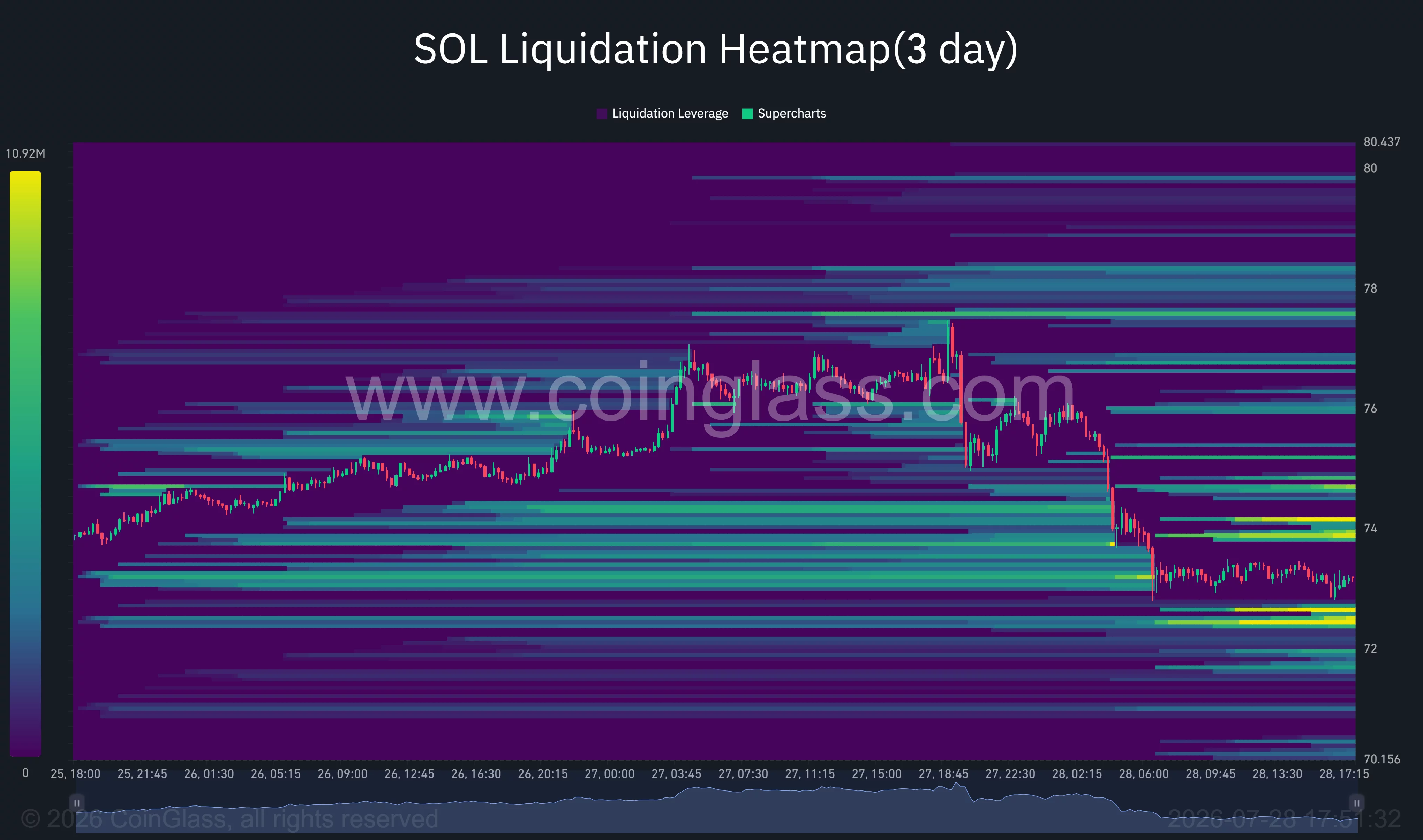
The heatmap shows that the largest nearby concentrations now sit on both sides of the current price. A bright liquidity band has formed around $72.40–$72.70, while additional clusters are visible near $73.80–$74.20.
This positioning could keep short-term price action unstable. A move below $73 may attract SOL toward the lower liquidity pool, while an initial rebound could target the accumulated positions around $74.
Further liquidation interest is visible near $75 and $76.50. Those levels could act as upside targets if buyers regain control, but they may also become resistance because traders caught in the decline could use a recovery to exit positions.
The liquidation data support the view that derivatives positioning magnified the decline. However, the charts alone do not establish that institutional sell blocks caused the move.
SOL indicators point to weak momentum
Solana remains inside a descending parallel channel that has guided its 4-hour price action since the early-July peak above $83. The channel has produced a sequence of lower highs, including rejections near $79 and $77.
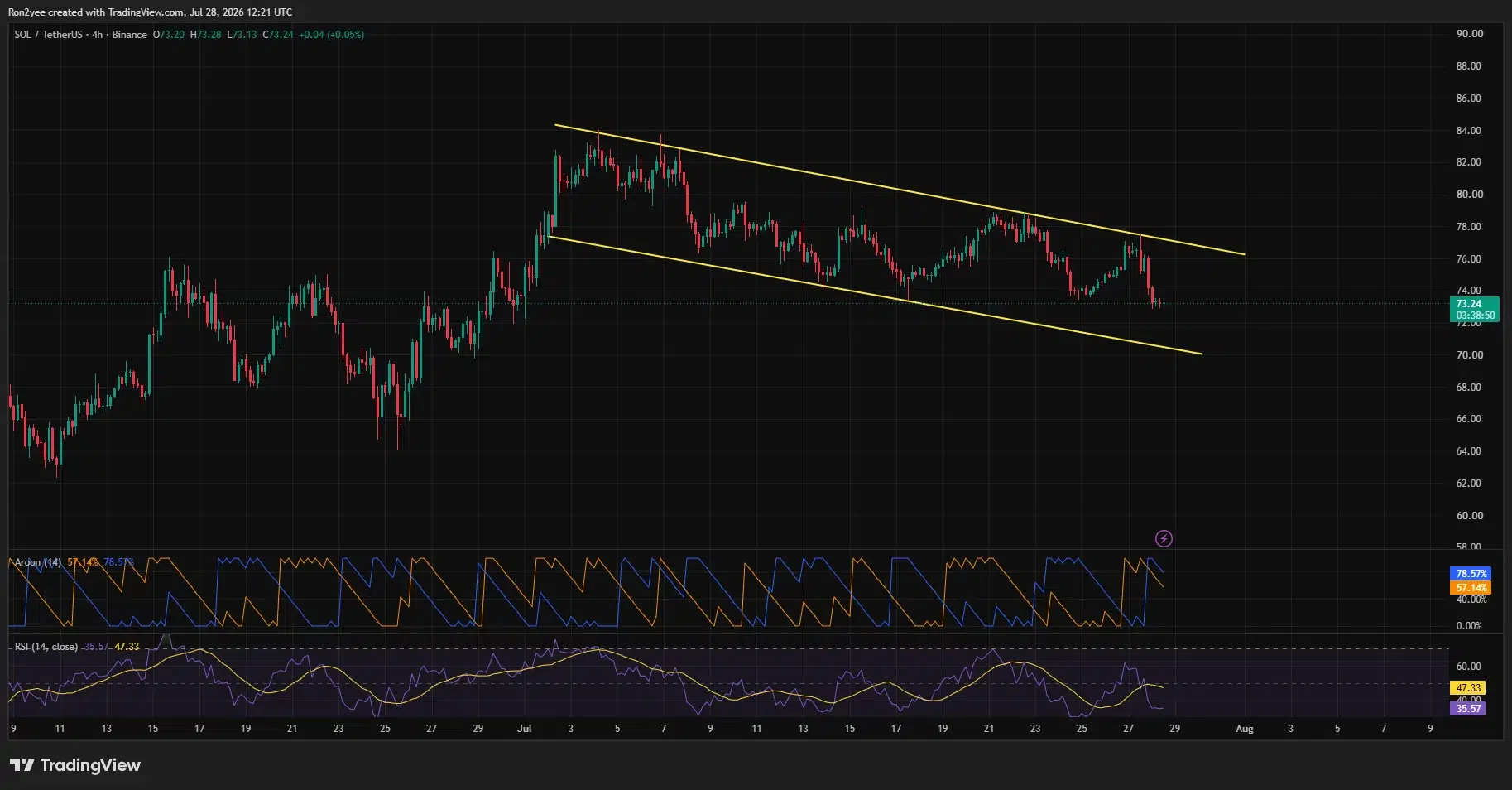
SOL is now approaching the channel’s lower half. The lower boundary sits close to $70, making that level the next broader technical support if $73 fails.
The 4-hour relative strength index has fallen to 35.57, below its signal average of 47.33. The reading shows that sellers control short-term momentum, although SOL has not yet entered the conventional oversold zone below 30.
Aroon readings also favor the downside, with the stronger line at 78.57% compared with 57.14% for the opposing measure. The indicator reflects the recency of price highs and lows rather than the size of a move, but its current configuration is consistent with SOL’s recent lower low.
On the daily chart, the average directional index stands at only 11.54. An ADX reading below 20 normally indicates a weak trend, suggesting SOL is still consolidating rather than entering a confirmed directional breakdown.
That weak reading leaves room for false moves around support. SOL could briefly sweep liquidity below $73 before recovering, particularly if selling pressure in the derivatives market eases.
Solana price levels to watch next
The first level buyers need to recover is $74. A move above that area would allow SOL to challenge the $75 pivot, which has changed from support into near-term resistance.
A daily close above $75 would weaken the immediate bearish case. Bulls would then need to clear $77–$78 and break above the descending channel to reopen a path toward the July high around $83.
Failure to reclaim $75 would leave SOL exposed to another test of the $72.50 liquidation cluster. Below that area, the channel boundary near $70 becomes the next likely target.
The daily Murrey Math chart places the bottom of the broader trading range at $68.75. That level may provide stronger support if a breakdown below $70 develops. A deeper correction could then extend toward the $62.50 pivot, although the current low ADX reading does not yet confirm such a move.
Fed decision adds risk for US traders
US investors are also awaiting the Federal Reserve’s next policy decision. Interest-rate expectations, movements in the dollar and Treasury yields can affect demand for high-risk assets such as SOL.
Treasury yields eased on July 28, while oil prices also fell as markets responded to renewed hopes for diplomacy in the Middle East. Brent traded below $87 and US crude near $81, reversing part of the inflation-driven pressure seen earlier in the week. The pullback reportedly followed a pause in attacks and renewed hopes for a US-Iran agreement.
That means SOL’s latest decline appears more closely linked to its technical breakdown and leveraged positioning than to a fresh rise in oil or Treasury yields. The Fed decision could still determine whether US liquidity conditions help SOL recover $75 or push it toward lower support.
Disclosure: This article does not represent investment advice. The content and materials featured on this page are for educational purposes only.
When DeFi dashboard Zapper announced this month that it would shut down after nearly seven years, it joined a growing list of decentralized finance projects that have folded in 2026.
Bitcoin DeFi platform Botanix, Solana portfolio tracker Step Finance, DeFi analytics platform Parsec and DEX aggregator Odos Protocol also wound down or are winding down this year after multiple market cycles.
The carnage isn’t limited to DeFi — RootData has tracked 101 “dead” crypto projects in total this year as of July 26 — but it accounts for more than half the cadavers.
Is it simply a case of bear market blues, or is there more to it than meets the eye?
Botanix’s founders pointed to weak demand when announcing the platform’s closure, and told Cointelegraph in June that onchain activity consolidating around a few venues like Hyperliquid and big centralized exchanges hastened Botanix’s decline.
While complaints the overall industry is consolidating into a fewer, larger venues are common, Artemis Research’s Alex Weseley tells Magazine that’s not the case in DeFi:
“The prevailing narrative has been that concentration is increasing in DeFi, caused by a series of exploits and capital rotation into the most ‘Lindy’ protocols. But the data disagrees.”
So, why are projects that survived the collapse of Terra, the implosion of FTX and the grip of Chokepoint 2.0 shutting down today? If the 2022 bear market didn’t kill these DeFi protocols, what is it about the 2026 market structure that is finishing them off?
Capital has rotated rather than exited
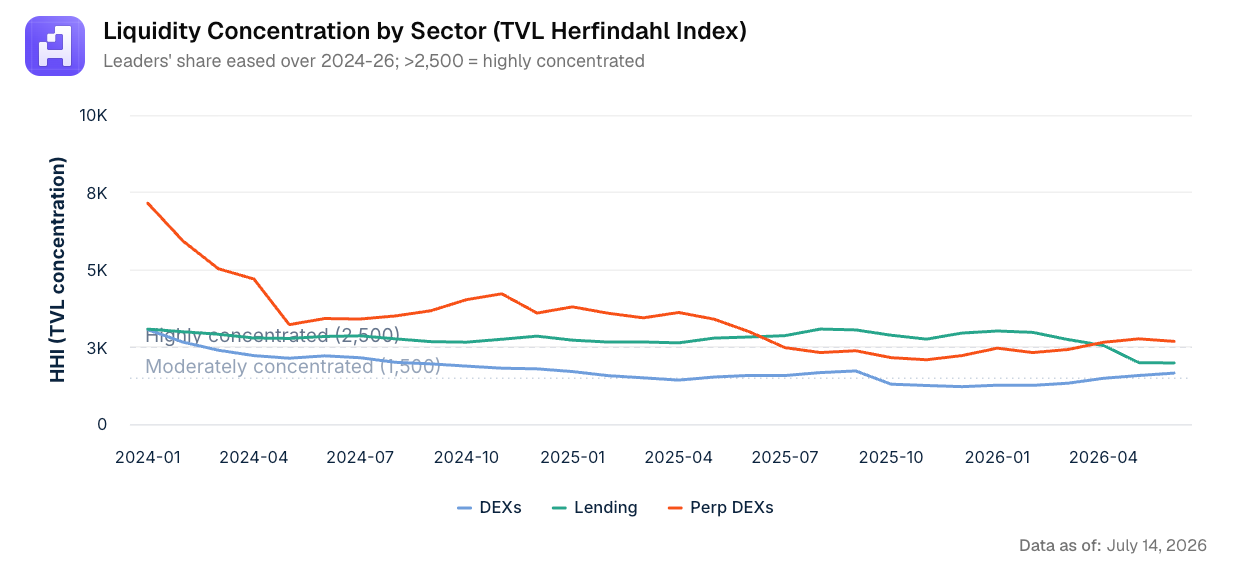
According to Artemis data, concentration across tracked DeFi protocols has actually drifted lower since 2024.
And while each major sector still has one dominant player like Uniswap in decentralized exchanges, Aave in lending and Jupiter in perpetuals by locked capital, “every one of those leaders holds a smaller share of its sector now than it did two years ago,” Weseley explains.
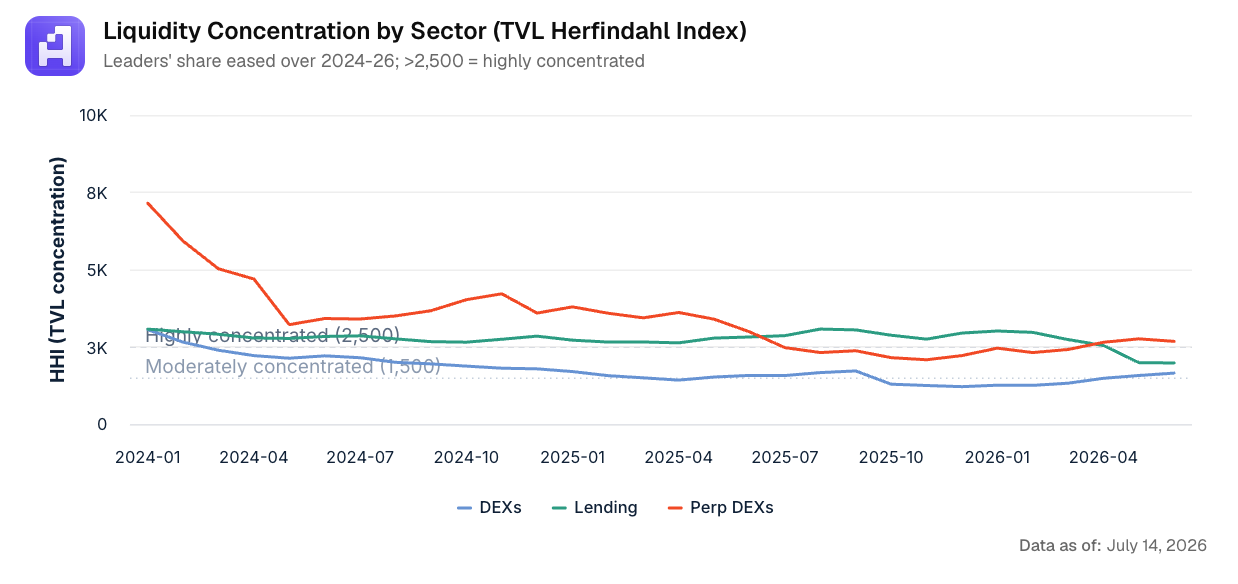
Liquidity concentration by sector (TVL Herfindahl index). Source: Artemis
He argues that onchain activity has shifted into different corners of the crypto economy rather than leaving the ecosystem altogether.
“The economics didn’t disappear; they rotated to adjacent apps (Hyperliquid, Polymarket, pump.fun), so classic DeFi viability shrank even as total onchain fee generation stayed high.”
Related: Mark Cuban-backed DeFi dashboard Zapper shutters after 7 years
In this view more protocols are competing for a slice of the pie, making each slice smaller.
Markus Levin, co-founder of blockchain infrastructure company XYO, says today’s landscape holds little resemblance to the early days of DeFi.
“The DeFi space is much more competitive than it was during the last bear cycle,” Levin tells Magazine.
“Early DeFi projects benefited from first-mover advantage and a relatively small field of competitors. Now, there are thousands of protocols competing for the same users and liquidity.”
Wesley explains it’s more instructive to look at revenue generation to work out where economic activity is occurring in DeFi, rather than the more common measure of total value locked (TVL).
“TVL is the right tool for the narrow ‘liquidity’ question but misleads elsewhere,” Wesley says.
“Fees and revenue are best, because they measure economic viability directly and expose shifts that TVL and headline usage hide.”
Artemis estimates the number of DeFi applications generating at least $1 million in monthly fees climbed to around 33 or 34 in mid-to-late 2025 before falling back to roughly 25 or 26 during the first half of 2026. The number generating more than $10 million in monthly fees roughly halved over the same period.
The rules for attracting capital have changed
DeFi risk management firm Gauntlet argues the broader market remains healthy, despite numerous DeFi protocols shutting down this year.
“Demand is the strongest it has ever been,” Nicholas Cannon, chief business officer at Gauntlet, tells Magazine. “Stablecoin supply keeps growing, and traditional finance is moving toward DeFi rather than away from it.”
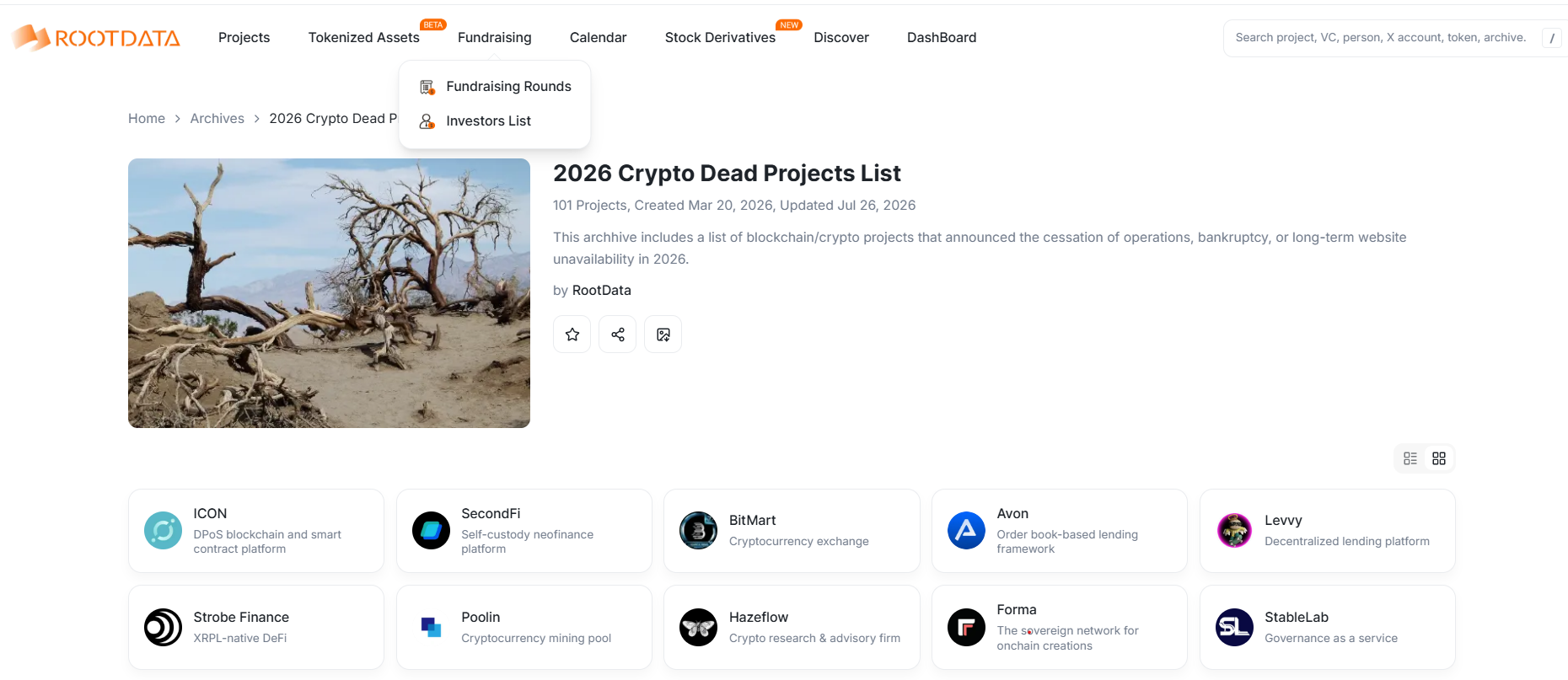
101 crypto projects have died so far in 2026 alone. Source: RootData
According to Gauntlet, the defining change since the previous market slump is that investors have become more selective and aren’t as easily distracted by short-term yield farming token incentives.
“What changed is that capital got discerning. In previous cycles, liquidity followed incentives wherever they pointed. Today it follows sustainable yield, track record, and curation. Incentives still have a role in bootstrapping, but they no longer carry a protocol on their own.”
Levin says that institutional capital in particular is more selective in 2026, favoring platforms with established track records over protocols luring users with shiny token incentives.
“The projects that survive this cycle are likely to be the ones that already have meaningful user distribution or can reach users beyond the traditional DeFi audience,” he said, and that may prove to be a tougher test than the bear market itself.
Tokenized assets, stablecoins and emerging areas such as agentic DeFi are examples of where new experimentation is taking place.
Related: ARK pushes back against a16z’s ‘TradFi wants blockchain, not DeFi’ claim
Infrastructure is consolidating while innovation moves higher
One consequence of the industry’s maturation, Cannon said, is that fewer teams are trying to build the next Aave or Uniswap. Instead, they’re using established DeFi infrastructure as a foundation for their products and services.
The trend is also reflected in where investment dollars are flowing. DeFi lender Morpho announced a $175 million raise to bring institutional lending onchain in June, one of the sector’s largest fundraises, while agentic DeFi startup Alpaca raised $135 million in July to build infrastructure for AI-powered financial applications.
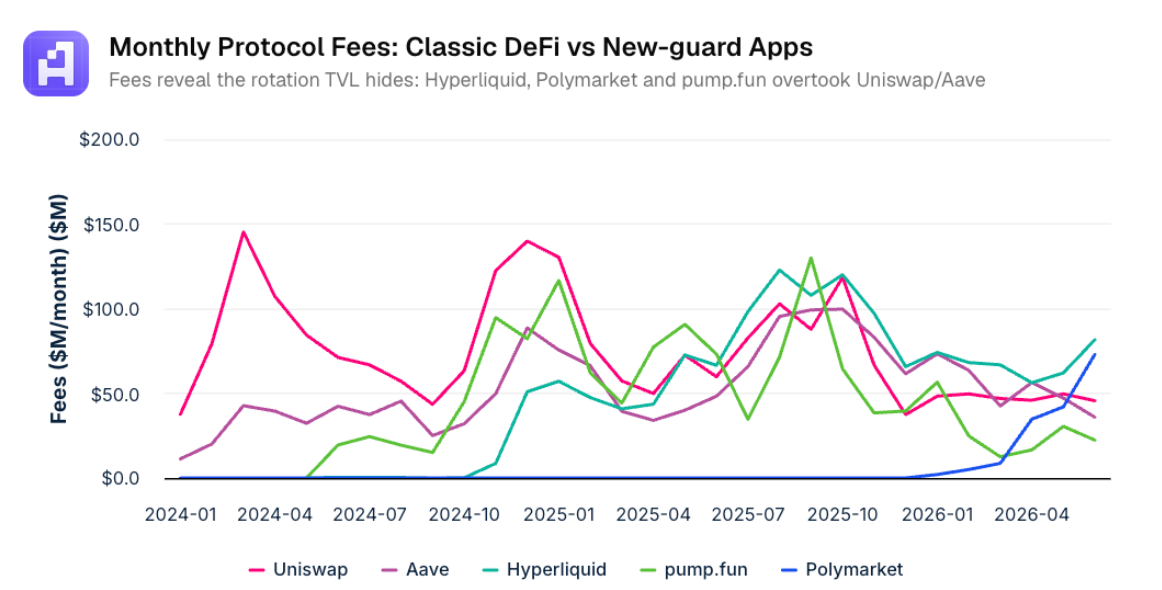
Monthly protocol fees: Classic DeFi vs new-guard apps. Source: Artemis
Morpho Labs co-founder Merlin Egalite says the next generation of successful protocols will increasingly focus on distribution rather than competing directly with established infrastructure.
“The protocols growing fastest will be the ones embedded into the platforms where users already are. Fintechs, wallets, exchanges building on top of you rather than competing with you.”
Egalite also argues that future growth will come from making DeFi infrastructure easier for traditional financial firms to adopt.
“The next wave of growth comes from fintechs, banks, and platforms that want to embed DeFi infrastructure without rebuilding it,” he says.
Magazine: Fears of AI-driven DeFi hack epidemic overstated for now — but not for long
Cointelegraph publishes long-form journalism, analysis and narrative reporting produced by Cointelegraph’s in-house editorial team with subject-matter expertise. All articles are edited and reviewed by Cointelegraph editors in line with our editorial standards. Content published in here does not constitute financial, legal or investment advice. Readers should conduct their own research and consult qualified professionals where appropriate. Cointelegraph maintains full editorial independence.
Under the policy, foreign law enforcement agencies must route certain requests through Mutual Legal Assistance Treaties, or MLATs. The treaties provide a formal process for governments to exchange evidence and information in criminal investigations, but requests can take considerably longer than direct cooperation with an exchange.
The change represents a departure from Binance’s previous approach, under which it worked directly with authorities to freeze suspicious accounts and provide information about users under investigation, the NYT said.
“Binance has not slowed its cooperation with global law enforcement,” a spokesperson said in an email to CoinDesk. “On the contrary, we have increased our cooperation year over year, while navigating the increasing complexity of government approaches to crypto regulation and data protection.”
The spokesperson said Binance continues to prioritize collaboration with law enforcement agencies worldwide, including in the U.S. and Europe. Binance said its assistance goes “beyond any legal obligation upon us and what traditional financial services firms typically do.”
“This is a deliberate strengthening of the controls and safeguards that govern how we cooperate, which is consistent with the standards expected of a regulated institution,” the spokesperson added.
The NYT’s report follows a similar account from The Information this month, which cited a Justice Department (DOJ) memo warning federal prosecutors handling crypto cases that they should prepare for less assistance from Binance when seeking to freeze or seize assets. Binance denied that its cooperation with U.S. authorities had changed.
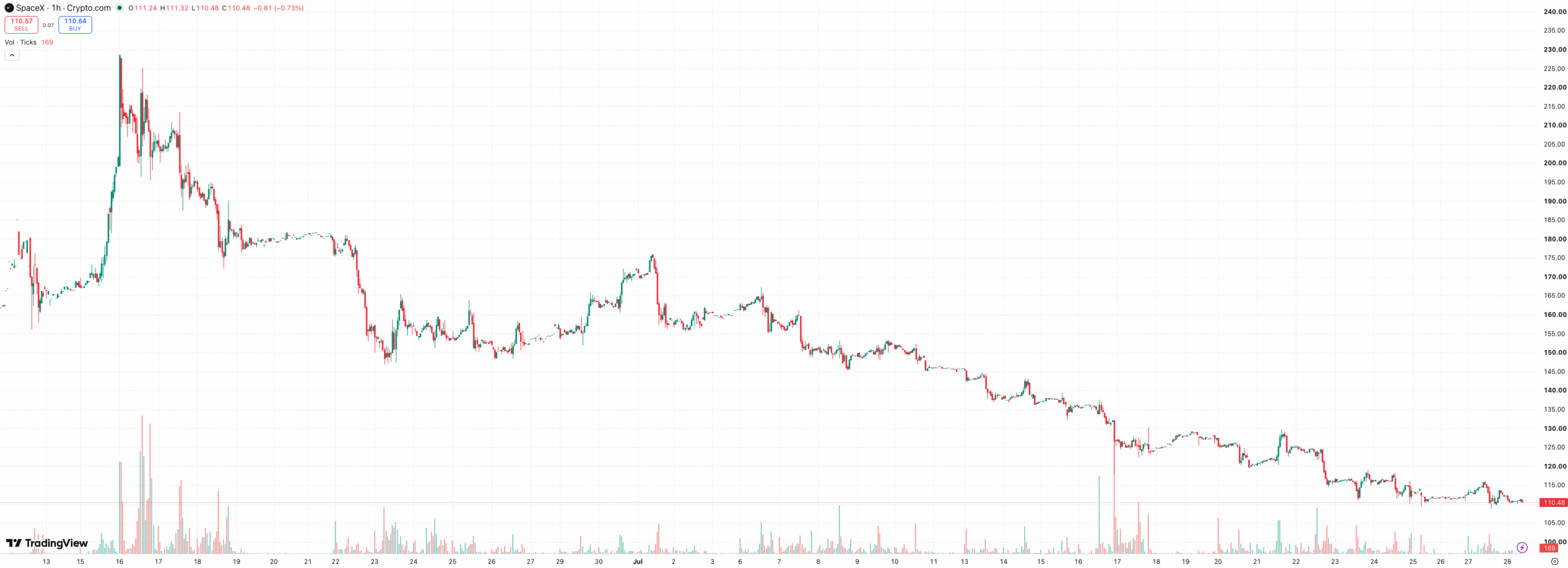
SpaceX stock fell to a record closing low of $113.50 on July 27, extending a very sharp reversal that began shortly after the company saw its debut on June 12.
The shares have now lost almost half of their value from the post-IP high above $225 and trade well below the offering price of $135.
It’s worth noting that SpaceX was the most-traded tokenized stock before and after its initial public offering on platforms such as Hyperliquid, Binance, and more.
Investors Reassess SpaceX’s Valuation
After the SpaceX IPO, the firm reached a market capitalization above $2.6 trillion, albeit briefly. By July 27, that figure had fallen to around $1.5 trillion, erasing slightly less than 50% of its gains.
The initial rally may have been driven by a number of factors, including speculation. However, it appears to have priced in substantial future growth from Starlink, reusable rockets, artificial intelligence, and proposed orbital data centers. Investors have since become less willing to pay for projects that may require years of development before producing any meaningful returns. This is evident in the chart.
According to official SpaceX reports, the company lost $4.9 billion last year on revenue of close to $19 billion. It’s worth noting that they also raised $25 billion through the bond market to support expensive technology infrastructure, adding concerns about higher borrowing costs as well as debt-funded AI spending.
Some analysts have noted that profit-taking, as well as the unwinding of extremely bullish post-IPO positions, has undoubtedly contributed to and accelerated the decline.
Lockup Fears Add More Selling Pressure
In addition to the above, the approaching expiration of SpaceX’s first post-IPO lockup period represents another concern investors have. After the company reports its first public quarterly results, some early investors, as well as eligible employees, will be allowed to sell a part of their holdings. This starts on August 6th – two days after the report, which is scheduled for August 4th.
Short sellers have also increased their positions, somewhat expectedly.
All in all, the attention is now entirely focused on August 4 and it’s interesting to see the details regarding the firm’s revenue, losses, AI spending, the growth of Starlink, as well as the potential supply of newly tradable shares.
The post Why SpaceX (SPCX) Stock Has Crashed Nearly 50% Since Its June Peak appeared first on CryptoPotato.
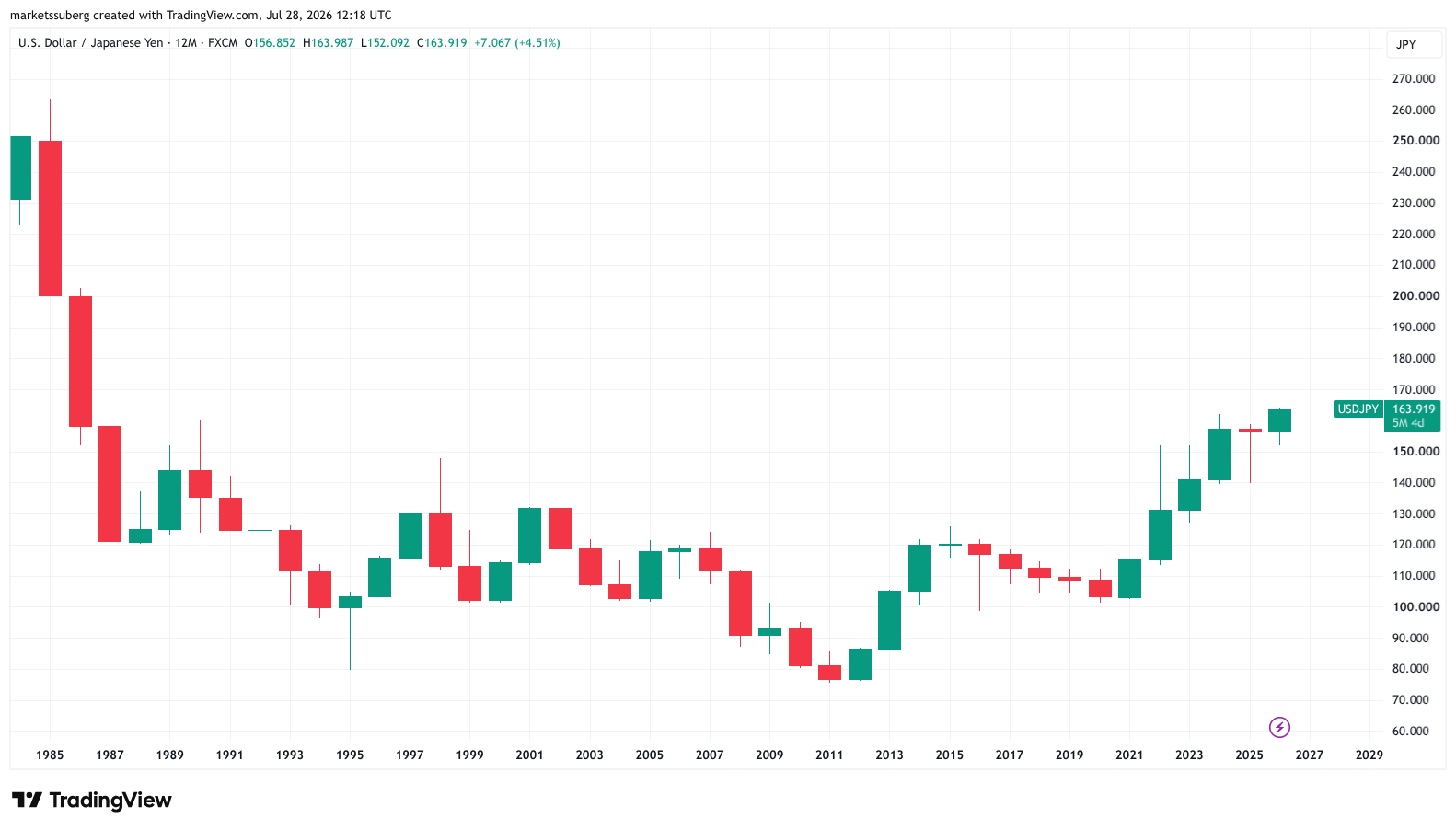
Japan’s central bank is in focus this week as its next interest-rate meeting comes amid new 40-year yen lows against the US dollar.
Key points:
- The Japanese yen is approaching new 40-year lows against the US dollar, nearly beating its latest record from last week.
- The Bank of Japan will decide on interest-rate changes on July 31, with rates already at 1%, their highest since September 1995.
- Analysts have been warning that the yen carry trade could unwind again, repeating a major crypto headwind from 2024.
Dollar-yen seeks to reclaim 40-year record
Data from TradingView showed USD/JPY approaching 164 on Tuesday, just a fraction below new 40-year highs seen last week.
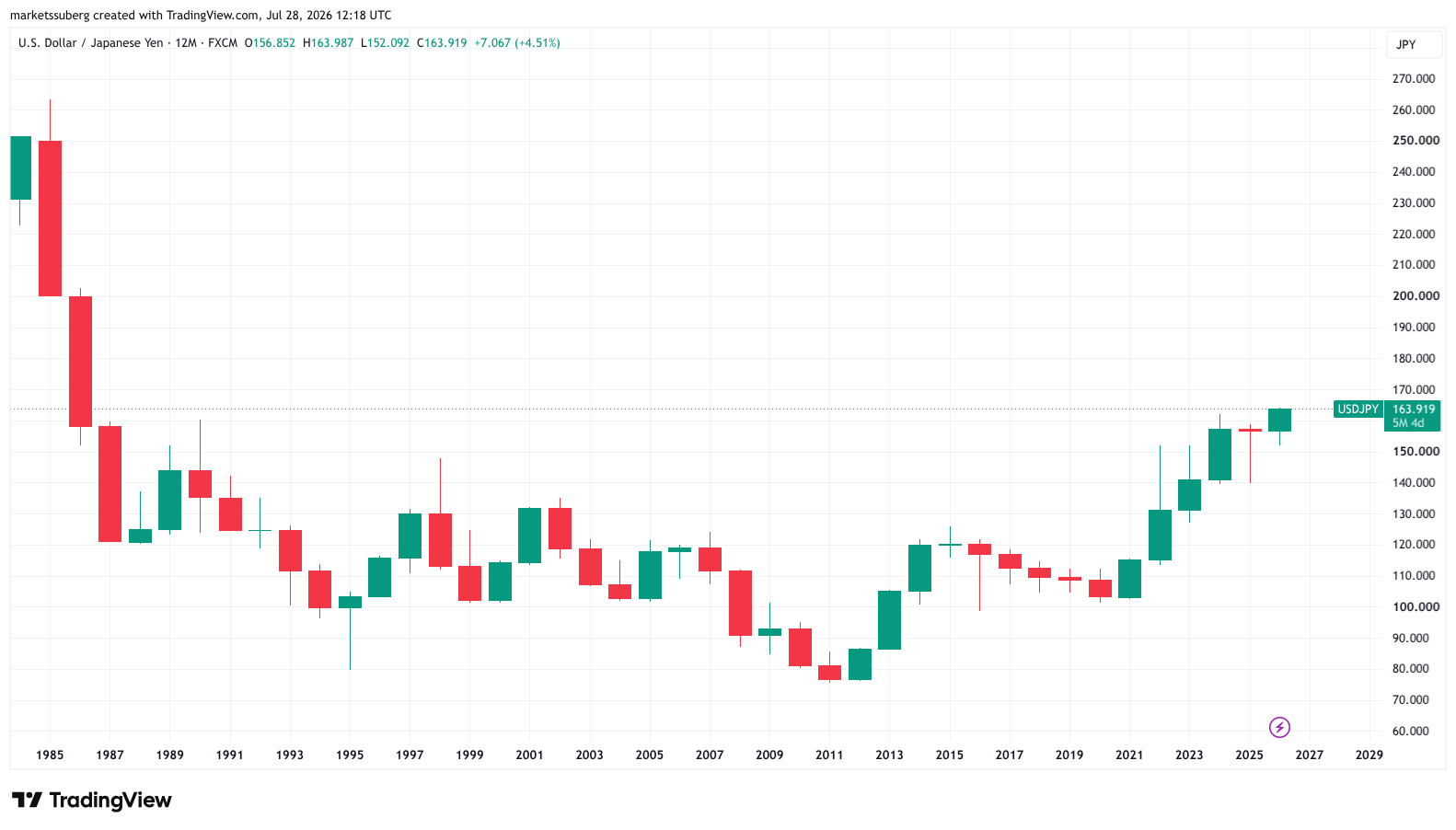
USD/JPY 12-month chart. Source: Cointelegraph/TradingView
The yen’s status as a funding currency is making BoJ monetary policy have an outsized influence on global markets. Japan’s currency markets are characterized by minimal capital controls and unmatched liquidity among non-dollar currencies.
Japan’s persistent current account and trade surpluses in earlier decades along with systemically low interest rates have made JPY the most important global funding currency. However, since Japanese inflation picked up in 2022, this has created the risk of carry trade unwinds accompanied by a liquidity crunch.
On Thursday and Friday, the Bank of Japan (BoJ) will decide on whether to adjust its benchmark rate, which at 1.0% is currently at its highest since 1995.
Markets expect rates to stay the same, with market-implied probabilities of a rate hold at 98%, given that policymakers enacted their latest raise in June. Prediction service Polymarket puts the odds of no change at 99% as of Tuesday.
At the time, however, the BoJ suggested that fresh hikes would come later. In a summary from the June meeting, it referenced inflationary trends in the form of the Consumer Price Index (CPI), coupled with historically low rates in place for the past three decades, as grounds for the change.
“As for the future conduct of monetary policy, given that underlying CPI inflation has been approaching 2% and financial conditions have been accommodative, it is appropriate for the Bank to continue to raise the policy interest rate and adjust the degree of monetary accommodation, in response to developments in economic activity and prices as well as financial conditions,” BoJ said.
Since then, a concurrent headwind, the weakening of the yen, has gathered pace, staying above the key 160 level against the dollar despite a dip following the June rate hike.
The BoJ previously noted the potential for a weaker yen to weigh on CPI growth, constricting consumer spending power.
“Attention should also be paid to the point that, with firms’ behavior shifting more toward raising wages and prices recently, exchange rate developments are, compared to the past, more likely to affect prices, and that such moves could affect underlying CPI inflation through changes in inflation expectations,” its Outlook for Economic And Prices document, issued after its April meeting, read.
Yen carry trade unwind risks global spread
For crypto traders, developments in the yen are of key importance. The yen carry trade, which can act as a liquidity source for crypto markets, is heavily influenced by BoJ moves to stabilize the yen’s exchange rate against the dollar. As Cointelegraph reported, interventions in August 2024 sparked a snap “unwinding” of the carry trade, with an immediate detrimental impact on Bitcoin and altcoins.
Related: Rate path still divides investors: Five things to know in Bitcoin this week
Now, with USD/JPY building on new 40-year highs, concerns of a repeat are growing.
“That trade only works if two conditions remain intact. Japanese interest rates remain exceptionally low. The yen remains broadly stable or continues depreciating,” analyst Ricky Ho wrote in his latest X commentary on Monday.
Ho said that carry-trade unwinds are “rarely gradual” thanks to high amounts of leverage deployed by participants.
He warned that any changes in BoJ policy could thus have wider-reaching consequences for a global economy already accustomed to the Japanese economic status quo.
“Ultimately, we think investors remain too focused on whether the BOJ hikes in September, October or December. The more important issue is that the direction of policy has fundamentally changed,” Ho said.


John Oliver’s return to Last Week Tonight landed on crypto’s most politically charged fault line. The TRUMP crypto memecoin is trading near $1.48, down about 6% over the past day. Meanwhile, Bitcoin sits around $63,460 after slipping roughly 2%, reflecting cautious sentiment ahead of key macro events.
Oliver’s HBO exposé highlighted one striking figure. Trump’s first year back in office reportedly generated more than $2.2 billion in personal income. Around $1.4 billion came from crypto ventures, including NFTs, memecoins, and World Liberty Financial. He called Trump “the first crypto president” and traced his shift from dismissing Bitcoin to embracing digital assets.
The segment also described the TRUMP memecoin as a classic pump and dump. Oliver argued insiders sold into strength while many retail investors absorbed steep losses. He tied that criticism to the Trump family’s expanding crypto business and questioned whether political influence amplified investor demand.
For markets, the bigger issue is regulation. Ethics lawyers argue that a sitting president earning substantial crypto revenue creates an obvious conflict of interest. Whether that leads to tighter oversight or fuels more speculation around Trump crypto tokens remains a key question traders continue to weigh.
Discover: The Best Crypto to Diversify Your Portfolio
Can TRUMP Crypto Memecoin Recover, or Is $1.50 the New Ceiling?
At $1.48, TRUMP is pressing against a range that has offered little meaningful technical support since its sharp post-launch decline. The recent 24-hour range sits between roughly $1.47 and $1.56. Sellers continue rejecting rallies near the upper boundary, while buyers struggle to defend recent lows with conviction.
Volume remains the key factor. Oliver’s segment has brought fresh attention, but attention cuts both ways for a memecoin. It attracts speculative traders while reinforcing the pump-and-dump narrative for a much wider audience. Meanwhile, Bitcoin trades near $63,460, down about 2% on the day, offering little support for risk assets.
The bullish case depends on political headlines fueling speculative inflows. If TRUMP reclaims $1.56 with sustained volume, it could target $1.75 next. Even so, that outcome looks difficult unless Bitcoin regains momentum and market sentiment improves.
The base case favors consolidation between $1.45 and $1.56 as Oliver’s criticism continues circulating. Regulatory scrutiny may also keep buyers cautious. As a result, many holders could remain trapped on thin margins while waiting for a stronger catalyst.
The bearish case starts with a decisive break below $1.47. That would expose the $1.40 area if selling pressure accelerates. Any meaningful congressional action involving crypto conflicts of interest could intensify downside pressure, although no formal action has been announced.2 hours.
Trade Memecoins on Bybit and Get a Chance to Win Our $1,000 USDT Airdrop
Bitcoin Hyper Eyes Early-Stage Entry as Political Heat Pressures Meme Plays
When politically exposed tokens carry headline risk, and BTC softens on macro pressure, rotation tends to find infrastructure plays rather than narrative ones. The current market structure, with BTC dominance in flux and alt-season signals emerging, rewards projects that offer technical utility over political adjacency. That’s the environment Bitcoin Hyper ($HYPER) is raising into.
The project’s positioning is straightforward and technically specific: it is the first-ever Bitcoin Layer 2 integrating the Solana Virtual Machine (SVM), delivering smart contract execution and transaction throughput that, by design, outperforms Solana itself at the infrastructure level.
While inheriting Bitcoin’s security and trust model. That’s a meaningful combination if the architecture delivers, addressing Bitcoin’s three core limitations (slow finality, high fees, no programmability) without abandoning the base layer’s guarantees. The Decentralized Canonical Bridge handles BTC transfers natively.
Presale numbers as of this writing: $0.0136838 per $HYPER, with $33 million raised. Staking is live with a high APY incentive for early participants. With BTC under near-term pressure, a Bitcoin-native infrastructure presale absorbs a different risk profile than a memecoin.
Research Bitcoin Hyper before the current stage closes.
Discover: The Best Token Presales
The post John Oliver Rips Trump Crypto Involvement as “Flagrantly Corrupt and Compromised” appeared first on Cryptonews.

SEC Crypto: Securitize Capital, the advisory subsidiary of tokenized asset platform Securitize, has registered with the SEC as a full investment adviser, unlocking expanded institutional mandates for its onchain capital markets business.
The move graduates the firm from exempt reporting adviser status, under which it operated with constraints that limited the scope of the assets and clients it could serve.
Securitize announced the registration on Monday, framing it as a direct expansion of its regulated business stack. CEO Carlos Domingo said the registration strengthens the company’s ability to help institutions develop and manage investment strategies for onchain capital markets, according to Securitize.

Discover: The Best Crypto to Diversify Your Portfolio
What the Registration Actually Changes For Securitize
As an exempt reporting adviser, Securitize Capital operated under a lighter regulatory regime, primarily suited to venture capital or private funds with limited U.S. assets.
Full SEC registration under the Investment Advisers Act imposes additional disclosure, compliance, recordkeeping, and examination requirements, but it also removes the constraints on who the firm can advise and at what scale.
The practical effect: Securitize can now pursue a wider range of institutional advisory mandates, separately managed accounts, broader private fund structures, and formal investment strategies built around its tokenization infrastructure, without the cap imposed by exempt status.
This also completes Securitize’s U.S. regulatory stack in a meaningful way. The firm already operates an SEC-registered broker-dealer, an alternative trading system, a transfer agent, and fund administration services.
Adding a full RIA license positions it as a vertically integrated, regulated infrastructure provider for tokenized securities, a configuration few competitors can match. For context on the broader push toward regulated institutional infrastructure in crypto, the regulatory momentum driving institutional adoption has been building across multiple fronts in 2026.
Scale and Asset Manager Relationships
Securitize is the largest tokenization platform by onchain asset value, with approximately $4.8 billion in tokenized assets across funds managed by BlackRock, Apollo, KKR, VanEck, Hamilton Lane, and other institutional asset managers.
That existing franchise is what the advisory registration layers on top of; this is not a startup building toward institutional relevance, it’s a firm with established AUM relationships formalizing the advisory wrapper around them.
The Apollo relationship is worth flagging specifically. Securitize Capital has been listed as the contact on SEC filings tied to the Securitize Tokenized Apollo Diversified Credit Fund, indicating active work in tokenized credit strategies. Full RIA status makes structuring and managing those types of mandates more straightforward from a regulatory standpoint.
The trajectory here mirrors what’s happening elsewhere in institutional crypto infrastructure. Ripple’s push into institutional finance with RLUSD and prime brokerage and Fasanara Capital’s on-chain activity in institutional DeFi both reflect the same pattern: traditional capital isn’t waiting for perfect regulatory clarity before committing infrastructure spend to onchain markets.
Public Company Context and Stock Performance
Securitize began trading on the New York Stock Exchange under the ticker SECZ on July 2, after completing a merger with Cantor Equity Partners II. Shares have since fallen roughly 46% from their first-day closing price – a sharp correction that adds some irony to a week of regulatory milestone announcements.
The neoclassical facade of the New York Stock Exchange building on Wall Street.

The stock decline doesn’t directly undercut the strategic logic of the RIA registration, but it does put the compliance build-out in context: Securitize is now a public company with earnings obligations, and the advisory license needs to translate into fee-generating mandates to justify the increased regulatory overhead.
The infrastructure is compelling; the revenue model tied to it is what the market is apparently still pricing in.
For institutional asset managers already running tokenized funds through Securitize’s platform, full RIA status likely reduces friction around adding advisory services to existing relationships.
Whether that converts into new AUM inflows or an expanded mandate scope in the near term is the open question that the registration itself doesn’t answer.
Trade Ripple XRP on Bybit and Get a Chance to Win Our $1,000 USDT Airdrop
The post Securitize Gains Full RIA Status to Expand Onchain Advisory Mandates appeared first on Cryptonews.

Adam Draws the String, PNDbotics’ Humanoid Steps Into Archery Territory

Fresh Look Beauty Classes: Weekend Beauty Courses for Busy Students

PayPal expands stablecoin push as crypto assets factor into Q2 results


-

 Fashion4 days ago
Weekend Open Thread: Brooks Brothers
-

 NewsBeat7 days ago
How a former Blue Peter presenter stunned America’s Got Talent judges
-
 Business6 days ago
New Jersey voter registration controversy explained: How 6,600 noncitizens got on the rolls, and what happens next
-

 Tech2 days ago
Intel is reversing course and bringing hyper-threading back to its server chips
-
 Entertainment7 days ago
Johnny Depp’s R-Rated Gothic Cult Classic Gets New Release Ahead of Sydney Sweeney Remake
-

 Crypto World6 days ago
Ethics, other provisions in crypto Clarity Act to be further discussed
-

 Politics1 day ago
Luke Littler dismantles Gerwyn Price to retain title in Blackpool
-
 Sports2 days ago
Commonwealth Games boxing: Jadumani Singh seals dominant 5-0 win over Pakistan’s Sumama Rehman to enter quarter-finals | Commonwealth Games News
-

 Sports4 days ago
2026 3M Open leaderboard: Scottie Scheffler finds putter in Round 1, sits three back
-

 Fashion4 days ago
16 Dresses for the High Summer Event
-

 Politics5 hours ago
The Part of the Electric Transition Nobody Wants to Discuss
-

 News Videos5 days ago
The Peugeot Family: How 200 Years of an “Old Money” Dynasty Died in A Boardroom
-

 Politics2 days ago
Spain sweeps the board at 2026 World Cup with individual awards
-

 News Videos2 days ago
BITCOIN JUST ENTERED THIS CRITICAL ZONE…
-
 Entertainment4 days ago
A New Post-Apocalyptic Gundam Anime Series Blasts Into SDCC
-

 Crypto World2 days ago
XRP Ledger adds $2.6B as RWA inflows rank second
-

 Crypto World3 days ago
Ripple bought a bank in pieces. The $4 billion audit
-

 Tech3 days ago
Anthropic launches Claude Opus 5, a cheaper AI model for coding, agents and enterprise workflows
-

 Crypto World5 days ago
Uniswap (UNI) pushes deeper into tokenized RWAs with permissioned trading pools
-

 Entertainment3 days ago
Sara Gilson Killed By Husband After Viral “Pedophile” TikTok Video
You must be logged in to post a comment Login