

Crypto World
Solana price climbs back above $90 as upgrade narrative meets heavy trading

Solana price rises back above $90 with multi-billion-dollar volume as traders bet on congestion fixes, the Alpenglow upgrade, and SOL’s role as a leading high-throughput layer-1.
Summary
- Solana price is trading around $92–$93 today, with a market cap near $52.9 billion and 24-hour volume of roughly $4.2–$4.4 billion.
- The layer-1 token has gained about 3.3% over the past 24 hours and roughly 2.8% in the last seven days, outpacing the broader market’s 1.3% daily rise.
- Ongoing work to address network congestion and upcoming protocol upgrades are helping shape Solana’s position as a high-throughput Ethereum rival despite its history of outages.
Solana (SOL) price is changing hands around $92.39 today, up 0.62% in the last hour, 3.27% over the past 24 hours and 2.78% in the past week, giving it a market capitalization of about $52.88 billion and 24-hour trading volume near $4.18 billion. External dashboards place SOL’s current price in the $92.02–$92.64 band, with a circulating supply of roughly 572.25 million tokens, a market cap of around $52.65–$52.89 billion and 24-hour volume between about $4.34 billion and $4.39 billion. Over the past several sessions in March, daily closes have clustered roughly in an $86–$94 range, confirming a consolidation phase after a volatile start to the month.
That performance is unfolding in a firm market: the total crypto market cap stands near $2.45 trillion, up about 1.31% over the last day, putting Solana among the stronger large-cap performers over the same period. In earlier March snapshots, SOL traded around $84.56 with a market cap of $48.18 billion and 24-hour volume of $5.40 billion, then climbed toward the mid-$90 area with a market capitalization near $54 billion and daily volume described as “moderate,” highlighting a steady recovery rather than a single spike. Together, these figures point to a liquid, actively traded market where price is being driven by both spot demand and derivatives positioning.
Solana is a high-throughput layer-1 blockchain that combines a proof-of-stake consensus mechanism with a timing technique called proof of history, which allows validators to order transactions more efficiently and target tens of thousands of transactions per second. The network has become a core venue for decentralized finance, NFTs, and consumer apps, with SOL serving as the native asset for transaction fees, staking and collateral, firmly placing it in the layer-1 smart contract platform category rather than a DeFi protocol or AI token. Historically, this speed-focused design has come with a trade-off: Solana has experienced multiple outages and congestion episodes, including several multi-hour network halts in 2023 and earlier, which pushed developers and validators to prioritize stability improvements.
More recently, the project has been preparing a major core protocol overhaul known as Alpenglow, described as the most significant reconsideration of Solana’s architecture to date and expected in the first half of 2026. Community governance records show that about 98% of participating token holders backed the upgrade in a 2025 vote, indicating broad internal support for changes aimed at improving decentralization, throughput and fee dynamics. In parallel, client teams have rolled out updates such as version 1.17.31 and follow-on releases to mitigate persistent network congestion and transaction failures that surfaced during recent periods of high meme-coin and NFT activity.
Although detailed whale transaction feeds for Solana are spread across multiple analytics sites, available market metrics demonstrate heavy participation by larger traders and leveraged players. Historical data shows that on March 25, 2026, SOL traded in a $90.82–$93.21 band with daily volume around 4.43 billion units, corresponding to multi-billion-dollar turnover at current prices. Another dataset cites a volume-to-market-cap ratio near 8.2–8.3%, based on roughly $4.34–$4.39 billion in volume against a market cap just above $52.6 billion, a level of activity consistent with ongoing directional trading and derivatives hedging rather than solely passive holding.
Sector-wide, Solana is part of a cluster of alternative layer-1 networks that includes Ethereum, Avalanche and Sui, all of which compete on smart contract capacity but with different trade-offs in fees, security models and decentralization. Today, Ethereum trades around $2,180 with a market cap of about $263.11 billion and 24-hour volume near $19.19 billion, while Avalanche changes hands around $9.74 with a market cap of $4.21 billion and $262.28 million in daily volume, and Sui trades near $0.969 with a market cap of $3.78 billion and $382.72 million in 24-hour volume. This positions Solana as one of the most valuable and actively traded non-Ethereum smart contract platforms, a status that has persisted despite its checkered stability history and now rests heavily on the successful delivery of congestion fixes and the Alpenglow upgrade.
Within that broader landscape, Solana’s latest push back above $90 looks like a textbook consolidation rally in a flagship layer-1: price grinding higher in a defined range, supported by billions in daily volume and a clear catalyst path in the form of protocol upgrades and congestion relief.


TLDR
- Bitmine reduced its weekly ether purchases after months of rapid accumulation in 2026.
- The company bought 26,659 ETH last week, worth about $63 million at current prices.
- Bitmine now holds more than 5.2 million ETH, which equals about 4.31% of Ethereum’s circulating supply.
- Tom Lee said the firm slowed buying as it approached its long-term goal of owning 5% of supply.
- Bitmine has acquired over 1 million ETH since the start of this year.
- The company’s total crypto and cash holdings stand at $13.4 billion.
Bitmine Immersion Technologies has reduced its weekly ether purchases after months of rapid accumulation. Chairman Tom Lee confirmed the shift after the firm approached its 5% Ethereum supply target. The company still holds over 5.2 million ETH after buying more than 1 million tokens this year.
Bitmine Eases Weekly Ether Accumulation Pace
Bitmine bought 26,659 ETH last week, valued at about $63 million at current prices. However, that figure equals roughly one quarter of its recent weekly average. The purchase increased total holdings to over 5.2 million ETH, or about 4.31% of the circulating supply.
Tom Lee addressed the change during remarks at Consensus 2026 in Miami. He said the company would reduce weekly purchases from over 100,000 ETH. “Our previous pace of buys would have us reach 5% by mid-July,” Lee said in a statement.
The company adjusted its pace as it neared its long-term acquisition target. Lee said Bitmine considered easing purchases once it approached the 5% threshold. The firm has already acquired more than 1 million ETH since January 2026.
Bitmine continues to buy ether despite the broader market downturn. Lee stated that the company remains committed to its treasury strategy. He described the recent months as one of the fastest accumulation periods in the crypto sector.
He also expressed confidence in current market trends and recovery signals. “We have decided to slow down our pace of weekly accumulation,” Lee said. He linked the change to timing rather than a shift in outlook.
Ethereum Holdings and Treasury Composition
Bitmine’s total crypto and cash holdings stand at $13.4 billion. The company holds 201 Bitcoin alongside its Ether reserves. It also maintains $775 million in cash and equity stakes.
Those equity investments include Beast Industries and Eightco Holdings. However, ether remains the core asset in the company’s treasury. The firm focuses its strategy on Ethereum’s long-term supply position.
Bitmine has staked more than 4.7 million ETH from its total holdings. That amount represents over 90% of its ether balance. The staked assets currently hold an estimated value of $11.1 billion.
The company operates its MAVAN staking platform to manage these assets. It launched the platform earlier this year for institutional clients. Bitmine also uses MAVAN for its internal treasury operations.
Lee reiterated his outlook for Ether’s price performance. “If ETH closes above $2,100 at the end of May, this would be the third consecutive monthly gain,” he said. He added that such a streak has not occurred during a crypto bear market.
The company continues to monitor Ether’s monthly performance levels. Lee linked price strength to improving sentiment in software and growth stocks. He maintained that what he calls “crypto spring” has begun.

Crypto World
Crypto platform Kraken is raising capital at $20 billion valuation ahead of its planned IPO


Payward, the parent company of crypto platform Kraken, is raising new capital at a $20 billion valuation, according to two people with knowledge of the matter.
Kraken declined to comment on the raise.
The latest fundraising round comes as the company ramps up spending on takeovers.
Most recently, it bought stablecoin-focused payments firm Reap for $600 million and digital asset derivatives platform Bitnomial for $550 million as it continues to scale up ahead of a planned IPO. Payward was valued at $20 billion in both transactions.
Its biggest deal came in 2025 with the $1.5 billion acquisition of NinjaTrader, a U.S.-based retail futures platform and CFTC-registered futures commission merchant. The acquisition gave Kraken a major foothold in the U.S. derivatives market while expanding its reach to a broad base of active futures traders.
Payward said it confidentially submitted a draft S-1 registration statement to the U.S. Securities and Exchange Commission on November 19, marking the first step toward a potential public listing.
CoinDesk reported in March that the company had paused its IPO plans amid unfavorable market conditions. Sources said the firm remains interested in going public, though likely only once market conditions improve.
At Consensus Miami last week, Payward and Kraken co-CEO Arjun Sethi said the exchange is “80% ready” to go public.
Kraken is a U.S.-based cryptocurrency exchange that lets users buy, sell and trade digital assets, including bitcoin and ether, using either fiat currencies or crypto. The company has expanded beyond spot trading into products such as derivatives, staking and custody, transforming itself into a broader full-service crypto platform.
In recent years, the Wyoming-based firm has adopted a more focused but increasingly strategic acquisition strategy aimed at expanding beyond core crypto trading into derivatives and broader multi-asset market infrastructure.
Deutsche Börse stake
Deutsche Börse (DB1), the owner of the Frankfurt Stock Exchange and Xetra, announced in April that it had taken a $200 million stake in Payward.
The stake, acquired through a secondary share sale, represented roughly 1.5% of the company. The transaction valued Payward at $13.3 billion, down from the roughly $20 billion valuation attached to previous fundraising rounds. Payward did not receive any proceeds from the transaction.
Last November, Kraken said it had raised $800 million in two tranches to support its push into bringing traditional financial products onchain. The round included backing from investors such as Jane Street, DRW Venture Capital and Tribe Capital, while Citadel Securities later agreed to a separate $200 million strategic investment at a $20 billion valuation.
Read more: Kraken parent goes for the OCC charter in bid to become a federal crypto bank


Co-founder Adeniyi Abiodun unveiled confidential transactions at Sui Live Miami, the same week SUI Group Holdings staked its entire $140M treasury.

Key Takeaways
- AST SpaceMobile shares climbed 12.15% Monday before its Q1 2026 quarterly results, scheduled for release after market close
- Wall Street consensus calls for a $0.2125 per-share loss with $37.5 million in quarterly revenue
- The company lost a BlueBird 7 satellite following a Blue Origin launch malfunction; insurance coverage anticipated
- Rising rivalry from Amazon’s $10.8 billion Globalstar acquisition and SpaceX’s Starlink platform intensifies market dynamics
- Implied volatility suggests a roughly 12.1% price swing following the earnings announcement
Shares of AST SpaceMobile (ASTS) surged more than 12% during Monday’s session, reaching $75.05, as market participants braced for the company’s first-quarter 2026 financial results set to drop after the closing bell.
Despite Monday’s strong performance, the stock remains significantly below its 52-week peak of $129.89, indicating substantial ground left to recover.
Analyst consensus points to a quarterly loss of $0.2125 per share alongside revenue of $37.5 million for the March period. These figures would represent progress from the previous quarter’s $0.26 loss per share, although revenue is projected to decline from the $54.3 million recorded in Q4.
Per-share loss estimates have deteriorated by 15.1% during the last two months, reflecting increasing analyst skepticism ahead of the results.
Launch Failure Raises Questions About Deployment Strategy
A failed Blue Origin New Glenn rocket mission last month resulted in AST‘s BlueBird 7 satellite being placed in an incorrect orbit. The satellite has since reentered the atmosphere and is classified as a complete loss, although the company confirms insurance will cover the incident.
Initial projections called for deploying 45 to 60 satellites throughout this year. Industry analyst Tim Farrar now forecasts actual deployments between 21 and 42 units, complicated by the FAA’s current grounding of the launch vehicle.
Market observers will pay close attention to any guidance updates regarding adjusted deployment schedules and backup launch provider arrangements.
Company leadership previously established a 2026 revenue goal ranging from $150 million to $200 million, banking on accelerated commercial launches during the year’s latter half. Wall Street projects revenue could hit $1 billion in 2027.
Amazon and SpaceX Intensify Direct-to-Device Battle
Competitive dynamics have evolved rapidly. Amazon’s approximately $10.8 billion deal to purchase Globalstar represents a major entry into satellite-to-device communications. Deutsche Bank subsequently lowered its AST price target, anticipating increased pricing competition.
SpaceX’s Starlink platform maintains market leadership and currently operates commercial services in partnership with T-Mobile.
Industry forecasts project the direct-to-device sector will expand from $570 million in 2025 to $2.64 billion by 2030, underscoring the importance of successful execution.
Among 10 analysts tracking ASTS, three maintain buy ratings, five recommend holding, and two advise selling. The average price target stands at $83.90, suggesting approximately 12% potential upside from current trading levels. Price targets span from Scotiabank’s $41.20 to Clear Street’s $115.
Options trading volume ahead of earnings runs at 1.6 times typical levels, with call options outnumbering puts by a 3-to-1 margin. Derivatives markets indicate an expected price movement of approximately 12.1%, or roughly $10, following the earnings release. Historical data shows a median 9% post-earnings move across the previous eight quarters.
The broader space technology sector also posted gains Monday, contributing momentum to ASTS’s advance.


For years, Audemars Piguet (AP) timepieces were regarded as a mark of success for a certain kind of crypto bro. Over the weekend, the watchmaker announced that it’s collaborating with Swatch, an entry-level watchmaker.
The “Royal Pop” collab has, in the eyes of crypto investors who bought into AP’s ostensibly exclusive brand, destroyed its reputation as a wealth signal for crypto bros who’ve made it.
Indeed, Protos spoke with two watch resellers who say that complaints from AP owners are “raining in.”
The AP watch that inspired the upcoming Swatch design, AP’s Royal Oak, has long sold for north of $30,000. Models of Royal Oak with more rarity, such as the 15202ST, have even resold for six figures.
To the dismay of collectors who thought AP would protect its brand, both companies called the partnership a “disruptive collaboration that fuses joyful boldness.”
Translated into crypto jargon, it was a rug-pull.
Social status devastation
Crypto Twitter understood the framing immediately. “Imagine owning a Royal Oak and a dude in a Swatch comes up to you like hey man nice watch I got one too 10/10 for crypto influencers all over again lmao.”
Another commentator wrote what others were thinking: “The crypto bros can finally get their AP. Even the ones who roundtripped their entire port or are down 96.69%. Shoutout to Swatch.”
An NFT veteran with more than 277,000 followers laughed, “Can’t wait to buy my black royal oak x swatch so I can act like a cool kid at my next crypto event.”
AP’s Swatch collab, announced over the weekend, drops on Saturday, May 16. In plastic. For approximately $500.
Chopping the Royal Oak down
High-end AP watches like Royal Oak earned the attention of newly enriched crypto influencers. Their watches had scarce supply, cultural cachet, a chart that only went up.
From 2019 to early 2022, AP prices charted like a crypto runner.
The Royal Oak 15202ST Jumbo averaged about $21,800 on the secondary market in 2016, per dealer data. By 2021, it averaged $69,000. By 2022, it peaked near $106,000.
The move tracked the crypto bull market in lockstep which peaked in November 2021, before losing two-thirds of its value within 12 months.
Even before this week’s disappointment, dealer data showed AP 15202ST watches changing hands at roughly one-third less than their 2022 peak.
Read more: Bitconned: The story of Miami crypto bros facing 100 years in prison
Even prior to the Swatch collab, AP has performed the worst this year among its big three Swiss peers on the secondary market.
AP resales struggled to stay up just 3.4% according to SwissWatchExpo and Le Watch Buyers data cited by Borro. In contrast, Patek Philippe gained 16% and Rolex added 8%.
Got a tip? Send us an email securely via Protos Leaks. For more informed news and investigations, follow us on X, Bluesky, and Google News, or subscribe to our YouTube channel.
Digital asset company Galaxy and Ethereum treasury platform Sharplink will launch a private fund that will invest Ether in decentralized finance (DeFi) strategies, signaling growing institutional interest in earning onchain yield from crypto holdings.
The proposed fund, called the Galaxy Sharplink Onchain Yield Fund, is expected to launch in the coming weeks with $125 million in initial commitments, the companies said Monday.
Sharplink plans to contribute $100 million from its staked Ether (ETH) treasury, while Galaxy will commit $25 million and serve as the fund’s manager.
The fund will allocate capital to DeFi liquidity protocols and other onchain yield opportunities, with the goal of generating additional returns while allowing Sharplink to maintain its long-term exposure to Ether.
Galaxy CEO Mike Novogratz said the structure reflects growing institutional demand for blockchain-based investment products that offer yield and risk management tools similar to those used in traditional finance.

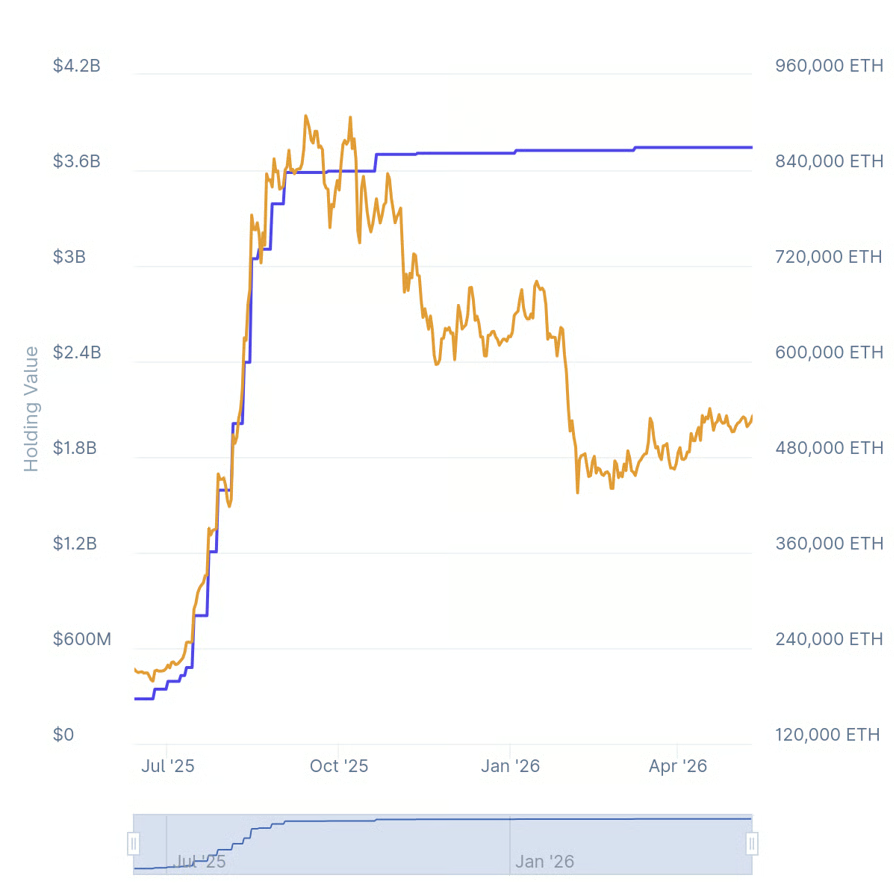
The value of Sharplink’s Ether portfolio. Source: CoinGecko
Sharplink is one of the largest corporate holders of Ether, with more than 868,000 ETH on its balance sheet. At October market highs, those holdings were valued at nearly $4 billion.
Related: Crypto Biz: Wall Street wants more than just Bitcoin
Sharplink posts nearly $686 million Q1 loss as ETH price declines
Sharplink has continued to expand its Ethereum treasury strategy despite a sharp first-quarter loss driven by Ether’s price decline.
The company on Monday reported a net loss of $685.6 million, or $3.25 per diluted share, primarily due to non-cash accounting charges related to the drop in ETH prices during the quarter. Of that total, $506.7 million was attributed to unrealized losses on its Ether holdings.
Ether fell from a mid-January high of about $3,354 to $2,104 on March 31, according to CoinMarketCap data. It was last trading hands on Monday at about $2,339.
Revenue in the quarter rose to $12.1 million from $700,000 a year earlier, reflecting growth in the company’s operating business.
Since launching its Ether treasury strategy in June 2025, Sharplink has earned approximately 18,800 ETH in cumulative staking rewards. The company ended the first quarter with $16.9 million in cash.

Sharplink’s balance sheet as of March 31, 2026. Source: Sharplink
The results underscore the volatility associated with crypto treasury strategies, particularly for companies that accumulated large positions over the past year. Similar pressures have affected Bitcoin treasury companies, where earnings can swing sharply with underlying asset prices.
Related: Crypto treasury companies likely to consolidate in 2026: Crypto exec

Australia Targets Long-Term Crypto Gains Through New CGT Framework
Australia moved closer to changing its capital gains tax structure for cryptocurrencies and other assets. Bitcoin traded near $103,000 during the proposal discussions, while broader crypto markets remained stable. The government plans to replace the current 50% CGT discount with an inflation-indexed tax framework from 2027.
The proposed reform appeared ahead of Australia’s federal budget announcement scheduled for Tuesday night. Treasurer Jim Chalmers is expected to outline the full proposal during the fiscal budget presentation. The plan would directly affect cryptocurrencies, shares, and other long-term investment assets.
The government also plans to offer a transition period for newly acquired assets. Assets purchased after budget night would still receive the existing discount until mid-2027. However, the updated framework would later apply to gains earned on those holdings.
Crypto Market Faces Higher Compliance and Tax Costs
The proposal could increase compliance requirements for cryptocurrency holders across Australia. Traders and long-term holders would need to track inflation-adjusted cost bases more accurately. Consequently, tax reporting processes could become more complex for digital asset transactions.
The government framed the reform as part of a broader effort to modernize Australia’s tax system. Authorities also continue expanding digital asset regulations across trading and custody services. Last month, Australia approved new licensing rules for digital asset and tokenized custody platforms.
Critics argued that the tax overhaul could redirect capital away from productive investments. Some market participants warned that higher CGT rates may favor owner-occupied housing over businesses and commercial assets. Others stated that investment activity could continue if market returns remain attractive.
Australia Expands Crypto Regulation Alongside Tax Reforms
The proposed CGT overhaul arrived as Australia increased oversight of the digital asset industry. Regulators recently introduced licensing requirements for crypto platforms operating within the country. The government stated that the measures aim to improve accountability and market standards.
The updated tax structure would also align cryptocurrencies more closely with other taxable investment classes. Officials expect the inflation-linked model to calculate gains more accurately during periods of rising prices. However, many long-term crypto holders could still pay more tax compared with the current system.
Australia’s crypto sector now faces simultaneous regulatory and tax adjustments ahead of 2027. The proposed changes could reshape trading behavior and long-term holding strategies across the market. Parliament is expected to debate the measures after the federal budget announcement.
Bitcoin (BTC) could be set for an extended uptrend, with a pending bullish signal from a key valuation metric suggesting that BTC prices might go “much higher,” according to crypto analysts.
Key takeaways:
- Bitcoin’s MVRV golden cross signals a shift to bullishness, historically preceding prolonged price rallies.
- Bitcoin traders argue $60,000 was the bear market bottom, see “huge” BTC price breakout next.
Bitcoin MVRV momentum sends a “trend reversal signal”
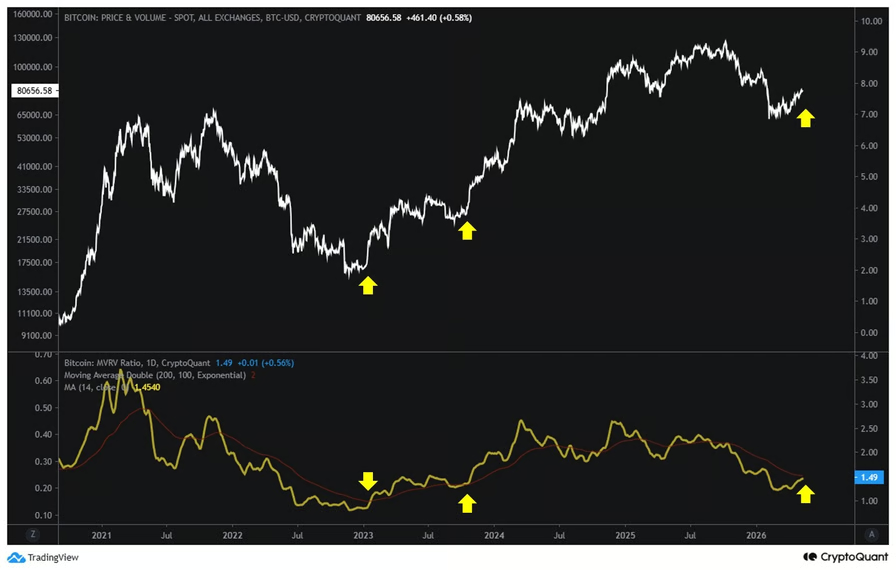
Bitcoin’s Market Value to Realized Value (MVRV) ratio, an indicator that measures whether the asset is overvalued, is about to print a “golden cross,” an occurrence that has previously preceded massive price rallies, according to CryptoQuant analyst CW8900.
Related: Saylor signals another Bitcoin buy after hinting at selling in Q1 earnings call
“A golden cross between the $BTC MVRV Ratio and the 200D EMA line is imminent,” the analyst said in an X post on Sunday, adding:
“This signal is a representative trend reversal signal and is a bullish indicator.”

Bitcoin MVRV momentum indicator. Source: CryptoQuant
The last time the indicator produced this bullish crossover was just after the 2022 cycle bottom, preceding a 90% BTC price rally to $31,000 from $16,300 in Q1 2023. Another cross in September 2023 was followed by a 400% bull run to the current all-time high of $126,000 reached in October 2025.
In an earlier analysis, CW8900 highlighted a golden cross when the 30-day simple moving average (SMA) of Bitcoin’s MVRV ratio crossed above its 90-day SMA in late April, saying:
“$BTC has completely turned to a bullish trend.”

Source: CW8900
Meanwhile, Bitcoin’s recent rally to $83,000 boosted the short-term holder (STH) cost basis level as newer buyers returned to profitability.
STH cost basis refers to the average purchase price of investors who have held Bitcoin for less than 155 days.
The chart below shows that the price could rise higher to touch the “heated” band of this metric, currently at $92,000.
Despite profit-taking at current prices, the STH risk zone suggests BTC can go higher in the short term with the “heated” band at $92,000 and the overheated band at $104,000.

Bitcoin short-term cost basis bands. Source: Glassnode
Bitcoin analysts say BTC’s “huge breakout” is coming
As Cointelegraph reported, analysts say Bitcoin is at a make-or-break point as it retests the 200-day moving average at $82,500.
A break above this level could end the multi-month downtrend, while a rejection could result in a fresh sell-off toward $50,000.
Analyst Shib Spain argues that BTC’s break above a multi-month downtrend line on the weekly chart marked a structural shift from bearish dominance, reinforced by a bullish crossover from the MACD indicator.
“Bitcoin’s huge breakout is coming. MACD bullish reversal forming,” the analyst said in a recent post on X, adding:
“The bull run is just getting started.”

BTC/USD daily weekly chart. Source: Shib Spain
Fellow analyst Moustache highlights the BTC market cap and its RSI bouncing off multi-year support lines on the monthly time frame, as shown in the chart below.
“Just like in 2022, I’ve called the bottom for $BTC again this cycle,” the analyst said in an X post on Monday, adding:
“Prices will go much, much higher. We’ve got something big to look forward to.”

Bitcoin market cap, USD. Source: X/Moustache
As Cointelegraph reported, several analysts predict a “supercycle” rally toward $180,000-$250,000 as early as this year, supported by institutional accumulation and a strengthening technical setup.
TLDR
- The Senate Banking Committee scheduled May 14 for the markup of the CLARITY Act.
- Lawmakers will debate amendments before voting on whether to advance the bill to the Senate floor.
- The House previously passed the CLARITY Act with a 294–134 bipartisan vote.
- The bill would define regulatory boundaries between the SEC and the CFTC.
- The Senate version expands the legislation to nine titles, including stablecoin oversight and bankruptcy protections.
The Senate Banking Committee will meet May 14 to mark up the Digital Asset Market Clarity Act. Lawmakers will debate amendments and decide whether to send the measure to the Senate floor. However, bank lobbyists and some Democrats now threaten to block the bill before it advances.
CLARITY Act Faces Senate Test After House Approval
The committee will hold the executive session at 10:30 a.m. in Room 538 of the Dirksen Senate Office Building. Chairman Tim Scott confirmed the schedule last week and opened the meeting to public livestream. Lawmakers will consider amendments before voting on whether to advance the bill.
The House passed H.R. 3633 on July 17, 2025, with a 294–134 bipartisan vote. All 216 Republicans supported the measure, while 78 Democrats joined them. Since then, the Senate delayed two markup sessions and extended talks over stablecoin oversight.
The CLARITY Act would define regulatory boundaries between the SEC and the CFTC. The bill grants the CFTC authority over spot markets for digital commodities. Meanwhile, the SEC would retain control over investment contract assets and primary offerings.
Senators expanded the Senate draft to nine titles covering decentralized finance safeguards and illicit finance rules. The text also includes bankruptcy protections for crypto customers and the Blockchain Regulatory Certainty Act. That provision would provide safe harbors for blockchain software developers.
Banking Lobby and Democratic Ethics Dispute Intensify
Major banks have increased lobbying efforts in recent weeks as the vote approaches. At the same time, Democrats demand ethics rules covering crypto holdings by public officials. Republicans argue that such provisions could derail the measure entirely.
Senators Cynthia Lummis and Bernie Moreno warned about tight legislative deadlines. They said failure to clear committee before the May 21 Memorial Day recess could delay action until 2030. The White House has set July 4 as its target for presidential approval.
SEC Chair Paul Atkins urged Congress on April 9 to advance the bill. He said both agencies stand ready to implement the framework once enacted. Atkins referenced “Project Crypto” as an internal readiness initiative.
Treasury Secretary Scott Bessent framed the legislation as a national security issue in a Wall Street Journal op-ed. He warned that regulatory gaps push blockchain firms toward Singapore and Abu Dhabi. White House crypto adviser Patrick Witt said negotiations over stablecoin yield have concluded.
Senator Lummis reiterated support after the Easter recess and wrote “Clarity” on X.
Speaking at the Bitcoin Conference, she stated, “We are gonna markup the CLARITY Act in May.” She added, “We are gonna get it to the finish line.”
Chairman Scott previously targeted September 2025 for a floor vote. He later moved the timeline to late 2025 and then to June or July 2026. The May 14 markup now represents the Senate’s first formal committee vote on the bill.

A comparative analysis published on May 11 by XWIN Japan tracked how Bitcoin, Ethereum, XRP, BNB, and Solana held up during the six months of market stress between October 2025 and April 2026.
According to the report, that downturn was less about panic selling alone and more about “internal selection,” with investors separating Bitcoin from the broader altcoin market amid macro stress and shrinking liquidity.
Bitcoin Stayed Ahead While Altcoins Took Deeper Losses
Going by XWIN’s data, BTC dropped 52.5% in that period, going from a peak of around $126,000 to roughly $60,000. And while that was a brutal fall in absolute terms, compared to the rest of the group, the flagship crypto held up better.
Solana got battered the most. It fell 71.6% from its highest level of $238 to $67. At the same time, Ethereum and XRP declined by 63%, while Binance Coin dropped 59%.
In terms of recovery from their bottom prices, SOL enjoyed the biggest bounce at 38%, with Bitcoin the second-best at 34.7%.
XWIN Japan’s analysis divided the six-month period into three phases, namely a derivatives-driven unwind in late 2025, a macro fear and liquidity contraction phase in early 2026, and an institutional-led recovery this spring.
What it found, broadly, is that BTC’s relative resilience wasn’t accidental, with the report pointing to ETF inflows, corporate treasury buying, and demand as a geopolitical hedge as ongoing sources of support through the worst of the selling.
“Even during market stress, capital consistently returned to Bitcoin,” the analysis stated, describing BTC as having become a global macro asset rather than just a crypto token.
ETH, by contrast, saw its price collapse despite network activity holding up. The report noted that staking growth, Layer-2 usage, and stablecoin settlement stayed strong throughout the drawdown period, even as the price fell from around $4,700 to below $1,800.
On the other hand, XRP’s relative performance was tied mostly to regulatory narrative and ETF expectations around cross-border payment themes, while BNB stayed somewhat steadier due to activity within the Binance ecosystem.
Where Things Stand
We can get an indication of how much progress has been made so far by looking at present-day prices for the assets XWIN quoted in its research. For instance, Bitcoin is trading at around $81,000, which is an 11% increase from the previous month.
ETH is around $2,300, up about 4% on the month, while XRP gained some 7.5% in the same period and was changing hands near $1.45 at the time of writing.
Solana, however, has had the strongest performance of them all, up more than 12% in the past month and about 12% on the week, and is currently trading near $95.
The post How Bitcoin Outperformed ETH, XRP, BNB, and SOL During 2025-2026 Market Stress appeared first on CryptoPotato.

UK firefighters respond to a lithium-ion battery fire every five hours, new data reveals

RTE to air Father Ted Eurovision episode in boycott of song contest
Saudi Aramco Profit Jumps Despite War Disrupting Shipping Routes

Manchester United reach agreement with Casemiro over contract clause amid transfer speculation

US brings back mandatory military draft registration

Steven Gerrard disagrees with Gary Neville over ‘shock’ Chelsea and Arsenal claim | Football


-
 Crypto World3 days ago
HarrisX Poll Found 52% of Registered Voters Support the CLARITY Act
-

 Fashion3 days ago
Weekend Open Thread: Marianne Dress
-

 Crypto World4 days ago
Upbit adds B3 Korean won pair as Base token gains Korea access
-

 Tech7 days ago
Image AI models now drive app growth, beating chatbot upgrades
-
 NewsBeat4 days ago
NCP car park operator enters administration putting 340 UK sites at risk of closure
-

 Tech2 days ago
Auto Enthusiast Carves Functional Two-Stroke Engine from Solid Metal
-

 Politics3 days ago
Politics Home Article | Starmer Enters The Danger Zone
-
 Business2 days ago
Ignore market noise, India’s long-term story intact, say D-Street bulls Ramesh Damani and Sunil Singhania
-

 Crypto World6 days ago
UAE Free Zone Deploys Blockchain IDs to Verify Registered Firms
-

 Tech13 hours ago
GM Agrees To Pay $12.75 Million To Settle California Lawsuit Over Misuse Of Customers’ Driving Data
-

 Crypto World5 days ago
BlackRock CEO Larry Fink Discusses a New Asset Class
-

 Crypto World5 days ago
Robinhood says Wall Street is building onchain
-
Entertainment7 days ago
Serena Williams hits Met Gala in metallic dress after GLP-1 reveal
-

 Tech6 days ago
Apple and Samsung are dominating smartphone sales so thoroughly that only one other company makes the top 10
-

 Tech6 days ago
I tested the Xiaomi 17 Ultra’s camera and I don’t think I’ll ever go back to an iPhone
-

 Fashion5 days ago
The Best Work Pants for Women in 2026
-

 Entertainment5 days ago
Sarah Paulson Called Out For Met Gala ‘Hypocrisy’
-
 Tech4 days ago
AI agents are missing all the discussions your team is having. SageOX has an answer: agentic context infrastructure
-
 Sports7 days ago
Everton v Man City LIVE: Haaland’s two-word response as visitors collapse to hand Arsenal advantage in Premier League title race
-

 Politics7 days ago
Met Gala 2026: Madonna’s Dramatic Red Carpet Look Steals The Show
You must be logged in to post a comment Login