
Crypto World
Solana (SOL) Rockets to 7-Month High, Bitcoin (BTC) Taps $80K Again: Market Watch

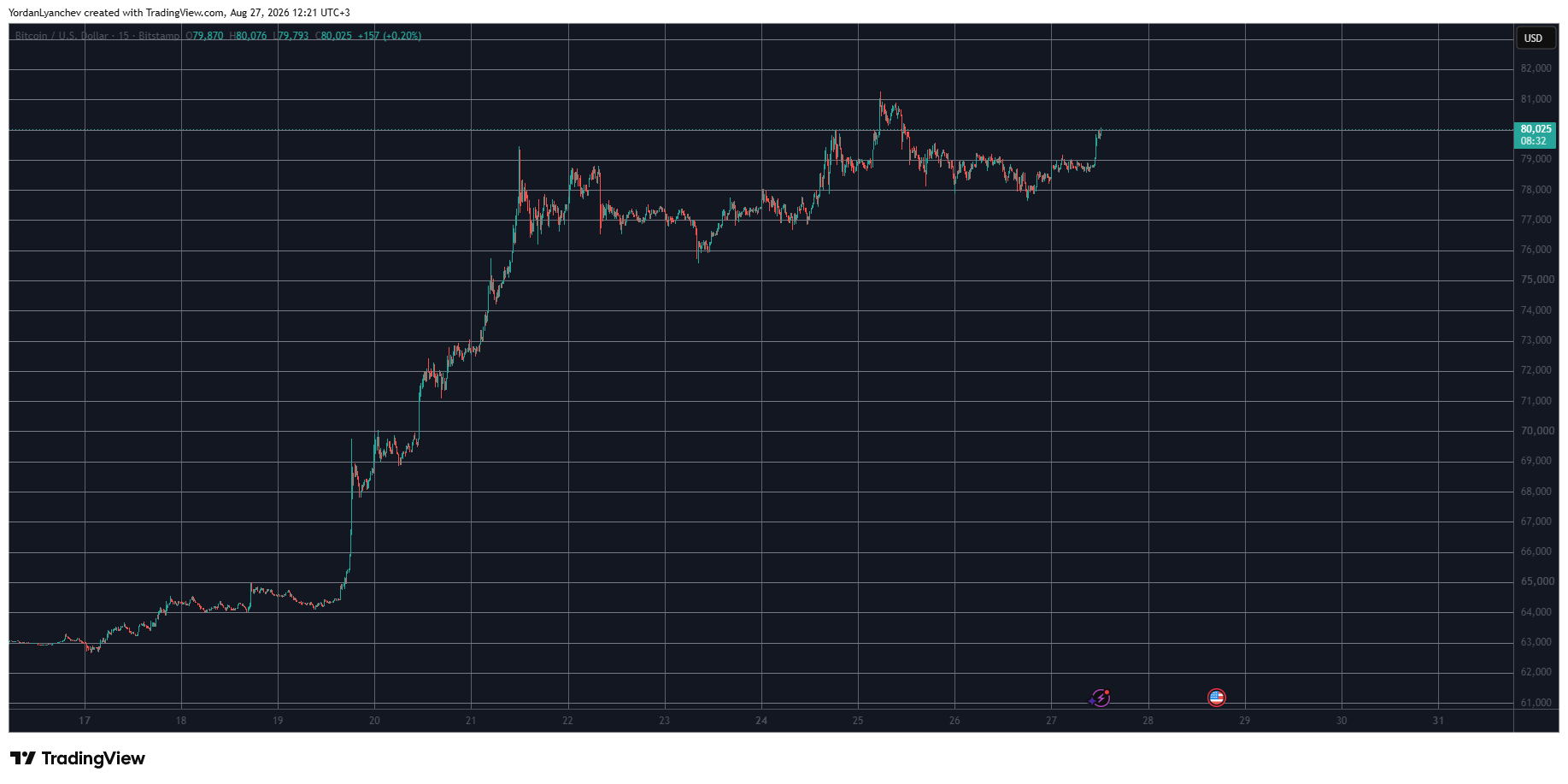
Bitcoin is on the move again in the right direction, jumping by over $2,000 since yesterday’s low and inching closer to the $80,000 resistance.
Solana has emerged as today’s top performer among the larger caps, surging by 8% to its highest price tag since late January at $105.
BTC Aims at $80K
It was just over a week ago when bitcoin’s major rally commenced, when the asset broke out of the $65,000 resistance and surged to $70,000 within hours. The bulls kept the pressure on, driving the cryptocurrency to $75,000 on Thursday and to a multi-month high at almost $80,000 on Friday morning.
However, it couldn’t breach that level on its first attempt and slipped to $75,500 during the weekend. Nevertheless, the bulls stepped up once again and defended that level. Moreover, BTC started to climb as the new business week progressed and surged past $80,000 and $81,000 on Tuesday morning for the first time since mid-May.
This meant that it had added over $16,000 in value in less than a week. However, it was stopped and couldn’t climb any higher. The next leg down drove it to just under $78,000, but it reacted well in the past few hours and jumped to $80,000 as of press time.
Its market capitalization has risen past $1.6 trillion on CG, while its dominance over the altcoins stands at over 58%.
SOL Hits New Local High
Most larger-cap alts have turned green today as well. ETH has seemingly reclaimed the $2,500 level finally after a 3% surge to over $2,550. BNB is above $710, while XRP defended the $1.40 support and is back to $1.45 as of now.
SOL is today’s top performer from this cohort of assets. A 7% pump has driven it to $105 for the first time since January 31. LINK and DOGE are also well in the green, and so are TAO and ENA.
The total crypto market cap has added around $50 billion in a day and is up to $2.780 trillion on CG.

The post Solana (SOL) Rockets to 7-Month High, Bitcoin (BTC) Taps $80K Again: Market Watch appeared first on CryptoPotato.

Crypto World
SimpleSwap Marks a Year Inside Exodus Wallet, Ships Five Partner Updates WithNo Integration Changes


SimpleSwap today marked one year of fixed-rate exchanges running inside the Exodus wallet.
SimpleSwap-powered fixed-rate exchanges have been running within the Exodus wallet for a year. Over those twelve months, the partner side of the product gained five capabilities, none of which required Exodus or any other partner to change their integration.
Automatic refunds on swaps paused for screening
A small number of exchanges are paused for compliance checks. If a check requires further review and the exchange cannot proceed, the funds are automatically returned to the refund address; no ticket is needed.
Most refunds are completed within 5 to 15 minutes, although they can take up to 30 minutes when networks are busy. Partner statistics first show the exchange as failed, then as refunded once the money arrives.
What partners need to know:
- The refund_address field must be passed in the API request. Partners who do not collect a refund address from the user can provide their own and settle directly with the user.
- A standard network fee is deducted from the returned amount. No service charge is added on top of it.
- Coverage spans the major networks and assets. Account managers hold the current list.
- Refunds apply to eligible exchanges, not to every case.
A pause does not mean the user is being accused; it simply means there is reason to take a closer look. Crypto funds can carry over history from earlier or third-party transactions that the current sender may know nothing about, which is why the money is returned rather than left sitting somewhere.
“Nobody celebrates a swap that had to be sent back,” said Stefan Lauer, Head of Infrastructure at SimpleSwap. “But whether that money comes back on its own or through a support ticket is the part a partner lives with every day. Wallets put their own users in front of infrastructure they did not build, and a year of that from Exodus is not a small thing to hand over. Most of what shipped this year came from taking it seriously.”
Fee settings per API key and per pair
Partner accounts now set the fee percentage for an individual API key and an individual pair, rather than across the account as a whole.
A wallet can issue a separate key for each product or traffic source, give each one its own margin, and then compare the results directly. A BTC-to-USDT route can be priced differently from a long-tail altcoin route.
Pricing experiments run within the dashboard rather than in a release cycle.
Margin set on the individual transaction
The exchange creation method accepts a custom_fee parameter, so the profit share is set when an exchange is created rather than inherited from its key. Reference: https://api.simpleswap.io/docs/api/create-exchange
A promotional rate for one user segment can run alongside a standard rate for another, without changing account settings.
This is the level of payment flows usually needed, where pricing depends on the basket rather than on the integration.
Reverse estimate
A standard estimate answers the question “How much will I receive for 1 BTC?” Reverse estimate answers the opposite one: “How much does the customer need to send to receive 500 USDT?”.
Payment services use it to quote goods and services in a stable equivalent while accepting whatever asset the buyer holds.
The settlement figure is known before the invoice goes out.
300+ assets added, with no partner-side release
More than 300 assets were listed over the year, including tokens requested directly by partners. They reach partner apps through the same currency call already in place.
Behind that pace sits the aggregation layer, which now draws on 20+ liquidity providers across CEX and DEX venues, with NEAR among the sources announced publicly. A wider pool means a new asset can usually be routed through existing infrastructure, rather than waiting for a single venue to support it.
Listing requests arrive when a coin starts moving, making the speed of adding an asset a commercial rather than a technical question.
Where things stand after year one
- 20+ liquidity providers aggregated across CEX and DEX sources
- 2,800+ assets available for exchange, 300+ of them listed in the past year
- 3.2M+ trading pairs
- 6,000+ partner products running SimpleSwap
- 20M+ swaps processed for 10M+ users since 2018
- 99.9% uptime
- 4-minute average support response when a case needs a person
Five changes went out over the year, and not one of them was a migration. The integration Exodus shipped in August 2025 is the same one running today, with a broader asset list and finer control over what each transaction earns. Teams that want to switch any of it on will find the details in the API documentation or through their account manager.
About SimpleSwap
SimpleSwap is a self-custodial, multi-source swap aggregator that helps users exchange crypto with greater privacy and control, without having to compare providers and routes themselves. It supports direct wallet-to-wallet swaps across 20+ liquidity providers and 2,800+ swappable assets, combining liquidity from well-known CEX and DEX sources under the hood.
Operating since 2018, the exchange infrastructure is integrated into 6,000+ partner products, including Exodus, Tangem, Ellipal, Cake Wallet, and Tonkeeper.
For partners: SimpleSwap API integration at https://simpleswap.io/affiliate-program API documentation: https://api.simpleswap.io/docs
The post SimpleSwap Marks a Year Inside Exodus Wallet, Ships Five Partner Updates WithNo Integration Changes appeared first on BeInCrypto.

XRP price is trying to reconcile two conflicting signals coming from the asset. One points to distribution. The other points to accumulation at scale. Both are happening at once, and that’s not a coincidence.
CryptoQuant-linked analyst Darkfost flagged a 231 million XRP withdrawal from Binance in a single day this week, worth $330-335 million at the time, the largest such move in about six months. Whale wallets have also sent close to 1.45 billion XRP to Binance over the trailing 30 days.
Those figures look like sell-side ammunition even as some of that liquidity cycles back off-exchange. Meanwhile, seven U.S. spot XRP ETFs have pulled in $1.55 billion in cumulative inflows, with August alone doubling July’s pace.
The market isn’t dragging XRP down; Solana posted 20%+ gains this week while Bitcoin keeps on going higher.
Discover: The Best Token Presales
Can XRP Price Hit $1.70 This Week?
XRP price is moving in an intraday range of $1.40 to $1.45, showing a market still digesting last week’s 50% rally before this week’s pullback toward the $1.40 zone. Immediate support sits near $1.40, with a deeper floor around $1.33-1.36 based on Fibonacci retracement levels.
Resistance clusters at $1.50-$1.55, where XRP was already rejected once, then again near the $1.65 prior weekly close. RSI(14) readings near 25 suggest an oversold condition, though the aggregate technical signal still leans toward sell pressure.

If XRP can maintain its ETF inflows with whale-driven supply, it could reclaim $1.50, and momentum carries it back toward $1.65. Consolidation could also happen between $1.40 and $1.50 while the market waits for the next flow data print.
But it’s going to look bad if it breaks below $1.40, which opens the door to $1.33, especially if escrow unlock concerns resurface and compound whale selling.
We are watching for confirmation and should track daily ETF flow reports alongside exchange balance shifts before committing size.
Trade XRP on Bybit and Get a Chance to Win Our $1,000 USDT Airdrop
LiquidChain Targets Early Mover Upside as XRP Tests Key Levels
A 4.53% bounce off recent lows is constructive, but XRP at a market cap already north of $80 billion isn’t handing out 10x setups. The math simply doesn’t work that way at scale.
This pushed a segment of traders toward earlier-stage plays where the upside curve looks different. LiquidChain ($LIQUID), a Layer 3 infrastructure project positioning itself as the connective tissue between Bitcoin, Ethereum, and Solana liquidity pools, is on traders’ radar.
The Order doesn’t ask twice.
⟁
When the signal comes, you answer.https://t.co/vqvBcdSQYC pic.twitter.com/z4Oc2AUBpi— LiquidChain (@getliquidchain) August 27, 2026
The pitch: a Unified Liquidity Layer with Single-Step Execution and Verifiable Settlement, built on a Deploy-Once Architecture that lets developers ship once and reach all three ecosystems instead of fragmenting deployments across chains.
Current presale price sits at $0.01494, with $950K raised so far.
Research LiquidChain directly before the presale closes.
Discover: The Best Crypto to Diversify Your Portfolio
The post XRP Price Caught Between $231M Whale Selling and ETF Inflows appeared first on Cryptonews.

South Korean crypto exchange Bithumb has reportedly secured its first-instance court wins in two lawsuits seeking to recover proceeds from users who sold Bitcoin that the exchange mistakenly credited to their accounts. The rulings come as regulators continue to scrutinize the earlier operational lapse and Bithumb works to contain the financial impact.
According to a report by Chosun Biz, the Seoul Central District Court ruled in Bithumb’s favor in two of four unjust enrichment cases filed against users. The lawsuits involved different amounts: one ruling concerned a claim of 194 million won (about $140,000), while the other related to 5 million won (about $3,600). Two additional cases—seeking roughly 14.8 million won (about $10,700) and 500 million won (about $362,000)—remain pending, the report said.
Key takeaways
- Bithumb has won first-instance rulings in two of four unjust enrichment lawsuits tied to a February Bitcoin crediting error.
- The court decisions cover claims of 194 million won and 5 million won, while two other claims are still awaiting outcomes.
- The lawsuits proceeded via service by public notice because standard delivery methods for court documents failed for the defendants.
- The legal push targets proceeds from users who sold Bitcoin credited by mistake before affected accounts were frozen.
How the court cases connect to Bithumb’s February mistake
The underlying dispute traces back to an event on Feb. 6, 2026, during which Bithumb intended to distribute rewards denominated in Korean won. As described in earlier coverage by Cointelegraph, Bithumb said the error happened during a promotional activity: an employee allegedly selected Bitcoin as the payment unit instead of the intended fiat currency.
Rather than crediting the planned reward amount in won to 249 users, the exchange reportedly credited customer accounts with 620,000 BTC. At the time of the incident, that volume was valued at more than $40 billion, according to the reporting that followed the episode. Bithumb later stated that it recovered the vast majority of the mistakenly credited amount—618,212 BTC—leaving only a small residual shortfall.
However, the problem was not purely theoretical. Some users had reportedly already sold 1,788 BTC worth of the credited balances before Bithumb moved to freeze the affected accounts. It is those early sales that became the focus of Bithumb’s March litigation strategy.
What Bithumb is trying to recover through unjust enrichment suits
As reported by Cointelegraph, Bithumb filed four unjust enrichment lawsuits in March against users who sold the mistakenly credited Bitcoin and did not return the proceeds. The exchange’s approach, as characterized in that earlier reporting, was to seek monetary recovery from the sale proceeds rather than compel users to return Bitcoin itself.
The newly reported first-instance rulings therefore represent more than symbolic legal progress: they support Bithumb’s argument that users who benefited from the mistaken credits should compensate the exchange to the extent of the sold proceeds. Still, with half of the cases remaining pending, the broader extent of Bithumb’s ultimate recovery is not yet fully determined.
For users, the developments also underscore a practical risk in operational error scenarios. Even when a credit is unintended, actions taken immediately after the balance appears—such as trading or exchanging the credited asset—can later become a subject of legal dispute if the credit is subsequently reversed or invalidated.
Service by public notice highlights delivery hurdles in the lawsuits
Chosun Biz also noted that both of the cases that reached rulings advanced through service by public notice. The court reportedly used this method because it could not deliver the necessary documents to the defendants through ordinary channels.
That procedural detail matters because it can affect how quickly cases move and how defendants participate. While service by public notice is not unusual in certain jurisdictions when direct service fails, it can raise questions about whether defendants were fully informed in time to respond through standard procedures. The reported decisions, however, indicate the court proceeded to judgment nonetheless.
Regulatory pressure continues alongside the litigation
While the lawsuits play out in civil court, Bithumb is also facing ongoing regulatory scrutiny related to the February error. South Korea’s Financial Supervisory Service (FSS) reportedly investigated the incident, focusing on how the exchange could credit customers with Bitcoin it did not hold.
Cointelegraph previously reported that the regulator sent Bithumb an inspection opinion in early August, which marked the formal start of sanctions proceedings, though no final penalty had been announced at the time of that reporting. In the same earlier coverage, Cointelegraph said it reached out to the Financial Services Commission (FSC) for an update but did not receive a response by publication.
Separately, Bithumb has faced other legal and compliance challenges this year. South Korean police reportedly raided its offices in June as part of an investigation unrelated to the Bitcoin crediting error, involving allegations of favoritism related to lawmaker Kim Byung-ki. The company is also contesting a separate six-month partial business suspension over alleged Anti-Money Laundering violations; Cointelegraph reported that a Seoul court stayed the suspension in April pending the outcome of Bithumb’s challenge.
Taken together, the court rulings and the regulator’s continuing work indicate that Bithumb’s February incident is being treated as both a financial and governance issue—not merely a one-off operational glitch. For investors and market participants, the key question is whether Bithumb’s internal controls reforms and compliance measures will satisfy regulators after a mispayment of this magnitude.
What to watch next
With two remaining unjust enrichment lawsuits still pending, the next development will likely be whether Bithumb’s legal strategy yields further first-instance judgments and how those cases ultimately resolve. At the same time, market observers will continue to watch for any FSS sanctions outcome, since regulatory findings could shape how exchanges in South Korea tighten operational controls to prevent similar crediting errors.

Key takeaways
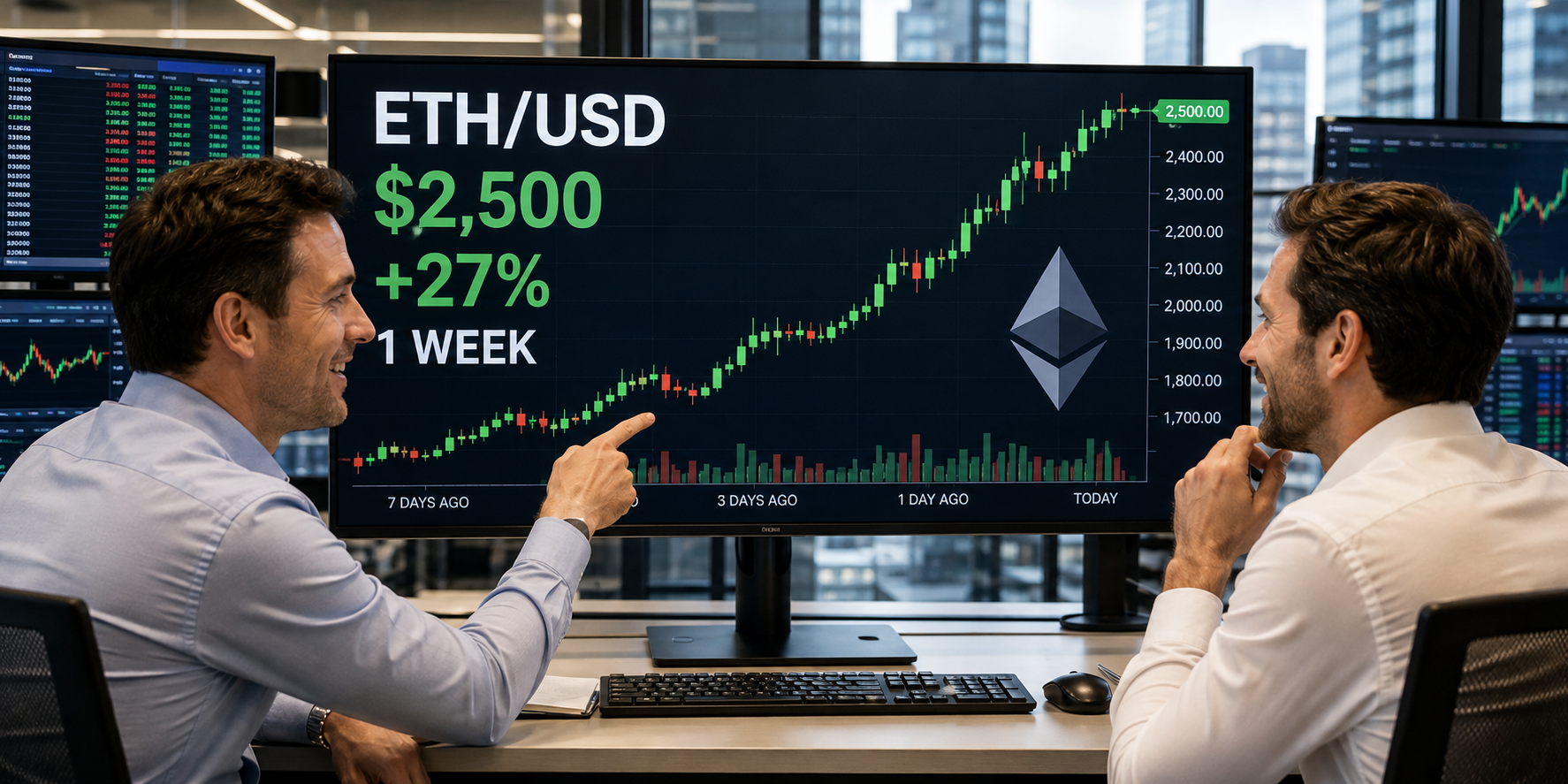
- Ethereum has gained 27% in seven days after breaking above $2,000 and triggering substantial short liquidations.
- Proposed SEC crypto rules and planned Treasury bond buybacks have strengthened risk appetite.
- Ethereum ETFs attracted more than $1.2 billion in August, their highest monthly inflow since August 2025.
Ethereum rallies 27% after breaking above $2,000
Ethereum has climbed 27% over the past seven days after moving above the psychologically important $2,000 level. The breakout triggered substantial short liquidations, adding momentum to the rally.
Improving regulatory expectations in the United States also supported the broader cryptocurrency market. The Securities and Exchange Commission’s proposed framework for crypto assets could give projects more flexibility to raise capital without following the traditional securities-listing process.
Meanwhile, the Treasury Department announced plans to double its bond buybacks beginning in September. The program is expected to inject billions of dollars of liquidity into financial markets, potentially benefiting risk-sensitive assets such as cryptocurrencies.
Institutional demand has strengthened alongside the price recovery. Investors poured more than $1.2 billion into Ethereum-linked exchange-traded funds during August, according to SoSoValue.
That represents the strongest monthly inflow since August 2025, when ETH reached its latest record high.
Crypto market sentiment has also shifted sharply. The Crypto Fear and Greed Index rose from below 40, indicating fear, to 80, representing extreme greed. It is the index’s highest reading since December 2024, when Ethereum traded near $4,000.
The change suggests that investors have adopted a more aggressive, risk-on position. However, elevated optimism can also increase the possibility of a short-term correction.
Ethereum’s on-chain data supports the improving outlook, but a key volume signal has yet to be triggered.
The gap between Ethereum’s seven-day and 30-day trading-volume moving averages has narrowed following renewed buying activity and the recent short squeeze.
A crossover in which the seven-day average moves above the 30-day average would provide stronger confirmation of bullish momentum. According to the analysis, this signal has identified the beginning of Ethereum’s previous bullish cycles during the past three years.
Until that crossover occurs, the rally still lacks full volume-based confirmation.
The successful implementation of Ethereum’s planned Glamsterdam upgrade could become the market’s next major catalyst.
A smooth rollout may strengthen confidence in Ethereum’s development roadmap and network capabilities. The upgrade could have an effect similar to the Pectra upgrade in April 2025, which coincided with improving market momentum.
Its impact will depend on implementation, adoption and broader financial-market conditions.
ETH may retest $2,200 before advancing toward $2,800
The weekly Ethereum outlook has shifted from bearish to bullish, with a medium-term target of $2,800. The revised forecast follows an earlier bearish projection of $1,600 for the first half of 2026.
A confirmed break above $2,200 is viewed as a potential buy signal. Historical price action suggests ETH could then consolidate between $2,200 and $2,800, resembling the pattern seen at the beginning of the April–May 2025 rally.
Momentum indicators nevertheless point to the possibility of a near-term pullback. Ethereum’s weekly Relative Strength Index has reached 88, placing it deep in overbought territory.
A correction toward $2,200 would relieve some of that pressure and could establish a stronger base for another advance. Failure to hold that level, however, would weaken the current bullish setup.

If Ethereum holds above $2,200 and subsequently clears the $2,800 resistance level, historical patterns suggest a longer-term target near $5,400.
That projection remains conditional rather than guaranteed. Ethereum would need continued ETF demand, supportive liquidity conditions, successful network upgrades, and sustained trading momentum to maintain the rally.
For now, $2,200 is the most important support level, while $2,800 represents the next major resistance.

Israel’s friends and allies must demand E1’s cancellation—not just postponement or freezing, but definitively ruling it out as a threat to the two-state solution which is necessary for both Israel and Palestine to have peace and security.
Many Israelis recognize this threat and oppose the growing extremism and intolerance in their politics and society at large. For instance, we met with President Isaac Herzog on our visit, who condemned settler violence. We also acknowledge the deep trauma Israel’s people suffered after the Hamas terror attacks of October 7, which included the detention of hostages contrary to all international law.
We take inspiration from the brave Israeli and Palestinian civil society activists we met. They remain determined to combat impunity for abuses and injustice, and to strive for a future for both peoples based on equality and respect for international law.
Yet this vision is far from the reality we saw on our visit. We saw how ongoing settlement of the West Bank and the sustained violence against and displacement of Palestinians threatens ethnic cleansing and annexation. Combined with the occupation of Gaza, including renewed calls by Israeli ministers for new settlements in the Strip, we are convinced that what is underway is the conquest and erasure of one state by another.
Your day-ahead look for Aug. 27, 2026


Park Hyeon-joo, Mirae Asset Financial Group’s founder, outlined his ambitious stablecoin, RWAs, and STOs plan for Digital X, formerly known as Korbit, in an event for his employees.
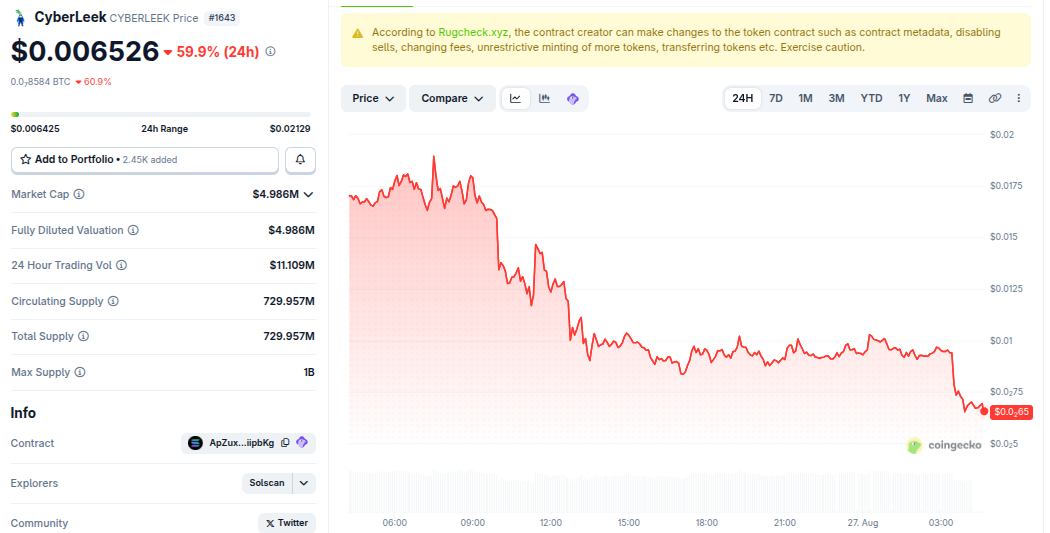
CYBERLEEK has given back a large share of its parabolic rally. Indeed, the token fell by nearly 60% right after the account behind the campaign posted footage of the game’s prologue.
The Solana meme coin ties directly to the Grand Theft Auto VI leaks. Now, it trades at 71.30% below its all-time high of $0.03436, reached on August 23.

Why the Bigger Leak Failed to Reverse the Slide
CyberLeek began circulating gameplay clips on August 18, days after the token itself went live. Early videos showed driving, flying, nightclubs, stores, radio stations, and map details from Leonida.
The clips were watermarked with QR codes pointing buyers toward the coin. Holders even used CYBERLEEK transfers to vote on which footage would drop next.
The token’s launch was not a coincidence. On-chain records show the project domain was registered on August 14, and the token first traded on August 15, while the first public leak arrived three days later.
That sequence, combined with buy prompts inside the videos, raised suspicion. Critics accused the campaign of functioning as a pump dressed up as a consumer protest. As a result, the market cap jumped from near zero to more than $20 million at the peak. Short-term gains, in fact, exceeded 1,400% during the frenzy.
On August 26, the leaker posted a roughly five-minute clip from a Lucia-focused prologue section, after earlier footage of Jason in a police chase that ended with a brief Lucia cutscene.
Follow us on X to get the latest news as it happens.
That drop was billed as the first true story spoiler. It arrived the same day Rockstar Games broke its silence, calling the leaks “heartbreaking and unfortunate” while confirming that the Netflix Extended Look would still air as planned.
“…Many thought initially this would be a HUGE catalyst, and the Cyberleek team shared the ENTIRE prologue of one of the main characters from GTA6, however it did not move the needle…,” one analyst said on X.
What the Collapse Reveals About the Trade
The market did not treat the spoiler as fresh fuel. CYBERLEEK now trades at $0.006819, with a market cap of $4.99 million, according to CoinGecko data, 71.30% below its August 23 peak. The takedown of the project’s own website added fresh pressure, sparking what the exchange described as developer desperation and accelerating an already steep decline.
Classic meme coin mechanics, profit-taking after a listing-driven pump, collided with mounting legal pressure. Take-Two has sought subpoenas against Microsoft, Discord, and X to identify the source of the leaks.
CyberLeek has framed the leaks as a fight for physical discs, offline single-player access, and an end to locked fake DLC. Rockstar’s statement did not address those demands. Boxed copies of GTA VI are expected to contain a download code rather than a disc.
Consumer groups such as Stop Killing Games have rejected the leak tactic even while sharing some of the ownership concerns.
On the other hand, the official Extended Look airs on Netflix today, August 27, giving fans their first officially sanctioned look at the game after weeks of unauthorized leaks.
Subscribe to our YouTube channel to watch leaders and journalists provide expert insights.
Whether that footage ends the leak premium or merely gives traders another headline will determine whether CYBERLEEK’s collapse is a pause or the end of the trade.
The post GTA 6 Leak Coin CYBERLEEK Crashes Nearly 60% After Its Biggest Spoiler Yet appeared first on BeInCrypto.

How will other tech companies respond?
The settlement has an unusual quirk: Meta agreed to pay 70% of the settlement total—some $12.7 billion—over the next decade. But the remaining $5.3 billion is conditional, depending on whether YouTube and TikTok implement similar or more restrictive settings, including a one-hour daily time limit.
At a time when Meta faces fierce competition in the teen market from those competitors, the company is planning to run full-page print ads on Thursday in the The Washington Post, New York Times and the Los Angeles Times calling to make those settings the “new industry standard.” Neither TikTok nor Google, which owns YouTube, have commented.
In the past, tech companies have often copied one another’s safety policies. How competitors will respond to Meta’s settlement agreement is an open question.
What happens to similar cases focused on youth safety?
In addition to the action brought by state attorneys general, school districts and families have filed thousands of lawsuits against tech platforms including Meta, Google, Snap, and TikTok, alleging that the design of their products caused harmful consequences for teens. In March, a jury found Meta and YouTube’s product design led to the mental distress of a young woman, and ordered the companies to pay $4.2 million and $1.8 million in damages respectively.
Crypto World
Solana Votes on Plan to Cut $1.5 Billion in Future SOL Emissions: What It Means for Price?
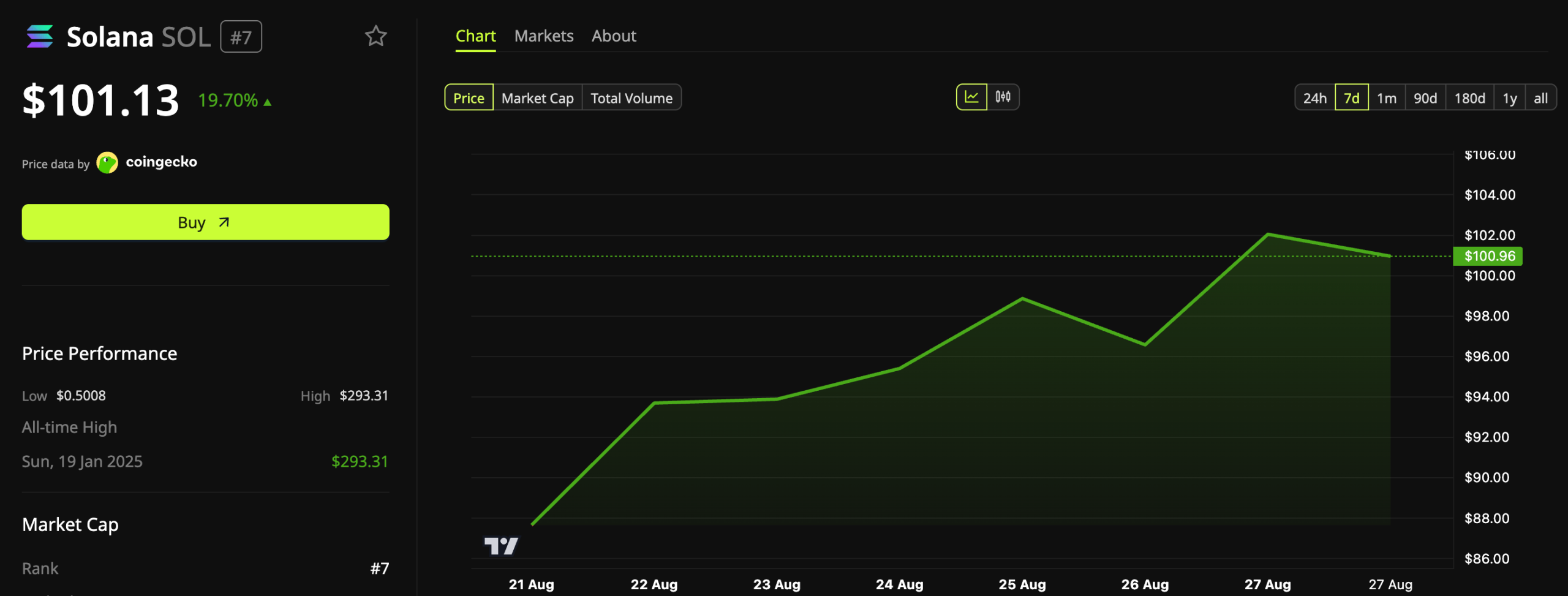
Solana (SOL) validators are voting on two supply proposals. One would raise the disinflation rate, and the other would burn more SOL.
Together, they would reduce projected emissions by about $1.4 billion to $1.5 billion over six years. But what could that mean for Solana’s price? Other protocols may offer some precedent.
What Solana Is Voting On
Solana’s staking yield sits near 5.25%, drawing mainly from protocol inflation of about 3.78%. Transaction fees and maximal extractable value (MEV) supply the rest.
SGP-0002, which corresponds to the technical proposal SIMD-0550, proposes reducing the inflation schedule. This would be done by increasing the disinflation rate.
“It doubles Solana’s annual disinflation rate from -15% to -30%, compressing the timeline to Solana’s 1.5% terminal inflation rate from approximately 5.7 years to 2.8 years, reaching that level by H1 2029 rather than H1 2032,” 21Shares explained.
Under this, nominal staking yield falls to roughly 4.34% in the first year. It drops to 3% in year two and 2.25% in year three.
SGP-0003, based on SIMD-0553, would divide Solana’s current 5,000-lamport signature fee into two parts: a 2,500-lamport base inclusion fee paid to the block leader and a resource fee determined by requested compute units and the applicable resource fee rate, which would be burned.
“At current network activity, daily SOL burns would rise from approximately 600–800 SOL to approximately 7,500–9,000 SOL, or $712,500 to $855,000, as of August 24. It is a meaningful acceleration in supply destruction, though not sufficient alone to offset current inflation of roughly $4.5 million per day,” the blog added.
Voting is set to continue through epoch 1023. According to 21Shares, the two proposals could roughly halve staking yields within two years and make the asset “structurally scarcer.”
Follow us on X to get the latest news as it happens
Ethereum and Cosmos Offer an Imperfect Comparison
21Shares pointed to two previous upgrades to gauge how markets could react to Solana’s supply-reduction proposals.
Cosmos’ (ATOM) Proposal 848 cut maximum inflation in November 2023. ATOM gained 25% over the following month and 10% over three months. However, the period also coincided with growing optimism around the approval of spot Bitcoin (BTC) ETFs.
Ethereum’s EIP-1559 introduced a burn mechanism in August 2021. ETH climbed 37% in one month and 60% over three months. However, broader market conditions also supported the rally as the crypto market approached its cycle peak.
The two examples suggest that supply-reduction upgrades can strengthen a token’s narrative. However, broader market conditions can have a larger influence on price.
“In both cases, the near-term move (1–3 months) likely came from a mix of the deflationary signal and supportive market conditions, not the upgrade alone. At the same time the subsequent 6–12 month drawdowns had little to do with the upgrades: for ETH, the onset of the 2022 bear market and the Fed beginning its rate hiking cycle; for ATOM, the broader summer 2024 slump,” the team added.
21Shares suggested that for SOL holders, the precedents offer a potentially bullish signal, but they do not guarantee a similar price reaction.

SOL trades near $101 after gaining close to 20% over the past week. The advance tracks a broader market rally rather than the governance vote itself.
Neither proposal alters the protocol on its own. Approval would hand developers a mandate, with the technical work and activation timing still to be settled.
That leaves two open questions for holders. Whether the changes reach mainnet and whether tighter supply extends the current rally will take months to answer.
Subscribe to our YouTube channel to watch leaders and journalists provide expert insights
The post Solana Votes on Plan to Cut $1.5 Billion in Future SOL Emissions: What It Means for Price? appeared first on BeInCrypto.

SimpleSwap Marks a Year Inside Exodus Wallet, Ships Five Partner Updates WithNo Integration Changes

The 10 Greatest Movie Screenplays of the ’60s, Ranked

How to watch transfer deadline live: Sky Sports deadline day show live on Peacock





-

 Fashion6 days ago
Weekend Open Thread: Madewell – Corporette.com
-

 Crypto World2 days ago
SpaceX stock could rise 75% to $240, JPMorgan says
-

 Business5 days ago
Musk’s Tesla, SpaceX Confirm $16.8 Billion ‘Terafab’ Chip Plant as World’s Largest Building in Texas
-

 Crypto World5 days ago
anatomy of crypto’s biggest liquidation event since 2021
-

 Crypto World2 days ago
A $30 Billion AI Fund Implodes, Now the SEC Is Investigating Wall Street’s Role
-

 Politics5 days ago
6 months on, Irish renters crushed by effects of government housing bill
-

 Crypto World1 day ago
Did Trump Just Move SpaceX Stock With One Truth Social Post?
-

 Business4 days ago
Mystery AI Model ‘Ox Alpha’ Draws Developers With Free Access as Chinese Lab Origins Remain Debated
-
 NewsBeat5 days ago
The ‘Lucky Dip Gang’ causing carnage for clicks: After five thugs were killed speeding in the wrong direction on a motorway, GUY ADAMS investigates a sick new trend… and why police aren’t even allowed to pursue them
-

 Business3 days ago
Moderna CEO warns China is pouring state money into mRNA technology
-

 Business7 days ago
Five Below: Kids Discount Retailer Reaps Rich Rewards
-
 Crypto World6 days ago
Nvidia Stock Suffers Longest Losing Streak Since 2022: Will Q2 Earnings End It?
-

 Business3 days ago
NVIDIA Stock Drops Nearly 2 Percent to $210 on Seventh Losing Day Ahead of Critical AI Earnings
-

 Sports4 days ago
Deshaun Watson fires back at Browns fans after being booed: ‘It’s a disrespectful thing’
-

 Business6 days ago
UK firms in critical financial distress rise 9% to 53,756
-
 Crypto World4 days ago
Google Gemini AI Predicts Ethereum Could Become the Trade Retail Misses in 2026
-

 Tech6 days ago
Unitree’s New Superman Robot Claims to Outjump and Outrun Every Human, Usain Bolt Included
-

 Tech6 days ago
Faster chip in a familiar form factor
-

 Crypto World6 days ago
SEC Regulation Crypto vs CLARITY Act: which framework wins
-

 Business5 days ago
Will Tesla Stock Be Higher or Lower a Year From Now? Here’s What Wall Street Analysts Are Saying
You must be logged in to post a comment Login