
Crypto World
Solana Whale That Made $20 Million in 2023 Starts Buying Again

A Solana (SOL) whale that banked more than $20 million in 2023 has resurfaced after two years, buying $3.6 million in SOL.
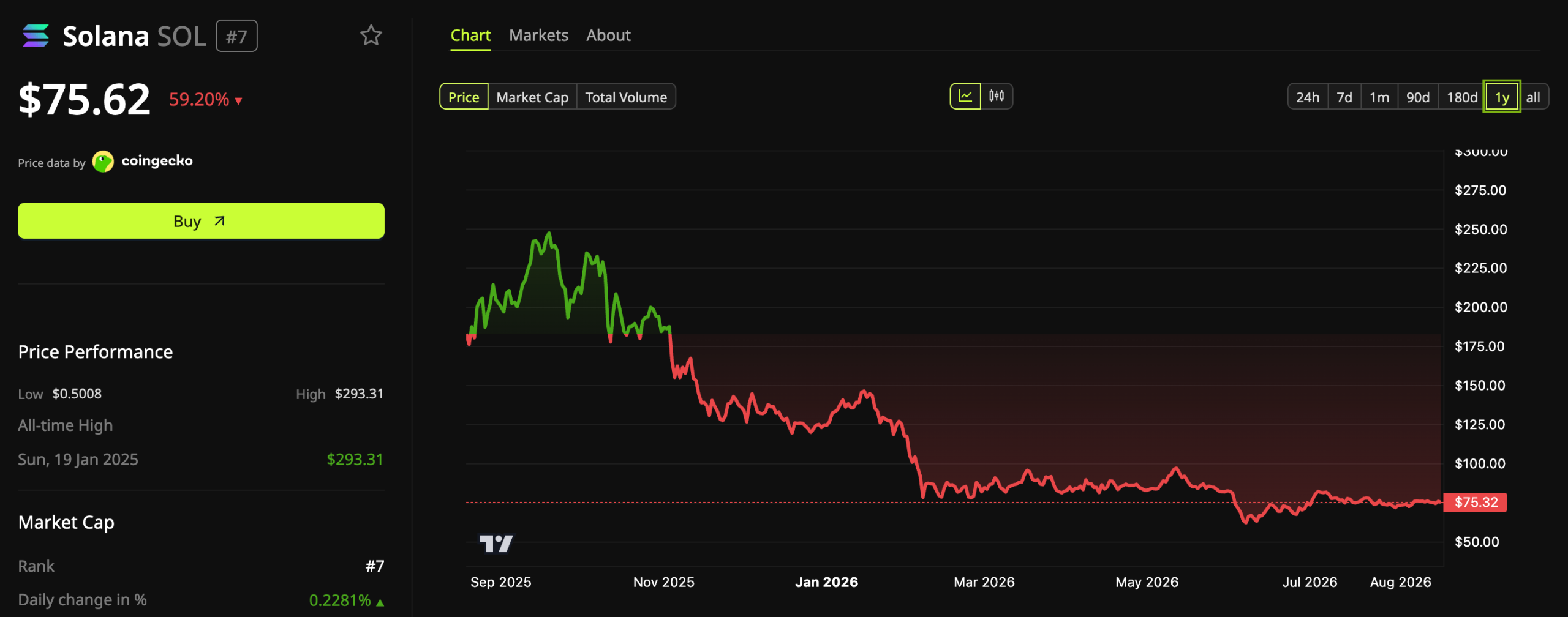
Blockchain tracker Lookonchain flagged the purchase. This comes as SOL trades roughly 74% below its January 2025 record high.
Dormant Whale Buys $3.6 Million in Solana After Two Years
The buy totaled 47,535 SOL. The wallet, tagged GvHYQQ, accumulated in 2023, before SOL began its climb.
It bought 291,790 SOL for $6.82 million across the August and October dips that year, averaging $23.37 per token. SOL then started climbing in late 2023.
The whale sold 191,789 SOL for $24.62 million at an average price of $128.36, locking in more than $20 million in realized profit. The address stayed silent for over two years afterward.
“Now, after 2 years of inactivity, the whale is buying the SOL dip again,” Lookonchain said.
According to Arkham data, the wallet still holds roughly 100,000 SOL from its original 2023 stack. The fresh buy lifts that position to about 147,535, worth close to $11.1 million at current prices.
Follow us on X to get the latest news as it happens
SOL Price Sits 39% Lower This Year
Meanwhile, SOL changed hands near $75. The altcoin has moved little over the past 24 hours. It is down about 1% across the past month.
The token has shed roughly 39% year-to-date. Over 12 months, the decline reaches 59%.

The backdrop is split. Several on-chain signals turned bearish in mid-August. Exchange netflows flipped positive, while decentralized exchange volume sat close to 80% below its April peak.
Institutional flows point the other way. Solana ETF inflows climbed to $10.26 million in the week ending August 14, nearly 70 times the prior week’s total.
With the macro and geopolitical backdrop still volatile, whether the bet pays off a second time is an open question.
Subscribe to our YouTube channel to watch leaders and journalists provide expert insights
The post Solana Whale That Made $20 Million in 2023 Starts Buying Again appeared first on BeInCrypto.



Crypto-collateralized lending shrank by $11.33 billion during the second quarter of 2026, a 16.78% drop that left the market at $56.16 billion, according to Galaxy Research.
The contraction extended a third consecutive quarterly decline for crypto lending. Galaxy framed the slide as an orderly unwind rather than forced selling.
Every Crypto Lending Category Lost Ground
The market now sits 40.13% below its third-quarter 2025 peak of $78.69 billion. No segment escaped the pullback.
“Q2 was the first quarter since Q4 2022 in which onchain lending declined across every category (CeFi, DeFi, and the crypto-collateralized portion of collateral debt position stablecoins), as the market’s deleveraging trend continued,” Galaxy Research revealed.
Outstanding borrows on Decentralized Finance (DeFi) lending apps fell $7.79 billion, or 27.61%, to $20.43 billion. This was the steepest drop among the three legs.
Centralized finance (CeFi) open borrows contracted 9.62% to $22.98 billion. The reduction came mainly from Tether, whose market share slipped 371 basis points to 58.54%.
Galaxy, Coinbase, Ledn, Arch, Sygnum, and Milo all grew their books during the quarter. The crypto-collateralized portion of the CDP stablecoin supply fell 7.86%.
“Again, there is potential for double-counting between total CeFi loan book size and CDP stablecoin supply, because some CeFi entities might rely on minting CDP stablecoins with crypto collateral to fund loans to offchain clients,” the report read.
Corporate borrowing eased as well. Strategy completed a $1.5 billion debt repurchase in May, cutting debt tied to digital asset treasury strategies to $16.1 billion.
Follow us on X to get the latest news as it happens
Contraction Looks Nothing Like the 2022 Unwind
The pace separates this cycle from the last one. Crypto-backed lending collapsed more than 55% in the second quarter of 2022, then fell a further 9% and 29% in the following two quarters.
The current sequence runs 10%, 5%, and 17% across three quarters. Galaxy attributes the difference to a gradual reduction in risk rather than to forced liquidations or counterparty failures.
“Lending markets are taking the stairs down, not the elevator,” Galaxy said.
Post-quarter data hints that the decline may be slowing. DeFi borrows measured $21.94 billion on July 21, up from $20.43 billion at quarter’s end.
Futures open interest, which fell 3.08% to $103.2 billion in Q2, recovered to roughly $114 billion by the end of July. Galaxy frames these as early signals that open interest and onchain borrows may be finding a floor.
Subscribe to our YouTube channel to watch leaders and journalists provide expert insights
The post Crypto Lending Falls 17% to $56 Billion: Is This Slide Healthier Than 2022? appeared first on BeInCrypto.

Changpeng Zhao, known as CZ, transferred $965,000 in BNB and BinanceLife tokens to his Giggle Academy education initiative and confirmed he is retiring the public wallet that funded the donation. The address had become one of the most-watched wallets on BNB Chain, and traders were extracting six-figure profits by front-running his token burns before Zhao decided to shut it down.
CZ described the problem as mundane and said that meme coin spam had made the wallet address unusable. Writing on Binance Square, he said he was testing Trust Wallet when unsolicited tokens cluttered the interface to the point he could no longer easily find his own BNB. Every attempt to burn the excess only invited more speculative sends, turning routine housekeeping into a public spectacle, he said he could never fully clean up.
— Coin Bureau (@coinbureau) August 18, 2026
 LATEST: CZ officially stops using his public wallet, saying it’s “almost impossible to clean out” as unsolicited meme coins continue piling in.
Multiple traders had been monitoring CZ’s wallet for trading signals, with one reportedly making $282K, a 29x return, after spotting… pic.twitter.com/Ja8LUcU55h
Rather than migrate the balance to a fresh private address, Zhao routed the full amount to Giggle Academy, the free education project he funded after leaving Binance’s leadership. He said he intends to stop using the wallet entirely, effectively turning it into a burn address.
CZ Wallet Turned Into a Trading Signal
The mechanics behind the front-running are simple once mapped out. Because BNB Chain activity is fully visible, any burn Zhao executed reduced the circulating supply in a way that could move the price, and traders watching the address in real time could position ahead of the reaction. Lookonchain’s data shows one operator compounding a small stake into a six-figure exit almost entirely by anticipating those burns.

None of this has moved BNB meaningfully. The token sits around $602, with little to no movement, a mixed backdrop that suggests the market still treats the wallet drama as a niche trading story rather than a price catalyst. Our model carries an A+ rating on BNB with a longer-horizon projection of +34.13% over one year, detailed further on its BNB forecast page.

Trade BNB on Bybit and Get a Chance to Win Our $1,000 USDT Airdrop
What’s Next
Retiring the address resolves the specific front-running loophole that produced those six-figure gains, since copy-traders lose their signal once the wallet goes quiet. But the underlying tension is not solved, as any new address Zhao uses may eventually be identified and watched with the same intensity, and the incentive to find it is now measured in hundreds of thousands of dollars per successful guess.
For now, the last recorded activity on the old wallet is the transfer that funded Giggle Academy, closing out a small but lucrative corner of BNB Chain trading.
Discover: The Best Crypto to Diversify Your Portfolio
The post CZ Wallet Abandoned After Traders Earned Big on Signals appeared first on Cryptonews.
Hardware wallet maker BitBox has released a firmware update that fixes two vulnerabilities it described as “severe” that could have enabled the installation of malicious firmware or put user funds at risk.
In a security disclosure on Monday, BitBox said one involved memory corruption affecting Multi editions of BitBox02 and BitBox02 Nova that had not been configured with a wallet. A malicious host could exploit it to execute arbitrary code and potentially install malicious firmware, which could lead to lost funds.
The second affected BitBox’s Silent Payments implementation and could have allowed a malicious host to lock Bitcoin to an unintended address. Direct theft was not possible, but an attacker could potentially demand a ransom to cooperate in recovering the coins, according to BitBox. The company said it had received no reports of either vulnerability being exploited or causing users to lose funds.
The disclosure comes at a sensitive moment for self-custody, after a Coldcard firmware flaw was linked to more than $112 million in Bitcoin thefts, underscoring how weaknesses in devices designed to protect private keys can become points of failure.
Cointelegraph reached out to BitBox for more information but did not receive a response before publication.
BitBox patch follows Coldcard thefts, wallet data leaks
The BitBox security update follows a wave of hardware-wallet incidents involving devices and the services surrounding them.
The most damaging was the Coldcard flaw, which traced to a March 2021 firmware change that went undetected for more than five years. The vulnerability affected wallet-seed randomness, allowing attackers to brute-force impacted wallet seeds and derive their private keys without physical access.
Galaxy Research said Friday that Coldcard-related losses had exceeded $112 million, with about 1,778.6 BTC swept from more than 8,600 addresses.
Related: Coldcard exploit pushes July losses to $247M as second-worst month of 2026
More recently, separate data breaches involving Trezor and SafePal exposed customer and order information belonging to more than 53,000 customers. Trezor attributed the exposure of 13,689 customers’ data to shipping provider ShipMonk, while SafePal said an authorization flaw in an order-tracking plug-in exposed details belonging to 39,798 customers.
Neither incident compromised devices, private keys or recovery phrases, but both companies warned that the information could enable targeted phishing and impersonation attacks.
Magazine: Do the Coldcard attacks mean all hardware wallets are now insecure?
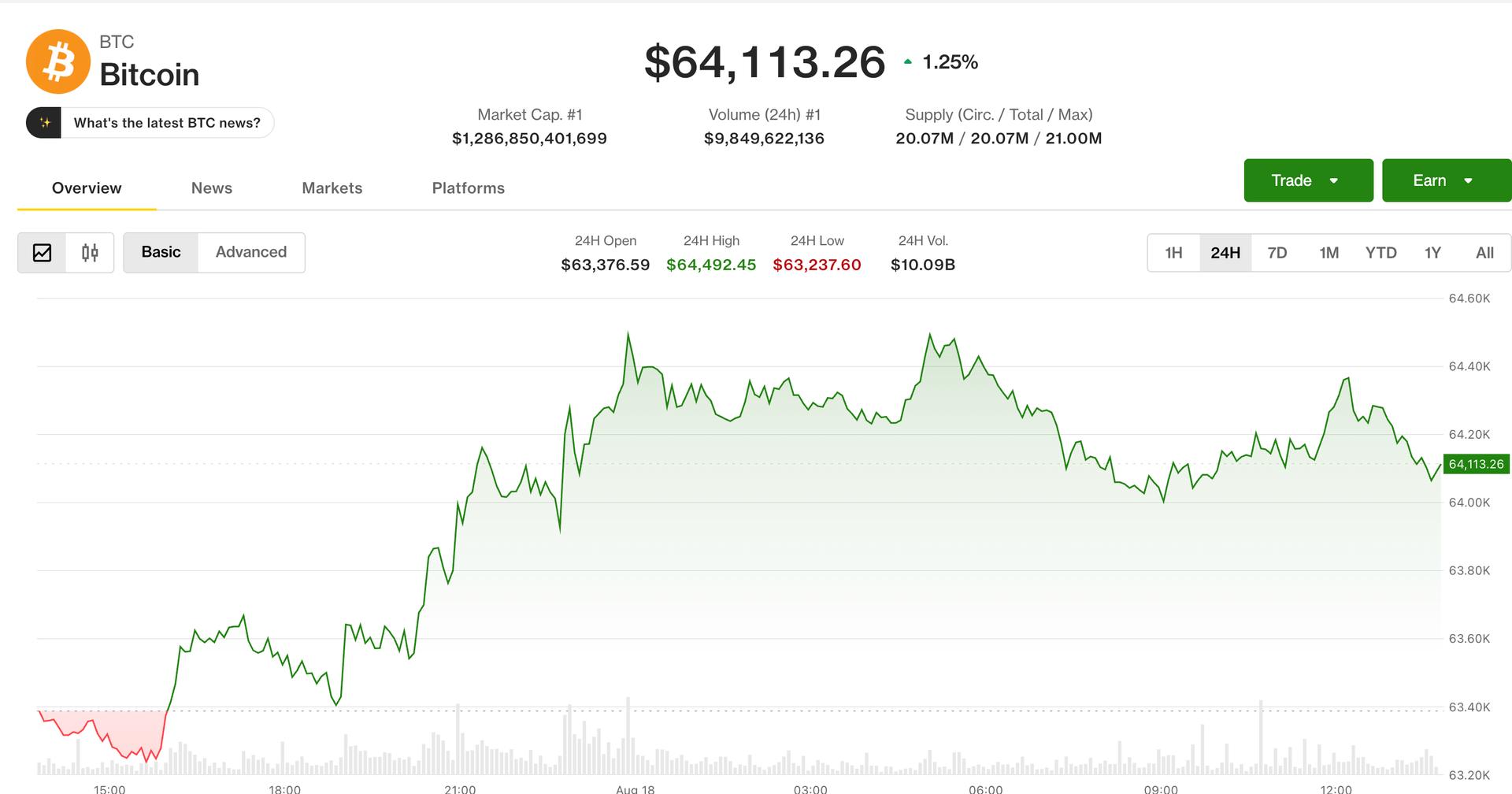
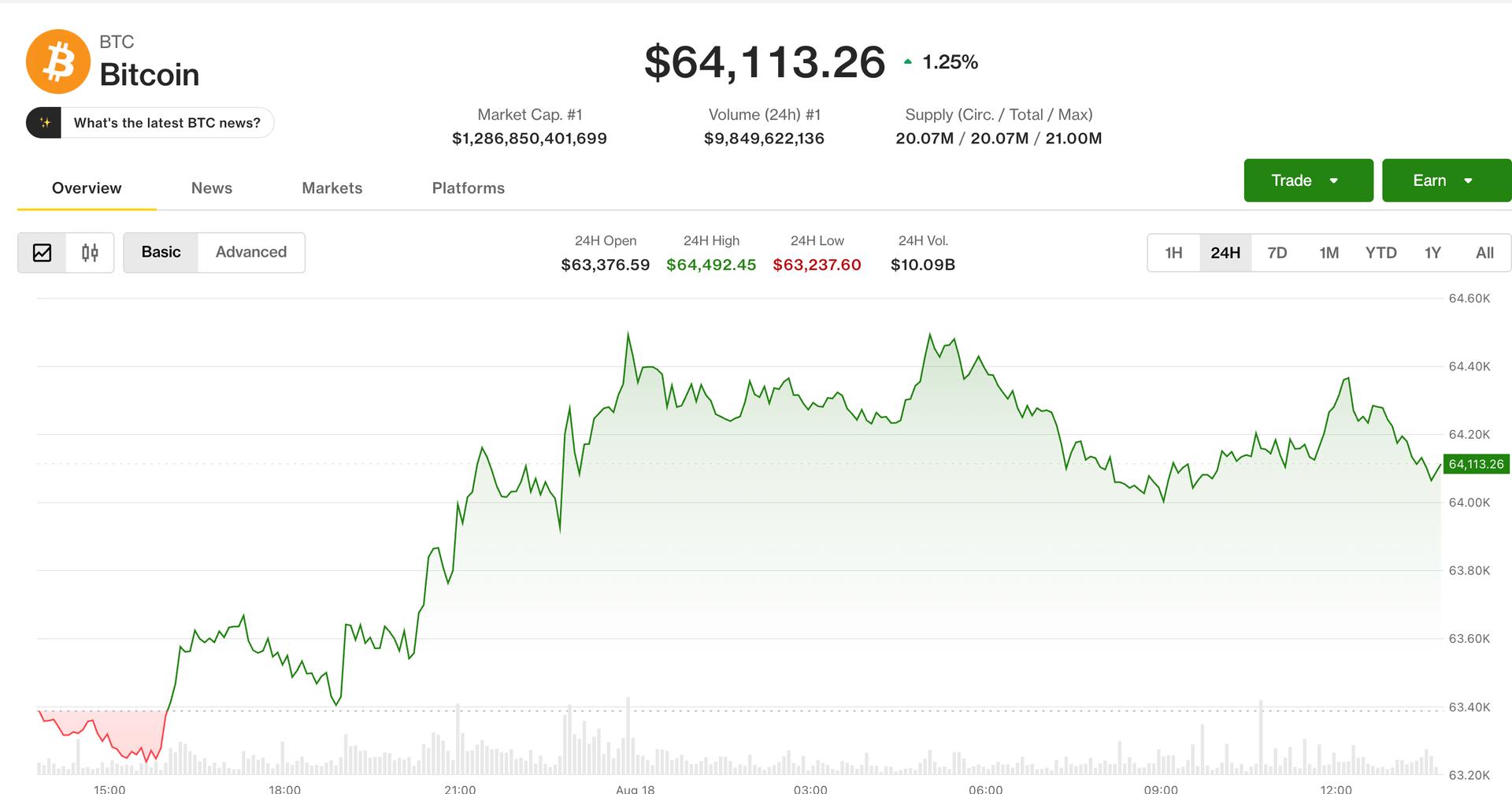
Bitcoin traded near $64,100 on Tuesday, up 1% on the day and holding above $64,000 even as rising bond yields and climbing oil drained appetite for risk assets, per CoinDesk data.
Ether held near $1,893 and the rest of the majors sat flat, with Hyperliquid the week’s outlier, up 8.3%.
The pressure is coming from bonds and crude. The 30-year Treasury yield rose to 5.33%, its highest since 2007, as investors demand more to finance heavily indebted governments and guard against sticky inflation. Long-dated yields climbed worldwide, and S&P 500 futures fell 0.5%, heading for a third straight day of losses.
Brent crude topped $91 a barrel as the US-Iran conflict escalated, with Trump threatening to bomb Oman if it interferes with US operations in the region.
That combination is the macro headwind that has capped crypto all summer, now sharpening. Higher oil feeds inflation, higher inflation lifts yields, and rising borrowing costs pull money out of risk assets and reinforce expectations that central banks stay tight. Bitcoin sits in the same risk complex, so the read-through is negative at the margin.
What stands out is that bitcoin is holding anyway. It’s up on the day and green on the week while stocks fall for a third session and yields hit generational highs, the kind of relative firmness that fits the returning-ETF-demand thread rather than fighting it. Watch whether it can keep diverging.
A break above $64,500 would strengthen the case that fresh buyers are absorbing the macro pressure, while oil pushing toward $100 and yields climbing further would test that resilience fast.
The U.S. Justice Department has spent nearly a year investigating Andreessen Horowitz over whether partners at the venture capital firm are improperly serving on the boards of competing artificial intelligence companies.
Summary
- The DOJ is investigating Andreessen Horowitz over board seats held at competing AI companies.
- The probe involves Databricks and Fivetran and has been underway for nearly a year.
- Regulators are examining whether the board roles violate rules against interlocking directorates.
- The DOJ has not decided whether to take enforcement action.
Bloomberg News reported on Aug. 17, citing people familiar with the matter, that the inquiry involves Databricks and Fivetran, two data and AI companies backed by Andreessen Horowitz, with regulators examining the firm’s representation on both boards.
Andreessen Horowitz co-founder Ben Horowitz sits on Databricks’ board, while partner Martin Casado serves as a director at Fivetran. Both companies provide technology used by businesses to collect, organise and analyse large amounts of data, according to the report.
Casado had also served on the board of dbt Labs before Fivetran acquired the company in June. People familiar with the matter told Bloomberg that the Justice Department reviewed the transaction for months after it was announced in October, but ultimately cleared the deal without conditions.
The separate board investigation began around the same period as the merger review and has continued after the acquisition closed, the people said. The Justice Department has not made a final decision on whether to take action, leaving open the possibility that the inquiry could end without enforcement.
Andreessen Horowitz probe focuses on competing board seats
At issue is a provision of the Clayton Act, the 1914 antitrust law that restricts certain cases in which directors or officers simultaneously serve at competing companies. Such arrangements are commonly referred to as interlocking directorates.
During previous enforcement actions, the Justice Department has often resolved concerns by having a director leave one of the competing boards. Under former Assistant Attorney General Jonathan Kanter, the department revived enforcement of the provision and pushed directors at multiple companies to give up board seats.
Ari Emanuel, then chief executive of Endeavor Group Holdings, stepped down from Live Nation Entertainment’s board in 2021. Directors connected to more than 10 other companies also left boards during enforcement actions in 2022 and 2023, according to Bloomberg.
The Andreessen Horowitz investigation involves another question because regulators are examining the venture firm’s representation through more than one partner. Bloomberg reported that the law is written to apply to companies as well as individuals, and several courts have accepted that interpretation.
Andreessen Horowitz could still challenge that reading if the government eventually brings allegations, according to the report. No such decision has been made.
Spokespeople for Databricks and the Justice Department declined to comment to Bloomberg. Andreessen Horowitz and Fivetran did not respond to requests for comment.
Databricks has become one of a16z’s biggest AI holdings
Databricks is one of the most valuable private technology companies in Andreessen Horowitz’s portfolio and remains a potential candidate for an initial public offering.
The company last week announced $5 billion in new funding at a $190 billion valuation. Andreessen Horowitz has backed Databricks since its early years, with Horowitz leading a $14 million investment in the company in 2013, according to Bloomberg.
Years of follow-on investments have left Horowitz sitting on billions of dollars in potential returns tied to Databricks, the report said.
Databricks develops software that companies use to organise, process and analyse business data, including tools used to build AI applications. Fivetran also operates in the enterprise data sector, providing technology that moves and centralises information from databases, applications and other sources.
Andreessen Horowitz’s exposure to AI extends well past the companies involved in the DOJ inquiry. Bloomberg reported that the firm had $90 billion in assets under management as of January and recently raised a $15 billion fund, its largest fundraising haul, to invest across the startup sector.
The firm has put billions of dollars into AI businesses, including coding company Cursor and voice AI developer ElevenLabs. It has also backed OpenAI and holds a major investment in SpaceX, according to the report.
Its investment activity remains significant in crypto as well. crypto.news reported in July that a16z completed 18 deals during the period tracked by CryptoRank, putting it behind Animoca Brands among the most active investors in the dataset.
A few months earlier, the firm’s crypto division launched a $2.2 billion vehicle focused on stablecoins, tokenised assets and blockchain infrastructure. The new crypto fund came as Crunchbase data cited at the time showed AI startups had raised $242 billion during the first quarter of 2026, or roughly 80% of the $300 billion raised globally.
Washington ties have put a16z closer to federal policy
The antitrust investigation has continued while Andreessen Horowitz has developed close connections with Washington during President Donald Trump’s second administration, Bloomberg reported.
Marc Andreessen and Ben Horowitz each donated millions of dollars in 2024 to a group aligned with Trump while he was running for president. Later that year, Horowitz also contributed $2.5 million to a super PAC supporting Democratic presidential candidate Kamala Harris.
Andreessen has since taken a role in a federal policy initiative focused on artificial intelligence. The Federal Reserve appointed him in July to co-lead an AI task force studying the technology’s effects on productivity and employment.
The panel also includes Stanford University economist Charles I. Jones and Microsoft executive Asha Sharma. Federal Reserve staff will support the group, while its research and feedback will feed into the central bank’s review of how technological changes can affect economic output and jobs.
Within the Trump administration, Andreessen Horowitz has also become an influential participant in AI policy discussions. Bloomberg reported that the firm successfully pressed the administration to remove several safety guardrails governing the use of artificial intelligence.
Political spending connected to the firm has extended into digital assets. A July review found that Andreessen Horowitz contributed $24 million to Fairshake during the second half of 2025, part of crypto industry spending that left the political action committee and its affiliates with about $193 million on hand in January.
People familiar with the DOJ investigation told Bloomberg that regulators have not reached a final decision on how to proceed, and the inquiry could still close without any action against Andreessen Horowitz.

Bitcoin has fallen 21% this year, Ethereum is down 33%, and Solana has dropped 37%, according to Bitwise Chief Investment Officer Matt Hougan’s latest CIO memo. Hyperliquid gained 72% in a single month over the same stretch, a divergence Hougan reads as a preview of what CLARITY Act passage would do to DeFi valuations relative to Bitcoin itself.
The CLARITY Act would draw a formal line between SEC and CFTC jurisdiction over digital assets, replacing years of enforcement-led regulation with a statutory framework. The House passed the bill 294-134 in July 2025, with 78 Democrats crossing the aisle, and Senate Banking Chairman Tim Scott pushed it through committee 15-9 on May 14 after nearly a year of bipartisan negotiation.
JUST IN: — Bitcoin.com News (@BitcoinNews) August 17, 2026

 "Crypto wants the CLARITY Act to go through," says Bitwise CIO Matt Hougan.
Polymarket currently puts the odds at ~20%. 
Hougan says a surprise passage would spark a "new major market in crypto," but its failure means a "more gradual path" forward.  pic.twitter.com/uY8sVtnceZ
The floor is a different problem. Republicans hold 53 Senate seats against a 60-vote threshold, and only two Democrats on the committee backed the bill, leaving DeFi treatment and stablecoin rules as unresolved sticking points before any full vote.
That uncertainty is doing real damage to positioning. Hougan’s memo notes institutional capital is sitting out crypto entirely in favor of AI equities trading at record highs, a lower-friction bet that doesn’t carry the risk of a regulatory setback landing mid-quarter. Crypto ETFs are seeing outflows, and spot volumes sit at multi-year lows, conditions that typically don’t reverse until the policy question is actually resolved one way or the other.
“Crypto can survive CLARITY failing or rally if the bill passes. But it can’t thrive in the in-between,” Hougan said in the memo.
The Tokenization Case for Uniswap, Hyperliquid, and Chainlink
Hougan’s memo treats the rotation into idiosyncratic outperformers as the more interesting signal than the CLARITY Act headline itself. Hyperliquid’s 72% monthly gain and Zcash’s 50% rise didn’t track Bitcoin, Ethereum, or Solana at all, which Hougan attributes to fundamentals.
Separate reporting on Hougan’s comments, via Coinpedia, extends that thesis into a market-size argument for DeFi and infrastructure tokens specifically. Uniswap, Hyperliquid, and oracle network Chainlink currently trade as if they only ever serve crypto’s roughly $2 trillion total market.
If tokenization expands as CLARITY’s backers expect, those same protocols could plausibly start serving the equity market – around $150 trillion – or the bond market, closer to $200 trillion, forcing a repricing of the total addressable market that a compliant Bitcoin ETF simply doesn’t need.

That’s the distinction worth sitting with: Bitcoin benefits from any signal of continued U.S. support for crypto broadly, but it doesn’t need new legal plumbing to function as a settlement asset. DeFi applications and oracle infrastructure do, since institutional-scale tokenized equities and bonds require the kind of SEC-CFTC clarity that the CLARITY Act is designed to provide. That’s also where the bill’s unresolved DeFi-treatment language matters most, and it’s the same jurisdictional ambiguity delayed SEC-crypto engagement has left hanging over the sector for months.
Trade Crypto on Bybit and Get a Chance to Win Our $1,000 USDT Airdrop
What Breaks the Clarity Act Stalemate

If the Senate schedules and passes the CLARITY Act before year-end, Hougan’s framework suggests DeFi and infrastructure tokens re-rate faster than Bitcoin, since their upside is tied directly to a market-size expansion Bitcoin doesn’t require. Products already built around that thesis, including Bitwise’s Hyperliquid ETF and a floated Solana ETF, given how much tokenized equity activity already runs on that chain, would gain an immediate distribution advantage.
If the bill stalls again, expect the SEC and CFTC to keep filling the gap through incremental rulemaking rather than statute, the same pattern traders have watched play out across Ripple’s own regulatory clarity push.
Hougan’s own math implies that scenario keeps institutional capital parked in AI stocks and large-cap crypto range-bound, since, per his memo, no sustainable large-cap rally arrives before Congress actually settles the question. The Senate’s next scheduling decision, not the eventual vote tally, is what traders should be watching.
Discover: The Best Crypto to Diversify Your Portfolio
The post Clarity Act Uncertainty Keeps DeFi’s Bigger Market Bet on Hold appeared first on Cryptonews.


The European Union has expanded its Russia crypto sanctions to 14 foreign service platforms while creating a country-level transaction ban that could cut EU operators off from crypto providers in jurisdictions accused of repeatedly enabling sanctions evasion.
Summary
- The EU has imposed transaction bans on 14 foreign crypto platforms under its latest Russia sanctions package.
- New rules allow the EU to block crypto providers across countries that repeatedly fail to prevent Russia sanctions evasion.
- Restrictions on Russian and Belarusian ownership and control of EU crypto firms will expand from Aug. 25.
- No country has yet been placed under the new country level crypto transaction ban.
According to the Council of the European Union, the measures were adopted on July 23 under the bloc’s 21st sanctions package against Russia, extending transaction bans to crypto platforms based in Georgia, Panama, the United Arab Emirates, the Marshall Islands, Kyrgyzstan and Belarus.
The package also added four designations connected to Russia’s cross-border A7 payments network, including entities linked to its operations in Africa. EU officials said the network forms part of the financial infrastructure used to maintain payment channels despite restrictions imposed on Russia since its invasion of Ukraine.
More significantly, the package gives the EU authority to block transactions with crypto service providers across an entire third country if the Council determines that the jurisdiction has systematically failed to stop platforms from providing services that help Russia bypass sanctions.
The mechanism turns a measure proposed in June into an available sanctions tool. At the time, the European Commission proposed restrictions against 20 non-EU entities and sought authority to prohibit crypto services from jurisdictions hosting platforms used by sanctioned Russian actors.
EU crypto sanctions can now target entire countries
Under Article 5bc of amended Regulation (EU) No 833/2014, EU operators can be prohibited from dealing directly or indirectly with crypto-asset service providers or platforms enabling crypto exchanges or transfers when they are established in a listed third country.
A country can be added only when the Council determines that it has systematically and persistently failed to prevent crypto services or exchange and transfer platforms from facilitating activity covered by EU restrictions.
No country has yet been added to that list, according to economic sanctions specialist Nick Turner, meaning the provision currently gives the EU the legal mechanism without immediately imposing a nationwide crypto transaction ban on any jurisdiction.
Turner described the measure as an important change in the EU’s approach to secondary sanctions, which can place pressure on entities outside the bloc because of their dealings with sanctioned parties.
“Under the new Article 5bc, a country’s regulators are on the hook for failing to stop EU-sanctioned activity,” Turner wrote in his July 24 analysis.
The sanctions expert said the rule could create legal conflicts where domestic laws allow activity that EU sanctions require local authorities to prevent. In his assessment, the tool may initially be used to increase diplomatic pressure on governments hosting crypto businesses connected to sanctioned Russian activity.
Turner said it was “hard to say” whether the EU would ultimately place a country on the list, particularly because a nationwide designation would affect providers beyond the individual platforms accused of facilitating restricted transactions.
The authority had already been flagged when crypto.news covered the proposal in June. European Commission President Ursula von der Leyen said at the time that allowing country-level restrictions would serve as a deterrent for jurisdictions hosting platforms that help Russia evade EU sanctions.
Fourteen crypto platforms face direct transaction bans
Before any country-wide restrictions are used, the latest package has already imposed transaction bans on 14 crypto-related service platforms operating outside the EU.
The Council identified Georgia, Panama, the UAE, the Marshall Islands, Kyrgyzstan and Belarus as the jurisdictions hosting the affected platforms. The sanctions prevent EU operators from conducting covered transactions with the listed entities.
July coverage of the package showed that the crypto restrictions formed part of a much larger financial sanctions action involving 218 individual listings, including 48 people and 170 entities. The Council also imposed asset freezes and restrictions on making funds available to 94 banks and major financial institutions.
Another 33 Russian credit and financial institutions were placed under transaction bans, while four non-Russian banks were also targeted. The Council said one of the foreign banks was linked to Russia’s System for Transfer of Financial Messages, or SPFS, while three others were accused of helping entities circumvent sanctions.
Crypto infrastructure received separate treatment through the 14 platform designations and the four additions connected with the A7 cross-border network.
The EU had already targeted the A7A5 ruble-backed stablecoin and entities behind it in its 19th sanctions package in October 2025. The asset has been associated with the A7 payments network, which Western authorities have scrutinized over its role in maintaining Russia-linked international payment channels.
The 21st package extends that pressure to new A7-linked entities, including connections with Africa, while allowing EU authorities to address platforms operating from countries where enforcement against sanctioned crypto activity is considered insufficient.
Russian and Belarusian control of EU crypto firms faces tighter rules
Separate provisions also expand restrictions on Russian and Belarusian involvement in crypto businesses operating inside the EU.
From Aug. 25, the prohibition covering ownership, control and management positions will apply across crypto-asset services described under the Markets in Crypto-Assets Regulation, extending the restrictions beyond wallet, account and custody providers.
The expanded scope covers MiCA-regulated services including crypto advice, portfolio management and transfers carried out on behalf of customers under the amended sanctions framework.
For Belarusian nationals and residents, separate July measures prohibit them from owning or controlling MiCA-regulated crypto-asset service providers or holding positions within their governing bodies from Aug. 25. The final package followed a June proposal and expanded the number of foreign crypto platforms facing transaction bans from 11 in the proposal to 14 when adopted.
The restrictions arrive shortly after MiCA’s final EU-wide transition period expired on July 1, leaving crypto companies without the required authorization unable to continue providing covered services under their previous national registrations.
An Aug. 11 analysis of MiCA firms citing TRM Labs found that only 281 of 1,343 identified crypto service providers operating across the European Economic Area had secured authorization by the deadline, leaving 1,062 without approval.
TRM also found a difference in sanctions exposure between the groups. Unauthorized providers sent about $5 billion directly to sanctioned counterparties, roughly three times the $1.7 billion attributed to authorized firms, while 12% of unauthorized providers carried High or Severe risk ratings compared with 2% of authorized businesses.
Within that unauthorized group, exchanges accounted for 42% of providers, compared with 29% among authorized firms. TRM said every provider carrying its Severe risk classification was in the unauthorized group, while a small number of those firms sent between 1% and 12% of their transaction volume directly to illicit addresses.
The EU’s Anti-Money Laundering Authority has asked supervisors to closely oversee customer exits and asset transfers as unauthorized providers leave the market, while coordinating with regulators in other jurisdictions when customers and funds move across borders.


Edward Zimbardi faces federal wire fraud and money laundering charges over an alleged $165 million crypto Ponzi scheme. Fijian authorities deported the 59-year-old Georgia resident to the United States on August 14.
Zimbardi appeared before a federal magistrate judge in Los Angeles on Monday. Prosecutors want him held in the custody of the US Marshals Service pending further proceedings in the Northern District of Georgia.
How The Crypto Ponzi Scheme Allegedly Raised $165 Million
According to the press release, Zimbardi marketed an alleged Ponzi scheme called The Crypto Program between June 2022 and August 2023. This was an investment offering built around advertising packages. Buyers were promised a guaranteed 25% return every month.
Investors paid by moving cryptocurrency into wallets Zimbardi secretly controlled. Over 6,000 investors sent more than $165 million to those wallets.
However, Zimbardi allegedly invested more than $34 million in risky foreign-currency bets and lost substantial sums instead of buying advertising packages.
He then used deposits from later investors to pay earlier ones. At least $10 million went toward personal spending, including a house for his son, luxury vehicles, and alimony payments to his ex-wife.
“Zimbardi allegedly tricked thousands of people to invest in his ‘Crypto Program’ with false promises of enormous returns. Instead, he spent the money on risky currency trades, payments to early investors, and treating himself to a house and expensive vehicles,” US Attorney Theodore S. Hertzberg said.
Follow us on X to get the latest news as it happens
Fiji Deportation Ends a Year on the Run
The Crypto Program collapsed in August 2023, and investors lost their money. Zimbardi then went to Hawaii, Fiji, and other locations.
He fled to Fiji in July 2025 after becoming aware of the FBI investigation and stayed there for more than a year, prosecutors say. In May 2026, he canceled plans to attend his son’s wedding in Virginia, correctly suspecting agents would try to arrest him.
A federal grand jury indicted him on July 8 2026, on 12 counts of wire fraud, 12 counts of money laundering, and one count of money laundering conspiracy. Fijian authorities deported him on August 14 in coordination with the FBI and the US Department of State.
The case arrives as US crypto fraud losses surge. The FBI Internet Crime Complaint Center (IC3) logged 181,565 cryptocurrency complaints in 2025 with reported losses above $11.36 billion, a 22% increase over 2024.
The FBI is now asking Crypto Program investors to submit information about their losses for potential restitution. The indictment contains charges only, and Zimbardi is presumed innocent unless prosecutors prove guilt at trial.
Subscribe to our YouTube channel to watch leaders and journalists provide expert insights
The post Georgia Man Charged Over Alleged $165 Million Crypto Ponzi Scheme appeared first on BeInCrypto.
Apple shares remain under close scrutiny after several notable developments. On 10 August, Jefferies downgraded the stock from Hold to Underperform and lowered its price target from $285.56 to $263.66. The investment bank suggested that Apple may have abandoned plans for an all-glass iPhone intended to mark the product line’s 20th anniversary due to manufacturing challenges. According to Jefferies, this decision could limit the company’s ability to increase average selling prices at a time when memory component costs are rising.
At the same time, Apple announced the opening of a new manufacturing facility in Houston, where Mac mini production is expected to begin at a later stage. The project forms part of the company’s broader $600 billion initiative aimed at expanding its manufacturing footprint across the United States.
Technical Analysis of Apple
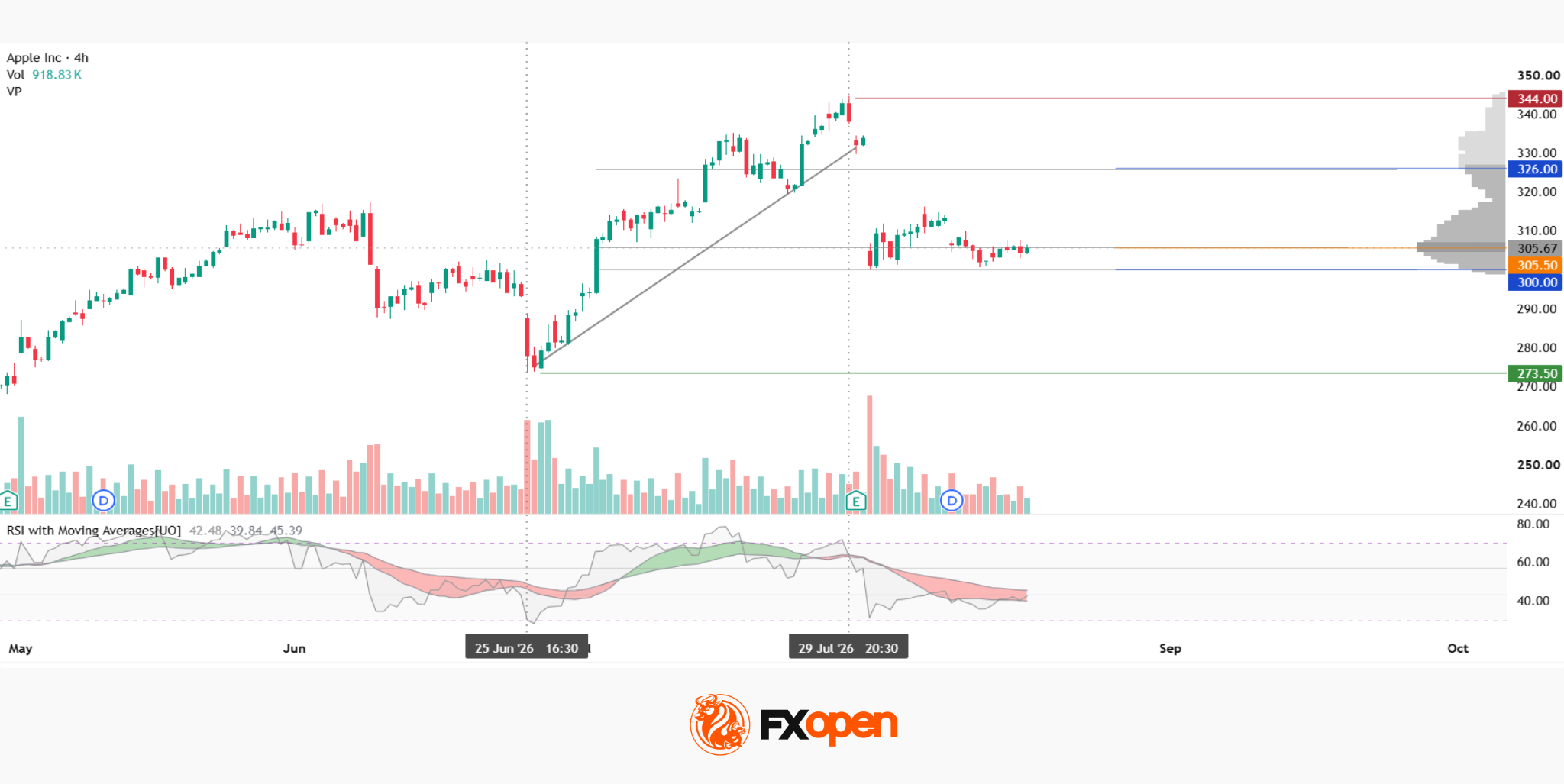
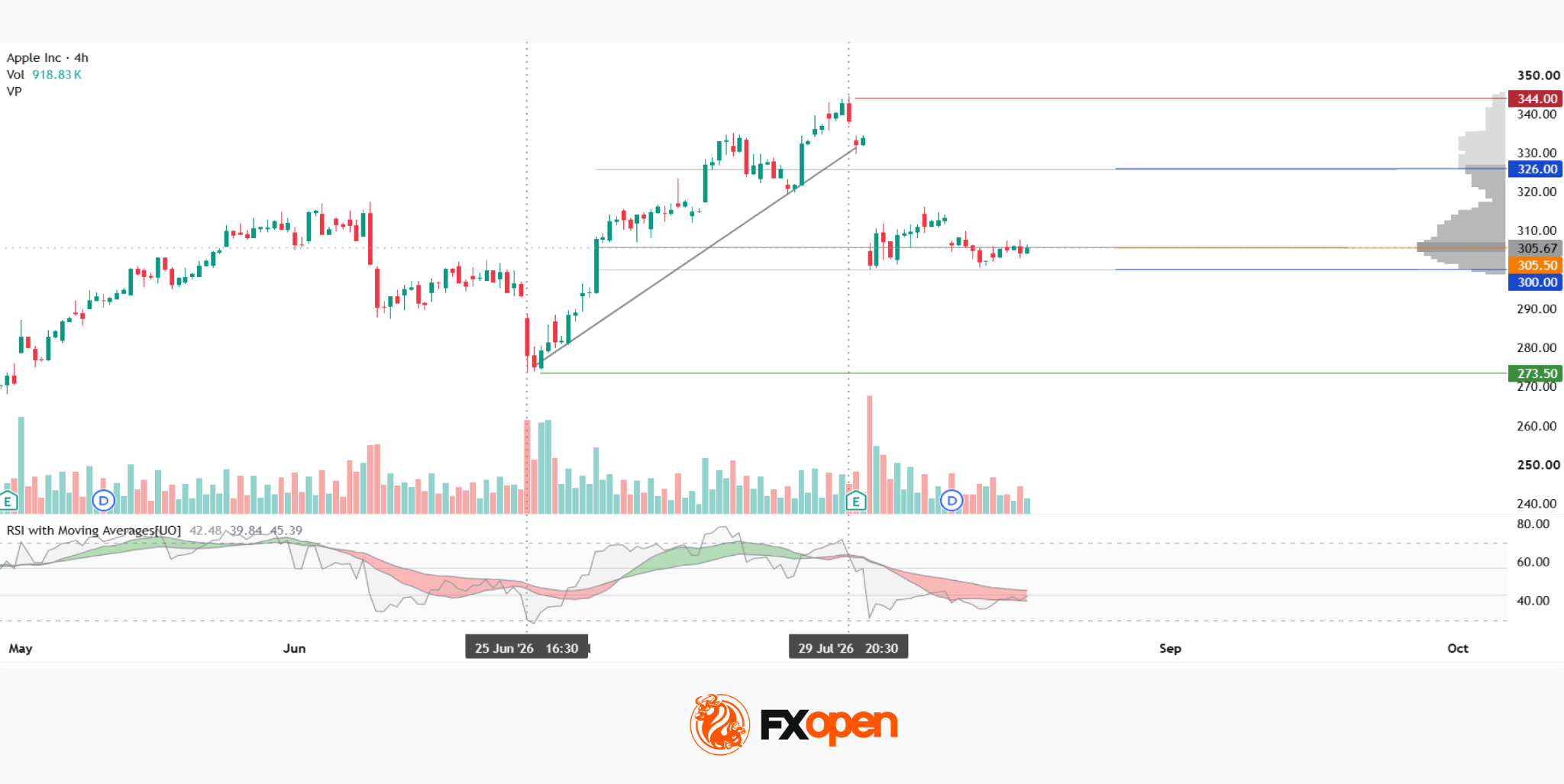
The four-hour chart highlights a significant technical event that occurred on 31 July, when the price moved below a rising trendline through a gap accompanied by trading volume well above recent averages. Despite the strength of that move, the breakdown has not yet developed into a sustained decline.
Instead, the stock has entered a consolidation phase, creating a well-defined market profile. Apple is currently trading between the Point of Control (POC) at $305.50 and the lower boundary of the profile at $300.00, while testing the POC area from below. Beneath the current consolidation zone, the next major support level can be found around $273.50.
Should the trend breakdown ultimately fail and buyers regain control, attention would shift towards two key resistance areas. The first is the upper boundary of the profile at $326.00, followed by a more substantial resistance zone near $344.00.
The RSI + MAs indicator currently stands at 42, 39 and 45. Both the RSI and the fast-moving average remain slightly below the neutral zone, while the slower moving average has yet to cross beneath the lower threshold, indicating that bearish momentum has not been fully confirmed.
Key Takeaways
Apple’s current sideways movement around the POC reflects a period of balance following the high-volume gap that disrupted the previous uptrend. While the market has yet to confirm a decisive bearish breakout, buyers have also been unable to push the stock back into a clear upward trajectory.
The divergence between the faster and slower components of the RSI + MAs indicator leaves the technical outlook unresolved, suggesting that the next directional move will likely depend on whether the price can either reclaim the upper part of the profile or break convincingly below the current consolidation range.
Buy and sell stocks of the world’s biggest publicly-listed companies with CFDs on FXOpen’s trading platform. Open your FXOpen account now or learn more about trading share CFDs with FXOpen.
This article represents the opinion of the Companies operating under the FXOpen brand only. It is not to be construed as an offer, solicitation, or recommendation with respect to products and services provided by the Companies operating under the FXOpen brand, nor is it to be considered financial advice.

Crypto has spent years building faster blockchains, cheaper transactions, decentralized applications, and increasingly sophisticated financial protocols. Yet one of the industry’s biggest challenges remains surprisingly fundamental
Building on crypto is still harder than it should be.
For crypto to move from an industry dominated by early adopters and specialized developers into a technology used by millions—or billions of people—it needs more than better protocols. It needs better developer infrastructure.
The next phase of blockchain growth may depend less on creating another Layer 1 and more on making it dramatically easier for developers to build, test, deploy, monitor, and scale applications on existing networks.
The Developer Experience Problem
In traditional software development, developers have access to mature tools for almost everything.
They can use established cloud platforms, databases, authentication systems, payment APIs, monitoring tools, analytics platforms, testing frameworks, and deployment pipelines. Much of the complexity is hidden behind reliable abstractions.
Crypto is different.
A developer building a decentralized application may need to understand wallets, private keys, RPC providers, smart contracts, gas fees, chain-specific infrastructure, indexing, token standards, bridges, signatures, transaction finality, security assumptions, and multiple blockchain environments.
That creates a steep learning curve.
Instead of asking:
“What can I build?”
developers often have to ask:
“How do I make all these infrastructure components work together?”
That is a serious barrier to innovation.
Infrastructure Is the Invisible Layer of Crypto
Users rarely think about infrastructure.
When someone sends a message, they don’t care which database handles it. When they stream a video, they don’t think about content delivery networks. When they purchase something online, they don’t need to understand payment-processing infrastructure.
Crypto should eventually work the same way.
A user shouldn’t need to understand RPC endpoints, nonce management, transaction simulation, gas estimation, block confirmations, or chain abstraction simply to interact with an application.
Developers shouldn’t have to rebuild those systems for every project either.
The more infrastructure becomes standardized and invisible, the more developers can focus on product design and user experience.
RPC Infrastructure Needs to Become More Reliable
Remote Procedure Calls, or RPCs, are one of the fundamental interfaces between applications and blockchains.
Yet developers frequently deal with issues such as:
- Rate limits
- Unstable endpoints
- Network congestion
- Provider outages
- Latency
- Inconsistent responses
- Difficult debugging
- Chain-specific configurations
For a consumer application serving thousands or millions of users, infrastructure reliability isn’t optional.
Crypto applications need RPC infrastructure that feels more like mature cloud infrastructure: predictable, scalable, observable, and easy to integrate.
Better infrastructure providers can abstract much of this complexity away from developers.
Indexing Is Another Major Bottleneck
Blockchains are excellent at recording transactions, but retrieving meaningful application-level information from raw blockchain data can be complicated.
Imagine building a decentralized marketplace.
You may need to answer questions such as:
- What assets does a particular wallet own?
- What transactions occurred during a specific period?
- Which NFTs changed hands?
- What is the user’s historical activity?
- What events occurred across multiple contracts?
- What are the current balances and positions?
Developers often need specialized indexing infrastructure to transform blockchain data into something applications can efficiently query.
Better indexing tools could turn blockchain data into something closer to a traditional developer-friendly database experience.
That would significantly reduce development time.
Testing and Debugging Need a Revolution
Smart contracts are immutable once deployed in many environments.
That makes testing especially important.
A small mistake can result in financial losses, broken applications, or serious security vulnerabilities.
Developers therefore need powerful tools for:
Simulation → Testing → Security Analysis → Deployment → Monitoring
The industry needs better local blockchain environments, transaction simulation, automated security testing, debugging tools, and production monitoring.
Imagine being able to reproduce a complex on-chain transaction locally with a few clicks and understand exactly why it failed.
That kind of developer experience could dramatically improve both productivity and security.
Wallet Infrastructure Should Become Invisible
Wallets are another major source of friction.
Traditional applications allow users to create an account with an email address, phone number, or social login.
Crypto often introduces concepts such as:
- Seed phrases
- Private keys
- Network switching
- Gas management
- Signature requests
- Transaction approvals
These mechanisms are important for self-custody, but developers need better ways to integrate them into applications.
The goal shouldn’t necessarily be to eliminate wallets.
The goal should be to make wallets easier to use without sacrificing security or user control.
Account abstraction, smart wallets, passkeys, embedded wallets, and better transaction flows are moving the ecosystem in this direction.
Chain Abstraction Could Change Everything
One of the biggest infrastructure challenges is fragmentation.
Crypto users and developers increasingly interact with multiple chains.
Ethereum, Layer 2 networks, Solana, appchains, alternative Layer 1s, and specialized networks can each have different architectures, tooling, transaction models, and developer environments.
For developers, supporting multiple networks can mean maintaining multiple infrastructure stacks.
For users, it can mean confusing network selection and asset management.
Better chain abstraction could allow applications to interact with multiple blockchain environments through a much simpler interface.
Instead of forcing developers to think about every chain individually, infrastructure could handle much of the complexity underneath.
The blockchain becomes the backend. The application becomes the product.
That’s a much more scalable model.
Security Must Be Built Into the Infrastructure
Crypto has another problem that traditional software can sometimes avoid at the same scale:
The infrastructure can directly control financial assets.
A vulnerable smart contract isn’t merely a software bug. It can become a financial catastrophe.
Developer infrastructure therefore needs security to be embedded throughout the development lifecycle.
That includes:
- Automated smart-contract analysis
- Dependency monitoring
- Transaction simulation
- Runtime monitoring
- Threat detection
- Permission analysis
- Key-management systems
- Automated alerts
- Formal verification tools
Security shouldn’t be something developers remember at the end of the project.
It should be integrated from the beginning.
Better Infrastructure Could Unlock More Developers
The crypto industry has often focused on attracting users.
But there is another equally important growth strategy:
Make it easier for developers to build things users actually want.
A developer shouldn’t need years of blockchain-specific experience to create a crypto-enabled application.
Imagine a world where a developer could integrate blockchain functionality using a few familiar APIs.
Want stablecoin payments?
Use an API.
Want tokenized assets?
Use an SDK.
Want wallet authentication?
Use an authentication layer.
Want on-chain analytics?
Query an indexed data service.
Want to deploy across multiple chains?
Use a unified deployment framework.
That is how crypto becomes accessible to the broader software-development community.
Infrastructure Is Becoming a Competitive Advantage
As blockchain networks become increasingly similar in areas such as transaction costs and performance, developer infrastructure could become a major differentiator.
A technically impressive blockchain is not enough if developers hate building on it.
A network with excellent documentation, SDKs, debugging tools, indexing, analytics, security infrastructure, and reliable APIs can potentially attract more developers—even if its raw technical specifications aren’t dramatically different from competitors.
This creates a powerful flywheel:
Better Infrastructure → More Developers → More Applications → Better User Experience → More Users → More Economic Activity
And more economic activity creates demand for even better infrastructure.
The Next Crypto Breakthrough May Not Be Another Blockchain
Crypto has historically celebrated protocol launches.
New chains receive attention. New consensus mechanisms generate headlines. New token standards create excitement.
But the next breakthrough may be less visible.
It could be an infrastructure layer that makes blockchain development dramatically simpler.
The biggest crypto innovation might not be another chain competing for blockspace.
It could be the tools that allow developers to stop thinking about blockspace altogether.
That’s the paradox of great infrastructure: when it works perfectly, nobody notices it.
What Better Developer Infrastructure Could Look Like
The ideal crypto developer stack could eventually resemble modern cloud development.
A developer could have:
One unified API layer
Connect to multiple blockchain networks without managing dozens of endpoints.
Powerful indexing
Query blockchain data without building custom data pipelines.
Built-in simulation
Test transactions before they reach production.
Integrated security
Automatically detect vulnerabilities and suspicious behavior.
Simple wallet infrastructure
Provide secure authentication without forcing users through confusing workflows.
Cross-chain tooling
Build applications that operate across networks without maintaining completely separate systems.
Real-time observability
Monitor contracts, transactions, users, and application health from a single dashboard.
One-click deployment
Move from development to production with significantly less operational complexity.
When these pieces work together, blockchain development begins to look less like a specialized discipline and more like ordinary software engineering.
The Real Goal: Hide the Complexity
Crypto doesn’t need to eliminate complexity.
It needs to move complexity away from developers and users.
The internet succeeded partly because developers didn’t have to understand every layer of networking before building websites and applications.
Cloud computing succeeded because developers didn’t need to operate physical servers to launch software.
Crypto can follow the same path.
The underlying blockchain technology can remain highly sophisticated while the developer experience becomes remarkably simple.
That is the infrastructure revolution crypto needs.
Final Thoughts
The future of crypto won’t be determined solely by transaction speed, token economics, or the number of blockchains competing for users.
It will also depend on how easy it is to build on those networks.
Better developer infrastructure can reduce complexity, improve security, accelerate experimentation, and open blockchain development to a much larger pool of software engineers.
The winning crypto ecosystems may ultimately be the ones that make developers forget they’re building on blockchain at all.
Because when infrastructure becomes invisible, innovation becomes visible.
Crypto doesn’t just need more developers.
It needs to make development easier.
And that may be one of the most important infrastructure challenges—and opportunities—of the next decade.
REQUEST AN ARTICLE

Crypto Lending Falls 17% to $56 Billion: Is This Slide Healthier Than 2022?

Copy Victoria Beckham’s Comfy, Slimming Dress Style for Less

All aboard as Asian Games preparations enter ‘final stages’


-

 Fashion4 days ago
Weekend Open Thread: Ann Taylor
-
 NewsBeat6 days ago
Communication cards help banking customers access services or report scams
-
 Sports4 days ago
This U.S. Amateur is a glimpse into golf’s future in more ways than you think
-

 Sports3 days ago
Birmingham 2026: Day 6 Timetable for Irish Athletes
-
 NewsBeat3 days ago
Myanmar says over 300,000 Rohingya refugees verified for repatriation as exodus enters ninth year
-

 Politics3 days ago
SEQ Code: The Three Letter Boarding Pass Code That Could Give You The Worst Seat
-
 Entertainment6 days ago
Keke Palmer Subtly Hints At Sean Evans Drama With Cryptic Post
-

 Fashion7 days ago
Coffee Break: The Fonteyn Jane Flat
-

 Fashion7 days ago
Should you refinance your debt? Pros, cons, and real numbers
-

 Tech7 days ago
Zoom Screen-Sharing Bug Let People Fully Take Over Other Devices On A Call
-
 Tech4 days ago
11 Ways to Rank Your Videos
-

 Fashion7 days ago
Claire Life: Kicking Off MVAAFF With the C Suite Luncheon Featuring Phylicia Rashad, Letoya Luckett, and More!
-
 Crypto World6 days ago
XRP bridge drained after software mistook fake deposits for real ones
-

 Sports6 days ago
DeQuan Jones in ‘high spirits’ after successful leg surgery
-
 Entertainment7 days ago
Star Wars Officially Continues ‘The Last Jedi’ With a New Spin-Off
-

 Tech5 days ago
DeepSeek Harness launches as open source rival to Claude Code, alongside V4-Pro on API with higher prices
-
 Crypto World6 days ago
Perplexity AI Predicts an XRP Scenario Few Analysts Are Discussing
-

 Politics7 days ago
In the Chris Kaba case, the police watchdog capitulated to the mob
-

 Tech6 days ago
SpaceXAI’s Grok Bot turns agents into persistent digital coworkers that can operate your apps for $120-per-month
-

 Politics6 days ago
How Average Are You In The UK?
You must be logged in to post a comment Login