

Crypto World
Solv Protocol Offers 10% Bounty After $2.7M Hack


Security researchers say a bug in Solv Protocol’s smart contracts allowed an attacker to mint an outsized amount of a Bitcoin-backed token and swap it for SolvBTC, the Bitcoin-pegged asset on the Solv network. In total, the incident is estimated at $2.7 million in losses, while the attacker minted 38.05 Solv Protocol BTC (SolvBTC) tokens before converting the bulk into a position on SolvBTC. Solv said fewer than ten users were affected and that it has deployed mitigations and engaged multiple security firms to investigate the exploit. The incident underscores ongoing security challenges in DeFi vaults that rely on cross-chain assets and minting logic.
Bitcoin-based DeFi platforms continue to attract attention for the financial leverage they offer across chains, but this episode shows how a single vulnerability can ripple through a broader ecosystem. The attacker’s maneuver involved 22 separate minting events, culminating in a swap that moved most of the minted tokens into just over 38 SolvBTC, a token pegged to Bitcoin. Pseudonymous researchers described the vulnerability as a re-entrancy-like flaw, a class of attack that has repeatedly exposed weaknesses in smart contracts where external inputs can provoke unintended minting or asset creation. While the precise chain of events remains under audit, the core insight is clear: minting controls on DeFi assets tied to real-world reserves demand robust, multi-layered safeguards.
Solv Protocol has been forthright about its response. In a public post on X, the team explained that they have put measures in place to prevent a recurrence and are collaborating with security firms Hypernative Labs, SlowMist, and CertiK to conduct a comprehensive review. A 10% bounty was offered to the attacker in exchange for returning the stolen funds, a strategy designed to recover value while maintaining a channel for dialogue. So far, there has been no confirmed on-chain communication from the attacker to the bounty address, according to Etherscan data, complicating any near-term recovery plan.
Solv Protocol’s model hinges on Bitcoin deposits backing Solv Protocol BTC, enabling users to lend, borrow, or stake across interconnected blockchains. The project has stressed that it possesses a substantial on-chain Bitcoin reserve—reported at roughly 24,226 BTC, valued at more than $1.7 billion at the time of reporting. This scale underscores the potential systemic impact of the breach, even if the immediate exposure to users appears limited. The event also places a spotlight on the resilience of liquidity providers across cross-chain ecosystems, where smart contract design, reserve accounting, and user protection mechanisms must align to prevent similar exploits in the future.
Initial assessments point to a flaw within a Solv smart contract that allowed excessive minting of a token used within the protocol. Security researchers describe this as a re-entrancy vulnerability, a persistent threat in DeFi that takes advantage of unexpected inputs to force asset creation beyond intended limits. The discourse around the incident has touched on broader lessons for DeFi—namely, the importance of formal verification, rigorous contract auditing, and robust guardrails for minting functions tied to real-world assets. The Solv incident joins a growing catalog of DeFi security episodes that encourage protocols to bake in stronger checks and consensus-driven escalation paths before minting or locking value.
Solv has provided a public wallet address in its update to encourage the attacker to participate in the bounty program. Yet, as of the latest blockchain checks, no on-chain message had arrived at that address. The lack of a reply is a reminder that, even with incentives, adversaries may delay or avoid engagement, leaving affected users and the ecosystem in a state of limbo as investigators map the full scope of the breach. The situation continues to evolve as security firms parse call traces, contract states, and token movements to determine whether additional exploits are possible or if the incident has crossed a boundary into a recoverable event.
The broader crypto community is watching how Solv and its security partners respond to this breach. The cross-chain nature of Solv’s products, coupled with the size of its Bitcoin-backed reserve, makes this incident more than an isolated hack; it tests the durability of risk controls, incident response, and incentive-driven remediation in DeFi’s Bitcoin-linked layer. While the immediate loss is tangible, the longer-term implications hinge on how effectively Solv can close the vulnerability, reassure participants, and demonstrate that cross-chain lending and staking platforms can withstand sophisticated, multi-stage exploits without eroding confidence in the underlying mechanics of wrap-and-bridge systems.
The event also highlights the tension between open, incentive-aligned security practices and the risk of misaligned incentives when large sums are at stake. As Solv and its partners conduct their audits and implement additional safeguards, observers will look for a clear roadmap outlining contract upgrades, formal verification steps, and a revised risk framework for minting and reserve management across Bitcoin-backed tokens. In an ecosystem where liquidity is a prized asset, the balance between rapid response and thorough, verifiable remediation remains the defining challenge for DeFi builders and auditors alike.
Why it matters
From a technical perspective, the Solv Protocol breach underscores how minting controls in DeFi products tied to real assets require exceptionally robust safeguards. A single bug in a contract that governs token creation can unlock outsized supply, enabling attackers to siphon value before guardrails activate. For users, the incident raises questions about the reliability of Bitcoin-backed DeFi vaults and the timeline for remediation—factors that influence whether liquidity remains available and secure across connected chains.
From a market perspective, the breach occurs against a backdrop of ongoing scrutiny of DeFi security practices, audit standards, and bug-bounty programs. The involvement of established security firms signals a serious investigative effort, but the absence of a public attacker-led recovery also underscores the fragility of trust when large on-chain reserves are at stake. For builders, the episode reinforces the need to implement multi-sig governance, formal verifications, and fail-safes that prevent minting beyond predefined caps, especially in systems that bridge Bitcoin to other networks.
For investors and users, the incident serves as a reminder to assess not only the yield or liquidity benefits of cross-chain DeFi products but also the depth and rigor of their security programs. The deployment of independent audits, transparent incident timelines, and concrete upgrade roadmaps will be critical in restoring confidence as the ecosystem weighs the trade-offs between innovation and safety in complex, asset-backed DeFi architectures.
What to watch next
- Updates from Hypernative Labs, SlowMist, and CertiK on the ongoing audit findings and patch implementations.
- Any further on-chain movements of the minted tokens or the SolvBTC asset, including potential recoveries or additional seizures.
- New governance or contract upgrades that address minting guards, emergency pause mechanisms, and reserve reporting.
- Public communications from Solv Protocol about timelines for remediation and user restitution, if applicable.
Sources & verification
- Solv Protocol’s official X posts detailing the incident and bounty offer.
- On-chain data and the transaction reference 0x44e637c7d85190d376a52d89ca75f2d208089bb02b7c4708ad2aaae3a97a958d.
- Public comments from security researchers (Hypernative Labs, SlowMist, CertiK) as cited in related updates.
- The reported figure of 24,226 BTC in Solv’s Bitcoin reserve and the broader context of SolvBTC as a Bitcoin-backed token.
Solv Protocol breach exposes risk in Bitcoin-backed DeFi vaults



Crypto markets demonstrated fragility on Friday, with bitcoin trading narrowly above a psychological level of support at $70,000.
The largest cryptocurrency broke above this level on Wednesday, rising to as high as $74,000 before failing to capitalize on a lower-liquidity zone above, and falling back alongside U.S. equities.
The intensifying war in the Middle East pushed oil to a new cycle high of $85 per barrel. Brent crude has risen roughly 42% since the start of the year. The surge in energy costs, alongside growing uncertainty around Iran, has prompted traders to reassess the inflation outlook in Europe, with money markets now even pricing the possibility of a European Central Bank rate increase by year-end — a sharp reversal from expectations for rate cuts in 2025.
Higher interest rates would typically weigh on bitcoin and the broader crypto market, as investors shift toward safer assets that offer attractive yields without the volatility associated with risk assets.
The altcoin market has also shown signs of weakness over the past week according to Santiment’s social volume tracker, which indicates that social media sentiment for the speculative market is nearing rock bottom.
Derivatives positioning
- The market is consolidating as bitcoin open interest (OI) rises to $16.16 billion from $15 billion last week, indicating a return of speculative interest.
- While retail funding remains stable in the 0%-to-10% range, Binance has flipped to -2.5%, signaling a localized surge in short hedging.
- Three-month basis is holding at 2.7%, a sign that institutional conviction remains soft.
- The options market has shifted toward cautious optimism. The 24-hour call volume split has tightened to 51/49 and the one-week 25-delta skew has cooled to 8% (from 15%), significantly lowering the cost of downside protection.
- While longer-dated implied volatility (IV) remains stable near 50%, the near-term has spiked into sharp backwardation, a signal that traders are pricing in an immediate, high-impact volatility event before a return to mid-term growth.
- Coinglass data shows $257 million in 24-hour liquidations, with a 70-30 split between longs and shorts. BTC ($121 million), ETH ($51 million) and others ($15 million) were the leaders in terms of notional liquidations.
- The Binance liquidation heatmap indicates $71,600 as a core liquidation level to monitor, in case of a price rise.
Token talk
- Decentralized finance (DeFi) tokens MORPHO and JUP led Friday’s selloff, losing between 2% and 3% since midnight UTC as traders rotated out of speculative tokens back into dollars.
- OKX’s native OKB token was the top gainer in the past 24 hours, rising by 23% after trading giant Intercontinental Exchange (ICE) signed a deal with the exchange to introduce tokenized stocks and crypto futures products.
- There were also substantial gains for KITE and RIVER, each rising around 15% in the past 24 hours to continue their impressive starts to the year.
- Privacy tokens continued to lose ground with zcash (ZEC) and decred (DCR) dropping 6% in the past 24 hours and the downturn accelerating since midnight UTC.
Ripple’s stablecoin RLUSD is moving closer to a major market capitalization milestone as new token issuance continues to expand its supply. Market data shows the stablecoin currently holds a valuation of $1.58 billion.
The figure places RLUSD only slightly below the $1.6 billion mark following a fresh mint of 10 million tokens on the XRP Ledger earlier today. Consequently, the new issuance has pushed the asset closer to another growth milestone in a short period.
Stablecoin Ranks Among Largest Digital Assets
The rising valuation has strengthened RLUSD’s position within the broader cryptocurrency market. According to current market rankings, the asset now stands as the 52nd largest cryptocurrency by market capitalization.
Additionally, RLUSD has climbed to become the 12th largest stablecoin in circulation. The rapid growth reflects increased activity within Ripple’s stablecoin strategy as the company continues expanding liquidity across its network.
Dominant Stablecoins Continue to Lead Market
Despite RLUSD’s recent growth, the stablecoin market remains heavily concentrated around two major players. Tether’s USDT leads the sector with a market capitalization exceeding $183 billion.
Circle’s USDC follows with roughly $77 billion in circulation. Together, they control a large share of global stablecoin liquidity and maintain a significant lead over newer entrants attempting to build market share.
Corporate Stablecoins Compete for Market Share
Beyond the two largest issuers, several projects compete in a fragmented mid-tier market. PayPal’s PYUSD currently leads regulated corporate stablecoins with a market capitalization of about $4.19 billion.
Newer projects, including Falcon USD and Global Dollar, also sit slightly ahead of RLUSD with valuations around $1.73 billion and $1.72 billion, respectively. Moreover, these tokens highlight increasing competition among corporate-backed digital dollars.
The expansion of RLUSD has allowed the token to move ahead of several established stablecoins. The asset now ranks above Binance’s BFUSD, which holds about $1.31 billion in market value.
Additionally, RLUSD has surpassed Tron’s USDD, which currently stands near $712 million. Consequently, the stablecoin has strengthened its position among mid-tier dollar-pegged assets in the global crypto market.
February Minting Strategy Accelerates Growth
Ripple increased supply aggressively throughout February as the company pushed additional liquidity into circulation. Over roughly three weeks, the RLUSD treasury minted nearly 75 million tokens.
The activity included a 30 million token issuance on February 9, followed by another 20 million minted on February 19. Moreover, Ripple later recorded its largest single-day mint with 69 million RLUSD issued to support expanding distribution channels.
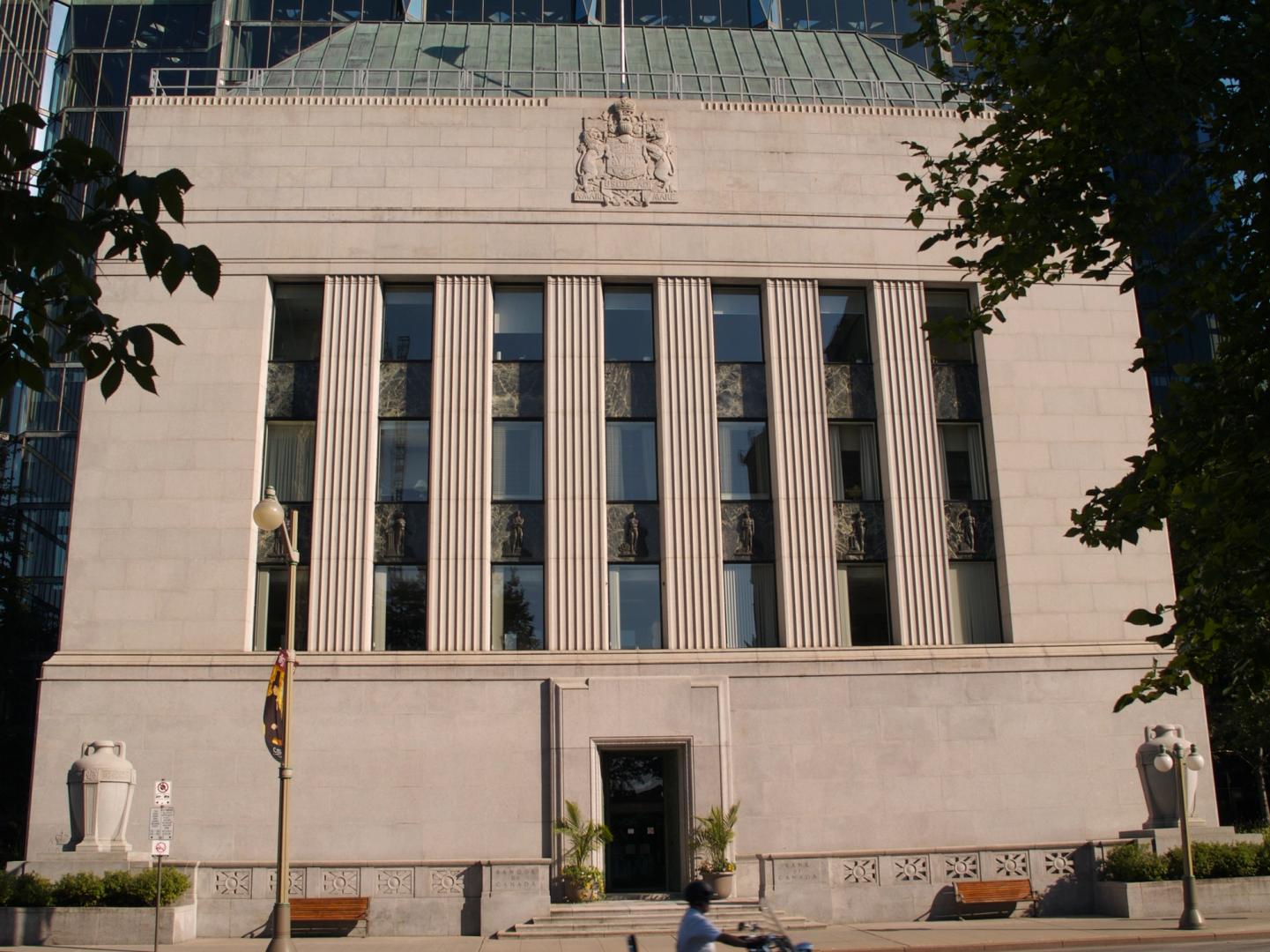
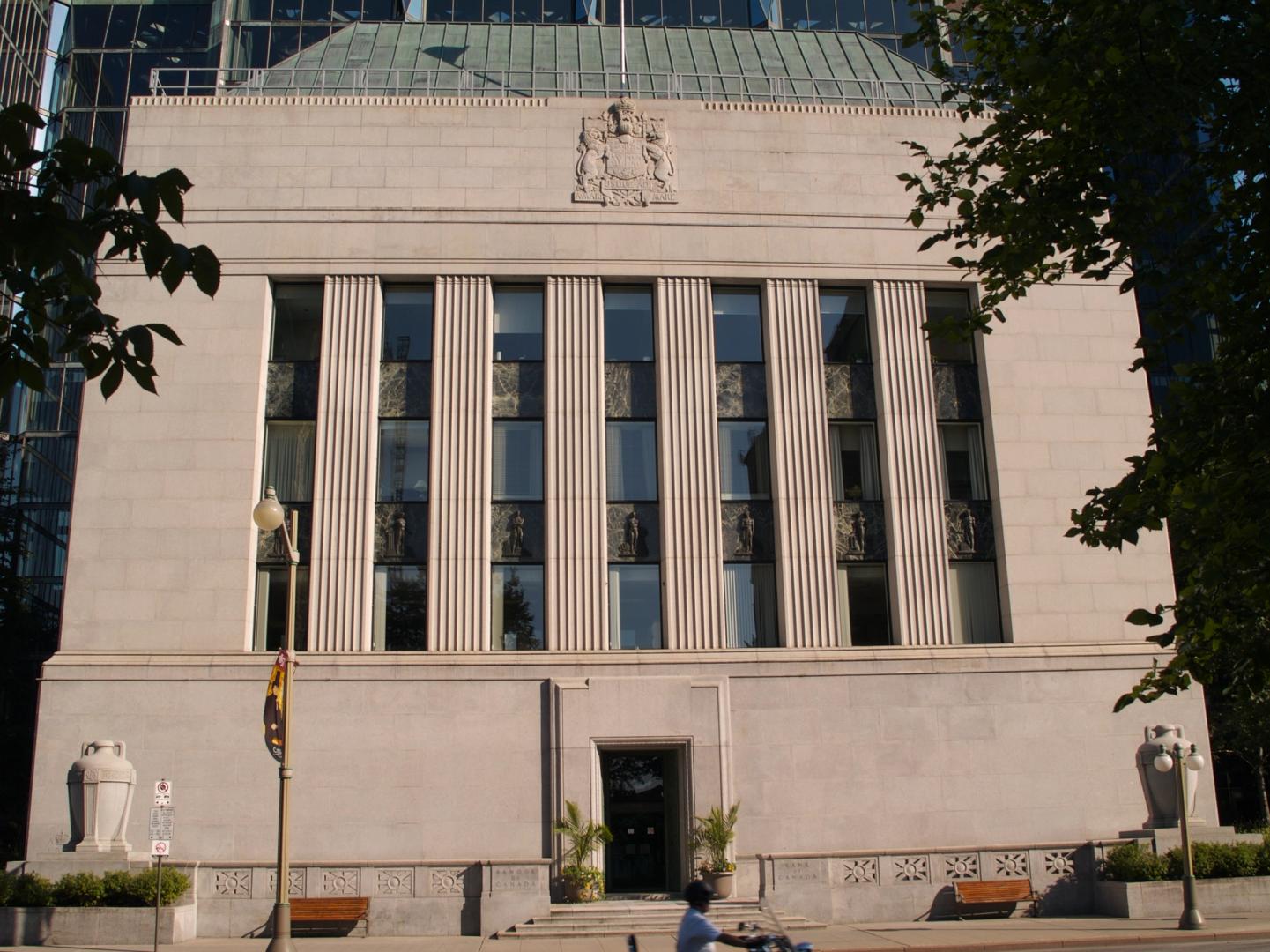
The Bank of Canada said it completed an experiment testing how tokenized bonds can move through financial markets in conjunction with a group of the country’s largest lenders.
The government’s Export Development Canada issued a C$100 million ($73 million) security with a maturity of less than three months, which was sold to a closed group of investors.
The test, known as Project Samara, also involved RBC Dominion Securities, RBC Investor Services Trust and the TD Securities division of Toronto-Dominion Bank. The group tested how bonds issued by EDC can be created, traded and settled using distributed ledger technology.
The platform, operated by RBC, supported the full lifecycle of a bond transaction. The bond was issued in tokenized form on the ledger, allowing participants to submit bids, process coupon payments, redeem bonds and trade on secondary markets through the same system.
The experiment also tested digital settlement using tokenized versions of wholesale Canadian dollars created and managed by the Bank of Canada. These digital funds moved on the same ledger as the bonds, allowing transactions to settle within the platform.
In its November budget, the federal government signaled plans to introduce legislation governing Canadian-dollar-backed stablecoins, with oversight expected to involve the Bank of Canada and rules focused on reserve backing, redemption policies and risk management.
Last month, the country’s investment regulator, CIRO, introduced a digital asset custody framework aimed at strengthening how crypto assets are held by trading platforms, tightening standards to reduce risks such as hacking, fraud and insolvency following past industry failures.

Bitcoin (CRYPTO: BTC) on-chain indicators are again drawing scrutiny as market watchers weigh the possibility of renewed accumulation. On Wednesday, exchange withdrawals surged to roughly 32,000 BTC, amounting to about $2.26 billion at prevailing prices, according to CryptoQuant data. For the week, total outflows approached 47,700 BTC — a top-tier figure over the past 12 months — with Bitfinex accounting for a sizable share, marking its largest daily outflow since June 2025. Analysts note that stablecoin flows moving into exchange wallets alongside BTC exiting venues fit a familiar pattern associated with dip-buying and repositioning into custody. While not a guarantee, the on-chain signals sketch a scenario in which institutions or large players are quietly accumulating.
Key takeaways
- Wednesday’s BTC withdrawals neared 32,000 coins, translating to roughly $2.26 billion, signaling potential large-scale buying pressure.
- Bitfinex recorded the largest daily BTC outflow since June 2025, estimated around 25,000 BTC.
- For the week through Friday, exchange netflows were negative on each trading day, totaling about 47,700 BTC, a setup some analysts consider bullish if the trend persists.
- Stablecoin activity moving to exchange wallets while BTC leaves suggests buyers are funding new positions rather than selling into the sell-side pressure.
- If netflows stay negative for another 3–5 days with no major re-entries to exchanges, the signal could qualify as “sustained accumulation,” though confirmation requires continued data.
Tickers mentioned: $BTC
Market context: The ongoing on-chain dynamics arrive amid a liquidity backdrop where traders watch risk sentiment and macro factors that influence crypto flows. Historically, sizable negative netflows indicate a reduction in immediate selling pressure on the spot market, which can support price stability or upside pressure when buyers resume activity. In this instance, the combination of large outflows and corresponding stablecoin inflows to exchanges aligns with a careful buildup rather than a rush to exit positions, underscoring how on-chain signals can precede a price response in a market sensitive to custody movements and liquidity shifts.
Why it matters
The significance of the latest data lies in the potential shift in supply dynamics. When coins depart exchanges and move toward cold storage or custodial wallets, the immediate availability of BTC for sale on spot markets contracts, which can ease selling pressure and tilt the balance toward upward price discovery if demand re-emerges. Analysts emphasize that sustained negative netflow — where more BTC leaves exchanges than re-enters — has historically coincided with periods of constructive price action, especially when accompanied by continued liquidity withdrawal from active venues.
The discussion around the anomalous 32,000 BTC outflow centers on its typical interpretation: moves associated with large spot purchases, followed by transfers to cold custody. Adler’s analysis notes that while a portion of spikes might reflect internal custody movements, the broader pattern often signals accumulation at the current price ranges. In early March 2026, a sizable liquidity inflow to exchanges — about $1.1 billion — preceded a shift in netflow dynamic, after which the net outflow eased but remained negative. The takeaway for market participants is that these sequences are not standalone events; they form part of a broader on-chain narrative about how big players manage risk, positioning, and custody as price cycles unfold.
For traders and institutions, the takeaway is to monitor whether the negative netflow persists. If the trend holds for several days, the market could be reading an elongated phase of demand absorption. Yet, even with a bullish tilt suggested by on-chain flows, price action remains contingent on broader macro cues, risk appetite, and the pace at which new buyers step in to support levels around key price anchors like $70,000. The data points themselves are descriptive — they don’t guarantee a rally — but they do illuminate where selling pressure is thinning and where buyers might be accumulating in anticipation of a future price move.
What to watch next
- Watch the next 3–5 days of net BTC exchange flows to confirm whether the negative trend persists without a substantial re-entry to exchanges.
- Monitor large transfers to cold storage or custodial services that could corroborate the hypothesis of accumulation.
- Track BTC price behavior near the $70,000 level and observe whether on-chain demand translates into sustained price support.
- Maintain awareness of additional data from CryptoQuant and CoinGlass for corroborating trends in exchange balances and netflow momentum.
Sources & verification
- CryptoQuant data on exchange netflow totals and the 32,000 BTC outflow observed on Wednesday.
- CoinGlass data confirming Bitfinex’s outflow magnitude and the weekly netflow pattern.
- Axel Adler Jr.’s analysis linking the spike to potential large spot purchases and custody movements.
- Related charts and analytical notes referenced in the article, including the linked external analysis pages.
On-chain signals point to a large BTC accumulation as exchange outflows spike
Bitcoin (CRYPTO: BTC) on-chain signals are again in focus as a wave of exchange withdrawals adds a layer of intrigue to market positioning. The data trail points to a notable transfer dynamic: a substantial portion of BTC was moved off exec-friendly venues on a single day, with Bitfinex at the center of the action. The near-32,000 BTC outflow on Wednesday stands out even within a week of elevated activity, and it coincides with stablecoin flows that move in step with the BTC exodus. Taken together, the indicators align with a familiar playbook in which buyers signal their intent by removing coins from exchanges and placing them in custody, potentially positioning for a liquidity-constrained move higher.
The analysis cites two pivotal observations: first, the single-day outflow magnitude around 32,000 BTC, and second, the week’s cumulative outflows near 47,700 BTC — figures that mark a notable milestone in the last year’s on-chain activity. The heavy involvement of Bitfinex, recorded as the exchange with the most pronounced outflow on the day, underscores the role of large venues as conduits for significant repositioning. In early March 2026, a separate liquidity event — a green bar representing roughly $1.1 billion in inflows to exchanges — was followed by a shift in netflow readings, moving to a negative but less extreme level as market participants reassessed risk and liquidity posture. The sequence implies a potential end-to-end cycle: exchanges see inflows or outflows, funds move to custody, and then the market adjusts to a thinner spot supply.
Analysts emphasize a key caveat: the observed spike is an anomalous one-day signal that warrants confirmation over several days of data. As Adler notes, the association between such spikes and large transfers to cold storage is common, but not universal. The larger question is whether the ongoing pattern of negative netflows can endure long enough to qualify as sustained accumulation. If the netflow remains negative for three to five more days without a surge of coins returning to exchanges, market observers will treat the trend as a reinforcing bullish signal — one that suggests demand is outweighing selling pressure at a time when liquidity dynamics are being recalibrated by custodial movements and macro sentiment.
On the price front, the narrative remains tethered to a price environment around $70,000, where buyers historically have shown resilience during episodes of improved on-chain conviction. While the data points do not guarantee an immediate uplift, they contribute to a broader chorus of signals that influence risk appetite and liquidity provisioning across spot markets. For investors, the takeaway is not certainty but a nuanced view: on-chain behavior is supporting a case for cautious optimism, contingent on continued outflows and the absence of a rapid re-entry of coins to exchanges.
For readers following the story closely, the implication is clear: the market is watching on-chain signals as a proxy for demand and supply. The presence of large outflows from exchanges, together with stablecoin inflows into exchange wallets, underscores a demand-side readiness among buyers who may be quietly building positions in anticipation of a future price move. The ongoing conversation around custody, liquidity, and risk sentiment will likely be amplified as data from CryptoQuant and CoinGlass continue to illuminate how these patterns evolve in the days ahead. The eventual confirmation or refutation of sustained accumulation will hinge on the persistence of negative netflows and the absence of renewed exchange-based selling pressure.
Crypto World
Cardano (ADA) Price Analysis: Bearish Momentum Dominates Despite Positive Macro Signals
TLDR
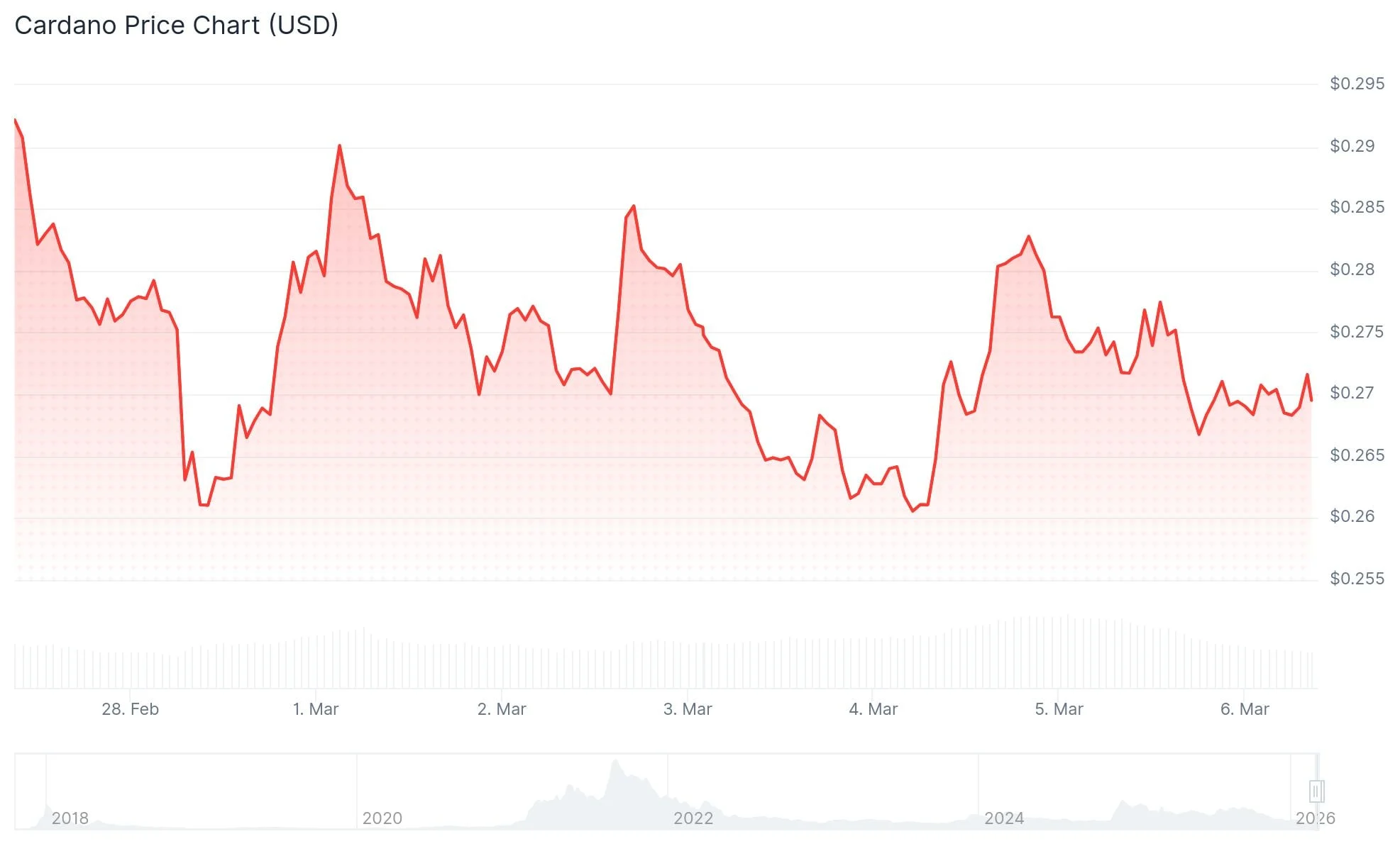
- Cardano is hovering near $0.27, facing critical resistance at a descending trendline around $0.28 that has consistently rejected upward moves
- Futures open interest has declined to $462 million, and the long-to-short ratio of 0.79 reflects dominant bearish sentiment
- Price action remains significantly below the 50-day and 100-day EMAs, both positioned above the $0.30 mark
- The Relative Strength Index stands at 46, below the neutral threshold, indicating limited momentum strength
- Manufacturing PMI has climbed to 52.4%, marking the third straight monthly gain in a 40-month period—a pattern historically linked to ADA rallies
Cardano (ADA) continues to trade around the $0.27 level this Thursday, March 6, as the cryptocurrency tests a critical descending trendline positioned near $0.28. This technical barrier has proven formidable in recent sessions, rejecting price advances and maintaining its role as the primary short-term obstacle.
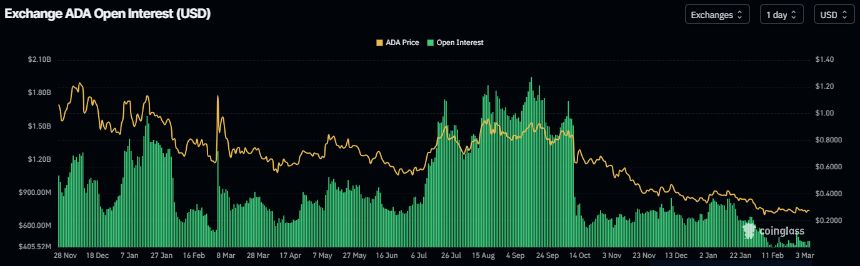
Futures market data reinforces the bearish narrative. Open interest in Cardano futures contracts has contracted to $462 million, marking a steady decline since the middle of January.
When open interest decreases while price action remains stagnant or declines, it typically indicates waning trader participation and reduced market conviction.
CoinGlass data shows the long-to-short ratio currently at 0.79—approaching its lowest reading in more than 30 days. This metric reveals that short positions outnumber long positions, confirming that market participants are predominantly betting on further price declines.
From a technical perspective, ADA remains substantially below both its 50-day and 100-day Exponential Moving Averages, which are clustered above the $0.30 threshold. This distance underscores the prevailing downtrend that has gripped the asset.
The daily Relative Strength Index registers at 46. Though it has rebounded from oversold conditions, the indicator remains beneath the 50 centerline, signaling that bullish momentum has yet to establish itself convincingly.
The MACD indicator shows marginally positive readings, but the histogram displays minimal movement. This configuration suggests consolidation rather than the emergence of a definitive trend reversal.
Key Price Levels to Watch
Looking at resistance zones, the immediate hurdle lies at the descending trendline near $0.28. A more formidable barrier exists at $0.32, where the downward-sloping EMAs also intersect.
A sustained daily close above $0.32 would be necessary to invalidate the current bearish framework and signal potential trend change.
On the downside, support is established at $0.26, with a secondary floor at $0.24. Should ADA breach the $0.24 level, it would likely trigger additional selling pressure.
Under current conditions, ADA appears poised to remain range-bound between $0.26 and $0.29 absent a significant market catalyst.
Macro Indicator Points to Possible Shift
Bitcoin recently broke through the $73,000 barrier, reaching a one-month peak, yet ADA failed to capitalize on this momentum. The altcoin registered only modest gains and couldn’t sustain a close above the prior session’s high.
Crypto analyst Dan Gambardello has highlighted the manufacturing Purchasing Managers Index (PMI) as a potentially significant indicator for Cardano’s medium to long-term trajectory.
The PMI, which measures manufacturing sector vitality, currently registers at 52.4%. This marks the third consecutive monthly advance over a 40-month timeframe.
Gambardello emphasizes that historical PMI expansion periods have frequently coincided with bullish cycles for ADA price performance.
The present configuration also bears resemblance to the 2019 correction phase, during which ADA experienced red monthly candles in six out of seven months before staging a substantial recovery.
Quantitative tightening concluded in December 2025. According to Gambardello, this development coupled with an ascending PMI creates a macro environment similar to the conditions that preceded Cardano’s previous significant price rally.
Cardano is now experiencing its sixth consecutive monthly decline following a negative February close.

TLDR:
- KuCoin froze a Canadian user’s account in July 2025, citing a system anomaly after a large withdrawal.
- The exchange publicly stated the account was deleted and funds were withdrawn months before the viral post.
- Adil shared screenshots on X countering KuCoin’s claim that no active case or frozen balance exists.
- KuCoin has asked the account owner to re-engage through official support channels for further review.
A public dispute has erupted between KuCoin and a Canadian crypto user over nearly $2.8 million CAD in allegedly frozen funds. The account holder, represented publicly by his cousin Adil on X, claims the money has been inaccessible since July 2025.
KuCoin pushed back on the claims directly via its official X account, stating the case was resolved months ago. The two sides now offer sharply conflicting accounts of the same situation.
KuCoin Froze Account After Large Withdrawal, User Claims
The trouble began on July 16, 2025. According to Adil’s post on X, his cousin made a large withdrawal, which triggered what KuCoin described as a “standard precautionary review.” The account was then frozen.
The user submitted KYC documentation, bank statements, and sources of wealth. KuCoin eventually told him, via email, that a “system anomaly” caused the hold. The exchange indicated each trade would need manual review before funds could be released.
The process dragged on for months. Adil says the communication became a cycle of delays, with each response pushing the timeline further. He described the experience as mentally draining for his cousin.
When the user turned to social media for help, KuCoin moderators publicly denied the issue existed.
Adil also claims the exchange threatened action against his cousin for submitting “inaccurate details,” even though private email communication acknowledged a system error on KuCoin’s end.
KuCoin Says Account Was Deleted and Funds Were Withdrawn
KuCoin responded publicly on X with a direct rebuttal. The exchange stated the UID referenced in the case was deleted roughly six months ago. According to KuCoin, the support ticket had been resolved and closed before the deletion occurred.
KuCoin also said the withdrawal connected to the ticket was completed successfully. The account, it claimed, held no assets when it was deleted.
The exchange cited privacy and security policies, noting its team can only discuss account details with the verified account holder. It invited the actual owner to contact support through the registered email if new information existed.
Adil rejected that response on X. He called it gaslighting and attached screenshots of past communications to support his claims.
He acknowledged sharing limited information publicly due to privacy concerns but maintained the account holder had been reaching out since July through proper channels.
Adil confirmed the account owner would continue contacting KuCoin via direct message, email, and other channels. He said he hoped the case could be located and resolved in good faith.
TLDR:
- Vancouver city staff found Bitcoin is not an allowable investment asset under the Vancouver Charter.
- Mayor Ken Sim’s November 2024 motion sought to protect city reserves from inflation using Bitcoin funds.
- British Columbia’s Ministry of Municipal Affairs cited undue risk in barring local governments from holding crypto.
- Bitcoin dropped nearly 50% from its all-time high of $126,000, reinforcing provincial caution over crypto holdings.
Vancouver city staff has recommended that the city council rescind a motion to establish a Bitcoin reserve. A legal review concluded that cryptocurrency does not qualify as an allowable investment asset under provincial law.
Vancouver Charter Bars Bitcoin as a Reserve Asset
A formal report was recently submitted to the Vancouver City Council by city staff. The document outlined a clear recommendation to scrap the reserve motion entirely.
Staff determined that the Vancouver Charter does not permit Bitcoin as an investment vehicle for the city. The Charter is the provincial statute governing city operations in British Columbia.
The report was direct in its conclusion. “Staff has conclusively determined that under the Vancouver Charter, Bitcoin is not an allowable investment asset for the City, and therefore recommends that this work be concluded,” the document stated.
Beyond the legal issue, staff also pointed to the need to reprioritize internal resources. Coordination with other ongoing city programs further supported the recommendation to end this work.
The Ministry of Municipal Affairs of British Columbia had previously addressed this matter directly. The ministry confirmed that local governments across the province are barred from holding cryptocurrency in reserve.
Officials cited exposure to undue risk as the core concern behind this restriction. That position from the province aligned closely with the findings in the staff report.
The Vancouver City Council had formally approved the motion in December 2024. Staff received direction to assess the proposal’s feasibility and return with findings by Q1 2025.
Despite the deadline passing, no report was publicly released until earlier this week. The delay raised questions about the transparency of the review process.
Mayor’s Bitcoin Initiative Faces Legal and Financial Setbacks
The motion was originally brought forward in November 2024 by Vancouver Mayor Ken Sim. It aimed to diversify the city’s financial reserves and shield its purchasing power from inflation.
Sim openly called Bitcoin “the greatest invention in human history” while presenting the proposal. That statement drew both widespread attention and scrutiny from various observers at the time.
As part of the broader initiative, Sim pledged to personally donate $10,000 worth of Bitcoin to the city. The proposal also sought to allocate a portion of municipal funds directly into the cryptocurrency.
The stated purpose was to protect the city’s finances against inflation and long-term market volatility. However, those ambitions have now been formally halted by legal constraints.
Bitcoin’s recent price history added another layer of concern to this debate. Since late 2024, the cryptocurrency reached an all-time high exceeding $126,000 before falling sharply.
It declined nearly 50%, dropping to lows near $63,000 over roughly four months. That level of volatility strengthened the provincial government’s caution about municipal crypto holdings.
At the time of reporting, Bitcoin was trading at approximately $70,534. The sharp price movements since late 2024 reinforced concerns from both city staff and provincial authorities.
The staff report, backed by the Vancouver Charter, appears to mark the end of the city’s crypto reserve ambitions.

Disclosure: The views and opinions expressed here belong solely to the author and do not represent the views and opinions of crypto.news’ editorial.
I keep hearing the same lazy line that Europe “regulates first, innovates later.” That sounds clever on a panel. It also ignores what is happening on the ground. Firstly, financial markets do not develop on vibes. They grow on repeatable rules, predictable supervision, and credible enforcement. MiCA has started to provide that. Secondly, MiCA isn’t about innovation and doesn’t need to be; it’s a fundamentally different area. It was created to support structured and predictable rules for market participants, and not to prevent or boost new initiatives.
Summary
- MiCA creates predictability, not paralysis: Markets scale on repeatable rules and supervision. MiCA provides a structured, staged framework for cross-border crypto activity across the EU.
- Compliance is becoming a competitive edge: Licensing under MiCA signals credibility, shifts liquidity toward compliant stablecoins, and attracts institutional capital rather than deterring it.
- Regulation reshapes incentives, not innovation: Europe’s volumes remain strong, while sandboxes and supervisory clarity reduce costly legal uncertainty for serious builders.
Businesses and entrepreneurs who want to innovate keep doing so. Yes, getting a license under MiCA requires extensive resources, but that doesn’t prevent projects from moving forward or exploring and testing new business models. Thirdly, the industry completely changed after FTX and Celsius collapsed, and this is the main catalyst and reason behind MiCA.
The Sandbox proved a simple truth
The European Blockchain Regulatory Sandbox is the most underappreciated part of the EU’s blockchain strategy. It runs from 2023 to 2026 and supports 20 projects per year, matching them with national and EU authorities for confidential, structured regulatory dialogues. Now, I’ve seen headlines calling it a marketing exercise. It’s really a mechanism for converting legal uncertainty into implementation steps.
Look at cohort three published earlier in February. The EU Blockchain Observatory and Forum did something important between June and November 2025. They brought together projects with regulators who deal with cybersecurity, data protection, and financial authorities. This matters because many blockchain failures occur at the intersections of GDPR, custody, AML, and other rules. The sandbox surfaces these gaps early, while products can still adapt. That is how you reduce the most expensive risk in crypto: building the wrong thing and discovering it after you have spent a lot of money.
MiCA’s real gift is market access at scale
MiCA is not perfect, but its core promise is powerful. One licensing framework designed to support cross-border activity, backed by a central register and common supervisory tooling. ESMA’s MiCA page explains the interim register structure and that it will be maintained through mid-2026 before full integration into ESMA systems.
So why is this timeline important? The MiCA rules started in 2023. The rules for stablecoins begin from 30 June 2024, and the wider regime applies from 30 December 2024. That staged roll-out is exactly what good regulation looks like. Give the market time to migrate, then enforce.
The “lean jurisdiction” argument misses what founders learn the hard way: you can incorporate cheaply in a light-touch venue, but you can’t easily buy credibility.
When you need reliable banking, institutional partnerships, and procurement-grade governance, you end up building the same controls anyway — just later, under stress, and usually after a near-miss. MiCA lets teams build those controls deliberately.
Regulation is reshaping markets, not killing them
Start with activity. Chainalysis reports that Europe’s transaction volumes recovered after a mid-2024 dip and peaked at $234 billion in December 2024, carrying momentum into early 2025. That does not look like a region that regulated itself into irrelevance.
Then look at stablecoins, where MiCA is already changing market structure. ESMA’s interim register lists 15 e-money token issuers managing 25 single-currency stablecoins. More importantly, the compliance filter is altering liquidity choices. MiCA alignment pushed the market toward compliant stablecoins. EURC grew 2,727% (July 2024–June 2025) versus USDC at 86%, in the same window.
That is what smart regulation does. It changes incentives so the safest, most transparent instruments win share. This is boring, but also how you attract serious capital.
There are still pain points
Let’s be honest about the trade-offs, because founders feel them every day. The biggest positive change is that licensing has become a competitive signal. Germany’s approach is a case study. BaFin approved 20 CASPs in 2025, leading the EU and accounting for 30% of total approvals across the bloc. There is also a clear concentration in licensing, with Germany and the Netherlands leading issuance.
That concentration reflects supervisory capacity and institutional comfort. Firms cluster where approvals are predictable and standards are clear. But there are still a lot of painpoints. Compliance is expensive, and Europe’s banking layer still behaves like a gatekeeper. Minimum licensing and compliance costs have risen roughly six-fold (€10k to €60k), venture funding is down 70% from 2022 levels, and blockchain-related job postings are down roughly 90% from 2022 levels.
Some of those trends track the global downcycle. Some are self-inflicted friction: slow onboarding, inconsistent national interpretations during transition, and banks that remain risk-averse even when regulation exists.
This is exactly why the sandbox matters. It gives regulators a feedback loop and gives companies a way to show controls early, before the bank says “no” by default.
A practical playbook for founders
If you are building in Europe, stop treating regulation like a box to tick at the end. Use dialogue early. If you can enter a structured forum like the EU sandbox, do it. It compresses legal uncertainty into product decisions.
The most important thing is to build with MiCA requirements in mind from the very beginning. Even if you launch lean, architect custody, disclosures, governance, and incident response as if licensing is inevitable. Pick your supervisory home strategically. Licensing concentration tells you where processes work today.
Treat compliance as a sales asset. Banks and institutional partners respond to governance, controls, and audited processes far more than they respond to “community”.



Bitcoin is on the cusp of falling below $70,000 for the first time since Wednesday, after climbing as high as $74,000 earlier this week.
The decline reflects a broader risk-off shift in markets as investors position ahead of key U.S. macroeconomic data and the developing war in Iran.
For now, attention is focused on the U.S. jobs report due at 13:30 UTC. The unemployment rate is expected to remain unchanged at 4.3% while nonfarm payrolls are forecast to drop to 59,000.
Labor market data is closely watched because it can influence expectations around Federal Reserve interest-rate policy, often leading investors to reduce risk exposure ahead of the release.
The war with Iran, nearing the end of its first week, is also contributing to market caution, pushing oil prices higher. WTI crude has climbed to around $83 per barrel, up more than 5% over the past 24 hours.
Meanwhile, the U.S. Dollar Index (DXY) has strengthened above 99 and the yield on the 10-year Treasury has risen to roughly 4.16%. Equity markets are slightly weaker, with the Invesco QQQ ETF, which tracks the Nasdaq 100 index, down about 0.5% in pre-market trading.
Crypto related stocks including Strategy (MSTR), Coinbase (COIN), and MARA Holdings (MARA) are also lower in pre-market trading.
TLDR:
- SEC moved to dismiss fraud claims against Justin Sun and TRON entities after nearly three years of litigation
- Rainberry Inc. will pay a $10M civil penalty while all claims against Justin Sun personally disappear
- The original SEC case accused TRON firms of 600,000 wash trades tied to $TRX market activity
- Celebrity promotions involving $TRX and $BTT tokens formed a central part of the regulator’s case
The U.S. SEC has moved to end its long-running lawsuit against TRON founder Justin Sun. Regulators asked a court to dismiss claims tied to a 2023 fraud case involving TRON entities.
A TRON-affiliated company will pay a $10 million civil penalty as part of the agreement. The resolution closes a dispute that centered on token sales, trading activity, and celebrity promotions.
SEC Ends Justin Sun Lawsuit Over TRX and BTT Token Sales
The original complaint targeted Justin Sun, the TRON Foundation, and the BitTorrent Foundation. Regulators alleged the firms sold unregistered securities tied to the TRX and BTT tokens.
According to the filing, the SEC claimed TRON entities conducted large volumes of wash trading. The complaint referenced more than 600,000 trades designed to inflate market activity.
The regulator also accused Sun’s companies of paying celebrities to promote tokens without disclosure. Those promotions included social media campaigns tied to $TRX and BitTorrent’s $BTT token.
The SEC now seeks to dismiss the claims against Sun personally. Court filings show the dismissal would occur without admissions of wrongdoing from the defendants.
The civil penalty will come from Rainberry Inc., a company linked to TRON operations. The proposed settlement would close the enforcement case after nearly three years.
TRON Founder Responds as SEC Crypto Enforcement Approach Shifts
Justin Sun confirmed the development through a post on X. He stated the regulator had moved to dismiss claims against him and TRON-related entities.
Sun also noted that the resolution closes the legal dispute while allowing him to continue working in the sector. He said his focus remains on expanding crypto innovation globally.
A separate post from the Wise Advice account summarized the settlement terms. It noted the penalty payment and the dismissal of all charges against Sun personally.
The same post argued the outcome reflects a wider shift in the SEC’s crypto enforcement strategy. Recent settlements and paused cases have reduced several ongoing legal battles.
The earlier complaint formed part of a broader regulatory push targeting token sales and trading activity. The settlement now closes one of the more visible cases tied to TRON’s ecosystem.
TRON’s market capitalization currently sits near $25 billion, according to widely cited market data. Some commentators questioned the relatively small penalty in relation to the network’s size.
Sun and TRON DAO described the outcome as a positive step for the project. The resolution allows the organizations to move forward without further litigation tied to the case.

Bitcoin fails to sustain breakout momentum as rate hikes beckon: Crypto Markets Today

Dems aren’t sure whether to actually spend big to flip Texas

Cozens scores go-ahead goal to help Senators beat Flames


-

 Politics3 days ago
Alan Cumming Brands Baftas Ceremony A ‘Triggering S**tshow’
-

 Fashion7 days ago
Weekend Open Thread: Iris Top
-

 Tech5 days ago
Unihertz’s Titan 2 Elite Arrives Just as Physical Keyboards Refuse to Fade Away
-

 NewsBeat6 days ago
Abusive parents will now be treated like sex offenders and placed on a ‘child cruelty register’ | News UK
-
 NewsBeat6 days ago
Dubai flights cancelled as Brit told airspace closed ’10 minutes after boarding’
-
Sports6 days ago
The Vikings Need a Duck
-
 NewsBeat6 days ago
The empty pub on busy Cambridge road that has been boarded up for years
-

 NewsBeat5 days ago
‘Significant’ damage to boarded-up Horden house after fire
-

 Tech1 day ago
Bitwarden adds support for passkey login on Windows 11
-

 Entertainment4 days ago
Baby Gear Guide: Strollers, Car Seats
-
 Sports17 hours ago
499 runs and 34 sixes later, India beat England to enter T20 World Cup final | Cricket News
-
 Tech7 days ago
NASA Reveals Identity of Astronaut Who Suffered Medical Incident Aboard ISS
-
Politics5 days ago
FIFA hypocrisy after Israel murder over 400 Palestinian footballers
-
 NewsBeat5 days ago
Emirates confirms when flights will resume amid Dubai airport chaos
-

 NewsBeat4 days ago
Is it acceptable to comment on the appearance of strangers in public? Readers discuss
-

 Tech5 days ago
Viral ad shows aged Musk, Altman, and Bezos using jobless humans to power AI
-

 Video4 days ago
How to Build Finance Dashboards With AI in Minutes
-

 Business2 days ago
Guthrie Disappearance Enters Fifth Week as Family Visits Memorial
-
 Crypto World5 days ago
US Judge Lets Binance Unregistered Token Class Action Proceed
-
 NewsBeat4 days ago
Ukraine-Russia war latest: Belgium releases video showing forces boarding Russian shadow fleet oil tanker