

Crypto World
South Africa Tax Authority Issues Proposed Crypto Tax Guidance


South Africa’s tax authority, the South African Revenue Service (SARS), has published draft guidance that explains how crypto assets should be taxed under the country’s existing income tax and capital gains tax frameworks. The proposed rules—released on Wednesday—aim to offer interpretive clarity rather than create entirely new obligations.
In a draft notice issued for public comment, SARS indicates that many common crypto activities, including trading, swapping and using crypto to pay for goods or services, are likely to be treated as disposals for tax purposes. However, the tax outcome would still depend on the taxpayer’s specific facts and circumstances, with the guidance stressing that intention and conduct over time matter.
Key takeaways
- SARS says crypto should generally be treated as an intangible asset, not legal tender or foreign currency, for tax purposes.
- Many crypto activities may trigger tax events because they can be viewed as disposals under existing income tax and capital gains tax rules.
- Whether someone is a trader or a long-term investor hinges on behavior, transaction frequency, and the purpose of holding crypto.
- The draft also suggests crypto can potentially fall under donations tax if transferred as “property,” with donation tax rates between 20% and 25% depending on value.
- The guidance is open for public comment until August 31 and is not yet final law.
Why SARS is issuing draft crypto tax guidance
The publication of draft guidance marks another step in South Africa’s effort to bring greater consistency to crypto taxation. SARS says the intent is to clarify how the existing tax regime applies to crypto, particularly under the Income Tax Act, 1962, along with capital gains tax principles.
That matters for local holders because tax treatment can affect how individuals and businesses account for crypto-related gains and losses—especially when transactions involve frequent trading or payments. SARS also noted in 2024 that at least 5.8 million residents held crypto assets, underscoring the scale of potential compliance implications if the guidance is adopted.
Crypto is treated as property, not currency
A central theme in the draft is how SARS characterizes crypto assets legally for tax purposes. According to the guidance, crypto assets are not treated as legal tender or foreign currency. Instead, SARS describes them as intangible assets—“not ‘currency’” and therefore not “foreign currency.”
The guidance draws a line between the asset and its function. While crypto can be used in ways that resemble money—such as trading, settlement, or payment—it is still framed as a distinct tax object. That distinction can be important because different categories of assets may be taxed under different rules, and the tax analysis may change depending on how SARS views the nature of the instrument involved.
Disposals, trading activity, and the role of intent
The draft repeatedly returns to the idea that many real-world crypto actions are economically similar to selling or exchanging an asset, which under tax law can amount to a disposal. SARS states that most crypto activities—including trading, swapping and spending—are generally treated as disposals and may trigger tax events.
At the same time, SARS cautions that the tax treatment will not be uniform for everyone. A key determinant is the taxpayer’s intention. The guidance explains that classification as a trader versus a long-term investor depends on behavior, including how often transactions occur and why the crypto is being held.
SARS also highlights that intention is not necessarily static. In the agency’s view, tax assessment should consider the taxpayer’s intention:
- at the time of acquisition,
- at the time of selling or disposing, and
- while holding the asset—recognizing that a person’s purpose can change over time.
This approach implies that taxpayers who rotate between investment and active trading could face different outcomes for different periods or different lots, depending on the evidence available. SARS says this requires a broad assessment of all relevant facts and circumstances, which may increase the importance of record-keeping—particularly for frequent traders and those who use crypto for payments rather than holding it untouched.
Potential reach to donations tax
The draft guidance also extends beyond routine trading and investing. SARS indicates that crypto assets may fall within South Africa’s donations tax rules because the assets are treated as “property” under tax law.
Under the framework described in the guidance, donations tax rates range from 20% to 25%, depending on the value of the donation. While the draft does not claim that every crypto transfer will automatically be subject to donations tax, it signals that SARS is prepared to treat certain transfers as taxable events in the context of property transfers, not just in the context of sale-like disposals.
What happens next: comment period and broader market context
The guidance is not final legislation. SARS says the draft is open for public comment until August 31, and the agency positions it as interpretive clarity rather than an attempt to introduce new legal obligations.
For market participants, this timing is significant. Many taxpayers will be deciding how to interpret their existing tax position in the lead-up to any final version of the rules. If the final guidance meaningfully narrows or expands the application of concepts like intention, disposal treatment, or property classification, taxpayers may need to adjust accounting methods and documentation practices accordingly.
South Africa is also one of Africa’s most active crypto markets. According to Chainalysis’ October 2024 report, the country received about $26 billion in crypto value during the one-year period covered by the study. Chainalysis also found that institutional and professional-sized transactions were the largest contributors, particularly from late 2023 through the first quarter of 2024, pointing to a gradual shift toward larger and more structured activity.
That trend can heighten the importance of clear tax rules for compliance. As trading volumes rise and more professional participation enters the market, inconsistency or uncertainty in how transactions are classified can translate into larger compliance risks—making guidance like SARS’s particularly relevant not only for retail investors but also for intermediaries and more active market participants.
As the August 31 comment deadline approaches, holders, traders, and businesses will want to watch for how SARS responds to submissions and whether the final version tightens the standard for determining intent, the treatment of swaps and payments, and the boundaries between trading and long-term investing.


Strategy sells 3,588 Bitcoin for $216M to fund dividends
Michael Saylor’s Strategy sold 3,588 Bitcoin (BTC) to fund preferred stock dividend payments and replenish its cash reserves.
Strategy sold the Bitcoin for $216 million, reducing its total holdings to 843,775 Bitcoin, according to a Monday 8-K filing with the US Securities and Exchange Commission.
This included 1,363 Bitcoin sold at an average price of $59,256 between last Monday and Tuesday, and 2,225 Bitcoin sold at an average price of $60,773 between Wednesday and Sunday.
Strategy disclosed the sale of 32 Bitcoin in early June, as its first reported Bitcoin sale since the 2022 tax-loss transaction.
Before Strategy disclosed its latest Bitcoin sale, Bernstein said the company was unlikely to be forced to sell its holdings, citing its liquidity position and cash reserve coverage.
Bernstein’s report said Strategy had 17 months of cash to cover dividend obligations and interest payments. It added that the company remained a net buyer of Bitcoin and served as a strong “balancing force” in a market where leading US Bitcoin miners are net sellers due to their pivot to AI.
Donald Trump says ‘nothing wrong’ with $1.4B crypto windfall while in office
US President Donald Trump has responded to criticism of his 2025 financial disclosures, showing that he earned $1.4 billion in income from crypto-related ventures while in office.
In a Thursday interview with CNBC’s Joe Kernen, Trump said that there was “nothing illegal” and “nothing wrong” with profiting from his crypto investments as president. He claimed that other people were responsible for his investments and he didn’t “even know who they are,” not directly answering questions about perceived conflicts of interest as president.
Trump’s comments followed the release of his 2025 financial disclosure report by the US Office of Government Ethics, showing that he took in more than $2 billion from his businesses and investments, about $1.4 billion of which was connected to crypto projects like his memecoin and family’s platform World Liberty Financial. Many advocacy organizations have characterized the investments as a “grift” allowing the president to influence related legislation like the Digital Asset Market Clarity (CLARITY) Act.
Trump disclosed that his memecoin generated about $636 million, World Liberty sales about $588 million and $197 million from equity in a stablecoin venture.

US senator calls for ban on elected officials issuing memecoins
Senator Kirsten Gillibrand, one of the US lawmakers behind negotiations for a digital asset market structure bill in Congress, has proposed barring elected officials and the president from issuing or sponsoring their own tokens, citing President Donald Trump’s and First Lady Melania Trump’s memecoins.
In a Friday notice, Gillibrand said that Congress should support measures barring elected officials and their spouses from “issuing or sponsoring their own digital assets.” The New York lawmaker said that the proposed restriction would include any US president and their spouse, but did not specifically mention extending the provision to the office of the vice president or other members of their families.
“This is a commonsense requirement that should get broad bipartisan support – public officials and their spouses should not be issuing memecoins,” said Gillibrand. “We cannot let self-dealing destroy an opportunity to strengthen consumer protections, crack down on illicit finance, and expand economic opportunity for the millions of Americans our financial system has left behind.”

Vitalik Buterin shares top priorities for new ‘Lean Ethereum’ strawmap
Ethereum co-founder Vitalik Buterin has named quantum resistance, scalability and privacy as three of Ethereum’s top priorities under a new “Lean Ethereum” strawmap, which lays out the network’s technical direction for the remainder of the decade.
In a post to X on Saturday, Buterin said the collection of upgrades will roll out over the next three to four years, touching nearly every layer of Ethereum in a transformation he compared in scale to the September 2022 Merge, which shifted the network away from energy-intensive mining.
“Quantum safety has shifted up a LOT in priority,” he said, adding that finalizing a quantum-safe solution for blobs has “become urgent.” Enhancing privacy is another priority, Buterin said, stating that it has become a “first class goal.”
Dankrad Feist, a former Ethereum Foundation researcher behind the payments-focused layer-1 Tempo blockchain, praised the new plan but argued the 3-4 year timeline is too slow, stating that AI could help developers ship the upgrades within a year.
Financial companies join forces for US dollar stablecoin, keeping reserve earnings
More than 140 companies have reportedly signed onto a US dollar-pegged stablecoin project that allows them to “receive all of the earnings” from its reserves.
In a Tuesday notice, Open Standard said it was launching the Open USD (OUSD) stablecoin, a US dollar-pegged coin supported by financial companies including Visa and Mastercard, as well as crypto companies Coinbase, Ripple, OKX and Bybit. The project will allow businesses to mint OUSD “at no cost and with no artificial limits on volume,” and keep earnings from the coin’s reserves.
“When Visa, Stripe, Mastercard, Coinbase and Google coordinate on a new stablecoin, the signal is unmistakable,” said Rhino.fi co-founder and CEO Will Harborne. “Open USD is the first launch with a real chance to win share from USDT and USDC, because reserve revenue flows back to everyone who holds it. But that same incentive is what drives fragmentation at scale.”
As the week continued, some of the signatories denied making any firm commitments to the consortium.

Winners and losers
At the end of the week, Bitcoin (BTC) is at $64,039, Ether (ETH) at $1798, and XRP (XRP) is at $1.14. The total market cap is at $2.12 trillion, according to CoinMarketCap.
Among the biggest 100 cryptocurrencies, the top three altcoin winners of the week are MemeCore (M) at 105%, Lighter (LIT) at 39%, and ether.fi (ETHFI) at 29%.
The top three altcoin losers of the week are Venice Token (VVV) at -13%, Stable (STABLE) at -10% and Audiera (BEAT) at -5%.
Top Prediction of the Week
Bollinger Bands creator eyes Bitcoin bear-market end, ‘W’-shaped reversal
John Bollinger, creator of the Bollinger Bands volatility indicator, believes he has spied a “W”-shaped double bottom on BTC/USD on the charts.
“$BTC has seen a series of bullish patterns broken, evidence of the power of the downtrend,” he commented in X posts on Friday.
“Will this ‘W’ be the one that breaks the trend?”
“W”-shaped reversals involve two swing lows with a rejected rebound in between, with price ultimately breaking through that rejection level to form a new uptrend.
Bollinger has been bullish on BTC for some time. In early May, he revealed a new long position via his Bitcoin investment vehicle.
As Cointelegraph reported, an increasing number of price indicators are flashing signals not seen since the last bear market in 2022. Despite this, market participants broadly believe that the next macro bottom is still to come and is due in Q3 or later.
Top FUD of the week
Tim Draper says Arkham got Bitcoin wallet attribution ‘wrong’
Billionaire investor and longtime Bitcoin bull Tim Draper said blockchain analytics company Arkham incorrectly linked him to a wallet involved in a large Bitcoin transfer to Coinbase Prime.
“It just wasn’t me. I haven’t touched it. Arkham has it wrong,” Draper told Cointelegraph, adding that he still expects Bitcoin to reach $250,000 within one year.
The statement came after blockchain analytics platform Lookonchain reported Friday that a wallet “possibly linked” to Draper had transferred 1,000 Bitcoin worth about $62 million to Coinbase Prime, citing data from Arkham.
Draper is best known in the crypto community as one of Bitcoin’s earliest high-profile investors, having won a US Marshals Service auction for nearly 30,000 Bitcoin seized by US authorities from Silk Road-related holdings in 2014. The holdings are now worth $1.9 billion, meaning Draper selling could have a big impact on Bitcoin’s.
Bitcoin profit and loss ratio falls to 43-month low
Bitcoin’s realized profit and loss ratio has fallen to a 43-month low of -0.35, a figure that signals extreme market-wide loss conditions but has historically coincided with market bottoms, blockchain analytics platform CryptoQuant said.
The Bitcoin realized P&L ratio — which measures the net percentage of Bitcoin (BTC) in profit or loss relative to total supply — hasn’t fallen this low since December 2022, shortly after FTX shockingly collapsed and sent Bitcoin below $16,000.
“Historically the indicator has marked BTC bottoms with extreme precision,” CryptoQuant said on Thursday. In 2015 and 2019, the Bitcoin realized P&L ratio also fell below -0.35 before price rallies followed.
The data could lift market sentiment, which has repeatedly fallen to near-record lows during the course of Bitcoin’s latest 50% drawdown from $126,080, set in October. Market sentiment has risen cautiously over the last 10 days, with Bitcoin up more than 7% since tanking to a near two-year low of $58,190 on June 25.
Upbit says it only expressed interest in future OUSD participation
South Korean crypto exchange Upbit said it is not participating in the issuance of Open USD, after its operator Dunamu was named among more than 140 businesses involved in the new stablecoin initiative.
“Upbit has only indicated our potential willingness to consider taking part in the future expansion of the OpenStandard ecosystem,” an Upbit spokesperson told Cointelegraph.
The clarification follows similar pushback from Samsung Electronics and other South Korean companies listed by Open Standard.
According to a Friday report by ChosunBiz, Samsung said it had not held formal discussions with the project and did not know what role it was expected to perform. Meanwhile, Shinhan Financial Group and KBank reportedly said they had only indicated that they would consider the initiative.
Cointelegraph reached out to Open Standard for comments but did not receive a response before publication.
Top Cointelegraph Features of the Week
The biggest blockchain upgrades still to come in 2026
From Ethereum’s Glamsterdam and Solana’s Alpenglow, to proposed post quantum security changes for Bitcoin, 2026’s key crypto upgrades are some of the most significant in years.
Has Strategy’s capital overhaul put an end to ‘death spiral’ fears?
Has Strategy’s new capital overhaul defused the fears swirling around STRC, or has it simply bought more time before the next bout of stress?
From Bitcoin critics to blockchain believers: The 5 biggest crypto backflips
From crypto hater Nouriel Roubini launching the Technodollar to Bitcoin critic Peter Schiff putting out tokenized gold, meet the skeptics who are now cashing in on crypto.
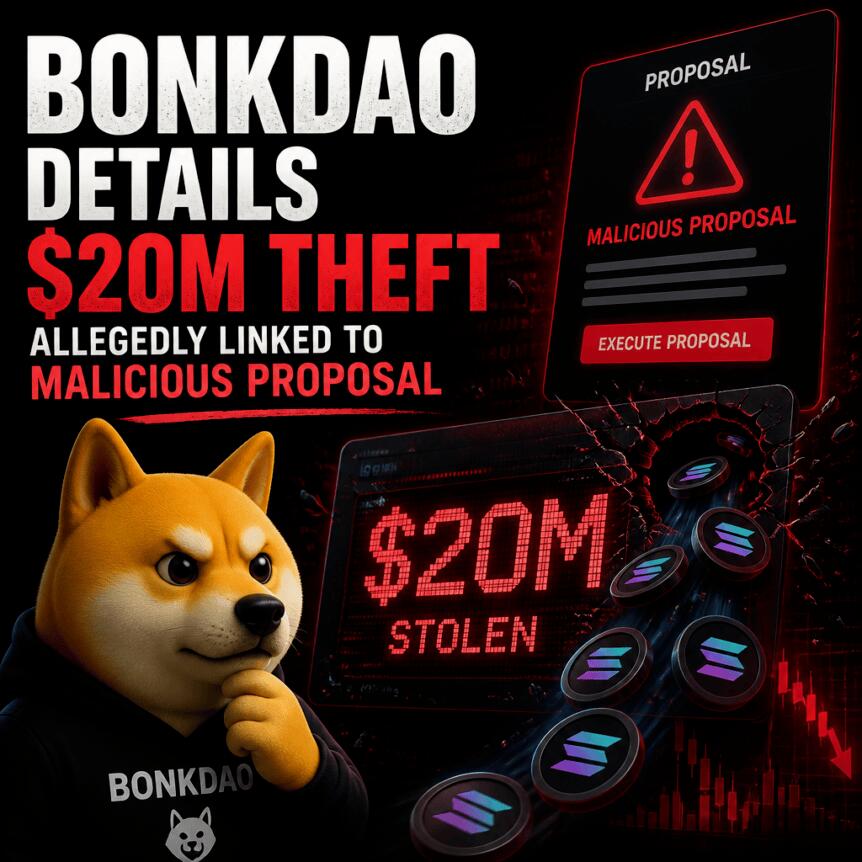
The DAO behind the Bonk (BONK) memecoin says an unknown actor drained $20 million in tokens from its Solana treasury, claiming the theft was carried out via what it describes as a “malicious governance proposal.” BonkDAO says it has contacted law enforcement and is working to recover the funds and determine who is responsible.
On Monday, the Bonk project posted on X that it reported the incident to authorities after the attack, which it says resulted in the transfer of $20 million worth of BONK tokens from the DAO’s treasury. The project did not identify the attacker, but framed the event as an abuse of its governance process rather than a simple compromise of its wallet or infrastructure.
Key takeaways
- BonkDAO claims $20 million in BONK tokens were removed from its Solana treasury through a “malicious governance proposal.”
- The project says it has informed law enforcement and is pursuing a fund-recovery effort while investigating the responsible party.
- BONK’s price reportedly fell about 7% over 24 hours following the reports, while broader memecoin market capitalization has been volatile.
- The incident echoes other recent memecoin-related compromises where attackers exploited on-chain mechanics around liquidity or governance.
What BonkDAO alleges happened
According to Bonk’s announcement on X, the DAO’s treasury on Solana was drained by an entity the project says it cannot yet identify. BonkDAO specifically points to a governance proposal that it characterizes as malicious, suggesting that the attacker used the protocol’s decision-making mechanics to move funds.
The project stated that the parties involved drained $20 million in tokens from the BonkDAO treasury. As part of its response, Bonk said it has already contacted law enforcement, and it is focused on two immediate goals: recovering funds and identifying those behind the proposal.
While the company’s exact internal controls and the timing of the proposal were not detailed in the post, the core claim—that the theft route involved governance—matters for token holders because governance systems are typically designed to be resilient to single points of failure. If a malicious proposal can pass or execute successfully, it raises questions about how proposals are validated, how voting authority is distributed, and what safeguards exist against fraudulent or coercive actions.
Market reaction and broader memecoin fragility
The reporting of the attack coincided with weakness in the BONK market. The article notes BONK was down roughly 7% over 24 hours and trading around $0.05 at the time of publication.
That move occurred during a period when memecoins broadly have struggled. The market capitalization of major memecoins—including Dogecoin (DOGE), Shiba Inu (SHIB), and Pepe (PEPE)—hit a reported two-year low last week, falling to roughly $22 billion before recovering to more than $26 billion in July. Based on CoinMarketCap data, total memecoin market capitalization stood at about $25.3 billion at the time of publication, down more than 54% compared with the prior 12 months.
For investors, incidents like this tend to amplify existing concerns about risk management and operational security across the memecoin sector. Even where the affected token is not the only one linked to memecoin sentiment, governance-driven treasury drains can quickly affect confidence in how safely community-controlled funds are managed.
Security pattern: governance and liquidity attacks
BonkDAO’s framing aligns with a wider pattern seen in the memecoin ecosystem, where attackers have targeted the mechanisms that make token economies function—especially liquidity and permissions.
Earlier coverage cited in the article described how the memecoin launch platform DxSale reported losing $7.3 million in tokens after a cyberattack connected to liquidity providers on the BNB Chain. In that case, sleuths were said to have identified the attacker’s wallet, but an expert also warned that tracing can be complicated by the infrastructure used to move stolen funds.
Taken together, these episodes highlight a recurring asymmetry: even when analysts can identify wallets or link activity on-chain, recovering assets may remain difficult if funds are transferred rapidly across multiple addresses or through tools that obscure the trail. BonkDAO’s statement that it is working to recover funds suggests the project expects the process to be complex, potentially involving coordination with exchanges, chain analysis efforts, and legal processes.
Related pressure on memecoin investors
The article also points to reporting about losses among holders of Official Trump (TRUMP), a memecoin associated with U.S. President Donald Trump. The New York Times, the article says, reported that about 1 million investors holding TRUMP had collectively lost $3.8 million as of June 30, citing data from blockchain analytics provider Nansen.
While that report focused on performance and holder outcomes rather than theft, it underscores a key reality for memecoin participants: the sector can deliver sharp drawdowns quickly. When governance incidents and broader volatility overlap, traders and long-term holders alike may face heightened uncertainty, especially around treasury actions, token distribution, and the transparency of risk controls.
Readers should watch next for whether BonkDAO can publish additional technical details about the governance proposal—such as the voting pathway, approval mechanism, and the steps taken to prevent similar actions—as well as for any updates from law enforcement or chain-monitoring efforts tied to the stolen funds. Until the investigation clarifies how the malicious proposal succeeded and whether any assets can be recovered, the incident remains a reminder that memecoin “community control” still depends heavily on robust smart-contract and governance safeguards.

China’s internet regulator removed more than 14,000 AI products from the country’s networks in the opening phase of a sweeping cleanup campaign called “Qinglang”. The move signals a major tightening of domestic AI control.
Here is what the crackdown covered, how tech giants responded, and what the next phase targets across the sector.
What China’s Qinglang AI Cleanup Actually Did
Qinglang, meaning “Clear and Bright,” is an annual internet governance campaign run by the Cyberspace Administration of China (CAC) to remove harmful or illegal online content. The 2026 edition focused heavily on AI across the entire ecosystem for the first time.
The scale of the first phase was significant. The CAC removed over 14,000 non-compliant AI products, including websites, apps, and AI agents. Furthermore, it scrubbed more than 6 million pieces of illegal or harmful information across Chinese networks.
Follow us on X to get the latest news as it happens.

The regulator also went after accounts and datasets. It suspended over 26,000 accounts and took down more than 1,300 AI-related product listings. Moreover, it removed nine open-source datasets that it deemed illegal under current Chinese rules.
The campaign began in April 2026 and targeted four main problems. These included skipping mandatory model registration, weak safety filtering, AI data poisoning, and content not properly labeled as AI-generated across platforms and services.
New obligations now apply across the board. AI services must register, implement safety filters, clearly label AI-generated content, and properly manage training data. Failing to comply can now trigger real takedowns and penalties for offending companies.
How Tech Giants Responded to the Crackdown
Major Chinese technology firms moved quickly to comply. Huawei added special reviews in its app store, while Alibaba improved its content identification systems. Zhipu built a new review model, and DeepSeek added checks to stop data manipulation.
Meanwhile, ByteDance’s Doubao and the Qwen team took a different route, disabling their custom agent features rather than meeting the new anti-addiction and instant-exit requirements.

Local internet offices also adapted their approach. Beijing paired platform self-checks with routine monitoring, while Shanghai tailored rules by platform type.
Zhejiang focused on model auditing, and Guangdong built a multi-agency mechanism across the full AI chain.
The second phase raises the stakes further. It will target AI used to spread disinformation, produce violent material, impersonate people, harm minors, and run paid astroturfing campaigns. The regulator promised heavier penalties for offending accounts and institutions.
A separate rule also takes effect on July 15. The Interim Measures for AI Anthropomorphic Interactive Services target AI companions built for emotional relationships. It bars virtual-companion services for minors and requires guardian consent for users under 14.
The crackdown lands amid intense US-China AI competition. Chinese firms now match new US systems within months of release. Notably, security firm Semgrep said a free Zhipu model recently outperformed Anthropic’s Claude Opus 4.8 at finding software vulnerabilities.
The post China Purges Over 14,000 AI Products Amid “Qinglang” Cleanup Campaign appeared first on BeInCrypto.
Two of Wall Street’s biggest banks just gave opposite advice on the same artificial intelligence (AI) trade. JPMorgan says the recent dip in AI chip prices is a buying opportunity, while Morgan Stanley says it is time to move on.
The disagreement is about timing, not direction. A sharp pullback in chip shares has capped a huge 2026 run, and both banks still back the AI boom while splitting on where the next gains sit.
JPMorgan Says the AI Chip Dip is a Gift
JPMorgan told clients the recent selloff is a buying opportunity. The bank says demand for AI chips remains strong while supply stays tight. It does not expect meaningful new chip capacity to arrive until 2028.
Follow us on X to get the latest news as it happens
That shortage hands chipmakers real pricing power. So JPMorgan prefers chip stocks over the big cloud companies known as hyperscalers. The bank also expects global stocks to reach new highs in the second half of 2026.
Morgan Stanley Says the Leaders are Tiring
Michael Wilson, chief investment officer at Morgan Stanley, sees it differently. His team says the momentum behind chip stocks is fading after they led the entire rally. Chipmaker earnings estimates have also been raised so fast that they now sit at historic extremes.
Wilson’s main clue is a strange disconnect. Hyperscalers like Microsoft, Amazon, and Meta are spending more than ever on AI, with capital budgets forecast at $805 billion in 2026 and $1.116 trillion in 2027. Yet their shares have continued to slip.
That gap, in his view, is a warning sign for chip stocks. He even compared the chip rally to silver’s sharp climb earlier in 2026, calling both liquidity-driven moves rather than lasting new trends.
Wilson expects major US benchmarks to stay under pressure in the near term.
“the momentum unwind is happening in some of the larger companies in the index,” Bloomberg reported, citing Wilson.
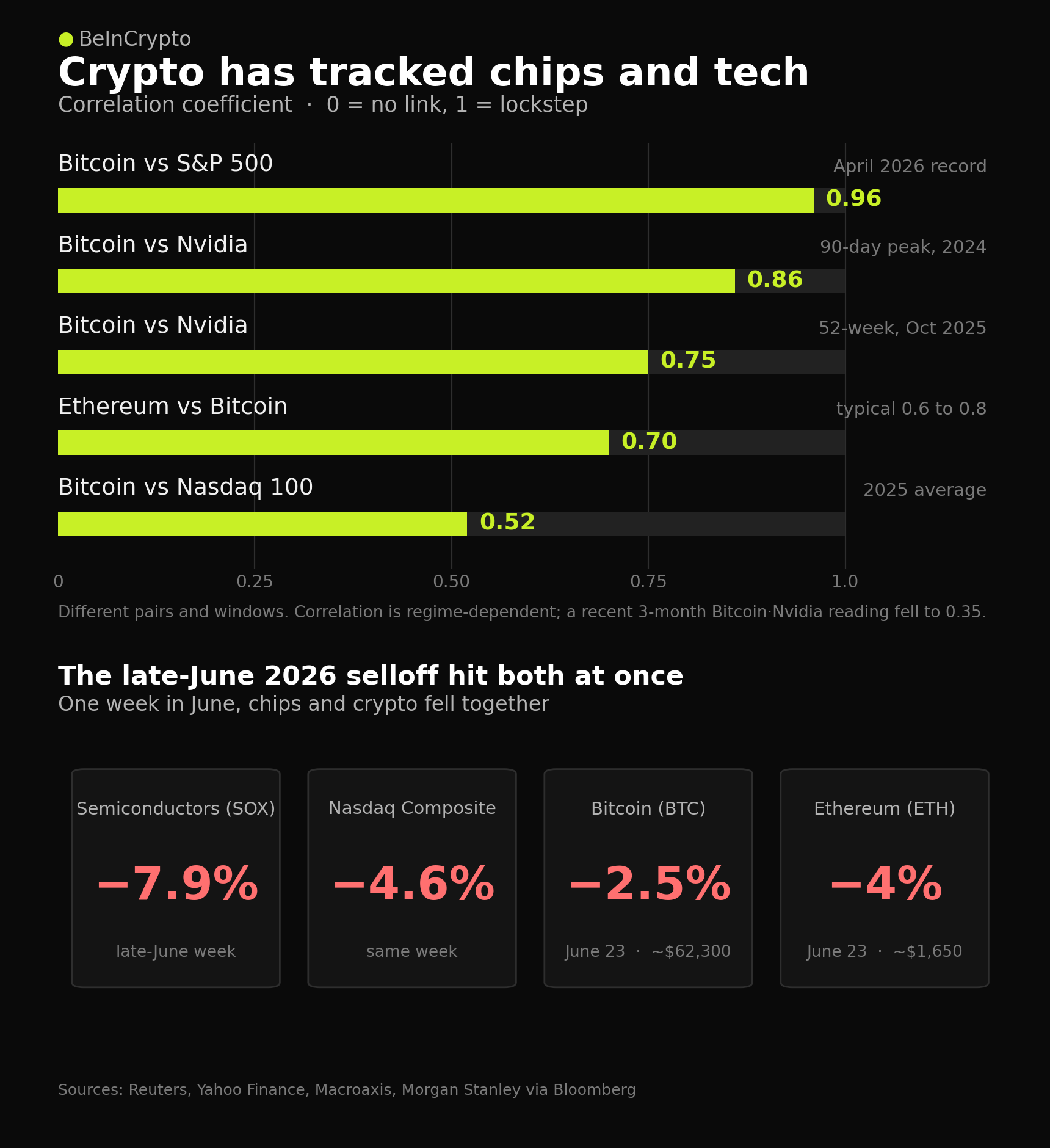
The numbers show the strain. The Nasdaq Composite fell 4.6% in one late-June week, while the recent chip selloff pushed the Philadelphia Semiconductor Index down 7.9% over the same stretch. The index still sits well above its level last September.
Nvidia Earnings Could Settle the Debate
Investors are now waiting for the next big clue. A strong sales forecast from Micron last month failed to lift chip stocks. Many want to hear from Nvidia on the health of AI chip demand.
The bigger tell may be whether hyperscalers stick to their spending plans, especially amid fears that they are overspending on AI. Wilson holds a year-end target of 8,000 on the S&P 500, roughly 7% above current levels.
Why Crypto Investors are Watching
Chip stocks and crypto have moved closely together, both trading as high-beta bets on AI and easy money. When semiconductors fall hard, Bitcoin (BTC) and Ethereum (ETH) have often caught the same cold.

The danger is that hyperscaler weakness turns into a broad tech selloff rather than a clean rotation, which could drag risk-on flows into crypto lower.
Steady hyperscaler spending on the next earnings calls would support Wilson’s rotation, while sudden cuts would spell trouble for chips and crypto alike.
The post JPMorgan Says Buy the AI Chip Dip But Morgan Stanley Pushes a Different Bet appeared first on BeInCrypto.


Ripple has received full Crypto Asset Service Provider (CASP) authorization from Luxembourg's Commission de Surveillance du Secteur Financier, the company said in a press release Monday. The license completes Ripple's Markets in Crypto-Assets Regulation (MiCA) requirements, letting it offer… Read the full story at The Defiant
Solana price has held above key technical support even after slipping 1.7%, while U.S.-listed spot Solana ETFs have continued attracting fresh inflows as Bitcoin and Ethereum funds recorded weekly withdrawals.
Summary
- Solana held above key support as $5.75 million in spot ETF inflows contrasted with Bitcoin and Ethereum fund outflows.
- Solana ranked second in weekly spot trading volume, while non-vote transactions topped 1 billion for the first time.
- Rising active users, strong DApp revenue, and bullish technical indicators continue to support Solana’s recovery.
After climbing more than 15% last week, Solana (SOL) price met selling pressure near the $80 level, where traders again defended resistance amid the broader market pullback. Even after the recent recovery, the token remains about 73% below its all-time high of $294.33 reached on Jan. 19, 2025.
Meanwhile, Bitcoin fell 1.65% during the same period, dragging the total cryptocurrency market capitalization down 1.47% to $2.14 trillion.
ETF demand has stayed positive despite market weakness
Fund flow data showed Solana diverging from the two largest cryptocurrencies during the latest reporting period. Spot Bitcoin ETFs recorded net outflows of $527 million between June 29 and July 2, extending their losing streak to eight consecutive weeks. Spot Ethereum ETFs also registered net outflows totaling $13.67 million.
By contrast, U.S.-listed spot Solana ETFs attracted $5.75 million in net inflows over the same period. The inflows indicated that investors continued adding exposure despite weakness across the wider digital asset market.
Capital also moved into several other altcoin investment products. XRP ETFs recorded $17.19 million in net inflows, while HYPE ETFs added another $4.32 million during the week.
Away from fund flows, on-chain activity continued to strengthen. According to SolanaFloor, Solana ranked second in global spot crypto trading volume for the second consecutive week, processing $12.25 billion across centralized and decentralized exchanges. That total remained ahead of Bybit’s $10.57 billion, although Binance retained the top position among exchanges during the reporting period.
SolanaFloor also reported that weekly non-vote transactions surpassed one billion for the first time. Unlike validator voting activity, non-vote transactions represent actual network usage generated by users, decentralized applications, and traders. The sharp rise at the beginning of July points to heavier activity across the ecosystem.
Technical structure still favors buyers above key support
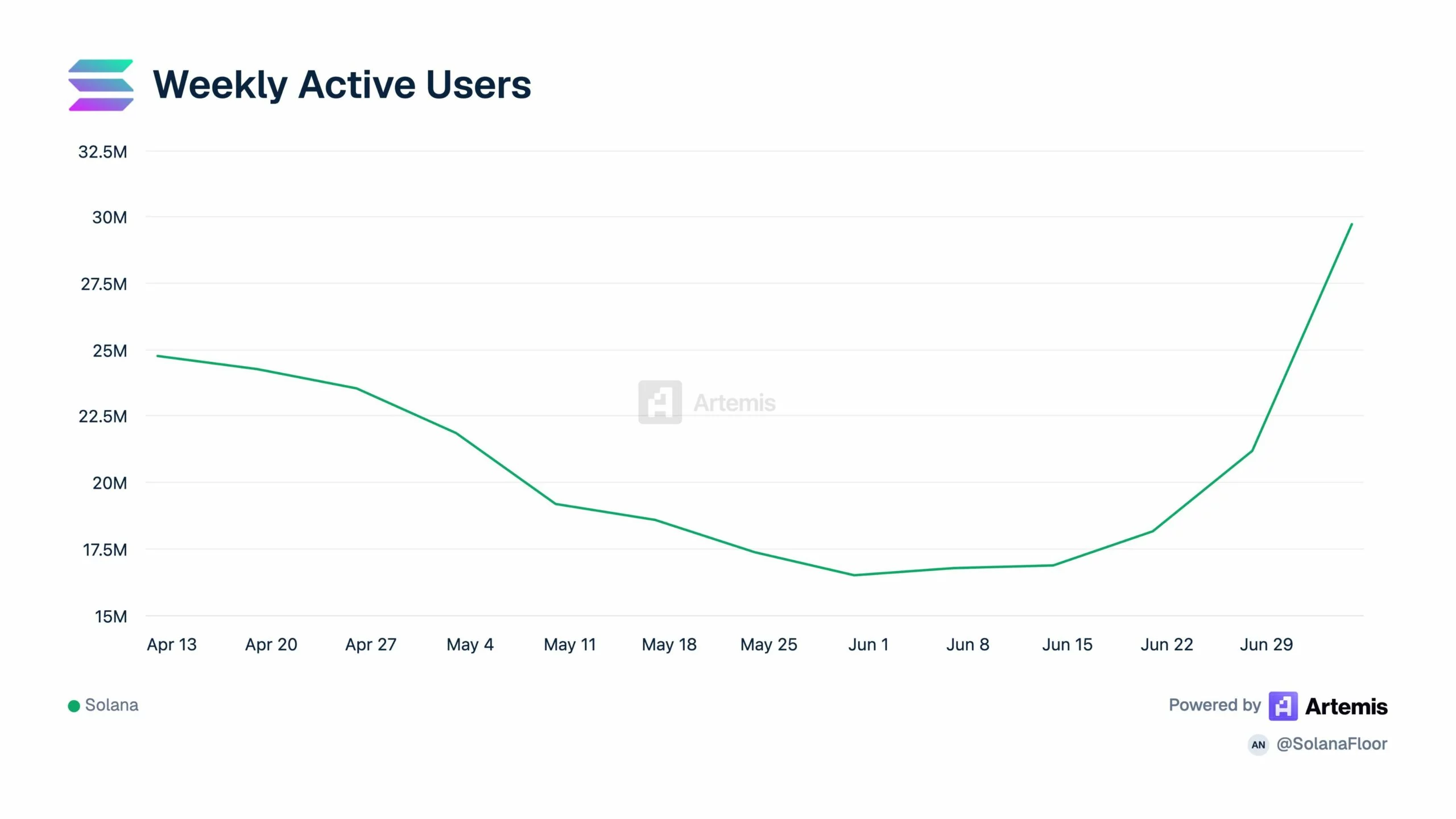
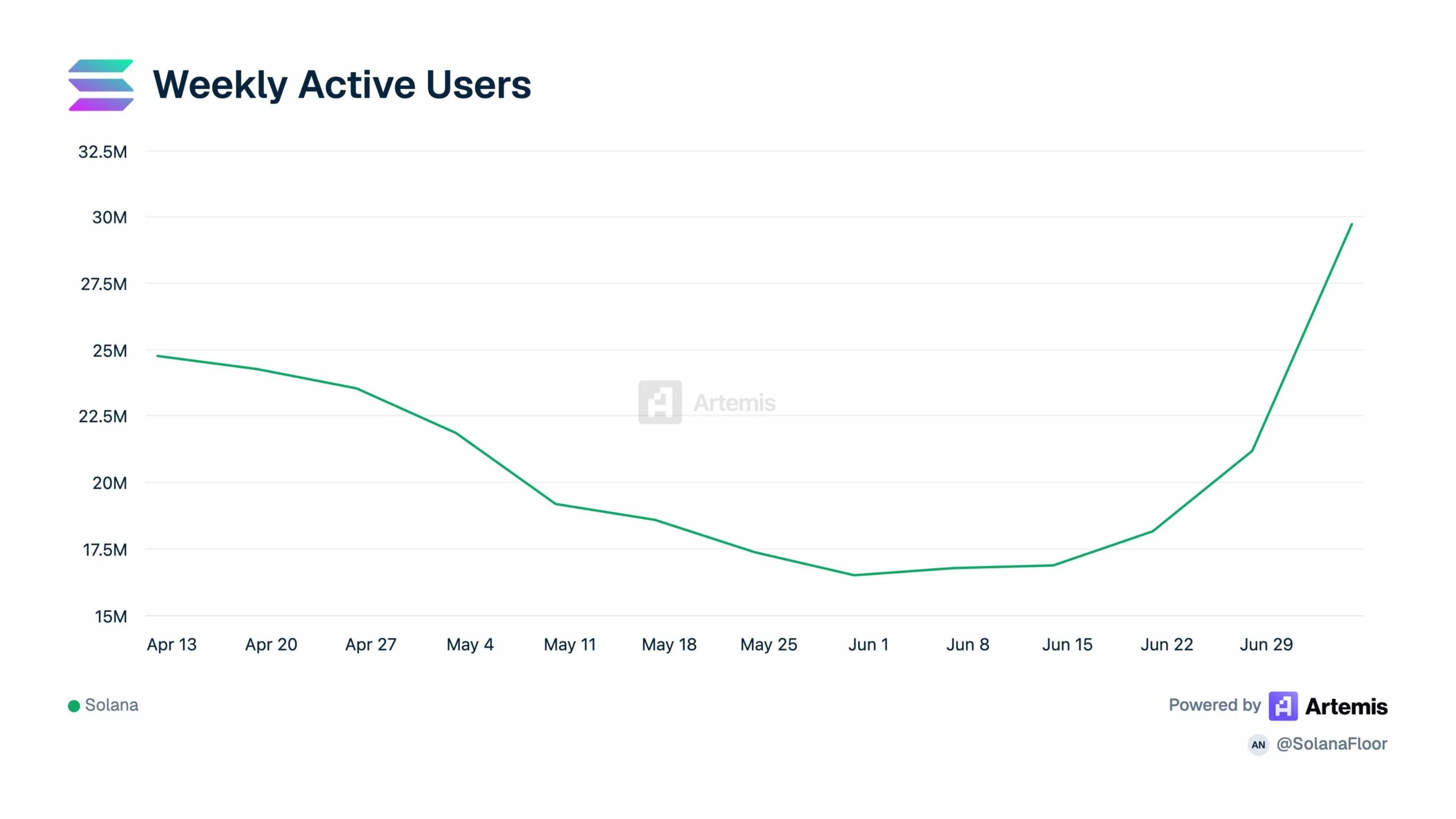
Network participation has accelerated alongside the recovery. According to Artemis data, Solana’s weekly active addresses climbed from 16.8 million to 29.7 million in just two weeks, an increase of roughly 12.9 million wallets, or about 76.8%. The rebound followed slower activity during June as users returned to decentralized applications across the network.
Separate ecosystem rankings also kept Solana at the top of several blockchain activity metrics. The network led all Layer 1 and Layer 2 chains in both 24-hour and seven-day decentralized application revenue while also recording the highest decentralized exchange trading volume over those periods. Polygon, Ethereum, Base, BNB Chain and Hyperliquid followed behind across the tracked categories.
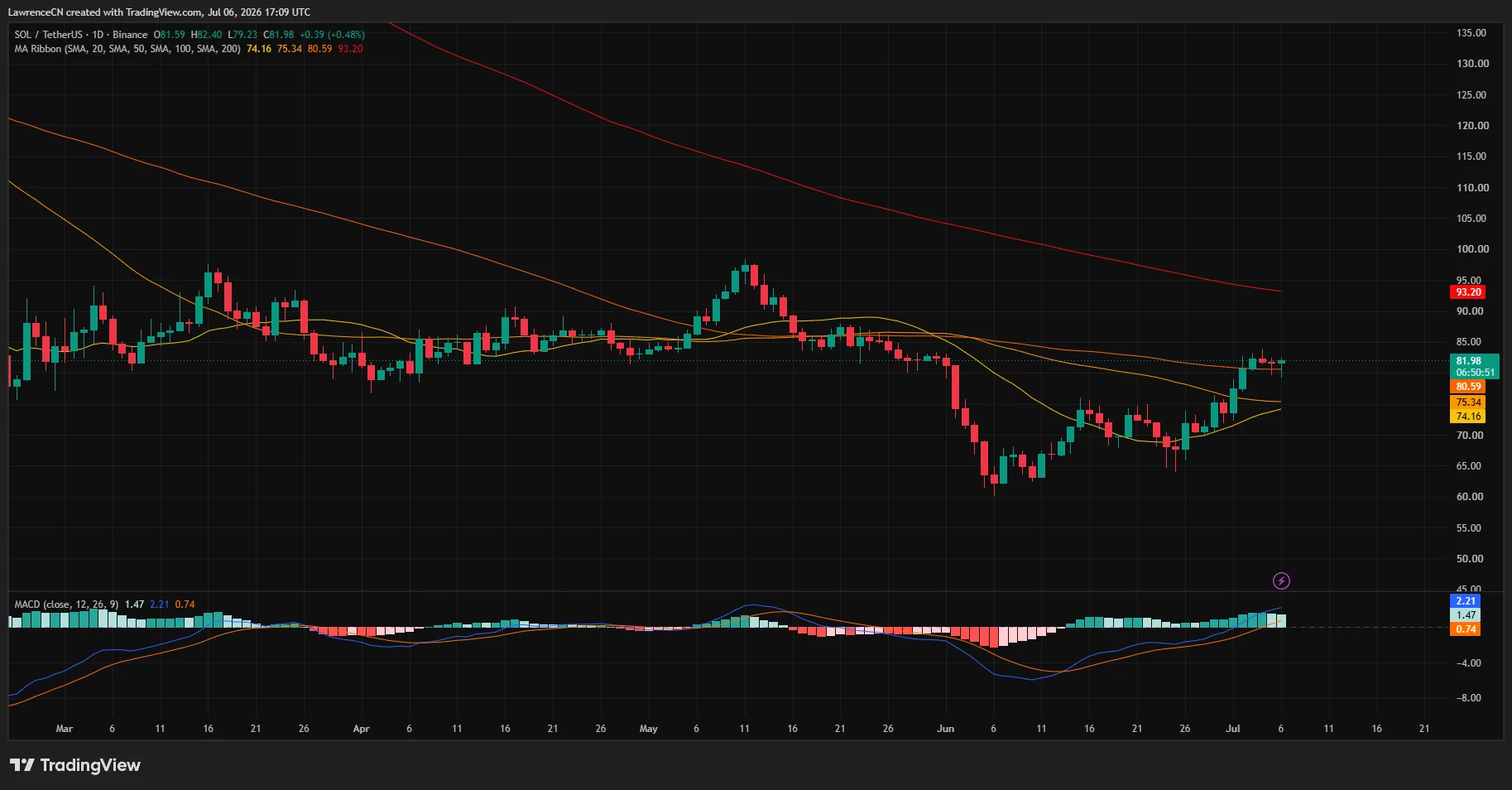
Price action continues to support the improving network data. On the daily chart, Solana remains above its 20-day, 50-day and 100-day moving averages, while the MACD indicator is still in bullish territory despite momentum easing after last week’s rally.
On the 4-hour chart, the Supertrend indicator continues to hold below price near $78.30, and Chaikin Money Flow has stayed slightly above zero, indicating modest buying pressure.
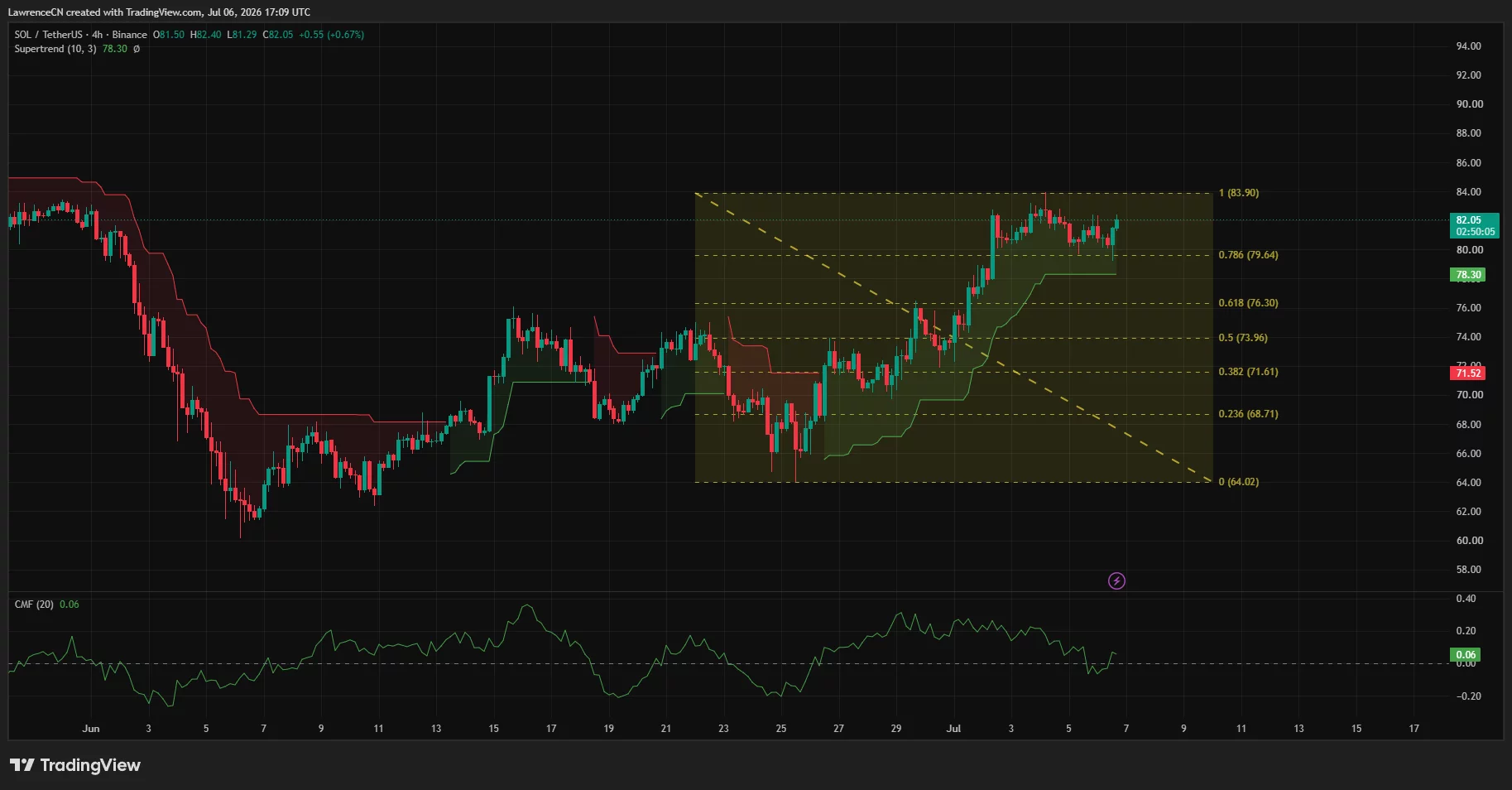
The latest consolidation has left immediate resistance around the recent high near $84, while the Supertrend level near $78 and the Fibonacci support around $76 remain the first areas buyers may need to defend if selling pressure returns. Together with steady ETF inflows and rising network activity, those technical levels suggest Solana’s recovery remains intact unless those support zones give way.
Disclosure: This article does not represent investment advice. The content and materials featured on this page are for educational purposes only.
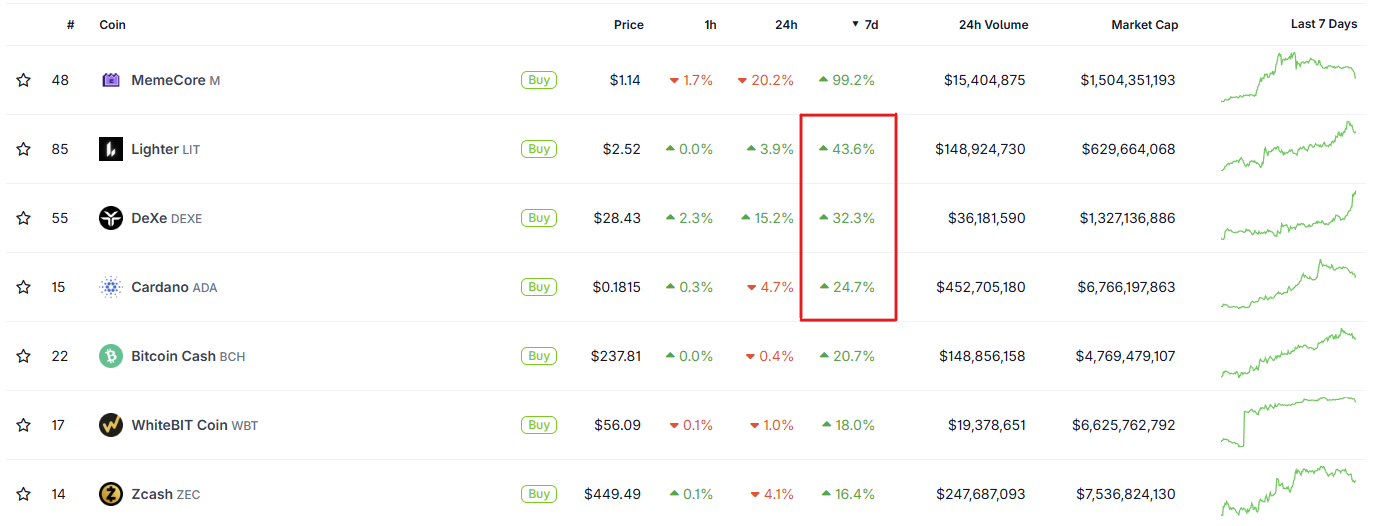
DeXe (DEXE), Lighter (LIT), and Cardano (ADA) rank among the biggest weekly gainers in the top 100 cryptocurrencies, making them the top coins to watch this week. Each enters the second week of July at a different stage of its trend.
According to CoinGecko, MemeCore (M) posted a larger seven-day gain, but a 20% daily drop disqualified it from this list. The three remaining leaders present two breakouts and one contested rebound.

Coins to Watch: DEXE Cup and Handle Breakout Targets $30
The DEXE weekly chart shows a completed cup-and-handle pattern. The token broke out in May 2026, then retested the 0.618 Fibonacci retracement near $15.62 before resuming its climb.
The retest started a three-week rally, and DEXE now trades near $28.39 after gaining 30% in seven days. As a result, the token is holding above the $24.20 resistance zone, its highest price in over a year. DEXE also led the previous altcoin watchlist at the start of July.

The first target from the formation sits at $30.31, which matches the 1.272 external Fibonacci level. The second waits at $38.09, the 1.618 extension. Reaching it would require a new record above the 2021 peak of $32.38.
However, volume has declined during the rally, which suggests the market remains calm rather than overheated. A second bearish divergence may also form on the weekly RSI. Continued price growth would cancel that signal and keep the structure healthy.
LIT Rally Extends Beyond Its First Target at $2.42
Lighter’s daily chart shows the token trading at its highest level since January. LIT gained nearly 48% over seven days and now trades near $2.54.
The rally already reached its first target at $2.42, the 1.272 external Fibonacci level. The next objective stands at $2.87, the 1.618 extension.

An ascending trendline supports the move, together with a strong demand zone near the $2.00 January high. Meanwhile, a recent tokenomics overhaul introduced permanent burns and a revamped staking model, providing the rally with a fundamental base.
The daily RSI reads about 77 with no bearish divergence, and volume remains high. However, readings this elevated often precede short cooling periods, so a dip toward $2.00 would not break the structure.
ADA Rebound Faces Its First Major Test at $0.205
Cardano was the strongest large-cap gainer last week, rising 26% in seven days. The move began at a multi-year low of $0.1382 and lifted ADA to about $0.20 before a pullback to $0.1818.
That peak almost matches the 0.382 Fibonacci retracement at $0.2052. Historically, this area marks a typical zone for a corrective bounce within a downtrend rather than a reversal.

ADA broke down from a descending parallel channel in early June and reached its support target near $0.15. If the recovery continues, the price may retest the channel’s lower band. The next resistance stands at the 0.5 retracement near $0.2259.
Volume remains high, but the daily RSI peaked near 65 and has slipped to about 56. In contrast, on-chain data shows the network added almost 15,000 new wallets after June’s crash, which supports the recovery case.
Key Levels for This Week’s Coins to Watch
A confirmed RSI divergence and fading volume would weaken the DEXE setup, while a LIT close below $2.00 would end its breakout structure. For ADA, the difference between a corrective bounce and a trend change rests on a daily close above $0.2259.
MemeCore’s recent crash shows how fast vertical rallies can unwind, which is why these invalidation levels matter this week.
The post Top 3 Crypto to Watch in the Second Week of July 2026 appeared first on BeInCrypto.

Key Takeaways
- Rivian manufactured 12,613 vehicles and handed over 12,194 units in Q2 2026, surpassing its projection of 9,000–11,000 deliveries
- Full-year 2026 delivery expectations were increased to 65,000–70,000 vehicles from the previous 62,000–67,000 range
- Shares of RIVN climbed approximately 6% following the announcement, building on the prior week’s 10.2% increase
- Investment firm Baird maintained its Outperform rating with a $23 price objective, suggesting about 23% potential upside
- The quarterly performance benefited from EDV commercial van sales, R1 vehicle lineup, and initial R2 model shipments
Rivian (RIVN) is currently changing hands at $19.76, climbing roughly 6% on Monday, building momentum from the previous week’s 10.2% surge after the electric vehicle manufacturer reported quarterly delivery figures that substantially exceeded its own projections.
Rivian Automotive, Inc., RIVN
The automaker manufactured 12,613 units and completed deliveries of 12,194 vehicles throughout the three-month period concluded June 30. These numbers significantly outpaced Rivian’s internal projections of 9,000 to 11,000 deliveries.
Year-over-year delivery volume expanded by nearly 14%. The outperformance stemmed from robust demand for its electric commercial vans and R1 product line, combined with the commencement of R2 shipments — a development investors have been eagerly anticipating.
In response to these results, Rivian elevated its full-year 2026 delivery projections to a range of 65,000 to 70,000 vehicles. This represents an increase from the previous bracket of 62,000 to 67,000 — marking a 3,000-vehicle boost at the median point.
This represents an unusual positive development for a company whose public market history has been characterized more by missed projections than exceeded expectations.
Wall Street Analysts Express Support
Baird confirmed its Outperform rating and maintained its $23.00 price objective after reviewing the delivery data. With current trading levels between $18.63 and $19.76, this target suggests potential appreciation of approximately 23%.
Canaccord and Needham similarly reaffirmed Buy ratings, contributing to the favorable analyst sentiment surrounding the stock this week.
Baird’s projection had represented the most optimistic forecast among Wall Street firms, and Rivian’s actual delivery number fell marginally short of it — though still exceeded the broader consensus. The firm adjusted its financial model to incorporate the Q2 results while maintaining its rating.
One concern analysts highlighted: Rivian’s gross profit margin currently stands at merely 1%, which continues to represent a significant challenge despite improving production volumes.
R2 Introduction Provides Growth Narrative
The second quarter represented the beginning of R2 deliveries. Although volumes remain modest, production acceleration is anticipated throughout the latter half of 2026.
The R2 represents a more compact, affordably-priced vehicle targeting a wider consumer audience compared to the R1 trucks and SUVs. Rivian has characterized it as the product capable of achieving meaningful production scale.
Commercial van shipments through the EDV initiative also bolstered quarterly performance. This business segment has demonstrated consistent results, despite receiving less market attention than the consumer vehicle division.
Visible Alpha analysts forecast Rivian will achieve 63,138 total vehicle deliveries for the complete year — modestly under the midpoint of the revised guidance range, indicating some Wall Street observers maintain cautious expectations regarding production acceleration.
Looking Ahead
Rivian plans to release complete Q2 2026 financial results on July 30, following market closure. A live audio presentation is scheduled for 5:00 p.m. ET to discuss operational performance and forward outlook.
RIVN has gained 1.8% year-to-date but remains 12% beneath its 52-week peak of $22.45, established in December 2025.


Key Takeaways
- MRNA reached a 52-week peak of $81.42, representing a 169.2% annual increase
- Six-month performance shows a remarkable 124% climb
- InvestingPro identifies the stock as trading above its Fair Value calculation
- Wall Street analysts hold an average “Reduce” stance with a $37.13 mean target
- Corporate insiders have offloaded 125,088 shares totaling more than $6.1 million over 90 days
Moderna shares peaked at $81.42 on July 6, establishing a fresh 52-week record and continuing what has become one of biotech’s most dramatic rallies this year. Trading hovered around $81.51 shortly thereafter, pushing the company’s market capitalization to approximately $32.2 billion.
The 52-week floor stands at $22.28. This positions MRNA with more than a triple-digit gain from its nadir — specifically, a 169.2% total return over twelve months.
The half-year climb alone registers at 124%, fueled partly by revitalized enthusiasm for Moderna’s mRNA technology and multiple developmental announcements.
During its Science Day presentation, Moderna disclosed that mRNA-6007, its in vivo CAR-T initiative, is advancing into preliminary development targeting autoimmune conditions, particularly systemic lupus erythematosus and related B cell-driven disorders.
Regulatory developments also contributed momentum. An FDA advisory panel delivered a unanimous endorsement for Moderna’s experimental seasonal influenza vaccine, mRNA-1010, for the 50-and-over demographic — representing a significant validation for the company’s expanding portfolio.
Options market participants responded actively. Contract volume reached 121,257, with substantial interest concentrated in the June 18, 2026 $65 call option.
Wall Street Remains Unconvinced
Notwithstanding the share price momentum, the analyst consensus tells a starkly different story. Moderna holds an aggregate rating of “Reduce” with a consensus price objective of merely $37.13 — representing less than 50% of current trading levels.
Goldman Sachs elevated its projection from $43 to $49 while maintaining a “neutral” stance. Bank of America adjusted upward from $32 to $34 but preserved an “underperform” rating. Barclays increased from $25 to $48 with “equal weight.” Both Jefferies and UBS maintained “hold” recommendations.
Among analysts tracking MRNA, two assign it a Buy rating, eleven suggest Hold, and five recommend Sell.
InvestingPro analytics position the equity among the platform’s most overextended securities when measured against its Fair Value assessment.
Corporate Leadership Reduces Positions
While institutional investors have been accumulating shares, company insiders have been liquidating positions. Board member Abbas Hussain divested 5,682 shares at $46.63 on May 1, trimming his holdings by 32%. Board member Noubar Afeyan sold 9,263 shares at $46.84 on May 21, decreasing his position by 70.24%.
Cumulatively, corporate insiders have liquidated 125,088 shares valued at more than $6.1 million during the previous 90-day period. Insider ownership currently represents 10.80% of outstanding shares.
Regarding institutional activity, the trend appears more constructive. Louisiana State Employees Retirement System established a fresh position of 17,700 shares valued at approximately $899,000 during Q1. AQR Capital, NewEdge Advisors, and American Century Companies similarly expanded their holdings. Institutional ownership now accounts for 75.33% of MRNA.
The company’s latest quarterly disclosure, published May 1, revealed Q1 revenue of $389 million — representing a 260.2% year-over-year expansion and significantly exceeding the $236.37 million analyst estimate. Earnings per share registered at -$3.40, falling short of the consensus forecast of -$3.02. The stock’s 50-day moving average currently sits at $53.50, while its 200-day average rests at $48.22.

In 2025, OpenAI raised funding at a $300 billion valuation. That number didn’t come from a single product launch or a breakthrough sitting in a lab somewhere. It came from usage, hundreds of millions of people opening ChatGPT every day, asking it questions, writing code with it, drafting emails through it, editing documents, building entire workflows around it, for years on end. That accumulated usage is the actual asset behind the valuation. It’s what proved the product worked at scale, what justified the pricing, and what ultimately convinced investors the company was worth funding at that number.
However, none of the people who generated that usage own any part of what it built. They paid a subscription, used the product, and walked away with nothing beyond the product itself. Stargate LLM is built around a different premise: that the people generating a platform’s usage should have a way to benefit from the value that usage creates, not just the company running it.
Where the $300 Billion Actually Came From
This isn’t a criticism of OpenAI’s business model so much as a description of how it works, and how every major AI platform’s valuation works. A company’s worth is built on engagement, retention, and the size of its active user base. ChatGPT’s usage numbers are the reason a $300 billion valuation was possible at all. Anthropic followed a similar trajectory, crossing $30 billion in annualized revenue in April 2026, again driven by daily usage from people using Claude for work, research, and everyday tasks.
The structure is consistent across the industry: users generate the data, the engagement, and the subscription revenue that make these companies valuable. The equity upside from that value sits with venture capital firms and early investors. The people doing the actual using never had an ownership stake to begin with, so there’s nothing for them to be paid out from.

Why This Structure Exists
This isn’t unique to AI. It’s how venture-backed software has worked for two decades. Google’s search engine ran on free usage from billions of people while a small group of early backers and employees became billionaires. The pattern repeats because private companies aren’t required to offer public equity, and by the time an IPO happens, if it happens at all, the earliest and steepest growth has usually already occurred. The users who built the company’s value in the meantime were never in a position to hold any of it.
AI has simply made this pattern more visible, because the scale is bigger and the growth is faster. A $300 billion valuation built substantially on usage is a bigger number than most historical examples, which is part of why it’s drawing more attention now than the same dynamic did with earlier tech platforms.
What Stargate LLM Does Differently
Stargate LLM is built around a different assumption: that usage itself should generate a return for the person doing the using, not just for the company running the platform. The mechanism for this is Proof of Usage, one of the largest allocations in Stargate’s tokenomics, with 50% of the total 150 billion coin supply, 75 billion Stargate coins, set aside specifically to reward users for real platform activity: conversational AI queries, image and video generation, referrals, staking, and structured feedback that improves the models.
This is a structural difference, not a marketing claim. The Stargate coin is required for core platform functions, subscriptions, credits, premium model access, which means usage and coin demand are directly connected from day one. Staking in the Stargate Vault adds a second layer: locked coins earn rewards drawn from platform revenue and the usage rewards pool, with governance votes determining how a portion of that revenue gets distributed to stakers over time. It means that the people generating the platform’s usage have a mechanism to benefit from that usage that ChatGPT and Claude’s user bases simply don’t have.
Stargate’s presale is where early access to this model is currently priced. It runs across ten escalating batches, from $0.0005 up to $0.0125, building toward a $0.025 launch price target, with Batch 1 entering at a 50x ratio to that target. Of the fixed 150 billion coin supply, 96% is allocated to community, ecosystem, and presale participants, with just 1% going to the core team, a deliberate contrast to the ownership concentration typical of venture-backed AI companies.
The Bottom Line
OpenAI’s $300 billion valuation and Anthropic’s $30 billion in revenue are both real, and both were built substantially on usage from people who hold no stake in either outcome. That’s not a flaw specific to those two companies; it’s how the current AI industry is structured almost everywhere, from Google to SpaceX to every major venture-backed platform before them. Stargate LLM’s bet is that a meaningful share of AI’s next phase of growth can be built differently, with usage rewarded directly rather than only benefiting the platform running it. The mechanism for that already exists in the tokenomics: Proof of Usage rewards, Vault staking, and governance-directed revenue distributions, all tied to the same coin users are already spending on the platform. The presale is where that structure starts, open to anyone with a wallet, not just the investors who got there first.
Explore Stargate LLM:
Website: Stargate.org
Buy: own.Stargate.com
Telegram: https://t.me/StargatellmOfficial
Twitter/X: https://x.com/Stargatellm
Disclaimer: This is a Press Release provided by a third party who is responsible for the content. Please conduct your own research before taking any action based on the content.

The 16 Sci-Fi Shows So Sexy, They’d Get Everyone Canceled Today

What are ‘tropical nights’ as phenomenon to hit UK amid third heatwave

AI chip boom lifts Samsung profits by 1,800%


-

 Fashion3 days ago
Weekend Open Thread: High Hopes
-

 Politics4 days ago
The House | “Reframing the debate from a binary discussion of winners and losers”: Yuan Yang reviews ‘We Are Not Machines’
-

 Crypto World7 days ago
Strategy authorizes up to $1.25B in Bitcoin sales under new capital plan
-

 Fashion8 hours ago
Open Thread: What Great Books Have You Read Recently?
-

 News Videos7 days ago
How to Build INSANE Live Financial Dashboards With Claude
-
 NewsBeat2 days ago
Taylor Swift and Travis Kelce wedding staffer hilariously struggles to keep her cool while checking in megastars
-

 Tech7 days ago
Anonymous researcher drops 0-day ‘exploitarium’ repo
-

 Business7 days ago
Australia treasurer says alleged access of prime minister’s bank data ’incredibly concerning’
-
 Crypto World5 days ago
Airdrop Registration Becomes Key Focus For Remittix As RTX Launch Updates Approach
-

 Sports5 days ago
Broncos roster: OL Ben Powers (No. 74) entering final year of contract
-

 Crypto World5 days ago
Binance stock trading tops $1B in first month after launch
-

 NewsBeat6 days ago
Presenter Caroline Flack’s brother Paul Flack dies aged 55
-

 Crypto World5 days ago
Alibaba-affiliate Ant Group enters the humanoid robot market with 12 deals
-

 Crypto World3 days ago
Standard Chartered Secures MiCA License as ESMA Adds 37 New Crypto Firms
-

 Crypto World1 day ago
South Africa proposes crypto tax guidance under existing rules
-

 News Videos9 hours ago
Best Time to Enter Small Caps Right Now? Another Bull Run? | Financially Free
-
 NewsBeat5 days ago
New exhibition reflects five decades of movement between island of Ireland and GB
-

 Business5 days ago
Meta Platforms Stock Jumps 7% Today as Bloomberg Reports Company Plans to Enter the Cloud Business
-

 Tech2 days ago
Lenovo laptops are now shipping with YMTC SSDs, a sign of Chinese NAND entering the mainstream
-

 Business4 days ago
What a 10 Percent Drop Means for Buyers, Sellers and Renters
You must be logged in to post a comment Login