

Crypto World
South Korea Probes 40 Crypto Manipulation Cases in Two Years


South Korea’s Financial Services Commission (FSC) says it has investigated more than 40 cases of alleged unfair conduct in the crypto market over the past two years, ranging from market manipulation to fraudulent trading activity. The regulator also claims it has identified 25 suspects connected to those matters after the Virtual Asset User Protection Act took effect in July 2024.
FSC Chair Lee Eog-won shared the figures in a post on X, noting that 30 of the cases have been reported to or referred to investigative authorities. He said the average unlawful gains in the matters reviewed were roughly 1.4 billion Korean won (about $940,000).
Key takeaways
- The FSC reports probing 40+ unfair trading cases over two years, including manipulation and fraud.
- After the Virtual Asset User Protection Act began in July 2024, Lee said authorities identified 25 suspects tied to 30 reported or referred cases.
- Lee estimated average unlawful gains of about 1.4 billion won per case.
- The law strengthens the FSC’s ability to supervise and inspect crypto service providers (VASPs), with additional focus on high-risk trading behavior.
- The regulator says it plans to expand market surveillance using AI-assisted monitoring and targeted responses.
Why the numbers matter for South Korean crypto markets
The FSC’s update is significant because it frames crypto enforcement not as isolated incidents, but as an ongoing investigative pipeline. By connecting the latest suspect and case counts to the start of the Virtual Asset User Protection Act, the regulator is effectively signaling that the post-legislation framework is now producing measurable enforcement outcomes.
For traders and users, the practical implication is that conduct previously handled under looser or less specific oversight is increasingly being treated as compliance and supervision issues—especially for activity that regulators typically view as harmful to market integrity, such as wash trading and insider-related behavior.
What the Virtual Asset User Protection Act requires from VASPs
At the core of the regulator’s message is how the July 2024 law changes the relationship between crypto platforms and investors. According to Cointelegraph reporting, the Virtual Asset User Protection Act is designed to protect users who buy and store crypto assets through virtual asset service providers (VASPs).
Under the framework described by the FSC, VASPs are required to separate client deposits and virtual assets from the company’s own holdings. Client deposits are held in banks, creating a structural distinction intended to reduce the risk that user funds could be mixed with corporate assets.
The statute also specifically targets market integrity issues, aiming to deter and address illicit practices such as insider trading, wash trading, and market manipulation. This, in turn, broadens the FSC’s oversight remit and gives the commission more authority to supervise and inspect VASPs.
Focus on market surveillance and enforcement capacity
In the same X post, Lee said the FSC will keep enhancing its market surveillance and investigation systems, explicitly citing the use of AI to support monitoring. He also indicated that authorities will “proactively respond to high-risk areas,” a phrase that suggests the regulator is increasingly focusing resources where it expects the most misconduct risk rather than reacting only after damage has occurred.
This matters because enforcement outcomes often depend not just on legal authority but on the ability to detect patterns in trading behavior at scale. The FSC’s emphasis on AI-based monitoring aligns with the kinds of tactics it named—wash trading and manipulation are frequently identifiable through transaction and order-flow patterns that can be monitored continuously.
Earlier coverage by Cointelegraph has also noted how South Korea is moving to bring digital assets more firmly within state oversight structures, including steps that extend beyond user-protection provisions. The latest enforcement update fits that broader direction by showing how supervision and investigations are being operationalized.
What investors should watch next
Going forward, the most important signal for market participants is whether the FSC’s investigation pipeline translates into sustained compliance pressure on VASPs—especially around surveillance-heavy practices like wash trading and manipulation. Readers should watch for additional enforcement actions and any expansion of AI-assisted monitoring capabilities, since that is likely to determine how quickly suspicious activity is detected and how consistently it leads to referrals and sanctions.



The wallet company said it expected the layoffs to generate between $10 million and $13 million in savings as part of its strategy to build a full-stack card issuance and payments platform.
The cryptocurrency market has shown a minor resurgence today (July 20), yet the best-performing asset (from the top 100 club) isn’t Bitcoin (BTC) or Ethereum (ETH), but Pump.fun’s native token, PUMP.
Meanwhile, some believe this may not be just a temporary price spike but the beginning of a much more substantial rally.
What Comes Next?
PUMP registered a 20% daily increase, reaching approximately $0.002, its highest level since mid-May. Its market capitalization soared to nearly $800 million, making it the 71st-biggest cryptocurrency.

One potential catalyst for the solid performance could be the increased interest from popular industry participants. Lookonchain revealed that the well-known crypto trader and influencer Ansem bought PUMP with 1,500 SOL (worth around $115,000), while another anonymous individual opened a $1.5 million long position with 10x leverage.
Crypto X is now rammed with analysts who believe PUMP is on the verge of a further jump. Crypto Patel claimed the token has confirmed a high-timeframe breakout, indicating a potential 200% upside.
X user 0xNeena opined that a decisive push above $0.002 could unleash the next wave upward, while Greeny went even further, suggesting this might mark the beginning of a bull run that may stretch into 2027.
Captain Faibik also chipped in, forecasting that PUMP could soon explode to around $0.0047, thus reaching its highest point since November last year.
Mind the Potential Risks
In an environment dominated by sellers and a bear market that has shattered investor optimism, it’s worth remembering that PUMP’s resurgence could be short-lived. Over the past few months, numerous altcoins have posted revivals, only to head south by double digits within days, sometimes even hours.
PUMP’s Relative Strength Index (RSI) should also serve as a warning. Its ratio has risen above 70, meaning that the token has entered overbought territory and could be due for a correction. The technical analysis tool ranges from 0 to 100, and readings below 30 are considered buying opportunities.

The post PUMP Climbs to a 2-Month High: Key Catalysts and What’s Next? appeared first on CryptoPotato.

Ripple Prime says institutional demand for blockchain infrastructure continues growing despite weaker digital asset market conditions. Ripple Prime executives describe the company as a key provider of continuous financial infrastructure for modern institutional markets. The latest comments follow expanding adoption of blockchain settlement, financing, and collateral management across multiple asset classes.
Executive Outlines Institutional Blockchain Strategy
Michael Higgins, international chief executive, said Ripple Prime is building infrastructure for continuous institutional market operations. He told Markets Media that blockchain networks support financial services beyond traditional banking hours. He described this shift as the foundation of “Wall Street 2.0.”
Higgins said, “The current crypto winter is not a digital asset winter.” He added that Ripple Prime supports markets requiring always-on blockchain infrastructure and uninterrupted access. He said those capabilities help institutions operate beyond conventional settlement schedules.
Ripple completed its Hidden Road acquisition for approximately $1.25 billion during October 2025. The transaction expanded Ripple Prime through broader institutional brokerage and financing capabilities. Executives said the business has since reported triple year-over-year revenue growth.
Expansion Supported by Financing and Infrastructure
The company recently secured a $200 million debt facility from Neuberger Specialty Finance. Executives said Ripple Prime will use the financing to increase institutional margin lending capacity. The facility supports clients operating across digital assets, foreign exchange, derivatives, swaps, and fixed income.
Traditional prime brokerage often limits collateral movements to standard banking hours. However, Ripple Prime enables continuous collateral management through the RLUSD dollar-backed stablecoin. That approach reduces operational delays during weekends and public holidays.
Executives said institutions increasingly require unified infrastructure across several financial markets. They stated Ripple Prime applies one operational framework across digital assets, foreign exchange, and traditional exchanges. The company said this design improves operational consistency for institutional clients.
Competition With Traditional Financial Providers
Higgins said established banks are expected to expand digital prime brokerage after regulatory frameworks become clearer. However, he said many existing providers still depend upon older technology systems. He added that non-bank market makers already dominate several important trading segments.
Higgins said the largest market makers in United States equities and foreign exchange are no longer banks. He argued Ripple Prime can integrate new trading venues faster because of its unified technology platform. He said consistent operational workflows simplify onboarding across different financial markets.
Ripple Prime said institutional demand continues supporting revenue growth and broader infrastructure expansion. Company executives maintain that continuous blockchain-powered financial services remain central to evolving institutional market operations. The latest statements reinforce the company’s focus on supporting around-the-clock financial infrastructure through blockchain technology.

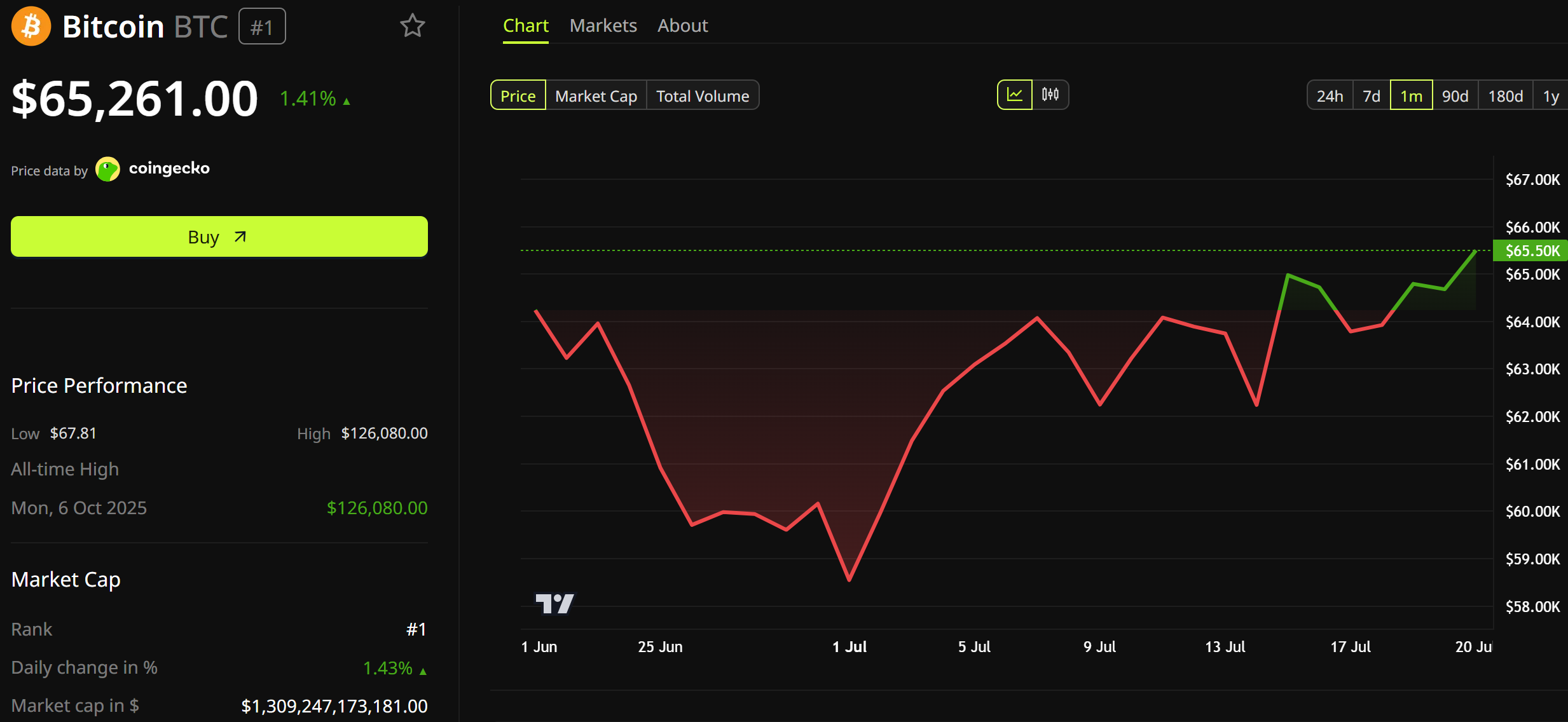
US spot Bitcoin (BTC) exchange-traded funds (ETFs) pulled in $75.7 million last week, their second winning week in a row. Bitcoin also reclaimed $65,000 on Monday as hopes grew that US-Iran talks may resume.
The rebound sounds big. It is not. The $273.1 million recovered so far is just 3.3% of the $8.2 billion that left the funds over the prior eight weeks.

A Modest Rebound After Record Bitcoin ETF Outflows
SoSoValue data shows the latest inflows followed $197.4 million the week before. When more money enters than leaves, investors are net buyers of the funds.
The recovery began in early July, when the funds snapped a 10-day streak of daily redemptions.
The hole is still deep, however. June was the worst month on record, with $4.5 billion exiting. That broke February 2025’s $3.56 billion record. BlackRock’s iShares Bitcoin Trust (IBIT) drove nearly 79% of the June exits.
Total assets tell the same story. The funds now hold about $77 billion, down from more than $104 billion in mid-May.

Follow us on X to get the latest news as it happens
Even the green week was bumpy. Monday alone saw $424.7 million leave, the biggest one-day exit since June 26, after US-Iran military tensions flared again. Buyers returned for the next four sessions.
BeInCrypto Markets data shows BTC trading near $65,261. The price is up 1.4% in a day and 5.2% on the week as Washington and Tehran signal talks could restart.
Gold’s Long Road or Citi’s Zero?
Bloomberg Intelligence senior ETF analyst Eric Balchunas says gold ETFs offer the best map for what comes next. Bitcoin and gold pay no interest or dividends. Sentiment alone moves them.
His case rests on GLD, the first US-listed gold ETF. It briefly became the world’s largest ETF in 2011. Assets then crashed from roughly $76 billion to $22 billion. Today it holds nearly $190 billion. Each cycle set a higher high.
IBIT looks familiar. It crossed $100 billion last October. Bitcoin then fell roughly 48% from its $126,080 peak.
“Bitcoin ETFs may be following the same script: spectacular gains, painful drawdowns and recoveries that may test investors’ patience,” Balchunas wrote, signaling that the pattern amounts to two steps forward and one step back.
Citigroup sees it differently. On July 1, the bank cut its 12-month Bitcoin target from $112,000 to $82,000, its second cut in a year that began at $143,000. It also expects zero ETF inflows over the next year, blaming stalled US crypto laws and weak institutional demand.
BlackRock CEO Larry Fink disagrees. He now calls the washout over as flows turn positive.
So who is right? Weekly flows will keep grabbing headlines. Yet gold’s history suggests multi-year cycles, not seven-day totals, may decide bitcoin’s next big move, especially with bond markets pricing renewed Fed hike risk.
The post Bitcoin Reclaims $65,000 as BTC ETF Inflows Return: Is the Worst Over? appeared first on BeInCrypto.


U.S. regulators have missed the GENIUS Act’s one-year rulemaking deadline, leaving the federal stablecoin framework awaiting final implementation even as industry participants say the law has already accelerated institutional adoption.
Summary
- U.S. regulators missed the GENIUS Act’s one year deadline to finalize key stablecoin rules, leaving several major proposals still under review.
- Industry participants said the law has already encouraged institutional stablecoin adoption, but unfinished rulemaking continues to create compliance uncertainty.
- Former SEC counsel Ashley Ebersole said the GENIUS Act established a strong legal framework but has fallen short in implementation because regulators missed the deadline.
According to federal rulemaking records and regulatory proposals reviewed after the July 18 deadline, none of the key agencies charged with implementing the Guiding and Establishing National Innovation for U.S. Stablecoins (GENIUS) Act have completed their final rules despite Congress requiring them to do so within one year of the law’s enactment.
President Donald Trump signed the GENIUS Act into law on July 18, 2025, creating the first standalone federal framework for payment stablecoins in the United States.
The legislation established reserve, redemption, disclosure, licensing and supervisory requirements for issuers while directing the Office of the Comptroller of the Currency, Federal Reserve, Federal Deposit Insurance Corporation, National Credit Union Administration, Treasury Department, and state regulators to complete implementing regulations through the notice-and-comment process within one year.
Although the deadline has now passed, the statute does not say that missing it delays the law’s effective date or suspends its requirements. Instead, much of the framework remains defined by the legislation itself while agencies continue working on the operational details that will govern compliance and supervision.
For companies building around stablecoins, however, the regulatory delay has become one of the biggest talking points one year after the law’s passage.
Legal clarity has improved but implementation remains unfinished
Speaking to crypto.news, Diogo Cassinelli, sales and partnerships manager at Trace Finance, said the anniversary serves as an opportunity to evaluate both the progress made under the GENIUS Act and the issues that remain unresolved.
“This week marks one year since the GENIUS Act was signed into law, and the anniversary is a useful checkpoint to reflect on how far the industry has come, and where we still need to go,” Cassinelli said.
While he described the creation of a federal framework for stablecoin issuance as “an incredible milestone,” he argued that operational questions extending beyond issuance continue to slow adoption.
According to Cassinelli, the unresolved issue is how stablecoins move through the traditional banking system and who ultimately bears responsibility for those transactions. He said this gap is one reason lawmakers and industry participants are paying close attention to the proposed Digital Asset Market Clarity Act, or CLARITY Act, which is expected to establish a wider market structure framework for digital assets.
Cassinelli said regulatory uncertainty has not stopped fintech firms from building cross-border payment products, but it has made expansion slower and more expensive because every banking relationship requires institutions to conduct their own compliance assessment instead of relying on a common federal standard.
“The process alone adds months to timelines that should take weeks,” he said, adding that those costs increase whenever companies enter new markets or onboard new banking partners.
Looking ahead, Cassinelli said passage of the CLARITY Act would allow banks and payment providers to approve stablecoin-related services more quickly because compliance expectations would already be established at the federal level.
“A definitive framework means banks and payment providers can say yes faster,” he said.
“CLARITY gives a definitive path for large institutions to move money with stablecoins, while also giving startups a clear map to build for these institutions.”
Agencies continue working through proposed rules
Several of the largest implementing rules remain at the proposal stage despite the statutory deadline.
The OCC previously proposed standards covering reserve assets, capital, liquidity, custody, reporting and risk management for issuers under its supervision. The FDIC later released its own proposal addressing prudential standards, reserve requirements, redemption, custody, capital treatment and the handling of tokenized deposits held by supervised institutions.
Meanwhile, the NCUA published separate licensing and operational proposals, with comments on its latest package closing only one day before the July 18 deadline, making completion of the rule impossible through the normal rulemaking process.
Treasury has yet to finalize guidance explaining when state stablecoin frameworks qualify as “substantially similar” to the federal regime, an important decision because issuers with no more than $10 billion in outstanding stablecoins may remain under state supervision if their regulatory framework receives Treasury certification.
At the same time, the Federal Reserve, FinCEN, OCC, FDIC and NCUA have jointly proposed customer identification requirements for primary-market participants, while additional anti-money laundering and sanctions proposals from FinCEN and the Office of Foreign Assets Control also remain under review.
Because several comment periods extend into August, at least part of the regulatory framework cannot be finalized before the one-year deadline.
Regulatory delays haven’t slowed industry growth
For investors, the first year of the GENIUS Act has still produced measurable changes across the stablecoin market.
Alex Witt, general partner at Verda Ventures, told crypto.news the legislation has already accomplished one of its main objectives by encouraging institutional participation.
“A year in, the GENIUS Act has clearly succeeded as a legitimization signal,” Witt said.
He pointed to stablecoin market capitalization exceeding $300 billion, transaction volumes increasing roughly fourfold, institutional entrants including Fidelity and Ripple obtaining charters, and Tether launching its USA₮ product through Anchorage as evidence that adoption has continued despite unfinished regulations.
At the same time, Witt argued that implementation has “badly lagged” because six federal agencies were expected to finalize rules by July 18 but have yet to complete any of them.
According to Witt, the absence of final regulations means the industry continues operating under legacy disclosure practices while charter approvals and Federal Reserve access decisions are occurring before the complete regulatory framework is in place.
“The unresolved pieces, the leaky yield ban pushing capital offshore and the January 2027 backstop effective date, mean the Act’s real test is still the next six months, not the year behind it,” he said.
Offering more insights on the matter, Ashley Ebersole, co-founder and chief legal officer of tx and a former senior counsel at the U.S. Securities and Exchange Commission, drew a similar distinction between the legislation itself and its implementation.
“One year post-enactment, it’s fair to say the GENIUS Act delivered a framework that established structural mandates, but has faltered in implementation,” Ebersole told crypto.news.
According to Ebersole, codifying payment stablecoins into federal law gave institutions the confidence needed to increase participation. She said stablecoin supply has expanded by approximately $55 billion since the law took effect, while tokenized U.S. Treasury assets have grown from about $3.9 billion to nearly $9 billion. She added that six separate real-world asset categories have now exceeded $1 billion in value, attributing part of that growth to the regulatory certainty created by the Act.
Ebersole nevertheless described the rulemaking delays as the legislation’s biggest execution challenge. She noted that agencies missed the one-year deadline despite Congress requiring implementation within that period, leaving eight major proposals still awaiting completion.
According to Ebersole, many institutions aligned their compliance planning with the original legislative timeline, making the administrative delays a setback even though the law contains a January 18, 2027, statutory backstop for implementation.
She also said stablecoins have become an essential settlement layer for tokenized assets, arguing that the legislation has reduced uncertainty surrounding long-term institutional blockchain infrastructure.
Ebersole identified the prohibition on issuer-paid yield as one of the biggest questions entering the framework’s second year.
“A definitive question for 2027 concerns the yield prohibition,” she said, explaining that decentralized finance protocols and wrapped products may continue offering interest-like returns through other mechanisms even though the GENIUS Act and Europe’s Markets in Crypto-Assets (MiCA) framework prohibit issuers from paying yield directly to token holders.
Jay File, chief executive and chief financial officer of Nasdaq-listed Lite Strategy, also pointed to the international regulatory environment rather than the delayed rulemaking alone.
“The GENIUS Act is the first serious federal framework for stablecoins,” File told crypto.news.
“Paired with MiCA’s enforcement baseline in Europe, we’re approaching a moment where the regulatory risk that caused institutional hesitation is finally being removed.”
File added that regulatory developments across multiple jurisdictions are moving digital assets toward “legitimacy, clarity, and institutional access,” which he described as beneficial for the industry.
Attention is now beginning to move toward the proposed CLARITY Act, which lawmakers continue negotiating in Congress. While discussions over ethics provisions and other outstanding issues remain unresolved, supporters, including Rep. Bryan Steil, have argued that the legislation would establish clearer rules for the wider digital asset market after the GENIUS Act created the first federal framework for payment stablecoins.

Robinhood Markets is drawing fresh attention from Wall Street as analysts argue the company’s next growth leg could come from tokenized assets and prediction markets rather than traditional retail crypto activity. In a Monday research note, Bernstein lifted its price target for Robinhood stock to $160 from $130, while keeping an Outperform rating. The shares were last reported around $101.
Bernstein’s thesis centers on the idea that two adjacent segments—prediction markets and tokenized equities—could scale faster than legacy revenue streams. The firm expects prediction markets to become Robinhood’s fastest-growing business, projecting segment revenue of $1.7 billion by 2028, which it frames as a 64% compound annual growth rate.
Key takeaways
- Bernstein raised Robinhood’s stock price target to $160 from $130 and maintained an Outperform rating.
- The research note argues prediction markets could become Robinhood’s fastest-growing segment, with revenue projected at $1.7 billion by 2028.
- Tokenized equities are presented as a major long-term opportunity, supported by Robinhood’s blockchain infrastructure strategy.
- Bernstein points to a broader market backdrop: growth in onchain real-world assets that could expand to $2 trillion–$4 trillion by 2030 from about $35 billion today.
- Infrastructure providers are also accelerating governance and issuance tooling for tokenized securities, suggesting institutional momentum is building.
Bernstein’s shift: prediction markets and tokenized equities
Bernstein’s Monday note emphasizes that Robinhood’s expansion path is increasingly tied to product categories that extend beyond straightforward crypto trading. The firm singled out prediction markets as the most immediate growth driver, forecasting rapid scaling that could outpace other lines of business.
Importantly, Bernstein also linked the prediction markets story to Robinhood’s broader platform ambitions—positioning the company to compete across multiple “battleground” asset types. While the note highlights several categories, its core investment case is that Robinhood can leverage its distribution and user base to build market activity around new trading paradigms.
Tokenized equities: Robinhood Chain and the infrastructure angle
On the tokenized equities front, Bernstein identified Robinhood’s engagement with blockchain infrastructure as a long-term differentiator. The firm referenced Robinhood Chain, describing it as the company’s Arbitrum-based layer-2 network used to support tokenized real-world assets.
According to Bernstein, Robinhood’s approach is designed to allow the platform to develop on-chain financial products without needing to depend on third-party blockchains. This matters for investors because infrastructure choices can affect product rollout speed, integration complexity, and the economics of building and operating blockchain-enabled services.
Bernstein tied its tokenization view to a macro capital markets shift, arguing tokenization is becoming a foundational layer for capital markets. The analysts projected the total value of onchain real-world assets could rise to $2 trillion to $4 trillion by 2030 from roughly $35 billion today. They further expect tokenized equities to capture an increasing portion of that growth as issuance and adoption broaden beyond certain asset types such as Treasury securities and private credit.
Rather than treating tokenized equities as a narrow experiment, Bernstein frames them as part of a larger, compounding trend in how financial institutions may issue, transfer, and govern assets digitally. For traders and users, that could eventually translate into more choices for tokenized instruments; for builders and issuers, it signals rising demand for compliant rails that can support custody, governance, and reporting.
Wall Street builds governance tooling for tokenized securities
Bernstein’s note landed as institutional infrastructure continues to mature. On Monday, Alpaca and Broadridge Financial Solutions announced they had integrated Broadridge’s shareholder governance capabilities into Alpaca’s Instant Tokenization Network.
The integration is aimed at giving holders of tokenized securities governance rights closer to those of traditional shareholders, including features such as proxy voting, investor communications, and regulatory disclosures.
That announcement follows last week’s partnership between Securitize and investment bank Cantor Fitzgerald, which focused on developing infrastructure for blockchain-based initial public offerings and follow-on equity offerings under existing U.S. securities regulations. Together, the developments suggest tokenized assets are moving beyond issuance experiments toward operational completeness—particularly around governance and regulatory workflows.
Tokenized stocks have also been gaining visibility in market tracking. RWA.xyz reports the asset class has grown to nearly $2 billion in market value this year.
What to watch next for Robinhood and tokenized markets
For readers following Robinhood’s trajectory, the key question is whether management can translate these infrastructure and segment-level bets into consistent revenue growth as prediction markets scale and tokenized equities gain traction. In the broader market, investors should watch whether governance tooling and compliance layers—such as the Broadridge-Alpaca integration—continue to expand, since that infrastructure often determines how quickly tokenized securities can move from pilots to repeatable offerings.


The hottest thing in artificial intelligence (AI) is not a chip or a chatbot. It is an IOU. Morgan Stanley expects AI companies to raise $570 billion from the bond market in 2026.
Nvidia and Kimi K3, Moonshot AI’s new Chinese model, own the headlines. Yet pension funds and insurers quietly pay for it all.
Morgan Stanley Turns the AI Bond Market Into a Fee Machine
The money is moving at record speed. Up to $236 billion of AI debt had been sold by May 31, four times last year’s pace, Forbes reported.
Morgan Stanley saw it coming. It led $65 billion in AI bond deals in late 2025 alone, according to Bloomberg.
The reward was $2.3 billion in fees in six months, LSEG data shows, up from $1.4 billion. That leap carried it past Goldman Sachs, behind only JPMorgan Chase.
The trick? Package Big Tech’s credit and long-term computing contracts into bonds that cautious investors will buy.
Follow us on X to get the latest news as it happens
Google’s Safety Net and Meta’s Hidden Debt
TeraWulf proves the model. The former Bitcoin miner now builds AI data centers instead. Its $3.2 billion bond sale drew $10 billion of orders at a 7.75% yield.
Why the rush for a junk-rated miner? Google. An SEC filing shows that Google is backing $3.2 billion in leases owed by tenant Fluidstack at TeraWulf’s New York campus. If Fluidstack stops paying, Google pays. In return, Google got the right to buy roughly 14% of TeraWulf.
Cipher Mining won a similar deal, which fueled a rally in miner stocks that outperformed BTC.
Meta plays the same game bigger. Morgan Stanley arranged $27 billion for its Hyperion campus in Louisiana, the largest private credit deal ever. Partner Blue Owl owns 80%, so the debt stays off Meta’s books.
Bond Investors Start Charging for Patience
Buyers are cooling. In February, they bought nearly five times as many Big Tech bonds as were on offer. By July, under two. And in late 2025, insuring Oracle’s debt cost more than at any time since 2009. The nerves align with broader AI bubble warnings.
The spending will not slow, however. Data centers need $2.9 trillion through 2028, and Big Tech’s cash covers only half of that, Morgan Stanley estimates.
Bonds built the railroads and the 1990s telecom boom. Now they are building AI. Every chip and every chatbot runs on borrowed money eventually. Whoever prices that debt decides how fast the future arrives.
The post Morgan Stanley Turned AI Into Wall Street’s Hottest Bond Trade appeared first on BeInCrypto.


Michael Saylor’s Strategy published formal guidance last July that his company would not sell MSTR stock below 2.5x the value of the company’s BTC holdings except to pay interest and dividends.
It’s sold $14.3 billion of MSTR since, every share of it below that formerly sacred 2.5x mNAV.
The term mNAV — invented by fans of public companies amassing crypto — refers to a company’s multiple-to-Net Asset Value under the assumption that crypto holdings like BTC are tantamount to its NAV, even though they’re not.
Saylor’s ephemeral pledge appeared on July 31, 2025, on slide 96 of the company’s earnings deck, claiming, “We will not issue MSTR below 2.5x mNAV except to pay interest and dividends.”
Executives also reiterated that commitment verbally on that earnings call and elsewhere.
Once upon a time, during a brief mania for leverage in late 2024 and early 2025, investors actually valued Strategy far higher than the value of its BTC.
Although the company has fallen below 1x mNAV several times and now trades at 1x, it once traded for 3.2x the value of its BTC — a level it’s never reattained.
Read more: It took Michael Saylor seven minutes to define mNAV
Michael Saylor’s long-term mNAV guidance lasted days
After formalizing its no-selling policy below 2.5x mNAV, Strategy changed its mind days later.
On August 18, 2025, it announced an “Update to MSTR Equity Guidance” in a follow-on SEC filing.
The update added a catch-all exception as number 3: “When mNAV (as defined on Strategy.com) is below 2.5x, Strategy will tactically issue MSTR Shares to (1) pay interest on debt obligations, (2) fund preferred equity dividends, and (3) when otherwise deemed advantageous to the Company.”
The new third clause was a longer way of saying, essentially, whenever.
It resumed dilutive share sales the same week it changed its guidance, offloading 875,000 shares for $310 million per an SEC filing and soon ramping it up to billions of dollars.
The selling has rarely paused since Saylor changed his mind.
Protos reviewed every weekly at-the-market disclosure filed since the change. They add up to at least 92 million new shares sold for $14.3 billion.
Strategy’s mNAV ratio has never come close to the 2.5x threshold since, with all sales below the threshold.
Relentless shareholder dilution
The number of MSTR shares outstanding are now 343 million. When Saylor’s 2.5x promise ended on July 31, 2025, the share count was near 284 million.
That means common shareholders have suffered dilution that has ballooned the supply of their investment by over 20% in less than 12 months.
To be fair, the price of BTC hasn’t performed particularly well over the last year, so Saylor can note that the company survived, managed a difficult environment, and paid all bondholders and dividend obligations on-time.
Shareholder dilution, unfortunately, serviced that uptime.
Strategy paid $381 million of preferred dividends in 2025 across its STRK, STRF, STRC, STRD, and STRE tickers, while its operations burned $67 million of cash.
Preferred dividends cost another $230 million in the first quarter of 2026 alone and now annualize to $1.763 billion.
Read more: We made a dictionary of MicroStrategy’s invented terminology
Selling MSTR below 1x mNAV can be ‘advantageous’
The August 2025 guidance slide had one more pledge: below 1.0x mNAV, Strategy “will consider issuing credit to repurchase MSTR.” It’s never done this.
Instead, by June 26, 2026, Strategy’s enterprise mNAV on its own website closed below 1.0x for the first time.
Strategy’s response was to quickly sell more shares of MSTR — 12.7 million, to be precise, for $1.15 billion.
Selling that stock slightly below and barely above 1x mNAV, apparently, remained in the zone of “when otherwise deemed advantageous to the company.”
Three days later, Saylor posted, “Strategy expects to remain disciplined in its use of MSTR issuance, particularly when the stock trades at or near 1x mNAV.”
In an attempt to instill confidence, Strategy’s board announced a large share repurchase authorization. Although it authorized buybacks, it’s never actually conducted buybacks under that authorization.
Every weekly filing since has repeated the same phrase: “did not purchase any shares under its share repurchase programs.”
Finally, the most devastating metric is simply the value that common shareholders have lost since Strategy’s revoked guidance to not dilute them below 2.5x.
At time of writing, MSTR was trading near $99.50, down 35% year to date and down 75% from its $401.86 close on the day of the original 2.5x mNAV promise.
Strategy has spent over $1 billion across five years amassing BTC and massive, unrealized losses. Despite massive expenditures actively managing its treasury, its average cost basis is more than $10,000 higher per BTC than the current price of BTC.
Its unrealized loss on its investment now exceeds $8 billion.
Got a tip? Send us an email securely via Protos Leaks. For more informed news and investigations, follow us on X, Bluesky, and Google News, or subscribe to our YouTube channel.
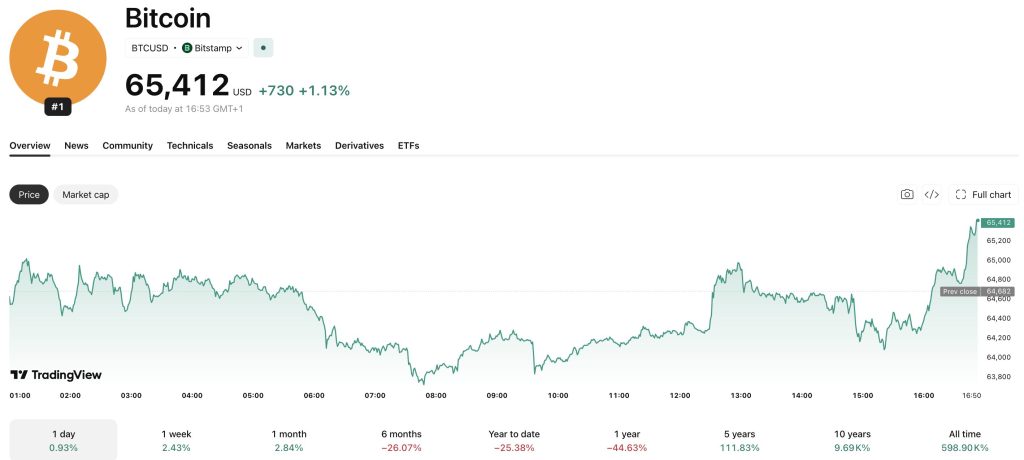
In Bitcoin news today, Michael Saylor, co-founder of Strategy and the largest publicly listed corporate BTC holder, has gone on record opposing BIP-110, the proposed one-year soft fork that would restrict non-financial data storage on the Bitcoin blockchain, arguing that the proposed cure carries more systemic risk than the condition it targets.
His critique, posted to X and covered by the Bitcoin Foundation on July 11, frames the entire debate not as a spam-management question but as a Bitcoin governance question: who decides what constitutes a valid transaction, and what happens once that line is drawn within the protocol.
That framing cuts directly to the precedent problem. As Saylor stated in his X post, “He wrote: “BIP 110 turns a spam dispute into a consensus change that would invalidate some currently valid, fee-paying transactions.
That precedent is the danger.” The concern is not specifically about Ordinals or blockchain spam today; it is about what the protocol becomes the moment it starts filtering transactions by perceived intent rather than fee payment and cryptographic validity.
Bitcoin News: The Miner Threshold is the Flashpoint
BIP-110’s activation mechanics have drawn as much fire as its content. The proposal would lock in if miners signal support in at least 55% of blocks during a 2,016-block period – well below the 95% threshold that has historically governed permanent consensus changes in Bitcoin.
Saylor has flagged this reduction as a structural risk, warning it could produce a network split and sustained market uncertainty at a moment when no such disruption is justified by the underlying threat.
The current miner signaling picture gives that warning context: as of July 13, support stood at approximately 1.3%, per the public BIP-110 signaling monitor at bip110.org. The voluntary signaling deadline falls around block 961,542 in August.
A 55% threshold is aggressive by any historical standard in Bitcoin governance; at 1.3% support, it is also currently unreachable, but the threshold itself remains a live governance concern regardless of the present signal count.
The technical scope of the proposal is sweeping for a supposedly temporary measure. BIP-110 would restore a tighter limit on OP_RETURN outputs, restrict larger data uploads, and reject blocks containing transactions that are valid under Bitcoin’s current rules.
Nodes adopting BIP-110 would, in effect, enforce a narrower definition of which transactions are acceptable than non-adopting nodes, a split scenario Saylor is flagging.
Discover: The Best Token Presales
Bitcoin Neutrality vs. Protocol Gatekeeping
Saylor’s deeper argument is that Bitcoin neutrality is not a soft preference; it is a structural property the network cannot afford to compromise.
With this Bitcoin news drop, the proposal reframes the change to consensus rules to fight spam as a decision about which valid, fee-paying transactions the network should accept, raising concerns about embedding judgment in the protocol.
The chilling-effect logic follows directly. If consensus rules can be modified to exclude data storage when a segment of the community labels it as spam, the same mechanism is available for other categories that would raise similar concerns.
The institutional investors who have followed Strategy’s lead and the broader wave of corporate treasury adoption across the Bitcoin corporate treasury space are implicitly betting on protocol stability. A governance mechanism that can exclude valid use cases introduces a risk category unrelated to price or macro.
There is also a direct fee-revenue argument. Suppressing on-chain use cases, whatever their aesthetic merit, can affect the demand for transaction fees.
Saylor’s position is that market-based fees and individual relay policies are the correct instruments for managing unwanted data traffic, because they operate without altering consensus and can be reversed or adjusted without a network-wide coordination event.
Broader Opposition and What Comes Next
In other Bitcoin news, Saylor is not the only prominent voice pushing back. Other long-standing Bitcoin contributors have also publicly opposed BIP-110. The debate has surfaced a wider tension in Bitcoin governance over who holds effective veto power: miners, developers, node operators, or major holders, and whether a 55% miner threshold is a legitimate activation path for changes of this scope.
With miner support effectively at zero six weeks before the August deadline and no clear institutional momentum building behind the proposal, BIP-110 may be difficult to push through under the required 55% signaling threshold. But the governance argument Saylor is making does not expire with this particular proposal.
The question of whether Bitcoin’s consensus layer should ever be used to discriminate between transaction types, and who gets to make that call, is now squarely on the table. Institutional players have a direct stake in how that question gets answered.
Strategy holds approximately 843,775 BTC. His argument is not philosophical posturing. It is a position from the largest corporate Bitcoin balance sheet in existence, and it lands squarely on the side of preserving the protocol’s neutrality.
Discover: The Best Crypto to Diversify Your Portfolio
The post Bitcoin News: Saylor Warns BIP-110 Trades Bitcoin Neutrality for a Dangerous Precedent appeared first on Cryptonews.

How Big Brother’s Rachel Reilly Is Preparing for Survivor

Nancy Mace won’t run for Lindsey Graham’s Senate seat

Leandro Paredes not sent off after World Cup final brawl as Fifa opens investigation


-
 NewsBeat4 days ago
London Mayor Sadiq Khan handed a peerage by Keir Starmer alongside 15 other Labour figures… just days before the PM leaves No10
-

 Fashion3 days ago
Weekend Open Thread – Corporette.com
-

 Politics2 days ago
The House | The City of London can help the new chancellor deliver growth in every postcode
-

 Politics5 days ago
Young campaigners urge incoming PM to act on outdoor junk food ads
-

 Crypto World5 days ago
CFTC blocks Kalshi from unwinding Michigan trades after court order
-
 Crypto World3 days ago
Two July Windows Left: The CLARITY Act’s Senate Fight and What Failure Means
-

 Crypto World2 days ago
Ripple Payments Joins MiCA With 14 Firms, Does It Mean Anything For XRP?
-

 Business5 days ago
Nvidia Stock Slips After Big Tuesday Rally as Huang Confirms Vera Rubin Chip Is Now in Production Today
-

 Politics1 day ago
Democrats look to World Cup watch parties to register thousands of voters
-
 Entertainment5 days ago
Disney’s Most Ambitious Failed Star Wars Attraction Is Coming to SDCC
-

 Crypto World3 days ago
Ripple wins EU-wide access as ESMA adds it to MiCA register
-

 Business5 days ago
Palantir Shares Rise After Expanded Nvidia Partnership and Fresh Analyst Upgrades Ahead of Earnings Day
-

 Crypto World4 days ago
Injective Submits SEC Transfer-Agent Registration to Onchain Ownership Records
-

 NewsBeat3 days ago
Registration is now open for March for Men with Kev 2026
-

 Tech7 days ago
Get Your ESP32 Sunny Side Up With This Solar Dev Board
-

 News Videos6 days ago
XRP BOMBSHELL… XRP OMBOARDED FOR TRANSACTIONS!!!
-

 Tech6 days ago
Dark Secrets Emerge When Jailbreaking LLMs
-

 NewsBeat9 hours ago
Unregistered fitter used Gas Safe logo on business flyers
-
 Sports5 days ago
New Cornerback Enters Vikings Trade Rumor Mill
-

 News Videos4 days ago
Money | Class 12 Economics | CBSE Board Exam 2026-27
You must be logged in to post a comment Login