

Crypto World
Sovereign Funds Buying Bitcoin Dip, MidChains CEO Says


Sovereign wealth funds have been accumulating spot Bitcoin, a sign that Bitcoin’s current price level is becoming attractive to institutional investors, according to MidChains CEO Basil Al Askari.
While there has been a slowdown in retail crypto market participation, the opposite is being seen on the institutional and corporate side, Basil Al Askari said on Cointelegraph’s “Chain Reaction” podcast on Monday.
“I would be able to confirm that one, at least one, and possibly in the coming weeks, two sovereign wealth funds have been accumulating spot Bitcoin specifically,” he said.
A sovereign wealth fund is a state-owned investment fund, typically capitalized by a country’s reserves, so the move signals state-level conviction, not just private speculation. Sovereign wealth funds collectively control more than $13 trillion globally.
Al Askari, who heads MidChains, a regulated crypto trading platform focused on retail and institutions based in Abu Dhabi, said this low price point is seen very much as an “entry level for a lot of those mega funds” that have the patience to accumulate over an extended period of time.

Basil Al Askari speaking on Chain Reaction. Source: Cointelegraph
The potential impact on Bitcoin’s price is not going to be a massive cascade on the market immediately, he said, but it sends “a very clear signal” to other institutions that may be sitting on the sidelines and looking at these larger funds as leaders, seeking a “way to experiment and start to get involved” with Bitcoin.
Related: Bullish Bitcoin RSI divergence has analysts calling for 2022-style bear market bottom
“I do think this is what will happen, is that over the longer term period, we’ll start to see Bitcoin becoming more and more scarce as a result of larger holders with much longer time horizons on their holding periods as far as looking at investments.”
Abu Dhabi’s Mubadala Investment Company invested $437 million in BTC via BlackRock’s iShares Bitcoin Trust (IBIT) shares in February 2025, while Bhutan’s Druk Holding and Investments is one of the earliest and most direct sovereign holders of the asset, but it has been selling some this year.
ETFs outflow billions as corporates buy the dip
Coinbase’s head of institutional strategy, John D’Agostino, told CNBC earlier this month that the dip is being welcomed by institutional investors.
“I just got off a plane from the Middle East, and I can tell you that the family offices in the UAE and the government and sovereign funds that are putting the effort into buying this asset class are not unhappy at being able to buy it at a discount,” D’Agostino said.
The current situation has been mixed, with sustained US spot BTC exchange-traded fund outflows exceeding $4.1 billion so far this month. Meanwhile, corporate treasuries, primarily Strategy, which has scooped up 3,657 BTC this month, continue to accumulate.
Magazine: AI is banking the unbanked in Africa… faster than crypto



Ripple CEO Brad Garlinghouse has criticized Michael Saylor’s Bitcoin strategy, arguing that Strategy’s funding approach added pressure to the wider crypto market.
Summary
- Brad Garlinghouse said Strategy’s Bitcoin funding model added pressure during the latest crypto market pullback.
- Strategy authorized up to $1.25 billion in Bitcoin sales to support dividends, reserves and buybacks.
- Ripple’s CEO said long-term crypto value should come from utility, not complex capital structures.
In a CNBC clip shared by Squawk on the Street, Garlinghouse said, “I think team Michael Saylor wasn’t focused on the right stuff, and that has hurt the overall market.”
Garlinghouse later posted on X that “Financial engineering doesn’t drive long-term value. Utility does.” As previously reported by crypto.news, he also said during a CNBC interview that lasting value in digital assets should come from real-world use, not from financial structuring used to keep buying Bitcoin.
His comments came as Bitcoin and XRP remained under pressure after months of weak price action. The debate now centers on whether large corporate Bitcoin strategies can support the market during downturns, or whether they add selling pressure when capital structures weaken.
Strategy Bitcoin plan draws scrutiny
Strategy has relied on equity and preferred stock programs to grow its Bitcoin holdings. Its STRC preferred stock has traded below its $100 reference level, raising questions about investor demand for the product and the cost of funding future Bitcoin purchases.
As reported by crypto.news, Strategy has now approved a new Digital Credit Capital Framework that allows the company to monetize up to $1.25 billion worth of Bitcoin if needed. Proceeds may go toward cash reserves, preferred stock dividends, debt obligations and buybacks of preferred securities or Class A shares.
The company also raised STRC’s annual dividend rate to 12% from 11.5% and increased its protected cash reserve to $2.55 billion. Strategy said the reserve covers about 17 months of preferred dividends and interest payments.
Reuters reported that Strategy’s enterprise value fell below the value of its Bitcoin holdings for the first time, with its mNAV ratio at 0.99. The company’s shares rose after it announced buybacks and the Bitcoin sale authorization, but the report said the milestone could weaken confidence in its long-running Bitcoin bet.
Market debate shifts to utility
Garlinghouse’s remarks framed the issue as a split between financial structure and utility. His position is that crypto projects need real use cases, active payment rails, settlement value and institutional adoption to create durable demand.
That message fits Ripple’s recent public focus on payments, stablecoins, custody and tokenization. Garlinghouse has argued that XRP sits at the center of Ripple’s 2026 strategy across payments, custody, liquidity and treasury management.
Supporters of blockchain utility made similar points after Garlinghouse’s comments. XRP Ledger validator Vet wrote that blockchain can solve real-world problems such as 24/7 settlement, weekend access to collateral and neutral internet-native assets.
The exchange also comes as Strategy faces pressure from its own Bitcoin-heavy balance sheet. As reported by crypto.news, Strategy holds 847,363 BTC, bought for about $64 billion at an average cost near $75,650 per coin, leaving the position billions underwater when Bitcoin trades below $60,000.


Azerbaijan has completed a draft law to regulate virtual assets and submitted it for review, with the Central Bank expecting the legislation to be adopted before the end of the year.
Summary
- Azerbaijan has submitted a draft crypto law that would require all virtual asset firms to obtain a central bank licence.
- Licensed crypto businesses would face ongoing regulatory supervision along with AML and customer identity requirements.
- The proposal comes as Azerbaijan continues to avoid launching a central bank digital currency while developing crypto market rules.
According to remarks by Central Bank of Azerbaijan Financial Technologies and Innovation Department Director Fidan Tofidi, the proposed legislation would require every company dealing with crypto assets to obtain a licence from the central bank before operating in the domestic market.
Under the draft framework, licensed firms would have to meet strict regulatory standards and remain under continuous supervision by the central bank. Tofidi said businesses would also be required to comply with anti-money laundering and counter terrorism financing rules while carrying out mandatory customer identification.
Speaking about the proposal, Tofidi said the central bank considers the legislation part of Azerbaijan’s financial market development strategy for 2027 to 2030, which she said is being built using real data. She added that protecting the stability of the country’s financial system remains one of the regulator’s main priorities.
Licensing framework takes shape
Once approved, the law would make a central bank licence mandatory for all crypto-related businesses serving Azerbaijan’s domestic market. Without regulatory approval, companies would not be allowed to provide virtual asset services inside the country.
The proposal comes as Azerbaijan continues to build its digital asset regulatory framework while maintaining a cautious stance on state-issued digital currencies.
Last year, Central Bank Governor Taleh Kazimov said the institution had no immediate plans to issue a central bank digital currency, explaining that officials wanted to study the impact of such projects on monetary policy and financial stability before making any decision.
At the time, Kazimov also said the central bank had not identified any fully successful CBDC implementation globally, noting that most projects remained in pilot stages.
Earlier, Binance’s director for government relations across the CIS region, Olga Goncharova, disclosed that the exchange had been discussing possible cooperation with the Central Bank of Azerbaijan on developing mechanisms for regulating the country’s cryptocurrency market.


The XRP Ledger is moving closer to a native credit layer after RippleX said the XRPL Lending Protocol has entered validator voting.
Summary
- XRPL’s lending vote could add native credit markets without relying on outside smart contracts.
- The protocol separates off-chain credit checks from on-chain repayment, interest and default execution.
- RippleX says the design targets institutions needing compliant liquidity, working capital and asset financing.
Jasmine Cooper, head of product at RippleX, said the network has already evolved through core stages of representing value, moving value and trading value. The next step, she wrote, is to “finance value.”
Ripple’s June 29 post frames credit as the missing layer for on-chain capital markets. The company said tokenized assets can now exist and move on-chain, but many markets still lack tools for borrowing, lending, collateral use and short-term liquidity. The XRPL Lending Protocol is designed to address that gap through protocol-level lending rather than a separate application.
Lending design separates credit checks
The proposed system keeps credit judgment off-chain and execution on-chain. Ripple said institutions would continue handling underwriting, legal review, credit risk and compliance checks outside the blockchain. Once loan terms are agreed, the XRP Ledger would enforce repayment schedules, interest calculations and default rules.
This design differs from many DeFi lending systems, where risk rules and liquidation logic sit directly inside app-level contracts. Ripple said a blockchain should not replace credit teams or legal processes, but it can standardize what happens after a loan agreement is made. The company wrote that the protocol can manage how liquidity is pooled, how loans start, how interest builds and how defaults are processed.
Vaults and loans form core system
The lending framework has two main components. Single Asset Vaults, or XLS-65, pool and manage one asset on the ledger. The Lending Protocol, or XLS-66, then allows that pooled liquidity to move into fixed-term loans with defined servicing and repayment terms.
Ripple’s open-source documentation describes XLS-66 as a lending primitive for on-chain, fixed-term, uncollateralized loans funded from Single Asset Vaults. The same documentation says the system relies on off-chain underwriting and risk management, while offering configurable peer-to-peer loans without banks or other traditional intermediaries.
The protocol also uses compliance controls. Ripple said lenders and borrowers would complete checks before joining pools, and verifiable credentials would decide who can take part and under what conditions. That setup aims to support public blockchain access while giving institutions permissioned controls.
Mainnet launch still needs approval
The proposals are not live on mainnet yet. Ripple said XLS-65 and XLS-66 remain subject to validator approval, while infrastructure providers and developers can already test the lending system on devnet.
As reported by crypto.news, XLS-66 entered validator voting on Jan. 28 after XRPL version 3.1.0, alongside the companion XLS-65 proposal. The report said the change would build fixed-term, fixed-rate lending directly into the XRP Ledger without relying on external smart contracts.
Security work has also continued before possible activation. As reported by crypto.news, RippleX developers worked with Common Prefix on formal verification for the lending code, aiming to catch edge cases that normal testing may miss. Halborn later completed a re-audit of the lending protocol and found no critical or high-risk flaws.
The lending vote comes as builders prepare products around the proposed framework. As reported by crypto.news, SOIL has said it wants to become one of the first applications to use XRPL’s native lending infrastructure if validators approve the amendments. That would make the vote important not only for core protocol design, but also for future lending, yield and working capital tools on XRPL.
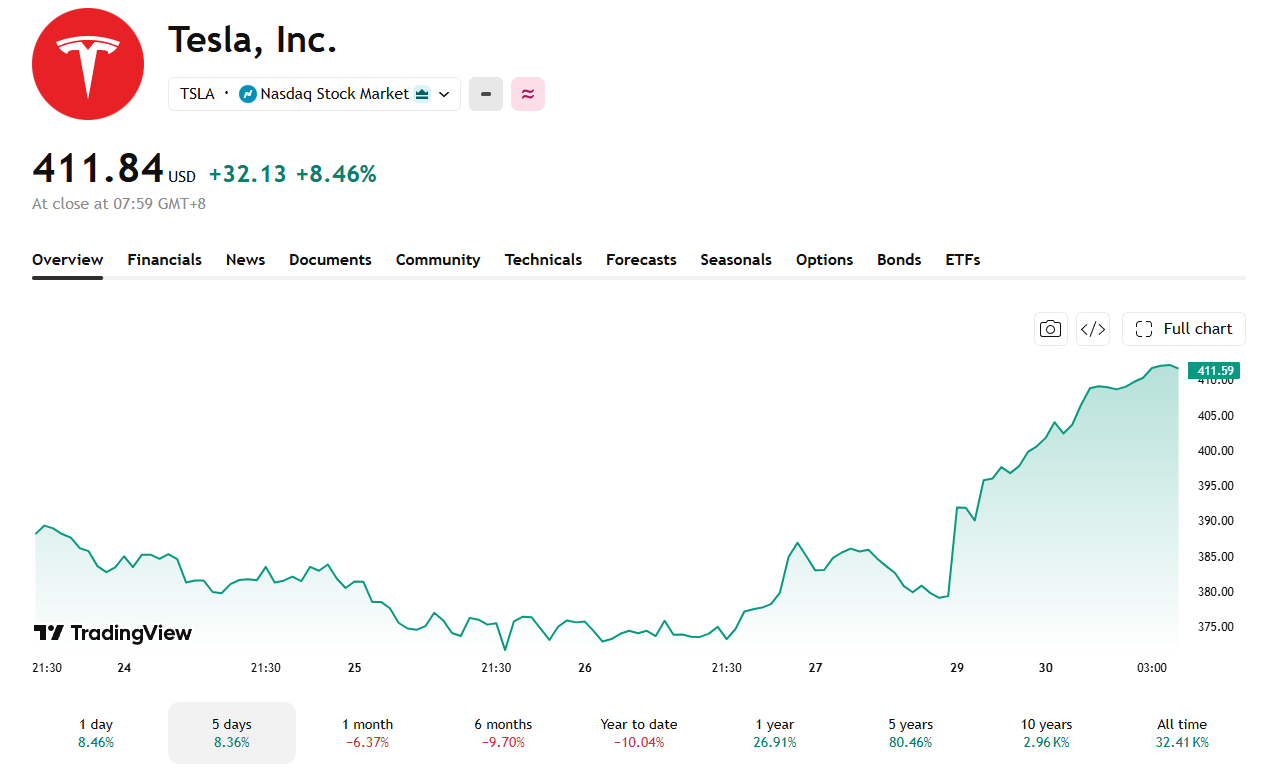
Tesla (TSLA) posted its biggest single-day gain in over a year on June 29, surging more than 8% after the company began rolling out a major software update to millions of older vehicles.
The catalyst was Full Self-Driving (FSD) v14 Lite, a new version of Tesla’s self-driving software built for older cars that had gone more than 14 months without a meaningful update.
Why Did Tesla Stock Jump?
Tesla sold millions of cars with the promise that they would eventually gain self-driving capabilities. Delivering a meaningful upgrade to that existing fleet, without requiring owners to buy a new car, signals that Tesla can keep older customers engaged.

It also gives those owners a reason to subscribe to Tesla’s $99-per-month FSD service, which represents a growing revenue stream for the company. The rally on June 29 also coincided with rising expectations ahead of Tesla’s second-quarter delivery report.
Morgan Stanley raised its Q2 delivery estimate to 413,000 vehicles, above the Wall Street consensus, citing recovering sales in Europe and China.
Investors tracking the broader Elon Musk investment picture have also watched how sentiment shifts between Tesla and SpaceX since its June IPO.
What Is FSD v14 Lite?
FSD is Tesla’s driver-assistance system. It handles much of the driving, lane changes, traffic lights, and parking, but still requires the driver to stay alert and in control at all times.
The v14 Lite update targets cars built with Tesla’s older Hardware 3 (HW3) chip, sold from around 2019 onward. Those vehicles had been running on FSD version 12.6 since early 2025. Meanwhile, newer Tesla models moved ahead with version 14, gaining features like automatic parking and gear-shifting.
Tesla VP of AI, Ashok Elluswamy, announced the rollout on X on June 29. He said the build “distills the driving behavior from AI4’s v14 series” into the older hardware, with “significantly improved safety” as the headline upgrade
Whether the stock holds these gains will likely depend on Tesla’s delivery numbers, due later this week, and on early performance data from the FSD v14 Lite rollout.
The post Tesla Stock Surges 8% After FSD v14 Lite Update Launches appeared first on BeInCrypto.
Key Highlights
- Over 6,100 fresh wallet addresses joined Chainlink’s network within a 48-hour window, representing the most significant expansion spike of 2026.
- Analytics from Santiment reveal LINK has surpassed 892,800 active wallets on Ethereum, with more than 8,000 new addresses appearing in just five days.
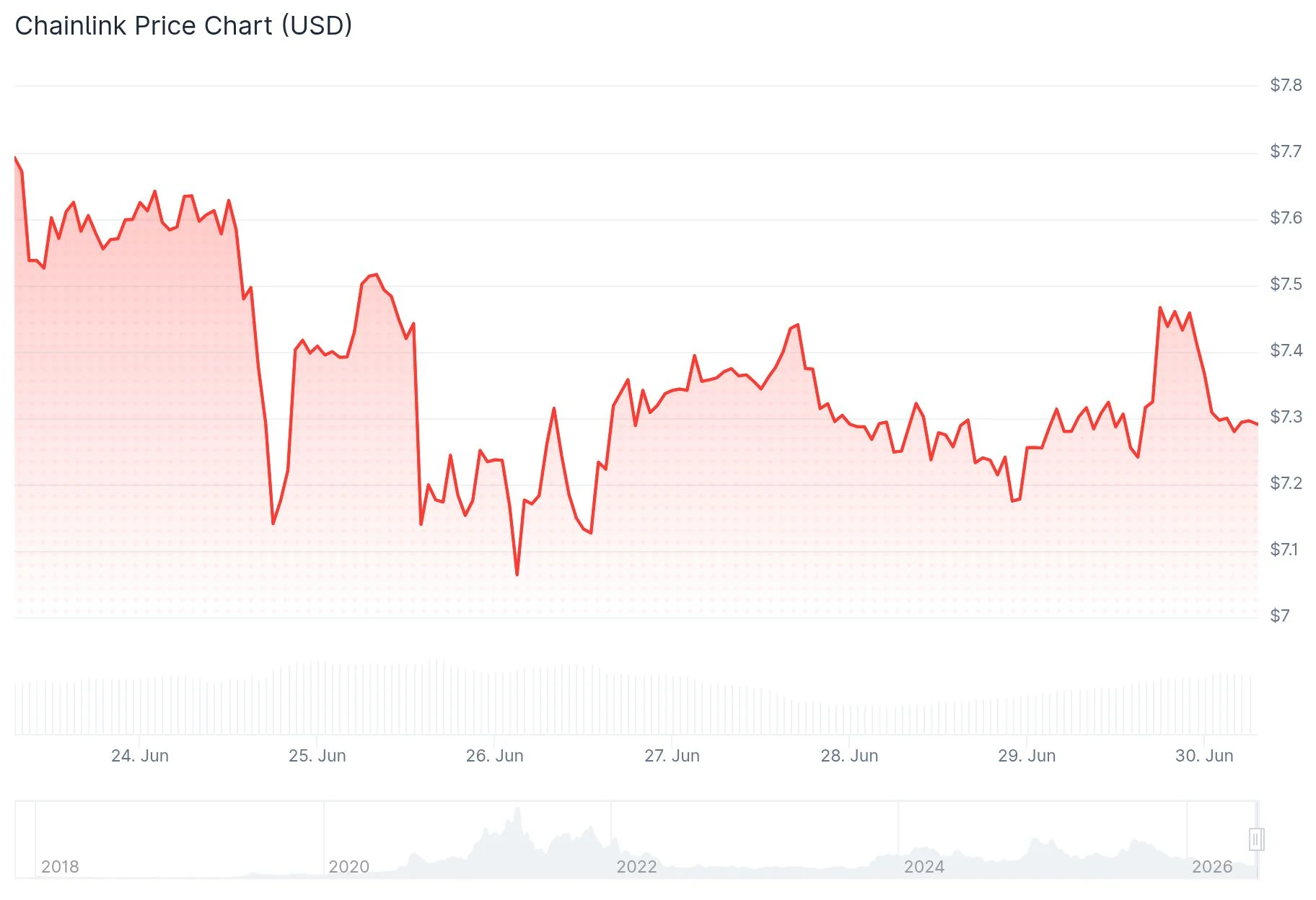
- This rapid user base expansion occurs while LINK’s market value hovers near recent bottom levels, trading around $7.30.
- Chainlink’s technology plays a central role in the real-world asset tokenization sector, which has expanded by over 100% since the beginning of 2025.
- Major financial players including the DTCC, UBS, and Mastercard are actively collaborating with Chainlink to develop tokenized asset systems.
Chainlink’s ecosystem is experiencing a remarkable surge in user adoption despite its token continuing to struggle with price performance. Recent analytics indicate the network onboarded 6,100 new unique wallet addresses within a mere two-day period. This represents the most aggressive user acquisition rate the protocol has registered throughout 2026.
Address growth serves as a fundamental metric for gauging network adoption and genuine usage, distinct from speculative price movements. It’s entirely possible for a digital asset to experience downward price pressure while simultaneously expanding its active user community. This divergence appears to be exactly what Chainlink is demonstrating at present.
Santiment Intelligence, a respected blockchain data analytics platform, published findings highlighting this unusual pattern. The firm’s official account noted that Chainlink’s address count has entered a “parabolic” growth phase. Their data indicates LINK on the Ethereum network has reached 892,800 wallets containing balances, representing an influx of over 8,000 new holders within a five-day timeframe.
Breaking Down The User Growth Metrics
Analysts at Santiment observed that maintaining the current velocity, Chainlink could breach the 900,000 holder threshold before the current week concludes. Their projections further suggest that if this momentum sustains, the network might achieve the 1 million holder milestone by the conclusion of the summer season.
The Santiment analysis also drew connections between this adoption wave and recent institutional developments. The report referenced Project Pangea, ongoing DTCC collateral initiatives, the expansion of tokenized financial products, and around-the-clock equity data delivery systems as catalysts driving renewed interest. The analysts suggested that this pattern of accumulation during price weakness often precedes broader market recognition and momentum shifts.
LINK has experienced approximately 20% depreciation over the trailing three-month period. Current market data shows the token exchanging hands at $7.30, a significant decline from its 52-week peak of $27.70.
Despite facing downward price pressure, Chainlink continues advancing its position within the real-world asset tokenization ecosystem. This emerging sector involves representing traditional asset ownership—including equities, fixed income instruments, and property—on distributed ledger technology. The tokenized asset market has experienced explosive growth, expanding from $15.2 billion in early 2025 to $32.2 billion currently.
Both the New York Stock Exchange and Nasdaq are actively developing platforms for tokenized equity offerings. The DTCC, the critical infrastructure provider for securities clearing and settlement operations, has established a strategic partnership with Chainlink to construct the technical foundation for continuous trading capabilities.
Understanding Chainlink’s Infrastructure Position
Chainlink provides oracle services and connectivity solutions that bridge blockchain networks with external data sources and traditional systems. Its technology operates across both permissionless public blockchains like Ethereum and permissioned private networks deployed by financial institutions.
This interoperability proves crucial as traditional financial institutions explore both public and private blockchain architectures. Chainlink’s technology stack accommodates both paradigms, positioning the protocol to capture value regardless of which model achieves dominance.
The protocol’s institutional partnership roster features prominent names including UBS, Mastercard, and various U.S. government entities. Chainlink also claims its infrastructure underpins over 70% of decentralized finance applications currently operational.
Market strategists specializing in blockchain metrics caution that wallet proliferation in isolation doesn’t guarantee imminent price appreciation. They emphasize that on-chain transaction volumes, accumulation behaviors, and technical price structure must all align to validate a sustainable trend reversal.
Currently, Chainlink’s wallet metrics continue their upward trajectory while the token’s market price remains anchored near multi-month support levels. The immediate data point market participants are monitoring is whether the network successfully crosses the 900,000 holder mark by week’s end, as current growth rates indicate is probable.


TL;DR
- UK FCA sets October 2027 deadline for crypto licensing.
- Existing AML registrations must be replaced with new approvals.
- Stablecoin rules eased after industry feedback.
- UK pushes toward a fully regulated crypto market.
Crypto companies operating in the United Kingdom now have a clear timeline to secure regulatory approval after the Financial Conduct Authority (FCA), which started the year with a crackdown on crypto companies, finalized its long-awaited crypto framework, setting October 25, 2027, as the date the new regime officially takes effect.
The announcement marks one of the country’s biggest regulatory overhauls for digital assets, bringing exchanges, custodians, stablecoin issuers, staking providers, and other crypto businesses under a unified licensing system. Firms currently registered under the UK’s anti-money laundering (AML) rules will not automatically qualify under the new framework and must submit entirely new applications if they wish to continue operating.
Firms Face Strict Authorization Timeline Under UK FCA
According to the FCA, the application window will open on September 30, 2026, and remain available until February 28, 2027. During that period, companies intending to provide regulated crypto services in the UK must either apply for a fresh license or amend their existing financial services permissions.
The regulator warned businesses not to delay their applications, noting that incomplete submissions or late filings could slow the approval process and potentially interrupt operations before the new rules become effective.
One notable revision concerns stablecoin issuers. The regulator reduced its proposed capital requirement from 2% of issued stablecoin value to 1%, acknowledging feedback that the original proposal was unnecessarily burdensome for businesses entering the market.
Despite the softer capital requirement, issuers will still be required to maintain adequate reserves, ensure timely redemption of tokens, and comply with strict operational standards.
The FCA also confirmed that sterling-backed stablecoins will fall under its direct supervision, while larger stablecoins considered systemically important may instead come under the oversight of the Bank of England.
Stronger Risk Controls for Crypto Businesses
Beyond licensing, the new framework introduces significantly tougher operational requirements for crypto companies.
Businesses will be expected to demonstrate that they can withstand severe market disruptions by maintaining sufficient capital against higher-risk assets and conducting annual stress tests that assess their financial resilience during periods of economic uncertainty.
Unlike major banks, which receive standardized stress-testing scenarios from the Bank of England, crypto firms will be allowed to design their own testing models based on their internal risk assessments before submitting the results to the FCA for review.
According to FCA Executive Director for Payments and Digital Finance David Geale, the framework applies the same regulatory principles already used across traditional financial services, ensuring firms manage comparable risks under comparable standards.
The FCA has also indicated that decentralized finance will remain a regulatory priority as the sector evolves.
As regulation gets tight around the world, future guidance is expected to distinguish between protocols that operate without any identifiable controlling entity and platforms that maintain centralized governance or management structures. Services with identifiable operators or controlled decentralized autonomous organizations (DAOs) are more likely to fall within the regulator’s supervisory scope.

XRP is continuing to hold above the crucial $1.00 support level, trading near $1.04 after falling to a 19-month low of around $1.01 on June 25.
Despite the recent price weakness, Santiment found that interest in the XRP Ledger has remained strong.
FOMO Returns
According to the latest data, the XRP Ledger recorded 4,941 new wallet creations in a single day, which is its highest level of network growth in more than three months. This suggests that new users are entering the ecosystem at a time when XRP’s price is under pressure, the analytics firm explained.
At the same time, social sentiment has turned increasingly optimistic. Santiment’s data reveal there are now 3.7 bullish comments for every bearish comment, the highest positive-to-negative ratio in three months. As such, many traders are treating the $1.00-$1.05 range as a dip-buying opportunity, which reflects growing fear of missing out (FOMO).
The firm said this optimism is partly driven by XRP’s history of rebounding after sharp declines, ongoing discussions around ETFs and institutional adoption, and the view that larger holders have continued accumulating during the downturn. Santiment added that it remains important to see whether the surge in new wallets develops into steady buying demand or proves to be only short-term FOMO.
Separate data from CryptoQuant showed that whale activity is becoming more prominent across centralized exchanges overall, but less concentrated on Binance. It found that whales are increasingly spreading their activity across multiple trading platforms.
Institutional Demand
Even as the price continues to struggle, XRP investment products have managed to attract fresh capital. US-based spot XRP ETFs attracted $15.34 million in net inflows on June 29. The Bitwise XRP ETF accounted for the largest share at $11.94 million, followed by Canary XRPC at $3.40 million.
June’s total has now surpassed $62 million, bringing cumulative net inflows across all the spot XRP ETFs to $1.48 billion, according to data compiled by SoSoValue.
The post Is XRP Ready for a Reversal? Wallets Surge as FOMO Hits 3-Month Peak appeared first on CryptoPotato.
Crypto World
RedotPay Selects OpenPayd to Strengthen Global Stablecoin Payment Infrastructure for Millions of Customers

[PRESS RELEASE – London, United Kingdom, June 30th, 2026]
RedotPay, a global stablecoin-based payment fintech, has selected OpenPayd, a leading financial infrastructure provider, to enhance its treasury operations, multi-currency payments, and cross-border remittances for customers worldwide.
The collaboration strengthens RedotPay’s payment infrastructure, enabling a more seamless experience for global fund movement so users can navigate between local and digital currencies effortlessly.
As a result of the integration, RedotPay users benefit from faster, more efficient cross-border remittances and frictionless multi-currency payment options. The integration also optimizes how liquidity is managed behind the scenes. As a result, transactions are processed securely and without unnecessary delays, regardless of where the user is located.
By leveraging OpenPayd’s infrastructure and integrating the best of traditional and digital finance into a single, intuitive platform, RedotPay enables users to move seamlessly between local and digital currencies as it continues to scale its global footprint. Throughout, it maintains its commitment to a fast, flexible, and user-centric payment experience.
Jonathan Chan, Head of Partnerships & Co-Founder of RedotPay, said: “Our goal has always been to make digital finance accessible and practical for everyday use. By partnering with world-class infrastructure providers, we’re removing the friction from cross-border payments. This collaboration allows RedotPay users to enjoy effortless multi-currency payments and faster cross-border remittances, allowing us to better serve customers as our global reach expands.”
Lux Thiagarajah, Chief Commercial Officer at OpenPayd, said: “RedotPay is building one of the most compelling payment experiences at the intersection of traditional finance and digital assets. As they continue to scale globally, the ability to move seamlessly between payment rails, currencies, and stablecoins becomes a competitive advantage. OpenPayd is proud to provide the infrastructure that enables RedotPay to deliver faster, more efficient, and more flexible money movement for customers around the world.”
About RedotPay
RedotPay is a global stablecoin-based payment fintech that integrates blockchain solutions with traditional banking and finance infrastructures. Our intuitive platform empowers millions around the world to spend and send digital assets, ensuring faster, more accessible, and inclusive financial services. RedotPay advances financial inclusion for the unbanked and supports crypto enthusiasts, driving global adoption of secure and flexible stablecoin-powered financial solutions to bring crypto to real life. For more information, visit www.redotpay.com.
About OpenPayd
OpenPayd is building the universal financial infrastructure for the digital economy. Founded in 2018 by Dr. Ozan Ozerk, its rails-agnostic platform enables businesses to move and manage money globally – across fiat and digital assets – through a single, powerful API. OpenPayd provides embedded accounts, FX, domestic and international payments, Open Banking, and stablecoin on/off ramps – delivering interoperability between traditional finance and digital assets. With one of the most comprehensive banking networks in the market, OpenPayd enables real-time money movement, everywhere.
Trusted by global brands including eToro, Kraken, OKX, and B2C2, OpenPayd processes more than $240 billion in annual volumes for over 1100 businesses. It is the infrastructure layer powering the next generation of financial services.
The post RedotPay Selects OpenPayd to Strengthen Global Stablecoin Payment Infrastructure for Millions of Customers appeared first on CryptoPotato.
Crypto World
Bitcoin’s tie to USD/JPY is the strongest it’s been since 2022. Here’s why that matters.


Under the “yen carry trade” framework, a weak yen (USD/JPY rising) is supposed to be accompanied by rising BTC, just as it tends to support stocks. Extending that logic, a strengthening yen should trigger risk aversion in both stocks and cryptocurrencies.
That’s precisely what happened in late July/early August 2024, when the Bank of Japan hiked interest rates, sending the yen sharply higher. Risk assets had a meltdown, with BTC falling from roughly $65,000 to $50,000 in the following weeks.
Carry-unwind fears have resurfaced lately as the yen continues to slide, hitting four-decade lows this week. That’s raised hopes of more aggressive action by the BOJ to stem the yen’s slide.
However, if the latest correlation is anything to go by, potential BOJ action and a resulting rise in the yen could actually put a floor under BTC, working the opposite way from what carry-trade logic would predict.
A mirage?
Correlation doesn’t necessarily mean causation.
Neither BTC nor the yen may be driving the other directly. Instead, broad US dollar strength or weakness may be moving both assets independently, creating the appearance of a tight BTC-yen relationship.
That reading makes sense in context: markets have recently priced in at least one 25-basis-point interest rate hike from the Fed this year. That hawkish repricing, a sharp reversal from earlier hopes of rate cuts, has lifted the dollar broadly. The euro, the Australian dollar, the New Zealand dollar, gold and silver have all declined against the greenback over the same stretch.


The chances of the crypto market structure bill, or CLARITY Act, passing before the November midterm election have remained far from assured as major legislative hurdles continue, according to investment bank TD Cowen.
Summary
- TD Cowen said the CLARITY Act faces significant political and procedural hurdles before the November midterm election.
- Senate leaders are expected to begin considering the bill in mid July, but unresolved policy disputes could delay a floor vote.
- Ethics rules, anti money laundering concerns and uncertainty over President Donald Trump’s support continue to weigh on the bill’s prospects.
According to TD Cowen’s Washington Research Group, Senate Majority Leader John Thune is expected to begin the procedural process for the CLARITY Act during the week of July 13, potentially setting up a Senate floor vote either that week or during the week of July 20.
The investment bank’s managing director, Jaret Seiberg, said the legislation still faces several obstacles before it can clear the Senate.
He identified July 24 as the key deadline before the House leaves for its August recess and questioned whether the bill could realistically advance later in the year if lawmakers fail to act before then.
“We continue to question if the bill can pass in the fall before the election,” Seiberg wrote.
The assessment follows similar concerns raised last week by Galaxy Research, which reduced its estimate of the CLARITY Act becoming law in 2026 to 50% from 60%, citing Senate scheduling constraints and limited legislative time.
Earlier this month, JPMorgan analysts also said they see less than a 50% chance of the bill passing this year because of the approaching midterm election, unresolved policy disputes and the continuing debate over stablecoin yield.
Previous reporting by journalist Eleanor Terrett also said congressional staff, White House officials and crypto industry representatives have continued negotiating the legislation while the Senate remains in recess, with ethics rules, anti-money-laundering provisions and digital asset market oversight among the unresolved issues.
Trump stance and ethics debate remain key obstacles
One area of uncertainty, according to TD Cowen, is whether President Donald Trump would ultimately sign the legislation.
Seiberg said Democrats are expected to force Republicans to vote on politically difficult amendments, and Republican lawmakers are unlikely to take those votes unless they believe Trump will approve the final bill.
According to the note, that confidence has weakened after Trump declined to sign a bipartisan housing bill negotiated by his own administration and later said he would not approve legislation until Congress passes the Safeguard American Voter Eligibility Act. Although Seiberg said Trump could still make an exception for the CLARITY Act, he warned the uncertainty could delay the bill.
Ethics provisions have also become another point of disagreement. According to TD Cowen, Democrats want to ban government officials and their families from owning crypto businesses, a proposal that would also apply to the president. Seiberg said Trump has not indicated a willingness to compromise, leaving Republicans in a position where they may have to reject a Democratic amendment.
“It is not clear to us the GOP has the votes,” Seiberg wrote, adding that Republican Senators Thom Tillis, Mitch McConnell, Bill Cassidy, John Cornyn, Susan Collins, and Lisa Murkowski could play an important role because several are moderates or are retiring.
Separately, TD Cowen said the White House has continued meeting with stakeholders over concerns from law enforcement agencies about whether software developers should be held responsible if tools they create are later used for money laundering or other illicit finance. Seiberg said resolving those concerns would improve the bill’s prospects.
The discussion follows a letter sent last week by several law enforcement groups to the White House arguing that Section 604 of the CLARITY Act, known as the Blockchain Regulatory Certainty Act, could weaken oversight by protecting non-custodial software developers and make investigations into illicit crypto activity more difficult.
However, Seiberg said he does not expect changes to the bill’s stablecoin yield provisions despite continued opposition from banks.

The True Cost of AI Hidden in Big Tech’s Financials | WSJ’s Take On the Week

Parents warned of exploding squishy toys burning children

BlackRock New York Municipal Opportunities Fund Q1 2026 Commentary


-
 Sports7 days ago
Two goals and an assist by sheer aura: Cristiano Ronaldo just entered the World Cup chat
-

 Fashion4 days ago
Weekend Open Thread: Staud – Corporette.com
-

 Politics4 days ago
The House | Manchesterism won’t survive the painful trade-offs unless it gets citizens on board
-

 Politics4 days ago
Potential 2028er World Cup attendee leaderboard
-

 News Videos2 days ago
MAJOR BITCOIN & MARKET UPDATE!!!! (MUST WATCH ASAP!!!)
-

 Business4 days ago
Asia stock markets slide as tech shares slump
-

 Tech5 days ago
A Look At A Gaggle Of Transputer Boards
-

 Crypto World6 days ago
Securitize Wraps Roubini's SEC-Registered ETF as Dubai VARA Digital Security
-
Crypto World6 days ago
Bitcoin (BTC) Dips Below $62K, Ethereum (ETH) Plunges 6% Daily: Market Watch
-
 Crypto World5 days ago
Dell (DELL) Shares Tumble Over 5% Following Analyst Downgrade to Hold
-

 Crypto World3 days ago
Coinbase, Circle Deepen Crypto Stock Losses Despite Resilient S&P 500
-
Business6 days ago
Entergy settles forward sale agreements, raises $672 million in cash proceeds
-

 Crypto World3 days ago
Kraken's xStocks Opens Bending Spoons IPO Registration to EEA Retail
-

 Sports4 days ago
FIH Pro League: India defeat Pakistan 7-1, register biggest win of campaign | Other Sports News
-

 Crypto World4 days ago
Bitcoin Sparks $600M Hourly Liquidations With $65,000 Set To Become Resistance
-

 Tech2 days ago
Bluekit phishing kit adopts browser-in-the-middle for login theft
-

 Tech3 days ago
Russian hackers now target Signal backup recovery keys
-
Crypto World4 days ago
Hyperliquid Named on Singapore MAS Investor Alert Register
-

 Crypto World4 days ago
RTX holders must register wallets before token distribution begins
-

 Crypto World5 days ago
Ripple and SBI launch RLUSD in Japan after JFSA approval
You must be logged in to post a comment Login