

Crypto World
SpaceX (SPCX) Achieves Record-Breaking Nasdaq-100 Entry After Historic IPO


Key Highlights
- In a remarkably swift move, SpaceX secured Nasdaq-100 membership merely 15 days following its June 12 public offering, marking one of the most rapid index additions in history.
- Index-tracking funds are projected to purchase between $4.3 billion and $6 billion worth of SPCX shares to align with updated index weightings.
- Both Goldman Sachs and Morgan Stanley launched coverage on Tuesday with their highest possible ratings; Goldman characterized the opportunity as potentially reaching “multi-trillion-dollar” scale.
- The company’s index representation reflects a float-adjusted market capitalization of approximately $300 billion, though only around 638 million shares are publicly tradeable.
- An additional 20% of shares will become available for trading following SpaceX’s inaugural earnings announcement, anticipated within weeks.
In a historic development for Wall Street, SpaceX (SPCX) secured its position in the prestigious Nasdaq-100 index on Tuesday, achieving this milestone a mere 15 days after making its stock market entrance on June 12 — establishing one of the swiftest index inclusions ever documented.
Space Exploration Technologies Corp., SPCX
During premarket trading on Tuesday, shares declined approximately 1.5% to reach $158.37. Following its initial public offering, SPCX has experienced price fluctuations ranging from a peak of $225.64 to a trough of $147.11.
The inclusion required strategic regulatory maneuvering. Nasdaq implemented modified eligibility criteria specifically designed for recently debuted companies, enabling SpaceX to meet qualification standards despite its abbreviated public trading record.
The Nasdaq-100 comprises the exchange’s most valuable non-financial enterprises. SpaceX now stands alongside technology titans including Apple, Nvidia, Alphabet, Amazon, Meta, and Broadcom in an elite collection representing nearly $40 trillion in aggregate market capitalization.
Commanding a market valuation of $2.1 trillion, SpaceX currently ranks as America’s sixth-most-valuable corporation. Chief Executive Elon Musk holds distinction as humanity’s inaugural trillionaire.
The company’s initial public offering generated $86 billion in capital — an unprecedented amount — though this constituted merely a portion of its staggering $1.8 trillion IPO valuation. Presently, approximately 638 million shares remain accessible for public trading, representing roughly $102 billion in market value.
Recognizing the constrained share availability, Nasdaq is applying a weighting methodology that values SpaceX at triple its tradeable market capitalization, effectively assigning it the index influence of a $300 billion enterprise. This calculation translates to approximately 0.75% of the Nasdaq-100’s aggregate value.
Massive Passive Investment Inflows Anticipated
More than $587 billion in investment capital tracks the Nasdaq-100 benchmark, encompassing Invesco’s popular QQQ and QQQM exchange-traded funds. These investment vehicles must now acquire SPCX shares to maintain proper index alignment.
J.P. Morgan analysts projected last month that this index addition would generate approximately $4.3 billion in passive investment flows. Barron’s analysis suggests the actual figure may approach $6 billion — representing roughly 6% of SPCX shares currently available for trading.
Market participants seem to have positioned themselves ahead of this event. SPCX shares have climbed approximately 10% from recent nadirs approaching Tuesday’s inclusion, potentially incorporating anticipated indexation demand into current pricing.
Additional share supply approaches. Approximately 20% of SpaceX equity will transition from restricted to tradeable status following the corporation’s initial quarterly earnings disclosure, scheduled for the coming weeks. This unlock event should alleviate some existing supply-demand imbalances.
Major Financial Institutions Launch Coverage With Optimistic Outlooks
Tuesday simultaneously represents the conclusion of the mandatory quiet period for underwriting banks, including Goldman Sachs, Morgan Stanley, BofA Securities, Citigroup, and J.P. Morgan.
Morgan Stanley commenced research coverage with its premium rating designation, characterizing SpaceX as “AI’s final frontier.” Goldman Sachs similarly launched coverage at its most favorable rating level, asserting that each of SpaceX’s primary business segments possesses potential to evolve into multi-trillion-dollar markets over a five-year-plus horizon.
RBC, Bernstein, and Stifel added their voices with top-tier ratings as well, with RBC emphasizing Starship — SpaceX’s completely reusable next-generation launch vehicle — as the “flywheel that powers SpaceX’s ambitions.” Oppenheimer had previously established an “outperform” rating in June.
Dissenting perspectives exist. Morningstar assigned SpaceX a valuation near $780 billion, citing concerns regarding uncertainties surrounding its artificial intelligence ventures, including xAI and social networking platform X.
S&P Global rejected establishing an expedited pathway for S&P 500 membership in June. The company may require at least twelve months before achieving inclusion in that benchmark index.
FTSE Russell incorporated SpaceX into its U.S. market indexes last month, with the iShares Russell 1000 ETF already providing investor access to the stock.


EDX Markets, an institutional cryptocurrency trading platform, said it raised $76 million in a Series C funding round led by SBI Holdings.
The company plans to use the funds to develop new products and grow internationally. EDX operates an institution-only crypto marketplace that separates trading from custody and settlement through a central clearinghouse. The model is designed to reduce counterparty risk and mirrors the structure used in traditional financial markets.
SBI Holdings has been one of Japan’s most active financial groups in crypto. Its SBI VC Trade unit offers access to Ripple’s RLUSD stablecoin in Japan, while SBI Shinsei Trust Bank recently issued JPYSC, a yen-denominated stablecoin developed with Startale Group.
Last month, SBI agreed to acquire crypto exchange Bitbank for 46.7 billion yen ($289 million), adding to its existing SBI VC Trade platform.
EDX has been moving beyond spot trading. The firm earlier this year introduced FlowConnect, a crypto-as-a-service product that allows financial firms to offer crypto trading to their customers.

The CLARITY Act picked up its first major public law enforcement endorsement on July 1 when the National Organization of Black Law Enforcement Executives (NOBLE) formally backed the bill, and two days later Major County Sheriffs of America withdrew its opposition entirely, shifting to neutral.
Two organized law enforcement bodies moving constructively on the same digital asset legislation within 72 hours is not coincidental, it reflects deliberate outreach and signals that the Senate floor fight is now a live negotiation, not a procedural formality.

Discover: The Best Token Presales
NOBLE’s Endorsement: What the Organization Said and Why It Matters
NOBLE’s July 1 letter to Senate Majority Leader John Thune and Minority Leader Chuck Schumer was addressed to the two officials who control Senate floor timing, a deliberate signal that the endorsement was meant to move the legislative calendar, not just the public narrative.
The organization, which represents more than 3,000 members across nearly 60 chapters worldwide including chief executives and command-level officials, cited four specific provisions driving its support: expanded regulatory obligations on digital asset businesses, enhanced forfeiture authorities, new transparency requirements, and oversight rules for digital asset kiosks.
Critically, NOBLE addressed the enforcement-gap argument head-on. The organization stated explicitly that the legislation does not alter the federal criminal authorities investigators and prosecutors rely on daily, money laundering, unlicensed money transmitting, conspiracy, aiding and abetting, and sanctions enforcement statutes all remain intact under the bill’s current text.
— Eleanor Terrett (@EleanorTerrett) July 3, 2026
 NEWS: The Major County Sheriffs of America (MCSA) has shifted to a “neutral” position on the Clarity Act after what it describes as “continued discussions in recent days regarding parts of Section 604,” aka the Blockchain Regulatory Certainty Act.
In a letter to Senate Banking… pic.twitter.com/24XIZTfWHR
That framing directly rebuts the criticism that had dogged earlier CLARITY Act drafts, where anti-corruption groups argued the bill could create exploitable gaps in illicit-finance enforcement.
Stand With Crypto, the crypto advocacy group representing more than 2.6 million U.S. supporters, called NOBLE the first major law enforcement organization to publicly endorse the CLARITY Act.
That distinction matters for Senate Democrats who have been most vocal about enforcement preservation, an endorsement from a respected law enforcement body with NOBLE’s institutional standing provides political cover that no industry lobbying group can supply.
“Law enforcement voices are engaging constructively on digital asset legislation, and the first major endorsement is on the books.”
Stand With Crypto said this after the NOBLE letter was made public, per reporting on the NOBLE endorsement development.
Discover: The Best Crypto to Diversify Your Portfolio
Major County Sheriffs Move to Neutral on Section 604
Major County Sheriffs of America, whose members collectively serve more than 130 million citizens through offices employing at least 700 personnel each, sent its own letter on July 3, this one addressed to Senate Banking Committee Chairman Tim Scott and ranking member Elizabeth Warren.
MCSA’s position shift from opposition to neutral turned on Section 604, the provision incorporating the Blockchain Regulatory Certainty Act, which establishes liability protections for blockchain developers and service providers who do not custody or control digital assets.

MCSA said continued review and discussions around Section 604 clarified how the administration interprets and plans to implement that provision.
The organization stopped short of endorsement, it explicitly noted room to further strengthen the legislation to support both responsible innovation and state and local law enforcement needs, but it withdrew formal opposition.
Removing an active opponent from the ledger is not the same as gaining a supporter, but in a Senate that requires 60 votes for floor passage, eliminating organized resistance from an association representing major population centers carries real procedural weight.
Don’t Miss Out on Our $1,000 USDT Airdrop on ByBit
The post NOBLE Endorses CLARITY Act as Major County Sheriffs Drop Opposition appeared first on Cryptonews.
Crypto World
AI trade loses steam as Samsung earnings fail to lift chip stocks amid open source AI shift
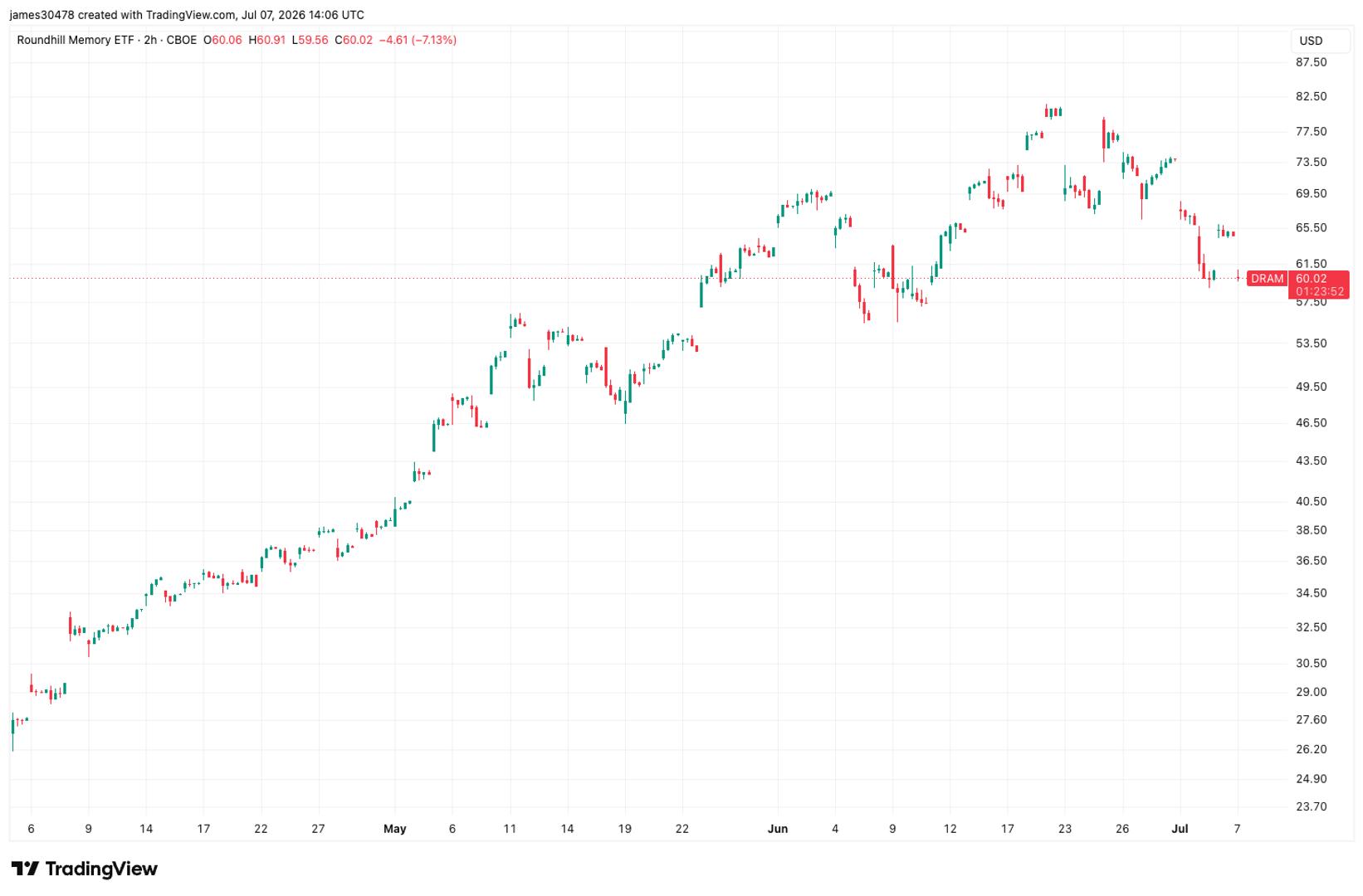
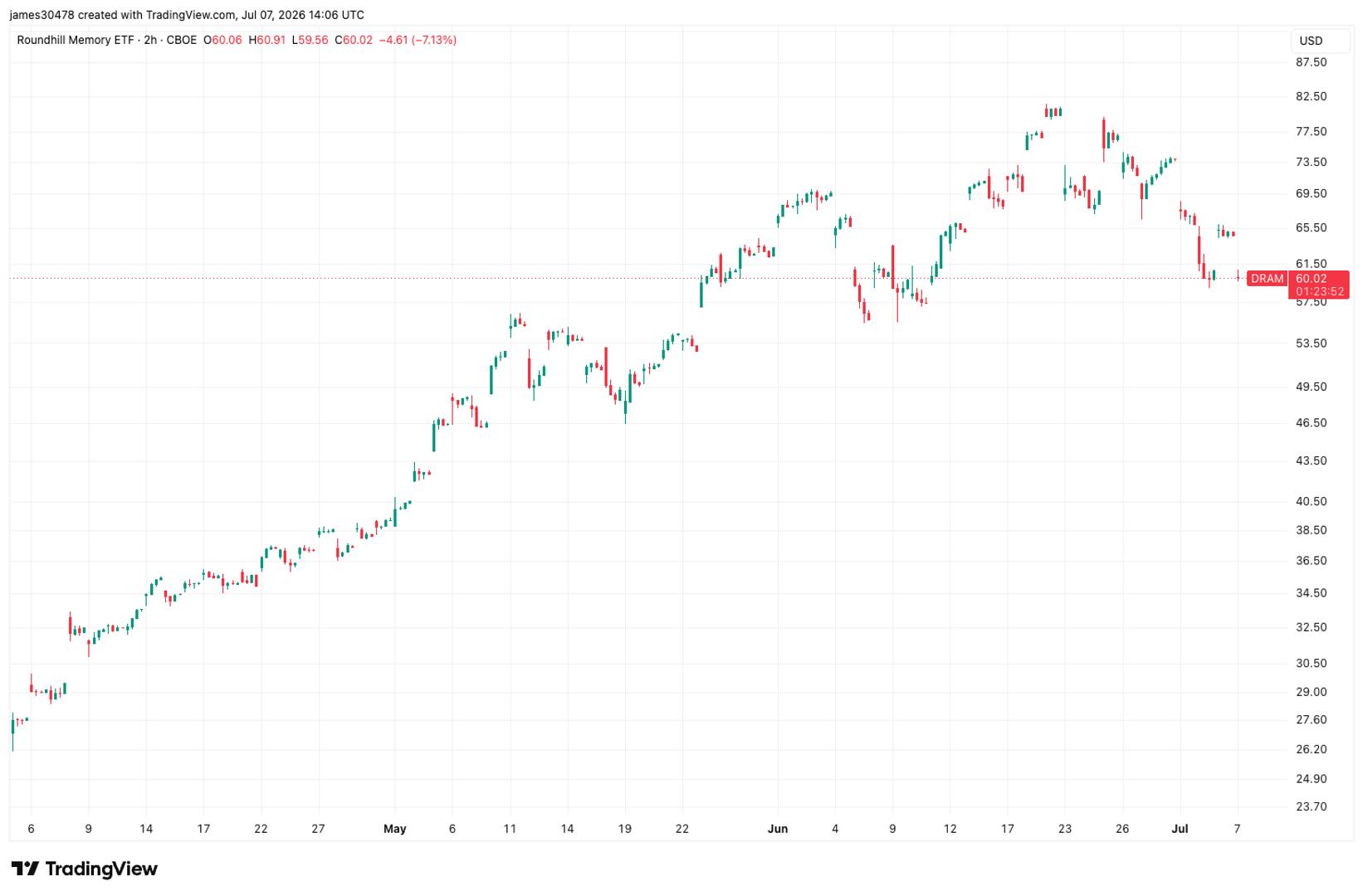
The AI trade, which incorporates semiconductors and memory stocks, is showing signs of fatigue as investors reassess whether the extraordinary spending boom on chips and data centers can be sustained.
Semiconductor and memory stocks such as Micron Technology (MU) and Sandisk (SNDK) came under heavy pressure on Tuesday, after Samsung Electronics (005930) reported record second-quarter earnings but missed revenue estimates.
Shares still fell nearly 7%, extending a broader selloff across AI-linked chipmakers. Concerns are growing that hyperscalers could slow AI infrastructure spending.
Meanwhile, rival SK Hynix is down 25% from its all-time high ahead of its U.S. listing this week, a deal that is also drawing investor capital away from existing chip stocks.
Adding to the changing narrative, China’s Zhipu AI, one of the country’s leading artificial intelligence startups, is exploring a custom AI chip as demand for its open-source GLM models surges, highlighting the rise of lower-cost AI ecosystems built around domestic hardware rather than cutting-edge US chips.
The shift comes just weeks after SpaceX’s blockbuster IPO and amid elevated valuations across AI-related stocks. Investors are increasingly questioning whether the next phase of AI will require ever more GPUs and high-bandwidth memory, or whether more efficient models will reduce demand for the infrastructure that has powered the AI rally.
Over the past year, bitcoin and the broader crypto market have suffered from the AI trade, and if investor enthusiasm for AI continues to fade, crypto bulls could see capital rotate back into digital assets.
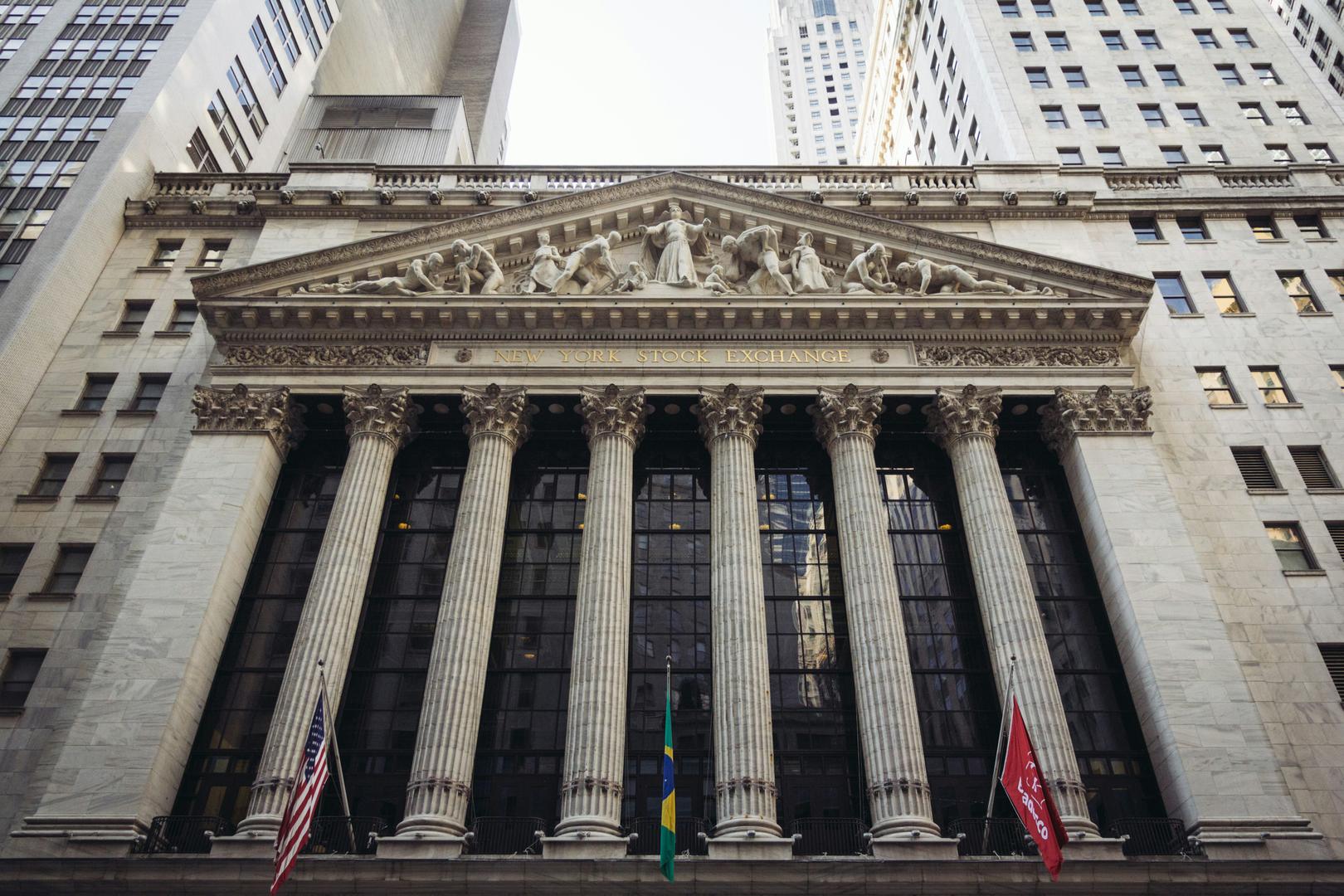
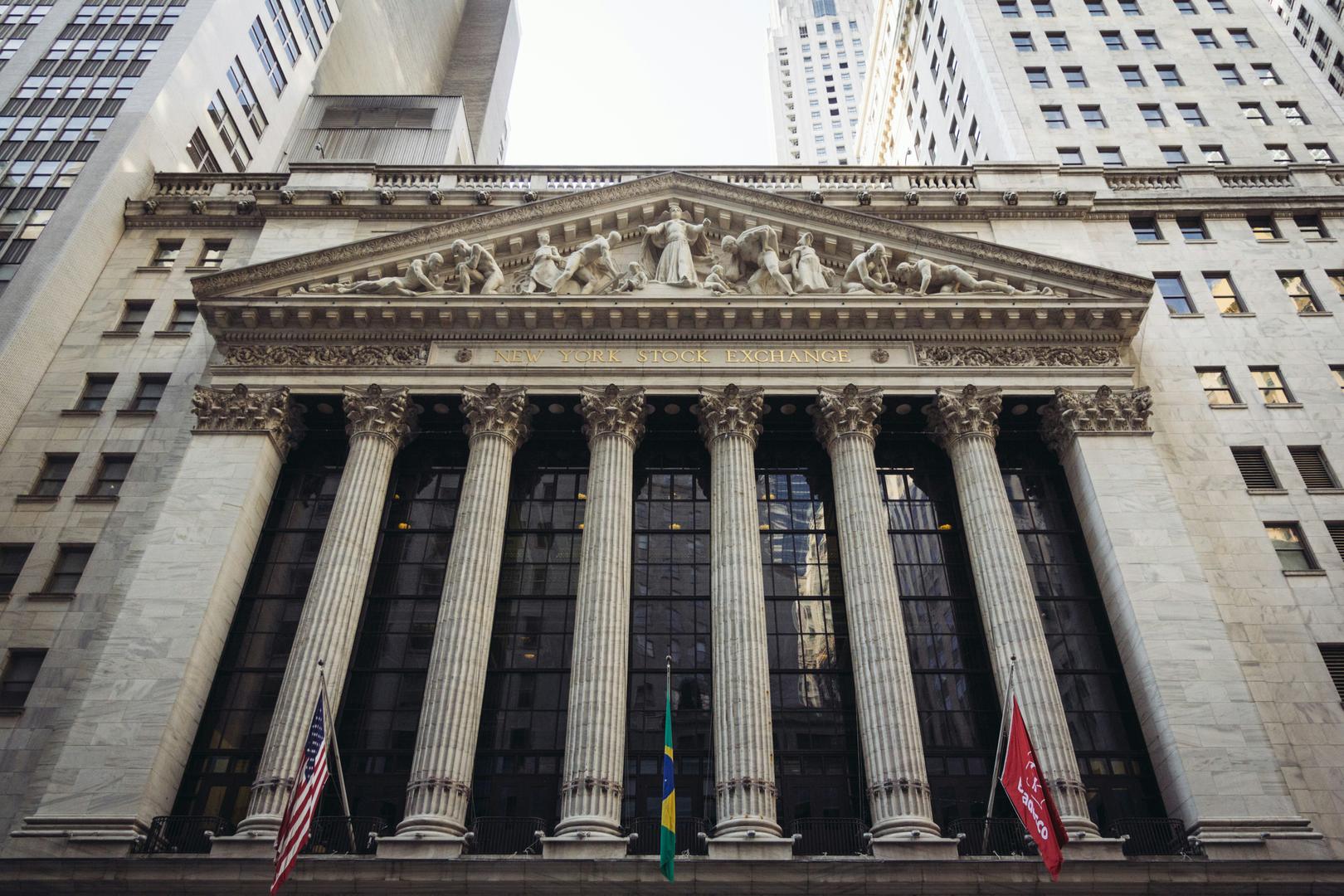
Wall Street analysts have begun coverage of SpaceX (SPCX) following the expiration of the 25-day quiet period after the company’s June initial public offering (IPO), with nearly every major brokerage launching their coverage with a bullish rating.
The aerospace and satellite company, which held 18,712 bitcoin as of March 31, went public in June, raising $75 billion in one of the year’s largest IPOs. Shares were priced at $135 in the offering. The stock was trading at $150.93 on Tuesday, down more than 6% from recent post-listing highs but still above its IPO price.
The two lead underwriters, Goldman Sachs and Morgan Stanley, both initiated coverage with buy-equivalent ratings. Goldman analyst Eric Sheridan set a price target of $205, while Morgan Stanley’s Adam Jonas assigned a $300 target.
They were joined by analysts at Bank of America, Citigroup, Deutsche Bank, JPMorgan, Macquarie, RBC Capital Markets, UBS and Wells Fargo, all of which launched coverage with buy or equivalent recommendations.
The most optimistic forecast came from Raymond James, where analyst Brian Gesuale initiated coverage with a Strong Buy rating and an $800 price target.


Vanguard has opened the search for a head of digital assets, creating a senior role that would oversee the firm’s strategy for cryptocurrencies and blockchain-based financial technology.
The position, listed within Vanguard Personal Wealth, calls for an executive to develop the firm’s digital asset vision, identify business opportunities and lead execution across product, technology, operations, legal and compliance teams. The candidate will also advise senior leadership on changes in digital asset markets, represent Vanguard in discussions with regulators and industry groups and help shape the firm’s long-term approach.
It also highlights other areas of the ecosystem, including tokenization, stablecoins, digital wallets, custody, blockchain-enabled settlement and operating models as areas the executive will evaluate, as well as determining whether Vanguard should build new capabilities internally, partner with third parties or delay entering certain parts of the market.
The search marks another step in Vanguard’s gradual shift toward digital assets after years of resisting the sector. The asset manager, which oversees roughly $10 trillion, remained one of crypto’s largest institutional skeptics while peers such as BlackRock, Fidelity and Franklin Templeton rolled out spot bitcoin ETFs and other blockchain initiatives.
Crypto World
1win Announces the Expansion of Its Web3 Ecosystem with the Upcoming Launch of 1win Token
[PRESS RELEASE – Curaçao, Willemstad, July 7th, 2026]
Crypto casino 1win is expanding its Web3 strategy with the development of its native ecosystem token, 1win Token ($1WIN). The initiative combines a dual-chain infrastructure, Telegram-based user engagement, and an ecosystem designed to connect platform activity with token utility.
The upcoming launch represents another step in the growing convergence of blockchain technology and online entertainment. Rather than positioning cryptocurrency solely as a payment method, the company is developing a broader ecosystem in which digital assets play an active role across platform services.
Unlike traditional platform tokens that primarily function as payment instruments, 1win Token has been designed with a strong focus on iGaming utility. The token will be integrated across the 1win platform, allowing users to utilize $1WIN in casino games, sports betting, exclusive lotteries, and future platform services.
The project introduces two independent tokenomic mechanisms designed to support the long-term sustainability of the ecosystem. Through its Weekly Buyback program, 1win will use 10% of the revenue generated from gameplay conducted with $1WIN to repurchase tokens from the open market. The buyback mechanism is intended to create continuous market demand while reinforcing the token’s long-term utility within the ecosystem.
Alongside this model, the ecosystem implements a Daily Token Burn mechanism. Every day, 10 percent of all 1win Token spent across supported platform products – including games, lotteries and other ecosystem activities – will be permanently removed from circulation. By gradually reducing the total token supply over time, this mechanism is designed to reinforce long-term scarcity while supporting the broader economic balance of the ecosystem.
Beyond token utility, the launch introduces several benefits for both platform users and cryptocurrency enthusiasts. Players will have access to crypto deposit bonuses of up to 600 percent, with a combined value of up to $2,000, while cryptocurrency deposits and withdrawals are expected to be processed in less than 90 seconds. Token holders will also gain access to exclusive lotteries and dedicated airdrop campaigns through the 1win Telegram Mini App, where users can complete tasks, participate in community activities, and prepare for future token distribution events.
To keep up with the 1win Token news and updates, users can follow on X.com (@1winToken) and other social media platforms.
About 1win
1win is an international iGaming platform offering sports betting, online casino entertainment, and cryptocurrency payment solutions to users worldwide. Since its launch, the company has continued to invest in blockchain technologies and Web3 products, including the development of 1win Token and its Telegram Mini App ecosystem.
Website: https://1wintoken.com
The post 1win Announces the Expansion of Its Web3 Ecosystem with the Upcoming Launch of 1win Token appeared first on CryptoPotato.
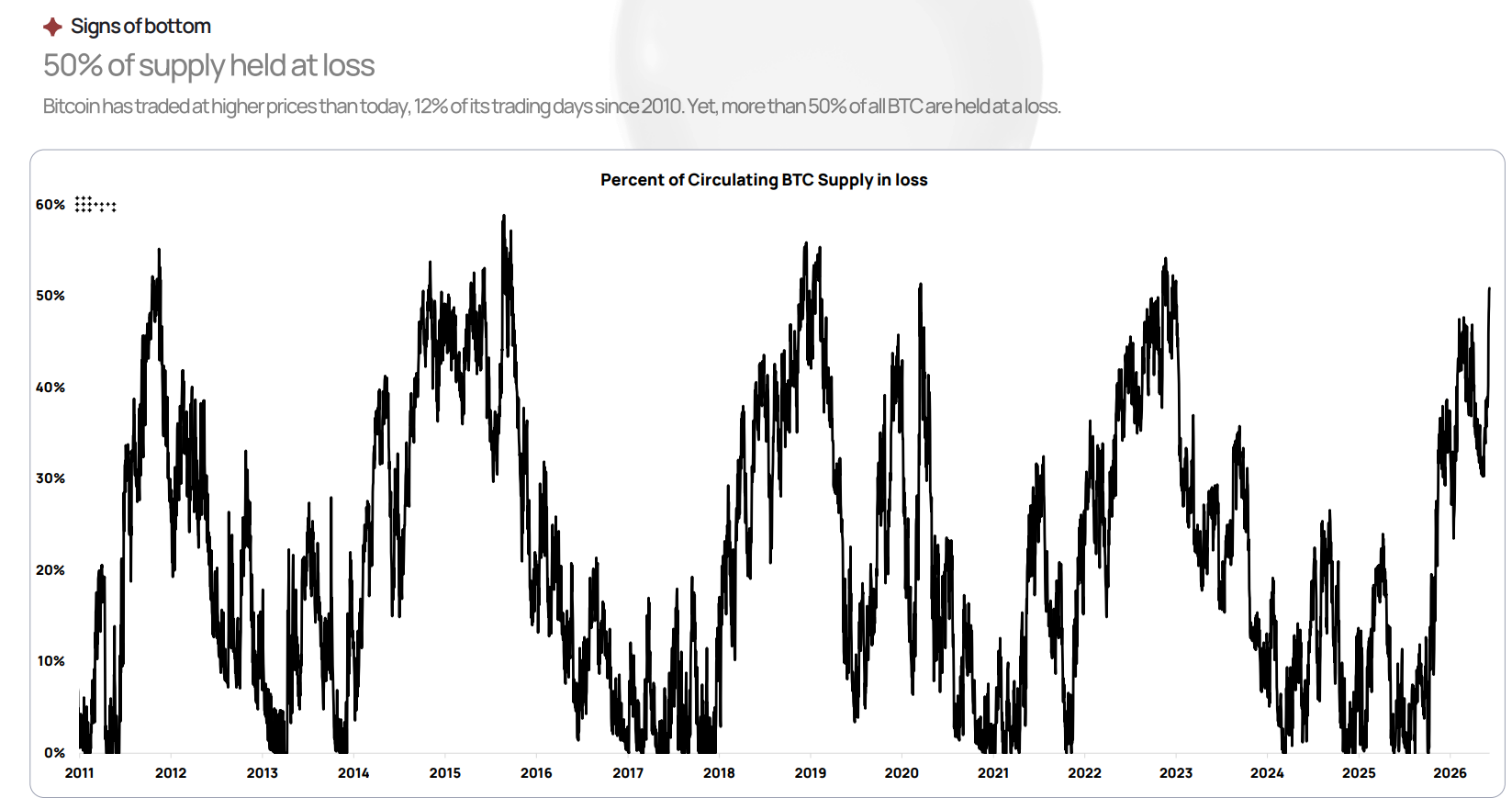
The growing Bitcoin supply held at a loss suggests that the crypto market is nearing its cycle bottom, according to digital asset brokerage company K33.
Over 50% of all Bitcoin (BTC) is currently held at a loss, K33 said in a report published Tuesday.
K33 added that because the past year’s bull market was less extreme than previous cycles, the current downturn could also be less severe.
Historically, when more than half of the circulating supply has been underwater, Bitcoin has tended to be in the late stages of a bear market, making the metric one of several indicators analysts use to assess whether selling pressure may be nearing exhaustion.
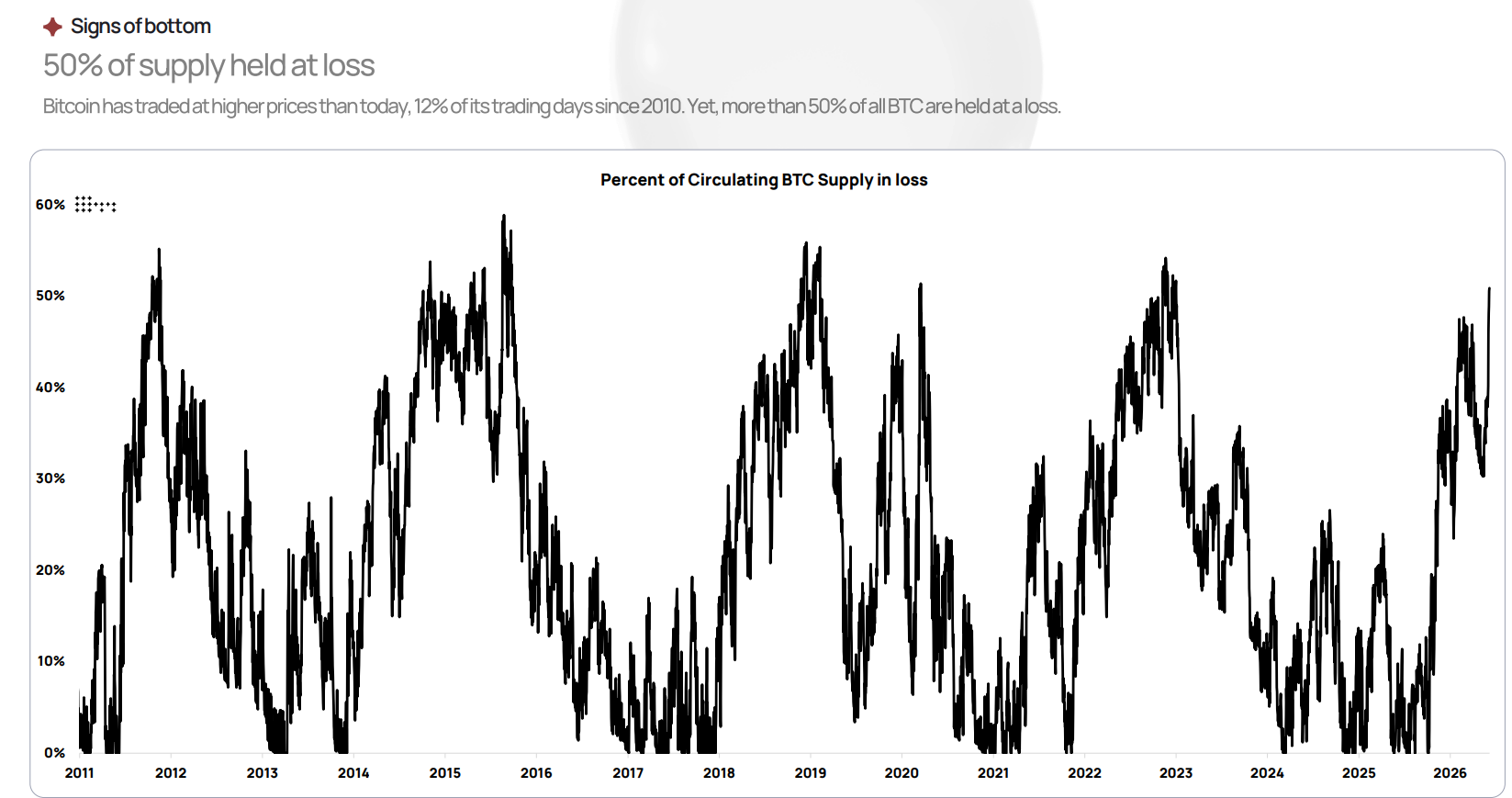
Percent of the circulating BTC supply in loss. Source: K33
Past Bitcoin cycles bottomed within weeks of the signal
K33 said previous bear markets typically bottomed within weeks of more than half of Bitcoin’s supply being held at a loss.
During the 2017 bear market cycle, Bitcoin bottomed 31 days after over 50% of the BTC supply was held at a loss. Similarly, Bitcoin bottomed 23 days after half the supply was held at a loss in November 2018 and about 13 days after the same development in November 2022.
The 2014 cycle was an outlier, as Bitcoin only bottomed 101 days after half the supply was held at a loss. It was also the only cycle in which Bitcoin was lower one year after the signal, falling 25%.
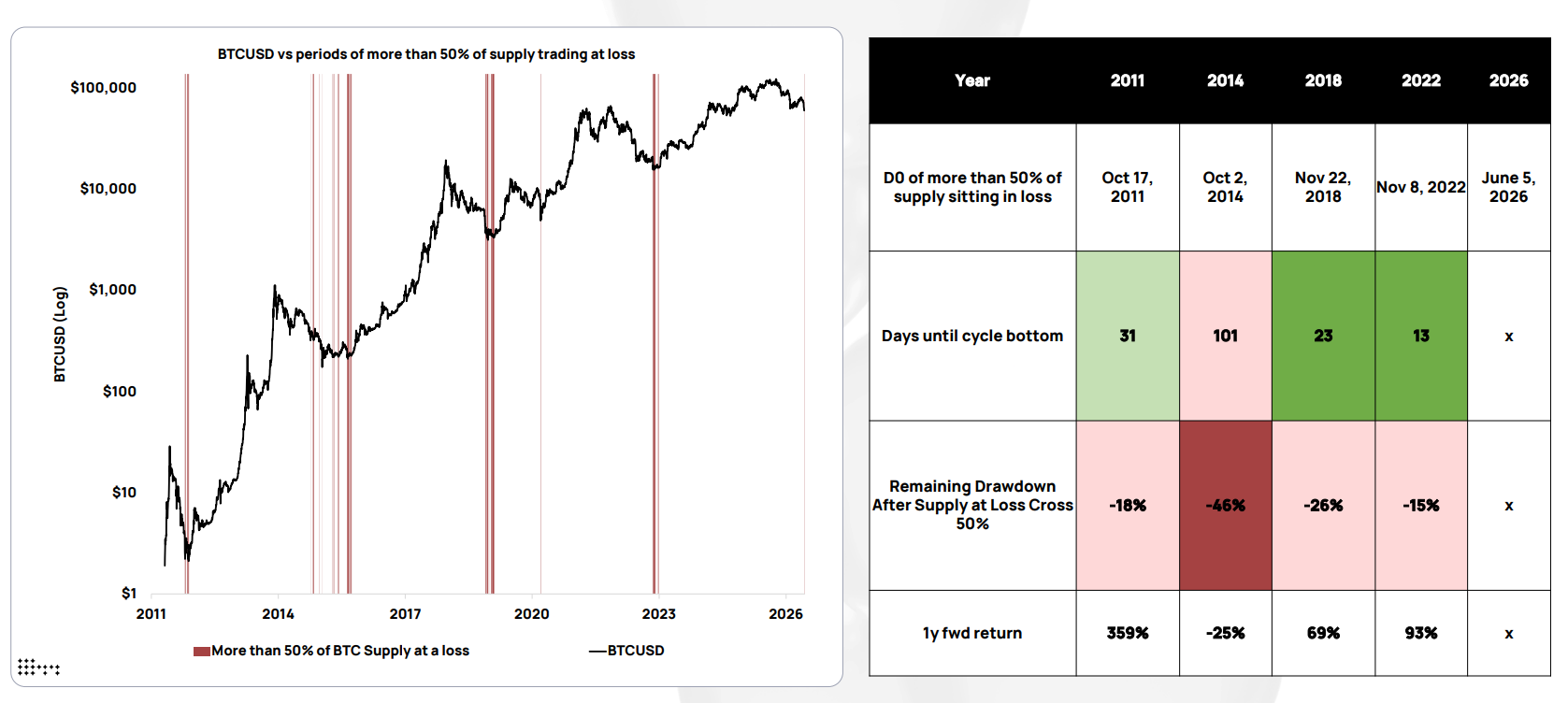
Bitcoin during periods when 50% of the supply was held at a loss and its annual returns table for the following years. Source: K33
However, the report noted that large sellers, such as spot Bitcoin exchange-traded fund (ETF) holders, could make this cycle behave differently from previous ones because of their impact on price.
The spot Bitcoin ETFs registered two consecutive days of inflows, with $265 million on Monday, but saw $4.51 billion in net outflows in June, marking their worst month on record, according to Farside Investors data.
Related: Strategy sells 3,588 Bitcoin for $216M to fund dividends, keeps $2.55B reserve intact
Bitcoin risk appetite signals imminent bottom: Block Scholes
Other indicators are also suggesting an imminent bottom, such as the Block Scholes Risk Appetite Index, which measures bullish and bearish momentum in digital assets.
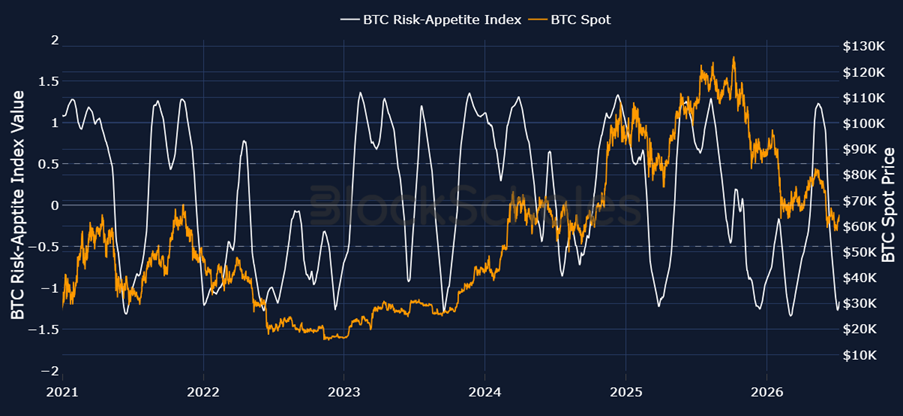
BTC risk appetite index and spot BTC price. Source: Block Scholes
Bitcoin’s risk appetite fell to a low of -1.27 on July 3 and has since bounced higher, which historically preceded a median spot return of 12% over the following 100 days, according to the eight prior instances identified by Block Scholes.
“Historically, such a move has preceded a more bullish outperformance in spot prices and could lead to further allocation towards risk assets such as crypto,” a spokesperson for Block Scholes told Cointelegraph.
Magazine: Bitcoin slides to $58K, XRP hits $1 but onchain data promising: Market Moves
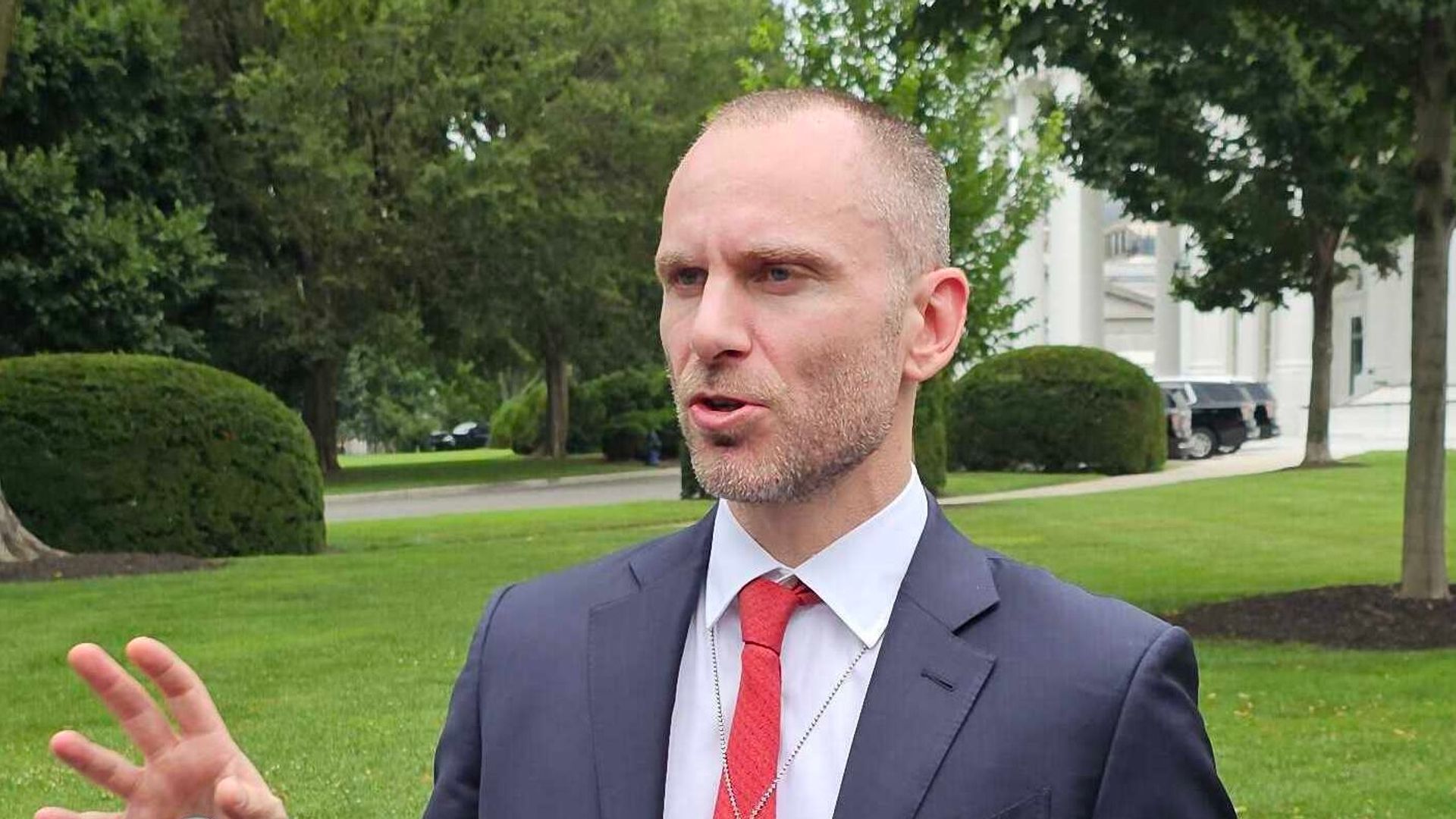
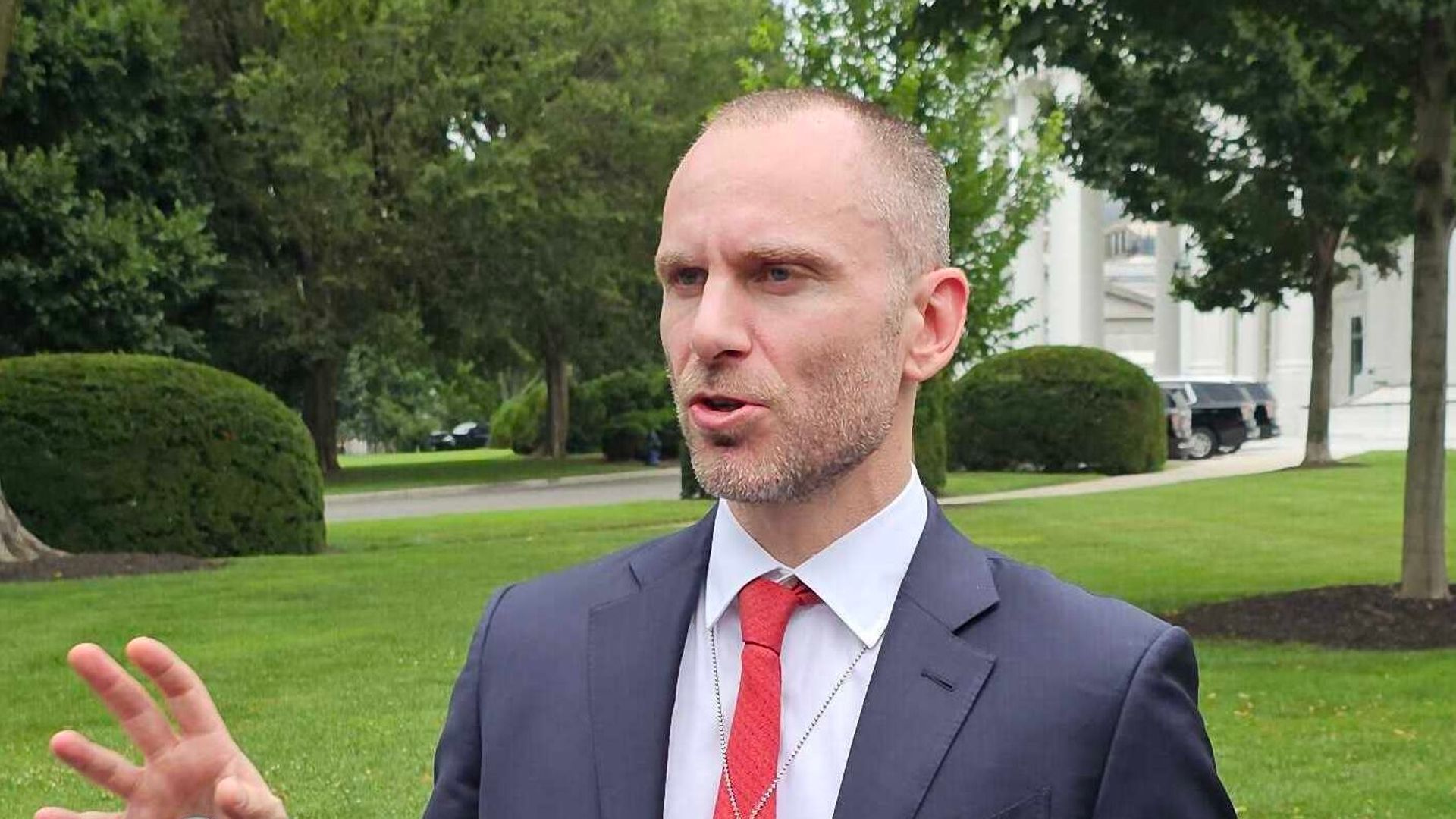
Richard Heathcote, who until March was Tether’s chief investment officer, is planning to sell part of his 1.26% stake in the stablecoin giant, according to a Bloomberg report.
Heathcote is working with PJT Partners to sell his holding in the San Salvador, El Salvador-based company, Bloomberg said, citing sources close to the matter. The sources said discussions with potential buyers were ongoing. They declined to comment on the company’s potential valuation.
Heathcote took on a non-executive advisory role at the issuer of USDT, the largest stablecoin by market capitalization, in March, and was replaced by his deputy Zachary Lyons.
In February, Tether scaled back from plans to raise as much as $20 billion after facing investor resistance to a proposed $500 billion valuation that would rank the stablecoin issuer among the world’s most valuable private companies. Tether advisers then followed up with plans to raise $5 billion. Tether reported a full-year profit of more than $10 billion for 2025.
Tether did not respond to a CoinDesk request for comment. PJT Partners declined to comment. Heathcote could not be reached.
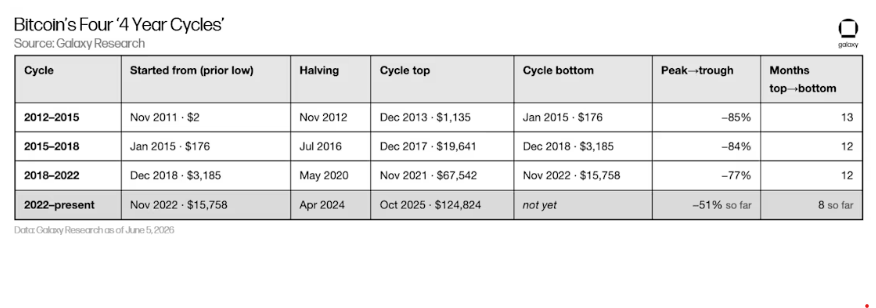
Bitcoin is trading in a market that’s getting harder to define.
Hovering around $64,000 at the time of writing, Bitcoin is down by almost 50% from its cycle peak. That’s a much shallower draw down than previous cycles, but the bull run this time around did not reach the same heights.
The 2025 rally was driven by exchange-traded fund (ETF) inflows, post-halving momentum and renewed institutional demand, pushing the market to a new all-time high of more than $126,000 in October 2025.
Since then, the trend has been inexorably downward, but analysts are split on what that decline signifies.
According to Standard Chartered and other bullish institutional desks, Bitcoin may have already reached its cycle bottom last month, with structural demand from ETFs and treasury companies, and improving long-term capital flows reducing the likelihood of a deeper draw down.
Other analysts take a more cautious approach, seeing Bitcoin as likely in the final stages of its bear market but not at a confirmed bottom yet.
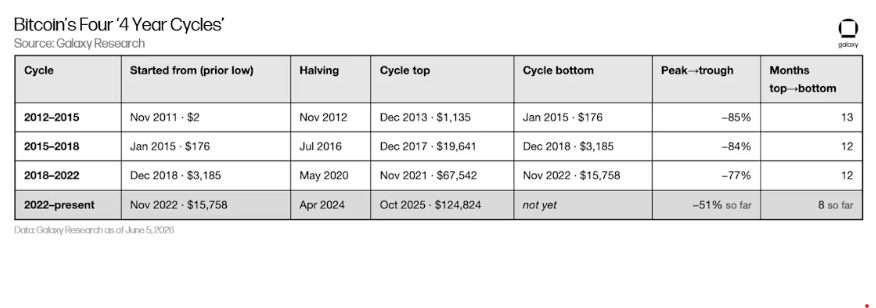
Bitcoin’s four-year cycles. Source: Galaxy
Galaxy Research, for example, argued in June that traditional cycle signals have not fully reset, meaning the risk of further pain cannot be ruled out.
Curiously, analysts are no longer just divided on price targets but on what a “cycle bottom” actually means in a market increasingly shaped by ETFs, macro liquidity, and shifting global capital flows.
Some analysts still see further downside ahead
At the most cautious end of the spectrum is Russell Thomson, chief investment officer at Hilbert Capital asset management firm.
Speaking to Cointelegraph, Thomson said he believes Bitcoin remains in a downcycle and is likely to break below recent lows before forming a durable base. He said that the current structure is still dominated by global macro conditions and liquidity rather than crypto-native signals.
Related: $60.4K Becomes ‘most important area’: Five things to know in Bitcoin this week
Thomson expects Bitcoin to first revisit the $56,000-$52,000 range, representing summer 2024 lows, before potentially extending losses further to between $40,000 and $45,000, an area he associates with prior consolidation phases in the early 2024 market structure.
Timing-wise, he sees Bitcoin’s broader cycle rhythm still broadly intact, with a potential low forming around October 2026, although he stressed that macro policy shifts could pull that forward.
“Fed rate cuts and/or [the CLARITY Act] passing could put the bottom in earlier than that,” he said.
He argued that institutional capital has not insulated Bitcoin from macro cycles, but rather deepened its sensitivity to global liquidity conditions, making it behave more like a “high-beta macro instrument” than a “detached crypto-native asset.”
That view is echoed by analysts at Citibank, who cut their 12-month price target for Bitcoin to $82,000 from $112,000 on July 1, highlighting how Bitcoin’s growing integration into traditional financial markets has strengthened its correlation with risk assets and macro liquidity conditions rather than reducing volatility.
Late-stage bear market, but not confirmed bottom yet
A more positive but still cautious view comes from André Dragosch, head of research (Europe) at Bitwise.
Dragosch told Cointelegraph that the current environment resembles a “late-stage bear market,” arguing that multiple indicators already suggest downside exhaustion.
He noted that sentiment has deteriorated to levels last seen after the collapse of FTX in 2022, a period typically associated with seller fatigue.
Dragosch also does not believe the cycle low has been confirmed. “I don’t think that we have seen the final bottom just yet, although we are probably very close,” he said, emphasizing that no single indicator can reliably identify a cycle bottom.
Related: Dormant $1.9M Bitcoin tied to New York lawsuit moves after nearly 15 years
He also highlighted the structural shift in the market, pointing to the rise of ETFs and institutional participation, which have increased off-chain trading and reduced the reliability of some historical cycle indicators.
Despite this uncertainty, he said downside risks appear increasingly limited at current levels, adding that Bitcoin could begin outperforming artificial intelligence equities over the coming months if macro conditions stabilize.
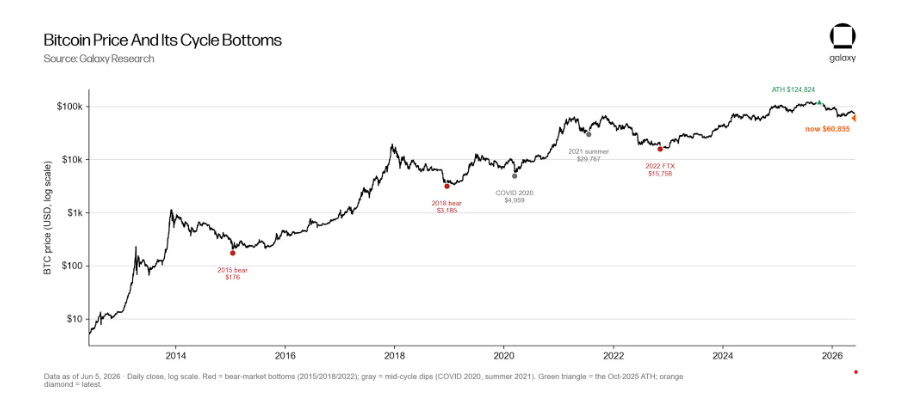
Bitcoin price and its cycle bottoms. Source: Galaxy
In Galaxy’s base-case scenario, the firm pointed to a potential slide to between $40,000 and $46,000, depending on how liquidity and macro conditions evolve.
‘When will Bitcoin bottom?’ could be the wrong question
A more structural interpretation comes from Dean Chen, an analyst at Bitunix Exchange.
Chen told Cointelegraph that Bitcoin is still in a decline, but one increasingly defined by global liquidity competition rather than internal crypto market structure.
“I believe Bitcoin remains in a down cycle, although it has entered a relatively stable valuation range supported by the structural capital base created after the approval of US spot Bitcoin ETFs in 2024,” Chen said.
While ETFs have created a more persistent institutional bid, Chen argued that Bitcoin is now competing directly with other major global capital narratives, particularly artificial intelligence and equity markets, for marginal liquidity.
Related: Tim Draper says Arkham got Bitcoin wallet attribution ‘wrong’
“The bigger challenge isn’t Bitcoin itself; it’s the competition for global liquidity,” he said. “Capital continues to flow toward AI infrastructure, equities, and other high-growth opportunities.”
In his view, this changes how cycle analysis should be understood altogether.
“The wrong question is ‘when will Bitcoin bottom?’” Chen said. “The more important question is: ‘when will crypto once again become the most attractive destination for global risk capital?’”
He noted that derivatives markets now play a significantly larger role in price discovery than in previous cycles, with funding rates and open interest increasingly driving short-term volatility.
That means Bitcoin may not form a sharp V-shaped bottom at all, he said, but instead spend an extended period building a structural base.
A Bitcoin cycle that no longer looks like previous cycles
Beyond price targets, what emerges from these competing views is a deeper disagreement over how Bitcoin’s cycle structure should even be defined.
Thompson sees Bitcoin as still firmly inside a macro-driven down cycle, where liquidity conditions have not yet fully turned.
Dragosch sees a late-stage bear market where exhaustion signals are already visible, even if confirmation is still pending.
Chen argues that Bitcoin is now competing directly with global capital allocation themes such as AI and equities, making traditional bottom-calling frameworks increasingly incomplete.
In this cycle, it seems, the debate is not just about where Bitcoin bottoms but whether a “bottom” is still a single moment at all.
Magazine: Bitcoin will not hit $1M by 2030, says veteran trader Peter Brandt


Cardano wallet firm SecondFi says it will not resume “normal operations” and will instead focus solely on “returning assets to affected users” as it continues to grapple with last month’s $2.4 million ADA exploit.
Developer Emurgo, claimed yesterday that “SecondFi will not resume normal operations, even once the audits are complete.”
It added, “Going forward, our involvement in SecondFi is limited to a dedicated asset recovery team, tasked solely with returning assets to affected users.”
The firm has yet to release an audit of what took place during the exploit, which saw 16 million ADA ($2.4 million) stolen by bad actors, and 129 million ADA ($18.5 million) taken by a mysterious white hat hacker.
Emurgo is also yet to launch a recovery plan for affected users and is still in the process of arranging one.
Read more: Mystery deepens over Cardano wallet’s $18.5M white hat hacker
What was announced, however, was a new site for users to check the status of their wallet, however, it isn’t live yet.
What’s the deal with the white hat hacker funds?
SecondFi wallets were drained last month after a “nonce derivation” issue exposed users’ private keys.
The exploited code created deterministic transaction data that could provide clues to recreate a wallet’s private key and facilitate the ADA theft.
In the weeks that followed, users speculated that the white hat hacker may not actually have been associated with Emurgo.
An X Spaces discussion with Cardano founder, Charles Hoskinson, fueled speculation after he said, based on information derived from a meeting between Emurgo and Cardano’s governance firm Intersect, that the white hat hacker was unknown to Emurgo.
Hoskinson then noted, “or at least [Emurgo] said it is not affiliated with Emurgo.”
SecondFi’s latest statement on July 4 notes that the assets acquired through its emergency response, which involved the white hat hacker, “are currently protected and accessible.”
As for the threat actor funds, it claims that Emurgo has established a recovery fund address here, which currently contains $2.8 million worth of ADA.
It’s unclear whether these funds are made up of the rescued ADA, or Emurgo’s own supply.
Protos has reached out to Emurgo for comment and will update this piece if we hear anything back.
Got a tip? Send us an email securely via Protos Leaks. For more informed news and investigations, follow us on X, Bluesky, and Google News, or subscribe to our YouTube channel.

SJSU kept volleyball coach despite 1998 abuse claims, Title IX probe

Chemistry Ventures is raising $500M for its second fund

Greencroft Forest Park appeal dismissed by High Court


-

 Fashion4 days ago
Weekend Open Thread: High Hopes
-

 Fashion22 hours ago
Open Thread: What Great Books Have You Read Recently?
-

 Politics4 days ago
The House | “Reframing the debate from a binary discussion of winners and losers”: Yuan Yang reviews ‘We Are Not Machines’
-
 NewsBeat2 days ago
Taylor Swift and Travis Kelce wedding staffer hilariously struggles to keep her cool while checking in megastars
-
 Crypto World6 days ago
Airdrop Registration Becomes Key Focus For Remittix As RTX Launch Updates Approach
-

 Sports6 days ago
Broncos roster: OL Ben Powers (No. 74) entering final year of contract
-

 Crypto World5 days ago
Binance stock trading tops $1B in first month after launch
-

 Crypto World4 days ago
Standard Chartered Secures MiCA License as ESMA Adds 37 New Crypto Firms
-

 NewsBeat7 days ago
Presenter Caroline Flack’s brother Paul Flack dies aged 55
-

 Business20 hours ago
AXT Shares Jump Nearly 14% as Semiconductor Materials Maker Rebounds on AI-Linked Indium Phosphide Demand
-

 Crypto World6 days ago
Alibaba-affiliate Ant Group enters the humanoid robot market with 12 deals
-
Crypto World19 hours ago
SK hynix (000660.KS) Stock Dips as $28B Nasdaq ADR Offering Drives AI Memory Expansion
-

 News Videos23 hours ago
Best Time to Enter Small Caps Right Now? Another Bull Run? | Financially Free
-

 Crypto World2 days ago
South Africa proposes crypto tax guidance under existing rules
-

 Tech2 days ago
Lenovo laptops are now shipping with YMTC SSDs, a sign of Chinese NAND entering the mainstream
-

 Business6 days ago
Meta Platforms Stock Jumps 7% Today as Bloomberg Reports Company Plans to Enter the Cloud Business
-
 NewsBeat5 days ago
New exhibition reflects five decades of movement between island of Ireland and GB
-

 News Videos11 hours ago
Whats Hidden Inside This Cash Register? #treasure #reselling #money
-

 Business4 days ago
What a 10 Percent Drop Means for Buyers, Sellers and Renters
-

 Crypto World5 days ago
Binance Re-Enters Philippines As EU MiCA Rules Restrict Access
You must be logged in to post a comment Login