

Crypto World
SparkLend Expands wBTC Limit to 30,000 in DeFi Push


TLDR
- SparkLend increased its wBTC deposit cap from 3,000 to 30,000, effective May 11, 2026.
- The previous 3,000 wBTC limit was reached shortly after the asset was listed on March 31, 2026.
- SparkLend uses an automated system that raises the cap by 500 wBTC every 12 hours.
- The protocol will take about 27 days to scale the limit fully to 30,000 wBTC.
- SparkLend reported total value locked of approximately $3.55 billion in May 2026.
SparkLend has lifted its Wrapped Bitcoin deposit cap from 3,000 to 30,000 wBTC, effective May 11, 2026. The DeFi lending protocol operates within the MakerDAO ecosystem and confirmed the update after reaching the previous ceiling. The change expands borrowing capacity and increases available liquidity for Bitcoin-backed positions on the platform.
SparkLend and wBTC: Deposit Ceiling Expands Tenfold
SparkLend listed wBTC on March 31, 2026, and users filled the 3,000 wBTC cap within weeks. The protocol was then approved for a tenfold increase to meet sustained demand. The new limit sets the maximum deposit level at 30,000 wBTC.
The platform uses a cap automator to adjust limits in scheduled increments. It increases the ceiling by 500 wBTC every 12 hours. At that pace, the system will require about 27 days to reach the full 30,000 wBTC threshold.
SparkLend confirmed the update took effect on May 11, 2026. The protocol stated that the automated process will continue until it reaches the new cap. The system does not raise the full amount at once but follows programmed intervals.
The protocol reported total value locked of about $3.55 billion in May 2026. Reports showed TVL reached $3.6 billion in April 2026. The figures reflect on-chain data tracked across supported assets.
Bitcoin-Linked Assets Shape Platform Growth
SparkLend also supports cbBTC and LBTC as Bitcoin-linked collateral options. These assets allow users to access decentralized borrowing across different networks. The protocol integrates them to expand liquidity sources tied to Bitcoin.
The expansion of the wBTC cap removes previous access limits for new depositors. Before the change, users could not deposit once the 3,000 wBTC ceiling was reached. The revised structure now permits additional participation over time.
wBTC maintains a 1:1 peg with Bitcoin through custodial backing. The asset depends on reserve transparency and operational integrity. Any disruption in that structure can affect protocols that hold wBTC.
Sharp Bitcoin price declines can trigger loan liquidations tied to wBTC collateral. Liquidations can increase selling pressure on underlying assets. This mechanism remains standard across decentralized lending platforms.
SparkLend stated that support for cbBTC and LBTC spreads exposure across Bitcoin-linked instruments. The protocol continues to operate within MakerDAO’s framework. The cap expansion process remains active as of May 2026.




Americans are sending Washington a clear message: the United States should lead the future of digital finance, not fall behind while other countries write the rules. A new national HarrisX survey of registered voters found that 70% say the U.S. should have already passed crypto legislation, 62% say it is important for America to set the global rules for digital finance, and 60% prefer clear federal legislation over case-by-case enforcement.
That makes the Senate Banking Committee’s decision to mark up the Clarity Act a critical next step toward giving the United States a workable framework for digital asset markets.
For years, Washington treated digital assets as a moving target. The technology evolved quickly, the market was volatile, and policymakers were still sorting out the risks and opportunities. That is no longer the case. Lawmakers, regulators and staff have now spent years studying these markets, engaging stakeholders and wrestling with difficult questions around consumer protection, market integrity, custody, trading and disclosure.
The industry has changed as well. A sector that once spoke in scattered, often conflicting voices has become more disciplined in its engagement with policymakers. That matters because durable legislation comes from sustained engagement, practical proposals and a willingness to work through tradeoffs.
The House made that much clear when it passed the CLARITY Act with strong bipartisan support. That vote did not resolve every outstanding question, but it established something important: digital asset market structure belongs squarely on Congress’s agenda. The Senate now has a chance to build on that foundation.
It is doing so with a stronger policy foundation than it had even a year ago. The SEC and the CFTC have taken steps to improve coordination and clarify how existing law applies to parts of the market. Those efforts are important, but they also underscore the limits of agency action. Only Congress can provide durable rules on regulatory boundaries, registration requirements, market oversight and the treatment of digital assets that do not fit neatly within older frameworks.
Meanwhile, the market has continued to move ahead. Following the signing of the GENIUS Act, stablecoins have grown rapidly and are becoming more connected to mainstream payments infrastructure. Tokenization is moving from concept to institutional experimentation. Major financial firms are testing blockchain-based systems for settlement and other market functions. Public blockchain networks are increasingly part of that activity.
Some of that development is taking place on networks like Solana. PayPal expanded PYUSD to Solana to support faster, lower-cost payment use cases. Visa has included Solana in its stablecoin settlement work. And SoFi, which launched SoFiUSD in December, has said parts of its broader digital asset banking platform are expected to leverage Solana alongside other networks. These examples show how digital asset markets are becoming more connected to real financial activity.
It’s clear: Digital assets are the next generation of financial infrastructure.
Congress should legislate with that reality in mind. A market structure bill has to do difficult, important work. It has to draw workable lines between regulators. It has to establish clear rules for market participants while ensuring robust consumer protections. And it has to account for the fact that blockchain networks and digital asset markets do not map neatly onto categories built for earlier generations of financial products.
That is precisely why markup matters. It requires lawmakers to engage real legislative text in public. Members debate substance, offer amendments, narrow disagreements and test whether a proposal is ready to move. On legislation this consequential, that process is where serious policymaking happens.
For digital asset legislation to last, it must be bipartisan. A framework written on a party-line basis will be fragile from the start. Rules that shape markets endure when both parties help write them. The good news is that more lawmakers on both sides of the aisle now understand the stakes. They understand the need for consumer protection, the importance of market integrity and the cost of leaving a growing sector trapped in legal uncertainty.
The United States has deep capital markets, strong institutions, world-class entrepreneurs and a long history of leading in financial innovation. It should bring those strengths to digital assets as well. Clear rules will protect consumers, strengthen markets and give responsible builders the confidence to operate and invest in the United States.
Digital asset markets will continue to grow. Capital will move. Infrastructure will be built. The question is whether the United States will shape that future with clear rules, credible oversight and the confidence to lead.
The Senate can help answer that question now by moving this legislation forward and closer to the President’s desk. It’s critical that it does.
Crypto World
Tower Semiconductor (TSEM) Soars 17% on Earnings Beat and Major AI Chip Contracts Worth $1.3B

Key Highlights
- Tower Semiconductor surpassed Q1 2026 earnings expectations with adjusted EPS of $0.65, topping the $0.55 Wall Street consensus
- First-quarter revenue reached $413.6 million, marking a 15% year-over-year increase and exceeding the $408 million projection
- Second-quarter revenue forecast of $455 million surpassed analyst expectations of $436 million — potentially setting a new company milestone
- The company secured $1.3 billion worth of silicon photonics agreements for 2027 delivery, with customers already providing $290 million in upfront payments
- TSEM shares skyrocketed more than 17%, reaching a 52-week peak of $267.42
Tower Semiconductor delivered an impressive performance on Tuesday. The Israel-based chip manufacturer reported solid earnings results, provided robust forward guidance, and unveiled $1.3 billion in artificial intelligence chip agreements — creating a trifecta of positive catalysts.
Tower Semiconductor Ltd., TSEM
TSEM shares surged over 17% during early U.S. market hours, climbing to a 52-week peak of $267.42. Meanwhile, broader market indices remained subdued, with the S&P 500 declining 0.11% and the Nasdaq essentially unchanged, highlighting that Tower’s rally was driven purely by company-specific developments.
First-quarter 2026 revenue totaled $413.6 million, representing a 15% climb compared to the prior-year period, and narrowly exceeding the Street’s $408 million projection. Adjusted earnings per share landed at $0.65, comfortably beating the analyst consensus of $0.55 by a dime.
Gross profit expanded 52% year-over-year to reach $111 million. Operating profit saw even more dramatic growth, nearly doubling with a 96% surge to $65 million compared to $33 million in the first quarter of 2025.
Looking ahead to Q2 2026, Tower projected revenue of $455 million, with a variance of plus or minus 5%. Wall Street analysts had penciled in $436 million. Successfully hitting this target would establish a new revenue record for the semiconductor manufacturer.
However, the most significant development centers around silicon photonics. Tower locked in $1.3 billion in agreements for 2027 revenue from its primary silicon photonics clients — specialized chips that utilize light instead of electrical signals for data transmission, making them particularly effective for AI data center applications.
Secured Revenue Stream of $1.3 Billion
Customers demonstrated serious commitment beyond mere paperwork — they’ve already transferred $290 million in advance payments to reserve manufacturing capacity. Furthermore, they’ve pledged to place even larger orders for 2028, with additional upfront payments scheduled for delivery by January 2027.
CEO Russell Ellwanger expressed confidence, stating the company is “confident in our path toward achieving our financial model targets of $2.8 billion in annual revenue and $750 million in net profit in 2028.”
These financial objectives now carry substantial weight. The order pipeline continues to strengthen.
Credit Rating Boost Reinforces Positive Trend
S&P’s Maalot maintained Tower’s “ilAA” credit rating while elevating its outlook from stable to positive — a subtle yet significant validation of the company’s business direction.
Tower’s semiconductor products support automotive, industrial, consumer electronics, and communications sectors, though current momentum stems primarily from AI data center requirements.
In March, competitor GlobalFoundries initiated legal action against Tower, claiming patent infringement on 11 patents associated with chip production for smartphones and related devices. This legal matter remains unresolved.
Tower concluded the trading day at a new 52-week high, with the stock’s appreciation stemming exclusively from company-specific announcements rather than broader semiconductor industry trends.


Reform UK leader Nigel Farage is reportedly facing a parliamentary standards inquiry over whether he failed to declare a 5 million pound ($6.7 million) gift from crypto billionaire Christopher Harborne.
The UK Parliamentary Standards Commissioner has opened an inquiry into whether Farage breached House of Commons rules by not registering the payment, the BBC reported Wednesday.
Farage said he was under “no obligation” to declare the gift from the Reform party backer, which he received before he was elected to the Commons in 2024. Critics argue he should have registered the payment after becoming a member of parliament.
The Conservatives wrote to the parliamentary standards watchdog asking it to investigate the matter, according to the BBC. The Conservatives also raised the issue with the Electoral Commission, which is reportedly deciding whether to launch a formal investigation into the donation.
The inquiry adds to scrutiny of Farage’s financial ties to crypto-linked backers and businesses, as UK lawmakers and regulators pay closer attention to the role of digital asset money in politics.
The development comes a month after the UK Liberal Democrats called on the Financial Conduct Authority to investigate whether Farage breached market rules by appearing in a promotional video for Stack BTC while holding a financial stake in the company.
Farage previously disclosed a $286,000 equity investment in the company after acquiring a 6.31% stake through his media vehicle Thorn In The Side in March.
Related: Revolut among 4 companies chosen to test stablecoins in UK sandbox
UK lawmakers mull halt to political crypto donations
Cryptocurrency donations to political parties have come under growing scrutiny in the UK.
Farage’s Reform UK was the first party to start accepting crypto donations in 2025. Reform recently disclosed a $4 million donation from Harborne in the fourth quarter of 2025, after receiving a record $12 million gift in the previous quarter.
Political cryptocurrency donations are currently legal in the UK, subject to permissible rules under the Electoral Commission guidance. However, some parliamentary committees have called for a halt.
On March 18, the Joint Committee on the National Security Strategy urged the UK government to impose an immediate moratorium on crypto donations to political parties until the Electoral Commission produces statutory guidance ahead of the next general election, which is due to take place by August 2029.
The committee also called for the creation of a Political Finance Enforcement Unit and for reducing the minimum declaration threshold of political donations from $14,900 to $668. It cited growing foreign-state threats and efforts to influence the UK’s positions on critical issues, including its relations with the US, the European Union and Ukraine.
Three weeks earlier, Matt Western, chair of the committee, urged the government to put a temporary halt on crypto donations to political parties, citing foreign interference risks, Cointelegraph reported on Feb. 26.
Magazine: Clarity Act risks repeat of Europe’s mistakes, crypto lawyer warns


U.S. President Donald Trump arrived in Beijing on May 13 for a formal state visit at the invitation of Chinese President Xi Jinping.
Summary
- U.S. President Donald Trump has arrived in Beijing for a state visit following an invitation from Xi Jinping.
- Markets are closely watching geopolitical sentiment, with prediction platforms pricing shifts in U.S.–China diplomatic expectations.
- Crypto traders are assessing whether renewed U.S.–China engagement could impact risk appetite and global liquidity flows.
The visit marks a renewed high-level diplomatic engagement between the world’s two largest economies amid ongoing strategic and economic competition.
The announcement has quickly drawn attention across financial markets, where geopolitical developments between the U.S. and China often influence risk sentiment, trade expectations and cross-asset volatility. Crypto traders, in particular, are watching for potential spillover effects into liquidity conditions and speculative positioning.
Prediction markets are also reacting to the development. Platforms such as Polymarket are tracking event-based probabilities tied to U.S.–China relations, including the likelihood of trade policy shifts, tariff adjustments, or formal agreements emerging from diplomatic meetings.
Geopolitics meets prediction markets and crypto sentiment
On Polymarket, traders typically express views on scenarios such as “U.S.–China trade deal probability,” “new tariff escalation risk,” or “high-level diplomatic agreement outcomes,” allowing sentiment to be priced in real time rather than through traditional polling or analyst forecasts.
These markets have become increasingly relevant to crypto participants because geopolitical risk is now tightly linked to digital asset volatility cycles. When tensions rise, liquidity often tightens and risk assets tend to experience sharper repricing, while diplomatic easing can trigger broad-based risk-on rotations.
In the current context, the Trump–Xi meeting is being interpreted less as a single political event and more as a signal node for global macro positioning. Traders are watching whether it leads to policy clarity, trade de-escalation, or further strategic uncertainty between the two nations.
Crypto markets watch macro signals for liquidity direction
Crypto investors are closely monitoring geopolitical developments like this because digital assets increasingly trade as high-beta macro instruments sensitive to global liquidity expectations.
Improved U.S.–China relations could support broader risk appetite by reducing tail-risk uncertainty in global trade, while escalation or breakdown in talks could have the opposite effect, tightening liquidity conditions and increasing volatility across speculative markets.
At the same time, prediction markets are amplifying the speed at which sentiment is priced in. Platforms like Polymarket allow traders to hedge or speculate directly on geopolitical outcomes, effectively turning diplomatic events into tradable macro signals.
As a result, the Trump visit to Beijing is being watched not only as a diplomatic milestone but also as a potential catalyst for shifts across prediction markets, equities, and crypto-linked risk assets, depending on how negotiations and messaging unfold in the coming days.
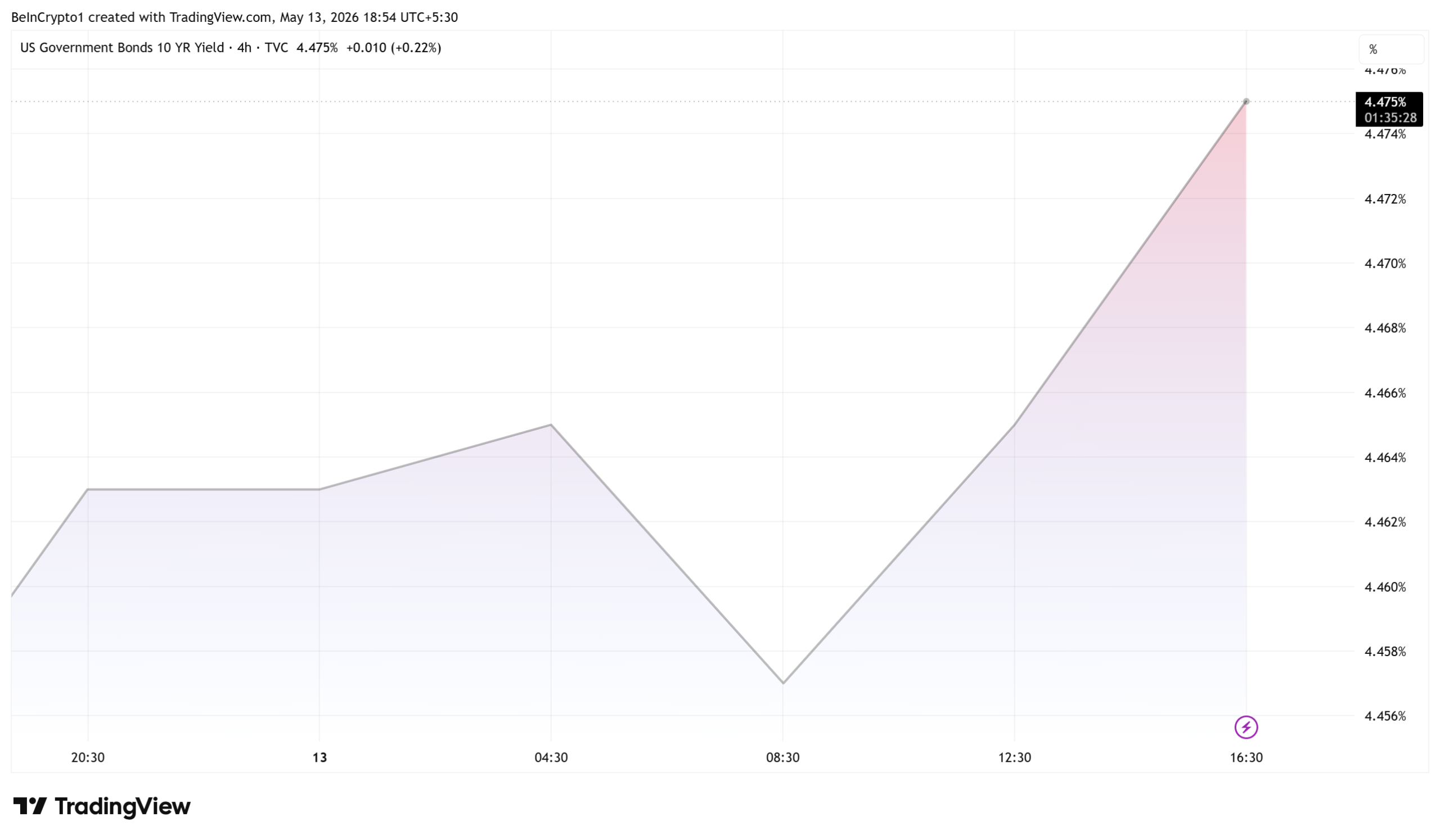
US Producer Price Index (PPI) Final Demand jumped 6% in April 2026, the highest reading since January 2023. The print came in well above the 4.9% consensus forecast.
The monthly gain hit 1.4%, nearly triple the 0.5% consensus, while core PPI rose 1% on the month. Both headline and core figures now sit at three-year highs.
Services Drove the April Surge
Final demand services climbed 1.2%, the largest monthly advance since March 2022. The gain accounted for roughly 60% of the headline move, according to the BLS release.
Trade services margins rose 2.7%, while transportation and warehousing prices jumped 5%. Final demand goods advanced 2%, with energy up 7.8% and gasoline prices climbing 15.6%.
The narrowest core measure excludes food, energy, and trade services. It rose 0.6% on the month and 4.4% annually, near its highest reading since early 2023.
Energy contributed heavily as the Iran war jolted crude and refined prices. Yet the breadth of services gains flagged stickier underlying pressure, echoing stagflation concerns that returned after recent prints.
Markets Reprice the Fed Path
Treasury yields pushed higher after the release. The 30-year yield rose to 5.042%, just below its 19-year peak.

Bond traders priced in renewed Fed rate hike risks, and Goldman Sachs recently pushed back its next-cut forecast to December 2026.
Equity futures sold off on the print. The dollar firmed against major peers as widening rate differentials supported the greenback.
“Both CPI and PPI Inflation are now officially at 3+ year highs. Odds of rate HIKES are rising,” stated analysts at the Kobeissi Letter.
Whether Federal Reserve officials now signal a hawkish pivot will set the tone for risk assets in coming sessions. A sustained rebound in producer costs could push consumer inflation higher into the second half of 2026.
The post US PPI Shocker Hits 6% in April 2026, Crushing Fed Rate Cut Hopes appeared first on BeInCrypto.
Bitcoin (BTC) may reach $100,000 by June as Strategy’s renewed buying power and falling stablecoin dominance suggest liquidity is returning to crypto.
Key takeaways:
- Michael Saylor’s Strategy may purchase at least 3,127 BTC this week via the sales of STRC shares.
- Falling crypto market dominance of USDT and USDC stablecoins increases BTC’s odds of reaching $100,000.
Strategy resumes Bitcoin buying as STRC stock reclaims $100 par
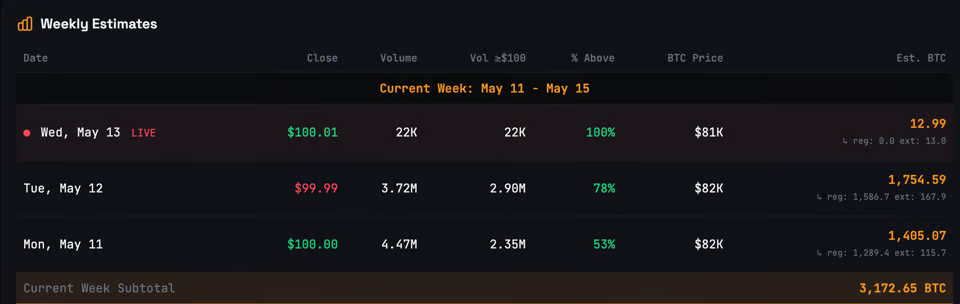
Strategy’s preferred stock, Stretch (STRC), has reclaimed its critical $100 par value, restoring one of the company’s funding mechanisms for Bitcoin purchases, data from STRC.LIVE shows.
As of Wednesday, STRC was trading around $100.01, with estimates suggesting the preferred-share program has already unlocked enough buying power for Strategy to acquire at least 3,172 BTC this week.

Strategy’s weekly BTC buying estimates via STRC stock sales. Source: STRC.LIVE
That is nearly 235% of Bitcoin’s newly mined supply over the same period.
Strategy’s Bitcoin accumulation model becomes significantly more efficient whenever STRC trades at or above par. In those conditions, the company can issue preferred shares more aggressively, raise fresh capital, and redirect proceeds into Bitcoin.
Since February, the company has added roughly 101,700 BTC, lifting its holdings to nearly 819,000 BTC as of May 11 from about 717,000 BTC in mid-February.

Source: X
Bitcoin rose more than 40% over the same stretch, underscoring how Strategy’s latest accumulation wave has coincided with BTC’s broader recovery.
“STRC raised $5.58 billion YTD since January,” market analyst Pio Vincenzo said in a Wednesday post, adding that MSTR may raise “another $20 billion by the end of the year.”
Related: Strategy CEO Phong Le says company will sell BTC only in specific cases
Falling stablecoin dominance is bullish for Bitcoin’s price
Another bullish signal is coming from the stablecoin market.
The combined dominance of Tether’s USDT and Circle’s USDC is showing signs of topping near the 10%–11% resistance zone, according to a fractal analysis shared by analyst MikybullCrypto.

Net USDT and USDC’s crypto market dominance monthly chart. Source: TradingView/MikybullCrypto
Stablecoin dominance measures how much of the crypto market is sitting in digital dollars. When it falls, it usually means capital is rotating back into Bitcoin and other crypto assets.
Past cycles show a similar pattern.
During 2022–2024, stablecoin dominance dropped nearly 70% while Bitcoin rose by around 600%. Similarly, in 2021, a 54% drop in stablecoin dominance aligned with BTC’s 525% price gains.

Net USDT and USDC’s crypto market dominance vs. BTC/USD monthly chart. Source: TradingView
On average, stablecoin dominance has fallen by 61.3%, while Bitcoin has rallied by around 560% in the same period.
“BTC therefore has a higher chance for a sustained bullish reversal on the weekly chart,” MikybullCrypto said, adding:
“Reaching $100k this quarter seems likely.”
On the flip side, Bitcoin upside continues to show signs of exhaustion near its 200-day exponential moving average (200-day EMA, the blue line) at around $82,000.

BTC/USD daily chart. Source: TradingView
Failing to break above this resistance increases the odds of sell-offs in the coming weeks, with a potential rising wedge pattern hinting at a drop under $70,000 by June.
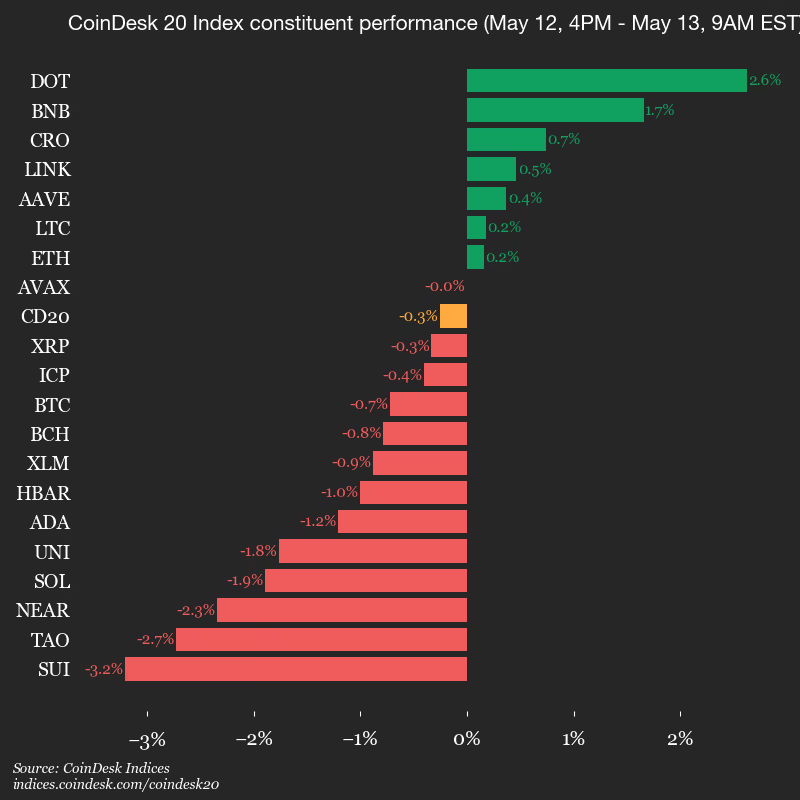
CoinDesk Indices presents its daily market update, highlighting the performance of leaders and laggards in the CoinDesk 20 Index.
The CoinDesk 20 is currently trading at 2185.22, down 0.3% (-5.55) since yesterday’s close.
Seven of 20 assets are trading higher.

Leaders: DOT (+2.6%) and BNB (+1.7%).
Laggards: SUI (-3.2%) and TAO (-2.7%).
The CoinDesk 20 is a broad-based index traded on multiple platforms in several regions globally.
Crypto World
Solana News: Coinbase Just Added Solana as Loan Collateral Alongside Bitcoin and Ethereum: Is SOL Finally Getting Its Moment?

Coinbase has added Solana as eligible collateral for its crypto-backed lending service, allowing U.S. users to borrow up to $100,000 in USDC against their SOL holdings. Bullish news for Solana.
The integration was on May 12, confirming SOL joins Bitcoin and Ethereum as accepted collateral on Coinbase’s non-custodial loan product built on the Morpho protocol over Base.
The maximum loan-to-value ratio for SOL is set at 70%. That number is the key variable; it determines how much borrowing power a holder unlocks, and it sets the distance to liquidation in a volatile asset.
Holding SOL? — Coinbase
SOL-backed loans are now available on Coinbase.
Instantly borrow up to $100K in USDC against your Solana without selling. pic.twitter.com/rfZBZ0KiH6
 (@coinbase) May 12, 2026
In practice: a holder with $10,000 in SOL can draw up to $7,000 in USDC. Collateral is locked in a smart contract on-chain.
No repayment deadline applies, but if the LTV hits the liquidation threshold, which carries a 4.38% penalty, the position is auto-liquidated, and the remaining collateral is returned.
Borrowed USDC cannot be used for trading on Coinbase directly.

Discover: The best pre-launch token sales
Solana Price Momentum Makes the integration News Timing Deliberate, Breakout to $100 Soon?
SOL is sitting at $95.69 on the 4h chart, and the price action since early May has been the most decisive upside move since the February collapse, with price breaking out of the $82 to $92 range that had been containing it for weeks and pushing toward the $98 to $100 zone that has been the ceiling since January.
The structure of higher lows from the $77 bottom in late February through March and April built a solid base, and the breakout that is now unfolding has real momentum behind it rather than looking like another fakeout.
The $94 level is now the immediate support to watch on any pullback, as it marks the breakout zone from the prior range. Holding that on a retest would confirm the move is genuine and not just a wick into resistance.
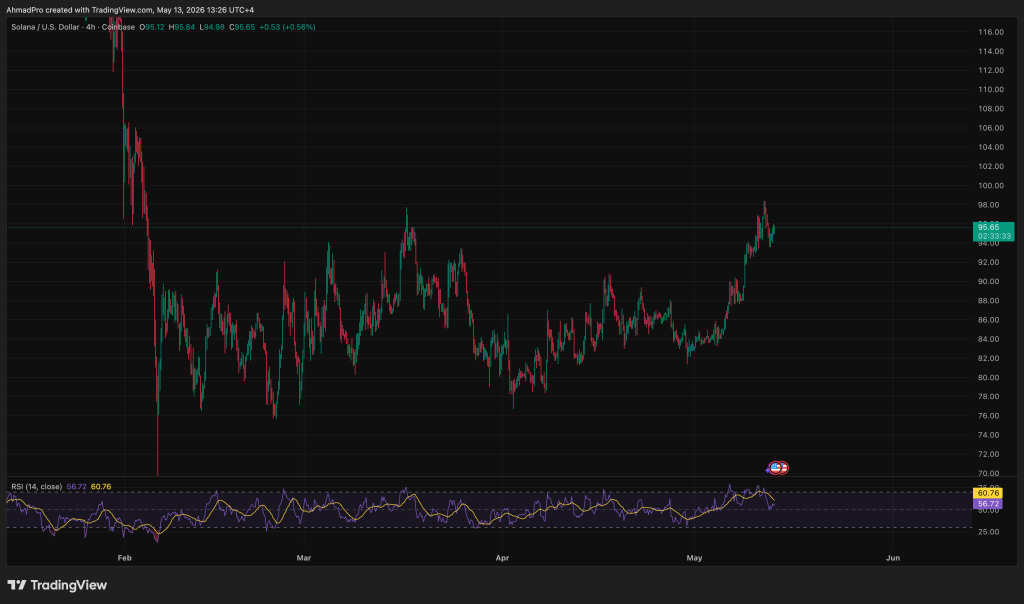
Above the current price, $98 to $100 is the next meaningful wall, and a clean break there opens the path toward $106 and $110, where heavier resistance sits from the January distribution.
What makes this move more interesting than a mere technical breakout is the Coinbase lending news behind it.
SOL being added as the third major collateral tier after Bitcoin and Ethereum, alongside $2.3 billion in cumulative crypto-backed loan originations, means holders with unrealized gains can now access liquidity without selling, which structurally reduces sell pressure while demand stays intact.
The long-term trend recovery is still incomplete with price below its 200-day moving average, but the short and medium-term setup is the most constructive it has been all year.
Discover: The best crypto to diversify your portfolio with
The post Solana News: Coinbase Just Added Solana as Loan Collateral Alongside Bitcoin and Ethereum: Is SOL Finally Getting Its Moment? appeared first on Cryptonews.


- DIU names Concordium official AI partner for 2026 IIHF event.
- Concordium launches blockchain fan ID pilot with Danish hockey.
- Partnership fee settled fully in Concordium CCD tokens.
Danmarks Ishockey Union (DIU), the governing body for ice hockey in Denmark, has named Concordium as the Official AI Partner of the Danish National Ice Hockey Team in a partnership centered on blockchain-based digital identity and artificial intelligence infrastructure.
The collaboration will officially launch during the 2026 IIHF Ice Hockey World Championship in Switzerland and will include multiple technology-focused initiatives aimed at enhancing fan engagement through AI-powered systems and on-chain identity verification.
Concordium, which describes itself as a regulatory-grade AI infrastructure platform powered by blockchain technology, said the partnership will serve as a real-world demonstration of how verified digital identities and AI agents can operate at scale in consumer-facing environments.
Verified fan program to debut at IIHF Championship
The partnership between DIU and Concordium will initially focus on two core initiatives built on Concordium’s infrastructure.
The first is a Verified Fan Programme designed to pilot a privacy-preserving fan experience using zero-knowledge proof technology.
The system is intended to allow users to verify identity-related credentials while limiting exposure of personal information.
The second initiative is an Agentic Commerce pilot, which aims to demonstrate how verified AI agents can operate autonomously while interacting with fans and digital commerce systems.
The project builds on Concordium’s previous work involving the x402 agentic payments protocol, which is focused on enabling secure and verifiable machine-driven transactions.
“Agents transacting at scale need a verified identity they can carry and settlement rails they can trust,” said Varun Kabra, Chief Growth Officer at Concordium.
“The infrastructure for that already exists. What it has lacked is legibility, a place where mainstream audiences can see it working. We are very excited to partner with the Danish Ice Hockey team to build together a solution where AI can deliver a much superior fan experience.”
DIU said the partnership was structured around long-term technology collaboration rather than traditional sponsorship branding alone.
“We approached this the way we approach every serious collaboration, starting with what we could build together, not what would go on the jersey,” said Michael Dupont, CEO of Danmarks Ishockey Union. “Concordium is a Swiss-built and regulatory-grade AI infrastructure. The programmes planned over the course of the partnership are the kind of work that fits how Danish hockey wants to be seen.”
Partnership settled entirely in CCD tokens
As part of the agreement, Concordium branding will appear on the Danish national team’s helmets and jerseys, alongside category exclusivity across digital assets during the term of the partnership.
The organizations also said the full partnership fee was settled entirely in CCD, Concordium’s native blockchain token.
According to the announcement, the agreement represents the first national-team partnership fully paid and locked in a native protocol token.
The transaction was settled on-chain at signing, while a 12-month lock-up period was enforced directly at the protocol level.
DIU will maintain full self-custody of the digital assets under the arrangement.
Global tournament exposure supports partnership visibility
The partnership launches ahead of the 2026 IIHF World Championship, where Denmark’s national team is expected to receive broad international television exposure.
Games involving the Danish team are broadcast across Sweden, Finland, Germany, Switzerland, Canada, and the United States through networks including Viaplay, ZDF, ARD, TSN, and ESPN.
According to the organizations, the 2025 IIHF World Championship generated a cumulative live television audience of 215 million viewers and 25.6 billion event impressions across 155 territories.
DIU noted that Denmark has become an established host nation for international hockey tournaments, hosting four IIHF World Championships within eight years, including the men’s tournaments in 2018 and 2025, and women’s tournaments in 2022 and 2026.
The price remains in a flat channel. When will it break away?
PI Network (PI) Price Predictions: Analysis
Key support levels: $0.16
Key resistance levels: $0.20, $0.28
PI Remains Stuck in a Channel
With momentum lacking, the PI price has been moving sideways above 17 cents in the past week. Buyers attempted to test the 20-cent resistance in late April but were rejected. Since then, the volume has been falling as well.
This consolidation could last quite a while longer, but it remains a positive development considering that the price has stopped making lower lows. This builds confidence that PI has bottomed already.
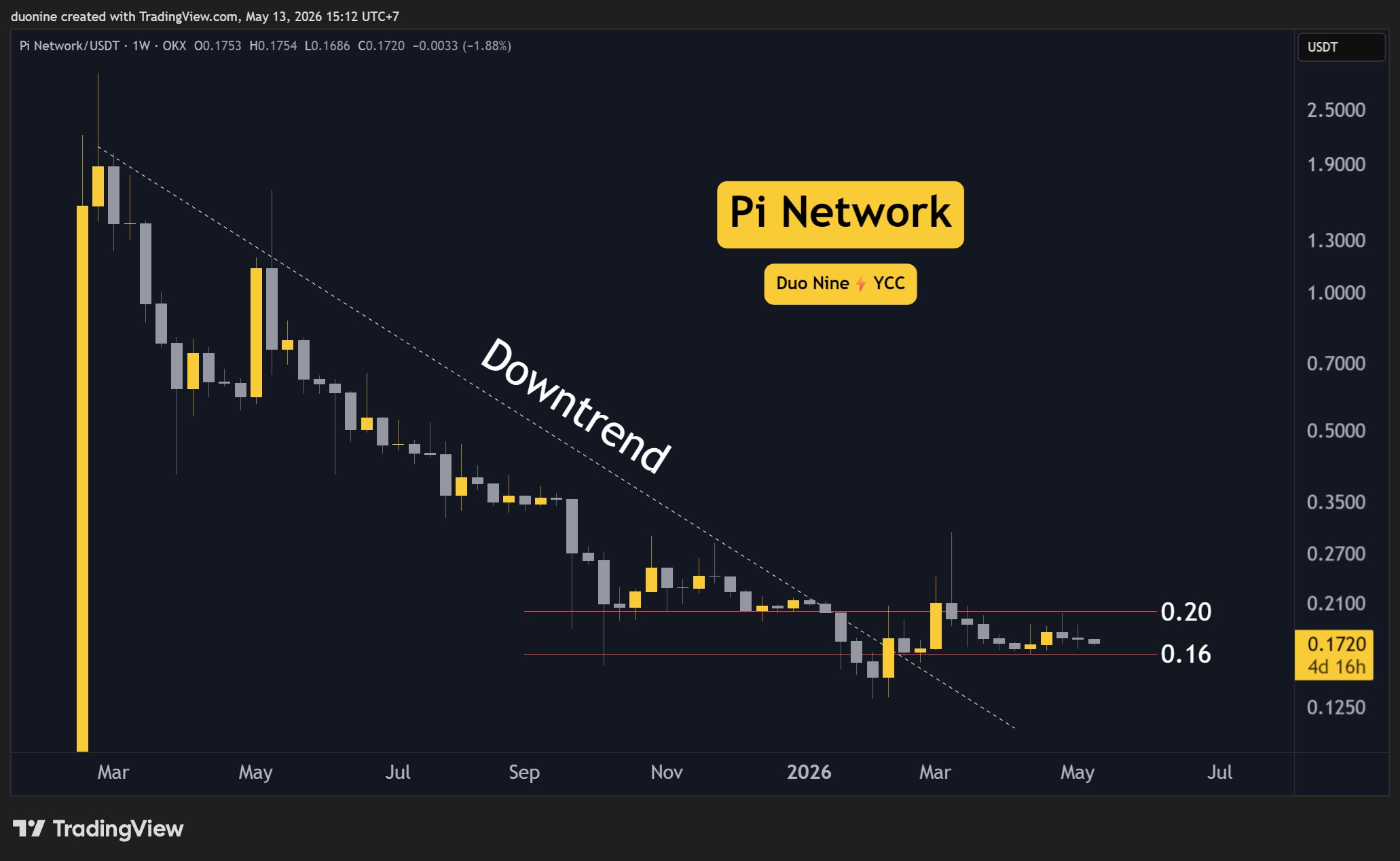
Low Momentum, but Higher Lows
At the time of this post, the price and momentum indicators don’t give any indication that they want to aim for a breakout. Nevertheless, the price has been making higher lows after the bottom at 13 cents.
This could be interpreted as bullish and would be confirmed as soon as the price moves above the 20-cent resistance. For that to happen, the buy volume will need to pick up since it has been falling in May so far.

Flat Volume Keeps the Price Stuck
Volume is the second most important indicator after the price itself. Since the start of April, the volume has remained low, even if there were small attempts at changing this. Because of that, the price was unable to move out of its current range between 16 and 20 cents.
A sign to watch for is higher highs on the volume profile. For now, this is missing, but PI is a momentum coin and could change that at any point. Until then, best to be patient here as the price grinds slowly.

The post Pi Network (PI) Price Predictions for This Week, May 13 appeared first on CryptoPotato.

It’s time for clarity for America’s digital asset markets

Reform ditch ‘shoot Starmer’ candidate on eve of by-election

Contractor pulls out of leisure centre redevelopment in Cambridgeshire town

Manchester United reach agreement with Casemiro over contract clause amid transfer speculation

US brings back mandatory military draft registration

Steven Gerrard disagrees with Gary Neville over ‘shock’ Chelsea and Arsenal claim | Football


-
 Crypto World5 days ago
HarrisX Poll Found 52% of Registered Voters Support the CLARITY Act
-

 Fashion5 days ago
Weekend Open Thread: Marianne Dress
-

 Crypto World6 days ago
Upbit adds B3 Korean won pair as Base token gains Korea access
-
 NewsBeat6 days ago
NCP car park operator enters administration putting 340 UK sites at risk of closure
-

 Fashion2 days ago
Coffee Break: Travel Steam Iron
-

 Fashion3 days ago
What to Know Before Buying a Curling Wand or Curling Iron
-

 Tech3 days ago
Auto Enthusiast Carves Functional Two-Stroke Engine from Solid Metal
-

 Politics2 days ago
What to expect when you’re expecting a budget
-
 Business4 days ago
Ignore market noise, India’s long-term story intact, say D-Street bulls Ramesh Damani and Sunil Singhania
-

 Politics4 days ago
Politics Home Article | Starmer Enters The Danger Zone
-

 Crypto World7 days ago
BlackRock CEO Larry Fink Discusses a New Asset Class
-

 Tech2 days ago
GM Agrees To Pay $12.75 Million To Settle California Lawsuit Over Misuse Of Customers’ Driving Data
-

 Entertainment6 days ago
Sarah Paulson Called Out For Met Gala ‘Hypocrisy’
-

 Politics6 days ago
Simon Cowell Says He Was ‘Horrible’ To Susan Boyle During BGT Audition
-

 Entertainment6 days ago
General Hospital: Ric & Ava Bombshell – Ric’s Massive Secret Exposed!
-

 Crypto World6 days ago
Robinhood says Wall Street is building onchain
-

 Entertainment7 days ago
Bold and Beautiful Early Spoilers May 11-15: Steffy Revolted & Liam Overjoyed!
-

 Sports6 days ago
UEFA Champions League final schedule, teams, venue, live time and streaming | Football News
-

 Entertainment6 days ago
Why David Letterman Called CBS ‘Lying Weasels’
-

 Fashion7 days ago
The Best Work Pants for Women in 2026
You must be logged in to post a comment Login