
Crypto World
Stablecoin payments are fast, but local-currency settlement remains a bottleneck: Gravity Team CEO

Stablecoins can cross borders within seconds, but converting them into spendable local currency remains a slower and more fragmented process, Gravity Team CEO Mārtiņš Beņķītis told crypto.news as the firm launched its institutional OTC desk.
Summary
- Stablecoin transfers do not remove the need for local liquidity, banking access, and payout infrastructure.
- Gravity Team says traditional settlement can tie up 20% to 40% of monthly payment flows.
- Stripe and Mastercard have expanded their stablecoin infrastructure through major acquisitions.
- Gravity Team launched an OTC desk offering T+0 fiat settlement in more than 20 currencies.
Stablecoin payments depend on two types of liquidity
Mārtiņš Beņķītis, co-founder and CEO of emerging-markets liquidity provider Gravity Team, told crypto.news that stablecoin infrastructure has become a liquidity issue because the same tokens perform different jobs across trading and payments.
Market makers hold stablecoins to quote buy and sell prices, move inventory between exchanges, and respond to changes in trading activity. Payment companies, by contrast, use stablecoins to fund a conversion before releasing local currency to the recipient.
Trading inventory must remain available across multiple venues, while a payment balance can be used again after settlement. However, the payment company still needs enough local currency to complete the other side of the transfer when the stablecoin arrives.
“Stablecoin payment infrastructure is a liquidity story because stablecoin balances serve very different jobs,” Beņķītis said.
“A market maker uses them to quote on both sides of order books and manage inventory risk across dozens of connected exchanges. A payment business uses them to fund a conversion and release local currency to the recipient.”
Gravity Team’s corridor analysis found that correspondent banking can leave the equivalent of 20% to 40% of monthly transaction flow in pre-funded accounts. The company said stablecoins may reduce this idle capital, but only when an operator maintains funded local-currency books and enough inventory to quote the conversion.
The conversion point remains a bottleneck
A stablecoin payment contains at least two distinct stages. The first moves the token on-chain, while the second converts it into the currency that a recipient can spend through a local bank account or payment service.
Beņķītis said the second stage has become the newest area of competition for payment providers. Every currency market has different levels of liquidity, bank operating hours, compliance controls, transaction limits, and counterparties.
Gravity Team currently supports settlement involving the Philippine peso, Indonesian rupiah, Mexican peso, Brazilian real, euro, British pound, and U.S. dollar. The company plans to add the Vietnamese dong.
Its internal data found that between 3% and 7% of traditional inbound wires in the Southeast Asian and Latin American corridors it serves are delayed or returned on their first attempt. Stablecoin transfers in those markets reportedly clear on-chain more than 99.9% of the time once broadcast.
Beņķītis cautioned that the on-chain success rate does not cover the entire payment.
“Local conversion and payout still have to complete after the token arrives,” he said.
Operators using direct banking relationships can control funding, payment cut-off times, and failed transactions more closely. Partner-based models can reach additional countries but depend on another company’s liquidity, availability, transaction limits, and handling of unsuccessful payouts.
The commercial test, according to Beņķītis, is therefore not how quickly a token reaches a wallet. It is how often the complete payment reaches the recipient at the quoted price and within the promised period, including when the primary payout route is unavailable.
Stripe and Mastercard move deeper into stablecoin payments
Large payment companies have already spent heavily to bring stablecoin infrastructure into their existing networks.
Stripe completed its acquisition of Bridge in February 2025. Bridge provides infrastructure for businesses to receive, store, convert, issue, and spend stablecoins.
Mastercard completed its acquisition of BVNK on Aug. 3. The card network had agreed to pay as much as $1.8 billion, including $300 million in contingent payments, for technology connecting fiat and stablecoin rails.
Beņķītis described both acquisitions as logical steps but said global platforms must still maintain consistent pricing and settlement as they add currencies with different operating conditions.
Gravity Team estimates that stablecoin settlement costs between 0.1% and 0.4% of the principal across the corridors it studied. Its estimated cost for correspondent banking ranges from 3% to 11% after including foreign-exchange spreads, intermediary charges, and capital held in pre-funded accounts.
Those comparisons also come from company research. Actual costs can vary by corridor, payment size, compliance requirements, and the number of intermediaries involved.
A March 2026 Federal Reserve note separately found that correspondent banking chains can make cross-border payments slower, more expensive and less transparent. The Fed said intermediaries may repeat compliance checks and make it harder to determine where a payment is being held.
Gravity Team opens institutional OTC desk
Gravity Team launched an institutional over-the-counter desk on Aug. 24 as part of its effort to connect crypto liquidity with local fiat settlement.
The company said the service acts as the principal counterparty for transactions within agreed limits for size, price, and volatility. Clients receive quotes with defined validity periods instead of executing large orders through public exchange order books.
The desk offers stablecoin settlement in under 60 seconds and T+0 fiat settlement in more than 20 currencies where local banking conditions allow. T+0 means the fiat side is intended to settle on the same day as the transaction rather than after one or more business days.
Gravity Team said it has direct banking relationships in more than 20 markets and intends the desk for payment providers, fintech companies, brokers, and other institutions moving funds into emerging economies. It also offers request-for-quote execution and credit lines, subject to its counterparty terms.
The launch comes as emerging markets account for some of the fastest growth in crypto activity. Chainalysis reported that Asia-Pacific crypto volume rose 69% to $2.36 trillion during the 12 months ending June 2025, while Latin American activity increased 63%.
For U.S. payment companies, the issue also extends beyond moving dollar-backed tokens overseas. Although the GENIUS Act created a federal framework for payment stablecoin issuers, domestic issuer rules do not by themselves supply peso, real, rupiah, or other local-currency liquidity in destination markets.
Stablecoins can shorten the digital part of a cross-border transfer. Completing the payment still requires local funding, currency conversion, regulatory checks, and a functioning payout route.

Ethereum price broke above $2,500 this week during a sharp market-wide rally, and BitMine Immersion Technologies used the moment to make its largest weekly purchase since early July.
The Tom Lee-chaired firm added 32,447 ETH, pushing its position closer to a stated “5% Alchemy” target.

BitMine’s Largest Purchase in Weeks
BitMine spent $81 million to buy the new tokens, bringing its total holdings to 5,847,611 ETH, valued at approximately $14.6 billion at current prices.
Including 210 Bitcoin (BTC), stakes in Beast Industries and Eightco Holdings, and $308 million in cash and marketable securities, the company reported a combined treasury of $14.9 billion, up from $11.4 billion the previous week.
The company has purchased ETH every single week since launching its treasury strategy on June 30, 2025, a run of roughly 14 months without interruption.
Its current holdings amount to roughly 4.8% of Ethereum’s total supply, putting the firm about 97% of the way toward the 5% threshold it has pursued publicly since the strategy began.
Roughly 5,067,309 ETH, or 87% of BitMine’s holdings, sits staked through its Made in America Validator Network.
The company projects that the position could generate around $330 million in annualized revenue, though actual returns depend on network conditions and validator performance rather than being guaranteed.
Why Tom Lee Sees This Rally as Different
ETH traded near $2,511 as of August 24, according to BeInCrypto data, after surging roughly 30% over the past week, its strongest gain since May 2025. That climb outpaced Bitcoin’s own advance of roughly 22% over the same period.
Lee framed the past week’s price action as historically significant. This marks the largest weekly gain since May 2025, and in the two prior instances of similar magnitude, such a move signaled the launch point of a much larger rally, one he noted was followed by gains exceeding 160% in earlier cycles.
He pointed to several tailwinds behind the move: Wall Street’s growing tokenization efforts, expanding agentic AI applications built on blockchain infrastructure, supportive policy signals out of Washington, and easing broader financial conditions.
BitMine’s continued buying, even as ETH rallies rather than dips, signals institutional conviction rather than opportunistic bottom-fishing.
As the largest publicly traded Ethereum treasury company, it positions its steady accumulation and staking operations as a structural force behind the network’s growth, regardless of short-term price swings.
Whether this week’s breakout above $2,500 marks the start of the larger move Lee described will likely depend on whether the fundamental catalysts he cited continue building momentum in the weeks ahead.
Subscribe to our YouTube channel to watch leaders and journalists provide expert insights.
The post Tom Lee’s BitMine Buys $81 Million in Ethereum as ETH Hits $2,500 appeared first on BeInCrypto.
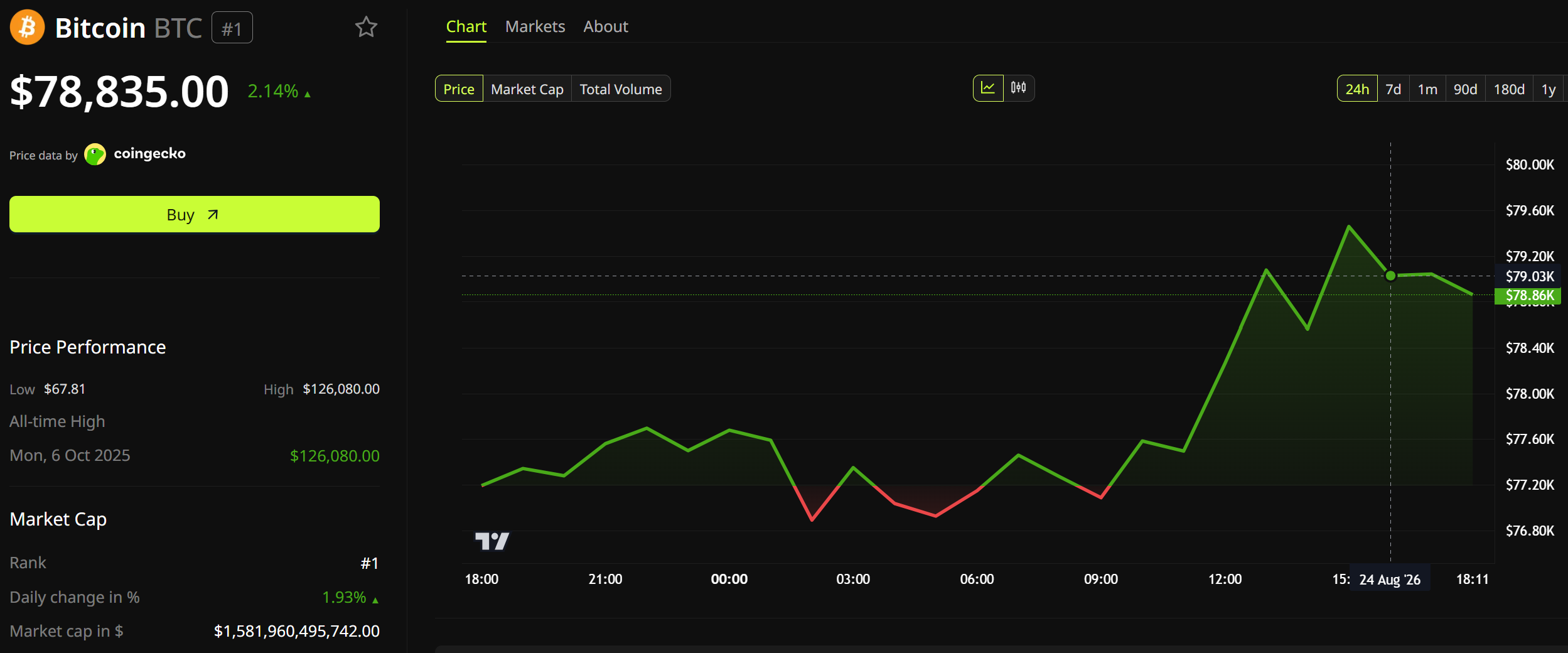
Bitcoin (BTC) touched $80,000 on Monday, then handed the level straight back. Critics are lining up against the US Treasury plan that sparked the move.
The token traded near $78,835 at press time. The bond market had already run this exact play last week, and it did not hold.

What Pushed Bitcoin to $80,000
The Treasury General Account (TGA) is the government’s checking account at the Federal Reserve. Tax receipts fill it. Treasury Secretary Scott Bessent has let it swell, with reports pegging the account near $950 billion.
Treasury’s own daily cash statement showed $935.1 billion on August 20, the latest official reading. Two senior Treasury officials told CNBC that money could fund bond buybacks.
Treasury doubled those buybacks on August 19. Long-end operations rose from $2 billion to at least $4 billion each. The first lands on September 9, per the department’s own announcement.
Traders liked the plumbing. Spending TGA cash does not grow the Fed’s balance sheet. It just moves money into bank reserves. That reads as liquidity, and liquidity has been Bitcoin’s fuel all month.
The Bond Market Already Round-Tripped This Trade
Treasury’s own yield data tells the story. The 30-year yield hit 5.31% on August 17, its highest reading since 2007.
The buyback news knocked it down to 5.19% two days later. By August 21 it sat at 5.27%. The entire rally vanished in two sessions.

Monday delivered a second bounce. The 30-year eased to 5.21% and the 10-year to 4.69%. Bitcoin’s spot price rode that wave to $80,000, then slid.
Why Critics Say It Will Not Hold
Bessent calls the strategy a “Treasury Twist.” The name echoes Operation Twist, the 1961 attempt to bend long-term rates lower.
Citadel Securities calls it financial repression. The firm warns it could weaken the dollar and stoke inflation. The deficits behind the yield spike go untouched.
Peter Schiff, chief economist at Euro Pacific Asset Management, has long warned about bond markets.
“This reckless plan will substantially shorten the average maturity of the national debt, increasing our exposure to rising short-term rates… It’s a recipe for massive QE and runaway inflation. Got gold?” Schiff wrote.
Benjamin Chabot, a former economist at the Federal Reserve Bank of Chicago, asked the sharper question.
“Does it matter if Treasury uses the TGA to buy bonds? Probably not. TGA funds are mostly spoken for. What matters is how Treasury refills the TGA after purchases,” he stated.
Fundstrat’s Tom Lee took the other side. He says the shift favors long-duration assets, crypto included.
Treasury has not spent a dollar of the account. September 9 is when the talk becomes numbers.
The post Bitcoin Loses $80,000 as Critics Swarm Treasury's $950 Billion Buyback Plan appeared first on BeInCrypto.


CME Group has added three regional U.S. dollar reference rates and real-time indices for Ethena’s ENA token, with daily publication beginning Aug. 24.
Summary
- ENA reference rates now cover the London, New York, and APAC market closes.
- CF Benchmarks calculates the rates using trades from eligible spot exchanges.
- Daily benchmarks remain available on weekends and holidays, matching crypto’s continuous trading schedule.
- The pricing tools may support portfolio valuation, risk controls, and ENA-linked financial products.
CME Group adds ENA rates for three market closes
CME Group said it had added Ethena (ENA) to its single-asset cryptocurrency benchmark suite, extending standardized U.S. dollar pricing to the token across three major trading regions.
CF Benchmarks, the benchmark administrator that manages CME’s cryptocurrency indices, will calculate and publish the new products. The lineup contains daily reference rates that provide a fixed valuation point, along with real-time indices that update during the trading day.
Under the regional format, the CME CF Ethena-Dollar Reference Rate tracks the London close under the ENAUSD RR identifier. ENAUSD NY provides a New York closing rate, while ENAUSD AP covers the end of the APAC trading day.
Each rate is published at 4 p.m. in its respective region. By using three local closing times, the suite lets firms select a valuation point that corresponds with their working day instead of applying one global cutoff to a market that never closes.
Publication continues seven days a week, including weekends and public holidays. ENA trades continuously on cryptocurrency exchanges, so its price can change when traditional stock, bond, and derivatives markets are closed.
Alongside the daily rates, the associated real-time indices provide updated dollar prices throughout the day. Trading desks may use those figures to monitor positions, compare execution prices or measure intraday exposure, while a daily rate gives accountants and fund administrators a fixed figure for reporting.
ENA pricing draws from multiple spot exchanges
Rather than taking ENA’s price from one trading platform, CF Benchmarks draws on transactions from eligible spot exchanges that meet its constituent venue rules. The method reduces the reliance on any single exchange’s order book, liquidity conditions or temporary pricing differences.
Reference rates and real-time indices serve different purposes. A reference rate produces a price at a set time and can support portfolio valuation, net asset value calculations, and contract settlement. A real-time index follows the asset during the day and can assist with trading, collateral monitoring, and risk controls.
A benchmark does not involve the purchase or custody of ENA by itself. It provides a standardized price that banks, asset managers, trading firms, or product issuers can cite when valuing exposure or designing a separate financial instrument.
The distinction also means CME’s announcement is not the same as launching ENA futures, options, or an exchange-traded fund. Any listed product would require its own contract terms, launch process and applicable regulatory treatment; CME’s post announced pricing benchmarks and did not identify a tradable ENA contract.
CF Benchmarks already administers rates used across CME’s cryptocurrency products. In March 2025, Crypto.com became a constituent exchange for several Bitcoin and Ether indices, adding its market data to a group that also included Coinbase, Kraken, Gemini, Bitstamp, itBit, Bullish and LMAX Digital. As previously reported by crypto.news, CME said at the time that data from another eligible venue would add depth and improve pricing accuracy for those benchmarks.
CME crypto benchmarks move beyond Bitcoin and Ether
The ENA addition places the Ethena governance token beside a growing list of crypto assets covered by CME-linked pricing tools. CME’s benchmark and derivatives lineup has expanded beyond Bitcoin and Ether to assets including Solana, XRP, Cardano, Chainlink, Stellar, Avalanche and Sui.
In June, the exchange launched Nasdaq CME Crypto Index futures tied to a basket containing Bitcoin, Bitcoin Cash, Ether, Solana, XRP, Cardano, Chainlink, and Stellar Lumens. The cash-settled index contract gave market participants a way to track several cryptocurrencies through one regulated product without holding the underlying tokens.
CME also introduced standard and micro futures for Avalanche and Sui in May. Both products settle in cash against their respective CME CF reference rates, illustrating how a standardized spot benchmark can later support settlement for a listed derivative when the exchange launches one.
No comparable ENA derivative was included in the Aug. 24 announcement. The immediate addition consists of the three daily regional reference rates and their corresponding real-time indices.
For U.S. firms, the New York variant supplies an ENA price at 4 p.m. local time, aligning the benchmark with the close of the American equity trading day. Fund administrators operating on U.S. schedules can therefore value ENA exposure at a familiar cutoff, even though the underlying token continues trading afterward.
American investors should not treat the benchmark’s inclusion as regulatory approval of ENA or an endorsement of Ethena’s products. CME Group operates major U.S. derivatives markets, but the announcement concerns the availability of pricing data rather than the legal classification of the token or authorization of a new investment product.
Ethena expands its institutional market connections
ENA’s addition follows several steps that have brought Ethena’s ecosystem into institutional trading and asset-management channels. The token governs the protocol behind USDe, a synthetic dollar whose backing model uses crypto assets, derivatives positions and other approved reserve arrangements.
On Aug. 19, Ethena and FalconX launched a $1 billion secured lending facility that uses part of USDe’s backing assets to finance overcollateralized loans for institutional borrowers. Under the institutional lending facility, FalconX originates and services loans through a special-purpose vehicle, while qualified custodians hold collateral worth more than each borrower’s outstanding balance.
Ethena had already incorporated institutional lending into USDe’s backing structure earlier in 2026. Governance records cited in August showed agreements with Anchorage Digital, Maple Institutional, and Coinbase Asset Management had been completed during March and April.
In June, BlackRock integrated USDe into its Aladdin investment platform, which is used by institutions overseeing more than $20 trillion in assets. Ethena also said BlackRock’s BUIDL tokenized fund would serve as a main asset for a white-label product and support liquidity arrangements involving tokenized assets.
Coinbase Ventures separately disclosed an open-market ENA purchase in June as Coinbase and Ethena prepared products focused on on-chain finance and savings. Unlike a discounted private allocation, the venture arm acquired its ENA position through the public market.
More recently, ENA gained about 65% in the week leading up to Aug. 21 and approached $0.1465 following the FalconX agreement. A technical review of ENA found that its four-hour relative strength index had climbed close to 94, an overbought reading that increased the risk of profit-taking even as the token retained its upward momentum.
The same analysis placed resistance at $0.1465, followed by potential levels at $0.1587 and $0.1709, while support stood near $0.1343, $0.1221, and $0.1099. CoinGlass data cited in the report showed leveraged-position clusters around $0.118 to $0.120, with additional liquidity between $0.104 and $0.116.

XRP trades at just under $1.50 after failing to hold the handle. The question now is whether this is a routine cooldown or the start of something uglier. Here’s our full XRP price prediction.
Just last week, XRP spiked over 20%, briefly touching $1.70 on August 22, its highest print since January. The rally unwound fast once Bitcoin stalled near $80,000 and dropped below $76,000, triggering a market-wide leverage flush that dragged XRP down with it.
$XRP ran from $1.00 to $1.70 fast. Now sitting at $1.47–$1.50 cooling off. Structure still intact — this looks like a reset, not a reversal.https://t.co/XWBgZfmqS5
— Ripple Bull Winkle | Crypto Researcher

 (@RipBullWinkle) August 24, 2026
Daily RSI hit roughly 80, way overbought territory, just right as price hit the $1.70 resistance zone, an area stacked with trapped longs from multiple 2025 swing highs looking to break even.
Bitcoin has since clawed back to around $77K, but the broader market has largely priced in last week’s positive catalysts and needs something new to keep pushing higher. For XRP specifically, that “something new” has a name and a date: the Clarity Act, potentially hitting the Senate floor in mid-September.
Discover: The Best Token Presales
XRP Price Prediction: Hit $1.70 Again This Week?
XRP is consolidating in a tight band between $1.45 support and $1.51 resistance, with the daily pivot sitting at $1.49, essentially a coin flip zone. Volume has cooled from last week’s frenzy, a sign the FOMO-driven buying has largely exhausted itself for now.
Trading above every major daily moving average still technically favors bulls, but stretched momentum after a 51-52% weekly gain rarely resolves cleanly. If A Senate vote on the Clarity Act in September removes regulatory overhang, spot volume could surge, and XRP could clear $1.70 to challenge $2 and eventually $3.

However, price could chop in the $1.40-$1.51 range while the market waits for a catalyst, testing patience more than conviction. A clean break below $1.45 opens the door to the 0.382 Fibonacci support at $1.35-$1.40, with deeper structural floors at $1.25 and $1.18 if momentum fully unwinds.
A bullish structure survives a test of $1.35, but it won’t survive a break below it.
Trade XRP on Bybit and Get a Chance to Win Our $1,000 USDT Airdrop
LiquidChain Targets Early Mover Upside as XRP Tests Key Levels
Anyone who bought XRP under $1.20 last week is sitting comfortably. But here’s the uncomfortable math: even a clean breakout to $3 from here is roughly a 2x from current levels. It’s solid, but not the kind of move that changes a portfolio’s trajectory.
At XRP’s market cap, the era of 50x moves is over. That capital has to go somewhere if traders want asymmetric upside, and increasingly it’s rotating toward earlier-stage infrastructure plays.
LiquidChain is one of the presales absorbing that rotation. It’s a Layer 3 execution environment fusing Bitcoin, Ethereum, and Solana liquidity into a single unified layer. With Liquid, developers deploy once and reach all three ecosystems, rather than fragmenting liquidity across chains.
LiquidChain is making “which chain? — LiquidChain (@getliquidchain) August 23, 2026
 ” a thing of the past.
  ⟁https://t.co/vqvBcdSQYC pic.twitter.com/ip83gw1P0u
The presale sits at $0.0149 per token with $950K raised so far, still 100X from here to the current XRP price.
Core features include Single-Step Execution and Verifiable Settlement, both aimed at solving the cross-chain liquidity fragmentation problem that’s plagued DeFi for years.
Research LiquidChain while the raise is still active.
Discover: The Best Crypto to Diversify Your Portfolio
The post XRP Price Prediction: $1.50 Pullback, or End of the Rally? appeared first on Cryptonews.
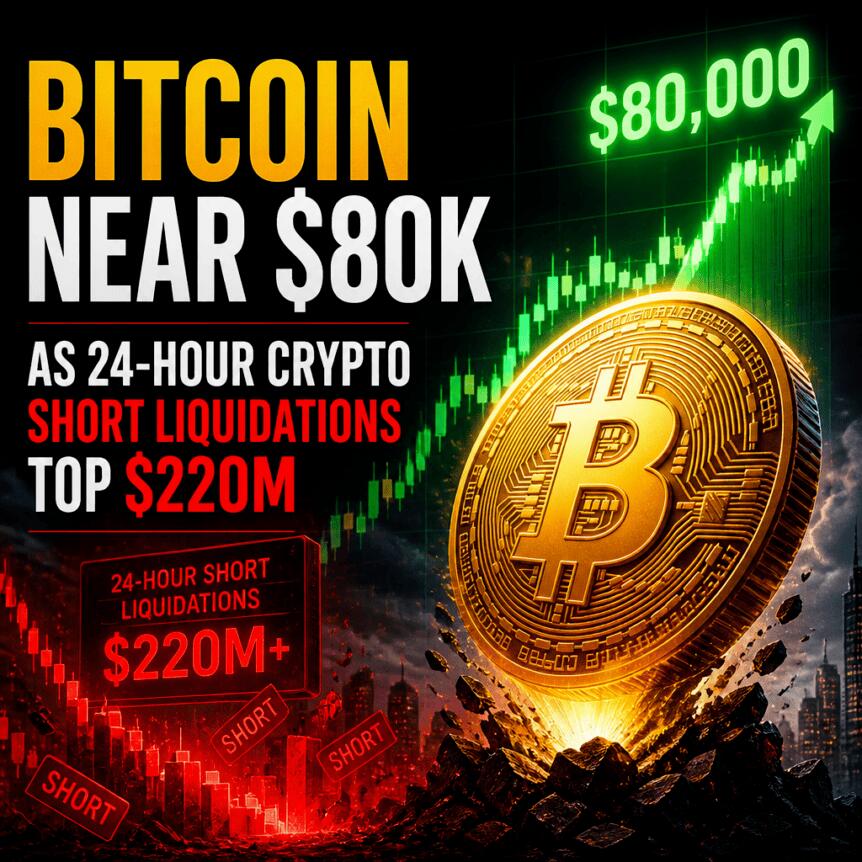
Bitcoin reclaimed the $80,000 level on Monday, pushing through a key psychological and technical milestone after last week’s sharp rally drew fresh momentum from traders. The breakout marked BTC’s first trade above $80,000 since mid-May, with price up roughly 3% at the time of reporting before easing after the European session.
As the market tested higher levels, activity on leveraged venues also picked up—most notably in short liquidations—underscoring how crowded positions may have been forced to unwind during the advance.
Key takeaways
- BTC/USD moved above $80,000 for the first time since May 15, ending a more than three-month absence from that range.
- CoinGlass data showed crypto short liquidations passed $220 million over the prior 24 hours as Bitcoin approached the $80,000 mark.
- Support appears to be clustering around the mid-$70,000s, with a bid liquidity band centered on $76,700, according to a CoinGlass liquidation heatmap.
- Analyst Rekt Capital said the “real test” will be whether Bitcoin can sustain strength, pointing to the 50-week exponential moving average near $77,251.
Bitcoin breaks back above $80,000 for the first time since May
TradingView charts showed BTC/USD crossing $80,000 for the first time since May 15, reaching the level during the Wall Street open. The move came alongside another roughly 3% gain on the day before pullbacks occurred following the European close, suggesting the market was still digesting the breakout rather than entering immediately into a smooth trend.
This return matters because it represents more than a single price point. Levels around $80,000 have historically functioned as both a reference for market positioning and a threshold traders watch for continuation signals. When Bitcoin re-enters a range it previously failed to hold for months, it can quickly shift expectations for whether the market is simply rebounding or genuinely transitioning to a stronger phase.
Short liquidations surge as leveraged traders unwind
Higher prices drew in additional leverage-related activity. According to CoinGlass, crypto short liquidations exceeded $220 million over the preceding 24 hours at the time of writing. While liquidations can occur in both directions, large short liquidation bursts typically accompany fast upward moves as price rallies force shorts to cover.
CoinGlass also highlighted a liquidation heatmap feature: a band of bid liquidity centered around $76,700. In practical terms, that cluster can act as a near-term “gravity point” during pullbacks—buyers who respond to forced liquidation dynamics may help slow a downside reversal if price falls back toward that zone.
Still, it’s important to remember that liquidation clusters are reactive, not predictive. They can help explain why certain retracements stabilize, but they don’t guarantee that a move back down will be limited or that new support will permanently hold.
The focus shifts from rally to “staying power”
Even with Bitcoin returning to a key higher range, market observers emphasized that sustaining the breakout is the real challenge. Earlier coverage from Cointelegraph had flagged concerns among some traders that bearish market patterns could reassert themselves later in the year, with downside potentially returning from September onward to trigger broader capitulation to new macro lows.
In that context, the latest push above $80,000 looks less like a finish line and more like the opening stage of a longer test. Rekt Capital, a trader and analyst, argued in his market commentary that Bitcoin must prove it can hold those levels. He pointed out that Bitcoin has closed the week at the highs and framed the next phase as a “real test” for whether strength persists.
“Bitcoin has Weekly Closed at the highs. Now starts the real test,”
Rekt Capital also cautioned that if the rally is only a “bear market relief” bounce, Bitcoin could pull back as early as the current week or within the following few weeks. That distinction—relief rally versus durable trend—has major implications for traders and portfolio managers because it changes expectations around volatility, timing of entries, and the likelihood of retesting lower ranges.
Key technical level in view: the 50-week EMA
Rekt Capital highlighted one technical benchmark in particular: the 50-week exponential moving average, currently around $77,251. He noted that Bitcoin achieved its first weekly close above that trend line since November 2025.
He also drew a comparison to the 2022 bear market, when BTC/USD managed two weekly closes above the same type of trend line before subsequently dropping to cycle lows. The point of the comparison isn’t to claim a repeat outcome, but to show how quickly markets can revert when trend-breaking closes occur without sustained follow-through.
For investors watching this level, the near-term question becomes whether price can remain above a widely tracked dynamic benchmark long enough to change market structure. If Bitcoin continues to close above the 50-week EMA and keeps higher levels defended on retracements, it would strengthen the case that the rebound is progressing into something more persistent. If not, the market may revert back toward the mid-$70,000s where liquidation-driven support has begun to form.
Next, traders are likely to monitor whether Bitcoin can hold above $80,000 on subsequent sessions and, more importantly, whether weekly closures continue to support the breakout thesis. The debate between “relief rally” and “sustained strength” will likely hinge on follow-through around the 50-week EMA near $77,251 and how price behaves during pullbacks toward the liquidation liquidity band centered at $76,700.


Extraordinary Attorney Woo’s Park Eun-bin and Doona!’s Yang Se-jong star as ghost-whispering hotel heiress Cheon Yeo-ri and ace prosecutor Ma Gang-uk, respectively, in the supernatural romance series Spooky in Love. In the Korean drama, which broadcast domestically on tvN and was distributed globally by Netflix, Yeo-ri and Gang-uk are initially brought together by their shared desire for justice. For Yeo-ri, this takes the form of helping the ghosts she alone can see. For Gang-uk, it means doing a good, by-the-book job as an investigator. But when Gang-uk learns Yeo-ri’s secret, the two grow closer.
While Spooky in Love starts out with a strong, ghost-of-the-week format, the second half of the drama leans more into corporate in-fighting and family drama as context for Yeo-ri and Gang-uk’s romance. When Chairwoman Baek insists that Yeo-ri get engaged in order to secure a more stable future for the hotel and resort company, Yeo-ri side-steps the advances of family friend and fellow chaebol Kang Min-hwan (Ong Seong-wu) to announce she is engaged to Gang-uk. What starts as a fake relationship to keep Yeo-ri’s grandmother off of her back soon develops into the real thing. But can Yeo-ri and Gang-uk’s love survive Min-hwan’s machinations to take control of both Yeo-ri and her company? Here’s everything that happens in the Spooky in Love finale.
Yeo-ri’s supernatural powers, explained

Yeo-ri wasn’t born with the ability to see ghosts. She developed it 12 years prior to the start of the series, when she nearly died in the mysterious yacht accident that killed her boyfriend and Min-hwan’s little brother, Kang Ji-hwan (Kim Min-chul). The condition has ghosts constantly nagging Yeo-ri for help, and also keeps her isolated from the land of the living. If she touches hands with someone else, they will temporarily gain the ability to see ghosts for a month. As a result, she wears gloves constantly, and keeps a physical distance from her friends, family, and co-workers.
The stakes of Yeo-ri’s secret are intensified due to the power her family holds. Yeo-ri is the heir to the Reina Group, a corporate hotel chain that wields immense wealth. Yeo-ri’s grandmother, Baek Kyung-ja (Ye Soo-jung), plans to pass the baton to Yeo-ri—rather than step-daughter Ok Gye-hui (Baek Ji-won) or her adult children, Ha-ri (Cho Hye-joo) and Don-jun (Lee Dal). However, if Chairwoman Baek, or the larger public, finds out that Yeo-ri is haunted by ghosts, it could call her ability to run the family corporation into question.
Still, Yeo-ri’s sense of justice runs deep. In Spooky in Love’s early episodes, Yeo-ri is visited by the ghost of Jang Eun-ju (Yoon Hye-rim), a young woman who was murdered by her boyfriend, Park Seung-jae (Kim Do-wan), after she becomes pregnant with their child. Seung-jae is well-connected. Not only is he a rich pro golfer, but his father is one of the leading contenders in the next presidential race. When he is initially tried for murder, with Gang-uk acting as prosecutor, he is acquitted due to his father’s immense influence. It is only when Gang-uk and Yeo-ri team up that they are able to gather more evidence, and definitively pin the murder on Seung-jae.
What happened on the yacht?
Yeo-ri grew up close to Kang Ji-hwan and Kang Min-hwan, brothers poised to inherit ownership of CL Raymond Group. Though both brothers had feelings for Yeo-ri, Ji-hwan was the first to ask her out. For Min-hwan, this intensified the jealousy he had long felt of his little brother. Jin-hwan, who looked up to his brother, didn’t realize that he was often treated better by some members of the family compared to Min-hwan, who was adopted. When Jin-hwan started dating Yeo-ri, it was the final straw for Min-hwan.
On the day of the accident, the brothers are out on a yacht with their friends, including Yeo-ri and fellow rich kid Park Seung-jae. We learn in the penultimate episode that when the yacht hit a rock and Jin-hwan was thrown over the side, Min-hwan had the chance to pull his brother back onboard, but let the pleading Jin-hwan fall into the water below instead. Jin-hwan dies, and Yeo-ri, who also went overboard in the accident, is rescued from the water. She is wearing a protective pendant gifted to Jin-hwan by his grandmother. He asked her to wear it while they were on the boat, joking that, if something should happen, she should live and he will die.
Later, Yeo-ri and Gang-uk seek out the shaman who made the pendant. The original maker is dead, but her daughter informs them that the power of the pendant changed Yeo-ri and Jin-hwan’s fates. That power, paired with Yeo-ri’s inability to let Jin-hwan move on in the immediate aftermath of the accident, led to Yeo-ri’s ability to see ghosts. The shaman tells Gang-uk and Yeo-ri that, in order for Yeo-ri to stop seeing ghosts, she owes the afterlife a life.
Gang-uk’s connection to Jin-hwan
Gang-uk, who was raised by his grandmother, did not grow up in the same social circles as Yeo-ri, Min-hwan, and the other members of the chaebol class. However, he shares a unique connection to Jin-hwan. When Jin-hwan died, a sick Gang-uk was given Jin-hwan’s heart. The transplant allowed him to live on. Ever since, Jin-hwan and Min-hwan’s mother, Song Hee-won (Kim Seo-ra) has kept tabs on Gang-uk through his grandmother. Though she lost one of her sons, it makes her happy to see Gang-uk doing well.
Min-hwan’s crimes escalate

This truth of Jin-hwan’s death is known only by Min-hwan for more than a decade. Yeo-ri doesn’t remember what happened during the accident and, even if she did, she didn’t witness what occurred between the brothers that day. However, when Seung-jae temporarily gets out of jail to attend his father’s funeral, he happens to stumble upon a camcorder memory card with footage of Min-hwan choosing not to save Jin-hwan. Seung-jae attempts to blackmail Min-hwan with the evidence. When the two meet up in an abandoned warehouse, Min-hwan kills him for it.
Gang-uk finds Min-hwan’s cufflink at the scene of the crime, but Min-hwan counters. He hires someone to hit Gang-uk with a truck. Yeo-ri pushes the man she loves out of the way at the last second, saving his life and putting her own in grave danger. She is hit by the truck, and ends up in a coma. As Yeo-ri’s life hangs in the balance, we see her traverse a beautiful kind of purgatory. The ghosts she has helped in the past 12 years, including Eun-ju, are waiting for her there. They lend her some of their warmth to keep her from crossing to the other side.
Yeo-ri and Jin-hwan balance the scales
Still, Yeo-ri finally does make it to a Styx-like river, a boundary between the world of the living and the world of the dead. Before she can step onto the boat that would bring her across, the ghost of Jin-hwan appears to take her place. The two share a teary conversation in which they process Jin-hwan’s death. Yeo-ri apologizes for living instead of him, but Jin-hwan doesn’t see it that way. He says she still has so much to live for, and that the ghosts she has helped are rooting for her. When Yeo-ri wakes back up, she no longer has the power to see ghosts. Jin-hwan has crossed to the other side; the afterlife has been given the soul it was robbed of 12 years prior.
Min-hwan is brought to justice
Unbeknownst to Min-hwan, Seung-jae has hidden the memory card in a hollow golf ball at the warehouse. When Yeo-ri and Gang-uk are investigating, they find the card and have the evidence to take Min-hwan down. In the most dramatic way possible, Yeo-ri reveals the evidence to Min-hwan’s mother and the other people gathered at Jin-hwan’s memorial service. More than losing his power or going to jail, Min-hwan seems most distraught at the idea of his mother discovering his betrayal. A year later, when she visits her remorseful son in jail, she tells him that after he has finished serving his time, she will be waiting for him. Min-hwan, who always thought his mother’s love for her biological son diminished her love for her adopted son, can perhaps finally see otherwise.
Does Spooky in Love have a happy ending?
Spooky in Love has the happiest of endings. A year following the main events of the series finale, Yeo-ri is announced as the new chairwoman of Reina. Yeo-ri and Gang-uk are happily together. Gang-uk, who had been transferred out of Seoul after reporting internal corruption at the prosecutor’s office, has just received a promotion back in the capital city where Yeo-ri lives. The two visit Siena Hall, the Reina wedding property that symbolizes Yeo-ri’s late parents’ love for one another, and walk together, hand in hand.
When the two first started falling for one another, Yeo-ri had said that her greatest wish was to walk hand-in-hand with the person she liked. Then, she was too afraid to touch anyone, burdened by the certainty she would pass her curse onto them. Now, she does so, unafraid. The simple scene doesn’t just demonstrate the love between Yeo-ri and Gang-uk; it demonstrates the intimacy and warmth Yeo-ri is able to let into her life more broadly. She is no longer alone, and Gang-uk is only one part of that reality.

Polish prosecutors have reportedly charged Przemysław Kral, the head of the collapsed cryptocurrency exchange Zondacrypto, in connection with an alleged large-scale fraud, and he has started cooperating with investigators, according to reporting from Onet.
Onet says Kral is seeking a reduced sentence in exchange for testimony that could include details about how Zondacrypto funding was linked to right-wing political figures in Poland. Prosecutors estimate that Zondacrypto customers lost at least 2.4 billion Polish zlotys (about $650 million), and investigators allege that only part of customer funds was used to buy crypto, while the remainder was moved to private accounts controlled by exchange managers.
Key takeaways
- Przemysław Kral of Zondacrypto has reportedly been charged and is cooperating with Polish prosecutors.
- Prosecutors estimate customer losses at least 2.4 billion zlotys (about $650 million).
- Investigators allege Zondacrypto used only a portion of customer funds to purchase crypto and diverted the rest to private accounts.
- Kral is reportedly trying to secure a reduced sentence through testimony, potentially touching on alleged exchange-related political funding.
- Earlier public statements included a claim that Zondacrypto could not access a cold wallet holding roughly 4,500 Bitcoin.
Cooperation talks and the alleged damage
Onet reports that prosecutors estimate Zondacrypto customers lost at least 2.4 billion zlotys. The outlet also states investigators believe the exchange did not preserve customer money in full, but instead used only part of customers’ funds to buy cryptocurrency, with additional amounts allegedly transferred to private accounts under the control of Zondacrypto’s managers.
According to Onet, Kral began exploring cooperation conditions weeks ahead of the reported charge outcome. The outlet previously reported that he had been negotiating the terms of possible collaboration with prosecutors for about six months.
That reporting also described informal meetings between Kral and prosecutors in Poland as well as in locations including Sicily and parts of the Persian Gulf, where discussions reportedly focused on the structure of a potential deal.
Allegations tied to political connections
In the newest Onet report, the outlet says Kral is seeking a lighter sentence by offering testimony that could include details about alleged Zondacrypto involvement with funding right-wing politicians.
The political angle is not new to the Zondacrypto case. Onet previously reported that Zondacrypto had acted as a key sponsor of Poland’s Conservative Political Action Conference (CPAC) shortly before the second round of the presidential election, which was won by Karol Nawrocki.
Onet also notes that in its final year, Zondacrypto spent 37 million zlotys on advertising with broadcaster Telewizja Republika. The outlet further claims that companies owned by Kral made payments to foundations linked to politicians Zbigniew Ziobro and Przemysław Wipler.
What Kral said earlier about the missing Bitcoin
Since mid-April, Kral has remained publicly silent on X after disclosing that Zondacrypto was unable to access a cold wallet reportedly holding about 4,500 Bitcoin. Earlier coverage from Cointelegraph noted the wallet access issue and described the resulting withdrawal crisis.
Kral has denied accusations of misappropriating customer funds. He said the private keys for the wallet were intended to have been transferred by Zondacrypto founder and former CEO Sylwester Suszek, who has been missing since 2022.
That explanation has been central to how the case has been discussed publicly: rather than conceding fund loss, Kral pointed to an alleged custody and key-transfer failure involving Suszek. Prosecutors’ latest estimates and alleged diversion of funds, as described by Onet, suggest investigators view that narrative differently.
Unanswered questions as the probe expands
As the case moves into the cooperation phase, several issues remain unclear based on the available reporting. Onet’s claims focus on the scale of customer losses and the alleged path of diverted funds, but they do not establish in detail how investigators quantify losses or reconcile them with any remaining assets, including the purported cold wallet.
Cointelegraph reported that it was unable to reach Kral or Zondacrypto for comment. The outlet said email addresses connected to the exchange were unavailable after Kral’s April disclosure about the wallet access problem.
For investors and market participants, the Zondacrypto situation underscores a persistent pattern seen in major exchange collapses: customer assets may be at risk not only through outright theft, but also through custody failures, opaque internal controls, and use of funds in ways that do not align with client expectations. The investigation’s alleged findings—customers’ funds being partially used for purchases while the rest allegedly moved to private accounts—highlight why transparency around wallet management and auditability matters, especially in jurisdictions where recovery and enforcement can take time.
Readers should watch next for what Kral’s cooperation ultimately produces in court filings—particularly whether testimony about alleged political funding is corroborated by evidence and how prosecutors account for the missing Bitcoin and any other recoverable funds. The case also raises broader questions about how regulators and law enforcement will evaluate the relationship between exchange operations, third-party entities, and political influence when rebuilding trust after a collapse.
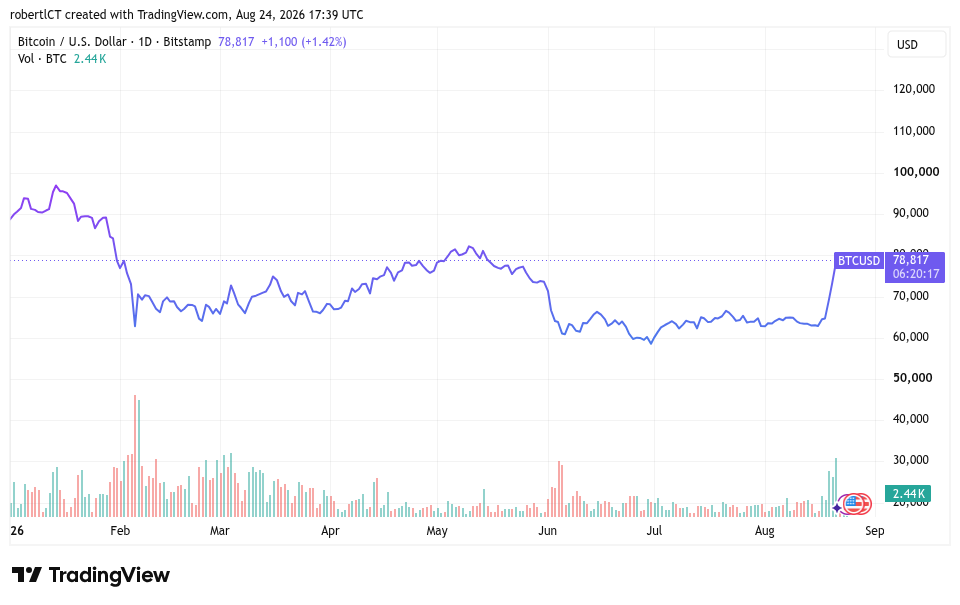
Bitcoin (BTC) passed $80,000 after Monday’s Wall Street open as bulls built on last week’s snap BTC price rally.
Key points:
- Bitcoin hits $80,000 for the first time since mid-May as bullish momentum gathered pace.
- BTC price analysis warns that the market still needs to sustain higher levels to challenge the bear-market thesis.
Bitcoin returns to $80,000 after 100-day hiatus
Data from TradingView showed BTC/USD passing the $80,000 for the first time since May 15, up another 3% on the day before pulling back following the European close.
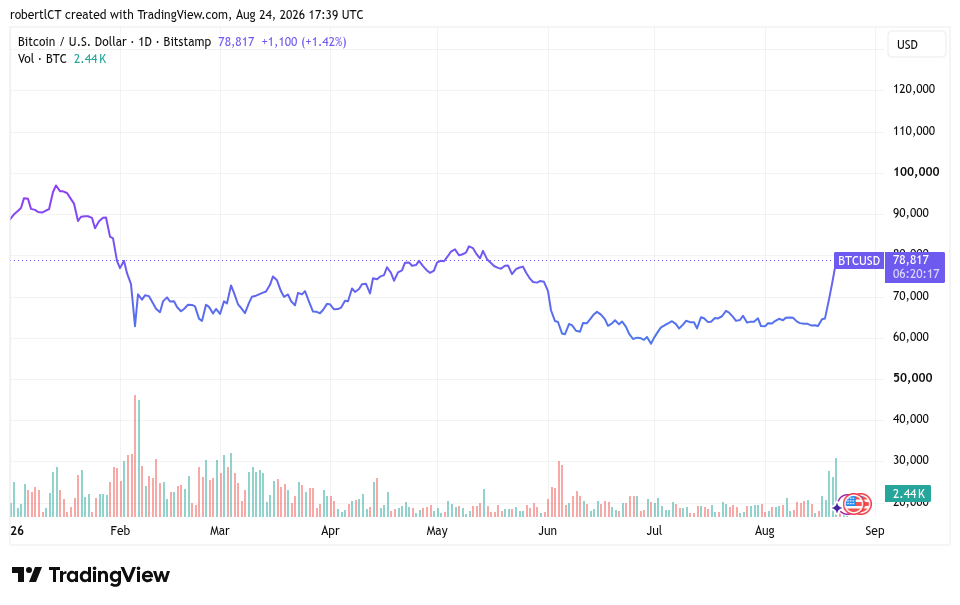
Source: TradingView
The move spurred an uptick in crypto short liquidations, with these passing $220 million over the 24 hours to the time of writing, per data from CoinGlass. A band of bid liquidity centered on $76,700, potentially offering support in the event of a downward BTC price reversal.
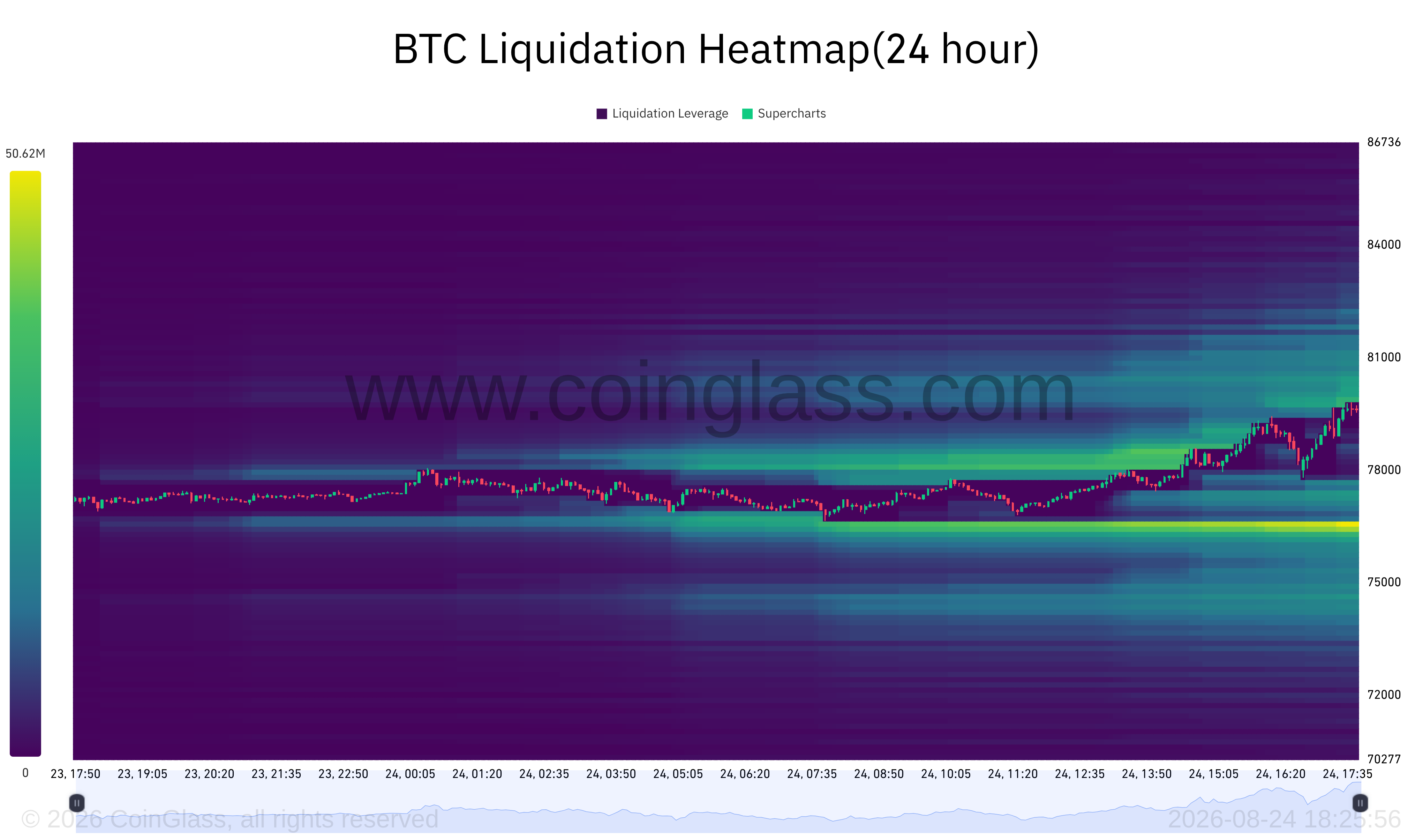
BTC liquidation heatmap. Source: CoinGlass
Analyst: BTC rebound must prove staying power
Bitcoin was up 25% month-to-date, seeing its best August performance since 2017 and increasingly diverging from bear-market norms. Earlier, Cointelegraph reported on concerns among some traders that bearish history could still repeat, with downside reemerging from September onward to spark a final capitulation to new macro lows.
Related: BTC price loses 200-week trend line as 2022 repeats: Five things to know in Bitcoin this week
“Bitcoin has Weekly Closed at the highs. Now starts the real test,” trader and analyst Rekt Capital wrote in his latest market commentary on X.
“If this is a Bear Market Relief Rally, then Bitcoin could pullback as early as this week, or at least over the next few weeks. Now it’s all about Bitcoin proving sustained strength.”
Rekt Capital had eyed the 50-week exponential moving average in particular, currently at $77,251, as price achieved its first weekly close above it since November 2025. During Bitcoin’s 2022 bear market, BTC/USD achieved two weekly closes above that trend line before dropping to cycle lows.
Magazine: Bitget CEO isn’t buying the Bitcoin rally — She’s waiting for $50K
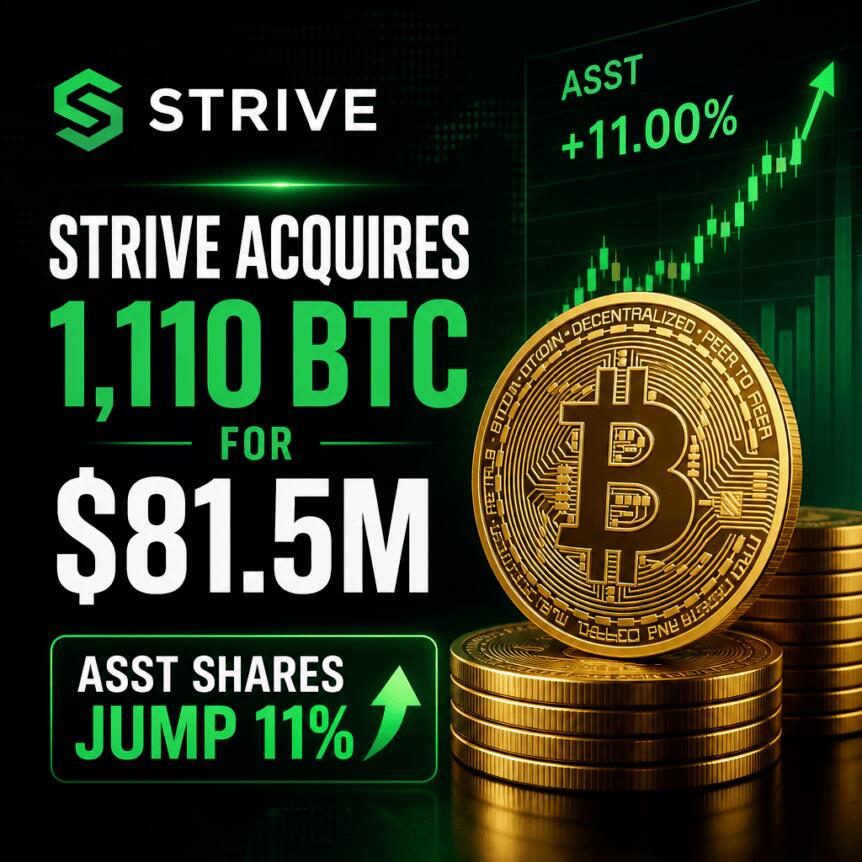
Strive Asset Management has made its latest Bitcoin purchase, according to a filing with the U.S. Securities and Exchange Commission. The Nasdaq-listed company bought 1,110 BTC during the week of Aug. 17 through Aug. 21, spending about $81.5 million in total and bringing its Bitcoin treasury to 21,356 BTC.
The purchase price averaged $73,409 per Bitcoin, inclusive of fees and expenses, based on the company’s disclosures. As of the same period, Strive reported that its cash and cash equivalents increased by $17.1 million to $171.9 million, while its Class A shares outstanding rose by 3.65 million to 79.89 million.
Key takeaways
- Strive purchased 1,110 BTC for about $81.5 million between Aug. 17 and Aug. 21, per its SEC filing.
- The average all-in cost was $73,409 per Bitcoin, with Strive adding to a total holding of 21,356 BTC.
- Bitcoin was trading around $79,000 on Monday, roughly 8% above Strive’s reported average purchase price for the latest buys.
- Company data cited by BitcoinTreasuries.NET places Strive among the largest publicly traded corporate Bitcoin holders.
- Separately, Strive’s SATA preferred stock returned to its $99-to-$101 trading corridor after dipping earlier in June.
Another corporate Bitcoin buy—and what the pricing implies
In the SEC filing, Strive details how it executed the most recent tranche of Bitcoin purchases. The company’s average cost—$73,409 per BTC including fees and expenses—was below the approximate $79,000 level at which Bitcoin traded on Monday, according to the article’s market reference. That gap suggests Strive acquired the latest Bitcoin inventory at a discount relative to the spot price at the start of the following trading day, though investors will be watching how the treasury’s realized cost basis compares as new purchases continue.
The timing also matters for corporate-holding strategies that aim to maintain a consistent allocation rather than attempt precise market timing. Strive’s cash position, which rose to $171.9 million, indicates it had room to continue deploying capital into its treasury approach during the covered week. At the same time, growth in Class A shares outstanding to 79.89 million points to ongoing corporate balance sheet activity beyond the Bitcoin buy itself.
BitcoinTreasuries.NET data, cited alongside the filing, ranks Strive as the seventh-largest publicly traded corporate Bitcoin holder, positioning it behind Bullish and ahead of SpaceX. For traders, that kind of ranking can be more than trivia: it can influence investor perception around liquidity, follow-on demand, and how visible corporate BTC strategies are to the broader market.
Strive links the strategy to “scarcity” and share structure
Alongside the purchase news, Strive’s CEO Matt Cole framed the company’s broader thesis in terms of relative scarcity and how Strive’s share structure is intended to participate. In a post on X ahead of Monday’s market open, Cole said the “upside” is not only tied to Bitcoin moving higher, but to Bitcoin “becoming the fastest horse inside an expanding scarcity trade,” adding that $ASST is “structured to amplify” that outcome while remaining “responsibly” supported.
This is essentially an investor-facing explanation of why the treasury strategy is paired with the company’s capital structure. Investors should treat such statements as strategic framing—not performance guarantees—while monitoring how the firm actually funds purchases and how its market-linked products behave during BTC volatility.
Beyond Bitcoin: SATA preferred stock returns to its target range
While the Bitcoin purchase grabbed attention, Strive’s other major development was movement in its SATA preferred stock. The filing context notes that SATA closed at $100.01 on Friday, returning to a management targeted trading range of $99 to $101 after trading as low as $83.30 in late June.
According to the article, Strive previously narrowed SATA’s targeted corridor from $95–$105 to $99–$101 in March. Around that time, the company also stated it would not issue SATA through at-the-market or follow-on offerings below $100, a commitment that is designed to limit dilution at prices the company considers off-target.
SATA was launched in November 2025, initially selling 2 million shares at $80 each for $160 million in gross proceeds. The preferred stock is described as variable-rate and perpetual, with a stated amount and an initial liquidation preference of $100 per share—key features that differentiate it from Strive’s common equity.
Functionally, SATA is intended to operate as an income-focused instrument. The variable dividend rate is meant to encourage trading near $100, and the article notes Strive raised the annualized dividend rate to 13% in April. It also switched from monthly to daily dividend payments beginning June 16, referencing an SEC filing for the change in payment schedule.
How SATA compares to Strategy’s STRC
SATA is presented as similar to STRC, the variable-rate perpetual preferred stock issued by Strategy, which is widely regarded as the largest corporate Bitcoin holder. The article states STRC traded near $97 on Monday, below Strategy’s $100 target, while Strategy reported no Bitcoin purchases for the week ended Aug. 23.
For market participants, this comparison is useful because both SATA and STRC are designed to tie investor outcomes to corporate Bitcoin holdings while using dividend mechanics to influence preferred-share pricing. If Strategy is paused on new purchases while Strive is actively adding BTC, the relative behavior of their preferred instruments could become a proxy for how markets are weighing treasury accumulation versus dividend/rate adjustments.
However, investors should be careful not to assume one day’s price action directly reflects the treasury’s longer-term economics. Preferred stocks can respond to yield expectations, liquidity, and broader risk sentiment, and variable-rate structures can shift quickly as dividend calculations change.
Next, readers should watch whether Strive continues its steady cadence of Bitcoin purchases and how that activity filters into the market’s expectations for both ASST and its preferred share suite. The sustainability of SATA staying near the $100 corridor will also be important, especially if Bitcoin volatility increases or if Strive’s treasury strategy funds new buys alongside changes in dividends and share issuance.
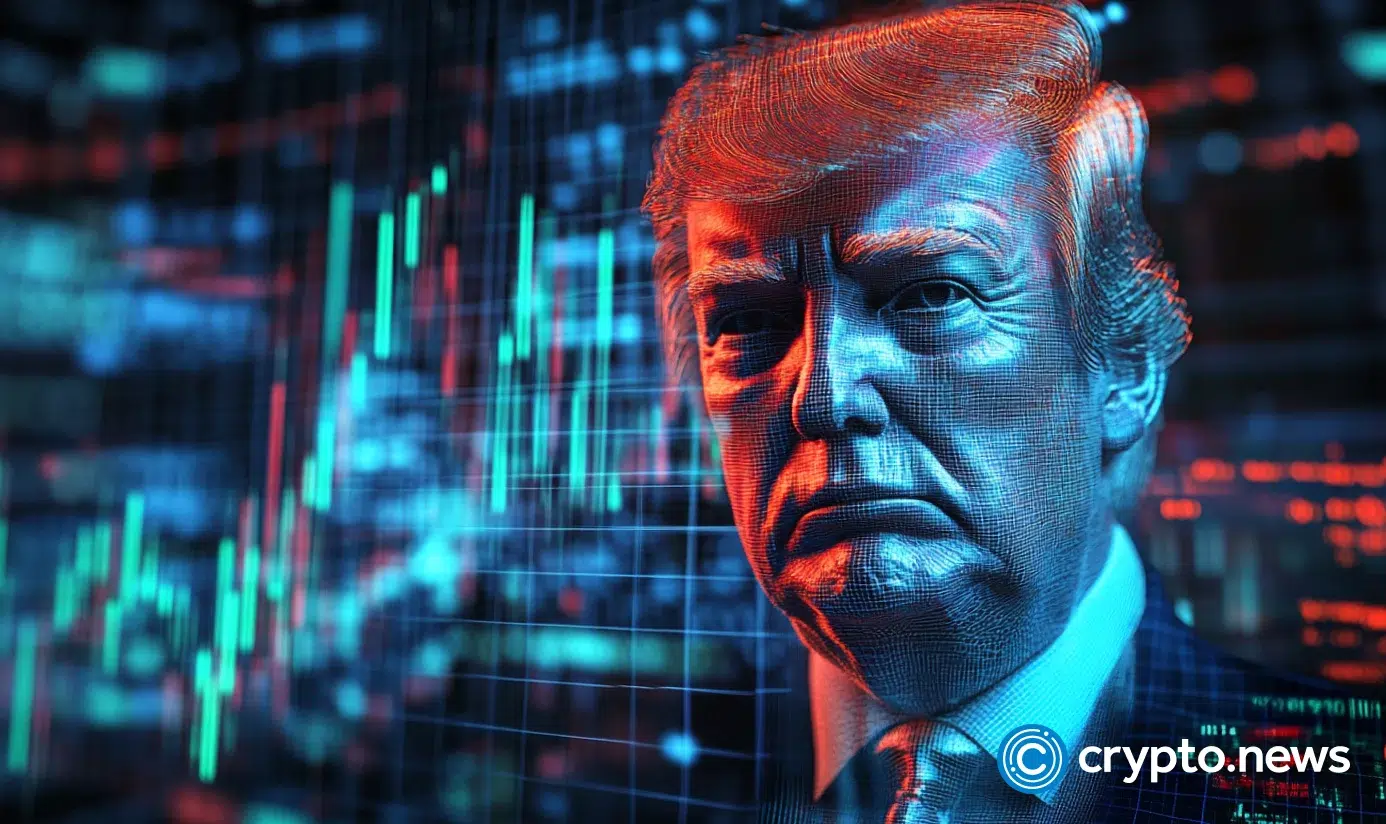
Bitcoin has recovered above $79,000 after briefly falling toward $78,200 as President Donald Trump threatened 50% tariffs on Canadian vehicles, automotive parts and steel from Jan. 1, 2027.
Summary
- Trump said tariffs on several Canadian automotive and steel imports would rise to 50%.
- Bitcoin briefly fell toward $78,200 before recovering to about $79,300.
- U.S.-Canada trade negotiations ended without an agreement after three days of talks.
- U.S. spot Bitcoin ETFs drew about $1.92 billion during the latest five-session rally.
Trump tariffs target Canadian vehicles and steel
A Truth Social post published by Trump on Aug. 24 said the United States would raise tariffs on all Canadian cars, trucks, automotive parts and steel to 50% at the start of 2027.
“Build in the U.S. and there are ZERO TARIFFS,” Trump wrote before criticizing Canada’s approach to trade with the United States.
The announcement followed the collapse of negotiations between Washington and Ottawa on Aug. 21. According to Reuters, the proposed agreement would have reduced the main U.S. tariff on Canadian cars and light trucks from 25% to 15%. Duties on Canadian aluminum and steel would also have fallen from 50% to 25%.
Negotiators did not resolve several points, including whether tariff relief would cover medium- and heavy-duty trucks. With no agreement in place, Trump increased the pressure on Ottawa through his latest tariff threat.
Canada, for its part, plans to impose retaliatory tariffs on selected U.S. products from Sept. 8 in response to existing 50% U.S. duties on about $20 billion of Canadian goods. Prime Minister Mark Carney described the dispute as a trade war after the talks failed.
“You’re at war when you get attacked,” Carney said on Aug. 22.
Trump also claimed Canada conducts 95% of its business with the United States, although official trade figures cited by Reuters show Canada sends more than three-quarters of its goods exports to the U.S. and receives almost half of its goods imports from its southern neighbor.
U.S. goods and services trade with Canada totaled $872.3 billion in 2025, making the country one of America’s two largest trading partners. The high level of integration means parts can cross the border several times before a finished vehicle reaches a dealership.
Bitcoin price has recovered from its tariff-driven dip
Bitcoin initially moved lower after Trump published the tariff announcement, falling from above $79,000 to around $78,200. Buyers soon absorbed the decline, helping BTC return above the psychological $79,000 level.
At the time of writing, Bitcoin traded near $79,300, up more than 2% over the previous 24 hours. The cryptocurrency also came within roughly $500 of the $80,000 level after reaching an intraday high close to $79,900.
The limited reaction contrasts with Bitcoin’s behavior during earlier tariff disputes. In February, BTC lost the $65,000 support level as new U.S. global duties approached, while the total crypto market value fell as traders reduced exposure to risk assets. Earlier crypto.news coverage of that decline recorded a roughly 5% Bitcoin drop from a previous high of $66,465.
Monday’s price move has been smaller because Bitcoin entered the announcement with strong upward momentum. BTC climbed from about $62,679 on Aug. 17 to a three-month high near $79,500 on Aug. 21, adding almost 27% between the weekly low and high.
After pulling back toward $76,600 over the weekend, the asset resumed its advance on Aug. 24. The latest tariff news briefly interrupted that recovery but did not erase the day’s gain.
Treasury buybacks have supported Bitcoin’s rally
Behind Bitcoin’s recent advance, the U.S. Treasury has expanded its liquidity-support buybacks for longer-dated government securities. The department raised the maximum size of each operation from $2 billion to at least $4 billion for bonds in the 10-to-20-year and 20-to-30-year maturity ranges.
Scheduled to take effect on Sept. 9, the revised program will also increase the number of long-end operations from two to four per quarter through Nov. 4. No money has been deployed under the expanded schedule yet.
The announcement prompted a rapid repricing in the bond market. The 30-year Treasury yield fell from a 19-year high of about 5.34% to 5.19%, while the 10-year yield declined to around 4.65%.
As earlier buyback coverage detailed, Bitcoin jumped 8.2% from an intraday low near $64,100 to $69,500 in less than 12 hours after the Treasury disclosed the change. About $1.44 billion in short positions was liquidated across major crypto exchanges during the move, including $1.29 billion within one hour.
The buyback program does not amount to Federal Reserve quantitative easing. The Treasury purchases older and less liquid bonds using proceeds from newly issued debt, changing the composition of government liabilities without reducing the total federal debt stock.
Continued demand through regulated U.S. investment products has provided another source of buying. Spot Bitcoin exchange-traded funds attracted approximately $1.92 billion across five sessions during the latest rally.
On Aug. 20 alone, the funds recorded about $606 million in net inflows after drawing roughly $517 million during the previous session. BlackRock’s IBIT accounted for a large portion of the demand, while the combined assets held by U.S. spot Bitcoin ETFs rose above $90 billion.
Canadian tariffs carry risks for U.S. prices
For American consumers and investors, the proposed duties could affect vehicle prices and the earnings of automakers with supply chains spanning the U.S.-Canada border. Canadian plants supply engines, transmissions and other components to assembly facilities in the United States, while U.S.-made parts also move north for vehicle production.
Flavio Volpe, president of Canada’s Automotive Parts Manufacturers’ Association, told Reuters that U.S. assembly plants depend on specific Canadian components and could face production stoppages if the tariff threat disrupts their supply.
Auto industry executives also questioned whether the 50% rate would take effect as announced, noting that Trump has previously withdrawn or revised tariff threats during negotiations. More than four months remain before the planned Jan. 1 implementation date, leaving time for Washington and Ottawa to restart discussions.
Canada’s retaliatory measures are scheduled to begin sooner. Starting Sept. 8, Ottawa plans to apply duties to selected American products in response to tariffs already ordered by the Trump administration, while the White House has not released the detailed rules governing the proposed 2027 automotive levies.

XRP: “YOU DON’T HAVE MUCH LONGER” Popular Analyst Insists -Report

Prince Harry steps down from board of wildlife charity ahead of return to UK with Meghan | UK News

Austin, Sacramento top cities where renting beats buying by $1,000

Weekend Open Thread – Corporette.com

Weekend Open Thread: Brooks Brothers

London Mayor Sadiq Khan handed a peerage by Keir Starmer alongside 15 other Labour figures… just days before the PM leaves No10
XRP: “YOU DON’T HAVE MUCH LONGER” Popular Analyst Insists -Report

The True Origin of the 2008 Financial Crisis: What Historians Get Wrong

Crypto Trading LIVE: BTC Live Trading Bitcoin Analysis | 18 AUG #crypto #bitcoin #btc
-

 Fashion3 days ago
Weekend Open Thread: Madewell – Corporette.com
-

 Business6 days ago
SMA Solar Technology AG (SMTGY) Q2 2026 Earnings Call Transcript
-

 Crypto World3 days ago
anatomy of crypto’s biggest liquidation event since 2021
-

 Business2 days ago
Musk’s Tesla, SpaceX Confirm $16.8 Billion ‘Terafab’ Chip Plant as World’s Largest Building in Texas
-

 Tech7 days ago
Qwen3.8-27B runs frontier-class coding agents and reasoning locally, no cloud API required
-

 Crypto World7 days ago
OCC Greenlights Trump Family Crypto Firm for Trust Charter
-

 Politics2 days ago
6 months on, Irish renters crushed by effects of government housing bill
-
 NewsBeat2 days ago
The ‘Lucky Dip Gang’ causing carnage for clicks: After five thugs were killed speeding in the wrong direction on a motorway, GUY ADAMS investigates a sick new trend… and why police aren’t even allowed to pursue them
-

 Crypto World7 days ago
NAVI Prime launches institutional lending framework on Sui
-

 Tech5 days ago
GLM-5.3 hits the API at $1.4/$4.4 per million tokens
-

 News Videos5 days ago
Don’t Leave Your Financial Future To Chance | August 19, 2026
-
Tech7 days ago
5 Of The Most Reliable Car Brands To Consider If You’re Buying A Used SUV
-
 Crypto World7 days ago
Dow’s 3-Year Winning Run Isn’t a Crash Signal, Still 49% Odds of Double-Digit Gains
-

 Tech7 days ago
Keychron K8 Ultra 8K review: a great value keyboard with comfort issues
-
 Tech7 days ago
Nvidia discloses $21B stake in SpaceX
-

 Business6 days ago
Stock Market Today: Tech Futures Slide As Treasury Yields Jump; Nvidia, Micron, Sandisk Sell Off
-

 Business5 days ago
Marvell Shares Jump 7% as Google Chip Deal Confirms Custom AI Silicon Partnership, Analysts
-

 Business4 days ago
Five Below: Kids Discount Retailer Reaps Rich Rewards
-

 Business1 day ago
Mystery AI Model ‘Ox Alpha’ Draws Developers With Free Access as Chinese Lab Origins Remain Debated
-
Business7 days ago
Fabrinet (FN) Q4 2026 Earnings Call Transcript
You must be logged in to post a comment Login