

Crypto World
StablecoinX to List on Nasdaq Amid Crypto Bear Market

Stablecoin infrastructure company StablecoinX has completed its merger with TLGY Acquisition Corp, a publicly traded special purpose acquisition company, allowing it to begin trading on Nasdaq on Friday.
StablecoinX is the first public stablecoin infrastructure company focused on supporting the Ethena ecosystem through decentralized verifier nodes and software infrastructure, and will trade under the symbol “USDE,” according to a statement on Thursday.
“We believe Ethena has emerged as one of the most important platforms powering the next generation of digital dollars,” said Edward Chen, CEO and Chairman of StablecoinX.
The Nasdaq debut is a big bet that stablecoins are becoming the plumbing of global finance, and comes despite a broader crypto bear market and Ethena’s relatively small 1.4% market share of the stablecoin market compared with those offered by its competitors, such as Tether and Circle.
Ethena’s USDe is a yield-bearing synthetic dollar-pegged stablecoin. Unlike USDt (USDT) or USDC (USDC), which are backed by actual dollars, USDe (USDE) maintains its $1 peg through a derivatives strategy.
It is backed by crypto collateral in Bitcoin and Ether and short futures positions on those same assets, enabling the long and short positions to cancel out the price volatility, helping to keep its value at approximately $1.
Ethena’s delta-neutral strategy works well in normal markets but is vulnerable during periods when futures funding rates go negative.
USDe supply falls
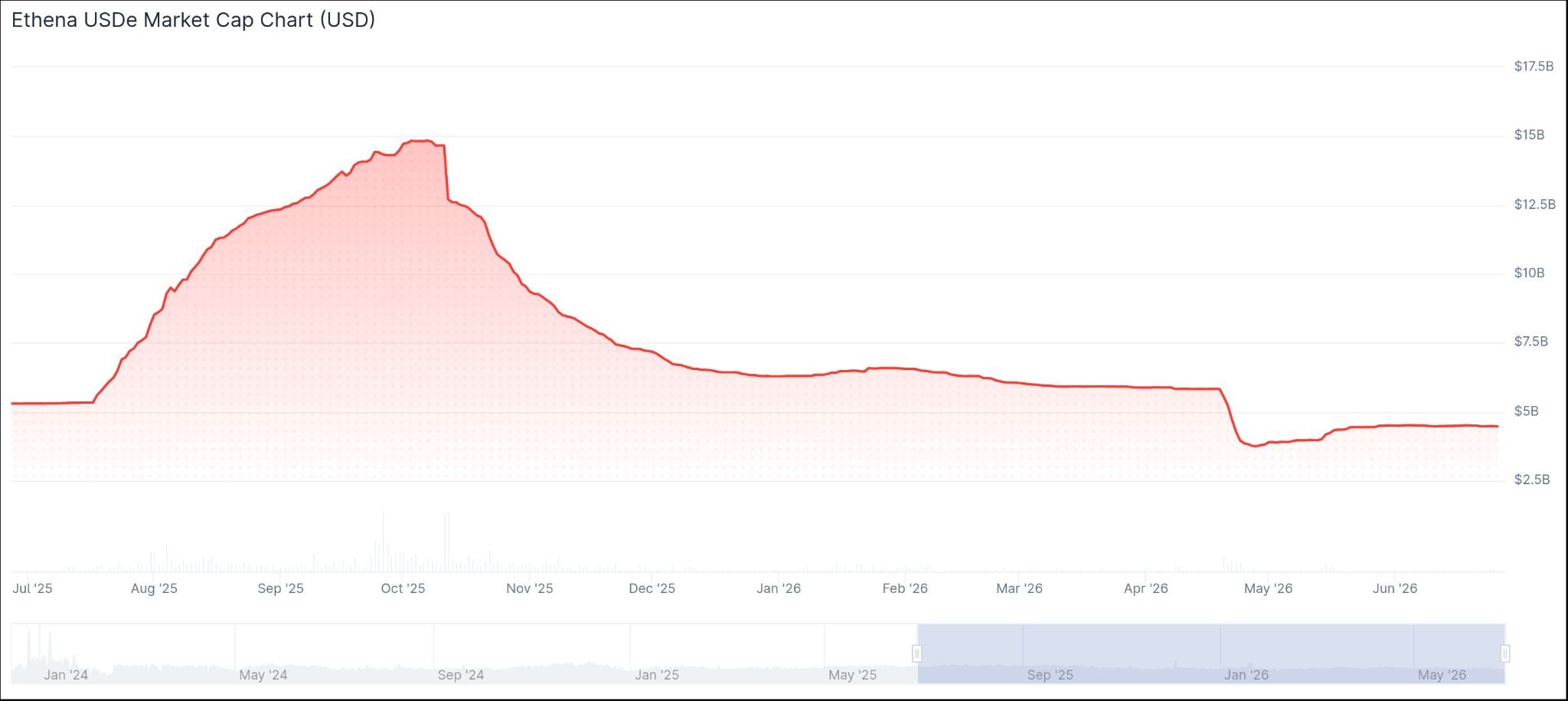
While stablecoin circulation has grown in recent years, USDe market capitalization has declined by 70% since its peak in October to around $4.5 billion today, ranking it sixth among stablecoins.
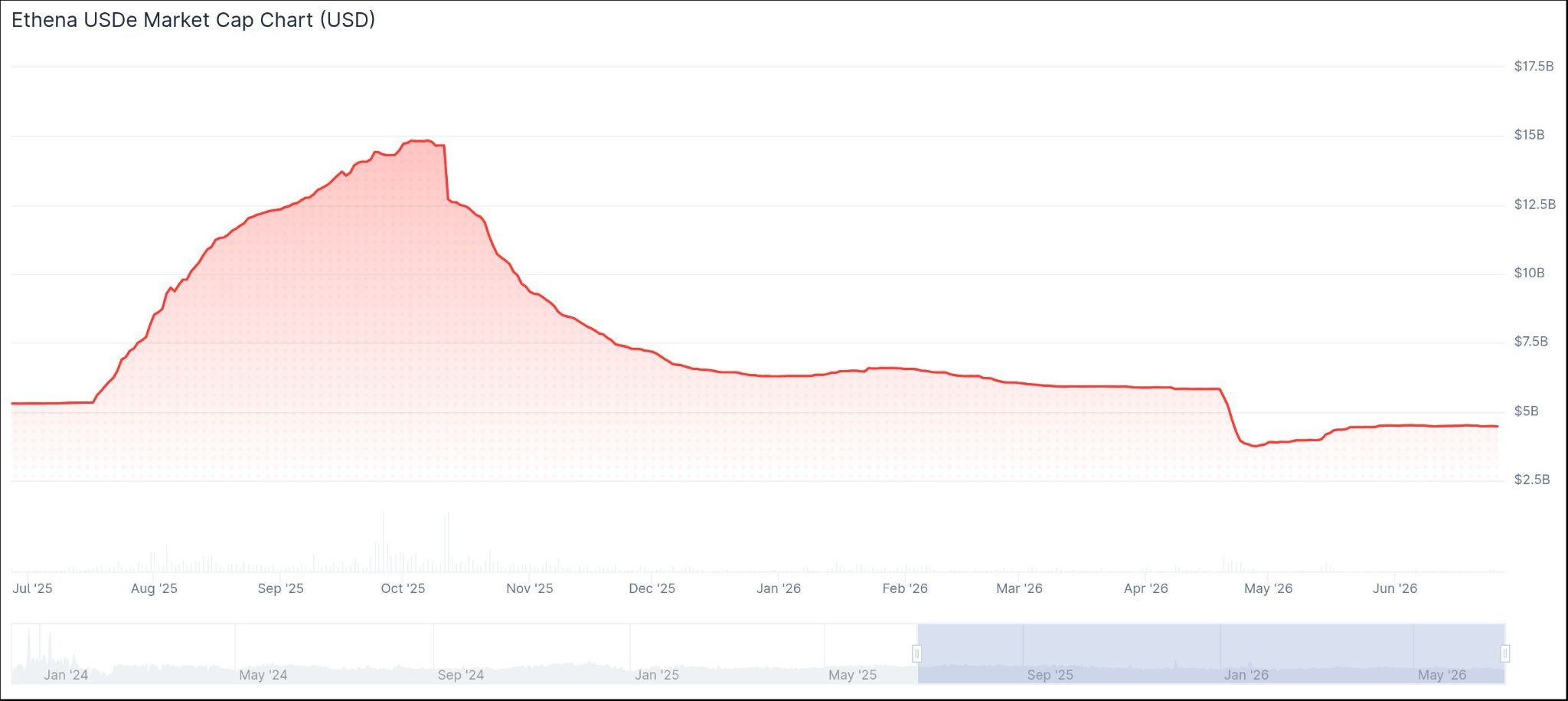
USDe supply has fallen since the bull market peak. Source: CoinGecko
StablecoinX’s treasury also holds approximately 3 billion Ethena governance tokens (ENA), or around 20% of the total supply, valued at approximately $275 million. The company announced a $360 million capital raise to purchase ENA on Sunday.
However, the asset is currently trading at $0.08, down 94% from its April 2024 all-time high.
Related: Yield-bearing stablecoins surge as Washington fights over yield
The company has three business lines: a decentralized verifier node (DVN) serving as a cross-chain message verifier for the Ethena ecosystem, a middleware software stack called “Stablecoin Harness” and distribution services, which are currently in development.
The company says the three businesses reinforce one another, though the broader crypto bear market presents a challenging backdrop for its Nasdaq debut.
Crypto SPACs and crypto treasuries have had a tough time this year as the broader market has tanked 52%, with $2.3 trillion leaving the space since October and crypto falling out of favor among investors.
Pre-merger TLGY fell 6.93% on Thursday on OTC markets to end the day trading at $9.40, according to Google Finance data.
Magazine: AI is banking the unbanked in Africa… faster than crypto


Kooc Media has introduced a fresh set of PR packages aimed at AI startups and software teams who need media coverage without the usual wait. The goal is simple: help these companies get seen quickly, reach buyers and investors, and stand out in a market that gets more crowded by the day.
The timing makes sense. Hundreds of new AI tools, agents, and software products hit the market each month, and most of them never get any attention. Plenty of founders have a solid product but no real plan for getting it in front of people. Kooc Media’s new packages are built to close that gap with quick, reliable coverage on trusted tech and finance sites.
Made for AI and Software Teams
A lot of agencies use the same playbook for every client, no matter the industry. Kooc Media has gone the other way. The packages were shaped around what AI startups, machine learning companies, automation tools, and software founders actually need.
That means coverage written for the right readers. Whether the product is a new AI agent, a language model tool, a developer platform, or a subscription software service, each campaign is matched to the brand’s audience and what it wants to achieve.
“Founders in this space don’t have time to sit around waiting for coverage,” said Michelle De Gouveia, spokesperson for Kooc Media. “We set these packages up so a team can ship a product and see real coverage within days. It’s quick, it’s clear, and it actually delivers.”
More details are available on the Kooc Media AI Companies PR page.
Real Placements, Not Just Pitches
The biggest weakness in old-school PR is that nothing is promised. Agencies send out pitches and cross their fingers. Founders end up paying for the attempt, not the outcome.
Kooc Media handles it another way. The company owns and runs its own group of news sites, including Blockonomi, CoinCentral, MoneyCheck, Parameter, Beanstalk, and Computing. Clients get articles that are actually published, not a spreadsheet of emails that went nowhere.
Since Kooc Media runs these sites directly, articles can go live the same day. That gives software and AI founders instant visibility right when they need it, whether that’s a launch, a raise, or a big update.
The full list of in-house sites is on the Kooc Media brands page.
Reach Across Major Outlets
Beyond its own sites, Kooc Media runs full newswire distribution to hundreds of partner websites and thousands of syndicated outlets.
Depending on the package, releases can also land on major financial and business networks. That includes coverage on sites such as Business Insider, Bloomberg, Benzinga, MarketWatch, USA Today, and Dow Jones feeds, plus other global platforms.
For founders, that kind of reach carries weight. Seeing a brand on names people already trust makes it easier to win over customers, partners, and investors.
A Free Spot on AgentLocker.ai
One of the standout parts of these packages is free placement on AgentLocker.ai, Kooc Media’s own directory of AI tools and agents.
AgentLocker.ai is a growing hub where people go to find new AI tools, agents, and software. It puts products in front of users who are already searching for fresh AI solutions.

Every client on an AI PR package gets listed and featured on AgentLocker.ai for free. It’s an extra route to visibility on top of the press coverage, and a place where the product keeps getting found long after the campaign wraps up.
Take a look at the directory at AgentLocker.ai.
Pairing press coverage with a dedicated AI directory listing means more value out of one package. Rather than paying separately for a listing and for PR, clients get both together.
PR Handled For You
Most AI and software startups run lean. They usually don’t have a marketing department or anyone focused on PR. Kooc Media covers that with managed PR creation run by its in-house editorial team.
Founders don’t have to write their own releases or articles. They share the details, and the Kooc Media team writes the content, publishes it, and pushes it out.
The work covers press release writing, sponsored articles, homepage placements, guaranteed publication on in-house sites, newswire distribution, and full reporting with live links to every placement.
That reporting matters. Clients get a clear breakdown of where their coverage ran, with direct links to each piece. Nobody has to wonder whether the job got done.
Set Packages or Custom Campaigns
Kooc Media offers both fixed packages and fully custom campaigns. The fixed options suit founders who want something quick and simple. The custom side is for brands that want a more tailored push across search, news, and social.
That range works for early teams launching a first product as well as bigger software companies running PR on an ongoing basis.
Backed by Years in Fast Industries
These packages are built for AI and software, but they’re part of Kooc Media’s wider work in fast-paced sectors. The agency has been active in crypto, fintech, tech, and iGaming since it launched in 2017.
Founders working across those overlapping areas can also check out Kooc Media’s crypto PR services and gambling PR services. Plenty of AI and software products touch these spaces, like trading tools, fintech apps, and gaming software, so that background adds real value.
Why This Helps AI Founders
AI is growing fast, but getting noticed is harder than ever. New tools appear daily, and most slip by unseen. Solid PR can be what separates a product that breaks through from one that stays buried.
By bringing together real coverage, same-day publishing, wide newswire reach, and a free AgentLocker.ai listing, Kooc Media gives AI and software founders a clear shot at visibility. The packages are quick, simple, and focused on results, which is what most founders are after.
For teams that want to launch fast and get noticed, these packages are a straightforward way to get a product in front of the right people.
Kooc Media’s AI packages are available now through the company’s website at https://kooc.co.uk.
Disclaimer: This is a Press Release provided by a third party who is responsible for the content. Please conduct your own research before taking any action based on the content.

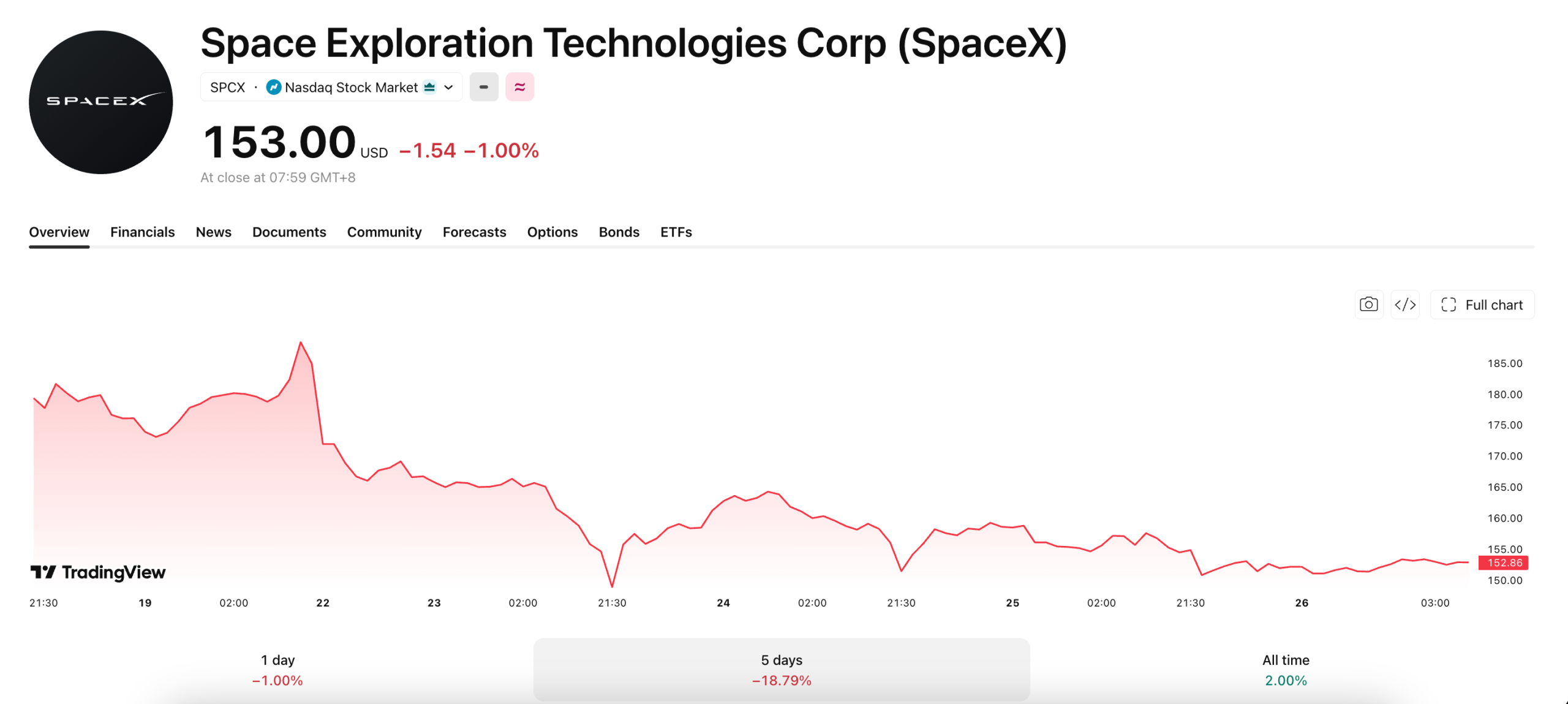
SpaceX went public on June 12. Fourteen days later, one of Europe’s largest asset managers is calling it a market top signal. Allianz Chief Investment Officer Ludovic Subran warned this week that SpaceX’s rapid return to capital markets has pushed a healthy rally into “bubble territory.”
The warning came days after SpaceX launched a $25 billion corporate bond sale, which rattled the price of shares in Elon Musk’s company. SPCX is down almost 19% over the last five days.
From Record IPO to Bubble Warning in 14 Days
Subran described SpaceX’s bond move as a prime example of markets shifting “from a healthy boom, a stretched boom . . . into bubble territory.” His core argument drew a sharp line between equity and debt investors.
“The guy just got $70 billion of funny money to play with to get us to space. Equity investors, you can take them to Mars. Bond investors are, like, ‘where is my coupon?’”
— Ludovic Subran, CIO, Allianz
The bond deal drew $89 billion in orders. Bankers upsized it from $20 billion to $25 billion to meet demand. SpaceX plans to use the proceeds to retire a $20 billion bridge loan it took on in March. Still, bond investors extracted a price premium.

The 2036 tranche priced at 1.4 percentage points above US Treasuries, roughly 0.4 points wider than similarly rated BBB peers, according to Bloomberg. Investment-grade US companies currently borrow at under 0.8 points above Treasuries, near a multi-decade low.
A Poster Child That Could Become a Catalyst
SPCX opened at $150 on June 12. It surged to an intraday high of $225.64 by June 16. Then it reversed. As of June 26, SPCX trades near $152 — a 32% drop from peak, erasing over $600 billion in market value in under two weeks.
That slide now reshapes the broader IPO pipeline. As BeInCrypto reported earlier this week, OpenAI leans toward pushing its own listing to 2027, citing choppy markets and weakening retail appetite after SpaceX’s turbulent debut.
Analysts had warned before the listing that SpaceX, OpenAI, and Anthropic together could flood public markets with roughly $3 trillion in new equity supply, more than the entire US IPO market raised from 2016 to 2025. Easy to imagine given the near $86 billion raised by SpaceX alone.
SpaceX’s bond sale adds another $25 billion to that total demand. Susquehanna started coverage of SPCX with a Neutral rating and a $170 price target. Morningstar set its best-case fair value at $169, flagging the stock as significantly overvalued at its peak.
SpaceX reports its first public earnings on August 6. That result will likely determine whether the post-IPO slide marks a correction or the start of something wider.
The post SpaceX Called a Market Top Signal Just 2 Weeks After Its $86 Billion IPO appeared first on BeInCrypto.
With just a couple of days left to the second most anticipated day throughout the year for Pioneers, the team behind the protocol published a new vibe coder campaign.
It will allow users to participate by joining relevant creator or developer communities, and they will have the chance to win Pi merchandise.
2 Days Left
March 14 and June 28 are arguably the most important days for the broader Pi Network ecosystem due to their resemblance to the mathematical constant π, from which the project derives its name. Each is highly anticipated by the community as they expect a major announcement, such as the token listing on Kraken, announced around March 14.
All eyes are now on June 28, known as Pi2Day. In the latest post on the matter, the Core Team outlined the new initiative:
“Pioneers can participate by joining relevant creator or developer communities and sharing why Pi may be useful for builders who already have prototypes or working apps built through AI platforms. Then submit your public post link in the Pi app for a chance to win Pi Network merchandise!”
Users can refer Pi vibe coders to the Pi App Studio, explain how externally created apps can connect with the ecosystem, and highlight the users, payments, ads platform, and “broader infrastructure available” through the project.
The team reaffirmed that the value proposition should be clear and as follows:
“In the Pi ecosystem, vibe coders building web apps with AI can make their app accessible to 60M+ engaged users, and run their app on built-in payments, identity, and ads infrastructure, by simply plugging their service or product into Pi Network.”
Pioneers can also introduce Pi to creator communities, describe how the Pi App Studio simplifies vibe creators’ integration with Pi, share stats on organic Pi app traction, and explain how devs and creators should explore the ecosystem.
No New ATL
Despite the excitement about the upcoming Pi2Day and the team’s continuous updates, the project’s native token headed south alongside the rest of the market in the past few days. PI was rejected at $0.14 last week, and the subsequent crash pushed it south to just over $0.12 yesterday.
However, it managed to remain above the all-time low marked on June 6 at $0.1189. Its rebound has been rather impressive, as it now trades at $0.13.
The unlocking schedule continues to be more favorable for the Pi bulls. The average number of tokens to be released daily remains below 4.3 million for the next month, which should, at least in theory, reduce the immediate selling pressure from investors who have been waiting for their coins for a while.

The post Major Pi Network Community Update for Pioneers Ahead of Pi2Day (June 28) appeared first on CryptoPotato.


Invesco has filed with the U.S. Securities and Exchange Commission to launch a tokenized money market fund that will invest in cash and short term U.S. Treasury securities for stablecoin reserve management.
Summary
- Invesco has filed to launch a tokenized money market fund designed for stablecoin reserve assets under the GENIUS Act.
- Superstate will provide blockchain based tokenization support and maintain the fund’s on chain shareholder registry.
- Invesco has joined BlackRock, State Street, ProShares and other asset managers competing to manage stablecoin reserves.
The U.S. Securities and Exchange Commission filing showed that Invesco plans to introduce the Invesco Stablecoin Reserves Onchain Fund, a portfolio that will invest in cash, cash equivalents, repurchase agreements, and short-term U.S. Treasury securities while maintaining a stable $1 net asset value. The proposed fund will operate within Invesco’s existing Short Term Investments Trust and will qualify as a Rule 2a-7 government money market fund.
The filing stated that the reserve portfolio is designed to satisfy asset eligibility requirements under the Guiding and Establishing National Innovation for U.S. Stablecoins (GENIUS) Act, which governs payment stablecoins in the United States. Stablecoin issuers must maintain one-to-one reserves in safe and liquid assets under the framework.
Superstate will act as the fund’s sub-transfer agent and maintain a blockchain-integrated shareholder registry that links conventional fund records with on-chain ownership tokens. The filing did not identify the public blockchain that will support the product, although it confirmed that tokenized shares will be issued on a designated public network.
The registration builds on an existing partnership between Invesco and Superstate. Earlier this year, Invesco assumed day to day portfolio management of Superstate’s tokenized U.S. Treasury fund, which managed roughly $900 million in assets. The product was renamed the Invesco Short Duration US Government Securities Fund while Superstate continued providing tokenization services through its FundOS platform.
Asset managers expand stablecoin reserve offerings
The filing adds Invesco to a growing group of traditional financial firms introducing products tailored for stablecoin reserve management after the GENIUS Act established a federal framework for reserve assets.
State Street launched the State Street Stablecoin Reserves Money Market Fund in June as a Rule 2a-7 government money market fund backed by State Street Bank and Trust Company and Anchorage Digital. The company said the product was created specifically to help stablecoin issuers satisfy reserve requirements under the GENIUS Act.
ProShares also entered the market earlier this year with its ProShares GENIUS Money Market ETF, trading under the ticker IQMM. The company said the ETF invests exclusively in short term U.S. Treasury securities and other government backed instruments to provide a compliant reserve management option for stablecoin issuers.
Among other players, BlackRock, Franklin Templeton, Fidelity, Morgan Stanley, BNY, JPMorgan, and Goldman Sachs have also introduced or filed products tied to tokenized money market funds or stablecoin reserve infrastructure as competition expands across the sector.
Citigroup has projected that the stablecoin market could grow from about $300 billion today to as much as $4 trillion by 2030. The bank said the expansion could create a significant market for firms that manage the cash and Treasury assets backing dollar denominated stablecoins.


The FBI is urging victims of the OneCoin cryptocurrency investment fraud to file compensation claims before the June 30 deadline.
Summary
- OneCoin victims must file by June 30 to seek compensation from DOJ’s official remission program.
- FBI says the claims process is free, but filing does not guarantee compensation for victims.
- Ruja Ignatova remains wanted, with authorities offering $5m for information leading to arrest.
The agency said the process applies to people whose OneCoin investments caused a net financial loss.
According to the FBI notice, victims can seek payment through a Department of Justice remission program. The program covers eligible individuals who bought OneCoin between 2014 and 2019 and suffered direct financial losses.
The FBI said the DOJ launched the official process through onecoinremission.com, which is managed by Kroll Settlement Administration. Victims can file petitions online, by mail or by email. The agency warned that filing a petition does not guarantee payment.
The process is free. The FBI said justice.gov and onecoinremission.com are the only authorized websites for the investigation. That warning is important because fraud victims are often targeted again by fake recovery agents.
Over $40m in seized assets available
The remission program will use more than $40m in forfeited assets recovered from figures tied to the OneCoin scheme. The funds are meant to provide partial relief to victims who lost money after accounting for any withdrawals they completed.
In the FBI notice, FBI New York Assistant Director in Charge James C. Barnacle Jr. said victims were misled by false statements and empty promises. He added that the FBI remains committed to “returning these stolen funds to their rightful owners.”
As previously reported, the DOJ opened a $40m compensation fund for OneCoin victims in April. The latest FBI notice gives victims a final reminder before the deadline closes.
The DOJ said in its official announcement that OneCoin was sold to investors through false claims about its value and use. U.S. Attorney Jay Clayton said the founders “sold a lie disguised as cryptocurrency.”
OneCoin’s fraud history
OneCoin began in Bulgaria in 2014. Prosecutors said Ruja Ignatova and Karl Sebastian Greenwood promoted it as a new virtual currency that could challenge Bitcoin. The project used the phrase “Bitcoin killer” to attract investors.
The FBI said OneCoin used a multi-level marketing structure. Buyers purchased packages that gave them tokens they were told could mine OneCoin. They were then encouraged to sell packages to friends, family and other investors.
The system created fast growth, but prosecutors said the product had no real value. The FBI said victims worldwide lost more than $4b. Greenwood was arrested in Thailand in 2018 and later extradited to the U.S.
Greenwood was sentenced to 20 years in prison in September 2023. He was also ordered to forfeit $300m. The case remains one of the largest crypto fraud cases ever pursued by U.S. authorities.
Search for Ignatova continues
Ignatova remains at large. The FBI said she led OneCoin until October 2017, when she was charged in the Southern District of New York. She was later added to the FBI’s Ten Most Wanted Fugitives list in June 2022.
The U.S. Department of State is offering up to $5m for information leading to Ignatova’s arrest or conviction. The FBI says anyone with information can submit a tip through its official tip line or online portal.
In a previous article, crypto.news discussed Ruja Ignatova’s place on the FBI’s most wanted list. Previously, crypto.news explored reports about where the OneCoin founder may be hiding, though her location remains unconfirmed.
The FBI also told people who believe they are victims of crypto investment fraud to report it through the Internet Crime Complaint Center. For OneCoin victims, the most urgent step is the June 30 remission deadline. After that date, late claims may not be considered.
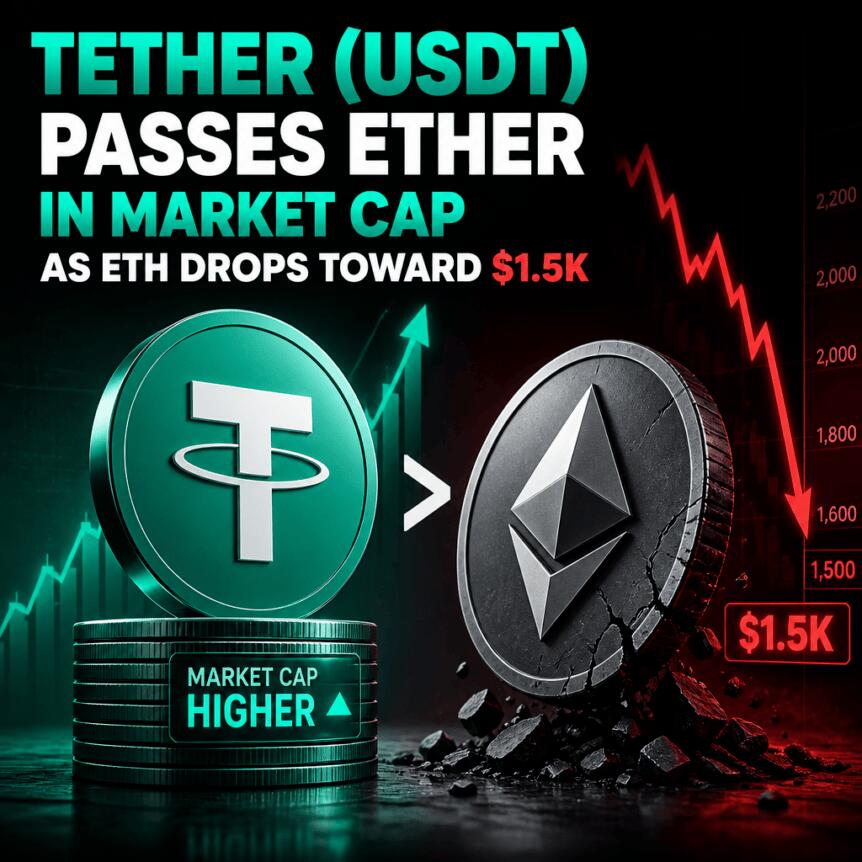
Ether slid to its lowest level of the year on Friday, and the move had an immediate knock-on effect across the market’s largest capitalizations. After a 5.2% drop over 24 hours, ETH’s market capitalization fell below $185 billion, with the token trading around $1,510 on Coinbase, according to TradingView.
That decline allowed Tether’s USDt to overtake ETH for the second-largest spot by market capitalization, with USDt at roughly $186 billion at the time of the flip. Analysts framed the outcome as a reminder that—at least in the current environment—many traders and users are choosing stability over volatility.
Key takeaways
- ETH’s selloff pushed its market capitalization below $185 billion, after a 5.2% 24-hour decline, according to TradingView.
- Tether’s USDt briefly rose to about $186 billion in market cap, overtaking Ether for the second-largest position.
- Market commentary linked the flip to ongoing stablecoin demand, which now represents almost 15% of total crypto market capitalization.
- Ethereum’s broader ecosystem has seen internal restructuring, but new R&D efforts via Ethlabs are also underway.
- Some Ethereum-aligned treasuries continued buying during the weakness, while Circle’s USDC also showed strength relative to XRP.
Why USDt overtook Ether as ETH hit a fresh low
The immediate trigger was Ether’s sharp downward move over a single day. TradingView data cited in the report shows ETH falling to around $1,510 on Coinbase, following the 5.2% crash. With ETH’s market cap dropping below $185 billion, USDt’s approximately $186 billion figure became large enough to move it into the #2 slot.
Bitrue Research Institute’s research lead, Andri Fauzan Adziima, told Cointelegraph that the overtake underscores how the market is currently “favor[ing] stability over ETH’s volatility.” The point wasn’t just about one day of price action—it was about what capital is rewarding in the moment.
Stablecoins keep growing even when the market turns
The USDt-versus-ETH flip aligns with a wider trend: stablecoins are steadily expanding their share of the crypto market. Cointelegraph notes accelerating stablecoin growth, citing that the category accounts for almost 15% of total crypto market capitalization.
In a Thursday post, 21Shares highlighted an important contrast with the last downturn: stablecoin supply contracted by more than 30% during the prior bear market, but is reaching record highs this time. The firm argued that the shift suggests stablecoins have become a defining use case rather than something that depends strictly on the market cycle.
“To us, that is the strongest evidence yet that stablecoins are one of crypto’s defining use cases – demand that no longer depends on the cycle.”
From a liquidity and trading perspective, deeper stablecoin balances can improve on-ramps and off-ramps and help sustain activity during volatility. Alvin Kan, chief operating officer of Bitget Wallet, also pointed to that angle, calling the flip a “notable milestone” reflecting stablecoins’ dominance.
“It demonstrates strong demand for reliable, liquid on- and off-ramps during periods of volatility, while serving as a reminder that ETH must continue delivering compelling utility and narrative momentum to maintain its position.”
Ethereum pressure, but active “buy-the-dip” behavior
While Ether’s price weakness drew attention, several Ethereum-related players reportedly leaned into the decline.
Crypto treasury company Sharplink made its first purchase in eight months, buying 5,000 ETH on Thursday after ETH’s drop. Bitmine, which is chaired by Tom Lee, also continued accumulating: it added 76,881 ETH last week, according to the coverage cited by Cointelegraph.
These actions don’t automatically reverse price trends, but they can be meaningful for sentiment and for how long-horizon holders behave when market conditions deteriorate. If treasuries continue converting into ETH at lower levels, it suggests confidence in the asset’s longer-term role even while short-term volatility punishes holders.
At the same time, the Ether slump has unfolded alongside changes to Ethereum’s institutional structure. Cointelegraph referenced executive departures and a 20% workforce reduction at the Ethereum Foundation. However, it also notes that a new nonprofit organization, Ethlabs, was launched this week by key EF developers and researchers and backed by Ether treasuries Bitmine and Sharplink, pointing to continued efforts focused on Ethereum research and development.
Broader capitalization moves: USDC vs. XRP
Ether wasn’t the only major asset showing relative strength or weakness during the market’s choppy session. The report also states that Circle’s USDC flipped Ripple’s XRP in market capitalization as XRP declined toward $1, its lowest level since November 2024.
At the time of the comparison mentioned in the coverage, XRP’s market capitalization was cited around $64 billion, compared with USDC’s roughly $73.6 billion. For investors tracking stablecoins, the takeaway is similar to what the USDt flip signals: stablecoin demand can be resilient even when other large coins experience extended drawdowns.
Looking ahead, the key question is whether ETH can reclaim critical support levels and sustain momentum, or whether stablecoins continue to widen their grip on market capitalization. Traders and investors will likely watch how stablecoin growth trends evolve alongside Ethereum’s institutional and R&D developments—especially if volatility persists.

Polymarket confirmed Friday that a compromised third-party vendor allowed attackers to inject malicious code into its frontend, draining about $3 million from fewer than 15 user accounts.
The platform says it will fully refund all affected users.
What Happened
The attack was first flagged by on-chain security researcher Specter, who posted that an apparent phishing campaign had drained funds from more than 11 victim wallets holding Polymarket’s PUSD stablecoin.
At the time, they estimated losses at $2.94 million, with PeckShield confirming the figure shortly after and noting that the attacker had bridged the stolen funds from Polygon to Ethereum and converted them into 1,893 ETH.
The prediction market acknowledged the breach through one of its official accounts, Polymarket Traders.
“This morning we discovered a 3rd party vendor had been compromised, injecting a malicious script into our frontend for some users. We’ve contained it and removed the affected dependency,” it wrote on X. “We’re contacting impacted users and refunding them in full.”
William LeGate, who works closely with the platform, echoed news about the compensation, repeating that the issue had been resolved and that affected users would get back their money in full.
Another blockchain security account, GoPlus Security, described the incident as a supply chain attack. It said that the malicious code affected about 15 accounts, with losses totaling $3 million, a conclusion that was also reached by Bubblemaps, which praised Polymarket’s response after the losses were contained.
A Recurring Problem
This is not the first time Polymarket has been hit. Last month, the platform disclosed another breach in which an admin wallet used for employee reward top-ups was drained of about $700,000, likely through a private key compromise. At first, crypto sleuth ZachXBT had estimated the losses to be around $520,000, with Bubblemaps later quoting the higher figure after tracking the funds across several addresses.
Developer Josh Stevens confirmed at the time that a 6-year-old private key had been exposed through an internal configuration and that the company had since rotated credentials and moved to key management services. However, that incident did not touch user funds or core contracts.
While the two incidents involved different attack methods, they both targeted systems outside Polymarket’s prediction markets themselves. Furthermore, the latest one has come at a time when the platform is already navigating other reputational headwinds, including a recent report by the Wall Street Journal, which claimed that it had paid college-age creators between $2,000 and $3,000 per month to post videos of staged bets on dummy versions of the Polymarket website, with not even one of the over 1,100 clips traceable to real blockchain activity.
There was also another controversy early this month when a trader claimed that they had lost $500,000 after the prediction service allegedly changed resolution rules for a market tied to Strategy’s Bitcoin sale.
The post Polymarket to Refund Users After Hackers Steal $3M in Frontend Attack appeared first on CryptoPotato.
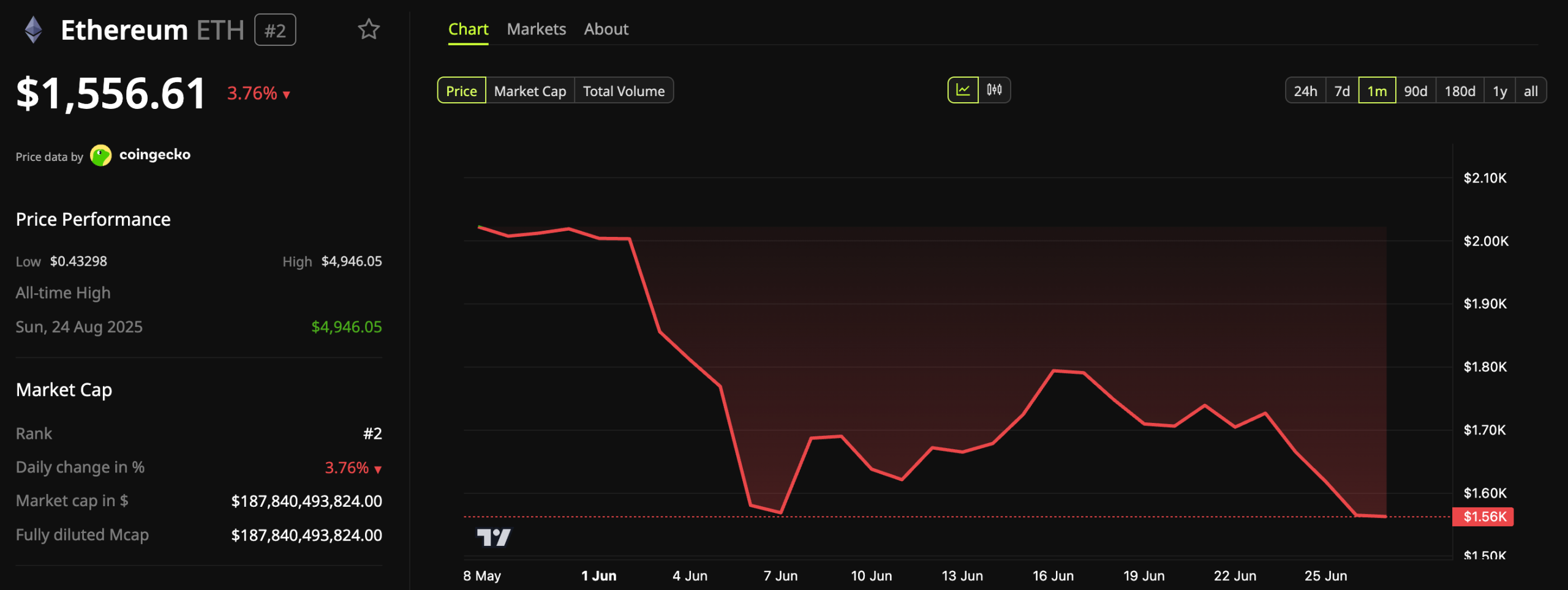
SharpLink has resumed buying Ethereum (ETH) for the first time in 8 months, adding 5,000 ETH to its holdings.
The move breaks a long buying pause and lands while ETH trades far below the price the firm paid to build its treasury.
SharpLink Return to Buying as ETH Slides
According to Lookonchain, the 5,000 ETH, worth about $7.85 million, came from FalconX. SharpLink holdings have reached 876,285 ETH valued at roughly $1.4 billion. This also includes 22,102 ETH earned through staking rewards.
The acquisition adds to a position trading well below cost. SharpLink’s average purchase price is $3,609, while ETH traded near $1,556 today. That gap leaves the firm with an unrealized loss of more than $1.7 billion.
Follow us on X to get the latest news as it happens

That gap reflects a steep market decline. Ethereum has posted two consecutive red quarters and is on track to close the second quarter lower.
The asset has dropped nearly 25% over the past month, according to BeInCrypto Markets. The fall outpaced Bitcoin (BTC), which lost 22% across the same period.
Institutional appetite has cooled alongside the sell-off. According to SoSoValue data, spot Ethereum ETFs have recorded outflows for six consecutive weeks, with outflows extending into this week. The trend signals weak demand.

Mounting Losses and a Wider Ethereum Bet
The buying resumes after a punishing quarter. SharpLink reported a net loss of $685.6 million for the first quarter of 2026.
Most of that came from non-cash unrealized losses on its ETH holdings. Staking revenue, however, lifted total revenue to $12.1 million from $0.7 million a year earlier.
SharpLink has also widened its Ethereum commitment beyond its own balance sheet. The firm helped fund Ethlabs, a nonprofit research lab backing Ethereum’s institutional push.
Subscribe to our YouTube channel to watch leaders and journalists provide expert insights
The post SharpLink Resumes Ethereum Buying After 8-Month Pause appeared first on BeInCrypto.
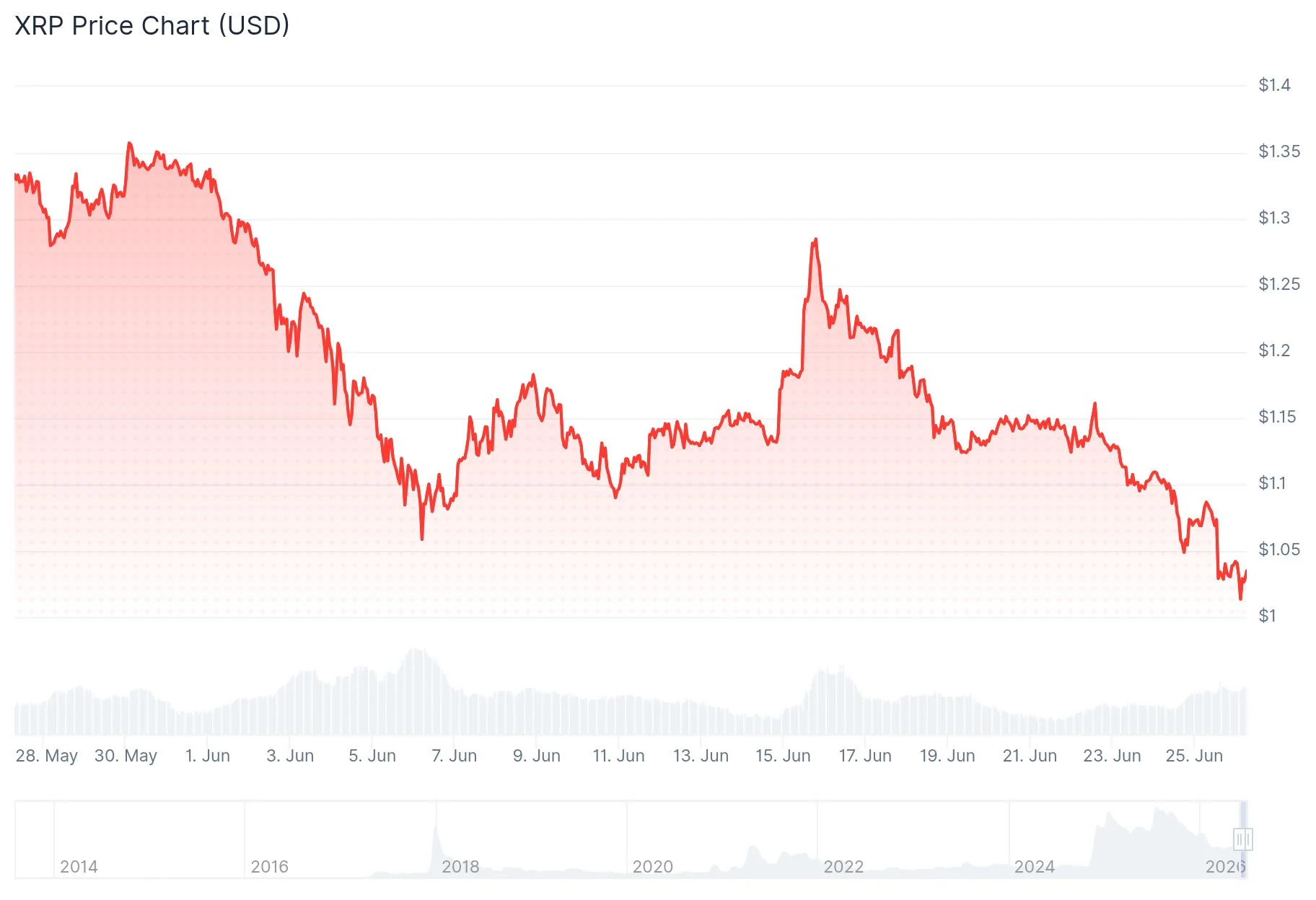
Key Takeaways
- XRP touched $1.01 on June 25, marking its lowest valuation in 2026 and matching levels not seen since November 2024
- The digital asset has declined 43% from the beginning of 2026
- Approximately 100 million XRP tokens exited Binance reserves during the last month
- Large holder accumulation stays in positive territory with 5.14 million XRP daily net average over 90 days
- XRP spot ETFs have attracted $243 million in combined inflows starting from April
On June 25, 2026, XRP plummeted to $1.01, establishing its weakest performance for the year. This valuation brings the cryptocurrency dangerously close to breaking beneath the $1 threshold for the first time since November 2024.
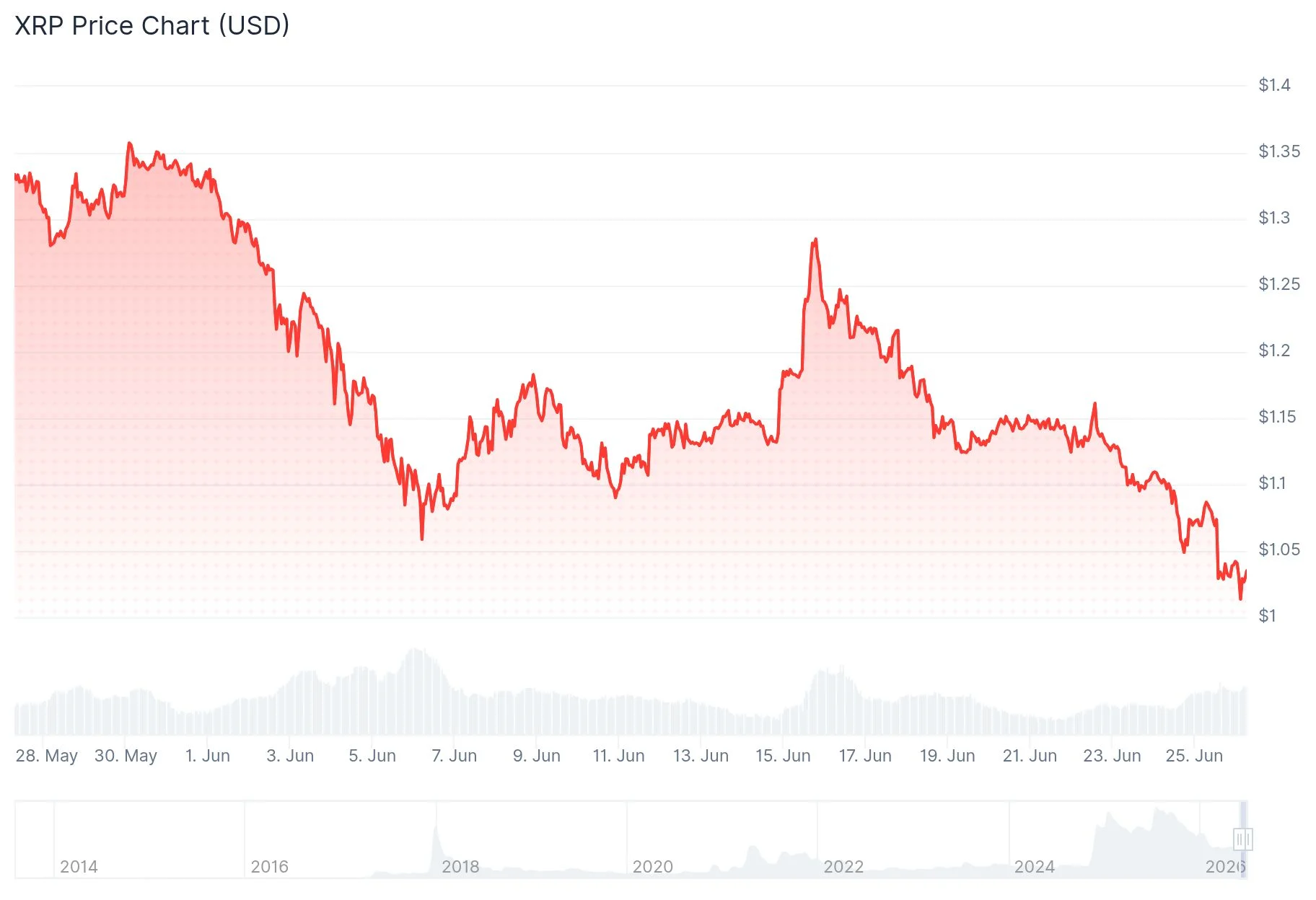
The digital currency has surrendered 43% of its value since January 2026. The wider cryptocurrency sector has similarly experienced pressure, with Bitcoin sliding under $58,200 during the same trading session.
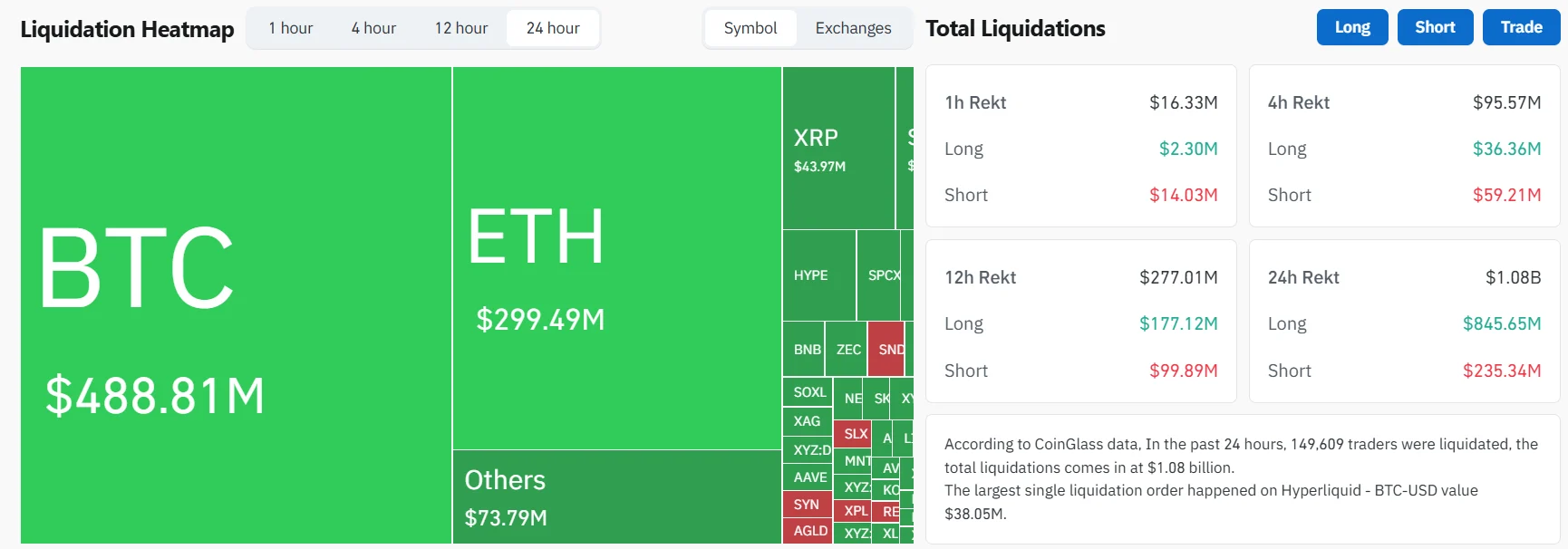
According to CoinGlass data, liquidations across the crypto market exceeded $915 million in the 24-hour window ending June 25. XRP contributed $42 million to this figure, with long positions representing $40.7 million of the total.
When XRP previously traded at comparable levels in November 2024, market dynamics were markedly different. Donald Trump’s presidential election victory had just occurred, triggering a widespread crypto market rally. During early November 2024, XRP was valued at $0.50 before experiencing a dramatic climb to $2.70 by December’s opening.
The token achieved its 2025 zenith of $3.65 during mid-July, coinciding with advancing clarity regarding its regulatory classification in the United States. The catastrophic market-wide flash crash on October 10 severely impacted prices, leaving XRP unable to recover momentum.
Market analyst Celal Kucuker published his perspective on X, projecting XRP’s floor at the $0.86–$0.87 zone, while identifying a ceiling target between $8–$9. His forecast correlates with Bitcoin stabilizing around $54,000.
Exchange Holdings Decrease Amid Rising Outflows
Blockchain metrics reveal a narrative diverging from price movements. XRP quantities stored on trading platforms have experienced consistent reductions across numerous exchanges.
Cryptocurrency researcher Amr Taha observed that Binance’s XRP holdings declined to approximately 2.68 billion tokens by June 25, down from 2.78 billion recorded on May 12. This represents roughly 100 million XRP departing the platform within a six-week timeframe.
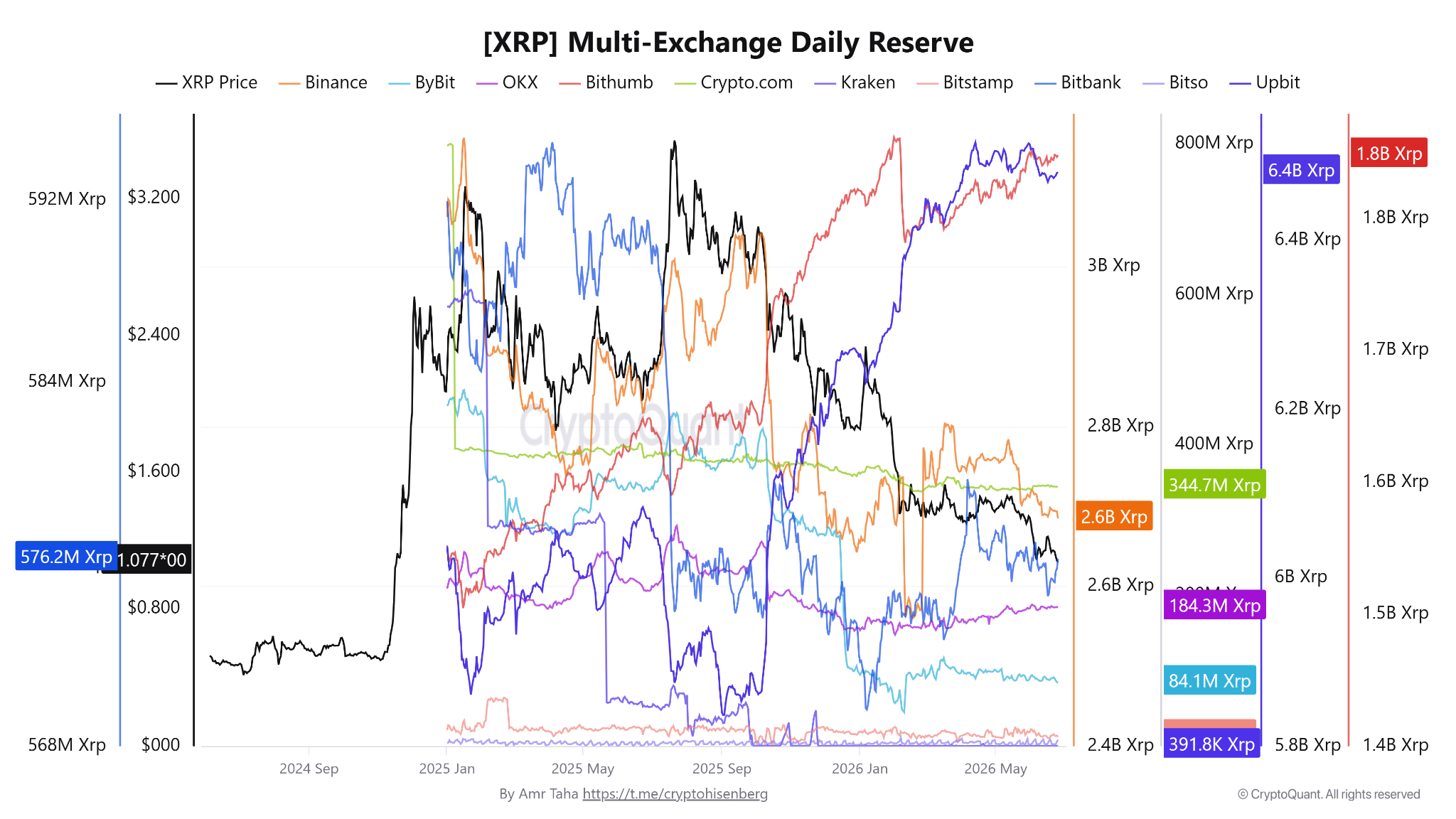
Upbit’s stockpile decreased from 2.51 billion to 2.48 billion XRP during the May 31 to June 25 period. Bybit witnessed a more pronounced percentage reduction, falling from 92 million to 82 million XRP since early June.
On Binance, withdrawal transactions have exceeded deposit activity for seven consecutive days beginning June 17. Withdrawals represented 53.8% of total flows on June 23, reaching the highest proportion since June 2024.
Major Holders and ETF Activity Show Continued Support
Significant XRP investors have maintained buying pressure. The 90-day rolling average for large holder net flows registered a positive 5.143 million XRP daily throughout the quarter.
Spot XRP ETF products recorded $2 million in net inflows on June 24, pushing June’s aggregate to $31 million. Since their April introduction, these funds have accumulated $243 million in total inflows.
ETF momentum has decelerated from initial enthusiasm. The products captured $666.61 million during November 2024 and $499.91 million in December. Throughout 2026, monthly inflows have fluctuated between $15.59 million in January and $131.94 million in May.
March remains the sole period recording negative flows, with $31 million in net outflows for the month.
At publication time, XRP was changing hands at $1.03.
Crypto World
The DATA Foundation Launches to Tackle AI’s Multi-Billion Dollar Training Data Bottleneck
[PRESS RELEASE – Palo Alto, United States, June 25th, 2026]
Story rebrands as The DATA Foundation, launches DATA Network with flagship Kled AI integration, registering 1.5 billion user-contributed records on the platform
The Foundation also introduces Trace, the first public audit layer for consent, licensing, and data provenance at scale
Today, Story announces a strategic transition to become The DATA Foundation (“DATA”) and launches Trace, an onchain registry for AI training data provenance and licensing. The launch includes a flagship integration with Kled, the world’s largest opt-in human data marketplace, registering 1.5 billion user-contributed records on the Network. Andrea Muttoni becomes CEO of The DATA Foundation, and Kled’s founder, Avi Patel, joins in an advisor position as the Chief Data Officer.
AI’s Training Data Has Hit a Bottleneck
The shift to DATA reflects where the market is pulling hardest. AI training data has emerged as the most valuable and least solved category of IP. Frontier AI labs have hit a multi-billion-dollar data bottleneck, where the internet has been effectively exhausted for scraping. The remaining supply is either expensive and bespoke or legally undocumented, leaving labs without a way to source data at scale, prove its provenance, or guarantee its quality.
The legal stakes are rising, as frontier labs stake out market-defining products on data sourced through opaque networks, often without clear records of consent or jurisdiction. Scraped and undocumented data is no longer an option for enterprise-grade AI.
“The challenge in AI has shifted from compute and architecture to sourcing and provenance. As the scrapable web fractures, the question for labs now is who is keeping the receipts,” said Andrea Muttoni, CEO of The DATA Foundation. “With Kled, we combine full data transparency and auditability with the largest pool of AI training data on the planet.”
Building the Infrastructure for Trusted AI Data
DATA builds on the original mission to deliver a data and intellectual property (IP) layer for the internet, recognizing that the form of data and IP that is most critical in this era is AI training data. DATA Network brings essential infrastructure for training AI, anchored by a flagship integration with Kled. Starting today, Kled’s licensing rails and contributor receipts run on DATA Network with added support for stable coin payouts, which involves registering a staggering 1.5 billion user-contributed records with programmatic legal safeguards.

“Frontier labs have exhausted the supply of high-quality, human-generated public text available on the open web. Suppliers showing data-sourcing provenance will win the next decade of deals, and that’s our bet,” said Avi Patel, CEO and founder of Kled and part-time advisory CDO of The DATA Foundation. “Instead of sourcing data blindly, Kled’s data marketplace and DATA’s auditable chain of custody converge on what labs actually need to license data with confidence and transparency.”
Trace Launches as the Public Audit Layer for AI Training Data
Trace, The DATA Foundation’s public audit and search platform, also launches today alongside the Kled integration. Trace generates immutable, confidential receipts for every contribution, allowing labs to verify the legitimacy of datasets in seconds. For every single record uploaded by users worldwide, a receipt on DATA will be generated, enabling upstream compensation for contributors’ data and intellectual property. This addresses an urgent need for a verifiable and compliant AI training data market, which has become a legal and operational minefield.
A Wider Contributor Network
DATA’s thesis was validated by Poseidon, the AI data processing project incubated by Story, which cleans, normalizes, and scores raw human data for authenticity and quality, ensuring every record that reaches a buyer is model-ready. Poseidon’s early traction with frontier labs proved the AI training data opportunity. Backed by a16z and now running entirely on DATA, its contributor app Numo is live today, bringing thousands of contributors into the AI economy in exchange for real-time payouts.
“We started Story to build an IP layer for the internet, and the most important IP of this era is the data you can’t scrape: how a surgeon’s hands move, how a robot grips, how people speak, drive, and work in the real world,” said SY Lee, CEO of PIP Labs and strategic adviser to The DATA Foundation. “DATA is where that conviction goes next: an end-to-end network that proves real-world data’s origin, licenses it, and pays the people who made it. “
Token Migration and Ecosystem Continuity
The $IP token migrates to $DATA one-to-one with no action required from existing holders. Migration guidance, exchange timing, and an FAQ are available here.
About The DATA Foundation
Data is the biggest bottleneck in frontier AI. The data models need most either sits siloed with people and companies, or doesn’t exist yet, and won’t, until incentives are aligned to create it. DATA Network is the world’s AI audit rails built to answer the three questions every lab asks: can you source data at scale, prove where it came from, and guarantee its quality? Contributor apps including Numo and Kled supply opt-in human data; Trace gives every record a public, tamper-proof receipt; Poseidon turns it into model-ready datasets, so frontier AI can keep advancing on a foundation it can trust. $IP is now $DATA. More information available at datafdn.org.
The post The DATA Foundation Launches to Tackle AI’s Multi-Billion Dollar Training Data Bottleneck appeared first on CryptoPotato.

How Minnesota Governor reacted to Naz Reid getting traded to Charlotte Hornets

Amazon and Microsoft join new nonprofit’s push to help American workers navigate the AI economy

Met Office says temperatures will drop by 10C as big weather change coming


-

 Fashion7 days ago
Weekend Open Thread: Miami – Corporette.com
-

 Entertainment5 days ago
Renter of Home in Anne Heche Crash Denies Settlement With Son
-
 Sports3 days ago
Two goals and an assist by sheer aura: Cristiano Ronaldo just entered the World Cup chat
-

 Tech4 days ago
Microsoft accidentally kills epic Outlook email threads
-

 Business5 days ago
Soccer-U.S. defends Iran World Cup travel restrictions, says discussions ongoing
-

 Politics6 days ago
Andy Burnham and the meaning of Makerfield
-

 NewsBeat7 days ago
Keir Starmer Allies Question His Chances For No 10
-

 Tech12 hours ago
A Look At A Gaggle Of Transputer Boards
-
Crypto World2 days ago
Bitcoin (BTC) Dips Below $62K, Ethereum (ETH) Plunges 6% Daily: Market Watch
-

 Politics6 hours ago
Potential 2028er World Cup attendee leaderboard
-

 Crypto World2 days ago
Securitize Wraps Roubini's SEC-Registered ETF as Dubai VARA Digital Security
-
Business2 days ago
Entergy settles forward sale agreements, raises $672 million in cash proceeds
-
 Business6 days ago
Wall Street Week Ahead: Investors see Micron earnings as pulse check of AI rally momentum
-
 Crypto World6 days ago
Can Charles Hoskinson Really Rescue Cardano?
-

 Crypto World6 days ago
HIVE shares jump as $220M AI deal speeds Bitcoin mining pivot
-

 Crypto World6 days ago
Jake Chervinsky accuses CME of protecting derivatives monopoly
-

 Entertainment6 days ago
Jose Alvarado Wants Taylor Swift at More Knicks Games
-
 Tech5 days ago
Signal’s Meredith Whittaker says AI chatbots ‘are not your friends’ and calls Copilot agents a backdoor
-

 Sports19 hours ago
India vs Bangladesh LIVE Score, Women’s T20 World Cup: Bangladesh Opt To Bat; India Enter ‘Do-Or-Die’ Stage As Semi-Final Race Heats Up
-

 Tech4 days ago
Nearly 7,000 fake Amazon domains registered ahead of Prime Day 2026, researchers warn
You must be logged in to post a comment Login