

Crypto World
Standard Chartered backed Anchorpoint set to launch HKDAP stablecoin: report



Standard Chartered-backed Anchorpoint has prepared to launch its Hong Kong dollar stablecoin HKDAP, with a joint announcement expected before the end of July, according to local media.
Summary
- Standard Chartered and Anchorpoint are expected to announce the launch of the Hong Kong dollar stablecoin HKDAP within the next two weeks, according to local media.
- HKDAP received one of Hong Kong’s first stablecoin issuer licenses in April and will be backed one to one by Hong Kong dollar reserves.
- The stablecoin completed a successful Ethereum mainnet transfer test in May ahead of its planned public rollout.
According to local media citing market sources, Standard Chartered Bank (Hong Kong) and Anchorpoint Financial Technology are expected to announce the rollout of HKDAP, a Hong Kong dollar-pegged stablecoin, within the next two weeks.
The report said the launch will come through Anchorpoint, one of the first two companies to receive a stablecoin issuer license from the Hong Kong Monetary Authority (HKMA) in April.
If confirmed, the announcement would move the project from regulatory approval into public issuance after months of technical preparation under Hong Kong’s stablecoin framework.
HKDAP moves toward issuance
Anchorpoint is a joint venture backed by Standard Chartered Bank (Hong Kong), HKT and Animoca Brands. When the HKMA granted its first batch of stablecoin issuer licenses in April, Anchorpoint said it planned to begin issuing HKDAP in phases during the second quarter of 2026 under Hong Kong’s Stablecoins Ordinance.
According to Anchorpoint’s earlier announcement, every HKDAP token will be backed one-to-one by high-quality Hong Kong dollar reserves held in segregated accounts, following the reserve and disclosure requirements laid out by the HKMA for fiat-referenced stablecoins.
Earlier company statements also said HKDAP would follow a business-to-business-to-consumer (B2B2C) rollout model before expanding to wider use.
Ethereum testing completed before launch
The expected launch follows a successful Ethereum mainnet transfer test completed in May involving Anchorpoint, licensed digital asset platform OSL Group, and PantherTrade, a trading platform backed by Futu Holdings.
According to participants in the test, the transaction demonstrated that HKDAP could be issued, transferred, and settled on Ethereum’s public blockchain using production-ready infrastructure rather than a sandbox environment. A spokesperson involved in the trial said the transfer validated both the technical architecture and the compliance framework ahead of commercial issuance.
Anchorpoint has previously said deploying HKDAP on Ethereum will allow interoperability with existing wallets, exchanges, and decentralized finance applications while maintaining regulatory oversight under Hong Kong’s licensing regime.
The stablecoin project forms part of Hong Kong’s effort to establish a regulated digital payment asset tied to the Hong Kong dollar as jurisdictions across Asia continue developing licensed stablecoin frameworks. The HKMA issued its first stablecoin issuer licenses to Anchorpoint and HSBC in April under rules requiring full reserve backing, segregated customer assets and ongoing regulatory supervision.



Michael Saylor, co-founder and executive chairman of Strategy, published a 110-point essay on X on July 18 urging the Bitcoin network to reject BIP-110, the "anti-spam" soft fork proposal, in a rare foray into protocol governance. The essay, titled "110 Reasons BIP 110 Is a Bad Idea," had drawn… Read the full story at The Defiant
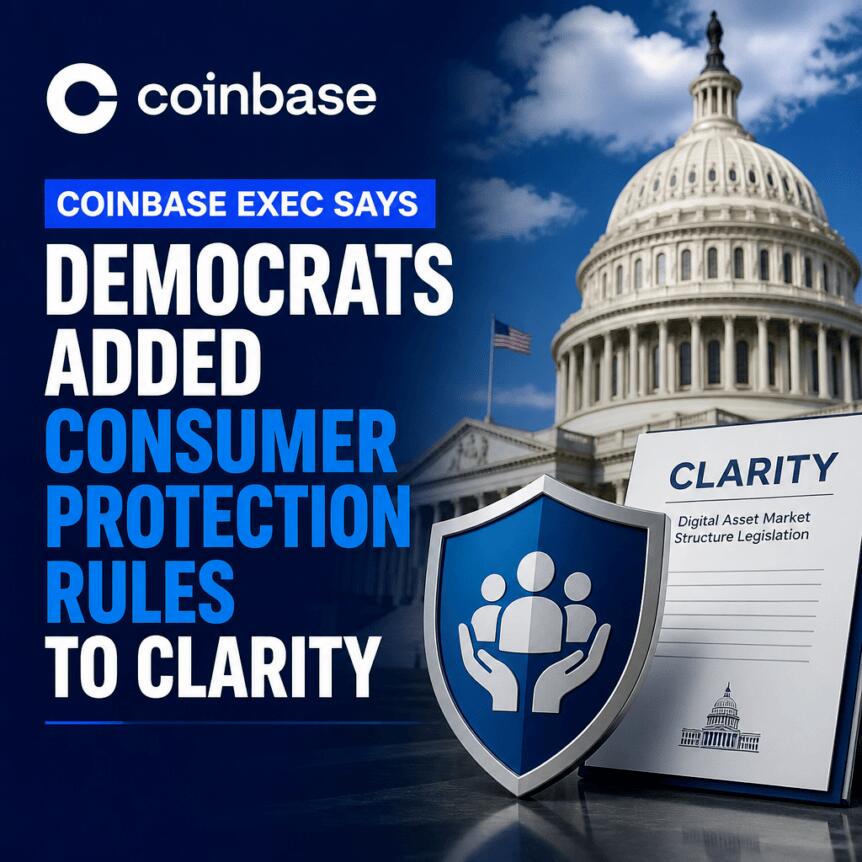
With a US Senate vote on the Digital Asset Market Clarity (CLARITY) Act appearing increasingly close, negotiations are continuing behind closed doors over the bill’s final text. In an interview with CNBC published Monday, Coinbase vice chair Ryan VanGrack said Democratic lawmakers have been adding additional customer-facing protections as the Senate works through the last drafts, framing the changes as giving the legislation “more teeth.”
VanGrack emphasized that the bill’s focus should remain on consumers, arguing that the current regulatory “status quo” does not provide adequate infrastructure for customer protection. However, he did not address whether lawmakers are also finalizing ethics-related provisions—an issue some Democrats have said will be necessary for them to support the bill.
Key takeaways
- Coinbase leadership says Democratic lawmakers are strengthening the CLARITY Act’s customer protections as final Senate negotiations continue.
- Ethics provisions remain a potential sticking point, with some Democrats indicating they may oppose the bill without them.
- Political dynamics are shifting as the White House signals support, including comments tied to the death of Senator Lindsey Graham.
- Senate timelines are still uncertain: as of Monday, lawmakers had not released the final bill text or scheduled a floor vote.
- Coinbase’s earlier public objections to an earlier version of the bill may have affected Senate committee progress.
Customer protections become the latest battleground
In his CNBC remarks, VanGrack described the ongoing negotiation as fundamentally about consumer safeguards. “At the end of the day, this is about customer protections,” he said. He added that “the status quo lacks this infrastructure, lacks these protections,” and that Democrats used the opportunity to ensure customers are “first and foremost” in the legislation.
The comment matters for both investors and users because the practical impact of market-structure bills is often determined by details: how customer assets are handled, what disclosures are required, and what enforcement mechanisms exist when firms fail to meet obligations. If the CLARITY Act’s final version meaningfully strengthens those provisions, it could reduce regulatory ambiguity for exchanges and other digital asset intermediaries while tightening compliance expectations.
Ethics provisions could determine whether support holds
While VanGrack highlighted customer protections, he did not explicitly confirm any progress on ethics provisions. That omission is notable because multiple commentators cited earlier by Cointelegraph have described ethics provisions as something Democrats may require before they vote for the bill.
For lawmakers, this creates a narrow path: the bill must satisfy both regulatory policy goals and political accountability demands. For market participants, it means the primary risk may not be whether CLARITY is “good enough” on paper, but whether it can clear enough procedural and party approval hurdles in time—especially if ethics language becomes a last-minute bargaining chip.
From SEC case dismissal to renewed momentum
CLARITY’s drive to reshape US crypto regulation comes in the context of a major legal reset. Under the Biden administration, the SEC sued Coinbase alleging the company operated as an unregistered securities exchange, broker, and clearing agency. The case was later dropped after Donald Trump took office, with Mark Uyeda—Trump’s pick for acting SEC chair—heading the agency.
That backdrop helps explain why the bill is being treated as unusually comprehensive. A market-structure law would not only influence how existing enforcement is conducted, but also shape what regulated activity looks like going forward. Even so, the bill’s future still depends on Senate consensus: the fact that one major enforcement dispute was resolved does not automatically eliminate legislative disagreement on customer rules or ethics.
Why the bill’s path has been uneven
The CLARITY Act has not moved in a straight line. Coinbase’s internal stance may have contributed to earlier procedural friction. The article notes that Coinbase CEO Brian Armstrong announced in January that the exchange could not support the legislation “as written,” and that this may have delayed a markup of an earlier version in the Senate Banking Committee.
Since then, several Coinbase executives—including chief legal officer Paul Grewal—have reportedly moved to publicly support passage of the bill, according to a post shared on X. That shift suggests the final negotiating draft may have incorporated changes Coinbase demanded. But it also underscores why investors should be careful about assuming political progress automatically resolves industry concerns: support can evolve as language changes, and the Senate’s final text may still differ from earlier versions that drew criticism.
Beyond the policy debate, the political environment is intensifying. After the death of Senator Lindsey Graham, Trump said on social media that members of the Senate should pass CLARITY “in honor of” the South Carolina lawmaker, calling him “a big supporter” of the bill. Separately, reports referenced by Cointelegraph say Republican lawmakers met with Trump to discuss the legislation amid Democrats’ worries about the president’s connections to the crypto industry.
As of Monday, lawmakers had not released the final text of the bill and had not scheduled a floor vote, leaving timing uncertain even as negotiations continue.
What to watch next as the Senate weighs the final draft
The near-term focus should be on whether the Senate publishes the final CLARITY Act text and, crucially, whether ethics provisions are addressed in a way that satisfies skeptical Democrats. If those elements are resolved, momentum could accelerate quickly; if not, customer-protection improvements may still fall short of what is needed for the bill to clear the chamber.


Hackers have disabled Kenyan President William Ruto’s official website, replaced its homepage and demanded a ransom of 5 Bitcoin.
Summary
- Hackers defaced Kenyan President William Ruto’s website and demanded a ransom of 5 Bitcoin.
- Kenyan authorities found no evidence that sensitive data was accessed, stolen, or lost.
- State investigators and external partners are examining how attackers breached the website’s security.
According to a report, the Kenyan government opened an investigation after attackers took control of president.go.ke on July 18 and posted insulting messages directed at Ruto. The hackers also threatened to release unspecified information unless officials paid the ransom by Saturday evening.
William Kabogo, cabinet secretary for Kenya’s Ministry of Information, Communications and the Digital Economy, confirmed that the government’s ICT Authority activated its cybersecurity response protocols after detecting the breach. Officials restricted public access to the website while technical teams worked to contain the attack and begin a forensic review.
“At this time, there is no evidence of unauthorized access to sensitive data, data exfiltration, or loss of information. Government systems and digital services remain secure and operational.”
Despite the government’s assurance, the website remained unavailable as of 1:51 p.m. EST on July 18, according to the original report. Officials had not publicly confirmed whether they contacted the attackers or considered paying the requested Bitcoin.
The report also did not identify the hackers, explain how they entered the website, or specify what information they claimed to possess. Bitcoin transactions can be viewed on a public blockchain, but the attackers’ wallet address was not included in the available details, preventing an independent review of any payment activity.
Kenya says sensitive government data remains secure
State House officials confirmed that government technical teams were working with the National Computer and Cybercrime Coordination Committee, known as NC4, and external technical partners. Their review focused on restoring the presidential portal and identifying how the attackers passed its security controls.
Kabogo’s statement separated the compromised public website from Kenya’s other government systems, which he described as secure and operational. Authorities had found no evidence of stolen or lost sensitive information at the time of the update, although the forensic investigation remained active.
July’s incident followed another attack on Kenyan state infrastructure in November 2025. According to the report, the coordinated operation briefly compromised several ministry websites and increased scrutiny of the security protecting the country’s digital public services.
An NC4 report recorded billions of cyber threats against Kenya’s government systems and critical infrastructure during a three-month period earlier in 2026. In response, Kenyan authorities have continued efforts to standardize how cybercrime cases are investigated across the country, according to the report.
The demand for Bitcoin placed a crypto payment at the center of the presidential website breach, but Kenyan officials had not attributed the attack to a known ransomware group. Authorities also had not disclosed whether the ransom message contained a payment deadline beyond Saturday evening or evidence supporting the threatened leak.
Crypto-linked breaches keep regulators on alert
Kenya’s investigation comes as governments and financial regulators examine separate attacks involving crypto platforms, executives and state-backed cyber groups.
Earlier in July, Airbnb CEO Brian Chesky confirmed that hackers had compromised his X account after it published a long thread about blockchain-based real-world asset tokenization. The posts discussed digital ownership and financial markets in enough detail that some observers and publications initially treated them as genuine comments from the Airbnb chief.
After the posts were removed, Chesky acknowledged the compromise and joked about the unexpected audience it brought to his profile. His account did not promote a token sale or request a crypto payment in the material described, but the incident showed how attackers can use a recognized executive’s identity to make blockchain-related claims appear credible.
South Korea’s Financial Supervisory Service has also begun a formal sanctions process against Dunamu, the operator of Upbit, following the exchange’s November 2025 wallet breach. SBS reported that the regulator sent Dunamu an inspection opinion letter after examining whether Upbit met its obligations under the Virtual Asset User Protection Act.
South Korean reports valued the Upbit assets affected by the attack at 44.5 billion won, or roughly $32 million at current exchange rates, while an earlier crypto.news estimate placed the loss near $36 million. The incident involved Solana-based assets held by the exchange.
Upbit stated that it transferred assets to cold wallets, suspended deposits and withdrawals, and began tracing the stolen funds after detecting unusual transfers. The company also promised to cover customer losses with its own money, while authorities reviewed the security failure and the timing of its public disclosure.
At the government level, G7 leaders called for coordinated action against North Korea’s cryptocurrency thefts and cybercrime following their June summit in Evian-les-Bains, France. Their geopolitical statement linked the issue to concerns about Pyongyang’s nuclear and ballistic missile programs.
Although the G7 statement urged member countries to act together, it did not announce new sanctions, crypto exchange requirements or mixer restrictions. The leaders also provided no schedule for enforcement against wallets, platforms or intermediaries suspected of handling stolen funds.


Tether Gold has gained commodity status in Abu Dhabi, as DefiLlama data shows XAUT’s locked value has climbed more than threefold to about $2.86 billion over the past year.
Summary
- ADGM recognized Tether Gold as an Accepted Spot Commodity for approved regulated firms.
- XAUT’s locked value more than tripled over the past year to $2.86 billion.
- Tether is expanding across tokenized gold, US payroll payments and Latin American banking.
Abu Dhabi Global Market has recognized XAUT as an Accepted Spot Commodity, allowing regulated firms in the international financial center to provide services involving the tokenized gold asset when they hold the required permissions.
Under the designation, eligible companies can add XAUT-related products to their regulated offerings inside ADGM. Tether CEO Paolo Ardoino described the decision as a clearer route for approved firms seeking to support the asset, while ADGM linked the addition to an expanded selection of products available within the financial center.
The decision follows ADGM’s earlier recognition of Tether’s USDT as an Accepted Fiat Referenced Token. With both assets now accepted under separate regulatory categories, Tether can place its dollar stablecoin and gold-backed token within one of the Middle East’s largest international financial centers.
ADGM’s treatment of XAUT applies only to firms that secure the relevant regulatory approvals. The designation does not give every company operating in the financial center automatic permission to offer trading, custody or other XAUT services.
Tokenized gold demand has lifted XAUT’s locked value
DefiLlama figures show that Tether Gold’s total value locked has risen from approximately $826 million to $2.86 billion within a year. Based on those figures, the increase amounts to about 246%, placing XAUT among the largest products in the tokenized commodity market.
RWA.xyz estimates that tokenized commodities hold about $4.46 billion in distributed value. The data platform places the full tokenized real-world asset market at roughly $34.73 billion, giving commodities a share of nearly 13%.
Against those figures, XAUT’s reported $2.86 billion in locked value represents a substantial portion of the commodity category tracked by RWA.xyz. Differences between TVL and distributed-value methods mean the two datasets are not directly interchangeable, but both indicate that gold-backed tokens account for a large share of commodity tokenization.
Use cases for XAUT are also moving beyond spot trading and custody. Bitcoin lending platform Ledn announced in June that it plans to accept the token as loan collateral later this year, which would let customers borrow against tokenized gold without selling their holdings.
Ledn’s planned integration would place XAUT inside a crypto-backed lending product, adding a borrowing function to an asset mainly used for gold exposure. The company has not yet disclosed detailed terms such as loan-to-value ratios, interest rates or the exact launch date.
For regulated firms in ADGM, the new status could make similar services possible when their licenses cover the relevant activity. ADGM’s announcement, however, did not identify which firms intend to add XAUT or set a timeline for the first regulated offerings.
Tether is extending its reach across payments and finance
Beyond tokenized gold, Tether has continued investing in payment systems and financial platforms. Last week, crypto.news reported that the company led a $7 million Series A round for Pact Labs alongside Blockchange Ventures and Lasagna.
According to crypto.news, the financing will support Pact Labs’ payroll and payment infrastructure while helping businesses adopt USAT, Tether’s dollar-backed stablecoin designed for the US market. The partnership focuses on wage payments rather than crypto trading, targeting a US payroll sector that processes more than $11 trillion each year.
Another investment has extended Tether’s presence in Latin American finance. Bloomberg reported that the company contributed $20 million to a $197 million equity round for Argentine digital bank Ualá, adding the platform to Tether’s portfolio of stablecoin-related investments.
Ualá announced the round in March and identified Tether among the participants, though it did not disclose the issuer’s contribution at the time. Allianz X led the financing, while Bloomberg later reported the size of Tether’s individual investment.
These investments come as Tether faces questions over USDT’s future availability on US crypto platforms. CoinDesk reported that the first anniversary of the GENIUS Act has renewed attention on whether the foreign-issued stablecoin can meet the law’s requirements before its transition period ends.
President Donald Trump signed the Guiding and Establishing National Innovation for U.S. Stablecoins Act into law one year ago, introducing a three-year compliance window. CoinDesk reported that uncertainty remains over how some deadlines will apply to foreign issuers such as Tether.
Circle has taken steps to align its operations with the incoming US framework, according to the report, while Tether has not publicly explained how it plans to bring USDT into full compliance.
The ADGM recognition gives XAUT a defined regulatory route in Abu Dhabi while Tether develops separate products and investments across gold, payroll and digital banking. USDT’s position in the United States, however, will depend on how regulators implement the GENIUS Act and whether Tether satisfies the final requirements.
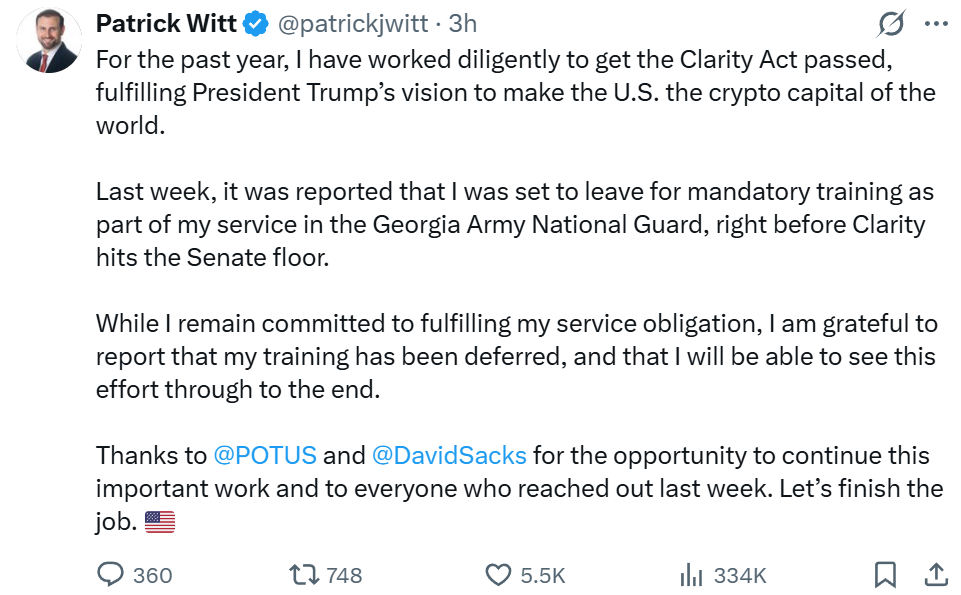
The White House’s top crypto adviser Patrick Witt said he will no longer take a leave of absence at the end of the month for military training, allowing him to remain at the White House to help advance the CLARITY Act in the Senate.
“Last week, it was reported that I was set to leave for mandatory training as part of my service in the Georgia Army National Guard, right before Clarity hits the Senate floor,” Witt said in an X post on Monday.
“While I remain committed to fulfilling my service obligation, I am grateful to report that my training has been deferred, and that I will be able to see this effort through to the end,” he added.
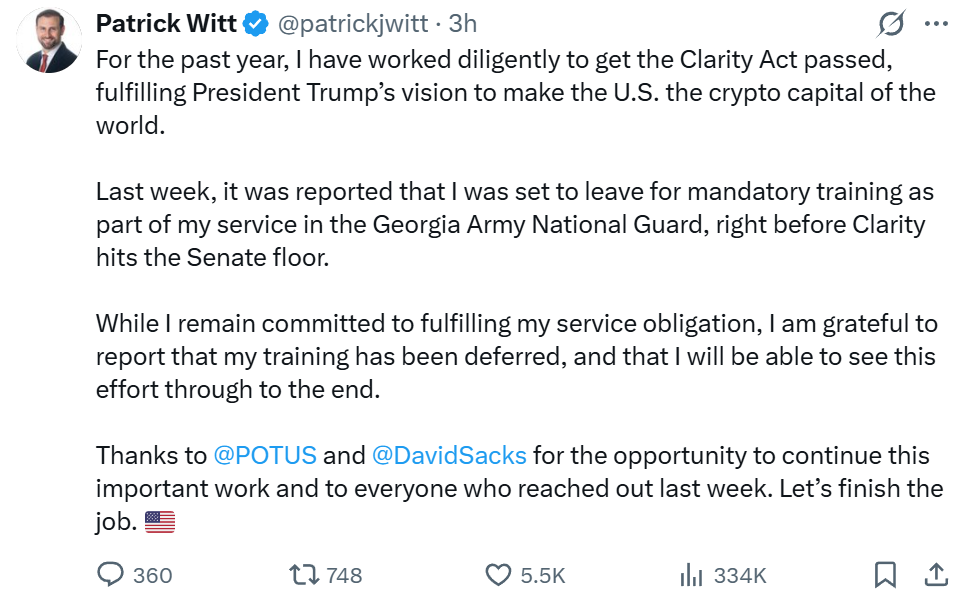
Source: Patrick Witt
The CLARITY Act, which would create the first comprehensive US regulatory framework for the crypto market, faces a make-or-break deadline to pass the Senate before the Aug. 8 recess. Witt is the White House’s lead negotiator on the legislation.
Witt, who has served as the executive director of the President’s Council of Advisors for Digital Assets since August, had been expected to report for Judge Advocate General (JAG) training with the Georgia Army National Guard on July 27. The training will qualify him to serve as a legal officer in the Guard.
Related: Democrats added certain consumer protection rules to CLARITY: Coinbase exec
According to a report from Crypto In America on Tuesday, Witt had already deferred his mandatory military training in April to remain at the White House to work on CLARITY Act negotiations, which stretched on longer than expected. This is the second time Witt has deferred his training.
Harry Jung to leave White House Crypto Council
Witt staying at the White House comes as Harry Jung, the Deputy Director of the President’s Council of Advisors for Digital Assets, announced he will leave his post.
“In two weeks, I will leave government service with immense gratitude,” said Jung in a post to X on Monday. “These past two years transformed America’s position on crypto. I’m proud of all we accomplished.”
Jung was originally slated to take over Witt’s responsibilities in the crypto council while he was on military leave, according to Crypto In America.
Magazine: Peter Brandt predicts the exact day Bitcoin’s bear market will be over
Decentralized perpetuals exchange Lighter has made Robinhood Stock Tokens eligible as trading collateral on Robinhood Chain, letting users post tokenized equities such as NVDA, GOOG and AAPL as margin for perpetual futures. The move expands Lighter's accepted collateral beyond the USDG stablecoin,… Read the full story at The Defiant

An XRPL validator has said that he will not vote for another reduction in its account reserves, sparking a community debate over whether lower costs would help adoption or weaken network protections.
The dispute has split community members between those who see lower reserves as necessary for easier onboarding and those who argue that it could strip out a security buffer that the network still needs.
XRPL Reserve Debate Revisits Network Costs and Spam Protection
In a July 20 post on X, Hussein Zangana, the XRP Ledger Foundation’s director of community, told his nearly 57,000 followers that the network’s account reserves have already fallen significantly since the network launched.
In 2012, activating an account required 1,000 XRP in base reserves, with Jed McCaleb later reducing the requirement to 200 XRP. From there, reserves came down gradually through validator votes rather than formal amendments, landing at today’s figures: a 1 XRP base reserve to activate an account, plus a 0.2 XRP owner reserve for each token held, including RLUSD or USDC, or for each of up to 32 NFTs.
He said that he’d backed earlier reductions himself, and at the time, the cuts had made sense given XRP’s rising price and XRPL’s beefier server capacity. However, as things stand, he’s drawing a different line.
“We have to be very careful in arbitrarily lowering reserves,” Vet wrote. “There’s a clear reason for its existence and security comes first. The debate should start there.”
According to him, reserves were designed to protect network resources, including storage and memory, by making it more expensive to create a large number of accounts that could be used for spam or DDoS attacks.
The dUNL validator added that he would only vote to lower reserves if the lower requirements could provide the same level of protection the current one does. He further confirmed that he would definitely not vote for higher transaction fees, which he claimed many community members had been using “as an argument to compensate for lower reserves.”
Where the Rest of the Community Landed
Vet did face some pushback, especially from community member Daniel Keller, who argued that lower reserves could help the project attract more users who are unfamiliar with crypto.
According to him, the focus should be on onboarding people outside the existing crypto audience, where sponsors might want to activate accounts on their behalf while keeping down acquisition costs.
Keller also questioned whether Vet’s concerns about spam were overstated and pointed out that the ledger had handled periods of high activity in the past without lower reserves causing any issues.
Meanwhile, another community member, Chris Thompson, raised a different worry: that lowering reserves could make it easier to create more easily disposable wallets, which could increase the surface area for possible exploitation.
Recent XRPL updates have also seen uneven adoption, with only 43% of nodes moving to its v3.2.0 upgrade. The update introduced changes such as reduced memory usage for nodes of between 30% and 40%, as well as improvements tied to network operations.
The post XRPL Reserve Debate Splits Community Over Adoption vs Security appeared first on CryptoPotato.
US-listed spot Bitcoin exchange-traded funds (ETFs) are seeing renewed investor demand, but the latest inflow streak has yet to provide enough momentum for a stronger recovery.
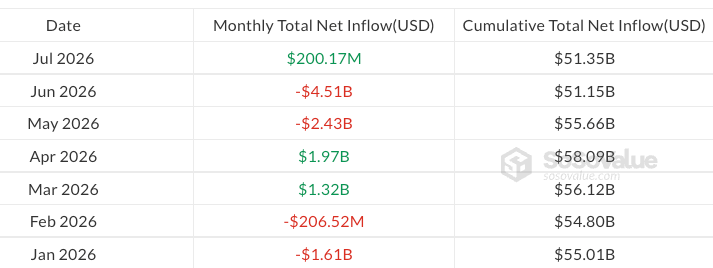
Bitcoin ETFs recorded $75.7 million in net inflows for the week ending July 17, marking a second consecutive week of positive flows, according to SoSoValue data.
The latest inflows followed $197.4 million in net inflows the previous week, bringing July’s total ETF inflows to $200.2 million. US spot Bitcoin ETFs recorded $4.5 billion in net outflows in June, with total 2026 net flows still negative at $5.2 billion.
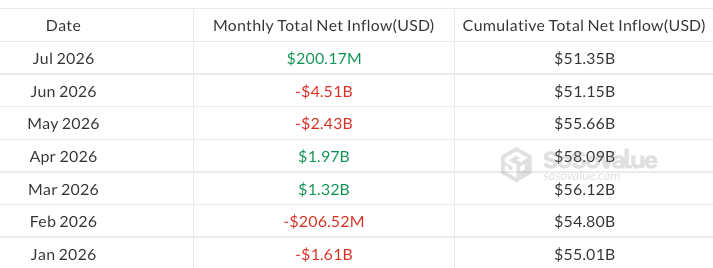
Monthly flows in US-listed spot Bitcoin ETFs since January. Source: SoSoValue
Analysts said the return of inflows suggests selling pressure is easing, but the current pace of buying remains too limited to confirm a broader uptrend.
New uptrend requires Bitcoin to decisively break above $65K
The two-week ETF inflow streak came as Bitcoin recovered toward $64,000 after falling from higher levels in June, but the move has not yet been strong enough to confirm a broader trend reversal, according to Simon-Peter Massabni, head of business development at XS.com.
Bitcoin needs to “decisively break above the $65,000–$65,500 range” to confirm a new uptrend, Massabni told Cointelegraph, adding that the current recovery “still lacks real strength.”
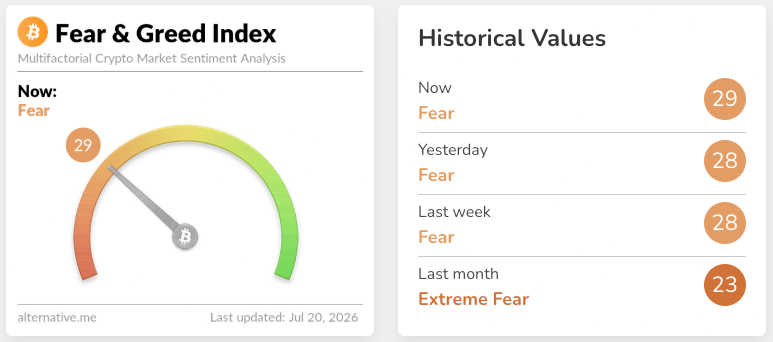
Crypto Fear & Greed Index. Source: Alternative.me
“Four consecutive sessions of inflows should be interpreted as a sign that selling pressure is easing, rather than clear evidence that institutional investors have returned on a broad scale,” Massabni said, referring to the daily ETF flow data from last week.
Citi cuts 12-month Bitcoin ETF inflow forecast from $10 billion to zero
Massabni also highlighted Citigroup’s recent revision to its Bitcoin ETF outlook, which reflects concerns over the strength of institutional demand.
On July 1, Citi cut its 12-month ETF inflow forecast from $10 billion to zero after weaker-than-expected flows and recent outflows. The bank also lowered its 12-month Bitcoin price target from $112,000 to $82,000.
Related: Prediction markets defy crypto downturn with record Q2 volume: CoinGecko
“The market does not lack reasons to start buying Bitcoin,” Massabni said, adding that “what is still missing is a sufficiently strong catalyst — most likely a flow of capital large and persistent enough to turn the current rebound into a genuine trend.”
Bloomberg ETF analyst Eric Balchunas compared Bitcoin ETFs’ trajectory with gold ETFs, noting that both products have experienced rapid adoption followed by extended periods of weaker performance.
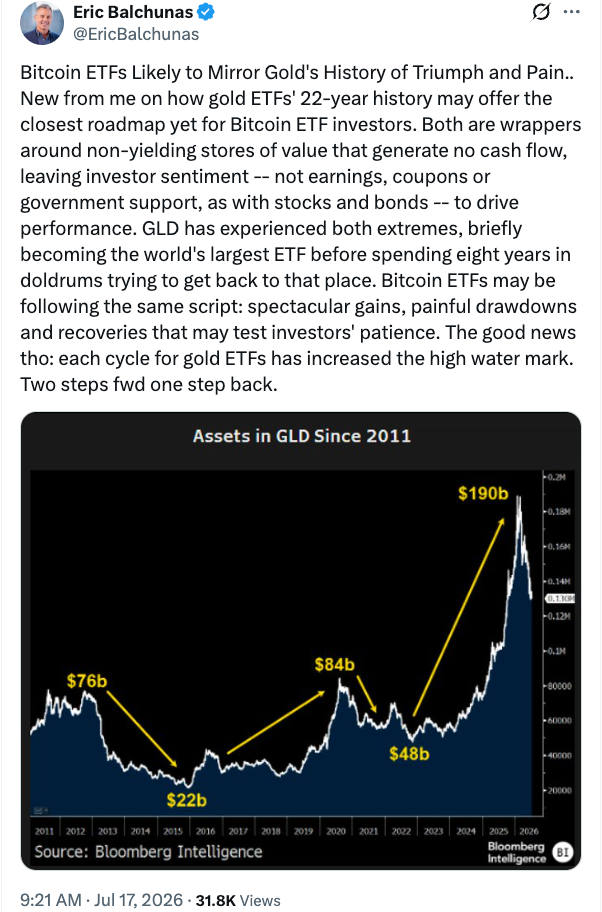
Source: Eric Balchunas
In an X post on Friday, Balchunas said Bitcoin ETFs may follow a similar pattern of “spectacular gains, painful drawdowns and recoveries,” with each cycle potentially setting higher highs over time.
Magazine: Will the US get CLARITY this week? Bitcoin’s new $80K target: Hodler’s Digest, July 19

Nigeria’s President Bola Ahmed Tinubu has signed an executive order aimed at reducing what the government describes as fragmentation in how digital asset activities are regulated across agencies. In remarks relayed by the president’s special adviser, Bayo Onanuga, the order is framed as a coordination effort rather than a sweeping reallocation of powers.
According to Onanuga, the executive order seeks to “harmonize the regulation of virtual assets,” improve cooperation among financial, revenue, and capital markets agencies, and better protect citizens from fraud while enabling “responsible innovation.” It also sets up a virtual asset council to steer related policy work, while the Nigerian tax authority is directed to update its approach.
Key takeaways
- Nigeria’s executive order focuses on harmonizing digital asset regulation through coordination, not by creating a new regulator.
- A new virtual asset council is planned, bringing top regulators under a single policy direction structure.
- The Nigerian Revenue Service is expected to issue updated guidance on how digital asset activity is taxed.
- Officially, registration requirements are described as activity- and asset-dependent, designed to close oversight gaps for unregistered operators.
Executive order targets regulatory fragmentation
Onanuga said the framework established by the executive order does not create a new regulator or transfer statutory powers between Nigeria’s institutions. Instead, he described it as a method to coordinate existing mandates while maintaining independence for each agency.
In the government’s framing, the problem is that digital asset oversight has not been sufficiently unified, creating room for operators to operate without falling cleanly under regulatory scrutiny. Onanuga said the registration approach will be determined by the “nature of the activity and the asset involved,” and that this is intended to “close the gaps” through which unregistered actors have previously escaped oversight.
For market participants, the distinction between “coordination” and “new regulator” matters. When powers are not consolidated into a single authority, compliance requirements can remain distributed—but clearer harmonization can reduce ambiguity about which agency handles which aspect of onboarding, reporting, or enforcement.
Virtual asset council brings regulators under one policy umbrella
The executive order also establishes a virtual asset council headed by senior figures from Nigeria’s financial regulators. While the order’s intent is described as policy direction, the key practical takeaway is that regulators are being pulled into a more structured dialogue.
Onanuga’s comments suggest the council is meant to align policy across agencies without replacing their statutory roles. That structure could affect how rules evolve over time—especially if the council is used to reconcile differing interpretations of responsibilities among financial oversight bodies, revenue authorities, and capital markets regulators.
Nigeria’s adoption trajectory makes that coordination particularly important. The country has been a major hub for stablecoin and broader crypto activity in Africa, according to an IMF report cited in the government’s messaging.
Why Nigeria’s stablecoin and crypto footprint raises the stakes
In a June report referenced in the coverage, the International Monetary Fund (IMF) said Nigeria accounted for about 60% of stablecoin inflows within sub-Saharan Africa since 2019. The IMF report also estimated that Nigeria saw roughly $59 billion in crypto inflows between July 2023 and June 2024.
Those numbers underscore why Nigeria is a focal point for regulatory clarity—not only for local service providers but also for cross-border businesses and payment-linked use cases. When adoption is concentrated in one jurisdiction, regulatory uncertainty can quickly spill over into liquidity, on-ramps, and compliance planning for companies operating in or serving Nigerian users.
The IMF added that the policy challenge is to narrow the “workaround” incentives that arise in cross-border payments, while containing new risks. It characterized the solution as a clear strategy that remains open to innovation but anchored in strong macroeconomic policy and effective regulation.
In that context, Nigeria’s executive order can be read as an attempt to align regulation with actual usage patterns—particularly where stablecoins and other digital assets are used for value transfer and settlement.
Nigeria’s tax authority moves to tighten digital asset compliance
The executive order directs the Nigerian Revenue Service to update its policies on digital assets, building on steps already announced. As mentioned in the report, authorities in January said that, under the Nigeria Tax Administration Act, crypto service providers would be required to link transactions to tax identification numbers and, in some cases, national identification numbers.
The government position described in the coverage indicates that the additional details expected from the tax authority are intended to clarify the effects on taxpayers. For businesses, the existing direction toward identification linkage signals a compliance shift that could reshape onboarding procedures, transaction recordkeeping, and reporting workflows.
Because tax obligations often interact with financial regulation—especially where registration and oversight requirements are tied to who can operate—updated guidance from the Revenue Service may become a central piece of Nigeria’s broader digital asset compliance regime.
What to watch next
Investors, exchanges, and service providers in Nigeria will likely look for how the virtual asset council’s coordination translates into concrete, activity-specific registration rules and how the Nigerian Revenue Service operationalizes the tax identification linkage. The immediate uncertainty is not whether compliance will be tightened, but how quickly harmonized guidance will roll out across agencies and what standards will be used to determine registration requirements by asset type and business activity.


Coinbase has backed a tougher CLARITY Act after Senate Democrats added customer safeguards, even as its 2026 approval odds have fallen to 31% on Polymarket amid a dispute over ethics rules involving President Donald Trump.
Summary
- Coinbase backs the revised CLARITY Act after Democrats secured stronger customer protections.
- White House resistance to crypto ethics rules threatens a Senate vote before August.
- Polymarket traders place the bill’s chance of becoming law in 2026 at 31%.
Coinbase vice chair Ryan VanGrack told CNBC on Monday that Democrats had secured stronger consumer protections during closed-door negotiations over the bill’s final Senate text. He described those changes as giving the legislation “more teeth,” though he did not provide details about the provisions or indicate whether lawmakers had settled the separate ethics dispute.
“At the end of the day, this is about customer protections,” VanGrack said.
“The status quo lacks this infrastructure, lacks these protections, and the Democrats used this opportunity, wisely, to make sure that customers were first and foremost in [this bill].”
According to VanGrack, the additional safeguards address gaps in the current US framework for digital asset businesses and their customers. His comments also signal Coinbase’s support for the negotiations after the exchange opposed an earlier Senate draft at the start of the year.
CEO Brian Armstrong announced in January that Coinbase could not support the legislation as then written, a decision that may have contributed to a delay in the Senate Banking Committee’s markup. Since then, Coinbase executives have publicly supported efforts to pass a revised bill, with chief legal officer Paul Grewal among those calling for the process to continue.
Lawmakers have not released the final Senate text or scheduled a floor vote as of Monday. Although VanGrack praised the consumer protection changes, he did not say whether the latest negotiations had produced an ethics agreement capable of winning enough Democratic votes.
Trump ethics dispute holds up a Senate agreement
As crypto.news previously reported, Polymarket traders have lowered the CLARITY Act’s probability of becoming law in 2026 to 31% while the White House withholds support for a disputed ethics provision. The administration had not approved the proposed language as of July 20, according to sources cited in the report.
Those sources also said the White House had not told Senate negotiators what limits it would accept. Without a clear position from the administration, the report said lawmakers may require more time to draft an updated version, putting the Republican timetable for a vote before the August recess at risk.
Senate Majority Leader John Thune wants the chamber to consider the bill before lawmakers leave Washington, but he has acknowledged that Republicans have not reached a bipartisan agreement. Because the party cannot clear the Senate’s procedural barriers alone, Thune would need support from Democrats to advance the legislation.
Democratic lawmakers have tied their support to restrictions addressing elected officials’ financial interests in digital assets. Their concerns center on Trump’s crypto activities, including Official Trump (TRUMP), World Liberty Financial and other investments linked to the president and his family.
In June, Trump disclosed $1.4 billion in earnings tied to his memecoin, World Liberty Financial and other digital asset holdings. Democrats have cited such financial connections while pressing for ethics language in the market structure legislation, according to reports on the Senate negotiations.
Republican senators met Trump on Thursday to discuss the bill, though the meeting did not produce a public White House position on the contested provision. Senate Democrats held their own closed-door meeting a day earlier to assess whether they could support the legislation.
Coinbase support raises pressure for a compromise
Trump has urged the Senate to approve the CLARITY Act and used the death of Senator Lindsey Graham to renew that call. In a social media post last week, the president asked senators to pass the legislation “in honor of” the South Carolina Republican, whom Trump described as a strong supporter of the proposal.
Despite Trump’s public endorsement of the bill, the White House’s reluctance to accept the ethics language has left negotiators without an agreement needed to move it forward. The disagreement places the administration’s request for swift passage against Democratic demands for rules covering officials with crypto-linked financial interests.
The latest support from Coinbase gives the bill an industry endorsement from one of the largest US crypto exchanges. It also represents a change from Armstrong’s January rejection of the previous version, although neither Coinbase nor VanGrack has publicly endorsed a specific ethics proposal.
Coinbase’s relationship with federal regulators has also changed since Trump returned to office. During the Biden administration, the Securities and Exchange Commission sued the exchange for allegedly operating as an unregistered securities exchange, broker and clearing agency.
After Trump took office, the SEC under acting Chair Mark Uyeda dropped the case. The agency’s withdrawal removed one of Coinbase’s largest regulatory disputes as Congress continued working on legislation intended to define oversight of digital asset markets.
For Senate negotiators, the unresolved issue remains whether stronger customer protections can be paired with ethics restrictions that satisfy Democrats and receive White House approval. Until lawmakers publish the revised text and secure enough bipartisan support, Thune’s desired vote before the August recess remains uncertain, while Polymarket traders continue to price in a low chance of enactment this year.

Sail Virtually Aboard The “Itanic” With IA-64 Emulator

Criminal damage probe ongoing after Hardwick Hall windows smashed

Why Andy Burnham will find it so tricky to unite Britain


-
 NewsBeat4 days ago
London Mayor Sadiq Khan handed a peerage by Keir Starmer alongside 15 other Labour figures… just days before the PM leaves No10
-

 Fashion3 days ago
Weekend Open Thread – Corporette.com
-

 Politics3 days ago
The House | The City of London can help the new chancellor deliver growth in every postcode
-

 Politics6 days ago
Young campaigners urge incoming PM to act on outdoor junk food ads
-

 Crypto World5 days ago
CFTC blocks Kalshi from unwinding Michigan trades after court order
-
 Crypto World4 days ago
Two July Windows Left: The CLARITY Act’s Senate Fight and What Failure Means
-

 Crypto World3 days ago
Ripple Payments Joins MiCA With 14 Firms, Does It Mean Anything For XRP?
-

 Business5 days ago
Nvidia Stock Slips After Big Tuesday Rally as Huang Confirms Vera Rubin Chip Is Now in Production Today
-

 Politics1 day ago
Democrats look to World Cup watch parties to register thousands of voters
-
 Entertainment5 days ago
Disney’s Most Ambitious Failed Star Wars Attraction Is Coming to SDCC
-

 Crypto World3 days ago
Ripple wins EU-wide access as ESMA adds it to MiCA register
-

 Business5 days ago
Palantir Shares Rise After Expanded Nvidia Partnership and Fresh Analyst Upgrades Ahead of Earnings Day
-

 Crypto World4 days ago
Injective Submits SEC Transfer-Agent Registration to Onchain Ownership Records
-

 NewsBeat4 days ago
Registration is now open for March for Men with Kev 2026
-

 Tech7 days ago
Get Your ESP32 Sunny Side Up With This Solar Dev Board
-

 News Videos6 days ago
XRP BOMBSHELL… XRP OMBOARDED FOR TRANSACTIONS!!!
-

 Tech6 days ago
Dark Secrets Emerge When Jailbreaking LLMs
-

 NewsBeat13 hours ago
Unregistered fitter used Gas Safe logo on business flyers
-
 Sports5 days ago
New Cornerback Enters Vikings Trade Rumor Mill
-

 News Videos4 days ago
Money | Class 12 Economics | CBSE Board Exam 2026-27
You must be logged in to post a comment Login