Global consumer spending on recorded music increased 8.6% to $47.1 billion in 2025, with streaming accounting for 86% of the total, according to Futuresource Consulting’s latest industry outlook.
The number of paid music subscriptions worldwide reached 865 million, an increase of 71.5 million from the previous year. Those figures make the direction of the business difficult to misunderstand: streaming is no longer merely the largest part of the recorded music market. It has become the market’s central economic engine, with physical sales and downloads operating around it.
Futuresource expects global music spending to surpass $50 billion in 2026 and reach $60.2 billion by 2030, when subscription streaming could account for almost nine out of every ten dollars spent on recorded music.
That does not mean physical music is disappearing. Consumer spending on physical formats increased 7% during 2025, while global vinyl retail value rose 10% to $3.77 billion. Streaming may have taken over the largest bedroom and changed the Wi-Fi password, but records and CDs have not moved into the garage quite yet.
Advertisement
Subscriber Growth Is Moving Beyond Mature Markets
Source: Futuresource Consulting
The addition of 71.5 million paid subscriptions during 2025 reflects continued growth in regions where streaming adoption still has considerable room to expand.
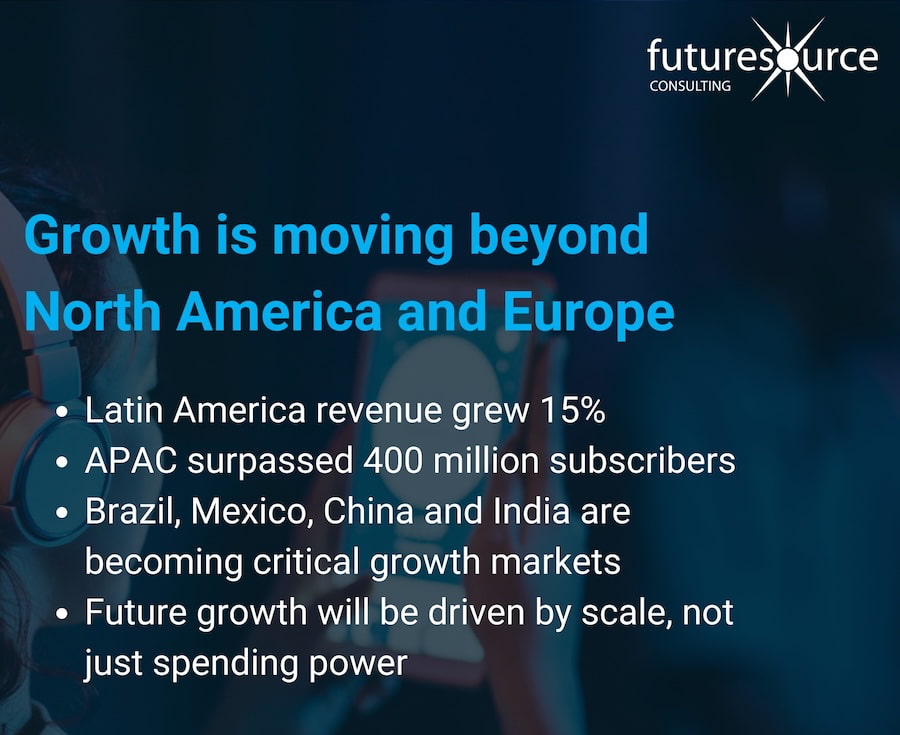
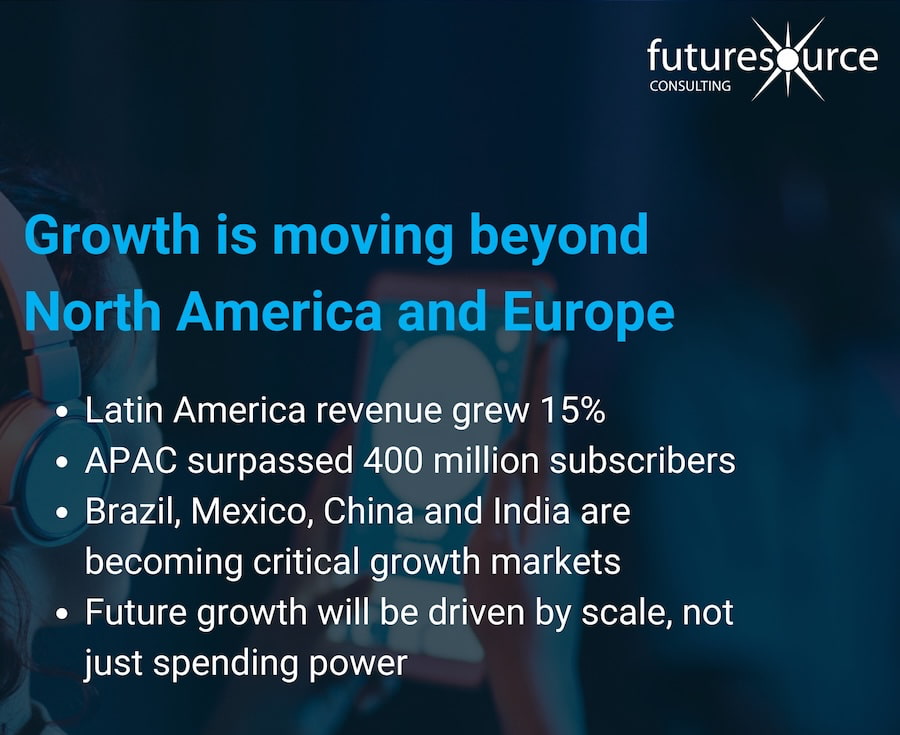
Latin American recorded music revenue increased 15%, while the Asia-Pacific region surpassed 400 million paid music subscriptions. China, India, Brazil and Mexico are expected to play increasingly important roles as subscription growth slows across North America and Western Europe.
That slowdown is one reason streaming services are focusing more heavily on higher-priced plans, bundled content, premium features and regular price increases. Most consumers in mature markets who are willing to pay for music streaming already subscribe to at least one service, which means future growth depends increasingly on charging existing users more rather than simply finding new ones.
Spotify, Apple Music, TIDAL, Qobuz, Amazon Music and other platforms have responded with higher monthly prices, additional subscription tiers, audiobooks, music videos, artificial-intelligence features and other additions designed to make the increases appear less like increases.
Some of those changes have created real value. Others have mostly improved the number printed on the credit-card statement.
Advertisement
Vinyl Remains the Physical Market’s Economic Engine
Source: Futuresource Consulting
Vinyl continues to generate the largest share of physical music revenue, with global retail spending reaching $3.77 billion in 2025.
That figure is consistent with the broader trend eCoustics has followed throughout 2026. The RIAA reported that U.S. vinyl generated $1.043 billion in wholesale revenue during 2025, with 46.8 million records sold. Revenue increased 9.3%, while unit sales grew 7.9%.
Advertisement. Scroll to continue reading.
It was the format’s 19th consecutive year of growth in the United States, which makes it increasingly difficult to dismiss vinyl as a short-lived revival driven entirely by aging collectors and Record Store Day releases. Fads generally do not survive four presidential administrations, multiple economic downturns, a pandemic and the arrival of $50 single-LP reissues bought by people who already own five other copies.
Vinyl now supports a substantial network of independent retailers, pressing plants, equipment manufacturers, distributors, labels and reissue companies. It has also evolved into something broader than an audio format, combining music ownership with collectibility, artwork, limited editions and physical merchandise.
Advertisement
That explains why buyers continue to spend money on colored vinyl, numbered editions, alternate covers and deluxe box sets, even when the same music is available instantly through a streaming subscription.
CDs Are Showing More Life Than Expected
Source: Luminate
Compact discs remain considerably smaller than vinyl in both revenue and cultural visibility, but the format has shown unexpected momentum during 2026.
Luminate reported that U.S. CD sales increased 16% to 16.3 million units during the first half of the year, while vinyl unit sales grew by only 2.4%. That gave CDs a growth rate almost seven times higher during the period.
K-pop releases contributed significantly through elaborate packaging, photo cards, alternate editions and fans purchasing multiple versions of the same album. However, Luminate found that CD sales would still have increased 6.7% after K-pop titles were removed from the data, suggesting that the improvement was not dependent on one unusually committed group of collectors.
Target, Walmart and other mass-market retailers now account for almost 30% of U.S. physical music sales, another indication that records and CDs are no longer confined to independent stores and specialist websites.
Advertisement
The figures do require some context. Futuresource measures global consumer spending, while the RIAA reports U.S. wholesale revenue net of returns and Luminate tracks retail consumption and unit activity. The numbers describe related trends, but they are not directly interchangeable.
The RIAA still reported that U.S. CD sales declined to 29.5 million units in 2025, with wholesale revenue falling to $312.4 million. Luminate’s stronger first-half results therefore suggest a possible change in direction rather than proof that compact discs have suddenly returned to their late-1990s commercial peak.
Nobody should start rebuilding Tower Records just yet.
Physical formats will remain much smaller than streaming, but the evidence does not support the idea that they are disappearing. Vinyl is a multibillion-dollar global business with nearly two decades of sustained U.S. growth, CD sales are showing renewed momentum in 2026, and manufacturers at both ends of the market continue introducing new players and transports.
Advertisement
Esoteric and Luxman still serve buyers who want disc playback treated as a precision instrument, while Denon, Yamaha, NAD, Audiolab, Mission, Quad, Topping and FiiO continue to develop products at more accessible prices. This is not an industry maintaining a format on life support; it is one still investing in it.
Advertisement. Scroll to continue reading.
The turntable market is even more remarkable. There have not been this many new models available in at least 30 years, with hundreds of options from Rega, Pro-Ject, Thorens, Kuzma, VPI, Vertere, Linn, Luxman and far too many others to list without turning this article into a dealer catalog. Entry-level decks, premium belt-drive designs, direct-drive models, automatic turntables and statement products all continue to arrive because demand remains real.
Interest in physical music has not been this strong in a very long time. Listeners understand that well-mastered records and CDs can sound better than compressed or compromised streams, but sound quality is only part of the appeal. Physical media provides ownership, permanence and a sense of community among listeners, collectors, retailers and artists that no monthly subscription can reproduce.
Advertisement
There will never be a Streaming Store Day. Nobody is lining up outside at 6 a.m. to celebrate a licensing agreement that can disappear before lunch.
The music business often treats streaming and physical media as opposing formats, but consumers increasingly use them for different reasons.
Streaming provides access, convenience and discovery. It allows listeners to explore enormous catalogs, move between devices and hear new releases immediately without committing to a purchase.
Physical media provides ownership and permanence. A record or CD cannot disappear because a licensing agreement expired, an artist changed distributors or a streaming platform removed a specific version from a regional catalog.
Advertisement
CDs also provide an inexpensive route to creating lossless local files, while vinyl offers artwork, presentation and a physical connection to an album that streaming cannot reproduce. For many listeners, the most practical approach is to stream broadly and purchase selectively.
That is not a contradiction. It may be the most rational way to consume music in 2026: use streaming to discover, buy the albums that matter, rip the CDs and retain a library that does not depend on a monthly subscription or somebody else’s licensing agreement.
The cloud is convenient. It is not ownership.
AI Will Influence Where the Next Billions Go
Source: Futuresource Consulting
Futuresource also identifies artificial intelligence as one of the major forces shaping the music business.
Streaming platforms are using AI for recommendations, playlists, search and engagement, while labels and rights holders explore licensing and content-management agreements. Services are also being forced to address the rapid growth of fully synthetic music and determine whether AI-generated recordings should compete directly with human artists for recommendations and royalty payments.
Advertisement
Deezer has taken one of the clearest positions by identifying fully AI-generated tracks and removing them from algorithmic recommendations. Other services are still developing their policies, even as synthetic content continues to increase.
Advertisement. Scroll to continue reading.
The issue will become more significant as streaming controls a larger share of global music spending. Platforms do not merely deliver music; they influence what listeners discover, which artists receive exposure and how revenue is distributed.
There is a great deal of money attached to those decisions, which usually means the ethical discussion will continue immediately after the commercial agreements have been signed.
Advertisement
The Bottom Line
Global paid music subscriptions reached 865 million in 2025, while streaming captured 86% of recorded music spending and pushed the market to $47.1 billion. By 2030, that share could approach 90%, driven by higher prices, premium tiers, expansion in developing markets and the increasingly unavoidable arrival of AI inside every service.
Those numbers confirm that streaming has won the battle for access. It is fast, convenient and almost impossible to avoid. What it does not provide is ownership, permanence or any guarantee that the version of an album you love will still be available next year, in the same country, under the same licensing agreement.
Physical media remains much smaller, but it offers something streaming cannot: control. A record or CD belongs to the buyer, can be played without permission from a platform and often sounds better when the mastering is superior.
That combination of sound quality, ownership and community is why records and CDs continue to matter, even as streaming absorbs most of the money. The industry may prefer recurring monthly payments, but listeners still understand the difference between having access to music and actually owning it.
Advertisement
The industry appears perfectly willing to charge people for both, and a growing number of listeners appear willing to pay.
Melanie Nakagawa, Microsoft chief sustainability officer, left, speaking with GeekWire reporter Lisa Stiffler at a fireside chat at Seattle City Hall on July 17. (PNW Climate Week / Fer Sagastume Photo)
Microsoft Chief Sustainability Officer Melanie Nakagawa faced a barrage of pointed questions from the audience Friday during a session at the annual Pacific Northwest Climate Week in Seattle.
Protesters challenged Nakagawa through most of the 30-minute session held in a conference room at Seattle’s City Hall, calling out the company’s use of fossil fuel energy sources to power its AI data centers and challenging Microsoft’s commitment to climate goals set years ago.
As a reporter covering sustainability issues for GeekWire, I moderated the session. Many of the issues raised by the crowd were on my list of questions for Nakagawa. The disruptions also included chants from protesters seated among attendees, at times going beyond climate issues to condemn Microsoft’s technology deals with Israel.
Security guards ultimately ushered some protesters out of the space, while others remained. Interruptions from the audience continued for all but the final 10 minutes of the session.
The event capped off Pacific Northwest Climate Week, which included conversations around the city and region about climate change solutions, policies and innovations.
Advertisement
Microsoft has for many years been viewed as an environmental corporate leader, setting an ambitious goal in 2020 to become carbon negative within a decade. It created an internal carbon tax — one of the corporate world’s largest — that charges individual Microsoft divisions for emissions from sources like air travel to fund climate-friendly initiatives. The company is credited with helping create and sustain the carbon dioxide removal sector, among other roles.
But the rapid expansion of AI data centers and their huge energy demands are undercutting Microsoft’s standing. The company recently released its annual sustainability report, disclosing that its carbon footprint grew 25% last year, moving it further from its 2030 target.
Microsoft CSO Melanie Nakagawa, left, and GeekWire reporter Lisa Stiffler before a fireside chat was derailed by protesters. (PNW Climate Week / Fer Sagastume Photo)
One protester’s question was about a deal announced earlier this year in which Microsoft is partnering with Chevron to build a 2.7 gigawatt natural gas facility to power a data center campus in Texas. I asked Nakagawa how the company defends the agreement, and she pointed to the 4.7 gigawatts of renewable energy that Microsoft has supported in the state. I followed up by asking about the Redmond, Wash.-based company’s commitment to carbon dioxide removal (CDR) projects given recent reports about a pause on new deals.
Nakagawa was unable to answer before the crowd drowned her out with a call-and-response chant: “Microsoft, you can’t hide. We can see your dirty side.”
Another protester criticized the escalating pursuit of AI. “You’re selling us a product that we don’t even need, and we never should ask for,” he said. “No one wants AI. You’re destroying the climate with AI.”
Advertisement
I brought up legislation proposed earlier this year in Washington to mandate clean energy use and bring transparency to data center impacts in the state. Microsoft opposed and helped defeat the bill, though the company says it wants to work with lawmakers to pass rules next year. I asked what needed to change in the legislation for Microsoft to support it.
Nakagawa didn’t provide specifics, but noted that this year, for the first time, the company shared facility-level information in its annual report on electricity and water use for data centers worldwide.
“People want to know more about the data, and we believe you can have an honest and candid conversation with transparency and access to that information and data,” she said.
Given the obvious public concerns, I asked Nakagawa, “Do you really honestly believe that by 2030, the company can hit that carbon-negative goal?”
Advertisement
Nakagawa pointed to wide-ranging initiatives that are starting to help curb specific emissions, including investments to make Xbox devices lower carbon and financial support for the recent opening of a production plant in Moses Lake, Wash., for sustainable aviation fuel company Twelve.
“There are a couple areas where we’re seeing a lot of promising progress,” she said. “Look, this is going to be a hard target. We’ve not been at all shying away from the fact that this is a difficult goal.”
Apple has quietly increased the price of Apple Music in the US, with individual subscriptions now costing $11.99 per month instead of $10.99.
The change also affects Family and Student plans. In addition, several Apple One bundles are impacted. The price rise comes almost four years after Apple last increased Apple Music subscription fees in October 2022.
The biggest jump is for the Apple Music Family plan, which now costs $19.99 per month, up from $16.99. The Student plan has also increased by $1, bringing the monthly fee to $6.99.
Apple has also adjusted pricing for two of its Apple One bundles. While the Individual plan remains unchanged, the Family tier now costs $27.95 per month, up by $2. Meanwhile, the Premier plan has increased to $39.95 per month. Apple has also confirmed similar price increases in Brazil.
Advertisement
In a statement to Music Business Worldwide, Apple said the latest changes are “the result of rising licensing costs,” suggesting that higher payments to rights holders and music labels are behind the increase.
Advertisement
The price hike means Apple Music now sits closer to many of its biggest streaming rivals. However, the service continues to distinguish itself with features such as Lossless Audio, Hi-Res Lossless, Spatial Audio with Dolby Atmos, live radio stations and a catalogue of more than 100 million songs.
For existing subscribers, the increase is relatively modest on the Individual plan, but families will notice a more significant jump. Moreover, an extra $3 each month adds up to $36 more per year. This makes it one of the largest increases Apple has introduced for the service.
Advertisement
Spotify, YouTube Music and other services have all introduced price increases in recent years. As a result, premium music subscriptions are becoming steadily more expensive across the board.
If you’re already subscribed, the updated pricing should appear on your next billing cycle. New customers signing up from today will pay the new rates immediately. Meanwhile, anyone considering Apple’s wider ecosystem may want to compare whether an Apple One bundle now offers better overall value than paying for Apple Music on its own.
Bats are remarkable creatures, able to fly at night or inside the confines of caves without light to guide their way. A team of researchers at Worcester Polytechnic Institute (WPI) has determined how to use low power ultrasonic sensors to guide drones in obscured environments.
While radar, lidar, and GPS are all great for navigation and sensing, they can run into issues when light is obscured or can take too much power to be practical for the limited battery life of a drone. The researchers found that a dual sonar array could be used to implement a much lower power sensing system for a drone that performs well in environments that would stymie a computer vision system.
A shield placed behind the array cuts down on the sound of the propellers that would otherwise drown out the signal, and further signal analysis via a neural net separates the echoes of objects in front of the drone from the background. The prototype could navigate in various simulated environments like forests, smoke, and snow. It looks like it even got a chance to go for a flight in the actual woods. All the code and hardware designs are Open Source, so have at it!
Chris Fall, the director of the Center for AI Standards and Innovation (CAISI), has resigned, the agency confirmed to multiple news outlets.
He was appointed just three months ago after the last appointee, Collin Burns, left in less than a week, The Washington Post reported at the time. Burns was reportedly “pushed out” of the job in April because he previously worked for Anthropic and the Trump administration had been battling with the company, sources told the Post.
No reason was given for Fall’s departure. Prior to leading CAISI, Fall was the director of the Department of Energy’s Office of Science during the first Trump administration and had been the acting director of the DOE’s Advanced Research Projects Agency-Energy. He worked in the DOE’s Office of Naval Research (ONR) prior to that.
Before Burns and Fall, the agency was led by venture capitalist David Sacks, whose title at the time was White House AI and crypto czar. Sacks stepped down in March.
Advertisement
CAISI, which operates under the National Institute of Standards and Technology, is the primary organization for developing technical standards and testing methods for AI models as well as assessing cybersecurity risks. Yet it was not the agency at the center of the most recent model-risk brouhaha.
That occurred in June when the U.S. Commerce Department invoked an obscure export control directive that effectively forced Anthropic to pull its Mythos and Fable models from the market. The ban was lifted by the end of the month, when Secretary of Commerce Howard Lutnick said he was satisfied with Anthropic’s safety plans.
Earlier this month, the White House also signed an executive order for a new AI safety oversight program called “Gold Eagle” that creates a clearinghouse for cybersecurity vulnerability coordination. A host of federal organizations were named as part of the program, including the Commerce Department and Department of Homeland Security. But, as CNBC pointed out, CAISI was not among the federal organizations mentioned.
Meanwhile, after Anthropic’s models were freed from the ban, Google DeepMind CEO Demis Hassabis began calling for the creation of an independent, industry-run standards body to regulate frontier AI modeled after FINRA — the same sort of mission that CAISI was formed to tackle.
Advertisement
Fall’s resignation also follows this weekend’s handwringing over Chinese AI lab Moonshot’s new version of its open model Kimi, which performed competitively against flagship frontier models. The administration was weighing efforts to somehow ban Chinese open models, Axios reported. This sparked immediate debate and outrage over the weekend, including from Sacks, who argued that regulations shouldn’t be used as a protectionism strategy for U.S. proprietary AI labs.
While CAISI has released a few reports on the capabilities of Chinese open-weight models Z.ai’s GLM-5.2 and DeepSeek V4 Pro, it hasn’t talked much about its processes for testing. (Open weight means these models can be publicly downloaded and run locally, but its training code and datasets are not available). Since July 9, TechCrunch has sent multiple inquiries to both the DoC and NIST about how its LLM evaluations work and has not received a response.
When you purchase through links in our articles, we may earn a small commission. This doesn’t affect our editorial independence.
A new NYT Connections puzzle appears at midnight each day for your time zone – which means that some people are always playing ‘today’s game’ while others are playing ‘yesterday’s’. If you’re looking for Monday’s puzzle instead then click here: NYT Connections hints and answers for Monday, July 20 (game #1135).
Good morning! Let’s play Connections, the NYT’s clever word game that challenges you to group answers in various categories. It can be tough, so read on if you need Connections hints.
What should you do once you’ve finished? Why, play some more word games of course. I’ve also got daily Strands hints and answers and Quordle hints and answers articles if you need help for those too, while Marc’s Wordle today page covers the original viral word game.
Advertisement
SPOILER WARNING: Information about NYT Connections today is below, so don’t read on if you don’t want to know the answers.
Latest Videos From
NYT Connections today (game #1136) – today’s words
(Image credit: New York Times)
Today’s NYT Connections words are…
MUSIC
GRAM
DRIVER
VISION
TUBE
CROP
BOOK
APP
ORCHESTRATION
EXTENSION
TANK
KINESIS
PROMPTER
HALTER
LYRICS
PLUGIN
NYT Connections today (game #1136) – hint #1 – group hints
What are some clues for today’s NYT Connections groups?
Advertisement
YELLOW: Types of a similar garment
GREEN: Computer terms
BLUE: Parts of a composition
PURPLE: Begin with word that rhymes with Nelly
Need more clues?
We’re firmly in spoiler territory now, but read on if you want to know what the four theme answers are for today’s NYT Connections puzzles…
Sign up for breaking news, reviews, opinion, top tech deals, and more.
NYT Connections today (game #1136) – hint #2 – group answers
What are the answers for today’s NYT Connections groups?
Advertisement
YELLOW: KINDS OF TOPS
GREEN: SOFTWARE DOWNLOADS
BLUE: ELEMENTS OF A MUSICAL
PURPLE: TELE____
Right, the answers are below, so DO NOT SCROLL ANY FURTHER IF YOU DON’T WANT TO SEE THEM.
NYT Connections today (game #1136) – the answers
(Image credit: New York Times)
The answers to today’s Connections, game #1136, are…
BLUE: ELEMENTS OF A MUSICAL: BOOK, LYRICS, MUSIC, ORCHESTRATION
PURPLE: TELE____: GRAM, KINESIS, PROMPTER, VISION
My rating: Easy
My score: Perfect
This happens very rarely to me, but I saw the hardest group immediately today, with PROMPTER and VISION helping me connect GRAM and KINESIS.
It felt like an easy purple, but maybe telegram caught a few people out seeing as they are now a fairly pointless form of communication.
Regardless, I was rewarded with my 50th Purple First badge — it has taken me a while to reach this milestone, with my haphazard play style instead being to just connect the first group I see, rather than looking for the most likely to be a purple. I can’t imagine being that tactical with Connections.
In truth, this felt like a game where any of the groups could have been yellow on any other day, although all of the groups did contain things that have largely disappeared.
Advertisement
Yesterday’s NYT Connections answers (Monday, July 20, 2026, game #1135)
YELLOW: ANNOUNCE: BLARE, HERALD, SOUND, TRUMPET
GREEN: THINGS TO CLICK: BUTTON, ICON, LINK, MENU
BLUE: ASSOCIATED WITH PEARLS: BUBBLE TEA, OYSTER, SWINE, WISDOM
PURPLE: STARTING WITH ALCOHOLIC BEVERAGES: ALEXA, MEADOW, PORTOBELLO, SAKES
What is NYT Connections?
NYT Connections is one of several increasingly popular word games made by the New York Times. It challenges you to find groups of four items that share something in common, and each group has a different difficulty level: green is easy, yellow a little harder, blue often quite tough and purple usually very difficult.
On the plus side, you don’t technically need to solve the final one, as you’ll be able to answer that one by a process of elimination. What’s more, you can make up to four mistakes, which gives you a little bit of breathing room.
It’s a little more involved than something like Wordle, however, and there are plenty of opportunities for the game to trip you up with tricks. For instance, watch out for homophones and other word games that could disguise the answers.
It’s playable for free via the NYT Games site on desktop or mobile.
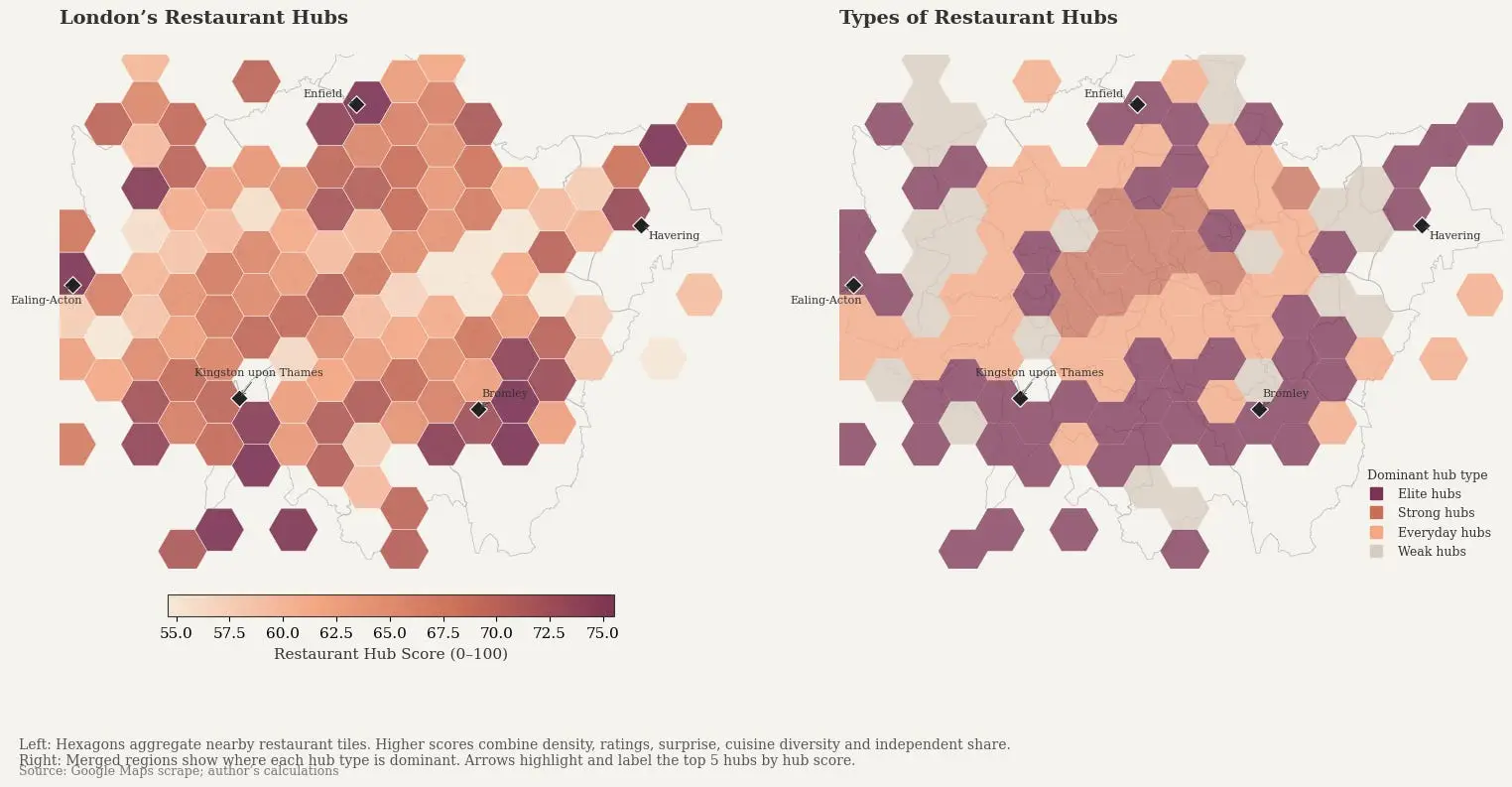
We all know that Google and other big players pick and choose what information people see, but we sometimes overlook it outside of the search and social media space. [Lauren Leek] decided to take a look at how Google Maps picks winners and losers in the restaurant scene in London.
Building a machine learning model to determine a new restaurant recommendation (as one does), [Leek] uncovered interesting, and perhaps concerning, elements of how Google Maps ranks restaurants. Broken down by relevance, proximity, and prominence, many new restaurants face the issue of not drawing traffic without reviews and vice-versa causing a vicious cycle. Relevance and proximity are fairly straightforward, but what goes into “prominence?”
[Leek] found that “it is not just what people think of a place – it is how often people interact with it, talk about it, and already recognise it.” This leads to chains and high foot traffic areas awash in reviews while more out-of-the-way places find it more difficult to draw traffic. Some of this is expected and would be happening even when word of mouth was the primary way to find out where to eat, but as with many things, the algorithm amplifies this, along with the undisclosed paid placement of restaurants in Maps results.
While still in its infancy, [Leek] built a public dashboard where people can sort restaurants in the city. The machine learning algorithm is designed to identify places that are hidden gems that punch above their Google Maps weight and may make you look like the trendy one (if you live in London).
Advertisement
Zooming out further, [Leek] found larger clusters that revealed restaurant “diversity, in other words, is not just about taste. It is about where families settled, which high streets remained affordable long enough for a second generation to open businesses, and which parts of the city experienced displacement before culinary ecosystems could mature.”
We spend hours testing every product or service we review, so you can be sure you’re buying the best. Find out more about how we test.
Adobe is a popular brand when it comes to all things creative, including AI content generation and editing. With its newly improved Firefly tool, Adobe has taken AI content generation a step further with realistic, real-time outputs.
In addition to being highly accurate, Firefly is also one of the most affordable tools on the market today. But is it the best AI video editor for your needs? Read on to find out. In this article, we’ve put Firefly to the test, examining its features, pricing, ease of use, and overall value for money.
Advertisement
Adobe Firefly: Plans and pricing
Adobe Firefly is available online by clicking here, as well as part of the Creative Cloud suite of apps.
Latest Videos From
It offers one of the most generous free video editing software we’ve seen. Instead of capping your monthly or one-time usage, Adobe allows you to generate a limited number of images and videos each day. This means you can continue using Firefly for a longer period, provided you stay within the daily limits.
What we like about the free plan is that Firefly does not lock its image or video editing features behind paywalls. Even on the free plan, you get access to features such as Generative Fill, Background Removal, AI Markup, video upscaling, text-based editing, as well as audio features such as generating soundtracks, speech, text-to-avatar, and more. Unlike other platforms, Firefly’s free plan can actually come in handy for limited individual use.
(Image credit: Adobe Firefly)
Its paid plans are also among the most inexpensive we’ve seen in the category, with the Standard plan starting at $8.49 per month when billed annually, which comes with 2,000 credits.
Advertisement
With this plan, you get access to all the AI models Firefly has to offer, with hard upper limits on the number of images and videos you can generate with each model. Videos, however, are capped at a maximum duration of five seconds, which might not be enough for users looking to generate long-form content. Besides this, you get access to unlimited Firefly Boards, while the remaining features stay the same as those in the free plan.
Sign up to the TechRadar Pro newsletter to get all the top news, opinion, features and guidance your business needs to succeed!
Next is the Pro plan at $16.99 per month (4,000 credits), billed annually, where you get unlimited access to several AI models such as Gemini 2.5 Flash, FLUX.1 Kontext, and others. The maximum number of images and videos you can generate is also higher than in the Standard plan.
Then there’s the Pro Plus plan, priced at $29.38 per month, where you get up to 10,000 credits and higher limits on image and video generation. In this plan, a wider range of models comes with unlimited access, including Gemini 3.0, ChatGPT Image, Runway Gen-4.5, and Gemini 3 Nano Banana Pro 2K.
Advertisement
Finally, there’s the Premium plan at $118.93 per month, offering 50,000 credits and unlimited access to almost all AI models except a few. This plan is ideal for large content creation and creative teams.
Adobe Firefly: Features
Right off the bat, what impressed us most about Firefly is its brainstorming and early-stage concepting feature called Firefly Boards. It is essentially an infinite-canvas mood board and ideation workspace that lets you upload your own images, sketches, or stock images, or generate new ones.
You can select multiple assets and combine elements while brainstorming ideas with your creative team. This is similar to Midjourney- or Discord-style iteration, giving remote creative teams a space to flesh out new ideas.
Advertisement
(Image credit: Adobe Firefly)
Moreover, Firefly offers access to more than 10 popular video, audio, and image models, each with its own limits on the amount of content you can generate. Some notable features are Generative Expand and Generative Fill, which let you expand the canvas of an image or video after it has been generated using Adobe’s AI engine. Similarly, there’s also Generative Remove, which helps you remove elements from a piece of content.
Firefly also throws in a range of audio features, such as the ability to generate speech, translate videos from one language to another, or add text-to-sound effects to your content. However, we were a bit disappointed with its video editing features, such as trimming, arranging, and refining content, all of which are still in beta. Its AI assistant is also at a very early stage and currently supports only one conversation at a time.
You also have the option to upload an image to provide Firefly with a style or structure reference and create a consistent look across a batch of images. Unlike many other AI tools, Firefly allows you to use your own images to train its AI models and create custom models. This is still an early-stage feature, and we expect it to improve over the next year or so.
Firefly has also expanded its multilingual reach and now supports prompts in more than 100 languages, along with translations in more than 20 languages. There’s also an option for bulk actions such as background removal, color grading, and cropping.
Advertisement
Its mobile apps have also improved a lot over the past year and now offer native iOS and Android apps with an experience that’s very close to the web interface. And of course, Firefly is part of Adobe’s broader AI-powered content generation and editing ecosystem, integrating directly with apps like Photoshop and Illustrator.
Adobe Firefly: Interface and in use
Adobe Firefly is by far one of the most improved image and video editing software we have seen in a long time. One of the biggest criticisms of Firefly was that it did not offer any option to edit the images it generated. However, all that has changed with its revamped user interface.
Not only did it generate a pretty high-quality image for us, but it also provided several editing options. We especially liked its Tune feature, which is currently in beta and allows you to change the look of an image by selecting from a list of preconfigured options.
Advertisement
There is also a prompt option, which lets you keep fine-tuning your generated image with follow-up prompts.
(Image credit: Future)
However, if that is too much work, there are several fine-grained controls available. For instance, there is a Fill feature that lets you fill any blank spaces in the image with an element of your choice. Similarly, there’s the Remove feature, which lets you remove any element you do not want in the final result.
What we liked the most is its Select feature, where you can select a particular element in an image or video and then type a prompt to edit only that selected portion. This helps avoid unwanted changes in other parts of the image or video and ensures that the edit is applied only to the section you selected.
(Image credit: Future)
The generation interface itself is pretty simple. You’ll see a prompt box at the bottom of your screen, along with a panel on the left-hand side where you can control the generation settings.
Advertisement
For instance, you can select the model you want to use, the resolution, the aspect ratio (16:9 or 9:16), and the duration of the video. There is also an advanced setting where you can enter a random seed value to experiment with the AI engine settings.
What we found particularly eye-catching is the prompt enhancement feature, which lets you improve your prompts before generating an image or video. This helps you create more detailed prompts, which in turn result in more accurate outputs.
Adobe Firefly: How we tested
We tried the free version of Adobe Firefly over several days and were quite impressed with the results. We first tried to create an AI image with the following prompt:
Advertisement
“A tired line cook in a stained white apron, frowning with exhaustion, wiping sweat off his forehead while chopping six carrots on a wooden cutting board. Behind him, a dim, cluttered restaurant kitchen with steam rising from a pot. Photorealistic, dramatic low lighting, shot on 35mm film.”
As soon as we hit Generate, Firefly got to work and produced a pretty impressive image that closely matched our prompt.
(Image credit: Future)
However, it’s worth noting that Firefly is a tad slower compared to the likes of Fliki or Kapwing. That said, the accuracy of the results is worth the wait.
Once the image was generated, we clicked on it to open the editing panel and played around with the settings. For instance, we selected the burning steel pot behind the cook and prompted Firefly to change it to a wooden pot instead.
Advertisement
Rather than simply making the change, Adobe gave us an Edit Strength slider, allowing us to control how strongly the wooden effect was applied to the pot.
(Image credit: Future)
We then tried the Remove feature by selecting a bunch of carrots and asking Firefly to remove them. Adobe once again impressed us, as it accurately removed the carrots without distorting the chopping board around them.
(Image credit: Future)
Lastly, we used the Upscale feature to improve the quality of the image. This took the longest, more time than it took to generate the image in the first place. However, we were once again very satisfied with the final result.
We also generated an AI video using the following prompt:
Advertisement
“A woman in a red coat walks across a rain-soaked city street at night, neon signs reflecting in the puddles, camera slowly tracking alongside her.”
(Image credit: Future)
The results were again highly accurate, the colors were vibrant, and we were impressed by how closely Firefly followed the prompt without significantly diverging from the intended output.
Adobe Firefly: Alternatives
Although Adobe Firefly is a much-improved product, it does have a few shortcomings, which is why you may want to consider some alternatives. For instance, Adobe isn’t the best choice if you want to generate AI avatars. Although it offers the feature in a limited capacity, the results are not what you’d expect from a dedicated AI avatar generation tool.
Advertisement
In that case, you can try Kapwing, which offers one of the most extensive collections of AI avatars. You can choose from a wide range of characters, including traditional human-inspired faces and more outlandish options such as aliens, Cupid, demons, cyborgs, Dracula, and more.
Kapwing produces some of the best photorealistic AI avatars we have seen in the industry. It is also one of the few tools that can render videos in 4K quality. That said, it is a bit on the expensive side, with plans starting at $16 per month.
If you need a dedicated AI assistant to help with content generation and editing, you can try Fliki, which offers an AI Copilot that understands natural language inputs and helps you achieve your desired results more effortlessly. It also includes licensed YouTube music and advanced video generation options such as stop-motion videos.
Fliki also offers a wider range of customization options compared to Adobe Firefly, such as choosing the format and template, customizing the type of character, selecting the AI model you want to use, and adding voiceovers, captions, and AI avatars.
Advertisement
Adobe Firefly: Final verdict
Adobe Firefly is one of the best-known names in the content creation industry, and its recent improvements put it right at the top of our list of the best AI video editors. Firefly offers more than 10 AI models for image, video, and audio generation, helping you create photorealistic images, videos, and audio with simple prompts.
We were particularly impressed by Firefly Boards, which helps you brainstorm ideas on an endless online canvas in real time while collaborating with your content team. Firefly has also improved its editing interface and tools and now supports follow-up prompt editing, along with features like Generative Fill and Generative Remove.
That said, it has a few drawbacks, such as the lack of mature video editing tools, which are still in beta, and rather limited AI avatar generation capabilities. That said, if you already use Adobe tools like Illustrator or Photoshop, adding Firefly to your repertoire is a no-brainer.
Single datacenter and just three services taken down by ‘upstream’ power problem, while the rest of a zone and region kept humming
Google Cloud last week experienced an outage that analysts say demonstrates that not all promises of cloudy resilience are created equal.
Google’s incident report explained that three services – the VMware Engine (GCVE), NetApp Volumes, and Bare Metal Solutions (BMS) – experienced a 15-hour outage due to a cooling failure in its europe-west4-a zone.
Advertisement
The report includes the following detail: “The datacenter serving europe-west4-a for GCVE, BMS, and NetApp has experienced a power failure, which subsequently caused a cooling failure.”
The important detail there is that Google uses a discrete datacenter for those three services.
Another notable element of the incident report is the admission that “An electrical fault occurred on the utility grid upstream of the datacenter, disrupting the electrical distribution gear and cooling equipment.”
Google hasn’t explained how an upstream failure caused that disruption but did say it “proactively turned down workloads in order to protect customer data from any risks posed by running infrastructure in a high temperature environment.”
Advertisement
Whenever your correspondent talks to hyperscalers or datacenter operators about how they ensure resilience, they tell me about their use of multiple redundant pieces of energy infrastructure, plus on-site generation capabilities that can keep a datacenter powered for days if necessary.
We’ve asked Google if it had generators or other energy sources at this site, and if so, why it nonetheless had to turn down workloads. We’ve not received a response at the time of writing. Google told us its incident analysis “is currently ongoing” and promised to follow up once it is available.
Hidden dependencies
We also asked Google if it advertises the fact that some of its services are tied to a single datacenter, a matter of interest because like other hyperscalers it divides its cloud into “regions” that typically comprise multiple “zones” spread across a city or other locale. Like its hyperscale peers, Google recommends placing workloads across different zones and regions to ensure resilience. Yet this incident shows some services can be tied to a single datacenter in a zone – and that those single datacenters can experience problems while the rest of the zone keeps working.
Analysts told The Register the outage shows organizations need to dig into clouds’ promises of resilience.
Advertisement
“The real issue is transparency: customers are generally told to use multiple zones and regions for resilience but are rarely given visibility into whether a particular managed service has a single-datacenter dependency within a zone,” said Biswajeet Mahapatra, principal analyst at Forrester. “As a result, many organizations assume the cloud abstraction provides more facility-level redundancy than may actually exist for specialized services.”
“The underlying architecture is not necessarily unusual,” he added. “AWS, Azure, and Google all operate services that rely on dedicated hardware, storage platforms, or tightly coupled infrastructure that may not be distributed across multiple facilities in the same way as core compute and storage services.”
Gartner Director Analyst Adrian Wong reminded The Register of the 2023 outage at Google Cloud’s europe-west9-a region, the cause of which was a water leak that Google said “originated in a non-Google portion of the facility.”
Google uses a tool called “Spanner” to replicate data across zones, but in the flooded zone Google’s Spanner configuration didn’t work once one building became unavailable.
Advertisement
“It is very hard to figure out how an individual region is architected,” Wong said. “Our customers are often surprised by that,” he added.
The incident report for last week’s outage includes an apology.
“We know how much you rely on Google Cloud, and we regret the impact on your productivity,” the document states, before promising a final incident report will detail “preventative actions.”
But as this incident shows, knowing how Google plans to avoid future incidents of this sort won’t arm customers with the knowledge to understand if those mitigations will address hidden design issues that can reduce resilience. ®
Newegg is knocking $50 off AMD’s Ryzen 7 7700X3D with promo code PKC337, bringing it down from its $329 to $279. At that price, it becomes a stronger value proposition against the Ryzen 7 7800X3D while gaming performance stays nearly identical. Our full review is coming this week.
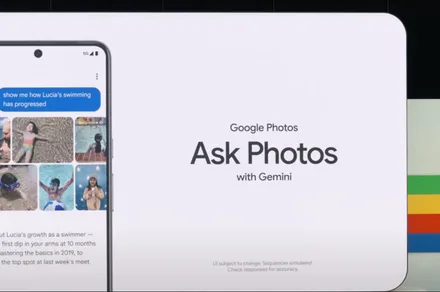
Google Photos is giving users an easier way to leave its Gemini-powered search when a simple keyword would do. A new toggle now sits at the top of the results page, letting users switch between Ask Photos and classic search without digging through settings.
The change appears to address feedback from people who opted into Ask Photos but wanted a quicker way to return to classic search when Gemini was slower or less useful for a straightforward query.
Why did Google add the toggle?
Ask Photos is built for complicated requests. It can understand natural-language questions and search for details inside images, including prompts such as “What’s my license plate?” Classic search is quicker when you only need to find a person, place, object, date, or keyword.
Reddit users complained about irrelevant results, missing keyword matches, and the disappearance of an obvious route back to classic search. Some found that the most reliable workaround was disabling Ask Photos through the Gemini settings entirely.
Advertisement
Google had already acknowledged the problems. It paused the rollout in June 2025 over latency, quality, and user-experience concerns before bringing Ask Photos back with faster handling for simple searches.
What the new toggle actually does
Users who have enabled Ask Photos will see classic search on the left and Ask Photos on the right. Google still chooses which system it believes suits the query, but either view is only a tap away. Classic search can remain selected across several basic searches. A more complicated question may switch the app back to Ask Photos, where it stays until changed manually.
People who have not opted in can continue using regular search. Google may still show them the toggle, but selecting the AI side opens the onboarding process first. Gemini still gets a prominent place in Google Photos. At least users no longer have to hunt through settings whenever classic search would work better.

























































You must be logged in to post a comment Login