
Crypto World
Standard Chartered to absorb Zodia



The crypto custody market reached a new consolidation milestone Wednesday when Bloomberg reported that Standard Chartered is planning to integrate Zodia Custody’s business into its corporate and investment bank division as early as this month, folding its majority-owned crypto custody subsidiary into an internal division that already offers similar services.
Summary
- The restructuring plan would merge overlapping custody functions that currently run in parallel between Standard Chartered’s internal CIB digital asset unit and the bank-backed Zodia Custody subsidiary it co-founded in 2020 with Northern Trust; an announcement could come as early as April 2026
- Zodia Custody would not disappear: the plan preserves Zodia as a standalone software-as-a-service platform offering crypto custody white-label services to third-party banks and fintechs across its seven offices in London, Dublin, Luxembourg, Singapore, the UAE, Sydney, and Hong Kong
- Standard Chartered declined to comment on the reported plans; minority shareholders including Northern Trust, Emirates NBD, SBI Holdings, and National Australia Bank did not immediately respond to or confirm whether they have been approached about the restructuring
The crypto custody market is consolidating, and Standard Chartered’s reported move to absorb Zodia Custody is its clearest signal yet that the bank intends to own the institutional digital asset infrastructure its advisors and corporate clients use, rather than maintaining it at arm’s length through a subsidiary. Bloomberg reported on Wednesday that discussions are underway to fold Zodia’s custody operations into the bank’s CIB division — a unit that has been building its own digital asset services since at least 2024.
The logic is operational. Zodia Custody and Standard Chartered’s internal division have been running parallel custody infrastructure, creating redundancy. Merging them consolidates both functions under a single regulated entity, reducing overhead and simplifying client-facing structures.
Under the reported plan, Zodia Custody’s customer-facing business for Standard Chartered’s institutional clients would move inside the bank. But Zodia would not be wound down. The subsidiary would continue operating as a white-label SaaS platform, providing crypto custody services to other banks and fintech firms that want to offer institutional-grade custody under their own brand. Zodia currently supports over 75 digital assets across seven offices globally, employs approximately 150 people, and holds regulatory registrations across the UK, Ireland, Luxembourg, and Hong Kong.
The dual structure — one business internalized, one remaining external — mirrors what the bank has already done with its broader digital asset strategy. Standard Chartered launched its own crypto custody services in Luxembourg in January 2025 and introduced spot crypto trading for institutional clients in July 2025 under the CIB umbrella. Those internal services were competing with Zodia’s external-facing platform for the same client base.
Standard Chartered’s Broader Crypto Stack
The Zodia integration fits into a multi-year digital asset buildout that now spans custody, trading, stablecoins, and prime brokerage. In January 2026, Standard Chartered moved to establish a crypto prime brokerage within its SC Ventures unit. In November 2025, it partnered with DCS Card Centre to support stablecoin-linked credit cards in Singapore. In March 2026, Bloomberg separately reported that Zodia Markets — the bank’s crypto trading subsidiary — lost its CEO Usman Ahmad in March, with Nick Philpott stepping in as interim. That leadership change preceded the custody restructuring news by less than two weeks.
As crypto.news reported, Zodia had been raising capital and expanding globally as recently as late 2024, with plans to enter new markets and attract tokenization and payments investors. As crypto.news noted, Standard Chartered secured its EU crypto custody license in Luxembourg in January 2025 — a move that in retrospect looks like preparation for bringing Zodia’s operations inside the regulatory perimeter of the bank itself.
The broader custody competition is intensifying. BNY Mellon, State Street, and Morgan Stanley — which named BNY Mellon as custodian for its MSBT Bitcoin ETF — have all expanded their crypto custody operations in 2026. Standard Chartered’s reported move accelerates that consolidation trend, positioning a globally systemically important bank as a direct competitor to specialist crypto custodians.

Crypto World
MoonPay’s AI-native debit card gives agents a live stablecoin railMoonPay’s AI-native debit card gives agents a live stablecoin rail


MoonPay has launched the MoonAgents Card, a Mastercard-enabled debit product that lets AI agents spend stablecoins directly at the point of sale with onchain settlement behind the scenes.
Summary
- MoonPay has launched the MoonAgents Card, a Mastercard-network debit card that lets AI agents spend stablecoins in real time with on-chain settlement.
- The card integrates directly with the Exodus wallet and is initially rolling out in the UK and Latin America, targeting users who already hold and manage stablecoins onchain.
- The offering builds on MoonPay Agents, a non‑custodial software layer that gives AI agents wallets, funding rails, and 50+ crypto tools, positioning MoonPay at the center of the “agentic payments” stack.
MoonPay has unveiled the MoonAgents Card, a Mastercard-network debit card designed so AI agents can spend stablecoins directly at the point of sale, with every transaction settling onchain behind the scenes.
MoonPay turns AI agents into card-paying customers
According to MoonPay’s agents page, the product sits on top of MoonPay Agents, a non‑custodial infrastructure layer that gives AI systems “a wallet, virtual account, zero‑fee stablecoin onramps, and 20+ skills” with a single CLI install.
The new card effectively grafts those agent wallets onto the existing Mastercard network.
In an earlier announcement about its wider crypto cards, MoonPay said its partnership with Mastercard allows stablecoins to be spent at “more than 150 million merchant locations worldwide,” with fiat conversion handled in the background so merchants see a standard card payment.
Exodus integration and regional rollout
MoonPay has been building toward this moment through a series of wallet integrations. Back in 2024, the company announced a partnership with Exodus, calling the popular self‑custody app a “beginner‑friendly Bitcoin and crypto wallet” and allowing users to buy assets like Bitcoin and Ethereum directly via MoonPay’s on‑ramp.
Exodus support is critical for the MoonAgents Card because it gives AI agents an immediate user base and a familiar interface. As Exodus explains in its own support materials, MoonPay is available across mobile, desktop, and Web3, with 160+ countries supported and payments via cards, Apple Pay, Google Pay, and bank transfers, making it easier to top up the stablecoin balance that ultimately funds agent‑driven card spending.
For now, the MoonAgents Card is live in the UK and parts of Latin America, two regions where card penetration is high but access to dollar‑linked stablecoins and advanced onchain tools has been fragmented. By giving AI agents a way to spend stablecoins “like cash” over existing card rails, MoonPay is betting that consumers will tolerate crypto complexity on the back end as long as the front‑end looks like a normal tap‑to‑pay experience.
Building an “agentic payments” stack
MoonPay’s AI ambitions go beyond a single card. When it introduced MoonPay Agents, the company described the platform as a way to give AI systems “access to wallets, funds, and the ability to transact autonomously using MoonPay CLI,” enabling “the full financial life cycle for AI agents: fiat‑to‑crypto funding, wallet management, token discovery, risk analysis, trading, portfolio tracking, and off‑ramping back to fiat.”
A follow‑up support article says MoonPay Agents now exposes “54 crypto‑specific tools across 17 key skills,” including multi‑chain deposits, automatic stablecoin conversion, and compatibility with x402-style machine‑to‑machine payments that require “no human input.” In other words, the MoonAgents Card is one more endpoint in a system where software can receive funds, manage portfolios, and now pay merchants with stablecoins over a global card network.
For crypto markets, that matters because it hints at a future where demand for stablecoins is driven not only by human remitters and traders but also by fleets of autonomous agents transacting continuously. As MoonPay itself puts it in its agents materials, the goal is to let AI “enter the economy” with minimal friction—something the MoonAgents Card is now attempting to turn into an everyday payments reality.


The crypto market opened May with a stronger tone as traders reacted to short liquidations, Bitcoin ETF demand, and wider risk appetite.
Summary
- Bitcoin traded near $77,000 as short liquidations helped lift the broader crypto market.
- Bitcoin funding rates stayed negative for 46 days before a major short squeeze.
- Strategy’s STRC offers an 11.5% variable dividend, but payouts are not guaranteed.
Crypto.news reported several market-moving stories today, led by Bitcoin’s move near $77,000, pressure on short sellers, and fresh debate around Strategy’s STRC stock.
The latest updates show a market still driven by leverage and institutional flows. However, risk remains visible across derivatives, geopolitics, and dividend-linked crypto equities.
Crypto market rises as shorts get squeezed
The total crypto market cap rose about 1.2% on Friday as forced short liquidations helped lift prices. Bitcoin traded near $77,000, while Ethereum held around $2,200. Major altcoins, including XRP, BNB, and Solana, also moved higher by about 1% to 2%.
More than $150 million in crypto positions were liquidated within 24 hours. About 70% of those positions were shorts. This means many traders betting on lower prices had to close positions as prices moved higher.
Moreover, U.S. spot Bitcoin ETFs continued to record inflows above $200 million per day. These inflows supported Bitcoin even as geopolitical risk remained high due to U.S.–Iran tensions.
Tech stocks also helped improve market sentiment. Alphabet shares jumped about 10% after strong earnings from its cloud and AI businesses. Crypto-linked stocks, including Coinbase and MicroStrategy, also moved higher with Bitcoin.
Bitcoin funding drain sets up squeeze
Bitcoin funding rates stayed negative for 46 straight days, marking the longest such period since 2023. In perpetual futures markets, negative funding means short traders pay long traders to keep positions open.
The extended funding pressure may have eroded 30% to 40% of short margin before the final squeeze. More than $427 million in short positions were later liquidated as Bitcoin pushed toward the $80,000 breakout level.
The report also linked the squeeze to fresh catalysts, including Strategy’s $2.54 billion Bitcoin purchase. The move added pressure on already weak short positions.
Strategy STRC income pitch draws risk debate
Strategy CEO Phong Le promoted STRC as an income product, citing its 11.5% variable dividend. He also said he personally bought $250,000 worth of STRC.
However, Strategy’s disclosures state that dividends are not guaranteed. The company’s board can suspend payments or adjust the rate at any time. The disclosures also state there is no assurance of principal repayment.
Crypto World
Ripple investors turn to new profit opportunities, with SHRMiner offering returns of up to $57,000 per month

Disclosure: This article does not represent investment advice. The content and materials featured on this page are for educational purposes only.
XRP holders explore yield strategies as SHRMiner gains attention for cloud mining and passive income.
Summary
- XRP holders are shifting from passive holding to strategies like SHRMiner to boost efficiency and earn potential income.
- SHRMiner enables XRP investors to turn idle assets into automated, yield-generating opportunities with minimal effort.
- As crypto evolves, platforms like SHRMiner are helping XRP holders move from static holding to dynamic, income-focused strategies.
As the cryptocurrency market evolves, many long-term XRP holders are re-evaluating their investment strategies. Instead of simply waiting for prices to rise, they are exploring how to maintain market participation while improving asset efficiency and potentially generating additional cash flow.
The cryptocurrency market continues to evolve, and more and more investors are reassessing their holding strategies. For many long-term XRP holders, simply waiting for the price to rise is no longer the only option. How to maintain market exposure while further improving asset efficiency and generating potential cash flow is becoming an increasingly important focus.
Against this backdrop, SHRMiner’s cloud mining and smart yield programs are gradually attracting more attention from cryptocurrency investors. As a DeFi solution that emphasizes automation, ease of use, and visible returns, SHRMiner provides XRP holders with a new path that differs from traditional holding strategies, establishing a more direct link between “holding digital assets” and “earning potential passive income.”

XRP investors are looking for new revenue opportunities
XRP has long been one of the most-watched major digital assets in the cryptocurrency market. As market cycles continue to change, more and more investors are beginning to ask a practical question: if they simply hold the asset during periods of market volatility, can those funds be used more effectively?
For these investors, the goal is no longer simply to wait for prices to rise, but to explore more flexible strategies that enable digital assets to generate potential returns during the holding period. As a result, platforms combining decentralized finance (DeFi) yield models, cloud mining, and smart contract-based profit schemes are increasingly becoming the focus of market attention. Some market observers believe that the future of cryptocurrency investment will no longer be limited to a single “buy, hold, sell” model, but will gradually shift towards a more diversified path of “holding high-quality assets + allocating yield-generating tools.” This shift is particularly noteworthy for XRP holders.
SHRMiner’s plans are now attracting market attention
SHRMiner stands out among numerous yield-generating platforms primarily because it simplifies the complex logic of mining and yield generation. Leveraging cloud computing capabilities and smart contract technology, the platform provides users with a relatively intuitive entry point, making digital asset mining easier to understand and participate in.
Compared to traditional mining, SHRMiner’s model eliminates the need for users to purchase mining rigs or handle equipment maintenance, electricity costs, or server management. This significantly lowers the barrier to entry for ordinary investors without a technical background or mining farm experience.
The platform supports a variety of digital assets, including BTC, XRP, ETH, and USDT. After users deposit these assets, the system automatically converts them into computing power to participate in the platform’s revenue-generating program. This not only simplifies the process but also increases the flexibility of asset allocation.
For many XRP investors, SHRMiner’s appeal lies in its attempt to transform “static holding” into “dynamic returns,” giving digital assets stored in a wallet the opportunity to participate in generating returns.
Join SHRMiner now and turn cryptocurrency into daily passive income
SHRMiner is designed to be simple and easy to use, allowing even users with no mining experience to quickly understand and participate in its profit model. The entire process mainly includes the following steps:
1. Create an account
Users can register by visiting the official website or using the mobile platform. According to the platform, new users receive a $15 reward and can claim a daily check-in reward of $0.60, providing an introductory experience for cloud mining beginners.
2. Select a mining plan
After registration, users can choose different mining plans based on their capital allocation and profit goals. The platform offers a variety of contract options, each with different investment scales, contract terms, and profit structures, thus catering to investors with different preferences.
3. Deposit digital assets
The platform supports major cryptocurrencies, including BTC, XRP, ETH, and USDT. After users deposit these assets, the system automatically converts them into computing power, which is used to participate in the platform’s revenue program.
4. Claim your daily earnings
Once the contract is activated, users can begin receiving daily mining rewards. These rewards can be withdrawn or reinvested in new contract plans to expand future mining capabilities.
This process requires no knowledge of mining hardware, electricity costs, or server infrastructure, significantly lowering the barrier to entry for participating in digital asset mining.
Why is SHRMiner’s new mining plan only now attracting attention?
In financial media and cryptocurrency discussions, a clear return structure is often the most attractive feature for investors. SHRMiner’s new mining program has garnered significant attention precisely because it presents its return structure in a simple and clear way, making it easier for investors to understand the potential returns at different investment levels.
According to the platform’s example scheme, different contract levels correspond to different revenue structures:
Introductory Plan
Investment Amount: $100
Contract Duration: 2 days
Estimated Daily Return: Approximately $4
Medium-Term Plan
Investment Amount: US$10,000
Estimated Daily Return: Approximately US$150
Estimated Monthly Return: Approximately US$5,250
Premium Plan
Investment Amount: US$50,000
Estimated Daily Return: Approximately US$900
For more details on contract plans and portfolio return schemes, please visit the official website. According to the platform example, under the contract portfolio model, the estimated maximum daily return is approximately $8,577.
Cryptocurrency investment strategies are changing
As the centralized finance (DeFi) ecosystem continues to develop, more and more investors are focusing on the earning potential of digital assets, rather than solely relying on price increases. In the past, many XRP holders chose to hold long-term, waiting for market opportunities. Today, more and more users are exploring ways to earn additional income while holding their assets.
Therefore, cloud mining and automated yield models are gaining increasing attention. By linking digital assets with computing power plans, investors can maintain market exposure while pursuing daily returns and potential cash flow. As the market matures, strategies combining holding and yield are becoming a new focus for cryptocurrency investors.
Conclusion
As the cryptocurrency market continues to evolve, investors are seeking more efficient asset management methods that go beyond traditional holding models. The logic behind cryptocurrency investment is rapidly evolving, moving from simply waiting for prices to rise to utilizing decentralized finance (DeFi) yield tools and cloud mining solutions to generate potential cash flow.
For long-term investors holding XRP, BTC, or ETH, finding new profit opportunities in ever-changing market cycles has become an increasingly important priority. Platforms like SHRMiner simplify the participation process, offer diverse contract options, and emphasize clearly visible reward structures, providing investors with a new perspective.
Interested investors can visit the SHRMiner website for more information, contact the team by emailing [email protected], or download the SHRMiner application to manage their mining plans and track earnings.
Disclosure: This content is provided by a third party. Neither crypto.news nor the author of this article endorses any product mentioned on this page. Users should conduct their own research before taking any action related to the company.

Bitcoin has resumed its ascent, trading above the $78,000 level and extending its April rally, supported in part by notable inflows into U.S. spot BTC exchange-traded funds. According to CoinGlass data, BTC climbed higher as April delivered an 11.87% gain, a move that was underpinned by SoSoValue data showing about $1.97 billion in spot BTC ETF inflows for the month. Despite the move, market skeptics point to a potential test around the $80,000 mark, a level that many traders say must flip into support to confirm that bulls are in control. CryptoQuant, meanwhile, cautions that the April rebound appears to have been driven largely by futures traders, with spot demand softer, suggesting the marginal buyer may have been speculative rather than fundamental.
The mounting tension around key levels adds up to a simple reality for traders: a sustained move above $80,000 could unlock a path toward the mid-$80,000s, but failure to hold could invite a deeper correction toward recent moving-average support. The 20-day exponential moving average sits around $75,814, acting as a nearer-term barometer, with the 50-day simple moving average near $72,362 offering a more substantial cushion if prices retreat. In the background, traders are watching the “True Market Mean” near the $78,000 zone and the Short-Term Holder cost basis around $79,000 as markers of potential supply pressure.
Key takeaways
- Bitcoin’s heavy lift remains the $80,000 ceiling: a confirmed flip to support could catalyze a move toward $84,000, while a break below the 20-day EMA risks a deeper pullback toward $72,362.
- April ETF inflows underpin the recent rally: SoSoValue data show about $1.97 billion flowing into U.S. spot BTC ETFs in April, reinforcing upside momentum for BTC near the current zone.
- CryptoQuant flags a futures-driven spark in April: the firm notes that spot demand faded as futures trading led the rally, signaling that the market’s marginal buyer may have been speculative rather than fundamental.
- Ether eyes the 50-day and a higher target: ETH sits near the 50-day SMA at $2,207, with a potential push toward $2,465 if buying interest persists and price remains above the 20-day EMA.
- Altcoins poised, but overhead resistance remains: most top coins are trading within defined ranges, with breakouts dependent on clearing local resistance levels and chart patterns.
Bitcoin price dynamics
BTC’s recent uptick began as it rebounded from the 20-day exponential moving average around $75,814, reflecting renewed dip-buying. The immediate challenge appears near $79,500–$80,000, where sellers could reassert pressure. A sustained rally beyond $80,000 would likely embolden bulls and open the door to a test of the $84,000 zone. Conversely, a break below the 20-day EMA could invite a more meaningful correction toward the 50-day simple moving average near $72,362 and possibly below that if a broader trend turns decisively bearish. In this scenario, a failure to hold could embolden sellers toward the longer-term support line.
Ether and the broader Ethereum ecosystem
Ether has found support near the 50-day SMA at about $2,207, a sign that buyers are viewing declines as opportunities. The trend momentum, however, shows signs of cooling as the 20-day EMA flattens and the RSI hovers near the midpoint. If ETH holds above the 50-day SMA, bulls could push toward $2,465, with the price potentially tracing a path up to the ascending channel’s resistance. A close above the channel’s resistance or a sustained hold above the 20-day EMA could trigger the next leg higher; otherwise, prices may remain range-bound within the channel until a decisive breakout occurs.
Altcoin snapshots
XRP price outlook
XRP remains confined in a range between $1.27 and $1.61, suggesting a tug-of-war between buyers and sellers. The 20-day EMA sits around $1.39 and has begun to edge down, with the RSI near midpoint signaling balanced momentum. A sustained move below the moving averages increases the odds of a test toward the $1.27 support, while a breakout above the moving averages could push XRP toward the downtrend line and then the $1.61 resistance. A close above $1.61 would be a genuine trend shift toward a new ceiling.
BNB price trajectory
BNB has dipped below major averages but has not seen a decisive deterioration in demand. The bulls are attempting to reclaim the moving averages, with a break back above them potentially opening a path to $654 and then $687 as overhead resistance. If price action turns down and breaks below $610, sellers could push toward the $570 support, where buyers are expected to re-emerge.
Solana in the spotlight
Solana is attempting to hold above $82.65, but bears continue to press. A breakdown below this level could send SOL toward $76, with a further slip to $67 if selling intensifies. Conversely, a move above the moving averages could keep SOL within the $82.65–$90.73 range for now, with a close above $90.73 potentially re-opening a path to the $98 overhead resistance.
Dogecoin’s rally potential
Dogecoin has shown resilience as buyers defended the $0.10 floor, increasing the probability of a rally toward the $0.12 hurdle. A decisive move above $0.12 could carry DOGE toward $0.14 and potentially $0.16, while a drop below the moving averages might keep the price confined to a $0.09–$0.12 corridor for some time.
Hyperliquid price path
Hyperliquid turned lower and dipped below the 50-day SMA, though a long lower wick signals buying interest at lower levels. The bulls will need to push above the 20-day EMA to target the $43.76–$45.77 zone, with a decisive close beyond that zone opening a route to $50. A breakdown below $38.70 could invite a deeper pullback toward $37.77 and eventually $34.45.
Cardano price trajectory
ADA has clung to the moving averages, signaling ongoing bullish pressure. A break above the downtrend line could lift ADA toward $0.32 and then $0.37, signaling a potential short-term trend shift. If ADA weakens and slides below $0.22, the setup could keep the pair within the descending channel for several more days.
Bitcoin Cash price dynamics
BCH bounced off the $443 level as bulls defended the line, with minor resistance near the 50-day SMA around $453. A clear break above that level could push BCH toward $486, where bears are expected to defend, and if buyers surpass that hurdle, toward $520. If prices fail to clear the resistance, BCH could remain range-bound between roughly $419 and $486.
Monero price outlook
XMR showed a constructive bounce from the 20-day EMA around $366, with the moving average’s uptrend and a positive RSI pointing to upside momentum. If buyers sustain a move above $406, a rally toward $500 could unfold. Conversely, a sharp reversal from overhead resistance could see XMR drift back toward the $302–$406 range as volatility settles.
Market signals and what comes next
On balance, investors are weighing a split between technical momentum and macro-driven risk appetites. The CryptoQuant note that April’s rally was heavily fuelled by futures positioning serves as a cautionary reminder that spot demand remains a critical piece of the puzzle. The ETF inflows point to continued institutional interest, but the durability of the rally will hinge on whether spot demand strengthens in tandem with price action. As BTC and major altcoins approach pivotal thresholds, traders will be looking for clear confirmations—above or below key levels—to gauge whether this cycle shifts toward a fresh leg higher or retests lower supports.
What to watch next: a sustained break above $80,000 paired with a decisive hold above the 20-day EMA would bolster the case for a continued ascent, while a rejection at that level could re-ignite selling pressure into the mid-to-late spring. For Ethereum, the crucial test remains holding the $2,207 region and achieving a close above $2,465 to confirm new upside momentum. Beyond these, the market will be watching whether the breadth of gains across top altcoins broadens or remains contained within established ranges, with the CryptoQuant perspective serving as a reminder that sentiment and liquidity will continue to shape the near-term trajectory.


A Chinese court has ruled that companies cannot legally dismiss employees solely to replace them with cost-saving artificial intelligence tools, setting a clear boundary on how far firms can go in using automation to reduce labour costs.
Summary
- Hangzhou court rules companies cannot fire workers solely to replace them with AI, rejecting automation as a valid ground under labour law.
- Tribunal finds dismissal unlawful after firm cut employee’s role and pay following AI adoption, orders additional compensation.
- Ruling comes as global firms cut jobs amid AI uptake, while the U.S. expands AI deployment across classified defence systems.
On April 30, the Hangzhou Intermediate People’s Court issued the ruling while hearing a dispute involving a senior tech worker, surnamed Zhou, who said his employer tried to demote him after introducing AI systems into its workflow.
Zhou joined the company in November 2022 as a quality assurance supervisor, earning a monthly salary of about $3,500. His responsibilities included optimising AI-generated outputs and filtering sensitive content.
Over time, those tasks were absorbed by large language models. The company then attempted to move Zhou into a lower-ranking role with a 40% pay cut, reducing his salary to about $2,100. Zhou declined the reassignment.
The company subsequently terminated his employment, citing organisational restructuring and reduced staffing needs. It offered him a severance package of about $43,000, which he challenged through arbitration.
An arbitration panel found the dismissal unlawful and supported Zhou’s request for additional compensation.
The employer then escalated the dispute, first filing a lawsuit in a district court and later appealing to the Hangzhou Intermediate People’s Court. At the centre of the case was whether replacing an employee with AI qualifies as a “major change in objective circumstances” under China’s Labour Contract Law, a condition that can justify termination.
The court rejected that argument. It held that AI-driven automation does not meet the threshold of a “major change,” and said the company failed to demonstrate that retaining Zhou had become impossible. Judges also noted that the alternative role offered to him was not a reasonable reassignment, reinforcing the conclusion that the termination was unlawful.
The ruling arrives as companies worldwide continue to cut jobs while increasing reliance on AI tools powered by large language models. Major firms, including Oracle, Meta, Amazon, Epic Games, Spotify, and Gemini, have collectively reduced headcount by thousands in the first five months of the year.
China draws a line as U.S. accelerates AI adoption in defence
While China’s courts are tightening safeguards around AI-led job cuts, other jurisdictions such as the United States are moving quickly to expand the use of artificial intelligence across critical sectors.
As reported by crypto.news, on May 1 the U.S. Department of Defense stepped up its AI strategy, signing new agreements with several major technology firms to deploy advanced systems across classified military networks.
According to a statement released Friday, Nvidia, Microsoft, Reflection AI, and Amazon Web Services have entered into agreements to provide operational capabilities. Two defence officials familiar with the matter also confirmed the deals.
These companies join a growing roster of partners that already includes SpaceX, OpenAI, and Google, all of which have committed to supplying AI tools for classified use. The announcement also serves as the first formal confirmation from the Pentagon of its agreement with Google, which had surfaced in earlier reports.
“These agreements accelerate the transformation toward establishing the United States military as an AI-first fighting force,” the department said.


Coinglass data show Ethereum longs face about $874m in liquidations below $2,206, while shorts risk roughly $403m above $2,412, creating two key forced‑flow bands.
Summary
- Coinglass data show that if Ethereum’s price drops below $2,206, cumulative long liquidations across major centralized exchanges would reach about $874 million.
- On the upside, a clean break above $2,412 would flip pressure onto shorts, with roughly $403 million in cumulative short liquidations triggered on mainstream CEXs at that level.
- These bands mark two key liquidation “walls” where concentrated leverage could turn a 5%–6% move in spot ETH into a much larger derivatives-driven cascade in either direction.
Derivatives analytics platform Coinglass is flagging fresh stress points on Ethereum’s futures liquidation heatmap, with hundreds of millions of dollars in leverage stacked just above and below current prices.
Coinglass heatmap flags ETH’s next forced‑flow zones
According to the latest heatmap bands, if ETH slides under roughly $2,206, the cumulative notional value of long positions queued for forced closure on leading centralized exchanges would reach about $874 million.
Conversely, if ETH breaks convincingly above around $2,412, Coinglass estimates that shorts worth roughly $403 million would be pushed into liquidation, as margin requirements are breached and exchanges auto-close positions.
Coinglass explains in its ETH liquidation documentation that the heatmap aggregates open leveraged long and short positions by price band and shows where liquidations are most likely to cluster, turning those zones into de facto “trapdoors” or “ceiling panels” for the market.
Why these levels matter for ETH traders
Liquidations are mechanically simple but systemically important: when price crosses a band with heavy leverage, exchanges sell (for over‑levered longs) or buy (for over‑levered shorts) into the move, often accelerating the initial direction.
As MEXC noted in a recent analysis of a similar setup near $2,000, nearly $1.8 billion in ETH leverage concentrated in a narrow range turned a modest spot move into a near‑vertical “liquidation wick” as long and short positions were flushed in quick succession.
In the current configuration, a break below $2,206 could unleash roughly twice as much forced selling from longs as the buy‑side pressure shorts would face above $2,412, suggesting downside de‑leveraging may be more violent unless positioning shifts.
For active traders, these bands often become reference points for stop‑loss placement and position sizing: trading into a heavy liquidation wall without a plan risks getting caught in a cascade, while waiting for those zones to clear can offer cleaner entries once excess leverage has been washed out.
Options desks and basis traders also watch the heatmap closely, since large liquidation events can briefly blow out implied volatility and funding rates, creating opportunities to sell rich options or capture dislocated spreads—provided they are positioned with enough cushion to survive the initial shock.


Summary
- HyperInsight data show Huang Licheng has boosted his Bitcoin long to about $14.5 million with more than 40x leverage, opening around $76,357 and facing liquidation near $72,904.5.
- He is also running a 25x leveraged Ethereum long worth roughly $23.3 million, with an average entry price of $2,311.63 and a liquidation level at $2,202.7.
- The positions, taken on derivatives venue Hyperliquid, put tens of millions of dollars in notional exposure at risk if BTC and ETH see even mid‑single‑digit pullbacks from current levels.
According to monitoring shared by on‑chain and derivatives tracker HyperInsight, high‑profile trader Huang Licheng has sharply increased his Bitcoin long exposure, pushing his total BTC long position to around $14.5 million with more than 40x leverage.
HyperInsight flags fresh BTC and ETH leverage from Huang Licheng
The data indicate an average opening price near $76,357, with a liquidation price at approximately $72,904.5, implying that a drawdown of roughly 4.5%–5% from entry would be enough to wipe out his margin and trigger forced closure on the position.
HyperInsight and related feeds have consistently tracked Huang’s activity on the Hyperliquid platform in recent weeks, noting that he has repeatedly used 40x BTC leverage, sometimes seeing unrealized drawdowns north of 60% on earlier attempts when volatility spiked.
25x ETH long adds another $23.3m in risk
Alongside the Bitcoin (BTC) bet, Huang is also running a large 25x leveraged Ethereum long, now worth roughly $23.3 million.
Per the latest HyperInsight snapshot, that position was opened around $2,311.63 with a liquidation threshold near $2,202.7, giving him barely a 4.7% buffer before the trade is forcibly closed if price moves against him.
Previous reports from PANews and Phemex showed Huang steadily ramping his ETH exposure over March and April, at times holding thousands of ETH in 25x longs with liquidation bands just a few percentage points below spot.
More recently, Phemex highlighted that he had placed sizable profit‑taking orders between $2,365 and $2,425 while running what it described as the largest ETH long on Hyperliquid, valued around $32.8 million at 25x leverage.
A leveraged book that can move—and be moved by—the market
In mid‑April, Phemex estimated Huang’s combined BTC and HYPE positions alone at over $56.5 million in notional value, with additional tens of millions of dollars tied up in ETH longs.
A later breakdown from PANews pegged his outstanding longs at roughly $79.16 million, split between about 555 BTC (around $42.76 million), 15,600 ETH (about $35.85 million), and a smaller HYPE allocation—illustrating the scale at which he is willing to deploy leverage across majors and smaller caps.
Such concentrated, high‑leverage positioning matters for other traders because it creates both a potential source of forced flow—if BTC or ETH touch his liquidation levels—and a sentiment signal, given Huang’s track record of stringing together profitable trades when momentum is with him.
For risk‑managed participants, the takeaway is straightforward: when prominent accounts are running 25x–40x leverage with liquidation bands just a few percent away, even relatively routine price swings can cascade into outsized liquidations, temporarily amplifying volatility on venues like Hyperliquid and beyond.

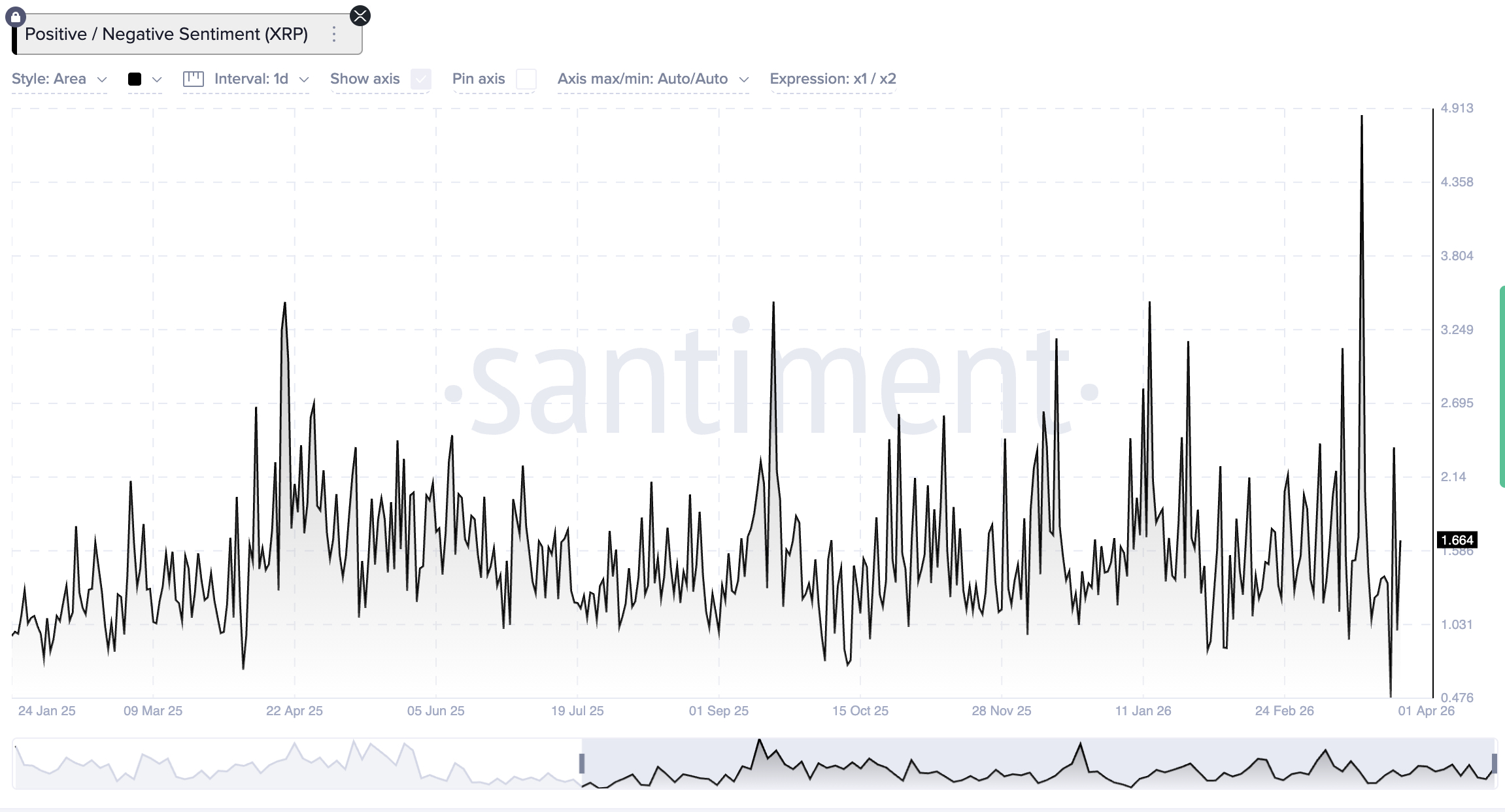
XRP is trading at the $1.40 level again after failing to break the $1.50 ceiling last month, and somehow, that’s the bullish part of the story. Social sentiment just hit its second-highest reading in two years, driven by Rakuten Wallet’s full-scale XRP integration. So what is our XRP price prediction for next week?
Starting today, @Rakuten_Wallet users in Japan can convert @Rakuten Points into XRP, spot trade in-app, and spend across 5M+ merchant locations. — RippleX (@RippleXDev) April 30, 2026

With 44 million Rakuten Pay users and $23B in loyalty points now redeemable for XRP, this is one of the largest retail deployments… pic.twitter.com/P7I52bGjVL
Santiment data clocked a positive-to-negative comment ratio of 4.8, near historic highs for the token. Rakuten Wallet’s deployment also enables 44 million users to convert loyalty points into XRP and spend at more than 5 million merchants.
Rakuten also launched a tiered reward campaign with bonuses on purchases of 30,000 yen or more, a lottery for 100,000-yen-plus buyers, and a pending iOS rollout. It’s a $23 billion loyalty ecosystem deploying XRP at a consumer scale.
Discover: The best pre-launch token sales
XRP Price Prediction: Break $1.50 Resistance and Target $5?
XRP recently tapped a local high of $1.44 before stalling, and that level now represents the immediate ceiling. A leverage flush followed the rejection, a signal that speculative positioning outpaced organic demand.
The price itself is now consolidating below both its 60-day and 200-day moving averages, a structurally bearish configuration that complicates the bullish narrative.
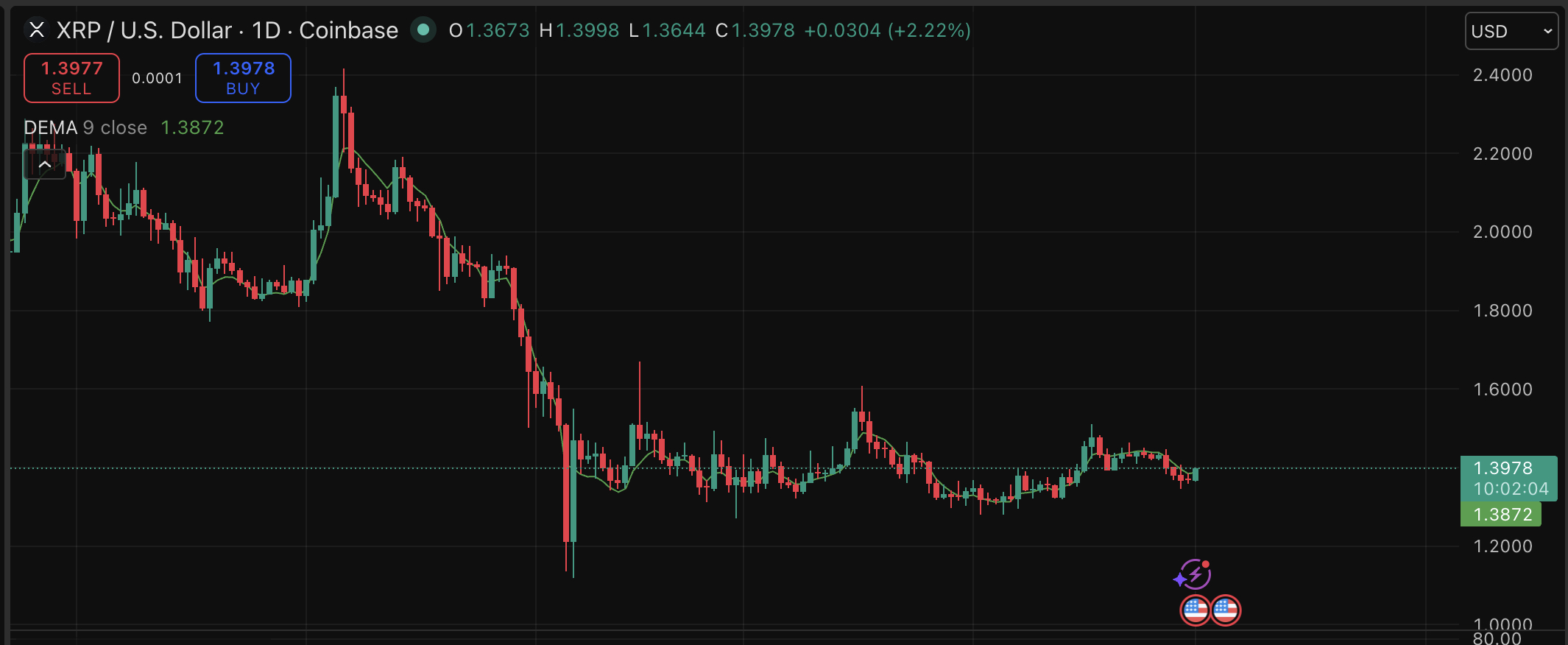
The technical picture is, frankly, a contradiction. Aggregate signals show a “Strong Buy” reading across 6 indicators (5 buy, 1 sell), yet the price has declined nearly 55% over the past nine months. Sentiment spikes historically precede short-term stabilization rather than immediate rallies as the FOMO builds before conviction does.
Ripple’s adoption narrative remains intact, but price discovery requires a sentiment ratio. Volume confirmation is the missing ingredient.
Discover: The best crypto to diversify your portfolio with
LiquidChain Targets Early Mover Upside as XRP Tests Key Levels
XRP’s current setup of strong narrative, muted price response, and overhead resistance is the kind of environment that pushes capital toward earlier-stage opportunities with higher asymmetric potential. When the blue-chip thesis stalls, the search for the next leg of upside moves down the risk curve. That’s where LiquidChain enters the picture.
LiquidChain ($LIQUID) is a Layer 3 infrastructure project that fuses Bitcoin, Ethereum, and Solana liquidity into a single execution environment, a cross-chain liquidity layer targeting the fragmentation problem that plagues DeFi.
The Order and the LiquidChain L3 have one thing in common.
They're both ready for anything.⟁https://t.co/vqvBcdSQYC pic.twitter.com/eHoGD2wtG0
— LiquidChain (@getliquidchain) May 1, 2026
With Liquid, developers can deploy once and access all three ecosystems simultaneously. The presale is currently priced at $0.01455, with more than $700K raised to date.
Key features include a Unified Liquidity Layer, Single-Step Execution, Verifiable Settlement, and Deploy-Once Architecture.
For those tracking the cross-chain narrative, research LiquidChain here.
The post XRP Price Prediction: Rakuten Integration Sends Sentiment to 2-Year High appeared first on Cryptonews.


Bitcoin price rose nearly 3% to $78,700 on May 1 as Iran submitted a new peace proposal through Pakistani mediators to the United States, easing oil pressure and improving risk sentiment across global markets for the second time in a week.
Summary
- Bitcoin price climbed to $78,700 on May 1, recovering from a multi-week low near $74,900 posted just two days earlier when Trump received a military briefing on new Iran strike options.
- Iran submitted a revised peace proposal through Pakistani mediators on May 1, CNBC reported, with oil prices edging lower on the development as Strait of Hormuz supply concerns partially eased.
- 21Shares chief market strategist Adrian Fritz said $80,000 is “quite a resistance” and that a confident break above it “could spark some momentum” as recent buyers return to profit.
Bitcoin price was trading at $78,722 on May 1, extending gains as US markets opened. CNBC reported that Iran sent an updated peace proposal to mediators in Pakistan, the latest diplomatic signal in a weeks-long negotiation over ceasefire terms, sanctions relief, and control of the Strait of Hormuz. Oil prices edged lower on the development, releasing pressure from one of the primary macro headwinds that had weighed on crypto and equities all week.
As crypto.news reported, Iran’s expected submission of a revised proposal compresses the “war premium” baked into oil markets and is modestly supportive for risk assets, but keeps Bitcoin hostage to headline volatility until a concrete deal is signed. The move from $74,900 on April 29 to $78,700 on May 1 retraced nearly the entire post-FOMC selloff, driven by the same diplomatic signal dynamic that produced every Bitcoin recovery during the conflict. “I think $80,000 is quite a resistance. We need a confident push through that level,” said 21Shares chief market strategist Adrian Fritz. “Once we’re above that, it could spark some momentum. People are back in profit, especially the ones that invested more recently.” Fritz added that a move above $85,000 could signal the first signs of a broader reversal.
As crypto.news documented, Bitcoin reached $78,400 during the prior week before being rejected sharply when hostilities resumed, establishing a clear pattern: every credible diplomatic signal produces a fast BTC repricing, and every breakdown reverses it within hours. As crypto.news tracked, hopes of a broader US-Iran deal have consistently fuelled bets on a BTC retest of $80,000 if ETF inflows resume and oil drops back toward pre-war levels. The $80,000 level has now been tested and rejected twice in 2026, making a decisive break above it, confirmed by sustained ETF inflows and stable oil, the clearest signal that the Iran-driven macro overhang on Bitcoin has meaningfully lifted.


Blockstream CEO Adam Back positioned Bitcoin treasury companies as arbitrage plays between the current fiat financial system and a future where BTC dominates global economics.
His statement adds intellectual weight to Strategy’s aggressive Bitcoin accumulation strategy and similar corporate initiatives gaining momentum.
Bitcoin Treasury as Arbitrage Play
Adam Back’s framing is elegant.
He calls Bitcoin treasury companies an “arbitrage between the fiat present and the hyperbitcoinized future.”
This means firms buying the cryptocurrency today at current prices benefit from two forces. First, BTC adoption accelerates. Second, fiat currencies depreciate through inflation or policy mistakes. The gap between these two outcomes creates substantial upside for early accumulators.
Back’s thesis suggests that companies holding Bitcoin position themselves as asymmetric bets on systemic transition rather than conventional equity plays.
The Financial Path to Hyperbitcoinization
Back’s argument rests on the currency eventually becoming the dominant global store of value. In this future, Bitcoin serves as the reserve asset backing international commerce and national treasuries.
Companies that accumulated BTC before this transition would benefit enormously. Their holdings would appreciate not just through price increases but also through the adoption of Bitcoin, which would increase its utility and acceptance.
This vision parallels Michael Saylor’s endgame prediction that Bitcoin reaches $10 million per coin through digital credit flows and institutional adoption.
Back’s bullish narrative faces serious skepticism. Peter Schiff has called Strategy’s Bitcoin strategy fundamentally flawed, arguing that rising dividend obligations will force liquidations before hyperbitcoinization arrives.
Schiff warns that the cryptocurrency could decline sharply if macro conditions deteriorate, making current accumulation economically irrational.
However, Eric Trump recently predicted Bitcoin would reach $1 million, signaling the Trump family’s confidence in its upside potential despite near-term volatility.
Bitcoin Treasury Companies Multiply
Back’s framework helps explain why public companies are aggressively raising capital to acquire BTC. If the hyperbitcoinization thesis proves correct, early accumulators capture enormous value.
Strategy leads this trend with 815,061 Bitcoin holdings worth $63.46 billion. Other companies are considering similar strategies, creating competitive pressure to accumulate while BTC remains relatively undervalued.
The arbitrage thesis suggests that hesitation to accumulate BTC today could prove costly if hyperbitcoinization accelerates faster than currently modeled.
Adam Back’s arbitrage framing provides intellectual scaffolding for BTC treasury strategies. Rather than viewing Bitcoin as speculative, Back positions it as a rational hedge against fiat system failure.
Whether this arbitrage thesis proves correct depends on adoption accelerating and fiat systems facing genuine stress. For now, companies betting on hyperbitcoinization are making convex bets with asymmetric upside and limited downside from current valuations.
The post Blockstream CEO Predicts Hyperbitcoinized Future for Bitcoin appeared first on BeInCrypto.

Browns coach Monken not ready to name starting QB amid Watson-Sanders battle

Spotify unveils verified badge to distinguish humans from AI

a gothic chiller set in a creepy Irish hotel that expertly weaves horror tropes

Manchester United reach agreement with Casemiro over contract clause amid transfer speculation

US brings back mandatory military draft registration

Steven Gerrard disagrees with Gary Neville over ‘shock’ Chelsea and Arsenal claim | Football


-

 Tech4 days ago
Register Renaming | Hackaday
-
 Crypto World6 days ago
Hyperliquid $HYPE Rally Builds Momentum as AI Sector Enters Prove-It Phase
-

 Politics4 days ago
Drax board avoid their own AGM, accused of greenwashing & environmental racism
-

 Tech4 days ago
Images of Samsung’s rumored smart glasses have leaked
-

 Tech5 days ago
Why Blue Badges Disappeared From Toyota Hybrids
-
 Sports6 days ago
IPL 2026: Ruturaj Gaikwad registers slowest fifty of the season, enters all-time unwanted list | Cricket News
-
 Tech6 hours ago
Trump’s 25% EU auto tariff breaches Turnberry Agreement that also covers semiconductors and digital trade
-

 NewsBeat6 days ago
LK Bennett closes all stores after entering administration
-

 Fashion3 days ago
Kylie Jenner’s KHY Enters a New Era with ‘Born in LA’
-
 Entertainment6 days ago
Mariah Carey Slams Deposition Claims In Brother’s Lawsuit
-

 Business3 days ago
Most Commercial Energy Audits Miss the Real Losses
-

 Business4 days ago
(VIDEO) Charlize Theron Climbs Times Square Billboard to Promote New Netflix Thriller ‘Apex’
-

 Crypto World4 days ago
CFTC’s AI will review U.S. crypto registration applications, chairman tells CoinDesk
-
 Sports6 hours ago
Paul Scholes issues Marcus Rashford reality check as agreement emerges over Man United star
-

 Business3 days ago
Barclay Brothers Avoid Bankruptcy: HSBC Drops High Court Petitions After IVA Deal
-

 Tech6 days ago
Microsoft to roll out Entra passkeys on Windows in late April
-

 Tech6 days ago
OpenAI’s Sam Altman apologizes for not reporting ChatGPT account of Tumbler Ridge suspect to police
-

 Tech6 days ago
OpenAI CEO apologizes to Tumbler Ridge community
-
 Business2 days ago
Tesla Officially Registers Elon Musk’s Stock: What Investors Need to Know
-

 Tech3 days ago
Get Ready for More Brain-Scanning Consumer Gadgets
You must be logged in to post a comment Login