
Crypto World
Strategy challenges MSCI proposal targeting digital asset treasury firms



Strategy has formally opposed MSCI’s proposed screening rules for companies with large non-operating asset holdings, arguing that the methodology unfairly targets digital asset treasury firms and could push companies including Strategy out of major global equity indexes.
Summary
- Strategy called MSCI’s proposed screening rules discriminatory and argued they unfairly target digital asset treasury companies.
- Companies with operating assets below 50% of total assets would face five additional tests, with four failures potentially making them ineligible for MSCI indexes.
- A May simulation identified Strategy, Metaplanet and Yellow Cake for possible deletion under the proposed methodology.
- Strategy said MSCI’s operating and non-operating asset distinction is not defined under U.S. GAAP, IFRS or existing U.S. securities law.
- MSCI is accepting feedback until Sept. 30, with a decision expected by Oct. 16 and any changes taking effect in December.
In a Monday letter signed by Executive Chairman Michael Saylor and CEO Phong Le, Strategy called MSCI’s proposal “discriminatory, arbitrary, and misguided” and asked the index provider to withdraw it.
“If adopted, the proposal would have no meaningful impact on Strategy’s business, but it would profoundly harm MSCI’s reputation as a reliable and neutral index provider,” Strategy wrote.
Strategy says MSCI proposal targets digital asset treasury firms
MSCI opened its latest consultation in August, proposing a new method for identifying companies whose balance sheets contain large amounts of assets it considers non-operating.
Companies whose operating assets account for less than 50% of total assets would face five additional financial-ratio tests under the proposed system. Triggering at least four of the five conditions could classify a company as non-operating and make it ineligible for the MSCI Global Investable Market Indexes.
The methodology examines operating asset intensity, expenses, operating cash flow, fair value changes tied to assets considered non-operating and dependence on financing to accumulate those assets.
Strategy argued that the proposal effectively revives MSCI’s earlier attempt to address digital asset treasury companies through a different screening process. The company described the latest methodology as a “pretext” for targeting DATs and challenged MSCI’s distinction between operating and non-operating assets.
MSCI considered a separate framework last year that could have removed companies with digital assets accounting for 50% or more of their total assets. Following industry opposition, the index provider kept crypto treasury firms in its indexes in January while it prepared a new review covering companies with substantial non-operating assets, as crypto.news previously reported.
Strategy opposed that earlier proposal as well, arguing that holding a large amount of Bitcoin should not make an operating company equivalent to an investment fund.
The new framework has since expanded beyond a crypto-specific threshold, though Strategy maintains that its practical effect remains concentrated on digital asset treasury companies.
MSCI simulation puts Strategy and Metaplanet at risk
The possible impact became clearer when a simulation based on May 2026 data identified Strategy, Metaplanet and U.K.-listed uranium investment company Yellow Cake as companies that would face deletion under the proposed methodology.
The MSCI simulation identified Strategy with a free-float-adjusted market capitalization of $23.93 billion, while Yellow Cake stood at $1.81 billion and Metaplanet at $654 million.
SharpLink, Center Laboratories and Lydia Holding were placed on a watchlist in the simulation because MSCI proposes different treatment for existing constituents. Under the proposed methodology, current index members would need to fail the applicable screening test in two consecutive annual reviews before removal.
Strategy challenged the basis of the screening process, saying MSCI’s use of “operating” and “non-operating” does not match established accounting definitions.
The company said neither U.S. generally accepted accounting principles nor International Financial Reporting Standards provides the distinction MSCI proposes to use. Strategy argued that existing U.S. securities law does not provide an equivalent test either.
Bitcoin is central to Strategy’s objection. MSCI treats the cryptocurrency on Strategy’s balance sheet as a non-operating asset, while Strategy reports its Bitcoin treasury as an operating segment.
According to the company, gains and losses related to its Bitcoin holdings are recorded as operating expenses following discussions with the U.S. Securities and Exchange Commission.
Strategy said MSCI would therefore be applying an index-level classification that differs from the accounting treatment used in its financial statements.
The company questioned why similar treatment would not apply to other businesses whose balance sheets contain large pools of assets. Its letter cited real estate investment trusts, timber businesses and energy infrastructure companies as examples of asset-heavy firms that could remain eligible under the proposed methodology.
Strategy argued that the difference would concentrate the effects of the test on digital asset treasury firms even though MSCI has presented the proposal as a company-wide screening framework.
Strategy wants MSCI to define its asset test
If MSCI proceeds with the proposal, Strategy asked the index provider to base any final methodology on recognized accounting or legal standards.
The company wants the rules applied only to financial filings released after the methodology has been finalized, preventing companies from being assessed retrospectively against a classification that did not exist when earlier filings were prepared.
Strategy requested a published record of the consultation process and asked MSCI to explain why the screening method is needed.
It wants the index provider to set objective criteria separating operating assets and activities from those considered non-operating, instead of relying on classifications that Strategy said lack established definitions.
The current dispute follows months of uncertainty over how major index providers should treat companies that use their balance sheets to hold Bitcoin and other digital assets.
When MSCI paused its earlier DATCO exclusion in January, Strategy shares rose as the immediate risk of removal from MSCI indexes eased.
The earlier debate had raised concerns about potential passive selling if companies were removed from benchmarks followed by index-tracking funds. JPMorgan estimated at the time that exclusion from MSCI indexes alone could lead to roughly $2.8 billion in selling of Strategy shares, with potential outflows reaching $8.8 billion if other index providers followed.
The estimate related to MSCI’s previous crypto-specific proposal and was not a forecast for the methodology currently under consultation.
MSCI is accepting comments on the latest proposal until Sept. 30 and plans to publish the outcome by Oct. 16. Any changes adopted following the consultation are expected to take effect in December.
Strategy continues building its Bitcoin position
The MSCI dispute comes as Strategy continues operating the world’s largest corporate Bitcoin treasury.
Strategy shares gained 4.42% on Monday to close at $132.94. On the same day, the company said it purchased 4,603 BTC during the previous week at an average price of $80,318 per Bitcoin.
Its capital structure has changed considerably during 2026 as the company has balanced Bitcoin purchases with cash reserves, preferred dividends and share issuance.
In June, Strategy added another 520 Bitcoin for roughly $35 million at an average price of $67,068 per coin, taking its holdings at the time to 847,363 BTC. The same filing showed the company had increased its U.S. dollar reserve by $300 million to $1.4 billion.
Treasury activity later moved in the opposite direction as Strategy used Bitcoin sales and equity financing for capital management.
By late July, the company had begun directing proceeds from common-share issuance toward its dollar reserve instead of immediately using the funds for additional Bitcoin purchases. One weekly filing showed Strategy raised $544.5 million by selling nearly 5.43 million MSTR shares while making no Bitcoin purchase during that period.
The company said the cash reserve could be used to cover preferred dividend obligations and other corporate needs.
Strategy later resumed Bitcoin purchases, including the 4,603 BTC acquisition disclosed Monday, while MSCI’s consultation determines whether companies with balance sheets dominated by assets it classifies as non-operating should remain eligible for its global equity indexes.



Key takeaways
- Pi Network is trading above $0.091 after gaining 10% in August.
- OpenPay has restored its cash-in feature, enabling users to convert PI and other altcoins into the OUSD stablecoin.
- PI must break above the $0.1000–$0.1022 resistance zone to strengthen its bullish outlook.
Pi Network traded in positive territory above $0.091 on Tuesday, preserving the 10% gain recorded during August.
The token’s latest recovery coincides with OpenPay’s decision to restore its cash-in feature. The service allows users to convert PI and other supported altcoins into the OUSD stablecoin for payments and transfers.
Despite improving utility, PI remains below the psychologically important $0.1000 level. A confirmed breakout above this resistance is required to establish a stronger upward trend.
OpenPay restores cash-in support for PI
OpenPay, a Web3 decentralized wallet connected to the Pi Network ecosystem, announced on Monday that it had reintroduced its cash-in feature following community demand.
The service supports 96 partners, including Pi Network, local banks in the Philippines and international payment providers such as Apple Pay and PayPal.
Users choosing to pay with PI must first convert their tokens into OUSD. The resulting stablecoins can then be used for transfers, QR-code payments or transactions directed back toward a Pi Wallet.
Restoring the feature could increase PI’s practical utility by providing holders with additional ways to move and spend their assets.
However, OpenPay’s additional Know Your Customer requirements may raise privacy and accessibility concerns among some community members.
PI remains capped below $0.1000
PI traded around $0.0915 on Tuesday but remained below the $0.1000 psychological resistance level.
The price continues to move sideways above the 23.6% Fibonacci retracement level at $0.0836. This retracement is based on PI’s decline from $0.1341 to $0.0703.
The consolidation indicates that buyers are defending lower levels, although persistent selling pressure around $0.1000 continues to limit the recovery.
PI must record a confirmed breakout above $0.1000 to strengthen its bullish outlook. The 50% Fibonacci retracement level at $0.1022 reinforces this resistance, creating a significant supply zone between $0.1000 and $0.1022.
A decisive daily close above the area could encourage sidelined buyers to enter the market and extend PI’s recovery toward the 78.6% Fibonacci retracement level at $0.1204.
The Moving Average Convergence Divergence indicator and its signal line are moving sideways slightly above the zero level on the daily chart.
This setup suggests that bullish momentum remains weak despite PI holding onto its recent gains.
The Relative Strength Index stands near 52, slightly above its neutral midpoint. Although the reading provides a mildly constructive signal, it does not indicate strong buying pressure.
Together, the indicators suggest that PI may continue consolidating unless buyers generate enough momentum to overcome the resistance around $0.1000.

The 23.6% Fibonacci retracement level at $0.0836 provides the most important immediate support.
A confirmed breakdown below this level could expose the swing low at $0.0703. Losing that support would weaken the current recovery structure and could push PI into a new price-discovery phase.
PI’s near-term direction will therefore depend on whether buyers can reclaim the $0.1000–$0.1022 resistance zone or sellers force a breakdown below $0.0836.


Crypto wallets linked to the OFAC-sanctioned Lazarus Group moved $30 million in digital assets through Hyperliquid, weeks after regulators said they were working on a path to introduce the exchange into US markets.
Crypto World
Stock Market Today: Dow Falls As Oil Prices, Treasury Yields Jump; Nvidia, Micron Slide
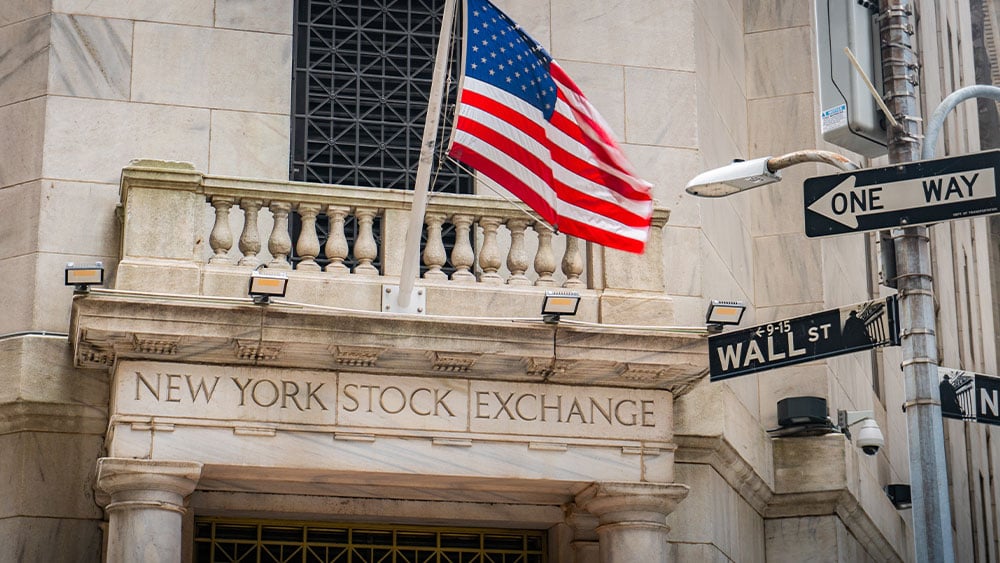
Futures for the Dow Jones Industrial Average and the other major stock indexes dropped Tuesday, as oil prices and Treasury yields jumped. Meanwhile, Nvidia (NVDA) and Micron Technology (MU) were early losers on the stock market today. Ahead of Tuesday’s open, Dow futures fell 0.5% as S&P 500 futures dropped 0.5%. Nasdaq-100 futures declined 1% in early morning trading. West…
Copyright ©2026 Investor’s Business Daily, LLC. All rights reserved. 87990cbe856818d5eddac44c7b1cdeb8

Bitcoin closed August 2026 up nearly 25%, giving the month a result that has not appeared in comparable post-peak years of 2014, 2018, and 2022.
Ash Crypto pointed to the unusual monthly candle on September 1, noting that the latest close breaks a pattern that has accompanied Bitcoin’s previous bear-market phases.
Bitcoin Breaks an August Pattern
Ash Crypto’s chart, based on Bitstamp data and using a logarithmic scale, compares August performances after Bitcoin’s major cycle highs. August 2014 fell about 18% after the 2013 peak, August 2018 lost roughly 9% after the 2017 peak, and August 2022 dropped some 14% following the 2021 high. However, this year, things went the other way.
Bitcoin started the month in the low $60,000s and climbed above $81,000 before finishing at about $78,600, producing a monthly gain of 24.95%, according to CoinGlass data. Ash Crypto described it as “BITCOIN JUST CLOSED AUGUST GREEN FOR THE FIRST TIME EVER IN A BEAR MARKET.”
The distinction is important, since the chart does not establish that BTC has entered a new bull market. Instead, it shows that August behaved differently from the same point in the previous three post-peak cycles. Bitcoin’s last all-time high was just past $126,000 in October 2025, leaving the asset well below that level despite the August recovery.
Furthermore, the flagship cryptocurrency also had its best August since 2017, when the month closed up more than 65%.
CoinGlass data back to 2017 shows how unusual that stretch has been. Outside of the aforementioned 65% gain in 2017 and 2021’s 13.8% jump, every August in between finished red, including two straight double-digit losses in 2022 and 2023, with this year snapping that run.
Besides August ending up positively, the third quarter is also shaping up nicely, with the same CoinGlass data showing it’s in the green by nearly 33%, although there’s still one month to go.
That uptick is only bettered by the same period in 2017 that saw BTC’s value go up more than 80%, and it would take an incredible run in September to bring Q3 2026 anywhere near that.
Price Action as September Starts
Bitcoin dipped below $77,000 as fresh attacks in the Middle East revived geopolitical tension, then clawed back most of that loss soon after.
That follows a productive patch last week, when the OG cryptocurrency pushed past $81,000 to hit its highest level in over three months, only to get rejected after Fed Chair Kevin Warsh’s hawkish remarks at Jackson Hole.
At the time of writing, it was trading near $78,000, after barely moving either way in 24 hours. Although that price reflected a loss of about 2.5% for the week, it was still up more than 23% over the past month.
Dominance over the rest of the crypto market has climbed above 58%, with a market cap near $1.57 trillion. Zoomed out further, BTC remains down close to 29% for the year and more than 38% below its October 2025 ATH.
The post Bitcoin Makes History With First-Ever Green August During a Bear Market appeared first on CryptoPotato.
Bitcoin price traded just below $78,000 on Sept. 1 after retreating from the $81,000 area, as fading trend strength, Federal Reserve rate concerns and nearby liquidation clusters kept the cryptocurrency inside a narrow range.
Summary
- Bitcoin price fell about 1.9% over seven days after encountering resistance near $81,300.
- The 4-hour ADX dropped to 12.26, indicating weak directional momentum.
- Liquidation liquidity is concentrated around $81,000–$82,000 and $75,000–$77,000.
- A daily close above $82,842 would strengthen the case for another leg higher.
Bitcoin price consolidates after 25% August rally
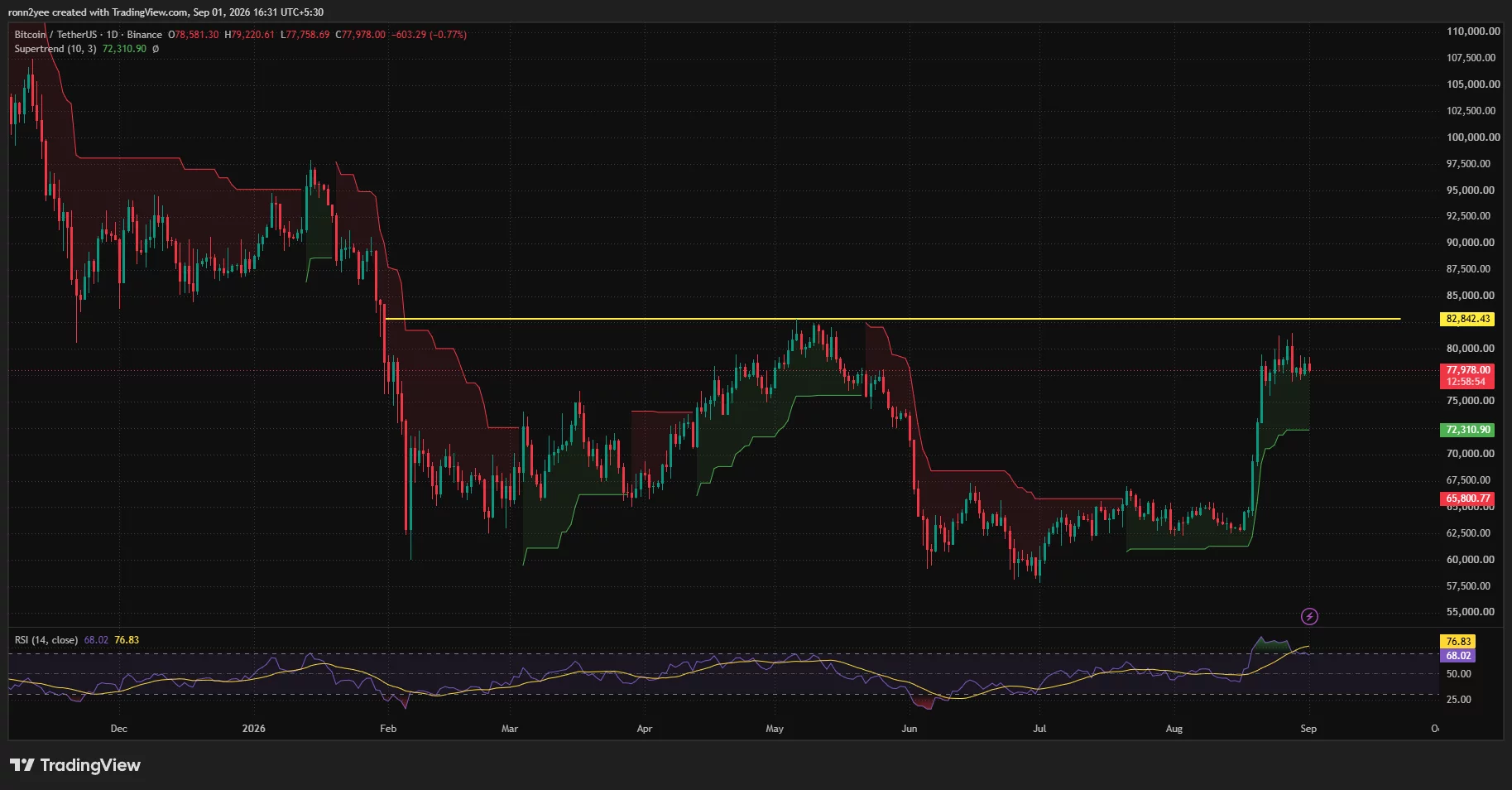
According to data from crypto.news, Bitcoin (BTC) price was trading near $77,978 at press time, down about 0.8% on the day and roughly 1.9% over the past week. The asset has pulled back from a local high near $81,300 while holding above the $77,700–$77,800 area.
The decline followed a nearly 25% advance in August, Bitcoin’s strongest monthly performance since November 2024. Profit-taking increased as buyers struggled to push the price through the $81,000–$82,000 resistance zone.
The daily chart shows Bitcoin holding most of its August breakout despite the recent pullback. Price remains well above the Supertrend support at $72,310, while the indicator continues to show a bullish trend on the daily timeframe.
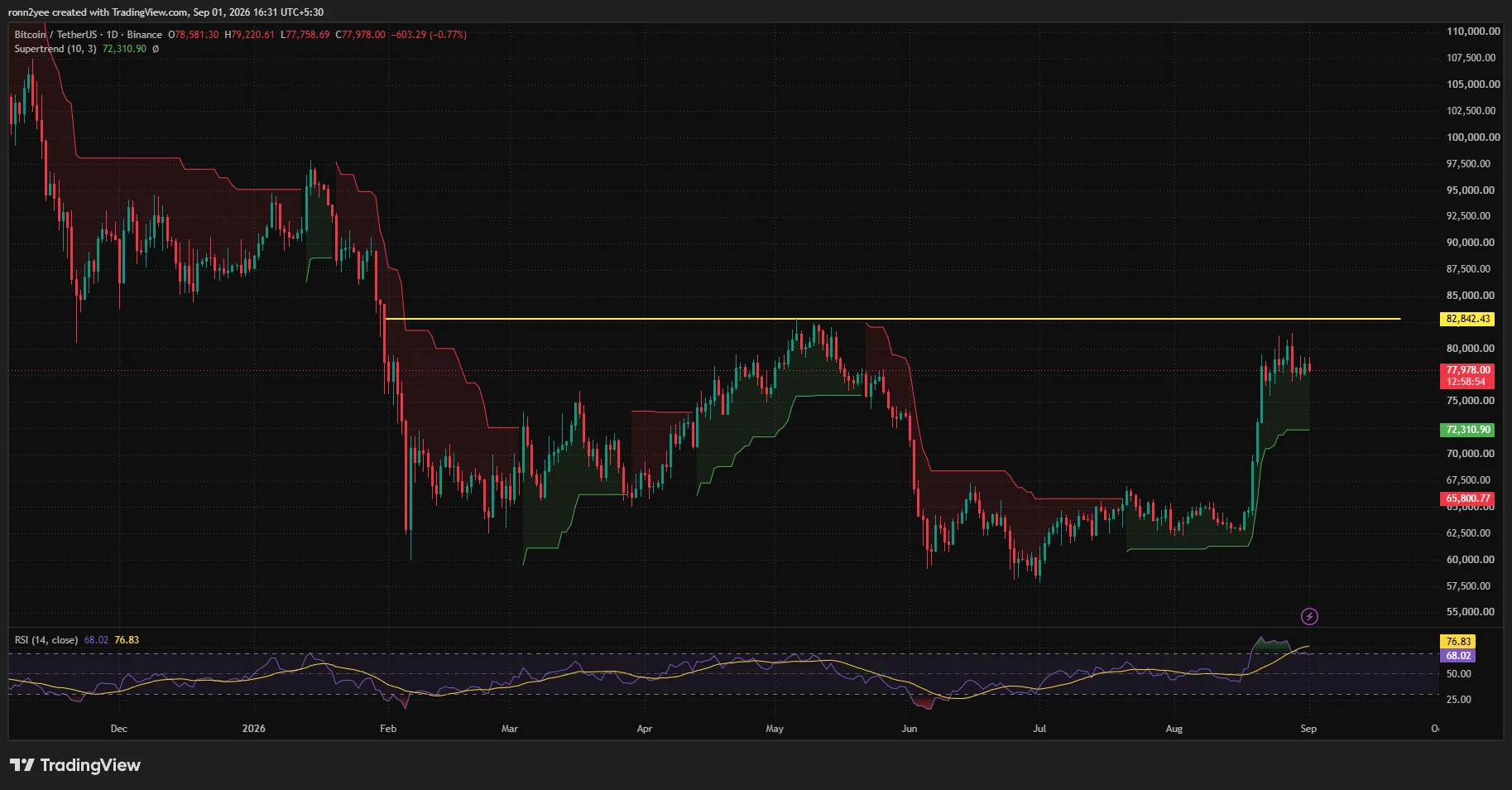
However, Bitcoin has repeatedly failed to sustain moves above $80,000. The rejection has left the price inside a short-term range, with neither buyers nor sellers showing enough strength to establish control.
The daily relative strength index stands at 68.02. Although the reading remains above the neutral 50 level, it has fallen below its moving average at 76.83, showing that bullish momentum has cooled since the August surge.
Fed concerns and ETF outflows limit demand
The pullback coincided with a more cautious US macroeconomic backdrop. Federal Reserve Chair Kevin Warsh said at Jackson Hole that policymakers would have “work to do” if inflation failed to move toward the central bank’s 2% target at a sufficient pace.
Warsh’s comments increased expectations that the Fed could consider another interest-rate increase. Higher rates can pressure Bitcoin because they raise the return available on government debt and reduce investors’ willingness to hold risk assets that generate no cash flow.
US spot Bitcoin exchange-traded funds also recorded about $201.8 million in net outflows on Aug. 28, according to SoSoValue data. The withdrawal ended a nine-session inflow streak that had brought more than $3 billion into the funds.
Institutional demand has not disappeared. Strategy disclosed that it purchased 4,603 BTC for approximately $370 million between Aug. 24 and Aug. 30 at an average price of about $80,318.
The US-listed company now holds 845,050 BTC. However, its latest purchase has not been enough to push the market back above the company’s recent acquisition price.
Bitcoin liquidity builds on both sides of the range
CoinGlass’s one-week Bitcoin liquidation heatmap shows substantial leveraged positions building above and below the current price.
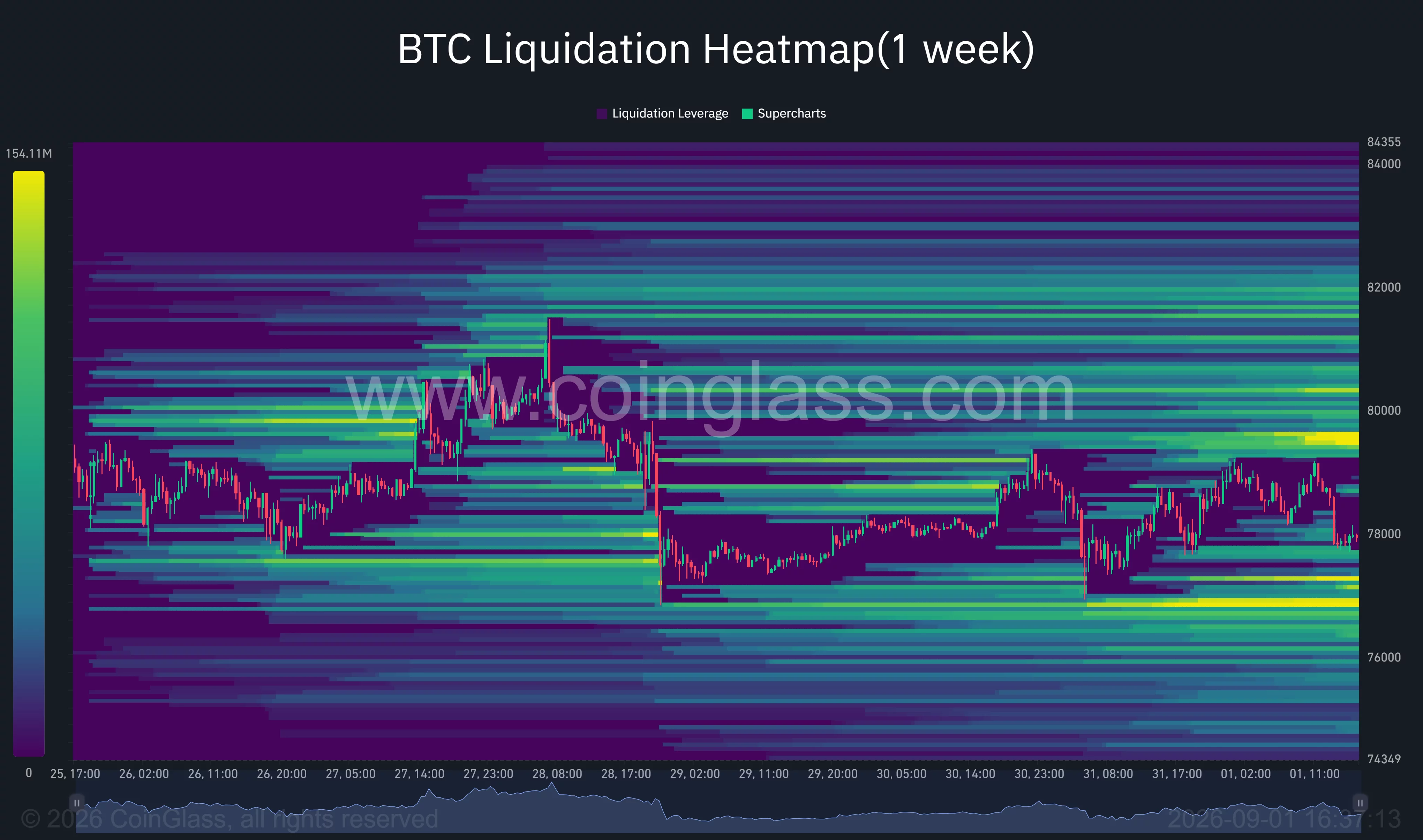
The closest large upside clusters sit around $79,500, $80,500, and $81,500–$82,000. A move into those areas could force short sellers to close positions, adding buying pressure and potentially accelerating a breakout.
The clearest downside liquidity is concentrated between approximately $76,500 and $77,000. Another pool extends toward $75,000, making the broader $75,000–$77,000 zone a possible target if Bitcoin loses its current floor.
Pseudonymous analyst Eliz also identified $81,000–$82,000 and $75,000–$77,000 as the two main liquidity areas. The analyst said the market had not received a sufficiently strong liquidity influx to produce a reliable directional setup.
The heatmap does not predict which cluster Bitcoin will reach first. It instead identifies areas where forced position closures could increase volatility once the price exits its present range.
Weak ADX points to continued range trading
Bitcoin’s 4-hour chart supports the consolidation outlook. The Bollinger Bands place their midpoint at $78,242, slightly above the current price.
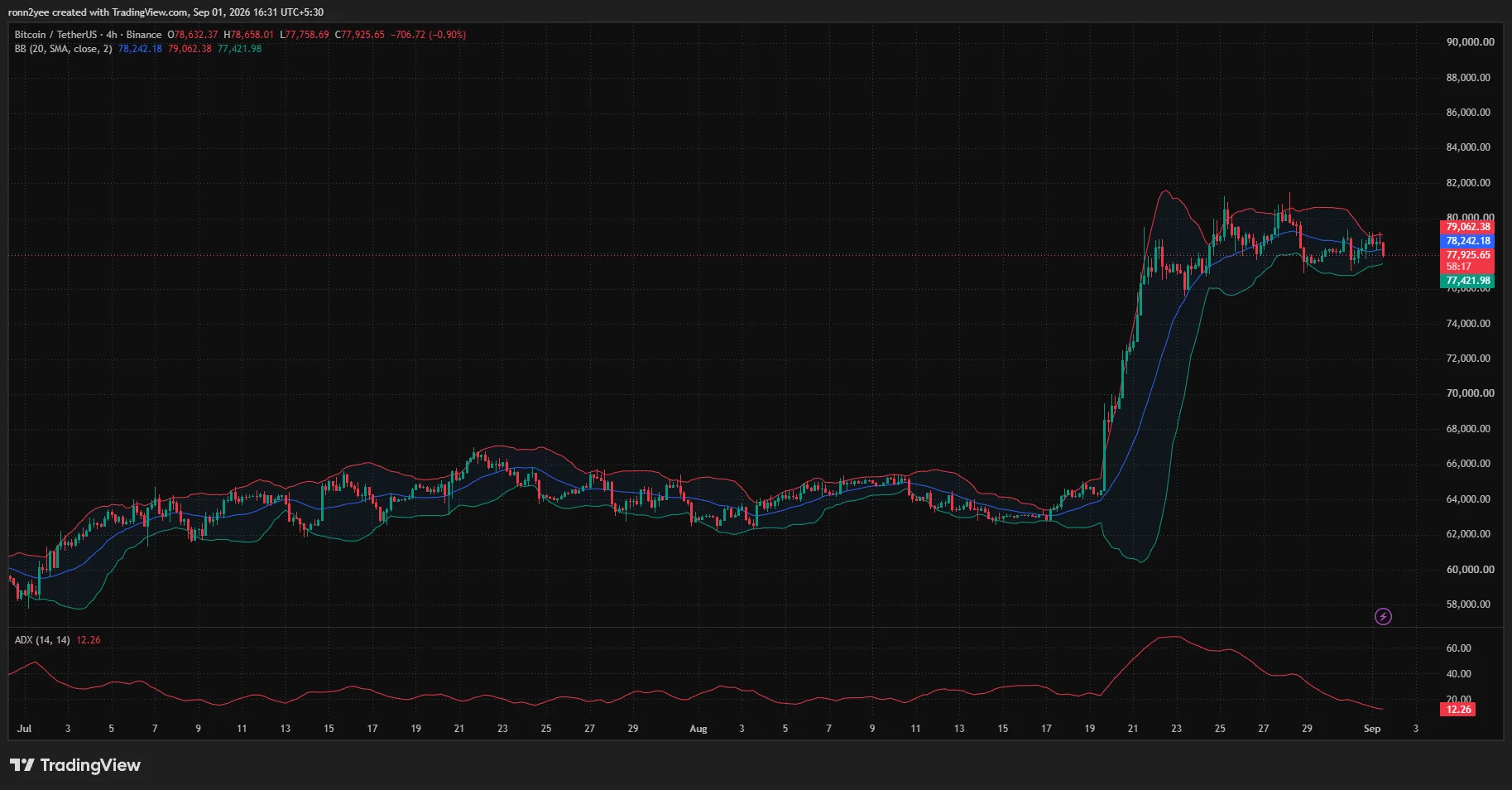
The upper Bollinger Band stands at $79,062, while the lower band is near $77,422. Price is trading in the lower half of the channel but has not produced a confirmed close below its lower boundary.
A break above $79,062 would put $80,000 back in focus, followed by the heavier liquidation zone around $81,000–$82,000. The daily chart places the next larger resistance level near $82,842.
A daily close above $82,842 would clear the recent high and could confirm that the August rally has resumed. Until then, repeated rejections below that level leave Bitcoin vulnerable to another range reversal.
On the downside, a sustained break below $77,422 would expose the liquidity cluster near $76,500–$77,000. Losing the broader $75,000 level could open a deeper pullback toward daily Supertrend support at $72,310.
The 4-hour average directional index has dropped to 12.26. Readings below 20 generally show that an asset lacks a strong trend, supporting the possibility of further sideways trading until Bitcoin breaks one of the range boundaries.
For US investors, ETF flows and interest-rate expectations remain the main near-term catalysts. A return to sustained spot ETF inflows could help buyers challenge $82,000, while renewed outflows or stronger rate-hike expectations could increase pressure on the $75,000–$77,000 support area.
Disclosure: This article does not represent investment advice. The content and materials featured on this page are for educational purposes only.

The London Stock Exchange (LSE) and crypto exchange Kraken are reportedly moving toward tokenized stock trading on a new LSE night-time venue, a bid to make parts of UK equities markets available outside traditional market hours. According to the Financial Times, LSE will work with Kraken’s parent company, Payward, to provide access to tokenized stocks that track major UK equity products starting in 2027.
The plan centers on LSE 24, the stock market operator’s proposed round-the-clock trading facility. LSE said it would begin operating Mondays through Fridays, with trading expected to run from the evening through the night window, offering 24/5 market access once launched.
Key takeaways
- LSE says tokenized stocks referencing leading UK equities would be introduced on its planned LSE 24 night-time trading venue starting in 2027.
- The effort is reported to involve Payward, Kraken’s parent company, which is expected to supply the tokenized-stocks access infrastructure.
- LSE 24 is designed for 24/5 trading, reflecting a broader industry push to reduce reliance on fixed market hours.
- This puts London among multiple global venues exploring tokenized equity products alongside Nasdaq, CME Group, and ICE.
- Onchain tokenized stocks continue to expand, with RWA.xyz data showing growth in both value and the number of holders over the last month.
What LSE’s tokenized equities push would change
Tokenized stocks are digital representations of traditional equities designed to move or settle onchain using blockchain infrastructure. In practice, that can enable fractional ownership, faster settlement workflows, and, depending on regulation and market design, trading that is less constrained by conventional market hours.
For LSE, pairing tokenized stocks with LSE 24’s extended schedule appears aimed at improving accessibility for investors who cannot participate during regular sessions. Instead of treating tokenization as a standalone experiment, the reported approach ties onchain equity access to an LSE product—its own trading venue—suggesting the exchange wants tokenized assets to become part of its mainstream market offering.
Payward’s chief commercial officer Mark Greenberg told the Financial Times that the LSE partnership would provide access to tokenized stocks tracking leading UK equity products starting in 2027. The reported timetable matters because it frames tokenization as something approaching deployment rather than long-term research—though readers should note the detail is based on reporting in the Financial Times.
LSE 24: the “24/5” venue as a catalyst
The technical and regulatory readiness of tokenized securities is only one side of the equation. The other is how and when trades can actually occur. LSE 24, which LSE announced on July 21, is positioned as a market structure that offers 24/5 trading from Mondays to Fridays.
That design echoes the core promise of tokenized markets in general: markets that can potentially run continuously, rather than being limited to standard exchange hours. By placing tokenized stocks within that extended-hours venue concept, LSE is effectively aligning its tokenization initiative with a specific liquidity and trading schedule—important for traders and liquidity providers assessing whether tokenized instruments can gain practical traction.
For investors, the benefit is straightforward: more time to trade during the week. For market operators and service providers, it creates a clearer product pathway—turning tokenization into an operational feature of a trading venue rather than an isolated offering.
Tokenization is becoming a cross-venue industry priority
LSE is not alone in exploring tokenized equity products. The broader push reflects how TradFi institutions are experimenting with blockchain-based securities, often with an eye toward fractionalization and potentially faster settlement mechanisms.
According to earlier coverage cited within the source, Nasdaq agreed in August to acquire LeveL Markets, described as the third-largest alternative trading system in the US by trading volume, as part of a move toward tokenized markets with round-the-clock trading. In March, Nasdaq was also reported to be working with Payward and Payward’s Backed subsidiary (issuer behind xStocks) to build an “equities transformation gateway.” Separately, the source references that Nasdaq had previously filed a tokenization proposal with US securities regulators in September 2025.
The pattern is similarly visible in other exchange groups. The source notes that ICE—parent of the New York Stock Exchange—received investment involvement from crypto exchange OKX to bring NYSE-listed tokenized stocks to the exchange starting from the second quarter of 2026. It also highlights that Deutsche Börse invested $200 million in Payward, tied to plans for broader access to blockchain-based securities and tokenized investment products.
Beyond equities, derivatives venues are also moving toward crypto-linked products. The source cites CME Group’s plans for futures contracts tied to Cardano, Chainlink, and Stellar and its later intention to add Avalanche and Sui futures, subject to regulatory approval. While these are different instrument types than tokenized stocks, they show that large operators are actively building infrastructure for blockchain-adjacent trading.
How fast is tokenized stock adoption progressing?
The LSE initiative arrives as tokenized stocks continue to grow. Data provider RWA.xyz, cited in the source, reported that the total value of tokenized stocks rose by 15% over the previous 30 days to $2.53 billion. Over the same period, it said the number of tokenized equity holders increased by 153% to 2.45 million.
Those figures help contextualize why exchange operators are accelerating exploration: the market for tokenized equities appears to be expanding in both capital and participant counts. Still, investors should distinguish between growth in onchain holdings and growth in regulated exchange volumes. Tokenized assets can exist across multiple venues and jurisdictions, and the level of liquidity varies widely depending on market access, settlement design, and compliance frameworks.
What to watch next is how quickly tokenized stock offerings move from pilots and partner-led deployments into standardized venue listings—and whether extended trading schedules like 24/5 materially improve execution quality for investors.
For now, the most immediate question is whether LSE’s 2027 timeline for tokenized equities on LSE 24 holds through regulatory reviews and market preparation. As other large exchanges press forward with tokenization strategies, the next signals for investors will be concrete launch details, the structure of tokenized instruments, and evidence that liquidity can follow the promise of more hours and broader access.
Bitcoin trades at $78,646.05, down 0.28% in the last 24 hours, a quiet number for a market that’s watching Washington more than charts right now. The reason is that Polymarket CLARITY Act odds contract has collapsed from 82% odds of passage in February to just 13% by early August, a move that’s rattled traders betting on regulatory clarity as the next major catalyst.
The Senate faces a September 15 cloture vote on H.R. 3633, the bill that would hand the CFTC exclusive authority over spot digital-commodity markets while leaving the SEC in charge of securities-classified tokens and exchange oversight. Republicans hold 53 seats; they need seven Democrats to cross the aisle to hit the 60-vote threshold.
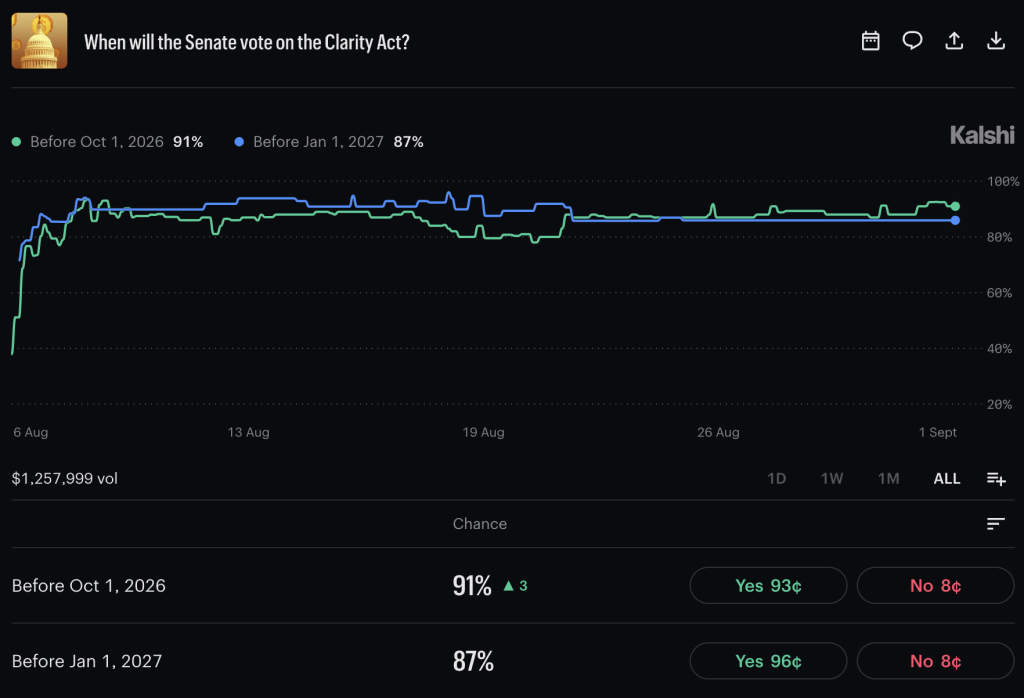
Polymarket’s contract, which has moved over $11.5M in volume, now implies just a 13-14% chance of enactment in 2026, a stark contrast to Kalshi’s 91% probability that a Senate vote will occur at all before October 1. Coinbase CEO Brian Armstrong remains publicly “rather optimistic” about clearing 60 votes, but the prediction markets tell a colder story.
That gap between “a vote happens” and “the bill actually passes” is the real trade here. It’s also spilling into how traders price crypto-adjacent risk heading into Q4.
Can Bitcoin Hold Support as Polymarket Clarity Act Odds Crater?
BTC’s 0.28% daily slide to $78,646.05 isn’t dramatic on its own, but it’s occurring against a backdrop of regulatory uncertainty, which typically compresses risk appetite.
The $76,000-$78,000 zone has functioned as near-term support through recent sessions; a break below invites a retest of the low-$70Ks. Upside resistance sits near $82,000-$84,000, a level BTC hasn’t reclaimed with conviction since the momentum around the CLARITY Act began fading in July.
Bull case: a surprise bipartisan push or committee reschedule flips sentiment, odds rebound toward 30%+, and BTC tests $84K.
Base case: consolidation continues near current levels as the Senate calendar drags without resolution.
Bear case: the September 15 cloture vote fails outright, odds sink into single digits, and BTC retests sub-$76K support. Watch the vote date closely; it’s the only near-term catalyst that moves this needle materially.
[button link=”https://99bitcoins.com/visit/kalshi” color=”green” text_color=”white” size=”medium” target=”new” rel=”nofollow”]Check out the BTC Markets on Kalshi and Claim Your Free $25[/button]
Kalshi Traders Turn Bearish on the CLARITY Act

The likelihood of the CLARITY Act becoming law in 2026 has significantly declined. Prediction-market traders are increasingly betting that the landmark crypto regulation bill will have difficulty passing in the Senate.
According to the latest market data from Kalshi, there is currently a 91% probability that the Senate will hold a vote on the CLARITY Act before October 1. However, this does not indicate that the bill is likely to pass.
A critical challenge will occur on September 15, when senators are expected to vote on a procedural motion to advance the legislation. The bill requires 60 votes to overcome the cloture hurdle, making bipartisan support essential.
Kalshi’s pricing for the bill’s passage has dropped to approximately 22%, reflecting a significant shift in sentiment. Traders are increasingly worried about unresolved disagreements over stablecoin rewards, DeFi regulation, anti-money-laundering provisions, and government officials’ restrictions on crypto-related activities.
This makes September a crucial month for the CLARITY Act. A successful procedural vote could restore optimism and potentially lead to a significant repricing in crypto-related prediction markets. Conversely, failure to secure the necessary 60 votes could effectively push comprehensive crypto market-structure legislation into 2027.
For now, traders on Kalshi indicate that a Senate vote is highly likely, but passage remains a long shot.
[button link=”https://99bitcoins.com/visit/kalshi” color=”green” text_color=”white” size=”medium” target=”new” rel=”nofollow”]Make Your Prediction With $25 Free on Kalshi[/button]
This is not financial advice. Crypto markets are highly volatile and speculative. Always conduct independent research before making investment decisions.
The post Polymarket CLARITY Act Odds Slashed to 15% of Being Passed in 2026 appeared first on Cryptonews.
TRON founder Justin Sun says Forbes and Bloomberg strip 70% to 80% off his crypto holdings when they calculate his net worth. He calls that gap his biggest bet.
Traditional trackers value him in the mid single-digit billions. Sun says the number they cut is the number that actually matters.
Why Forbes and Bloomberg Discount His Net Worth
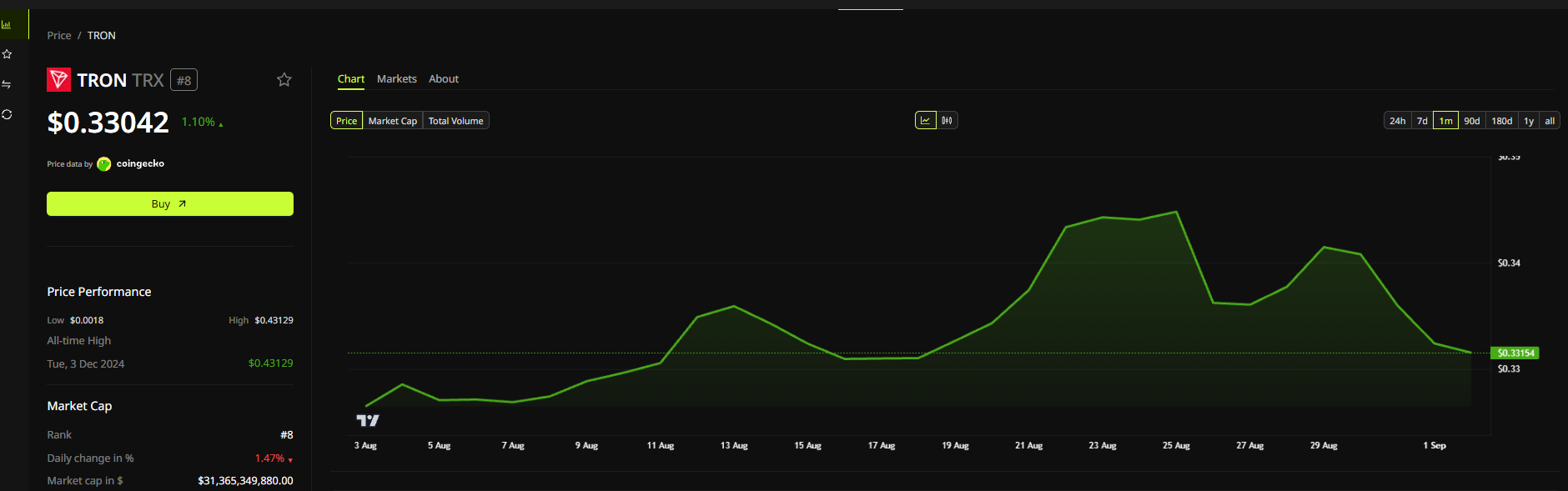
TRON (TRX) currently trades near $0.33, which ranks it eighth by market value at roughly $31.4 billion. That single price moves most of his balance sheet.

Traditional wealth trackers penalize concentration and volatility. Consequently, they treat most digital assets as uncertain rather than bankable. Forbes puts Sun at $8.5 billion and ranks him 444th globally.
Sun accepts that logic yet rejects its conclusion. He framed the discounted slice as the place where his judgment sits. His finances drew fresh attention during his World Liberty lawsuit.
“When Bloomberg and Forbes calculate my net worth, they discount my crypto assets by 70-80%. I understand their logic: concentration, high volatility, and by their standards, it doesn’t count as “certain.” That’s their methodology, and it has nothing to do with me.” Justin Sun, TRON founder, wrote in a post on X.
The tension is not new. Sun sued Bloomberg in 2025 to stop it from publishing his holdings. He cited personal security risks at the time.
Scrutiny has grown across his businesses this year. He answered questions about Binance’s HTX restrictions in August.
Meanwhile, his exchange moved closer to a settlement with the FCA, the UK financial regulator.
Sun Rejects Diversifying Out of Crypto
For 14 years, Sun has held most of his personal assets in crypto. He calls that a choice, not an oversight.
Advisers repeatedly urged him to rotate into real estate, stocks, or cash. However, he dismisses those as second-best assets.
“…if I’m already holding what I believe to be the best assets, what’s the point of exchanging them for second-best?” Sun made the argument in a separate post.
He cited Tesla in 2012, Bitcoin’s early days, Nvidia in 2016, and storage chips in 2024. In each case, winners held instead of selling. His corporate holdings keep growing regardless. Tron Inc.’s TRX treasury topped 711 million tokens in August.
Questions about his personal spending resurfaced after a $50 million dispute went public.
Sun says time will settle the argument. The next repricing of his portfolio, therefore, does the scoring for him.
The post Richer Than Anyone Thinks? Why Justin Sun Will Never Cash Out His Crypto appeared first on BeInCrypto.

Ethereum price is grinding steadily, but its quiet number masks a much louder signal underneath. BitMine Immersion Technologies, chairman Tom Lee’s crypto treasury vehicle, just made its largest single ETH purchase since June.
BitMine picked up 53,501 ETH worth $131 million, pushing its total stack to 5,901,112 ETH, or valued near $14.8 billion at a $2,511 reference price. That’s 4.9% of Ethereum’s entire circulating supply, putting the firm 98% of the way toward its self-described “Alchemy of 5%” target.
The buy also extends an unbroken streak: BitMine has bought ETH every single week since June 30, 2025, now 65 weeks running. Lee says Ethereum has outpaced the S&P 500 by 5,430 basis points this quarter alone.
This accumulation doesn’t happen in a vacuum. ETH momentum has been building since early August, and the technical picture now hinges on whether that institutional bid is enough to force a breakout.
Discover: The Best Crypto to Diversify Your Portfolio
Can Ethereum Price Hit $3,000 This Week?
ETH is consolidating around $2,450, inside a range bounded by a low of $2,444 and a high near $2,485 over the past day, tight action for a coin absorbing a nine-figure institutional purchase. Price is consolidating inside a rising wedge just below the critical $2,550 resistance, a level that has rejected two separate breakout attempts already.
Below, support clusters at the 20-day EMA ($2,293.75), Supertrend ($2,212.19), 200-day EMA ($2,161.32), and 100-day EMA ($2,036.88), with price currently holding above all four, a constructive if imperfect setup.

The best scenario is for it to have a clean break above $2,550, which opens a path toward $2,800. Or it could have a continued chop inside the wedge while BitMine’s weekly buying provides a soft floor.
However, the bear case happens if another rejection at $2,550 sends the price back toward the $2,161 200-day EMA. Worth watching before positioning either way.
Agree with Tom Lee’s take? Trade ETH on Bybit and Get a Chance to Win Our $1,000 USDT Airdrop
LiquidChain Targets Early Mover Upside as Ethereum Tests Key Levels
BitMine’s conviction validates the ETH accumulation thesis, but at a $2,459 price point and a $296 billion-plus market cap, the doubling and tripling that early ETH holders saw years ago isn’t realistically on the table anymore. That math is pushing traders further down the risk curve, toward infrastructure plays still in price discovery.
The ceremony starts with a single word. — LiquidChain (@getliquidchain) August 31, 2026

 pic.twitter.com/vudkt5bEzI
LiquidChain ($LIQUID) is one of the names picking up that flow. LiquidChain is a Layer 3 infrastructure project fusing Bitcoin, Ethereum, and Solana liquidity into a single execution environment with a unified layer where developers deploy once and reach all three ecosystems rather than fragmenting liquidity across chains.
The presale is priced at $0.014951 with $960K raised so far. Core features include Single-Step Execution and Verifiable Settlement, aimed at solving the liquidity fragmentation problem that’s dogged cross-chain trading since day one. P
Research LiquidChain before the round progresses further.
Discover: The Best Token Presales
The post Ethereum Price Holds as Tom Lee’s BitMine Makes Biggest ETH Buy Since June appeared first on Cryptonews.
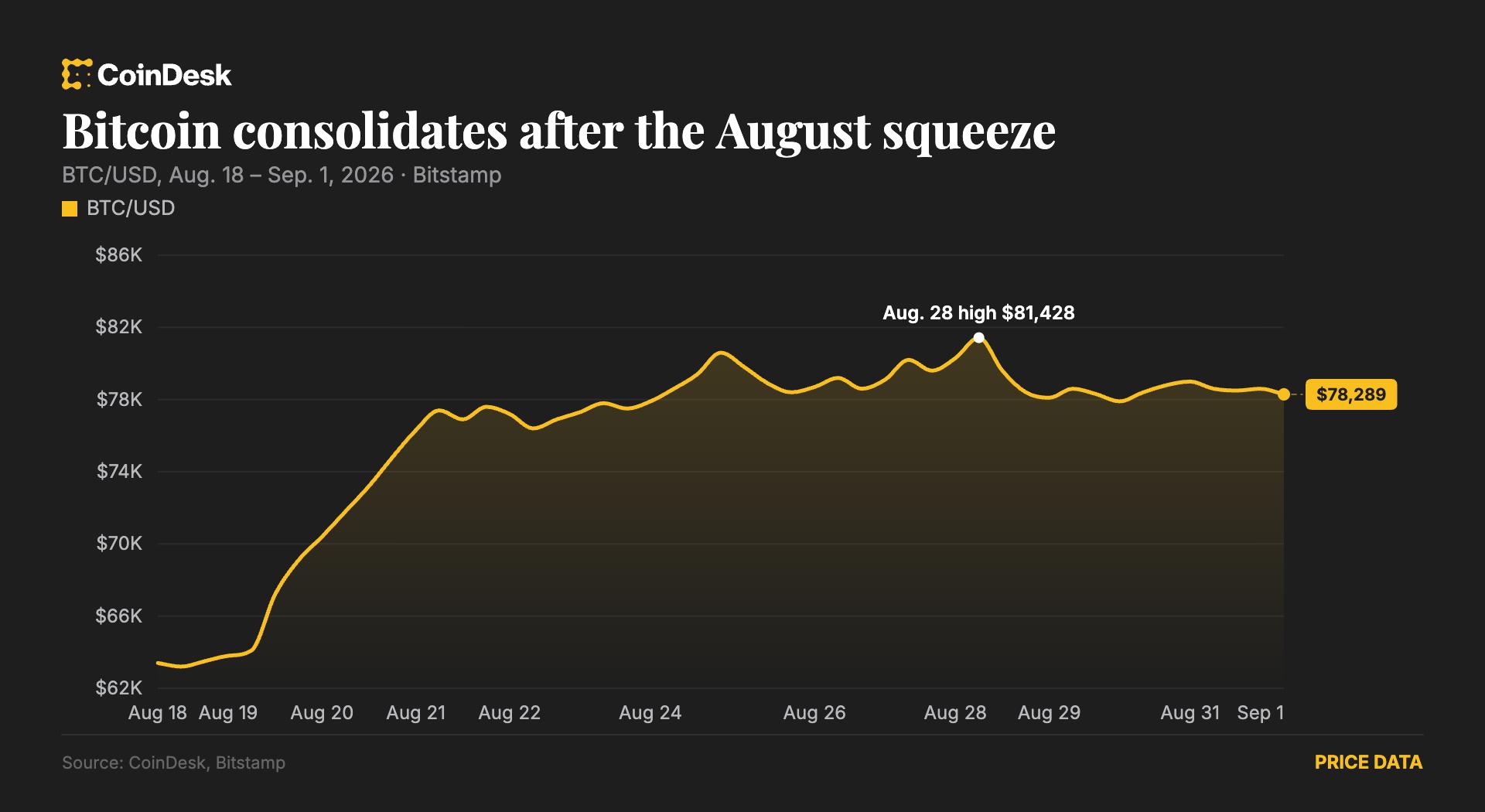
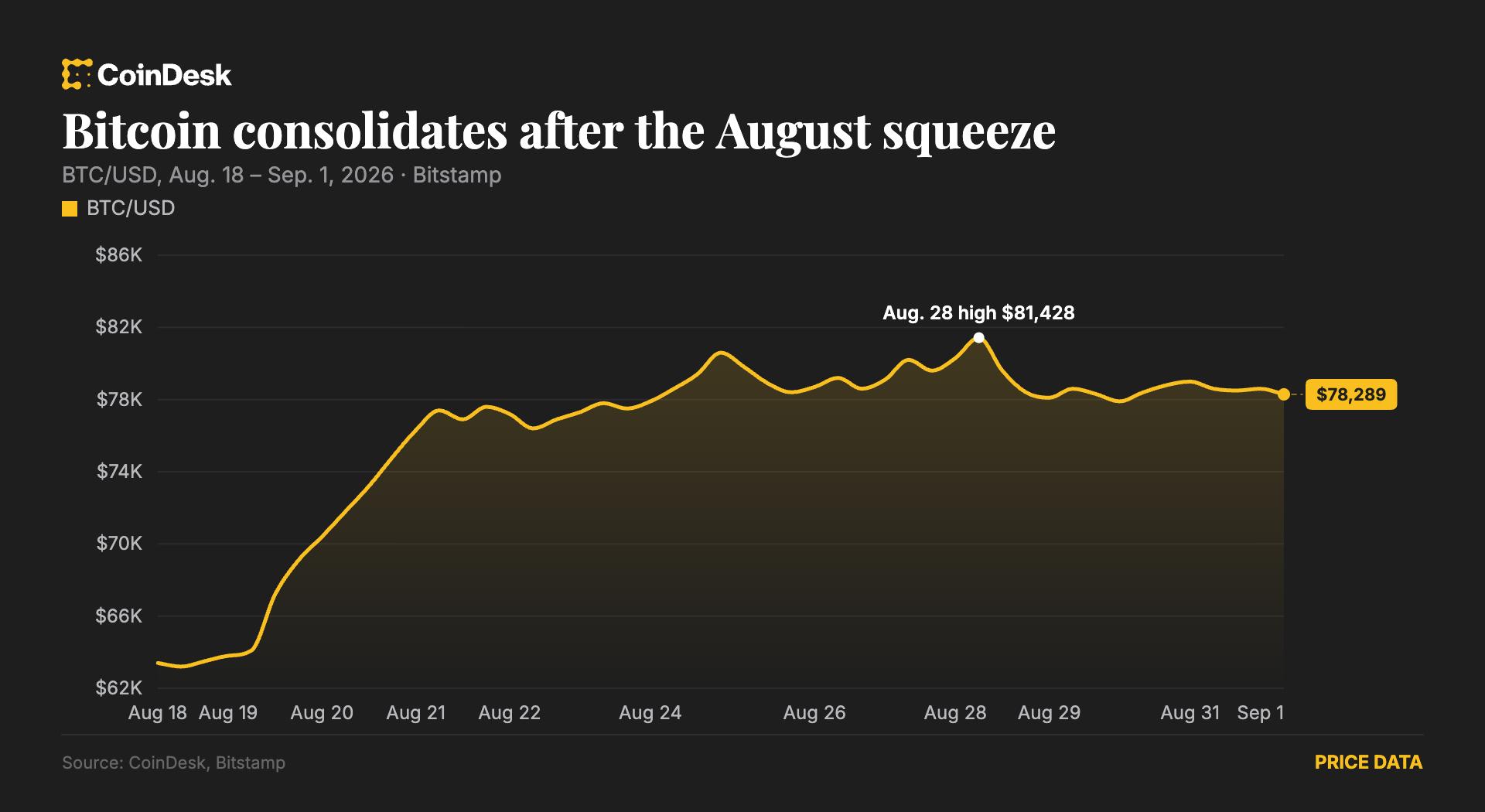
BTC drifted lower after last week’s rally to $81,428, while ARB led DeFi gains as Robinhood Chain’s daily fees topped $2 million.

Scott McTominay to undergo heart procedure as Napoli release statement

Crypto Bull Market Confirms Here!!

One last U-turn! Keir Starmer QUITS as an MP despite promising he would stay on after being ousted by Burnham… leaving new PM with by-election headache





-

 Crypto World7 days ago
SpaceX stock could rise 75% to $240, JPMorgan says
-

 Fashion4 days ago
Weekend Open Thread: Maeve – Corporette.com
-

 Crypto World5 days ago
Bitcoin’s 22% rally now needs real demand to outlast Treasury liquidity boost
-

 Crypto World6 days ago
Warsh Jackson Hole keynote puts financial innovation first
-

 Business4 days ago
Salesforce Stock Soars 19% as Blowout Earnings and Agentforce AI Growth Silence Software Skeptics
-

 Crypto World6 days ago
Elon Musk Grok Bot Promise: We Will Make You Whole if AI Loses Your Money
-

 Business5 days ago
Apple Confirms September 9 Keynote and Reveals Its Full Pre-Order Schedule
-

 Crypto World6 days ago
Did Trump Just Move SpaceX Stock With One Truth Social Post?
-

 Business3 days ago
Onto Innovation Stock: AI’s Next Bottleneck Is Yield (NYSE:ONTO)
-

 Business6 days ago
Walmart takes aim at younger shoppers with new fashion brand
-
 NewsBeat6 days ago
Lindsay Clancy jury braces for closing arguments as judge tells court: ‘You’ve heard all the evidence’ – Live updates
-

 Crypto World3 days ago
Bitcoin price tests $82K resistance as Brandt stays long
-

 Crypto World5 days ago
NVIDIA revenue hits $96.2B as AI demand doubles
-

 Business7 days ago
Thailand’s Eastern Economic Corridor Capital City (EECiti): Key Developments and Investment Opportunities
-

 Business4 days ago
iPhone 18 Pro Pre-Orders Could Shift to Saturday as Apple Reportedly Avoids September 11 Anniversary
-

 NewsBeat6 days ago
Trump’s trade truce with China faces test with Iran effort
-
 Crypto World6 days ago
Nvidia Q2 Earnings Reveal $96.2 Billion Beat, So Why Is NVDA Falling?
-

 Tech5 days ago
Claude Cowork gets its own browser that doesn’t touch your tabs, bookmarks, or saved passwords
-
 Tech3 days ago
Hugging Face built a $4.5 billion empire on free AI models. Now Nvidia is buying it for $12.9 billion
-

 Crypto World4 days ago
Truflation calls for Fed rate cut after PCE forecast
You must be logged in to post a comment Login