

Crypto World
Strategy Sells $216M Bitcoin, Bollinger Bullish on BTC: Hodler’s Digest


Strategy sells 3,588 Bitcoin for $216M to fund dividends
Michael Saylor’s Strategy sold 3,588 Bitcoin (BTC) to fund preferred stock dividend payments and replenish its cash reserves.
Strategy sold the Bitcoin for $216 million, reducing its total holdings to 843,775 Bitcoin, according to a Monday 8-K filing with the US Securities and Exchange Commission.
This included 1,363 Bitcoin sold at an average price of $59,256 between last Monday and Tuesday, and 2,225 Bitcoin sold at an average price of $60,773 between Wednesday and Sunday.
Strategy disclosed the sale of 32 Bitcoin in early June, as its first reported Bitcoin sale since the 2022 tax-loss transaction.
Before Strategy disclosed its latest Bitcoin sale, Bernstein said the company was unlikely to be forced to sell its holdings, citing its liquidity position and cash reserve coverage.
Bernstein’s report said Strategy had 17 months of cash to cover dividend obligations and interest payments. It added that the company remained a net buyer of Bitcoin and served as a strong “balancing force” in a market where leading US Bitcoin miners are net sellers due to their pivot to AI.
Donald Trump says ‘nothing wrong’ with $1.4B crypto windfall while in office
US President Donald Trump has responded to criticism of his 2025 financial disclosures, showing that he earned $1.4 billion in income from crypto-related ventures while in office.
In a Thursday interview with CNBC’s Joe Kernen, Trump said that there was “nothing illegal” and “nothing wrong” with profiting from his crypto investments as president. He claimed that other people were responsible for his investments and he didn’t “even know who they are,” not directly answering questions about perceived conflicts of interest as president.
Trump’s comments followed the release of his 2025 financial disclosure report by the US Office of Government Ethics, showing that he took in more than $2 billion from his businesses and investments, about $1.4 billion of which was connected to crypto projects like his memecoin and family’s platform World Liberty Financial. Many advocacy organizations have characterized the investments as a “grift” allowing the president to influence related legislation like the Digital Asset Market Clarity (CLARITY) Act.
Trump disclosed that his memecoin generated about $636 million, World Liberty sales about $588 million and $197 million from equity in a stablecoin venture.

US senator calls for ban on elected officials issuing memecoins
Senator Kirsten Gillibrand, one of the US lawmakers behind negotiations for a digital asset market structure bill in Congress, has proposed barring elected officials and the president from issuing or sponsoring their own tokens, citing President Donald Trump’s and First Lady Melania Trump’s memecoins.
In a Friday notice, Gillibrand said that Congress should support measures barring elected officials and their spouses from “issuing or sponsoring their own digital assets.” The New York lawmaker said that the proposed restriction would include any US president and their spouse, but did not specifically mention extending the provision to the office of the vice president or other members of their families.
“This is a commonsense requirement that should get broad bipartisan support – public officials and their spouses should not be issuing memecoins,” said Gillibrand. “We cannot let self-dealing destroy an opportunity to strengthen consumer protections, crack down on illicit finance, and expand economic opportunity for the millions of Americans our financial system has left behind.”

Vitalik Buterin shares top priorities for new ‘Lean Ethereum’ strawmap
Ethereum co-founder Vitalik Buterin has named quantum resistance, scalability and privacy as three of Ethereum’s top priorities under a new “Lean Ethereum” strawmap, which lays out the network’s technical direction for the remainder of the decade.
In a post to X on Saturday, Buterin said the collection of upgrades will roll out over the next three to four years, touching nearly every layer of Ethereum in a transformation he compared in scale to the September 2022 Merge, which shifted the network away from energy-intensive mining.
“Quantum safety has shifted up a LOT in priority,” he said, adding that finalizing a quantum-safe solution for blobs has “become urgent.” Enhancing privacy is another priority, Buterin said, stating that it has become a “first class goal.”
Dankrad Feist, a former Ethereum Foundation researcher behind the payments-focused layer-1 Tempo blockchain, praised the new plan but argued the 3-4 year timeline is too slow, stating that AI could help developers ship the upgrades within a year.
Financial companies join forces for US dollar stablecoin, keeping reserve earnings
More than 140 companies have reportedly signed onto a US dollar-pegged stablecoin project that allows them to “receive all of the earnings” from its reserves.
In a Tuesday notice, Open Standard said it was launching the Open USD (OUSD) stablecoin, a US dollar-pegged coin supported by financial companies including Visa and Mastercard, as well as crypto companies Coinbase, Ripple, OKX and Bybit. The project will allow businesses to mint OUSD “at no cost and with no artificial limits on volume,” and keep earnings from the coin’s reserves.
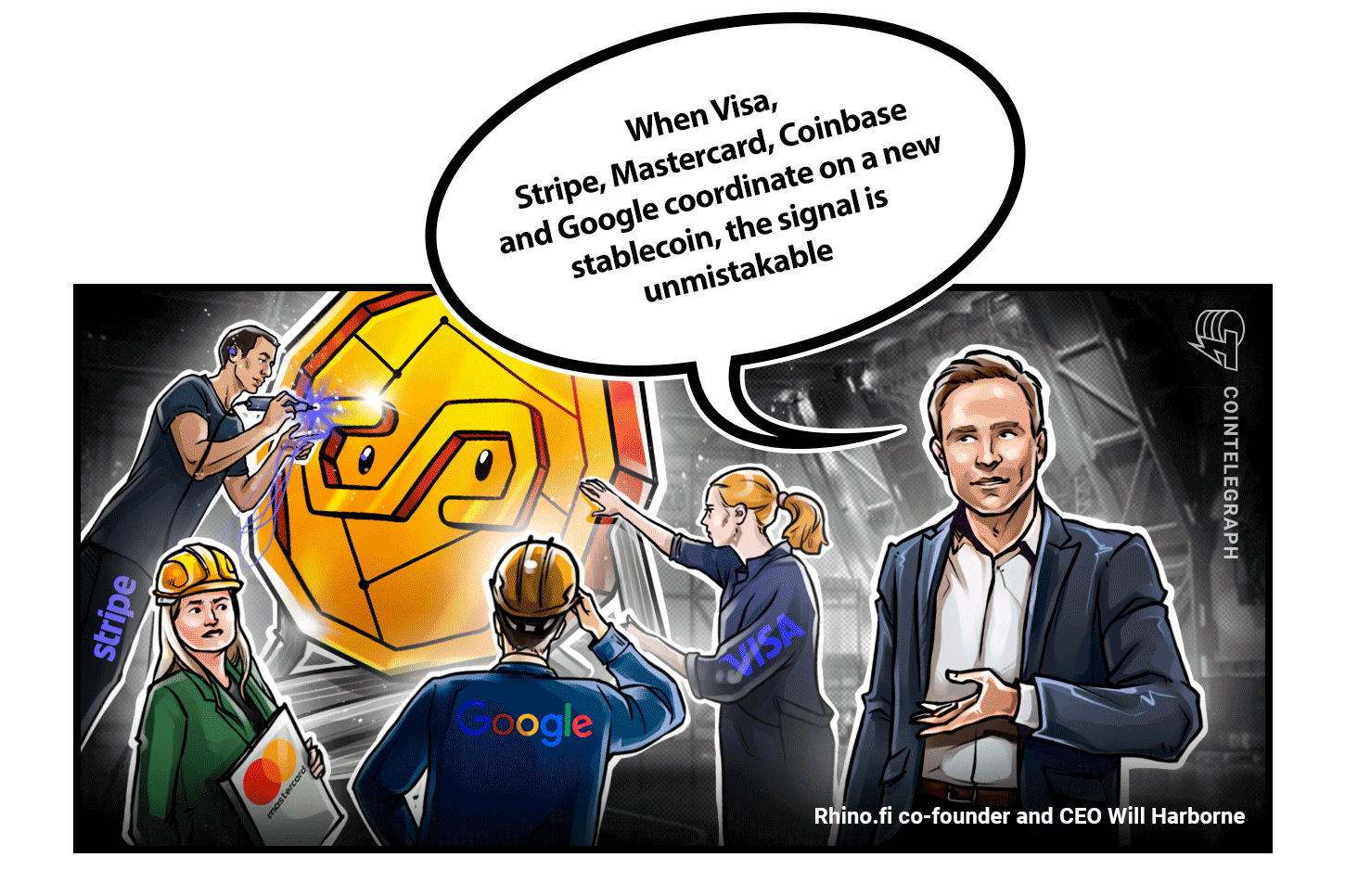
“When Visa, Stripe, Mastercard, Coinbase and Google coordinate on a new stablecoin, the signal is unmistakable,” said Rhino.fi co-founder and CEO Will Harborne. “Open USD is the first launch with a real chance to win share from USDT and USDC, because reserve revenue flows back to everyone who holds it. But that same incentive is what drives fragmentation at scale.”
As the week continued, some of the signatories denied making any firm commitments to the consortium.
Winners and losers
At the end of the week, Bitcoin (BTC) is at $64,039, Ether (ETH) at $1798, and XRP (XRP) is at $1.14. The total market cap is at $2.12 trillion, according to CoinMarketCap.
Among the biggest 100 cryptocurrencies, the top three altcoin winners of the week are MemeCore (M) at 105%, Lighter (LIT) at 39%, and ether.fi (ETHFI) at 29%.
The top three altcoin losers of the week are Venice Token (VVV) at -13%, Stable (STABLE) at -10% and Audiera (BEAT) at -5%.
Top Prediction of the Week
Bollinger Bands creator eyes Bitcoin bear-market end, ‘W’-shaped reversal
John Bollinger, creator of the Bollinger Bands volatility indicator, believes he has spied a “W”-shaped double bottom on BTC/USD on the charts.
“$BTC has seen a series of bullish patterns broken, evidence of the power of the downtrend,” he commented in X posts on Friday.
“Will this ‘W’ be the one that breaks the trend?”
“W”-shaped reversals involve two swing lows with a rejected rebound in between, with price ultimately breaking through that rejection level to form a new uptrend.
Bollinger has been bullish on BTC for some time. In early May, he revealed a new long position via his Bitcoin investment vehicle.
As Cointelegraph reported, an increasing number of price indicators are flashing signals not seen since the last bear market in 2022. Despite this, market participants broadly believe that the next macro bottom is still to come and is due in Q3 or later.
Top FUD of the week
Tim Draper says Arkham got Bitcoin wallet attribution ‘wrong’
Billionaire investor and longtime Bitcoin bull Tim Draper said blockchain analytics company Arkham incorrectly linked him to a wallet involved in a large Bitcoin transfer to Coinbase Prime.
“It just wasn’t me. I haven’t touched it. Arkham has it wrong,” Draper told Cointelegraph, adding that he still expects Bitcoin to reach $250,000 within one year.
The statement came after blockchain analytics platform Lookonchain reported Friday that a wallet “possibly linked” to Draper had transferred 1,000 Bitcoin worth about $62 million to Coinbase Prime, citing data from Arkham.
Draper is best known in the crypto community as one of Bitcoin’s earliest high-profile investors, having won a US Marshals Service auction for nearly 30,000 Bitcoin seized by US authorities from Silk Road-related holdings in 2014. The holdings are now worth $1.9 billion, meaning Draper selling could have a big impact on Bitcoin’s.
Bitcoin profit and loss ratio falls to 43-month low
Bitcoin’s realized profit and loss ratio has fallen to a 43-month low of -0.35, a figure that signals extreme market-wide loss conditions but has historically coincided with market bottoms, blockchain analytics platform CryptoQuant said.
The Bitcoin realized P&L ratio — which measures the net percentage of Bitcoin (BTC) in profit or loss relative to total supply — hasn’t fallen this low since December 2022, shortly after FTX shockingly collapsed and sent Bitcoin below $16,000.
“Historically the indicator has marked BTC bottoms with extreme precision,” CryptoQuant said on Thursday. In 2015 and 2019, the Bitcoin realized P&L ratio also fell below -0.35 before price rallies followed.
The data could lift market sentiment, which has repeatedly fallen to near-record lows during the course of Bitcoin’s latest 50% drawdown from $126,080, set in October. Market sentiment has risen cautiously over the last 10 days, with Bitcoin up more than 7% since tanking to a near two-year low of $58,190 on June 25.
Upbit says it only expressed interest in future OUSD participation
South Korean crypto exchange Upbit said it is not participating in the issuance of Open USD, after its operator Dunamu was named among more than 140 businesses involved in the new stablecoin initiative.
“Upbit has only indicated our potential willingness to consider taking part in the future expansion of the OpenStandard ecosystem,” an Upbit spokesperson told Cointelegraph.
The clarification follows similar pushback from Samsung Electronics and other South Korean companies listed by Open Standard.
According to a Friday report by ChosunBiz, Samsung said it had not held formal discussions with the project and did not know what role it was expected to perform. Meanwhile, Shinhan Financial Group and KBank reportedly said they had only indicated that they would consider the initiative.
Cointelegraph reached out to Open Standard for comments but did not receive a response before publication.
Top Cointelegraph Features of the Week
The biggest blockchain upgrades still to come in 2026
From Ethereum’s Glamsterdam and Solana’s Alpenglow, to proposed post quantum security changes for Bitcoin, 2026’s key crypto upgrades are some of the most significant in years.
Has Strategy’s capital overhaul put an end to ‘death spiral’ fears?
Has Strategy’s new capital overhaul defused the fears swirling around STRC, or has it simply bought more time before the next bout of stress?
From Bitcoin critics to blockchain believers: The 5 biggest crypto backflips
From crypto hater Nouriel Roubini launching the Technodollar to Bitcoin critic Peter Schiff putting out tokenized gold, meet the skeptics who are now cashing in on crypto.

Two central banks, two hawkish tones — but only one dollar just took a hit. The ECB delivered a 25bp hike in June, its first since 2023, lifting the deposit rate to 2.25% as Middle East-driven energy costs pushed headline inflation to 3.2% in May before easing to 2.8% in June, with growth downgraded to 0.8% amid weaker confidence.
The Fed, under new Chair Kevin Warsh, held rates at 3.50%-3.75% for a fourth straight meeting, with a hawkish dot-plot shift initially fueling hike expectations. However, the June employment report—released on July 3rd—showed nonfarm payrolls rising by just 57K against 110K expected, the weakest reading in four months, while the unemployment rate dipped to 4.2% only due to a labor force participation rate falling to 61.5%, its lowest level in five years.
The result: both central banks’ communications currently lean hawkish, but with the Fed’s data now sending mixed signals. Which side ultimately prevails could well set the tone for EUR/USD’s trend into year-end.
EUR/USD Technical Analysis
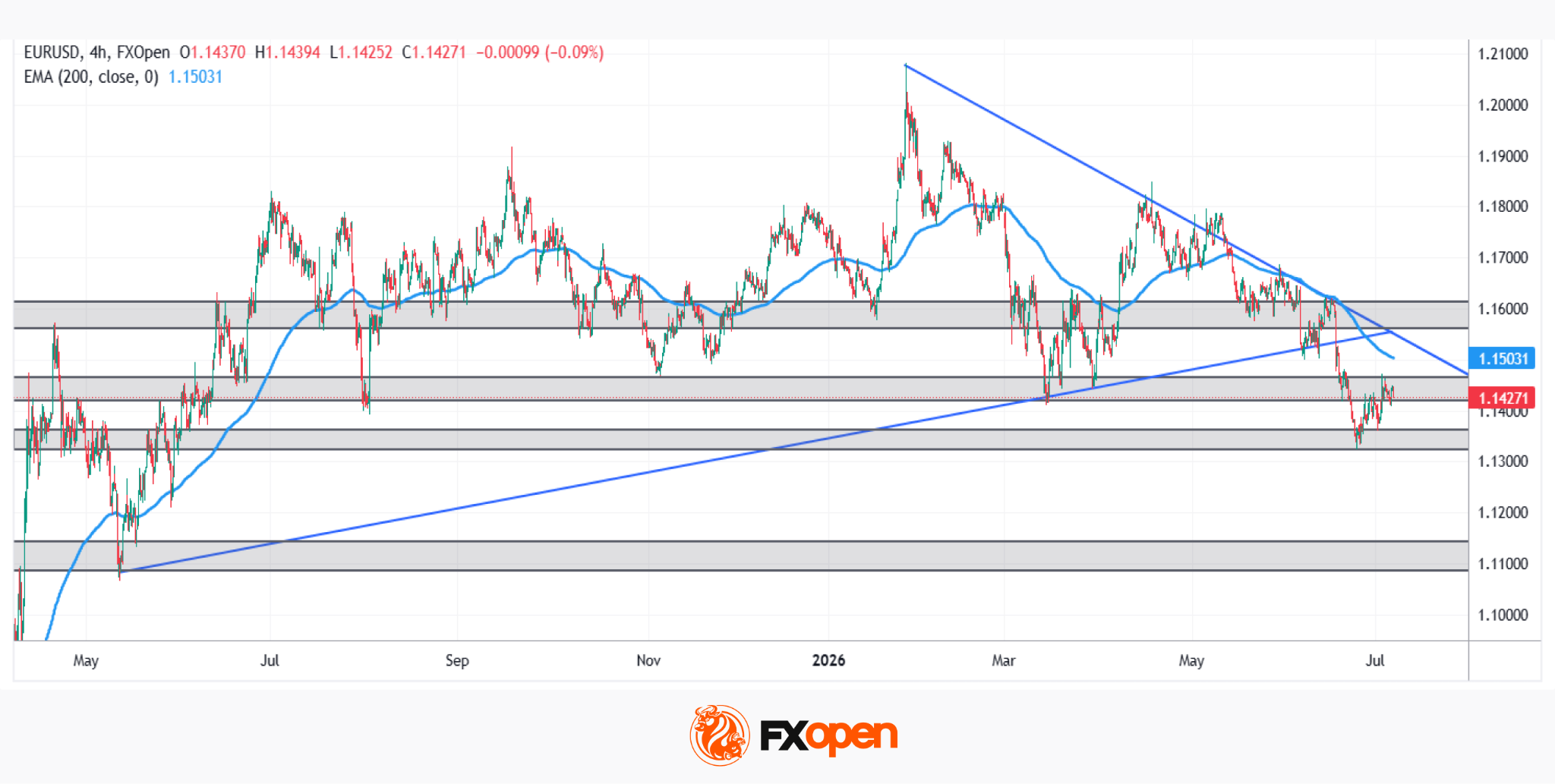
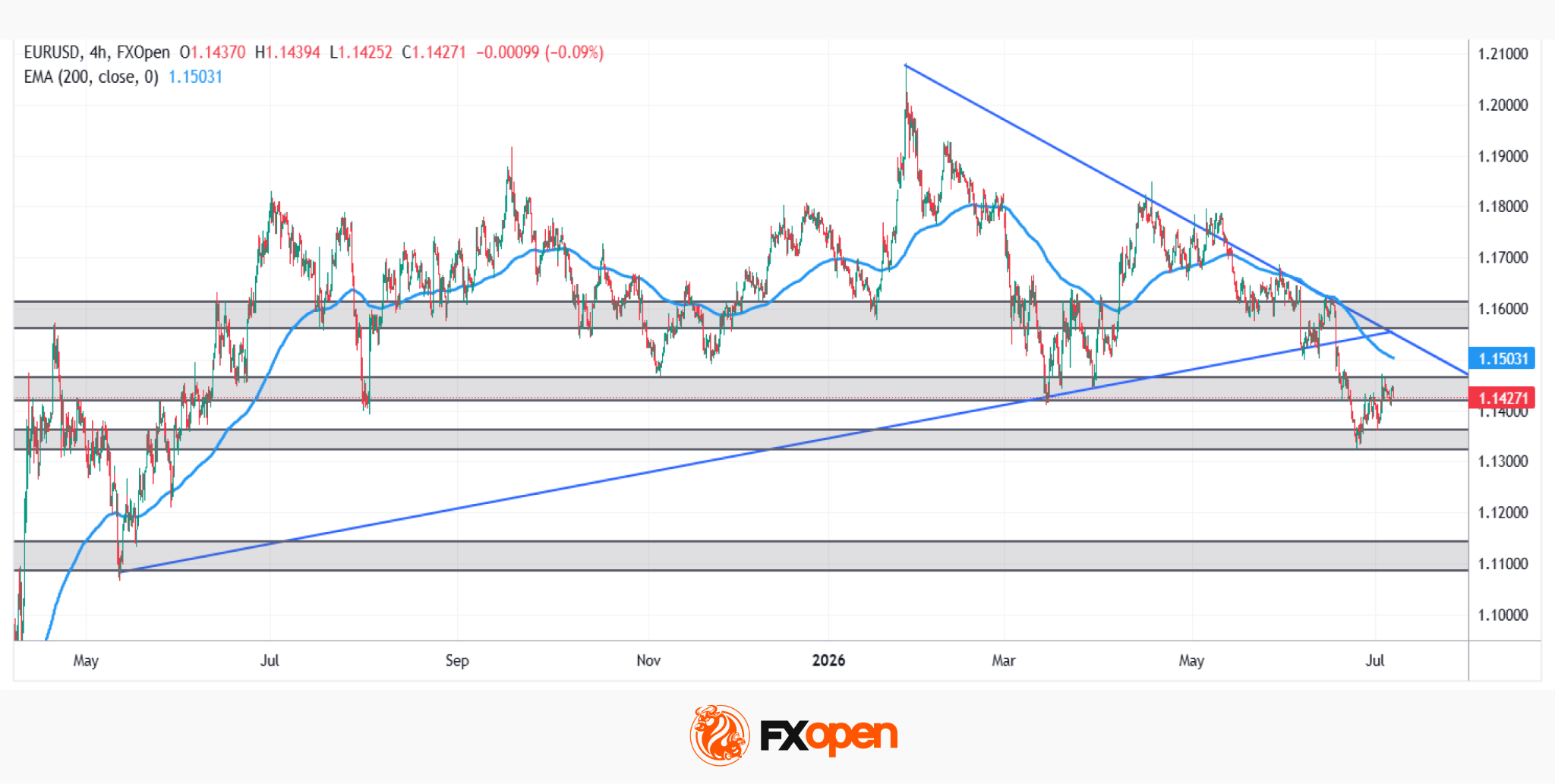
EUR/USD has spent roughly the past year confined within a broad consolidation range, as the chart illustrates, with price repeatedly oscillating between well-defined boundaries and no decisive breakout sustained in either direction.
Bullish Scenario
After briefly breaking below the range’s base support, price snapped back quickly, reclaiming the range almost as fast as it left it. For renewed bullish momentum to take hold, EUR/USD first needs to hold above the 1.1420-1.1460 support zone. The next, more decisive test lies with the descending trendline originating from January’s highs, which has been respected consistently throughout the year. This same area also converges with the 200-period EMA and the long-term ascending trendline broken to the downside in June. This confluence makes 1.1500-1.1550 the pivotal zone: a clean break above it would open the door for the euro to regain sustained strength against the dollar.
Bearish Scenario
The alternative reading is that price is currently only retesting the previously broken key support at 1.1420-1.1460. A decisive break below the low formed near 1.1320-1.1350 would confirm renewed downside momentum, clearing the path to resume the broader medium-term downtrend, where the next significant support comes into play around 1.1100-1.1150.
Either scenario will likely require confluence between technical structure and fundamentals, with central bank rhetoric and action remaining the key driver. ECB or Fed — which one becomes the catalyst for EUR/USD’s next major trend?
Trade over 50 forex markets 24 hours a day with FXOpen. Take advantage of low commissions, deep liquidity, and spreads from 0.0 pips (additional fees may apply). Open your FXOpen account now or learn more about trading forex with FXOpen.
This article represents the opinion of the Companies operating under the FXOpen brand only. It is not to be construed as an offer, solicitation, or recommendation with respect to products and services provided by the Companies operating under the FXOpen brand, nor is it to be considered financial advice.


- James said real pressure for keepers comes in the silence between shots.
- At Liverpool, City, Portsmouth and England, preparation shaped James.
- For traders too, instinct works only when built on the right information.
Zoomex hosted the third episode of its World Cup Edition X Space as part of the Zoomex World Cup Impact Pledge, bringing together England goalkeeper David James and a panel of traders: Crypto Kid, Farouk Bashar, and Theo Mercier.
Fernando Aranda hosted the session, which covered the knockout round, penalty psychology, goalkeeping philosophy, and England’s legitimate chances of winning the whole thing, a position James held without qualification and with obvious enjoyment.
The session continued the five-part charity initiative running across the series.
Zoomex is committing 1,000 USDT per episode to a charity of each football guest’s choosing, rising by an additional 5,000 USDT if the prediction proves correct.
James picked England to win the World Cup and nominated the UEFA Foundation as his charity of choice.
Last defence, last line, last save
The episode opened with a question every keeper answers differently, how do you describe the pressure of facing an unrelenting barrage of shots when your team is being outplayed?
James reframed the premise.
“I think the pressure is when you don’t have so much to do. When your team’s attacking and they’re not scoring and it goes down the other end and you’ve got to make the big save. That’s when the concentration has got to be there.”
He carried that logic across a career that spanned Liverpool, Manchester City, Portsmouth, and 53 caps for England.
The goalkeeper who is in the zone does not fear the next shot. He invites it. The trader who has done the homework does not fear the next candle. The preparation has already decided what happens next.
With the Congo goalkeeper the previous night, the opposite had been true. England were creating chances. The keeper was alert because the game required him to be.
“If you’re in the zone, then just keep shooting, keep shooting, because I’m going to be there.”
He was facing volume, but volume keeps a goalkeeper sharp. The danger is the long silence between saves.
The read on the England versus Congo game itself was direct. England won, which was the most important thing, but the Congo goalkeeper was exceptional for sixty or seventy minutes.
He had to be, James said, because England were creating the chances that required exceptional saves.
When Harry Kane’s header went in, and shortly after a thunderbolt from range made it two, the game was decided.
“There was a belief that there was going to be a second. And that’s where, the best goalkeepers in the world, they accept that goals go in, but don’t worry about the scoreline. They just say, OK, that shot beat me. Next shot, I will save. There’s no nerves.”
He was immediately thinking about the next fixture: Mexico at the Azteca. “Other than the final, it doesn’t get much better than that.”
He meant it as a compliment to the occasion, not a warning about the difficulty.
Penalties are about preparation, until they are about instinct
The panel spent substantial time on penalties, partly because the tournament had already produced defining moments in shootouts, and partly because the psychology maps almost exactly onto what traders describe as system versus gut reaction.
James described the two modes a goalkeeper can operate in during a shootout.
The first is pure preparation: the water bottle, the information, the tendencies logged from five or ten previous penalties by the same player, foot placement, the angle of the run-up, which way the non-kicking arm drops, whether there is a stutter in the approach.
All of that gets processed and the goalkeeper explodes at the last possible moment.
The second mode is instinct, and instinct, he said, can be wrong.
“When I thought I was the best goalie in the world and no one was going to beat me and I dived the wrong way, it was all instinct and sometimes your instincts are wrong. The more information you have, arguably, the better your instincts get.”
Crypto Kid connected it immediately.
“That phrase is very applicable to trading as well. Like the more information that you have in front of you, the more data that you can analyse, the better your instinct and ability to predict market movements get.”
Farouk had asked whether the goalkeeper’s rituals and routines in a shootout are natural or practiced. James was clear.
“My practice would be imagining the penalty shoot-out, imagining the crowd, even to the point where, if you’re playing in the Azteca, then you’re imagining being at one end or the other and what this is going to be like. And then you imagine yourself, how do you stand in that goal?”
Jordan Pickford’s approach has evolved over years from shouting and making faces to something more controlled. Whatever the method, James was confident it was rehearsed, not spontaneous.
On Bono specifically, who had already made a reputation in this tournament for his penalty-saving presence, James was thoughtful.
He had watched Bono in the last World Cup doing a particular movement with his feet: stepping one way, going the other. In subsequent shootouts, Bono was doing something slightly different.
“Now I’m thinking he’s doing something different because he knows everyone’s seen what he does. So the next penalty shootout in Morocco, the striker will be saying, “I think I know what you’re doing, but are you going to do something?”
The reputation itself becomes a variable. By the time the striker has processed what Bono is likely to do, Bono has already changed it.
You cannot learn to jump higher, you can learn to prepare better
Theo asked whether James had ever made a save and known in real time that it was a highlight moment.
The answer was yes, occasionally, but less often than people might assume, and for a reason worth sitting with.
“It’s very rare, especially with an experienced goalkeeper to be able to do something that you haven’t done before. You’re not going to be able to jump any higher than you have before. You’re not going to be able to spring. There might be some technical points where you’ve had to move into the position, react.”
The deflection save the Congo goalkeeper made the night before was one of those moments where instinct and body memory combine into something that looks miraculous from outside but feels like execution from inside.
“You look at it and go, OK, I’ve trained really hard to be able to make that save. I’m just so glad I made that save today. Rather than when you’re young and don’t know anything and you go, I’m fantastic, because I’ve never experienced it before.”
The same principle applies to mistakes. James described how the relationship with error has changed across his career and across the sport.
Twenty or thirty years ago, if you made a mistake, you might never see it properly again. It lived in the mind as an impression.
Now, by the hydration break, someone can show you exactly what happened, at what angle, at what moment the decision went wrong.
“A lot of it is, what happened there didn’t make sense. OK, now I know what happened, and you deal with it rather than thinking that it was something that it wasn’t.”
The practical outcome: errors become data rather than ghosts. Farouk brought up Uruguay and Bielsa’s decision to substitute the goalkeeper at half-time.
James had direct experience on the other side of that equation.
As a manager, he once brought a player off after twenty minutes.
“I knew that the game wasn’t going to get any better for the player. So I had to make changes. Fortunately, we ended up winning the game, but I had the conversation and explained why I did what I did.”
The substitution is not the hard part. The communication is. If the reasoning reaches the player, they move forward. If it does not, the confusion becomes a problem that outlasts the match.
France has eight players over 35 kilometres per hour
The question of which teams present the most difficult problems for a goalkeeper led James into statistics in the way he clearly enjoys them.
He had been tracking top-speed data across the tournament.
“If you look at players whose top speed in the World Cup is over 35 kilometres an hour, we have four. France have eight.”
He let the number land. The point was not just the count, but the distribution.
“It’s not just one or two players in similar positions. France is all over the place. They’ve got defenders, they’ve got wingers, they’ve got forwards.”
Whoever faces France in the knockout rounds is not defending against a fast team. They are defending against a team where the fast player could come from anywhere on the pitch at any moment.
His read on Mexico and Spain was built around a different kind of pressure: both teams had not yet conceded in the tournament. That sounds like strength. James described it as a form of fragility.
“When you haven’t conceded, you can think that we are unbeatable. But you can also fear that at some point you will get beaten, and it’s how you respond to conceding that first goal.”
Every other team in the competition had already made the adjustment.
They knew what it felt like to give one up and keep going. Mexico and Spain were still waiting for that moment, and it was coming.
The Cape Verde goalkeeper was the standout individual performance in the tournament so far. Forty years old. Three draws.
The performance against Spain in the first game, James said, was the reason Cape Verde were still in the competition.
“If it wasn’t for that performance against Spain in the first game, they’re going home. They’re going home without that performance. And now they have an opportunity to do something.”
He was waiting for the round of sixteen to identify the tournament’s best goalkeeper with more confidence.
The group stage had been one-sided in too many matches to draw firm conclusions. The round of thirty-two had continued that trend.
When the games tighten, distribution becomes the margin. “All the goalkeepers will be at the top level for the distribution, and the slight nuance in the quality of distribution will be the difference.”
Thierry Henry and Didier Drogba: Two of the loveliest guys you will ever meet
Fernando asked who made him most nervous across a career: the striker or midfielder who made him want to avoid the fixture.
“I was never nervous. I was just always disappointed.”
Then the answer: Thierry Henry and Didier Drogba. “Whenever it didn’t matter how good I felt. When I left the pitch, they’d won the game and usually one of them had scored.”
The frustration was not about fear. It was about the gap between preparation and outcome. He could feel ready. He could feel certain. And by the final whistle, one of them had still scored.
The more difficult detail: “Fernando, they are two of the loveliest guys you’re ever going to meet, which is even worse, because you want them to be horrible.”
He was clearer on goalkeeping evolution when Farouk raised the question. The rule changes have done more to alter the position than any tactical development.
When goal kicks moved from the box to open play, every goalkeeper had to develop a passing range that the position had never previously required. Distribution became structural rather than optional.
“When it comes to the actual physical side of goalkeeping, I’ve not seen any real evolution at all.”
The jumps are the same. The dives are the same. What has changed is the demand placed on the goalkeeper’s feet and decision-making inside the build-up.
He is pursuing his coaching badges partly to investigate whether the physical side of the position has scope for genuine development that the sport has not yet found.
Outfield, something has clearly happened. Players like Barcola and Dembélé are doing things at pace and in tight spaces that the best players in the world were not doing ten years ago.
Whether the goalkeeping position has evolved to match the players now running at it from eight different directions is a question James does not think has been fully answered.
England until we lose, and we have not lost
On England’s tournament prospects, James held the position he had taken before the first ball was kicked and was not moving from it.
Every argument that could be made for Spain, France, Brazil, or Argentina, he said, could be made equally for England. Until England lose, England are in it.
“I just think this year, this tournament, it’s all about England. So that’s my winner.”
He had watched Jude Bellingham pick up the Congo goalkeeper after a save, a moment of what he called friendly frustration, the recognition between two professionals that the other had done the job right.
Harry Kane had stepped up when it mattered. “For successful teams to be successful, there’s moments when the player steps up. And last night, Harry Kane stepped up.”
Crypto Kid supplied the external validation from outside the session: it is coming home, as the Prime Minister had apparently confirmed.
The panel’s own predictions spread across the obvious candidates. Theo saw Argentina or France one level above the rest. Farouk backed France on the basis of consistent performance across the group stage.
Crypto Kid was hoping for Argentina. Theo, asked to defend Brazil, admitted with some resignation that Brazil had the players but possibly not the structure.
On the prediction market, Olise was the consensus pick for top assists, with France likely to go deep enough in the tournament to give him the opportunities.
Mbappé and Messi split the golden boot votes.
The system does not have emotions, neither should you
James connected the work of a goalkeeper to the work of a trader in a way that the panel immediately recognised. Preparation decides the outcome before the event begins. Instinct is what preparation becomes when time runs out.
Crypto Kid had been thinking about the same parallel across the session.
“The more information that you have in front of you, the more data that you can analyse, the better your instinct and ability to predict market movements get. So it’s actually super, super related.”
The goalkeeper with the water bottle is running the same process as the trader who has backtested the position before opening it. The reading is faster at the moment because the thinking has already happened.
Farouk asked about goalkeeping rituals and whether they are learned or natural.
James’s answer extended into how the best professionals in any field develop their pre-performance routine: they rehearse the situation before it arrives, including the crowd, the specific stadium, the possible shooter, the possible market condition.
The routine is not superstition. It is a prior simulation under controlled conditions so that the real moment does not arrive as a surprise.
James’s closing advice to the audience was built on the same structure.
“I’ve done all my homework. Yes, I got the right result, but it’s because I’ve done my homework. Rather than when you’re young and don’t know anything and you go, I’m fantastic. It’s a lesson more about preparing yourself to do that than it is expecting something to happen that you’ve never practised or prepared for.”
He finished with a promise to return to the Zoomex X Space after swimming in Trafalgar Square fountain following England’s victory. Fernando said he would take a flight to be there.
The lesson from the Zoomex space
The thread that ran through the entire session was the relationship between information, preparation, and the moment of execution.
James’s career was built on narrowing that gap. A penalty is not decided when the ball is struck.
It is decided in the days of study that precede the shootout, in the mental rehearsal of the crowd, the shooter, the foot placement, the moment of explosion.
The moment itself is fast. The preparation is long. When the preparation is thorough, the fast moment goes the right way more often than it does not.
The traders described the same architecture. Farouk and Theo both described coming to the market with a position built before the session opens, and the discipline of not overriding that position when emotion says otherwise.
The goalkeeper who dives before the moment of information has arrived goes the wrong way on instinct alone. So does the trader who opens a position without a stop loss because the stomach says to hold.
David James’s specific answer to why he was never nervous, only ever disappointed, is worth sitting with.
He was disappointed because the preparation was thorough and the outcome still went against him. He was not nervous because nervousness means the preparation was incomplete.
The job of preparation is to remove the unknowns that produce nerves, and replace them with a plan that decides what happens when the situation changes.
The plan does not eliminate losing. It eliminates panicking while losing.
The Zoomex World Cup Impact Pledge continues across two more episodes. England are going to win the World Cup. David James said so, and 1,000 USDT for the UEFA Foundation is waiting on the other side of it.
About Zoomex
Founded in 2021, Zoomex is a global cryptocurrency trading platform with over 3 million users across more than 35 countries and regions, offering 600+ trading pairs.
Guided by its core values of “Simple × User-Friendly × Fast,” Zoomex is committed to fairness, integrity, and transparency in delivering a high-performance, low-barrier, trustworthy trading experience.
As an official partner of the Haas F1 Team and global brand ambassador partner of goalkeeper Emiliano Martínez, Zoomex brings the same focus on speed, precision, and discipline from the racetrack and the pitch to trading.
The platform holds regulatory licenses including Canada MSB, U.S. MSB, U.S. NFA, and Australia AUSTRAC, and has passed security audits conducted by Hacken.
This article is authored by a third party, and CoinJournal does not endorse or take responsibility for its content, accuracy, quality, advertisements, products, or materials. Readers should independently research and exercise due diligence before making decisions related to the mentioned company.


RealFi has launched its public testnet, opening access to the first live version of its yield-bearing stablecoin infrastructure ahead of a planned mainnet release later this year.
Summary
- RealFi has opened its public testnet for USDr and its yield bearing staking token sUSDr ahead of a planned mainnet launch later this year.
- The protocol generates returns from traditional fixed income assets instead of crypto token incentives, with indicative yields of up to 9% APY.
- The launch comes as interest in yield bearing stablecoins and tokenized real world assets continues to grow across institutional markets.
According to a press release shared with crypto.news, the public testnet gives users, developers and institutional participants a live environment to test the infrastructure supporting USDr, the protocol’s dollar-pegged stablecoin, and sUSDr, the yield-bearing token users receive after staking USDr.
The company said the rollout is intended to test wallet integrations, staking flows, yield distribution and other protocol functions under live market conditions before the network goes fully live. RealFi added that feedback collected during the testnet phase will be used to refine the platform before its mainnet launch.
Stablecoin backed by traditional financial assets
At the centre of the platform is USDr, a liquid stablecoin that does not generate yield on its own. Users who stake USDr receive sUSDr, which earns returns from a reserve of traditional financial assets rather than crypto-native incentives. According to RealFi, those reserves include money market funds, corporate floating-rate bonds, and direct lending to fintech companies.
The company said it is targeting yields of up to 9% APY through its reserve-backed structure, while noting that returns remain indicative and variable and are not guaranteed. RealFi added that the design focuses on capital efficiency, transparency and sustainability instead of inflationary token emissions.
“Stablecoins have become one of the most important pieces of infrastructure in digital finance, but most of the capital sitting inside them remains economically unproductive,” John O’Connor, CEO of RealFi, said in an accompanying statement.
He added that the next stage of the market involves allowing on-chain dollars to participate in real economic activity while preserving the liquidity and accessibility expected from stablecoins.
RealFi said the protocol will launch first on Cardano before expanding to Ethereum shortly afterwards. The company added that it combines reserve-backed yield generation with Cardano-native staking while using an architecture designed to reduce reliance on volatile decentralised finance market conditions.
Looking ahead, RealFi said the public testnet will also serve as a large-scale infrastructure and market stress test before the planned mainnet rollout.
“We believe the future of stablecoins will look far closer to financial infrastructure than speculative crypto products,” O’Connor said, adding that the long-term opportunity lies in creating digital dollars that remain stable while generating productive returns.
Yield-bearing stablecoins gain attention
The launch comes as financial institutions continue exploring tokenized real-world assets and stablecoins backed by income-generating assets. Earlier this month, former Brazil central bank director Tony Volpon introduced BRD, a Brazilian real-pegged stablecoin backed by government bonds that distributes sovereign debt yields to token holders, offering foreign investors blockchain-based exposure to Brazil’s high domestic interest rates.
However, in the U.S., yield-bearing assets have come under scrutiny. In April, the American Bankers Association argued that allowing payment stablecoins to pay interest could encourage deposit outflows from community banks, increase funding costs and reduce local lending, while debate continues around proposed legislation including the GENIUS Act and CLARITY Act.
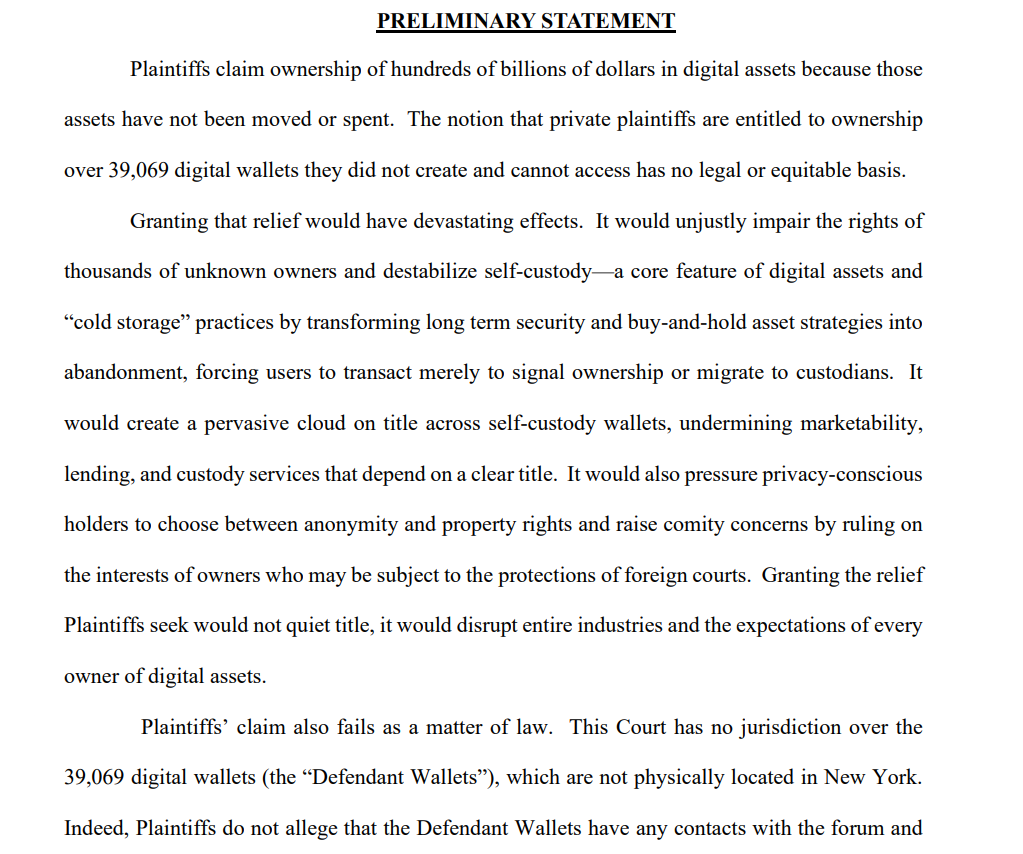
Blockchain trade association the Digital Chamber filed an amicus brief in the New York lost property case seeking ownership of thousands of dormant Bitcoin addresses.
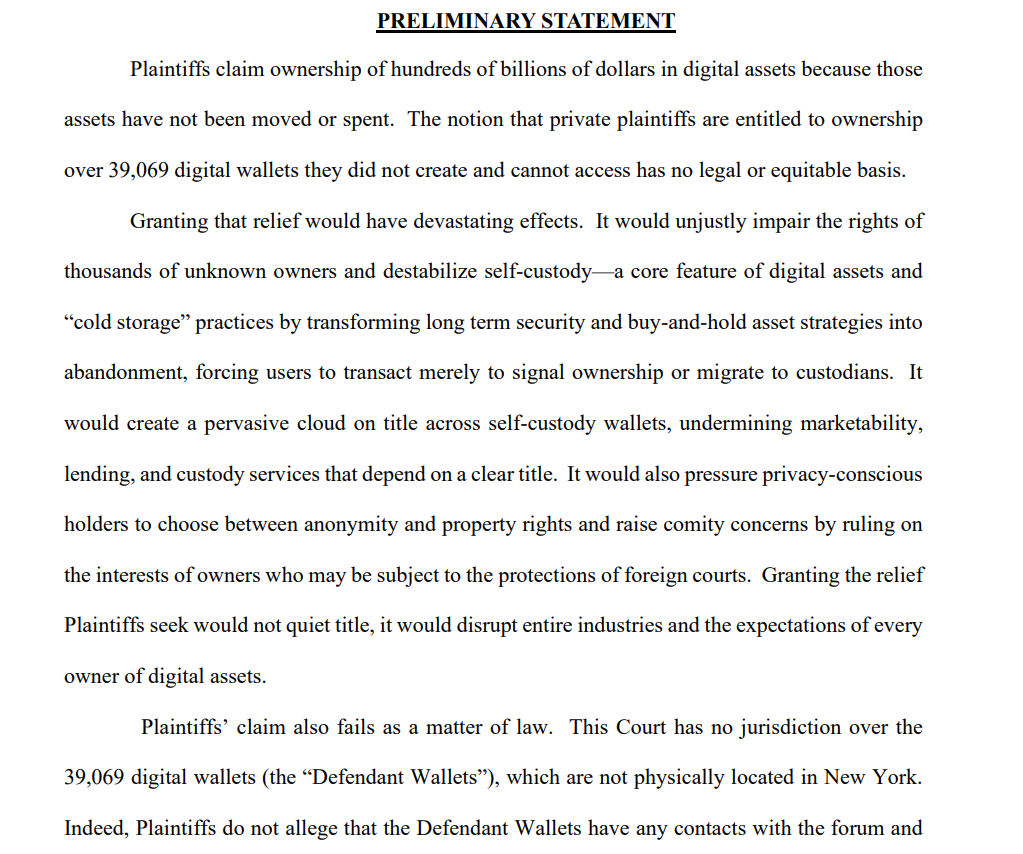
The Monday filing is the second amicus brief in the case. It opposes the claims of ownership, arguing that treating dormant wallets as abandoned property would create a “pervasive cloud on title across self-custody wallets.”
Digital Chamber argues that a ruling based on the plaintiffs’ theory would undermine the “foundational principles of digital property ownership, with negative ripple effects reaching the traditional finance industry.”
The amicus brief was filed in a lawsuit brought by “Noah Doe” and two Wyoming-based companies in late May, seeking ownership of 39,069 dormant Bitcoin addresses, in what could become a test of how inactive crypto may be treated under the state’s lost-property law.
The listed addresses hold an estimated 3.7 million Bitcoin (BTC) worth about $234 billion and include some of the wallet addresses associated with Bitcoin creator Satoshi Nakamoto, according to Sani, founder of analytics platform Timechain Index.
The Digital Chamber files an amicus brief to dismiss the case seeking ownership of 39,069 Bitcoin wallets. Source: iapps.court.state.ny.us
The Digital Chamber describes itself as the oldest and largest digital asset trade association representing over 250 members, including crypto exchanges, banks, investment firms and other industry participants.
Related: Strategy sells 3,588 Bitcoin for $216M to fund dividends, keeps $2.55B reserve intact
Dormant Bitcoin wallets awaken after lawsuit
Some of the long-dormant Bitcoin wallets named in the lawsuit have been waking up.
At least 31 of the listed addresses moved 17,527 Bitcoin in June, up from five addresses that transferred 4,834 BTC in February, according to Galaxy Digital head of research Alex Thorn.
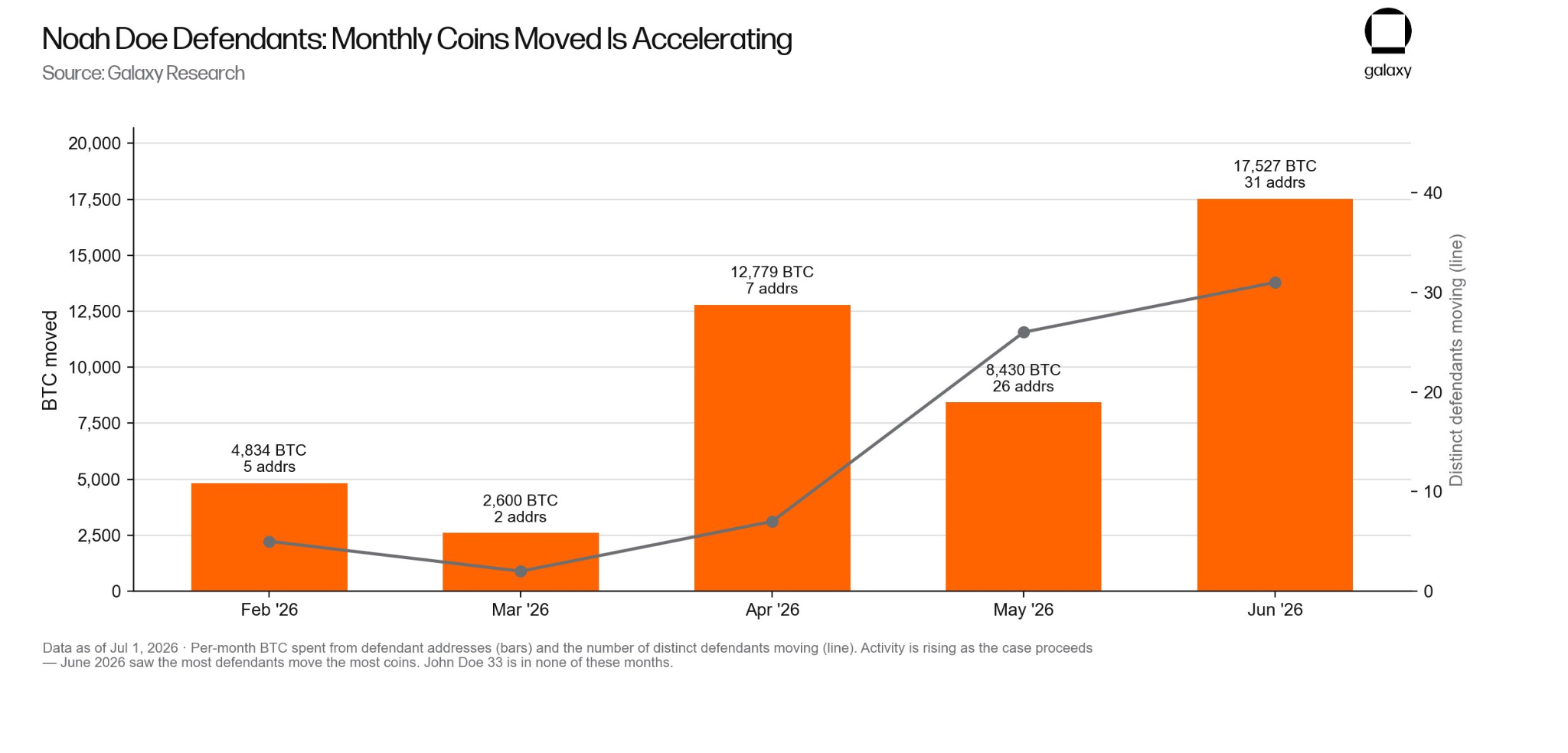
Source: Alex Thorn
Bitcoin address “1KV47” transferred 30 BTC, worth about $1.88 million, on Saturday, marking the wallet’s first movement in almost 15 years, since August 2011.
Regardless of the lawsuit’s outcome, it is unclear how the plaintiffs could gain control of the assets without holding the private keys to the wallets.
On Thursday, a pseudonymous defendant filed a notice of appearance and motion to dismiss, claiming they control one of the dormant wallets named in the lawsuit.
Magazine: Bitcoin decouples from tech stocks, Ether eyes ‘selling wave’: Market Moves

Key Highlights
- In a remarkably swift move, SpaceX secured Nasdaq-100 membership merely 15 days following its June 12 public offering, marking one of the most rapid index additions in history.
- Index-tracking funds are projected to purchase between $4.3 billion and $6 billion worth of SPCX shares to align with updated index weightings.
- Both Goldman Sachs and Morgan Stanley launched coverage on Tuesday with their highest possible ratings; Goldman characterized the opportunity as potentially reaching “multi-trillion-dollar” scale.
- The company’s index representation reflects a float-adjusted market capitalization of approximately $300 billion, though only around 638 million shares are publicly tradeable.
- An additional 20% of shares will become available for trading following SpaceX’s inaugural earnings announcement, anticipated within weeks.
In a historic development for Wall Street, SpaceX (SPCX) secured its position in the prestigious Nasdaq-100 index on Tuesday, achieving this milestone a mere 15 days after making its stock market entrance on June 12 — establishing one of the swiftest index inclusions ever documented.
Space Exploration Technologies Corp., SPCX
During premarket trading on Tuesday, shares declined approximately 1.5% to reach $158.37. Following its initial public offering, SPCX has experienced price fluctuations ranging from a peak of $225.64 to a trough of $147.11.
The inclusion required strategic regulatory maneuvering. Nasdaq implemented modified eligibility criteria specifically designed for recently debuted companies, enabling SpaceX to meet qualification standards despite its abbreviated public trading record.
The Nasdaq-100 comprises the exchange’s most valuable non-financial enterprises. SpaceX now stands alongside technology titans including Apple, Nvidia, Alphabet, Amazon, Meta, and Broadcom in an elite collection representing nearly $40 trillion in aggregate market capitalization.
Commanding a market valuation of $2.1 trillion, SpaceX currently ranks as America’s sixth-most-valuable corporation. Chief Executive Elon Musk holds distinction as humanity’s inaugural trillionaire.
The company’s initial public offering generated $86 billion in capital — an unprecedented amount — though this constituted merely a portion of its staggering $1.8 trillion IPO valuation. Presently, approximately 638 million shares remain accessible for public trading, representing roughly $102 billion in market value.
Recognizing the constrained share availability, Nasdaq is applying a weighting methodology that values SpaceX at triple its tradeable market capitalization, effectively assigning it the index influence of a $300 billion enterprise. This calculation translates to approximately 0.75% of the Nasdaq-100’s aggregate value.
Massive Passive Investment Inflows Anticipated
More than $587 billion in investment capital tracks the Nasdaq-100 benchmark, encompassing Invesco’s popular QQQ and QQQM exchange-traded funds. These investment vehicles must now acquire SPCX shares to maintain proper index alignment.
J.P. Morgan analysts projected last month that this index addition would generate approximately $4.3 billion in passive investment flows. Barron’s analysis suggests the actual figure may approach $6 billion — representing roughly 6% of SPCX shares currently available for trading.
Market participants seem to have positioned themselves ahead of this event. SPCX shares have climbed approximately 10% from recent nadirs approaching Tuesday’s inclusion, potentially incorporating anticipated indexation demand into current pricing.
Additional share supply approaches. Approximately 20% of SpaceX equity will transition from restricted to tradeable status following the corporation’s initial quarterly earnings disclosure, scheduled for the coming weeks. This unlock event should alleviate some existing supply-demand imbalances.
Major Financial Institutions Launch Coverage With Optimistic Outlooks
Tuesday simultaneously represents the conclusion of the mandatory quiet period for underwriting banks, including Goldman Sachs, Morgan Stanley, BofA Securities, Citigroup, and J.P. Morgan.
Morgan Stanley commenced research coverage with its premium rating designation, characterizing SpaceX as “AI’s final frontier.” Goldman Sachs similarly launched coverage at its most favorable rating level, asserting that each of SpaceX’s primary business segments possesses potential to evolve into multi-trillion-dollar markets over a five-year-plus horizon.
RBC, Bernstein, and Stifel added their voices with top-tier ratings as well, with RBC emphasizing Starship — SpaceX’s completely reusable next-generation launch vehicle — as the “flywheel that powers SpaceX’s ambitions.” Oppenheimer had previously established an “outperform” rating in June.
Dissenting perspectives exist. Morningstar assigned SpaceX a valuation near $780 billion, citing concerns regarding uncertainties surrounding its artificial intelligence ventures, including xAI and social networking platform X.
S&P Global rejected establishing an expedited pathway for S&P 500 membership in June. The company may require at least twelve months before achieving inclusion in that benchmark index.
FTSE Russell incorporated SpaceX into its U.S. market indexes last month, with the iShares Russell 1000 ETF already providing investor access to the stock.


Strategy’s reported sale of 3,588 BTC on Monday—raising cash to support preferred stock dividend payments and replenish reserves—triggered an immediate dip in Bitcoin, but analysts say the move ultimately reduced near-term financing pressure for the company’s yield-linked product.
The transaction, described in earlier coverage from Cointelegraph, followed Strategy’s prior disclosure that it would maintain enough U.S. dollar liquidity to meet its dividend obligations. Grayscale Research said the stock’s rebound signals investors are taking the company’s funding plan as credible again, while other research voices framed the sale as a stabilizing step rather than a sign of distress.
Key takeaways
- Strategy sold 3,588 BTC to fund preferred dividend payments and rebuild cash reserves, strengthening its reported dollar liquidity runway.
- Analysts said the action should ease “forced-selling” concerns tied to the company’s financing structure.
- Grayscale Research pointed to a rebound in STRC as evidence of renewed investor confidence.
- Bitcoin briefly fell after the announcement but recovered quickly, suggesting the market reaction was short-lived.
- What matters next is whether Strategy continues to manage liquidity through planned mechanisms and whether investor confidence persists.
A liquidity cushion aimed at dividend coverage
According to Cointelegraph’s earlier reporting on the sale—“Strategy sells BTC” as part of its plan to fund preferred stock dividend payments—Strategy used the proceeds to bolster its U.S. dollar reserves. The company’s dollar liquidity now totals $2.55 billion, which Grayscale Research and other analysts characterized as roughly 17 months of dividend coverage.
That context is important because Strategy’s dividend obligations are central to how the market evaluates its capital framework. Earlier in June, Strategy clarified that it would issue shares and sell Bitcoin as needed to preserve sufficient U.S. dollar reserves tied to dividend requirements. Monday’s sale fits within that described approach.
Why the market reaction was brief
Strategy’s announcement caused Bitcoin to drop by about 2.4% within hours. However, both Bitcoin and Strategy’s yield-bearing STRC product rebounded soon afterward, implying that investors did not view the sale as a long-term escalation.
Zach Pandl, Grayscale’s head of research, said Strategy’s actions should “restore market confidence” in its financing structure. He added that this could help Bitcoin “find a more durable bottom,” framing the update as a reduction in pressure for additional BTC sales coming from the company that runs in parallel with the dividend plan.
Grayscale Research also linked STRC’s rebound to improved expectations for the instrument. In a post referenced by Cointelegraph, Grayscale Research noted that “The rebound in STRC suggests investors are responding positively to this decision.”
Analysts call it stabilizing rather than distressed selling
Andri Fauzan Adziima, research lead at the Bitrue Research Institute, told Cointelegraph the sale was a “smart, stabilizing move that actually strengthens the setup for Bitcoin.” In his framing, the company’s decision to convert BTC into cash to cover dividends for an extended period reduces uncertainty about how multiple obligations are balanced simultaneously.
Pandl emphasized that, while Strategy’s balance sheet was not inherently impaired, shifting market conditions had previously introduced uncertainty over how competing priorities would be handled. In a quote carried in the source reporting, he noted that “shifting market conditions created uncertainty about how Strategy would balance competing priorities.”
Once Strategy replenished its cash reserve enough to cover approximately 17 months of dividend payments, Pandl and Adziima argued the risk balance improved—both by lowering the likelihood of short-term, forced BTC selling and by giving investors more visibility into the company’s near-term liquidity plan.
Reducing forced-selling overhang for Bitcoin and STRC
Adziima specifically pointed to the mechanics of the move: using sale proceeds to pad cash reserves for around 17 months of STRC dividends “cut near-term financing pressure and overhang,” which he said helped spur Bitcoin’s quick recovery above $64k while lifting STRC toward the $90 area.
In the same assessment, he argued that the change “reduces forced-selling risks, rebuilds confidence in their structure and paves the way for a more durable bottom” as other buyers step in—framing the outcome as prudent balance-sheet management rather than capitulation.
Cointelegraph’s source material also noted Bitcoin’s trading levels around the time of publication, citing a rebound to roughly $64,400 in late trading Monday after dipping to about $63,120 earlier.
The broader implication for traders and investors is that the market may be recalibrating how it prices Strategy’s BTC holdings. When liquidity coverage looks more than sufficient for dividend obligations, investors often become less sensitive to headlines about BTC sales, because the sales appear less likely to represent a forced unwind. Conversely, if coverage shrinks quickly, the same type of announcement can carry more weight and volatility.
What to watch next
Going forward, investors will likely focus on whether Strategy’s reserve coverage remains stable under normal market conditions and whether STRC’s improved trading behavior persists alongside continued transparency about how dividends are funded. The key uncertainty remains how future liquidity requirements and capital-market conditions interact—particularly if Bitcoin volatility rises again and market confidence becomes harder to maintain.
Crypto World
Battle of the Bitcoin Reserve: Treasury-Commerce Department Infighting Delays Trump Crypto Plan

Bitcoin News: More than 16 months after President Trump signed the executive order establishing a Strategic Bitcoin Reserve, the U.S. government has not formally designated a managing agency, has not publicly disclosed its full holdings, and has not acquired a single satoshi of new Bitcoin, the result of an unresolved turf war between the Treasury Department and the Commerce Department over which agency should control roughly 328,372 BTC valued at approximately $25 billion.
The DOJ Office of Legal Counsel is now mediating between the two departments, a development that signals the dispute has moved beyond bureaucratic friction into genuinely contested legal territory.
The March 6, 2025 executive order created two separate structures: the Strategic Bitcoin Reserve, composed of forfeited Bitcoin the government acquired through seizures, and a broader U.S. Digital Asset Stockpile for other confiscated crypto assets.

The order also directed Treasury and Commerce to develop budget-neutral methods for expanding Bitcoin holdings, a constraint that, combined with the unresolved oversight question, has effectively frozen any new accumulation.
Discover: The Best Token Presales
Bitcoin News: Why Neither Agency Wants to Own This
The core legal problem is that existing government asset management statutes were designed around gold, foreign exchange reserves, and Treasuries, not a volatile digital bearer asset.
Treasury’s traditional authority centers on fiscal instruments; holding Bitcoin as a long-term strategic asset, rather than liquidating it as typical seized property, sits awkwardly with that mandate. Commerce has been floated as an alternative home on the theory that Bitcoin represents a strategic technology and economic competitiveness asset, but that framing requires its own legal scaffolding.
The White House has confirmed that work on a U.S. Strategic Bitcoin Reserve is still moving forward, although legal and regulatory hurdles remain.
Officials are reportedly still debating which federal agency should oversee the reserve, with the Treasury Department and… pic.twitter.com/PMp3YXSTrc— MS Capital (@MSCapital_X) July 7, 2026
The result, as reported by Bloomberg and KuCoin, is a bureaucratic vacuum where neither side is willing to formally accept responsibility that may not legally be theirs.
The BITCOIN Act, which would codify the Strategic Bitcoin Reserve under the Treasury with explicit congressional authorization, has been proposed but not enacted, and without it, agencies are reluctant to move.
That legislative gap may ultimately prove the harder obstacle than the interagency dispute itself, a point raised in early July that the reserve’s legal durability likely requires congressional action regardless of how the OLC resolves the current standoff.
Broader questions about legislative authority over crypto policy are playing out across multiple fronts in Washington simultaneously.
The original executive order set a 30-day deadline for agencies to report holdings and a 60-day deadline for Treasury to deliver a full legal, custodial, and legislative evaluation. Both passed without public disclosure; the 60-day deadline expired May 5, 2025. As of early July 2026, no report has been delivered, and no agency has been formally designated.
Scott Bessent’s Contradictory Signals
Scott Bessent, the Treasury Secretary, created additional confusion when he said publicly that the U.S. “won’t be buying” additional Bitcoin in the near term, then partially walked that back on social media by saying Treasury is exploring “budget-neutral pathways” for expanding holdings.
The contradiction matters because it reflects the same tension embedded in the executive order itself: the political appetite for accumulation is constrained by a fiscal rule that makes accumulation nearly impossible without either a market-neutral mechanism or an explicit congressional appropriation.

White House digital assets adviser Patrick Witt said an announcement on the reserve structure is “coming soon,” which suggests the administration still views the project as active rather than shelved.
That framing aligns with the OLC mediation, a resolution process, not an abandonment. But “coming soon” has been the operative phrase for months, and the crypto community’s frustration with the absence of a concrete framework is well documented. CoinTribune noted growing criticism centered on the lack of structure and the fact that no new Bitcoin has been acquired under what was billed as a historic Trump crypto policy initiative.
The March 2025 order did include one unambiguous directive: Treasury-controlled Bitcoin “shall not be sold and shall be maintained as reserve assets.” That no-sell clause is the clearest public statement on the government’s intended long-term posture toward its US government Bitcoin holdings, and it remains in force regardless of the oversight dispute.
Discover: The Best Crypto to Diversify Your Portfolio
Don’t Miss Out on Our $1,000 USDT Airdrop on ByBit
The post Battle of the Bitcoin Reserve: Treasury-Commerce Department Infighting Delays Trump Crypto Plan appeared first on Cryptonews.
Crypto World
Bitcoin Suisse Advances Middle East Expansion, Receives Financial Services Permission in Abu Dhabi
[PRESS RELEASE – Zug, Switzerland, July 7th, 2026]
Premium virtual assets pioneer BTCS (Middle East) Ltd. is now fully authorized by the Financial Services Regulatory Authority (FSRA) of ADGM, enabling regulated institutional services across the UAE.
Building on its position as Switzerland’s leading crypto financial services provider, Bitcoin Suisse is further accelerating its international expansion. Bitcoin Suisse Group’s subsidiary, BTCS (Middle East) Ltd. (“BTCS ME”) has received Financial Services Permission (FSP) from the Financial Services Regulatory Authority (FSRA) of ADGM, the international financial centre of Abu Dhabi, marking another significant step toward the Group’s international growth strategy becoming a leading global wealth management partner.
The FSP marks the completion of a thorough, multi-stage licensing process and enables BTCS ME to deliver a comprehensive suite of regulated digital asset financial services to institutional and professional clients in the United Arab Emirates. Bitcoin Suisse brings more than a decade of experience across multiple digital asset market cycles to the UAE. The Group currently safeguards USD 3.7 billion in crypto assets and ranks as the fourth-largest staking operator globally.
With the FSP, clients benefit from the same foundations that have made Bitcoin Suisse a trusted partner to investors, institutions, and blockchain innovators for more than a decade. Across multiple market cycles, Bitcoin Suisse has built a reputation for resilience, combining a robust, proprietary infrastructure with a service philosophy centered on long-term client relationships.
Institutional and professional clients can access a regulated digital asset financial infrastructure designed for sophisticated needs, including managing and hedging digital asset exposure, in a fully compliant environment, institutional-grade custody, and trading approved virtual assets. All supported by a dedicated relationship manager, ensuring access not only to institutional-grade technology and regulatory clarity, but also to personal attention, continuity, and deep expertise. As the market evolves, BTCS ME is also positioned to support clients in accessing tokenized real-world assets in the future.
By combining regulatory strength, operational depth, and a highly personalized approach to client service, BTCS ME is designed to support clients through the next phase of institutional adoption.
Ceyda Majcen, Chief Executive Officer and SEO of BTCS ME, leads Bitcoin Suisse Group’s expansion in the Middle East and brings extensive, long-standing senior leadership experience across the Group.

Receiving the FSP from the FSRA is a major milestone in our international growth strategy. The authorization reflects more than a decade of experience building resilient infrastructure, risk frameworks, and trusted client relationships. We are excited to bring our unique combination of institutional-grade capabilities and highly personalized service to the UAE, one of the world’s most dynamic hubs for digital assets.”
Arvind Ramamurthy, Chief Market Development Officer at ADGM, said “We congratulate Bitcoin Suisse on receiving its FSP from the FSRA. Its expansion into ADGM reinforces the strength and maturity of our digital assets’ ecosystem, which continues to attract leading global institutions seeking regulatory clarity, market access and long-term growth opportunities. As Abu Dhabi further strengthens its position as a leading financial hub in the region, ADGM remains committed to enabling innovation within a robust, internationally recognized regulatory environment.”
About Bitcoin Suisse
Bitcoin Suisse is a leading premium digital assets financial services provider. Founded in 2013 by digital asset experts, it provides a cohesive suite of trading, custody, staking and lending services for institutional clients, digital asset foundations, family offices, asset managers and high-net-worth individuals. Bitcoin Suisse is headquartered in Zug with over 200 employees in Switzerland, Liechtenstein, the United Arab Emirates, and Bermuda. www.bitcoinsuisse.com
The post Bitcoin Suisse Advances Middle East Expansion, Receives Financial Services Permission in Abu Dhabi appeared first on CryptoPotato.
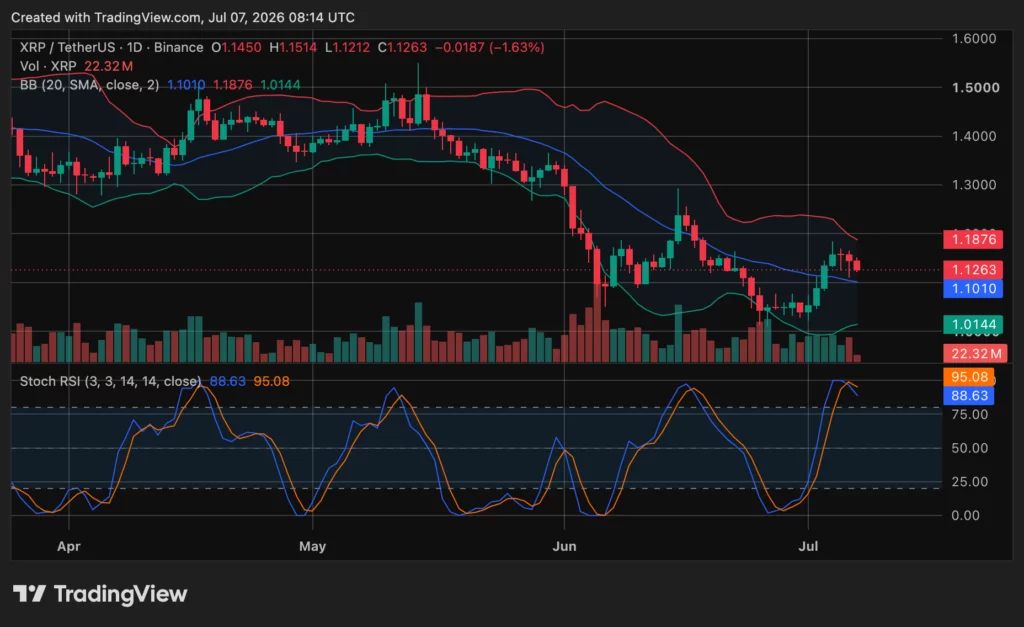
XRP traded near $1.13 on July 7, down 1.69% in the past 24 hours, according to crypto.news market data.
Summary
- XRP’s rebound needs a clear break above $1.14 to confirm stronger short-term momentum for bulls.
- ETF inflows remain positive, but CLARITY delays have removed a near-term policy catalyst for XRP.
- Spot CVD has improved across exchanges while Binance perpetual traders keep selling into rebounds.
The token moved between $1.11 and $1.16 during the session, while trading volume stood at about $1.73 billion.
The rebound from the late-June low near $1.00 remains intact, but buyers have not yet turned it into a stronger breakout. the token pushed back toward the $1.14 to $1.18 zone, but it failed to hold the upper part of that range.
The price now sits near a short-term decision area. A close above $1.14 would show that buyers are gaining control. A clean move above $1.18 to $1.20 would give bulls a stronger signal and place the next resistance levels back in focus.
The downside level is also clear. If XRP loses $1.10, the current rebound would weaken. A move below that area could expose $1.06, which some traders now see as the next retest zone.
XRP ETF inflows help, but policy catalyst slips
The recovery has come while XRP-linked investment products continue to attract demand. The latest background data showed spot XRP ETFs recorded a ninth straight week of net inflows, adding $17.19 million despite broader policy uncertainty.
Those inflows have helped support the market, but they have not been enough to break the larger downtrend. As previously reported, XRP ETFs gave investors regulated access, but they did not solve the wider legal question around XRP’s status under U.S. law.
The CLARITY Act remains the main policy catalyst for many traders. The bill missed its July 4 target and now faces an Aug. 7 deadline before the Senate’s summer break.
That delay removed a near-term trigger for digital assets. The bill has passed the House, cleared the Senate Banking Committee, and sits on the Senate calendar, but staff still need to merge Banking and Agriculture versions before a full Senate vote.
Moreover, Standard Chartered has said XRP ETFs could attract $4 billion to $8 billion in first-year inflows if CLARITY passes. That forecast depends on legal clarity unlocking larger institutional demand.
Technical setup stays mixed
The XRP/USDT daily chart shows price recovering from the late-June low, but the broader trend remains weak after the June breakdown. The token is trading above the middle Bollinger Band near $1.10, which keeps the short-term rebound alive.
The upper Bollinger Band sits near $1.18. That matches the area traders are watching for a stronger breakout. Until the token closes above that zone, the move remains a rebound inside a weak structure rather than a confirmed trend shift.
The lower Bollinger Band sits near $1.01. That level remains important if selling pressure returns. A break below $1.10 would increase the risk of a move back toward that area.
Momentum also shows a mixed picture. The Stochastic RSI is elevated, with readings near 88.63 and 95.08. That shows strong short-term momentum, but it also places XRP close to overbought territory. Since the faster line has moved below the slower line, the rebound may be losing some force.
EGRAG Crypto said XRP must defend $1.10 after moving below the 21 EMA on the four-hour chart. He said, “Hold $1.10 = structure still alive,” while a loss of $1.06 would increase caution.
Dark Defender took a more bullish weekly view and said XRP is “launching the Wave 5 without the Clarity Act.” Other analysts also pointed to higher long-term targets, but those views still depend on price clearing the current resistance zone first.
Spot demand rises while perps stay defensive
On-chain and derivatives data show a split market. CryptoQuant analyst Amr Taha said XRP’s estimated spot CVD across centralized exchanges rose from about minus $42 million on May 12 to plus $406 million by July 7.
That change points to stronger spot buying across exchanges. It suggests market buyers have absorbed more available XRP supply over the past two months.
The derivatives market shows the opposite trend. Binance perpetual CVD fell from about minus $48 million to minus $783 million over the same period. That shows sustained sell-side pressure from perpetual traders.
Open interest also fell from about $255 million on May 22 to $203 million on July 7. That drop suggests leveraged traders have reduced exposure while spot buyers have become more active.
Binance spot data has improved, but it has not turned positive. Estimated spot CVD on Binance rose from about minus $212 million on June 25 to minus $173 million on July 7, showing that selling pressure has eased but not fully reversed.
Disclosure: This article does not represent investment advice. The content and materials featured on this page are for educational purposes only.


Japanese bonds are challenging the boost bitcoin has received from shifting interest-rate expectations that lifted the price of the largest cryptocurrency by 8% in fewer than seven days.
The 10-year Japanese government bond (JGB) yield has surged to a 30-year high of 2.85%, adding 18 basis points since the start of the month and raising borrowing costs across other major developed markets.
The U.S. 10-year Treasury yield has gained nearly three basis points and is testing 4.5% for the first time in nearly a month. The German 10-year bund is approaching 3% and the U.K. 10-year gilt is yielding around 4.8%. Real yields, which are adjusted for inflation, are also climbing.
For years, Japan kept global yields suppressed through near-zero interest rates and aggressive quantitative easing. That policy fueled carry trades that involved borrowing yen at a low rate and investing in high-yielding bonds elsewhere. Thus, Japan indirectly capped borrowing costs in advanced nations.
This matters for bitcoin because higher government bond yields increase the opportunity cost of holding an asset that generates no cash. Capital parked in BTC is capital not earning the stronger, more reliable returns available in fixed income.

EUR/USD Analysis: Who Is in Control?

10 Perfect ‘Little House on the Prairie’ Episodes To Revisit Before the Netflix Reboot

England dealt double injury blow ahead of crucial Fiji clash


-

 Fashion4 days ago
Weekend Open Thread: High Hopes
-

 Fashion17 hours ago
Open Thread: What Great Books Have You Read Recently?
-

 Politics4 days ago
The House | “Reframing the debate from a binary discussion of winners and losers”: Yuan Yang reviews ‘We Are Not Machines’
-
 NewsBeat2 days ago
Taylor Swift and Travis Kelce wedding staffer hilariously struggles to keep her cool while checking in megastars
-
 Crypto World6 days ago
Airdrop Registration Becomes Key Focus For Remittix As RTX Launch Updates Approach
-

 Sports6 days ago
Broncos roster: OL Ben Powers (No. 74) entering final year of contract
-

 Crypto World5 days ago
Binance stock trading tops $1B in first month after launch
-

 Crypto World4 days ago
Standard Chartered Secures MiCA License as ESMA Adds 37 New Crypto Firms
-

 NewsBeat6 days ago
Presenter Caroline Flack’s brother Paul Flack dies aged 55
-

 Crypto World5 days ago
Alibaba-affiliate Ant Group enters the humanoid robot market with 12 deals
-

 Crypto World2 days ago
South Africa proposes crypto tax guidance under existing rules
-

 News Videos18 hours ago
Best Time to Enter Small Caps Right Now? Another Bull Run? | Financially Free
-

 Tech2 days ago
Lenovo laptops are now shipping with YMTC SSDs, a sign of Chinese NAND entering the mainstream
-

 Business5 days ago
Meta Platforms Stock Jumps 7% Today as Bloomberg Reports Company Plans to Enter the Cloud Business
-
 NewsBeat5 days ago
New exhibition reflects five decades of movement between island of Ireland and GB
-

 Business15 hours ago
AXT Shares Jump Nearly 14% as Semiconductor Materials Maker Rebounds on AI-Linked Indium Phosphide Demand
-

 News Videos6 hours ago
Whats Hidden Inside This Cash Register? #treasure #reselling #money
-

 Business4 days ago
What a 10 Percent Drop Means for Buyers, Sellers and Renters
-

 Crypto World4 days ago
Binance Re-Enters Philippines As EU MiCA Rules Restrict Access
-

 News Videos21 hours ago
Avoid entering in FOMO #bitcoin #cryptocurrency #trading #scalping
You must be logged in to post a comment Login